Unfolding the Art of Georgia O’Keeffe

pdf-icon

by Deborah Jenner.

O’Keeffe’s special vision bends, buckles and lobs flowers, landscapes and space itself
into similar smoothly-painted folds of swirling hues in order to unearth a deeper truth.

Abstract

Through the metaphor of folding, O’Keeffe’s art reveals an original interpretation of form and colour. Parallels with origami shed light on her approach to composition that never loses sight of the intrinsic wholeness of the surface. Her palette is seen as a prismatic refraction releasing brilliant hues from the underlying white light. By redefining her art’s erotic, biomorphic folds within a spiritual context, this paper reveals a uniquely all-embracing vision of her work. Her frequent shifts between abstraction and realism function not unlike the graceful reversal of a Mobius strip. Seen through the significance of folds, critiques of O’Keeffe’s art from Camera Work to present times take on a new twist.

Key words: 20th century American art, Gallery 291, abstract art, origami, spirituality, Transcendentalism

Text

O’Keeffe’s Texan landscape series of 1917, Light Coming on the Plains (Fig. 1), traces the breaking of dawn or unfolding of light in its simplest form: Pure white sunrays start arching above the sky-blue horizon only to dissipate and reappear as glowing aura. The morning light is coming (as the title aptly points out) and going over an extended present. When all three paintings are hung together, their interactive radiant glow releases pulsating halos. The sensation is dazzling.
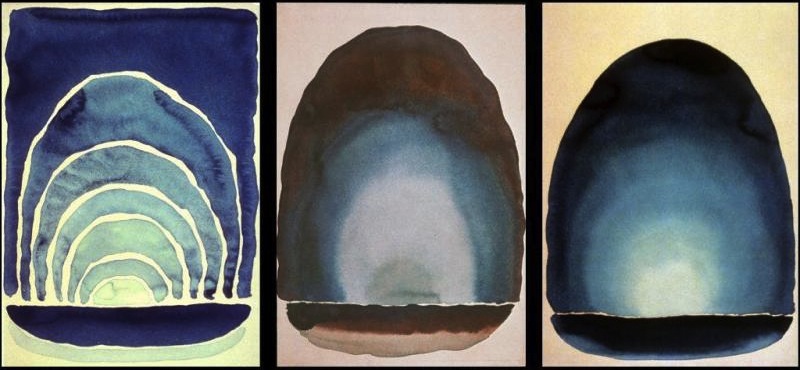
light-coming-on-the-plains-i-ii-and-iii
Fig. 1. Georgia O’Keeffe. Light Coming on the Plains, I, II and III, 1917, watercolor on paper (each 30.2 x 22.54), Amon Carter Museum, Fort Worth, Texas.

Her smoothly painted fields of swirling hues suggest a cosmic soup with the eternal potential of metamorphose. Her luminous patterns hold in suspension the fertile phase before light waves collapse into textured particles. Her brushwork has no need for Impressionist flicks that freeze fleeting instants. Instead of depicting momentarily reflecting surfaces, her sleek, luminous vistas unveil how energy shapes light itself. Even the shadows are not cast from an exterior light source. The art of O’Keeffe expresses the idea that creation is seen as a refraction of whiteness or visual emptiness. In this optic, forms are not drawn upon a blank background. The whole pictorial surface is sub-divided by bending light into colours to reveal its potential differentiation.

Although O’Keeffe feared that the strange, abstract patterns of her early works, or ‘Specials’, would seem incomprehensible and even foolish,[1] she asked her friend, Anita, to take a cardboard tube of them to Gallery ‘291’ in 1916. The moment Alfred Stieglitz unrolled her drawings he experienced the same sensation of awe as one does with Chinese landscape scrolls. The act of spreading them out is all part of their allure. The viewer is led to participate and explore new vistas by following the imaginary journey through their continually shifting perspective of voids and forms. Such parallels with O’Keeffe’s work are hardly farfetched since she had studied Sung Dynasty ink painting under Arthur Dow at Columbia University and her own work was clearly unlike that of any other Western artist.

Stieglitz recognized the worth of O’Keeffe’s art at once and insisted on exhibiting it. He foresaw that her drawings “would bring a greater awareness to all who saw them”.[2] He hung Blue Lines (1916) right over his desk at Gallery 291. This quiet little painting, minimal in every respect, simply juxtaposes a straight line and a bent one, both seemingly growing out of a pool of inky blue. Yet, it presents a binary option, I-Ching-like, that enables all further variations of expression to unfold. And, in O’Keeffe’s case, they soon do. Her works of the late 1910s Music: Blue and Green, Music: Pink and Blue (Fig. 2), and Evening Star correspondingly fan out, twist, and coil light in order to channel prismatic colour into liquidly, abstract linear forms.
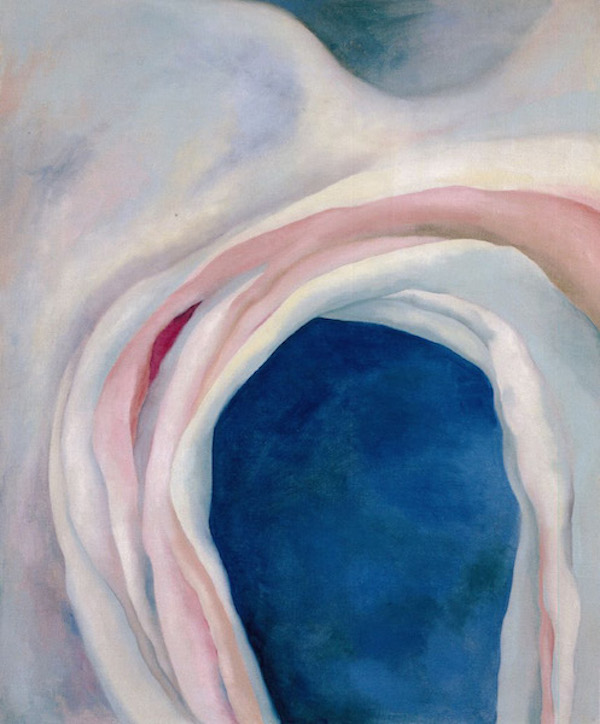
Fig. 2. Georgia O'Keeffe. Music – Pink and Blue, N°1, 1918, oil on canvas (88,9 x 73.7) Collection of Barney A Ebsworth, St. Louis, Missouri, partial and promised gift to Seattle Art Museum
Fig. 2. Georgia O’Keeffe. Music – Pink and Blue, N°1, 1918, oil on canvas (88,9 x 73.7), Collection of Barney A Ebsworth, St. Louis, Missouri, partial and promised gift to Seattle Art Museum

However, any reference to factorization in O’Keeffe’s art must not be considered as some variation of cubism, which fragments by multiplying the external viewpoints. Quite the opposite, O’Keeffe’s whole pictorial plane is factored, not fractured. Hers demonstrates the method of “dividing space in a beautiful way” developed by her art instructor at Columbia Teacher’s College, Arthur Dow. Furthermore, in contrast to the illusionist devices, which cubism still relied on, her depiction of depth through painted folds is always subordinated to the conscious presence of the unbroken surface. O’Keeffe’s picture plane can, thus, display the implied volumes without disguising the fictive nature of their individual materiality. In evoking forms through folds, her works emphasize a sort of creative play, toying with shapes as they unfold. All the while, it underlines the impermanence of all that appears to have been made and the fallacy of believing that any truly independent structure could be made. Her paintings suggest that she has bent space itself to enclose the volumes portrayed and upon closer scrutiny, they would simply sink back into the canvas’ undifferentiated surface.

This recalls the approach of paper-folding – Origami – whose immaculate sheets of white paper offer an ideal symbol of the primordial space and at the same time, when artfully creased, allow temporary forms to appear. Another aspect of Japanese art, that O’Keeffe adopted is Notan. It replaces chiaroscuro to balance areas of light and dark without designating a particular light source or rupturing the flat pictorial surface. In painting, Notan, thus, complements the illusion of folds. Dow had illustrated Notan in his manual, Composition, with the bold, graphic, floral patterns and elaborate draping of kimonos that respect the fabric’s intrinsic flatness. Is it a coincidence that in later life O’Keeffe wore only kimonos? She quite naturally introduced elegant pleats, creases and tucks in various objects of everyday life. She was an avid seamstress and even made her own undergarments. As a child, she had designed a portable dollhouse that that exploited the concept of unfolding volumes. In fact, Duchamp’s Valise (1935-1941)– that contains a display of his works folded up in a briefcase – was inspired by her dollhouse and that of her friend, Carrie Stettheimer, for whom he painted miniature copies of his works.[3]

O’Keeffe did not always wish to create an object of art or even a handicraft but simply render aesthetic whatever she came into contact with. This explains her Zen-like refinement and presence in every action even that of folding a dinner napkin. Her graceful gestures echo those of a Tea Ceremony Master. It is not surprising that Okakura Kakozo’s Book of Tea was a most treasured source of inspiration for her.[4] Stieglitz noticed the way she fondled things and often photographed her elegant long fingers. Graceful hands may also become a mudrâ, a Sanskrit term for a symbolic gestures in Buddhist images. O’Keeffe prominently displayed one such sculpture in her bedroom at Abiquiu – a Thai carving of a hand in the mudrã ‘Fear not’ – which she had received as a gift from art curator Henry Clifford. [5]

Indeed, there is nothing to fear as long as the ultimate emptiness of form itself and the impermanence of all creation are understood. O’Keeffe’s images are designed precisely to demonstrate this quintessential truth.[6] Through the contemplation of their beauty, they become a meditative act that epitomizes the ultimate vacuity of any subject matter portrayed. Her still lifes such as Calla Lily on Grey (1928; Fig. 3) tease the viewer by relaxing here and there their portrayed ‘solid’ objects into a fluid state of pure colour where tucks, pleats and curls express the underlying cataclysmic nature of all natural phenomenon.
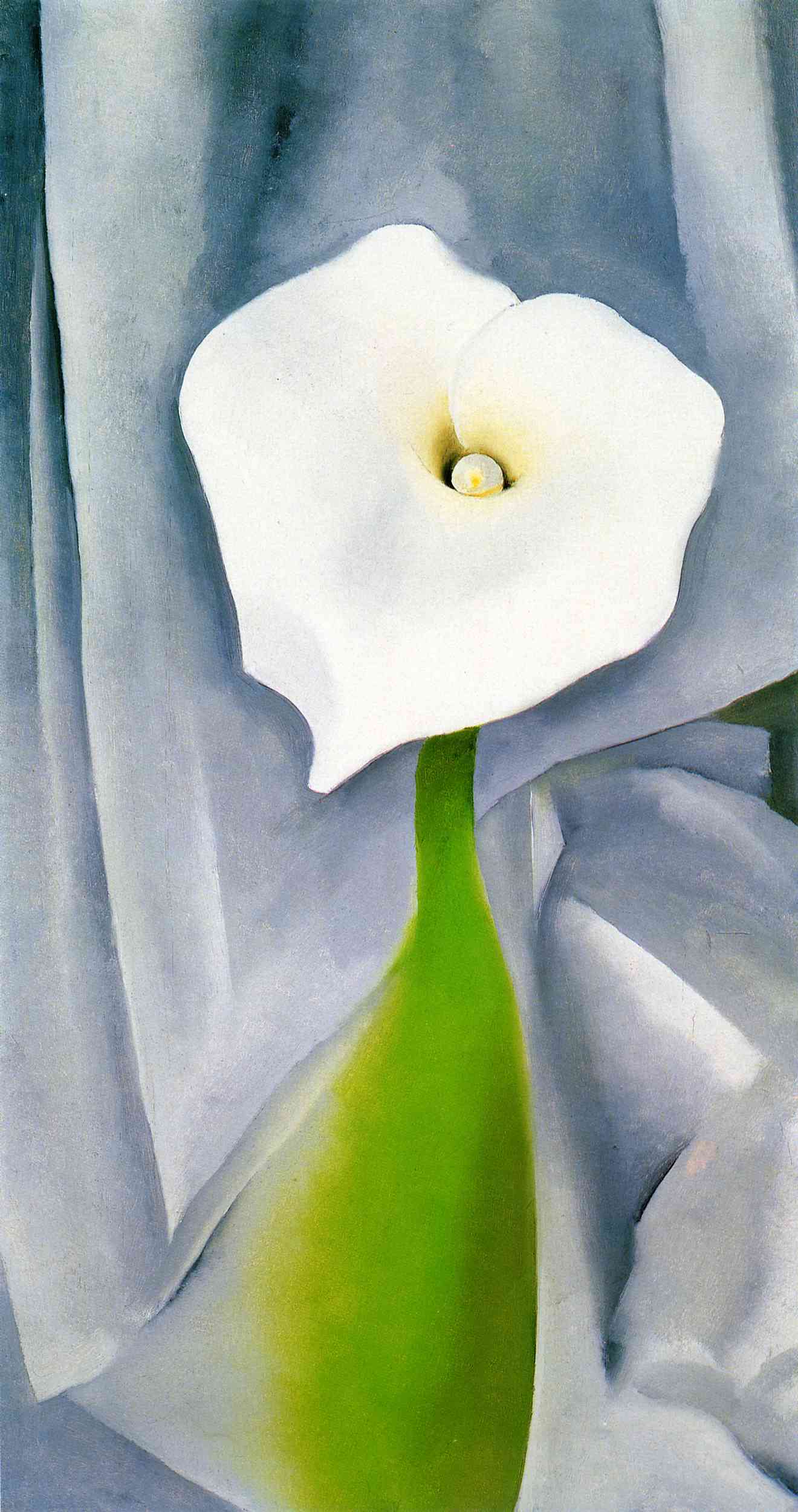
Fig. 3. Georgia O’Keefe. Calla Lily on Grey, 1928, oil on canvas (80.96 x 43.18), Museum of Fine Arts, Boston, Gift of the William H. Lane Foundation

What may be called substance never loses its malleable quality. In the same way, her New Mexican landscapes such as Black Mesa Landscape, New Mexico, Out back of Marie’s II (1930) depict mountainous folds buckling and smoothing out again and again over geological time.

Even her individual ‘portraits’ of plants and animals – clamshells, calla lilies, and snakes – are foremost defined by their organic hinges, folds and coiling as simply an on-going process rather than a separate entity.

In fact, a so-called individual form ‘unfolds’ when an expanse of space temporarily folds itself up. Just as the Mobius strip appears to turn inside out, yet has but one surface, the ultimate non-differentiated reality is able to model itself into an apparent existence. That is why authentic origami intentionally keeps the original sheet of paper intact. Both cutting and pasting are taboo.[7] O’Keeffe’s compositions have this same fundamental unity. This is what gives them such a different feeling from collage or trompe l’œil. They evoke the innate, primordial creative force that perpetually defines mountain valleys, ocean waves, river networks, leaves, flower buds and even shellfish by simply folding and unfolding itself.

When the viewer opens his eyes onto such wonder, he naturally repeats the same folding gesture with his own eyelids. It is as if the world has come into existence anew with his conscious regard. This recalls the celebrated phrase of O’Keeffe, “I think all the world has turned into what I’m seeing”.[8] It also alludes to her mystical motivation for painting: In graphically putting to paper her own vision, she alters ours. She makes our material world appear to dematerialize into her own harmonious compositions of coloured light.

Given that colour is simply white light bent through a prism, tinted folds naturally appear as the underlying subject of O’Keeffe’s more abstract art. Grey Line with Lavender and Yellow (1925), for example, depicts a few large, flat shapes, each of a different hue, overlapping or curling back to form a delicate, luminous composition. Blind I, Dark (1921), on the other hand, gives a haunting view of curves as obstructions. Hues and bends can compete with each other thereby emphasizing their interdependence. Abstraction (1926) fades the colours to emphasize the folds. Through this seemingly banal subject, O’Keeffe resolves the painterly question of adapting surfaces to reveal volumes with her origami-like facets instead of foreshortening.

While with Inside Red Canna (1919), she had taken the opposite approach by collapsing her voluminous figurative subject so that it could fit onto the two-dimensional canvas plane. In fact, Canna’s multi-layered, organic petals are reduced to completely flat, knife-edged pleats. The motif becomes a spectacular fan-shaped blossom that recalls the Sri Yantra. Other more realistic flower paintings by O’Keeffe portray naturally folded forms – from sprouting stems to curling petals – with refined sweeps of parabolic curves. In Skunk Cabbage (1928), she brings the viewer right up into the folds of her enveloping subject by placing the vanishing point outside the canvas. Flowers Abstraction (1924) makes an elaborate study of intertwining petals edged in orange whereas Abstraction, White (1927) focuses on a close-up of two, colourless folds. Abstraction, White Rose of the same year expresses the flower’s heart as a bursting array of whorls.
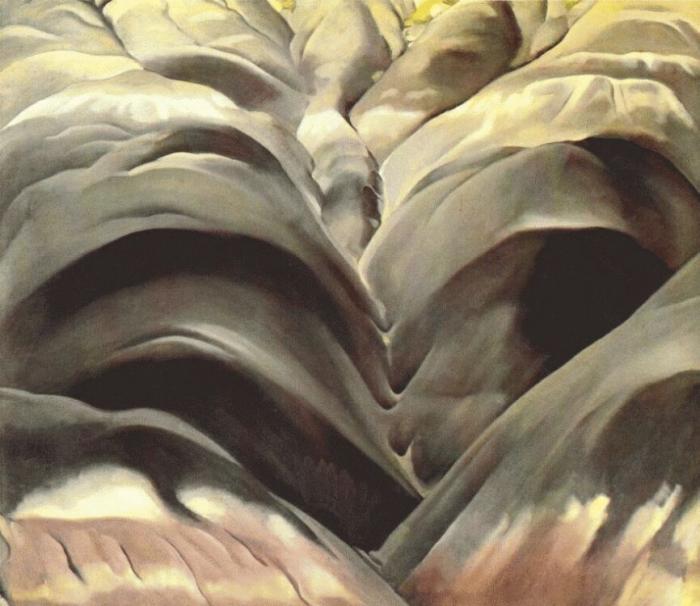
Fig. 4. Georgia O'Keefe. Black Place - I, 1944, oil on canvas (66 x 76,5) San Francisco Museum of Modern Art, Gift of Charlotte Mack
Fig. 4. Georgia O’Keefe. Black Place – I, 1944, oil on canvas (66 x 76,5)
San Francisco Museum of Modern Art, Gift of Charlotte Mack

Not only close-up flowers but also far-away landscapes appear to be folding and unfolding. O’Keeffe’s seascape, Night Wave (1928) gives the movement of an entire ocean with one solitary wave lapping against the shore. She seems to alternate between intricate and streamlined compositions in order to recall the reversibility of folds and of form itself. In Black Place – I (1944; Fig. 4), O’Keeffe suggests the textures of valleys as ‘crumpled’ and of mountains as ‘buckled’ by varying the angle and frequency at which folds appear.

One of the most curious subjects is from a later series, Untitled (Sacsayhuaman) (1956). It looks like a flattened sheet of paper showing traces of previous creases. Folds everywhere even unfolded and smoothed out become a memory of past forms just as facial wrinkles and palm reading trace an individual’s unique history. In old age, O’Keeffe bore proudly her own wrinkled visage that had been weathered by New Mexico’s desert sun.

After the death of Stieglitz, Georgia traveled all around the world. Her 1950s landscapes were sketched from an airplane window as if she was reflecting back upon her memories of life on earth, isolating the essential. Their flattened, birds-eye views, tracing only a few bends and turns, clearly suggest rivers or roads. Brian Dijkstra in Georgia O’Keeffe and the Eros of Place, found that: “O’Keeffe’s paintings illuminate and celebrate the eerie beauty of the silences that fold themselves into nature’s ability to overcome the closely guarded distances between our selfhood and what is Other”.[9]

In viewing O’Keeffe’s far-away and close-up perspectives, which she often wittingly juxtaposed in the same painting, we start to feel grand – not in the sense of dominating our environment but in the sense of surpassing our own limited self. Just as with the Mobius strip, the outer and inner appear to be interchangeable. Her vision makes us open up. For Eldredge, her paintings provoke “a universal sensation of joyful release into another world”.[10]

The metaphor of folds can be taken even further when interpreted, as ‘mind-bending’. This applies to the particular way that O’Keeffe paints which obliges the viewer to consciously participate in the process of regarding a painting. We become aware of that fact that what we think we see is, in reality, something else. This, in turn, encourages us to regard our own mind in a new way. Fisher recognized such an effect at O’Keeffe’s very first solo show as his critique in Camera Work of 1917 explains:

And it is in so communing that the consciousness comes that one’s self is other than oneself, is something larger, something almost tangibly universal, since it is en rapport with a wholeness in which one’s separateness is, for the time, lost. Some such consciousness, it seems to me, is active in the mystic and musical drawings of Georgia O’Keeffe … strongly appealing to that apparently unanalyzable sensitivity in us through which we feel the grandeur and sublimity of life.[11]

In regarding O’Keeffe’s art as spiritual, it becomes clear that she accentuates her motifs of folds to express the most profound realities. There is a sort of vibrating energy between the light and dark zones provoked not by shadows but by the event of a natural landscape continuously unfolding. This energy can also be seen through O’Keeffe’s flower paintings. Black and Purple Petunias (1925) seem to be ‘peeling’ apart their individual petals in order to blossom right before our eyes. One viewer at O’Keeffe’s exhibition of 1925 understood their profound meaning as:

The essential truth … the drama of life working itself out there among the petals … it is the universe we are looking at, it isn’t it? Whatever the object may be that catches our eye if we look into things rather than at them … You take a seed … and unroll the Cosmos out of it.[12]

The folds in O’Keeffe’s abstract flowers loop back upon themselves. In this way, they reconnect the interior of a simple bud with the entire universe. They trace the ultimate fold, which turns infinite space itself perpetually inside out. Her more concretized forms, on the contrary, must sustain the repercussions of folding and unfolding space. The art of O’Keeffe, whether abstract or realist, is unique in that it has found the delicate balance between manifestation and nothingness. She, thus, demonstrates how the mystical becomes visible on earth. In order to achieve this, she based her view of nature, and of all reality, on the syncopated swings between forms and intervals of space as if she sought to demonstrate the Buddhist mantra from the Heart Sutra: “Form is emptiness, emptiness is form”.

In this optic, O’Keeffe’s work admirably fits Ansel Adams’ definition of art as “… the turning out to the light the inner folds of the awareness of the spirit”.[13] Her paintings of radiant flowers, hills and abstract forms in folds engender a vision of the Beyond made visible. Adams declared, in reference to her own particular art, that “Nobody can look at a painting without being deeply affected. So the mystique begins and endures”.[14] He is far from being the only one who understood the spiritual nature of her art. Sara Whitaker Peters in The Early Years: Becoming O’Keeffe went even further: “I now that O’Keeffe was a visionary Symbolist artist whose central concern was to cure people’s minds and bodies with her paintings. And this is why she would not (or could not) divulge what she did”.[15]  Furthermore, Barbara Rose has claimed for many years that O’Keeffe is a maverick mystic and a Later-day Emersonian.[16]

O’Keeffe’s connection with Transcendentalism can be better understood in recalling that when Emerson insisted on ‘the bended horizon’ (Journal V, 46)[17], he had recognized the deep spiritual connotations with regards to the angle of one’s viewpoint. He, thus, proposed that everyone envision himself as ‘a transparent eyeball'[18] in order to “discover that Within and Above are synonymous” (Journal III, 399).[19] He took his inspiration for the ‘Oversoul’ from the absolute, all-enfolding Consciousness described in the Upanishads as the ‘Divine Ground’ from which all things emanate and to which all living things may hope to return. Another Transcendentalist, Walt Whitman, in Autumn Rivulets, personifies this ‘Divine Ground’ in the form of a woman whose folds are the matrix of all creation: “Unfolded out of the folds of the woman man comes unfolded, and is always to come unfolded”.[20] The sensuous forms, in O’Keeffe’s paintings, enveloping hidden cavities – too easily explained as representing a woman’s desire to have a child – actually recall this poem from Leaves of Grass.

The idea of folds in association with O’Keeffe’s art has cropped up again and again in both her colleagues’ and art historians’ commentary. In 1922, Rosenfeld re-evaluated such a metaphor for the folds in her images: “Shapes as tender and sensitive as trembling lips, seem slowly, ecstatically to unfold before the eye. It is as though one had been given to see the mysterious parting movement of petals under the rays of sudden fierce heat or the scarcely perceptible twist of a leaf in a breath of air”.[21]

Through folds, O’Keeffe managed to symbolize all creation in a single rose. This brings out the underlying wave-like patterns that characterize each motif which, in turn, echo the undulations that transmit all light, sound and rays of energy along the electromagnetic spec[tr]a. This is why O’Keeffe’s paintings often seem musical or charged with electricity like with Ballet Skirt or Electric Light (1927). Moreover, for Rosenfeld, O’Keeffe’s knife-edged creases and fluid undulations in Blue and Green Music (1919) go much deeper, reaching that:

Dim region where human and animal and plant are One, indistinguishable, and where the state of existence is blind pressure and dumb unfolding. There are spots in this work wherein the artist seems to bring before one the outline of a whole universe, an entire course of life, mysterious cycles of birth and reproduction and death, expressed through the terms of a woman’s body.[22]

Unfortunately, the folds in the works of O’Keeffe were quickly dismissed by other art historians as simply symbols of feminine genitals. Her flowers became identified as the folds or undulations of a vulva. Even Judy Chicago’s porcelain plates from The Dinner Party (1970s) portray O’Keeffe as such.[23] There is no point in denying that many of her paintings of oysters or clams do emphasize puckering clefts of symmetric shells with mysterious interiors of dark, opaque emptiness. Yet, they evoke more than an equivalent of female sexuality. Such shapes call forth not only early forms of life on this earth, but also early forms of the earth itself. Her uterine landscapes and abstracts insist on the materiality of Mother Earth. Folds being naturally organic render all subjects biomorphic and fertile, bursting out into ever-new forms – a style quite distinct from the cerebral, geometric abstraction favoured by most European artists. They represent something quite abstract and powerful in their inert energy, which is at the same time full of potential evolution. Their imminent unfolding is inevitable.

However, at the same time, O’Keeffe’s pictures seem to demonstrate that that all forms and colours are just a mirage. They recall the importance Carl Jung gave to never losing sight of the form’s underlying clear light, which is the ultimate reality. In her treasured book on alchemy, The Secret of the Golden Flower, Jung tells the follower to not forget that although “every separate thought takes shape and becomes visible colour and form, the total spiritual power unfolds its trace and transforms itself into emptiness”.[24] This corresponds to an Eastern mystical component. O’Keeffe achieved such glowing, back-lit luminosity by delimiting coloured shapes and simply leaving areas of bare, white paper or sized canvas around them to better outline their natural boundaries. She composes, thus, like for music with intervals of silence or space. That being said, her borders are rarely softened; all is in sharp focus. Yet the forms never stick out. The white spaces serve to show that forms are not solid but just diaphanous images like those of a film projected on a screen. Colours are after all simply bent light that, thanks to a prismatic effect, becomes spectral.

Just as Origami translates this phenomenon of folds into sculpture, O’Keeffe’s painting does so with pigment. As Jack Cowart so aptly put it, “O’Keeffe wrapped colour around the ethereal”.[25] When critiques sense her ‘photographic influence’ they may actually be trying to explain the primordial presence of white light in all her works just as this article’s insistence on folds underlines that O’Keeffe’s colours are always presented as refracted light rays. As her colleague, Charles Dumuth, said of her palette: “Each colour almost regains the fun it must have felt within itself on forming the first rainbow”.[26]

This has deep spiritual significance. Manifestation is simply play or Lila. Emptiness in a picture – whether blank spaces or translucent tints – lets the light circulate and breathe. If not, the space is smothered and the fundamental unity is forgotten. All shapes, after all, are simply temporary displays made by turning space inside out. It is in this light that O’Keeffe paints folds.

O’Keeffe was always careful to deny the three-dimensional solidity for her forms. Her apparently illogical maze of flower petals and tilted pelvis cavities elicit a more abstract space – at once interior and exterior. O’Keeffe thus finds the delicate balance along ‘the razor’s edge’ determining the particular while maintaining awareness of the whole. Her motifs have no contours. Their edges, albeit often very sharp, do not cut shapes out of the background. They are themselves the ridges and troughs of each other. They can even loop back on themselves so that when the viewer follows their borders, he never arrives at a whole circle but finds twists and turns that render interior and exterior space one.[27] The edge, in this way, negates the very form it outlines. With O’Keeffe, the whole, or entire canvas, is truly divided in a beautiful way without ever breaking its innate unity.

Her approach brings to mind an article in Camera Work which redefined the role of the artist as that of literally unravelling or reversing the process of creation: “translating with brush or chisel all things back to their private original glamour with the witchcraft of this holy pagan innocence unwinding the cords of complexity … wound round and round the Holy Ghost of Beauty”.[28] The Stieglitz circle developed Straight Photography and abstract painting to reveal this primitive force. As O’Keeffe’s colleague, Arthur Dove, insisted, one must depict not form but formation. It is not the object but the act of creation or unfolding that counts.

What is more, O’Keeffe’s folds do not just suggest the known forms of the universe; she creates her own private universe of forms to show us how illusions manifest in our minds. For example, her creases delicately trace a ‘hard edge’. Such wrinkles symbolize all potential deformations of space. At the same time they point to the smooth, underlying continuity. This recalls O’Keeffe’s comment about her paintings of sun-bleached bones against the sky: “The blue that will always be there as it is now after all man’s destruction is finished”. As with Pelvis II (1944), all of her paintings transcend their immediate themes to become universal reminders of Wholeness.

This delicate balance between such a two-fold reality is explained from a Theoretical Physics point of view by David Bohm whose central theory is fittingly called ‘Enfolded order’. Bohm believes that forms ‘explicate’ themselves similarly from the Universe as a whole, and then ‘fold back in again’ only to re-emerge again, in ceaseless succession.[29] O’Keeffe’s folds illustrate the illusion of form itself, thus, shattering the normal vision in traditional Western art known as Alberti’s window. Her series of Sky Above the Clouds in the 1960s even reverse normal linear perspective so as to make the vanishing point fall upon the viewer standing a meter or so away from the canvas. In this way, it seems as if the pictorial space tips horizontally to form a flat shelf-like area spreading out before one’s eyes.

When almost blind, O’Keeffe painted a final canvas, The Beyond (1972), which explores a whole new dimension. It unrolls the horizon evenly along the entire width of the canvas. No longer following any vanishing point, the vista revealed seems to suggest a field of vision of 360 degrees simultaneously. In eliminating all refraction, blackness invades the foreground yet a line of luminous whiteness traces a suspended horizon against the boundless blue sky. O’Keeffe shows the viewer that all folds, all phenomena and lives themselves are fleeting ripples on the surface of infinite openness.

Acknowledgements: This paper has never been presented or published before;

Posted on Alpheus web site on July 24, 2016;

Deborah Jenner, Ph.D. is a lecturer in Art History at the Sorbonne in Paris, France. 

jennerdeborah@yahoo.fr

Notes

[1] Robert M Cortes, ‘Profiles – Abstraction – Flowers’, The New Yorker, July 6, 1929, pp. 21–24 21

[2] Sara Whitaker Peters, The Early Years – Becoming O’Keeffe, Abbeville Press, New York, 1991. p. 27

[3] O’Keeffe and Duchamp were regulars at the Stettheimer sisters’ salons. Carrie’s dollhouse is on permanent display at the Museum of the City of New York.

See : http://brbl-archive.library.yale.edu/exhibitions/cvvpw/gallery/stetthe2.html

[4] Okakura Kakuzo, student and then colleague of Ernest Fenollosa in Japan, became curator in the Asian Arts department of the Boston Museum of Fine Arts in 1904. Dow’s 1913 edition of Composition, praised his work, The Book of Tea (1906).

[5] Eldredge, The Georgia O’Keeffe Museum catalogue. New Mexico, 1995. p. 101

[6] Buisson, Manuel pratique d’origami (Practical Manual of Origami), Celiv, Paris, 1990. pp. 103–4

[7] Ibid. p.138

[8] Sharyn Udall, O’Keeffe and Texas, The Marion Koogler McNay Art Museum, San Antonio, Texas, 1998. p. 26

[9] Brian Dijkstra, Georgia O’Keeffe and the Eros of Place, Princeton University Press, New Jersey, 1998. p. 6

[10] Charles Eldredge, catalogue. p. 16

[11] William Murrell Fisher, ‘The Georgia O’Keeffe Drawings and Paintings at ‘291’’, Camera Work 49–50, June 1917. p. 5

[12] Charles Eldredge, Georgia O’Keeffe: American and Modern, Yale University Press, National Gallery of Art, Washington DC, 1993. 1 p. 75 (Letter from Albert Blohm to O’Keeffe, Yankers, New York, April 4, 1925) (Yale)

[13] Roger Lipsey, An Art of Our Own: The Spiritual in Modern Art, Shambhala, Boston, 1988. p. 393

[14] Jan Garden Castro, The Art & Life of Georgia O’Keeffe, Crown Publishers, New York, 1985. p. 135

[15 ] Peters, Op. Cit. p.12

[16] Katherine Hoffmann, An Enduring Spirit: The Art of Georgia O’Keeffe, Scarecrow Press, London, 1984. p.84 (O’Keeffe Trail, New York Review of Books, March 31, 1977)

[17] Sherman Paul, Emerson’s Angle of Vision: Man & Nature in American Experiences, Harvard University Press, Cambridge, Massachusetts, 1952. p.76–78. Citing Emerson’s Journal, Paul gives a detailed analysis of how Emerson’s ‘transparent eyeball’ whose motifs become “chromatic entities, without resistance, mass or convexity”. This study on O’Keeffe shows that such a vision can be suggested in a painting through certain plastic means such as avoiding that which solidifies forms (i.e. a vanishing point and shadows) with smoothly-blending multiple, atmospheric perspectives and that which renders opacity (i.e. chiaroscuro, heavy brushwork and effects of reflection) by keeping colours translucent and tones pure.

[18] Ralph Waldo Emerson, ‘Nature,’ Selected Essays, Penguin Classics, New York, 1982. p. 39

[19] Ibid. pp. 34–35

[20] Emory Hollaway (Editor), Walt Whitman – Complete Poetry and Selected Prose and Letters, Bodley Head, Random House, 1978. pp. 356–57

[21] Paul Rosenfeld, ‘The Paintings of Georgia O’Keeffe – The Work of the Young Artist,’ Vanity Fair, Oct. 1922. pp. 56, 114

[22] Ibid., 56

[23] Judy Chicago, Through the Flower: My Struggle as a Woman Artist, Anchor Books, Doubleday, New York, 1977 pp. 141–43

[24] Richard Wilhelm (translator), The Secret of the Golden Flower – A Chinese Book of Life (with commentary by Carl Jung) A Harvest Book, Harcourt Brace & Company, San Diego 1931 (1962). p.108

[25] Jack Cowart, & Juan Hamilton, Georgia O’Keeffe Art and Letters, National Gallery of Art, Washington DC, 1987. p.4

[26] Eldredge, Georgia O’Keeffe: American and Modern, Yale University Press, National Gallery of Art, Washington DC, 1993 p.165 (citation of ‘Paints’ 1926 Intimate Gallery 1927 n.p. Statement)

[27] Allan Watts, The Book: On the Taboo Against Knowing Who You Are, Collier Books, New York 1966. p13. Alan W. Watts, a student of Suzuki, explains: “God has no skin and no shape because there isn’t any outside to him. (With a sufficiently intelligent child, I illustrate this with a Mobius strip – a ring of paper tape twisted once in such a way that it has only one side and one edge.) The inside and the outside of God are the same.”

[28] Benjamin Decasseres, ‘Rodin and the Eternality of the Pegan Soul’, Camera Work, no. 34 April 1911. pp.13–4

[29] ‘The New Scientist Interviews David Bohm,’ New Scientist, 96, no. 1331, November 11, 1982. pp.361–65. http://www.robert-temple.com/articles/NewScientist_DBohm.pdf

By Way of Husserl: A Phenomenology of Duchampian Art

Introduction.

This paper is about the French painter and conceptual artist Marcel Duchamp, who created a series of very influential conceptual event-objects. In the beginning of the twentieth century he shocked and revolutionized the artworld. He did so with art objects trying to capture the phenomenon of motion and with already fabricated, found objects, called readymades, with which he poked and broke through the boundaries of what even the avant-garde in his days accepted as art. His influence was wide and enduring. New York Dada, Surrealism, installation art, Pop Art and conceptual art were all movements in which the contours of his shadow could be recognized even to the extent that one can study now a wide-ranging Duchamp Effect and study how, when and why that came about.

This paper will not focus on the Duchamp effect but on the Duchamp cause as a necessary ingredient of understanding Duchamp’s influence throughout the twentieth century and beyond. Therefore, if the question at hand is: “Is there a Duchamp Effect?”, then a really rigorous answer to that question will first have to establish what we mean with the idea “Duchamp Effect” by looking at the “Duchamp Cause”. In other words, and this will be my specific research question, what was it precisely that Duchamp did with, through, for and against art, such that we can then recognize and assess how other artists, both with and after him, could appropriate and expand on his innovations and how other writers could develop reasonable or unreasonable re-interpretations and critiques of his gestures.

Because of some training in phenomenological methodology obtained during a previous stint of classes which I took ten years ago at Northern Illinois University under the Heidegger expert Dr. Theodore Kisiel, I could quite easily see, not only that Duchamp’s radical experiments with art could be better understood from within the phenomenological framework, but also that Duchamp himself was applying, in an implicit, spontaneous manner, the very same tools which underlie phenomenology. After refreshing myself with some of the basic readings in phenomenology, especially regarding aesthetics, I could easily see the fruitfulness of letting Duchamp and phenomenology interact. On that basis I can formulate an initial answer to my research question, which is as follows:

In his artistic accomplishments Duchamp applied in a naïve, non-formal manner several techniques explicitly developed by the German philosopher and founder of the phenomenological school of philosophy Edmund Husserl. Duchamp did this especially through a) the ‘bracketing’ or ‘suspension’ of hitherto unquestioned assumptions regarding art (epoché) and b) by the application of ‘imaginative free variation’ (eidetic reduction) on many explicit and implicit aspects of art. These non-formal techniques enabled Duchamp to a) radically question the assumptions underlying the phenomenon art; and b) thereby opening up new possibilities how art can be re-conceptualized and executed. Besides that, a further deepening of the answer might be accomplished by a phenomenological interpretation of the inter-subjective phenomenon ‘artworld’.

During my second literature search for relevant sources regarding philosophical interpretations of Duchamp and phenomenological sources helpful in evaluating Duchamp from within that framework, I found a Master of Arts thesis by Alice Thorson titled “Marcel Duchamp: a phenomenological approach to art”, which was, of all places, submitted and approved at The School of Art at Northern Illinois University in 1981, the very same department I was taking a class on Duchamp for which I wrote this paper.[1]

After a careful reading I have to admit that the study is quite illuminating, thorough and basically trumps my own investigation. The structure of my paper will therefore be slightly different in that it will present Thorson’s findings, which I will try to test by some investigations of my own which she did not execute. Fortunately the volume of Duchamp’s artistic accomplishments, gestures, writings and interviews is extensive enough to execute the above intention. But before that we need a little outline of Husserl’s phenomenology, specially those features which will be relevant to the phenomenon art.

I. Phenomenology: epoché, eidetics, life-world

In this section I will present a somewhat skeletal overview of at least three basic phenomenological ideas, the first two of which–the epoché and eidetics–are better understood as philosophical techniques or procedures rather than ontological conclusions regarding fundamental features of reality. The third idea–the life-world–is about our experience of reality and, again, not about reality itself. As much as possible I will try to bring in the experience of art objects and of beauty into the discussion to clarify the ideas and create some initial understanding relevant to discussions later in the paper. Because Husserl’s ideas are all intimately and structurally interconnected, even define each other, it will be hard to keep his ideas in neat little boxes and not bring into play other fundamental Husserlian ideas like intentionality and intersubjectivity.

Epoché

The epoché is a subtle gestalt-switch in our perception of reality, going from our natural, naïve, quotidian attitude about life and art, to a “suspension” or “bracketing” of this attitude. And not only our quotidian attitude is put out of play, but also any and all–or at least initially, most of–scientific, religious and metaphysical explanations. The idea is to come to a direct consideration of our experiences from within such experiences and bring new observations to language with the help of a vocabulary most appropriate to experience, without the help of constructs which come from outside. The idea is that we cease to look at the givens of life as if they are readymade and come from the outside, but that their existence is correlated with the manner in which we ourselves, in a mostly hidden subjective accomplishment, constitute them.

The experience of an art object and the experience of beauty are not merely coming from outside ourselves but also have an active, intentional component which lies in our own subjective nature such that there is a congruency between the intentional perceiving act and the intended object as perceived. We are not passive blank slates upon which art objects, through the senses, can imprint their existence and beauty. We are active participants in the molding of such experiences by intending art objects as such and experience beauty (or the lack of it) as such. Or, as John Brough, from whom we will hear more later, expresses it. “In the epoché, then, the phenomenologist is no longer focused on the work of art as an object ‘in itself,’ but on how the work of art presents itself as a work of art in experience”. This attitude, or transcendental view, will “make possible the understanding of the subjectivity that functions anonymously in the natural attitude . . . ” (Brough, 1970, 29-30; italics in original; bold added).

If this point is grasped, one can see Husserl’s basic idea of the intentional structure of consciousness: consciousness is being conscious of–through a certain act–an intended object and is a process which goes through a few phases. Note that we might intend certain art objects as initially beautiful, but find ourselves frustrated in its fulfillment and might find the object actually ugly. This is because the dynamic aspect of intentional experience has the structural sequence of going from a) empty intending, to b) fulfilled intuiting, to c) relative stable identity over a certain time-span. For example, I might emptily intend something in the dark as a snake, but then cannot bring the intention to a fulfilled intuition of what I initially constitute as a snake, because it actually is a rope. This means I switched from the frustrated fulfillment of snake to emptily intending rope, and having that intention fulfilled such that a relative stable identity of rope is constituted. Such switches happen all the time in our experience of reality, but we are mostly not aware of the underlying mechanics.[2]

This point is of importance because a deeper understanding of Duchamp’s gestures might hinge on a correct understanding of the structure and dynamics of consciousness as investigated by Husserl and how Duchamp calibrates, inverts and even subverts these mechanics.

In short, the epoché is a subtle switch in attitude by which quotidian, scientific, religious and metaphysical explanations of experience and the manner in which they shape experience are set aside in order to make room for a more direct, careful exploration of experience from inside-out through which subsequently the intentional structure of consciousness can be discovered. In this manner many taken-for-granted claims about life and art become questionable, but also open to investigation as contingent accomplishments of human consciousness itself.

Eidetics

Eidetics, or the eidetic reduction, is a Husserlian technique to tease out the essence or eidos of a phenomenon by varying any and all aspects in one’s imagination and find out which aspects are, and which aspects are not, the sine qua non of both the experienced object and the experience of it. The procedure is also known as ‘imaginative free variation’ by which one can distinguish between ‘essential moments’ and ‘contingent parts’ of the phenomenon investigated. For example, one could wonder if the opening and the stem of a glass are essential or contingent elements of a glass. Through one’s imagination one can quickly figure out that a glass without stem can still function as a glass, but a glass without an opening not. Therefore, in phenomenologese, the stem is a contingent part and the opening an essential moment.

Applied to art, the procedure of imaginative free variation would try to vary any and all of its aspects and see which are necessary components and which ones one could ‘drop’ as contingent. Here one could dwell on the ‘obvious’ example that an art object does not have to be beautiful and that beauty does not necessarily reside only in art objects. Because one can vary art objects as having beauty or not, beauty is a contingent part of art. And because one can vary beauty as residing in an art object or in nature, an art object is therefore a contingent aspect of beauty. Note that, though the example seems self-evident and not necessarily in need of clarification, one is able to explain its truth by way of applying imaginative free variation to sort out essence from contingency. Here again I like to stress the idea that Duchamp’s variations on art can be made more understandable if one grasps the technique of ‘imaginative free variation’, because it provisionally looks like that Duchamp, through his very imaginative variations, brought to consciousness many a hidden aspect of art of which the artworld was barely conscious and then showed either their necessity or non-essential nature, or at least made them questionable.

The life-world

The third Husserlian idea to put in place is the idea of life-world. The best way to introduce this idea is by way of an illuminating article by continental philosopher John Barnett Brough, titled “Art and Artworld: Some Ideas for a Husserlian Aesthetic”, in which he re-interprets, with the help of Husserl’s phenomenological idea of life-world, the institutional theory of art as developed by analytic philosopher of art George Dickie.[3]

Brough agrees with Dickie that works of art are not natural objects with intrinsic properties but are artifacts which have to attain the status of art object within the complex context of the values and practices of the artworld, a world comprised of artists, art critics, dealers, collectors, curators and the interested public. It is these people in their local or internationalized scenes which share and transmit the for-the-time-being acceptable answers to the questions of what art is, how it is presented and what might be said about it. Brough diverts from Dickie in calibrating the idea of ‘institutional’ by downplaying its organizational aspect and up-playing the idea of a shared, but not institutionalized “cultural practice”. Brough, formulating in Husserlian terms the necessary and sufficient possibility conditions for art to be, states that

. . . a cultural object can arise and can present itself as a cultural object . . . only within a particular world in which those creating the object and those to whom the object is presented form a community of praxis bound by a common goal. . . . The artworld as the cultural horizon “within which, for the individual, possible ways of understanding this culture are present” serves as the necessary and sufficient condition for the presentation of artifacts as works of art (Brough 1988, 36; Italics in original; bold added; quoting from Husserl, 1970).

Other aspects which Brough highlights in his article are the ideas that a) all people comprising the artworld fulfill different roles or vocations which both contribute to the constitution of this artworld and take the artworld as his or her given context; b) the artworld is really a communal, intersubjective creation in which each actor plays a partial role within the role of the whole community, however romantic individualistic or indifferently detached an actor might be. As Brough states, the artworld is a “nexus of individual subjects unified in a single cultural praxis” and is “a total, many-leveled intentional accomplishment of intersubjectivity” (Brough 1988, 37). And c) that the artworld is a thoroughly historical world in the sense that it is a mosaic unity of traditions which includes its entire cultural past and which unity provides the horizon within which innovations are possible, including the limit-seeking and -breaking innovative gestures by Duchamp.

II. Earlier phenomenological study of Duchamp

In the abstract of Alice Thorson’s MA thesis one can read that “[a]lthough interpretations of Duchamp and his works are many and varied, his ideas have yet to be considered in relation to those of phenomenology, the philosophical movement with which his development coincides, both chronologically and foundationally” (Thorson, 1981; hereafter AT). In this section I will present what seem to be Thorson’s main findings, which, with the help of the groundwork done in the previous section, should not be too arduous. Her findings come under four headings. First, she sees a direct connection between Duchamp and Symbolism as both were battling naturalistic presuppositions in aesthetics, which struggle went parallel with Husserl’s own struggle with naturalism in philosophy. Second, she makes the case that Duchamp and Husserl went through a similar sequence of four phases in their development. Third, she found in Duchamp’s life and work “a number of strikingly phenomenological elements” (AT, Abstract), three of which (eidetics, intentionality, non-dualism) she found important. And fourth, regarding Duchamp’s legacy, she states quite boldly that later artists “would instinctively recognize the importance of Duchamp’s phenomenological investigations, and in retrospect, Duchamp’s contributions become unified under the heading of a phenomenological approach to art” (AT, Abstract). In this section I will focus on the second and third headings, i.e. the parallel development between Duchamp and Husserl and Duchamp’s own non-formal phenomenological investigations.

Developmental parallels

Though I quickly perceived the non-formal phenomenological aspects of Duchamp’s work and was very glad to find Thorson’s study, I was initially quite skeptical about her claims about the developmental parallels between Husserl and Duchamp. After all, one is an artist and the other a philosopher working in entirely different media and I have not found the slightest indication of any direct or indirect influence on Duchamp by the work of the older Husserl.[4]

But after rereading her arguments and contemplating that both reacted to similar naturalist positions and ended up doing similar investigations, it could even be argued that the parallel between the two was necessarily based in the bare logic of the phenomena themselves with which they were dealing, regardless of the difference in media through which they worked. But this point might only become established after a thorough familiarization with the developmental arc of both innovators.

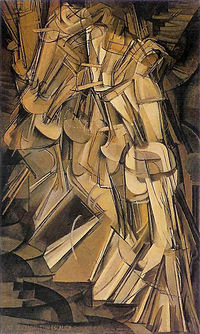
Returning to Thorson, she named the four parallel phases 1) Experiment, 2) Reintegration, 3) Transcendence, and 4) Return. The first phase was one of experiment and struggle, but maybe could have been better named refutation and rejection. Husserl’s first important development took place in his refutation of psychologism, which was an attempt at explaining logic by way of a naturalist psychology. Duchamp, after having created Nude Descending a Staircase, No. 2 (Fig. 1), arguably a cubist masterwork, rejects cubism, a style still harboring vestiges of naturalism. In this struggle against naturalism Thorson also detects a struggle against dualism.

Duchamp_-_Nude_Descending_a_Staircase
Fig. 1. Duchamp, Marcel. Nude Descending a Staircase (No. 2). 1912. Philadelphia Museum of Art

In the second phase Thorson sees a parallel between Husserl’s finding of the phenomenological reduction, the epoché, and Duchamp’s intention to “reduce, reduce, reduce …” (Duchamp quoted in AT, 98) his work from any concrete elements which resulted in what Thorson coins his short “mechanomorphic style” (AT, 91) and the presentation of the readymade. About the readymades she stated that its “effect of dispelling accepted preconceptions in art paralleled the effects of Husserl’s epoché in philosophy” (AT, 95). This is because both are quite radical switches from taking the world and art as merely given to the realization that there is a formative subjective component which might be more important in shaping our experience than previously acknowledged. This is the intentional structure of consciousness, which, because of the interaction and correlation between subject and object, is a step in overcoming dualism.

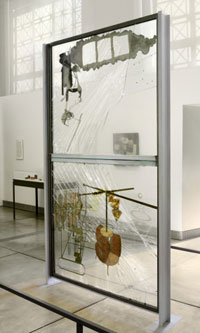
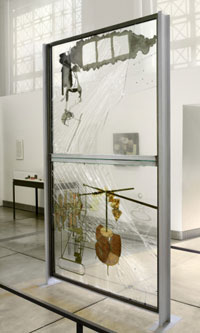
In the third phase the parallel is between on one side Husserl’s development of the eidetic reduction, i.e. the method to find essential structures and meanings through imaginative free variation, and on the other side Duchamp’s attempts to subjugate art to idea, which he very much realized in Large Glass (Fig. 2). As ideal meanings transcend their particular instantiations, so do the ideal elements in Large Glass resist identification with “empirical particulars” (AT, 98).

1952-98-1v1-pma
Fig. 2. Duchamp, Marcel. The Bride Stripped Bare by Her Bachelors, Even (The Large Glass). 1913-1925. Philadelphia Museum of Art

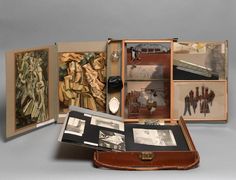
The last parallel, and this one clinched it for me, is about the return from the transcendental world of ideal meanings to the world as lived, the mundane world of everyday experiences, which after all, is the basis for any and all abstractions and idealizations we can construct. Maybe stirred by Martin Heidegger’s existential-phenomenological characterization of man’s Dasein as being-in-the-world (Heidegger, 1962)–that is, a part of man’s essence is the concrete situational ‘here/there’ of his world from which he cannot extract himself except in an imaginary way through mental abstraction–Husserl wrote a major analysis of the idea that in the end all our activities, even when oriented towards ideal meanings, scientific laws or philosophical necessities, they are all rooted within his or her communally constituted, intersubjective, thoroughly historical life-world (Husserl, 1970). Though Thorson under-presents Husserl’s idea of the life-world, she does develop how this return worked out for Duchamp. For her the pivotal year is 1934 when Duchamp executes this return with the conception of Box in Valise (Fig. 3), which gesture implied “a bow in the direction of art-permanence” (AT, 100), with which he confoundedly contradicted his status as an iconoclast.

Fig. 3. Duchamp, Marcel. Box in Valise or From or by Marcel Duchamp or Rrose Selavy . 1935-41.

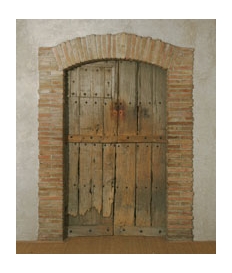
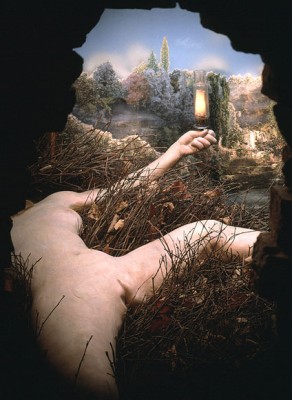
But the apotheosis of the return is Duchamp’s posthumously presented and still quite baffling Etant Donnés (trsl. Given; Fig. 4) comprised of a life-size old door with two peep holes through which one sees a three-dimensional tableau of a nude in a landscape. Thorson states that Etant Donnés is not a surrender to realism, nor a repudiation of his previous ideas, nor the effect of old age, nor a transformation because of looming death, all of which were proposed by other critics. The piece is an altogether logical outcome of the reconciliation of on one side ideas and the other side life. “The Etant Donnés signifies that like Husserl, Duchamp’s concern for ideas finds its ultimate resolution in a return to the lived-world as the basis of experience” (AT, 102).

Duchamp-EtantDonnee-Door

Fig. 4. Duchamp, Marcel. Etant donnés; 1. La chute d’eau, 2. Le gaz d’éclairage (Given: 1. The Waterfall, 2. The Illuminating Gas). 1946-1966. Philadelphia Museum of Art

In short, and as formulated in her abstract.

Careful examination reveals both artist and philosopher working through a similar sequence of ideas to arrive at comparable solutions. Both began with a struggle against dualism which they found couched in naturalist preconceptions. A realization of the intentionality of consciousness offered a solution to the initial subject/object division, while an awareness that meaning transcends its empirical presentation spurred them both on a search for ideal meanings. Ultimately each came to recognize that meaning inheres in the individual’s subjective experiencing of the everyday world (AT, Abstract).

III. The naive, non-formal phenomenology of Duchamp

Under the chapter title “Duchamp’s Phenomenological Approach to Art” Thorson unpacks further the very striking phenomenological aspects of Duchamp’s work. She especially focuses in on 1) Duchamp’s attitude towards art which very much resembles Husserl’s epoché; 2) his search for “eidetic essences”, 3) how intentionality confers meaning and binds subject and object and 4) the overcoming of duality in a qualified union. Once these aspects are fleshed out a new understanding is possible, one which could even provide a “unity and a new intelligibility” to Duchamp’s gestures with his conceptual event-objects.

Duchamp’s Epoché

Duchamp’s epoché can be found in his non-committal, aloof attitude towards politics, education, patriotism, religion, logic and many other aspects of society. He doesn’t believe in taking positions and tries to be beyond any of the pro or contra partisan positions. As far as art is concerned it looks like he is ‘bracketing’ a number of conventional ideas about art like the idea of progress in art; the artist’s sanctified role; art history and art’s alleged timeless power; taste and its cultivation in art education; and the institutionalized presentation of art in museums. Like Husserl’s concern to get “back to the things themselves” (Husserl quoted in AT, 119) Duchamp wants to be free from the limitations which come with ‘positions’ and conventional prejudices. He wants to go back to pure experience by breaking through the limitations which come with language and the manner in which language shapes experience.

Duchamp’s Eidetics

But, like Husserl, he is open for the existence of ideality, that is, the concept that in experience as well as in art, an idea or essence is always already operative or expressed and that this idea could be found through some sort of reduction, of which Husserl had a more explicit methodological awareness and Duchamp a more tacit, intuitive grasp. Thorson gives the example of how Duchamp went about to arrive at the essence of motion and how to depict that in artistic form. In this context Duchamp’s operative terms were reduction, stripping and denudation to conceive the essence of motion which culminated in his Nude Descending a Staircase, where naturalistic forms were stripped away and replaced by cubist abstractions with added lines and dots. As stated to Pierre Cabanne, Duchamp confirmed that with this piece he “was breaking the chains of naturalism forever . . .” (Cabanne quoting Duchamp as quoted in AT, 126). Thorson also discusses Duchamp’s use of “imaginative free variation”, being the methodology of the eidetic reduction and quotes him saying, “Any idea that came to me, the thing would be to turn it around and try to see it with another set of senses . . .” (Duchamp quoted in AT, 127). Initially his phenomenological investigations through free variations were directed at the essence of depicting motion in an artistic manner, but with the readymades the investigation shifted to the essence of art itself. Now his reductions and variations were targeting the then accepted attributes of art like “style, quality, originality, beauty, etc.” (AT, 132). These allegedly indispensable attributes were stripped away in the readymade, which were meant to have none of such even though others still did see beauty and originality.

Duchamp’s intentionality

Through this investigation of art with the readymade, what comes to the fore is, as discussed above, the intentional structure of experience. The art object is not established by external, objective standards about intrinsic qualities, nor by internal subjective, psychological reactions, but is established, or constituted, in the give and take between subject and object, in their polar relation. “Thus the readymade served to highlight the indissoluble unity between the object-as-intended and the subject’s intending-toward, and to reveal this relationship as the ultimate foundation for the determination of art-meaning” (AT, 132). It is Thorson’s contention that Duchamp is non-formally aware of this intentional structure in which the onlooker has a bigger role in establishing what art means than hitherto assumed.

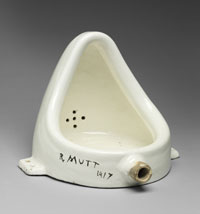
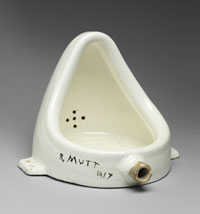
The above point can be made a bit more explicit with the following example. We might initially emptily intend Fountain (Fig. 5) as an art object because it is presented to us with the claim that it is art. But, because so many aspects of art seem to have been stripped away in this object, we have to re-calibrate our set of tacit expectations regarding art by doing some quick imaginative free variations to test if the missing aspects are essential or not, and then either interpret Fountain as a silly or shocking hoax if we hold on to beauty, taste and style as essential to art, or we interpret the object as a significant, artistic conceptual event-object if we go along with Duchamp and toss them. A third alternative might be possible and that is to acknowledge Fountain as both showing and changing the boundaries of the definition and function of art, but still keep open a personal choice of what art might mean for oneself with the whole issue having become more explicitly open and elective. In this middle position Duchamp showed something about art, but did not necessarily destroy it as some have argued.

Fig. 5. Duchamp, Marcel. Fountain. 1917. Photo of a duplicate.
Fig. 5. Duchamp, Marcel. Fountain. 1917.
Photo of a duplicate.

Duchamp’s non-dualism

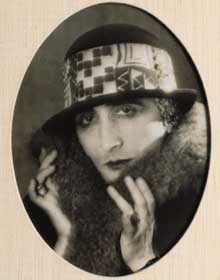
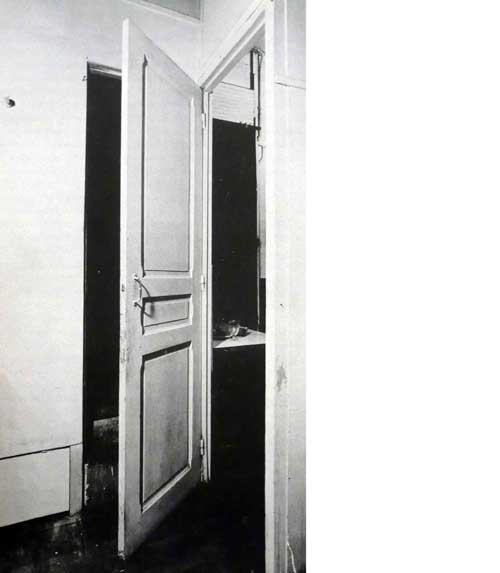
The last phenomenological aspect Thorson highlights is Duchamp’s overcoming of dualism–based on the inseparability of subject and object–not only in establishing the meaning and limits of art, but of meaning in general. His appreciation of complementarity of allegedly opposed positions; his acting out of the androgynous nature of the sexes through his alter ego Rrose Sélavy (trsl. Eros: Such-is-life; Fig. 6); his interest in the reconciliation of opposites in alchemy; his refutation of bivalent logic in Door, 11 Rue Larrey (Fig. 7), which door can be both open and closed at the same time; his eroto-maniacal preoccupation with sex; all these indicate a preference for non-dualism.

Fig. 6. Ray, Man. Rrose Sélavy (Marcel Duchamp). 1921. Philadelphia Museum of Art
Fig. 6. Ray, Man. Rrose Sélavy (Marcel Duchamp). 1921.
Philadelphia Museum of Art


Fig. 7. Duchamp, Marcel. Door, 11 Rue Larrey. 1927.

Duchamp as phenomenologist?

In closing her chapter, Thorson thinks it wrong to qualify Duchamp as a phenomenologist. Too much what he did has no parallel in phenomenology and, I would add, many phenomenological investigations are too technical to find an equivalent in Duchamp.[5]

But phenomenology does provide “a tentative framework through which the variety and complexity of his activities gain coherence and greater intelligibility . . .” (AT, 140). I would classify Duchamp therefore as a non-formal, intuitive phenomenologist, because he was very accomplished in suspending and playing around in a phenomenological manner with art, but was not explicitly aware of the formal phenomenological manner he was doing so.

Because Duchamp’s conceptual event-objects were often more about art than art itself, the discussion about whether he created art or not could be settled by naming his gestures meta-artistic, which nicely captures the idea that his gestures were neither art nor non-art and had a built-in self-referential structure.

From cause to effect

Duchamp, as a non-formal phenomenological meta-artist, was able to liberate a similar critical distancing and imaginative capacity in his fellow artists and audience, which could be traced as the “Duchamp Effect”. As Thorson states, and I do agree, the phenomenological framework will help us in understanding his legacy, because “Duchamp’s legacy is a phenomenological approach to art” (AT, 141; italics in original; bold added) especially picked up and amplified in his friend John Cage.

Here I like to stress the idea, and add my own thoughts, that phenomenology can provide a unity of intelligibility to Duchamp’s art, as Thorson makes clear in different parts of her study. The unity consists in the idea that the Husserlian epoché and eidetics are closely intertwined and feed off each other. Critical distancing through suspension of assumptions will create a field of new possibilities and, other way around, being confronted with surprising instances of conceptual event-objects could lead, in different degrees, to critical distancing, even full-fledged entry into a transcendental attitude from which the interaction between oneself as an intending subject and its intended, constituted objects becomes a possibility (Meraud, 2010). Once one gets habituated within that attitude–which is not a given as one can slip out of it–a multitude of variations are possible and it looks like that Duchamp operated within the art world by inhabiting this attitude in a non-formal manner.

Also, based on the presented insights, one might evaluate possible critiques and re-interpretations of Duchamp’s work, for example the critiques coming from Clement Greenberg, Thomas Hess and Wayne Andersen.

Greenberg’s beef with Duchamp was that he thought he was too destructive for one’s fragile faculty of esthetic, contextualized expectation-cum-surprised satisfaction in relation to art, which for him was an essential ingredient of art appreciation to be finely cultivated (Greenberg, 1971). Greenberg has a point because phenomenology will show that we always already engage life and art with an interacting mix of tacit and explicit expectations, all set within, and to be explicated by, the dynamic sequence of a) intentional experience of emptily intending, to b) different degrees of fulfillment, culminating in c) stability, frustration or ambiguity. I think Greenberg had a fine, though conservative, appreciation for that dynamic. But again, Duchamp and his fellow avant-gardistas were not necessarily out there to destroy art come what may. They merely made such expectations and frameworks more explicit, questionable, investigatable and changeable. If they did so in an aesthetically tasteless manner or by shock and scandal is besides the point. Granted, I think some of what claims to be modern art is bad and tasteless, but at the same time the challenging of conventional standards of taste could only be effected by provocations through its opposite. And contrary to Duchamp’s statements that he had given up on art, he actually never did, and the presentation of Etant Donnés, which incorporated a vast amount of modern styles and vintage Duchampian gestures, made that point quite clear. Greenberg might have been shocked again, but I would be surprised if he would deny having learned anything from Duchamp.
My position here would be somewhere in between, in that we do not necessarily have to give up our own tacit and explicitly cultivated standards of aesthetics just because Duchamp happened to show their contingent, subjective nature, and we do not have to stick defensively to these standards like Greenberg, because modern art, even avant-garde art, is full of pleasant, aesthetic and thought-provoking surprises.

The above considerations should remind us also that a tendency towards an idealized interpretation of Duchamp should be resisted. Though Duchamp’s status since the 1960s has risen to that of patron saint of modern art, I find these older criticisms of Duchamp by Clement Greenberg and Thomas Hess still valid. And the recent quite severe and provocative deconstruction of Duchamp as an “overrated erotomaniac” by art historian Wayne Andersen in his study Marcel Duchamp: The Failed Messiah, is a welcome antidote. Andersen thinks, to quote him at his most provocative, that “Marcel Duchamp’s gift to artists was similar to the Marquis de Sade’s gift to sadists—relief from moral restraints, accountability, guilt, and shame” (Andersen, 2010, p. 3). In Andersen’s study it is not so much Duchamp himself who is to be blamed, but a section of the art world which had sanitized, elevated and aggrandized him as a messianic figure, whose “nihilism was eagerly adopted as artistic freedom” (Andersen, 2010, p. 5) and whose persona became more important than his art. Again, it is phenomenology which can elucidate the constitution of idealized narrative interpretations. Amongst many aspects, the idealization process includes the discarding of truly contingent, unimportant elements as well as suppressing essential, important ones. In Andersen’s view what got suppressed was Duchamp’s vulgarity, the second-rate nature of most of his art and his anti-feminism. Whether Andersen cut Duchamp to size a notch too far is for me an open question, but I think he does show that certain overlooked aspects of Duchamp’s persona and art are essential and have to be taken into consideration if one wants to arrive at the complex eidos Marcel Duchamp. The in-between position might be to acknowledge Duchamp as important and influential, but not to be infatuated with.

IV. Conclusion

It is Thorson’s contention, and mine too, that through understanding the epoché; the procedure of “imaginative free variation”; and the concept of life-world, we can better understand a) what Duchamp seemed to have accomplished as a conceptual artist creating thought-provoking event-objects; b) that he himself executed imaginative variations on art which unity becomes intelligible through understanding Husserl’s ‘imaginative free variation’; and c) that these variations set examples to other conceptually nimble artists to find their own unique variations.

Because a phenomenological assessment of Duchamp is, from a transcendental viewpoint, purely philosophical, it cannot in principle trump Marxist, psycho-analytic or critical art historical interpretations, because those pertain to the more empirical realms of sociology, psychology and history. A Marxist analysis of Duchamp’s personal position within the elitist upper class of American society might still result in relevant insights about Duchamp’s life and his art. And a psycho-analytic assessment of some of his formative experiences is not ruled out either. Here one can look at the possible long-term influence of his traumatic experience of having some of his most important works rejected by his fellow artists, as well as the often repeated hypothesis that he struggled with an incestuous tendency towards his sister. The first experience might have made him cynical about art and the second made him conflicted about sexuality. And, lastly, phenomenology cannot invalidate criticisms coming from Greenberg and Andersen. At best it can illuminate its procedures, but not set aesthetic standards.

In closing, it looks like to me that Duchamp’s “artistic conceptual event-objects” are meta-artistic phenomena which precariously balance on the cusp between art and philosophy such that his art, which is neither art nor non-art, can illuminate philosophy and other way around.

Endnotes

[1]. That a phenomenological approach to Duchamp was executed at NIU might not be a coincidence as NIU’s philosophy department in the 1970s and ’80s harbored accomplished continental philosophers like Lester Embree, who moved on to become one of the major organizers of the international movement of phenomenologists; Theodore Kisiel, a world-renowned expert on the early Heidegger; and Michael Gelven, who delved into literature, art and spirituality.

[2]. With ‘mechanics’ I do not mean to imply a mechanistic view, but rather something like the dynamic and structural logos of experience in which all parts are integrated and have some causal effect on each other and together compose a whole.

[3]. Brough drew on the following studies by George Dickie: Art and the Aesthetic: An Institutional Analysis (Cornell University Press, 1974) and The Art Circle (Haven Publications, 1984).

[4]. If there might have been philosophical influences on Duchamp, besides the well-known influence of anarchist thinker Max Stirner, I would have looked at how Friedrich Nietzsche might have shaped Duchamp indirectly through artists like Hugo Ball of Cabaret Voltaire and closer to him, Francis Picabia, who both were familiar with and had embraced Nietzsche’s thought.

[5]. A logical next step would be to see if and how Heidegger’s existential-hermeneutic phenomenology might clarify further what Duchamp did.

Sources used and consulted

Andersen, Wayne. Marcel Duchamp: The Failed Messiah. Geneva, Switzerland: Éditions Fabriart, 2011. Print.

Brough, John B. “Art and Artworld: Some Ideas for a Husserlian Aesthetic”. Edmund Husserl and the Phenomenological Tradition: Essays in Phenomenology. Ed. Robert Sokolowski. Washington, D.C.: The Catholic University of America, 1988. 25-45. Print.

Danto, Arthur. “The Artworld”. The Journal of Philosophy, 61/19 (Oct. 15, 1964): 571-84.

Demos, T. J. “Duchamp’s Labyrinth: ‘First Papers of Surrealism,’ 1942”. October, vol. 97 (Summer, 2001): 91-119.

Duchamp, Marcel. The Writings of Marcel Duchamp. Michel Sanouillet and Elmer Peterson (Eds.). N.p.: Da Capo Press, n.d. Print. Originally published by Oxford University Press, 1973. Print.

Evans, J.C. et al. “Aesthetics”. Encyclopedia of Phenomenology. Ed. Lester Embree, et al. Dordrecht, The Netherlands: Kluwer Academic Publishers, 1997. Print.

Greenberg,Clement. “Counter Avant-Garde” [1971]. In Marcel Duchamp in Perspective. Masheck, Joseph, ed., Da Capo Press, 2002. Pp. 122-33. Print.

Heidegger, Martin. Being and Time. San Francisco: Harper Collins, 1962, trans. by Macquarrie and Robinson. Print.

Hess, Thomas B. “J’Accuse Marcel Duchamp”. In Marcel Duchamp in Perspective. Masheck, Joseph, ed., Da Capo Press, 2002. Pp. 115-20. Print.

Hofmann, Werner. “Marcel Duchamp and Emblematic Realism”. In Masbeck, Joseph (Ed.). Marcel Duchamp in Perspective. Englewood Cliffs, NY: Pretice-Hall, 1975. Print.

Hubregtse, Menno. “Robert J. Coady’s The Soil and Marcel Duchamp’s Fountain: Taste, Nationalism, Capitalism, and New York Dada”. Revue d’art canadienne / Canadian Art Review 34 / 2 (2009). Web. 09 Feb. 2014.

Husserl, Edmund. The Crisis of European Sciences and Transcendental Phenomenology: An Introduction to Phenomenological Philosophy. Evanston, IL: Northwestern University Press, 1970. Print.

Kisiel, Theodore. “Do It Yourself Phenomenology”. Hand-out. Philosophy 428, NIU, DeKalb, IL, Spring 2003.

Kosuth, Joseph. “Art after Philosophy”. Studio International (October, 1969).

Meraud,Tavi. “More Than Meets the Eye: Connections between Phenomenology and Art”. Postgraduate Journal of Aesthetics, Vol. 7, No. 3, December 2010. Web. 5 Feb 2014.

Moffitt, John F. Alchemist of the Avant-Garde: The Case of Marcel Duchamp. New York: State University of New York Press, 2003. Web. Googlebooks.

Ricoeur, Paul. Time and Narrative. 3 vols. transl. by Kathleen McLaughlin and David Pellauer. Chicago: University of Chicago Press, 1984-88. Print.

Sokolowski, Robert. “The Logic of Parts and Wholes in Husserl’s Investigations”. Philosophy and Phenomenological Research, 28/4 (Jun., 1968): 537-553

Thorson, Alice R. “Marcel Duchamp: A phenomenological approach to art”. MA Thesis Northern Illinois University, 1981. Thesis director Norman Magden. Print.

Fountain and Large Glass by Marcel Duchamp: What was that all about?

Introduction

This essay will try to formulate a coherent statement about the connection between two influential ‘conceptual event-objects’ created by the French avant-garde painter and conceptual artist Marcel Duchamp (1887-1968). The two items under discussion are Fountain (1917; Fig. 1) and Large Glass (1913-1925; Fig. 2).

Maybe to call them provisionally ‘conceptual event-objects’ might be helpful in order to ween us away from our conventional manner of conceptualizing. Admittedly, these objects are now treated as art objects, with their reproductions now statically displayed in various museums, but, after reading about them, they also have serious temporal aspects to justify the term of ‘event’ and are also highly conceptual in their referral to philosophical questions regarding the ontological status of art and its relation to reality, even the nature of reality itself. In other words, all conventional meanings associated with art and art production are more or less suspended to facilitate, at least for me in my historical situatedness, a fresh entry into the subject.

Note on Method

The terms and ideas which seem to be often associated with both objects, both in the writings of Duchamp himself and in the writings by commentators are: esthetics; taste; readymade; indifference; object; event; mind; humor; irony; meta-irony; sarcasm; delay; timing; subversion; inversion; functionality; and science.

One manner of bringing these terms together in their coherence is by using them in one paragraph, or ideally in one sentence, and by this limitation of space force the inner structure of their connections to come out by a creative use of grammar and connecting words. And if in the process the form of the linguistic accomplishment reflects its content, then maybe a truly coherent ‘statement’ might be had. Therefore, without further ado:

Duchamp’s readymades are humorous, ironic, sometimes even sarcastic subversions of both traditional and avant-garde standards of taste and esthetics of the late Belle Époque, by choosing esthetically neutral objects to which he felt indifferent, giving them thought-provoking titles which invert the locus of action from the object to the mind; from its functionality to its dubious esthetics; from its superficial, narrow, specific quotidian meaning to an open-ended philosophical impact.

Hofmann’s Formalizable Take on Readymades

The above can be construed as another step in opening up this new space in understanding Duchamp, which initially started for me with naive amusement and intrigue and then moved in a formalized framework of understanding readymades with the help of German historian of art Werner Hofmann. In his article “Marcel Duchamp and Emblematic Realism” the author makes the case that Duchamp’s readymades carry a plurality of meaning, or “levels of reality” of which he gives five–and as we shall see, five very logically interconnected–variations.

The first alternate meaning he observes besides its quotidian one, is that readymades indicate that quotidian objects can be more than just their utility and that Duchamp gave ordinary objects an extra aura or authority of meaning. The second interpretation is that a readymade can trigger a “psychopathlogical encounter” with nihilism in the sense that the object has lost all intrinsic esthetic or functional meaning and became completely “enigmatic and unfathomable”. The third variation is that the object can be freed from its functional meaning and seen purely formally and esthetically. The last interpretation is to let “the formal value of the object coincide with the its utilitarian value” (Hofmann in Masbeck; 1975, pp. 62-3).

The formal-logical interconnection of these five meanings can be shown to be as follows. Let B stand for beauty or esthetic value; and let F stand for function or utilitarian value; then the four positions can be formalized as follows:

1) just F ( F & – B )
2) Not only F ( F & X )
3) Not F, nor B ( – F & – B )
4) Not F, but B. ( – F & B )
5) Both F and B ( F & B )

This formalization pretty much exhausts most, if not all, possible combinations of the object’s properties of functionality and esthetics. Though this formalization can give a handle on the enigmatic logic of the multi-interpretable readymade, it is also very abstract, actually, too abstract. What is of course not mentioned are the very specific, complex, historical circumstances in which the readymade emerged, especially in the case of Fountain if we follow the narrative reconstructed by Canadian doctoral candidate in history of art Menno Hubregtse.

Fountain

Hubregtse’s hypothesis is that Duchamp chose the readymade Fountain to both playfully mock and seriously protest a concept of art promoted by an American dealer of avant-garde art, Robert Coady, as an opportunity to challenge the concept of art and the status of the artist in general. Coady, in his magazine The Soil, criticized the influence of European art on American sensibilities and thought that America already had its indigenous, though unintentional, art in the form of its industrial machines and mass products. Hubregtse wrote that “Coady believed that industrial products embodied the spirit of America and had far greater significance as a national art form than the art being produced and promoted by artists and critics trained at the various academies throughout America” (Hubregtse; 2009, p. 29). From several references and other indirect connections between Coady and Duchamp, Hubregtse’s hypothesis of an antagonistic Coady-Duchamp relationship as a background narrative to Fountain looks very plausible.

But it is not the whole story. Hubregtse makes the case that Duchamp was not just opposed to Coady’s concept of American art, but also was looking for an opportunity to challenge any and all standards of esthetics and taste. This was motivated by his anarchist-individualist worldview shaped by his reading of German anarchist philosopher Max Stirner. Hubregtse states that Duchamp’s “submission of the urinal as an art object tried to kick out the pedestal from under the ‘artist’ and destabilize the elevated status the artist enjoyed in the social hierarchy” (Hubregtse; 2009, p. 36).

Large Glass

Moving from Fountain to Large Glass is initially a bit of a challenge. Not everything applicable to readymades could be applied to Large Glass, which on face value looks like a ‘traditional’, ‘conventional’ (from the perspective of the 21st century) piece of modern art with its ‘seemingly abstract, enigmatic content, use of various materials and its reputation as an important milestone in the history of modern art made by the very influential Marcel Duchamp’. But, once the object came out of hiding; and Duchamp’s notes about it were piece by piece published; and the artist himself made some public comments; and friends an experts formulated their interpretations; the item (or conceptual event-object) took on increasingly clear and profound interpretations.

Duchamp’s friend Michel Sanouillet in his introduction to The Writings of Marcel Duchamp basically sees Large Glass as something of a work of science fiction in which the problem of the relationship between man and machine is highlighted in a particular hypothetical scenario, in this case the romantic and sexual relationship between the sexes, but then as machines. Maybe machines are more alive then we think, which opens the possibility that, posed in a question, “What if the machine, stripped of all its anthropomorphic attributes were to evolve in a world made in its image with no reference to the criteria governing man, its creator? (Sanouillet; 1973, p. 8). What would the mental state be, and the laws governing, its possible desires for, and interactions with, other machines? Would there be love, marriage and ‘blossomings’? And if so, how would that look like? Maybe Large Glass is a fantastic depiction of such a science fictional state of affairs in which a mechanical bride excites a bunch of mechanical bachelors and gets excited by them with “essence d’amour” (“love gasoline”), all by the laws (some real, some invented) of mechanical causation and random chance which rule the behavior of cylinders, magnets, weights, pumps, grinders, shootings, etc.

Both Compared

If one would now compare Duchamp’s readymades with Large Glass, it looks like that Large Glass is seemingly a more traditional piece of art, because it has multiple, philosophical messages, though the temporal aspect of it being unfinished and the role of the piecemeal published notes and remarks, makes the object into what I keep calling a conceptual event-object. The object triggers a meaningful event which has to be conceptually finished in the mind. The readymade Fountain is in a similar manner an event which message has to be finished in the mind. Fountain is actually even more of an event, because of the very ephemeral status of its original object. It does not exist anymore, it was never properly exhibited, and might even have been nonchalantly tossed away after it had triggered the event of its higher, ironic, conceptual meaning as a fundamental challenge to the ontological status of art, artists and ordinary objects.

Illustrations

1998-74-1v1-pma

Fig. 1. Duchamp, Marcel. Fountain. 1917.


1952-98-1v1-pma

Fig. 2. Duchamp, Marcel. The Bride Stripped Bare by
Her Bachelors, Even (The Large Glass). 1913-1925.
Philadelphia Museum of Art

Sources

Duchamp, Marcel. The Writings of Marcel Duchamp. Michel Sanouillet and Elmer Peterson (Eds.). N.p.: Da Capo Press, n.d. Print. Originally published by Oxford University Press, 1973.

Hofmann, Werner. “Marcel Duchamp and Emblematic Realism”. In Masbeck, Joseph (Ed.). Marcel Duchamp in Perspective. Englewood Cliffs, NY: Pretice-Hall, 1975. Print.

Hubregtse, Menno. “Robert J. Coady’s The Soil and Marcel Duchamp’s Fountain: Taste, Nationalism, Capitalism, and New York Dada“. Revue d’art canadienne / Canadian Art Review 34 / 2 (2009). Web. 09 Feb. 2014.