Additions to Bibliography September 2024


Additions to the main Bibliography Monetary Theory and Reform

A. Proposed Legislations and Organizational Endorsements

Carmack, Patrick S.J., J.D. 1996. “Monetary Reform Act“. The Money Masters.

B. Academic Studies on Sovereign Monetary Theory and Reform

Bang-Andersen, Jens & Lars Risbjerg & Morten Spange. 2014. “Money, Credit and Banking“. Monetary Review, 3: 65-81.

Bichler, Shimshon & Nitzan, Jonathan. 2022. “Book review: Steve Keen, (2021) The New Economics: A Manifesto“. realworld economics review, 102 (18 December 2022): 156-163.

Bofinger, Peter & Haas, Thomas. 2018. “A simple microeconomic model for the analysis of Vollgeld“. W.E.P. – Würzburg Economic Papers, No. 99, University of Würzburg, Department of Economics, Würzburg.

Carmack, Patrick S.J., J.D. 2020. “Reforming the Primary Instrumental Cause of Increasing Income Inequality“. Adler–Aquinas Institute, Colorado Springs, CO, USA.

—–, —–. 2019. “The Main Cause of Income Inequality”. Studia Gilsoniana, A Journal in Classical Philosophy, 8/4.

Constâncio, V. 2016. “Challenges for the European Banking Industry”. Lecture given at the Conference on “European Banking Industry: What’s Next?”, organised by the University of Navarra, Madrid, 7 July 2016.

Crocker, Geoff. 2020. Basic Income and Sovereign Money. The Alternative to Economic Crisis and Austerity Policy. Cham, Switzerland: Palgrave Mcmillan.

Daneke, Gregory A. 2019. Serfs Up: Finance, Feudalism, and Fascism, Ruminations on the political economy of our time while there is still time. Seattle: Amazon Paperback.

—–, —–. 2022. “The Paradigm in the Iron Mask: Toward an Institutional Ecology of Ecological Economics.” real-world economics review, 102: 16-29.

De Grauwe, Paul. 2008. “Returning to Narrow Banking“. In: B. Eichengreen and R. Baldwin, What the G20 should do on November 15th to fix the financial system, a VoxEU.org Publication.

Demeulemeester, Samuel. 2022. “Divorcing money creation from bank loans: Revisiting the “100% money” proposal of the 1930s“. Revue d’economie politique, 132/5: 835-859.

Desan, Christine A. 2022. “How To Spend a Trillion Dollars: Our Monetary Hardwiring, Why It Matters, and What To Do About It.” Shared at AMI Conference 2022.

Dietsch, Peter. 2021. “Money creation, debt, and justice”. Politics, Philosophy & Economics, 20/2: 151-179.

Dietz, Rob, Herman Daly, and Dan O’Neill. 2013. Enough is enough: Building a sustainable economy in a world of finite resources. London: Routledge.

Diren Valayden & Jakob Feinig. 2022. “Humanization as Money: Modern Monetary Theory and the Critique of Race“. Humanity: An International Journal of Human Rights, Humanitarianism, and Development, 13/2 (Summer 2022): 146-157.

Etzrodt, Christian. 2023. “Positive Money: Progressive Solution or Trojan Horse?“. Cambridge Journal of Economics, 47/6: 1207-1224.

Feinig, Jakob. 2015. Money and its publics: Public involvement in American monetary policy from 1690 to 1936. Dissertation, State University of New York at Binghamton.

Flaschel, Peter, et al. 2010. “Broad banking, financial markets and the return of the narrow banking idea“. The Journal of Economic Asymmetries, 7/2: 105-137.

Goodhart, Charles & Jensen, Meinhard. 2015. “Currency School versus Banking School: An ongoing Confrontation“. Economic Thought, 4 /2: 20-31.

Hockett, Robert C. 2019a. “Money’s Past is Fintech’s Future: Wildcat Crypto, the Digital Dollar, and Citizen Central Banking“. Cornell Legal Studies Research Paper No. 19-05, Stanford Journal of Blockchain Law & Policy. 

—–, —–. 2019b. “Finance without Financiers“. Politics & Society, 47/4: 491-527.

—–, —–. 2021. “Digital Greenbacks: A Sequenced’ Treasury Direct’ and ‘Fed Wallet ‘Plan for the Democratic Digital Dollar.” Journal of Technology Law & Policy,  25/1.

—–, —–. 2024. Spread the Fed: Distributed Central Banking for Productive Monetary Policy. London: Palgrave Macmillan. Forthcoming.

Hook, Andrew. 2023. “Towards an institutional “landscape” view of modern money creation mechanisms and some reflections on their ecological significance“. Sustainability Science, 18: 1977–1993.

Hotson, John H. 1983. “What’s Wrong with Mainstream Macroeconomics?“. Eastern Economic Journal, 9/3: 246-257.

—–, —–. 1985a. “The Growlery: Ending the Debt-Money System“. Challenge, 28/1 (March / April 1985): 48-50.

—–, —–. 1985b. “Response: Professor Friedman’s Goals Applauded, His Means Questioned“. Challenge, 28/4: 59-61.

—–, —–. 1986. The Keynesian Revolution and the Aborted Fisher-Simons Revolution, Or, The Road Not Taken. Department of Economics, University of Waterloo, 1986.

—–, —–. 1996. “The Chicago Plan and New Deal Banking Reform“. Eastern Economic Journal, 22/1 (Winter, 1996): 108-110.

Huber, Joseph. 2012. “Many roads lead to Rome–not all by the shortest path. Comments and reflections on The Chicago Plan Revisited.”

Kash, Ian A., Eric J. Friedman, and Joseph Y. Halpern. 2007. “Optimizing scrip systems: Efficiency, crashes, hoarders, and altruists“. Proceedings of the 8th ACM conference on Electronic commerce, 2007.

Keen, Steve. 2021. The New Economics: A Manifesto. Cambridge, UK: Polity Press.

—–, —–. 1995. “Finance and Economics Breakdown: Modeling Minsky’s ‘Financial Instability Hypothesis’“. Journal of Post Keynesian Economics, 17/4: 607-35.

Kim, Hongkil & Griffin, Hunter. 2022. “Why not Sovereign Money AND Job Guarantee?” real-world economics review, 99: 106-124.

Li, Boyao. 2022. “How does bank equity affect credit creation? Multiplier effects under Basel III regulations“. Economic Analysis and Policy, 76: 299-324.

Li, Boyao & Yougui Wang. 2020. “Money creation within the macroeconomy: An integrated model of banking”. International Review of Financial Analysis, 71: 101547.

Loef, Hans E., and Hans G. Monissen. 1999. “Monetary policy and monetary reform: Irving Fisher’s contributions to monetary macroeconomics“. WEP-Würzburg Economic Papers, No. 11, University of Würzburg, Department of Economics, Würzburg.

McMillan, Jonathan. 2024. Capitalism and the Market Economy: Bringing back together what Banking Pulls apart. Zurich, Switzerland: Zero/One Economics.

Pilkington, Philip. 2014. “Bank of England endorses post-Keynesian endogenous money theory“. No. 32. Working paper (PDF). Fixing the Economists, 12 March 2014.

Sheard, Paul. 2023. The Power of Money: How Governments and Banks Create Money and Help Us All Prosper. Dallas, TX: Matt Holt.

Simić, Aleksander. 2019. Just Money. Sovereign Money System and the Ethics of Banking. Master’s of Applied Ethics. MS thesis. Utrecht University.

Tavlas George. 2020. “On the Controversy over the Origins of the Chicago Plan for 100 Percent Reserves: Sorry Frederick Soddy: It Was Knight and (Most Probably) Simons!” Hoover Institution, Economics Working Paper 20102. Forthcoming, Journal of Money, Credit and Banking.

Tymoigne, Éric, and L. Randall Wray. 2006. “Money: An Alternative Story“. In: Arestis, Philip, and Malcolm C. Sawyer, (eds), A Handbook of Alternative Monetary Economics, Cheltenham, UK & Northampton, MA: Edward Elgar Publishing: pp. 1-16. Also; Working Paper No. 45, Center for Full Employment and Price Stability (July 2005).

van Egmond, N., and B. de Vries. 2020. “Modeling the Dynamics of the Financial-Economic System: Understanding The Current ‘Money as Debt’ Crisis“. Journal of Banking, Finance and Sustainable Development, 1/1: 145-168

van Egmond, N., and B. de Vries. 2020. “Modelling the dynamics of the financial-economic system: Exploring the ‘debt free money’ alternative“. Journal of Banking, Finance and Sustainable Development, 1/1: 169-180.

van Eijck, Jan, and Philip Elsas. 2017. “What is money?” In: Başkent, Can, Lawrence S. Moss, and Ramaswamy Ramanujam (eds), Rohit Parikh on logic, language and society, Vol. 11, Springer, pages 67-75.

Vivian, R., and Nicholas Spearman. 2016. “Banks and Money Creation ‘Out of Nothing’“. No. 3. Working Paper, EU and Comparative Law Issues and Challenges Series, Dec 2016.

White, William. 2023. “Why The Monetary Policy Framework in Advanced Countries Needs Fundamental Reform.” Institute for New Economic Thinking Working Paper Series 210.

C. Studies Critical of Sovereign Monetary Theory and Reform (including MMT section)

Green Party USA. 2022. “Special MMT Edition“. Banking and Monetary Reform Committee. Green Party USA. Newsletter, January 2022.

Lavoie, Marc. 2022. “MMT, sovereign currencies and the Eurozone“. Review of Political Economy, 34/4: 633-646.

Miles, Derrick. 2021. “MMT and the Green Party: A GPWA Member Perspective“. Real Progressives, 30 Jan 2021.

Musgrave, Ralph. 2014. “Charlotte Van Dixhoorn criticises Positive Money“. Ralphonomics, 12 May 2014. [Responding to van Dixhoorn, 2013]

Nersisyan, Y. and Wray, L. R. 2017. “Cranks and heretics: The importance of an analytical framework“. Cambridge Journal of Economics, 41/6: 1749–60.

D. Non-academic Advocacy Pamphlets, Reports, Briefings and Books

Bossone, Biagio & Costa Massimo. 2018. “The ‘accounting view’ of Money: Money as Equity (Part II)“. All About Finance, World Bank Blog, 21 May 2018.

Dawnay, Emma. 2017. “Souvereign Money Initiative: The Background to the National Referendum on Sovereign Money In Switzerland“. Wettingen, Switzerland: Verein Monetäre Modernisierung (MoMo).

Egnatz, Nick. 2019. “The Constitution and a Just System of Money“. Alliance For Just Money, 19 July 2019.

—–, —–. 2019. “Challenging the Economics Profession“. Alliance For Just Money, 2 Nov 2019.

Egnatz, Nick. 2023. Money Creation 101: Change Our Money – Change Our World.

—–, —–. 2024. History of Money 101: Change Our Money – Change Our World.

Hummel, Sam. 2022a. “Global Study on Monetary Literacy Finds Massive Illiteracy & Disapproval“. Sam Thinks out Loud on Substack, 21 Jan 2022.

—–, —–. 2022b. “The Bank of England Says Economics Textbooks Teach Falsehoods About Money and Banking“. Sam Thinks out Loud on Substack, 23 March 2022.

—–, —–. 2022c. “80% of People Have a Mistaken Understanding of the Relationship Between Money and the Economy“. Sam Thinks out Loud on Substack, 19 May 2022.

—–, —–. 2022d. “Here’s the Proof that Banking Crises Simply Don’t Need to Happen. Period“. Sam Thinks out Loud on Substack, 4 June 2022.

—–, —–. 2022e. “One Paragraph Summaries of Top Papers for Understanding Bank Money Creation and Its Economic Effects“. Sam Thinks out Loud on Substack, 29 Sept 2022.

—–, —–. 2022f. “Who Owns and Controls Your Country’s Central Bank? It May Not Be Who You Think“. Sam Thinks out Loud on Substack, 6 Oct 2022.

—–, —–. 2022g. “100+ Experts Confirm: ‘Banks Create New Money Whenever They Lend’ “. Sam Thinks out Loud on Substack, 11 Nov 2022.

—–, —–. 2022h. “Ben Bernanke’s 2022 Nobel Prize in Economics is an Embarrassment“. Sam Thinks out Loud on Substack, 21 Nov 2022.

Jackson, Andrew. 2014. “The Positive Money Proposal: The Transition Process in Balance Sheets“. London: Positive Money.

Jackson, Andrew, Ben Dyson, and Graham Hodgson. 2013. “The Positive Money Proposal“. London: Positive Money.

Jackson, Tim. 2009. Prosperity without Growth: Economics for a Finite Planet. London: Earthscan / Routledge.

Schuller, Govert. 2019. “Ons Geld and the Road to the WRR Report“. Alliance For Just Money, 8 Mar 2019.

E. Supporting Studies Addressing Monetary Issues

Goldstein, Jonathan. 2020. “A Three Class Predator-Prey Model with Financial Super Predators: The Financial Profit Squeeze“. Working paper 503 (February 2020), Political Economic Research Institute, University of Massachusetts, Amherst.

Hudson, Michael & Charles Goodhart. 2018. “Could/should Jubilee debt cancellations be reintroduced today? If not, what alternative measures of debt relief and redistribution might be possible?“. Economics: The Open-Access, Open-Assessment E- Journal, 12 (2018-45): 1–25.

Hudson, Michael. 2024. Temples of Enterprise: Creating Economic Order in the Bronze Age Near East. Dresden, Germany: ISLET Press.

van Doornen, Heske. 2017. “Going Beyond Exchange“. Economic Questions, Blog of the Young Scholars Initiative, 15 May 2017.

F. Journalistic Articles Addressing Monetary Reform

Daneke, Gregory A. 2023. “When Wank Became Swank: Money, Banking, and The Evolution of the All-Debt Economy“. Medium, 31 Aug 2023.

Hockett, Robert. 2020. “Digital Greenbacks“. Forbes, 17 May 2020.

Kummer, Larry. 2012. “The lost history of money: An antidote to the myths“. Fabius Maximus Web Site, 12 Dec 2012.

Murphy, Richard. 2024. “Central bankers on their ability of banks to create money out of thin air“. Funding the Future, 6 Jan 2024.

Ongweso Jr, Edward. 2023. “Saule Omarova’s Plan to Remake the Financial System“. Dissent, Fall 2023.

Switzer, Howard. 2018. “Weaving a Unifying Narrative: The Money Thread“. Green Horizon, 15/36: 4-6.

G. Educational and Promotional Videos

Dietz, Rob, Herman Daly, and Dan O’Neill. 2019. Enough is enough: Building a sustainable economy in a world of finite resources. Video.

Funny Money. 2023. “Decolonizing International Economy: Featuring Fadhel Kabou“. Funny Money YouTube Channel. 25 Aug 2023.

Schularick, Moritz. 2021. “Central Bank Balance Sheets and the Macroeconomy: 1587-2020“. Paris School of Economics on YouTube, 31 May 2021.

Tily, Geoff. 2016. “Academics and civil society clash on money“. Policy Research in Macroeconomics, 18 July 2016.

H. Other Relevant Background Studies

Blyth, Mark. 2013. Austerity: The History of a Dangerous Idea. Oxford: Oxford University Press.

Chang, Ha-Joon. 2002. Kicking Away the Ladder: Development Strategy in Historical Perspective. London: Anthem Press.

Chwieroth, Jeffrey. 2010. Capital Ideas: The IMF and the Rise of Financial Liberalization. Princeton, NJ: Princeton University Press.

Domhoff, G william. 1967-2023. Who Rules America? 8 Editions. Upper Saddle River, NJ: Prentice-Hall

—–, —–. 2005. “The Four Networks Theory of Power: A Theoretical Home for Power Structure Research“. Who Rules America Website.

Edwards, Sebastian. 2019. American Default: The Untold Story of FDR, the Supreme Court, and the Battle over Gold. Princeton, NJ: Princeton University Press.

Eichengreen, Barry. 2019. Globalizing Capital: A History of the International Monetary System. Princeton, NJ: Princeton University Press.

Ferguson, Niall, et al. 2023. “The Safety Net: Central Bank Balance Sheets and Financial Crises, 1587-2020“. Hoover Institution, Centre for Economic Policy Research, 3 Feb 2023.

Ferguson, Niall & Andreas Schaab & Moritz Schularick. 2015. “Central bank balance sheets: expansion and reduction since 1900“. CESifo Working Paper, No. 5379, Center for Economic Studies and ifo Institute (CESifo), Munich.

Good, Aaron. 2022. American Exception: Empire and the Deep State. Ashland, OR: Blackstone Publishing.

Hochschild , Adam. 2023. American Midnight: The Great War, a Violent Peace, and Democracy’s Forgotten Crisis. Boston, MA: Mariner Books.

Hülsmann, Jörg Guido. 2014. “Fiat money and the distribution of incomes and wealth.” In: The Fed at One Hundred: A Critical View on the Federal Reserve System. Cham, Switzerland: Springer: 127-138.

Kentikelenis, Alexandros & Thomas Stubbs. 2023. A Thousand Cuts: Social Protection in the Age of Austerity. Oxford: Oxford UP.

Lowenstein, Roger. 2023. Ways and Means: Lincoln and His Cabinet and the Financing of the Civil War. London & New York: Penguin Books

Maher, Stephen and Scott Aquanno. 2024. The Fall and Rise of American Finance: From JP Morgan to Blackrock. London & New York; Verso.

Marx, Karl. “Comments on James Mill, Éléments D’économie Politique“. Collected Works.

Mattei, Clara. 2022. The Capital Order: How Economists Invented Austerity and Paved the Way to Fascism. Chicago: University of Chicago Press.

McCoy, Alfred. 2017. In the Shadows of the American Century: The Rise and Decline of US Global Power. Chicago: Haymarket Books.

Phillips, Peter. 2018. Giants: The Global Elite. New York: Seven Stories Press

Phillips, Peter. 2024. Titans of Capital: How Concentrated Wealth Threatens Humanity. New York: Seven Stories Press.

Shermer, Ellie. 2021. Indentured Student: How Government-Guaranteed Loans Left Generations Drowning in College Debt.  Chapel Hill, NC: University Press of North Carolina.

Schularick, Moritz and Alan M. Taylor. 2012. “Credit Booms Gone Bust: Monetary Policy, Leverage Cycles, and Financial Crises, 1870-2008”. American Economic Review, 102/2: 1029-61.

Scott, Brett. 2022. Cloudmoney: Cash, Cards, Crypto, and the War for Our Wallets. New York: Harper Business.

Sokona et al. 2023. Just Transition: A Climate, Energy and Development Vision for Africa. Independent Expert Group on Just Transition and Development.

Taylor, Yamagata. 2021. Race for Profit: How Banks and the Real Estate Industry Undermined Black Homeownership. Chapel Hill, NC: University Press of North Carolina.

Tooze, Adam. 2008. The Wages of Destruction: The Making and Breaking of the Nazi Economy. London & New York: Penguin Books

—–, —–. 2015. The Deluge: The Great War, America and the Remaking of the Global Order, 1916-1931. London & New York: Penguin Books

—–, —–. 2018. Crashed: How a Decade of Financial Crises Changed the World. London & New York: Penguin Books

—–, —–. 2021. Shutdown: How Covid Shook the World’s Economy. London & New York: Penguin Books

White, Richard. 2017. The Republic for Which It Stands: The United States during Reconstruction and the Gilded Age, 1865-1896. Oxford: Oxford UP.
Take Action for Monetary Justice

.
Sign AFJM’s Letter to the Federal Reserve! 

Urgent and fundamental problems require urgent and fundamental solutions. When those in charge are incapable or unwilling to make fundamental changes, then We, the People, must take charge!

The Alliance For Just Money exclaims “Mayday! Mayday! Mayday!” a distress call for our destructive money system, which is structurally incapable of serving our people and planet. Earth is warming and its species, oceans, and ecosystems are dying. Our government and people are drowning in debt; wealth inequality is growing exponentially; wars are multiplying; and the money supply is bigger than ever. Yet we are told there is not enough money to care for our people and planet!

Individuals and organizations are invited to add their signatures to a letter [also below] initiated by the Alliance For Just Money and supporters of a public money system to the leaders of the Federal Reserve Bank of Chicago calling on them to work with us and elected officials to enact the American Monetary Reform Act of 2024.

The letter is part of an action taking place at the Federal Reserve Bank of Chicago on Friday, May 17, starting at 12PM CT. It includes an outside press conference, leafleting, petitioning, and delivering the letter to and meeting with Federal Reserve Bank of Chicago leaders.

Take charge! Take action!

  1. Sign the letter as an individual or organization to the Board President of the Federal Reserve Bank of Chicago. The deadline is Wednesday, May 15th at 5PM CT.
  2. Join us at the Federal Reserve Bank, 230 S La Salle St, Chicago on Friday, May 17th at 12PM CT.
  3. Take part in any of the Mayday for Money events in Chicago, May 17th-19th.

====

Dr. Austan D. Goolsbee, 

President, Federal Reserve Bank of Chicago

230 South LaSalle Street
Chicago, IL 60604

Dear Dr. Goolsbee and the Federal Reserve Bank of Chicago Board of Directors:

Mayday! Mayday! Mayday for Money! The Alliance For Just Money (AFJM), allied organizations, and citizens are gathering together in Chicago this weekend to issue the international distress call about the US Federal Reserve System and related monetary systems worldwide.

Tomorrow marks the 110th anniversary of the formal signing of the Federal Reserve Bank of Chicago’s organization certificate.[1] In passing the Federal Reserve Act in December 1913, Congress surrendered its Constitutional authority—under Article I Section 8—to create all U.S. money and regulate the value thereof. Congress instead ceded that power to the commercial banks nationwide. Over a century later, We, the People declare “Mayday for Money,” calling for a sovereign public money system. 

We and a growing number of citizens recognize that, no matter how officially established and protected it has been, the private, debt-based modern money system is inherently unjust, unsustainable, and undemocratic.[2] Our current money system is structurally incapable of serving our people and planet. Earth is warming and its species, oceans, and ecosystems are dying. Our government and people are drowning in debt; wealth inequity is growing exponentially; wars are multiplying; and the money supply is bigger than ever. Yet we are told there is simply not enough money to care for our people and planet! We must change this narrative and demand a sovereign public money system.

We are at a historical juncture regarding monetary policy and financial systems worldwide. With the rise of digital currencies, we invite you to dialogue with us to enact Just Money rather than allow our financial institutions to continue our private, debt-based money system. We call upon you to work with us and our elected officials to pass the American Monetary Reform Act of 2024, that will establish and transition us to a sovereign public money system.[3]

Respectfully submitted by the undersigned, representing over _#_ organizations and _#_ individuals whose signatures are collected in our online petition at http://www.________.  

~~Alliance For Just Money Board of Directors and staff; American Monetary Institute Stewards; Move to Amend Co-Director Team; Banking & Monetary Reform Committee of the Green Party-US; An Economy of Our Own Advisory Board; and the Women, Money, & Democracy committee of the 108-year-old Women’s International League for Peace and Freedom-US; Ecological Economics for All.

Cc:  President Biden, Vice President Harris, and US Senators and Representatives

Alliance For Just Money, Inc., is a national, nonpartisan, nonprofit 501(c)(3)


[2] Omarova, S. T. (2020, March 20). “Technology v technocracy: Fintech as a regulatory challenge“. Journal of Financial Regulation, 6(1), 75–124 . See also International Movement for Monetary Reform; legal scholars of money at JustMoney.org; and regenerative and distributive economics efforts of DoughnutEconomics.org.

[3] The American Monetary Reform Act (AMRA) of 2024 is based on the H.R. 2990 National Emergency Employment Defense (NEED) Act of 2011 which was updated and improved upon by AFJM. It and a two-page factsheet on it are on AFJM’s Archive page (www.monetaryalliance.org/archive-afjm/) and directly at www.monetaryalliance.org/wp-content/uploads/American-Monetary-Reform-Act.pdf, and  www.monetaryalliance.org/wp-content/uploads/AMRA-Fact-Sheet.pdf.

The Next Financial Crisis is around the Corner?


Introduction

We know that the current monetary system is crisis-prone. We know that during the last big crisis in 2008 we skirted a total freeze-up and a possible break-down of the international banking system. We know that Wall Street was bailed-out and Main Street left to fend for itself. We know the system received some band-aids and was not re-set on a sound footing. And now we see another series of big booms and possible big busts, starting with the implosion of crypto-giant FTX in November 2022 and recently the bankruptcy of SVB.

Maybe a good quote to set the table for some warnings is the following from economists Dirk Bezemer and Michael Hudson (2016: 761):

An economy based increasingly on rent extraction by the few and debt buildup by the many is, in essence, the feudal model applied in a sophisticated financial system. It is an economy where resources flow to the FIRE sector [Finance, Insurance & Real Estate] rather than to moderate-return fixed capital formation [the productive economy]. Such economies polarize increasingly between property owners and industry/labor, creating financial tensions as imbalances build up. It ends in tears as debts overwhelm productive structures and household budgets. Asset prices fall, and land and houses are forfeited.

Different sources make it clear that we might be close again. Below is a little collection of economists and financial commentators ringing the bell with a postscript on the Silicon Valley Bank bankruptcy in March 2023.

Nouriel Roubini, aka Dr. Doom

Dr. Doom in 2007 was on the forefront of warning the world that the time was ripe for a big correction, if not crisis. He’s back again.

The chairman and chief executive officer of Roubini Macro Associates, nicknamed Dr. Doom following his 2008 prediction, warned that anyone expecting a shallow US recession should examine the extensive debt ratios of corporations and governments.

Roubini added that as rates increase and debt servicing costs grow, “many zombie institutions, zombie households, corporates, banks, shadow banks and zombie countries are going to die” (Boughedda).

Later Roubini himself opened his analysis in an article with:

The world economy is lurching toward an unprecedented confluence of economic, financial, and debt crises, following the explosion of deficits, borrowing, and leverage in recent decades (Roubini).

“Recession is a certainty in 2023, but how much will it hurt India?”

This article in India Today carries lots of colorful graphs to see that the world will get into a recession in 2023 and that “various financial crises” will accompany it. When the World Bank and the IMF think there will be a recession this might be interpreted that it will actually pack out worse.

A new World Bank study shows that central banks across the globe raising interest rates to curb inflation may not be a good idea. This can likely lead to various financial crises along with the recession. “Global growth is slowing sharply, with further slowing likely as more countries fall into recession. My deep concern is that these trends will persist, with long-lasting consequences that are devastating for people in emerging markets and developing economies,” said World Bank Group President David Malpass (Sharma).

“Why The Banks Are Collapsing”

A reasonably good video comes from a somewhat alarmist web site analyzing five reasons why we can expect some or many big banks to collapse. The video is sponsored by a dubious company selling titles like ‘Lord’ and ‘Lady’ in Scotland.

1) Collateral Debt Obligations, 2) Corruption, 3) Collateral Loan Obligations, 4) Overconfidence, 5) Recession.

We can argue with this list as #5 Recession is more of an effect than a cause of bank behavior. And, though they mention it, Moral Hazard, the idea that banks expect that they will be bailed out anyway, should have its own entry. And what is totally missing is an analysis of the leading cause of financial crises and that is the allocation of easily created loans by commercial banks to the unproductive FIRE sector creating thereby asset bubbles which usually pop.

Trouble in Cryptoland

In November 2022 the crypto currency exchange platform FTX went bankrupt after a classic bank run with depositors withdrawing $6 billion. Crypto-giant and rival Binance might have triggered the run by withdrawing from FTX after revelations about a murky relationship between FTX and a sister company Alameda. Binance then thought of buying and bailing out the platform, but changed its mind in a day.

How far this bankruptcy will reverberate through cryptoland and the banking world is anyone’s guess but it is already dragging in its wake a few other outfits and the wipe-out of about $2 trillion in market value. And after FTX filed for bankruptcy hackers got away with $515 million. Some think this is a Lehman moment, which started the GFC in 2008, others compare it with the 2001 collapse of Enron. Regulators are expected to step in, which might scare more people into selling, creating more havoc, and justifying more regulation (Yaffe-Bellany; Wiki entry of FTX).

The inequality-crisis nexus: Its origin and application to India

I stumbled upon prominent Indian economist Raghuram Rajan as one of the few who warned his peers at the 2005 Jackson Hole, Wyoming gathering of top bankers and their regulators, that the financial system had become potentially more crises-prone because of deregulation, innovation, dangerous incentives to bank managers and some other flaws (Rajan, 2006).

He said the rollout of complicated instruments such as credit-default swaps and mortgage-backed securities made the global financial system a riskier place. Indeed, he argued that such developments “may also create a greater – albeit still small – probability of a catastrophic meltdown” (Cooper).

Rajan was then chief economist at the IMF. Later he became governor of the Reserve Bank of India (RBI), Vice-Chairman at the Bank for International Settlements (BIS) and is now back in academia at the University of Chicago.

After the crisis he came out with an award-winning book, Fault Lines (2010), making the case that inequality had increased the debt burden of households. The logic was that households, in order to keep up with spending while income shrank, took on debt to make up for the difference. Rajan also thought that the US government was incentivizing mortgages too much, also leading to a growth in debt. For this he was criticized as it looked he was blaming the victims of the GFC. Summarizing Rajan’s position:

Much of the impetus for the current debate stems from Raghuram Rajan’s widely discussed book ‘Fault Lines’ (2010). Rajan argues that low and middle income consumers have reduced their saving and increased debt since income inequality started to soar in the United States in the early 1980s. This has temporarily kept private consumption and employment high, but it also contributed to the creation of a credit bubble. With the downturn in the housing market and the sub-prime mortgage crisis starting in 2007, the overindebtedness of U.S. households became apparent and the debt-financed private demand expansion came to an end in the ‘Great Recession’ of 2008/9 (Van Treeck, 2013: 421).

How this nexus might apply to India is next and starts with a picture of inequality in India.

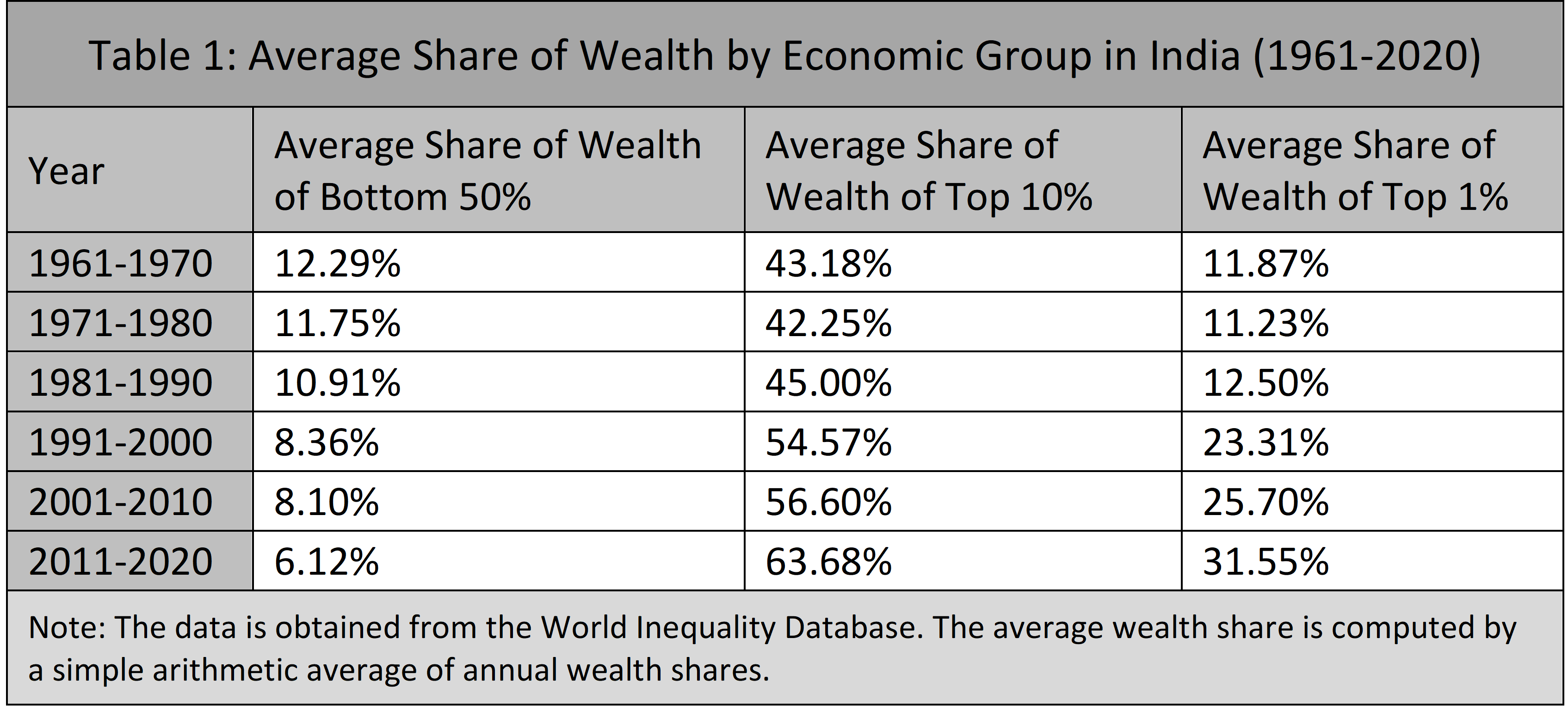
For example, data from the recently published “World Inequality Report 2022” suggests that inequality – of both income and wealth – in India kept increasing in the last few decades and that this trend has continued even in recent years. In particular, after 1990, the share of the national income of the top 10% and top 1% has consistently increased while the share of the national income of the bottom 50% has consistently declined.

The article comes with a table which makes the trend over six decades painfully clear (Gathak, 2022).

Next step is to look at the trend in bank lending in the form of retail loans and mortgages.

According to data released by RBI, the bulk of the increase in bank lending has been on account of retail loans, with credit card outstanding, consumer durables and loans against fixed deposits being the new drivers of growth in FY22.

. . . . Individuals continue to borrow for consumption even as corporations have deleveraged and paid their loans (Shetty, 2022). 

But what are the causes of this increase of indebtedness? Increased consumer optimism? Easier access to loans? Or the relative income hypothesis? This hypothesis is based on the idea that consumption patterns are related to the perception and valuation of one’s relative socio-economic position in one’s environment. It combines the desire of ‘keeping up with the Joneses’ during boom times and trying to keep up with your own previous peak consumption during downturns. The relative income hypothesis is a component of the Rajan hypothesis of causally connecting inequality with financial fragility.

Though I have anecdotal and observed evidence from the US for Rajan’s hypothesis, I am not sure how it would work out in India. The first thing to find is some correlation between increased inequality in India and increased indebtedness, and then see if causal connections can be made. But this project is too big to pursue here.

Postscript

Meanwhile in March 2023 a potentially humungous crisis was temporarily averted after two US banks went bankrupt and were taken over by different authorities. Silicon Valley Bank (SVB) in California ($209b) and Signature Bank in New York ($118b) are now the second and third biggest bank failures in US history after the record-setting failure of Washington Mutual ($307b) in 2008. Though 97% of deposits at SVB and 90% at Signature were not insured, the US government regards the crisis as a systemic risk and will guarantee all deposits in newly formed ‘bridge banks’. Throughout the crisis stock markets stayed relatively calm, but some banks took big hits with shares of Republican Bank going down 60%. The price of safe-haven gold increased about 5%.

Some Tremors in India

SVB’s troubles created also concern in India because many Indian start-ups and high-net-worth individuals have big accounts at SVB.

Indian startups that have millions of dollars stuck with the troubled Silicon Valley Bank are waiting for business hours in the US to resume Monday and could withdraw all their money from the bank en masse. The only thing that could stop that is if the US government manages to find a buyer for the beleaguered bank, founders said (Barik).

Little did anybody know that US regulators would step in with guarantees.

Ellen Brown

Again, what is next is anybody’s guess, though some of our allies in the monetary reform movement think it can be dire.

For example Ellen Brown of the Public Banking Institute warns that again we are facing the collapse of the derivatives house of cards. This time the derivatives used as a hedge against interest rate changes will come into play. She writes about “The Interest Rate Shock” which will ripple through the system.

Interest rate derivatives are particularly vulnerable in today’s high interest rate environment. From March 2022 to February 2023, the prime rate (the rate banks charge their best customers) shot up from 3.5% to 7.75%, a radical jump. Market analyst Stephanie Pomboy calls it an “interest rate shock.” It won’t really hit the market until variable-rate contracts reset, but $1 trillion in U.S. corporate contracts are due to reset this year, another trillion next year, and another trillion the year after that.

A few bank bankruptcies are manageable, but an interest rate shock to the massive derivatives market could take down the whole economy (Brown).

Steve Keen

Another warning comes form Australian economist and author Steve Keen. He blames the actions of the Fed in raising interest rates while ignoring its effects on the financial sector. He thinks that the Fed uses models in which debt, banks and money are ignored. The causal chain is that increased interest rates will diminish the value of bonds, of which many banks have massive amounts on their books.

Meanwhile, in the real world, rising interest rates on government bonds can cause banks to go insolvent. SVB was the canary in the coal mine here, but the factor that brought it undone is shared by all financial institutions, because government bonds are a major component of their assets. When interest rates rise, bond values fall, and this can drive financial institutions into insolvency—where their Liabilities exceed their Assets (Keen).

In his own Minsky Model he shows that the financial sector as a whole might get into negative equity territory if interest rates hit 5%. That is, the whole sector can go belly-up. Though he states his scenario is more hypothetical and educational than a real-world plausibility, the lesson he wants to convey is that,

It’s The Fed that deserves to be roasted instead, for attempting to manage the financial system using models that ignore banks, debt, and money.

Michael Hudson

Famed author and economist Michael Hudson addresses both of the above mentioned dangers, i.e. a) the effect of increased interest rates on the value of bonds and in turn its effect on the equity position of banks, and b) the looming danger of derivatives. On the interest rate he states that,.

Prices are plunging for bonds, and also for the capitalized value of packaged mortgages and other securities in which banks hold their assets on their balance sheet to back their deposits.

The result threatens to push down bank assets below their deposit liabilities, wiping out their net worth – their stockholder equity.

Like others, he wondered “why the Fed doesn’t simply bail out banks in SVB’s position”, but that question has just been answered by the regulators with their decisive intervention fully guaranteeing all deposits.

The issue with derivatives he thinks is the “larger elephant in the room”.

Volatility increased last Thursday and Friday. The turmoil has reached vast magnitudes beyond what characterized the 2008 crash of AIG and other speculators. Today, JP Morgan Chase and other New York banks have tens of trillions of dollar valuations of derivatives – casino bets on which way interest rates, bond prices, stock prices and other measures will change.

According to Hudson we are getting into really dangerous territory:

So far, the stock market has resisted following the plunge in bond prices. My guess is that we will now see the Great Unwinding of the great Fictitious Capital boom of 2008-2015. So the chickens are coming home to roost – with the “chicken” being, perhaps, the elephantine overhang of derivatives fueled by the post-2008 loosening of financial regulation and risk analysis.

By the way, the two above economists have written some of the most hard-hitting and provocative criticisms of how the economics discipline is mis-theorized by their peers through ignoring the role of money, banks and the money creation process. From Hudson we have J Is For Junk Economics, and Keen wrote Debunking Economics.

Alternatives

In the six years after the 2008/9 Global Financial Crisis (GFC) the monetary reform movement has attained far-reaching results in promoting breakthrough monetary theories, especially the credit creation theory of money and banking, and in proposing reform policies based on empirical findings and computer models.

Many central and commercial banks admitted the truth about money creation and through citizen’s initiatives many popular assemblies had to discuss the findings and proposals. In Switzerland it even came to a referendum.

Our ideas are still spreading and are picked up in many countries to the extent that monetary reform organizations have been started. Even so, main stream economists, politicians and policy think tanks are resisting our findings or stay blissfully ignorant of them. Hopefully this half-panic around SVB’s downfall will create questions about the current crisis-prone, unsustainable monetary system and awaken the vision that a more stable, more equitable and less indebted system is possible.

Sources

Anonymous. 2022. “Why The Banks Are Collapsing: The Coming Economic Crisis”. Moon YouTube Channel, Nov 2022.

Barik, Soumyarendra. 2023. “Indian startups with millions of dollars stuck in Silicon Valley Bank weighing en masse withdrawal”. Indian Express, 13 March 2023.

Bezemer, Dirk & Hudson, Michael. 2016. “Finance is not the economy: Reviving the conceptual distinction ”. Journal of Economic Issues, 50/3: 745-768.

Boughedda, Sam. 2022. “Nouriel Roubini, “Dr. Doom,” Expects a Severe, Long and Ugly Recession – Bloomberg”. Investing.com, 20 Sept 2022.

Brown, Ellen. 2023. “The Looming Quadrillion Dollar Derivatives Tsunami”. The Web of Debt Blog, 13 Mar 2023.

Cameron, Cooper. 2015. “6 economists who predicted the global financial crisis”. In the Black, 7 July 2015.

Gathak, Maitreesh et al. 2022. “Trends in Economic Inequality in India”.The India Forum, 19 Sept 2022.

Hudson, Micheal. 2017. J Is For Junk Economics: A Guide To Reality In An Age Of Deception. Dresden, Germany: ISLET Press. (Amazon)

Hudson, Micheal. 2023. “Why the Banking System is Breaking Up“.12 Mar 2023.

Keen, Steve. 2011. Debunking Economics: The Naked Emperor Dethroned? London: Zed Books. (Amazon)

Keen, Steve. 2023. “Silicon Valley Bank: The Fed’s Role in its Downfall”. Patreon, 11 Mar 2023.

Rajan, Raghuram G. 2006. “Has finance made the world riskier?.” European Financial Management, 12/4: 499-533. 

Rajan, Raghuram G. 2010. Fault Lines: How Hidden Fractures Still Threaten the World Economy. Princeton, New Jersey: Princeton University Press.

Roubini, Nouriel. 2022. “The Unavoidable Crash“. Project Syndicate, 2 Dec 2022.

Sharma, Samrat. 2022. “Recession is a certainty in 2023, but how much will it hurt India?” India Today, 12 Oct 2022.

Shetty, Mayur. 2022. “Individuals borrow more, corporates deleverage”. Times of India, 5 Sept 2022. 

Trading Economics. 2022. Graph of Households Debt in India in Percentage of GDP, 2009-2022. Derived from the Bank of International Settlements.

Van Treeck, Till. 2014. “Did inequality cause the US financial crisis?” Journal of Economic Surveys, 28/3: 421-448. 

Wiki entry: FTX (Company)

Yaffe-Bellany, David. 2022. “Embattled Crypto Exchange FTX Files for Bankruptcy”. New York Times, 11 Nov 2022.

Extra: https://www.visualcapitalist.com/ftx-leaked-balance-sheet-visualized/

John Titus is not up to Snuff? Or the Need for Epistemic Maturation


For several reasons I feel compelled to write this blog about some of the output of video-blogger John Titus. Titus is a prolific vlogger usually commenting on all kinds of shenanigans in the financial world. In 2012 he produced the feature-length documentary Bailout after which he became a regular commentator. He has been interviewed many times, speaks at conferences and has published some articles.

But he makes some alarming claims which are not backed by evidence. For example, he came out as a Covid-19 conspiracist, stating that “the arrival of the 2020 pandemic was about as accidental as an assassination. The pandemic narrative is nothing but a cover story to conceal from the public what in reality is the biggest asset transfer ever”[1a]. In another video he makes bizarre claims about a mainstream TV interview with a FED official [1b]. It is hard to analyze, so you have to watch it for yourself.

Recently I dove also into his presentation at the 2021 conference of the American Monetary Institute, with which I am affiliated. Its title was “Did BlackRock Originate the Federal Reserve’s Unprecedented Pandemic Response Six Months beforehand?”[2]

My analysis of that presentation is that Titus was construing a false connection between 1) a BlackRock semi-public economics paper discussing the possibility of the FED ‘going direct’, defined there as “the central bank finding ways to get central bank money directly in the hands of public and private sector spenders”[3] and b) a later instantiation of that policy by the FED during the Covid-19 emergency.

Titus tries to make us believe that BlackRock had originated this policy and even ordered the FED to implement it. Titus states at 21m (till which point the video is very instructive and even enjoyable) that the BlackRock paper “tells the FED what to do when there is another downturn” and at 31m “that it is no accident, but according to a plan”.

The two points of meaningful coincidence he mentions to back up his allegation are 1) the paper was delivered at Jackson Hole, Wyoming, at the yearly gathering of the central and commercial bank big shots in August 2019, and 2) the FED implemented the policy about six months later at the beginning of the Covid-19 pandemic. Based on this coincidence–which is not even a correlation, leave alone causation–Titus bases his conclusion that BlackRock both originated the plan and ordered its implementation.

What he overlooked, and what pulls pretty much the rug out from his origination and coerced implementation thesis, is that ‘going direct’ and its close cousin ‘helicopter money’ have been discussed far and wide and comes up almost automatically when there is some financial crisis happening.

The media seems awash with talk about rotary flight – the ‘helicopter money’ or ‘helicopter drop‘ of Milton Friedman and Ben Bernanke fame.

This was stated by Oxford Professor of International Economics Roger Baldwin in 2016 in a paper with an overview of economists’ views of ‘going direct’ [4].

And some monetary reformers look at it like a possible step towards a sovereign money system [5,6]. Thomas Mayer, of the Swiss institute Flossbach von Storch Research Institute with sympathies for monetary reform, stated,

Helicopter money would facilitate the change-over from our present credit money system to an alternative money system, in which money is no longer created as private debt but as an asset backed by the reputation of the issuer. Crypto money technology would be well suited for the creation of and payments with reputation money.

And all these papers, including BlackRock’s, not only overlap in their policy proposals, but also in their analyses of the very minimal monetary policy space left for monetary authorities since the 2007 Global financial Crisis, which would justify the unusual policy.

Titus’ construal however–interpreting the policy as a novelty imposed on the FED–is based on unacceptable cherry-picking of just two events (the BlackRock paper and The FED policy), severely de-contextualizing the situation, then insinuating suspicious shenanigans, all laced with an entertaining “gotcha” element.

Titus does have a case in pointing out the entanglement between BlackRock and the FED, creating a big conflict of interest, either real or perceived. But he unnecessarily undermines this alarming fact by framing it in a highly speculative, conspiratorial set-up.

Given the frequency of Titus’ defective analyses I would conclude with the two following points, one of which is about research strategy and the second about the relationship between the monetary reform movement and researchers like Titus.

First, similar to my advise on how to use Wikipedia and conspiracist sources, if Titus (or Wikipedia or a conspiracist) makes a plausible claim, go to the source provided and engage the source itself. And if the material pans out and you get into a debate, refer to the source, not Titus, not Wikipedia nor any conspiracist.

Second, if the movement for just money aspires to applying the highest epistemic standards in making its case to the public, academia and the policy formation community, we have to keep our distance from researchers who mix too many unsubstantiated conspiracist claims into their discourse, as good and informative their non-speculative material might be.

But not all is lost. Many researchers started out in conspiracist or religionist circles and extracted themselves from such and learned to apply higher, epistemic standards to their output. And you would be surprised to find out the many to whom that might apply. Personally speaking, ‘been there, done that’, and left on my old web site the evidence for all to see and remind myself of my own jagged arc of epistemic maturation.

Govert Schuller
Shillong, Sept 2022

Sources

[1a]. Titus, John. 2020. “Summary – Going Direct Reset”. The Solari Report.

[1b]. Titus, John. 2020. “Presenting The Federal Reserve Script for Totalitarianism”. Best Evidence channel on YouTube, 20 April 2020.

[2]. Titus, John. 2021. “Did BlackRock Originate the Federal Reserve’s Unprecedented Pandemic Response Six Months beforehand?” AMI channel on YouTube, 24 Nov 2021.

[3]. Bartsch, E., Boivin, J., Fischer, S., Hildebrand, P., & Wang, S. 2019. “Dealing with the next downturn: From unconventional monetary policy to unprecedented policy coordination“. Macro and Market Perspectives, 105: 1-16.

[4]. Baldwin, Richard. 2016. “Helicopter money: Views of leading economists.” Voxeu.org, 13.

[5]. Mayer, Thomas. 2016. “From Zirp, Nirp, QE, and helicopter money to a better monetary system.” Flossbach von Storch Research Institute, Economic Policy Note 16.3 (2016): 2016.

[6]. Jourdan, Stan & Lonergan, Eric. 2016. “Citizens’ Monetary Dividend: Upgrading the ECB’s toolkit”. Quantitative Easing For People, Policy Brief, September 2016. 

Monetary Reform: Simple Spiel


What monetary reform is all about is to promote a bill that has already been drafted in various formulations here in the USA. One in the 1930s and one in 2012. And it concerns a radical change in the current monetary system.

In western countries, the proportion of bank money is about 93-97%. If everyone were to pay off their debt, only a very small amount of money would remain (3-7%).

What most people, including bankers and economists, do not understand is that the money supply comes from banks issuing credit. Most people think that if you borrow for example $200,000, a bank already has that money in the form of deposits from other customers (or equity), and then passes that amount on to the borrower. Not so. The bank creates credit as debt which ‘circulates’ in the economy as if it were money. And when you pay off your loan, the principal is written off, and the money supply decreases (sort of destroying that money). The interest goes into the pocket of the bank.

This sounds counter-intuitive, but this phenomenon has long been known to some economists, sociologists, historians, politicians and critics. Only a few see the consequence that an economic article of faith, i.e. investments follow from savings, is incorrect. The savings are the result of bank lending.

The credit-based monetary system is inherently unstable. If the bank debts are not paid properly, the bank money loses its backing. The government must then help. In this system, the greatest concern is that everyone continues to pay their debts properly. However, debt levels have become unsustainable. In a non-commercial monetary system, this could be easily solved, by putting extra cash into circulation with which to pay off debts. However, the current credit-based monetary system focuses on commercial exploitation. In that system, no debts can be canceled and no money can be given away “for nothing.” Within this commercial system, unsustainable debts will have to be addressed through inflation. This prevents the loss generated by the rickety monetary system from ending up with the banks. The public and society are left with the tab. That is unnecessary and perverse. Hence, I am recruiting you to promote a monetary system that serves society, rather than the oligarchy that exploits it for its convenience.

The very dangerous side of this system lies in the short-term thinking of the banks. Most people expect banks to be prudent, but they are not. Too many loans when things are going well in a boom, and too few during a bust. As a result, the money supply and the economy fluctuate like a yo-yo with repeated financial crises and dramatic consequences for the citizen.

Some even think that this ‘invention’ of bank money is the semi-secret engine of imperialist capitalism and is pushing the world to its doom. All this bank money is manically looking for returns and just waltzes over citizens, governments and nature in search of the greatest possible profit.

What we are now proposing is a system of sovereign, stable money that is issued by the state and managed by a monetary authority. Banks are no longer allowed to create money themselves and will finance their loans with either their own capital, raised capital or savings.

And the monetary authority then has the responsibility to ensure that enough money flows through the economy such that neither inflation nor deflation takes place. And a growing and stable economy thus needs a proportional increase in the money supply, which is calculated by the monetary authority and then gives Congress the green light to spend it democratically as debt-free money.

According to economic analyses and computer models, this system has the advantage that bank runs will no longer take place, the economy is more stable, economic inequality decreases, and that public debt and debt in general will decrease. And because the state now (again) has the right to be the first to spend new money, and it can do this democratically, there is much more leeway to tackle the major social problems. The austerity mindset can be lifted and society can be freed from the political power and malignant priorities of the banking system. Banks naturally have a social function, such as evaluating the creditworthiness of citizens and companies, but they are no longer allowed to run the monetary system.

The monetary system should be seen as a utility company and history provides many examples that the state can do this better than private institutions.

In the Netherlands, our sister organization is called Ons Geld (Our Money) and has put this subject on the political agenda through a citizens’ initiative and with the help of the theater group De Verleiders (The Seducers) and their play Door de Bank Genomen (Taken by the Bank). The political process is a bit slow, but they continue to work towards a socially responsible monetary system.

____________

This blog was written originally in Dutch to explain friends and family there why I took the job of managing director of the Alliance For Just Money in december of 2020. I checked the piece with Edgar Wortmann for grammar and content and then translated it into English. That’s why it might not flow as it could if I’d had it written in English in the first draft and why there is this reference at the end to Dutch monetary reform efforts only.

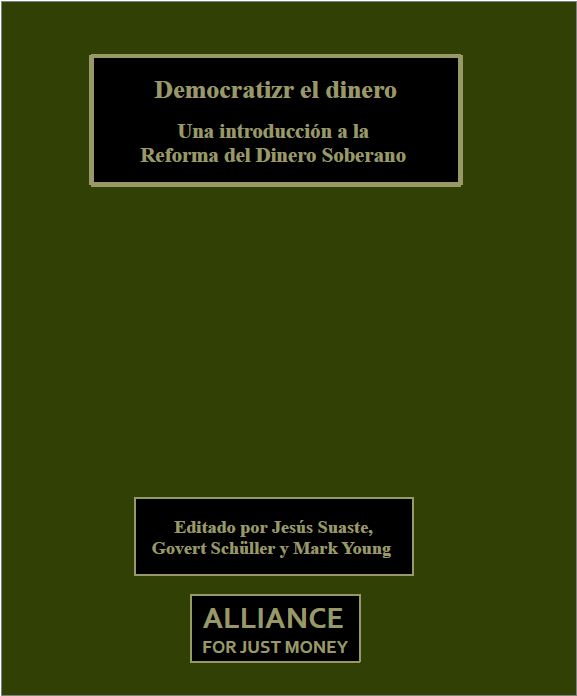
Launch Announcement of Democratizar el Dinero


The Alliance For Just Money is excited to have stepped into the publishing business by releasing a Spanish anthology of a dozen translations of high quality articles on the latest findings in monetary theory and on ongoing improved reasons for real monetary reform.

The title is Democratizar el Dinero. Una introducción a la Reforma del Dinero Soberano (Democratizing Money: An introduction to Sovereign Monetary Reform) and is available in print, as a downloadable pdf, and as an audiobook (forthcoming).

One of the Alliance’s goals is to ensure that all nations and ethnic groups, regardless of language, understand the importance of monetary reform, especially those countries and populations that have the most to benefit from a reform of our monetary system for their nations and citizens.

A special thanks goes to Jesús Suaste Cherizola for helping us to achieve this very important goal. The essays translated for this publication were selected to give the reader of broad overview of the history, problems, solutions and obstacles associated with our current system and reforming it for the benefit of all people.

Please enjoy the articles in Spanish by purchasing the book or downloading the pdf version, or read the original articles in English. The book’s landing page has all the relevant links.

Please visit our website here and our social media platforms on Facebook and Twitter @AllianceJust. Although the website resources are in English the website can be viewed in Spanish be utilizing the translate function on your mobile device or PC. You can also contact the International Movement For Monetary Reform (IMMR) at this address if you are interested in more information on monetary reform or interested in taking action in your community.

And remember that anything physically possible, ecologically wise, and socially desirable is also financially feasible.

Triple-column Comparison

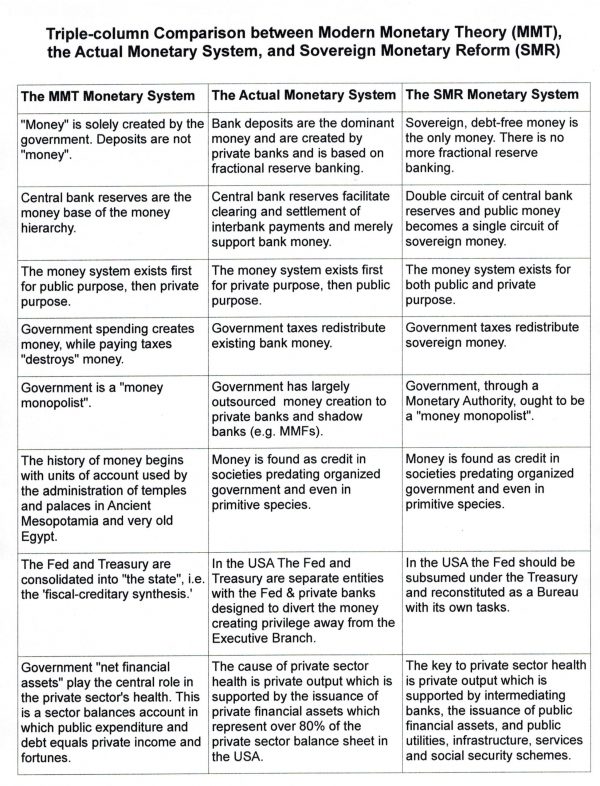
Triple-column Comparison between Modern Monetary Theory (MMT), the Actual Monetary System, and Sovereign Monetary Reform (SMR)


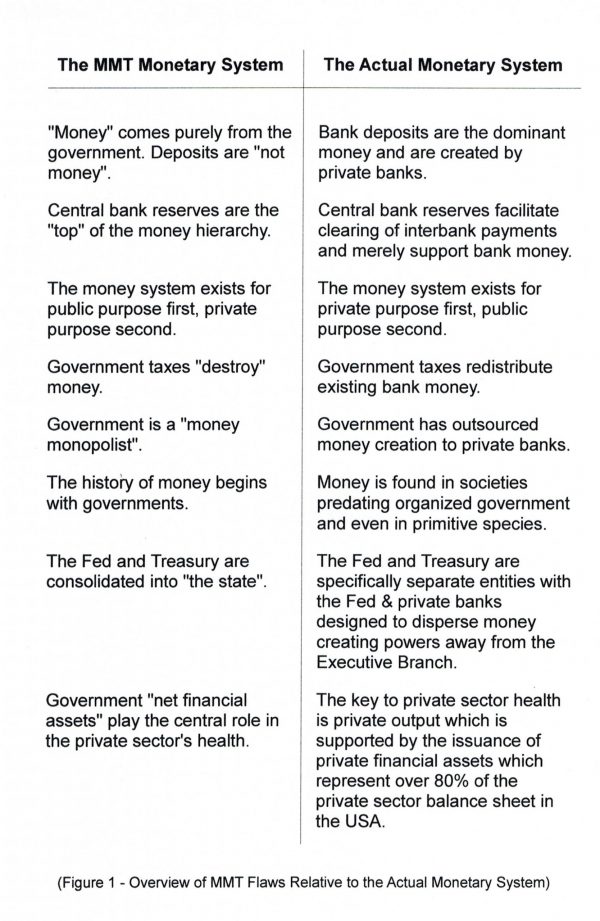
A while ago I found a very useful double-column comparison of the concept of the monetary system in Modern Monetary Theory (MMT) and how the monetary system actually functions. The figure is titled:

“Overview of MMT Flaws Relative to the Actual Monetary System”

It is a small image easily used on-line in posts and discussions and was composed by Cullen Roche in a 2013 article titled “A Critique of Modern Monetary Theory (MMT)“. Roche is the author of Pragmatic Capitalism: What Every Investor Needs to Know About Money and Finance and editor of the eponymous web site Pragmatic Capitalism.


Recently I had the idea to expand the double column into a triple one by adding the ideas and proposals by the movement proposing Sovereign Money Reform (SMR) based on what Dr. Joseph Huber calls New Currency Theory (NCT). With some help the entries were refined, corrected or paraphrased. The result is the following triple column.

I am presenting it here for anybody to use as an educational tool in the discussion about the deep flaws of MMT in order to 1) promote what we think is the correct theory of money and banking and 2) promote the necessary legislative changes which are needed to redress the deep systemic flaws of the current money regime.

To be clear, what we propose is the following triple-pronged policy proposal, which can be found on the web site of the International Movement for Monetary Reform:

We propose a transition towards a sovereign money system in which:

All official money – be it cash, money-on-account or new forms of digital currency – is created by a monetary state authority, according to the needs of the economy in a transparent and accountable process.

Money is created free of debt, and is directly spent into the economy via the state by way of government expenditure or directly distributed to the citizens as an equal dividend.

Private banks cannot create official money as credit. They only act as payment service providers and/or financial intermediaries by lending and investing existing official money, which they obtain from savers and investors.

This proposal of course is quite different of what proponents of MMT propose and that is government spending on worthy causes like the Green New Deal by allegedly creating new money and do so till the ‘slack’ is out of the economy and inflation might set in. We think that, based on our understanding how the system currently works, 1) this will lead to deficit spending because spending still has to be compensated through taxes and bonds, and 2) it unconscionably neglects to deal with the issue of money creation in the hands of private commercial banks and its disastrous consequences.

Meanwhile the American people already have a bill on the shelf to implement sovereign monetary reform and it is the 2012 H.R. 2990, the National Emergency Employment Defense Act or NEED Act. With some tweaking this bill can be adopted to solve a large chunk of the severe financial challenges the US Congress is facing to prevent the economy from collapse and citizens from bankruptcy and eviction, all in the context of the COVID-19 pandemic. Once you understand the current monetary system, one cannot but see its solution in sovereign monetary reform.


More critical posts on MMT:

Requesting Evidence for a Crucial MMT Claim

Richard Wolff’s Trajectory beyond MMT into SMR

Introduction to the Problem with Modern Monetary Theory (MMT)

Money and Banking: Assessing overlaps and differences between SMR and MMT

Modern Money Theory revisited – still the same false promise

Educational and Promotional Videos


VIDEOS ON MONETARY THEORY AND REFORM


A. TOP 12 Videos
B. Videos Produced in the Monetary Reform Movement
C. Other Monetary Theory and Reform Videos of Interest
D. Background Videos


A. TOP 12 VIDEOS

Bjerg, Ole. 2016. “Where does money come from?“ TEDxCopenhagen. 24 May 2016.

Bongiovanni, Joe. 2013. “Why Monetary Reform Must Become Your Number One Issue“. Argusfest on YouTube. 29 Sept 2013.

Dyson, Ben. 2014. “Why Our Monetary System Is Broken and How It Can Be Fixed“. Presentation at the Economy, People and Planet conference at the Copenhagen Business School (CBS). Positive Money on YouTube. 1 Oct 2014.

Grant, Victoria. “12 year old child reveals one of the best kept secrets in the world”. Public Banking Institute. 5 May 2013.

Hammon, Virginia. 2019. “How We Can Pay for a Better World: Change the Money System“. How We Pay for a Better World. YouTube. 30 Aug 2019.

Hammon, Virginia. 2020. “A Solution to the Crisis – Just Money Now!“. How We Pay for a Better World. YouTube. 21 July 2020.

Kucinich, Dennis. 2012. “The Key to Economic Recovery; Kucinich Explains Monetary Reform”. DJ Kucinich on YouTube. 8 May 2012.

Positive Money. 2011. “A Simple Solution to the Debt Crisis“. Positive Money on YouTube. 13 Aug 2011.

Positive Money. 2013. “What Is Money?“. Positive Money on YouTube. 13 May 2013.

Positive Money. 2013. “10 year old explains the truth about where money comes from…” Positive Money on YouTube. 4 Sep 2013.

Wolf, Martin. 2014. “Case for Radical Monetary Refrom“. Keynote speech at “Bridging Theory and Practice” conference organized by the Sustainable Finance Lab, Amsterdam, 14 Dec 2016. Sustainable Finance Lab on YouTube. 16 Oct 2018. (Accompanying slides)

Zarlenga, Stephen. 2009. “Nationalize the Fed: End Banks Power to Create Money”. Recorded 2 May 2009. YouTube. 22 June 2009.


B. VIDEOS PRODUCED IN THE MONETARY REFORM MOVEMENT

American Monetary Institute. Collection of Videos. American Monetary Institute on YouTube.

Boait, Fran. 2013. “How the current money system is damaging Businesses, Society and Environment“. Presentation at the Positive Money Conference, January 2013. Positive Money on YouTube. 22 Mar 2013.

Boait, Fran. 2014. “How does the money system affect Inequality, Housing & Environment?“. Positive Money on YouTube. 21 Dec 2014.

Bongiovanni, Joe. 2013. “Why Monetary Reform Must Become Your Number One Issue“. Argusfest on YouTube. 29 Sept 2013.

Bongiovanni, Joe. 2014. “Why Should GUV Borrow? Who Controls the Money?“. Economic Stability on YouTube. 25 Jan 2014.

Bongiovanni, Joe. 2017. “On Public Money: Thoughts on our Monetary Sytem, and our History of Public Money“. Presentation at the 2017 “Democracy Convention”, Minneapolis, MS. AMI on YouTube. 9 Aug 2017.

Chalmers, Patrick. 2013. “Why doesn’t the Media understand Money?“. Presentation at the Positive Money Conference, January 2013. Positive Money on YouTube. 22 Feb 2013.

Chick, Victoria. 2013. “Why don’t Economists understand money?” Presentation at the Positive Money Conference, January 2013. Positive Money on YouTube. 6 Mar 2013.

Coates, Delman. 2016. “The New Abolitionism: Monetary Reform and the Struggle for Human Rights “. Presentation at the 12th AMI Conference, Chicago, September 2016. AMI on YouTube. 12 Oct 2016.

Coates, Delman. 2017. “The New Abolitionism: Monetary Reform and the Future of Social Justice”. Presentation at the 2017 Democracy Convention, Minneapolis, MS. AMI on YouTube. 9 Aug 2017.

Dyson, Ben. 2012. “Power of Banks vs Democracy“. Positive Money on YouTube. 24 Oct 2012.

Dyson, Ben. 2013. “How to Fix Banking“. Presentation at the Positive Money Conference, January 2013. Positive Money on YouTube. 19 Feb 2013.

Dyson, Ben. 2014. “Why Our Monetary System Is Broken and How It Can Be Fixed“. Presentation at the Economy, People and Planet conference at the Copenhagen Business School (CBS). Positive Money on YouTube. 1 Oct 2014.

Eckrich, Lucille & Walsh, Steven. 2017. “Money, Schooling and Educators: Creating a Critically-Informed Movement for Monetary Reform and Ecojustice“. Presentation at the 2017 Democracy Convention, Minneapolis, MS. AMI on YouTube. 9 Aug 2017.

Eder, Jeff. 2020. “Banking for a Better World“. Progreessive Money Canada. 6 Sep 2020.

Egnatz, Nick. 2016. “On Social Justice through Monetary Reform”. Presentation at the 11th AMI Conference, Chicago, September 2015. AMI on YouTube. 27 Jan 2016.

Hammon, Virginia. 2019. “How We Can Pay for a Better World: Change the Money System“. How We Pay for a Better World. YouTube. 30 Aug 2019.

Hammon, Virginia. 2020. “A Solution to the Crisis – Just Money Now!“. How We Pay for a Better World. YouTube. 21 July 2020.

Huber, Joseph. 2016. “How The Money System Works“. Presentation at the American Monetary Institute Conference, 2016. American Monetary Institute on YouTube. 16 Dec 2016.

Kucinich, Dennis. 2012. “The Key to Economic Recovery; Kucinich Explains Monetary Reform”. DJ Kucinich on YouTube. 8 May 2012.

Kucinich, Dennis. 2009. “Dennis Kucinich addresses AMI Monetary Reform Conference Participants 2009“. Presentation at the 5th AMI Conference, Chicago, September 27, 2009. AMI on YouTube. 13 Oct 2009.

Kucinich, Dennis. 2010. “Dennis Kucinich 5 Minutes on Money on House Floor”. AMI on YouTube. 16 Aug 2010.

Kucinich, Dennis. 2010. “Dennis Kucinich speaks on the American Monetary Act in House of Representatives – Part 1”. AMI on YouTube. 8 June 2010.

Kumhof, Michael. 2019. “Banks are not Intermediaries of Loanable Funds“. Positiva Pengar on YouTube. 13 July 2019.

Positive Money. Collection of Videos. Positive Money on YouTube.

Positive Money. 2011. “A Simple Solution to the Debt Crisis“. Positive Money on YouTube. 13 Aug 2011.

Positive Money. 2012. “House Prices: Why are they so high?“. Positive Money on YouTube. 18 Sept 2012.

Positive Money. 2012. “Why is there so much Debt?“. Positive Money on YouTube. 24 Oct 2012.

Positive Money. 2013. “What Is Money?“. Positive Money on YouTube. 13 May 2013.

Positive Money. 2013. “Inequality: Why are the rich getting richer?“. Positive Money on YouTube. 2 Aug 2013.

Positive Money. 2013. “10 year old explains the truth about where money comes from…” Positive Money on YouTube. 4 Sep 2013.

Positive Money. 2014. “Could These 3 Simple Changes to Banking Fix the Economy?” Positive Money on YouTube. 16 Jan 2014.

Positive Money. 2014. “How to waste £445 billion? (The Failure of Quantitative Easing)“. Positive Money on YouTube. 27 June 2014

Positive Money. 2014. “Banking 101“. 6 Videos. Positive Money on YouTube. 30 June 2014.

Positive Money. 2019. “It’s the banks, stupid“. Positive Money on YouTube. 8 Aug 2019.

Melor, Mary. 2010. “Money is Us: The Social and Public Nature of Money“. Presentation at the Positive Money Student Conference on Monetary Reform and Fractional Reserve Banking. In three parts. Positive Money on YouTube. 14 Dec 2010.

Morris, Miriam. 2013. “How to change the money system“. Presentation at the Positive Money Conference, January 2013. Positive Money on YouTube. 12 Mar 2013.

Poteat, Robert. 2010. “The Case for Monetary Reform“. Presentation at the 6th Annual AMI Conference, Chicago, September 2010. AMI on YouTube. 14 Oct 2010. [Not complete]

Switzer, Howard. 2017. “Climate Change and Money: Hacking at the Root“. Presentation at the 2017 Democracy Convention, Minneapolis, MS. AMI on YouTube. 14 Aug 2017.

Turner, Aidar. 2015. “A new era for monetary policy“. Positive Money on YouTube. 17 Feb 2015.

Walton, Jamie et al. 2017. “On Public Money: The Need Act“. Presentation at the 2017 Democracy Convention, Minneapolis, MS. AMI on YouTube. 26 Aug 2017.

Zarlenga, Stephen. 2009. “Nationalize the Fed: End Banks Power to Create Money”. Recorded 2 May 2009. YouTube. 22 June 2009.

Zarlenga, Stephen. 2010. “AMI’s Purpose, Objectives and Methodology“. Presentation at the 6th Annual AMI Conference, Chicago, September 2010. AMI on YouTube. 13 Oct 2010.

Zarlenga, Stephen. 2010. “Introduction to The American Monetary Institute “. AMI on YouTube. 4 Jan 2010.


C. OTHER MONETARY REFORM AND THEORY VIDEOS OF INTEREST

Altraide, Dagogo. 2017. “Who Controls All of Our Money?“. ColdFusion on YouTube. 11 June 2017.

Altraide, Dagogo. 2020. “How is Money Created? – Everything You Need to Know.”. ColdFusion on YouTube. 8 June 2020.

Anon. “Solutions Unincorporated – My Name Is William”. Interview with William Abram. D See Video Productions. 4 Feb 2013.

Anon. 2012. “Where does money come from? Waar komt geld vandaan? Var kommer pengarna ifrån?” Vastgoedzeepbel, 21 Nov 2012. .

Anon. 2013. “Hitler finds out how money is created“. Ville livarinen. 18 Sep 2013.

Bjerg, Ole. 2016. “Where does money come from? “ TEDxCopenhagen. 24 May 2016.

Brown, Ellen. 2016. “Taking Back the Money Power: The Public Option in Banking“. (Q&A). Argusfest on YouTube. 13 Nov 2016.

Bruce, Jim. 2013. “Money for Nothing: Inside the Federal Reserve“. Liberty Street Films. 7 June 2013.

Conference videos: The Future of Money – 10 years after Lehman and Nakamoto. November 2018, Frankfurt, Germany. Frankfurt School of Finance and Management.

Conference videos: The Future of Money – Central Bank Digital Currency and Beyond. 15 June 2019, Stockholm, Sweden. Positiva Pengar

Corbett, James. 2014. “Century of Enslavement“. The Corbett Report. 11 July 2014.

Dalio, Ray. 2013. “How The Economic Machine Works“. YouTube, 22 Sept 2013.

Desan, Christine. 2011. “Booms and Busts: The Legal Dynamics of Modern Money “. OpenCulture.com, 12.

Desan, Christine A. 2013. “Modern Money & Public Purpose 5: Constitutional History ”. Presentation at seminar, “Money, Democracy and the Constitution: Revolutionary Experience in the United States”. Modern Money Network. 16 Mar 2013.

Desan, Christine. 2017. “The Dollar as a Democratic Medium: Making Money a Currency of Social Justice ”. HLS Thinks Big, 23 May 2017.

Graeber, David. 2017. “Where Did Money Really Come From? ”. YouTube. 17 Oct 2017.

Grant, Victoria. “12 year old child reveals one of the best kept secrets in the world”. Public Banking Institute. 5 May 2013.

Horwath, Mike & Oswald, Michael. 2012. “97% Owned – Economic Truth documentary – How is Money Created “. Documentary. Independent POV. YouTube. May 1 2012.

Huber, Joseph. 2018. “Vollgeld – Yes, Implementing a Sovereign Money System“. Presentation at “Our Money, Our Banks, Our Country – Money Creation in the Modern Economy” conference by The Monetary Institute, Zürich, February 2018. The Monetary Institute on YouTube. 23 April 2018.

Klein, Manuel et al. 2018. Conference videos and papers. Berlin, Germany: Monetative. 24 Nov 2018.

Kotlikoff, Larry. 2018. “Why I Support Sovereign Money“. Presentation at “Our Money, Our Banks, Our Country – Money Creation in the Modern Economy” conference by The Monetary Institute, Zürich, February 2018. The Monetary Institute on YouTube. 23 April 2018.

Kumhof, Micheal. 2013. “The Chicago Plan Revisited “. London School of Economics and Political Science (LSE). 22 Nov 2013.

Monetary Institute. Collection of Presentations. From “Our Money, Our Banks, Our Country – Money Creation in the Modern Economy” conference by the Monetary Institute, Zürich, February 2018. The Monetary Institute on YouTube.

Niepelt, Dirk & Rimkus, Ron. 2016. “Contemplating the End of Fractional Reserve Banking in Switzerland”. CFA Institute.

Orrrefur, Samuel K. et al (Eds.). 2019. “The Future of Money: Central Bank Digital Currency and Beyond “. Conference videos. Stockholm: Positiva Pengar. 15 June 2019.

Oswald, Michael. 2014. “Princes of the Yen: Central Banks and the Transformation of the Economy”. Documentary. Independent POV. YouTube. 4 Nov 2014.

Oxley, James. 2014. “Money creation in the modern economy – Quarterly Bulletin Article”. Bank of England on YouTube. 12 Mar 2014.

Oxley, James. 2014. “Money in the modern economy: An introduction – Quarterly Bulletin Article”. Bank of England on YouTube. 12 Mar 2014.

Permanent Commission on Finance. 2015. “Round table conversation on the money system“. Hearing at the Permanent Commission on Finance of the Second Chamber of the States General of the Netherlands. Troelstra Hall. 14 Oct 2015.

Public Banking Institute. Collection of Videos. Argusfest on YouTube.

Rosenblith, Alan. 2009. “The Money Fix – A Documentary for Monetary Reform ”.

Still, Bill. 2013. “Jekyll Island: The Truth Behind The Federal Reserve“. YouTube, 7 April 2018.

Titus, John. 2019. “Mommy, Where Does Money Come From?“. BestEvidence on YouTube. 15 April 2019.

Vollgeld Initiative & Studierende für die Freiheit & Hayek Club. 2017.“Monetary reform and the future of money”. Panel discussion at the University of Zürich.

Vrabel, Damon. “Renaissance 2.0 – the Rise of Financial Empire”. csper.org. 9 Jan 2012.

Vrabel, Damon.”Debunking Money – The Way the World Really Works”. csper.org. 10 Jan 2012.

Werner, Richard. 2018. “Today’s Source of Money Creation“. Presentation at “Our Money, Our Banks, Our Country – Money Creation in the Modern Economy” conference by The Monetary Institute, Zürich, February 2018. The Monetary Institute on YouTube. 23 April 2018.

Wortmann, Edgar. 2015. “Verkenning van de monetaire werkelijkheid [Exploring Monetary Reality]”. In English. Presentation at the University of Leiden. In two parts. (part 1); (part 2).

Wolf, Martin. 2014. “Stop banks from creating money“. Presentation at “Does Money Grow on Trees?” event, 9 Sept 2014. Positive Money on YouTube. 14 Oct 2014.

Wolf, Martin. 2014. “On Radical Reform for the Global Financial System“. Presentation at the New York Council on Foreign Relations, 17 Oct 2014. Council on Foreign Relations on YouTube. 17 Oct 2014.

Wolf, Martin. 2014. “Case for Radical Monetary Refrom“. Keynote speech at “Bridging Theory and Practice” conference organized by the Sustainable Finance Lab, Amsterdam, 14 Dec 2016. Sustainable Finance Lab on YouTube. 16 Oct 2018. (Accompanying slides)

On Money: The Libra versus Sovereignty

A US-based progressive monthly, The Nation, just published an article about the Libra by MMT enthusiast Rohan Grey, titled:

“Facebook Wants Its Own Currency. That Should Scare Us All. Instead of embracing Facebook’s Libra, we should be rallying for a public option for digital currency.”

This is an interesting article and deserves close scrutiny for several reasons. First of all it sounds the alarm about this proposal by a group of transnational corporations led by Facebook to capture the privilege of issuing currency at the expense of sovereign, public institutions. For Democrats, he observes,

. . . the core issue is the ever-greater concentration of economic power in the hands of private actors who lack any meaningful commitment to democratic values.

Secondly, and as a direct effect of this concern, citizens will have to think seriously about what money is; where it comes from; the advantages and disadvantages of the current system; and what reforms are possible and needed to prevent a wholesale kidnapping of our money system.

For better or worse, Libra has brought monetary reform to the forefront of our collective consciousness, and made it impossible to ignore.

The third point is the author’s own extensive list of possible changes, which is blind to the most obvious solution. He commendably mentions bank accounts at postal banks to service the un- and under-banked, and the introduction of digital cash. But, while he refers to the Bank of England’s seminal 2014 paper on how commercial banks create most of our money supply, he merely proposes to regulate that practice and not bring it back under democratic control. He ignores the solution presented by sovereign money advocates who are actively fighting for returning money to democratic control.

The fourth point is that the author of this article, Rohan Grey, is highly sympathetic to modern monetary theory (MMT), which is an amalgamation of economic theories and incorrect assertions. For sovereign monetary reformers, a very curious aspect of MMT is that it correctly embraces the credit theory of money creation, i.e. banks create 90-95% of what we use as money through extending loans, but it is strangely oblivious to the disastrous effects and possible remedies of that privatized money creation system. This MMT sympathy would explain why the author is in favor of digital cash but not necessarily of nationalizing the money supply, which would remove the current privilege of private commercial banks to create our money supply.

We are in agreement with MMT’s opposition to a corporate owned and controlled money system such as Libra and will work with them to oppose this development and promote public digital cash. However, we strongly disagree with MMT’s desire to keep the existing privately-created debt-money supply intact, because it is dysfunctional. Leaving the current money system in place and supplementing it with some changes in banking does not solve the deeper systemic problems of inequality, injustice, and an unsustainable economy. Upgrading from privately created debt-money to publicly created asset money is the best long-term solution. Why does MMT ignore this solution?

The author closes the article with arguably the best observation made on the Libra.

Libra, then, represents the preemptive privatization of a global public monetary layer that does not yet exist: a neoliberal corporatist’s wet dream.

Global Problems and the Culture of Capitalism


Introduction

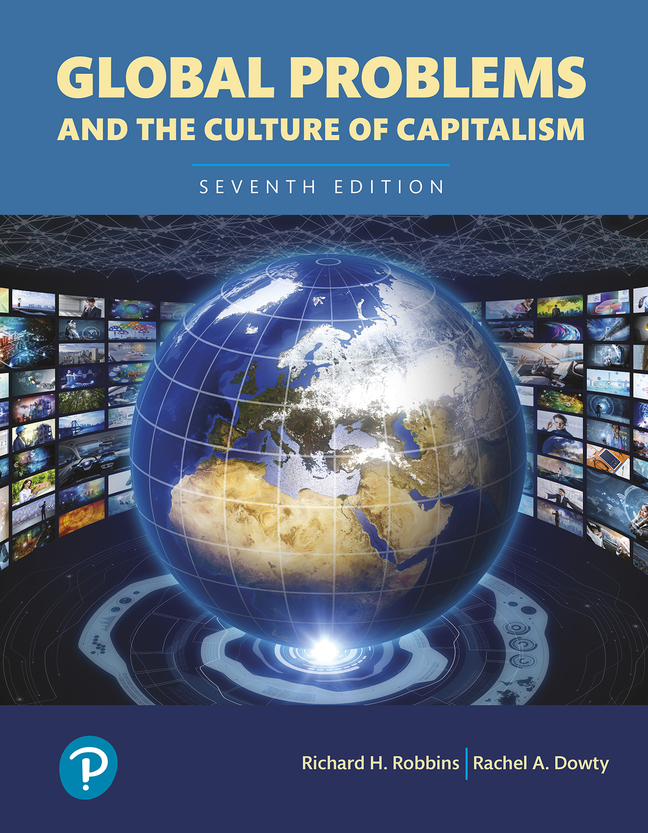
In 2011 I took a sociology class on global social problems. Three texts were required and one of them, Global Problems and the Culture of Capitalism by Richard Robbins, stood out in several ways. The book was very rich in information with many on-the-ground narratives. It had a simple but effective overarching theory; it addressed the issue of money creation, something I was already familiar with through Stephen Zarlenga and the American Monetary Institute. And it offered many interesting references I wanted, and did, pursue.

Of all the textbooks on economics, political science, history and sociology, this one counts for me as one of the best and most impactful ones during my crawl through college. And I am certainly not alone in assessing the book’s value. Though originally written in 1999 it went through seven editions, the latest in 2018, and has been translated into Polish, Korean, Chinese and Arab.

Tim Di Muzio

Now, many years later I dug into the work by the Canadian academic Tim Di Muzio and especially liked his book Debt as Power in which the destructive impact of the our debt-money capitalist regime is systemically addressed. There was a co-author involved. Last week we hosted Di Muzio on our Monetary Coffee House meeting and he shared that his foray into debt-money had more or less started with reading a book on global problems and that he had contacted its author.

A few hours later, while composing an e-mail about the sources mentioned in our meeting, did it dawn on my thick skull that the book Di Muzio referred to was Global Problems, the very same I had studied, and that its author Richard Robbins was also his co-author of Debt as Power! This put the book in a new light and I pulled out my old, underlined and annotated copy of Global Problems to give some passages another read.

Money

One of the foundational sections in the book is titled “A Primer on Money: The Philosopher’s Stone”. On Amazon you can read it as part of the “Look inside” feature on pages 4 to 11. Around page 100 (depending on the edition) one can read the basic idea reiterated:

We generally assume that governments create money by printing it. And, in fact, when money was linked to gold, there was a limit on how much could be printed. However, with the lifting of these restrictions, most money is now created by banks and other lending institutions through debt. We generally assume, also, that the money that banks lend is money that others have deposited.

However, that is not the case; only a fraction of the money that banks lend needs to be in deposits. In effect, whenever a bank lends money, or whenever a product or service is purchased on credit, money has been created. In effect, then, there is virtually no limit on the amount of money that lending institutions can create; furthermore, the interest on the loan payments creates yet more money. Economists call this debt money (Rowbotham 1998:5), or credit money (Guttmann 1994).

Though some parts of this quote could be calibrated for accuracy, the basic theory is there. Most of what we use as money is debt-money created by banks when they extend loans. 

Forced Money Growth

The main thrust of the textbook is to provide empirical flesh to the following, skeletal mechanism. When banks create loans and charge interest, they do not create the money to pay off the interest. This pushes the system into finding ways to grow the money supply by making ever more loans extended to consumers and businesses. And they need to find ever more ingenious ways to create or find things and services to be sold.

In other words, the money supply must grow if the economy is to remain healthy, and for the money supply to grow there must be a steady increase in the things or services that money can buy (4th edition, p. 11).

To keep the system going, Robbins argues,

. . . there must be a constant conversion of things that have no money value into things that do–that is, there must be constant commodification.

And the maintenance and global spread of this impetus is not without problems. On the contrary, Robbins argues that many if not most global problems can be traced back to the blind and iron logic of perpetual growth and commodification. But that is not something necessarily acknowledged by its beneficiaries living in the privileged zones at the core of the world-system.

Robbins challenges this blind spot and actually in the third part of the book addresses the resistance and rebellion against the culture of capitalism by workers, feminists, ecologists, minorities, indigenous people and other citizen-activists engaging in “antisystemic protest”.  

Solutions

As far as solutions to this impetus is concerned Robbins discusses a wide spectrum of possibilities. And the ones relevant to monetary reform are the reassessment of  perpetual economic growth as an index of a nation’s well-being and look for alternative indices and goals. And, more explicitly, Robbins sees “Zero Economic Growth” as a valid prospect and agrees with David Korten’s proposal to:

Make the creation of national currencies a public function, rather than allowing banks and other financial institutions to increase the money supply through debt (405).

This is also what the Alliance for Just Money proposes in its promotion of the NEED Act, which boils down to the following three basic and interconnected fundamental changes:

1. Require Congress to exercise its Constitutional power to be the sole creator of all U.S. money, issued debt-free, and to establish a transparent and independent public monetary authority to determine the amount of new money the Treasury will disperse under authority of Congress.

2. End the privilege of commercial banks to create and issue what we use as money.

3. Transfer ownership of the 12 Federal Reserve Banks, and all remaining operations of the Federal Reserve System, to the U.S. Treasury. 

In closing I like to reiterate that Robbins’ Global Problems and the Culture of Capitalism is a great starting point to study the connection between debt-money and global problems.  Also that the books co-authored with Di Muzio will only deepen the understanding of this connective tissue and add to the motivation towards, and see the possibilities of, structural reform.

Stay tuned for more from Richard Robbins and Tim Di Muzio.

Sources

Robbins, Richard & Rachel Dowty. 2018 (1999). Global Problems and the Culture of Capitalism (Seventh Edition). New York: Pearson/Allyn & Bacon.

Di Muzio, Tim & Robbins, Richard. 2016a. Debt as Power: Theory for a Global Age. Manchester, UK: Manchester U.P.

Di Muzio, Tim & Robbins, Richard. 2017. An Anthropology of Money: A Critical Introduction. London: Routledge.

Guttmann, Robert. 1994. How Credit-Money Shapes the Economy: The United States in a Global System. London: M. E. Sharpe.

Rowbotham, Michael. 1998. The Grip of Death: A Study of Modern Money, Debt Slavery and Destructive Economics. Charlbury, Oxfordshire: Jon Carpenter.