
The Future of Consciousness: Is Krishnamurti its Prophet?


Subtitle: And What Has That to Do With the Restoration of the Ecosystem?

Introduction

In order to have a good grasp of what is possible in the future we need a good grasp on what has happened so far in the past. And if the aim is the assessment of the possibility that earth’s ecosystem can be restored, we need an assessment of the causes which lead to the dire ecological situation humanity finds itself in.

The following short paper is an admittedly speculative contribution to this assessment and is rooted in a particular philosophical history of consciousness. The guiding idea of this presentation is that consciousness has contingent structures and dynamics. Because it is contingent and left a historical record, it has a history which can be explicated and narrated.

The psychological hypotheses of Julian Jaynes and the teachings of global philosopher Jiddu Krishnamurti are central in the construction of this narrative. A short introduction of both will clarify why.

Julian Jaynes

Julian Jaynes (1920-1997) was an American psychologist who consternated quite some academics and lay people with his controversial 1976 book The Origin of Consciousness in the Breakdown of the Bicameral Mind.

In this intriguing study Jaynes developed four hypotheses which more or less hang together but can also be addressed separately. I will give a very short formulation of the first two.

1) J-Consciousness. This technical term refers to our modern sense of individuality and interiority and can be named “Introspectable inner mind space”, in which an analogue “I” can move around a metaphoric “me” in different scenarios to figure out and evaluate possible actions in order to cope with unfamiliar situations. Jaynes takes great pains to make clear that ‘consciousness’ is not to be equated with perception or sentience. It is made up of language in the format of narrativity and is an analogue to the real world. (65ff, 204ff & 447-52)

2) The Bicameral Mind. In ancient times individuals and groups, when in stressful, non-routine situations, were directed by Auditory Command Hallucinations (ACH) to successfully navigate the dangerous unknown. These commands originate in the right brain hemisphere and are received in the left hemisphere. Except for recent instances, recipients experience such commands as coming from outside themselves as if coming from a different, more authoritative being. Jaynes thinks this ‘mental architecture’ might have started around 12,000 BCE and was dominant till 1,000 BCE, after which J-consciousness set in (84ff & 452-3).

In short, one could say that J-consciousness is a manner of coping with the world through the metaphorical constitution of an introspectable inner mind space which is a selective and storied analog of the real world in which an analog ‘I’ can move around a metaphor ‘Me’ in a spatialized temporality in which the analog ‘I’ can switch swiftly between memories and expectations all in order to figure out possible actions congruent with its narrative arc.

Krishnamurti

Krishnamurti and his teachings are hard to classify, but naming him a global philosopher spreading a transformative philosophy might come close, especially if philosophy is not taken in the western, modern professional-technical meaning, but as the public pursuit of wisdom done through a variety of discourses. And, though born in India, I do not consider him an Indian philosopher.

His central concern is conveyed in the phrase ‘choiceless awareness’. The idea of ‘choiceless awareness’ is to convey the possibility to observe also without any reactivity, without any sense of judgement. It is what it is, as people say, and only when a person, idea, problem is approached in non-reactive awareness will there be a chance to see ‘what is’. And if ‘what is’ is some egoic or ego-centric process, merely observing it without judging, might lead to its transformation and overcoming.

As far as the role of thought is concerned Krishnamurti was very respectful of science and rationality, but also sharply critical of some of its inventions like god(s), soul, religions, ideologies, and the most dangerous invention of all, the ‘me’, the ego, the sense of separate selfness. Most, if not all, human problems start there and can only be solved there.

In short, one could say that Krishnamurti sees human liberation only in and through a close, non-judgmental awareness and intuitive understanding of the mind’s processes. When, in this process of self-knowledge, or awareness of the self, the observer realizes he is the observed, total transformation can take place.

Note that Jaynes’ notion of the introspectable inner mind space is almost congruent with Krishnamurti’s concept of the ‘me’ or ‘self’. Their specific differences and similarities I have worked out in a forthcoming paper.

History of Consciousness
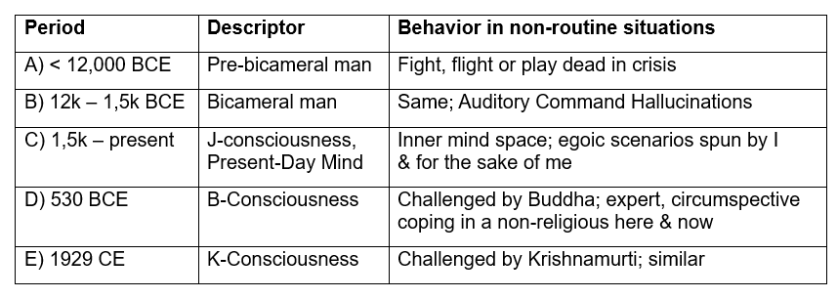
With the above minimal groundwork a history of consciousness and its contingent structures can be worked out. The first column has the approximate dates; the second its best one-word description; the third has some crucial aspects as far as its architecture / mentality is concerned and how it deals with uncommon, non-routine situations and crises.

B-consciousness is my name given to the first serious challenge to, or improvement of, J-consciousness. And K-consciousness is the second serious one. This doesn’t exclude that there were many in between. 

The shift from the bicameral mind to J-consciousness is still in full swing and has the following dynamics:

A) Attempts to re-activate the bicameral mind by religious practices like ecstasies, divination, inspirations, mediumship and more recent channeling. Where bicameral man had the certainty of being pushed around by commands and had no second thoughts about its wisdom and correctness, J-consciousness has to live with an awareness of the contingency of its actions based on the plurality of possibilities. One way out of this uncertainty is to reactivate the bicameral mind through certain spiritual techniques and be guided again by voices or by divined signs. There exist innumerable practices of this kind, which all have in common that a basic question of ‘what should I do’ will be answered as if coming from on high while it is the subconscious which is producing the voices and / or interpretations.

B) The move to overcome religious impulses in more rational and naturalized frameworks amplified by the Greek philosophical revolution of 700 – 300 BCE and similar developments in Asia. The other route to attain certainty about action is by improving the capacity to rationally analyze alternate courses of action. Logic, rationality, experimentation and imagination are all practices which will improve the predictability of action and take away a certain amount of anxiety.

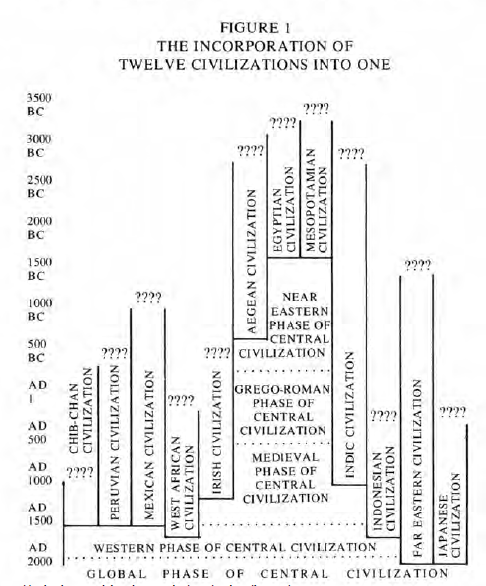
C) The Rise of Central Civilization incorporating all other civilizations in one global entity driven by an egocentric impulse based in J-consciousness (See Appendix A). If you look at the figure in Appendix A you will see an alternative conceptualization of the march of civilizations. This one is based on the merging of, on one side, historical investigations of comparing civilizations (Toynbee, 1947a, b, 1962-64; Quigley, 1979), and on the other side, sociological investigations in the field of world-system theory (Wallerstein, 1974-1989; Frank, 1998). What both seem to agree on is that the origin of now globalized western civilization is merely a phase of what they call ‘central civilization’, i.e. the merger of Egyptian and Mesopotamian civilizations around 1,500 BCE, which then went through a Near-Eastern phase, then a Greco-Roman phase, then a Medieval one, then Western and now a Global phase. In its growth it gobbled up almost any and all other civilizations (Wilkinson, 1997).

Central Civilization emerged around 1,500 BCE out of an intense civilizational conflict in which Jaynes argues the bicameral mind found its demise and J-consciousness its start as a better coping mechanism (Jaynes, 1976: 223f). Bicamerally ruled empires around the Mediterranean might have found their end during a “perfect storm of calamities” early in the 12th century BCE of earthquakes, rebellion, invasions, collapse of trade, disease, drought and famine (Cline, 2021: 134f). Since then this ‘mental architecture’ went through many modes of interiorization and is now also global.

The questions, or hypotheses, are 1) whether it was specifically J-consciousness, in its more powerful mode of planning and rationality, which gave central civilization its staying power and dubious success over others; 2) if Buddhist civilization(s) can be construed as a possible first attempts to overcome J-consciousness with a new mentality, which I will name B-consciousness, but failed; and 3) if K-consciousness–also based on a different architecture, but not dissimilar to Buddhism–as allegedly lived and promoted by Krishnamurti, might become another challenge to the reigning J-consciousness.

Transition to a Sustainable Civilization

The connection of the history of consciousness and its future along the lines of what Krishnamurti proposes should be connected to the idea of ecosystem restoration. It is possible that only under the aegis of a civilization inspired by the ecological sensitivities and ideas of Krishnamurti that humanity will be able to construct a sustainable civilization. This might take 200-500 years. Only then the very much needed restoration of the ecosystem can be executed with any success of making the relationship between humanity and nature truly sustainable. How bad the ecological and social situation might have turned is anybody’s guess, but a short dark age of anarchy and chaos is not out of the question. But, so far, humanity has gone through many of them before and survived to tell the story.

Origin

“The Future of Consciousness: Is Krishnamurti Its Prophet? And What Has That to Do With the Restoration of the Ecosystem?” Presentation at the Indian Philosophical Congress (IPC), 95th session, Gandhi University, Wardha, Maharashtra, December 29, 2022.

Sources

Agrawal, M. M. 1991a. Consciousness and the Integrated Being: Sartre and Krishnamurti. Shimla, India: Indian Institute of Advanced Studies.

Agrawal, M. M. 1991b. “Nothingness and Freedom: Sartre and Krishnamurti”. Journal of Indian Council of Philosophical Research, 9/1: 45-58.

Cline, Eric H. 2021. 1177 BC: The Year Civilization Collapsed. Revised and updated. Princeton: Princeton University Press.

Dreyfus, Hubert. 1972. What Computers Can’t Do: The Limits of Artificial Intelligence. New York: Free Press.

—— . 2002. “A phenomenology of skill acquisition as the basis for a Merleau-Pontian nonrepresentational cognitive science.” (2002)

—— & Stuart Dreyfus. 1980. “A Five-Stage Model of the Mental Activities Involved in Directed Skill Acquisition“. Washington, DC: Storming Media.

—— & —— . 1986. Mind Over Machine: The Power of Human Intuition and Expertise in the Era of the Computer. New York: Free Press.

—— & ——- . 1991. “Towards a Phenomenology of Ethical Expertise.” Human Studies, 14/4: 229-250.

Frank, Andre Gunder. 1998. ReOrient: Global Economy in the Asian Age. Berkeley: University of California Press.

Jaynes, Julian. 1982 (1976). The Origin of Consciousness in the Breakdown of the Bicameral Mind. 2nd edition with added Afterword. New York: Houghton Mifflin Harcourt.

Julian Jaynes Society. www.julianjaynes.org

Krishnamurti, J. 1929. “The Dissolution of the Order of the Star: A Statement”. International Star Bulletin (September 1929): 28-34. Also titled “Truth is a Pathless Land“.

—– . 1954. The First and Last Freedom. Foreword by Aldous Huxley. New York: Harper & Brothers.

—– . 1976. Krishnamurti’s Notebook. New York: Harper & Row.

Lutyens, Mary. 1975. Krishnamurti: The Years of Awakening, Avon Books, New York.

Martin, Raymond & Barresi, John. 2006. The Rise and Fall of Soul and Self: An Intellectual History of Personal Identity. New York: Columbia U.P.

Quigley, Carroll. 1979. The Evolution of Civilizations: An Introduction to Historical Analysis. Liberty Fund.

Rodrigues, Hillary. 1990. Insight and Religious Mind: An Analysis of Krishnamurti’s Thought. American University Studies, Series VII, Theology and Religion, Vol. 64. Master of Arts Thesis, McMaster University, 1988. New York: Peter Lang.

Rorty, Amelie O. 1976. “A Literary Postscript: Characters, Persons, Selves, Individuals”. In: Rorty, Amelie O. (Ed.), The Identities of Persons. Berkeley, CA: University of California Press. 301-323. Also in: Rorty, Amelie O. (Ed.). 1988. Mind in Action. Boston: Beacon Press, 1988.

Sartre, Jean-Paul. 1957 (1936). The Transcendence of the Ego. Trans. Williams, F. & Kirkpatrick, R (Transl.). New York: The Noonday Press.

Schuller, Govert. 1997. Krishnamurti and the World Teacher Project: Some Theosophical Perceptions. Theosophical History Journal, Occasional Paper V.

—— . 2014. “The Jaynesian Paradigm and Beyond“. Alpheus, January 2014.

Taylor, Charles. 1989. Sources of the Self: The Making of the Modern Identity. Cambridge, UK: Cambridge UP.

Toynbee, Arnold J. 1962–1964 [1934–1961]. A Study of History. 12 vols. Oxford: Oxford University Press.

Wallerstein, Immanuel. 1974-1989. The Modern World-System. 3 volumes. New York & San Diego & London: Academic Press.

Wilkinson, David. 1987. “Central Civilization”. Comparative Civilizations Review, 17/17: Article 4. Also in: Sanderson, Stephen K., 1995, Civilizations and World Systems: Studying World-historical Change, Lanham, MD: Rowman Altamira, pp. 46-74.

“AMI Conference Statement to COP26: Regarding the Monetary Dimension of Climate Change”. American Monetary Institute, Evanston, IL, USA, 11 Nov 2021.

Appendix A.

Central Civilization (Figure 2.1 from Wilkinson, 1997: 32).


Environmental Virtue Ethics–Review

Environmental Virtue Ethics
Philip Cafaro and Ronald D. Sandler (editors)
Lanham, MD: Rowman & Littlefield, 2004. Print.

A Review-essay by Josef Mathews

“No Man is an Island,” writes poet John Donne. The idea contained in those words is a profound and timeless truth. It refers to the sea of connections that bind human beings. Environmental Virtue Ethics, edited by Ronald Sandler and Philip Cafaro, echoes this sentiment and extends the concept into the nonhuman world. There is a spider web of links between humans and betwixt humans and nature. The book is a collection of 13 essays penned by academics. They share their views on the topic of human relations with the natural world as well as with each other. While this paper captures the essence of the entire book, special attention is given to ideas in a chapter by Peter Wenz. Nonetheless, the collective message is that if humans live in harmony with each other and with nature, both the natural world and the human species will flourish; otherwise, social problems and environmental degradation multiply.

A tenable claim advanced in the book is that people are interconnected to and interdependent on each other as well as the natural world. Most people will not need complex scientific experiments to be convinced of this idea. Simple observations of causes and effects as they occur in the laboratory of daily life will do. While personal experience is valuable, keen insights on the global biotic community from dedicated and perceptive observers and thinkers of reality expands the band of individual observations. Geoffrey Frasz, in his essay Benevolence as an Environmental Virtue, captures the sentiment of the inextricable link between humans and nature:

We do not exist in the world as isolated, atomic individuals who simply act on objects outside of ourselves. Rather we are relational beings, moral agents who act in specific social, historical, and ecological contexts. …To be human is to dwell in relations with the nonhuman world (133).

While this observation is plain, its acknowledgment has profound implications. Some reflection on this idea will likely persuade the thinker to believe that what he does to the environment he is doing to himself and others. Therefore, out of enlightened self-interest and a genuine concern for everything other than the self, the individual is more inclined to make better behavior choices.

Indeed, actions have consequences. When humans act on the environment the impact can be classified essentially as positive or negative for human and environmental health. Peter Wenz uses a David Korten quote to summarize relations between humans and between humans and nature and the eventual fallout. Japan, a first world nation, in order to dodge pollution on their land, set up a copper smelting operation in the Philippines, a third world nation. The project began with the ejection of local residents from their land. Subsequently, plant contamination diminished local water supplies, fish, and rice. It increased upper-respiratory diseases among local residents who depended on the most dangerous and filthiest jobs at the plant. As a result, the locals suffered while the company owners prospered (201). This example highlights a willful disregard of marginalized people. Clearly, their worth as human beings, in the eyes of the company owners, is not much more than a means to an end. If the owners and other decision makers cared, there would have been significantly more consideration for the well-being of the people that already lived on the land as well as the workers. In fact, it is quite possible that a modicum of concern for people and the environment might have rendered the plan unconscionable.

Think about the hopes and dreams of these workers. A dirty plant which compromises their well-being is not fertile ground to realize their potential. Furthermore, the above example demonstrates that maltreatment of the environment reflects back on human well-being as well. In this case, the residents who dwell near the smelting operation endured the health repercussions associated with the degradation of the environment. To put it simply, at the benefit of a few people, many people suffered and the environment degraded. However, this need not be. If decision makers regard workers as intrinsically valuable and view them as human beings, they will not only ensure the health and safety of workers but also support their personal and professional development. Everyone has the basic rights to clean air, water, and it is a basic truth that all people have gifts and talents. Consultation of human development literature will bolster the idea that although people may have different capacities and abilities, all hold the potential to develop them. It is simply a matter of having the opportunity to flourish.

As often the case is, poor people bear the brunt of consumerism. Peter Wenz defines consumerism as the “ideology that society should maximize consumption, pursue consumption without limit” (198). It is true that humans need to consume. As a matter of fact, everyone depends on the natural world for sustenance; that includes the rich and the poor. However, some are deprived of basic necessities for survival while others overconsume. Wenz writes that “dependence on free sources of food and materials is common in the Third World” (200). However, the pursuit of increased output at times interferes with this access to even the basic supplies. Take, for example, the reduced access to basic nutrients like Vitamin A. The killing of a wild and free source of Vitamin A, bathau, with pesticides in India serves as an example. Ironically, the proliferation of bathau was fanned by the use of artificial fertilizers. One problem with such fertilizers is that poor people cannot afford them (200). The fertilizer was meant to grow high-yield crops. Two problems with this particular crop are their high water requirement and need for artificial fertilizers. Unable to dig deeper wells as well as secure artificial fertilizers, the poorest farmers were rendered incapable of keeping their farms and grow traditional varieties which required less water and no artificial fertilizers. While increased production and profits are not necessarily bad in themselves, it is the existent poor that often suffer. They get pushed deeper into destitution while a minority prospers on profits from fertilizers and pesticides. The lucky farmers who could afford the farming inputs profit from the crops themselves.

In the specific scenario described above, the locals were essentially denied Vitamin A. An unacceptable consequence is the occurrence of blindness among tens of thousands of Indian children every year due to a lack of vitamin A (200). As Wenz demonstrates, the benefits of particular practices are not always enjoyed by everyone. In fact, it negatively impacts vulnerable people. A concern for human welfare needs to be inclusive, and the negative consequences of boosting production need to be balanced against the benefits of freeing resources for optional consumer items. Respect for others should be a pivot point for projects intended to maximize production.

While problems dot the human landscape, so do solutions. The book proposes a strong idea which is a salve for social and environmental problems. It is land-ownership for the masses. Wenz uses another quote by Korten which explains this idea:

Rapid economic growth in low-income countries brings modern airports, television, express highways, and air-conditioned shopping malls … for the fortunate few. It rarely improves living conditions for the many. This kind of growth requires gearing the economy toward exports to earn the foreign exchange to buy the things that wealthy people desire. Thus, the lands of the poor are appropriated for export crops. The former tillers of these lands find themselves subsisting in urban slums on starvation wages paid by sweatshops producing for export. Families are broken up, the social fabric is strained to the breaking point, and violence becomes endemic (202).

An idea that emerges from the above quote is that the lack of land ownership is a contributor to social problems. In fact, other sources confirm this idea. A number of articles filed under World Food & Hunger on The Global Policy Forum website explore the nexus between land ownership and hunger. The page heading captures a basic truth that land is distributed unfairly and this inequity is a key factor to poverty and hunger. Across the globe, land is mostly in the hands of the rich elites, stripping the paupers arguably of the basic right to grow their own food. The principal message in the quote outlines the relationship between groups of humans, expressly the relationship between a small group of landowners and the landless many.

However, there is no need for people to starve, especially if they are willing to work the land to grow their own food. A book originally published in 1995, When Corporations Rule the World by David Korten, asserts that equitable sharing of the earth’s sustainable resources would meet the needs of the population at that time (199). The 2015 third edition of the same book contains the same wording which signifies even today, with the earth bustling with more than seven billion people, there is enough for everyone to survive. Another fertile argument for land ownership on a global scale is that small landowners who depend on their land will be good custodians of the earth because the land sustains them and they have a personal relationship with it. In that scenario both humans and the environment flourish, a universal wish of the essayists in the book.

Peter Wenz underscores other problems that are associated with the integration of traditional societies into the global consumer market. The resulting destitution creates social problems, like child prostitution, which disintegrates the social fabric of societies. Other negative effects are a growing disparity in income between nations and a decrease in global food security. In the year 2000, half the global population’s vitamin and nutritional needs were unmet (202). As mentioned earlier, it is not just humans that suffer; the environment aches as well. Environmental concerns aside, the earth simply does not contain the resources for all its inhabitants to embark on a lifestyle which is on par with the high-income countries (199, 203). An undeniable conclusion is that an insatiable appetite for endless goods and services precipitates social and environmental problems. Therefore, it is in the best interest of the human species and the rest of the earth community for humans to be more considerate consumers.

One approach to solving social and environmental problems is through educating the global population of the consequences of overconsumption along with character development, in particular the cultivation of empathy. People are less likely to jeopardize the well-being of other humans and other living things, no matter which part of the world they live in, if they develop a concern for the other like John Donne observed. Furthermore, one need not stop at living things; respect and reverence can be distributed more broadly to nonliving things like rocks, mountains, streams, and rivers. After all, all of these entities individually make up the whole of our natural world and life-sustaining systems. The education and character development applies both to the young people of today, who are still in their formative years, and the adults who make decisions which have consequences in the real world. The book clearly articulates the development of virtues that result in desirable outcomes for all.

Furthermore, the drivers of consumption need to consider that environmental degradation eventually spills over into their own neighborhoods. After all, water flows and air circulates, taking pollution along with them. To be sure, there may be less contamination when the water and air reach their homes, but that should not deter polluters from being better global citizens. Plus, the wealthy are not immune to social problems. The waves of those problems reach their shores as well.

Rich or poor, the factors that make human beings tick vary. This is so even when their actions are identical. Simply stated, people’s motives may differ. Wenz notices this peculiarity in the human species but places the importance on the end results rather than the motivations. What matters is the flowering of humans and the environment. He writes:

[N]onanthropocentric environmentalists have reasons to favor traditional virtues because their exercise tends to protect the nonhuman environment. Anthropocentrists have reason to support the same virtues because their exercise promotes human flourishing. Nonanthropocentric and anthropocentric considerations regarding human virtue and vice are thus mutually reinforcing. Each is stronger in combination with the other than alone, a relationship I define as synergistic (197).

As the above quote suggests, a balance of human and nonhuman interests motivating an individual is probably the ideal. Nonetheless, the following example demonstrates the concept of dual stimuli at work. Consider a group of people acting out of concern for other humans and another group acting out of concern for the natural world. On the one hand, humans concerned about other humans may oppose the use of sport utility vehicles because it contributes to climate change which adversely affects poor people across the globe. On the other hand, humans concerned about the natural world might be troubled by climate change because it endangers the survival of many species. The motivations are different, but they result in less consumption of natural resources and more preservation of the environment, and more flourishing of humans (209-210). In the absence of a broader environmental ethic, human-centered ethics still manages to promote the well-being of the natural world because, on many occasions, what is good for humans and what is good for the environment coincide. Still, the environment may not get the full protection that it would under a more rigorous environmental ethic (Gruen, 58, 60). Of course, some people may be equally compelled by the welfare of human beings and a reverence for the natural world. Perhaps this dual concern is a more well-rounded approach, but people possess different value systems which originate from many places. Some people may wish to protect the environment because it has instrumental value. Others are motivated to preserve the environment because they regard nature with a sense of reverence and sees intrinsic worth; its value is independent of whether or not it serves human ends (220).

The book, Environmental Virtue Ethics, in its entirety, including Wenz’s chapter, wishes for a peaceful existence not only between human beings but also between the human species and the natural world. The desire is that people respect each other and nature. However, despite people having strong convictions, changing their ways of being in a society that operates counter to their principles is akin to swimming upstream. Wenz takes into account the nuances and complexities of culture and status quo which make it difficult to adhere to virtues to their full extent. He does not ask individuals to ditch their car, in a car-centric society, if it halts their flourishing. Yet that is not a valid excuse to drive a thirsty vehicle. Wenz posits alternatives that deviate from mainstream practice, like driving vehicles that are fuel efficient, driving less, or/and increasing use of public transportation. The message is to adopt practices that improve on existing ones while not causing disharmony in social relationships which are critical for human flourishing. He asks the individual to be the vanguard of trendsetters that help both humans and the natural world to blossom (210-211). As the example illustrates, modifying current lifestyles for the welfare of the global biotic community is not an all-or-nothing effort. This piece of news should be encouraging for someone who does not think their small efforts will make a difference in the grand scheme of things. There is plenty of middle ground. A small change is better than no change and a significant change is an improvement over a small correction. Permission is granted to act even in the smallest ways for a better outcome for the greater good.

The consequences of over-consumption of goods and services by people in wealthy nations and by elite groups in poor nations disproportionately afflict the already marginalized poor. This is both unjust and morally reprehensible. While social and environmental problems are real and grave concerns in the world of today, the solutions are simple and actionable. Consuming less and living with a concern for the human and nonhuman world are obvious choices. The cultivation of virtues encourages individuals to be more concerned for others and the natural world. A more ethical global community allows for greater cohesion among its members and better relations with the natural world. Therefore, when possible, whether by doing a little or doing a lot, human beings “should cultivate … virtues to benefit themselves, other human beings, and the nonhuman environment (212). Environmental Virtue Ethics inspires the fostering of virtues that benefit both humankind and the natural world that the species is a part of.

Works Cited

Cafaro, Philip, and Ronald D. Sandler. Environmental Virtue Ethics. Lanham, MD: Rowman & Littlefield, 2004. Print.

“Global Policy Forum.” Land Ownership and Hunger. Global Policy Forum. Web. 14 Feb. 2016. .

Gruen, Lori, Dale Jamieson, and Christopher Schlottmann. Reflecting on Nature: Readings in Environmental Philosophy. New York: Oxford UP, 2013. Print.