
The Next Financial Crisis is around the Corner?


Introduction

We know that the current monetary system is crisis-prone. We know that during the last big crisis in 2008 we skirted a total freeze-up and a possible break-down of the international banking system. We know that Wall Street was bailed-out and Main Street left to fend for itself. We know the system received some band-aids and was not re-set on a sound footing. And now we see another series of big booms and possible big busts, starting with the implosion of crypto-giant FTX in November 2022 and recently the bankruptcy of SVB.

Maybe a good quote to set the table for some warnings is the following from economists Dirk Bezemer and Michael Hudson (2016: 761):

An economy based increasingly on rent extraction by the few and debt buildup by the many is, in essence, the feudal model applied in a sophisticated financial system. It is an economy where resources flow to the FIRE sector [Finance, Insurance & Real Estate] rather than to moderate-return fixed capital formation [the productive economy]. Such economies polarize increasingly between property owners and industry/labor, creating financial tensions as imbalances build up. It ends in tears as debts overwhelm productive structures and household budgets. Asset prices fall, and land and houses are forfeited.

Different sources make it clear that we might be close again. Below is a little collection of economists and financial commentators ringing the bell with a postscript on the Silicon Valley Bank bankruptcy in March 2023.

Nouriel Roubini, aka Dr. Doom

Dr. Doom in 2007 was on the forefront of warning the world that the time was ripe for a big correction, if not crisis. He’s back again.

The chairman and chief executive officer of Roubini Macro Associates, nicknamed Dr. Doom following his 2008 prediction, warned that anyone expecting a shallow US recession should examine the extensive debt ratios of corporations and governments.

Roubini added that as rates increase and debt servicing costs grow, “many zombie institutions, zombie households, corporates, banks, shadow banks and zombie countries are going to die” (Boughedda).

Later Roubini himself opened his analysis in an article with:

The world economy is lurching toward an unprecedented confluence of economic, financial, and debt crises, following the explosion of deficits, borrowing, and leverage in recent decades (Roubini).

“Recession is a certainty in 2023, but how much will it hurt India?”

This article in India Today carries lots of colorful graphs to see that the world will get into a recession in 2023 and that “various financial crises” will accompany it. When the World Bank and the IMF think there will be a recession this might be interpreted that it will actually pack out worse.

A new World Bank study shows that central banks across the globe raising interest rates to curb inflation may not be a good idea. This can likely lead to various financial crises along with the recession. “Global growth is slowing sharply, with further slowing likely as more countries fall into recession. My deep concern is that these trends will persist, with long-lasting consequences that are devastating for people in emerging markets and developing economies,” said World Bank Group President David Malpass (Sharma).

“Why The Banks Are Collapsing”

A reasonably good video comes from a somewhat alarmist web site analyzing five reasons why we can expect some or many big banks to collapse. The video is sponsored by a dubious company selling titles like ‘Lord’ and ‘Lady’ in Scotland.

1) Collateral Debt Obligations, 2) Corruption, 3) Collateral Loan Obligations, 4) Overconfidence, 5) Recession.

We can argue with this list as #5 Recession is more of an effect than a cause of bank behavior. And, though they mention it, Moral Hazard, the idea that banks expect that they will be bailed out anyway, should have its own entry. And what is totally missing is an analysis of the leading cause of financial crises and that is the allocation of easily created loans by commercial banks to the unproductive FIRE sector creating thereby asset bubbles which usually pop.

Trouble in Cryptoland

In November 2022 the crypto currency exchange platform FTX went bankrupt after a classic bank run with depositors withdrawing $6 billion. Crypto-giant and rival Binance might have triggered the run by withdrawing from FTX after revelations about a murky relationship between FTX and a sister company Alameda. Binance then thought of buying and bailing out the platform, but changed its mind in a day.

How far this bankruptcy will reverberate through cryptoland and the banking world is anyone’s guess but it is already dragging in its wake a few other outfits and the wipe-out of about $2 trillion in market value. And after FTX filed for bankruptcy hackers got away with $515 million. Some think this is a Lehman moment, which started the GFC in 2008, others compare it with the 2001 collapse of Enron. Regulators are expected to step in, which might scare more people into selling, creating more havoc, and justifying more regulation (Yaffe-Bellany; Wiki entry of FTX).

The inequality-crisis nexus: Its origin and application to India

I stumbled upon prominent Indian economist Raghuram Rajan as one of the few who warned his peers at the 2005 Jackson Hole, Wyoming gathering of top bankers and their regulators, that the financial system had become potentially more crises-prone because of deregulation, innovation, dangerous incentives to bank managers and some other flaws (Rajan, 2006).

He said the rollout of complicated instruments such as credit-default swaps and mortgage-backed securities made the global financial system a riskier place. Indeed, he argued that such developments “may also create a greater – albeit still small – probability of a catastrophic meltdown” (Cooper).

Rajan was then chief economist at the IMF. Later he became governor of the Reserve Bank of India (RBI), Vice-Chairman at the Bank for International Settlements (BIS) and is now back in academia at the University of Chicago.

After the crisis he came out with an award-winning book, Fault Lines (2010), making the case that inequality had increased the debt burden of households. The logic was that households, in order to keep up with spending while income shrank, took on debt to make up for the difference. Rajan also thought that the US government was incentivizing mortgages too much, also leading to a growth in debt. For this he was criticized as it looked he was blaming the victims of the GFC. Summarizing Rajan’s position:

Much of the impetus for the current debate stems from Raghuram Rajan’s widely discussed book ‘Fault Lines’ (2010). Rajan argues that low and middle income consumers have reduced their saving and increased debt since income inequality started to soar in the United States in the early 1980s. This has temporarily kept private consumption and employment high, but it also contributed to the creation of a credit bubble. With the downturn in the housing market and the sub-prime mortgage crisis starting in 2007, the overindebtedness of U.S. households became apparent and the debt-financed private demand expansion came to an end in the ‘Great Recession’ of 2008/9 (Van Treeck, 2013: 421).

How this nexus might apply to India is next and starts with a picture of inequality in India.

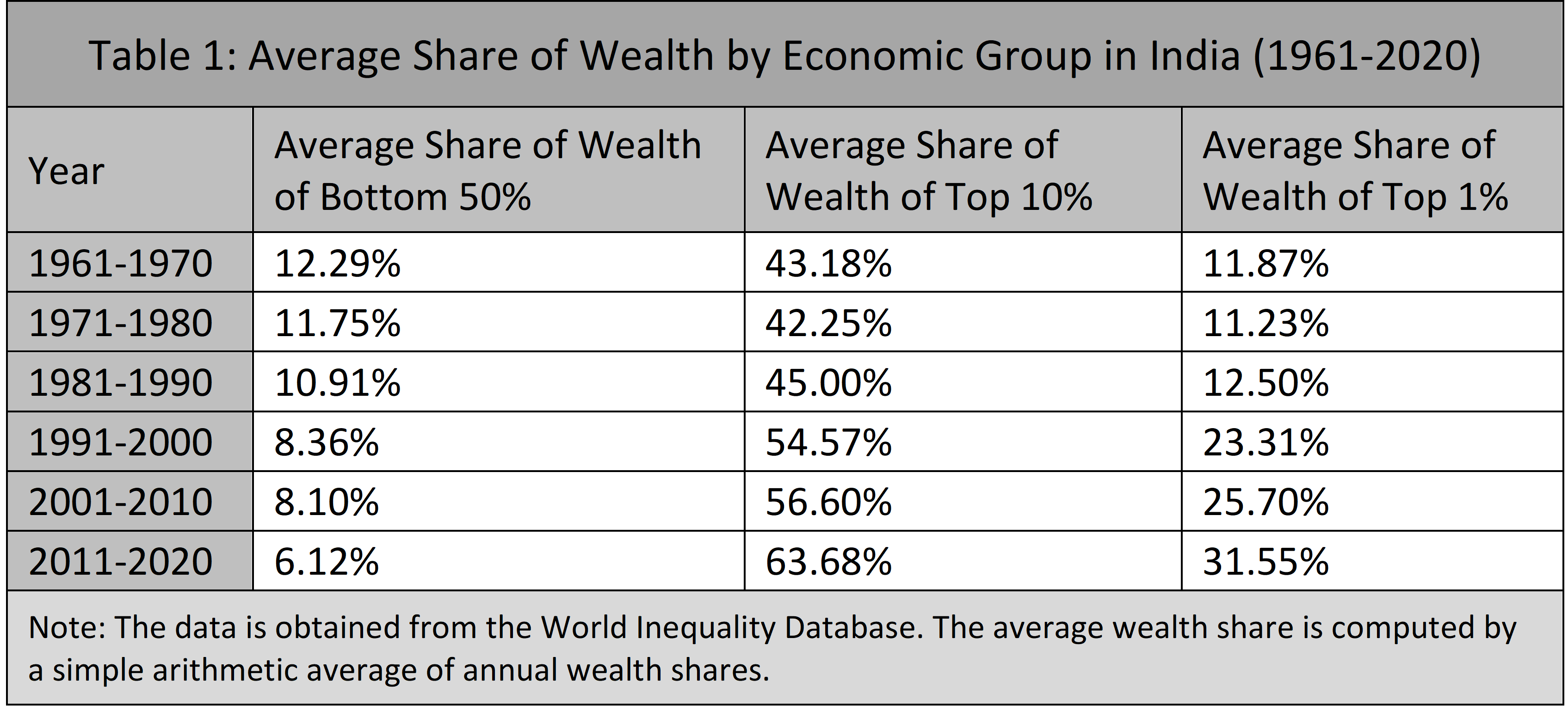
For example, data from the recently published “World Inequality Report 2022” suggests that inequality – of both income and wealth – in India kept increasing in the last few decades and that this trend has continued even in recent years. In particular, after 1990, the share of the national income of the top 10% and top 1% has consistently increased while the share of the national income of the bottom 50% has consistently declined.

The article comes with a table which makes the trend over six decades painfully clear (Gathak, 2022).
Next step is to look at the trend in bank lending in the form of retail loans and mortgages.

According to data released by RBI, the bulk of the increase in bank lending has been on account of retail loans, with credit card outstanding, consumer durables and loans against fixed deposits being the new drivers of growth in FY22.

. . . . Individuals continue to borrow for consumption even as corporations have deleveraged and paid their loans (Shetty, 2022). 

But what are the causes of this increase of indebtedness? Increased consumer optimism? Easier access to loans? Or the relative income hypothesis? This hypothesis is based on the idea that consumption patterns are related to the perception and valuation of one’s relative socio-economic position in one’s environment. It combines the desire of ‘keeping up with the Joneses’ during boom times and trying to keep up with your own previous peak consumption during downturns. The relative income hypothesis is a component of the Rajan hypothesis of causally connecting inequality with financial fragility.

Though I have anecdotal and observed evidence from the US for Rajan’s hypothesis, I am not sure how it would work out in India. The first thing to find is some correlation between increased inequality in India and increased indebtedness, and then see if causal connections can be made. But this project is too big to pursue here.

Postscript

Meanwhile in March 2023 a potentially humungous crisis was temporarily averted after two US banks went bankrupt and were taken over by different authorities. Silicon Valley Bank (SVB) in California ($209b) and Signature Bank in New York ($118b) are now the second and third biggest bank failures in US history after the record-setting failure of Washington Mutual ($307b) in 2008. Though 97% of deposits at SVB and 90% at Signature were not insured, the US government regards the crisis as a systemic risk and will guarantee all deposits in newly formed ‘bridge banks’. Throughout the crisis stock markets stayed relatively calm, but some banks took big hits with shares of Republican Bank going down 60%. The price of safe-haven gold increased about 5%.

Some Tremors in India

SVB’s troubles created also concern in India because many Indian start-ups and high-net-worth individuals have big accounts at SVB.

Indian startups that have millions of dollars stuck with the troubled Silicon Valley Bank are waiting for business hours in the US to resume Monday and could withdraw all their money from the bank en masse. The only thing that could stop that is if the US government manages to find a buyer for the beleaguered bank, founders said (Barik).

Little did anybody know that US regulators would step in with guarantees.

Ellen Brown

Again, what is next is anybody’s guess, though some of our allies in the monetary reform movement think it can be dire.

For example Ellen Brown of the Public Banking Institute warns that again we are facing the collapse of the derivatives house of cards. This time the derivatives used as a hedge against interest rate changes will come into play. She writes about “The Interest Rate Shock” which will ripple through the system.

Interest rate derivatives are particularly vulnerable in today’s high interest rate environment. From March 2022 to February 2023, the prime rate (the rate banks charge their best customers) shot up from 3.5% to 7.75%, a radical jump. Market analyst Stephanie Pomboy calls it an “interest rate shock.” It won’t really hit the market until variable-rate contracts reset, but $1 trillion in U.S. corporate contracts are due to reset this year, another trillion next year, and another trillion the year after that.

A few bank bankruptcies are manageable, but an interest rate shock to the massive derivatives market could take down the whole economy (Brown).

Steve Keen

Another warning comes form Australian economist and author Steve Keen. He blames the actions of the Fed in raising interest rates while ignoring its effects on the financial sector. He thinks that the Fed uses models in which debt, banks and money are ignored. The causal chain is that increased interest rates will diminish the value of bonds, of which many banks have massive amounts on their books.

Meanwhile, in the real world, rising interest rates on government bonds can cause banks to go insolvent. SVB was the canary in the coal mine here, but the factor that brought it undone is shared by all financial institutions, because government bonds are a major component of their assets. When interest rates rise, bond values fall, and this can drive financial institutions into insolvency—where their Liabilities exceed their Assets (Keen).

In his own Minsky Model he shows that the financial sector as a whole might get into negative equity territory if interest rates hit 5%. That is, the whole sector can go belly-up. Though he states his scenario is more hypothetical and educational than a real-world plausibility, the lesson he wants to convey is that,

It’s The Fed that deserves to be roasted instead, for attempting to manage the financial system using models that ignore banks, debt, and money.

Michael Hudson

Famed author and economist Michael Hudson addresses both of the above mentioned dangers, i.e. a) the effect of increased interest rates on the value of bonds and in turn its effect on the equity position of banks, and b) the looming danger of derivatives. On the interest rate he states that,.

Prices are plunging for bonds, and also for the capitalized value of packaged mortgages and other securities in which banks hold their assets on their balance sheet to back their deposits.

The result threatens to push down bank assets below their deposit liabilities, wiping out their net worth – their stockholder equity.

Like others, he wondered “why the Fed doesn’t simply bail out banks in SVB’s position”, but that question has just been answered by the regulators with their decisive intervention fully guaranteeing all deposits.

The issue with derivatives he thinks is the “larger elephant in the room”.

Volatility increased last Thursday and Friday. The turmoil has reached vast magnitudes beyond what characterized the 2008 crash of AIG and other speculators. Today, JP Morgan Chase and other New York banks have tens of trillions of dollar valuations of derivatives – casino bets on which way interest rates, bond prices, stock prices and other measures will change.

According to Hudson we are getting into really dangerous territory:

So far, the stock market has resisted following the plunge in bond prices. My guess is that we will now see the Great Unwinding of the great Fictitious Capital boom of 2008-2015. So the chickens are coming home to roost – with the “chicken” being, perhaps, the elephantine overhang of derivatives fueled by the post-2008 loosening of financial regulation and risk analysis.

By the way, the two above economists have written some of the most hard-hitting and provocative criticisms of how the economics discipline is mis-theorized by their peers through ignoring the role of money, banks and the money creation process. From Hudson we have J Is For Junk Economics, and Keen wrote Debunking Economics.

Alternatives

In the six years after the 2008/9 Global Financial Crisis (GFC) the monetary reform movement has attained far-reaching results in promoting breakthrough monetary theories, especially the credit creation theory of money and banking, and in proposing reform policies based on empirical findings and computer models.

Many central and commercial banks admitted the truth about money creation and through citizen’s initiatives many popular assemblies had to discuss the findings and proposals. In Switzerland it even came to a referendum.

Our ideas are still spreading and are picked up in many countries to the extent that monetary reform organizations have been started. Even so, main stream economists, politicians and policy think tanks are resisting our findings or stay blissfully ignorant of them. Hopefully this half-panic around SVB’s downfall will create questions about the current crisis-prone, unsustainable monetary system and awaken the vision that a more stable, more equitable and less indebted system is possible.

Sources

Anonymous. 2022. “Why The Banks Are Collapsing: The Coming Economic Crisis”. Moon YouTube Channel, Nov 2022.

Barik, Soumyarendra. 2023. “Indian startups with millions of dollars stuck in Silicon Valley Bank weighing en masse withdrawal”. Indian Express, 13 March 2023.

Bezemer, Dirk & Hudson, Michael. 2016. “Finance is not the economy: Reviving the conceptual distinction ”. Journal of Economic Issues, 50/3: 745-768.

Boughedda, Sam. 2022. “Nouriel Roubini, “Dr. Doom,” Expects a Severe, Long and Ugly Recession – Bloomberg”. Investing.com, 20 Sept 2022.

Brown, Ellen. 2023. “The Looming Quadrillion Dollar Derivatives Tsunami”. The Web of Debt Blog, 13 Mar 2023.

Cameron, Cooper. 2015. “6 economists who predicted the global financial crisis”. In the Black, 7 July 2015.

Gathak, Maitreesh et al. 2022. “Trends in Economic Inequality in India”.The India Forum, 19 Sept 2022.

Hudson, Micheal. 2017. J Is For Junk Economics: A Guide To Reality In An Age Of Deception. Dresden, Germany: ISLET Press. (Amazon)

Hudson, Micheal. 2023. “Why the Banking System is Breaking Up“.12 Mar 2023.

Keen, Steve. 2011. Debunking Economics: The Naked Emperor Dethroned? London: Zed Books. (Amazon)

Keen, Steve. 2023. “Silicon Valley Bank: The Fed’s Role in its Downfall”. Patreon, 11 Mar 2023.

Rajan, Raghuram G. 2006. “Has finance made the world riskier?.” European Financial Management, 12/4: 499-533. 

Rajan, Raghuram G. 2010. Fault Lines: How Hidden Fractures Still Threaten the World Economy. Princeton, New Jersey: Princeton University Press.

Roubini, Nouriel. 2022. “The Unavoidable Crash“. Project Syndicate, 2 Dec 2022.

Sharma, Samrat. 2022. “Recession is a certainty in 2023, but how much will it hurt India?” India Today, 12 Oct 2022.

Shetty, Mayur. 2022. “Individuals borrow more, corporates deleverage”. Times of India, 5 Sept 2022. 

Trading Economics. 2022. Graph of Households Debt in India in Percentage of GDP, 2009-2022. Derived from the Bank of International Settlements.

Van Treeck, Till. 2014. “Did inequality cause the US financial crisis?” Journal of Economic Surveys, 28/3: 421-448. 

Wiki entry: FTX (Company)

Yaffe-Bellany, David. 2022. “Embattled Crypto Exchange FTX Files for Bankruptcy”. New York Times, 11 Nov 2022.

Extra: https://www.visualcapitalist.com/ftx-leaked-balance-sheet-visualized/

John Titus is not up to Snuff? Or the Need for Epistemic Maturation


For several reasons I feel compelled to write this blog about some of the output of video-blogger John Titus. Titus is a prolific vlogger usually commenting on all kinds of shenanigans in the financial world. In 2012 he produced the feature-length documentary Bailout after which he became a regular commentator. He has been interviewed many times, speaks at conferences and has published some articles.

But he makes some alarming claims which are not backed by evidence. For example, he came out as a Covid-19 conspiracist, stating that “the arrival of the 2020 pandemic was about as accidental as an assassination. The pandemic narrative is nothing but a cover story to conceal from the public what in reality is the biggest asset transfer ever”[1a]. In another video he makes bizarre claims about a mainstream TV interview with a FED official [1b]. It is hard to analyze, so you have to watch it for yourself.

Recently I dove also into his presentation at the 2021 conference of the American Monetary Institute, with which I am affiliated. Its title was “Did BlackRock Originate the Federal Reserve’s Unprecedented Pandemic Response Six Months beforehand?”[2]

My analysis of that presentation is that Titus was construing a false connection between 1) a BlackRock semi-public economics paper discussing the possibility of the FED ‘going direct’, defined there as “the central bank finding ways to get central bank money directly in the hands of public and private sector spenders”[3] and b) a later instantiation of that policy by the FED during the Covid-19 emergency.

Titus tries to make us believe that BlackRock had originated this policy and even ordered the FED to implement it. Titus states at 21m (till which point the video is very instructive and even enjoyable) that the BlackRock paper “tells the FED what to do when there is another downturn” and at 31m “that it is no accident, but according to a plan”.

The two points of meaningful coincidence he mentions to back up his allegation are 1) the paper was delivered at Jackson Hole, Wyoming, at the yearly gathering of the central and commercial bank big shots in August 2019, and 2) the FED implemented the policy about six months later at the beginning of the Covid-19 pandemic. Based on this coincidence–which is not even a correlation, leave alone causation–Titus bases his conclusion that BlackRock both originated the plan and ordered its implementation.

What he overlooked, and what pulls pretty much the rug out from his origination and coerced implementation thesis, is that ‘going direct’ and its close cousin ‘helicopter money’ have been discussed far and wide and comes up almost automatically when there is some financial crisis happening.

The media seems awash with talk about rotary flight – the ‘helicopter money’ or ‘helicopter drop‘ of Milton Friedman and Ben Bernanke fame.

This was stated by Oxford Professor of International Economics Roger Baldwin in 2016 in a paper with an overview of economists’ views of ‘going direct’ [4].

And some monetary reformers look at it like a possible step towards a sovereign money system [5,6]. Thomas Mayer, of the Swiss institute Flossbach von Storch Research Institute with sympathies for monetary reform, stated,

Helicopter money would facilitate the change-over from our present credit money system to an alternative money system, in which money is no longer created as private debt but as an asset backed by the reputation of the issuer. Crypto money technology would be well suited for the creation of and payments with reputation money.

And all these papers, including BlackRock’s, not only overlap in their policy proposals, but also in their analyses of the very minimal monetary policy space left for monetary authorities since the 2007 Global financial Crisis, which would justify the unusual policy.

Titus’ construal however–interpreting the policy as a novelty imposed on the FED–is based on unacceptable cherry-picking of just two events (the BlackRock paper and The FED policy), severely de-contextualizing the situation, then insinuating suspicious shenanigans, all laced with an entertaining “gotcha” element.

Titus does have a case in pointing out the entanglement between BlackRock and the FED, creating a big conflict of interest, either real or perceived. But he unnecessarily undermines this alarming fact by framing it in a highly speculative, conspiratorial set-up.

Given the frequency of Titus’ defective analyses I would conclude with the two following points, one of which is about research strategy and the second about the relationship between the monetary reform movement and researchers like Titus.

First, similar to my advise on how to use Wikipedia and conspiracist sources, if Titus (or Wikipedia or a conspiracist) makes a plausible claim, go to the source provided and engage the source itself. And if the material pans out and you get into a debate, refer to the source, not Titus, not Wikipedia nor any conspiracist.

Second, if the movement for just money aspires to applying the highest epistemic standards in making its case to the public, academia and the policy formation community, we have to keep our distance from researchers who mix too many unsubstantiated conspiracist claims into their discourse, as good and informative their non-speculative material might be.

But not all is lost. Many researchers started out in conspiracist or religionist circles and extracted themselves from such and learned to apply higher, epistemic standards to their output. And you would be surprised to find out the many to whom that might apply. Personally speaking, ‘been there, done that’, and left on my old web site the evidence for all to see and remind myself of my own jagged arc of epistemic maturation.

Govert Schuller
Shillong, Sept 2022

Sources

[1a]. Titus, John. 2020. “Summary – Going Direct Reset”. The Solari Report.

[1b]. Titus, John. 2020. “Presenting The Federal Reserve Script for Totalitarianism”. Best Evidence channel on YouTube, 20 April 2020.

[2]. Titus, John. 2021. “Did BlackRock Originate the Federal Reserve’s Unprecedented Pandemic Response Six Months beforehand?” AMI channel on YouTube, 24 Nov 2021.

[3]. Bartsch, E., Boivin, J., Fischer, S., Hildebrand, P., & Wang, S. 2019. “Dealing with the next downturn: From unconventional monetary policy to unprecedented policy coordination“. Macro and Market Perspectives, 105: 1-16.

[4]. Baldwin, Richard. 2016. “Helicopter money: Views of leading economists.” Voxeu.org, 13.

[5]. Mayer, Thomas. 2016. “From Zirp, Nirp, QE, and helicopter money to a better monetary system.” Flossbach von Storch Research Institute, Economic Policy Note 16.3 (2016): 2016.

[6]. Jourdan, Stan & Lonergan, Eric. 2016. “Citizens’ Monetary Dividend: Upgrading the ECB’s toolkit”. Quantitative Easing For People, Policy Brief, September 2016. 

Global Rift: The Third World Comes of Age (Review)

Last summer I read with pleasure Dr. Stravianos’ historical narrative of the genesis of the Third World during the 400 year expansion of capitalism throughout the world.

The dean of ‘world systems analysis’ Immanuel Wallerstein [3] stated about the book:

“There is no comparable work that covers the whole Third World over a four-century period. It is readable and comprehensive . . . In short, it is excellent”.

Though it is almost 40 years old, I think the book is a classic in its field and very affordable.

Find below a very incisive review of the book and its main theses found on Good Reads [1]. The original article [2], from which the review is lifted, provides a critical overview of the field of International Political Economics (IPE) and defends a more heterodox and holistic view against the orthodox view allied with mainstream neoclassical economics.

The relevance of heterodox IPE in the vein of ‘world system analysis’ for our endeavor of monetary reform is that it is important to understand the history and genesis of the current global system in order to get a better grip on how it could and should be reformed if we want to take a truly global perspective.

[1]. www.goodreads.com/book/show/271171.Global_Rift
[2].www.academia.edu/34494374/Units_Markets_Relations_and_Flow
[3] https://en.wikipedia.org/wiki/World-systems_theory

Stavrianos’ Global Rift: The Third World Comes of Age (1980)

Global Rift presents a systematic and relational history of the First and Third Worlds, in which both are constituted by the “structure and dynamics of the whole” (23). Stavrianos stresses the unique dynamism of European capitalism as it incorporates all other regions of the world as part of its own logic, so that the wealth of Europe and poverty in most of the regions of the rest of the world are interconnected. While Stavrianos invariably explores internal political, economic, and cultural aspects of particular societies, his aim, like Wolf’s, is to highlight the neglected “indivisible whole” – the external, interactive, and systemic ways that both wealth and poverty are produced in a global political economy. Other theorists and other books, including Wolf’s, present similar accounts of the “great stream” of “social process,” but none have quite the range and depth of detail of Global Rift.

Stavrianos demarcates capitalism both temporally and spatially, according to criteria similar to Chaudhuri’s. Temporally, he locates four periods of European capitalist expansion: (1) 1400-1770, in which the European “center” or “core” is engaged in commercial capitalism and colonialism is largely confined to the Americas; (2) 1770-1870, in which the center, primarily Britain, is engaged in industrial capitalism and there is a “waning colonialism” in the periphery; (3) 1870-1914, which he describes as the era of “monopoly capitalism” and world-wide colonialism; and (4) 1914-1980 (when the book was published), in the core must actively defend monopoly capitalism in the face of “revolution and decolonization,” which when subdued produces “neocolonialism” (41). These periods correspond to spatial delineations produced by and within spreading capitalist relations: the space which initiates and sustains capitalism (the core); that which the core has incorporated into its own dynamics (the Third World); that which begins to encounter European Capitalism but is not yet integrated (the periphery); and spaces that remain external to global capitalism. In short, as capitalism develops and intensifies, more and more of the peripheral and external spaces become internalized as the Third World. It is this dynamic social process and the spatial striations and inequalities it produces that Stavrianos wishes to reveal. By identifying these broad systemic patterns, he allows readers to see how particular spaces or societies in a particular time fit into the contours of capitalism as a global phenomenon.

For example, in the initial period of the emergence of West European capitalism, he shows how the Third World originated in the incorporation of the somewhat distinctive Eastern European region into the trade, investment, and production circuits of Western Europe (Chapter 3), extended quickly into Latin America (chapter 4). Some spaces remain “peripheral” at this stage: Africa, despite the centrality of the slave trade, and the Middle East, meaning the Ottoman empire, remain not yet penetrated by European capitalism (chapters 5 and 6). Asia, primarily India and China here, largely spared capitalist penetration and remained an “external area” (chapter 7). Stavrianos performs three more tours of the world – each exploring the relation of core and periphery in successive periods of capitalist development.

The key and consistent point for Stavrianos, then, is that the First and Third Worlds are not simply products of separable and uneven internal developments. Rather, they are relationally co-constituted within an “indivisible whole,” with wealth on one side and poverty on the other. Indeed, “the phrase ‘Third World’ connotes those countries or regions that participated on unequal terms in what eventually became the global market economy” (31-2, emphasis added). For Stravrianos, the co-constituted structural inequalities central to capitalism profoundly distort human development as a whole, though the effects fall most fatally on the Third World, challenging claims of market-induced harmony. Though Stavrianos’ recognizes capitalism’s transformative role, including the expanding human productivity released by the restless pursuit of profit, he places greater ethical weight on the devastation wreaked on the economics, politics, and culture of the conquered societies (35-7). Capitalism utterly reshapes them: “This was a total and all-encompassing process, for the culture as well as the economies of those societies were profoundly distorted and remodeled in order to satisfy the demands of the global market” (37, emphasis added).

The burden of the text, and picking up the story of European expansion where Chaudhuri ends, is to show how the encounter between European capitalist expansion and the Third World imposes new relationships that incorporate the latter. Here Stavrianos relies, interestingly, on Joseph Schumpeter’s distinction between economic development and economic growth (1961, 63): Economic development “calls forth…qualitatively new phenomena” that “are not forced upon it from without but arise by its own initiative, from within,” whereas “mere economic growth” involves “processes of adaption… [of] the same kind as changes in the natural data.” Though Schumpeter’s major concern is not global dynamics but to challenge the static character of equilibrium analysis (McNulty 1968; Legrand and Hagemann 2017), Stavrianos pounces on this distinction between internally created qualitative economic changes (development) versus economic changes that follow from externally initiated and generated processes (economic growth) to organize his narrative.
The distinguishing feature of Third World status besides low incomes, Stavrianos insists, is “growth determined by foreign capital and foreign markets rather than by local needs” (4).

Externally determined growth fosters “vertical economic linkages” that tie raw material extraction and agricultural production in the Third World to demands in the “metropolitan centers.” By contrast, “horizontal economic linkages” more fully integrate local production and local needs and support local employment and incomes (39-40; emphasis added). Though the development of the “indivisible whole” of global capitalism may foster some “trickle down” for the First World working classes (267, 270, 439, 794), the dependence of Third World economies on growth via vertical economic ties means that incomes and wealth tend to “trickle up” (794):
The people of the Third World experienced no corresponding improvement in living standards. For them the impact of the West was a wrenching experience, in which everything was turned upside down and inside out. This was inevitable, for all Third World societies, by definition, were integrated into the world market economy, with unavoidable disruptions and distortion of their traditional institutions. (267)

Thus, Stavrianos arrives at an elegant relational definition of the Third World: “the Third World is not a set of countries or a set of statistical criteria but rather a set of relationships—unequal relationships between controlling metropolitan centers and dependent peripheral regions, whether colonies as in the past or neocolonial “independent” states as today” (40).
In all of this, Stavrianos asserts, the “interests of the colonies were automatically subordinated to those of the mother country” (55). After all, “the purpose of the colonies was to provide markets for manufactures, to supply raw materials that could not be produced at home, to support a merchant marine that would be valuable in wartime and to engender a large colonial population with manpower” (55-6). Colonial underdevelopment appears a natural and automatic corollary of the expansion of capitalism.

But can we be so certain that this subordination is natural and automatic? Why do the capitalism’s systemic inequalities map largely, if not always neatly, onto a European and North American Core and a Latin American, African and Asian Third World. Creating and sustaining vertical ties with the colony follows an economic logic, certainly, but that seems insufficient. Stavrianos’ explanation seems to rely on the additional factors of political competition/chauvinism and practices informed by doctrines of white supremacy. Western Europeans did not imagine their colonies as part of the home nation, territory, or culture. Nor did they consider the peoples of these areas as necessarily equally human. In either case, the peoples of Africa, Asia, and the Americas are thought of as something apart and, thereby unworthy of full ethical or legal consideration. Stavrianos’s narrative makes explicit the role of multiple logics – the logic of capitalism but also that of the Westphalian state-system and perhaps that of white supremacy – near the end of the book where he highlights the limits of worker internationalism. It is not true that “working men have no country;” “Far from a world dividing along class lines, it is state frontiers that are decisive and meaningful” (631). Indeed, the “evolving world system is dominated not by class interests but by nationalist considerations” (631). Thus, changing our world is not merely a matter of restructuring the global economy. It requires “a comparable restructuring of national units” (812).

This last comment hints at an important narrative shift: Stavrianos, more so than Wolf, begins to show that European capitalism’s expansive dynamism is met head-on by Third World resistance and rebellion. Though initial rebellions and wars of resistance against European invasions and colonization across the Third World were largely unsuccessful, appearing only as a “gestation phase” of “uncoordinated resistance” (432), these events were not isolated. They all reacted to the same cause – capitalism’s logic of incorporating each space into its own logic and dynamics (424). And yet, these events were separated from each other and the failure, apart from Japan (chapter 17), to resist “imperialist onslaught” resulted directly from lack of “any international mutual support,” while “the imperialist powers aided each other all over the globe.” The Twentieth Century brought a change, where, slowly but surely, these movements overcame their isolation as mutually supportive struggles for national independence and liberation. These struggles’ efforts to “break with” a “trauma” created by 500 years of history became the “center of global revolutionary initiative” (431-2).

Of course, capitalist counter-revolutionary forces were not idle. They responded with mobilizations of their own political, economic, cultural counterrevolutionary strategies, as Stavrianos labels them (pp. 433-483). He announces that the future of our world depends on the “nature, strength, and interaction of global revolutionary and counterrevolutionary forces” (432) and his less hopeful prognosis has been vindicated by events already unfolding as he writes the final sections of Global Rift. Skyrocketing oil prices, Third world debt, stagflation in the core, and draconian monetary policy combined with assassinations, support of dictators tied to the interests of capital, and intensified counter-insurgency to weaken and fracture the Third World movement and its demands for an international order serving and reflecting national needs, ideals, and goals. As reactionary forces gained the geopolitical-economic upper hand, theories diagnosing and protesting global inequality were gradually marginalized in respectable academic discussion in the US (Blaney and Inayatullah 2008), just as neoclassical economics reasserted its predominance, erasing nearly any other voice. It is at this moment that liberal institutionalist IPE assumed a dominant position in the academy of the US imperial core, obscuring attention to the “indivisible whole” with its privileging of unit-level explanations. Yet, the struggle continues because, according to Stavrianos and as theorized by others (Escobar 1995; Santos 2007), the “problem of how to attain autonomous economic development remains unresolved, both in theory and practice” (796).

A vote to upend banking as we know it?

By Howard Switzer. 

For a decade the nascent monetary reform movement has been educating people about what money is, how it is created, its consequences and solutions. In a June 1st article by Brian Blackstone titled “A Vote to Upend Banking as We Know It,’ [1] the Wall Street Journal recognized monetary reform, taking it seriously thanks to the Vollgeld (Sovereign Money) Initiative in Switzerland.[2] Of course being the voice of Wall Street there is a bit of spin on the issue as the title itself suggests.

It is fast becoming common knowledge that banks create money when they make a loan, be it to an individual, a business, or a government. In fact nearly our entire money supply is created by the private commercial banks this way.[3] The problem with this, that reformers and honest economists recognize, is that the money for the principle of the loan is created but not the money that must be paid in interest. That money must come from the principle of another loan as that is how money is created. That problem is exacerbated by the fact that as the principle of the loan is paid that money is extinguished leaving even less money in the system to pay interest. When a default happens, as the WSJ says, the bank’s profits, meaning the interest, take a hit. Not mentioned is the fact that the banks then collect the real wealth that was put up as collateral in order to obtain money that was created out of thin air via keystrokes. Thus as soon as loan payments exceed loans being made the system, our economy, crashes and many lose their homes, farms and businesses, often including the assets of many smaller banks.

Previously many people believed the myth that government creates our money and that banks only lend money they have held in savings deposits. This is not what happens. While this is indeed how banking should operate, as an intermediary providing services for already existing money, they actually operate what is called the fractional reserve system. This has been practiced by banks for literally hundreds of years, when bankers discovered they could lend many times what they held on deposit because the paper receipts were found to be so much more convenient as a circulating exchange medium, i.e. money. In 1913 Congress made it the law of the land giving a few private banks control over the nation’s money, our monetary policy.

As the article notes The Chicago Plan, presented by economists in the 1930s, would have made it so banks only lend existing money which would be created by government and spent into the economy on public projects or gifted to the people, as in a citizen’s dividend, to give the economy a shot in the arm when necessary. This for the first time would actually give our elected representatives the power to fulfill their Constitutional mandate to promote the general welfare, a fact that the author overlooks. For there to be enough money in the system, public spending would need to increase greatly with money going into the pockets of the public to spend on the production and services provided by the people who would then deposit much of it in the banks. This then allows the banks to operate as had been believed, lending existing money held in time deposits for making wise investments. Banks, unable to just create money, would then regard risky investments much more carefully.

Would such a policy upend banking as we know it? Many bankers are unaware of how the money system works as well and are fearful of any change in the system despite this actually only amounting to a small change in bookkeeping rules. However, in general the banks would gain just as the people and their government would gain as prosperity would be the natural result of such policy. Banks would operate as people believe they do so “banking as we know it” would not actually change. What would change is the ability of government to fund ways for the needed goods and services that polls have shown for decades what the people want; healthcare, education, a 21st century energy and transportation infrastructure and the re-building of the local food networks and economies where we all live.

While the article calls it a 100% Reserve System that is something of a misnomer as a Sovereign Money System would do away with reserve requirements, and the Federal Reserve, as they would no longer be needed having been replaced by real money. Rather than having some 15,000 independent banks manufacturing and destroying our check-book money in a haphazard way, based on their notions of what will be profitable, Government control of the money supply would save the banks from themselves and stabilize the economy. No more booms and busts due to loan payments exceeding loans being made, that is, no more financial system crashes, no more recessions and depressions.

Sovereign money in fact is what was at issue with the founding of our nation, it was the reason, as Ben Franklin described, for the revolution. It was an effort to wrest monetary control away from the international banking industry then headquartered in the Bank of England, then privately owned. While we won the revolution militarily we lost in monetarily in the power struggle that ensued as represented by Jefferson the farmer and Hamilton the banker. We all know who won.

As people become more aware of how the system works and how it could work better, the movement will grow despite what will no doubt be an unrelenting propaganda campaign against it. However, once the benefits that are possible to obtain broadly for the nation by implementing a sovereign money system are understood, it will be too great to resist for everyone.

Sources

[1]. Blackstone, Brian. 2018. “A Vote to Upend Banking as We Know It“.  The Wall Street Journal. 1 June 2108. 

[2]. Vollgeld Initiative. “Campaign for Monetary Reform – News from Switzerland“.  The Swiss Sovereign Money Initiative Web Site.

[3]. For the definitive proof of this practice see: McLeay, Michael & Radia, Amar & Thomas, Ryland. 2014a. “Money Creation in the Modern Economy”. Monetary Analysis Directorate. Bank of England Quarterly Bulletin (Q1, 2014): 14-27.

Howard Switzer was a 2012 Green candidate who sought election to the U.S. House to represent the 7th Congressional District of Tennessee.  Switzer was also the 2010 Green Party candidate for Governor of Tennessee. He previously ran for Governor in 2006 and is a National Committee Delegate of the Green Party since 2001.

The  Green Party US has endorsed monetary reform. See: Green Party US. 2014. “Monetary Reform (Greening the Dollar)”. July 2014. 


A Viable Solution to the Economic Crisis

By Robert Poteat, Director, American Monetary Institute

The Problem: The 1913 Federal Reserve Act

Arguably the greatest attack on humanity in all of history was made December 23, 1913, the enactment of the Federal Reserve Act by the Congress and President of the United States. It was the culmination of centuries of political, financial, intellectual, and moral corruption. The corruption has only increased in the one hundred three year history of the Federal Reserve Banking System.

Stated purpose of the Act:

An Act To provide for the establishment of Federal reserve banks, to furnish an elastic currency, to afford means of rediscounting commercial paper, to establish a more effective supervision of banking in the United States, and for other purposes.

The Act gave the power and privilege of creating the nation’s money supply to a private banking cartel, the Federal Reserve Banking System. That power is reserved and granted to the Congress of the United States by Article I, Section 8, Clause 5, of the United States Constitution. The Act did in fact establish Federal Reserve Banks. If “elastic currency” is a euphemism for inflation, the System has fulfilled that intention. Certainly, the System rediscounts commercial paper to the advantage of the monopoly System and disadvantage of the nation. Since the passage of the Act, there have been nineteen recessions, including two major depressions, showing banking supervision to be a tragic farce. Who knows the meaning of the vague phrase “other purposes?”

Subsequently, the Act was amended to also require the maintenance of employment. That, too, has become another item in the System’s catalogue of failures. The System’s failure is obscured by politically manipulated corruption of employment statistics.

The System creates the nation’s money supply by creating debt. The debt is euphemistically called credit. Either way, credit and debt is the same thing. It is done by bookkeeping trickery often referred to as fractional reserve deposit expansion. [1]

This power to issue debt used as money gives the private banking cartel power over the rest of society because it not only determines how much debt, used as money, is put into circulation and withdrawn; but, also, gives the cartel power to determine who gets money for what purpose. War is given preference over beneficial production, physical infrastructure, and human infrastructure such as education and healthcare.

The Act was passed just ahead of the United States entry into WWI. The war was

financed by bank credit creating the greatest increase in national debt to that time. Since then, the national debt has been exponentially expanded and used as power to concentrate wealth in private hands that control government, information sources, production, and education. Since WWII the economy of the United States has been co-opted for the purpose of nearly continuous war making. The war making is an attempt to gain monopoly control of the world’s resources for the most violent and brutal corporate empire the world has yet known.

The power to issue money was assigned to the Congress by the Constitution of the United States. Congress, and President Woodrow Wilson subverted democracy and justice when it passed that power to private interests. The System subverts peace, justice and democracy. It is the responsibility of the current Congress and President of the United States to address and correct the mistake Congresses and Presidents have made.

The Solution: The 2012 NEED Act

A viable correction has been offered; it was last introduced into the 112th Congress by former Congressman Dennis Kucinich as HR 2990, the National Emergency Employment Defense Act (the NEED Act ). [2] If passed, this bill could have refreshed and stabilized the U.S. economy, begun paying off the national debt, and made any level of physically possible and socially acceptable human culture available without national debt. The NEED Act would 1) terminate the power of private banks to create credit used as money; 2) restore the power to Congress to create and spend into circulation United States money debt and interest free to maintain a stable and productive economy without inflation or deflation; and 3) the present statistical data keeping, bank regulation, and institutional knowledge of the present system would be folded into the US Treasury as a new bureau. Private banks would retain the business privilege of acting as monetary intermediaries using their own money or money deposited with them by investors desiring that service. Uninformed people believe that this is the way banks operate now. 

Some provisions of the NEED Act are an immediate end to growth of national debt; fast investment in infrastructure to create millions of jobs; a tax free grant to all citizens to stimulate the economy; and begin paying off the national debt as it comes due to reduce interest burden on taxpayers. Environmental cleanup and energy needs can be met while creating jobs, too.

Another less visible public benefit of the NEED Act is that banks without the power to create credit would not be able to create the “bubble and crash” economy that has been so effective in robbing society to form the greatest concentration of wealth in the fewest hands in history, ever.

The United States has just experienced and incredibly corrupt election cycle of money, lies, voter fraud, media bias, personal attacks, and avoidance of substantive issues such as banking, war and resulting, legal, moral, and social disintegration. Much of the corruption was exposed by computer hacking without which it would not be known, except, perhaps, to historians fifty years in the future when irrelevant.

What would any election cycle be without catch-phrase promises like “drain the swamp,” clean up/out the corruption, and “make America great, again”? The NEED Act is the opportunity to make the promises real.

If the incoming administration spokesman and President elect intends to make good on his promises, a means to finance it is already written in legislative language. The aggressive promises, if carried out without monetary reform, could only mean huge increases in national debt, environmental destruction, stratification of wealth, and unstable economy; just more of the same.

A great opportunity is before the incoming administration.

Sources

[1]. Modern Money Mechanics: A Workbook on Bank Reserves and Deposit Expansion. 1992 (1961). The Federal Reserve Bank of Chicago. 

This publication is outdated since “reserves” no longer serve as a limitation of loan making, but it does confirm that loans are created by bookkeeping entries. The process is also confirmed by other Federal Reserve Bank publications and statements and a Bank of England report titled “Money Creation in the Modern Economy”.

McLeay, Michael & Radia, Amar & Thomas, Ryland. 2014. “Money Creation in the Modern Economy”. Monetary Analysis Directorate. Bank of England Quarterly Bulletin 2014 Q1:14-27.

[2]. HR 2990 – National Emergency Employment Defense Act of 2011 (NEED Act). 112th Congress (2011-2012)

The American Monetary Institute is funded by public donation. Please support AMI with tax deductible contributions by check, credit card, direct deduction, or PayPal.

The American Monetary Institute is a 501c3 Charitable Trust founded in 1996 for independent research and publication of monetary history, theory, and science toward a moral and just monetary system.

Over time, whoever controls the money system controls the nation.

Stephen Zarlenga, founder (1941 – 2017)

American Monetary Institute, P, O, Box 601, Valatie, NY 12184

TPP: What Could Possibly Go Wrong?

By Nick Egnatz.

The TPP (Trans Pacific Partnership) is a treaty between the U.S. and 11 other Pacific Rim nations. Together with the TTIP (Trans-Atlantic Trade and Investment Partnership) between the U.S. and the European Union countries and TiSA (Trade in Services Agreement) between the U.S. and 49 other nations, the three treaties represent what consumer advocate Ralph Nader calls a “corporate coup d’etat”.

This trio of treaties has been negotiated in secrecy for the last 7 years by 600 corporate lawyers and our State Department.  President Obama exerted his political muscle to obtain Fast Tract Authority that limits debate and forces Congress to vote up or down on the treaties without amendments.

Benignly called a trade deal, yet only 6 of the TPP’s 30 chapters deal with trade.

“The other two dozen chapters amount to a devilish ‘partnership’ for corporate protectionism. They create sweeping new ‘rights’ and escape hatches to protect multinational corporations from accountability to our governments… and to us.” Syndicated columnist Jim Hightower.[1]

As treaties, the U.S. Constitution’s Supremacy Clause will anoint the trio, “the supreme law of the land”, superior to all state law and to all prior federal law.

“By the Constitution of the United States, a treaty and a statute are placed on the same footing, and if the two are inconsistent, the one last in date will control, provided the stipulation of the treaty on the subject is self-executing”.[2]

Finally released on Nov. 5, 2015, the TPP now confronts us — 5,544 pages of undecipherable legalese. President Obama, the Republican Congress and just enough Democratic Members have joined hands with the huge transnational corporations singing kumbaya in praise of the TPP. What could possibly go wrong with it?

In 1994 President Clinton had similar rosy predictions that NAFTA (North American Free Trade Agreement) would result in one million new jobs, twenty years later the Economic Policy Institute estimated that 700,000 jobs were lost to Mexico as a result of the treaty.[3]

Again in 2012, President Obama predicted 70,000 new jobs would result from the Korea-U.S. Free Trade Agreement (KORUS). The Economic Policy Institute instead says it has cost us 40,000 jobs.[4]

Obama has dispatched his Cabinet officers to the media, singing the treaty’s praises. But their refrain has fallen on ears that have heard it all before. Trade unions have been the backbone of support for the Democratic Party, yet every major trade union vehemently opposes the TPP. Environmental organizations oppose the TPP. Groups defending internet freedom, oppose the TPP.

AFL-CIO President Richard Trumka called NAFTA, TPP and TTIP

“thinly disguised tools to increase corporate profits by poisoning workers, polluting the environment and hiding information from consumers”.[5]

On the other side President Obama thinks that,

“We have an opportunity to set the most progressive trade agreement in our nation’s history”. (BarackObama.com)

Ralph Nader’s response:

“One must seriously question what President Obama and his corporate allies believe to be the definition of “progressive” when it comes to this grandiose statement. History shows the very opposite of progress when it comes to these democratic sovereignty-shredding and job-exporting corporate-driven trade treaties — unless progress is referring to fulfilling the deepest wishes of runaway global corporations”.[6]

Pulitzer Prize winning journalist Chris Hedges on the TPP:

“Corporations will be empowered to hold a wide variety of patents, including over plants and animals, turning basic necessities and the natural world into marketable products. And, just to make sure corporations extract every pound of flesh, any public law interpreted by corporations as impeding projected profit, even a law designed to protect the environment or consumers, will be subject to challenge in an entity called the investor-state dispute settlement (ISDS) section. The ISDS, bolstered and expanded under the TPP, will see corporations paid massive sums in compensation from offending governments for impeding their ‘right’ to further swell their bank accounts. Corporate profit effectively will replace the common good”.[7]

Sierra Club Executive Director Michael Brune also opposes the treaty:

“Congress must stand up for American jobs, clean air and water, and a healthy climate and environment by rejecting the Trans-Pacific Partnership”.[8]

President Obama’s Affordable Care Act, 11,000 pages of legalese, was unintelligible enough that the Constitutional law professor himself did not understand that many people would not be able to keep their health insurance policies when he promised them that they would. The TPP likewise makes general statements that environmental and labor standards will be upheld and then proceeds to offer pages and pages of unintelligible mumbo jumbo that pave the way for legal action challenging these generalities. Citizens, labor groups, environmental groups, etc. will have no standing to bring legal action within the TPP, TTIP and TiSA. Only the corporations are given the right to adjudicate claims and this will be done before secret tribunals of corporate lawyers.

What could possibly go wrong, indeed?

Nick Egnatz is a Vietnam vet who was named NW Indiana Citizen of the Year 2006 by the National Association of Social Workers for his anti war activism. 

Contact Nick at OccupyNick@yahoo.com

[1]. Hightower, Jim. “The Trans-Pacific Partnership is not about free trade. It’s a corporate coup d’etat–against us!“. Hightower – Lowdown. 30/8, Aug 2015.

[2]. Whitney v. Robertson, U.S. Supreme Court, 124 U.S. 190 (1888).

[3]. Scott, Robert E. “NAFTA’s Legacy: Growing U.S. Trade Deficits Cost 682,900 Jobs“. Economic Policy Institute. 17 Dec 2013.

[4]. “KORUS Has Cost the United States 40,000 Jobs: U.S.-Korea Free Trade Agreement has hurt the American economy, Trans-Pacific Partnership could be even worse”. Press release. Economic Policy Institute. 18 July 2013.

[5]. Vail, Bruce. “Rejecting TPP, AFL-CIO’s Trumka Calls for ‘Global New Deal’“. In These Times. 25 Mar 2014.

[6]. Nader, Ralph. “10 Reasons The TPP Is Not A ‘Progressive’ Trade Agreement“. Huffington Post. The Blog. 8 June 2015.

[7]. Hedges, Chris. “The Most Brazen Corporate Power Grab in American History“. Truthdig. 6 Nov 2015.

[8].Byrnes, Dan. “Sierra Club: Congress Should Reject Polluter-Friendly Trans-Pacific Partnership“. Sierra Club (Oklahoma Chapter). 5 Oct 2015.

An Open Letter to Greens & Progressives

By Nick Egnatz
There is certainly much to like in Jill Stein’s Power to the People Plan, yet it will fail to create the “deep system change” it calls for unless it endorses Monetary Reform (Greening the Dollar) in the Green Party Platform, voted on and adopted by the Green Party National Committee. 
 
“Deep system change” requires a decisive end to the bank creation of money.  Putting the power to create our money with our Congress, as the Constitution states, is the only way forward to democracy. 
 
“Deep system change” starts with comprehensive monetary reform.  The problem with our monetary system is that banks create almost all of what we use for money as debt when they make loans.  As the loans are paid, this money is extinguished.  Of necessity it requires individuals and our different levels of government to remain in debt, at levels that can never be repaid, or there simply won’t be enough money in the system.  Aristotle examined money systems and concluded that “Money exists by law” and not by banker’s fiat.  It is the responsibility of the federal government to create and spend into existence, debt-free, an adequate money supply for the needs of the nation and its people.  How can the People Have Power, if we continue to allow the bank’s to create our money?
 
The Current Green Party Platform refers to the comprehensive monetary reform that had been developed by the American Monetary Institute called the American Monetary Act.  In 2011 Congressman Dennis Kucinich and co-sponsor John Conyers put it into legislative form before the Congress as the National Employment Defense Act (NEED Act). 
 
The 3 Necessary Monetary Reforms of the NEED Act: 

1.     Makes the Federal Reserve System part of our government, exactly what most people mistakenly believe it is now. 

2.     Decisively ends all bank creation of money as debt.  Banks will only loan money that already exists, exactly what most citizens mistakenly believe they do now. 

3.     Our federal government creates new US Money for the needs of the nation and its people, as determined by Congress, in non inflation/deflationary amounts. 
 
The NEED Act: 

·        Implements the American Society of Civil Engineers 2013 Infrastructure Report Card, creating an estimated 10 million new, good-paying jobs. 

·        
Bails out the American people with a Citizen’s Dividend, that should be $10,000 for each citizen, ending the Depression.

·        
Bails out small businesses by giving them customers with money in their pockets for their goods and services, not more loans.

·        
Commits to funding healthcare and education. 

·        Gives 25% of all newly created money directly to State governments.

·        
Provides interest free financing to local governments for streets, sewers, schools, libraries, etc., allowing them to save the exorbitant interest they now must pay for improving the physical structure of their communities.
 
The NEED Act is not an anti banking measure.  It nationalizes money creation, not banks.  Let the banks serve the nation’s people, exactly the way that almost all of us mistakenly think they do now — by loaning money that already exists.  Money for bank loans will come from our revitalized citizens and from the creation within the Treasury Department of a Revolving Fund to be lent to banks.  The NEED Act provides a seamless transition to a democratic money system.

All three reforms must be done or the Money Power will remain with banks. 

  • The Bank of England was nationalized in 1946 (Reform #1).  But because bank creation of money was not stopped (Reform #2), private banks still create 97% of the UK ‘s money. 
  • Jackson and Van Buren revoked the Second Bank of the U.S. ‘s charter, effectively ending most bank created money at the time (Reform #2).  Misunderstanding the true nature of money, they failed to create and spend, debt-free money into existence (Reform #3), bringing on the Panic of 1837. 
  • Debt-free Greenbacks (Reform #3 of) were created under Lincoln to fight the Civil War and save the nation.  Because bank creation of money (Reform #2) was not decisively stopped, the bankers eventually got the upper hand and quashed the Greenbacks.

Thus all 3 of the NEED Act’s reforms are necessary to change our monetary system from a banker’s debt money system to a democratic system.  Creating public banks is a false reform that does nothing to change the system.
 
The Green Party was founded on the principle that our society must be able to live in harmony with our Mother Earth.  A monetary system that by its nature allows banks to determine what projects our money is created for and requires people and nations to become debt slaves is anathema to this principle.  I urge Greens to support their own Party Platform by vigorously endorsing the NEED Act as the cornerstone in building a harmonious, sustainable, equitable and peaceful country.  
 
Nick Egnatz
Munster, Indiana 

Nick Egnatz is a Vietnam veteran. He has been actively protesting our government’s crimes of empire in both person and print for some years now and was named “Citizen of the Year” for Northwest Indiana in 2006 for his peace activism by the National Association of Social Workers. 

Linking Social Justice to Monetary Reform gives an easily understandable treatment of a subject that many  bankers and economists would prefer you not understand. 

Contact Nick at OccupyNick@yahoo.com

Celebrating 10 Years of Resistance to Banker’s Wars

By Nick Egnatz

Celebrating 10 Years of Resistance to Banker’s Wars
Saturday, August 1, 2015
Hwy of the Flags Vets Memorial
SE Corner Indianapolis Blvd & Ridge Rd,
Highland, Indiana 46322
Noon-1PM Vigil

Party to follow at 8340 Baring Ave, Munster, Indiana 46321
Food and beverages will be served. Not sure on the menu yet.
Feel free to bring something if you can. But it is not necessary.
Your attendance is the best thing that you can bring.
Bring lawn chairs if you have them.

Contributions to the American Monetary Institute will be accepted. Cash or check.
This is entirely voluntary. It is done because the funds are needed.
Those that can afford, please donate.
Those that can’t please come and learn.
About creating a society where fundraisers for just causes are unnecessary.

Introduction

10 years ago, July 23, 2005 twelve people stood against the Iraq War at the Hwy of the Flags Vets Memorial in Highland, Indiana. At the time many of us were under the delusion that one of our political parties supported war and the other one would in some way give us peace. Flushed with this delusion, many thought that a Democratic victory in the 2006 Congressional election and a Democratic victory in the 2008 Presidential, Congressional and Senate elections would bring about a more peaceful nation that would be able to address the growing inequality that indicts the country as an abject failure to the hopes and aspirations of those that believed the words, “all men are created equal.”

Many of those who stood against war when it was portrayed as Republicans — bad, Democrats — good, became confused when the wars continued under the Democrats. Some of us chose however to hold the Democrats to the same standards that we had demanded of the Republicans: championing a peaceful and more equal society that lived up to the Declaration of Independence’s promise.

All Wars Are Banker’s Wars

When we say that all wars are banker’s wars we refer to the first profit center of war — the banks loaning money created out of thin air to the national government so that it can go to war, build up vast arsenals of weaponry and operate 700-1,000 foreign military bases. The Bank of England began in just such a way in 1694, when Richard III abdicated his sacred duty to provide sovereign money for his people by gifting the Money Power to the private Bank of England. In return the Bank of England promised to create and loan the British government whatever monies were needed for its wars in return for the payment of interest on the forever debt that was created. The implication was that the loans were backed by gold or silver, the reality was they were created out of thin air and the practice continues today to the extreme anguish of the nations and people it has indebted.

They could be comfortable that there would never be a run on their bank because “The Bank’s notes had the one supreme advantage of being accepted by the Government for all payments due, and of being paid out by the Government for all state expenses. Thus they came to be identified with the government.” (Stephen Zarlenga, Lost Science of Money). What a scam!

A final irony, after the two World Wars of the last century the Archbishop of Canterbury William Temple led the fight that nationalized the Bank of England in 1946. Because they neglected to stop other private banks from creating money, the money creation in England just morphed over to the other private banks and the reform had very limited benefit. In the U.S. the private Federal Reserve System was modeled after the Bank of England and it remains private. It provides whatever funding is needed for war and militarization. While it does return its income, after profit is deducted, to the Federal government, the private banks that own all 12 Federal Reserve Regional Banks are allowed to keep all the profit they make in the money creation scheme.

For 10 years a handful of us have stood every Saturday at the Hwy of the Flags Vets Memorial. We have been out in the cold of winter and the heat of summer. A few times only one of us has been able to continue the vigil, but has done so. There have only been at most 3 or 4 Saturdays out of more than 500 that no one has been able to observe the protest at the ‘corner’ and those extremely rare occasions occurred because those in our core group had been involved in actions at other locales.

On Saturday, August 1, we will mark the 10th anniversary of repudiating the myths that American militarism and power is used for peace and that an equitable and sustainable lifestyle for our people can ever be achieved by allowing banks to create and control what we use for money.

What Then Must We Do?

Luke asked it in the Bible, Leo Tolstoy in his book of the same name. Today, overwhelmed with the plethora of issues pelting us daily like The Hard Rains Gonna Fall that Dylan wrote and sang about, every thinking individual asks the same question. End the Wars, A More Equal Society, Living Wage Jobs for All, Clean Sustainable Energy are just a few of the solutions that many of us would like to achieve.

Yet neither of the political parties are interested in the monetary reform that would be the cornerstone in building a new peaceful, more equal, prosperous and sustainable society. How can I make such an audacious claim? In 2011 Dennis Kucinich put the NEED Act (National Emergency Employment Defense Act) before Congress. John Conyers was the sole co-sponsor. One could certainly say that Kucinich was the sole real progressive voice in Congress and he was promptly redistricted. Since then in the midst of a depression for the poor and working class, not another single Democrat or Republican politician has had the intestinal fortitude to sponsor the NEED Act.

What does the NEED Act do?

1. It federalizes the Federal Reserve System. Most Americans mistakenly think that the Federal Reserve is part of the Federal government, yet all 12 Federal Reserve Banks are entirely owned by the private banks in their respective regions that they are then tasked to regulate.

2. It decisively stops the creation of almost all of our money by private banks when they make loans. The Bank of England confirmed this fact in their Quarterly Bulletin for Q1, 2014, “Money Creation in the Modern Economy”, which ” … explains how the majority of money in the modern economy is created by commercial banks making loans…”. Under the NEED Act, money loaned by banks will be actual money already in existence, exactly what the majority of Americans presently think is the case.

3. US Money will be created (originated), debt-free, by the federal government, in non inflation/deflationary amounts and spent, not loaned, into existence for the needs of the nation and its people, immediately putting 10 million Americans to work at good paying jobs rebuilding our country’s broken infrastructure.

10 million new good paying jobs and zero support in Washington for the NEED Act? Yes, but the power structure’s refusal to debate the monetary reforms needed in the NEED Act is actually much worse. The NEED Act also:

Pays off the national debt, as it comes due, an impossibility under the debt money created by banks monetary system.

Provides for a tax-free Citizen’s Bailout called a Citizen’s Dividend, that could easily be $10,000 per person or $40,000 for a family of four.

Channels 25% of all newly created money to the beleaguered state governments, debt-free, to use as they see fit. Could our neighbors in Illinois find a use for this money? In Indiana individual communities are forced to pass referendums to increase local taxes just to keep the schools going.

Provides interest-free loans to local governments for capital improvements such as schools, libraries and roads. Municipal bond indebtedness in Chicago is a scandal, as it is in many other U.S. cities.

Calls for US Money to be used for education and healthcare. Yes we can: fund a real national healthcare system and free public education, including university, for all.

Not only do all of our politicians avoid supporting or even debating the NEED Act’s benefits, but other organizations that should be leaders in the fight for social justice and a monetary/economic system that works for the entire nation have been woefully absent from the discussion.

The NEED Act has been presented to countless union officials and only one union and one local have bothered to study and endorse it: the Chicago Teachers Union and Chicago Local 126 of the International Association of Machinists and Aerospace Workers. Why are the country’s major unions not interested in supporting legislation that would allow their members to get out of debt and provide jobs for 10 million workers?

The American Society of Civil Engineers 2013 Infrastructure Report Card gives our infrastructure a D+ rating and calls for $3.6 trillion to be spent by 2020 rebuilding our country’s crumbling infrastructure. Under the present bank debt money monetary system, Congress can’t come up with enough money to fix the potholes, let alone do the major repairs called for by the ASCE. Yet the ASCE refuses to study or endorse the NEED Act that would provide needed jobs for their members and those that work for them.

A rational person would assume that the nation’s contractors that employ the union workers might be interested in participating in $3.6 trillion worth of future contracts rebuilding our country. The American Road & Transportation Builders Association and the Transportation Construction Coalition representing 31 different national associations and labor unions have all been presented with the NEED Act. They are not the slightest bit interested.

Churches have so far been largely content to sit on the sidelines in the struggle for peace and monetary reform. While many smaller groups within churches have taken up the cause for peace and social justice, the larger organizations have been content to sit this one out. And sadly even the smaller groups that fight for peace and social justice have not made the connection that both are impossible without first taking the power to create our money away from banks and putting it where it belongs with the people through our elected government. The one notable exception — Pope Francis “As long as the problems of the poor are not radically resolved by rejecting the absolute autonomy of markets and financial speculation and by attacking the structural causes of inequality, no solution will be found for the world’s problems or, for that matter, to any problems.” But even though the Pope is on the right track, he has not yet discovered the solution to the problems he enumerates — monetary reform.

This is what we must then do — educate everyone we know about the monetary reforms of the NEED Act. That is how we create a bottom up movement that will allow us to get the things our society needs: peace, sustainability and a level of equality and prosperity for all. You might think I’m nuts. How can this ever come about when no politicians or institutions support it? I leave you with the conclusion from my free pamphlet Linking Social Justice to Monetary Reform.

Author’s Conclusion

“It is this author’s conclusion that improved levels of social and economic justice within the capitalist system are possible only through the monetary reform of the NEED Act. Why did the Bank of England, after 320 years in operation, choose now to address the bank creation of money? Why did establishment insiders Adair Turner and Martin Wolf do the same? Why did the UK Parliament on November 20, 2014 have a discussion on money creation for the first time in 170 years? Brought about in large part by the efforts of Positive Money, a UK based monetary reform movement similar to the American Monetary Institute in the U.S.

In either case there is a fundamental realization that a monetary system that produces progressively greater and greater inequality–as the bank money creation as debt system does–is unsustainable and eventually will have to be replaced. Or the elites have realized that people have become more knowledgeable about money creation and want to bring up a discussion. But then ultimately dismiss the real reform of the NEED Act and allow a non reform such as adding state banks to the mix which does nothing to fundamentally change the bank money created as debt monetary system.

I believe that the capitalist class is very interested in self preservation. If necessary to preserve their dominant position in society, the 1% may very well ultimately sacrifice the bank money creation as debt system to remain at the top of the societal heap. This would allow the elites, at least for now, to save the most basic capitalist principle of private ownership of the earth and its resources, without which capitalism could never exist.

It is beyond the scope of this article to challenge this basic assumption of the capitalist system. While this author believes that monetary reforms of the NEED Act are the only way to save the capitalist system, he also believes that the democratization of our money, accomplished by the NEED Act, strengthens the possibility of an eventual socialist system. Neither system though, socialism nor capitalism, will ever be successful for the vast majority of the people as long as bankers control our money creation.”

Our job is to educate our friends and neighbors about monetary reform. The monetary reforms of the NEED Act are really very simple, it only gets complicated when the bankers and economics profession tries to explain their nefarious system. When the next crisis comes, and come it will, those we have taught to be knowledgeable about monetary reform can assist us in creating a movement to put pressure on the power structures of government and institutions to demand the NEED Act. Those at the top of the heap, the 1%, will then weigh the benefits of giving us monetary reform to save the overall capitalist system of private ownership.

Nick Egnatz

Nick Egnatz is a Vietnam veteran. He has been actively protesting our government’s crimes of empire in both person and print for some years now and was named “Citizen of the Year” for Northwest Indiana in 2006 for his peace activism by the National Association of Social Workers. For the last few years he has worked closely with the American Monetary Institute to bring about monetary reform.

Contact Nick OccupyNick@yahoo.com