Bilderberg, Beyond the Taboo

© Peter Edel, 2020

The Dutch King, the Prime Minister, and a Minister
associated themselves withan anti-democrat
who financed right-wing extremists.
At the beginning of June of this year, a tradition was missing: the Bilderberg conference. The annual gathering of the elite from politics, business, the media and science has been postponed for the time being. ‘The meeting 2020 is postponed’ read the short statement on the opening page of the official Bilderberg website. Probably has everything to do with the corona crisis; there are regular visitors who, given their age, certainly belong to the risk group. For example, the invariably present Henry Kissinger, who, at the age of 97, still carries around him his crimes during the Vietnam War.

If postponement leads to cancellation, it is the second time that a conference has been called off since Bilderberg started in 1954. The first time was in 1976, in the middle of the Lockheed bribe scandal in which then-chairman HRH Prince Bernhard of the Netherlands was deeply involved.

It looks like we will not hear about Bilderberg in the media this summer. Not a very big loss, because the reports about the infamous annual meeting generally amount to little, with one of the few exceptions in this century being an episode of Andere Tijden from 2003. Furthermore, the media limits itself to the observation that there are links between Bilderberg and the Dutch royal family, that the conference is veiled in secrecy, and that conspiracy theorists love it. The Dutch language area does not get to hear much more about it than that.

This is a taboo that also applies to politics. Parliamentary questions from 2008 by former Socialist Party Member of Parliament Harry Van Bommel about Bilderberg were recently labeled as a conspiracy theory, while what Van Bommel brought up referred to nothing conspiratorial. But whoever mentions Bilderberg is simply lumped together very quickly with conspiracy buffs. Then, what exactly is said, no longer matters.

This article ignores the taboo that rests on Bilderberg, without connecting in any way to the usual conspiracy theories in this area.

Cyber Industry

What is Bilderberg actually? The initiators wanted to give American and European representatives from politics, business, the media and academia the opportunity to exchange ideas as private citizens without having to fear that their opinions would be aired in public.

The premise implies secrecy, although something will be made public. Since 2000, Bilderberg has placed a list of invitees on its website and a list of the key topics to be discussed. Afterwards, however, nobody explains anything and you have to guess what was discussed.

What is striking on the list of participants is that nowadays the cyber industry has gained a firm foothold within Bilderberg. Last year in Montreux, this was also reflected in the discussion topics, such as The Weaponization of Social Media and Cyber Threats.

In 2019, former Google CEO Eric Schmidt and Jared Cohen, CEO of Jigsaw, Google’s technology incubator, received an invitation. In addition, Satya Nadella, the CEO of Microsoft and Mustafa Suleyman, the co-founder of the artificial intelligence company Deepmind, were also invited. The same goes for LinkedIn and PayPal founder Reid Hoffman.

Another PayPal founder was also present last year: German-born American Peter Thiel. This article is mainly about this Bilderberger, billionaire, venture capitalist, libertarian and contrarian, because he is a prominent exponent of the cyber sector within Bilderberg, but also mainly because he stands head and shoulders above his cyber colleagues in terms of controversial antecedents.

Thiel is not just any Bilderberger either. He has been there for twelve years, an ‘honor’ that few have. You have to carry the name Oranje, Kissinger or Rockefeller for that (although that family has not been represented since the death of David Rockefeller in 2017). More tellingly, Thiel joined Bilderberg’s steering committee, which is an important position within the structure of the organization. In other words, Thiel belongs to the inner circle. As the name indicates, the steering committee determines the course of Bilderberg. It “assists” with tasks such as raising funds to make the conference possible, but especially also with the important selection of invitees.

Peter Thiel

After PayPal was acquired by eBay in 2002, Peter Thiel invested in Facebook, where he also joined the board of directors. Around the same time he started Palantir. One of the branches of this company, Palantir Gotham, supplies software to security services with which large amounts of data and systems to which, for example, number plate and face recognition are linked. Palantir claims not only to be able to solve crimes, but even to predict them.

The downside is that, according to critics, Palantir’s collecting of personal data is on a shaky footing with the (human) right to privacy. In other words: when you drive under a traffic light in a city where Palantir provides services to the police, Thiel knows that.

In the US, Palantir also supplies software to the Immigration and Customs Enforcement (ICE). Thiel’s company thus commits itself to the raids by ICE on undocumented immigrants and to the human rights violations that accompany it, such cages as with locked-up children. This led to protests among some Palantir employees.

Like Bilderberg, Palantir is also surrounded by secrecy. This is evident from the collaboration that the company started in 2012 with the New Orleans Police. The mayor of this American city knew about it, but the city government was kept out, which led to criticism. Under pressure New Orleans ended its partnership with Palantir six years later.

Palantir is not only represented within Bilderberg by Peter Thiel. The CEO of Palantir, Thiel’s college friend Alex Karp, will also be there. And not only that, because like Thiel, Karp also joined the steering committee of Bilderberg.

Startups

Peter Thiel, who may have taken refuge in New Zealand during the corona crisis, provided grants to numerous startups through his Founders Fund. They are usually in the cyber sector, but not always. Thiel, for example, donated seven million dollars to a project that was to lead to the development of a drug against herpes. He also came under fire because the project ignored the Food and Drugs Administration (FDA) guidelines for experiments with newly developed drugs. Thiel responded in a typical way: he opened an attack on the FDA.

Actually, more money went from Thiel to startups with a questionable character. Such as to Tlon, the producer of the computer program Urbit. Tlon was founded by Curtis Yarvin, who is not only a software developer, but also became known as the founder of the philosophy behind the far-right movements neo-reactionism and dark enlightenment. Through his website Unqualified Reservations Yarvin thus gained influence in general on the more developed circles within the far right in the US and in particular on the Alt Techies within the underbelly of Silicon Valley.

Neoreactionism

Yarvin’s neo-reactionism is equivalent to reactionism covered with a bit of cyber sauce. He rejects the ideas of equality, human rights and democracy arising from enlightenment thinking. He preferred to see the world return to the pre-enlightenment situation. Including feudalism and monarchism, on the understanding that Yarvin would prefer to draw the new monarchs from the ranks of CEOs of tech giants. He would also prefer to place the administration of the US in the hands of a CEO, a principle that he attaches rather incoherently to the ancient form of government cameralism.

Yarvin’s neo-reactionism shows affinity with traditionalism, such as that of the Russian ultra-nationalist Alexander Dugin. The latter harks back to the Italian traditionalist and ‘super fascist’ Julius Evola, whose thoughts can be found back in Yarvin. In addition, neoreactionism is a form of palingenesis (rebirth), the harking back to the glory of a bygone era, which is considered an aspect of fascism by political theorist Roger Griffin.

Yarvin’s views are shocking. The Norwegian mass murderer Anders Breivik failed, according to Yarvin, because his attack was “insufficient to liberate Norway from European communism.” Apparently, the 77 murders on Breivik’s conscience did not go far enough for Yarvin.

The Education of a Libertarian

In Thiel’s defense, it could be argued that he only decided to subsidize Yarvin because Tlon / Urbit is innovative in internet technology. However, relations between Thiel and Yarvin go further than a business relationship. Plus, Yarvin isn’t the only cyber-fascist to receive funding from Thiels Founder Fund. The Machine Intelligence Research Institute received money from the same direction when the transhumanist and eugenicist Michael Anissimov was the media director there. The same goes for Patri Friedman (the grandson of economist Milton Friedman) of the Seasteading Institute. Anissimov and Friedman, like Curtis Yarvin, are known as neo-reactionaries.

It may go too far to call Thiel himself a neo-reactionary, but there is certainly an ideological affinity. For example, in The Education of a Libertarian, like Yarvin, he spoke out against democracy. “Most importantly, I no longer believe that freedom and democracy are compatible”, he wrote in 2009, the year after his first appearance at Bilderberg. He never rescinded it.

Like Yarvin, Thiel sees CEOs, especially CEOs of tech companies, as the new monarchs. He said said: “We just do not call them monarchies in public, anything that’s not democracy makes people feel uncomfortable.”

The Diversity Myth

Another unpleasant fact about Thiel is his co-authorship of the book The Diversity Myth: Multiculturalism and Political Intolerance on Campus, published in 2016, in which multicultural policy of universities was criticized and date rape en passant was dismissed as “belated regret”. It took twenty years, but unlike his aversion to democracy in The Education of a Libertarian, he did come back to this idea in 2016.

Thiel did so in a statement sent to Forbes. “Rape in all forms is a crime” he wrote. He also expressed regret about insensitive, crudely argued statements in the book. But as Forbes‘ Ryan Mac put it, Thiel was vague about exactly what he meant by that. Mac did not explicitly blame Thiel for rejecting the 1996 criticism of multicultural policies.

Trump

Peter Thiel is good friends with US President Donald Trump. He donated $1.25 million to his election fund and was later also part of Trump’s Transition Team. According to the British newspaper The Guardian, Trump is “the fulfillment of Thiel’s desire to build a successful political movement for less democracy.”

Especially given Trump’s weakness with regard to the corona crisis, his re-election is no longer as self-evident as previously assumed. However, Thiel has deployed a new weapon to support his friend in the White House: HHS Protect Now, software developed by Palantir that could efficiently map the spread of the coronavirus.

It is unclear exactly how it works, so the mystery surrounding Palantir also remains here. Partly because of this, it is necessary to wait and see whether conditions regarding privacy will be respected. There is certainly concern about this in the American media.

Confrontations

Last year at the Bilderberg conference there were also guests of a completely different order from Peter Thiel. Such as the American historian Timothy D. Snyder, who specializes not only in the Nazi Holocaust, but also in Eastern Europe. The fact that he was invited must have had everything to do with the discussion theme Russia, although he is also known for his heavy criticism of Donald Trump.

By inviting Snyder, the steering committee planted the seeds for a fierce confrontation with Jared Kushner, Trump’s son-in-law who was there last year in Montreux, but especially with Thiel. We will probably never know whether that confrontation really happened due to the proverbial secrecy surrounding Bilderberg, but the author of this article would have liked to have been there …

Also because another confrontation was lurking in 2019. Thiel is nowadays not welcome at Google, which fielded last year, as previously described, a number of representatives to Bilderberg. A month after the conference, Thiel accused Google of being infiltrated by Chinese military.

“How many foreign intelligence agencies have infiltrated Manhattan Project for AI?” he said. By Manhattan Project for AI, he referred to the artificial intelligence-focused company Deepmind, which was founded by the aforementioned Mustafa Süleyman and was acquired by Google in 2014 – although Thiel himself also invested in it.

China was also one of the key topics at Bilderberg last year. Also keep in mind the trade war that Thiel’s friend Trump unleashed against China.

Facebook / Cambridge Analytica

Back to Timothy Snyder. In one of his videos on YouTube, he calls the image of Donald Trump as a successful businessman a myth. The fact that this image could nevertheless arise, according to Snyder, is mainly due to a lot of Russian money and efforts on social media, such as via Facebook.

Facebook was at the center of the 2018 scandal surrounding Cambridge Analytica (CA), the British / American data mining company that used data on many millions of Facebook users to influence both the British Brexit referendum in 2016 and the US Presidential election of the same year.

The outrage over CA’s manipulations was enormous. And that did not decrease after Netflix released the documentary The Great Hack about it. Andrew Adonis a member of the British House of Lords on behalf of Labor, who was also present at Bilderberg last year, made no bones about it: “Cambridge Analytica was hired to wage a giant, illegal ‘psy-ops’ campaign for the 2016 (Brexit) referendum & it’s amazing there haven’t yet been more prosecutions.”

Wylie

Peter Thiel knows CA’s primary financier, Trump and Brexit supporter Robert Mercer. In any case, reports appeared that he wanted to start a conservative news channel with Mercer. However, it is mainly Palantir that linked Thiel to CA.

This is how it emerges in the book Mindf*ck by former CA employee and later whistleblower Christopher Wylie. According to Wylie, the contacts between CA and Palantir came about at the initiative of an intern who worked at Strategic Communications Laboratories (SCL), the company from which CA originated. This Sophie Schmidt is the daughter of the former CEO of Google and last year Bilderberger, Eric Schmidt.

Wylie learned from his boss at CA, Alexander Nix, that Palantir had access to data on millions of US citizens. Equally interesting is that Palantir employee Alfredas Chmieliauskas joined CA to work on the development of the This Is Your Digital Life app, a personality test aimed solely at harvesting data about Facebook users. Thiels Palantir initially denied any connection, but later admitted that Chmieliauskas worked for CA.

Russia

There are also the Russian connections that can be made from CA. Steve Bannon is the former strategist of Donald Trump, editor of the far-right website Breitbart, alleged contact of Thiel-subsidized Curtis Yarvin, and co-founder of CA. Bannon showed his respect for the aforementioned Alexander Dugin, the Russian ultra-nationalist who has a lot of influence within the Kremlin and on the Russian armed forces.

Bannon and Dugin disagree when it comes to capitalism, for example, but the differences between them virtually disappear in light of the shared tendency to traditionalism; the traditionalism that Curtis Yarvin is also familiar with. According to The Nation, Bannon and Dugin had a secret meeting in 2018.

The information collected by CA about Facebook users also went to Russia, according to Christopher Wylie. CA employee Alexander Kogan, who, like Palantir employee Alfredas Chmieliauskas, was involved in the app that harvested data from Facebook users, was also working on a Russian-funded study into ‘Stress, health and psychological wellbeing in social networks.’ At the time, Kogan was affiliated with the University of Cambridge, but also with the University of Saint Petersburg.

CA also hired US political consultant Sam Patten. At the time, Patten was working with the Russian Konstantin Kilimnik, a former agent of the Russian intelligence service GRU. According to Wylie, Patten insisted that he had not transferred information from CA to Kilimnik. But Kilimnik got information about election polls in the US anyway, even if it came from Donald Trump’s former campaign chief Paul Manafort. Sam Patten and Konstantin Kilimnik worked in Ukraine for Manafort, which, as is known in the US, was sentenced to imprisonment, among other things for illegal services to the pro-Russian Ukrainian government of Viktor Yanukovych.

Facebook / Milner

Also, in the CA manipulations so essential to Facebook, one can note a Russian connection. In 2009, Russian / Israeli billionaire Yuri Milner invested many millions in Facebook, where Peter Thiel was already on the supervisory board at that time.

After the Paradise Papers were unveiled, it turned out that this investment had traveled a complicated route, but initially came from Gazprom, the Russian energy company in which the Russian state has a majority stake. In 2009 relations between the US and Russia were still different than they are today, but it was inevitable that Gazprom’s investment in Facebook through Milner received attention after the Russian manipulations in the US of 2016 came to light.

Yuri Milner also invested in Cadre, a company co-founded by Jared Kushner, Donald Trump’s son-in-law who, as we saw earlier, was also present at Bilderberg last year. Other investors in Cadre besides Milner include Goldman Sachs, George Soros (odd given his aversion to Trump) and Peter Thiel.

The connection with Russian interests that Peter Thiel acquired through the contacts between Palantir, CA and Facebook is a bit contrary to Bilderberg’s traditional Transatlantic orientation.

Personal capacity

In short, during last year’s Bilderberg conference, HRH Willem Alexander, Prime Minister Rutte and Minister Kaag, associated themselves with someone whose company was guilty of human rights violations, financed right-wing extremists, considered freedom incompatible with democracy, criticized multicultural policies and who also had a whiff of vodka.

The King, Prime Minister and Minister were at Bilderberg in their personal capacity but how much difference does that really make? Is there no problem when they become personally associated with an anti-democratic element?

If such a thing had happened at another meeting, the Netherlands would probably have been too small, but when it takes place at Bilderberg, no journalist makes a point of it – although the question is how many Dutch journalists fully understand the connections outlined above . . .

Nor did the political world get excited about it. Perhaps for the same reason, although according to an anonymous source well known in political The Hague, it is possible that a presence at Bilderberg here is regarded as the icing on the cake of a political career. In other words, according to this source, there are MPs who are reluctant to criticize Bilderberg because they secretly hope to be invited themselves. The fact that Member of Parliament on behalf of Groen Links Kathalijne Buitenweg was one of the participants of Bilderberg last year is one of the indications that this does not only apply to right-wing politicians.

So probably there will not be a Bilderberg in 2020. And its absence creates space to think carefully about this tradition of conferences.

This article has been brought to the attention of the Bilderberg media team before publication, with an offer to include a possible response. However, they waived that.

Source

This article was originally published in Dutch by Peter Edel on the Belgian on-line site De Wereld Morgen (The World Tomorrow) titled “Bilderberg: voorbij het taboe!” on 15 June 2020. Google was so kind to translate it into English with final edits by Govert Schuller. All done with the permission of the author.

Peter Edel is a Dutch analyst and investigative journalist from Amsterdam. He is the author of De Schaduw van de Ster (The Shadow of the Star, 2002); Banvloek (Anathema, 2003); and De diepte van de Bosporus, een politieke biografie van Turkije (The Depth of the Bosporus: A political biography of Turkey, 2011).
On Trump: More on Alex Jones


Into the Grove

In quite some ways the following is an instructive story. In July 2000 Alex Jones, Mike Hanson and British journalist Jon Ronson infiltrated the yearly Bohemian Grove gathering of very wealthy and well-connected people just north of San Francisco. They dressed up as preppy, casual CEOs and slipped into the estate with hidden cameras without anybody being suspicious. On the first evening they witnessed and recorded a ritual named the Cremation of Care which symbolized the start of the two week gathering. Men were dressed in robes with hoods and sacrificially burned something they called Dull Care in front of a big stone owl accompanied by music.

In Ronson’s telling of the story, when they returned to their motel room that evening and watched the tape, Jones made the case that it was an occultic sacrifice of a human effigy, some sort of “bizarre Luciferian garbage”, and made other remarks to interpret the ritual in the most dark manner possible.

Ronson was less alarmed and thought they were merely burning “a symbol of their troubles so they can enjoy their bloody summer holiday”. When Jones insisted, Ronson called him out, actually yelled at him, for projecting onto this gathering acute dangers in the same way the government projects danger on other people with sometimes lethal consequences.

“YOU’RE DOING TO THEM EXACTLY WHAT THEY DID TO RANDY WEAVER AND DAVID KORESH.  . . . YOU’RE PUTTING TWO AND TWO TOGETHER AND MAKING FIVE!”

The moral of the story is that Jones just wants to see dangers and makes intentionally skewered, conspiricist interpretations of things which by themselves might be quite innocent. Then his threat perception is so overblown, it triggers very emotional conspiranoid and aggressive reaction patterns, even leading him now in the arms of Trump.

Though he does direct attention to some under-reported issues and employs the Watson brothers, whose reporting seem to be factual, the way Jones goes about it is not very helpful to make real reform and changes possible. Trump and Jones deserve each other, but the US deserves something far better.

Meanwhile reptilian-detector David Icke thinks that real human sacrifices happen at the Bohemian Grove and that the stone owl stands for Moloch.

On the opposite side of the spectrum lies the statement the Bohemian Grove provided to Jonson about what they think they do: “The cremation of care is a musical and verse pageant heralding a two week midsummer escape from business cares and celebrating nature and good fellowship. As grand scale stage drama it may be a bit overdrawn, but it’s about as innocent as anything could be”.

Sociology of the Grove

In between one can find a more sociological assessment of this gathering by G. William Domhoff, a student of C. Wright Mills and long-time researcher of the US upper class and its executive branch, the power elite. Domhoff used his study of the Bohemian Grove to further make his case that a distinct upper class of about 1% of the population really exists and that its summer gatherings serve the social cohesiveness of their class.

At a political level the Bohemian Grove is one of the many organizations in the US where consensus-seeking and policy-planning occurs by the leaders of corporations and banks on class-related issues. But this “high-status summer resort” is not the primary organization for policy planning. That is done at the more specialized organizations like the Council on Foreign Relations and the Committee for Economic Development.

In short, the Bohemian Grove is not a satanic cult of the puppet masters of the world sacrificing babies, and it is neither an innocent midsummer escape for the rich. Its function is for members of the upper class to bond with each other and smooth over policy differences.

Because many of these policies exploit and hurt untold other people these gatherings have to be researched, exposed and countered. Alex Jones both contributed and hindered that process. Through him many people now know about the Bilderberg Group and the Bohemian Grove, but his hot-headed, conspiricist interpretations of what goes on there darken the minds of his audience, many of whom might have even drifted off further and fell for the utterly bizarre fantasies of QAnon.

Only a good dose of careful social science might counter that trend and the work by Domhoff is crucial to arrive at a nuanced insight of the power elite.

At the same time, and very unfortunately so, a large part of the US electorate might already be in a dangerous phase of ramped-up emotions and in serious denial of facts, reasoning and science. This hysteria, coupled with a tendency towards authoritarianism, became amplified by a psychopathic politician, or pathocrat, now sitting in the White House.

To what level of intensity and destructiveness this might lead is unknown, but the signs are not good. Mix in the pandemic and the fight for racial justice and you might end up with something explosive. For the sake of the health of the US body politique this pathocrat has to be impeached or voted out and made harmless. Some experts expect that, once he is out, many people will come back to their senses and America can assess and repair the extensive damages.

Sources

Domhoff, G. William. 1974. The Bohemian Grove and Other Retreats: A Study in Ruling Class Cohesiveness. New York: Harper & Row. Abbreviated text.

Ronson, Jon. 2001. “The Satanic Shadowy Elite?” Part 4 of “Secret Rulers of the World”. Documentary. World of Wonder Productions, 20 May 2001.

Ronson, Jon. 2001. “The Bilderberg Group“. Part 5 of “Secret Rulers of the World”. Documentary. World of Wonder Productions, 27 May 2001.

Ronson, Jon. 2002. Them: Adventures with Extremists. Book. New York: Simon & Schuster, 2002.

Frontline. 2020. “Alex Jones and Donald Trump: How the Candidate Echoed the Conspiracy Theorist on the Campaign Trail“. Frontline, 28 July 2020.

Willimon, Beau, et al. 2013. House of Cards. The Complete Fifth Season.
The Bohemian Grove is the inspiration for the “Elysian Fields” in season 5.

Talking about Borders


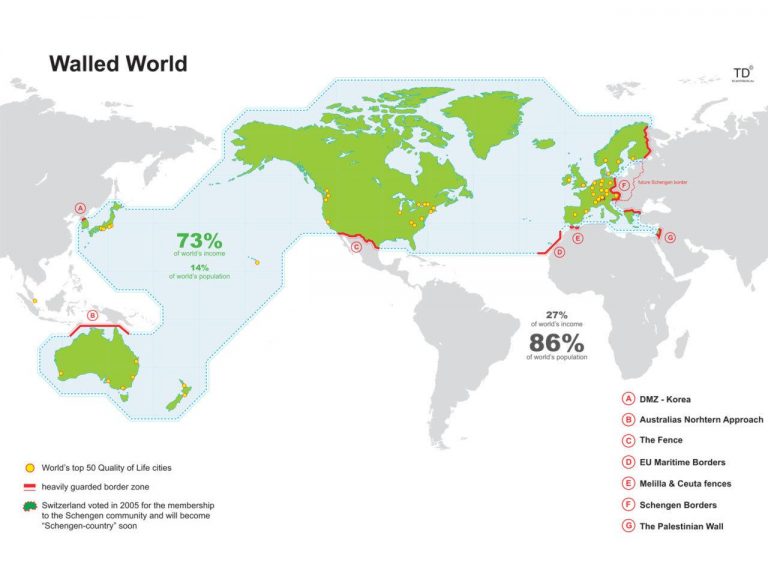
Often maps can convey ideas better than words. One example is this terrific map I recently found illustrating the geographical dimension of the ‘Trilateral West’ or ‘North-Western Triad’, which is composed of the three economic power houses, Japan, the US and the EU, including some of its loyal satellites like South Korea, Australia, New Zealand, Canada, Switzerland and Israel (Deutinger, 2009). It clearly indicates the porous maritime and hard continental borders keeping this walled world from getting inundated by political and economic refugees. In this article I will address three discernible planning phases since the start of WW II by which this walled arrangement came into being.

Fig 1. The Walled World (Deutinger, 2009)

Phase I: The War and Peace Studies Project

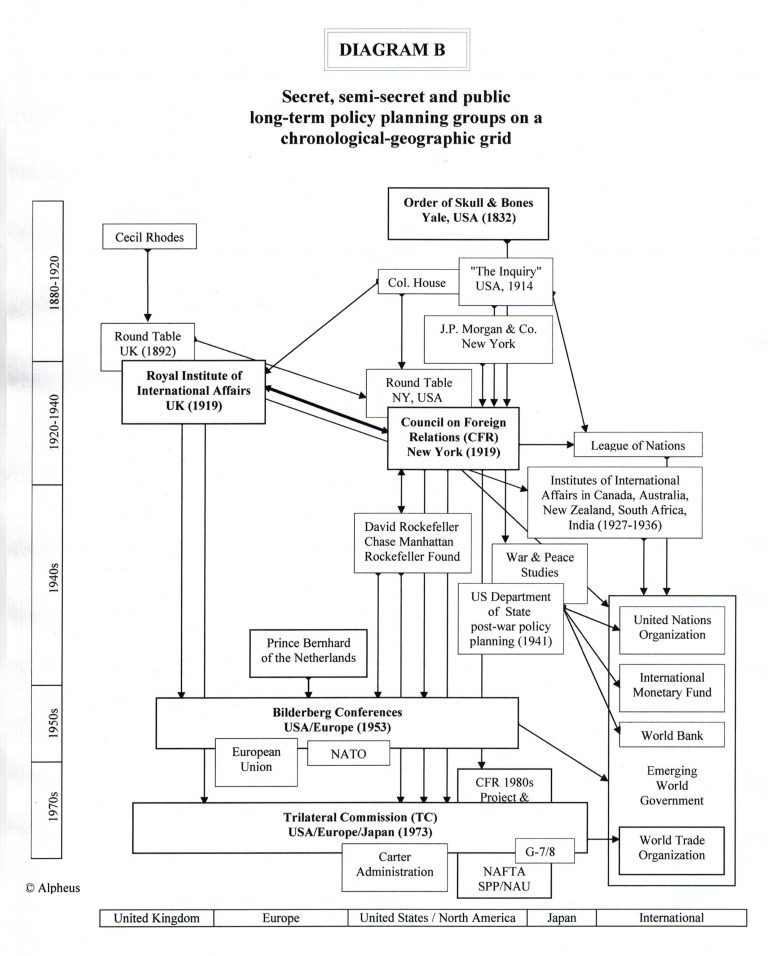
Historically speaking the foundation for this arrangement was the post-WW II Breton Woods system, which international order was devised by the power elites of the US and Europe in their elite, long-term policy planning think tanks, the New York based Council on Foreign Relations (CFR) and the London based Royal Institute for International Affairs (RIIA). Already in 1939 the CFR saw the need for a revamped international system and started even before the US was involved in the war with an organized study effort named ‘The War and Peace Studies Project’. This project was initiated in order to devise a best possible international order for its corporate members, predominantly Wall Street banks and international conglomerates (Shoup & Minter, 1977; Wala, 1994).

Starting in 1941 the study groups in the CFR were intimately cooperating with the US State Department’s own research groups, which incorporated many of the CFR’s ideas and personnel. The main institutional framework proposed by the State Department was the United Nations (UN), the International Monetary Fund (IMF) and the International Bank for Reconstruction and Development (the ‘World Bank’). At a series of conferences by the allies–Breton Woods being the most important one–the proposals were adopted and these institutions then all played important roles in the transition from a formal colonialist-imperialist international order to an informal imperialist order of nominally independent countries. The dollar, pegged to gold at $35 per ounce, became the basic currency for international trade. Only much later the originally planned World Trade Organization (WTO) was founded.

Within this international political-economic legal framework the important trans-national agents of influence were American and European big investment houses, trans-national corporations (TNCs), intelligence agencies and military alliances, with NATO being the most important one integrating the US and Europe.

Initially the US was the hegemon, but when Europe got back on its feet with the help of the Marshall Plan in the early 1950s and frictions developed between them, the very elite yearly Bilderberg conferences were started in 1953 to informally address US-European strategic differences and come to more coordinated policies. Many if not most of the US attendees who show up regularly are members of the CFR. And behind both there was the continual presence of David Rockefeller. These costly, high-security conferences are still held on a yearly basis, the last one in 2019 in Montreux, Switzerland (Thompson 1980, van der Pijl 1984, Richardson 2011, 2012, Schuller 2014).

Phase II: The 1980s Project

In the early 1970s, with the stellar rise of Japan and some serious problems in the international system like the oil crisis, the looming US defeat in Vietnam, Third World revolutions and the decoupling of the dollar from gold, it was time for the CFR, under the chairmanship of David Rockefeller, to re-address the whole international set-up with another multi-year round of studies and consultations now named ‘The 1980s Project’. Out of this came the further integration of Japan into the system by giving its corporate elite a big seat at the 1973 founded Trilateral Commission (TC) with Japan, the US and Europe each given a third of member- and leadership positions; the institution of international summits like the G-7 and G-20; and the start of neoliberalism initially implemented by the TC dominated Carter administration lead by TC founding member Jimmy Carter and TC main architect and executive director Zbigniew Brzezinski. This can be conceptualized as corporate democrats taking over the Democratic Party from the New Deal / Great Society social democrats. The establishment of the WTO and NAFTA can also be credited on its account (Shoup & Minter 1977; Shoup, 1980; Domhoff 1982; Sklar, 1980; Gill 1991, Domhoff 2013; Shoup 2015).

Because this system of ‘world management’ is composed of these three major and coordinating imperialist centers, it can be named the trilateral system, or the ‘North-Western Triad’, or as I do, the ‘Trilateral West’ with Japan seen as being in the ‘far west’ of the system as ‘The Walled World’ map is geo-spatially organized, and not as usual in the ‘far east’.

Phase III: Renewing America Initiative

A third round of in-depth CFR studies were commenced in 2011 under the leadership of CFR president Richard Haass. It was named the ‘Renewing America Initiative’, because the problems the US was increasingly facing were now domestic in nature: a crumbling infrastructure; a failing educational system; and loss of manufacturing jobs, and thereby a diminished power base to project influence internationally. The CFR also admitted, through Haass, that the US had gone from sole super power status as the indispensable, benign hegemon after the end of the Cold War to being a ‘first among equals’. To address the problems at the domestic front pensions, health care and other entitlements had to be cut; unions had to be curbed; congressional gridlock had to be broken (by a coalition of conservative democrats, moderate republicans and independents); and in foreign policy there would have to be an economic and military ‘pivot’ to Pacific Asia away from the Middle East. Major geo-economic initiatives were the Trans Pacific Partnership (TTP) and the Transatlantic Trade and Investment Partnership (TTIP). With the current Trump administration this agenda is in jeopardy, mainly because the moderate, status quo, internationalist, corporate Republicans started to lose power to emerging radical, nationalist, authoritarian Republicans. It is possible that, because of a back-lash against the semi-fascist and corrupt Trump administration, the corporate democrats and republicans will get the upper hand again and can revive their internationalist agenda after 2020 (Shoup, 2015).

The Deep History

The deep history of America’s premier foreign policy think tank, the CFR, is a story quite by itself. It was founded together with its UK sister organization, the RIIA, during the aftermath of the first world war when internationalist-oriented parties in the US became concerned about the US not joining the League of Nations (Quigley, 1966,1981). Feeding ideas and personnel into the CFR were some intriguing groups and individual movers and shakers. First of all, with the CFR as its extension, there was an informal study group concerned about post-WW I economic and political issues. This group had the name ‘The Inquiry’ with presidential advisor Col. House as its main force. House was also involved in the American branch of the semi-secret organization the ‘Round Table’, which was the US satellite of its UK mother lodge started by Cecil Rhodes, the premier UK imperialist planner. The British organization had many informal names besides its official one of ‘Round Table’, like ‘Milner’s Kindergarten’ and the ‘Cliveden Set’. The CFR can be conceptualized as the US Round Table front organization. Also representatives of J.P. Morgan & Co. and patriarchs of the Yale based fraternity Skull & Bones were at the founding table of the CFR (Sutton, 1986).

Many years ago I created a geographical-chronological grid of the main semi-secret groups, think tanks, international organizations and some individuals involved in this narrative of globalization. I cut it down to the essentials and the grid admittedly lacks a twenty-first century update.

Fig. 2. Chronological-geographic Grid


World System Analysis

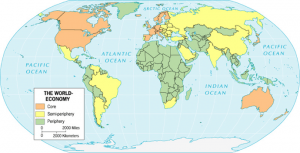
There are different ways to conceptualize these international dynamics. In the framework of sociologist Wallerstein’s ‘world system analysis’ the Trilateral West is the ‘core’ of the world system imposing its political and economic will on the rest of the world, which is divided in a sphere of semi-peripheral countries, which have some development, and peripheral countries, which are under-developed (though there is a debate on what actually ‘development’ means)(Wallerstein, 2004).

Fig. 3. The World-Economy (Elwell, 2013)

In the above map the geographically integrated nature of the Trilateral West with its maritime and hard borders is somewhat lost. The Deutinger map has North America in the middle instead of Europe, which also reflects its importance . . . for now (a third map with China in the middle might become the more explanatory map in the coming decades).

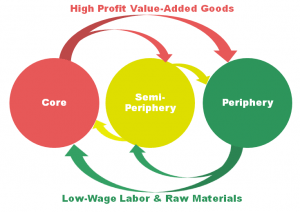
Fig 4. Flow of Goods, Resources and Labor

Which brings me to the dynamic aspect of this international structure. Basically the core produces high-tech, high-profit goods for its domestic and foreign markets while taking in low-price raw materials and low wage workers. The periphery is in the unenviable position where it generates hardly any high-tech, high-profit goods and has to give up its resources and labor for a pittance. In between are the somewhat developed, semi-periphery countries with an intermediary, buffering role between the core and the periphery being both exploiter and exploitee. Countries in the core will try to stay in that position while the others will try to go at least one status up.

The core mostly has a hegemon, usually the country with the largest navy, merchant fleet, manufacturing base and financial institutions. In Wallerstein’s chronology the Dutch in the 17th century came first, and in the 18th and 19th century it was the UK. Then after a period of transition between 1914 and 1945, which knocked out Germany as a candidate, the USA became the hegemon. Anno 2020 the power and status of the USA is diminishing year by year, not the least because of the scandalous incompetence of the Trump administration, and that of China is rising. With China joining the WTO, G-20, the informal Davos, and the adoption of the adapted Trans-Pacific Partnership (TPP), China will become increasingly incorporated into the core of the globalized system from which position it is already reforming and protecting it, and will probably take over the role of hegemon in a few decades.

This transformation of a major Communist power from antagonist, to resister, to participant, to reformer, to protector and finally to leader of the international capitalist system is quite extraordinary (Zhihai, 2011). Some would see this as a diabolical and long established plot between Wall Street and Communists, while others would see this as the logical outcome once China went from failing Communism to authoritarian state capitalism–being communist only in name–and thereby going back to its traditional position of dominance in the world economy which it had lost to the west for about four centuries (Frank, 1998; Arrighi 2007).

It is also possible that this process will be halted by a cold or hot face-off between China and Russia on one hand (they have been long-time strategic allies) and the Trilateral West on the other. And the factors leading into this already smoldering conflict are legion. Botched intelligence operations, electoral interference, sanctions, tariffs, counter-tariffs, right-wing anti-globalization populism, the correlated rise of nationalism–and all of this now aggravated by the pandemic and global recession pushing countries into increased self-sufficiency–can result in the de-coupling of the two main spheres of geopolitical power and put them at severe loggerheads. Cooler and more competent heads are necessary to navigate the tectonic economic and political shifts caused by China’s rise.

At the same time alternatives have to be developed to deconstruct the juggernaut of imperialistic globalization. Most importantly the hidden engine of the globalization process, the current monetary system, will have to be reformed. Humongous streams of capital can be re-directed, even created, to help a controlled process of de-globalization take place focused on a social-economic development of the periphery and semi-periphery, which is non-exploitative and ecologically sustainable, while the Trilateral West itself will have to tackle its own inequalities through raising taxes on corporations and the rich, and nationalize their currencies to redirect capital from financial speculation to investments in infrastructure, either physical, health or educational in the context of a Green New Deal. Sounds big, but the research underpinning such radical reforms is now quite large and monetary reform proposals are already on the shelf and could be activated in a matter of weeks.*

Originally, in an on-line presentation, the above narrative was embedded in an even larger one, i.e. of the dynamics of civilizations since the dawn of history till the relative dominance of the West. This will have to wait for another article. For now, I hope to have sketched a historical, institutional and geographical framework wide enough to get some grip on international developments.

* For more on monetary theory and reform see: Zarlenga 2002, 2009; Kumhof & Benes 2012; Ingham 2004; Werner 2012, 2014; Egnatz 2015; Huber 2017; Di Muzio & Robbins 2016, 2017, 2020; and Hammon & Pash 2019. Browse also this small bibliography with introductory items for initial orientation and this weighted list of of best studies based on the opinion of a group of experts.

Sources

Arrighi, Giovanni. 2007. Adam Smith in Beijing: Lineages of the Twenty-first Century. London & New York: Verso.

Aubourg, Valerie. 2003. “Organizing Atlanticism: The Bilderberg Group and the Atlantic Institute, 1952–1963”. Intelligence and National Security, 18/2 (2003): 92-105. Comparing two private, transatlantic organizations which started in the 1950s and flourished in the 1960s.

Deutinger, Theo. 2009. “Walled World“. Amsterdam & Salzburg: TD Architects. Retrieved 17 May 2020.

Di Muzio, Tim & Robbins, Richard. 2016. Debt as Power: Theory for a Global Age. Manchester, UK: Manchester U.P.

Di Muzio, Tim & Robbins, Richard. 2017. An Anthropology of Money: A Critical Introduction. London: Routledge.

Di Muzio, Tim & Robbins, Richard. 2020. “Capitalized Money, Austerity and the Math of Capitalism“. Current Sociology, 68/2: 149–168.

Domhoff, G. William.1969. The Higher Circles: The Governing Class in America: An Investigation of the Men and Women who govern our Country. New York: Vintage Books. Penetrating sociological study of the power elite. Special chapter on the CFR and one on conspiricist views of the upper-class.

Domhoff, G. William. 1978. The Powers That Be: Processes of Ruling Class Domination In America. New York: Vintage Books. Study of the ways and means of power-elite hegemony. Most revealing chapter on the role of the CFR in creating the UN, IMF and World-bank.

Domhoff, G. William. 2013. The Myth of Liberal Ascendancy: Corporate Dominance from the Great Depression to the Great Recession. Boulder & London: Paradigm Publishers.

Egnatz, Nick. 2014. “Linking Social Justice to Monetary Reform”. Alpheus. 25 Dec 2014.

Elwell, Frank W. 2013. “Wallerstein’s World-Systems Theory“. Retrieved May 17, 2020.

Eringer, Robert. 1980. The Global Manipulators: The Bilderberg Group… the Trilateral Commission… covert power groups of the West. Bristol, UK: Pentacle Books. An early journalistic foray into Bilderberg-land and how the media failed the public. First chapter here.

Estulin, Daniel. 2007. The True Story of the Bilderberg Group. Walterville, OR: TrineDay
“For some 15 years, Estulin has been a thorn in the sides of the Bilderbergers, relentlessly hunting down their secret meeting places, gaining inside sources who divulge what goes on behind closed doors, even photographing attendees and publicly disclosing it all.”

Frank, Andre Gunder. 1998. ReOrient: Global Economy in the Asian Age. Berkeley: University of California Press.

Gill, Stephen. 1991. American Hegemony and the Trilateral Commission. Cambridge, UK & New York: Cambridge UP.

Hammon, Virginia & Pash, Mark. 2019. How We Pay for a Better World. Portland: Great Democracy Media.

Huber, Joseph. 2017. Sovereign Money. Beyond Reserve Banking. London: Palgrave Macmillan.

Ingham, Geoffrey. 2004. “The Emergence of Capitalist Credit Money.” In: L. Randall Wray (Ed.), Credit and State Theories of Money: The Contributions of A. Mitchell Innes. Edward Elgar. 173-223.

Kumhof, Michael & Benes, Jaromir. 2012. “The Chicago Plan Revisited“. IMF Working Papers 12/202. Washington: International Monetary Fund.

Miller. Todd. 2019. “Israel’s Occupation Inspired the Brutal Security Regime at the US-Mexico Border“. Truthout, 17 Oct 2019. Excerpt from Empire of Borders: The Expansion of the U.S. Border Around the World. London: Verso Books.

Quigley, Carroll. 1966. Tragedy and Hope: A History of the World in our Time. New York: Macmillan. Tucked away in a vast narrative of 1870-1945 world history, eminent historian reveals evidence of the existence of a secret cabal within the Anglo-American establishment and its impact on history.

Quigley, Carroll. 1981. The Anglo-American Establishment: From Rhodes to Cliveden. New York: Books in Focus. Eminent historian reveals historical roots of a secret cabal within the Anglo-American establishment. Study written in 1946 and finally published posthumously in 1981.

Richardson, Ian. “Bilderberg, Elite Consensus and the Media“. The Huffington Post, UK Edition. July 13, 2011. Web.

Richardson, Ian; Andrew Kakabadse; Nada Kakabadse. 2012. “Shaping Global Political Realities: The Workings of Transnational Elite Networks“. World Financial Review, March-April 2012.

Ronson, Jon. 2002. Them: Adventures with Extremists. New York: Simon & Schuster. Two chapters dedicated to his adventures to find out more about Bilderberg.

Ross Sr., Robert Gaylon. 1995. Who’s Who of the Elite: Members of the Bilderbergs, Council on Foreign Relations, Trilateral Commission, and Skull & Bones Society. N.p.; RIE.
“The book is an excellent “reference” as to specifically who is affiliated with each specific elite organization, as well as cross-referencing what branch of government, industry, etc. their “day-job” corresponds with”. Different editions available.

Schuller, Govert. 2014. “Bilderberg 2014: A Secretive Elite Wonders if Privacy Exists“. Alpheus, October 2014.

Scott, Peter Dale. 1993. Deep Politics and the Death of JFK. Berkeley and Los Angeles: University of California Press,.

Shoup, Laurence H. and Minter, William. 1977. Imperial Brain Trust: The Council on Foreign Relations and United States Foreign Policy. New York: Monthly Review Press. Academic study of the history, network and influence of the CFR, especially its architecture of the post-WW II order with institutes like the UN, IMF and World Bank, and later its 1980s Project laying the groundwork for trilateralism, the G-7 Summits and the Trilateral Commission.

Shoup, Laurence H. 1980. The Carter Presidency and Beyond: Power and Politics in the 1980’s. Palo Alto, CA: Ramparts Press.

Shoup, Laurence H. 2015. Wall Street’s Think Tank: The Council on Foreign Relations and the Empire of Neoliberal Geopolitics, 1976-2014. New York: Monthly Review Press. Continuation of Imperial Brain Trust.

Sklar, Holly (Editor). 1980. Trilateralism: The Trilateral Commission and Elite Planning for World Management. Boston: South End Press. Collection of case studies of the imperialist power of the TC. Includes an annotated TC membership list.

Sutton, Antony and Patrick Wood. 1978, 1981. Trilaterals Over Washington. 2 vols. Scottsdale, Arizona: August Corp. Groundbreaking study on the Trilateral Commission by academic investigators.

Sutton, Antony. 1986. America’s Secret Establishment: An Introduction to the Order of Skull & Bones. Billings, Montana: Liberty House. After obtaining the membership list of this Yale senior semi-secret society, Sutton could connect the dots from his Wall Street trilogy and lay out the central role S&B played in fomenting wars and revolutions and controlling education.

Thompson, Peter. 1980. “Bilderberg and the West”. In: Trilateralism, Holly Sklar (Editor).

van der Pijl, Kees. 1984. The Making of an Atlantic Ruling Class. London: Verso. Study of the development and integration of the American and West European post-WWII corporate elite.

Wala, Michael. 1994. The Council on Foreign Relations and American Foreign Policy in the Early Cold War. Oxford & New York: Berghahn Books. “Based on extensive analysis of primary sources, this book clearly delineates the Councils activities- its study and discussion groups and its publications – and the developing international political, military, and economic situations.”

Wallerstein, Immanuel. 1974-1989. The Modern World-System. 3 volumes. New York & San Diego & London: Academic Press.

Wallerstein, Immanuel. 2000. The Essential Wallerstein. New York: The New Press.

Wallerstein, Immanuel. 2004. World-Systems Analysis: An Introduction. Durham, NC: Duke University Press. Short overview and introduction to his comprehensive approach to world history.

Werner, Richard A. 2012. “How to Turn Banks into Financial Intermediaries and Restore Money Creation and Allocation Powers to the State”. University of Southampton, Center for Banking, Finance and Sustainable Development, Policy Discussion Paper, No. 3-12 (8 Nov 2012): 2-9.

Werner, Richard A. 2016. “A lost century in economics: Three theories of banking and the conclusive evidence”. International Review of Financial Analysis, 46 (July 2016): 361-379.

Zarlenga, Stephen. 2009 (2006). “Presenting the American Monetary Act”. Valatie, NY: American Monetary Institute.

Zarlenga, Stephen. 2002. The Lost Science of Money: The Mythology of Money – the Story of Power. Valatie, NY: American Monetary Institute.

Zhihai, X. I. E. 2011. “The Rise of China and its Growing Role in International Organizations“. Journal of Modern Chinese Studies, 4/1: 85-96.

Trump and the Deep State / The Koch Brothers’ New Brand


Just read new and updated forewords to two important book-length studies about power in the US. Both were updated to put their considerable investigations in connection with the new Trump administration.

The first book is by Prof. Peter Dale Scott, co-founder of the Peace and Conflict Studies program at UC Berkeley. He wrote a new foreword–“Donald J. Trump and The Deep State”[1]–to the recent 2017 paperback version of his The American Deep State: Big Money, Big Oil, and the Struggle for U.S. Democracy (2014)[2]. He is an expert on the concept of ‘Deep State’ and provides an updated history of the concept’s development.

Entry to the next massive study can be best obtained by reading ecological activist Bill McKibben’s review–“The Koch Brothers’ New Brand”[3]–to Jane Mayer’s Dark Money: The Hidden History of the Billionaires Behind the Rise of the Radical Right.[4] On Amazon you can read most of her new foreword.

What becomes clear in these writings is the fact that Trump and his cabinet are very much integral elements of the American power elite, though are part of a nationalist faction which has always operated at the margins of government.

Originally posted on Facebook, Feb 10, 2017.

[1]. Scott, Peter Dale. “Donald J. Trump and The Deep State“. Who.What.Why. 6 Feb 2017.

[2]. Scott, Peter Dale. The American Deep State: Big Money, Big Oil, and the Struggle for U.S. Democracy. Lanham, MD: Rowman & Littlefield, 2014. 

[3]. McKibben, Bill. “The Koch Brothers’ New Brand”. New York Review of Books. 10 Mar 2016. 

[4]. Mayer, Jane. Dark Money: The Hidden History of the Billionaires Behind the Rise of the Radical Right. New York: Doubleday, 2016.

On Trump: The Steele Report Echoing the Golitsyn Deception?


Ten days before the inauguration of Trump an anonymous bombshell intelligence report was published by Buzzfeed.[1] The report, written by former British MI6 agent and Russia expert Christopher Steele, alleges that 1) Russian intelligence has compromising material on Trump gathered when he visited Leningrad and Moscow a few years ago; 2) there were extensive and frequent contacts between people high in the Trump campaign and Russian intelligence; and 3) that intelligence was swapped between the two parties; Trump giving intelligence on Russian oligarchs in the US and Russia reciprocating with ‘opposition research’ on Hillary Clinton. If the report is even half true it will be the biggest political bombshell in recent history, even bigger than Watergate, and will lead to a hopefully short constitutional crisis solved by Trump stepping down as President and the possible arrests of Paul Manafort, Carter Page and Michael Cohen.

 
If false, and the Intelligence Community knew these memos to be false, this will be a very troubling interference by them into the affairs of the US Government and heads will roll.
 
If its truth doesn’t matter in this post-truth age, then you’re in for at least a good spy novel read.
 
The material was widely known apparently in media, intelligence and political circles since the summer of 2016, but were never divulged until CNN found out that a two page synopsis of this material was presented to both Trump and Obama at an intelligence briefing, which might have lend a certain credibility to this set of ‘intelligence memos’.[2] After CNN’s report Buzzfeed decided to publish all the 35 pages of memos to inform the American public of what these allegations were.
 
Apparently the FBI already had these memos before McCain also got a copy and passed them on to the FBI. The believers’ narrative is that the memos were written by a former MI6 agent who had a good reputation for producing believable material. He was hired by both anti-Trump republicans and later by democrats. They also make the case that this material provides the missing background info to understand Trump’s puzzling positive relationship with Russia.
 
The story will not easily disappear. If it is true, which still might be possible, it will blow up Trump. If it is false, which seems to be the current working hypothesis, the focus will be on who fabricated it, when and why.
 
The Wall Street Journal and others think it came from a British private intelligence company named Orbis and that the writer was Christopher Steele, who went underground fearing for his life.[3] He is considered by many to be a reliable source.[4]
 
Obviously, if there really exists a compromising tape, and as long as there is plausible deniability about its existence, the Russians have some power over Trump. If the Steele Memos (or Russian Dossier) are to believed, the Russians did not use any big pressure on Trump because he has cooperated so well with them.
 
Since these memos have become public all parties involved will have adapted their tactics. For example, the Russians will lay low and consistently deny any wrongdoing because they do not want to jeopardize their desired goal of more lenient sanctions or even their total lift. They took a huge risk with helping Trump into the White House in order to have sanctions lifted, because, if found out, there might be a severe backlash and sanctions might increase.

On the other side–and here the full, fascinating wilderness-of-mirrors metaphor is applicable–author, journalist and expert on Russia, David Satter, came up with an alternative explanation of the origin and intentions behind this very controversial Steel Dossier / Trump Report. He thinks that the Russians fed Steele with concocted, but very plausible, compromising information about Trump’s relations with Russian prostitutes, agents and politicians in order to confuse, undermine and demoralize American intelligence, politicians and public.[5] So far that game plan seems to work.

I thought about this possibility before, because Soviet intelligence had probably mounted something similar in the late 1950s when they concocted a very complex but plausible story of Soviet infiltration at very high levels of US intelligence, especially the CIA, and mixed the story with the idea that the big breaks in the international communist world, especially the Russia-China break, were intentional deceptions in order for the Communist bloc to look fragmented and weak to the West. And it was touted as a very smart, very devious long term plan by the Communist world to defeat the West.

This information was carefully fed to one defector, Anatoly Golitsyn, who brought the story to the CIA where the head of counterintelligence, James Jesus Angleton, bought the package, hook, line and sinker. This information triggered an unprecedented mole-hunt within the ranks of the CIA, which had a crippling and polarizing effect on the CIA’s capacity of sorting out genuine defectors from plants and solid information from deceptive fabrications, for example the very tricky question of the extent of Soviet involvement in the JFK assassination about which different defectors presented different stories.[6]

For several reasons I believed the Angleton-Golitsyn thesis on Soviet deception to be correct and wrote an article in 2004 explaining the whole set-up and weaving it together with then stock-in-trade right-wing conspiracy memes about Yale’s semi-secret senior society Skull & Bones and the New York based think tank The Council on Foreign Relations.[7] Though I did not have, then nor now, definitive refutation nor confirmation of the thesis, it was US journalist Ron Rosenbaum who pointed out the possibility that the whole Golitsyn story could have been a very clever concoction of which even the defector himself was not aware.[8]

If Satter’s thesis pans out then Trump and his team could be cleared from most of the Steele allegations, even though the extent of Trump’s financial involvement with Russian oligarchs and Mafya is still unclear, and we can conclude that Russia’s intervention with the US electoral process was one or two layers more devious and smart than most of us might have thought.

Originally posted on Facebook, January 19,  2017.

[1]. Anon. [Steele, Christopher]. “Trump Intelligence Allegations“. Buzzfeed. 10 Jan 2017. 

[2]. Evan Perez, Jim Sciutto, Jake Tapper and Carl Bernstein, . “Intel chiefs presented Trump with claims of Russian efforts to compromise him“. CNN. 10 Jan 2017. 
 
 
[4]. Nick Hopkins and Luke Harding. “Donald Trump dossier: Intelligence sources vouch for author’s credibility“. The Guardian. 12 Jan 2017. 

[5]. Satter, David. “The ‘Trump Report’ Is a Russian Provocation”. The National Review. 12 Jan 2017.

[6]. Books sympathetic to the Angleton-Golitsyn thesis are Edward Jay Epstein’s Deception: The Invisible War Between The KGB And The CIA (New York: Simon & Schuster, 1989) and Mark Riebling’s Wedge: The Secret War Between the FBI and CIA (Alfred Knopf, New York, 1994).

More critical books are Tom Mangold’s Cold Warrior: James Jesus Angleton: The CIA’s Master Spy Hunter (New York: Touchstone, 1991) and David Wise’s Molehunt: The Secret Search for Traitors that Shattered the CIA (New York: Random House, 1992).

[7]. Schuller, Govert. “The Abiding Communist Threat in its Open and Hidden Manifestations“. Alpheus. 4 July 2004.

[8]. Rosenbaum, Ron. “The Shadow of the Mole: Two superpowers, three master spies, four false defectors, five schools of mole lore, and seven types of ambiguity.” Harper’s (October 1983). Also in: Travels with Dr. Death (New York: Penguin, 1991).

The Controlled Demolition of WTC 1, 2, 7 and of its Official Explanation

In less time than the duration between American Airline Flight 11 crashing into World Trade Center One on September 11, 2001, and its total collapse 102 minutes later, one can experience the controlled demolition of the official version presented by the National Institute of Standards and Technology (NIST) of how the collapse allegedly happened through a combination of structural damage and fire-induced failure. By placing scientific facts at the many weak points of the NIST structure a group of experts representing the more than 2,300 professional members of Architects & Engineers for 9/11 Truth effectively demolished the NIST report and send its authors back to engineering school.

In their recently published booklet, “Beyond Misinformation: What Science Says about the Destruction of World Trade Center Buildings 1, 2, and 7“, the authors make the case that the NIST hypothesis was grossly under-developed because a) it only speculates about how the collapse could have been initiated, but gives no analysis whatsoever of the building’s behavior during its destruction; b) it ignores recordings and eyewitness accounts of explosions while also misrepresenting the occurrence of molten steel and smoke puffs occurring before and below the cascading collapse, all indicating the possibility of controlled demolition; and c) NIST’s inadequate responses to “Requests for Correction” by critical experts pointing to serious flaws.

While the NIST study admits it cannot provide a full explanation of the collapse, the A&E report makes a strong case that “the hypothesis of controlled demolition readily, simply, and completely explains all of the evidence regarding the structural behavior of WTC 1 and WTC 2 during their destruction” (p. 23). The evidence discussed ranges from the statistical improbability of total collapse of high-rise steel buildings; the sudden onset of the collapse; the constant acceleration of their fall as if nothing existed below to slow the cascade; the enormous energy needed for the pulverization, dismemberment, and explosive ejection of materials; the occurrence of demolition squibs; and the eyewitness accounts of explosions.

On top of that the A&E report also presents the forensic evidence of “high-temperature thermitic reactions” before, during and after the destruction of the buildings (pp. 30-37). Molten metal was seen pouring out of WTC 2 and was found in the debris; the few samples of steel investigated had sulfidated; four samples of WTC dust contained spherules and other composite particles indicating temperatures much higher (2,800F) than officially acknowledged (1,000F); and the smoking gun was the discovery of unreacted nano-thermite in the dust samples. Note well that this last finding means that traces of explosives were found which had not yet detonated!

While overall the main stream media and many technical journals ignore these findings, it is obviously up to civic society, comprised of grass-root organizations and activist individuals, to present truth to power and fight the good political fight to get the real culprits of 9/11 apprehended. I invite you to click on the booklet and spend $2.50 [as of 12/20/15 the booklet is free] and 100 minutes to see why.

A&E-Cover

Bilderberg 2014: A Secretive Elite Wonders if Privacy Exists


Introduction

If you are interested in studying parapolitics–i.e. the practice of attaining political ends through secrecy and covert operations by intelligence agencies, think tanks and private networks (Scott)–there might be no better group to look into as the “Bilderberg”, the annual three-day conference in which the cream of the crop of the Atlantic power elite can freely exchange differing viewpoints and enhance mutual understanding, as they like the public to believe.

This year (2014) the conference was in Copenhagen, in a Marriott hotel guarded by “a double ring of three-metre (10ft) high security fencing” and a little army of security guards. As usual, the hotel was closed off to regular guests and certainly to journalists, two of whom were arrested for asking questions of the organizers at the hotel bar (Skelton).

The conference is conducted under the so-called Chatham House Rule by which “participants are free to use the information received, but neither the identity nor the affiliation of the speaker(s), nor that of any other participant, may be revealed” (Chatham House). Participants can make notes, but are not allowed to take those home. What they can take home is a list of the participants and their contact information. There was no press conference nor a communiqué and participants agreed not to give interviews to the press. As the organizers state about the conference in a press release: “There is no desired outcome, no resolutions are proposed, no votes are taken, and no policy statements are issued”.

The organization does publish a list of participants and mentions the topics of discussion, but is otherwise stingy in providing more information. Its headquarters has the same address as the main address of the University of Leiden in the Netherlands at a picturesque canal just around the corner where I used to live. It might have a staff of just one person. All the footwork and research though seems to be done at the Council on Foreign Relations (CFR) in New York, which many consider the most influential of long-term policy planning organizations in the West. They were the architects of the United Nations, the International Monetary Fund, the World Bank and the then still-born World Trade Organization (Shoup & Minter). Many of the Bilderberg Steering Committee members are prominent members of the CFR.

The Non-Reporting by Reporters

The media were well represented, but do not hold your breath to receive a report or, God forbid, a scoop by John Micklethwait, Editor-in-Chief of The Economist; Natalie Nougayrède, Director and Executive Editor of Le Monde; Martin Wolf, Chief Economics Commentator of The Financial Times; or by any of the other five highly placed journalists present from Austria, Italy, Spain, Sweden and Turkey. The condition of their participation is to put away their notebooks and keep silent afterward.

If Bilderberg is ever mentioned in such media it is to ridicule conspiracy theorists and their inflated, paranoid ideas about who runs the world. Any attempt at critical analysis, of which I deem them perfectly capable, seems verboten, though reporting during the last decade has improved. And small chance to see academic studies mentioned which view such gatherings from a non-conspiratorial social science angle like the work of Ian Richardson, Carol Quigley, Anthony Sutton, Laurence Shoup, Holly Sklar, G. William Domhoff, or Kees van der Pijl. This is unfortunate, because such knowledge is now pushed under and into the dark where it gets mixed with antisemitism, alien agendas and–to which undersigned has contributed–occultism. Fortunately, besides the mainstream The Guardian in the United Kingdom, there are some journalists representing smaller and fringe media reporting on the Bilderberg like Jon Ronson, Jim Tucker, Alex Jones and others with widely differing qualities of reporting.

One of the questions discussed this year in Denmark was “Does privacy exist?” Given the extensive security measures surrounding the conference and the strict rules of engagement inside, this question drips with sinister irony. As Charlie Skelton, reporting on the spot for The Guardian, UK’s foremost paper to tackle under-reported stories, contemplates:

There’s something distinctly chilling about the existence of privacy being debated, in extreme privacy, by people such as the executive chairman of Google, Eric Schmidt, and the board member of Facebook Peter Thiel: exactly the people who know how radically transparent the general public has become.

Now, add to this list of social media representatives Reid Hoffman, the co-founder and executive chairman of LinkedIn, and Clara Shih, CEO and founder of Hearsay Social (about whom more later), and you have a nice group of experts for the elite to consult about social media and privacy.

Maybe the best way to frame the topic is to realize that the elite there gathered in Denmark takes privacy and secrecy for granted as a right for themselves and considers the public’s privacy as merely a privilege to be tinkered with in secrecy. Facebook’s business model requires transparency to shape its members into predictable, profitable consumers and the NSA’s Snowden-blown secret mandate is to monitor the world’s communication patterns and treat ordinary Americans as incipient terrorists. Both NSA and Facebook tinker with their interpretations of privacy and political rights as much as they can get away with.

Little Case Study

To help maximize the reach of “highly regulated companies” like banks and insurers into our social networks to make money, is a California start-up company Hearsay Social. Without a hint of alarm about the company’s 1984-ish agenda The New York Times reported that,

To help bank employees navigate regulations, Hearsay offers software that includes libraries of approved content to post on social media, and it allows employees to customize their messages as long as they are vetted before publication. In addition, the program lets its users “listen” to activity on their social networks (Alden).

I mention this factoid because the CEO of this company, Clara Shih, was also in Copenhagen and might be the youngest Bilderberg attendee I know of. She is 32. Her monitoring software might be in high demand by other very important participants from the banking sector like HSBC’s chairman Douglas Flint and its senior adviser Sherard Cowper-Coles; Paul Achleitner and Josef Ackerman of Deutsche Bank; Franco Bernabe, VP of Rothschild Europe; and representatives of international financial institutions like Christine Lagarde, head of the IMF and Benoît Coeuré, executive board member of the European Central Bank. Add to this list some higher-ups from Lazard and Goldman Sachs and the picture is again of an enormous concentration of power and influence present at this Bilderberg conference.

NATO War Council?

Besides the social media and banking companies, both the intelligence and military community are also well represented at this Bilderberg meeting. Where else would one find–besides a possible NATO war council–professionals with the highest security clearance and military authority like Keith B. Alexander, the former commander of the U.S. Cyber Command and former director of the NSA; Philip M. Breedlove, the Supreme Allied Commander of Europe; the Secretary General of NATO, Anders Fogh Rasmussen; and John Sawers, head of the UK Secret Intelligence Service? Again, a quite impressive grouping.

Because the crisis in the Ukraine is officially on the Bilderberg agenda and NATO can be construed as an instrument of western, corporate finance capitalism (extremely well represented in Copenhagen) which together push into Eastern Europe and beyond to find more living space for corporations to extract wealth, this meeting might indeed be an informal war council to formulate a medium to long term policy which might satisfy all major–and sometimes divergent–corporate, military, intelligence and financial interests involved. After all, the name of the game in these clubs is consensus building around long-term corporate policy preferences (Richardson).

The Facebook-Intelligence Interface

As a last point, one might find in the above mentioned Peter Thiel an interesting interface between social media and the intelligence community as he sits on the board of Facebook and was behind Palantir Technologies, “a secretive data-mining company that made its name working for the CIA” (Waters), whose current CEO Alex Karp’s whereabouts in June was … you guess … also in Copenhagen. Once you look into the biographies of the attendants, very interesting patterns come to the fore and cry out for further investigation.

One might ask Thiel for the sake of transparency what actionable information he privately divulged and received on the question of privacy during the conference. And if the information might impact the running of Facebook. As long as he does not mention with which participants he had an exchange and is not talking to the press, he is not breaking the rules, at least not the ones set by the organizers. Such questions are relevant as Thiel is on the record stating he wants even more and better technology to monitor the world to prevent terrorism (Waters).

Academic Scrutiny

Fortunately a group of social scientists did manage to publish one of the rare academic monographs on Bilderberg, titled Bilderberg People: Elite power and consensus in world affairs. They did interview some of the attandees. Their research program is based on the following legitimate curiosity:

“In order to comprehend the significance of elite transnational networks, we need to gain some degree of transparency on what is taking place within them. We need to understand the interdependencies and motivations of participants, as well as the relationship between power and consensus within such communities. And, crucially, we need to understand how consensus is formed and disseminated within, and beyond, networks of this kind” (Richardson, 36).

Framing the Bilderberg like this might not be exciting, but the imperative to correctly understand these people, rather than demonizing them, is of great importance if attainable, realistic reforms of this world are on your agenda.

One of the pertinent questions in this study is about how to best frame our understanding of this club. One quoted reference about the origin of Bilderberg asked in its title ” CIA plot, socialist conspiracy, or new world order?” (Wilford), to which the authors answered, though tucked away in a footnote, that “Wilford’s research provides extremely qualified support for the new world order hypothesis” (Richardson et al). This hypothesis is basically stating that Bilderberg tries to understand and shape the process of globalization through secretive consensus building within the transatlantic elite. In their conclusion Richardson et al come to the following succinct formulation of their findings:

This book has sought to demonstrate that they are an integral part of a system of world politics that exists beyond any formal conception of constituency or process. They facilitate communication primarily between transnational business interests and internationalist political elites, and their focus, not always conscious, is related to the structural challenges of globalization (217).

Much more could be written about this group, but for now, I hope you have obtained a taste for parapolitics as a relevant discipline to understand a bit better how the world works. It is not an invitation to grand conspiracy theorizing, but a call to vigilance because the cumulative effect of a series of petites conspiracies in the many shapes corruption takes, combined with the secretive long-term policy formation process within the transnational elites, might be equal to the dystopian disasters the grand conspiracy theorists project.

Sources

Alden, William. “Hearsay Social Raises $30 Million to Give Bankers an Online Presence“. The New York Times. Sept 5, 2013. Web.

Bilderberg Meetings. “Participants“. Web (cached).

Bilderberg Meetings. “Press Release“. Web (cached).

Chatham House. “Chatham House Rule“. Web.

Richardson, Ian; Andrew Kakabadse; Nada Kakabadse. Bilderberg People: Elite Power and Consensus in World Affairs. (London & New York; Routledge, 2011). Print.

Skelton, Charlie. “Bilderberg at 60: inside the world’s most secretive conference“. The Guardian. May 29, 2014. Web.

Waters, Richard. “Lunch with the FT: Peter Thiel“. Financial Times . Dec 20, 2013. Web.

Wilford, Hugh. “CIA plot, socialist conspiracy, or new world order? The origins of the Bilderberg group, 1952–55”. Diplomacy & Statecraft 01/2003; 14(3):70-82. Print.

Background

Aubourg, Valerie. “Organizing Atlanticism: the Bilderberg group and the Atlantic Institute, 1952–1963”. Intelligence and National Security, 18:2 (2003), 92-105. Comparing two private, transatlantic organizations which started in the 1950s and flourished in the 1960s.

Domhoff, G. William. The Higher Circles: The Governing Class in America: An Investigation of the Men and Women who govern our Country (New York: Vintage Books, 1969). Penetrating sociological study of the power elite. Special chapter on the CFR and one on conspiricist views of the upper-class.

Domhoff, G. William. The Powers That Be: Processes Of Ruling Class Domination In America (New York: Vintage Books, 1978) Study of the ways and means of power-elite hegemony. Most revealing chapter on the role of the CFR in creating the UN, IMF and Worldbank.

Eringer, Robert. The Global Manipulators: The Bilderberg Group… the Trilateral Commission… covert power groups of the West. Bristol, UK: Pentacle Books, 1980. Print. An early journalistic foray into Bilderberg-land and how the media failed the public. First chapter here.

Estulin, Daniel. The True Story of the Bilderberg Group. Walterville, OR: TrineDay, 2007. Print. “For some 15 years, Estulin has been a thorn in the sides of the Bilderbergers, relentlessly hunting down their secret meeting places, gaining inside sources who divulge what goes on behind closed doors, even photographing attendees and publicly disclosing it all.”

Pijl, Kees van der. The Making of an Atlantic Ruling Class (London: Verso, 1984). Print. Study of the development and integration of the American and West European post-WWII corporate elite.

Quigley, Carroll. The Anglo-American Establishment: From Rhodes to Cliveden (New York: Books in Focus, 1981). Print. Eminent historian reveals historical roots of a secret cabal within the Anglo-American establishment. Study written in 1946 and finally published posthumously in 1981.

Quigely, Carroll. Tragedy and Hope: A History of the World in our Time (New York: Macmillan, 1966). Print. Tucked away in a vast narrative of 1870-1945 world history, eminent historian reveals evidence of the existence of a secret cabal within the Anglo-American establishment and its impact on history.

Richardson, Ian. “Bilderberg, Elite Consensus and the Media“. The Huffington Post, UK Edition. July 13, 2011. Web.

Richardson, Ian; Andrew Kakabadse; Nada Kakabadse. “Shaping Global Political Realities: The Workings of Transnational Elite Networks“. World Financial Review. March-April 2012. Web.

Ronson, Jon. Them: Adventures with Extremists (New York: Simon & Schuster, 2002). Two chapters dedicated to his adventures to find out more about Bilderberg.

Ross Sr., Robert Gaylon. Who’s Who of the Elite: Members of the Bilderbergs, Council on Foreign Relations, Trilateral Commission, and Skull & Bones Society. (N.p.; RIE, 1995). “The book is an excellent “reference” as to specifically who is affiliated with each specific elite organization, as well as cross-referencing what branch of government, industry, etc. their “day-job” corresponds with”. Different editions available.

Scott, Peter Dale. Deep Politics and the Death of JFK. Berkeley and Los Angeles: University of California Press, 1993.

Shoup, Laurence H. and Minter, William. Imperial Brain Trust: The Council on Foreign Relations and United States Foreign Policy (New York: Monthly review Press, 1977). Print. Academic study of the history, network and influence of the CFR, especially its architecture of the post-WW II order with institutes like the UN, IMF and World Bank, and later its 1980s Project laying the groundwork for trilateralism, the G-7 Summits and the Trilateral Commission.

Thompson, Peter. “Bilderberg and the West”. In Trilateralism, Holly Sklar (Editor).

Sklar, Holly (Editor). Trilateralism: The Trilateral Commission and Elite Planning for World Management (Boston: South End Press, 1980). Collection of case studies of the imperialist power of the TC. Includes an annotated TC membership list.

Sutton, Antony and Patrick Wood. Trilaterals Over Washington. 2 vols. (Scottsdale, Arizona: August Corp., 1978, 1981). Groundbreaking study on the Trilateral Commission by academic investigators.

Sutton, Antony. America’s Secret Establishment: An Introduction to the Order of Skull & Bones (Billings, Montana: Liberty House, 1986). After obtaining the membership list of this Yale senior secret society, Sutton could connect the dots from his Wall Street trilogy and lay out the central role S&B played in fomenting wars and revolutions and controlling education.

Wala, Michael. The Council on Foreign Relations and American Foreign Policy in the Early Cold War (Oxford & New York: Berghahn Books, 1994). “Based on extensive analysis of primary sources, this book clearly delineates the Councils activities- its study and discussion groups and its publications – and the developing international political, military, and economic situations.”

Added in 2020:

Ronson, Jon. 2001. “The Bilderberg Group“. Part 5 of “Secret Rulers of the World”. Documentary. World of Wonder Productions, 27 May 2001.

Wisnewski, Gerhard. 2014. The Bilderbergers, Puppet-Masters of Power?: An Investigation into Claims of Conspiracy at the Heart of Politics, Business and the Media. West Hoathly, UK: Clairview Books.

Kantor, Lukas. 2017. “Bilderberg Group and Transnational Capitalist Class: Recent Trends in Global Elite Club as Vindication of neo-Marxism.” Critique, 45/1-2: 183-204.

Gijswijt, Thomas W. 2007. Uniting the West: The Bilderberg Group, the Cold War and European Integration, 1952-1966. PhD. Thesis / Dissertation. Heidelberg University, 2007.

Gijswijt, Thomas W. 2019. Informal Alliance: The Bilderberg Group and Transatlantic Relations During the Cold War, 1952-1968. Oxon, UK & New York: Routledge.

Willimon, Beau, et al. 2013. House of Cards. The Complete Fifth Season.
Bohemian Grove is the inspiration for “Elysian Fields” in season 5.

Entertaining, Type-II Error-prone, Axiomatic Skepticism: An Incomplete Form of Systemic Doubt

Review of “The Perks of Paranoia” (Video; 2013; 3.30 mins) by Christopher Griffin.

Though the creator of the entertaining video, Christopher Griffin, used the fruitful idea of “hyper-active threat detection” derived from evolutionary psychology to explain the tendency of some hyper-active brains to see conspiracies where there are none, he is only giving a part of the evolutionary picture. He overlooks the idea that–as people have evolved faculties to detect the good or bad intentions of other people, and as we try to detect the intentions for beneficial cooperation or nefarious conspiracies in other groups–we do so because deception and deception-detection are structural ingredients of evolution. It is not merely the simple case of evading predators. There is more going on, and more than we might be comfortable with. Continue reading “Entertaining, Type-II Error-prone, Axiomatic Skepticism: An Incomplete Form of Systemic Doubt”