
Reflections on the World’s Biggest Election

Introduction

India is constitutionally a secular country, but polarizing aspects of its religious culture and ethnic diversity have undermined electoral politics at an alarming speed and in an alarming manner.

Dr. Ambedkar, the author of India’s constitution, and Mahatma Gandhi (and even Jiddu Krishnamurti) tried to prevent that development in their own diverse ways.

Ambedkar tried by promoting the secular values of freedom, equality and fraternity with pragmatic arguments; Gandhi tried it with his inclusivity, especially by promoting good relations between Hindus and Muslims; and Krishnamurti contributed by radically questioning the violence-prone mechanisms of identity formation around the ‘me’.

What specific advise they would give contemporary Indians could be a worthy exercise in educated guessing, but they would certainly observe the current drift towards religion-based authoritarianism with consternation.

Education

My own political education about India’s current affairs I’m receiving from, among others, the below pictured publications, which do not paint a pretty picture.
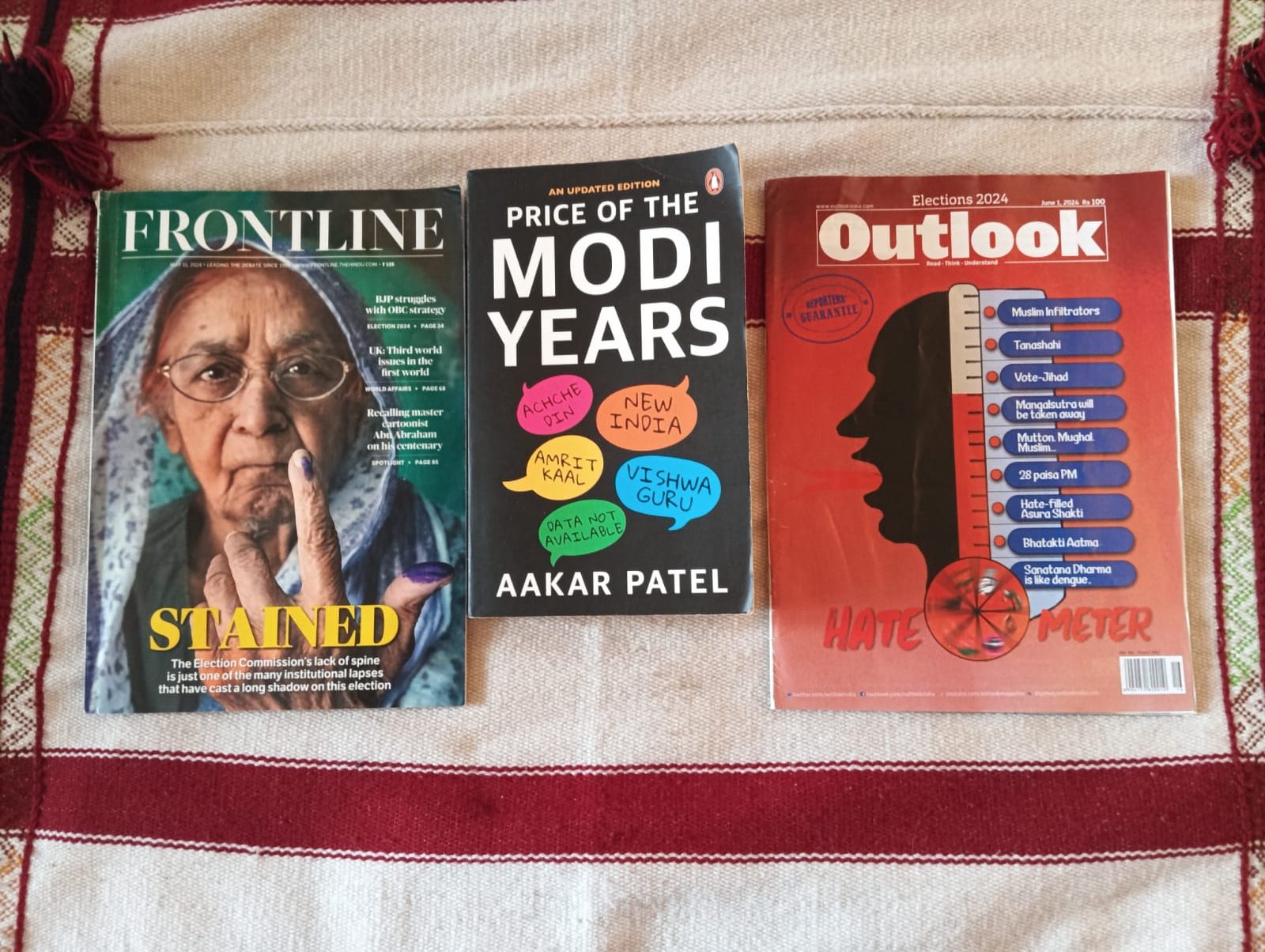
While reading the venerable Frontline and Outlook magazines during the election, and specifically Amnesty International India Aakar Patel‘s Price of the Modi Years, I became really worried about Indian politics.

Patel’s book opens with a devastating list of 50 international indices and ratings indicating that since 2014 India was slipping on almost all metrics, except some economic ones like competitiveness and innovation.

India fell in ranking in the spheres of democracy, human development, civil liberties, rule of law, press freedom, religious freedom, air quality, sustainability, the gender gap, intellectual property, food security and then some. Instead of reflection and realistic analysis, the response of the government in 2020 was a media campaign to correct perceptions, and some proposing India create its own indices. Patel concluded that,

The record leaves little room for debate or dispute. The scale and rapidity of decline in governance after 2014 is manifest. India was struggling to keep up with the world and sinking on several fronts. It may appear strange that anyone should have thought that reversing this performance required ‘a massive publicity campaign’ which would ‘shape India’s perception’ through advertising and more websites, but that is what Modi thought and how he oriented his government to act [p. 33].

Then page after page, going on for 450 in total, Patel’s “report card on India” relentlessly exposed many of the failed policies, illegal tricks and unconstitutional schemes by Modi and the BJP, apparently condoned by a partisan supreme court, largely under-reported by a suppliant press, uncritically accepted by their followers, and impotently decried by the opposition. 

The Election

But now I’m somewhat relieved with the outcome of the election (fortunately accepted by all as fair), which was reported as “India Cuts Modi Down“, illustrated by the following facts. BJP lost its seat in the district where the highly controversial Ayodhya temple was recently inaugurated–a feat high on its wish list–accompanied by lots of pomp with Modi as the guest of honor, or better, the officiating, non-official high priest.

Then BJP got halved in the conservative states of Uttar Pradesh, Maharashtra and Haryana, all part of BJP’s heartland, but also important agrarian states. Two states went from 100% BJP or BJP-allied representation to 100% Indian National Congress (INC), i.e. one seat from Nagaland and both seats from conflict-ridden Manipur (which means that the INC should move quickly to negotiate reconciliation and normalization).

All in all BJP lost 63 seats, while they had hyped the projection that their coalition could get a whopping 400+ out of 543 total seats in the Lokh Sabha, India’s chamber of representatives. Maybe they hoped for the magic realization of a self-fulfilling prophecy with the help of some of their favorite deities.

What motivated the Voters?

But this also scared voters, especially minorities (of which 200m Muslims), about what protections and privileges Modi and the BJP could take away from them with a super-majority, for example with a rewritten constitution (there are some versions floating around taking away all voting rights from religious minorities).

Another section of the population it might have lost are the farmers, whose plight has not improved since Modi promised to double their income in 2014, and who felt existentially threatened by a couple of agrarian reform bills against which they vehemently protested with success.

Then Modi’s mismanagement of the COVID pandemic, especially during the second wave in the spring of 2021, might also have cost him votes, certainly from the underpaid frontline health workers, and families and friends of the poor who didn’t get oxygen nor vaccines in time. And then those working in the deliberately shackled NPO sector (with 19m people involved) would have lost reason to vote for Modi, as would be the case for producers and consumers in the demoted journalism business.

Anyway, Modi, who now speculates that his birth was maybe not biological, has to step down from his self-promoted, Priest-King status to become an ordinary politician doing ordinary coalition politics with his secular allies to form a government and take his third term as India’s prime minister. 

He claims he was humbled by the election outcome, but his spokesperson stated that “the way the government was run for the last 10 years, it will be the same”, which after reading Patel, doesn’t sound reassuring.

Not Just India

And I do not want to merely single out India on its right-ward, theocratic slide. There is a global tendency towards authoritarianism in which religious fundamentalism plays a huge role.

I have seen this happening up close in the USA and even a highly developed, progressive and tolerant country like The Netherlands can, and just did, fall into xenophobia by voting a far right-wing party, led by an Islamophobic politician, into power as its largest party. Fortunately such set-backs are only temporary and India might still set a great example in that regard.

I’m comfortable with debating conservatives justifying classical liberalism and the value of communal life, but we should by all means abide by a Habermas-inspired, dialogue-based, negotiated, mutual accommodation leading to peaceful co-existence. Maybe we should appeal to the religious idea of the sacredness of the stranger as guest, and / or the philosophical idea of deep reference for the Other.

The demonizing of Muslims, Dalits, Palestinians, Israelis, colored immigrants, and whoever else you don’t like based on fanatic ideologies, fundamentalist theologies or unacknowledged racism should be challenged, which is not always easy as it feels often like poking a bear.

Troubles in Scotland of the East


It might not have made it to the international news platforms, but we have had a disturbing series of events happening in Meghalaya. Let me recount.

The effects of an inter-state incident last Tuesday early morning at the Assam-Meghalaya border between Assam police and Meghalaya citizens resulting in six dead (one Assam forest official and five Meghalaya locals), are still rippling through the state. It happened in or just outside the village of Mukroh in the district of West Jaintia Hills, about a 4 hours and 125 km drive east from Shillong. Out of respect for the dead and to prevent social unrest the state government cancelled all festivals, which is too bad because November–with its pleasant, dry and sunny weather and cherry trees blossoming–is festival month. The state also partially shut down the internet for 48 hours, which was later criticized for good reasons by an editorial in the Shillong Times. Unexpectedly I was able to stay on-line and receive updates and reports through WhatsApp and news platforms.

One unfortunate side-effect was that on that very Tuesday NEHU, the non-profit SEHER and the central government in Delhi had an international music festival organized with bands from Singapore, Indonesia, Myanmar and one local band. A similar but larger event had succesfully taken place a few days before in Delhi with the same bands to celebrate 30 years of diplomatic relations with the Association of South-East Asian Nations (ASEAN). Lots of work, money and planning had gone into this. I was part of it, one day driving with a group of volunteers all over Shillong to eleven colleges to distribute invitations. Unfortunately exams were going on and the principals we met were reluctant to let students go to the fest. Still, one of the principals, a very nice man I had met before, together with a friend who teaches there, gave us the best welcome with tea and cookies.

Maybe because the event was on our relatively safe and gated campus the organizers from the Office of International Affairs at NEHU tried to keep it going. Even though it was at 1:30 pm that I received the first message via WhatsApp that all festivals were cancelled (and for a moment believed the rumor that it actually was a fake news message regurgitated from 2018), I heard that the organizers proceeded as if everything was still on while conferring with authorities. I was fine with that not realizing that the early morning incident would have such a wide impact. My big question throughout the day and later was if the state and the NEHU officials had overreacted.

Around 2 pm I was seated with some other volunteers inside the venue in one of the front rows next to the entrance when a group of activist student union members came in their black clothes, black masks and scarfs and black flags, which they planted in the pots next to the entrances. That looked pretty intimidating though I didn’t know then if there was a connection with the border incident. A group of six of them were allowed inside and they walked in front of the podium as if checking out the situation. Meanwhile one of the bands was doing its sound check. This might have been the MRTV Modern Music Band from Myanmar, which sounded, like the other bands, very promising. Later I heard that the students had demanded the cancellation to be effectuated. Apparently there was a scuffle outside between them and some organizers and I did hear a professor on the phone yelling “get our people here”, as if he had access to a group of students or security personnel to counter the student union.

We were still seated when one of the organizers from Delhi–the chair of the non-profit SEHER, which organizes festivals on behalf of the central government–passed by and thanked us for our volunteer work. I politely stood up, shook his hand and talked with him. He seemed not to know what was going on, even that the festival was probably cancelled. This was around 3 pm, an hour before the event should have started with an official opening. So, I told him and he was understandably a bit miffed, as I was a bit perplexed. Later I got flack for having told him, which I’m still in the dark about.

I then walked off with a little group of volunteers to an adjacent part of the campus. To somewhat bemused consternation I dropped one of my rare F-bombs. We visited the complex of unused bio-domes, used to house a butterfly park, which now looked both post-apocalyptic and photogenic. It was constructed in 2019 but probably abandoned because of Covid. We were all uncertain about what had happened and very sad about the cancellation. Some had planned to go back home for a few days, but would not travel for safety reasons. The concern was especially for students from Assam. One of them thought she might be beaten up.

For me and my African friend’s protection we were put on the bus around 4 pm with the last performers, the singer-songwriter Linying and her band from Singapore, having done their sound check, and drove back to the guest house where they were staying.

The organizer from Delhi was there too and I conveyed my condolences for what had happened, gave my obviously fake apologies for having informed him, and talked with him about the effects of the cancellation. He was very distraught and saddened and thought it was a set-back for his long-term project to have India look more to its south-east neighbors and what they can offer, starting with music. It was also a sad set-back for NEHU and Meghalaya. Which international bands would like to come? I suggested everybody interested watch some world cup football or have a small acoustic concert or jam with the musicians at the guest house. This never happened, but still heard later that despite the unfortunate developments our guests had a good time.

I did talk to some of the Indonesian musicians of the fusion band Rhiau Rhythm from Sumatra. Asked them if they knew the little town Lahat on Sumatra, which they did. Told them my father had been born there and apologized for my grandfather’s colonialist impact when the Dutch were in control, which they received with a good laugh.

I went back to my place, which is next to the guest house. Unexpectedly I still had access to the internet and received raw video footage of the shooting, and first news reports and government communications about what had happened at the border. That story is still not totally clear as more detailed versions became available correcting previous ones. I did watch some World Cup matches and got news that a car with Assam plates had been set on fire in Shillong and that further unrest was expected. Now the ripples started looking a bit scary.

Days later I heard that a tourist car had been pelted with stones by teenagers and that there was an attempt to set a bus on fire. Some political groups have held peaceful rallies in Shillong to commemorate the dead and protest the non-resolution of the ongoing problems at the border. They are demanding more protection for the locals from intrusions by Assam police and border personnel. Afterwards some incidences of violence were reported.

Then the union of petrol truck drivers refused to drive petrol from Assam to Meghalaya without further safety measures, which caused a panic with long lines at petrol pumps. With added escorts this seem to have been resolved. Taxi drivers’ associations of Guwahati and Shillong, whose members drive between the two towns, but are not driving that stretch now, also demand resolution to border issues otherwise they’ll strike next week. Then a trainee customs official from outside the state was seriously injured in a mob attack in Shillong.

The latest news is that the state has extended by 48 hours mobile access to the internet (I still have access both on phone and laptop) and Assam authorities have advised Assamese not to travel to Meghalaya as the situation is not good there. Meanwhile Delhi sent four groups of paramilitary forces to the affected border area to help law enforcement keep law and order. No other incidents were reported and Monday Shillong ‘limped back to normalcy‘.

What other ripples to expect is unclear, but the weather is still very pleasant, and positive plans for the future concerning international student relations are set in motion. We also should be able, after everything has calmed down, to watch one day the Shillong rock band Colours in concert. They were the last band on the program and deducing from video footage, would have closed the festival in a dancing frenzy. I missed that workout as I was on the dance card of some dance and music lovers.