Additions to Bibliography September 2024


Additions to the main Bibliography Monetary Theory and Reform

A. Proposed Legislations and Organizational Endorsements

Carmack, Patrick S.J., J.D. 1996. “Monetary Reform Act“. The Money Masters.

B. Academic Studies on Sovereign Monetary Theory and Reform

Bang-Andersen, Jens & Lars Risbjerg & Morten Spange. 2014. “Money, Credit and Banking“. Monetary Review, 3: 65-81.

Bichler, Shimshon & Nitzan, Jonathan. 2022. “Book review: Steve Keen, (2021) The New Economics: A Manifesto“. realworld economics review, 102 (18 December 2022): 156-163.

Bofinger, Peter & Haas, Thomas. 2018. “A simple microeconomic model for the analysis of Vollgeld“. W.E.P. – Würzburg Economic Papers, No. 99, University of Würzburg, Department of Economics, Würzburg.

Carmack, Patrick S.J., J.D. 2020. “Reforming the Primary Instrumental Cause of Increasing Income Inequality“. Adler–Aquinas Institute, Colorado Springs, CO, USA.

—–, —–. 2019. “The Main Cause of Income Inequality”. Studia Gilsoniana, A Journal in Classical Philosophy, 8/4.

Constâncio, V. 2016. “Challenges for the European Banking Industry”. Lecture given at the Conference on “European Banking Industry: What’s Next?”, organised by the University of Navarra, Madrid, 7 July 2016.

Crocker, Geoff. 2020. Basic Income and Sovereign Money. The Alternative to Economic Crisis and Austerity Policy. Cham, Switzerland: Palgrave Mcmillan.

Daneke, Gregory A. 2019. Serfs Up: Finance, Feudalism, and Fascism, Ruminations on the political economy of our time while there is still time. Seattle: Amazon Paperback.

—–, —–. 2022. “The Paradigm in the Iron Mask: Toward an Institutional Ecology of Ecological Economics.” real-world economics review, 102: 16-29.

De Grauwe, Paul. 2008. “Returning to Narrow Banking“. In: B. Eichengreen and R. Baldwin, What the G20 should do on November 15th to fix the financial system, a VoxEU.org Publication.

Demeulemeester, Samuel. 2022. “Divorcing money creation from bank loans: Revisiting the “100% money” proposal of the 1930s“. Revue d’economie politique, 132/5: 835-859.

Desan, Christine A. 2022. “How To Spend a Trillion Dollars: Our Monetary Hardwiring, Why It Matters, and What To Do About It.” Shared at AMI Conference 2022.

Dietsch, Peter. 2021. “Money creation, debt, and justice”. Politics, Philosophy & Economics, 20/2: 151-179.

Dietz, Rob, Herman Daly, and Dan O’Neill. 2013. Enough is enough: Building a sustainable economy in a world of finite resources. London: Routledge.

Diren Valayden & Jakob Feinig. 2022. “Humanization as Money: Modern Monetary Theory and the Critique of Race“. Humanity: An International Journal of Human Rights, Humanitarianism, and Development, 13/2 (Summer 2022): 146-157.

Etzrodt, Christian. 2023. “Positive Money: Progressive Solution or Trojan Horse?“. Cambridge Journal of Economics, 47/6: 1207-1224.

Feinig, Jakob. 2015. Money and its publics: Public involvement in American monetary policy from 1690 to 1936. Dissertation, State University of New York at Binghamton.

Flaschel, Peter, et al. 2010. “Broad banking, financial markets and the return of the narrow banking idea“. The Journal of Economic Asymmetries, 7/2: 105-137.

Goodhart, Charles & Jensen, Meinhard. 2015. “Currency School versus Banking School: An ongoing Confrontation“. Economic Thought, 4 /2: 20-31.

Hockett, Robert C. 2019a. “Money’s Past is Fintech’s Future: Wildcat Crypto, the Digital Dollar, and Citizen Central Banking“. Cornell Legal Studies Research Paper No. 19-05, Stanford Journal of Blockchain Law & Policy. 

—–, —–. 2019b. “Finance without Financiers“. Politics & Society, 47/4: 491-527.

—–, —–. 2021. “Digital Greenbacks: A Sequenced’ Treasury Direct’ and ‘Fed Wallet ‘Plan for the Democratic Digital Dollar.” Journal of Technology Law & Policy,  25/1.

—–, —–. 2024. Spread the Fed: Distributed Central Banking for Productive Monetary Policy. London: Palgrave Macmillan. Forthcoming.

Hook, Andrew. 2023. “Towards an institutional “landscape” view of modern money creation mechanisms and some reflections on their ecological significance“. Sustainability Science, 18: 1977–1993.

Hotson, John H. 1983. “What’s Wrong with Mainstream Macroeconomics?“. Eastern Economic Journal, 9/3: 246-257.

—–, —–. 1985a. “The Growlery: Ending the Debt-Money System“. Challenge, 28/1 (March / April 1985): 48-50.

—–, —–. 1985b. “Response: Professor Friedman’s Goals Applauded, His Means Questioned“. Challenge, 28/4: 59-61.

—–, —–. 1986. The Keynesian Revolution and the Aborted Fisher-Simons Revolution, Or, The Road Not Taken. Department of Economics, University of Waterloo, 1986.

—–, —–. 1996. “The Chicago Plan and New Deal Banking Reform“. Eastern Economic Journal, 22/1 (Winter, 1996): 108-110.

Huber, Joseph. 2012. “Many roads lead to Rome–not all by the shortest path. Comments and reflections on The Chicago Plan Revisited.”

Kash, Ian A., Eric J. Friedman, and Joseph Y. Halpern. 2007. “Optimizing scrip systems: Efficiency, crashes, hoarders, and altruists“. Proceedings of the 8th ACM conference on Electronic commerce, 2007.

Keen, Steve. 2021. The New Economics: A Manifesto. Cambridge, UK: Polity Press.

—–, —–. 1995. “Finance and Economics Breakdown: Modeling Minsky’s ‘Financial Instability Hypothesis’“. Journal of Post Keynesian Economics, 17/4: 607-35.

Kim, Hongkil & Griffin, Hunter. 2022. “Why not Sovereign Money AND Job Guarantee?” real-world economics review, 99: 106-124.

Li, Boyao. 2022. “How does bank equity affect credit creation? Multiplier effects under Basel III regulations“. Economic Analysis and Policy, 76: 299-324.

Li, Boyao & Yougui Wang. 2020. “Money creation within the macroeconomy: An integrated model of banking”. International Review of Financial Analysis, 71: 101547.

Loef, Hans E., and Hans G. Monissen. 1999. “Monetary policy and monetary reform: Irving Fisher’s contributions to monetary macroeconomics“. WEP-Würzburg Economic Papers, No. 11, University of Würzburg, Department of Economics, Würzburg.

McMillan, Jonathan. 2024. Capitalism and the Market Economy: Bringing back together what Banking Pulls apart. Zurich, Switzerland: Zero/One Economics.

Pilkington, Philip. 2014. “Bank of England endorses post-Keynesian endogenous money theory“. No. 32. Working paper (PDF). Fixing the Economists, 12 March 2014.

Sheard, Paul. 2023. The Power of Money: How Governments and Banks Create Money and Help Us All Prosper. Dallas, TX: Matt Holt.

Simić, Aleksander. 2019. Just Money. Sovereign Money System and the Ethics of Banking. Master’s of Applied Ethics. MS thesis. Utrecht University.

Tavlas George. 2020. “On the Controversy over the Origins of the Chicago Plan for 100 Percent Reserves: Sorry Frederick Soddy: It Was Knight and (Most Probably) Simons!” Hoover Institution, Economics Working Paper 20102. Forthcoming, Journal of Money, Credit and Banking.

Tymoigne, Éric, and L. Randall Wray. 2006. “Money: An Alternative Story“. In: Arestis, Philip, and Malcolm C. Sawyer, (eds), A Handbook of Alternative Monetary Economics, Cheltenham, UK & Northampton, MA: Edward Elgar Publishing: pp. 1-16. Also; Working Paper No. 45, Center for Full Employment and Price Stability (July 2005).

van Egmond, N., and B. de Vries. 2020. “Modeling the Dynamics of the Financial-Economic System: Understanding The Current ‘Money as Debt’ Crisis“. Journal of Banking, Finance and Sustainable Development, 1/1: 145-168

van Egmond, N., and B. de Vries. 2020. “Modelling the dynamics of the financial-economic system: Exploring the ‘debt free money’ alternative“. Journal of Banking, Finance and Sustainable Development, 1/1: 169-180.

van Eijck, Jan, and Philip Elsas. 2017. “What is money?” In: Başkent, Can, Lawrence S. Moss, and Ramaswamy Ramanujam (eds), Rohit Parikh on logic, language and society, Vol. 11, Springer, pages 67-75.

Vivian, R., and Nicholas Spearman. 2016. “Banks and Money Creation ‘Out of Nothing’“. No. 3. Working Paper, EU and Comparative Law Issues and Challenges Series, Dec 2016.

White, William. 2023. “Why The Monetary Policy Framework in Advanced Countries Needs Fundamental Reform.” Institute for New Economic Thinking Working Paper Series 210.

C. Studies Critical of Sovereign Monetary Theory and Reform (including MMT section)

Green Party USA. 2022. “Special MMT Edition“. Banking and Monetary Reform Committee. Green Party USA. Newsletter, January 2022.

Lavoie, Marc. 2022. “MMT, sovereign currencies and the Eurozone“. Review of Political Economy, 34/4: 633-646.

Miles, Derrick. 2021. “MMT and the Green Party: A GPWA Member Perspective“. Real Progressives, 30 Jan 2021.

Musgrave, Ralph. 2014. “Charlotte Van Dixhoorn criticises Positive Money“. Ralphonomics, 12 May 2014. [Responding to van Dixhoorn, 2013]

Nersisyan, Y. and Wray, L. R. 2017. “Cranks and heretics: The importance of an analytical framework“. Cambridge Journal of Economics, 41/6: 1749–60.

D. Non-academic Advocacy Pamphlets, Reports, Briefings and Books

Bossone, Biagio & Costa Massimo. 2018. “The ‘accounting view’ of Money: Money as Equity (Part II)“. All About Finance, World Bank Blog, 21 May 2018.

Dawnay, Emma. 2017. “Souvereign Money Initiative: The Background to the National Referendum on Sovereign Money In Switzerland“. Wettingen, Switzerland: Verein Monetäre Modernisierung (MoMo).

Egnatz, Nick. 2019. “The Constitution and a Just System of Money“. Alliance For Just Money, 19 July 2019.

—–, —–. 2019. “Challenging the Economics Profession“. Alliance For Just Money, 2 Nov 2019.

Egnatz, Nick. 2023. Money Creation 101: Change Our Money – Change Our World.

—–, —–. 2024. History of Money 101: Change Our Money – Change Our World.

Hummel, Sam. 2022a. “Global Study on Monetary Literacy Finds Massive Illiteracy & Disapproval“. Sam Thinks out Loud on Substack, 21 Jan 2022.

—–, —–. 2022b. “The Bank of England Says Economics Textbooks Teach Falsehoods About Money and Banking“. Sam Thinks out Loud on Substack, 23 March 2022.

—–, —–. 2022c. “80% of People Have a Mistaken Understanding of the Relationship Between Money and the Economy“. Sam Thinks out Loud on Substack, 19 May 2022.

—–, —–. 2022d. “Here’s the Proof that Banking Crises Simply Don’t Need to Happen. Period“. Sam Thinks out Loud on Substack, 4 June 2022.

—–, —–. 2022e. “One Paragraph Summaries of Top Papers for Understanding Bank Money Creation and Its Economic Effects“. Sam Thinks out Loud on Substack, 29 Sept 2022.

—–, —–. 2022f. “Who Owns and Controls Your Country’s Central Bank? It May Not Be Who You Think“. Sam Thinks out Loud on Substack, 6 Oct 2022.

—–, —–. 2022g. “100+ Experts Confirm: ‘Banks Create New Money Whenever They Lend’ “. Sam Thinks out Loud on Substack, 11 Nov 2022.

—–, —–. 2022h. “Ben Bernanke’s 2022 Nobel Prize in Economics is an Embarrassment“. Sam Thinks out Loud on Substack, 21 Nov 2022.

Jackson, Andrew. 2014. “The Positive Money Proposal: The Transition Process in Balance Sheets“. London: Positive Money.

Jackson, Andrew, Ben Dyson, and Graham Hodgson. 2013. “The Positive Money Proposal“. London: Positive Money.

Jackson, Tim. 2009. Prosperity without Growth: Economics for a Finite Planet. London: Earthscan / Routledge.

Schuller, Govert. 2019. “Ons Geld and the Road to the WRR Report“. Alliance For Just Money, 8 Mar 2019.

E. Supporting Studies Addressing Monetary Issues

Goldstein, Jonathan. 2020. “A Three Class Predator-Prey Model with Financial Super Predators: The Financial Profit Squeeze“. Working paper 503 (February 2020), Political Economic Research Institute, University of Massachusetts, Amherst.

Hudson, Michael & Charles Goodhart. 2018. “Could/should Jubilee debt cancellations be reintroduced today? If not, what alternative measures of debt relief and redistribution might be possible?“. Economics: The Open-Access, Open-Assessment E- Journal, 12 (2018-45): 1–25.

Hudson, Michael. 2024. Temples of Enterprise: Creating Economic Order in the Bronze Age Near East. Dresden, Germany: ISLET Press.

van Doornen, Heske. 2017. “Going Beyond Exchange“. Economic Questions, Blog of the Young Scholars Initiative, 15 May 2017.

F. Journalistic Articles Addressing Monetary Reform

Daneke, Gregory A. 2023. “When Wank Became Swank: Money, Banking, and The Evolution of the All-Debt Economy“. Medium, 31 Aug 2023.

Hockett, Robert. 2020. “Digital Greenbacks“. Forbes, 17 May 2020.

Kummer, Larry. 2012. “The lost history of money: An antidote to the myths“. Fabius Maximus Web Site, 12 Dec 2012.

Murphy, Richard. 2024. “Central bankers on their ability of banks to create money out of thin air“. Funding the Future, 6 Jan 2024.

Ongweso Jr, Edward. 2023. “Saule Omarova’s Plan to Remake the Financial System“. Dissent, Fall 2023.

Switzer, Howard. 2018. “Weaving a Unifying Narrative: The Money Thread“. Green Horizon, 15/36: 4-6.

G. Educational and Promotional Videos

Dietz, Rob, Herman Daly, and Dan O’Neill. 2019. Enough is enough: Building a sustainable economy in a world of finite resources. Video.

Funny Money. 2023. “Decolonizing International Economy: Featuring Fadhel Kabou“. Funny Money YouTube Channel. 25 Aug 2023.

Schularick, Moritz. 2021. “Central Bank Balance Sheets and the Macroeconomy: 1587-2020“. Paris School of Economics on YouTube, 31 May 2021.

Tily, Geoff. 2016. “Academics and civil society clash on money“. Policy Research in Macroeconomics, 18 July 2016.

H. Other Relevant Background Studies

Blyth, Mark. 2013. Austerity: The History of a Dangerous Idea. Oxford: Oxford University Press.

Chang, Ha-Joon. 2002. Kicking Away the Ladder: Development Strategy in Historical Perspective. London: Anthem Press.

Chwieroth, Jeffrey. 2010. Capital Ideas: The IMF and the Rise of Financial Liberalization. Princeton, NJ: Princeton University Press.

Domhoff, G william. 1967-2023. Who Rules America? 8 Editions. Upper Saddle River, NJ: Prentice-Hall

—–, —–. 2005. “The Four Networks Theory of Power: A Theoretical Home for Power Structure Research“. Who Rules America Website.

Edwards, Sebastian. 2019. American Default: The Untold Story of FDR, the Supreme Court, and the Battle over Gold. Princeton, NJ: Princeton University Press.

Eichengreen, Barry. 2019. Globalizing Capital: A History of the International Monetary System. Princeton, NJ: Princeton University Press.

Ferguson, Niall, et al. 2023. “The Safety Net: Central Bank Balance Sheets and Financial Crises, 1587-2020“. Hoover Institution, Centre for Economic Policy Research, 3 Feb 2023.

Ferguson, Niall & Andreas Schaab & Moritz Schularick. 2015. “Central bank balance sheets: expansion and reduction since 1900“. CESifo Working Paper, No. 5379, Center for Economic Studies and ifo Institute (CESifo), Munich.

Good, Aaron. 2022. American Exception: Empire and the Deep State. Ashland, OR: Blackstone Publishing.

Hochschild , Adam. 2023. American Midnight: The Great War, a Violent Peace, and Democracy’s Forgotten Crisis. Boston, MA: Mariner Books.

Hülsmann, Jörg Guido. 2014. “Fiat money and the distribution of incomes and wealth.” In: The Fed at One Hundred: A Critical View on the Federal Reserve System. Cham, Switzerland: Springer: 127-138.

Kentikelenis, Alexandros & Thomas Stubbs. 2023. A Thousand Cuts: Social Protection in the Age of Austerity. Oxford: Oxford UP.

Lowenstein, Roger. 2023. Ways and Means: Lincoln and His Cabinet and the Financing of the Civil War. London & New York: Penguin Books

Maher, Stephen and Scott Aquanno. 2024. The Fall and Rise of American Finance: From JP Morgan to Blackrock. London & New York; Verso.

Marx, Karl. “Comments on James Mill, Éléments D’économie Politique“. Collected Works.

Mattei, Clara. 2022. The Capital Order: How Economists Invented Austerity and Paved the Way to Fascism. Chicago: University of Chicago Press.

McCoy, Alfred. 2017. In the Shadows of the American Century: The Rise and Decline of US Global Power. Chicago: Haymarket Books.

Phillips, Peter. 2018. Giants: The Global Elite. New York: Seven Stories Press

Phillips, Peter. 2024. Titans of Capital: How Concentrated Wealth Threatens Humanity. New York: Seven Stories Press.

Shermer, Ellie. 2021. Indentured Student: How Government-Guaranteed Loans Left Generations Drowning in College Debt.  Chapel Hill, NC: University Press of North Carolina.

Schularick, Moritz and Alan M. Taylor. 2012. “Credit Booms Gone Bust: Monetary Policy, Leverage Cycles, and Financial Crises, 1870-2008”. American Economic Review, 102/2: 1029-61.

Scott, Brett. 2022. Cloudmoney: Cash, Cards, Crypto, and the War for Our Wallets. New York: Harper Business.

Sokona et al. 2023. Just Transition: A Climate, Energy and Development Vision for Africa. Independent Expert Group on Just Transition and Development.

Taylor, Yamagata. 2021. Race for Profit: How Banks and the Real Estate Industry Undermined Black Homeownership. Chapel Hill, NC: University Press of North Carolina.

Tooze, Adam. 2008. The Wages of Destruction: The Making and Breaking of the Nazi Economy. London & New York: Penguin Books

—–, —–. 2015. The Deluge: The Great War, America and the Remaking of the Global Order, 1916-1931. London & New York: Penguin Books

—–, —–. 2018. Crashed: How a Decade of Financial Crises Changed the World. London & New York: Penguin Books

—–, —–. 2021. Shutdown: How Covid Shook the World’s Economy. London & New York: Penguin Books

White, Richard. 2017. The Republic for Which It Stands: The United States during Reconstruction and the Gilded Age, 1865-1896. Oxford: Oxford UP.
Is Israel Committing Genocide?


For those who aspire to think at the highest levels of human rights and International Humanitarian Law (IHL), the following article is a terrific historical overview of its concept and application, not only to Israel as a state possibly engaged in genocide, but also Hamas as a non-state perpetrator of crimes against humanity. The author was cofounder in 1978 of Human Rights Watch (HRW).

As of May 20 the legal issue has become of international importance with arrest warrants requested by chief prosecutor Karim Khan of the International Criminal Court (ICC) for Israel’s Prime Minister Netanyahu, his defense minister Yoav Gallant, and three Hamas officials, Yahya Sinwar (Hamas chief in the Gaza Strip), and Mohammed Deif (commander of its military wing), and Ismail Haniyeh (the leader Hamas’s political bureau).

Is Israel Committing Genocide?

By Aryeh Neier, President Emeritus of the Open Society Foundations

I have been engaged for six decades in the human rights movement, which has endeavored to restore peace by enforcing International Humanitarian Law. Can the law bring a measure of justice to the victims of Israel’s and Hamas’s violence?

Like most of my colleagues in the international human rights movement, I use the term “genocide” sparingly. During my fifteen-year tenure at Human Rights Watch (HRW), which I cofounded in 1978, I applied the term to only one of the many great crimes that we monitored: Saddam Hussein’s slaughter of the Iraqi Kurds in 1988.

The Kurds had suffered severe abuses under Saddam’s dictatorship, and during the Iran–Iraq War of 1980–1988 they rebelled. In response Saddam used chemical weapons against them, as he had against Iranian forces. A particularly large attack took place in March 1988 against the Kurdish city of Halabja, killing about five thousand people. Then, over the following six months, Saddam’s forces rounded up Kurdish men and boys from northern Iraq and bused them to a desert area where bulldozers had dug trenches in the sand. Thousands of victims were forced into the trenches, machine-gunned, and buried.

At HRW, it took us more than two years to discover the desert killings and burials. One person who provided crucial information was a twelve-year-old boy named Taymour Abdullah Ahmad who had climbed out of a trench with a bullet in his back. A Bedouin family found him as he crossed the desert, and they nursed him to health. Two years later Ahmad made his way back to the Kurdish region of Iraq, where we were able to get his story. We subsequently found a few other survivors.

Iraqi forces had destroyed a dozen towns and as many as four thousand villages, looted property and farm animals on a vast scale, and imprisoned tens of thousands of women, children, and elderly people under dire conditions. Iraqi intelligence had been trained by East Germany’s Stasi, and the regime kept detailed records of its actions throughout the war. In a few cities, Kurdish forces overran Iraqi security offices and captured many of these records. At HRW, we were able to have fourteen tons of them flown to the United States, and we translated them from Arabic to obtain a full picture of the crimes against the Kurds that we came to call a genocide.

In The Destruction of the European Jews (1961), the historian Raul Hilberg argued that the elimination of a people is “a step-by-step operation.” First comes defining the group, then expropriating its resources, then concentrating its members in one place, and finally annihilating them. Saddam’s campaign against the Kurds, we determined, fit Hilberg’s paradigm to perfection. It clearly met the definition of genocide under international law: “Intent to destroy, in whole or in part, a national, ethnical, racial or religious group, as such.” We were never able to arrange a trial of Saddam’s government in the International Court of Justice (ICJ), but the Iraqi interim government used some of our evidence when it tried Saddam and other leading officials, including his cousin Ali Hassan al-Majid (known as Chemical Ali), and executed them.

I stepped down as executive director of HRW in 1993, a year before the slaughter of the Tutsi in Rwanda. The organization called that, too, a genocide. In this century it has only used the term to characterize the persecution and slaughter of the Rohingya in Myanmar.

In late December, when South Africa brought to the ICJ its accusation that Israel was committing genocide in Gaza, I did not join some of my colleagues in the international human rights movement in their support of the charge. I was deeply distressed by Israel’s bombing campaign, particularly by its frequent use in densely populated areas of 500- and 2,000-pound bombs—supplied by the United States—that were killing large numbers of civilian noncombatants. (On May 8 Biden halted the shipment of such bombs to prevent their use in Rafah.) Such weapons are clearly inappropriate for use in those circumstances. Yet I was not convinced that this constituted genocide.

I thought then, and continue to believe, that Israel had a right to retaliate against Hamas for the murderous rampage it carried out on October 7. I also thought that Israel’s retaliation could include an attempt to incapacitate Hamas so that it could not launch such an attack again. To recognize this right to retaliate is not to mitigate Israel’s culpability for the indiscriminate use of tactics and weapons that have caused disproportionate harm to civilians, but I believe that Hamas shares responsibility for many of Israel’s war crimes. Hamas’s leaders knew, when they planned the attack, that Israel had the most right-wing government in its history, at immense cost to the civilian population of Gaza.

Hamas’s operatives do not wear uniforms, and they have no visible military bases. Hamas has embedded itself in the civilian population of Gaza, and its extensive network of tunnels provides its combatants the ability to move around quickly. Even if Israel’s bombers were intent on minimizing harm to civilians, they would have had difficulty doing so in their effort to destroy Hamas.

And yet, even believing this, I am now persuaded that Israel is engaged in genocide against Palestinians in Gaza. What has changed my mind is its sustained policy of obstructing the movement of humanitarian assistance into the territory.

As early as October 9 top Israeli officials declared that they intended to block the delivery of food, water, and electricity, which is essential for purifying water and cooking. Defense Minister Yoav Gallant’s words have become infamous: “I have ordered a complete siege on the Gaza Strip. There will be no electricity, no food, no fuel, everything is closed. We are fighting human animals and we act accordingly.” The statement conveyed the view that has seemed to guide Israel’s approach throughout the conflict: that Gazans are collectively complicit for Hamas’s crimes on October 7.

Since then Israel has restricted the number of vehicles allowed to enter Gaza, reduced the number of entry points, and conducted time-consuming and onerous inspections; destroyed farms and greenhouses; limited the delivery of fuel needed for the transport of food and water within the enclave; killed more than two hundred Palestinian aid workers, many of them employees of the United Nations Relief and Works Agency (UNRWA), the principal aid provider in the blockaded territory before October 7; and persuaded many donors, including the United States, to stop funding UNRWA by claiming that a dozen of the agency’s 13,000 employees in Gaza were involved in the October 7 attack or have other connections to Hamas. (An investigation by former French foreign minister Catherine Colonna, released on April 22, concluded that Israel had provided no evidence to support its allegations and that UNRWA is “irreplaceable and indispensable.”) The air strikes on April 1 that destroyed all three vehicles in a World Central Kitchen convoy, killing six international aid workers and a Palestinian driver and translator, seemed a continuation of these policies. Israel’s explanation that this was the result of a “misidentification” has aroused skepticism. As a result, other humanitarian groups may be deterred from providing aid.

The cumulative effect of these measures is that many Palestinians—especially young children—are starving. In April the Gaza Health Ministry reported that twenty-eight children have died of starvation. That number could multiply many times over if reports on food insecurity are valid. On April 10 USAID Administrator Samantha Power answered “yes” when asked, at a House Foreign Affairs Committee hearing, whether famine is already occurring in Gaza. On May 3 Cindy McCain, executive director of the World Food Program, stated on NBC News that there is a “full-blown famine in northern Gaza.” Deaths from famine are only a fraction of the total fatalities reported by the ministry. As of this writing, 34,904 Palestinians have been killed, including at least 14,685 children and 9,670 women, and another 78,514 have been injured. Though some Israelis dispute these figures, they are in truth probably an undercount because they do not include those buried under the rubble.

Many of those who survive malnutrition will suffer long-term consequences such as increased susceptibility to illnesses and psychological damage. In Gaza’s north, UNICEF found in February that malnutrition among children under five had nearly doubled in a month. The obstruction of humanitarian assistance is unlikely to affect Hamas combatants directly. Even in conditions of famine, men with guns find a way to get fed. It is those who bear no responsibility for Hamas’s crimes who are suffering most.

All access to the territory is controlled by the Israel Defense Forces, which have denied entry to Israeli and Palestinian human rights organizations and to international organizations like HRW and Amnesty International. Limiting the ability of these organizations to gather information and make detailed reports on the conflict hardly insulates Israel from criticism for its abuses. That is because international observers judge the conflict in Gaza on the basis of principles and assumptions that the human rights movement has helped to establish.

Today the human rights movement includes thousands of organizations around the world; among international citizen movements, only the environmental movement might be better developed. Amnesty International and HRW, neither of which seeks or accepts government funding, have offices and hundreds of research staff members in many countries. HRW’s staff numbers over five hundred; Amnesty’s staff is much larger. Over the past few decades these organizations have created a broad awareness that there is a body of law, known as International Humanitarian Law (IHL), that represents civilized values and regulates the conduct of combatants. It forbids such practices as indiscriminate bombing and requires military forces to try to protect civilians from harm. It condemns attacks that intentionally or indiscriminately destroy civilian dwellings and such structures as schools, hospitals, and places of religious worship. And it prohibits measures that are intended to starve the civilian population or to deny them other necessities of life.

Some principles of International Humanitarian Law have ancient roots. Herodotus tells us that Sparta, in violation of the customs of war, murdered heralds sent by the Persian king Xerxes to conduct negotiations. Sparta afterward sent to Persia two noblemen who were meant to pay for that crime with their lives. Xerxes refused to kill them; this, he said, would release the Spartans from their guilt for violating the customs of war. The Chinese military strategist Sun Tzu called on armies to treat captives well. Saint Augustine argued that the goal of war is not more war, but peace. Therefore conducting war in a manner that contributes to the restoration of peace is essential.

In the age of chivalry, from approximately the twelfth to the fifteenth century, specific rules were developed for those honored as knights. Courts such as the Parlement of Paris tried cases involving violations. In the seventeenth century the Dutch scholar Hugo Grotius codified the laws of war. A century later Jean-Jacques Rousseau wrote that once men have laid down their arms and submitted, “they cease to be enemies…and revert to the condition of men, pure and simple, over whose lives no one can any longer exercise a rightful claim.”

Contemporary IHL is substantially based on the work of two men who made major contributions in the 1860s: Henri Dunant, a young Swiss businessman who founded what would become the International Committee of the Red Cross (ICRC), and Francis Lieber, a German-born professor of law at Columbia who drafted a detailed code that Secretary of War Edwin Stanton promulgated to regulate the conduct of Union forces during the Civil War. Lieber’s code included a provision stating that when Union soldiers occupied enemy territory,

all wanton violence committed against persons in the invaded country, all destruction of property not commanded by the authorized officer, all robbery, all pillage or sacking, even after taking a place by main force, all rape, wounding, maiming, or killing of such inhabitants, are prohibited under the penalty of death, or such other severe punishment as may seem adequate for the gravity of the offense.

Lieber and Stanton’s efforts were aided by the invention of the telegraph, which made it possible for newspapers to employ war correspondents who reported on the conduct of military forces as battles were underway. When those forces engaged in cruel practices, that information was widely disseminated.

Another significant development took place at the end of the nineteenth century, when Tsar Nicholas II of Russia convened a peace conference at the Hague with the intent of placing limits on military expenditures and armaments. In that respect the conference failed. But it succeeded in adopting the first international treaty that placed limits on the conduct of war. This included the adoption of the Martens Clause, named for the Russian diplomat who proposed it:

Until a more complete code of the laws of war is issued, the high contracting Parties think it right to declare that in cases not included in the Regulations adopted by them, populations and belligerents remain under the protection and empire of the principles of international laws, as they result from the usage established between civilized nations, from the laws of humanity, and the requirements of the public conscience.

The Martens Clause gave rise to the concept of crimes against humanity, under which Nazi leaders were prosecuted at Nuremberg and Japanese military leaders were prosecuted at Tokyo after World War II.

The contemporary human rights movement began with a focus on political persecution. In 1898 the French lawyer and politician Ludovic Trarieux, motivated by the controversy over the trial in which Captain Alfred Dreyfus was convicted of spying for the Germans, launched the Ligue des Droits de l’Homme. The Ligue’s early work included efforts to protect indigenous peoples in French colonies against ethnic persecution and other abuses. In 1922 it helped found the Fédération Internationale des Ligues des Droits de l’Homme (FIDH), which united sections of that organization in several European countries. It was dangerous work. Giacomo Matteotti, a leading antifascist political figure and a leader of FIDH’s Italian section, was murdered by the Fascist secret police in 1924. Carl von Ossietzky, a leader of its German section who won the 1935 Nobel Peace Prize for exposing German rearmament in violation of the Versailles Treaty, was imprisoned by the Nazis and died in 1938 of tuberculosis, which he contracted in prison. Victor Basch, the president of FIDH in France, was murdered during World War II by a fascist paramilitary organization.

A few members of the FIDH escaped France after the German invasion and made their way to the United States. They contacted Roger Baldwin, the longtime director of the American Civil Liberties Union, and joined him in establishing the International League for Human Rights, which began operating during the war years and advocated for the United Nations to incorporate a commitment to protect human rights in its charter. Another organization, the Geneva-based International Commission of Jurists, which promotes the independence of judges and lawyers, was founded in 1952; it is still active today.

The work of the ICRC, a Swiss organization that is independent of national Red Cross societies, led to the adoption of the Geneva Conventions of 1929, which were important during World War II in protecting prisoners of war of countries that had ratified them. In 1949 the ICRC organized the adoption of a revised set of Geneva Conventions, which identified “grave breaches” that should be prosecuted and also provided significant protections against abuses in internal armed conflicts.

Additional important protections for civilians were incorporated in two important Protocols to the Geneva Conventions adopted in 1977, one dealing with international armed conflicts and the other with non-international armed conflicts. The Protocols outline many of the rules that the Israel Defense Forces have been accused of violating in Gaza, including a prohibition on indiscriminate bombing and the use of starvation as a weapon of war.

In 1961, after the British lawyer Peter Benenson published an article titled “The Forgotten Prisoners” in the British newspaper The Observer, an item that was subsequently reprinted all over the world and called for the release of all people held for peaceful expression of their beliefs, Amnesty International was established. From the start it set out to enlist members and establish sections in many countries. At first it strictly limited itself to freeing people it designated as “prisoners of conscience.” But it gradually expanded its mandate, adding the issue of torture and many other human rights concerns. The organization was also intent on remaining neutral in the cold war, insisting that its activists should “adopt” equal numbers of prisoners of conscience on opposing sides of the East–West divide, as well as in nonaligned countries.

In 1978, along with Robert Bernstein and Orville Schell, I founded the organization that became Human Rights Watch. It began as Helsinki Watch, which promoted human rights in the thirty-five countries of Europe and North America that had adopted the 1975 Helsinki Accords. These were the first international agreements to respect human rights that the Soviet Union and other communist countries joined in signing. Rights activists in Moscow and other Soviet bloc countries formed organizations to monitor compliance with them. When the Soviet Union started imprisoning those activists, we decided to form an organization to help secure their release and to extend the effort to obtain compliance with the human rights provisions of the Helsinki Accords.

As the chair and CEO of Random House, Bernstein was the publisher of some of the activists in those Soviet bloc countries, such as the physicist and Nobel Peace Prize laureate Andrei Sakharov, and so was affected by the Soviet Union’s crackdown. Schell was a prominent lawyer who had chaired the New York City Bar Association and had taken part in efforts to protect the rights of lawyers. As I had served as executive director of the ACLU, my participation signaled that we were also concerned with rights in the United States. After I became executive director in 1981, we added sections dealing with rights in the Americas, Asia, Africa, and the Middle East. Once we acquired the capacity to promote rights worldwide, we renamed the organization Human Rights Watch in 1988.

Before the 1980s the principal effort to promote compliance with International Humanitarian Law consisted of attempts by the ICRC to persuade military commanders and top government officials to conduct military operations in accordance with its principles. The ICRC did not publicize its efforts, in large part because it prized its ability to obtain access to prisoners of war and other security detainees so as to provide them with protection. The organization believed it would lose such access if it publicized its interactions with military officials, and detainees would suffer.

Human Rights Watch made the decision to try to complement the confidential work of the ICRC by engaging in publicized efforts to obtain compliance with the provisions of IHL in circumstances of armed conflict. Over time other human rights organizations, including Amnesty International, followed suit. These efforts, which reflected the growing strength and capacity of the human rights movement, created public awareness of IHL and helped to establish the context in which a conflict such as the war in Gaza is being judged by concerned members of the public worldwide.

The first significant use of IHL by the human rights movement came in 1981, when the Americas division of Human Rights Watch decided, in accordance with the provisions of the Geneva Conventions and Protocols, to assess the conduct of the armed forces engaged in the civil war in El Salvador that had begun two years before. During the war, which lasted until 1992, about 75,000 people died, the great majority in killings by death squads made up of military men, in aerial bombardments by the Salvadoran Air Force of rural areas where peasants were suspected of providing food and shelter to left-wing guerrillas, and in massacres carried out by the country’s military in villages suspected of harboring guerrillas. Up to that point, the human rights movement had been guided by international law largely based on UN-sponsored treaties that were intended to give legal force to the provisions of the Universal Declaration of Human Rights, which was adopted by the UN in 1948. Those treaties addressed such matters as race discrimination, the rights of women, and the rights of refugees, but they did not address the issues that arise during armed conflicts.

It was the war in Bosnia, which began in 1992, that made large parts of the human rights movement focus more closely on International Humanitarian Law. Bosnian Serb forces, which launched the war with the backing of the government of Serbian president Slobodan Milošević, announced explicitly that their purpose was “ethnic cleansing.” They conducted massacres in towns with large Muslim populations. They besieged Sarajevo, killing thousands of its residents by shelling and sniping from the surrounding hills and by depriving the city’s population of water, food, and other necessities. And the Serb military set up detention camps in which many inmates died after suffering from ill treatment, starvation, and sexual assault.

As the director of HRW, I proposed the establishment of an International Criminal Tribunal to deal with these crimes. There had been no such body since the Nuremberg and Tokyo tribunals in the immediate aftermath of World War II, as the onset of the cold war had made it impossible for the UN Security Council to agree on forming any. But by 1992 the Soviet Union had dissolved, and my call for a tribunal coincided with revelations in the press about the worst abuses of the Bosnian Serb detention camps. Many others took up the call, including Madeleine Albright, the US ambassador to the UN, and Robert Badinter, France’s former minister of justice. In May 1993 the Security Council unanimously established the International Criminal Tribunal for the Former Yugoslavia (ICTY). It was a triumph for International Humanitarian Law.

The tribunal got off to a slow start. The UN did not have a chief prosecutor for fourteen months, and for a long period the ICTY had only a low-level prison camp guard in custody. Eventually, however, it indicted leading figures from all parties to the wars of the 1990s in the former Yugoslavia, obtained custody of all of them except those who died before they were apprehended, and conducted fair trials. Milošević died while on trial, but the leaders of the Bosnian Serbs responsible for the largest number of atrocious crimes, Radovan Karadžić and General Ratko Mladić, are still serving prison sentences today.

The UN Security Council also created the International Criminal Tribunal for Rwanda (ICTR) in 1994 in the months following the genocide in that country. It too got off to a shaky start but righted itself over time. The ICTR conducted fair trials of the figures primarily responsible for many great crimes, including former Rwandan prime minister Jean Kambanda, the first person convicted of genocide by an international tribunal, who remains in prison at this writing. The ICTR has been faulted, however, for not bringing to trial leaders of the Rwandan Patriotic Front, which overthrew the government that conducted the genocide but in the process committed major crimes itself.

In the late 1990s the UN also started forming “hybrid” tribunals with national governments to try officials and revolutionaries who had committed atrocities. The most successful of these, in Sierra Leone, sentenced Charles Taylor, a former president of Liberia, to a fifty-year prison sentence for backing the Revolutionary United Front when it committed atrocities during the civil war in Sierra Leone. In 1998 the success of ad hoc tribunals helped make it possible to convene 148 governments in Rome for the conference that established the International Criminal Court (ICC). The treaty they adopted spelled out that the court’s jurisdiction includes war crimes, crimes against humanity (which can take place during times of peace as well as war, and which had not previously been spelled out in an international treaty), and genocide. Now not only could governments bring civil proceedings against other governments in the International Court of Justice; a prosecutor could also bring criminal charges of genocide against individuals at the ICC. One hundred twenty countries supported the treaty, twenty-one abstained, and seven voted to oppose it: Iraq, Libya, China, Qatar, Yemen, Israel, and the United States.

The ICC began operation in 2002. In its early years, all the prosecutions brought before it were in Africa, in part because many African countries had ratified the treaty that established the court, whereas other countries where significant crimes were committed—including China, India, and Russia—had not. The ICC may bring indictments against individuals from such states with the authorization of the UN Security Council, but the Council’s permanent members, including China, Russia, and the United States, can veto any such action. In March 2023 the ICC issued an arrest warrant against President Vladimir Putin of Russia for the war crime of transferring Ukrainian children to Russia. It was able to do so because the crime was committed on the territory of Ukraine, which had accepted the court’s jurisdiction. Any member state of the ICC that Putin visits is obliged to detain him.

In 2015 Palestine ratified the Rome Statute and was accepted as a party to the ICC. This appears to give the ICC jurisdiction to bring indictments both for the crimes Hamas committed on October 7 and for Israel’s crimes in Gaza. If the ICC does issue indictments involving Israel’s conduct in Gaza, I expect that Israel will argue that the court lacks jurisdiction on the grounds that Palestine is not a state and its ratification of the statute is not valid. But even if ICC prosecution does not become a significant factor in the conflict, the court’s existence has contributed to a public awareness that Israel’s and Hamas’s actions should be judged in accordance with contemporary standards of International Humanitarian Law.

If it were feasible, establishment of an ad hoc tribunal along the lines of the International Criminal Tribunal for the Former Yugoslavia or for Rwanda would be a good way to address the crimes committed by Hamas and the crimes committed by Israel since October 7. Such a tribunal could bring indictments against Hamas leaders who were in places like Qatar or Lebanon rather than Gaza on October 7 but who took part in planning and directing the assaults against Israeli civilians. It could also bring charges against Israeli officials who made decisions about the use of weapons and tactics that were designed to kill large numbers of civilians, and about the policies that continue to deny food, water, and other necessities to the civilian population of Gaza.

The chances of securing the creation of such a tribunal by the UN Security Council are, of course, slim. The United States could use its veto power to protect Israel, and Russia, which has prevented the establishment of a tribunal for Syria by the ability to exercise its veto power, is unlikely to be enthusiastic. In the absence of a special tribunal, prosecutions could be initiated by the International Criminal Court, which has been investigating possible war crimes by both Palestinian and Israeli actors since 2021. In recent days rumors have circulated that the ICC is preparing arrest warrants for Israeli prime minister Benjamin Netanyahu, Gallant, and IDF chief of staff Herzi Halevi—a rumor Israeli officials have responded to with indignation—as well as leaders of Hamas. Netanyahu’s assertion that ICC indictments would be antisemitic is indicative of his promiscuous use of antisemitism allegations. In the event that its head of government is charged, Israel is likely to object on the grounds that Palestine is not a state that could authorize such proceedings.

The International Court of Justice is considering the accusation that Israel is committing genocide in Gaza. The ICJ does not have criminal jurisdiction, and it is not able to adjudicate charges involving war crimes or crimes against humanity. Even so, if it ultimately finds that Israel has committed genocide, that will be a resounding defeat for a state that was born in the aftermath of a genocide that many of its founders had barely survived.

I have been engaged in efforts to protect human rights for more than six decades, often in circumstances with exceedingly high stakes. I cannot recall any dispute over rights that aroused greater passions and more debate than that involving the war in Gaza since October 7. There is much about it that is deeply depressing, including how difficult it is to find a way to give victims any hope that justice will eventually be done. I myself hope that the frequent citation of International Humanitarian Law as the standard for judging the conflict will have a positive effect. Whatever else emerges from this war, and whatever judgment comes from the ICJ, it is evident that Israel has done itself as well as its Palestinian victims long-term harm.

Aryeh Neier is President Emeritus of the Open Society Foundations. His most recent book is The International Human Rights Movement: A History. (June 2024)

From: New York Review of Books, June 6, 2024 issue.


Additions to Bibliography February 2023


B. Academic Studies on Sovereign Monetary Theory and Reform

Armelius, Hanna & Carl Andreas Claussen, David Vestin. 2020. “Money and monetary policy in times of crisis”. Monetary Policy Department and the Payments Department of the Riksbank. Riksbank of Sweden. Economic Commentaries, 4 (11 June 2020): 1-15.

Assenmacher, Katrin & Claus Brand. 2018. “The Swiss Sovereign Money Initiative”. Credit and Capital Markets, 51/4: 621-644.

Baeriswyl, Romain. 2017. “The Case for the Separation of Money and Credit”. In Heinemann, F., Klüh, U., and Watzka, S. (eds.), 2017, Monetary Policy, Financial Crises, and the Macroeconomy, Cham: Springer, pp. 105–21.

Barber, G. Russell. 1973. “The One Hundred Percent Reserve System”. The American Economist, 17/1: 115–127.

Bertocco, Giancarlo & Andrea Kalajzic. 2018. “How much does finance benefit society?”. PSL Quarterly Review, 71/287: 419-437.

—–, —–. 2001. “Is Kaldor’s theory of money supply endogeneity still relevant?” Metroeconomica, 52/1: 95–120.

—–, —–. 2010. “The endogenous money theory and the characteristics of a monetary economy”. Rivista Italiana degli Economisti, 15/3: 365–401.

—–, —–. 2013a. “Money as an institution of capitalism: Some notes on a monetary theory of uncertainty”. Economic Notes, 42/1: 75–101.

—–, —–. 2013b. “On Keynes’s criticism of the loanable funds theory”. Review of Political Economy, 25/2: 309–26.

Bjerg, Ole. 2018. “We Need to Put Things Back to Normal”. Interview with Ole Bjerg (2018) Journal of Economic Sociology = Ekonomicheskaya sotsiologiya, 19/4: 172–181.

Brown, Harry Gunnison. 1940. “Objections to the 100 Per Cent Reserve Plan.” The American Economic Review, 26/3: 309–314.

Buchanan, James M. 2010. “The Constitutionalization of Money.” Cato Journal, 30/2: 251–258.

Burns, Scott. 2016. “Old (Chicago) School, New Century: The Link between Knight and Simons’ Chicago Plan to Buchanan’s Constitutional Money.” Constitutional Political Economy, 27/3: 299–318.

Carroll, Charles Holt. 1964. Organization of Debt into Currency and Other Papers. Edited with an Introduction by E. C. Simmons. Princeton, NJ: Van Nostrand.

Chai, Hee-Yul, and Sang B. Hahn. 2018. “Does Monetary Policy Regime Determine the Nature of the Money Supply?: Evidence from Seven Countries in the Asia-Pacific Region“. East Asian Economic Review, 22/2: 217-239.

Currie, Lauchlin B. [1934] 1968. The Supply and Control of Money in the United States. New York, NY: Russell & Russell.

Demeulemeester, Samuel. 2019. “The 100% money proposal of the 1930s: Conceptual clarification and theoretical analysis.” PhD thesis, ENS de Lyon.

—–, —–. 2020. “Would a State Monopoly over Money Creation Allow for a Reduction of the National Debt? A Study of the ‘Seignorage Argument’ in Light of the ‘100% Money’”. Debates, Research in the History of Economic Thought and Methodology, vol. 38A, A Symposium on Public Finance in the History of Economic Thought, 123–44.

—–, —–. 2021. “The 100% money proposal of the 1930s: An avatar of the Currency School’s reform ideas?” The European Journal of the History of Economic Thought, 28,/4: 577–98.

Doorman, Frans. 2015. Our Money – Towards a New Monetary System. Lulu internet publishers.

Douglas, Paul H. 1935. Controlling Depressions. New York, NY: Norton.

Dow, S.C. 1997. “Endogenous Money”. In G.C. Harcourt and P.A. Riach (eds), A ‘Second Edition’ of The General Theory, vol. II, London and New York: Routledge, 61–78.

Fisher, Irving. 1936. “100% Money Again.” Social Research, 3/2: 236–241.

—–, —–. 1936. “The Bankers’ Interest in 100% Money.” The Bankers’ Magazine, October, 1936.

—–, —–. 1937. “100 Percent Reserves—An Old System Adapted to Modern Needs.” Commercial & Financial Digest, Los Angeles, California, June 1937. Reprinted in I. Fisher, Testimony before a Subcommittee of the Committee on Agriculture and Forestry, U.S. Senate, 75:1, August 12, 1937, 292–296.

—–, —–. 1937. “Note Suggested by Review of ‘100 Per Cent Money.’” Journal of the Royal Statistical Society, 100/2: 296–298.

—–, —–. 1946 (1997). “Answers to Objections to the 100% Plan.” Fisher Papers, Yale University Library. Reprinted in Barber et al, 1997, The Works of Irving Fisher – Vol. 11. 100% Money, 308–311.

Graham, Frank D. 1936. “Partial Reserve Money and the 100 Per Cent Proposal.” The American Economic Review, 26/3: 428–440.

—–, —–. 1941. “100 Per Cent Reserves: Comment.” The American Economic Review, 31/2: 338–340.

Higgins, Benjamin. 1941. “Comments on 100 Per Cent Money.” The American Economic Review, 31/1: 91–96.

Hook, Andrew. 2022. “Examining modern money creation: An institution-centered explanation and visualization of the “credit theory” of money and some reflections on its significance.” The Journal of Economic Education, 53/3: 210-231.

Krainer Robert E. 2013, “Towards a Program for Financial Stability”. Journal of Economic Behavior & Organization, 85 (January): 207-218.

—–, —–. 2017, “Economic Stability under Alternative Banking Systems: Theory and Policy”. Journal of Financial Stability, 31: 107-118.

Kumhof, Michael, et al. 2020. “Central Bank Money: Liability, Asset, or Equity of the Nation?” Cornell Law School Research Paper No. 20-46.

Lainà, Patrizio. 2017. “Seignorage from Full-Reserve Banking”. Published in Lainà, Patrizio, “Full-Reserve Banking: Separating Money Creation from Bank Lending”, PhD Thesis, University of Helsinki (November 13, 2017).

Lehmann, Fritz. 1936. “100% Money.” Social Research, 3/1: 37–56.

Lester, Richard A. 1935. “Check-Book Inflation.” The American Scholar, 4/1: 30–40.

Mellor, Mary. 2019. Money: Myths, Truths, and Alternatives. Bristol, UK: Policy Press.

Nayan, S., Kadir, N., Abdullah, M. S., & Ahmad, M. 2013. “Post Keynesian Endogeneity of Money Supply: Panel Evidence”. Procedia: Post Keynesian Endogeneity of Money Supply: Panel Evidence Economics and Finance, 7: 48-54.

Neuman, Andrew M. 1937. “100 Per Cent. Money.” The Manchester School, 8/1: 56–62.

Ponsot, Jean-François. 2017. “Rethinking Money“. In: Rochon, Louis-Philippe, and Sergio Rossi (eds), A Modern Guide to Rethinking Economics, Edward Elgar Publishing, 2017, 114-28.

Robbins, Richard H. 2014. “Debt and the Monetary Foundations of Inequality”. Anthropology News, 55, 14–15.

—–, —–. 2020. “Financialization, Plutocracy, and the Debtor’s Economy: Consequences and Limits”. In: Hann, Chris and Don Kalb (Eds.), Financialization: Relational Approaches. Max Planck Studies in Anthropology and Economy, Volume 6, New York and Oxford: Berghahn, 65–94.

—–, —– & Tim DiMuzio. 2020. “Capitalized money, austerity and the math of capitalism”. Current Sociology, 68: 149–168.

Robinson, George Buchan. 1937. “100% Bank Reserves.” Harvard Business Review, 15: 438–447.

Rochon, Louis-Philippe. 1999. Credit, money, and production: An alternative post-Keynesian approach. Cheltenham, UK and Northampton, MA: Edward Elgar.

—–, —–. 2001. “Cambridge’s Contribution to Endogenous Money: Robinson and Kahn on Credit and Money”. Review of Political Economy, 13/3: 287-307.

—–, —– & —–, —–. (eds). 2003. Modern Theories of Money: The Nature and Role of Money in Capitalist Economies. Cheltenham, UK and Northampton, MA: Edward Elgar.

Schuller, Govert. 2023. “Rochon’s Five Propositions on Bank Credit Creation”. Valatie, NY: American Monetary Institute.

Simarmata, Djamester. 2023. “Development Finance by Money Creation, instead of Foreign Debt or Saving: A New Paradigm For Development Economics”. MS [Forthcoming]

Simons, Henry C. 1934. “A Positive Program for Laissez-Faire”. Public Policy Pamphlet No 15. Chicago: University of Chicago Press.

Skaggs N.T. 1997. “Henry Dunning Macleod and the Credit Theory of Money”. In: Cohen A.J., Hagemann H., Smithin J. (eds), Money, Financial Institutions and Macroeconomics, Recent Economic Thought Series, vol 53, Dordrecht: Springer.

Smithin, J. 2013. “Keynes’s theories on money and banking in the Treatise and the General Theory”. Review of Keynesian Economics, 2/2: 242–56.

Stellinga, Bart, et al. 2021. Money and Debt: The Public Role of Banks. Research for Policy Series. Studies by the Netherlands Council for Government Policy. Cham, Switzerland: Springer.

Thomas, Rollin G. 1940. “100 Per Cent Money: The Present Status of the 100 Per Cent Plan.” The American Economic Review, 30/2: 315–323.

Tolley, George S. 1962. “100 Per Cent Reserve Banking”. In: Yeager, L. B. (ed.), In Search of a Monetary Constitution, Cambridge, MA: Harvard University Press, 275–304.

Watkins, Leonard L. 1938. Commercial Banking Reform in the United States: With Especial Reference to the 100 Per Cent Plan and the Regulation of Interest Rates on Bank Deposits. Vol. 5. Michigan Business Studies, 8. Ann Arbor, MI: University of Michigan.

Werner, Richard A. 2003. Princes of the Yen: Japan’s Central Bankers and the Transformation of the Economy. New York: M.E. Sharpe.

—–, —–. 2018. “Shifting from Central Planning to a Decentralised Economy”. Paper presented at the 14th Rhodes Forum: Dialogue of Civilisations Research Institute, Panel 2: “Economic Alternatives when Conventional Models Fail”, Rhodos, Greece, on 1 October 2016 and at the 4th European Conference on Banking and the Economy (ECOBATE 2016), in Winchester Guildhall, Winchester UK, on 12 October 2016.

Whittlesey, Charles R. 1935. “Banking and the New Deal”. Public Policy Pamphlet No. 16. Chicago: University of Chicago Press.


C. Studies Critical of Sovereign Monetary Theory and Reform (including MMT section)

Pro MMT

Berkeley, A., Ryan-Collins, J., Tye, R., Voldsgaard, A. and Wilson, N. 2022. “The self-financing state: An institutional analysis of government expenditure, revenue collection and debt issuance operations in the United Kingdom.“ UCL Institute for Innovation and Public Purpose, Working Paper Series (IIPP WP 2022-08)

Ryan-Collins, Josh. 2022. “Why the British state is a magic money tree“. The New Statesman, 26 May 2022

Keen, Steven. 2022. “A Little Knowledge is a Dangerous Thing: Observations on the debate between MMT advocates and Progressive Money Canada founder Jeff Eder”. Planksip, 30 Sept 2022.

Critical of MMT

Eder, Jeff. 2022. “Steve Keen has lost his way in a Minsky Maze”. Progressive Money Canada. [Response to Keen, 2022]

Epstein, Gerald A. 2019. What’s Wrong with Modern Money Theory? A Policy Critique. Cham, Switzerland: Palgrave.

Mueller, Antony P. 2019. “The magic money tree: The case against modern monetary theory (MMT).” Research Paper Series Adam Smith Institute (ASI), UK.

Schuller, Govert. 2020a. “Requesting Evidence for a Crucial MMT Claim”. Blog. Alliance For Just Money, 16 Aug 2020.

—–, —–. 2020b. “Triple-column Comparison between Modern Monetary Theory (MMT), the Actual Monetary System, and Sovereign Money Reform (SMR)”. Blog. Alliance For Just Money, 21 Sept 2020.

—–, —–. 2020c. “ ‘What’s Wrong with Modern Money Theory?’: A Summary”. Blog. Alliance For Just Money, 5 Oct 2020.

—–, —–. 2022. “Did Dr. Joshua Ryan-Collins go MMT?”. Paper presented at the American Monetary Institute conference, October 8, 2022. Video here.

D. Non-academic Advocacy Pamphlets, Reports, Briefings and Books

AMI. 2021. “AMI Conference Statement to COP26: Regarding the Monetary Dimension of Climate Change”. American Monetary Institute, Evanston, IL, USA, 11 Nov 2021.

Anon. 2019. “Open Letter: Rethinking the Role of Banks in Economics Education”. Rethink Economics.

Hermanutze, Derryl. 2020. A Brief History of Financial Plunder. Independently published.

Jordan, Thomas J. 2018. “How money is created by the central bank and the banking system.” Speech at the Zürcher Volkswirtschaftliche Gesellschaft, Zürich, 16 Jan 2018. Speech given in German. Zürich: Swiss National Bank.

McConnachie, A. 2006. Clarifying Our Money Reform Proposals: A Report for the Tenth Annual Bromsgrove Conference. Bromsgrove Conference, Bromsgrove, England.

Positive Money. N.d. “What people think banks do: The money multiplier and other myths“. London: Positive Money.

Stuart, James Gibb. 1991. Scotland and Its Money. Edinburgh: John Dunlop.

—–, —–. 1992. Economics of a Green Renaissance. Glasgow: Ossian Publishers.

—–, —–. 1993. Hidden Menace to World Peace. Glasgow: Ossian Publishers.

Turner, W.E. 1966. Stable Money: A Conservative Answer to Business Cycles. With introduction by Representative Wright Patman. N.p.

E. Supporting Studies Addressing Monetary Issues

Costa, Jorge Meira & Marc Gauvin, McNeill. 2015. “A proposal for harmonising current disparate (scientific and legal) definitions of money towards greater decidability in the provision of Justice according to universal principles of contract law“. Presentation at MERC first annual conference on The Monetary Policies in The Balkans, The Future of The Euro and The Eurozone in The Balkan Region. Monetary and EconomicResearch Center, Sofia -Bulgaria, 2015.

DiMuzio, Tim. 2023. “Capitalism, Money and Inequality in the World”. In: Bieri, Sabin & Bader, Christoph (Eds.), Transitioning to Reduced Inequalities, Basel, Switzerland: MDPI Books.

Gauvin, Marc & Sergio Dominguez. 2020. “A Systems Engineering Approach to Formal Monetary and Financial Stability Without the Vagaries of “Austerity” “. Submitted December 2020 to Monetary Research Centre (MRC), University of National and World Economy (UNWE), Sofia Bulgaria.


F. Journalistic Articles Addressing Monetary Reform

Baker, Scott, 2012. “The Instant Solution to the New Depression: Debt-free Money”. HuffPost, 4 june 2012.

Howell, John. 2017a. “Who creates money and where does it go?” The Athens Messenger, 25 Jan 2017.

—–, —–. 2017b. “Why money creation is central to most of the problems faced by society”. Athens, OH: Democracy over Corporations.

Joób, Mark. 2014. “The Sovereign Money Initiative in Switzerland“. World Economics Association Newsletter, 4/3 (June 2014): 6-7. (Comments here)

Hulsmann, Jorg Guido & Patrizio Laina & Joseph Huber & Ib Ravn & Bryan Gould. 2020. “Letter: It’s time to reconsider full reserve banking”. Financial Times (UK), 30 Aug 2020.


G. Educational and Promotional Videos (and other media)

Collins, Josh Ryan & Gabor, Daniela & Dyson, Ben & Werner, Richard. 2014. “Money and Banking”. Rethinking Economics, London Conference, June 2014. RE YouTube Channel, 25 Aug 2014.

Reiss, Michael. 2012. “Money… How It Works”. Unconventional Economics YouTube Channel, 22 dec 2012.

Schasfoort, Joeri. 2020. “How Commercial Banks Really Create Money (the Money Multiplier is a MYTH).” Money & Macro YouTube Channel, 28 Mar 2020.

—–, —–. 2020. “The Monetary Financial System Visually Explained“. Money & Macro YouTube Channel, 9 Dec 2020.

—–, —–. 2021. “Why Private Bank Money Creation is Dangerous.” Money & Macro YouTube Channel, 27 Jan 2021.

Turner, Adair. 2014. “The Need for Radical Change”. Keynote Speech, Rethinking Economics, London Conference, June 2014. RE YouTube Channel, 25 Aug 2014.

Kamp, Diane & Dave Zollinger. 2008. “Stephen Zarlenga Talks About the Lost Science of Money”. Demcracy’s Edge talk radio. 48m31s. Internet Archive, 20 Oct 2008.

Werner, Richard. 2015. “A Prosperous Future Together”. Dialogues of Civilizations. Rhodes Forum 2015. Dialogues of Civilizations YouTube Channel, 23 Dec 2015.


H. Other Relevant Background Studies

Barrdear, John & Kumhof, Michael. 2021. “The macroeconomics of central bank digital currencies.” Journal of Economic Dynamics and Control (2012): 1041-48.

Bichler, Shimshon, Jonathan Nitzan, and Timothy DiMuzio. 2012. “The 1%, Exploitation and Wealth: Tim Di Muzio interviews Shimshon Bichler and Jonathan Nitzan“. Faculty of Law, Humanities and the Arts, University of Wollongong – Papers 810.

Chick, Victoria. 1986. “The evolution of the banking system and the theory of saving, investment and interest”. Economies et Sociétés, 20/8–9: 111–26.

Grim, Ryan. 2009. “Priceless: How the federal reserve bought the economics profession.” Huffington Post,23 Oct 2009

Hockett, Robert C. 2020. “The capital commons: A plan for building back better and beyond.” 20 Aug 2020. Available at SSRN 3697337.

—–, —– & Omarova, Saule T., 2018. “Private Wealth and Public Goods: A Case for a National Investment Authority“. Journal of Corporation Law, 437:

—–, —– & —–, —–. 2020. “Financing Continuous Development: The ‘American Plan’ of State Capitalism”. Cornell Legal Studies Research Paper No. 20-31 (April 2, 2020). Available at SSRN. Also in: Wright, Mike et al (eds.), 2020, The Oxford Handbook of State Capitalism, Oxford: Oxford UP.

Kaldor, N. 1970. “The New Monetarism”. Lloyds Bank Review, 97/1: 1–18.

Kuypers, Stef. 2019. Money, behavior and society: The invisible link. TEDxAntwerp, Nov 2019.

Lietaer, Bernard & Christian Arnsperger, Sally Goerner, Stefan Brunnhuber. 2012. Money and Sustainability The Missing Link. A Report from the Club of Rome – EU Chapter – to Finance Watch and the World Business Academy. Axminster, UK: Triarchy Press.

—–, —– & Dunne, Jacqui. 2013. Rethinking Money: How New Currencies Turn Scarcity into Prosperity. San Francisco: Berrett-Koehler.

Lonergan, Eric. 2014. Money (The Art of Living). Second edition. Oxon, UK & New York: Routledge.

Minsky, Hyman P. 1994. “Financial Instability and the Decline (?) of Banking: Future Policy Implications“. Working Paper No. 127, October 1994. The Jerome Levy Research Institute of Bard College.

—–, —–. 1995. “Would Universal Banking Benefit the U.S. Economy?” Hyman P. Minsky Archive, Paper 51, reworked version dated April 5, 1995.

Nain, Aditya, & P. G. Jung. 2021. Understanding Money: Philosophical Frameworks of Monetary Value. London & New York: Taylor & Francis.

Omarova, Saule T. “The People’s Ledger: How to Democratize Money and Finance the Economy”. Vanderbilt Law Review, 74/5:

Palley, Thomas. 2022. Theorizing dollar hegemony, Part 1: The political economic foundations of exorbitant privilege. No. PKWP2220. Post-Keynesian Economics Society, August 2022.

Ricardo, David. [1824] 1951. Plan for the Establishment of a National Bank. London: John Murray, Albemarle-Street, 1824. Reprinted in: Sraffa P. (ed.), 1951, The Works and Correspondence of David Ricardo, Vol. 4, Cambridge, UK: Cambridge UP, 271-300

Robbins, Richard H. 2022. “ ‘An Opportunity of a Lifetime’: Covid-19 in the Age of Finance”. In: Tim Di Muzio and Matt Dow (Eds.), Covid-19 and the Global Economy, London & New York: Routledge.

—–, —–. 2022. “Financialization”. In: James G. Carrier (ed.), The Handbook of Economic Anthropology, 3rd Edition, Oxford: Berg Publishing.

—–, —–. 2020. ‘The Economy After Covid-19”. Focaal Blog.

Sanderson, Stephen K. 1995. Civilizations and World Systems: Studying World-historical Change. Lanham, MD: Rowman Altamira.

Schuller, Govert. 2020. “Talk About Borders”. Blog, Alliance For Just Money, 23 May 2020.

Seligman, Edwin Robert Anderson, et al. 1908. The Currency Problem and the Present Financial Situation: A Series of Addresses Delivered at Columbia University, 1907-1908. New York, NY: Columbia University Press.

Suaste Cherizola, Jesús. 2021. “From Commodities to Assets: Capital as Power and the Ontology of Finance”. Review of Capital as Power, 2/1: 1-29.

Toynbee, Arnold J. 1962–1964 [1934–1961]. A Study of History. 12 vols. Oxford: Oxford University Press.

Toynbee, Arnold J. 1947a. A Study of History. Vol. I. Abridgment of vols. I–VI by D. C. Somervell. London: Oxford University Press.

Toynbee, Arnold J. 1947b. A Study of History. Vol. II. Abridgment of vols. VII–XI by D. C. Somervell. London: Oxford University Press.

Viñuela, Carlos, Juan Sapena, and Gonzalo Wandosell. 2020. “The Future of Money and the Central Bank Digital Currency Dilemma” Sustainability, 12/12: 9697.

Wallerstein, Immanuel. 1974-1989. The Modern World-System. 3 volumes. New York & San Diego & London: Academic Press.

—–, —–. 2000. The Essential Wallerstein. New York: The New Press.

—–, —–. 2004. World-Systems Analysis: An Introduction. Durham, NC: Duke University Press.

Wilkinson, David. 1987. “Central Civilization”. Comparative Civilizations Review, 17/17: Article 4. Also in: Sanderson, Stephen K., 1995, Civilizations and World Systems: Studying World-historical Change, Lanham, MD: Rowman Altamira, pp. 46-74.


New Links to Older Studies

Klein, Manuel et al. 2018. “The Future of Money – 10 years after Lehman and Nakamoto” (Conference). Conference videos and papers. 24 Nov 2018. Berlin, Germany: Monetative.

Robertson, James. 2012. Future Money: Breakdown or Breakthrough? Totnes, UK: Green Books.

Werner, Richard A. 1997. “Towards a New Monetary Paradigm: A Quantity Theorem of Disaggregated Credit, With Evidence from Japan“. Kredit und Kapital, 30/2 (July 1997): 276–309 .

—–, —–. 2005. New Paradigm in Macroeconomics: Solving the Riddle of Japanese Macroeconomic Performance. Basingstoke, UK & New York: Palgrave Macmillan.

Talking about Borders


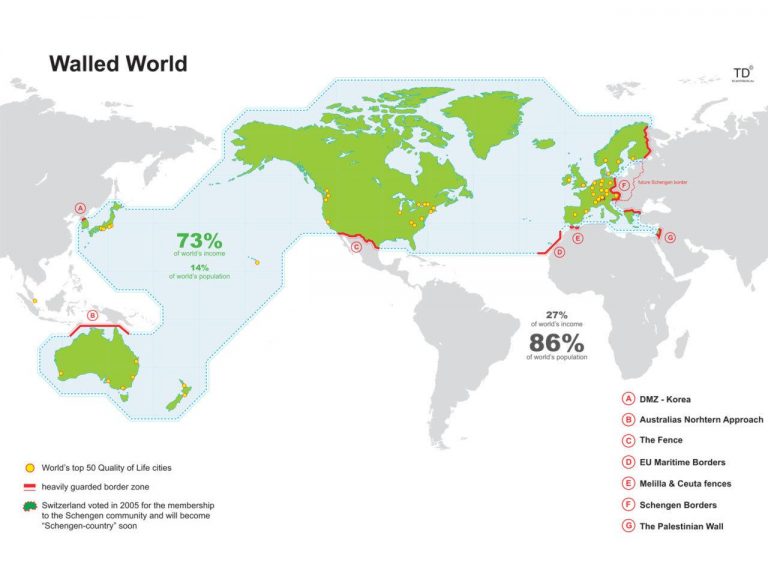
Often maps can convey ideas better than words. One example is this terrific map I recently found illustrating the geographical dimension of the ‘Trilateral West’ or ‘North-Western Triad’, which is composed of the three economic power houses, Japan, the US and the EU, including some of its loyal satellites like South Korea, Australia, New Zealand, Canada, Switzerland and Israel (Deutinger, 2009). It clearly indicates the porous maritime and hard continental borders keeping this walled world from getting inundated by political and economic refugees. In this article I will address three discernible planning phases since the start of WW II by which this walled arrangement came into being.

Fig 1. The Walled World (Deutinger, 2009)

Phase I: The War and Peace Studies Project

Historically speaking the foundation for this arrangement was the post-WW II Breton Woods system, which international order was devised by the power elites of the US and Europe in their elite, long-term policy planning think tanks, the New York based Council on Foreign Relations (CFR) and the London based Royal Institute for International Affairs (RIIA). Already in 1939 the CFR saw the need for a revamped international system and started even before the US was involved in the war with an organized study effort named ‘The War and Peace Studies Project’. This project was initiated in order to devise a best possible international order for its corporate members, predominantly Wall Street banks and international conglomerates (Shoup & Minter, 1977; Wala, 1994).

Starting in 1941 the study groups in the CFR were intimately cooperating with the US State Department’s own research groups, which incorporated many of the CFR’s ideas and personnel. The main institutional framework proposed by the State Department was the United Nations (UN), the International Monetary Fund (IMF) and the International Bank for Reconstruction and Development (the ‘World Bank’). At a series of conferences by the allies–Breton Woods being the most important one–the proposals were adopted and these institutions then all played important roles in the transition from a formal colonialist-imperialist international order to an informal imperialist order of nominally independent countries. The dollar, pegged to gold at $35 per ounce, became the basic currency for international trade. Only much later the originally planned World Trade Organization (WTO) was founded.

Within this international political-economic legal framework the important trans-national agents of influence were American and European big investment houses, trans-national corporations (TNCs), intelligence agencies and military alliances, with NATO being the most important one integrating the US and Europe.

Initially the US was the hegemon, but when Europe got back on its feet with the help of the Marshall Plan in the early 1950s and frictions developed between them, the very elite yearly Bilderberg conferences were started in 1953 to informally address US-European strategic differences and come to more coordinated policies. Many if not most of the US attendees who show up regularly are members of the CFR. And behind both there was the continual presence of David Rockefeller. These costly, high-security conferences are still held on a yearly basis, the last one in 2019 in Montreux, Switzerland (Thompson 1980, van der Pijl 1984, Richardson 2011, 2012, Schuller 2014).

Phase II: The 1980s Project

In the early 1970s, with the stellar rise of Japan and some serious problems in the international system like the oil crisis, the looming US defeat in Vietnam, Third World revolutions and the decoupling of the dollar from gold, it was time for the CFR, under the chairmanship of David Rockefeller, to re-address the whole international set-up with another multi-year round of studies and consultations now named ‘The 1980s Project’. Out of this came the further integration of Japan into the system by giving its corporate elite a big seat at the 1973 founded Trilateral Commission (TC) with Japan, the US and Europe each given a third of member- and leadership positions; the institution of international summits like the G-7 and G-20; and the start of neoliberalism initially implemented by the TC dominated Carter administration lead by TC founding member Jimmy Carter and TC main architect and executive director Zbigniew Brzezinski. This can be conceptualized as corporate democrats taking over the Democratic Party from the New Deal / Great Society social democrats. The establishment of the WTO and NAFTA can also be credited on its account (Shoup & Minter 1977; Shoup, 1980; Domhoff 1982; Sklar, 1980; Gill 1991, Domhoff 2013; Shoup 2015).

Because this system of ‘world management’ is composed of these three major and coordinating imperialist centers, it can be named the trilateral system, or the ‘North-Western Triad’, or as I do, the ‘Trilateral West’ with Japan seen as being in the ‘far west’ of the system as ‘The Walled World’ map is geo-spatially organized, and not as usual in the ‘far east’.

Phase III: Renewing America Initiative

A third round of in-depth CFR studies were commenced in 2011 under the leadership of CFR president Richard Haass. It was named the ‘Renewing America Initiative’, because the problems the US was increasingly facing were now domestic in nature: a crumbling infrastructure; a failing educational system; and loss of manufacturing jobs, and thereby a diminished power base to project influence internationally. The CFR also admitted, through Haass, that the US had gone from sole super power status as the indispensable, benign hegemon after the end of the Cold War to being a ‘first among equals’. To address the problems at the domestic front pensions, health care and other entitlements had to be cut; unions had to be curbed; congressional gridlock had to be broken (by a coalition of conservative democrats, moderate republicans and independents); and in foreign policy there would have to be an economic and military ‘pivot’ to Pacific Asia away from the Middle East. Major geo-economic initiatives were the Trans Pacific Partnership (TTP) and the Transatlantic Trade and Investment Partnership (TTIP). With the current Trump administration this agenda is in jeopardy, mainly because the moderate, status quo, internationalist, corporate Republicans started to lose power to emerging radical, nationalist, authoritarian Republicans. It is possible that, because of a back-lash against the semi-fascist and corrupt Trump administration, the corporate democrats and republicans will get the upper hand again and can revive their internationalist agenda after 2020 (Shoup, 2015).

The Deep History

The deep history of America’s premier foreign policy think tank, the CFR, is a story quite by itself. It was founded together with its UK sister organization, the RIIA, during the aftermath of the first world war when internationalist-oriented parties in the US became concerned about the US not joining the League of Nations (Quigley, 1966,1981). Feeding ideas and personnel into the CFR were some intriguing groups and individual movers and shakers. First of all, with the CFR as its extension, there was an informal study group concerned about post-WW I economic and political issues. This group had the name ‘The Inquiry’ with presidential advisor Col. House as its main force. House was also involved in the American branch of the semi-secret organization the ‘Round Table’, which was the US satellite of its UK mother lodge started by Cecil Rhodes, the premier UK imperialist planner. The British organization had many informal names besides its official one of ‘Round Table’, like ‘Milner’s Kindergarten’ and the ‘Cliveden Set’. The CFR can be conceptualized as the US Round Table front organization. Also representatives of J.P. Morgan & Co. and patriarchs of the Yale based fraternity Skull & Bones were at the founding table of the CFR (Sutton, 1986).

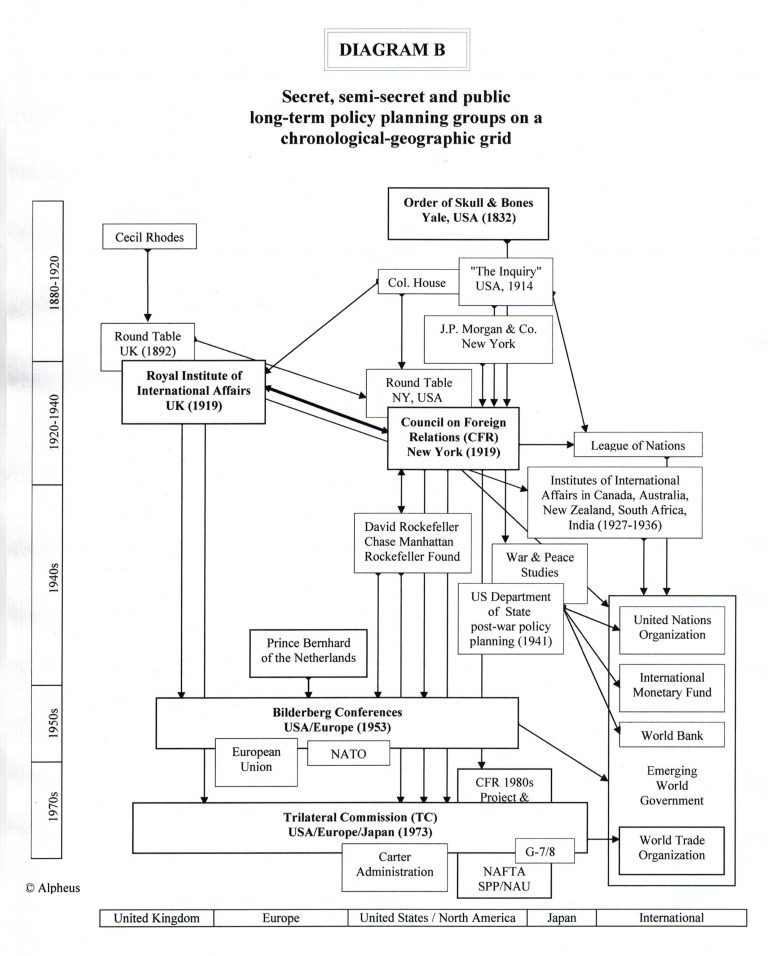
Many years ago I created a geographical-chronological grid of the main semi-secret groups, think tanks, international organizations and some individuals involved in this narrative of globalization. I cut it down to the essentials and the grid admittedly lacks a twenty-first century update.

Fig. 2. Chronological-geographic Grid


World System Analysis

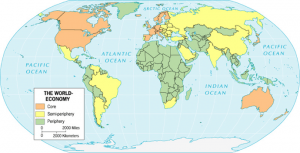
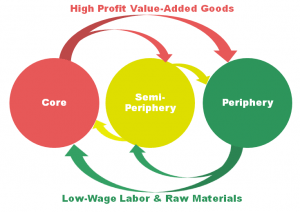
There are different ways to conceptualize these international dynamics. In the framework of sociologist Wallerstein’s ‘world system analysis’ the Trilateral West is the ‘core’ of the world system imposing its political and economic will on the rest of the world, which is divided in a sphere of semi-peripheral countries, which have some development, and peripheral countries, which are under-developed (though there is a debate on what actually ‘development’ means)(Wallerstein, 2004).

Fig. 3. The World-Economy (Elwell, 2013)

In the above map the geographically integrated nature of the Trilateral West with its maritime and hard borders is somewhat lost. The Deutinger map has North America in the middle instead of Europe, which also reflects its importance . . . for now (a third map with China in the middle might become the more explanatory map in the coming decades).

Fig 4. Flow of Goods, Resources and Labor

Which brings me to the dynamic aspect of this international structure. Basically the core produces high-tech, high-profit goods for its domestic and foreign markets while taking in low-price raw materials and low wage workers. The periphery is in the unenviable position where it generates hardly any high-tech, high-profit goods and has to give up its resources and labor for a pittance. In between are the somewhat developed, semi-periphery countries with an intermediary, buffering role between the core and the periphery being both exploiter and exploitee. Countries in the core will try to stay in that position while the others will try to go at least one status up.

The core mostly has a hegemon, usually the country with the largest navy, merchant fleet, manufacturing base and financial institutions. In Wallerstein’s chronology the Dutch in the 17th century came first, and in the 18th and 19th century it was the UK. Then after a period of transition between 1914 and 1945, which knocked out Germany as a candidate, the USA became the hegemon. Anno 2020 the power and status of the USA is diminishing year by year, not the least because of the scandalous incompetence of the Trump administration, and that of China is rising. With China joining the WTO, G-20, the informal Davos, and the adoption of the adapted Trans-Pacific Partnership (TPP), China will become increasingly incorporated into the core of the globalized system from which position it is already reforming and protecting it, and will probably take over the role of hegemon in a few decades.

This transformation of a major Communist power from antagonist, to resister, to participant, to reformer, to protector and finally to leader of the international capitalist system is quite extraordinary (Zhihai, 2011). Some would see this as a diabolical and long established plot between Wall Street and Communists, while others would see this as the logical outcome once China went from failing Communism to authoritarian state capitalism–being communist only in name–and thereby going back to its traditional position of dominance in the world economy which it had lost to the west for about four centuries (Frank, 1998; Arrighi 2007).

It is also possible that this process will be halted by a cold or hot face-off between China and Russia on one hand (they have been long-time strategic allies) and the Trilateral West on the other. And the factors leading into this already smoldering conflict are legion. Botched intelligence operations, electoral interference, sanctions, tariffs, counter-tariffs, right-wing anti-globalization populism, the correlated rise of nationalism–and all of this now aggravated by the pandemic and global recession pushing countries into increased self-sufficiency–can result in the de-coupling of the two main spheres of geopolitical power and put them at severe loggerheads. Cooler and more competent heads are necessary to navigate the tectonic economic and political shifts caused by China’s rise.

At the same time alternatives have to be developed to deconstruct the juggernaut of imperialistic globalization. Most importantly the hidden engine of the globalization process, the current monetary system, will have to be reformed. Humongous streams of capital can be re-directed, even created, to help a controlled process of de-globalization take place focused on a social-economic development of the periphery and semi-periphery, which is non-exploitative and ecologically sustainable, while the Trilateral West itself will have to tackle its own inequalities through raising taxes on corporations and the rich, and nationalize their currencies to redirect capital from financial speculation to investments in infrastructure, either physical, health or educational in the context of a Green New Deal. Sounds big, but the research underpinning such radical reforms is now quite large and monetary reform proposals are already on the shelf and could be activated in a matter of weeks.*

Originally, in an on-line presentation, the above narrative was embedded in an even larger one, i.e. of the dynamics of civilizations since the dawn of history till the relative dominance of the West. This will have to wait for another article. For now, I hope to have sketched a historical, institutional and geographical framework wide enough to get some grip on international developments.

* For more on monetary theory and reform see: Zarlenga 2002, 2009; Kumhof & Benes 2012; Ingham 2004; Werner 2012, 2014; Egnatz 2015; Huber 2017; Di Muzio & Robbins 2016, 2017, 2020; and Hammon & Pash 2019. Browse also this small bibliography with introductory items for initial orientation and this weighted list of of best studies based on the opinion of a group of experts.

Sources

Arrighi, Giovanni. 2007. Adam Smith in Beijing: Lineages of the Twenty-first Century. London & New York: Verso.

Aubourg, Valerie. 2003. “Organizing Atlanticism: The Bilderberg Group and the Atlantic Institute, 1952–1963”. Intelligence and National Security, 18/2 (2003): 92-105. Comparing two private, transatlantic organizations which started in the 1950s and flourished in the 1960s.

Deutinger, Theo. 2009. “Walled World“. Amsterdam & Salzburg: TD Architects. Retrieved 17 May 2020.

Di Muzio, Tim & Robbins, Richard. 2016. Debt as Power: Theory for a Global Age. Manchester, UK: Manchester U.P.

Di Muzio, Tim & Robbins, Richard. 2017. An Anthropology of Money: A Critical Introduction. London: Routledge.

Di Muzio, Tim & Robbins, Richard. 2020. “Capitalized Money, Austerity and the Math of Capitalism“. Current Sociology, 68/2: 149–168.

Domhoff, G. William.1969. The Higher Circles: The Governing Class in America: An Investigation of the Men and Women who govern our Country. New York: Vintage Books. Penetrating sociological study of the power elite. Special chapter on the CFR and one on conspiricist views of the upper-class.

Domhoff, G. William. 1978. The Powers That Be: Processes of Ruling Class Domination In America. New York: Vintage Books. Study of the ways and means of power-elite hegemony. Most revealing chapter on the role of the CFR in creating the UN, IMF and World-bank.

Domhoff, G. William. 2013. The Myth of Liberal Ascendancy: Corporate Dominance from the Great Depression to the Great Recession. Boulder & London: Paradigm Publishers.

Egnatz, Nick. 2014. “Linking Social Justice to Monetary Reform”. Alpheus. 25 Dec 2014.

Elwell, Frank W. 2013. “Wallerstein’s World-Systems Theory“. Retrieved May 17, 2020.

Eringer, Robert. 1980. The Global Manipulators: The Bilderberg Group… the Trilateral Commission… covert power groups of the West. Bristol, UK: Pentacle Books. An early journalistic foray into Bilderberg-land and how the media failed the public. First chapter here.

Estulin, Daniel. 2007. The True Story of the Bilderberg Group. Walterville, OR: TrineDay
“For some 15 years, Estulin has been a thorn in the sides of the Bilderbergers, relentlessly hunting down their secret meeting places, gaining inside sources who divulge what goes on behind closed doors, even photographing attendees and publicly disclosing it all.”

Frank, Andre Gunder. 1998. ReOrient: Global Economy in the Asian Age. Berkeley: University of California Press.

Gill, Stephen. 1991. American Hegemony and the Trilateral Commission. Cambridge, UK & New York: Cambridge UP.

Hammon, Virginia & Pash, Mark. 2019. How We Pay for a Better World. Portland: Great Democracy Media.

Huber, Joseph. 2017. Sovereign Money. Beyond Reserve Banking. London: Palgrave Macmillan.

Ingham, Geoffrey. 2004. “The Emergence of Capitalist Credit Money.” In: L. Randall Wray (Ed.), Credit and State Theories of Money: The Contributions of A. Mitchell Innes. Edward Elgar. 173-223.

Kumhof, Michael & Benes, Jaromir. 2012. “The Chicago Plan Revisited“. IMF Working Papers 12/202. Washington: International Monetary Fund.

Miller. Todd. 2019. “Israel’s Occupation Inspired the Brutal Security Regime at the US-Mexico Border“. Truthout, 17 Oct 2019. Excerpt from Empire of Borders: The Expansion of the U.S. Border Around the World. London: Verso Books.

Quigley, Carroll. 1966. Tragedy and Hope: A History of the World in our Time. New York: Macmillan. Tucked away in a vast narrative of 1870-1945 world history, eminent historian reveals evidence of the existence of a secret cabal within the Anglo-American establishment and its impact on history.

Quigley, Carroll. 1981. The Anglo-American Establishment: From Rhodes to Cliveden. New York: Books in Focus. Eminent historian reveals historical roots of a secret cabal within the Anglo-American establishment. Study written in 1946 and finally published posthumously in 1981.

Richardson, Ian. “Bilderberg, Elite Consensus and the Media“. The Huffington Post, UK Edition. July 13, 2011. Web.

Richardson, Ian; Andrew Kakabadse; Nada Kakabadse. 2012. “Shaping Global Political Realities: The Workings of Transnational Elite Networks“. World Financial Review, March-April 2012.

Ronson, Jon. 2002. Them: Adventures with Extremists. New York: Simon & Schuster. Two chapters dedicated to his adventures to find out more about Bilderberg.

Ross Sr., Robert Gaylon. 1995. Who’s Who of the Elite: Members of the Bilderbergs, Council on Foreign Relations, Trilateral Commission, and Skull & Bones Society. N.p.; RIE.
“The book is an excellent “reference” as to specifically who is affiliated with each specific elite organization, as well as cross-referencing what branch of government, industry, etc. their “day-job” corresponds with”. Different editions available.

Schuller, Govert. 2014. “Bilderberg 2014: A Secretive Elite Wonders if Privacy Exists“. Alpheus, October 2014.

Scott, Peter Dale. 1993. Deep Politics and the Death of JFK. Berkeley and Los Angeles: University of California Press,.

Shoup, Laurence H. and Minter, William. 1977. Imperial Brain Trust: The Council on Foreign Relations and United States Foreign Policy. New York: Monthly Review Press. Academic study of the history, network and influence of the CFR, especially its architecture of the post-WW II order with institutes like the UN, IMF and World Bank, and later its 1980s Project laying the groundwork for trilateralism, the G-7 Summits and the Trilateral Commission.

Shoup, Laurence H. 1980. The Carter Presidency and Beyond: Power and Politics in the 1980’s. Palo Alto, CA: Ramparts Press.

Shoup, Laurence H. 2015. Wall Street’s Think Tank: The Council on Foreign Relations and the Empire of Neoliberal Geopolitics, 1976-2014. New York: Monthly Review Press. Continuation of Imperial Brain Trust.

Sklar, Holly (Editor). 1980. Trilateralism: The Trilateral Commission and Elite Planning for World Management. Boston: South End Press. Collection of case studies of the imperialist power of the TC. Includes an annotated TC membership list.

Sutton, Antony and Patrick Wood. 1978, 1981. Trilaterals Over Washington. 2 vols. Scottsdale, Arizona: August Corp. Groundbreaking study on the Trilateral Commission by academic investigators.

Sutton, Antony. 1986. America’s Secret Establishment: An Introduction to the Order of Skull & Bones. Billings, Montana: Liberty House. After obtaining the membership list of this Yale senior semi-secret society, Sutton could connect the dots from his Wall Street trilogy and lay out the central role S&B played in fomenting wars and revolutions and controlling education.

Thompson, Peter. 1980. “Bilderberg and the West”. In: Trilateralism, Holly Sklar (Editor).

van der Pijl, Kees. 1984. The Making of an Atlantic Ruling Class. London: Verso. Study of the development and integration of the American and West European post-WWII corporate elite.

Wala, Michael. 1994. The Council on Foreign Relations and American Foreign Policy in the Early Cold War. Oxford & New York: Berghahn Books. “Based on extensive analysis of primary sources, this book clearly delineates the Councils activities- its study and discussion groups and its publications – and the developing international political, military, and economic situations.”

Wallerstein, Immanuel. 1974-1989. The Modern World-System. 3 volumes. New York & San Diego & London: Academic Press.

Wallerstein, Immanuel. 2000. The Essential Wallerstein. New York: The New Press.

Wallerstein, Immanuel. 2004. World-Systems Analysis: An Introduction. Durham, NC: Duke University Press. Short overview and introduction to his comprehensive approach to world history.

Werner, Richard A. 2012. “How to Turn Banks into Financial Intermediaries and Restore Money Creation and Allocation Powers to the State”. University of Southampton, Center for Banking, Finance and Sustainable Development, Policy Discussion Paper, No. 3-12 (8 Nov 2012): 2-9.

Werner, Richard A. 2016. “A lost century in economics: Three theories of banking and the conclusive evidence”. International Review of Financial Analysis, 46 (July 2016): 361-379.

Zarlenga, Stephen. 2009 (2006). “Presenting the American Monetary Act”. Valatie, NY: American Monetary Institute.

Zarlenga, Stephen. 2002. The Lost Science of Money: The Mythology of Money – the Story of Power. Valatie, NY: American Monetary Institute.

Zhihai, X. I. E. 2011. “The Rise of China and its Growing Role in International Organizations“. Journal of Modern Chinese Studies, 4/1: 85-96.