Triple-column Comparison

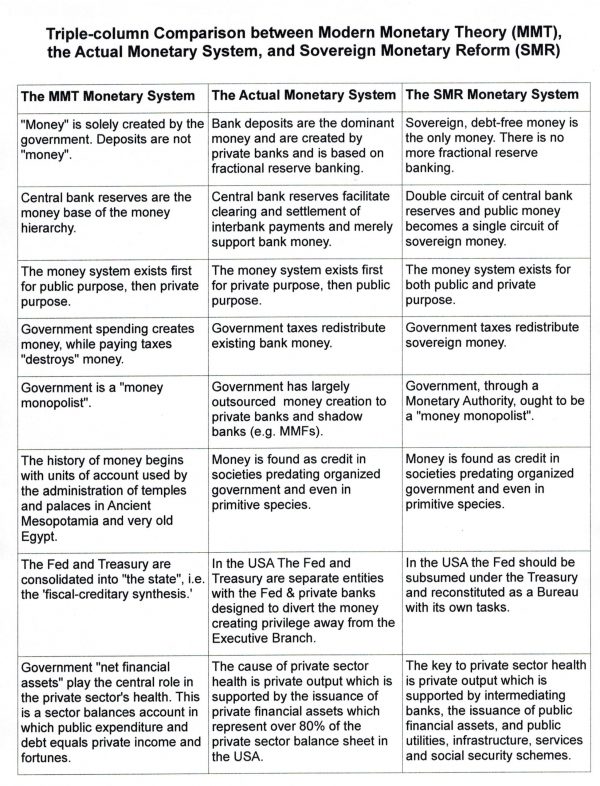
Triple-column Comparison between Modern Monetary Theory (MMT), the Actual Monetary System, and Sovereign Monetary Reform (SMR)


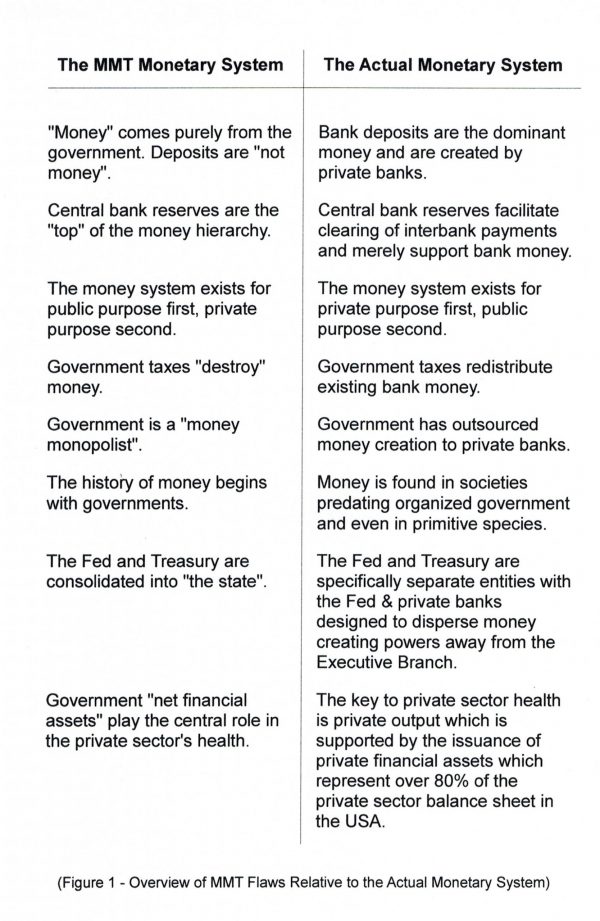
A while ago I found a very useful double-column comparison of the concept of the monetary system in Modern Monetary Theory (MMT) and how the monetary system actually functions. The figure is titled:

“Overview of MMT Flaws Relative to the Actual Monetary System”

It is a small image easily used on-line in posts and discussions and was composed by Cullen Roche in a 2013 article titled “A Critique of Modern Monetary Theory (MMT)“. Roche is the author of Pragmatic Capitalism: What Every Investor Needs to Know About Money and Finance and editor of the eponymous web site Pragmatic Capitalism.


Recently I had the idea to expand the double column into a triple one by adding the ideas and proposals by the movement proposing Sovereign Money Reform (SMR) based on what Dr. Joseph Huber calls New Currency Theory (NCT). With some help the entries were refined, corrected or paraphrased. The result is the following triple column.

I am presenting it here for anybody to use as an educational tool in the discussion about the deep flaws of MMT in order to 1) promote what we think is the correct theory of money and banking and 2) promote the necessary legislative changes which are needed to redress the deep systemic flaws of the current money regime.

To be clear, what we propose is the following triple-pronged policy proposal, which can be found on the web site of the International Movement for Monetary Reform:

We propose a transition towards a sovereign money system in which:

All official money – be it cash, money-on-account or new forms of digital currency – is created by a monetary state authority, according to the needs of the economy in a transparent and accountable process.

Money is created free of debt, and is directly spent into the economy via the state by way of government expenditure or directly distributed to the citizens as an equal dividend.

Private banks cannot create official money as credit. They only act as payment service providers and/or financial intermediaries by lending and investing existing official money, which they obtain from savers and investors.

This proposal of course is quite different of what proponents of MMT propose and that is government spending on worthy causes like the Green New Deal by allegedly creating new money and do so till the ‘slack’ is out of the economy and inflation might set in. We think that, based on our understanding how the system currently works, 1) this will lead to deficit spending because spending still has to be compensated through taxes and bonds, and 2) it unconscionably neglects to deal with the issue of money creation in the hands of private commercial banks and its disastrous consequences.

Meanwhile the American people already have a bill on the shelf to implement sovereign monetary reform and it is the 2012 H.R. 2990, the National Emergency Employment Defense Act or NEED Act. With some tweaking this bill can be adopted to solve a large chunk of the severe financial challenges the US Congress is facing to prevent the economy from collapse and citizens from bankruptcy and eviction, all in the context of the COVID-19 pandemic. Once you understand the current monetary system, one cannot but see its solution in sovereign monetary reform.


More critical posts on MMT:

Requesting Evidence for a Crucial MMT Claim

Richard Wolff’s Trajectory beyond MMT into SMR

Introduction to the Problem with Modern Monetary Theory (MMT)

Money and Banking: Assessing overlaps and differences between SMR and MMT

Modern Money Theory revisited – still the same false promise

Richard Wolff’s Trajectory beyond MMT into SMR

Introduction

Recently I watched two episodes of the progressive Thom Hartmann Program in which the host discussed banking and Modern Monetary Theory (MMT) with the Marxist economist Richard Wolff [1, 2]. Following are the pertinent points I came away with, which developed into a little article, in which I will try to make the case that, when Wolff found in MMT the correct theory of banking and money, he actually went beyond MMT. He did so by discerning some of the theory’s obvious policy implications, which people promoting Sovereign Monetary Reform (SMR)–which is a competing monetary theory focused on a radical reform of the monetary system–would heartily agree with.

Many persons in the comments section stated that both Hartmann and Wolff did not really understand MMT. For example the most stinging (pun intended) came from John B, commenting that

Prof Wolff knows very little about MMT or the functional operation of the banking system. As an academic, he should be conscious that one should not talk ‘authoritatively’ on a specialty discipline that one has not adequately researched[2].

This lack of understanding might be a surprise because both Wolff and Hartmann have had encounters with one of MMT’s spokespersons, Stephanie Kelton, and I assume that they have read some relevant literature.

Where Wolff is Right

Maybe it is most fair to say that Wolff’s understanding of MMT is half wrong and half right. He is right to state that, in order to originate loans, “banks do not depend on other people’s money”[2]. Banks can just credit the deposit account of their client when they sign up for a loan. This is basically the credit creation theory of money and banking.  Its truth is now admitted by central banks like the Bank of England [3] and empirically tested by the economist and central banking expert Richard Werner [4].

He is also right in the idea that the government can fine-tune the economy by increasing and decreasing the supply of money in circulation. This idea goes back to the theory of “functional finance” pioneered by Abba Lerner [5] and incorporated by MMT [6].

He also thinks that when government can create its own money it can drastically decrease its debt burden. He also correctly observed that leaving the money supply “in the hands of people who look at it as a source of private profit is a recipe for the disasters”[2] of the 2007/8 Global Financial Crisis which necessitated massive government bail-outs.

On all these points there is quite some agreement between the experts, MMT and the sovereign money reformers like Dr. Joseph Huber, Dr. Patricio Laina and the good folks at organizations like the American Monetary Institute (AMI), The Alliance for Just Money (AFJM) and the International Movement for Monetary Reform (IMMR).

Where Wolff is Wrong

Wollf is mistaken though when he ascribes to MMT the position that it is wrong to leave the power of money creation with banks and have that power transferred back to the government to put it under democratic control. The position of MMT is to leave the privilege of bank credit creation with the banks, while it assumes that the government already has the power to create money, unrestricted by any funding through taxation or selling bonds.

People promoting SMR will agree with Wolff that the money creation power should be transferred from the banks to the government. In the USA there exists a bill, the NEED Act, exactly proposing that [7]. And SMR disagrees with MMT’s position that taxes and bonds do not finance government spending and that government can just spend money under the existing rules and laws [8].

The Conflation and Confusion of Theories

The three main theories on money and banking all came into play in these conversations between Hartmann and Wolff, but were not sufficiently differentiated and separately evaluated. Hartmann, with his example of a $1m deposit becoming the basis to create $10m extra in loans seems to conflate the credit creation theory and the deposit multiplier theory. The credit creation theory basically says that bank credit money can be created out of nothing and that, at the end of the day, reserve requirements will be easily provided by the central bank. What drives the loan creation process is the demand for loans coupled to the banks’ evaluation of their profitability. Apparently the supply of money is not an issue.

The deposit multiplier theory posits a tight correlation between reserve requirements and the money supply. The often used example is from a 1961 FRB of Chicago publication in which an initial deposit of $10,000 and a reserve requirement of 10% can theoretically balloon into $90,000 in loans and investments. This happens when, in multiple stages, the bank loans out 90% of its deposit ($9,000), which will find its way first into the bank account of the borrower and from there into the account of the entity providing the merchandise or service for which purpose the loan was originated. The bank holding the second account in question can then originate a loan of $8,100, being the 90% allowed of the $9,000 deposit. This process can then be duplicated multiple times [11].

What Hartmann thinks is that a bank can just create $10m out of nothing based on a $1m deposit and an implied 10% reserve acquirement. This unrealistic scenario is not covered by any of these theories and looks more like a conflation of the credit creation theory and the deposit multiplier theory.

Wolff then corrects Hartmann with explaining the old and discredited financial intermediation theory of banking according to which banks make their profit by lending out money for a higher interest rate than they themselves pay to attract depositors. In this theory banks do not create nor multiply the money supply and merely mediate between those who have money to lend and those who desire money to borrow.

From MMT to SMR

Interestingly Wolff made these comments in the April 11, 2019 Hartmann program on the banking system and took them back again in the May 2, 2019 program on MMT. In the second program he first again explained the financial intermediation theory with the narration that first the money supply is created by the Federal Reserve and then banks can lend most of this money out again. Then, by explaining MMT’s research on how banks really operate, he switched to the credit creation theory as the correct one.

When a bank issues a loan nowadays, all that it does is create an account for the recipient of the loan and then the bank deposits into that account the amount of money that they had lend to the borrower. In other words, the bank is not dependent on other people putting deposits in . . . [2].

It looks like that Wolff had done some homework on MMT and was converted from the refuted financial intermediation theory to the credit creation theory. At the same time he did some suplemental thinking or reading over and beyond MMT, because he incorrectly projects behind MMT “the critical impulse” that “we should never have and we should not now put the control of the money supply so utterly into the hands of the banks” and mistakenly thinks that therefore MMT proposes that “we should have the creation of money brought back under the complete control of the government”. I am not sure where he might have found these ideas, but they are positions SMR is promoting and to which MMT is actually explicitly hostile to [9].

Conclusion

In short, the SMR crowd should be elated that Wolff, after learning some MMT and thereby switching from the old financial intermediation to the correct credit creation theory, apparently went beyond MMT by thinking through the policy implications of the credit creation theory and thereby arrived at a position with which SMR is quite in agreement, i.e. “we should have the creation of money brought back under the complete control of the government”.

This position might have been foreshadowed in Wolff’s book Capitalism’s Crisis Deepens in which he made the statement that to “ignore alternatives to private megabanks condemns us all to longer lasting, more socially costly, and recurring crises”[10].

Govert Schuller
Naperville, May 19, 2019

Sources

[1]. “Richard Wolff Explains How the Hell our Banking System was Put Together“. YouTube. Uploaded by Thom Hartmann Program, 11 April 2019.

[2]. “The Truth About Modern Monetary Theory (w/ Richard Wolff)“. YouTube. Uploaded by Thom Hartmann Program, 2 May 2019.

[3]. McLeay, Michael & Radia, Amar & Thomas, Ryland. 2014a. “Money Creation in the Modern Economy”. Monetary Analysis Directorate. Bank of England Quarterly Bulletin (Q1, 2014): 14-27.

[4]. Werner, Richard A. 2016. “A lost century in economics: Three theories of banking and the conclusive evidence”. International Review of Financial Analysis, 46 (July 2016): 361-379.

[5]. Lerner, Abba P. 1943. “Functional Finance and the Federal Debt“. Social Research, 10/1 (Feb): 38-5.

[6]. Bell [Kelton], Stephanie. 2000 “Do Taxes and Bonds Finance Government Spending?” Journal of Economic Issues, 34/3: 603-620.

[7]. H.R.2990 – National Emergency Employment Defense Act of 2011 (NEED Act). 112th US Congress (2011-2012).

[8]. Huber, Joseph. 2019a. “Modern Money Theory revisited – still the same false promise“. Sovereign Money, March 2019. Also here.

[9]. Mitchell, William. 2019. “The conga line of MMT critics – marching into oblivion“. Bill Mitchell – Modern Monetary Theory. 7 March 2019.

[10]. Wolff, Richard. 2016. Capitalism’s Crisis Deepens: Essays on the Global Economic Meltdown 2010-2014. Chicago: Haymarket Books. Page 117.

[11]. Nichols, Dorothy M. & Gonczy, Anne Marie L. 1961-1994. “Modern Money Mechanics: A Workbook on Bank Reserves and Deposit Expansion”. Chicago: Federal Reserve Bank of Chicago.

Introduction to the Problem with Modern Monetary Theory (MMT)

By Govert Schuller.

The Modern Monetary Theory (MMT) school is perceived sometimes as representing the ideas of the New Currency Theory (NCT) school so named by the eminent German economic sociologist and monetary reform theorist Joseph Huber. Huber, though admitting overlaps between the two theories, thinks the actual differences have profound consequences both at the theoretical level and, more importantly, at the policy level. Because this misconception creates confusion and unearned allegiances I like to highlight some pertinent quotes by Huber to be clear about these differences.

Guided by Huber’s introduction to his 2013 paper “Modern Money and Sovereign Currency” I will name four fundamental problems with MMT as 1) a problem of definition; 2) a problem of perception; 3) a problem of historical analysis; and 4) a problem of over-aggregation.

1) The initial problem according to Huber is one of definition:

“For example, MMT claims to be a chartal theory or state theory of money. Most people will understand ‘state money’ or ‘sovereign currency’ as money issued by a state authority such as a national central bank. MMT, however―and in line with banking doctrines and national-liberal ideas of old in the vein of Knapp and Mitchell-Innes―understand by ‘sovereign currency’ that the state just defines the national currency unit and for the rest accepts the money denominated in that currency issued by private banks rather than a public agency. This creates misunderstanding from the beginning.” (p. 5)

In short, MMT equates bank-credit money with sovereign money because it is issued in the state’s denomination and is accepted by the state as a medium of exchange. Meanwhile sovereign monetary reformers think that the 97% of the money stock created by commercial banks should not be considered sovereign money.

2) The second problem is MMT’s perception of banking as both benign for the economy and non-threatening to a state’s sovereignty:

“MMT does not recognize a need for monetary reform. Central bank and government together, it is assumed, exert effective control over banks’ creation of credit and deposits. Fractional reserve banking on the whole is seen as efficient and benign. To NCT this is just another example of fictional economics, for the actual situation today comes close to one of capture of the state’s monetary sovereignty by the private banking sector.” (p. 5)

In short, MMT ignores the cause of the aggravated and destructive boom-bust cycle fueled by the volatile expansion and contraction of bank-credit money, and is oblivious to the political power gained by the commercial banks.

3) A third problem is that MMT has its monetary history wrong.

“MMT has it that money is credit and debt by its very nature and history. MMT adherents ridicule the notion of debt-free money as ‘dry water’. . . . . Money certainly is a medium for paying debt, i.e. to get rid of debt, and thus has of course developed historically in a context of debt of various kinds. . . . MMT, yet, misrepresents 2,500 years of coin currencies when money typically was not lent into circulation against interest, but spent into circulation by the rulers of the realm free of interest and redemption.” (p. 6)

In short, because MMT sees money only as credit/debt they cannot understand the historical record indicating that there were times in which certain states did issue debt-free sovereign money.

4) A fourth problem is that MMT aggregates the productive, real-economic sector and the FIRE sector, i.e. finance, insurance and real estate.

“MMT’s categories of sector balances – public, private, foreign – remain simplistic and actually misleading as long as they do not incorporate in each sector Hudson’s distinction between a FIRE subsector, which can indirectly contribute to productivity, and a real-economic subsector which can immediately be productive.“ (p. 95)

Here I would add that, though the financial sector is perceived as the credit engine of the real economy and therefore both could be aggregated, the historical record shows that, when the financial sector starts allocating credit into speculative, non-productive ventures, the real economy will suffer and therefore they should be treated as different sectors.

Huber’s assessment of MMT therefore is quite severe:

“Without openly denying this, MMT is nonetheless contemptuous of monetary quantity theory and the notion of sound finances. MMT cultivates laxness about deficits and debt. MMT does not question why the concept of ‘functional finance’ turned out to be quite dysfunctional in practice.”

In summary, because 1) MMT works with a skewered definition of sovereign money; 2) has a blind spot to the elasticity of the money supply as the real cause of destructive speculation bubbles and ensuing debt-deflation spirals; 3) MMT misunderstands the historical record of sovereign money production; and 4) does not differentiate between the real economy and the FIRE sector, the aggregate of these shortcomings leads MMT to become irresponsibly lackadaisical about debts, deficits and the power of the financial sector over the state.

On the other side, those promoting sovereign monetary reform are very aware of the societal-formative and -destructive power of credit allocation by banks and their increasing gain in political power and are therefor promoting a three-prong policy proposal:

1) Nationalize the central bank and institute a monetary authority to manage the money supply such that its size has neither inflationary nor deflationary effects;

2) Allow the state to spend debt-free money into circulation on projects society really needs;

3) Abrogate the prerogative of banks to create the money supply and, instead, let them be true intermediaries in society’s flow of sovereign money.

With the above in mind I give Huber the last word on this:

“Today, monetary sovereignty is something which has to be recaptured from the banking industry. Regaining control of the currency and repossession of the complete monetary prerogative is a task of constitutional importance, a legal imperative, and a fundament of any stable economy.” (p. 95)

Post Script

In March 2019 Huber wrote another paper on MMT:

Huber, Joseph. 2019a. “Modern Money Theory revisited – still the same false promise“. Sovereign Money, March 2019  .

Sources

Huber, Joseph. 2013. “Modern Money and Sovereign Currency”. Sovereign Money: Website for New Currency Theory and Monetary Reform.

Huber, Joseph. 2014a. “Modern Money Theory and New Currency Theory”. Real-World Economics Review,  66 (13 Jan 2014): 38-57.

Additional Sources

Palley, Thomas I. 2014. “The Critics of Modern Money Theory (MMT) are Right”. IMK Working Paper, No. 132, Institut für Makroökonomie und Konjunkturforschung (IMK), Hans-Böckler-Stiftung, Düsseldorf.

Palley, Thomas I. 2015. “Money, Fiscal Policy, and Interest Rates: A Critique of Modern Monetary Theory“. Review of Political Economy, 27/1: 1-23.

Lavoie, Marc. 2013. “The monetary and fiscal nexus of neo-chartalism: a friendly critique.” Journal of Economic Issues, 47/1: 1-32. 

Roche, Cullen. 2011. “Modern Monetary Theory (MMT) Critique“. Pragmatic Capitalism, 7 Sept 2011. 

Walsh, Steven & Zarlenga, Stephen. 2012. “Evaluation of Modern Monetary Theory”. AMI Research Paper.