Additions to Bibliography September 2024


Additions to the main Bibliography Monetary Theory and Reform

A. Proposed Legislations and Organizational Endorsements

Carmack, Patrick S.J., J.D. 1996. “Monetary Reform Act“. The Money Masters.

B. Academic Studies on Sovereign Monetary Theory and Reform

Bang-Andersen, Jens & Lars Risbjerg & Morten Spange. 2014. “Money, Credit and Banking“. Monetary Review, 3: 65-81.

Bichler, Shimshon & Nitzan, Jonathan. 2022. “Book review: Steve Keen, (2021) The New Economics: A Manifesto“. realworld economics review, 102 (18 December 2022): 156-163.

Bofinger, Peter & Haas, Thomas. 2018. “A simple microeconomic model for the analysis of Vollgeld“. W.E.P. – Würzburg Economic Papers, No. 99, University of Würzburg, Department of Economics, Würzburg.

Carmack, Patrick S.J., J.D. 2020. “Reforming the Primary Instrumental Cause of Increasing Income Inequality“. Adler–Aquinas Institute, Colorado Springs, CO, USA.

—–, —–. 2019. “The Main Cause of Income Inequality”. Studia Gilsoniana, A Journal in Classical Philosophy, 8/4.

Constâncio, V. 2016. “Challenges for the European Banking Industry”. Lecture given at the Conference on “European Banking Industry: What’s Next?”, organised by the University of Navarra, Madrid, 7 July 2016.

Crocker, Geoff. 2020. Basic Income and Sovereign Money. The Alternative to Economic Crisis and Austerity Policy. Cham, Switzerland: Palgrave Mcmillan.

Daneke, Gregory A. 2019. Serfs Up: Finance, Feudalism, and Fascism, Ruminations on the political economy of our time while there is still time. Seattle: Amazon Paperback.

—–, —–. 2022. “The Paradigm in the Iron Mask: Toward an Institutional Ecology of Ecological Economics.” real-world economics review, 102: 16-29.

De Grauwe, Paul. 2008. “Returning to Narrow Banking“. In: B. Eichengreen and R. Baldwin, What the G20 should do on November 15th to fix the financial system, a VoxEU.org Publication.

Demeulemeester, Samuel. 2022. “Divorcing money creation from bank loans: Revisiting the “100% money” proposal of the 1930s“. Revue d’economie politique, 132/5: 835-859.

Desan, Christine A. 2022. “How To Spend a Trillion Dollars: Our Monetary Hardwiring, Why It Matters, and What To Do About It.” Shared at AMI Conference 2022.

Dietsch, Peter. 2021. “Money creation, debt, and justice”. Politics, Philosophy & Economics, 20/2: 151-179.

Dietz, Rob, Herman Daly, and Dan O’Neill. 2013. Enough is enough: Building a sustainable economy in a world of finite resources. London: Routledge.

Diren Valayden & Jakob Feinig. 2022. “Humanization as Money: Modern Monetary Theory and the Critique of Race“. Humanity: An International Journal of Human Rights, Humanitarianism, and Development, 13/2 (Summer 2022): 146-157.

Etzrodt, Christian. 2023. “Positive Money: Progressive Solution or Trojan Horse?“. Cambridge Journal of Economics, 47/6: 1207-1224.

Feinig, Jakob. 2015. Money and its publics: Public involvement in American monetary policy from 1690 to 1936. Dissertation, State University of New York at Binghamton.

Flaschel, Peter, et al. 2010. “Broad banking, financial markets and the return of the narrow banking idea“. The Journal of Economic Asymmetries, 7/2: 105-137.

Goodhart, Charles & Jensen, Meinhard. 2015. “Currency School versus Banking School: An ongoing Confrontation“. Economic Thought, 4 /2: 20-31.

Hockett, Robert C. 2019a. “Money’s Past is Fintech’s Future: Wildcat Crypto, the Digital Dollar, and Citizen Central Banking“. Cornell Legal Studies Research Paper No. 19-05, Stanford Journal of Blockchain Law & Policy. 

—–, —–. 2019b. “Finance without Financiers“. Politics & Society, 47/4: 491-527.

—–, —–. 2021. “Digital Greenbacks: A Sequenced’ Treasury Direct’ and ‘Fed Wallet ‘Plan for the Democratic Digital Dollar.” Journal of Technology Law & Policy,  25/1.

—–, —–. 2024. Spread the Fed: Distributed Central Banking for Productive Monetary Policy. London: Palgrave Macmillan. Forthcoming.

Hook, Andrew. 2023. “Towards an institutional “landscape” view of modern money creation mechanisms and some reflections on their ecological significance“. Sustainability Science, 18: 1977–1993.

Hotson, John H. 1983. “What’s Wrong with Mainstream Macroeconomics?“. Eastern Economic Journal, 9/3: 246-257.

—–, —–. 1985a. “The Growlery: Ending the Debt-Money System“. Challenge, 28/1 (March / April 1985): 48-50.

—–, —–. 1985b. “Response: Professor Friedman’s Goals Applauded, His Means Questioned“. Challenge, 28/4: 59-61.

—–, —–. 1986. The Keynesian Revolution and the Aborted Fisher-Simons Revolution, Or, The Road Not Taken. Department of Economics, University of Waterloo, 1986.

—–, —–. 1996. “The Chicago Plan and New Deal Banking Reform“. Eastern Economic Journal, 22/1 (Winter, 1996): 108-110.

Huber, Joseph. 2012. “Many roads lead to Rome–not all by the shortest path. Comments and reflections on The Chicago Plan Revisited.”

Kash, Ian A., Eric J. Friedman, and Joseph Y. Halpern. 2007. “Optimizing scrip systems: Efficiency, crashes, hoarders, and altruists“. Proceedings of the 8th ACM conference on Electronic commerce, 2007.

Keen, Steve. 2021. The New Economics: A Manifesto. Cambridge, UK: Polity Press.

—–, —–. 1995. “Finance and Economics Breakdown: Modeling Minsky’s ‘Financial Instability Hypothesis’“. Journal of Post Keynesian Economics, 17/4: 607-35.

Kim, Hongkil & Griffin, Hunter. 2022. “Why not Sovereign Money AND Job Guarantee?” real-world economics review, 99: 106-124.

Li, Boyao. 2022. “How does bank equity affect credit creation? Multiplier effects under Basel III regulations“. Economic Analysis and Policy, 76: 299-324.

Li, Boyao & Yougui Wang. 2020. “Money creation within the macroeconomy: An integrated model of banking”. International Review of Financial Analysis, 71: 101547.

Loef, Hans E., and Hans G. Monissen. 1999. “Monetary policy and monetary reform: Irving Fisher’s contributions to monetary macroeconomics“. WEP-Würzburg Economic Papers, No. 11, University of Würzburg, Department of Economics, Würzburg.

McMillan, Jonathan. 2024. Capitalism and the Market Economy: Bringing back together what Banking Pulls apart. Zurich, Switzerland: Zero/One Economics.

Pilkington, Philip. 2014. “Bank of England endorses post-Keynesian endogenous money theory“. No. 32. Working paper (PDF). Fixing the Economists, 12 March 2014.

Sheard, Paul. 2023. The Power of Money: How Governments and Banks Create Money and Help Us All Prosper. Dallas, TX: Matt Holt.

Simić, Aleksander. 2019. Just Money. Sovereign Money System and the Ethics of Banking. Master’s of Applied Ethics. MS thesis. Utrecht University.

Tavlas George. 2020. “On the Controversy over the Origins of the Chicago Plan for 100 Percent Reserves: Sorry Frederick Soddy: It Was Knight and (Most Probably) Simons!” Hoover Institution, Economics Working Paper 20102. Forthcoming, Journal of Money, Credit and Banking.

Tymoigne, Éric, and L. Randall Wray. 2006. “Money: An Alternative Story“. In: Arestis, Philip, and Malcolm C. Sawyer, (eds), A Handbook of Alternative Monetary Economics, Cheltenham, UK & Northampton, MA: Edward Elgar Publishing: pp. 1-16. Also; Working Paper No. 45, Center for Full Employment and Price Stability (July 2005).

van Egmond, N., and B. de Vries. 2020. “Modeling the Dynamics of the Financial-Economic System: Understanding The Current ‘Money as Debt’ Crisis“. Journal of Banking, Finance and Sustainable Development, 1/1: 145-168

van Egmond, N., and B. de Vries. 2020. “Modelling the dynamics of the financial-economic system: Exploring the ‘debt free money’ alternative“. Journal of Banking, Finance and Sustainable Development, 1/1: 169-180.

van Eijck, Jan, and Philip Elsas. 2017. “What is money?” In: Başkent, Can, Lawrence S. Moss, and Ramaswamy Ramanujam (eds), Rohit Parikh on logic, language and society, Vol. 11, Springer, pages 67-75.

Vivian, R., and Nicholas Spearman. 2016. “Banks and Money Creation ‘Out of Nothing’“. No. 3. Working Paper, EU and Comparative Law Issues and Challenges Series, Dec 2016.

White, William. 2023. “Why The Monetary Policy Framework in Advanced Countries Needs Fundamental Reform.” Institute for New Economic Thinking Working Paper Series 210.

C. Studies Critical of Sovereign Monetary Theory and Reform (including MMT section)

Green Party USA. 2022. “Special MMT Edition“. Banking and Monetary Reform Committee. Green Party USA. Newsletter, January 2022.

Lavoie, Marc. 2022. “MMT, sovereign currencies and the Eurozone“. Review of Political Economy, 34/4: 633-646.

Miles, Derrick. 2021. “MMT and the Green Party: A GPWA Member Perspective“. Real Progressives, 30 Jan 2021.

Musgrave, Ralph. 2014. “Charlotte Van Dixhoorn criticises Positive Money“. Ralphonomics, 12 May 2014. [Responding to van Dixhoorn, 2013]

Nersisyan, Y. and Wray, L. R. 2017. “Cranks and heretics: The importance of an analytical framework“. Cambridge Journal of Economics, 41/6: 1749–60.

D. Non-academic Advocacy Pamphlets, Reports, Briefings and Books

Bossone, Biagio & Costa Massimo. 2018. “The ‘accounting view’ of Money: Money as Equity (Part II)“. All About Finance, World Bank Blog, 21 May 2018.

Dawnay, Emma. 2017. “Souvereign Money Initiative: The Background to the National Referendum on Sovereign Money In Switzerland“. Wettingen, Switzerland: Verein Monetäre Modernisierung (MoMo).

Egnatz, Nick. 2019. “The Constitution and a Just System of Money“. Alliance For Just Money, 19 July 2019.

—–, —–. 2019. “Challenging the Economics Profession“. Alliance For Just Money, 2 Nov 2019.

Egnatz, Nick. 2023. Money Creation 101: Change Our Money – Change Our World.

—–, —–. 2024. History of Money 101: Change Our Money – Change Our World.

Hummel, Sam. 2022a. “Global Study on Monetary Literacy Finds Massive Illiteracy & Disapproval“. Sam Thinks out Loud on Substack, 21 Jan 2022.

—–, —–. 2022b. “The Bank of England Says Economics Textbooks Teach Falsehoods About Money and Banking“. Sam Thinks out Loud on Substack, 23 March 2022.

—–, —–. 2022c. “80% of People Have a Mistaken Understanding of the Relationship Between Money and the Economy“. Sam Thinks out Loud on Substack, 19 May 2022.

—–, —–. 2022d. “Here’s the Proof that Banking Crises Simply Don’t Need to Happen. Period“. Sam Thinks out Loud on Substack, 4 June 2022.

—–, —–. 2022e. “One Paragraph Summaries of Top Papers for Understanding Bank Money Creation and Its Economic Effects“. Sam Thinks out Loud on Substack, 29 Sept 2022.

—–, —–. 2022f. “Who Owns and Controls Your Country’s Central Bank? It May Not Be Who You Think“. Sam Thinks out Loud on Substack, 6 Oct 2022.

—–, —–. 2022g. “100+ Experts Confirm: ‘Banks Create New Money Whenever They Lend’ “. Sam Thinks out Loud on Substack, 11 Nov 2022.

—–, —–. 2022h. “Ben Bernanke’s 2022 Nobel Prize in Economics is an Embarrassment“. Sam Thinks out Loud on Substack, 21 Nov 2022.

Jackson, Andrew. 2014. “The Positive Money Proposal: The Transition Process in Balance Sheets“. London: Positive Money.

Jackson, Andrew, Ben Dyson, and Graham Hodgson. 2013. “The Positive Money Proposal“. London: Positive Money.

Jackson, Tim. 2009. Prosperity without Growth: Economics for a Finite Planet. London: Earthscan / Routledge.

Schuller, Govert. 2019. “Ons Geld and the Road to the WRR Report“. Alliance For Just Money, 8 Mar 2019.

E. Supporting Studies Addressing Monetary Issues

Goldstein, Jonathan. 2020. “A Three Class Predator-Prey Model with Financial Super Predators: The Financial Profit Squeeze“. Working paper 503 (February 2020), Political Economic Research Institute, University of Massachusetts, Amherst.

Hudson, Michael & Charles Goodhart. 2018. “Could/should Jubilee debt cancellations be reintroduced today? If not, what alternative measures of debt relief and redistribution might be possible?“. Economics: The Open-Access, Open-Assessment E- Journal, 12 (2018-45): 1–25.

Hudson, Michael. 2024. Temples of Enterprise: Creating Economic Order in the Bronze Age Near East. Dresden, Germany: ISLET Press.

van Doornen, Heske. 2017. “Going Beyond Exchange“. Economic Questions, Blog of the Young Scholars Initiative, 15 May 2017.

F. Journalistic Articles Addressing Monetary Reform

Daneke, Gregory A. 2023. “When Wank Became Swank: Money, Banking, and The Evolution of the All-Debt Economy“. Medium, 31 Aug 2023.

Hockett, Robert. 2020. “Digital Greenbacks“. Forbes, 17 May 2020.

Kummer, Larry. 2012. “The lost history of money: An antidote to the myths“. Fabius Maximus Web Site, 12 Dec 2012.

Murphy, Richard. 2024. “Central bankers on their ability of banks to create money out of thin air“. Funding the Future, 6 Jan 2024.

Ongweso Jr, Edward. 2023. “Saule Omarova’s Plan to Remake the Financial System“. Dissent, Fall 2023.

Switzer, Howard. 2018. “Weaving a Unifying Narrative: The Money Thread“. Green Horizon, 15/36: 4-6.

G. Educational and Promotional Videos

Dietz, Rob, Herman Daly, and Dan O’Neill. 2019. Enough is enough: Building a sustainable economy in a world of finite resources. Video.

Funny Money. 2023. “Decolonizing International Economy: Featuring Fadhel Kabou“. Funny Money YouTube Channel. 25 Aug 2023.

Schularick, Moritz. 2021. “Central Bank Balance Sheets and the Macroeconomy: 1587-2020“. Paris School of Economics on YouTube, 31 May 2021.

Tily, Geoff. 2016. “Academics and civil society clash on money“. Policy Research in Macroeconomics, 18 July 2016.

H. Other Relevant Background Studies

Blyth, Mark. 2013. Austerity: The History of a Dangerous Idea. Oxford: Oxford University Press.

Chang, Ha-Joon. 2002. Kicking Away the Ladder: Development Strategy in Historical Perspective. London: Anthem Press.

Chwieroth, Jeffrey. 2010. Capital Ideas: The IMF and the Rise of Financial Liberalization. Princeton, NJ: Princeton University Press.

Domhoff, G william. 1967-2023. Who Rules America? 8 Editions. Upper Saddle River, NJ: Prentice-Hall

—–, —–. 2005. “The Four Networks Theory of Power: A Theoretical Home for Power Structure Research“. Who Rules America Website.

Edwards, Sebastian. 2019. American Default: The Untold Story of FDR, the Supreme Court, and the Battle over Gold. Princeton, NJ: Princeton University Press.

Eichengreen, Barry. 2019. Globalizing Capital: A History of the International Monetary System. Princeton, NJ: Princeton University Press.

Ferguson, Niall, et al. 2023. “The Safety Net: Central Bank Balance Sheets and Financial Crises, 1587-2020“. Hoover Institution, Centre for Economic Policy Research, 3 Feb 2023.

Ferguson, Niall & Andreas Schaab & Moritz Schularick. 2015. “Central bank balance sheets: expansion and reduction since 1900“. CESifo Working Paper, No. 5379, Center for Economic Studies and ifo Institute (CESifo), Munich.

Good, Aaron. 2022. American Exception: Empire and the Deep State. Ashland, OR: Blackstone Publishing.

Hochschild , Adam. 2023. American Midnight: The Great War, a Violent Peace, and Democracy’s Forgotten Crisis. Boston, MA: Mariner Books.

Hülsmann, Jörg Guido. 2014. “Fiat money and the distribution of incomes and wealth.” In: The Fed at One Hundred: A Critical View on the Federal Reserve System. Cham, Switzerland: Springer: 127-138.

Kentikelenis, Alexandros & Thomas Stubbs. 2023. A Thousand Cuts: Social Protection in the Age of Austerity. Oxford: Oxford UP.

Lowenstein, Roger. 2023. Ways and Means: Lincoln and His Cabinet and the Financing of the Civil War. London & New York: Penguin Books

Maher, Stephen and Scott Aquanno. 2024. The Fall and Rise of American Finance: From JP Morgan to Blackrock. London & New York; Verso.

Marx, Karl. “Comments on James Mill, Éléments D’économie Politique“. Collected Works.

Mattei, Clara. 2022. The Capital Order: How Economists Invented Austerity and Paved the Way to Fascism. Chicago: University of Chicago Press.

McCoy, Alfred. 2017. In the Shadows of the American Century: The Rise and Decline of US Global Power. Chicago: Haymarket Books.

Phillips, Peter. 2018. Giants: The Global Elite. New York: Seven Stories Press

Phillips, Peter. 2024. Titans of Capital: How Concentrated Wealth Threatens Humanity. New York: Seven Stories Press.

Shermer, Ellie. 2021. Indentured Student: How Government-Guaranteed Loans Left Generations Drowning in College Debt.  Chapel Hill, NC: University Press of North Carolina.

Schularick, Moritz and Alan M. Taylor. 2012. “Credit Booms Gone Bust: Monetary Policy, Leverage Cycles, and Financial Crises, 1870-2008”. American Economic Review, 102/2: 1029-61.

Scott, Brett. 2022. Cloudmoney: Cash, Cards, Crypto, and the War for Our Wallets. New York: Harper Business.

Sokona et al. 2023. Just Transition: A Climate, Energy and Development Vision for Africa. Independent Expert Group on Just Transition and Development.

Taylor, Yamagata. 2021. Race for Profit: How Banks and the Real Estate Industry Undermined Black Homeownership. Chapel Hill, NC: University Press of North Carolina.

Tooze, Adam. 2008. The Wages of Destruction: The Making and Breaking of the Nazi Economy. London & New York: Penguin Books

—–, —–. 2015. The Deluge: The Great War, America and the Remaking of the Global Order, 1916-1931. London & New York: Penguin Books

—–, —–. 2018. Crashed: How a Decade of Financial Crises Changed the World. London & New York: Penguin Books

—–, —–. 2021. Shutdown: How Covid Shook the World’s Economy. London & New York: Penguin Books

White, Richard. 2017. The Republic for Which It Stands: The United States during Reconstruction and the Gilded Age, 1865-1896. Oxford: Oxford UP.
Take Action for Monetary Justice

.
Sign AFJM’s Letter to the Federal Reserve! 

Urgent and fundamental problems require urgent and fundamental solutions. When those in charge are incapable or unwilling to make fundamental changes, then We, the People, must take charge!

The Alliance For Just Money exclaims “Mayday! Mayday! Mayday!” a distress call for our destructive money system, which is structurally incapable of serving our people and planet. Earth is warming and its species, oceans, and ecosystems are dying. Our government and people are drowning in debt; wealth inequality is growing exponentially; wars are multiplying; and the money supply is bigger than ever. Yet we are told there is not enough money to care for our people and planet!

Individuals and organizations are invited to add their signatures to a letter [also below] initiated by the Alliance For Just Money and supporters of a public money system to the leaders of the Federal Reserve Bank of Chicago calling on them to work with us and elected officials to enact the American Monetary Reform Act of 2024.

The letter is part of an action taking place at the Federal Reserve Bank of Chicago on Friday, May 17, starting at 12PM CT. It includes an outside press conference, leafleting, petitioning, and delivering the letter to and meeting with Federal Reserve Bank of Chicago leaders.

Take charge! Take action!

  1. Sign the letter as an individual or organization to the Board President of the Federal Reserve Bank of Chicago. The deadline is Wednesday, May 15th at 5PM CT.
  2. Join us at the Federal Reserve Bank, 230 S La Salle St, Chicago on Friday, May 17th at 12PM CT.
  3. Take part in any of the Mayday for Money events in Chicago, May 17th-19th.

====

Dr. Austan D. Goolsbee, 

President, Federal Reserve Bank of Chicago

230 South LaSalle Street
Chicago, IL 60604

Dear Dr. Goolsbee and the Federal Reserve Bank of Chicago Board of Directors:

Mayday! Mayday! Mayday for Money! The Alliance For Just Money (AFJM), allied organizations, and citizens are gathering together in Chicago this weekend to issue the international distress call about the US Federal Reserve System and related monetary systems worldwide.

Tomorrow marks the 110th anniversary of the formal signing of the Federal Reserve Bank of Chicago’s organization certificate.[1] In passing the Federal Reserve Act in December 1913, Congress surrendered its Constitutional authority—under Article I Section 8—to create all U.S. money and regulate the value thereof. Congress instead ceded that power to the commercial banks nationwide. Over a century later, We, the People declare “Mayday for Money,” calling for a sovereign public money system. 

We and a growing number of citizens recognize that, no matter how officially established and protected it has been, the private, debt-based modern money system is inherently unjust, unsustainable, and undemocratic.[2] Our current money system is structurally incapable of serving our people and planet. Earth is warming and its species, oceans, and ecosystems are dying. Our government and people are drowning in debt; wealth inequity is growing exponentially; wars are multiplying; and the money supply is bigger than ever. Yet we are told there is simply not enough money to care for our people and planet! We must change this narrative and demand a sovereign public money system.

We are at a historical juncture regarding monetary policy and financial systems worldwide. With the rise of digital currencies, we invite you to dialogue with us to enact Just Money rather than allow our financial institutions to continue our private, debt-based money system. We call upon you to work with us and our elected officials to pass the American Monetary Reform Act of 2024, that will establish and transition us to a sovereign public money system.[3]

Respectfully submitted by the undersigned, representing over _#_ organizations and _#_ individuals whose signatures are collected in our online petition at http://www.________.  

~~Alliance For Just Money Board of Directors and staff; American Monetary Institute Stewards; Move to Amend Co-Director Team; Banking & Monetary Reform Committee of the Green Party-US; An Economy of Our Own Advisory Board; and the Women, Money, & Democracy committee of the 108-year-old Women’s International League for Peace and Freedom-US; Ecological Economics for All.

Cc:  President Biden, Vice President Harris, and US Senators and Representatives

Alliance For Just Money, Inc., is a national, nonpartisan, nonprofit 501(c)(3)


[2] Omarova, S. T. (2020, March 20). “Technology v technocracy: Fintech as a regulatory challenge“. Journal of Financial Regulation, 6(1), 75–124 . See also International Movement for Monetary Reform; legal scholars of money at JustMoney.org; and regenerative and distributive economics efforts of DoughnutEconomics.org.

[3] The American Monetary Reform Act (AMRA) of 2024 is based on the H.R. 2990 National Emergency Employment Defense (NEED) Act of 2011 which was updated and improved upon by AFJM. It and a two-page factsheet on it are on AFJM’s Archive page (www.monetaryalliance.org/archive-afjm/) and directly at www.monetaryalliance.org/wp-content/uploads/American-Monetary-Reform-Act.pdf, and  www.monetaryalliance.org/wp-content/uploads/AMRA-Fact-Sheet.pdf.

AMI Statement to the UN Climate Conference COP28


Introduction

Monetary conference calls COP28’s attention to the connection between the current dysfunctional monetary system and environmental degradation, including climate change

Chicago, November, 2023 — Last month, from September 29 until October 1, the American Monetary Institute (AMI) held its 19th annual conference on monetary theory and reform.

The conference brought together some of the world’s leading experts on monetary history and theory with some of the world’s most serious advocates of real and achievable economic and monetary reforms.

Attendees of the conference and, since then, other interested parties and individuals were and still are invited to sign a statement addressing the strong correlation between the current, debt-based monetary system and environmental degradation.

We call for the debt-based system to be changed into a sovereign monetary system; to develop similar institutions at an international level; and for the UN to set up a commission of monetary inquiry.

The concise statement being released to the participants of the UN Climate Conference’s COP28 is as follows:

The Statement

We acknowledge there exists a strong correlation between the current, debt-based monetary system and environmental degradation, including climate change. It acts through multiple paths of transmission, which have to be taken into account to find just and sustainable solutions.

The current monetary system is a debt-based system, because most of the money used for economic transactions, both in the real economy and the Finance, Insurance and Real Estate (FIRE) sector, is generated through the creation of debt when banks extend loans. This system is also a major cause of destructive economic boom and bust cycles, and creates socioeconomic inequality and political polarisation between and within creditor and a debtor classes.

Furthermore, we strongly believe that sovereign monetary reform (SMR) will allow substantial public investments, which are required to steer global civilization from our brown, carbon-based age to a green, equitable, post- fossil fuel age with a balanced carbon cycle.

In the case of the USA, SMR would entail the three following inter-connected changes to its current design:

        • Requires Congress to be the sole creator of all U.S. money debt-free, as authorized in the U.S. Constitution;
        • Ends the privilege of commercial banks to create money; and
        • Makes all remaining operations of the Federal Reserve System accountable to the public.

At an international level parallel institutions and regulations should be developed including: 1) a supranational reserve currency; 2) an international clearing system; 3) a monetary authority of currency issuance; and 4) an advisory Intergovernmental Panel on Economic and Social Issues (IPESI) to assess progress and detect problems.

Given the promising nature of SMR, we, the undersigned, therefore call for a UN Monetary Commission to investigate the strengths and weaknesses of the current monetary system, and to evaluate alternate proposals, especially SMR, to improve it.

Please Sign

The statement with ample background references and names of signers can be found on-line here.

If you like to add your name please fill out this form.

Add, if you like, town, state & country, institutional affiliation and any titles.

For questions email Steven Walsh or Govert Schuller.

AMI is a publicly supported charity to present the results of research leading to monetary reforms that bring forth a greater level of economic justice. The institute was founded in 1996 by Stephen Zarlenga, author of The Lost Science of Money.

Contact: Steven Walsh, Executive Director, (773) 636-8255, stevenjjwalsh@gmail.com

The American Monetary Institute: View from a Steward


Focus

The focus of the American Monetary Institute was and is on the almost unbridled credit creation facility of commercial banks (and its frequent turning off the tap) as a major cause of the destructive booms & busts in the financial sector and its spilling over into the real economy with disastrous consequences for regular people.

Furthermore, as a viable, structural, long-term solution we promote so-called sovereign monetary reform based on 1930s proposals collectively known as the Chicago Plan developed by prominent economists (Phillips, Demeulemeester, Kumhof).

Our first focus is on monetary theory and AMI embraces the so-named ‘credit creation theory of money and banking’ (Werner, McLeay, Ryan-Collins), aka ‘endogenous money’ in post-Keynesian parlance (Rochon & Rossi), and very nicely explained as the ‘finance franchise’ in Hockett & Omarova (2017).

Secondly, based on numerous analyses and models (Kumhof, Yamaguchi, van Egmond, Huber, Jackson), we promote the proposal that,

a) a nation’s money supply (and central bank if not yet done so) should be nationalized and transformed into debt-free, stable money,

b) stop the credit creation privilege of commercial banks and make them thereby into true intermediaries, 

c) institute a monetary authority to manage the money supply, and

d) let congress allocate the seigniorage (or taxation) coming out of the monetary authority’s decision process.

Implementation

This monetary theory and, based on it, radical reform proposal were a) incorporated into the 2012 NEED Act (HR 2990), with the help of AMI (Zarlenga), and sponsored (only) by Kucinich and Conyers; b) considered by the parliament of Iceland (Sigurjonsson); c) became the subject of a 2017 referendum in Switzerland, sorely lost by 75-25 (Lyons); and d) was debated by the parliament of the Netherlands in 2016, triggered by a citizens initiative, which only led to a thorough report after three years (Schuller; WRR).

After these half successes the movement seems to have burned out a little. Besides there was also a friendly schism, if I can say so, within the AMI leading to the formation of the Alliance For Just Money in 2018. And we had the shock that our very successful sister organization in the UK, Positive Money, thought it was advisable to distance itself from sovereign monetary reform because, in their still non-published deliberations, they thought it would crash the economy. On top of that COVID-19 hit with interesting financial responses by governments, from which we still try to extract the economic lessons.

For now AMI is giving some space to a) economists and monetary activists from LDCs; b) discussing the promises and perils of CBDC; c) of public and non-profit banking; d) of local currencies; and e) of parity economics, i.e. the idea to set a minimum price for raw materials in agriculture, fishing and mining.

But in the end, we are aiming at a ‘big switch’, when the money supply gets secured and prudently managed, and banking as we know it will end.

Sources

Demeulemeester, Samuel. 2018. “The 100% Money Proposal and its Implications for Banking: The Currie–Fisher Approach versus the Chicago Plan Approach“. The European Journal of the History of Economic Thought, 25/2: 357-387.

H.R.2990 – National Emergency Employment Defense Act of 2011 (NEED Act). 112th US Congress (2011-2012).

Hockett, Robert C. & Omarova, Saule. 2017. “The Finance Franchise“. Cornell Law Review, 102: 1143-1218.

Huber, Joseph. 2017. Sovereign Money. Beyond Reserve Banking. London: Palgrave Macmillan.

Jackson, Andrew & Dyson, Ben. 2012. Modernising Money: Why Our Monetary System Is Broken And How It Can Be Fixed. London: Positive Money.

Kumhof, Michael & Benes, Jaromir. 2012. “The Chicago Plan Revisited.” IMF Working Papers 12/202. Washington: International Monetary Fund.

Lyons, Matthew. 2018. “Will Switzerland Be The First Country In The World To Introduce A Sovereign Money System?” London: Positive Money. 28 Feb 2018.

McLeay, Michael & Radia, Amar & Thomas, Ryland. 2014a. “Money Creation in the Modern Economy”. Monetary Analysis Directorate. Bank of England Quarterly Bulletin (Q1, 2014): 14-27.

Phillips, Ronnie. 1995. The Chicago Plan & New Deal Banking Reform. Oxon, UK & New York, NY: Routledge.

Rochon, Louis-Philippe & Rossi, Sergio (eds.). 2015. The Encyclopedia of Central Banking. Cheltenham, UK & Northampton, MA: Edward Elgar Publishing.

Ryan-Collins, Josh & Greenham, Tony & Werner, Richard & Jackson, Andrew. 2012. Where Does Money Come From? A Guide to the UK Monetary and Banking System. London: New Economics Foundation. “Introduction”.

Schuller,Govert. 2019. “Ons Geld and the Road to the WRR Report“. AFJM, 8 Mar 2019.

Sigurjonsson, Frosti. 2015. “Monetary Reform: A Better Monetary System for Iceland“. A Report Commissioned by the Prime Minister of Iceland. March 2015. Foreword by Aidar Turner. Rekjavik, Iceland.

Van Egmond, Nicolas D & de Vries, Bert JM. 2016. “Dynamics of a sustainable financial-economic system”. Sustainable Finance Lab Working Paper. Utrecht University, The Netherlands.

Werner, Richard. 2014c. “How do banks create money, and why can other firms not do the same? An explanation for the coexistence of lending and deposit-taking”. International Review of Financial Analysis, 36 (2014): 71–77.

—–, —–. 2016. “A lost century in economics: Three theories of banking and the conclusive evidence”. International Review of Financial Analysis, 46 (July 2016): 361-379.

WRR. 2019. “Money Creation”. The Hague: The Netherlands Scientific Council for Government Policy (WRR).

WRR. 2019. Money and Debt: The Public Role of Banks – Summary of WRR Report. The Hague: Netherlands Scientific Council for Government Policy.

Yamaguchi, Kaoru. 2011. “Workings of a Public Money System of Open Macroeconomies: Modeling the American Monetary Act Completed”. In: Proceedings of the 29th International Conference of the System Dynamics Society, Washington D.C., USA, 2011. The System Dynamics Society. 

—–, —–. 2012. “On the Monetary and Financial Stability under A Public Money System (Revised): Modeling the American Monetary Act Simplified”. Paper presented at the 8th Annual AMI Monetary Reform Conference in Chicago, USA, Sept. 20 – 23, 2012. It was originally presented at the 30th International Conference of the System Dynamics Society, St. Gallen, Switzerland, July 22 – 26, 2012.

Zarlenga, Stephen. 2014 (2006). “Presenting the American Monetary Act / The 32-Page Brochure”. Valatie, NY: American Monetary Institute. Extensive introduction to, and final version of, the NEED Act.

Govert Schuller
Shillong, September 20, 2023

Additions to Bibliography February 2023


B. Academic Studies on Sovereign Monetary Theory and Reform

Armelius, Hanna & Carl Andreas Claussen, David Vestin. 2020. “Money and monetary policy in times of crisis”. Monetary Policy Department and the Payments Department of the Riksbank. Riksbank of Sweden. Economic Commentaries, 4 (11 June 2020): 1-15.

Assenmacher, Katrin & Claus Brand. 2018. “The Swiss Sovereign Money Initiative”. Credit and Capital Markets, 51/4: 621-644.

Baeriswyl, Romain. 2017. “The Case for the Separation of Money and Credit”. In Heinemann, F., Klüh, U., and Watzka, S. (eds.), 2017, Monetary Policy, Financial Crises, and the Macroeconomy, Cham: Springer, pp. 105–21.

Barber, G. Russell. 1973. “The One Hundred Percent Reserve System”. The American Economist, 17/1: 115–127.

Bertocco, Giancarlo & Andrea Kalajzic. 2018. “How much does finance benefit society?”. PSL Quarterly Review, 71/287: 419-437.

—–, —–. 2001. “Is Kaldor’s theory of money supply endogeneity still relevant?” Metroeconomica, 52/1: 95–120.

—–, —–. 2010. “The endogenous money theory and the characteristics of a monetary economy”. Rivista Italiana degli Economisti, 15/3: 365–401.

—–, —–. 2013a. “Money as an institution of capitalism: Some notes on a monetary theory of uncertainty”. Economic Notes, 42/1: 75–101.

—–, —–. 2013b. “On Keynes’s criticism of the loanable funds theory”. Review of Political Economy, 25/2: 309–26.

Bjerg, Ole. 2018. “We Need to Put Things Back to Normal”. Interview with Ole Bjerg (2018) Journal of Economic Sociology = Ekonomicheskaya sotsiologiya, 19/4: 172–181.

Brown, Harry Gunnison. 1940. “Objections to the 100 Per Cent Reserve Plan.” The American Economic Review, 26/3: 309–314.

Buchanan, James M. 2010. “The Constitutionalization of Money.” Cato Journal, 30/2: 251–258.

Burns, Scott. 2016. “Old (Chicago) School, New Century: The Link between Knight and Simons’ Chicago Plan to Buchanan’s Constitutional Money.” Constitutional Political Economy, 27/3: 299–318.

Carroll, Charles Holt. 1964. Organization of Debt into Currency and Other Papers. Edited with an Introduction by E. C. Simmons. Princeton, NJ: Van Nostrand.

Chai, Hee-Yul, and Sang B. Hahn. 2018. “Does Monetary Policy Regime Determine the Nature of the Money Supply?: Evidence from Seven Countries in the Asia-Pacific Region“. East Asian Economic Review, 22/2: 217-239.

Currie, Lauchlin B. [1934] 1968. The Supply and Control of Money in the United States. New York, NY: Russell & Russell.

Demeulemeester, Samuel. 2019. “The 100% money proposal of the 1930s: Conceptual clarification and theoretical analysis.” PhD thesis, ENS de Lyon.

—–, —–. 2020. “Would a State Monopoly over Money Creation Allow for a Reduction of the National Debt? A Study of the ‘Seignorage Argument’ in Light of the ‘100% Money’”. Debates, Research in the History of Economic Thought and Methodology, vol. 38A, A Symposium on Public Finance in the History of Economic Thought, 123–44.

—–, —–. 2021. “The 100% money proposal of the 1930s: An avatar of the Currency School’s reform ideas?” The European Journal of the History of Economic Thought, 28,/4: 577–98.

Doorman, Frans. 2015. Our Money – Towards a New Monetary System. Lulu internet publishers.

Douglas, Paul H. 1935. Controlling Depressions. New York, NY: Norton.

Dow, S.C. 1997. “Endogenous Money”. In G.C. Harcourt and P.A. Riach (eds), A ‘Second Edition’ of The General Theory, vol. II, London and New York: Routledge, 61–78.

Fisher, Irving. 1936. “100% Money Again.” Social Research, 3/2: 236–241.

—–, —–. 1936. “The Bankers’ Interest in 100% Money.” The Bankers’ Magazine, October, 1936.

—–, —–. 1937. “100 Percent Reserves—An Old System Adapted to Modern Needs.” Commercial & Financial Digest, Los Angeles, California, June 1937. Reprinted in I. Fisher, Testimony before a Subcommittee of the Committee on Agriculture and Forestry, U.S. Senate, 75:1, August 12, 1937, 292–296.

—–, —–. 1937. “Note Suggested by Review of ‘100 Per Cent Money.’” Journal of the Royal Statistical Society, 100/2: 296–298.

—–, —–. 1946 (1997). “Answers to Objections to the 100% Plan.” Fisher Papers, Yale University Library. Reprinted in Barber et al, 1997, The Works of Irving Fisher – Vol. 11. 100% Money, 308–311.

Graham, Frank D. 1936. “Partial Reserve Money and the 100 Per Cent Proposal.” The American Economic Review, 26/3: 428–440.

—–, —–. 1941. “100 Per Cent Reserves: Comment.” The American Economic Review, 31/2: 338–340.

Higgins, Benjamin. 1941. “Comments on 100 Per Cent Money.” The American Economic Review, 31/1: 91–96.

Hook, Andrew. 2022. “Examining modern money creation: An institution-centered explanation and visualization of the “credit theory” of money and some reflections on its significance.” The Journal of Economic Education, 53/3: 210-231.

Krainer Robert E. 2013, “Towards a Program for Financial Stability”. Journal of Economic Behavior & Organization, 85 (January): 207-218.

—–, —–. 2017, “Economic Stability under Alternative Banking Systems: Theory and Policy”. Journal of Financial Stability, 31: 107-118.

Kumhof, Michael, et al. 2020. “Central Bank Money: Liability, Asset, or Equity of the Nation?” Cornell Law School Research Paper No. 20-46.

Lainà, Patrizio. 2017. “Seignorage from Full-Reserve Banking”. Published in Lainà, Patrizio, “Full-Reserve Banking: Separating Money Creation from Bank Lending”, PhD Thesis, University of Helsinki (November 13, 2017).

Lehmann, Fritz. 1936. “100% Money.” Social Research, 3/1: 37–56.

Lester, Richard A. 1935. “Check-Book Inflation.” The American Scholar, 4/1: 30–40.

Mellor, Mary. 2019. Money: Myths, Truths, and Alternatives. Bristol, UK: Policy Press.

Nayan, S., Kadir, N., Abdullah, M. S., & Ahmad, M. 2013. “Post Keynesian Endogeneity of Money Supply: Panel Evidence”. Procedia: Post Keynesian Endogeneity of Money Supply: Panel Evidence Economics and Finance, 7: 48-54.

Neuman, Andrew M. 1937. “100 Per Cent. Money.” The Manchester School, 8/1: 56–62.

Ponsot, Jean-François. 2017. “Rethinking Money“. In: Rochon, Louis-Philippe, and Sergio Rossi (eds), A Modern Guide to Rethinking Economics, Edward Elgar Publishing, 2017, 114-28.

Robbins, Richard H. 2014. “Debt and the Monetary Foundations of Inequality”. Anthropology News, 55, 14–15.

—–, —–. 2020. “Financialization, Plutocracy, and the Debtor’s Economy: Consequences and Limits”. In: Hann, Chris and Don Kalb (Eds.), Financialization: Relational Approaches. Max Planck Studies in Anthropology and Economy, Volume 6, New York and Oxford: Berghahn, 65–94.

—–, —– & Tim DiMuzio. 2020. “Capitalized money, austerity and the math of capitalism”. Current Sociology, 68: 149–168.

Robinson, George Buchan. 1937. “100% Bank Reserves.” Harvard Business Review, 15: 438–447.

Rochon, Louis-Philippe. 1999. Credit, money, and production: An alternative post-Keynesian approach. Cheltenham, UK and Northampton, MA: Edward Elgar.

—–, —–. 2001. “Cambridge’s Contribution to Endogenous Money: Robinson and Kahn on Credit and Money”. Review of Political Economy, 13/3: 287-307.

—–, —– & —–, —–. (eds). 2003. Modern Theories of Money: The Nature and Role of Money in Capitalist Economies. Cheltenham, UK and Northampton, MA: Edward Elgar.

Schuller, Govert. 2023. “Rochon’s Five Propositions on Bank Credit Creation”. Valatie, NY: American Monetary Institute.

Simarmata, Djamester. 2023. “Development Finance by Money Creation, instead of Foreign Debt or Saving: A New Paradigm For Development Economics”. MS [Forthcoming]

Simons, Henry C. 1934. “A Positive Program for Laissez-Faire”. Public Policy Pamphlet No 15. Chicago: University of Chicago Press.

Skaggs N.T. 1997. “Henry Dunning Macleod and the Credit Theory of Money”. In: Cohen A.J., Hagemann H., Smithin J. (eds), Money, Financial Institutions and Macroeconomics, Recent Economic Thought Series, vol 53, Dordrecht: Springer.

Smithin, J. 2013. “Keynes’s theories on money and banking in the Treatise and the General Theory”. Review of Keynesian Economics, 2/2: 242–56.

Stellinga, Bart, et al. 2021. Money and Debt: The Public Role of Banks. Research for Policy Series. Studies by the Netherlands Council for Government Policy. Cham, Switzerland: Springer.

Thomas, Rollin G. 1940. “100 Per Cent Money: The Present Status of the 100 Per Cent Plan.” The American Economic Review, 30/2: 315–323.

Tolley, George S. 1962. “100 Per Cent Reserve Banking”. In: Yeager, L. B. (ed.), In Search of a Monetary Constitution, Cambridge, MA: Harvard University Press, 275–304.

Watkins, Leonard L. 1938. Commercial Banking Reform in the United States: With Especial Reference to the 100 Per Cent Plan and the Regulation of Interest Rates on Bank Deposits. Vol. 5. Michigan Business Studies, 8. Ann Arbor, MI: University of Michigan.

Werner, Richard A. 2003. Princes of the Yen: Japan’s Central Bankers and the Transformation of the Economy. New York: M.E. Sharpe.

—–, —–. 2018. “Shifting from Central Planning to a Decentralised Economy”. Paper presented at the 14th Rhodes Forum: Dialogue of Civilisations Research Institute, Panel 2: “Economic Alternatives when Conventional Models Fail”, Rhodos, Greece, on 1 October 2016 and at the 4th European Conference on Banking and the Economy (ECOBATE 2016), in Winchester Guildhall, Winchester UK, on 12 October 2016.

Whittlesey, Charles R. 1935. “Banking and the New Deal”. Public Policy Pamphlet No. 16. Chicago: University of Chicago Press.


C. Studies Critical of Sovereign Monetary Theory and Reform (including MMT section)

Pro MMT

Berkeley, A., Ryan-Collins, J., Tye, R., Voldsgaard, A. and Wilson, N. 2022. “The self-financing state: An institutional analysis of government expenditure, revenue collection and debt issuance operations in the United Kingdom.“ UCL Institute for Innovation and Public Purpose, Working Paper Series (IIPP WP 2022-08)

Ryan-Collins, Josh. 2022. “Why the British state is a magic money tree“. The New Statesman, 26 May 2022

Keen, Steven. 2022. “A Little Knowledge is a Dangerous Thing: Observations on the debate between MMT advocates and Progressive Money Canada founder Jeff Eder”. Planksip, 30 Sept 2022.

Critical of MMT

Eder, Jeff. 2022. “Steve Keen has lost his way in a Minsky Maze”. Progressive Money Canada. [Response to Keen, 2022]

Epstein, Gerald A. 2019. What’s Wrong with Modern Money Theory? A Policy Critique. Cham, Switzerland: Palgrave.

Mueller, Antony P. 2019. “The magic money tree: The case against modern monetary theory (MMT).” Research Paper Series Adam Smith Institute (ASI), UK.

Schuller, Govert. 2020a. “Requesting Evidence for a Crucial MMT Claim”. Blog. Alliance For Just Money, 16 Aug 2020.

—–, —–. 2020b. “Triple-column Comparison between Modern Monetary Theory (MMT), the Actual Monetary System, and Sovereign Money Reform (SMR)”. Blog. Alliance For Just Money, 21 Sept 2020.

—–, —–. 2020c. “ ‘What’s Wrong with Modern Money Theory?’: A Summary”. Blog. Alliance For Just Money, 5 Oct 2020.

—–, —–. 2022. “Did Dr. Joshua Ryan-Collins go MMT?”. Paper presented at the American Monetary Institute conference, October 8, 2022. Video here.

D. Non-academic Advocacy Pamphlets, Reports, Briefings and Books

AMI. 2021. “AMI Conference Statement to COP26: Regarding the Monetary Dimension of Climate Change”. American Monetary Institute, Evanston, IL, USA, 11 Nov 2021.

Anon. 2019. “Open Letter: Rethinking the Role of Banks in Economics Education”. Rethink Economics.

Hermanutze, Derryl. 2020. A Brief History of Financial Plunder. Independently published.

Jordan, Thomas J. 2018. “How money is created by the central bank and the banking system.” Speech at the Zürcher Volkswirtschaftliche Gesellschaft, Zürich, 16 Jan 2018. Speech given in German. Zürich: Swiss National Bank.

McConnachie, A. 2006. Clarifying Our Money Reform Proposals: A Report for the Tenth Annual Bromsgrove Conference. Bromsgrove Conference, Bromsgrove, England.

Positive Money. N.d. “What people think banks do: The money multiplier and other myths“. London: Positive Money.

Stuart, James Gibb. 1991. Scotland and Its Money. Edinburgh: John Dunlop.

—–, —–. 1992. Economics of a Green Renaissance. Glasgow: Ossian Publishers.

—–, —–. 1993. Hidden Menace to World Peace. Glasgow: Ossian Publishers.

Turner, W.E. 1966. Stable Money: A Conservative Answer to Business Cycles. With introduction by Representative Wright Patman. N.p.

E. Supporting Studies Addressing Monetary Issues

Costa, Jorge Meira & Marc Gauvin, McNeill. 2015. “A proposal for harmonising current disparate (scientific and legal) definitions of money towards greater decidability in the provision of Justice according to universal principles of contract law“. Presentation at MERC first annual conference on The Monetary Policies in The Balkans, The Future of The Euro and The Eurozone in The Balkan Region. Monetary and EconomicResearch Center, Sofia -Bulgaria, 2015.

DiMuzio, Tim. 2023. “Capitalism, Money and Inequality in the World”. In: Bieri, Sabin & Bader, Christoph (Eds.), Transitioning to Reduced Inequalities, Basel, Switzerland: MDPI Books.

Gauvin, Marc & Sergio Dominguez. 2020. “A Systems Engineering Approach to Formal Monetary and Financial Stability Without the Vagaries of “Austerity” “. Submitted December 2020 to Monetary Research Centre (MRC), University of National and World Economy (UNWE), Sofia Bulgaria.


F. Journalistic Articles Addressing Monetary Reform

Baker, Scott, 2012. “The Instant Solution to the New Depression: Debt-free Money”. HuffPost, 4 june 2012.

Howell, John. 2017a. “Who creates money and where does it go?” The Athens Messenger, 25 Jan 2017.

—–, —–. 2017b. “Why money creation is central to most of the problems faced by society”. Athens, OH: Democracy over Corporations.

Joób, Mark. 2014. “The Sovereign Money Initiative in Switzerland“. World Economics Association Newsletter, 4/3 (June 2014): 6-7. (Comments here)

Hulsmann, Jorg Guido & Patrizio Laina & Joseph Huber & Ib Ravn & Bryan Gould. 2020. “Letter: It’s time to reconsider full reserve banking”. Financial Times (UK), 30 Aug 2020.


G. Educational and Promotional Videos (and other media)

Collins, Josh Ryan & Gabor, Daniela & Dyson, Ben & Werner, Richard. 2014. “Money and Banking”. Rethinking Economics, London Conference, June 2014. RE YouTube Channel, 25 Aug 2014.

Reiss, Michael. 2012. “Money… How It Works”. Unconventional Economics YouTube Channel, 22 dec 2012.

Schasfoort, Joeri. 2020. “How Commercial Banks Really Create Money (the Money Multiplier is a MYTH).” Money & Macro YouTube Channel, 28 Mar 2020.

—–, —–. 2020. “The Monetary Financial System Visually Explained“. Money & Macro YouTube Channel, 9 Dec 2020.

—–, —–. 2021. “Why Private Bank Money Creation is Dangerous.” Money & Macro YouTube Channel, 27 Jan 2021.

Turner, Adair. 2014. “The Need for Radical Change”. Keynote Speech, Rethinking Economics, London Conference, June 2014. RE YouTube Channel, 25 Aug 2014.

Kamp, Diane & Dave Zollinger. 2008. “Stephen Zarlenga Talks About the Lost Science of Money”. Demcracy’s Edge talk radio. 48m31s. Internet Archive, 20 Oct 2008.

Werner, Richard. 2015. “A Prosperous Future Together”. Dialogues of Civilizations. Rhodes Forum 2015. Dialogues of Civilizations YouTube Channel, 23 Dec 2015.


H. Other Relevant Background Studies

Barrdear, John & Kumhof, Michael. 2021. “The macroeconomics of central bank digital currencies.” Journal of Economic Dynamics and Control (2012): 1041-48.

Bichler, Shimshon, Jonathan Nitzan, and Timothy DiMuzio. 2012. “The 1%, Exploitation and Wealth: Tim Di Muzio interviews Shimshon Bichler and Jonathan Nitzan“. Faculty of Law, Humanities and the Arts, University of Wollongong – Papers 810.

Chick, Victoria. 1986. “The evolution of the banking system and the theory of saving, investment and interest”. Economies et Sociétés, 20/8–9: 111–26.

Grim, Ryan. 2009. “Priceless: How the federal reserve bought the economics profession.” Huffington Post,23 Oct 2009

Hockett, Robert C. 2020. “The capital commons: A plan for building back better and beyond.” 20 Aug 2020. Available at SSRN 3697337.

—–, —– & Omarova, Saule T., 2018. “Private Wealth and Public Goods: A Case for a National Investment Authority“. Journal of Corporation Law, 437:

—–, —– & —–, —–. 2020. “Financing Continuous Development: The ‘American Plan’ of State Capitalism”. Cornell Legal Studies Research Paper No. 20-31 (April 2, 2020). Available at SSRN. Also in: Wright, Mike et al (eds.), 2020, The Oxford Handbook of State Capitalism, Oxford: Oxford UP.

Kaldor, N. 1970. “The New Monetarism”. Lloyds Bank Review, 97/1: 1–18.

Kuypers, Stef. 2019. Money, behavior and society: The invisible link. TEDxAntwerp, Nov 2019.

Lietaer, Bernard & Christian Arnsperger, Sally Goerner, Stefan Brunnhuber. 2012. Money and Sustainability The Missing Link. A Report from the Club of Rome – EU Chapter – to Finance Watch and the World Business Academy. Axminster, UK: Triarchy Press.

—–, —– & Dunne, Jacqui. 2013. Rethinking Money: How New Currencies Turn Scarcity into Prosperity. San Francisco: Berrett-Koehler.

Lonergan, Eric. 2014. Money (The Art of Living). Second edition. Oxon, UK & New York: Routledge.

Minsky, Hyman P. 1994. “Financial Instability and the Decline (?) of Banking: Future Policy Implications“. Working Paper No. 127, October 1994. The Jerome Levy Research Institute of Bard College.

—–, —–. 1995. “Would Universal Banking Benefit the U.S. Economy?” Hyman P. Minsky Archive, Paper 51, reworked version dated April 5, 1995.

Nain, Aditya, & P. G. Jung. 2021. Understanding Money: Philosophical Frameworks of Monetary Value. London & New York: Taylor & Francis.

Omarova, Saule T. “The People’s Ledger: How to Democratize Money and Finance the Economy”. Vanderbilt Law Review, 74/5:

Palley, Thomas. 2022. Theorizing dollar hegemony, Part 1: The political economic foundations of exorbitant privilege. No. PKWP2220. Post-Keynesian Economics Society, August 2022.

Ricardo, David. [1824] 1951. Plan for the Establishment of a National Bank. London: John Murray, Albemarle-Street, 1824. Reprinted in: Sraffa P. (ed.), 1951, The Works and Correspondence of David Ricardo, Vol. 4, Cambridge, UK: Cambridge UP, 271-300

Robbins, Richard H. 2022. “ ‘An Opportunity of a Lifetime’: Covid-19 in the Age of Finance”. In: Tim Di Muzio and Matt Dow (Eds.), Covid-19 and the Global Economy, London & New York: Routledge.

—–, —–. 2022. “Financialization”. In: James G. Carrier (ed.), The Handbook of Economic Anthropology, 3rd Edition, Oxford: Berg Publishing.

—–, —–. 2020. ‘The Economy After Covid-19”. Focaal Blog.

Sanderson, Stephen K. 1995. Civilizations and World Systems: Studying World-historical Change. Lanham, MD: Rowman Altamira.

Schuller, Govert. 2020. “Talk About Borders”. Blog, Alliance For Just Money, 23 May 2020.

Seligman, Edwin Robert Anderson, et al. 1908. The Currency Problem and the Present Financial Situation: A Series of Addresses Delivered at Columbia University, 1907-1908. New York, NY: Columbia University Press.

Suaste Cherizola, Jesús. 2021. “From Commodities to Assets: Capital as Power and the Ontology of Finance”. Review of Capital as Power, 2/1: 1-29.

Toynbee, Arnold J. 1962–1964 [1934–1961]. A Study of History. 12 vols. Oxford: Oxford University Press.

Toynbee, Arnold J. 1947a. A Study of History. Vol. I. Abridgment of vols. I–VI by D. C. Somervell. London: Oxford University Press.

Toynbee, Arnold J. 1947b. A Study of History. Vol. II. Abridgment of vols. VII–XI by D. C. Somervell. London: Oxford University Press.

Viñuela, Carlos, Juan Sapena, and Gonzalo Wandosell. 2020. “The Future of Money and the Central Bank Digital Currency Dilemma” Sustainability, 12/12: 9697.

Wallerstein, Immanuel. 1974-1989. The Modern World-System. 3 volumes. New York & San Diego & London: Academic Press.

—–, —–. 2000. The Essential Wallerstein. New York: The New Press.

—–, —–. 2004. World-Systems Analysis: An Introduction. Durham, NC: Duke University Press.

Wilkinson, David. 1987. “Central Civilization”. Comparative Civilizations Review, 17/17: Article 4. Also in: Sanderson, Stephen K., 1995, Civilizations and World Systems: Studying World-historical Change, Lanham, MD: Rowman Altamira, pp. 46-74.


New Links to Older Studies

Klein, Manuel et al. 2018. “The Future of Money – 10 years after Lehman and Nakamoto” (Conference). Conference videos and papers. 24 Nov 2018. Berlin, Germany: Monetative.

Robertson, James. 2012. Future Money: Breakdown or Breakthrough? Totnes, UK: Green Books.

Werner, Richard A. 1997. “Towards a New Monetary Paradigm: A Quantity Theorem of Disaggregated Credit, With Evidence from Japan“. Kredit und Kapital, 30/2 (July 1997): 276–309 .

—–, —–. 2005. New Paradigm in Macroeconomics: Solving the Riddle of Japanese Macroeconomic Performance. Basingstoke, UK & New York: Palgrave Macmillan.

Nominating the 2022 Nobel Economics Committee for the 2023 Ig Noble Economics Prize


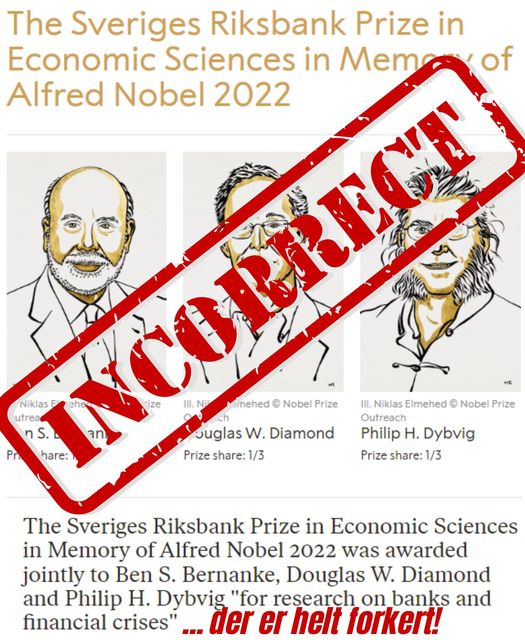
It is an honor to be awarded the prestigious Nobel Prize in Economic Sciences. This year it went to three American economists “for their research on banks and financial crises”. The lucky recipients were Ben S. Bernanke, Douglas W. Diamond, and Philip H. Dybvig and the Swedish committee titled their justification “Financial Intermediation and the Economy”.

For reasons to be shared here, this award is also an unexpected gift to the international monetary reform movement. Not because the Nobel committee or its award recipients are siding with this movement and its analysis of money and banking, but because the award is given for research which is based on the outdated, refuted, incorrect, mistaken ‘intermediation theory of money and banking’ based on the idea that banks are the intermediaries between savers and borrowers.

Meanwhile the truth, ladies and gentlemen, is that loans create deposits, because, when a loan is originated the borrower receives money which had not been in existence before. The commercial bank just credited his or her account and received in exchange the signed loan contract of the same value. This theory is named the credit creation theory, because a credit is created out of nothing, which then can be spend into the economy where it is received as good as money, no questions asked.

This is counter-intuitive, for sure, but we will see that even the research staff in the Swedish Riksbank, which is involved in awarding the prize, knows that the credit creation theory is the correct one and not the intermediation theory. I am sure you see the reason of the Ig Noble prize looming.

The news of this award came to me from someone sharing an article by Scott Horsely of the US-based National Public Radio (NPR), and Horsely, as so many reporters merely passing on official statements, dutifully reproduced the idea that,

Banks help to foster a more productive economy by channeling excess cash from depositors to borrowers in need of money to build homes and factories and businesses.[1]

So, he is, innocently or not, parroting the Swedish academy, which stated along the same lines that,

Financial intermediaries such as traditional banks and other bank-like institutions facilitate loans between lenders and borrowers, and thereby play a key role for the allocation of capital.[2]

A little further in the justification they state that,

. . . it would likely be prohibitively costly for a home buyer to write a separate financial contract with every individual lender that ultimately finances her mortgage. Furthermore, if every lender required the contract to stipulate that she had the right to get her money back on demand, costs would escalate quickly, as the borrower may repeatedly have to seek refinancing.

To solve this problem, financial intermediaries such as banks and mutual funds exist. These institutions channel funds from savers to investors, receiving funds from some customers and using the funds to finance others.

Of course people in the monetary reform (MR) movement immediately perceive the problem here, i.e. the committee still believes in the refuted intermediation theory, which has been replaced by the correct credit creation theory.

The irony is that researchers working at the ‘Monetary Policy Department and the Payments Department of the Riksbank’ of Sweden know where money comes from. I am not going to paraphrase but let them tell us themselves:

Commercial bank money is created when banks give loans

To understand what commercial bank money is and how it is created, we can look at an example that starts with a customer wanting a loan. The loan involves the customer signing a promissory note, that is, a promise to pay back the loan in the future as a certain amount of money to the bank. In return, the bank deposits a sum of money into the customer’s account with the bank.[3]

The source they refer to in ftn. #3 is the now quite famous 2014 paper by McLeay et all.[4]

3. For an accessible primer for how banks create credit, see McLeay et al. (2014).[3]

And this is not the only paper to be found at the Riksbank web site incorporating the credit creation theory of money. Another paper addressing CBDC even explicitly takes it as its starting point.

The paper builds on a model of bank loan supply that is based on the actual practice of banking. In the model, banks can create potentially unlimited amounts of loans and deposits in their own books. When banks give out loans and create deposits, they must also make sure that they can satisfy customers’ outflows to other banks, cash or CBDC. To satisfy these outflows, banks need central bank reserves.[5]

Given the above analysis it is my conviction that this is a gift for the monetary reform movement, because it can hammer home its message, citing chapter and verse, that 1) modern, mainstream macroeconomics (except for the Post-Keynesian theory of endogenous money [6]) is mistaken in its monetary theories; 2) that monetary reformers have the right theory; and 3) that radical monetary reforms are required and possible based on that theory.

These reforms could be boiled down to:

1. All official money – be it cash, money-on-account or new forms of digital currency – is created by a monetary state authority, according to the needs of the economy in a transparent and accountable process.

2. Money is created free of debt, and is directly spent into the economy via the state by way of government expenditure or directly distributed to the citizens as an equal dividend.

3. Private banks cannot create official money as credit. They only act as payment service providers and/or financial intermediaries by lending and investing existing official money, which they obtain from savers and investors.[7]

Furthermore, this committee of the Swedish academy and Swedish central bank should be nominated for next years Ig Noble Prize for improbable research (I used their logo above), because they gave it to research based on an imaginary, outmoded understanding of banking.

Following the motto of the Ig Noble Prize of “Research that makes people LAUGH . . . then THINK”, we can honestly say the 2022 economics award makes us laugh for its flat-earth-like outdatedness, and makes us think about why on our round earth the committee would give the prize to these economists.

And there is a precedent for giving allegedly successful entities that prize, like in the 2002 Ig Nobel prize for economics given to many accounting and financial entities “for adapting the mathematical concept of imaginary numbers for use in the business world” leading to financial crises and accounting scandals.[8]

So, what to do with this? Can we protest the prize? Instead of joking about the Ig Noble prize, look at its nomination procedures?[9] For truth’s sake maybe we should.

P.S.: Next door to Sweden in Denmark the monetary reform organization Gode Penge is not too happy with this prize either. On Facebook they gave the same explanation accompanied with a clear image.


Sources

[1]. Horsely, Scott. 2022. “Ben Bernanke among 3 American winners of Nobel Prize in economics”. NPR, 10 Oct 2022.

[2]. The Committee for the Prize in Economic Sciences in Memory of Alfred Nobel. 2022. “Financial Intermediation and the Economy”. Scientific Background on the Sveriges Riksbank Prize in Economic Sciences in Memory of Alfred Nobel 2022. The Royal Swedish Academy of Sciences, 10 Oct 2022.

[3]. Armelius, Hanna & Carl Andreas Claussen, David Vestin. 2020. “Money and monetary policy in times of crisis”. Monetary Policy Department and the Payments Department of the Riksbank. Riksbank of Sweden. Economic Commentaries, 4 (11 June 2020): 1-15.

[4]. McLeay, Michael & Radia, Amar & Thomas, Ryland. 2014a. “Money Creation in the Modern Economy”.Monetary Analysis Directorate. Bank of England Quarterly Bulletin (Q1, 2014): 14-27.

McLeay, Michael & Radia, Amar & Thomas, Ryland. 2014b. “Money in the modern economy: An introduction”. Monetary Analysis Directorate. Bank of England Quarterly Bulletin (Q1 2014): 4-13.

[5]. Juks, Reimo. 2020. “Central bank digital currencies, supply of bank loans and liquidity provision by central banks.” Sveriges Riksbank Economic Review, 2 (2020): 62-79.

[6]. See for example: Rochon, L.- P. and S. Rossi. 2013. “Endogenous money: the evolutionary versus revolutionary views”. Review of Keynesian Economics, 1 /4: 210–29.

[7]. International Movement for Monetary Reform. 2018. “About the IMMR & Our Manifesto”. IMMR web site.

[8]. Ig Nobel Prize Winners 2002.

[9]. The Ig Noble Nominations. “How to Nominate Someone”. Improbable Research web site.

18th Annual AMI Monetary Reform Conference, 2022


The Basics

The American Monetary Institute (AMI) will conduct its 18th international monetary conference on Friday till Sunday, October 7-9, 2022. It will be on-line on Zoom.

The provisional list of presenters and the schedule are here.

Times are in US Central Daytime. In India the Friday session starts 4:30 am IST; the Saturday starts at 6:30 pm IST; and Sunday starts 7:30 pm IST.

If you would like to participate in the October AMI conference, please register. If $35 is too much, for interested participants of developing countries, we will request a 1,500 INR donation. Even if that’s too much plead your case here.

About AMI

Since its founding in 1996 AMI was involved in monetary history, theory and reform. Its highlight was helping to draft legislation (the NEED Act) with Democrat Rep. Dennis Kucinich from Ohio for a radical change of the US monetary system in 2011. Unfortunately it stalled in committee.

The basic analysis of the problem is that the current monetary system is based on the fact that almost all that we use as money is created and allocated by commercial banks. Banks are not intermediaries between savers and borrowers as most people think, including economists and politicians. And we are talking about 90-97% of the money supply. It is banks which create money when originating loans and destroy it again when the principal is paid back.

As counter-intuitive this might sound, as of today, many commercial banks, central banks, economists, and other social scientists agree with this ‘credit creation theory of money and banking’ and have said so in peer-reviewed papers and official documents. The truth of this claim is not an issue anymore. The dialogue is about how dangerously dysfunctional this system is and what possibilities there are to reform, even, transform it.

This set-up creates many problems. First, it gives the banking community enormous economic and political power; 2) it creates inequality in the population; 3) it creates an unsustainable debt-burden; 4) even the state has to borrow from them as it believes it cannot create its own money; 5) it creates systemic problems like often recurring financial crises; 6) it creates a cruel profit-seeking, international system fueling corporate capitalism and globalization dependent for its return on investment on cheap labor and cheap resources while waltzing over human rights, political sovereignty and ecological integrity.

Proposed Legislation

Though this system needs multiple pieces of legislation to make it serve humanity and not the upper crust of the population, the pivotal legislation is monetary reform, the specific aims of which are:

1) Nationalize the central bank and institute a monetary authority to manage the money supply such that it is neither inflationary nor deflationary;

2) Allow the state to spend debt-free money into circulation on projects society really needs;

3) abrogate the prerogative of banks to create the money supply and let them be intermediaries in society’s flow of sovereign money.

Once this is accomplished the people will have the necessary tools to re-direct the flow of money towards 1) tackling now crippling budget deficits; 2) greening the economy; 3) repairing and building-up necessary physical, educational and health infrastructure; and 4) tampering destructive financial crises.

One point of detail maybe should be mentioned to make clear how this system would work as far as the creation and allocation of new, debt-free money would work. It will be the mandate of the Monetary Authority (MA) to research and analyze the national economy’s developments.  Based on that research it calibrates the amount of money to be issued such that no deflation nor inflation would occur (or maybe allow for a functional and benign 2% inflation). In a growing economy the money supply should grow proportionally and the MA would create the adequate amount, then pass it to congress, which then allocates this extra money through democratic deliberation.

International Scene

AMI also inspired the founding of sister organizations all over the world, some of which were instrumental in putting the issue of monetary justice on their national political agenda. Especially Iceland, the UK, The Netherlands, Switzerland and New Zealand have to be mentioned.

The Swiss monetary organization was even successful in making monetary reform the subject of a nation-wide referendum. Though the measure did not pass, it generated international attention. Struggling against deception by the authorities and bankers, and dealing with general ignorance of the public, it still garnered 25%.

If you are interested in systemic change on both national and global level, and perceive the central importance of how our monetary system is designed, we invite you to gain monetary literacy through the many sources mentioned below.

Sources

American Monetary Institute (AMI)

The Alliance For Just Money (AFJM)

Money Reform India (MRI)

Positive Money – UK (PM-UK)

International Movement For Monetary Reform (IMMR)

Introductory Bibliography (here)

Educational and Promotional videos (here)

Weighted Bibliography (here)

Extended bibliography (here)

Conference Page 2021 AMI Conference (here)

Video List 2021 AMI Conference (here)


Monetary Reform: Simple Spiel


What monetary reform is all about is to promote a bill that has already been drafted in various formulations here in the USA. One in the 1930s and one in 2012. And it concerns a radical change in the current monetary system.

In western countries, the proportion of bank money is about 93-97%. If everyone were to pay off their debt, only a very small amount of money would remain (3-7%).

What most people, including bankers and economists, do not understand is that the money supply comes from banks issuing credit. Most people think that if you borrow for example $200,000, a bank already has that money in the form of deposits from other customers (or equity), and then passes that amount on to the borrower. Not so. The bank creates credit as debt which ‘circulates’ in the economy as if it were money. And when you pay off your loan, the principal is written off, and the money supply decreases (sort of destroying that money). The interest goes into the pocket of the bank.

This sounds counter-intuitive, but this phenomenon has long been known to some economists, sociologists, historians, politicians and critics. Only a few see the consequence that an economic article of faith, i.e. investments follow from savings, is incorrect. The savings are the result of bank lending.

The credit-based monetary system is inherently unstable. If the bank debts are not paid properly, the bank money loses its backing. The government must then help. In this system, the greatest concern is that everyone continues to pay their debts properly. However, debt levels have become unsustainable. In a non-commercial monetary system, this could be easily solved, by putting extra cash into circulation with which to pay off debts. However, the current credit-based monetary system focuses on commercial exploitation. In that system, no debts can be canceled and no money can be given away “for nothing.” Within this commercial system, unsustainable debts will have to be addressed through inflation. This prevents the loss generated by the rickety monetary system from ending up with the banks. The public and society are left with the tab. That is unnecessary and perverse. Hence, I am recruiting you to promote a monetary system that serves society, rather than the oligarchy that exploits it for its convenience.

The very dangerous side of this system lies in the short-term thinking of the banks. Most people expect banks to be prudent, but they are not. Too many loans when things are going well in a boom, and too few during a bust. As a result, the money supply and the economy fluctuate like a yo-yo with repeated financial crises and dramatic consequences for the citizen.

Some even think that this ‘invention’ of bank money is the semi-secret engine of imperialist capitalism and is pushing the world to its doom. All this bank money is manically looking for returns and just waltzes over citizens, governments and nature in search of the greatest possible profit.

What we are now proposing is a system of sovereign, stable money that is issued by the state and managed by a monetary authority. Banks are no longer allowed to create money themselves and will finance their loans with either their own capital, raised capital or savings.

And the monetary authority then has the responsibility to ensure that enough money flows through the economy such that neither inflation nor deflation takes place. And a growing and stable economy thus needs a proportional increase in the money supply, which is calculated by the monetary authority and then gives Congress the green light to spend it democratically as debt-free money.

According to economic analyses and computer models, this system has the advantage that bank runs will no longer take place, the economy is more stable, economic inequality decreases, and that public debt and debt in general will decrease. And because the state now (again) has the right to be the first to spend new money, and it can do this democratically, there is much more leeway to tackle the major social problems. The austerity mindset can be lifted and society can be freed from the political power and malignant priorities of the banking system. Banks naturally have a social function, such as evaluating the creditworthiness of citizens and companies, but they are no longer allowed to run the monetary system.

The monetary system should be seen as a utility company and history provides many examples that the state can do this better than private institutions.

In the Netherlands, our sister organization is called Ons Geld (Our Money) and has put this subject on the political agenda through a citizens’ initiative and with the help of the theater group De Verleiders (The Seducers) and their play Door de Bank Genomen (Taken by the Bank). The political process is a bit slow, but they continue to work towards a socially responsible monetary system.

____________

This blog was written originally in Dutch to explain friends and family there why I took the job of managing director of the Alliance For Just Money in december of 2020. I checked the piece with Edgar Wortmann for grammar and content and then translated it into English. That’s why it might not flow as it could if I’d had it written in English in the first draft and why there is this reference at the end to Dutch monetary reform efforts only.

Additions to Bibliography May 2021


Dear folks,

Find here the link to the fourth AFJM Monetary Reform bibliography update.

The list, as is the bibliography itself here on Alpheus and on the AFJM web site, is alphabetized and categorized under Academic Sources, MMT Issue, Advocacy, Supporting Studies, Articles, Videos and Background Studies.

The list contains about ten dozen items collected over the last year. Some are brand new, most were published in the last 5 years.

One of the highlights would be the collection of articles relevant to monetary reform by Richard C. Cook, who worked with Stephen Zarlenga on the NEED Act and was our AFJM Coffee House guest on Aug 24, 2020.

Another highlight is the publication of Uli Kortsch’s anthology The Next Money Crash and its ‘stable’ of authors. Kortsch was also a guest at our coffee house (see also the video section with videos from the “Our Money” conference he organized).

Also articles by AFJM members Steven Walsh, Joe Bongiovanni, Richard Robbins, Ralph Musgrave and Ben Rininger found their way into the list, as well as monetary reform academics Joseph Huber, Mary Mellor, Ben Dyson, Kaoru Yamaguchi, Patrizio Lainà and Ronnie Phillips.

Then I found some writers already active in the 1990s on the monetary reform front like Thomas Greco and William Hixon.

For an international, geo-political perspective I can recommend the articles by Kai Koddenbrock (very much so) and Radhika Dessai.

About doublespeak by Swiss bankers read Pierre Ortlieb and on the MMT front consult Jeff Eder.

A fascinating tale of a legal challenge to the bank money system can be found in Thomas Olson’s reporting on the Credit River Case.

In the video section find another TedTalk on money by Stef Kuypers, and the series of presentations and discussions on monetary reform efforts in Switzerland.

Also many items addressing ‘narrow banking’ were added.

Lastly, some overlap between money and literature was addressed by George Reiff (on Goethe) and Bradly Hansen (on the Wizard of Oz).

For additions or corrections contact the editor.

Govert Schuller

Additions to Bibliography – May 2021

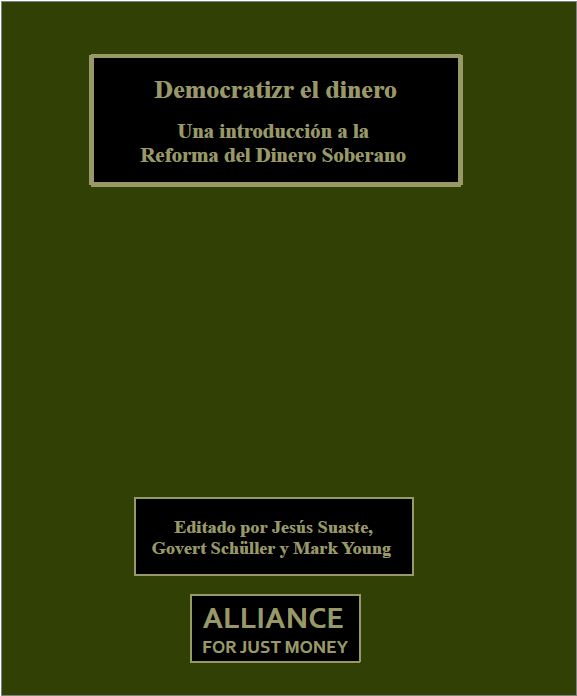
Launch Announcement of Democratizar el Dinero


The Alliance For Just Money is excited to have stepped into the publishing business by releasing a Spanish anthology of a dozen translations of high quality articles on the latest findings in monetary theory and on ongoing improved reasons for real monetary reform.

The title is Democratizar el Dinero. Una introducción a la Reforma del Dinero Soberano (Democratizing Money: An introduction to Sovereign Monetary Reform) and is available in print, as a downloadable pdf, and as an audiobook (forthcoming).

One of the Alliance’s goals is to ensure that all nations and ethnic groups, regardless of language, understand the importance of monetary reform, especially those countries and populations that have the most to benefit from a reform of our monetary system for their nations and citizens.

A special thanks goes to Jesús Suaste Cherizola for helping us to achieve this very important goal. The essays translated for this publication were selected to give the reader of broad overview of the history, problems, solutions and obstacles associated with our current system and reforming it for the benefit of all people.

Please enjoy the articles in Spanish by purchasing the book or downloading the pdf version, or read the original articles in English. The book’s landing page has all the relevant links.

Please visit our website here and our social media platforms on Facebook and Twitter @AllianceJust. Although the website resources are in English the website can be viewed in Spanish be utilizing the translate function on your mobile device or PC. You can also contact the International Movement For Monetary Reform (IMMR) at this address if you are interested in more information on monetary reform or interested in taking action in your community.

And remember that anything physically possible, ecologically wise, and socially desirable is also financially feasible.