Triple-column Comparison

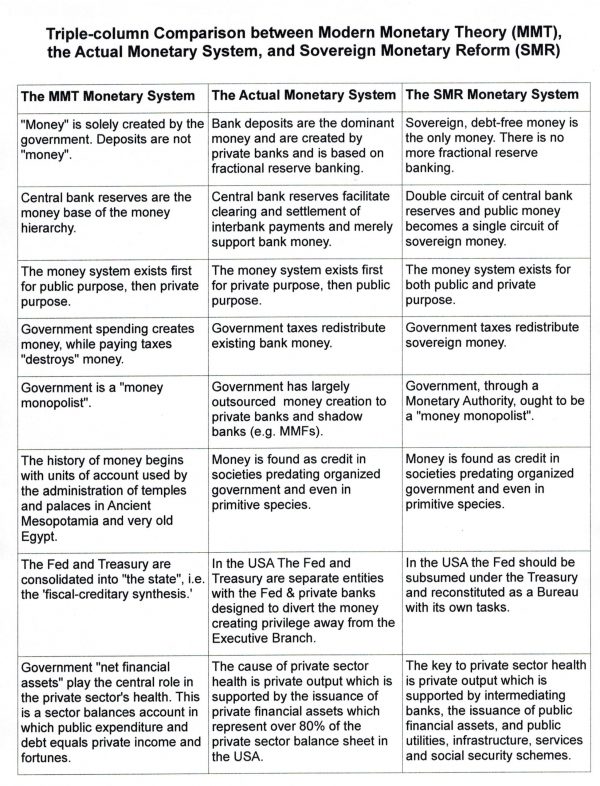
Triple-column Comparison between Modern Monetary Theory (MMT), the Actual Monetary System, and Sovereign Monetary Reform (SMR)


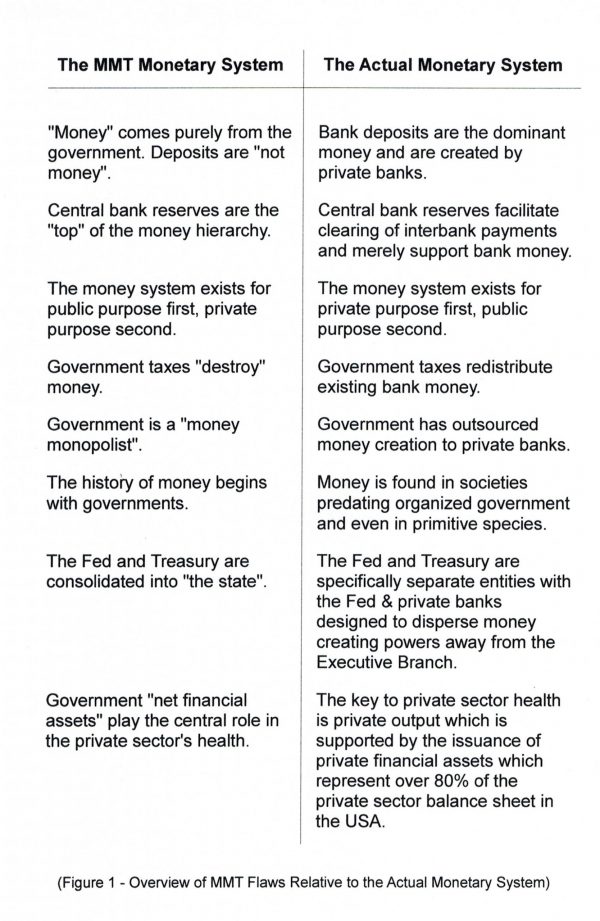
A while ago I found a very useful double-column comparison of the concept of the monetary system in Modern Monetary Theory (MMT) and how the monetary system actually functions. The figure is titled:

“Overview of MMT Flaws Relative to the Actual Monetary System”

It is a small image easily used on-line in posts and discussions and was composed by Cullen Roche in a 2013 article titled “A Critique of Modern Monetary Theory (MMT)“. Roche is the author of Pragmatic Capitalism: What Every Investor Needs to Know About Money and Finance and editor of the eponymous web site Pragmatic Capitalism.


Recently I had the idea to expand the double column into a triple one by adding the ideas and proposals by the movement proposing Sovereign Money Reform (SMR) based on what Dr. Joseph Huber calls New Currency Theory (NCT). With some help the entries were refined, corrected or paraphrased. The result is the following triple column.

I am presenting it here for anybody to use as an educational tool in the discussion about the deep flaws of MMT in order to 1) promote what we think is the correct theory of money and banking and 2) promote the necessary legislative changes which are needed to redress the deep systemic flaws of the current money regime.

To be clear, what we propose is the following triple-pronged policy proposal, which can be found on the web site of the International Movement for Monetary Reform:

We propose a transition towards a sovereign money system in which:

All official money – be it cash, money-on-account or new forms of digital currency – is created by a monetary state authority, according to the needs of the economy in a transparent and accountable process.

Money is created free of debt, and is directly spent into the economy via the state by way of government expenditure or directly distributed to the citizens as an equal dividend.

Private banks cannot create official money as credit. They only act as payment service providers and/or financial intermediaries by lending and investing existing official money, which they obtain from savers and investors.

This proposal of course is quite different of what proponents of MMT propose and that is government spending on worthy causes like the Green New Deal by allegedly creating new money and do so till the ‘slack’ is out of the economy and inflation might set in. We think that, based on our understanding how the system currently works, 1) this will lead to deficit spending because spending still has to be compensated through taxes and bonds, and 2) it unconscionably neglects to deal with the issue of money creation in the hands of private commercial banks and its disastrous consequences.

Meanwhile the American people already have a bill on the shelf to implement sovereign monetary reform and it is the 2012 H.R. 2990, the National Emergency Employment Defense Act or NEED Act. With some tweaking this bill can be adopted to solve a large chunk of the severe financial challenges the US Congress is facing to prevent the economy from collapse and citizens from bankruptcy and eviction, all in the context of the COVID-19 pandemic. Once you understand the current monetary system, one cannot but see its solution in sovereign monetary reform.


More critical posts on MMT:

Requesting Evidence for a Crucial MMT Claim

Richard Wolff’s Trajectory beyond MMT into SMR

Introduction to the Problem with Modern Monetary Theory (MMT)

Money and Banking: Assessing overlaps and differences between SMR and MMT

Modern Money Theory revisited – still the same false promise

Educational and Promotional Videos


VIDEOS ON MONETARY THEORY AND REFORM


A. TOP 12 Videos
B. Videos Produced in the Monetary Reform Movement
C. Other Monetary Theory and Reform Videos of Interest
D. Background Videos


A. TOP 12 VIDEOS

Bjerg, Ole. 2016. “Where does money come from?“ TEDxCopenhagen. 24 May 2016.

Bongiovanni, Joe. 2013. “Why Monetary Reform Must Become Your Number One Issue“. Argusfest on YouTube. 29 Sept 2013.

Dyson, Ben. 2014. “Why Our Monetary System Is Broken and How It Can Be Fixed“. Presentation at the Economy, People and Planet conference at the Copenhagen Business School (CBS). Positive Money on YouTube. 1 Oct 2014.

Grant, Victoria. “12 year old child reveals one of the best kept secrets in the world”. Public Banking Institute. 5 May 2013.

Hammon, Virginia. 2019. “How We Can Pay for a Better World: Change the Money System“. How We Pay for a Better World. YouTube. 30 Aug 2019.

Hammon, Virginia. 2020. “A Solution to the Crisis – Just Money Now!“. How We Pay for a Better World. YouTube. 21 July 2020.

Kucinich, Dennis. 2012. “The Key to Economic Recovery; Kucinich Explains Monetary Reform”. DJ Kucinich on YouTube. 8 May 2012.

Positive Money. 2011. “A Simple Solution to the Debt Crisis“. Positive Money on YouTube. 13 Aug 2011.

Positive Money. 2013. “What Is Money?“. Positive Money on YouTube. 13 May 2013.

Positive Money. 2013. “10 year old explains the truth about where money comes from…” Positive Money on YouTube. 4 Sep 2013.

Wolf, Martin. 2014. “Case for Radical Monetary Refrom“. Keynote speech at “Bridging Theory and Practice” conference organized by the Sustainable Finance Lab, Amsterdam, 14 Dec 2016. Sustainable Finance Lab on YouTube. 16 Oct 2018. (Accompanying slides)

Zarlenga, Stephen. 2009. “Nationalize the Fed: End Banks Power to Create Money”. Recorded 2 May 2009. YouTube. 22 June 2009.


B. VIDEOS PRODUCED IN THE MONETARY REFORM MOVEMENT

American Monetary Institute. Collection of Videos. American Monetary Institute on YouTube.

Boait, Fran. 2013. “How the current money system is damaging Businesses, Society and Environment“. Presentation at the Positive Money Conference, January 2013. Positive Money on YouTube. 22 Mar 2013.

Boait, Fran. 2014. “How does the money system affect Inequality, Housing & Environment?“. Positive Money on YouTube. 21 Dec 2014.

Bongiovanni, Joe. 2013. “Why Monetary Reform Must Become Your Number One Issue“. Argusfest on YouTube. 29 Sept 2013.

Bongiovanni, Joe. 2014. “Why Should GUV Borrow? Who Controls the Money?“. Economic Stability on YouTube. 25 Jan 2014.

Bongiovanni, Joe. 2017. “On Public Money: Thoughts on our Monetary Sytem, and our History of Public Money“. Presentation at the 2017 “Democracy Convention”, Minneapolis, MS. AMI on YouTube. 9 Aug 2017.

Chalmers, Patrick. 2013. “Why doesn’t the Media understand Money?“. Presentation at the Positive Money Conference, January 2013. Positive Money on YouTube. 22 Feb 2013.

Chick, Victoria. 2013. “Why don’t Economists understand money?” Presentation at the Positive Money Conference, January 2013. Positive Money on YouTube. 6 Mar 2013.

Coates, Delman. 2016. “The New Abolitionism: Monetary Reform and the Struggle for Human Rights “. Presentation at the 12th AMI Conference, Chicago, September 2016. AMI on YouTube. 12 Oct 2016.

Coates, Delman. 2017. “The New Abolitionism: Monetary Reform and the Future of Social Justice”. Presentation at the 2017 Democracy Convention, Minneapolis, MS. AMI on YouTube. 9 Aug 2017.

Dyson, Ben. 2012. “Power of Banks vs Democracy“. Positive Money on YouTube. 24 Oct 2012.

Dyson, Ben. 2013. “How to Fix Banking“. Presentation at the Positive Money Conference, January 2013. Positive Money on YouTube. 19 Feb 2013.

Dyson, Ben. 2014. “Why Our Monetary System Is Broken and How It Can Be Fixed“. Presentation at the Economy, People and Planet conference at the Copenhagen Business School (CBS). Positive Money on YouTube. 1 Oct 2014.

Eckrich, Lucille & Walsh, Steven. 2017. “Money, Schooling and Educators: Creating a Critically-Informed Movement for Monetary Reform and Ecojustice“. Presentation at the 2017 Democracy Convention, Minneapolis, MS. AMI on YouTube. 9 Aug 2017.

Eder, Jeff. 2020. “Banking for a Better World“. Progreessive Money Canada. 6 Sep 2020.

Egnatz, Nick. 2016. “On Social Justice through Monetary Reform”. Presentation at the 11th AMI Conference, Chicago, September 2015. AMI on YouTube. 27 Jan 2016.

Hammon, Virginia. 2019. “How We Can Pay for a Better World: Change the Money System“. How We Pay for a Better World. YouTube. 30 Aug 2019.

Hammon, Virginia. 2020. “A Solution to the Crisis – Just Money Now!“. How We Pay for a Better World. YouTube. 21 July 2020.

Huber, Joseph. 2016. “How The Money System Works“. Presentation at the American Monetary Institute Conference, 2016. American Monetary Institute on YouTube. 16 Dec 2016.

Kucinich, Dennis. 2012. “The Key to Economic Recovery; Kucinich Explains Monetary Reform”. DJ Kucinich on YouTube. 8 May 2012.

Kucinich, Dennis. 2009. “Dennis Kucinich addresses AMI Monetary Reform Conference Participants 2009“. Presentation at the 5th AMI Conference, Chicago, September 27, 2009. AMI on YouTube. 13 Oct 2009.

Kucinich, Dennis. 2010. “Dennis Kucinich 5 Minutes on Money on House Floor”. AMI on YouTube. 16 Aug 2010.

Kucinich, Dennis. 2010. “Dennis Kucinich speaks on the American Monetary Act in House of Representatives – Part 1”. AMI on YouTube. 8 June 2010.

Kumhof, Michael. 2019. “Banks are not Intermediaries of Loanable Funds“. Positiva Pengar on YouTube. 13 July 2019.

Positive Money. Collection of Videos. Positive Money on YouTube.

Positive Money. 2011. “A Simple Solution to the Debt Crisis“. Positive Money on YouTube. 13 Aug 2011.

Positive Money. 2012. “House Prices: Why are they so high?“. Positive Money on YouTube. 18 Sept 2012.

Positive Money. 2012. “Why is there so much Debt?“. Positive Money on YouTube. 24 Oct 2012.

Positive Money. 2013. “What Is Money?“. Positive Money on YouTube. 13 May 2013.

Positive Money. 2013. “Inequality: Why are the rich getting richer?“. Positive Money on YouTube. 2 Aug 2013.

Positive Money. 2013. “10 year old explains the truth about where money comes from…” Positive Money on YouTube. 4 Sep 2013.

Positive Money. 2014. “Could These 3 Simple Changes to Banking Fix the Economy?” Positive Money on YouTube. 16 Jan 2014.

Positive Money. 2014. “How to waste £445 billion? (The Failure of Quantitative Easing)“. Positive Money on YouTube. 27 June 2014

Positive Money. 2014. “Banking 101“. 6 Videos. Positive Money on YouTube. 30 June 2014.

Positive Money. 2019. “It’s the banks, stupid“. Positive Money on YouTube. 8 Aug 2019.

Melor, Mary. 2010. “Money is Us: The Social and Public Nature of Money“. Presentation at the Positive Money Student Conference on Monetary Reform and Fractional Reserve Banking. In three parts. Positive Money on YouTube. 14 Dec 2010.

Morris, Miriam. 2013. “How to change the money system“. Presentation at the Positive Money Conference, January 2013. Positive Money on YouTube. 12 Mar 2013.

Poteat, Robert. 2010. “The Case for Monetary Reform“. Presentation at the 6th Annual AMI Conference, Chicago, September 2010. AMI on YouTube. 14 Oct 2010. [Not complete]

Switzer, Howard. 2017. “Climate Change and Money: Hacking at the Root“. Presentation at the 2017 Democracy Convention, Minneapolis, MS. AMI on YouTube. 14 Aug 2017.

Turner, Aidar. 2015. “A new era for monetary policy“. Positive Money on YouTube. 17 Feb 2015.

Walton, Jamie et al. 2017. “On Public Money: The Need Act“. Presentation at the 2017 Democracy Convention, Minneapolis, MS. AMI on YouTube. 26 Aug 2017.

Zarlenga, Stephen. 2009. “Nationalize the Fed: End Banks Power to Create Money”. Recorded 2 May 2009. YouTube. 22 June 2009.

Zarlenga, Stephen. 2010. “AMI’s Purpose, Objectives and Methodology“. Presentation at the 6th Annual AMI Conference, Chicago, September 2010. AMI on YouTube. 13 Oct 2010.

Zarlenga, Stephen. 2010. “Introduction to The American Monetary Institute “. AMI on YouTube. 4 Jan 2010.


C. OTHER MONETARY REFORM AND THEORY VIDEOS OF INTEREST

Altraide, Dagogo. 2017. “Who Controls All of Our Money?“. ColdFusion on YouTube. 11 June 2017.

Altraide, Dagogo. 2020. “How is Money Created? – Everything You Need to Know.”. ColdFusion on YouTube. 8 June 2020.

Anon. “Solutions Unincorporated – My Name Is William”. Interview with William Abram. D See Video Productions. 4 Feb 2013.

Anon. 2012. “Where does money come from? Waar komt geld vandaan? Var kommer pengarna ifrån?” Vastgoedzeepbel, 21 Nov 2012. .

Anon. 2013. “Hitler finds out how money is created“. Ville livarinen. 18 Sep 2013.

Bjerg, Ole. 2016. “Where does money come from? “ TEDxCopenhagen. 24 May 2016.

Brown, Ellen. 2016. “Taking Back the Money Power: The Public Option in Banking“. (Q&A). Argusfest on YouTube. 13 Nov 2016.

Bruce, Jim. 2013. “Money for Nothing: Inside the Federal Reserve“. Liberty Street Films. 7 June 2013.

Conference videos: The Future of Money – 10 years after Lehman and Nakamoto. November 2018, Frankfurt, Germany. Frankfurt School of Finance and Management.

Conference videos: The Future of Money – Central Bank Digital Currency and Beyond. 15 June 2019, Stockholm, Sweden. Positiva Pengar

Corbett, James. 2014. “Century of Enslavement“. The Corbett Report. 11 July 2014.

Dalio, Ray. 2013. “How The Economic Machine Works“. YouTube, 22 Sept 2013.

Desan, Christine. 2011. “Booms and Busts: The Legal Dynamics of Modern Money “. OpenCulture.com, 12.

Desan, Christine A. 2013. “Modern Money & Public Purpose 5: Constitutional History ”. Presentation at seminar, “Money, Democracy and the Constitution: Revolutionary Experience in the United States”. Modern Money Network. 16 Mar 2013.

Desan, Christine. 2017. “The Dollar as a Democratic Medium: Making Money a Currency of Social Justice ”. HLS Thinks Big, 23 May 2017.

Graeber, David. 2017. “Where Did Money Really Come From? ”. YouTube. 17 Oct 2017.

Grant, Victoria. “12 year old child reveals one of the best kept secrets in the world”. Public Banking Institute. 5 May 2013.

Horwath, Mike & Oswald, Michael. 2012. “97% Owned – Economic Truth documentary – How is Money Created “. Documentary. Independent POV. YouTube. May 1 2012.

Huber, Joseph. 2018. “Vollgeld – Yes, Implementing a Sovereign Money System“. Presentation at “Our Money, Our Banks, Our Country – Money Creation in the Modern Economy” conference by The Monetary Institute, Zürich, February 2018. The Monetary Institute on YouTube. 23 April 2018.

Klein, Manuel et al. 2018. Conference videos and papers. Berlin, Germany: Monetative. 24 Nov 2018.

Kotlikoff, Larry. 2018. “Why I Support Sovereign Money“. Presentation at “Our Money, Our Banks, Our Country – Money Creation in the Modern Economy” conference by The Monetary Institute, Zürich, February 2018. The Monetary Institute on YouTube. 23 April 2018.

Kumhof, Micheal. 2013. “The Chicago Plan Revisited “. London School of Economics and Political Science (LSE). 22 Nov 2013.

Monetary Institute. Collection of Presentations. From “Our Money, Our Banks, Our Country – Money Creation in the Modern Economy” conference by the Monetary Institute, Zürich, February 2018. The Monetary Institute on YouTube.

Niepelt, Dirk & Rimkus, Ron. 2016. “Contemplating the End of Fractional Reserve Banking in Switzerland”. CFA Institute.

Orrrefur, Samuel K. et al (Eds.). 2019. “The Future of Money: Central Bank Digital Currency and Beyond “. Conference videos. Stockholm: Positiva Pengar. 15 June 2019.

Oswald, Michael. 2014. “Princes of the Yen: Central Banks and the Transformation of the Economy”. Documentary. Independent POV. YouTube. 4 Nov 2014.

Oxley, James. 2014. “Money creation in the modern economy – Quarterly Bulletin Article”. Bank of England on YouTube. 12 Mar 2014.

Oxley, James. 2014. “Money in the modern economy: An introduction – Quarterly Bulletin Article”. Bank of England on YouTube. 12 Mar 2014.

Permanent Commission on Finance. 2015. “Round table conversation on the money system“. Hearing at the Permanent Commission on Finance of the Second Chamber of the States General of the Netherlands. Troelstra Hall. 14 Oct 2015.

Public Banking Institute. Collection of Videos. Argusfest on YouTube.

Rosenblith, Alan. 2009. “The Money Fix – A Documentary for Monetary Reform ”.

Still, Bill. 2013. “Jekyll Island: The Truth Behind The Federal Reserve“. YouTube, 7 April 2018.

Titus, John. 2019. “Mommy, Where Does Money Come From?“. BestEvidence on YouTube. 15 April 2019.

Vollgeld Initiative & Studierende für die Freiheit & Hayek Club. 2017.“Monetary reform and the future of money”. Panel discussion at the University of Zürich.

Vrabel, Damon. “Renaissance 2.0 – the Rise of Financial Empire”. csper.org. 9 Jan 2012.

Vrabel, Damon.”Debunking Money – The Way the World Really Works”. csper.org. 10 Jan 2012.

Werner, Richard. 2018. “Today’s Source of Money Creation“. Presentation at “Our Money, Our Banks, Our Country – Money Creation in the Modern Economy” conference by The Monetary Institute, Zürich, February 2018. The Monetary Institute on YouTube. 23 April 2018.

Wortmann, Edgar. 2015. “Verkenning van de monetaire werkelijkheid [Exploring Monetary Reality]”. In English. Presentation at the University of Leiden. In two parts. (part 1); (part 2).

Wolf, Martin. 2014. “Stop banks from creating money“. Presentation at “Does Money Grow on Trees?” event, 9 Sept 2014. Positive Money on YouTube. 14 Oct 2014.

Wolf, Martin. 2014. “On Radical Reform for the Global Financial System“. Presentation at the New York Council on Foreign Relations, 17 Oct 2014. Council on Foreign Relations on YouTube. 17 Oct 2014.

Wolf, Martin. 2014. “Case for Radical Monetary Refrom“. Keynote speech at “Bridging Theory and Practice” conference organized by the Sustainable Finance Lab, Amsterdam, 14 Dec 2016. Sustainable Finance Lab on YouTube. 16 Oct 2018. (Accompanying slides)

Additions to Bibliography April 2020

This is a list with bibliographic additions to the extensive bibliography, alphabetized and categorized under Academic Sources, MMT Issue, Advocacy, Supporting Studies, Articles, Videos and Background Studies.

Academic Sources

Allen, William R. 1993. “Irving Fisher and the 100 Percent Reserve Proposal“. The Journal of Law and Economics, 36/2: 703-717.

Becklumb, Penny & Frigon, Mathieu. 2015. How the Bank of Canada Creates Money for the Federal Government: Operational and Legal Aspects (In Brief). Ottowa, Canada: Library of Parliament. 10 Aug 2015.

Bezemer, D. & Ryan-Collins & J., van Lerven, F. & Zhang, L. 2018. “Credit Where It’s Due: A Historical, Theoretical and Empirical Review of Credit Guidance Policies in the 20th Century“. UCL Institute for Innovation and Public Purpose Working Paper Series, No. 2018-11.

Bjerg, Ole. 2017. “Designing New Money: The Policy Trilemma of Central Bank Digital Currency.” Copenhagen Business School. Working Paper, June 2017

Chick, Victoria. 1993. “The Evolution of the Banking System and the Theory of Monetary Policy”. In Frowen, S.F. (Ed.), Monetary Theory and Monetary Policy: New Tracks for the 1990s, London: Macmillan, 79–92.

Demeulemeester, Samuel. 2018. “The 100% Money Proposal and its Implications for Banking: The Currie–Fisher Approach versus the Chicago Plan Approach“. The European Journal of the History of Economic Thought, 25/2: 357-387.

Desan, Christine. 2010. “Coin Reconsidered: The Political Alchemy of Commodity Money“. Theoretical Inquiries in Law, 11/1: 361-409.

Dimand, Robert W. 1993. “100 Percent Money: Irving Fisher and Banking Reform in the 1930s”. History of Economic Ideas: 59-76.

Di Muzio, Tim. 2015. The 1% and the Rest of Us: A Political Economy of Dominant Ownership. Zed Books Ltd. (Amazon)

DiMuzio, Tim, and Richard Robbins. 2020. “Capitalized Money, Austerity and the Math of Capitalism“. Current Sociology, 68/2: 149–168.

Dow, Sheila C. 2006. “Endogenous Money: Structuralist”. In: Arestis, Phillip & Sawyer, Malcolm (Eds.), A Handbook of Alternative Monetary Economics,
Cheltenham, UK & Brookfield, USA: Edward Elgar, 35-51.

Evans, Trevor. 1997. “Marxian Theories of Credit Money and Capital”. International Journal of Political Economy, 27/1: 7-42.

Frame, Iain. 2012. “Country Rag Merchants” and “Octopus Tentacles”: An Analysis of Law’s Contribution to the Creation of Money in England and Wales, 1790-1844. Thesis, Harvard Law School.

Frame, Iain. 2015. “‘Country Rag Merchants’ and English Local Currencies in the Late Eighteenth and Early Nineteenth Century“. Journal of Law and Society, 42/4: 588-610.

Frame, Iain. 2020. “Between the ‘Bank Screw’ and ‘Affording Assistance’. Rules, Standards, and the Bank Charter Act of 1844.” The Modern Law Review, 83/1: 64-90.

Goodhart, Charles & Hudson, Michael. 2018. “Could/should jubilee debt cancellations be reintroduced today?” Discussion Paper DP12605. London: Centre for Economic Policy Research.

Hockett, Robert C. & Omarova, Saule. 2015. “Public Actors in Private Markets: Toward a Developmental Finance State“. Washington University Law Review, 93: 103-175.

Hockett, Robert C. & Omarova, Saule. 2016. “Challenging the Financial Intermediation Myth“. The CLS Blue Sky Blog, 17 Oct 2016.

Hockett, Robert C. & Omarova, Saule. 2017. “The Finance Franchise“. Cornell Law Review, 102: 1143-1218.

Howells, Peter. 2006. “The Endogeneity of Money: Empirical Evidence“. In: Arestis, Philip, & Malcolm C. Sawyer (Eds.), A Handbook of Alternative Monetary Economics. Cheltenham, UK & Brookfield, USA: Edward Elgar Publishing. 52-68.

Hudson, Michael. 1994. “The Archaeology of Collapse: A 4000 Year Perspective” with Fred Harrison, in A Philosophy for a Fair Society. London: Shepheard-Walwyn, 7-31.

Hudson, Michael. 1998. “Land Monopolization, Fiscal Crises and Clean Slate ‘Jubilee’ Proclamations in Antiquity”. In A Philosophy for a Fair Society: 33-79. Also in Robert C. Hunt and Antonio Gilman, eds., Property in Economic Context. University Press of America, Monographs in Economic Anthropology, 14: 139-169.

Hudson, Michael. 1998. “Land Taxation in Mesopotamia and Classical Antiquity”. In Robert Andelson, ed., Land-Value Taxation Around the World. New York: Robert Schalkenbach, 17-35.

Hudson, Michael. 1999. “The Economic Roots of the Jubilee”. Bible Review (15 Feb 1999): 26-33, 44.

Hudson, Michael. 1999. “Just how did ancient bureaucrats set their interest rates?” Archaeological Odyssey, 2 (July/Aug 1999): 6-7.

Hudson, Michael. 1999. “From Sacred Enclave to Temple to City”. In Hudson, Michael. & Levine, Baruch (Eds.), Urbanization and Land Ownership in the Ancient Near East. Cambridge, MA: Peabody Museum Harvard, 117-191.

Hudson, Michael. 2003. “The Cartalist/Monetarist Debate in Historical Perspective”. In Edward Nell and Stephanie Bell (Eds.). The State, The Market and The Euro. Cheltenham: Edward Elgar, 39-76.

Hudson, Michael. 2004. “The Development of Money-of-Account in Sumer’s Temples”. In Michael Hudson and Cornelia Wunsch, ed., Creating Economic Order: Record-Keeping, Standardization and the Development of Accounting in the Ancient Near East. Bethesda, MD: CDL Press. 303-329.

Hudson, Michael. 2004. “The Archaeology of Money in Light of Mesopotamian Records”. In L. Randall Wray (Ed.). Credit and State Theories of Money: The Contributions of A. Mitchell Innes. Cheltenham: Edward Elgar.

Hudson, Michael. 2009 (1992). Trade, Development and Foreign Debt. Dresden, Germany: ISLET Press.

Hudson, Michael. 2010. America’s Protectionist Takeoff, 1815-1914: The Neglected American School of Political Economy. Dresden, Germany: ISLET Press.

Hudson, Michael. 2012. Finance Capitalism and its Discontents: Interviews and Speeches, 2003-2012. Dresden, Germany: ISLET Press

Hudson, Michael. 2014. The Bubble and Beyond: Fictitious Capital, Debt Deflation and Global Crisis. Dresden, Germany: ISLET Press

Hudson, Michael. 2015. Killing The Host: How Financial Parasites And Debt Bondage Destroy The Global Economy. Dresden, Germany: ISLET Press.

Hudson, Michael. 2017. J Is For Junk Economics: A Guide To Reality In An Age Of Deception. Dresden, Germany: ISLET Press.

Hudson, Michael. 2018. …and forgive them their debts: Lending, Foreclosure and Redemption From Bronze Age Finance to the Jubilee Year. Dresden, Germany: ISLET Press.

Hudson, Michael. & Levine, Baruch (Eds.). 1999. Urbanization and Land Ownership in the Ancient Near East. Cambridge, MS: Peabody Museum Harvard.

Hudson, Michael & Marc Van De Mieroop (Eds.). 2002. Debt and Economic Renewal in the Ancient Near East. Bethesda, MD: CDL Press.

Jackson, T. & Victor, P. 2015. “Credit Creation and the ‘Growth Imperative’ – A Quasistationary Economy with Debt-Based Money“. PASSAGE Working Paper 15/01. Guildford: University of Surrey.

Kelton, Stephanie & Nell, Edward (Eds.). 2003. The State, the Market, and the Euro: Chartalism Versus Metallism in the Theory of Money. Cheltenham: Edward Elgar.

McMillan, Jonathan. 2015. The End of Banking: Money, Credit, and the Digital Revolution. Zurich, Switzerland: Zero/One Economics .

Meikle, Scott. 1994. “Aristotle on Money”. Phronesis, 39/1: 26-44.

Mellor, Mary. 2010. “Could the Money System Be the Basis of a Sufficiency Economy“. Real-World Economics Review, 54: 79-88.

Mellor, Mary. 2015. Debt or Democracy? Public Money for Sustainability and Social Justice. Chicago: University of Chicago Press Economics Books. (See also “Money for the People” based on this book)

Mellor, Mary. 2010. The Future of Money: From Financial Crisis to Public Resource. London & New York: Pluto Press.

Minsky, Hyman P. 1986. Stabilizing an Unstable Economy. New Haven and London: Yale University Press.

Minsky, Hyman P. 1992. “The Financial Instability Hypothesis“. The Jerome Levy Economics Institute of Bard College, Working Paper No. 74.

Pavanelli, Giovanni. 2004. “The Great Depression in Irving Fisher’s Thought“. Political Events and Economic Ideas, 289.

Quignon, Laurent. 2019. “Money Creation: How Does It Work?” BNP Paribas, 19 Feb 2019.

Ricks, Morgan. 2018. “Money as Infrastructure“. Columbia Business Law Review, 3: 757-851.

Robbins, Richard H. 2018. “An Anthropological Contribution to Rethinking the Relationship between Money, Debt, and Economic Growth”. Focaal, 81: 99-120.

Rothbard, Murray Newton. 2002. History of Money and Banking in the United States: The Colonial Era to World War II. Auburn, AL: Ludwig von Mises Institute.

Ryan-Collins, Josh. “Is Monetary Financing Inflationary? A Case Study of the Canadian Economy, 1935-75“. Working Paper, No. 848. Annandale-on-Hudson, NY: Levy Economics Institute of Bard College.

Ryan-Collins, Josh & van Lerven, Frank. 2018. “Bringing the Helicopter to Ground: A Historical Review of Fiscal-Monetary Coordination to Support Economic Growth in the 20th Century“. Institute for Innovation and Public Purpose & New Economics Foundation, Working Paper, No. 2018-08, Aug 2018.

Schularick, Moritz & Taylor, Alan M. 2012. “Credit Booms Gone Bust: Monetary Policy, Leverage Cycles, and Financial Crises, 1870-2008“. American Economic Review, 102/2: 1029-61.

Simons, Henry Calvert.1948. Economic Policy for a Free Society. Chicago: University of Chicago Press.

Sissoko, Carolyn. 2015. “The Bank-Centered View of the Money Market Part I: Why Banks Are Different“. USC Gould School of Law, Center for Law and Social Science (CLASS) Research Papers Series No. CLASS15-4, 20 Jan 2015.

Skidelsky, Robert. 2019. Money and Government: The Past and Future of Economics. New Haven, CT: Yale University Press.

Weber, Beat. 2018. Democratizing Money?: Debating Legitimacy in Monetary Reform Proposals. Cambridge: Cambridge UP

Wray, Randall L. 1999. “An Irreverent Overview of the History of Money from the Beginning of the Beginning through to the Present”. Journal of Post Keynesian Economics, 21/4: 679-687.

Wray, Randall L. 2012. “Introduction to an Alternative History of Money“. Levy Economics Institute, Working Paper 717.

Yamaguchi, Kaoru. 2014. “From Debt Money to Public Money System – Modeling A Transition Process Simplified“. Paper presented at the 32nd International Conference of the System Dynamics Society, Delft, Netherlands, July 20 – 24, 2014. Awaji Island, Japan: Japan Futures Research Center.

Zhu, Yu, and Scott Hendry. 2018. “A Framework for Analyzing Monetary Policy in an Economy with E-money“. Available at SSRN 3318915.

Modern Monetary Theory

Pro

Byrne, Adrian & Hodgson, Graham. 2019. “Modern Monetary Theory and Monetary Reform Considered“. The Money Question, 27 Sep 2019.

Montier, James. 2019. “Why Does Everyone Hate MMT?” GMO.

Veal, Spencer. 2018. “Positive Money Meets Modern Monetary Theory“. Edinburgh, UK: Edinburgh Positive Money.

Wray, L. Randall. 2014. “From the State Theory of Money to Modern Money Theory: An Alternative to Economic Orthodoxy“. Levy Economics Institute, Working Papers Series, 792.

Contra

Henwood, Doug. 2019. “Modern Monetary Theory Isn’t Helping“. Jacobin, 21 Feb 2019.

Palley, Thomas I. 2019. “Macroeconomics vs. Modern Money Theory: Some Unpleasant Keynesian Arithmetic“. Post Keynesian Economics Society, Working Paper, No. 1910.

Advocacy Pamphlets, Reports, Briefings and Books

Hammon, Virginia & Pash, Mark. 2019. How We Pay for a Better World. Portland: Great Democracy Media.

Hammon, Virginia. 2018. US Money: What is it? Why We Must Change. How We Can. Portland: Great Democracy Media.

Hutchinson, Frances & Mary Mellor & Wendy Kay Olsen. 2002. The Politics of Money: Towards Sustainability and Economic Democracy. London: Pluto Press.

Keen, Steve. 2017. Can We Avoid Another Financial Crisis? Hoboken, NJ: John Wiley & Sons.

Mellor, Mary. 2017. “Money for the People“. Great Transition Initiative, Aug 2017.

Jackson, Andrew & Dyson, Ben. 2012. Modernising Money: Why Our Monetary System Is Broken And How It Can Be Fixed. London: Positive Money,.

Supporting Studies

Blyth, Mark. 2013. Austerity: The History of a Dangerous Idea. Oxford : Oxford UP. (Amazon)

Dodd, Nigel. 2016. The Social Life of Money. Princeton, NY: Princeton University Press.

Douthwaite, R 1990. The Growth Illusion. How Economic Growth Enriched the Few, Impoverished the Many and Endangered the Planet. Cambridge: Green Books.

Douthwaite, R. 2006. The Ecology of Money. Cambridge: Green Books.

Courchene, Thomas J. 1976. Money, Inflation, and the Bank of Canada: An Analysis of Canadian Monetary Policy from 1970 to early 1975. Vols. 1 & 2. Toronto: CD Howe Research Institute. (Amazon)

Greider, William. 1987. The Secrets of the Temple: How the Federal Reserve Runs the Country. New York: Simon & Schuster. (Amazon)

Henderson, Hazel. 2014. “Mapping the Global Transition to the Solar Age“.ICAEW and Tomorrow’s Company, UK (2014).

Karimzadi, Shahzavar. 2012. Money and its Origins. London: Routledge. (Amazon)

King, Mervyn. 2016. The End of Alchemy: Money, Banking and the Future of the Global Economy. WW Norton & Company. (Amazon)

Korten, David C. 1995. When Corporations Rule the World. San Francisco: Berrett-Koehler Publishers.

Korten, David C. 1999. The Post-corporate World: Life after Capitalism. San Francisco: Berrett-Koehler Publishers.

Korten, David C. 2007. The Great Turning: From Empire to Earth Community. San Francisco: Berrett-Koehler Publishers.

Korten, David C. 2010. Agenda for a New Economy: From Phantom Wealth to Real Wealth. San Francisco: Berrett-Koehler Publishers. (Excerpt)

Martin, Felix. 2015. Money: The Unauthorized Biography from Coinage to Cryptocurrencies. New York: Vintage. (Amazon)

Nicholas Shaxson. 2018. The Finance Curse: How Global Finance Is Making Us All Poorer. New York & London: Penguin.

Wolf, Martin. 2015. The Shifts and the Shocks: What We’ve Learned–and Have Still to Learn–from the Financial Crisis. New York & London: Penguin. (Amazon)

Wortmann, Edgar. 2019. “Ons Geld, Vollgeld and Positive Money“. Ons Geld, 9 Sept 2019.

Journalistic Articles

Bholat, David & Gutierrez, Karla Martinez. 2019. “The Ownership of Central Banks“. The Money Question, 21 Oct 2019.

Brown, Ellen. 2009. “Revive Lincoln’s Monetary Policy: An Open Letter to President Obama“. Web of Debt, 9 April 2009.

Brown, Ellen. 2013. “What We Could Do with a Postal Savings Bank: Infrastructure that Doesn’t Cost Taxpayers a Dime“. The Web of Debt, 23 Sept 2013.

Brown, Ellen. 2018. “This Radical Plan to Fund the ‘Green New Deal’ Just Might Work“. Web of Debt, 18 Dec 2018.

Di Muzio, Tim. 2019. “The Major Problems with Bank Money Creation“. Alliance For Just Money, 4 June 2019.

Di Muzio, Tim. 2019. “Brief Discussion of Money“. Alliance For Just Money, 21 Mar 2019. (Excerpt from The Tragedy of Human Development).

Graeber, David, 2019. “Against Economics“. Review of Skidelsky’s Money and Government. New York Review of Books, 66/19 (5 Dec 2019).

Keen, Steve & Harvey, Alan. “A Modern Jubilee“. IDEA: Dedicated to the Reform of Economics.

Lavoie, Marc. 2019. “Endorsing the Money-Creation View of Banking“. Rethinking Economics.

Macquarie, Rob. 2018. “A Green Bank of England: Central Banking for a Low-Carbon Economy“. London; Positive Money.

Picchioni, Costanza. 2020. “Lessons From Libra: The Future Of Digital Currency“. The Money Question, 10 Feb 2020.

Roberts, Paul Craig & Kranzler, Dave, Hudson, Michael. “Do Financial Markets Still Exist?“. Institute for Political Economy, 12 Feb 2018.

Robertson, James. 2007. “The History of Money: From Its Origins to Our Time“. Paris: Autrement.

Robbins, Richard H. 2019. “The Tyranny of the Rate of Return“. The Money Question, 9 Sept 2019.

Rudnyckyj, Daromir & Sayeed, Rehan. 2019. “The Money Question in Islamic Finance“. The Money Question, 25 Oct 2019.

Smith, Adam. 2019. “Much Ado About 1974: The Bank of Canada and the 70s“. Understanding Canada Web Site, 23 Nov 2019.

Smith, Adam. 2019. “Making the case for public money creation in Canada“. Understanding Canada Web Site, 23 May 2019.

Tily, Geoff. 2016. “Academics and Civil Society Clash on Money“. Prime Blogs,18 July 2016.

Turner, Adair. 2012. “Monetary and Financial Stability: Lessons from the Crisis and from Classic Economics Texts“. Speech at South African Reserve Bank, 2 Nov 2012.

van Lerven, Frank. 2016. “A Guide to Public Money Creation: Outlining the Alternatives to Quantitative Easing“. London: Positive Money.

van Lerven, Frank. 2018. “A Government is not a Household“. Positive Money, 29 Oct 2018.

van Lerven, Frank. 2018. “The Bank of England and a 1.5°C Green Transition: Reshaping Finance“. Briefing Note, New Economics Foundation, 16 Oct 2018.

van Lerven, Frank. 2018. “Ending the Fiscal-Monetary Tug-o-War“. Positive Money, 29 Aug 2018.

van Lerven, Frank. 2017. “Setting the Record Straight: Sovereign Money is not Full-Reserve Banking“. Positive Money, 27 April 2017.

van Lerven, Frank. 2017. “Two Thirds of Lenders Using Underhand Tactics for Consumer Loans“. Positive Money, 18 April 2018.

van Lerven, Frank. 2017. “Inflation Rises and Living Standards Fall: How Can the Bank of England Respond?” Positive Money, 11 April 2017.

Wortmann, Edgar. 2018. “Design Principles for CBDC“. International Movement for Monetary Reform, 28 June 2018.

Videos

Bongiovanni, Joe. 2013. “Why Monetary Reform Must Become Your Number One Issue“. YouTube, 29 Sep 2013.

Conference videos: The Future of Money – 10 years after Lehman and Nakamoto. November 2018, Frankfurt, Germany. Frankfurt School of Finance and Management.

Conference videos: The Future of Money – Central Bank Digital Currency and Beyond. 15 June 2019, Stockholm, Sweden. Positiva Pengar

Dalio, Ray. 2013. “How The Economic Machine Works“. YouTube, 22 Sept 2013.

Knight, Mae. 2020. On Facebook & Twitter endorsing the NEED Act and The Alliance for Just Money. See also: My Name Is Mae Knight And I am Running For Congress As A Democratic Socialist In Kentucky. YouTube, 26 June 2019.

Mellor, Mary. 2012. “Bringing Economics Down to Earth“. Schumacher College. Video file.

Mellor, Mary. 2012. “Understanding Money”. In four sessions. “What is Money?” / “Money and Banking ” / “Crisis ” / “The Future of Money“. YouTube, 19 Nov 2012.

Oswald, Michael. 2012. “97% Owned – Economic Truth documentary – How is Money Created“. Patreon.

Background Studies

Bair, Sheila. 2013. Bull by the Horns: Fighting to Save Main Street from Wall Street and Wall Street from Itself. New York: Simon and Schuster.

Black, William K. 2013. The Best Way to Rob a Bank Is to Own One: How Corporate Executives and Politicians Looted the S&L Industry. Second edition. Austin, TX: University of Texas Press.

Brown, Ellen. 2007. “Thinking Outside The Box: How A Bankrupt Germany Solved Its Infrastructure Problems“. Web of Debt, 9 Aug 2007.

DeCanio, Samuel. 2011. “Populism, Paranoia, and the Politics of Free Silver“. Studies in American Political Development, 25/1: 1-26.

Del Mar, Alexander. 2012 (1899). A History of Monetary Crimes. Whitefish, MT: Literary Licensing, LLC. (Amazon)

Dunning, Nelson A. 2019 (1887). Philosophy of Price, and Its Relation to Domestic Currency. Sydney, Australia: Wentworth Press. (Amazon)

Dupor, William. 2016. “How Does Government Spending Affect Inflation?” On the Economy Blog. FRB of St. Louis. 10 May 2016.

Dupor, William; and Li, Rong. 2015. “The Expected Inflation Channel of Government Spending in the Postwar U.S.“. European Economic Review, 74: 36-56.

Eisler, Riane. 2007.The Real Wealth of Nations. Oakland, CA: Berrett-Koehler Publishers.

Glattfelder, James B. 2012. “Who Controls the World“. TEDxZurich.

Hartley Withers. 2016 (1920). The Meaning of Money. London: Forgotten Books. (Amazon)

Hicks, John. 1961 (1931). The Populist Revolt: A History of the Farmers’ Alliance and the People’s Party. Lincoln, NE: University of Nebraska Press. (Amazon)

Howlett, Jeff. 2012. “Treasury and the Central Bank – A Contingent Institutional Approach“. Pragmatic Capitalism, 29 May 2012.

Kellogg, Edward. 2017 (1861). A New Monetary System: The Only Means of Securing the Respective Rights of Labor and Property, and of Protecting the Public from Financial Revulsions. Andesite Press.

Kelly, Marjorie. 2001.The Divine Right of Capital. Oakland, CA: Berrett-Koehler Publishers.

Lee, R. Alton, 2011. Principle Over Party: The Farmers’ Alliance and Populism in South Dakota, 1880-1900. South Dakota State Historical Society. (Amazon)

Litan, Robert E. 1987. What Should Banks Do? Washington: Brookings Institute Press. (Amazon)

Livingston, James. 1986. Origins of the Federal Reserve System: Money Class and Capitalism 1890-1913. Ithaca & London: Cornell University Press. (Amazon)

Loucks, Henry. 2019 (1893). The New Monetary System as Advocated by the National Farmers’ Alliance and Industrial Union. (Amazon)

Loucks, Henry. 2019 (1916). The Great Conspiracy of the House of Morgan Exposed, and how to Defeat It. Sydney, Australia: Wentworth Press. (Amazon)

Marron, Donald. 2013. “Is the Trillion-Dollar Platinum Coin Clever or Insane?“. Washington, DC: The Urban Institute.

Mehrling, Perry. 2011. The New Lombard Street: How the Fed Became the Dealer of Last Resort. Princeton, N.J.: Princeton University Press.

Mellor, Mary. 1997. “Women, Nature and the Social Construction of ‘Economic Man’”. Ecological Economics, 20/2: 129-140.

O’Connor, James. 1979. The Fiscal Crisis of the State. Transaction Publishers. (Amazon)

Phillips, Kevin. 2008. Bad Money: Reckless Finance, Failed Politics, and the Global Crisis of American Capitalism. New York: Viking Penguin.

Rothbard, Murray Newton. 1983. The Mystery of Banking. Ludwig von Mises Institute. (Amazon)

Schulte, Francis. 2015 (1895). The Little Statesman. N.P.: Palala Press. (Amazon)

Sinclair, Timothy J. 2014. The New Masters of Capital: American Bond Rating Agencies and the Politics of Creditworthiness. Cornell University Press. (Amazon)

Smith, Yves. 2010. ECONned: How Unenlightened Self Interest Undermined Democracy and Corrupted Capitalism. New York: St Martin’s Press. (Amazon)

Stavrianos, Leften. 1981. Global Rift: The Third World Comes of Age. New York: William Morrow. (Amazon)

Tahyar, Margaret E., et al. 2019. “Cryptocurrency“. Harvard Law School, The Case Studies, CSP045, January 2019.

Vitali, Stefania, James B. Glattfelder, and Stefano Battiston. 2011. “The Network of Global Corporate Control“. PloS one, 6/10: e25995.

Wilkin, Carl. 1942. Prosperity Is Within Our Grasp. No place: No publisher.

On Money: The Libra versus Sovereignty

A US-based progressive monthly, The Nation, just published an article about the Libra by MMT enthusiast Rohan Grey, titled:

“Facebook Wants Its Own Currency. That Should Scare Us All. Instead of embracing Facebook’s Libra, we should be rallying for a public option for digital currency.”

This is an interesting article and deserves close scrutiny for several reasons. First of all it sounds the alarm about this proposal by a group of transnational corporations led by Facebook to capture the privilege of issuing currency at the expense of sovereign, public institutions. For Democrats, he observes,

. . . the core issue is the ever-greater concentration of economic power in the hands of private actors who lack any meaningful commitment to democratic values.

Secondly, and as a direct effect of this concern, citizens will have to think seriously about what money is; where it comes from; the advantages and disadvantages of the current system; and what reforms are possible and needed to prevent a wholesale kidnapping of our money system.

For better or worse, Libra has brought monetary reform to the forefront of our collective consciousness, and made it impossible to ignore.

The third point is the author’s own extensive list of possible changes, which is blind to the most obvious solution. He commendably mentions bank accounts at postal banks to service the un- and under-banked, and the introduction of digital cash. But, while he refers to the Bank of England’s seminal 2014 paper on how commercial banks create most of our money supply, he merely proposes to regulate that practice and not bring it back under democratic control. He ignores the solution presented by sovereign money advocates who are actively fighting for returning money to democratic control.

The fourth point is that the author of this article, Rohan Grey, is highly sympathetic to modern monetary theory (MMT), which is an amalgamation of economic theories and incorrect assertions. For sovereign monetary reformers, a very curious aspect of MMT is that it correctly embraces the credit theory of money creation, i.e. banks create 90-95% of what we use as money through extending loans, but it is strangely oblivious to the disastrous effects and possible remedies of that privatized money creation system. This MMT sympathy would explain why the author is in favor of digital cash but not necessarily of nationalizing the money supply, which would remove the current privilege of private commercial banks to create our money supply.

We are in agreement with MMT’s opposition to a corporate owned and controlled money system such as Libra and will work with them to oppose this development and promote public digital cash. However, we strongly disagree with MMT’s desire to keep the existing privately-created debt-money supply intact, because it is dysfunctional. Leaving the current money system in place and supplementing it with some changes in banking does not solve the deeper systemic problems of inequality, injustice, and an unsustainable economy. Upgrading from privately created debt-money to publicly created asset money is the best long-term solution. Why does MMT ignore this solution?

The author closes the article with arguably the best observation made on the Libra.

Libra, then, represents the preemptive privatization of a global public monetary layer that does not yet exist: a neoliberal corporatist’s wet dream.

An Intermediary, Weighted List of Best Studies

Introduction

This is an intermediary, weighted bibliography of best studies in monetary theory and reform.  It is based on the opinion of a group of experts and is meant for advanced students ready for in-depth studies. 

The list is composed of about 65 items split into 1) a TOP 15 of studies receiving the highest scores with the widest consensus, and 2) a list of ca. 50 items receiving overall high scores and  wide consensus. 

Most links are connected to full texts. In the case of books you will be directed to Amazon. 

TOP 15 

Douglas, Paul H.& Fisher, Irving et al. 1939. A Program for Monetary Reform. MS.

Dyson, Ben & Graham Hodgson & Frank van Lerven. 2016. “Sovereign Money: An Introduction”. London: Positive Money.

Jackson, Andrew & Dyson, Ben. 2012. “Modernising Money: Why Our Monetary System is Broken and How it Can be Fixed“. London: Positive Money.

Fisher, Irving. 1935. 100% Money. New York: The Adelphi Company. Republished in: 1997. Works Vol. 11, ed. and introduced by William J. Barber. London: Pickering & Chatto.

Huber, Joseph & Robertson, James. 2000. Creating New Money: A Monetary Reform for the Information Age. London: New Economics Foundation.

Jakab, Zoltan & Kumhof, Michael. 2015, “Banks are Not Intermediaries of Loanable Funds – And Why This Matters”. Bank of England Working Paper No. 529. (May 29, 2015).

Kumhof, Michael & Benes, Jaromir. 2012. “The Chicago Plan Revisited“. IMF Working Papers 12/202. Washington: International Monetary Fund.

Lainà, Patrizio. 2015. “Proposals for Full-Reserve Banking: A Historical Survey from David Ricardo to Martin Wolf”. Economic Thought, 4/2: 1-19.

Phillips, Ronnie J. 1992. “The ‘Chicago Plan’ and New Deal Banking Reform”. The Jerome Levy Economics Institute, Working Paper No. 76, June 1992. Also in: Papadimitriou, Dimitris (Ed.), Stability in the Financial System, London Palgrave Macmillan. 94-114.

Ryan-Collins, Josh & Greenham, Tony & Werner, Richard & Jackson, Andrew. 2012. Where Does Money Come From? A Guide to the UK Monetary and Banking System. London: New Economics Foundation.

Sigurjonsson, Frosti. 2015. “Monetary Reform: A Better Monetary System for Iceland“. A Report Commissioned by the Prime Minister of Iceland. March 2015. Foreword by Aidar Turner. Rekjavik, Iceland.

Van Egmond, Nicolas D. & de Vries, Bert J.M. 2016. “Dynamics of a Sustainable Financial-Economic System”. Sustainable Finance Lab Working Paper. Utrecht University, The Netherlands.

Yamaguchi, Kaoru. 2010. “On the Liquidation of Government Debt under A Debtfree Money System: Modeling the American Monetary Act”. In Proceedings of the 28th International Conference of the System Dynamics Society, Seoul, Korea, 2010. The System Dynamics Society.

Yamaguchi, Kaoru. 2012. “On the Monetary and Financial Stability under A Public Money System (Revised): Modeling the American Monetary Act Simplified”. Paper presented at the 8th Annual AMI Monetary Reform Conference in Chicago, USA, Sept. 20 – 23, 2012.

Zarlenga, Stephen. 2002. The Lost Science of Money: The Mythology of Money – the Story of Power. Valatie, NY: American Monetary Institute.

Second Tier

Aliber, Robert Z. & Kindleberger, Charles P. 2015 (1978). Manias, Panics, and Crashes. A History of Financial Crises. 7th edition. New York: Basic Books.

Bjerg, Ole. 2014. Making Money: The Philosophy of Crisis Capitalism. London & New York: Verso.

Di Muzio, Tim & Robbins, Richard. 2016a. Debt as Power: Theory for a Global Age. Manchester, UK: Manchester UP.

Di Muzio, Tim & Robbins, Richard. 2017. An Anthropology of Money: A Critical Introduction. London: Routledge.

Dittmer, Kristofer. 2015. “100 Percent Reserve Banking: A Critical Review of Green Perspectives”. Ecological Economics, 109: 9–16.

Dyson, Ben & Tony Greenham & Josh Ryan-Collins & Richard A. Werner. 2010. “Towards a Twenty-First Century Banking and Monetary System”. Submission to the Independent Commission on Banking, 2010.

Ferguson, Niall. 2008. The Ascent of Money. A Financial History of the World. London & New York: Allen Lane.

Fisher, Irving. 1933. “The Debt-Deflation Theory of Great Depressions”. Econometrica, 1/4: 337–57.

Fisher, Irving. 2009 (1936). “100% Money and the Public Debt”. Economic Forum (Spring 1936): 406-420.

Galbraith, John Kenneth. 1975. Money. Whence it Came, Where it Went. New York: Houghton Mifflin.

Graeber, David. 2012. Debt. The First 5,000 Years. New York: Melville House Publishing.

Graziani, A. 2003. The Monetary Theory of Production. Cambridge, UK: Cambridge University Press.

Hixson, William F. 1993. Triumph of the Bankers: Money and Banking in the Eighteenth and Nineteenth Centuries in America. Westport, CT & London: Praeger.

Huber, Joseph. 2013. “Modern Money and Sovereign Currency”. Sovereign Money: Website for New Currency Theory and Monetary Reform.

Huber, Joseph. 2015. “The Chicago Plan (100% Reserve) and Plain Sovereign Money”. Sovereign Money: Website for New Currency Theory and Monetary Reform.

Huber, Joseph. 2017. Sovereign Money. Beyond Reserve Banking. London: Palgrave Macmillan.

Huber, Joseph. 2017. “Split-Circuit Reserve Banking: Functioning, Dysfunctions and Future Perspectives”. Sovereign Money: Website for New Currency Theory and Monetary Reform. Jan 2017. And in: Real-World Economics Review, 80 (26 june 2017): 63-84.

Huber, Joseph. n.d. “Currency and Banking Teachings. A frame of Reference of Lasting Relevance to Modern Money Systems”. Sovereign Money: Website for New Currency Theory and Monetary Reform.

Ingham, Geoffrey. 2004. “The Emergence of Capitalist Credit Money“. In L. Randall Wray (Ed.), Credit and State Theories of Money: The Contributions of A. Mitchell Innes. Edward Elgar. 173-223.

Jackson, Andrew & Dyson, Ben. 2013. “Sovereign Money: Paving the Way for a Sustainable Recovery”. London: Positive Money.

Jakab, Zoltan& Kumhof, Michael. 2014. “Models of Banking: Loanable Funds or Loans that create Funds?“. Supplementary Material for the Paper.

Jakab, Zoltan & Kumhof, Michael. 2018. “Banks are not Intermediaries of Loanable Funds: Facts, Theory and Evidence“. Bank of England, Staff Working Paper No. 761, October 2018.

Kennedy, Margrit & Kennedy, Declan. 1995. Interest and Inflation Free Money: Creating an Exchange Medium That Works for Everyone and Protects the Earth. Philadelphia: New Society Publishers.

Kindleberger, Charles P. 1993. A Financial History of Western Europe. Oxford & New York: Oxford UP.

Kumhof, Michael & Jakab, Zoltán. 2016. “The Truth about Banks”. Finance and Development. IMF Publication (March 2016).

Lainà, Patrizio. 2015b. “Money Creation under Full-reserve Banking: A Stock-flow Consistent Model”. Working Paper No. 851. Levy Economics Institute.

Lietaer, Bernard et al. 2012. Money and Sustainability. The Missing Link. Axminster: Triarchy Press

McLeay, Michael & Radia, Amar & Thomas, Ryland. 2014. Money Creation in the Modern Economy. Bank of England Quarterly Bulletin, 2014 Q1, 14–27.

Mitchell-Innes, Alfred. 1913. “What is Money?” The Banking Law Journal, 30/5: 377–408. Reprinted in L. Randall Wray (Ed.), Credit and State Theories of Money: The Contributions of A. Mitchell Innes. Edward Elgar, 14–49.

Natelson, Robert G. 2008. “Paper Money and the Original Understanding of the Coinage Clause“. Harvard Journal of Law & Public Policy, 31 (2008): 1017-81.

Nuri, Vladimir Z. 2002. “Fractional Reserve Banking as Economic Parasitism“. 
Economics Working Paper Archive.

Phillips, Ronnie J. 2015 (1994).The Chicago Plan & New Deal Banking Reform. Oxon, UK & New York, NY: Routledge.

Ravn, Ib. 2015. “Explaining Money Creation by Commercial Banks: Five Analogies for Public Education“. Real-World Economics Review, 71: 92-111.

Rowbotham, Michael. 1998. The Grip of Death a Study of Modern Money, Debt Slavery, and Destructive Economics. Charbury, UK: John Carpenter.

Svanbjörn, Thoroddsen & Sigurjónsson, Sigurvin B. 2016. “Money Issuance: Alternative Monetary Systems”. A report commissioned by the Icelandic Prime Minister’s Office. KPMG, Iceland.

Turner, Aidar. 2015. “The Case for Monetary Finance – An Essentially Political Issue”. Paper presented at the 16th Jacques Polak Annual Research Conference hosted by the IMF, Washington, D.C.

van Lerven, Frank & Dyson, Ben & Hodgson, Graham. 2015. “Would there be Enough Credit in a Sovereign Money System?”. London, Positive Money.

Werner, Richard A. 2012. “How to Turn Banks into Financial Intermediaries and Restore Money Creation and Allocation Powers to the State”. University of Southampton, Center for Banking, Finance and Sustainable Development, Policy Discussion Paper, No. 3-12 (8 Nov 2012): 2-9.

Werner, Richard A. 2014. “Can Banks Individually Create Money out of Nothing? The Theories and the Empirical Evidence”. International Review of Financial Analysis, 36 (2014): 1–19.

Werner, Richard A. 2014. “How do banks create money, and why can other firms not do the same? An explanation for the coexistence of lending and deposit-taking”. International Review of Financial Analysis, 36 (2014): 71–77.

Werner, Richard A. 2016. “A lost century in economics: Three theories of banking and the conclusive evidence”. International Review of Financial Analysis, 46 (July 2016): 361-379.

Yamaguchi, Kaoru. 2014-17. “Money and Macroeconomic Dynamics: Accounting System Dynamics Approach“. Edition 3.2. Awaji Island, Japan: Japan Future Research Center.

Zarlenga, Stephen. 2005. “The 1930s Chicago Plan and the 2005 American Monetary Act“. Valatie, NY: American Monetary Institute.

Zarlenga, Stephen. 2009 (2006). “Presenting the American Monetary Act”. Valatie, NY: American Monetary Institute.

Zarlenga, Stephen. 2009. “The Need for Monetary Reform“. Valatie, NY: American Monetary Institute.

Additions to Bibliography July 2019

This is a list with bibliographic additions to the extensive bibliography, alphabetized and categorized under Academic Sources, MMT Issue, Advocacy,  Supporting Studies, Articles, Videos and Background Studies.

Academic Sources

Brunner, Karl.1966. “The Role of Money and Monetary Policy“. Federal Reserve Bank. Research Department. Also in: Review, Federal Reserve Bank of St. Louis, 50 (July): 8-24. 

Dutraive, Véronique & Théret, Bruno. 2017. “Two Models of the Relationship between Money and Sovereignty: An Interpretation Based on John R. Commons’s Institutionalism”. Journal of Economic Issues, 51/1: 27-44.

Etzrodt, Christian. 2018a. “Modern Sovereign Money—Part I: The Moral Hazard of Fractional Reserve Banking“. Open Journal of Social Sciences, 6/9: 101-115. 

Etzrodt, Christian. 2018b. “Modern Sovereign Money—Part II: A Synthesis of the Chicago Plan, Sovereign Money, and the Modern Money Theory“. Open Journal of Social Sciences, 6/9: 116-135. 

European Central Bank. 2015. “What is Money“. European Central Bank, 24 Nov 2015. 

Goodhart, Charles A. E. 1989. Money, Information and Uncertainty, 2nd edition. London: Macmillan.

Goodhart, Charles A. E. 1989. “Has Moore become too Horizontal?” Journal of Post-Keynesian Economics, 14 (Fall): 134–6.

Jakab, Zoltan, and Michael Kumhof. 2018. “Banks are not intermediaries of loanable funds—facts, theory and evidence“. Bank of England Working Paper No. 761, 26 Oct 2018. 

Kydland, Finn E. & Prescott, Edward C. 1990. “Business Cycles: Real Facts and a Monetary Myth.” Federal Reserve Bank of Minneapolis. Quarterly Review, 14/2: 3-18. Also in: Hartley, James, Kevin Hoover, and Kevin D. Salyer. Real Business Cycles: A Reader, Routledge, 2013. 383-398. 

Lee, Kang-Soek, and Richard A. Werner. 2018. “Reconsidering Monetary Policy: An Empirical Examination of the Relationship between Interest Rates and Nominal GDP Growth in the US, UK, Germany and Japan“. Ecological Economics, 146: 26-34. 

Minsky, H.P. 1977. “The Financial Instability Hypothesis: an Interpretation of Keynes and an Alternative to Standard Theory”. Nebraska Journal of Economics and Business, 16/1: 5-16.

Moore, Basil J. 1979. “The Endogenous Money Stock”. Journal of Post Keynesian Economics, 2/1: 49-70.

Moore, Basil J. 1988. “The Endogenous Money Supply”. Journal of Post Keynesian Economics, 10/3: 372-385.

Palley, Thomas I. 2013. “Horizontalists, Verticalists, and Structuralists: The Theory of Endogenous Money Reassessed“. Review of Keynesian Economics, 1/4: 406-424. 

Werner, Richard A.. 2018. “Interest Rate Moves – Causes and Consequences for Investors“. PowerPoint Presentation, Hook, UK, 1 Feb 2018. 

WRR. 2019. Money and Debt: The Public Role of Banks – Summary of WRR Report. The Hague: Netherlands Scientific Council for Government Policy. 

Yamaguchi, Kaoru, Ph.D. & Yamaguchi, Yokei. 2016. “Head and Tail of Money Creation and its System Design Failures: Toward the Alternative System Design“. JFRC Working Paper No. 01-2016. Japan Futures research Center. 

MMT Articles

Contra

Fiebiger, Brett. 2012. “Modern Money Theory and the ‘Real-World’ Accounting of 1-1<0: The U.S. Treasury Does Not Spend as per a Bank“. In Fiebiger, Brett et al. 2012. “Modern Monetary Theory: A Debate”.

Fiebiger, Brett. 2012. “A Rejoinder to ‘Modern Money Theory: A Response to Critics’ ”. In Fiebiger, Brett et al. 2012. “Modern Monetary Theory: A Debate”.

Lonergan, Eric. 2016. “Debt-Free Money: A Brief Reply to Randall Wray“. London, Positive Money. 

Lonergan, Eric. 2016. “Accounting as Religion: Buffett, Derrida, and MMT“. London, Positive Money. 

PRO

Carter, Zach. 2018. “Stephanie Kelton Has The Biggest Idea In Washington“. HuffPost, 5 May 2018. 

Fiebiger, Brett & Fullwiler, Scott T. & Bell, Stephanie & Wray, L. Randall. 2012. “Modern Monetary Theory: A Debate“. Political Economy Research Institute Working Paper 279, University of Massachusettes Amherst. 

Fullwiler, Scott T. 2010. “Modern monetary theory-a primer on the operational realities of the monetary system“. Available at SSRN 1723198. 

Kelton, Stephanie & Andres Bernal & Greg Carlock, 2018. “We Can Pay For A Green New Deal“. HuffPost, 30 Nov 2018.

Advocacy

Bongiovanni, Joe. 2016. “That’s Not The Devil, That’s Real Money“. Econintersect, 8 Feb 2016. 

Bongiovanni, Joe. 2016. “Further Considerations On Lord Turner’s Monetary Finance Proposal“. Econintersect, 3 April 2016. 

Emry, Sheldon. 1984. “Billions for Bankers–Debts for the People“. Lord’s Convenent Church. 

Supporting Studies

Chossudovsky, Michel & Marshall, Andrew G. (Eds.). 2010. The Global Economic Crisis: The Great Depression of the XXI Century. Montreal: Global Research. 

Guttmann, R. 1994. How Credit-Money Shapes the Economy: The United States in a Global System. Armonk, NY & London, UK: E.M. Sharpe.

Verhagen, Frans C. 2012. The Tierra Solution: Resolving Climate Change Through Monetary Transformation. New York: Cosimo Books.

Articles

Keen, Steve. 2015. “Nobody Understands Debt — Including Paul Krugman“. Forbes, 10 Feb 2015. 

Videos

Anon. 2012. “Where does money come from? Waar komt geld vandaan? Var kommer pengarna ifrån?” Vastgoedzeepbel, 21 Nov 2012. Video file. 

Klein, Manuel et al. 2018. “The Future of Money: 10 years after Lehman and Nakamoto“. 24 Nov 2018. Conference videos and papers. Berlin, Germany: Monetative. 

Kumhof, Micheal. 2013. “The Chicago Plan Revisited“. London School of Economics and Political Science (LSE). 22 Nov 2013. 

Orrrefur, Samuel K. et al (Eds.). 2019. “The Future of Money: Central Bank Digital Currency and Beyond“. 15 June 2019. Conference videos. Stockholm: Positiva Pengar. 

Oswald, Michael. 2012. “97% Owned – Economic Truth documentary – How is Money Created“. Patreon.

Background studies

Goodchild, Philip. 2009. Theology of Money. Durham, SC: Duke University Press.

Hollis, Christopher. 1935. The Two Nations: A Financial Study of English History. London: George Routledge & Sons.

Robbins, Richard H. & Dowty, Rachel. 2008 (1999). Global Problems and the Culture of Capitalism. 7th Edition. New York: Pearson/Allyn & Bacon.

Vilar, Pierre. 2011 (1976). History of Gold and Money: 1450-1920. London: Verso.

Global Problems and the Culture of Capitalism


Introduction

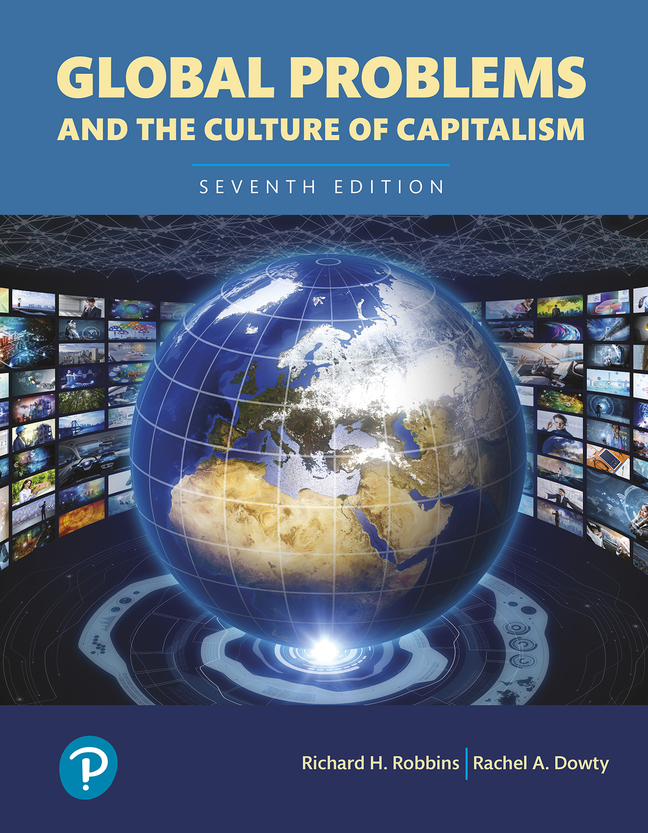
In 2011 I took a sociology class on global social problems. Three texts were required and one of them, Global Problems and the Culture of Capitalism by Richard Robbins, stood out in several ways. The book was very rich in information with many on-the-ground narratives. It had a simple but effective overarching theory; it addressed the issue of money creation, something I was already familiar with through Stephen Zarlenga and the American Monetary Institute. And it offered many interesting references I wanted, and did, pursue.

Of all the textbooks on economics, political science, history and sociology, this one counts for me as one of the best and most impactful ones during my crawl through college. And I am certainly not alone in assessing the book’s value. Though originally written in 1999 it went through seven editions, the latest in 2018, and has been translated into Polish, Korean, Chinese and Arab.

Tim Di Muzio

Now, many years later I dug into the work by the Canadian academic Tim Di Muzio and especially liked his book Debt as Power in which the destructive impact of the our debt-money capitalist regime is systemically addressed. There was a co-author involved. Last week we hosted Di Muzio on our Monetary Coffee House meeting and he shared that his foray into debt-money had more or less started with reading a book on global problems and that he had contacted its author.

A few hours later, while composing an e-mail about the sources mentioned in our meeting, did it dawn on my thick skull that the book Di Muzio referred to was Global Problems, the very same I had studied, and that its author Richard Robbins was also his co-author of Debt as Power! This put the book in a new light and I pulled out my old, underlined and annotated copy of Global Problems to give some passages another read.

Money

One of the foundational sections in the book is titled “A Primer on Money: The Philosopher’s Stone”. On Amazon you can read it as part of the “Look inside” feature on pages 4 to 11. Around page 100 (depending on the edition) one can read the basic idea reiterated:

We generally assume that governments create money by printing it. And, in fact, when money was linked to gold, there was a limit on how much could be printed. However, with the lifting of these restrictions, most money is now created by banks and other lending institutions through debt. We generally assume, also, that the money that banks lend is money that others have deposited.

However, that is not the case; only a fraction of the money that banks lend needs to be in deposits. In effect, whenever a bank lends money, or whenever a product or service is purchased on credit, money has been created. In effect, then, there is virtually no limit on the amount of money that lending institutions can create; furthermore, the interest on the loan payments creates yet more money. Economists call this debt money (Rowbotham 1998:5), or credit money (Guttmann 1994).

Though some parts of this quote could be calibrated for accuracy, the basic theory is there. Most of what we use as money is debt-money created by banks when they extend loans. 

Forced Money Growth

The main thrust of the textbook is to provide empirical flesh to the following, skeletal mechanism. When banks create loans and charge interest, they do not create the money to pay off the interest. This pushes the system into finding ways to grow the money supply by making ever more loans extended to consumers and businesses. And they need to find ever more ingenious ways to create or find things and services to be sold.

In other words, the money supply must grow if the economy is to remain healthy, and for the money supply to grow there must be a steady increase in the things or services that money can buy (4th edition, p. 11).

To keep the system going, Robbins argues,

. . . there must be a constant conversion of things that have no money value into things that do–that is, there must be constant commodification.

And the maintenance and global spread of this impetus is not without problems. On the contrary, Robbins argues that many if not most global problems can be traced back to the blind and iron logic of perpetual growth and commodification. But that is not something necessarily acknowledged by its beneficiaries living in the privileged zones at the core of the world-system.

Robbins challenges this blind spot and actually in the third part of the book addresses the resistance and rebellion against the culture of capitalism by workers, feminists, ecologists, minorities, indigenous people and other citizen-activists engaging in “antisystemic protest”.  

Solutions

As far as solutions to this impetus is concerned Robbins discusses a wide spectrum of possibilities. And the ones relevant to monetary reform are the reassessment of  perpetual economic growth as an index of a nation’s well-being and look for alternative indices and goals. And, more explicitly, Robbins sees “Zero Economic Growth” as a valid prospect and agrees with David Korten’s proposal to:

Make the creation of national currencies a public function, rather than allowing banks and other financial institutions to increase the money supply through debt (405).

This is also what the Alliance for Just Money proposes in its promotion of the NEED Act, which boils down to the following three basic and interconnected fundamental changes:

1. Require Congress to exercise its Constitutional power to be the sole creator of all U.S. money, issued debt-free, and to establish a transparent and independent public monetary authority to determine the amount of new money the Treasury will disperse under authority of Congress.

2. End the privilege of commercial banks to create and issue what we use as money.

3. Transfer ownership of the 12 Federal Reserve Banks, and all remaining operations of the Federal Reserve System, to the U.S. Treasury. 

In closing I like to reiterate that Robbins’ Global Problems and the Culture of Capitalism is a great starting point to study the connection between debt-money and global problems.  Also that the books co-authored with Di Muzio will only deepen the understanding of this connective tissue and add to the motivation towards, and see the possibilities of, structural reform.

Stay tuned for more from Richard Robbins and Tim Di Muzio.

Sources

Robbins, Richard & Rachel Dowty. 2018 (1999). Global Problems and the Culture of Capitalism (Seventh Edition). New York: Pearson/Allyn & Bacon.

Di Muzio, Tim & Robbins, Richard. 2016a. Debt as Power: Theory for a Global Age. Manchester, UK: Manchester U.P.

Di Muzio, Tim & Robbins, Richard. 2017. An Anthropology of Money: A Critical Introduction. London: Routledge.

Guttmann, Robert. 1994. How Credit-Money Shapes the Economy: The United States in a Global System. London: M. E. Sharpe.

Rowbotham, Michael. 1998. The Grip of Death: A Study of Modern Money, Debt Slavery and Destructive Economics. Charlbury, Oxfordshire: Jon Carpenter.

Richard Wolff’s Trajectory beyond MMT into SMR

Introduction

Recently I watched two episodes of the progressive Thom Hartmann Program in which the host discussed banking and Modern Monetary Theory (MMT) with the Marxist economist Richard Wolff [1, 2]. Following are the pertinent points I came away with, which developed into a little article, in which I will try to make the case that, when Wolff found in MMT the correct theory of banking and money, he actually went beyond MMT. He did so by discerning some of the theory’s obvious policy implications, which people promoting Sovereign Monetary Reform (SMR)–which is a competing monetary theory focused on a radical reform of the monetary system–would heartily agree with.

Many persons in the comments section stated that both Hartmann and Wolff did not really understand MMT. For example the most stinging (pun intended) came from John B, commenting that

Prof Wolff knows very little about MMT or the functional operation of the banking system. As an academic, he should be conscious that one should not talk ‘authoritatively’ on a specialty discipline that one has not adequately researched[2].

This lack of understanding might be a surprise because both Wolff and Hartmann have had encounters with one of MMT’s spokespersons, Stephanie Kelton, and I assume that they have read some relevant literature.

Where Wolff is Right

Maybe it is most fair to say that Wolff’s understanding of MMT is half wrong and half right. He is right to state that, in order to originate loans, “banks do not depend on other people’s money”[2]. Banks can just credit the deposit account of their client when they sign up for a loan. This is basically the credit creation theory of money and banking.  Its truth is now admitted by central banks like the Bank of England [3] and empirically tested by the economist and central banking expert Richard Werner [4].

He is also right in the idea that the government can fine-tune the economy by increasing and decreasing the supply of money in circulation. This idea goes back to the theory of “functional finance” pioneered by Abba Lerner [5] and incorporated by MMT [6].

He also thinks that when government can create its own money it can drastically decrease its debt burden. He also correctly observed that leaving the money supply “in the hands of people who look at it as a source of private profit is a recipe for the disasters”[2] of the 2007/8 Global Financial Crisis which necessitated massive government bail-outs.

On all these points there is quite some agreement between the experts, MMT and the sovereign money reformers like Dr. Joseph Huber, Dr. Patricio Laina and the good folks at organizations like the American Monetary Institute (AMI), The Alliance for Just Money (AFJM) and the International Movement for Monetary Reform (IMMR).

Where Wolff is Wrong

Wollf is mistaken though when he ascribes to MMT the position that it is wrong to leave the power of money creation with banks and have that power transferred back to the government to put it under democratic control. The position of MMT is to leave the privilege of bank credit creation with the banks, while it assumes that the government already has the power to create money, unrestricted by any funding through taxation or selling bonds.

People promoting SMR will agree with Wolff that the money creation power should be transferred from the banks to the government. In the USA there exists a bill, the NEED Act, exactly proposing that [7]. And SMR disagrees with MMT’s position that taxes and bonds do not finance government spending and that government can just spend money under the existing rules and laws [8].

The Conflation and Confusion of Theories

The three main theories on money and banking all came into play in these conversations between Hartmann and Wolff, but were not sufficiently differentiated and separately evaluated. Hartmann, with his example of a $1m deposit becoming the basis to create $10m extra in loans seems to conflate the credit creation theory and the deposit multiplier theory. The credit creation theory basically says that bank credit money can be created out of nothing and that, at the end of the day, reserve requirements will be easily provided by the central bank. What drives the loan creation process is the demand for loans coupled to the banks’ evaluation of their profitability. Apparently the supply of money is not an issue.

The deposit multiplier theory posits a tight correlation between reserve requirements and the money supply. The often used example is from a 1961 FRB of Chicago publication in which an initial deposit of $10,000 and a reserve requirement of 10% can theoretically balloon into $90,000 in loans and investments. This happens when, in multiple stages, the bank loans out 90% of its deposit ($9,000), which will find its way first into the bank account of the borrower and from there into the account of the entity providing the merchandise or service for which purpose the loan was originated. The bank holding the second account in question can then originate a loan of $8,100, being the 90% allowed of the $9,000 deposit. This process can then be duplicated multiple times [11].

What Hartmann thinks is that a bank can just create $10m out of nothing based on a $1m deposit and an implied 10% reserve acquirement. This unrealistic scenario is not covered by any of these theories and looks more like a conflation of the credit creation theory and the deposit multiplier theory.

Wolff then corrects Hartmann with explaining the old and discredited financial intermediation theory of banking according to which banks make their profit by lending out money for a higher interest rate than they themselves pay to attract depositors. In this theory banks do not create nor multiply the money supply and merely mediate between those who have money to lend and those who desire money to borrow.

From MMT to SMR

Interestingly Wolff made these comments in the April 11, 2019 Hartmann program on the banking system and took them back again in the May 2, 2019 program on MMT. In the second program he first again explained the financial intermediation theory with the narration that first the money supply is created by the Federal Reserve and then banks can lend most of this money out again. Then, by explaining MMT’s research on how banks really operate, he switched to the credit creation theory as the correct one.

When a bank issues a loan nowadays, all that it does is create an account for the recipient of the loan and then the bank deposits into that account the amount of money that they had lend to the borrower. In other words, the bank is not dependent on other people putting deposits in . . . [2].

It looks like that Wolff had done some homework on MMT and was converted from the refuted financial intermediation theory to the credit creation theory. At the same time he did some suplemental thinking or reading over and beyond MMT, because he incorrectly projects behind MMT “the critical impulse” that “we should never have and we should not now put the control of the money supply so utterly into the hands of the banks” and mistakenly thinks that therefore MMT proposes that “we should have the creation of money brought back under the complete control of the government”. I am not sure where he might have found these ideas, but they are positions SMR is promoting and to which MMT is actually explicitly hostile to [9].

Conclusion

In short, the SMR crowd should be elated that Wolff, after learning some MMT and thereby switching from the old financial intermediation to the correct credit creation theory, apparently went beyond MMT by thinking through the policy implications of the credit creation theory and thereby arrived at a position with which SMR is quite in agreement, i.e. “we should have the creation of money brought back under the complete control of the government”.

This position might have been foreshadowed in Wolff’s book Capitalism’s Crisis Deepens in which he made the statement that to “ignore alternatives to private megabanks condemns us all to longer lasting, more socially costly, and recurring crises”[10].

Govert Schuller
Naperville, May 19, 2019

Sources

[1]. “Richard Wolff Explains How the Hell our Banking System was Put Together“. YouTube. Uploaded by Thom Hartmann Program, 11 April 2019.

[2]. “The Truth About Modern Monetary Theory (w/ Richard Wolff)“. YouTube. Uploaded by Thom Hartmann Program, 2 May 2019.

[3]. McLeay, Michael & Radia, Amar & Thomas, Ryland. 2014a. “Money Creation in the Modern Economy”. Monetary Analysis Directorate. Bank of England Quarterly Bulletin (Q1, 2014): 14-27.

[4]. Werner, Richard A. 2016. “A lost century in economics: Three theories of banking and the conclusive evidence”. International Review of Financial Analysis, 46 (July 2016): 361-379.

[5]. Lerner, Abba P. 1943. “Functional Finance and the Federal Debt“. Social Research, 10/1 (Feb): 38-5.

[6]. Bell [Kelton], Stephanie. 2000 “Do Taxes and Bonds Finance Government Spending?” Journal of Economic Issues, 34/3: 603-620.

[7]. H.R.2990 – National Emergency Employment Defense Act of 2011 (NEED Act). 112th US Congress (2011-2012).

[8]. Huber, Joseph. 2019a. “Modern Money Theory revisited – still the same false promise“. Sovereign Money, March 2019. Also here.

[9]. Mitchell, William. 2019. “The conga line of MMT critics – marching into oblivion“. Bill Mitchell – Modern Monetary Theory. 7 March 2019.

[10]. Wolff, Richard. 2016. Capitalism’s Crisis Deepens: Essays on the Global Economic Meltdown 2010-2014. Chicago: Haymarket Books. Page 117.

[11]. Nichols, Dorothy M. & Gonczy, Anne Marie L. 1961-1994. “Modern Money Mechanics: A Workbook on Bank Reserves and Deposit Expansion”. Chicago: Federal Reserve Bank of Chicago.

On Money: Postal Financial Services


The social democratic wing of the US Democratic Party is floating two important proposals: 1) provide financial services through the wide network of postal offices to the so-called ‘unbanked and underbanked’ population; and 2) cap interest rates at 15% [6].

Both proposals have connections with monetary reform. The Kucinich NEED Act caps interest rates at 8% and also stipulates that the total interest payments on a loan cannot exceed the principle amount (Section 502)[1].

The idea of extending financial services through the postal system is not only a long-established idea but has been practiced, and is still practiced, in many countries [2]. In European MR circles this proposal is re-activated, but then in connection to the introduction of Central Bank Digital Currency (CBDC) as a measure to insure financial stability and a step towards full monetary reform [3].

The other important aspect of postal banking is to make financial services more accessible and less predatory. Many reporters and writers like Ellen Brown [4] quote from a 2001 UN discussion paper the following idea:

The essential characteristic distinguishing postal financial services from the private banking sector is the obligation and capacity of the postal system to serve the entire spectrum of the national population, unlike conventional private banks which allocate their institutional resources to service the sectors of the population they deem most profitable[5].

For the sake of social justice and economic equality the ideas of capping interest rates and providing banking services through the postal system should stay on our radar.

[1]. Zarlenga, Stephen A. 2014. “Presenting the American Monetary Reform Manual”. Valatie, NY: American Monetary Institute.

[2]. d’Alcantara, Gonzales, Paul H. Dembinski, and Odile Pilley. 2014. “Postal financial services, development and inclusion: Building on the past and looking to the future”. Université de Fribourg. htt

[3]. Edgar Wortmann. 2018. “Design Principles for CBDC“. International Movement for Monetary Reform. 28 June 2018.

[4]. Brown, Ellen. 2013. “What We Could Do with a Postal Savings Bank: Infrastructure that Doesn’t Cost Taxpayers a Dime“. The Web of Debt Blog. 23 Sept 2013.

[5]. Scher, Mark. 2001. “Postal Savings and the Provision of Financial Services“. DESA Discussion Paper No. 22. New York: United Nations-Development Policy Analysis Division.

[6]. Nichols, John. 2019. “AOC and Bernie Put Postal Banking Back on the Agenda“. The Nation, 10 May 2019.

Dutch Report on Money and Debt and its Reception by Ons Geld

On January 17, 2019, a research institute of the Dutch government, The Netherlands Scientific Council for Government Policy (WRR), offered its report on banking and money-creation to the Dutch government [1]. The report was commissioned by the government after a motion in the Dutch parliament in March 2016 during a debate, which itself was triggered by a citizen’s initiative organized by the Dutch monetary reform organization Ons Geld (Our Money)[2].

The Report

The 301-page report is titled “Money and Debt: The Public Role of Banks” and was accompanied with a 15-page synopsis [3]. An English translation is forthcoming. In its own words the scope of the report was thus:

In this report we discuss how money-creation works; how the context of money-creation has changed; and which problems the current system has. We investigate to what extent a public money system – as proposed among others by Ons Geld – can provide a solution. Finally we make recommendations to reform our system (Synopsis, 5; translated from Dutch original).

This article will give a summary of all these points as presented in the synopsis and also a summery of the official response by Ons Geld. How this report came about you can read here [5].

Money-creation

In the section “How money-creation Works” the authors explain the manner by which money is created and enters the economy. One of their findings is that 93% of the Dutch money stock is created as debt when banks originate loans and 7% of the money stock consists of cash in the form of coins and paper money. The Dutch named the non-cash part of the money supply “giraal geld”, which would loosely translate as “check money” and is usually named in English bankmoney or debt money. Because of this money-creating role by banks “money, debt and banks are in the current system very closely entangled”. But, though banks do create the bulk of the money supply, they cannot just do so without some restraints, of which the authors identify three: 1) The demand for money by businesses and individuals; 2) risk assessments by banks; and 3) monetary policies set by central banks.

Context

As far as the “Changed Context of money-creation” is concerned the authors identified three developments: 1) the shift from using cash to check money (after World War II just above half was check money); 2) the disappearance of public payment and savings options (the public Postbank was privatized and became part of ING); and 3) there was a shift from a “diverse banking landscape” to one in which there are only three big, uniform banks. The effect of these shifts was that 1) bank money became less prone to be changed into cash; 2) the necessary amount of prudent bank reserves diminished; and 3) banks acquired an implicit, public guarantee against insolvency. The overall effect was that “the brakes on money-creation” lessened and the risk of asset bubbles, inflation and economic crises heightened.

Core Problems

The report indicates “Two Core Problems” with the current Dutch money system: 1) The large amount and volatility of debt creates instability and economic crises; and 2) the balance between private and public interests became skewered. The banking sector became more important and powerful in the economy and the government became more important in the banking sector by guaranteeing and bailing out banks in crisis, with both tendencies leading to a “sort of semi-public” banking sector. This section ended with a call for “a good balance between public and private interests” (Synopsis, 8).

Public Money Proposal

In the section “The Public Money System as Solution” the report addressed the proposal offered by the Dutch monetary reform organization Ons Geld (Our Money), which proposal was inspired by the 1930 Chicago Plan and has now many variants developed in other countries like Iceland, the United Kingdom and Switzerland. Their synopsis is as follows:

These proposals differ in effect, but they essentially always come down to breaking the close link between money and debt. The current banking landscape would be split into a payment sector and a financing sector. In the payment sector money is held in accounts directly at the central bank or with payment banks where all deposits are 100% covered with central bank reserves. New money can only be created by the central bank. New money comes into the economy through government spending, loans or possibly direct transfers to citizens. In addition, it is possible that new money is used to reduce taxes or to pay off the public debt. In the financing sector, banks first have to raise money before they can provide loans. They can therefore not create new money. People lending money to these financing banks can also suffer losses and they can not reclaim their money at any time. How this financing sector should function exactly differs from one proposal to another (Synopsis, 9).

Though they find the wish to separate payments from financing to be “understandable”, the authors think that it also creates many new uncertainties. Their barrage of questions range from whether the central bank would be able to withstand public pressure; to whether they could prevent money-creation to get out of hand; to whether there would be enough credit to finance real estate; to whether a shadow finance system can be devised by the banks, effectively canceling the reform; to whether the government will really let banks fail. “What looks good on the drawing board can become something quite different in practice”. Together with the fact that such a system has never been tried out, the authors think it is hard to establish whether the new system might function better than the current one. And finally it is uncertain how such a system will fare during the transition period after introduction, and in the context of substantial international economic interdependence.

In its conclusion on a public money system the reports states that,

The WRR considers the transition to a public money system an unsuitable experiment with the monetary-financial system, the backbone of the economy (Synopsis, 10).

Recommendations

Apart from the negative conclusion about an alternative money system the report does provide four recommendations to change the balance between private and public interests: 1) Promote diversity in the financial sector; 2) limit the prolific growth of debt; 3) be better prepared for the next crisis; and 4) solidify the public dimension of banks.

Diversity is important for increased choice and better prices for consumers; increased stability of the sector; and better guidance of credit allocation. A possibility is to have a public or private bank solely dedicated to payments and savings or even the introduction of “digital central bank money”, all of which would have a disciplining effect on the banking sector and diminish their dominance. And their dominance, the authors observe, should be actively weakened by the government through different regulatory measures.

In order to diminish the growth of debt–which the authors deem important for stability, fast recuperation after crises, and balanced economic growth–macro-prudential policies have to be introduced to handle systemic risks. Some tax changes would be necessary and also the behavior of other parts in the economy (pension funds and the real estate market) will have to be regulated to manage debt levels.

Because instability is inherent in the current system, preparations for future crises are important to diminish its effects and enable fast recuperation. Financial risks will have to be spread in a more balanced manner from debtors to creditors; banks might be obligated to recapitalize; and besides the lowering of interests and the buying of bonds maybe more controversial monetary measures by the central bank will have to be applied like the monetization of government debt.

As there exists an unavoidable tension within banks between their private activities and public functions, the latter should be better “anchored’, i.e. the public interest should get “a more robust place” in the system through, for example, an advisory council; increased choice; an alternative payment system; and more publicly responsive regulators.

Conclusion

The report’s final word is a call for several balances: 1) a balance between regulation and freedom in private money-creation; and 2) a balance between private and public interests. “The prudent guidance of money and debt is a permanent task” (Synopsis, 13).

Reception by Ons Geld

Ons Geld published an official response to the report [4]. They especially appreciated three issues which the report addressed: 1) The call to study possible economic scenario’s and alternative money systems; 2) the possibility of a “secure harbor” for one’s money in the form of a “digital safe” to store one’s digital cash; and 3) the report’s starting point with the problematic entanglement of private and public interests in the current financial system.

On the other hand their critique and disappointment with the report is that it points in the wrong direction. The report proposes to solidify and manage the entanglement through further regulations, while Ons Geldproposes a clear separation between money-creation as a public utility and money lending as a commercial business. One venue which could incrementally lead to this separation is the establishment of a digital variation of cash. Once people get accustomed to digital cash, Ons Geld reasons, it will be easier to end the bank privilege of money-creation.

Meanwhile the societal discussion on the role of banks has been broadened and the issue of a fundamental change of the money system is on the political agenda. It is up to the government now to publish its own response to the report. Stay tuned.

Footnotes

[1]. IMMR. 2019. “Dutch WRR Report on Money and Debt is out“. International Movement for Monetary Reform. 1 Feb 2019.

[2]. Wortmann, Edgar. 2015. “Burgerinitiatief Ons Geld“. Ons Geld, 21 April 2015.

[3]. WRR. 2019. “Geld en Schuld: De Publieke Rol van Banken“. WRR Raport No. 100. Den Haag: Wetenschappelijke Raad voor het Regeringsbeleid. Synopsis. Translations from Dutch by editor.

[4]. Ons Geld. 2019. “Reactie van Stichting Ons Geld op het WRR-rapport ‘Geld en Schuld’ “. 19 Jan 2019.

[5]. Schuller, Govert. 2019. “Ons Geld and the Road to the WRR Report“. News – Alliance for Just Money, 6 Mar 2019.