Subtitle: And What Has That to Do With the Restoration of the Ecosystem?
Introduction
In order to have a good grasp of what is possible in the future we need a good grasp on what has happened so far in the past. And if the aim is the assessment of the possibility that earth’s ecosystem can be restored, we need an assessment of the causes which lead to the dire ecological situation humanity finds itself in.
The following short paper is an admittedly speculative contribution to this assessment and is rooted in a particular philosophical history of consciousness. The guiding idea of this presentation is that consciousness has contingent structures and dynamics. Because it is contingent and left a historical record, it has a history which can be explicated and narrated.
The psychological hypotheses of Julian Jaynes and the teachings of global philosopher Jiddu Krishnamurti are central in the construction of this narrative. A short introduction of both will clarify why.
Julian Jaynes
Julian Jaynes (1920-1997) was an American psychologist who consternated quite some academics and lay people with his controversial 1976 book The Origin of Consciousness in the Breakdown of the Bicameral Mind.
In this intriguing study Jaynes developed four hypotheses which more or less hang together but can also be addressed separately. I will give a very short formulation of the first two.
1) J-Consciousness. This technical term refers to our modern sense of individuality and interiority and can be named “Introspectable inner mind space”, in which an analogue “I” can move around a metaphoric “me” in different scenarios to figure out and evaluate possible actions in order to cope with unfamiliar situations. Jaynes takes great pains to make clear that ‘consciousness’ is not to be equated with perception or sentience. It is made up of language in the format of narrativity and is an analogue to the real world. (65ff, 204ff & 447-52)
2) The Bicameral Mind. In ancient times individuals and groups, when in stressful, non-routine situations, were directed by Auditory Command Hallucinations (ACH) to successfully navigate the dangerous unknown. These commands originate in the right brain hemisphere and are received in the left hemisphere. Except for recent instances, recipients experience such commands as coming from outside themselves as if coming from a different, more authoritative being. Jaynes thinks this ‘mental architecture’ might have started around 12,000 BCE and was dominant till 1,000 BCE, after which J-consciousness set in (84ff & 452-3).
In short, one could say that J-consciousness is a manner of coping with the world through the metaphorical constitution of an introspectable inner mind space which is a selective and storied analog of the real world in which an analog ‘I’ can move around a metaphor ‘Me’ in a spatialized temporality in which the analog ‘I’ can switch swiftly between memories and expectations all in order to figure out possible actions congruent with its narrative arc.
Krishnamurti
Krishnamurti and his teachings are hard to classify, but naming him a global philosopher spreading a transformative philosophy might come close, especially if philosophy is not taken in the western, modern professional-technical meaning, but as the public pursuit of wisdom done through a variety of discourses. And, though born in India, I do not consider him an Indian philosopher.
His central concern is conveyed in the phrase ‘choiceless awareness’. The idea of ‘choiceless awareness’ is to convey the possibility to observe also without any reactivity, without any sense of judgement. It is what it is, as people say, and only when a person, idea, problem is approached in non-reactive awareness will there be a chance to see ‘what is’. And if ‘what is’ is some egoic or ego-centric process, merely observing it without judging, might lead to its transformation and overcoming.
As far as the role of thought is concerned Krishnamurti was very respectful of science and rationality, but also sharply critical of some of its inventions like god(s), soul, religions, ideologies, and the most dangerous invention of all, the ‘me’, the ego, the sense of separate selfness. Most, if not all, human problems start there and can only be solved there.
In short, one could say that Krishnamurti sees human liberation only in and through a close, non-judgmental awareness and intuitive understanding of the mind’s processes. When, in this process of self-knowledge, or awareness of the self, the observer realizes he is the observed, total transformation can take place.
Note that Jaynes’ notion of the introspectable inner mind space is almost congruent with Krishnamurti’s concept of the ‘me’ or ‘self’. Their specific differences and similarities I have worked out in a forthcoming paper.
History of Consciousness
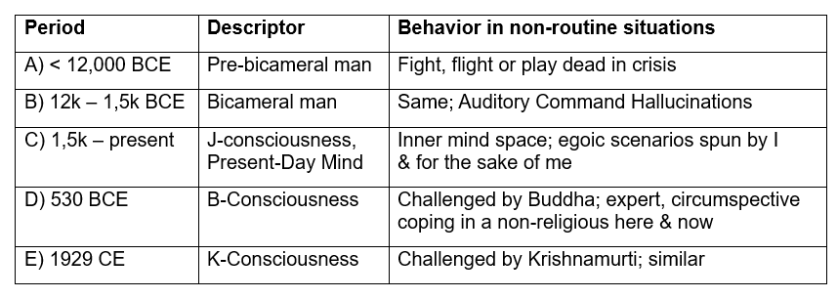
With the above minimal groundwork a history of consciousness and its contingent structures can be worked out. The first column has the approximate dates; the second its best one-word description; the third has some crucial aspects as far as its architecture / mentality is concerned and how it deals with uncommon, non-routine situations and crises.
B-consciousness is my name given to the first serious challenge to, or improvement of, J-consciousness. And K-consciousness is the second serious one. This doesn’t exclude that there were many in between.
The shift from the bicameral mind to J-consciousness is still in full swing and has the following dynamics:
A) Attempts to re-activate the bicameral mind by religious practices like ecstasies, divination, inspirations, mediumship and more recent channeling. Where bicameral man had the certainty of being pushed around by commands and had no second thoughts about its wisdom and correctness, J-consciousness has to live with an awareness of the contingency of its actions based on the plurality of possibilities. One way out of this uncertainty is to reactivate the bicameral mind through certain spiritual techniques and be guided again by voices or by divined signs. There exist innumerable practices of this kind, which all have in common that a basic question of ‘what should I do’ will be answered as if coming from on high while it is the subconscious which is producing the voices and / or interpretations.
B) The move to overcome religious impulses in more rational and naturalized frameworks amplified by the Greek philosophical revolution of 700 – 300 BCE and similar developments in Asia. The other route to attain certainty about action is by improving the capacity to rationally analyze alternate courses of action. Logic, rationality, experimentation and imagination are all practices which will improve the predictability of action and take away a certain amount of anxiety.
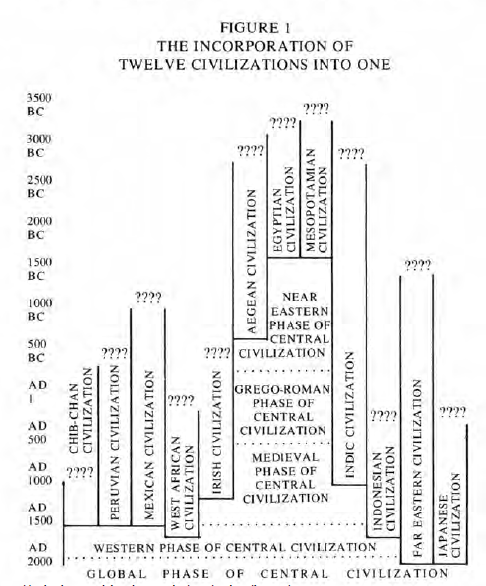
C) The Rise of Central Civilization incorporating all other civilizations in one global entity driven by an egocentric impulse based in J-consciousness (See Appendix A). If you look at the figure in Appendix A you will see an alternative conceptualization of the march of civilizations. This one is based on the merging of, on one side, historical investigations of comparing civilizations (Toynbee, 1947a, b, 1962-64; Quigley, 1979), and on the other side, sociological investigations in the field of world-system theory (Wallerstein, 1974-1989; Frank, 1998). What both seem to agree on is that the origin of now globalized western civilization is merely a phase of what they call ‘central civilization’, i.e. the merger of Egyptian and Mesopotamian civilizations around 1,500 BCE, which then went through a Near-Eastern phase, then a Greco-Roman phase, then a Medieval one, then Western and now a Global phase. In its growth it gobbled up almost any and all other civilizations (Wilkinson, 1997).
Central Civilization emerged around 1,500 BCE out of an intense civilizational conflict in which Jaynes argues the bicameral mind found its demise and J-consciousness its start as a better coping mechanism (Jaynes, 1976: 223f). Bicamerally ruled empires around the Mediterranean might have found their end during a “perfect storm of calamities” early in the 12th century BCE of earthquakes, rebellion, invasions, collapse of trade, disease, drought and famine (Cline, 2021: 134f). Since then this ‘mental architecture’ went through many modes of interiorization and is now also global.
The questions, or hypotheses, are 1) whether it was specifically J-consciousness, in its more powerful mode of planning and rationality, which gave central civilization its staying power and dubious success over others; 2) if Buddhist civilization(s) can be construed as a possible first attempts to overcome J-consciousness with a new mentality, which I will name B-consciousness, but failed; and 3) if K-consciousness–also based on a different architecture, but not dissimilar to Buddhism–as allegedly lived and promoted by Krishnamurti, might become another challenge to the reigning J-consciousness.
Transition to a Sustainable Civilization
The connection of the history of consciousness and its future along the lines of what Krishnamurti proposes should be connected to the idea of ecosystem restoration. It is possible that only under the aegis of a civilization inspired by the ecological sensitivities and ideas of Krishnamurti that humanity will be able to construct a sustainable civilization. This might take 200-500 years. Only then the very much needed restoration of the ecosystem can be executed with any success of making the relationship between humanity and nature truly sustainable. How bad the ecological and social situation might have turned is anybody’s guess, but a short dark age of anarchy and chaos is not out of the question. But, so far, humanity has gone through many of them before and survived to tell the story.
Origin
“The Future of Consciousness: Is Krishnamurti Its Prophet? And What Has That to Do With the Restoration of the Ecosystem?” Presentation at the Indian Philosophical Congress (IPC), 95th session, Gandhi University, Wardha, Maharashtra, December 29, 2022.
Sources
Agrawal, M. M. 1991a. Consciousness and the Integrated Being: Sartre and Krishnamurti. Shimla, India: Indian Institute of Advanced Studies.
Agrawal, M. M. 1991b. “Nothingness and Freedom: Sartre and Krishnamurti”. Journal of Indian Council of Philosophical Research, 9/1: 45-58.
Cline, Eric H. 2021. 1177 BC: The Year Civilization Collapsed. Revised and updated. Princeton: Princeton University Press.
Dreyfus, Hubert. 1972. What Computers Can’t Do: The Limits of Artificial Intelligence. New York: Free Press.
—— . 2002. “A phenomenology of skill acquisition as the basis for a Merleau-Pontian nonrepresentational cognitive science.” (2002)
—— & —— . 1986. Mind Over Machine: The Power of Human Intuition and Expertise in the Era of the Computer. New York: Free Press.
—— & ——- . 1991. “Towards a Phenomenology of Ethical Expertise.” Human Studies, 14/4: 229-250.
Frank, Andre Gunder. 1998. ReOrient: Global Economy in the Asian Age. Berkeley: University of California Press.
Jaynes, Julian. 1982 (1976). The Origin of Consciousness in the Breakdown of the Bicameral Mind. 2nd edition with added Afterword. New York: Houghton Mifflin Harcourt.
—– . 1954. The First and Last Freedom. Foreword by Aldous Huxley.New York: Harper & Brothers.
—– . 1976. Krishnamurti’s Notebook. New York: Harper & Row.
Lutyens, Mary. 1975. Krishnamurti: The Years of Awakening, Avon Books, New York.
Martin, Raymond & Barresi, John. 2006. The Rise and Fall of Soul and Self: An Intellectual History of Personal Identity. New York: Columbia U.P.
Quigley, Carroll. 1979. The Evolution of Civilizations: An Introduction to Historical Analysis. Liberty Fund.
Rodrigues, Hillary. 1990. Insight and Religious Mind: An Analysis of Krishnamurti’s Thought. American University Studies, Series VII, Theology and Religion, Vol. 64. Master of Arts Thesis, McMaster University, 1988. New York: Peter Lang.
Rorty, Amelie O. 1976. “A Literary Postscript: Characters, Persons, Selves, Individuals”. In: Rorty, Amelie O. (Ed.), The Identities of Persons. Berkeley, CA: University of California Press. 301-323. Also in: Rorty, Amelie O. (Ed.). 1988. Mind in Action. Boston: Beacon Press, 1988.
Sartre, Jean-Paul. 1957 (1936). The Transcendence of the Ego. Trans. Williams, F. & Kirkpatrick, R (Transl.). New York: The Noonday Press.
Schuller, Govert. 1997. Krishnamurti and the World Teacher Project: Some Theosophical Perceptions. Theosophical History Journal, Occasional Paper V.
Taylor, Charles. 1989. Sources of the Self: The Making of the Modern Identity. Cambridge, UK: Cambridge UP.
Toynbee, Arnold J. 1962–1964 [1934–1961]. A Study of History. 12 vols. Oxford: Oxford University Press.
Wallerstein, Immanuel. 1974-1989. The Modern World-System. 3 volumes. New York & San Diego & London: Academic Press.
Wilkinson, David. 1987. “Central Civilization”. Comparative Civilizations Review, 17/17: Article 4. Also in: Sanderson, Stephen K., 1995, Civilizations and World Systems: Studying World-historical Change, Lanham, MD: Rowman Altamira, pp. 46-74.
When I read the following passage in a review of a book on the philosophy of music, my understanding of Carnot’s second law of thermodynamics and its philosophical implications kicked in and inspired me to compose an article combining a wide variety of ideas and experiences. This is overdue as I had promised a late friend of mine an explanation of what I meant with the phrase ‘the mother of all reductions’.
According to this [Schopenhauer’s] metaphysics, the world has two aspects: representations and Will, which is the non-rational, aimless force at the heart of human instincts and, indeed, all of existence. Representations are a kind of manifestation of Will. Poetry, painting, sculpture and dance imitate the world of representations. According to Schopenhauer, music is, in contrast, “a copy of the will itself.” The world of representations or phenomena are pale reflections of Platonic forms; the Will is the essence of reality.[10]
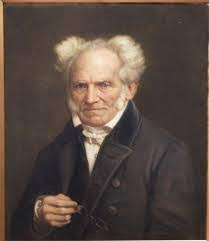
Arthur Schopenhauer
What if the aimless, non-rational Will, which Schopenhauer detected at the heart of existence, is nothing but what I would name ‘gradiance‘ (in French accent with a wink to Derrida’s ‘différance‘)? With this I mean the idea that everything exists and changes by the grace of gradient tensions between high and low pressures, high and low densities and high and low temperatures. These are arguably all variations of one phenomenon: uneven energy distribution, which create tensions to be overcome as energy always ‘aims’ at a perfectly evenly dispersed distribution.
Gradiance and Physics
This behavior can be experimentally observed in closed systems and explained with Carnot’s second law of thermodynamics. In physics the final energy state aimed at is called ‘thermodynamic equilibrium’, ‘maximum entropy’ or ‘heat death’. Pessimists might be dismayed by this end point, while optimists will point out that, before the universe will ever die of ‘heat death’, there will be an almost unlimited amount of creative, ordered ways in which this teleological process plays itself out. The Belgian physicist Ilya Prigogine named such emerging orderings dissipative structures [1].
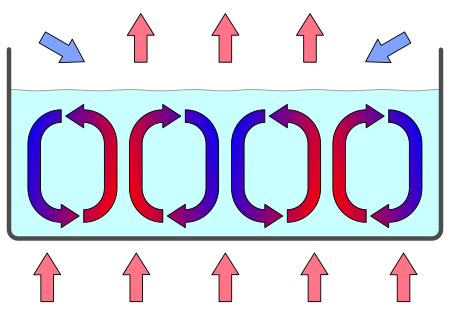
The paradigmatic example of these dynamic structures can be found in the ‘Bénard Cell’ when a fluid in a container is exposed to an increased temperature difference between the bottom plane and the top plane and after a while spontaneously self-organizing, non-linear convection cells form to more efficiently mediate between the gradient temperatures [2].
Convection cells dissipating energy gradients
Gradiance and Evolution
Writer and ecological philosopher Dorion Sagan (son of the famous scientist Carl Sagan) and his co-author Eric Schneider proposed to extrapolate this formative principle of gradiance to any and all phenomena including biological and mental life [3].
Into the Cool: Energy Flow, Thermodynamics, and Life
He would see our biological life as the thin layer of a very complex energy-mediation system between the cool earth and the hot sun and would see evolution as one of the most inventive tricks in the universe to optimize energy flows. Biological entities are therefore nothing but self-organized energy transformers looking first for high energy sources, then using those sources and lastly leaving lowered energy forms behind.
They are dissipative structures mediating between high and low concentrations of energy. Natural, instinctual desires guide this process at the temporal span of the specious now in which perceptions (‘affordances’ in J.J. Gibson’s terminology) of food, security and procreation are immediately perceived and pursued [11].
Language and mental life–especially narrative constructs which can efficiently hold together multiple dialectical aspects of life–help this process get along as a medium of information storage and exchange of ‘best practices’. This happens at the mediate span of extended temporality of remembered pasts and projected futures accompanied by a temporarily extended sense of narrative self covering one’s life-span [4].
Gradiance and Consciousness
This whole process is also accompanied by different levels of sentience of which our sense of self-conscious self-hood is one of its most intense, especially when fretting over possible courses of action in one’s mind-space while desires and fears have become intensified [5].
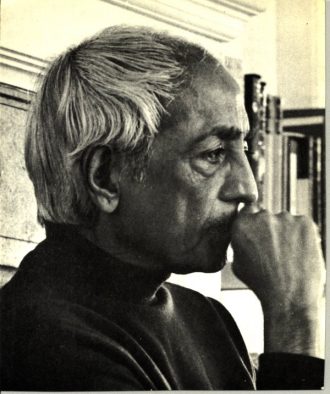
Jiddu Krishnamurti
Possibly the most intense experience humans could have is when it can silence its mind through meditation and then experience in this stillness the vastness and intense, whirling energy of the universe itself as was arguably the case with the maverick, global philosopher Jiddu Krishnamurti and his experiences of ‘benediction’. He left us with some poetic descriptions of these experiences, written in a diary he kept for a year in 1961.
[I]t was a movement in complete freedom, a movement that had no direction and dimension; in that movement there was boundless energy whose very essence was stillness. . . . In this emptiness there was fury; the fury of a storm, the fury of exploding universe, the fury of creation which could never have any expression. It was the fury of all life, death and love. But yet it was empty, a vast, boundless emptiness which nothing could ever fill, transform or cover up [6].
Saanen, Switzerland
When I attended the 1980 Krishnamurti gathering in Saanen, Switzerland, I had just started reading this Notebook, which opened my own mind to similar experiences.
Gradiance and Phenomenology
When talking about consciousness I would also like to make the connection between gradiance and Husserl’s phenomenology, especially the concept of the three-staged process of intentionality [12]. Intentionality here means the feature of directedness of consciousness towards something beyond itself, usually something complex like a landscape, a melody, a text, a social situation, etc.
Husserl makes the case that before we see a rolled-up rope as such, understand a string of words as a text, or hear a string of sounds as a melody, we approach the rope, text or melody initially with an empty intention which projects a possible fulfillment which might come to fruition, or not. The rope might turn out to be a snake, the text turns from a gentle love story into a dystopian nightmare, and the melodic structure sought in the sounds might stay elusive.
A successful fulfillment of an empty intention is achieved when a certain degree of identity can be established. The snake is really a snake because it looks like one, moves like one and reacts like one if you poke it. The end of the story makes the contrary beginning retro-actively meaningful. And the melody, once captured, is clearly repeated throughout the composition and can be reproduced by humming or by a skilled musician.
My proposal is that the dynamic, intentional structure of consciousness can be framed as an instance of gradiance, because there is an initial, teleological tension to be overcome between the empty phase and its fulfillment in possible identity. To be short, intentional experiences of desire and fear are connections between one’s natural evolved instincts projected emptily (like in hunger, thirst and attraction) unto one’s surrounding looking for fulfilment. Experiences of music connect intentionality to higher modes of experience, which will be the focus of the rest of this essay.
Gradiance and Music
How does art, especially music, fit into this discourse? According to the French philosopher Paul Ricoeur fictional narratives are laboratories for alternative ways to see and experience social life [7]. Characters and plots indicate possible templates for one’s own life to better overcome or mediate between all the diverse inner tensions and outer demands to which one is exposed.
Phrasing it in that way connects narrativity of course with managing one’s own energy field of natural desires, social habits and deliberative practices, and the possible ways to improve on them which might lead to different experiences of resolution and satisfaction. Within such a framework the phenomenon of art can be conceived as a very efficient medium to help both individual and collective energy transformations by provocatively breaking up old patterns and establishing new ones.
Bringing in the movie critic Roger Ebert and the sociologist Norbert Elias, one could muse that art functions as an ’empathy machine’ [8], which fuels the jagged civilizational process of increased empathy coupled with increased self-control with sometimes serious set-backs including disintegrations [9].
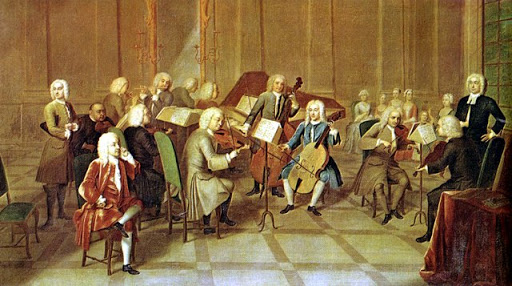
Baroque Orchestra
How does music fit in, especially its ineffable and utopian aspects highlighted by philosophers of music? Is music a non-verbal dissipative structure, which, qua experience, can be placed between literary art and meditation, if meditation can be re-conceived not merely as a spiritual practice but as a form of art by itself? Let’s work that out a little, first with connecting music with literature, then with meditation.
As an art-form music is arguably higher than literature because of its more expansive, emotive and energetic ‘meaning’, a meaning which does not refer to anything concrete outside itself but still evokes by its ineffable, spatial-temporally structured experience the depths, tensions, and resolutions of life itself.
To connect music with meditation I would first refer to personal experiences of nature mysticism in which one looks at, or into, nature through freely configurated dynamic gestalts of spontaneously arising perceived patterns in, for example, groupings of rocks and trees and other ‘compositions’. Such meditative way of seeing and being is highly creative and depends on a certain acquired skill of creatively perceiving gestalts and letting go of the usual chatter going on in one’s inner mind-space. In short, it is a form of art.
Secondly I would refer to my experiences of meditation after intensely listening to music, which can open up the appreciation of music’s containment in its silent and empty, spacious background. This background silence becomes foreground when one switches into a silent meditative mode and the lingering of the music becomes the background which then qualifies the particular silence of the foreground.
All such experiences are quite ineffable, but can still be, after reflection, find some words to get expressed by.
What about the ‘utopian’ aspect of music? In the review one can read that the German philosopher Ernst Bloch sees in music the “dialectical confrontation between two contradictory halves: formalism and materiality, rationalization and singular exemplarity, speculative autonomy and embodied immanence” and that “utopia is something that cannot be simply presented, represented, or even indicated; it must be obscurely interpreted through the abstract and translucent tone of the fugato. Music’s ineffability is a perplexing impetus to utopian insight” [10].
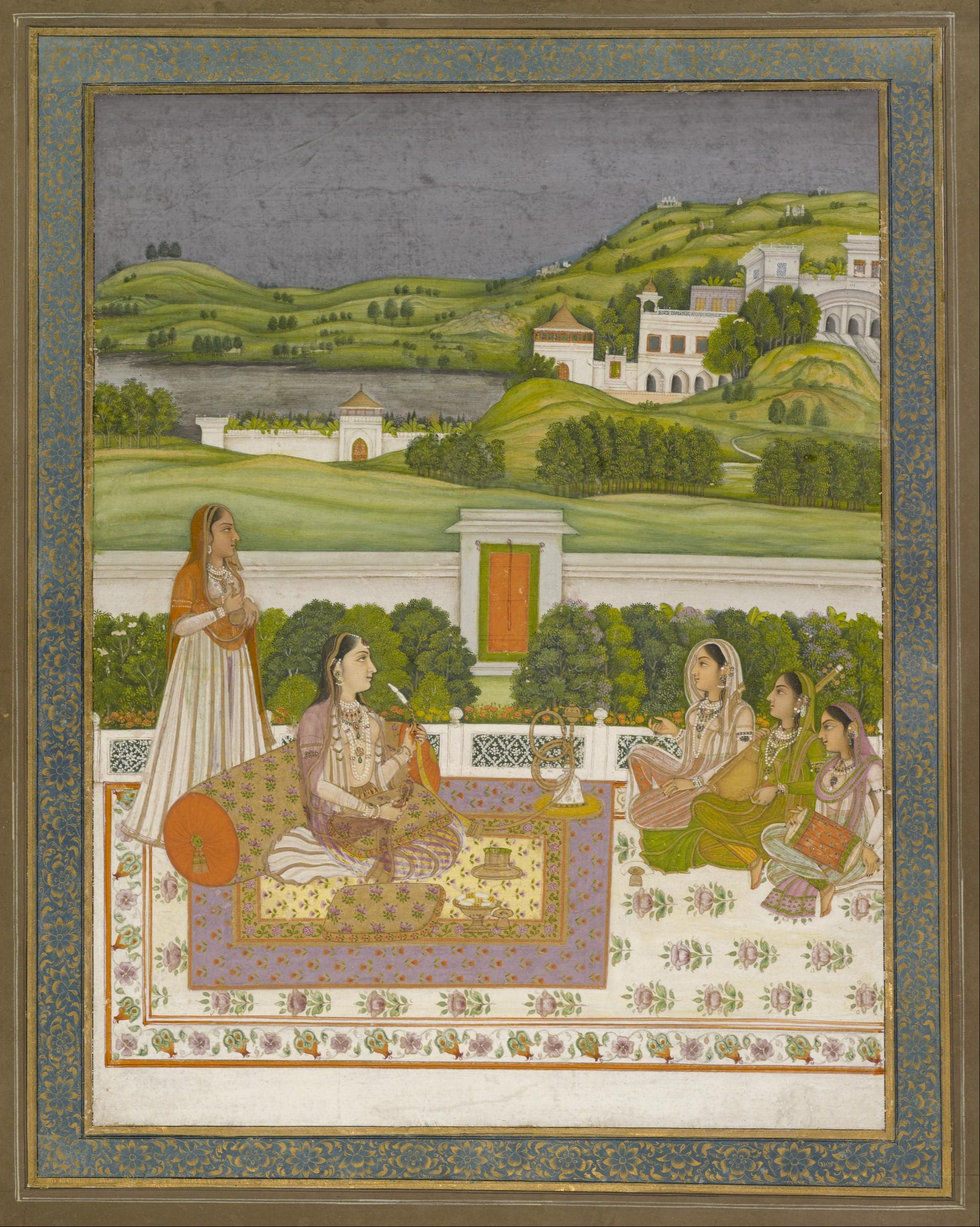
Princess Listening to Music
Leaving aside whether the above categorial dichotomies, like form vs matter, can be framed as conceptual expressions of an underlying gradiance, I would venture that music, interpreted as a temporally extended dissipative structure, has an intrinsic teleology towards a temporary or ultimate energetic resolution.
And one could, at the collective level, project into such experience of benign resolution, the emotive insight of a state of societal affairs which is commensurate to the music: Equally peaceful and dynamic, or whatever societal preferences one would like to project. In this manner the societal-formative power of music can be understood and shaved of its Romantic and/or esoteric interpretations [14].
Though the above view of interpreting art, music and meditation through thermodynamics looks like a stark, deflationary reductionism, this does certainly not imply a desolate devaluation of such experiences themselves. On the contrary, I see the second law of thermodynamics as the ‘mother of all reductions’ with which one can dismantle all kinds of fancy religious and metaphysical frameworks which will then open a more Taoist or Zen Buddhist sense of embodied, post-cognitive, energetic modes of being sans theological or metaphysical superstructures. And in this manner the Mother of all Reductions can pave the way for the Mother of All Experiences: The mystical experience of gradiance itself as was arguably experienced and expressed by J. Krishnamurti [6].
Endnotes
[1]. Prigogine, Ilya & Stengers, Isabelle. 1984. Order out of Chaos: Man’s New Dialogue with Nature. New York: Bantam Books.
[7]. Ricoeur, Paul. 1983-88. Time and Narrative. 3 Volumes. Chicago: University of Chicago Press.
[8]. Ebert, Roger. 2005. “Ebert’s Walk of Fame Remarks”. Roger Ebert’s Journal, 24 June 2005. Retreived 30 May 2020.
[9]. Elias, Norbert. 1978 (1939). The Civilizing Process. Vol 1: The History of Manners. Vol 2: Power and Civility. Jephcott, Edmund (Transl.). New York: Pantheon Books.
[10]. Gallope, Michael. 2017. Deep Refrains: Music, Philosophy, and the Ineffable. Chicago : University of Chicago Press.
[11]. Gibson, J.J. 1986. The Ecological Approach to Visual Perception. Hillsdale, NJ: Lawrence Erlbaum Associates.
[12]. Sokolowski, Robert. 1974. Husserlian Meditations: How Words Present Things. Evanston, IL: Northwestern U.P.
[13]. Young, James O. 2018. Review of Michael Gallope, 2017, Deep Refrains: Music, Philosophy, and the Ineffable, Chicago: University of Chicago Press. Notre Dame Philosophical Reviews, 22 April 2018.
[14]. For two great examples of esoteric interpretations of music see:
Scott, Cyril. 1933. The Influence of Music on History and Morals. London: Rider & Co.
Tame, David. 1984. The Secret Power of Music. Rochester, VT: Destiny Books
I am still in the middle of reading Wouter Kusters’ phenomenal PhilosophyofMadness: TheExperienceof PsychoticThinking. This book is a must read for all interested in philosophy, mysticism and madness, and those who are open to the disturbing closeness, even overlap, of all three, like Kusters’ ideas that: Philosophy is controlled madness; Madness develops its own philosophy, which is not necessarily mad; Monist philosophies push you to mysticism, which can take a turn into madness when you see too many connections; Madness could be cured with a better, less verbal and imaginary mode of mysticism. The book is a true cornucopia of well-developed crossings and relevant to all interested in the emerging practice of philosophical counseling.
I read a big chunk of the book in mid-January at a six hour transfer at Mumbai airport, tired and high on caffeine in a sea of strangers, with some staring at me with seemingly benign wonder. Usually I’d feel uncomfortable in such a setting, but the book has a very calming effect, because, I think, the writer has something very important to share; something he knows literally inside-out as he has lived through two psychotic episodes, and takes great care to formulate. He even shares chunks of his psychotic, stream of consciousness thinking, which are funny, absurdist, fascinating, meaningful narratives.
The Instability of Inner Time-consciousness
A special spot in the book is reserved for Husserl’s phenomenology of inner time-consciousness, one of the deepest reflections on the possibility conditions of conscious experience, and in Kusters’ writing a handy tool to understand both normal and psychotic experiences.
How do we keep consensus reality running in a semi-chaotic flow of events? And what happens when that breaks down and a psychotic manner of meaning-construction takes over? How can we best understand the interplay between memory, the just-passed (retention), the present, the just-to-come (protention) and expectations in the construction and changeof reality? Kusters makes good use of the idea that much can be learned from things going wrong, like Heidegger’s broken hammerand the unfortunate cases Merleau-Ponty looked into to understand behavior at its most basic moments of constitution.
Descriptive phenomenologies of madness and curative existential psychotherapies have earlier been developed by Merlau-Ponty, Michel Foucault, Thomas Szaz, Ronald Laing, Ludwig Binswanger, Meddard Boss, Viktor Frankl and quite some others,and Kusters can probably be placed in this category. Arguably he moved the investigation a couple of notches further.
For another step into understanding the genesis of madness I would connect the issue with Kant’s faculty of the productive imagination, which does not result necessarily in sane, justifiedknowledge, and actually could explain the highly productive, but not necessarily intelligible imagination operative in madness.
This highly intriguing and explanatory faculty got muffled away in the B version of the CritiqueofPureReason, only to be saved by Heidegger but for a few years just after he wrote BeingandTimeand developed a phenomenological reading of Kant.
Recently the faculty of productive imagination made a come-back with the work of Saulius Geniusas. Paul Ricoeur connected it with narrativity, the very effective epistemic device involved in identity-formation, a theme mentioned by Kusters and to which I devoted my master thesis.
Jaynes’ Take on Madness
The subject matter also connects with an impromptu paper I delivered a week earlier at this yearly philosophy conference which was started in 1925 by Nobel laureate Tagore and philosopher and first president of India, Radhakrishnan. One of its themes was the restoration of the ecosystem. This year it was hosted by the Mahatma Gandhi University, Wardha, Maharashtra, where Gandhi had his ashram from 1936 till his assassination and where he proclaimed the ‘Quit India’ movement. We visited the enchanted place, which was silently inspiring.
I titled my presentation, for which I got ten minutes, “The Future of Consciousness: Is Krishnamurti its Prophet?”It incorporates the ideas of Julian Jaynes, who also has some profound insights about the connection between madness and religion.
For Jaynes a lot of religious practices and manners of madness are triggered by a regression in (or by) the brain to an earlier ‘architecture’ he named bicameral, which was prevalent in the Bronze Age. This architecture had us humans obey Auditory Command Hallucinations (ACH) either originating in ourselves or in our superiors like kings and priests. It was the gods talking to us like in Homer’s Iliad with little to no space for disobedience and deliberation.
According to Jaynes the ACHs originate in the right hemisphere of the brain and travel over the corpuscallosum to the other side where its messages are received as if coming from outside. Ergo him naming it ‘bicameral’.
This ‘mentality’, ‘mind-set’, or ‘architecture’ increasingly disappeared with the onset of our modern sense of consciousness around 1,500 to 1,000 BCE, with its socially constructed, introspectable, inner mind space, in which metaphorical room we move around a fictive me in different scenarios in order to think through and feel out possible courses of action.
The speculation is that at the end of the Bronze Age many cultures clashed and the authorities led by ACHs didn’t come up with very viable strategies. People had to literally figure things out for themselves, which ‘selves’ had to be constructed from scratch in the process, something we experience also in our own development at around age 5 or 6. This egoic awareness comes with a lot of personal choices and uncertainty, and can be made more certain by applying science and rationality.
It also has a backward-looking inclination aimed at reviving the bicameral mind and its authority through religious practices like divination, ecstasies, oracles, enthusiasms, mediumship, channeling, etc. to trigger variants of command hallucinations, coming from gods, God, angels, masters or other imagined meta-empirical beings. It also derails in forward-looking hyper-individualism, scientism, technologization, ego-centered small-mindedness, neoliberalism, and the current state of global civilization on its way to economic and environmental doom.
Sustainable Future?
And what has this to do with Krishnamurti and the restoration of the ecosystem? Well, I am starting to make the claim that egoic consciousness, as it started just three thousand years ago, has gobbled up all civilizations and tribes (whether bicameral or pre-bicameral) into its egoic mentality and civilizational structure named ‘central civilization’, now in its global phase (Wilkinson, 1987).
This mentality and its social organization has an inbuilt vector towards disaster, which can only be challenged by a wholly different conscious architecture, of which Gautama might have been one of the earliest proponents and Krishnamurti one of the clearest later ones, with who knows how many in between. It might be this architecture which will have the required post-egoic structure and intelligent sensitivity to create a truly sustainable and just society. But that might need another 200+ years to break through to effective scale. Before that, I am sorry to say, brace yourselves.
Sources
Binswanger, Ludwig 1963. Being-in-the-World: Selected Papers of Ludwig Binswanger. Translated by Jacob Needleman. New York: Harper & Row.
—–, —–. 1993. Dream and Existence. Co-authored with Medard Boss, edited by Michel Foucault, and translated by Keith Hoeller. London: Humanities Press.
Boss, Medard 1963. Psychoanalysis and Daseinsanalysis. Translated by Ludwig Binswanger. New York: Harper & Row.
—–, —–. 1965. A Psychiatrist Discovers India. New York: Grune & Stratton.
—–, —–. 1979. Existential Foundations of Medicine and Psychology. Translated by Stephen Conway and Herbert Wehner. Lanham, MD: Jason Aronson.
Foucault, Michel 1965. Madness and Civilization: A History of Insanity in the Age of Reason. Translated by Richard Howard. New York: Vintage Books.
—–, —–. 1973. The Birth of the Clinic: An Archaeology of Medical Perception. Translated by A.M. Sheridan. New York: Vintage Books.
—–, —–. 2006. Psychiatric Power: Lectures at the Collège de France, 1973–1974. Translated by Graham Burchell. New York: Palgrave Macmillan.
Frankl, Viktor E. 1946. Man’s Search for Meaning. Translated by Ilse Lasch. New York: Beacon Press.
—–, —–. 1955. The Doctor and the Soul: From Psychotherapy to Logotherapy. Translated by Richard and Clara Winston. New York: Vintage Books.
—–, —–. 2000. Man’s Search for Ultimate Meaning. New York: Basic Books.
Geniusas, Saulius. 2015. “Between Phenomenology and Hermeneutics: Paul Ricoeur’s Philosophy of Imagination.” Human Studies, 38/2: 223-241.
—–, —–. 2018. “ Productive Imagination and the Cassirer-Heidegger Disputation“. In Geniusas, Saulius & Nikulin, Dmitri (Eds.). 2018. Productive Imagination: ItsHistory, Meaning and Significance. London: Rowman & Littlefield International. 135-156.
—–, —–. (Ed). 2018. Stretching the Limits of Productive Imagination: Studies in Kantianism, Phenomenology and Hermeneutics. London: Rowman & Littlefield International.
—–, —–. & Nikulin, Dmitri (Eds). 2018. Productive Imagination: Its History, Meaning and Significance. London: Rowman & Littlefield International.
Heidegger, Martin. 1962. Being and Time. Macquerrie, John & Robinson, Edward (Transl). New York: Harper Collins.
—–, —–. 1997 (1977). Phenomenological Interpretation of Kant’s Critique of Pure Reason. Emad, Parvis & Maly, Kenneth (Transl). Bloomington, IN: Indiana UP.
—–, —–. 1962. Kant and the Problem of Metaphysics. Churchill, James (Transl). Bloomington, IN: Indiana UP.
Husserl, Edmund. 1964. The Phenomenology of Internal Time-Consciousness. Churchill, James S. (Transl). Bloomington: Indiana UP.
Jaynes, Julian. 1976. The Origin of Consciousness in the Breakdown of the Bicameral Mind. New York: Houghton Mifflin Harcourt.
Kant, Immanuel. 1978. Critique of Pure Reason. Kemp Smith, Norman (Transl). London: Macmillan.
Kusters, Wouter. 2020. Philosophy of Madness: The Experience of Psychotic Thinking. Cambridge, MA: MIT Press.
Laing, R.D. 1960. The Divided Self: An Existential Study in Sanity and Madness. London: Penguin Books.
—–, —–. 1964. Sanity, Madness and the Family. Co-authored with Aaron Esterson. London: Penguin Books.
—–, —–. 1970. Knots. New York: Random House.
Merleau-Ponty, Maurice 1942. The Structure of Behavior. Translated by Alden L. Fisher. New York: Beacon Press.
—–, —–. 1945. Phenomenology of Perception. Translated by Donald A. Landes. London: Routledge & Kegan Paul.
Ricoeur, Paul. 1978. “The Metaphorical Process as Cognition, Imagination, and Feeling.” Critical Inquiry, 5/1: 143-159.
—–, —–. 1979. “The Function of Fiction in Shaping Reality”. Man and World, 12/2: 123– 141.
—–, —–. 1983-88. Time and Narrative. Volumes 1-3. Chicago & London: University of Chicago Press.
Schuller, Govert. 2019. The Possibility Conditions of Narrative Identity. Dissertation; Masters in Research in European Philosophy; Dr. Adrian Davis, Research Supervisor; University of Wales, UK.
—–, —–. 2022. “The Future of Consciousness: Is Krishnamurti Its Prophet?”. Presentation at the Indian Philosophical Congress (IPC), Mahatma Gandhi Antarrashtriya Hindi Vishwavidyalaya, Wardha, Maharashtra, 30 Dec 2022.
—–, —–. 2024. “The Future of Central Civilization: Historical Cycles and the Path Forward”. Presentation at the 2024 American Monetary Institute Conference, 29 Sept 2024.
Szasz, Thomas 1961. The Myth of Mental Illness: Foundations of a Theory of Personal Conduct. New York: Harper Perennial.
—–, —–. 1970. The Manufacture of Madness: A Comparative Study of the Inquisition and the Mental Health Movement. Syracuse, NY: Syracuse University Press.
—–, —–. 1988. Schizophrenia: The Sacred Symbol of Psychiatry. Syracuse, NY: Syracuse University Press.
Wilkinson, David. 1987. “Central Civilization”. Comparative Civilizations Review, 17/17: Article 4. Also in: Sanderson, Stephen K., 1995, Civilizations and World Systems: Studying World-historical Change, Lanham, MD: Rowman Altamira, pp. 46-74.
Krishnamurti, Jiddu. 1929. “The Dissolution of the Order of the Star”. International Star Bulletin (September 1929): 28-34. Also titled “Truth is a Pathless Land”.
—– . 1954. The First and Last Freedom. New York: Harper & Brothers.
Written by Krishnamurti
—–. 1956-1960. Commentaries on Living. From the Notebooks of J Krishnamurti. Series One to Three. Edited by Rajagopal Desikacharya. New York: Harper.
—– . 1976. Krishnamurti’s Notebook. New York: Harper & Row.
—–. 1982. Krishnamurti’s Journal. Foreword by Lutyens, Mary. New York: Haper & Row.
—–. 1987. Krishnamurti to Himself: His Last Journal. Foreword by Lutyens, Mary. New York: Haper & Row.
—–. 1997. “A Letter from Krishnamurti to a Friend: The Place of Social Reform”. The Link, 12 (Spring, 1997): 14-15.
—–. 2015. The Whole Movement of Life is Learning: Letters to his Schools. Brockwood Park, UK: Krishnamurti Foundation Trust.
—–. 2020. Happy Is the One Who Is Nothing: Letters to a Young Friend. London: Watkins.
—–. 2023. The Beauty of Life: Krishnamurti’s Journal. Revised and expanded third edition of Krishnamurti’s Journal, 1982. Introduction by McCoy, Ray; Foreword by Lutyens, Mary. London: Watkins.
Dialogues
—–. 1977. Truth and Actuality. Brockwood, UK: Krishnamurti Foundation Trust.
—–. 1979. Exploration into Insight. Foreword by Pupul Jayakar & Sunanda Patwardhan. London: Gollancz.
—– . 1984. Creation Come out of Meditation. Scientists Questions, Los Alamos, New Mexico, March 21, 1984. Video & transcript. Ojai, CA: Krishnamurti Foundation of America.
—– & Bohm, David. 1985. The Ending of Time. San Francisco: Harper & Row.
—– . & Bohm, D. 1986. The Future of Humanity: A Conversation. New York: HarperCollins.
—– & Jayakar, Pupul. 1995. Fire in the Mind: Dialogues with J Krishnamurti. Gurgaon, Harayana: Penguin Books India.
—– . 1996. Questioning Krishnamurti: J Krishnamurti in Dialogue with Leading Twentieth Century Thinkers. Edited by David Skitt. Bramdean Hampshire: Krishnamurti Foundation Trust Ltd.
—– . & Bohm, David. 1999. The Limits of Thought. London & New York: Routledge.
—– . & Anderson, A.W. 2000. A Wholly Different Way of Living. Chennai: Krishnamurti Foundation of India.
—–. 2003. Can Humanity Change? J Krishnamurti in Dialogue with Buddhists. Boulder, CO: Shambala Publications.
—– & Bohm, David & Shainberg, David. 2004. The Transformation of Man. Chennai: Krishnamurti Foundation India.
Collections
—–. 1969–1972. Early Writings. Vols. 1-7. Covering 1927-1933. Bombay: Chetana.
—–. 1980. From Darkness to Light: Poems and Parables. The Collected Works of Krishnamurti, Vol 1. New York: Harper & Row.
—– . 1991. “The Krishnamurti Text Collection & Index”. CD-Rom. Brockwood Park, UK: The Krishnamurti Foundation Trust.
—– . 1991. The Collected Works of J Krishnamurti. Volumes 1-18. Ojai, CA: Krishnamurti Foundation of America. Also Delhi: Motilal Banarsidass, 2014.
—–. The Complete Works of J Krishnamurti: 1910-1986. In ca. 50 volumes. Announced in: Krishnamurti Foundation India. Vasanta Vihar Newsletter. March 3, 2003, p. 1.
B. Academic & Expository Studies (Exhaustive)
Aberbach, David. 1993. “Mystical Union and Grief: The Ba ‘al Shem Tov and Krishnamurti”. Harvard Theological Review, 86/3: 309-321.
Agrawal, M. M. 1989. Reply To Mercier–A Pathless Reality: The Central Theme In J Krishnamurti’. International Philosophical Quarterly, 29: 351-356.
——- . 1991a. Consciousness and the Integrated Being: Sartre and Krishnamurti. Shimla, India: Indian Institute of Advanced Studies.
——- . 1991b. “Nothingness and Freedom: Sartre and Krishnamurti”. Journal of Indian Council of Philosophical Research, 9/1: 45-58.
Allen, A. n.d. “Krishnamurti and Perls”. Unpublished MS.
Anderson, Allen W. 2002. “On the Significance of Krishnamurti’s Teachings”. Krishnamurti Monograph Series, # 9. Ojai, CA: Krishnamurti Foundation of America.
—–. On Krishnamurti’s Teachings: The Collected Writings, Talks and Classroom Discussions of Allan W. Anderson on the Teachings of J Krishnamurti. Ojai, CA: Karina Library Press.
Anderson, Tyson. 2001. ” ‘We Share the Sunlight’: A Postmodern Spirituality”. Krishnamurti Monograph Series, # 5. Ojai, CA: Krishnamurti Foundation of America
Bauscher, Lance A. 1999. Imagination and the Self in the Philosophies of William Blake and Jiddu Krishnamurti. Dissertation, California State University, Dominguez Hills. Ann Arbor, MI: ProQuest Dissertations Publishing.
Bazemore, Duncan. 1995. “Krishnamurti: An Introduction to his Meditation”.Krishnamurti Monograph Series, # 7. Ojai, CA: Krishnamurti Foundation of America.
Boag, Al. 2010. From Being God To Being Human: Biblical Influences in the Teachings of J Krishnamurti. Master of Art (Research), The University of Sydney, NSW, Australia.
——- . 2011. “From Blavatsky to Krishnamurti: Hindu Chronology, Biblical Eschatology, Physiology”. Literature & Aesthetics, 21/1.
Bora, Shakuntala. 2010. Essays on: Philosophy of Jiddu Krishnamurti. Guwahati: Aalibaat Publication.
——. 2013. “Bounds of Thought and Beyond: Jiddu Krishnamurti”. In: Nataraju, Adarasupally (Ed), The Limits of Thought and Beyond, London: Bloomsbury, 88-94.
——. 2015. Rethinking: Philosophy of Jiddu Krishnamurti. Guwahati: Aalibaat Publication.
——. 2020. Suffering and Beyond: Jiddu Krishnamurti. Guwahati: Aalibaat Publication.
Boutte, Veronica. 2002. “The Phenomenology of Compassion in the Teachings of Jiddu Krishnamurti, 1895-1986”. Studies in Asian Thought and Religion, Vol. 23. Illustrated edition. Lewiston, NY: Edwin Mellen Press.
Bradford, Michael & Hayne, Patrick. 1995. “Jiddu Krishnamurti: 20th Century Philosopher and Mystic”. Markdale, Canada: Institute for Consciousness Research.
Brandt, Carol. 2003. “Was K Simplistic In His Approach To The Psyche?” The Link, 22: 29-31.
Butcher, Peter. 2002. “The Phenomenological Psychology of J Krishnamurti”. Krishnamurti Monograph Series, # 6. Ojai, CA: Krishnamurti Foundation of America.
Cavanaugh, Thomas C. 1979. “The General and Educational Philosophy of Jiddu Krishnamurti and Its Relevance to Contemporary Education”. Ed. D. dissertation, University of Southern California, Los Angeles, USA.
Delkhah, M. 1997. The Pure Man, Discipline of None: Positioning Grotowski’s Metaphysics in Contemporary Euro-Asian Mysticism as Represented by Krishnamurti. PhD dissertation, University of Kansas, Lawrence, USA.
Deshpande, Sudhakar. 2007. The Buddha Rediscovered in the Light of J Krishnamurti. Rajghat: KFI. Also: Eastern Book Linkers, 2009.
Dewhurst, David. 1994. “Awareness of Mind: A Discussion of the Krishnamurti Schools in India”. Educational Philosophy and Theory, 26/2: 16-32.
—–. 2023. “Adorno, Jiddu Krishnamurti, and Critical Theory: Negative Dialectics and Non-Identity Thinking”. Comparative and Continental Philosophy, 15/3: 181–94.
Dhopheshwarkar, AD. 1961 (1973). Krishnamurti and the Texture of Reality. Bombay: Chetana.
——- . 1967. J Krishnamurti and Awareness in Action. Bombay: Chetana.
——- . 1970. J Krishnamurti And Mind In Revolution. Bombay: Chetana.
——- . 1973 (1956). Krishnamurti and the Experience of the Silent Mind. Bombay: Chetana.
——- . 1976. Yoga of J Krishnamurti: A Catechism. Bombay: Chetana.
Erricker, Clive. 2001. “Jiddu Krishnamurti and the open secret”. In Erricker, Clive, and Jane Erricker (Eds), Contemporary Spiritualities: Social and Religious Contexts. London: Continuum.
Fauché, Fabienne. 2001. J-P Sartre et J Krishnamurti: Deux “athéismes” pour une morale. PhD Dissertation. Villeneuve-d’Ascq, France: Presses Universitaires du Septentrion.
Fitzgerald, T. 1991. “Krishnamurti and the Myth of God Incarnate”. Asian Philosophy, 1/2: 109-126.
Forbes, Scott. 1997. “Education as Religious Activity”. Krishnamurti Monograph Series, # 10. Ojai, CA: Krishnamurti Foundation of America.
Foster Patrick M. 2012. The Last Guru: The Significance of J Krishnamurti for the Modern World. Scotts Valley, CA: CreateSpace Independent Publishing Platform.
Fouéré, René. nd. “Krishnamurti et l’Existentialisme”. In Linsen, Robert (Ed), Krishnamurti et la Pensée Occidentale. Brussles: Editions Être Libre.
Fuller, Jean Overton. 1998. Cyril Scott And A Hidden School:Towards The Peeling Of An Onion. Fullerton, Ca.: Theosophical History.
Gardner, Martin. 2003. “The Vagueness of Krishnamurti”. In: Are Universes Thicker than Blackberries? New York & London: W. W. Norton. 112-121. Originally published in The Skeptical Inquirer (July/August 2000).
Gertel, Elliot B. 2002. “Krishnamurti, language and biblical ‘remembrance'”. Religious Studies and Theology, 21/2: 49.
Giddu, Narayan. 1998. As the River Joins the Ocean: Reflections about J Krishnamurti. Delhi: Book Faith India.
Gogate, Kanchan. 2021. “Religion and Religious Mind: Hermeneutical Explorations with Special Reference to Swami Vivekananda and J Krishnamurti”. Buddhist and Pali University of Sri Lanka, Webinar Series, Religiosity and Secularism in Futuristic Context, June 2021, Proceedings: 9-12.
Goleman, Daniel. 1977. “Krishnamurti’s Choiceless Awareness”. In The Varieties of Meditative Experience. New York: Dutton.
Golwelkar, Sameer. 2013. “A Critical Comparative Study of Self and Life as such in the philosophy of J Krishnamurti and Nisargadatta Mahara”. Devi Ahilya Vishwavidyalaya, 161-2 (?).
Gorman, Michael E. 1978. “AJ Korzybski, J Krishnamurti, And Carlos Castaneda: A Modest Comparison”. ETC: A Review of General Semantics, 35/2: 162-174.
Grego, Richard. 1997. Jiddu Krishnamurti and Thich Nhat Hanh on the Silence of God and the Human Condition. PhD dissertation, State University of New York, Albany, USA.
—–. 2018. ” ‘God Is Not in Temples, So It Doesn’t Matter Who Enters Them’: Jiddu Krishnamurti’s Critique of Gandhi’s Ahimsa Principle and Advaita Vedanta-Based Ethics”. In: Mahapatra, Debidatta Aurobinda (Ed), Gandhi and the World, Lanham, MD: Lexington Books, pp. 93-110.
Gullette, Alan. 1980. “Mystical Awareness and the Problem of Intentionality”. Independent Study. Dr. Richard Aquila. Philosophy 4103, Spring 1980. University of Tennessee-Knoxville.
Gunturu, Vanamali. 1998. Jiddu Krishnamurti’s Gedanken auser der Phaenomenologischen Perspective Edmund Husserl’s. PhD dissertation.Frankfurt: Peter Lang.
——- . 1999. Krishnamurti: Leben und Werk. München: Diedrichs.
Han, C. 1991. Comparing the “Educated Person” Conceptions of Dewey and Krishnamurti: Implications for the Republic of China. PhD dissertation, Columbia University, New York, USA.
Haynes, Joanna. 2007. “Freedom and the urge to think in philosophy with children”. Gifted Education International, 22/2-3: 229-237.
Heber, L. 1935. Krishnamurti and the World Crisis. London: Allen & Unwin.
Herzberger, Hans and Radhika (Eds). 1996a. “Krishnamurti on Interpretation”. Reference Materials on Krishnamurti’s Teachings. Working Paper #1. Madanapalle: Rishi Valley Study Centre.
——- & ——– (Eds). 1996b. “Krishnamurti on Analysis”. Reference Materials on Krishnamurti’s Teachings. Working Paper #2. Madanapalle: Rishi Valley Study Centre.
——- & ——– (Eds). 1996c. “Krishnamurti on Theosophy“. Reference Materials on Krishnamurti’s Teachings. Working Paper #4. Madanapalle: Rishi Valley Study Centre.
——- & ——– (Eds). 1997. “Krishnamurti on the Flight from Disturbance”. Reference Materials on Krishnamurti’s Teachings. Working Paper #5. Madanapalle: Rishi Valley Study Centre
——- & ——– (Eds). 1998. “Krishnamurti on Responsibility”. Reference Materials on Krishnamurti’s Teachings. Working Paper #7. Madanapalle: Rishi Valley Study Centre.
Hixon, Lex. 1989. Coming Home: The Experience of Enlightenment in Sacred Traditions. Los Angeles: Jeremy P Tarcher.
Holden, Lawrence K. 1972. The Structure of Krishnamurti’s Phenomenological Observations and its Psychological Implications. PhD dissertation, United States International University, Nairobi, Kenya.
Holroyd, Stuart. 1980. The Quest of the Quiet Mind: The Philosophy of Krishnamurti. Wellingborough, UK: Aquarian Press.
——- . 1991. Krishnamurti the Man, the Mystery & the Message. London: Element Books Ltd.
Horne, Robert Allan. 1973. A Worldview Synthesis of Gestalt Therapy and J Krishnamurti. PhD dissertation, California School of Professional Psychology, Alhambra, CA.
Hufford, Don. 2006. “Interpreting Jiddu Krishnamurti: Educational Implications”. Journal of Philosophy and History of Education, 56: 73.
Hunter, A. No date. J Krishnamurti as Religious Teacher and Educator. PhD dissertation, University of Leeds, UK.
Huxley, Aldous. 1954. “Foreword”. In Krishnamurti, Jiddu, The First and Last Freedom. New York: Harper & Brothers.
John, Joseph. 1975. “J Krishnamurti: A Noneudaemonistic Approach to Guidance”. Counseling and Values, 19/.4: 254-258.
Kalidas, Joshi. 2005. J Krishnamurti: Demystified. New Delhi: Pustak Mahal.
Kalsi, Ashutosh. 2007. The Ending of Nihilism: From Nietzsche to Krishnamurti. PhD dissertation, State University of New York, Buffalo, USA.
Kapur, Tribhuwan. 1999. Quest for Realisation: Jiddu Krishnamurti, The Bhagavad Gita, and G. I. Gurdjieff. Delhi: New Dawn.
Karve, Sushama. 2015. J Krishnamurti’s concepts of freedom, meditation, love and truth: A philosophical study. Thesis. Tilak Maharashtra Vidyapeeth, Pune, India.
Khare, Brij B. 1988. J Krishnamurti: Things of the Mind. Delhi: Motilal Banarsidass.
Khattar, R. 2001. Creativity as the impulse of life: Scholarly philosophies and thoughts for education. Unpublished master’s thesis, York University, Toronto, Canada.
Kneupper, Theodore L. 2003. “Krishnamurti’s Approach to Education”. Krishnamurti Monograph Series, # 11. Ojai, CA: Krishnamurti Foundation of America.
Kobbekaduwa, L.A. 1990. Education and the educated person: A comparison of J Krishnamurti and R.S. Peters. PhD dissertation, University of Alberta, Edmonton, Canada.
Krishna, P. 2003. “J Krishnamurti and the Scientific Temper”. Krishnamurti Monograph Series, # 14(?). Ojai, CA: Krishnamurti Foundation of America.
Krishnamurti, V.G.1990. From J Krishnamurti to the Upanishads. Calcutta: Writers Workshop.
Kumar, Ashwani. 2011. Understanding Curriculum as Meditative Inquiry: A Study of the Ideas of Jiddu Krishnamurti and James Macdonald. PhD dissertation, University of British Columbia, Vancouver, Canada.
—–. 2013. Curriculum as Meditative Inquiry. New York: Palgrave Macmillan.
Kumar, P Kesava. 2015. Jiddu Krishnamurti’s Conception of Tradition and Revolution: A Critical Study. Delhi: Kalpaz Publications.
Linsen, Robert (Ed). nd. Krishnamurti et la Pensée Occidentale. Brussles: Editions Être Libre.
Martin, D. W. 1975. An Analysis of Selected Works of Jiddu Krishnamurti: Implications for Higher Education. PhD dissertation, University of Connecticut, Storrs, USA.
Martin, Raymond.1997. “Introduction”. In: Martin, Raymond (Ed), Krishnamurti: Reflections on the Self, Chicago: Open Court, xi–xix.
—– . 1998. “Why isn’t Krishnamurti accepted at the University?” KFA Newsletter, Fall, 1998.
——- . 2003. On Krishnamurti. London: Wadsworth.
——- & Barresi, John. 2006. The Rise and Fall of Soul and Self: An Intellectual History of Personal Identity. New York: Columbia U.P.
Masoud, Delkhah. 1997. The pure man, disciple of none: Positioning Grotowski’s metaphysics and “method” in contemporary Euro-Asian mysticism as represented by Krishnamurti. PhD Dissertation, Department of Theatre and Film, University of Kansas. Ann Arbor, MI: ProQuest Dissertations Publishing. (Part)
Mathur, Dinesh. 1984. “J Krishnamurti on Choiceless Awareness, Creative Emptiness and Ultimate Freedom”. Diogenes, 126 (summer): 91-103.
Maxwell, Patrick. 1994. “The Enigma of Krishnamurti”. Journal for the Study of Religion, (1994):57-81.
McAuley, C. E. 2018. “Krishnamurti and Education: Application of Liberation”. Journal of Conscious Evolution, 5/5.
Mercier, Jean L. 1988. “A Key to Krishnamurti’s Thought”. International Philosophical Quarterly, 28/2: 171-183.
Mehta, Rohit, and Shridevi Mehta. 1990. J Krishnamurti and Sant Kabir: A Study in Depth. Delhi: Motilal Banarsidass.
Michel, Peter. 1995. Krishnamurti: Love and Freedom (Approaching a Mystery). Woodside, CA: Bluestar Communications.
Miller, William. 1994. “A Krishnamurti perspective on integral consciousness”. Integrative Explorations, 2/1: 30.
Moffatt, Ron. 1976. “Krishnamurti and Psychotherapy: Beyond East and West”. Unpublished master’s thesis, University of Delaware, Newark.
Mohammaditabar, Mohammad, et al. 2016. “J Krishnamurti and Alan Watts’ Philosophical Speeches: A Critical Discourse Analysis”. Modern Journal of Language Teaching Methods, 6/1: 524.
Moolayil, Sebastian Varghese. 2014. “Mind as a Way you Love Truth: A Philosophical Appraisal of Mind by Jiddu Krishnamurti”. Tattva Journal of Philosophy, 6/1: 73-85.
Mukherjee, M. & Agrawal, S. 2021. “Decolonising Lifelong Education: Learning from J Krishnamurti“. In: Tiffany Prete & Elizabeth Lange (Eds), Special issue of Indigenous Voices and Decolonising Lifelong Education, International Journal of Lifelong Education, 40/4: 328-33.
Narayan, G. Chandramouli Narsipur (Ed).1998. As the River Joins the Ocean: Reflections about J Krishnamurti. Ojai, CA: Edwin House Publishing Inc.
Narayana Moorty, J S R L. 1988. “Fragmentation, Meditation and Transformation: The Teachings of J Krishnamurti”. Journal of Indian Council of Philosophical Research, 133-145.
Needleman, Jacob. 1970. “A Note on Krishnamurti”. In The New Religions . New York: Doubleday. 145-162.
Niel, Andre. 1957. Krishnamurti: The Man in Revolt. Bombay: Chetana.
Patnaik, Nandini. 2014. Beyond The Pathless. Cuttack, Odisha: SET Publications
Perry, Whitall N. 1972. “Anti-Theology and the Riddles of Alcyone“. Review of Alan Watts, 1968, Beyond Theology: The Art of Godmanship, Cleveland & New York: Meridian Books. Studies in Comparative Religion, 6/3: 176-192.
Persico, Tomer. 2016. “A Pathless Land: Krishnamurti and the Tradition of No Tradition”. In: Chajes, Julie, and Boaz Huss (Eds), Theosophical Appropriations: Esotericism, Kabbalah and the Transformation of Traditions, Beer Sheva: Ben-Gurion University of the Negev Press.
Petrowski, Chari. 1995. “J Krishnamurti: Philosopher to the Common Man”. Ojai, CA: Krishnamurti Foundation of America.
Pillay, Kriben. 2003. “The Teachings of J Krishnamurti and their Links with Educational Theory”. Krishnamurti Monograph Series, # 12. Ojai, CA: Krishnamurti Foundation of America.
Poortman, JJ. 1964. “The World-Teacher and Contradictions”. In: Philosophy, Theosophy, Parapsychology, Leiden: Sythoff, 80-88
——- . 1961. “J Krishnamurti en de Wijsbegeerte”. In: De Grondparadox en andere Voordrachten en Essays, Assen: Van Gorcum, 93-110.
Powell, Robert. 1971. “Zen and Liberation according to Krishnamurti”. In: Vas, Luis S R (Ed), The Mind of J Krishnamurti, Bombay: Jaico Publishing House.
Rao, S.R. 2005. J Krishnamurti. New Delhi: Sahitya Akademi.
Rathnam, Anbananthan. 2013. Whole Teachers: A Holistic Education Perspective on Krishnamurti’s Educational Philosophy. PhD dissertation, The University of Toronto, Canada.
Raveh, Daniel. 2004. “Transformative Education: Sankara and Krishnamurti on the Encounter between Teacher and Student”. Journal of Indian Council of Philosophical Research, 21/3: 137-160.
Rechtshaffer, Ira. 1977. The Awakened Mind: A Comparative Study of J Krishnamurti, Chogyam Trungpa Rimpoche and Bubba Free John. PhD dissertation, California Institute of Integral Studies, San Francisco, USA.
Reinsmith, William. 1994. “Cultural Conditioning: The Dark Underside of Multiculturalism (Part Two: A Way Out)”. Inquiry, 14/2: 78-85.
——- . 1990. Insight and Religious Mind: An Analysis of Krishnamurti’s Thought. American University Studies, Series VII, Theology and Religion, Vol. 64, Master of Arts Thesis, McMaster University, 1988. New York: Peter Lang.
——- . 1995. “On Krishnamurti”. In: Blau, Evelyne (Ed), Krishnamurti: 100 Years, New York: Stewart, Tabori & Chang, 226-228.
——- . 1995. “Examining Jiddu Krishnamurti’s Legacy to Humanity”. New Perspectives: A Journal of Conscious Living, 9/2: 50-55.
——- . 1996. “J Krishnamurti’s ‘Religious Mind’ “. Religious Studies and Theology, 15/1: 40-56.
——- . 1997. “Movement in Emptiness: Assessing Krishnamurti’s Life and His Teachings on Religion”. Religious Studies and Theology, 15/ 2-3: 45-60.
——- . 2001. Krishnamurti’s Insight: An Examination of his Teachings on the Nature of Mind and Religion. Varanasi: Pilgrims Publishing.
——- . 2002. “The Nature and Implications of Transformation”. Krishnamurti Monograph Series, # 1. Ojai, CA: Krishnamurti Foundation of America.
——- . 2001. “Why Change?” Video talk by Professor Hillary Rodrigues. Annual KFA Gathering, May, 2001. Copyright 2001. Krishnamurti Foundation of America.
——- . 2009. “Krishnamurti on Religion”. The Link, 28: 30-35.
——- . 2010. “Valorizing Insight: Krishnamurti’s Educational Priority”. Published proceedings of the international symposium: “Being Alive to Responsible Citizenship: J Krishnamurti and the Challenge for Education”, University of Delhi, New Delhi, India.
——- . 2012. “Young Lord Maitreya: The Curious Case of Jiddu Krishnamurti”. In: Sasson, Vanessa R. (ed), 2012, Little Buddhas: Children and Childhoods in Buddhist Texts and Traditions. Oxford: Oxford UP.
——- . 2018. “The Self in Hindu Philosophies of Liberation“. In: Fernando, Suman & Roy Moodley (Eds), Global Psychologies: Mental Health and the Global South, London: Palgrave Macmillan, 99-118.
——- . 2018. “Insight through Awareness: A Crucial Value in Krishnamurti’s Approach to Education”. In: Thapan, Meenakshi (Ed), J Krishnamurti and Educational Practice: Social and Moral Vision for Inclusive Education, Delhi, India: Oxford UP, 42-67.
Rodríguez, Javier Gómez. 2022. “The Way of Insight: Krishnamurti’s Holistic Approach to Awareness in Education”. In: Bogner, Dirk Paul & Martin Harant (Eds), Bildung und Achtsamkeit: Theorie und Praxis des Kontemplativen im Bildungsprozess, Wiesbaden: Springer Fachmedien, 183-199.
Rommelaere, J. 1976. A comparative study of the educational theories of Mohandas Gandhi and Jiddu Krishnamurti. PhD dissertation, University of Connecticut, Storrs, USA.
Rogan, Daniel Patrick. 1980. The Nature and Experience of ‘Will’ in Theosophy, Depth Psychology, Krishnamurti, and EST. PhD dissertation, California Institute of Integral Studies.
Sabzevary, A. 2008. Choiceless Awareness through Psychological Freedom in the Philosophy of Krishnamurti. PhD dissertation, California Institute of Integral Studies, San Francisco, USA.
—–. 2009. Choiceless Awareness: Psychological Freedom in the Philosophy of Krishnamurti. Saarbrüken, Germany: Lambert Publishing.
Sanat, Aryel. 1988. “The Secret Doctrine, Krishnamurti & Transformation”. The American Theosophist, 76/5 (May 1988): 133-143.
——- . The Inner Life of Krishnamurti: Private Passion and Perennial Wisdom. Wheaton, IL: Quest Books. (Review)
Santucci, James A. 1997. “Foreword” to Krishnamurti and the World Teacher Project: Some Theosophical Perceptions. Theosophical History Journal, Occasional Paper V.
Sardesai, Arundhati. 1996. “Epistemology of J Krishnamurti”. Indian-Philosophical-Quarterly, 23/3-4: 454-466.
Schmidt, Dominque. 2003. The Revolution of Consciousness: Essays on the teachings of J Krishnamurti. Pondicherry: By author.
——- . 2019. A New Humanity: According to Sri Aurobindo and J Krishnamurti. Pondicherry: By author.
——- . 2024. “Spiritual Awakening and Enlightenment according to Sri Aurobindo and J Krishnamurti”. In: Reddy, V.A. (Ed), Sri Aurobindo: A Visionary Among World Thinkers (Comparative Studies in Select Concepts from Sri Aurobindo and World Thinkers), Pondicherry: Sri Aurobindo Centre for Advanced Research Trust (SACAR).
Sen, Sanat-Kumar. 1989. “Choiceless Awareness”. Journal of Indian Council of Philosophical Research, 1989: 43-55.
——- . 1988. “Knowledge as Bondage: An Unconventional Approach”. Journal of Indian Council of PhilosophicalResearch, 1988: 61-66.
Shah, Manzoor A. & M. Maroof Shah. 2008. “Krishnamurti’s Environmentalist Critique of Traditional Religion: A Critical Appraisal from Perennialist Perspective”. European Journal of Science and Theology, 4/2: 61-78.
Sherriff, Daryl. 2003. “On Factual and Psychological Memory in the Teachings of J Krishnamurti”. Krishnamurti Monograph Series, # 13. Ojai, CA: Krishnamurti Foundation of America.
——- . 2003. “On Thought and Memory: Jiddu Krishnamurti”.
Thapan, Meenakshi. 2001. “J Krishnamurti (1895–1986)”. Prospects: The Quarterly Review of Comparative Education, 31/2: 273-286.
——- . 2006. Life at School: An Ethnographic Study. New Delhi: Oxford UP.
——- . 2007. “Education and the Purpose of Living: The Legacy of J Krishnamurti”. Contemporary Education Dialogue, 5/1: 64-77.
——- (Ed). 2018. J Krishnamurti and Educational Practice: Social and Moral Vision for Inclusive Education. New Delhi: Oxford UP.
The Link. Issues 12 – 29 (Spring 1997 till 2010-2011). Magazine published by Krishnamurti Link International (KLI).
Thuruthiyil, Scaria. 1999. The Joy of Creative Living: Radical Revolution of the Mind: An Approach Proposed by Jiddu Krishnamurti. Roma: Biblioteca di Scienze Religiose.
Tiwari, B G. 1962. “The Philosophy of J Krishnamurti”. University Journal of Philosophy, 1/1 (April): 13-19.
Trout, Polly. 2001. Eastern Seeds, Western Soil: Three Gurus in America. Mountain View, CA: Mayfield Publishing Company.
Tubali, Shai. 2023.The Transformative Philosophical Dialogue: From Classical Dialogues to Jiddu Krishnamurti’s Method. Sophia Studies in Cross-cultural Philosophy of Traditions and Cultures, Volume 41. Cham, Switzerland: Springer.
Vas, Luis S R (Ed). 1971. The Mind of J Krishnamurti. Bombay: Jaico Publishing House.
——- . 2004. J Krishnamurti: Great Liberator or Failed Messiah? Delhi: Motilal Banarsidass.
Vedaparayana, Gandikota. 1986. “The Known and the Unknown: J Krishnamurti’s Conception of Consciousness”. Darshana International, 26/4 (Oct1986).
——- . 1997. “Philosophy as the Perception of Truth: A Comment on ‘Epistemology of J Krishnamurti’ “. Indian Philosophical Quarterly, 24/3: 413-424.
Walter, Peter Fritz. 2014. Krishnamurti and the Psychological Revolution: A Critical Essay on Krishnamurti’s Teaching and Philosophy. Scotts Valley, CA: Createspace Independent Pub.
Weeraperuma, Susunaga. 1974. A Bibliography of the Life and Teachings of Jiddu Krishnamurti. Leiden: EJ Brill.
—– . 1996. That Pathless Land: Essays on the Beauty and Uniqueness of J Krishnamurti’s Teachings. New Delhi: Motilal Banarsidass.
—–. 1998. Bliss of Reality: Essays on J Krishnamurti’s Extraordinary Insights into Life. New Delhi: Motilal Banarsidass.
—–. 2007. Say-ings of J Krishnamurti. New Delhi: Motilal Banarsidass.
—–. 2016. Remembering Krishnamurti. New Delhi: Satyam Books
—–. 2024. Living and Dying from Moment to Moment. New Delhi: Motilal Banarsidass.
Wesley, Donald Martin. 1975. “An Analysis of Selected Works of J Krishnamurti: Implications for Higher Learning”. Ed. D. dissertation, University of Cincinnati, USA.
Williams, S Lloyd. 2001. “Preserving the Teachings: The Historical Importance of Krishnamurti”. Krishnamurti Monograph Series, # 3. Ojai, CA: Krishnamurti Foundation of America.
Wingerter, J Richard. 2002. Beyond Metaphysics Revisited: Krishnamurti and Western Philosophy. Lanham: University Press of America.
Wit, Adriaan de. 1992. “Krishnamurti and Ionesco: Pioneers of the New Age Perception / Consciousness”. Journal of Evolutionary Psychology, 739/1-2: 44-59.
C. Biographical (Extensive)
Balfour-Clarke, R. 1977. The Boyhood of J Krishnamurti. Bombay: Chetana.
Blackburn, Gabriele. 1996. The Light of Krishnamurti. Ojai, CA: Idylwild Books.
Blau, E. 1995. Krishnamurti: 100 years. New York: A Joost Elffers Book.
Chandmal, Asit. 1985. One Thousand Moons: Krishnamurti at Eighty-five. New York: Harry N Abrams.
Grohe, F. 2001. The Beauty of the Mountain: Memories of Krishnamurti. Brockwood Park, Hampshire: Krishnamurti Foundation Trust Ltd.
Field, Sidney & Hay, Peter. 1989. Krishnamurti: The Reluctant Messiah. New York: Paragon House.
Forbes, Scott H. 2021. Krishnamurti: Preparing to Leave. Portland, OR: SHF Publications.
Fuller, Jean Overton. 1985. “Krishnamurti and Blavatsky”. Theosophical History, 1/2 (April 1985): 20-24.
——- . 1998. Cyril Scott and a Hidden School: Towards the Peeling of an Onion. Theosophical History Journal, Occasional Paper VII.
——- . 2003. Krishnamurti and the Wind: An Integral Biography. London: The Theosophical Publishing House.
Jayakar, Pupul. 1986. J Krishnamurti: A Biography. Delhi: Penguin Books India.
Kishore, Mahesh. 2019. Nitya: A Tale of Two Brothers. Portland, OR: SHF Publications.
Krishna, Padmanabhan. 2015. A Jewel on a Silver Platter: Remembering Jiddu Krishnamurti. Leeds, UK: Peepal Leaves Publishing.
Krishnamurti Foundation of America. 1996. “Statement by the Krishnamurti Foundation of America about the Radha Sloss’ book Lives in the Shadow with J Krishnamurti“. Ojai, CA: Krishnamurti Foundation of America.
Krohnen, Michael. 1996. The Kitchen Chronicles: 1001 Lunches with Krishnamurti. Ojai, California: Edwin House Publishing.
Landau, Rom. 1964 (1935). God is my Adventure. London: Unwin Books. Originally published by: Ivor Nicholson & Watson Limited, London, 1935.
Lee, Mark. 2015. Knocking at the Open Door: My Years with J Krishnamurti. New Delhi: Hay House.
Lilliefelt, Erna. 1995. History of the KFA: Report on the Formation of Krishnamurti Foundation of America and the Lawsuits Which Took Place between 1968 and 1986 to Recover Assets for Krishnamurti’s Work. Ojai, CA: Krishnamurti Foundation of America.
Lutyens, Lady Emily. 1957. Candles in the Sun. London: Rupert Hart-Davis.
Lutyens, Mary. 1975. Krishnamurti: The Years of Awakening. New York: Avon Books
Lutyens, Mary. 1981. Krishnamurti: The Years of Fulfillment. New York: Avon Books.
Lutyens, Mary. 1988. Krishnamurti: The Open Door. London: John Murray.
Lutyens, Mary. 1990. The Life and Death of Krishnamurti. London: John Murray.
Lutyens, Mary. 1995. The Boy Krishna: The first fourteen years in the life of. J Krishnamurti. Brockwood Park, UK: Krishnamurti Foundation Trust, England.
Lutyens, Mary.1996. Krishnamurti and the Rajagopals. Ojai, CA: Krishnamurti Foundation America.
Moody, David Edmund. 2013. The Unconditioned Mind: J Krishnamurti and the Oak Grove School. Wheaton, IL: Quest Books.
Narayan, G. 1999. As the River Joins the Ocean: Reflections about J Krishnamurti. Ojai, CA: Edwin House Publishing.
Nearing, Helen. 1992. Loving and Leaving the Good Life. White River Jct, VT: Chelsea Green.
Nethercot, Arthur H. 1963. The Last Four Lives of Annie Besant. London: Rupert Hart-Davis.
Patnaik, Nadini. 2014. Anecdotes from the Life of J Krishanmurti. Cuttack, India: Set Publications.
Patwardhan, Sunanda. 1999. A Vision of the Sacred: My Personal Journey with Krishnamurti. Ojai,CA: Edwin House.
Peat, David F. 1997. Infinite Potential: The Life and Times of David Bohm. Reading, MA: Addison Wesley.
Ravindra, Ravi. 1995. Krishnamurti: Two Birds on One Tree. Wheaton, IL: Quest Books.
Ross, Joseph E. 1989.Krotona of Old Hollywood: 1866-1913. The Krotona Series, Volume I. Montecito, CA: El Montecito Oaks Press.
——- . 2004. Krotona of Old Hollywood: 1914-1920. The Krotona Series, Volume II. Ojai, CA: The author.
——- . 2009. The New Krotona: From Hollywood to Ojai: 1921-1922. The Krotona Series, Volume III. Ojai, CA: The author.
——- . 2009. Krotona in the Ojai Valley: 1923-1926. The Krotona Series, Volume IV. Ojai, CA: The author.
——- . 2011. Krotona, Theosophy and Krishnamurti, 1927-1931: Archival Documents of the Theosophical Society’s Esoteric Center, Krotona, in Ojai, California. The Krotona Series, Volume V. Ojai, CA: The author.
——- . 2012. Krishnamurti’s Departure from the Theosophical Society: 1932-1940. The Krotona Series, Volume VI. Ojai, CA: The author.
Sloss, Radha Rajagopal. 1991. Lives in the Shadow with J Krishnamurti. Reading, MA: Addison-Wesley.
Smith, Ingram. 1989. Truth is a Pathless Land: A Journey with Krishnamurti. Wheaton, IL: Quest Books. Republished as The Transparent Mind.
——- . 1999. The Transparent Mind: A Journey with Krishnamurti. Ojai, CA: Edwin House. New edition of Truth is a Pathless Land.
Tan, Fidellithy. 2023. A scandal in the British Empire: Child guardianship, theosophy, sexuality and fatherhood in Besant v. Narayaniah. Master’s thesis, Nanyang Technological University, Singapore. https://hdl.handle.net/10356/172900
Thakar, Vimala.1966. On an Eternal Voyage. Hilversum, Netherlands: E.A.M. Frankena-Geraets.
Tillett, Gregory. 1982. The Elder Brother: A Biography of Charles Webster Leadbeater. London: Routledge & Kegan Paul.
Vernon, Roland. 2000. A Star in the East: Krishnamurti, the Invention of a Messiah. New York: St. Martin’s Press. (Review)
Webb, James. 1976. The Occult Establishment. La Salle, IL: Open Court.
Weeraperuma, Susunaga. 1996 (1988). J Krishnamurti as I knew him. Delhi: Motilal Banarsidass.
Williams, C V. 2004. Jiddu Krishnamurti: World Philosopher (1895-1986) — His Life and Thoughts. Delhi: Motilal Banarsidass.
Zimbalist, Mary. 2016. In The Presence of Krishnamurti: Mary’s Unfinished Book. Edited by Scott H Forbes. Portland, OR: SHF Publications.
D. Philosophical Background (initial)
Chattopadhyaya, DP & Embree, Lester & Mohanty, Jitendranath (Eds). 1992. Phenomenology and Indian Philosophy. Delhi, India: Motilal Banarsidass.
Cox, James. 2006. Guide to the Phenomenology of Religion: Key Figures, Formative Influences and Subsequent Debates. London & New York: Continuum.
Dallmayr, Fred. 1994. “Western Thought and Indian Thought: Comments on Ramanujan”. Philosophy East and West, 44/3: 527-542.
Eliade, Mircia. 1987. The Sacred and the Profane: The Nature of Religion. San Diego: Harcourt Brace Jovanovich.
Halbfass, Wilhelm. 1988. India and Europe: An Essay in Understanding. New York: SUNY.
Heidegger, Martin. 1962. Being and Time. Transl. by Macquarrie and Robinson. San Francisco: HarperCollins
——– . 2004. The Phenomenology of Religious Life. Bloomington, IN: Indiana U.P.
Husserl, Edmund. 1925. “Ueber die Reden Gotama Buddhos”. Der Piperbote (spring 1925).
Jonas, Hans. 1963. “Gnosticism, Existentialism and Nihilism”. Epilogue in: The Gnostic Religion: The Message of the Alien God & the Beginnings of Christianity, Boston: Beacon Press, 320-340.
Maharana, Surya Kanta. 2009. “Phenomenology of Consciousness in Ādi Śamkara and Edmund Husserl”. Indo-Pacific Journal of Phenomenology, 9/1.
Martin, Glen T. 1986. “Transformative Philosophy: A study of Sankara, Fichte, and Heidegger”. Metaphilosophy, 17/4: 363-370.
Martin, Raymond & John Barresi. 2006. The Rise and Fall of Soul and Self: An Intellectual History of Personal Identity. New York: Columbia UP.
May, Reinhard. 1996. Heidegger’s Hidden Sources: East Asian Influences on His Work. New York: Routledge.
Mohanty, Jitendranath N. 1972. “Phenomenology and Existentialism: Encounter with Indian Philosophy”. International Philosophical Quarterly, 12/4: 485-511.
——– . 1988. “Phenomenology and Indian Philosophy: The Concept of Rationality”. Journal of the British Society for Phenomenology, 19/3: 269-281. Also in Chattopadhyaya, Phenomenology and Indian Philosophy, 8-19.
——– . 1993. Essays on Indian Philosophy: Traditional and Modern. Oxford: Oxford U.P.
Morley, James. 2008. “Embodied Consciousness in Tantric Yoga and the Phenomenology of Merleau-Ponty”. Religion and the Arts, 12/1: 144-163.
Otto, Rudolf. 1958. The Idea of the Holy. London: Oxford University Press.
Parkes, Graham (Ed). 1990 (1978). Heidegger and Asian Thought. Honolulu: University of Hawaii Press.
Schuhman, Karl. 1992. “Husserl and Indian Thought”. In Chattopadhyaya (Ed), Phenomenology and Indian Philosophy, 20-43.
Sedlmeier, Peter, and Kunchapudi Srinivas. 2016. “How Do Theories of Cognition and Consciousness in Ancient Indian Thought Systems Relate to Current Western Theorizing and Research?”. Frontiers in Psychology, 7: 343.
Sinha, D. 2002. “Phenomenology in India”. In: Tymieniecka AT. (eds) Phenomenology World-Wide, Analecta Husserliana (The Yearbook of Phenomenological Research), vol 80. Dordrecht: Springer.
Tillich, Paul. 1957. Dynamics of Faith. New York: Harper and Row.
Twiss, Sumner & Walter Conser, Jr (Eds). 1992. Experience of the Sacred: Readings in the Phenomenology of Religion. Hanover, NH & London: University Press of New England.
Waddell, Vivian L. 2007. “A Phenomenological Description of the Inner Voice Experience of Ordinary People”. Journal of Consciousness Studies, 14/8: 35–57.
Wilberg, Peter. 2008. Heidegger, Phenomenology and Indian Thought. No place: New Gnosis Publications.
E. Theosophical Perceptions (Sympathetic and Critical)
Anrias, David. 1932. Through the Eyes of the Masters: Meditations and Portraits. London: Routledge.
——– . 1933. Adepts of the Five Elements. London: Routledge. (Excerpts)
Baker, Gladys. Ca 1929. “Krishnamurti: Who is he?” Pamphlet. Adyar, India: Indian Star Headquarters.
Bertram, EFD. n.d. “Krishnamurti and the Search for Light: A Reply to Mr. Hodson’s Attack”. n.p.
Carrithers, Walter, 1987. “Jiddu Krishnamurti and the Return of Madame Blavatsky”. Address read at The Second International Conference on Theosophical History, 1987. Including letter to “Brother Pilgrim” (Krishnamurti). Theosophical History (London), 2 (Oct. 1987): 126-33 and 2 (Jan. 1988): 165-83.
Fuller, Jean Overton. 1985. “Krishnamurti and Blavatsky”. Theosophical History, 1/2 (April 1985): 20-24.
Hodson, Geoffrey. 1929. Thus Have I Heard: A Book of Spiritual and Occult Gleanings from the Teachings of the Great. Adyar, India: Theosophical Publishing House. (Excerpt)
Krämer, Hans Martin & Julian Strube (Eds). 2020. Theosophy across Boundaries: Transcultural and Interdisciplinary Perspectives on a Modern Esoteric Movement. New York: SUNY.
Krishna, P. 1995. “Was Krishnamurti a Theosophist?”. The Theosophist, 116: 305-307.
Krishnamurti, Jiddu. 2022. “Interview by Wilfred Thomas”. Urgency of Change: The Krishnamurti Podcast, episode 32, audio and transcript, 22 Apr. 2022. Interview conducted 1 June 1970 at Brockwood Park, UK.
Scott, Cyril. 1932. The Initiate in the Dark Cycle. London: Routledge. Published anonymously under the authorship of “His Pupil”. (Excerpt 1; excerpt 2)
Mendizza, Michael. 1984. The Challenge to Change: A Feature-length Documentary Film on the Life and Teachings of J Krishnamurti. A. Chamberlain, R. (Narrator). Blau, Evelyne (Producer).
Sternberg, Adam & Lisa Clark (Producer & Writers). 2007. Jiddu Krishnamurti: The Reluctant Messiah. Made for The Adventures of Young Indiana Jones. Lucas Films YouTube Channel, Nov 6 2024.
Nitya: A Tale of Two Brothers
Mahesh Kishore, SHF Publications, 2019 (order here)
Just finished reading this remarkable study of the relationship of Krishnamurti and his younger brother Nityananda. The author provides a very intimate and sympathetic narrative of their deep friendship in the context of the World Teacher Project inaugurated by the then leaders of the Theosophical Society, Annie Besant and C.W. Leadbeater. This Project was the physical and mental preparation of the human ‘vehicle’ Krishnamurti for the consciousness of Maitreya, Buddha’s main disciple, to manifest through.
The narrative is firmly premised on 1) the idea that the Project was genuine, i.e. transcendental forces and personalities (Masters) were responsible for its start and guidance, and 2) that after Nitya’s death in November of 1925 his personality merged with Krishnamurti’s thereby transferring psychological attitudes Nitya had developed and Krishnamurti somewhat lacked, resulting in a quite different Krishnamurti at the end of December of 1925 when many people believed the first manifestations of Maitreya occurred.
In this manner Nitya indeed had become essential to Krishnamurti’s destiny, something many followers of the Project, including both brothers, believed, even to the extent that some of Nitya’s admirers could easily re-direct their more personable affection for Nitya to Krishnamurti.
The plot-line of the first volume of Mary Lutyen’s 1975 biography of Krishnamurti reads like a chronicle of Krishnamurti’s more or less solitary coming of age and enlightenment (“The Years of Awakening”), and seems to be, as far as its metaphysical premises are concerned, close to K’s deep skepticism of his Theosophical status and destiny as that attitude developed starting around 1927.
Kishore’s plot-line of his study reads more like a love story of two very close friends deeply dedicated (though with some ups and downs) to the Project and all its ramifications (except for the ‘Huizen manifestations’, which is a story by itself). And the author, as indicated above, is very much in sympathy with the Theosophical worldview guiding the brothers till 1925. Because he is in sympathy with that view he can easily recount the brothers’ experiences from their own situated perspective. This enables a very close emphatic interpretation of their lives and contributes to our understanding of the peculiar life-world of these two young men during their formative years. As the back cover justifiably states, the importance of this book is not only the presentation of some new facts, but the author’s “compellingly stringing his research together to create a new picture of of these two astonishing people”.
Very helpful to the narrative are indeed the author’s use of quotes from Nitya’s diary (ca. 10) and the many letters from Nitya to Krishnamurti (ca. 13), to Leadbeater (ca. 15), to Besant (ca. 10), and to the Manziarly family (ca. 8).
The quantity of letters, which have apparently survived, makes me think that it might be time, now about a hundred years after their composition, to have them all published in an academic format.
I like to end this review with a critical note about the author’s main claim regarding the merging of the consciousness of the two brother’s after Nitya’s death. This has to be done, because the author not only makes a strong case for this idea by quoting Krishnamurti himself, but he also recounts stories which makes this claim questionable, though there might be subtle ways out of certain contradictions based on the intricacies of Theosophical psychology, though such ad hoc reinterpretations will have their own interesting implications.
So, even though Krishnamurti made clear statements in his letters and poetry, and in verbal statements to others, that his consciousness had merged with Nitya’s, Kishore also recounts instances in which this idea becomes problematic. For example, and this might be one of the strongest counterfactuals, Kishore refers to Rosalind Rajagopal’s story that, when K saw her daughter Radha for the first time, he supposedly asked “Do you think it’s Nitya?” If the brothers’ consciousnesses had melded that question would never have been asked.
The Sympathetic and Critical Views Interpreting Each Other
First strategy
Second Strategy
Specific Questions and Answers
What was K’s experience of Benediction?
Was K enlightened or not?
What is true and what is false in K’s teachings?
Was K living his own teachings?
Postscript
Bibliography
Endnotes
INTRODUCTION
This article focuses on a few aspects of the Theosophy-Krishnamurti nexus and probably will only be of interest for those who like to think through the relationship between the very successful New Age movement of Theosophy and one of the most intriguing persons coming out of that movement, the Indian spiritual philosopher Jiddu Krishnamurti (from here on named K).
The article is based on an exchange of e-mails between a then anonymous writer and myself in November 2005, which I later posted as “Krishnamurti Discussion“. Because we both expressed an ambiguous relationship to K and his teachings, the exchange became a vessel to explore these in depth. What I added are some more autobiographical and narative elements inspired by my recent engagement with narrative identity theory and I expanded some arguments for the sake of clarity. I am also leaving intact some very stark statements I made about K with which I do not agree anymore, but were justified within the framework they were made.
Before diving into the intricacies of the exchange, a little introduction to the larger framework which this discussion took into account might be helpful.
Little did I know that, when I made a clarifying matrix of possible Theosophical perceptions of Krishnamurti’s metaphysical status, that the contradictory position I included in that matrix, i.e. the Project was Not Genuine & Successful, would develop into the one I now find most likely.i
The logic of this matrix was based on the possible combinations to the answer to two questions: Was the World Teacher Project with Krishnamurti perceived as genuine? And was it perceived as successful? The Project, as I will call it from here on, was the expectation of, and preparation for, the return of a great teacher in the form of the Christ overshadowing again a chosen vehicle like he had done with Jesus of Nazareth, but now through the young boy Jiddu Krishnamurti. With ‘genuine’ was meant that the initiative of the Project lay in some transcendental source of supreme intelligence and with ‘successful’ was meant whether the original intention of the transcendental source of intelligence had come to fruition.
The possible answers to these two questions generated the four following positions:
1) The project was perceived as genuine and successful;
2) The project was perceived as genuine, but failed;
3) The project was perceived as not genuine and failed (of course); and
4) The project was perceived as not genuine, but succeeded!
And for all the four possible positions there were Theosophists or allied thinkers taking the different positions. The most important among them I discussed in a previous paper, but here they are placed in their proper quadrant:
Fig. 1. Theosophical Perceptions of the World Teacher Project
The contradictory position is the Not Genuine & Successful one, which was thought to be plausible by the polish-British author Rom Landau and the Russian esotericist Pyotr Ouspensky, whose views Landau reported on. Their reasoning was that the Theosophical leaders Annie Besant and Charles Leadbeater just experimented with a sensitive boy to make him believe he could become the next great Christ-like teacher and that–low and behold!–the experiment produced a spiritual teacher of very great charisma and high caliber. Therefore the project was not genuine, but still successful.
When I did this research I was convinced of a quite different position. I thought that the Masters, i.e. a group of allegedly superhuman beings working in the deep background, had really directed the Theosophical luminaries Blavatsky, Besant and Leadbeater to prepare the way for a new Avatar, but that K was not up to the task and exited the Project. This was not as most Theosophists had expected. Though Leadbeater was initially sympathetic to K’s claims of transformation, in the end he didn’t buy it, while Besant went along with the idea that K was being overshadowed and then tried to harmonize the different factions developing in the Theosophical Society. My perspective was that K had indeed abrogated the Project, though very quickly turned around and claimed its success after all, but then on his own terms. In this interpretation the Masters moved on and expressed through some of their other trained channels their view of what had gone wrong. I gathered and combined these critical views in two pamphlets, which were released alongside the paper.ii
At the end of both pamphlets I made the case, with the help of the British philosopher of history Arnold Toynbee, that, as flawed K’s teachings might be, the combined impact of his charisma, life history and teachings would result in the foreseeable future in a new, though still flawed, civilization replacing the current globalized western one, provided the western one would not arrive at a level of sustainable maturity with the help of esoteric sources.
A few years later I was approached in an e-mail by someone who posed some really profound questions about K’s life and the many possible interpretations circling about him. This inspired me then to develop as well as possible, but still in a reasonably short response, the two dominant positions regarding K: The Genuine & Successful one and the Genuine & Unsuccessful one. What follows is an expanded version of this e-mail.iii
Context of Discovery
I shared with my correspondent that I also had a very ambivalent relation to K and his teachings and that, because K had such a profound influence on my life and thinking, I had been pursuing many of the questions my correspondent did.
When I first started dabbling in K it became quite clear that he had something very transformational to say, meaning that, while or after reading him, I would find myself with changed and awakened states of alertness about my surroundings and the workings of my own mind, though not actually knowing how or why. After a while I got the ‘hang’ of his teachings and started experimenting increasingly on my own during long walks and discussions with others.
Just after reading his remarkable biography in the spring of 1980 by Mary Lutyens, Krishnamurti: The Years of Awakening, I realized he was still alive. I hitchhiked to Saanen, Switzerland that summer and participated in the gatherings for two weeks. Just before hitting the road I had started reading Krishnamurti’s Notebook and, after a while at my Swiss destination, I was having similar experiences of benediction and bliss as described by K. These experiences only lasted, on and off, for the time I was in Switzerland.iv
I also found a little autobiography there, in French, by K’s former friend Vimala Thakar titled On an Eternal Voyage. From reading the account of her experiences with K and her own enlightenment, I derived the conviction that what K inspires us to do would indeed be feasible.
After many years of being a ‘purist’ Krishnamurtian, I developed again an interest in Theosophy, to which I had been previously exposed during high school. With all the ‘occult’ phenomena surrounding K it seemed to be a feasible project to harmonize the two outlooks. This did not have a high priority though. I was more interested then in philosophy, east and west, and especially found phenomenology, philosophy of science and Advaita Vedanta to my taste.
A sudden change in my philosophical endeavors happened when I found an early work by Sartre on ego-genesis titled The Transcendence of the Ego, which, because it came very close to what K was saying, provided a bridge and framework to re-interpret K in existential-phenomenological terms, an endeavor undertaken by many others I later discovered. The basic idea is that consciousness is originally ego-less, it has no self, but, because consciousness operates in a specious or thick now, it has the ‘space’ to reflect back on itself and catch its own ‘just past’. Sartre makes the case that in this self-reflexive move the ego arises as the product of the restructuring which happens in acts of self-awareness. The ego arising from this reflection is then seen as the carrier of all kinds of attitudes and dispositions. For example, when I meet the same person a couple of times and experience the meeting as pleasant, I might upon reflection conclude that I like this person thereby transferring the ephemeral quality of the encounter to my ‘self’ as its carrier and be able to say “I like this person”. At the same time the quality can also be transferred to the other person and conclude that that person is likeable as if it were a continuous attribute. This transformation is in itself quite innocent and maybe even helpful in finding one’s bearing in social life (‘life might be nicer if you are more likable and find more likeable people’), but Sartre’s point is that the ego and its imputed qualities is a derivative phenomenon, it is a construct. In a more simple form both Nietzsche and K said something similar: a thinker does not precede thought; it is thought which creates the thinker.
Anyway, this encounter with Sartre pretty much strengthened my conviction that phenomenology was not only fruitful for my understanding of both K and myself, but also of religion and mysticism in general to the point that I wrote an article making the case that Theosophy and phenomenology should as far as possible appropriate each other.v Later I found phenomenology very helpful in understanding conceptual art, especially the French pioneer in this genre Marcel Duchampvi, and it was my load-stone in the investigation of ‘narrative identity theory’ as the best tool to understand this most plausible of identity theories.vii
Another breakthrough in the mid-1980s, again quite unexpected and of a very different kind, was when I found Cyrill Scott’s The Initiate in the Dark Cycle.viii That book hit hard and deep. I was open to the profound Theosophical critique of K laid out in that book because I had started to doubt the feasibility of K’s transformation and had become disappointed trying. This revelation was also prepared by seriously entertaining the question of what the Masters might have thought about K. Probably I looked to them to extract myself from my self-imposed conundrum in regards to K. This set of experiences, maybe better named a genuine crisis of faith, paved the way to get involved in what I then believed to be a post-Theosophical group connected with the same Masters to which Blavatsky, Leadbeater and K were allegedly connected. And from this corner came an even more devastating critique of K.ix
But, while repudiating the metaphysical claims of K’s status and the claims regarding the purity of his teachings, I knew he had said many a true thing, and I was not ready to completely throw him overboard. After some intensive research in the mid-90s I wrote the Krishnamurti and the World Teacher Project: Some Theosophical Perceptions paper, trying to be objective and comparative. I also released on my newly constructed web site Alpheus two pamphlets to lay out my own personal, metaphysical views. On this site I tried to present as many resources as possible for people to investigate these matters for themselves.
Then philosophy struck again and I started another round of intensive studies of phenomenology, now with the Heidegger expert Theodore Kisiel, who I found at Northern Illinois University just 30 miles west from where I lived. This resulted in the above mentioned paper “The Relevance of Phenomenology for Theosophy”, which was also the basis for a class I taught on phenomenology at the Theosophical Society in America.x In the paper there is a sub-section on K, which spells out my intended philosophical research program to deal with K.xi
As regards the subtleties themselves involved in this endeavor I submit the following two analyses of K’s experiences in which I pull from both phenomenology and Theosophy. The two analyses are at loggerheads and a deeper investigation is necessary (see way below) to find the angle from which both accounts can be seen as true. This then might result in a deeper understanding of our ambivalence towards K.
Analysis I: The Sympathetic Theosophical View
The origin of this account was in several discussions conducted with Theosophists on awareness and its connection to implicit and explicit self-awareness and how such ideas might apply to K. At the same time we used a lot of Theosophical concepts to further elucidate K’s experiences and states of mind. The following is a table of the Sanskrit and English terminology used by many Theosophists, to which I added descriptions in an experiential terminology.
Fig. 2. Table of Sanskrit and English Terms for Aspects of Human Beings
In terms of states-of-consciousness one could differentiate within Krishnamurti’s own experiences and history–as he related them publicly and privately in his own words–the following ‘states,’ to which I will attach some of the above discussed Theosophical and/or Sanskrit terms:
a) In the years leading up to 1922 K was often critical, rebellious, doubtful of his expected role, even sometimes depressed. One could say that he was subjected to regular, mundane experiences of Kama-Manas with sometimes some Buddhi poking through.xii
b) This attitude was radically altered by his re-conversion or re-dedication to his mission inspired by a Mahatmic message received in Sydney in June 1922. With a touch of skepticism Lutyens wrote that the message was ” ‘brought through’ by Leadbeater”. The opening sentences read:
Of you, too, we have the highest hopes. Steady & widen yourself, and strive more & more to bring the mind & brain into subservience to the true Self within.xiii
Inspired by the message K wrote five weeks later that “I am going to get back my old touch with the Masters & after all that’s the only thing that matters in life & nothing else does”.xiv One could say that in a moment of vision the Buddhi principle was prevailing over his Kama-Manas.
c) From then on K engaged in a regular regime of meditation. This could be conceived as the stabilizing of the Buddhic in silence by subsuming the lower bodies. Of his intention K wrote that ” . . . I had to harmonize all my other bodies with the Buddhic plane . . . To harmonize the various bodies I had to keep them vibrating at the same rate as the Buddhic . . .” xv
d) In August 1922 in Ojai saw the start of the painful and dramatic Process. This could be conceived as if the Masters were purging K’s body through occult means while K himself was mostly absent in a state of out-of-body experience. K also had experiences of his Kundalini rising, i.e. the awakening of his spiritual energies in the Root Chakra at the base of the spine and rising towards the CrownChakra at the top of the head.xvi Occasionally, when K’s soul was OBE (went off”), a child-like sub-personality would express itself about the pain the body was going through. In Theosophy this is called the “physical elemental” and is a part of one’s Kama Rupa (lower desire body) connected to the physical body.xvii
e) After a year and a half, and back in Ojai again, the Process culminates in the opening of both the Crown and Third EyeChakras making it possible for K to have conscious communion with the Masters and a clear certainty about his mission.xviii At this moment one could say that the Buddhic principle had fully overcome and subdued the Kama-Manas.
f) Then K experienced initially a traumatic, but finally a very transformative experience. On his way to India in November 1925 he received news of the death of his brother and life companion Nitya. In and through the mourning process K seemed to have purged the last vestiges of doubt and attachments. It was a deepened vision born out of suffering. K also expressed that he was unified in spirit with Nitya.xix This could be explained by the idea that the brothers were Twin Flames, a neo-Theosophical concept originating in the I AM Movement.xx
g) On December 28, 1925 occurred the first manifestation of Maitreya in Adyar, India at the grounds of the international headquarters of the Theosophical Society during a meeting of the Star in the East. Many claimed, and even watched clairvoyantly, that Maitreya spoke through K, something K himself confirmed afterwards.xxi The openness and trust involved were enabled by K’s stable Buddhic state of awareness, making it possible for a realized Mahatma to temporally ‘take over’ K’s vocal cords at that level.
h) Around 1927 K starts to reframe his mystical-developmental arc with the intentionally vague term “my Beloved“. For K the Beloved was the ultimate goal to be united with, like attaining a mountain top or entering a flame.xxii As long as this goal had not yet been attained one could conceive this as the Buddhic sighting of Atman, i.e. the individualized spiritual soul has the vision of the all-pervasive divine self.
i) K becomes the Beloved in moments of intense mysticism. He sees the Beloved as everywhere and within everything. For K the Beloved was “the open skies, the flower, every human being” including all the masters, even Maitreya and Buddha, “and yet it is beyond all these forms”.xxiii Here it could be argued that some fusion of the Buddhic with the Atman was established. These pronouncements became the stepping stones for K to go beyond Theosophy into his own unique interpretation of his states of mind, but K’s statements also became stumbling blocks for the more doctrinaire Theosophists in their evaluation of K, especially surrounding the question whether he was fulfilling the Project or not.
j) By 1961, and maybe even earlier, K has deep experiences of ‘benediction,’ ‘otherness,’ and ‘immensity.’ He referred to these experiences early on in his Notebook as “that fullness of Il L.”, i.e. Il Leccio, the name of a Tuscan villa belonging to K’s friend Vanda Scaravelli.xxiv This might have been the place where these experiences started when he visited it on a regular basis just after WWII, though he had stayed there once before in 1937. This experience seems to have been unexpectedly coming and going, though in differing intensities. Again, in more Sanskrit terminology one could say he was experiencing Sat-chit-ananda, the combination of Being (Sat), Consciousness (Cit) and Bliss (Ananada), and, maybe best caught in the phrase ‘blissful consciousness of being’.
k) K’s state of high intensity meditation culminates one night in the middle of November 1979 in reaching “the source of all energy”, which he perceived as “the ultimate, the beginning and the ending and the absolute” as he stated in a specially dictated account of that momentous event. In Hindu philosophy Atma (the soul) is equated with Brahm (God). As K was arguably at that level of consciousness already, it could very well be that the ‘source’ was beyond Brahm, i.e. Parabrahm, the highest, supreme principle. On the other side it has to be mentioned that in the same statement K cautioned his readers that his experience “must in no way be confused with, or even thought of, as god or the highest principle, the Brahman, which are the projections of the human mind out of fear and longing, the unyielding desire for total security.”xxv
So far the identifiable steps K took on his spiritual-developmental arc and the possible Sanskrit terms to describe them. Excluded in this enumeration are the states of consciousness relevant to K as a teacher, which had its own developmental stages.
What has been gained with this differentiation? First of all it has to be noted that, though words fall short in giving complete descriptions, these states of consciousness are different enough that they can be expressed in different concepts. Secondly, that K was aware of these differences and was the first one to suggest the appropriate non-technical concepts. Thirdly, as skilled Theosophists can do, parallels can be found with Theosophical and Sanskrit terminology.
The fact that K was aware of these experiences and could describe them afterwards indicates that something like a ‘self,’ or something ‘self-same,’ was enduring during these experiences, at least from the experience itself up to the moment of having them written down. For me this also indicates that something implicitly self-aware in the experience became explicitly so in the wording and that memory had some function in this transition. In the context of this article such pondering is not that relevant, though it has to be mentioned that K’s mystical experiences are grist to the mill of an existential-phenomenological interpretation to be pursued in other venues.xxvi
Analysis II: The Critical Theosophical View
The critical Theosophical view would accept the above development of K until around 1927. At that point a sharp divergence can be noticed and it all seems to hinge on the interpretation of what K called his Beloved.
Around 1927, when Annie Besant proclaimed to the world the return of the Christ in the body of K, a process had commenced within Krishnamurti which made it more and more difficult for Maitreya to overshadow him. Besant’s understanding that K’s consciousness was blended with Maitreya’s and that a part of Maitreya was blended with K is incorrect. K became his ‘own’ and the only fusion taking place was K and his Beloved, not K and Maitreya.
In K’s own view he was leaving the Masters behind, and in Maitreya’s view, as per David Anrias, K took certain initiations under some very advanced and coldly intellectual nature spirits or Devas. Maitreya (per Anrias) specifically stated:
You who have studied the horoscope of Krishnamurti know that he is incapable of compromising with the past; also that he was reinforced in his seemingly destructive work by those great Devas of the Air, who, under direction of the Lords of Karma, are helping Man to polarize himself towards spiritual rather than material conquests.
In order to co-operate more completely with the Devas, Krishnamurti took initiations along their line of evolution. The essential nature of these Devas, used as agents of the Great Law, being perforce impersonal and detached, it came by degrees to influence his whole point of view, making him appear unsympathetic and even inhuman. Furthermore, since he had attained these initiations in the causal body by a positive effort of consciousness, it became all but impossible for him to be used any longer as my medium.xxvii
K’s account, based on experience and seen from the inside out, seems to accord with Maitreya’s account, seen from the outside in. Only their valuations differ. The crucial point, which made these developments possible, was that the Project was a unique experimental one, never done before with any previous preparations for an Avataric happening. Because it was experimental it had the chance for not working out as was hoped. And I thought anno 2005 that it had failed.
The failing factor, and here I use the word ‘failing’ in a completely factual and non-judgmental sense, was that K’s body could not endure the strain, even though it could endure a quite inconceivable amount of pain and stress. This shortcoming of K’s body was nobody’s fault.xxviii Where K was at fault was in re-interpreting the Project according to his own emerging understanding, which became increasingly at odds with Theosophy.
This understanding was–and this is the core of the problem–a reflection of K’s non-acceptance of the failure of the Project and his decision to carry it out anyway, even if that meant arrogating, through creative conceptual massaging, the World Teacher title while tossing out the whole spiritual-conceptual framework of Theosophy, including Masters and initiations.
Seen from this perspective, and mixing in some psychoanalysis, K’s teachings are one long continuous justification of that one fateful decision he made. Because of his charisma and appeal to flawed deep motives within ourselves similar to his own, he was successful in converting quite some people to his view and providing them thereby with the justifications to leave behind the deeper mystical understandings of life provided by Theosophy.
The only exceptions would be those Krishnamurtian Theosophists and Theosophical Krishnamurtians who have taken on a mighty spiritual-intellectual struggle to straighten out the many inconsistencies between the two views, for which I only have the greatest respect, even while contributing my own contrarian view.xxix
The Sympathetic and Critical Views Interpreting Each Other
Though both accounts are obviously quite different, I can see some of the possible strategies to explain the sympathetic analysis from the perspective of the critical one, and other way around.
First Strategy
To start with the first strategy–the refutation of the critical view by the sympathetic view–I think that K himself already gave some indications about possible interpretations. These mostly come down, as I pointed out in “K and the World Teacher Project”, to ad hominem attacks: the listener just doesn’t get it, because he/she doesn’t want to or has an alternate agenda. Many variations can be found on that theme. Or Theosophists might fall back on more esoteric ideas like the existence of imposter Masters who deceived critical Theosophists like Scott, Anrias, Hodsen and others. Or, some will argue, they were just hallucinating. The possibilities are vast and have not yet been presented in an exhaustive manner. What is safe to state here is that the Scott-Anrias line of criticism has been overall neglected except for the British Theosophist and writer Jean Overton Fuller, with whom I have had some exchanges on the subject, and German writer Peter Michel. Both took some pains to engage the Scott-Anrias material. Fuller was quite critical and thought that the Scott and Anrias writings was fictional and that some of its allegedly enlightened characters spouted “nonsense”.xxx Michel took them quite serious, but then tried to combine contradictory positions, which complexity I will leave for the aficionados to think through.xxxi What is quite fascinating is that K in 1936 responded to a question in which its criticism of K was lifted from a book by Scott. His answer was, that,
People who write books of this kind are consciously or unconsciously exploiting others. They have axes to grind, and having committed themselves to a certain system, they bring in the authority of a Master, of tradition, of superstition, of churches, which generally controls the activities of an individual.xxxii
So far for the manner in which all these Theosophical criticisms were and could be parried.
Second Strategy
The second strategy–and the real challenge for me–is to incorporate and re-interpret K’s development and experiences as presented in the sympathetic view, into the critical view. Is it possible for a person, in this case K, to have all that charisma, deep mystical experiences and profound teachings even while having failed a crucial test and having repudiated the Masters and Theosophy? This was, anno 2005, the leading question for me. Two points I will make in this context, one about skill acquisition as a time-consuming phenomenon and the second about K’s critical statements regarding Theosophy and the Masters.
One of the lines of investigation is to get a grip on the idea of skill acquisition as that pertains to displaying charisma, attaining deep levels of meditation and being able to talk to an audience without notes. The idea is that these are skills developed over a long period of time, possibly including many lives, and are not the side effects of a passive state of consciousness through which something otherworldly comes through, though apparently it was perceived as such by K himself and others.
Phenomenology can help here again, because it has made some attempts to differentiate the different levels of skill acquisition. Especially the American Heidegger expert Hubert Dreyfus is quite active in this field. For example the beginning of his paper “Could Anything Be More Intelligible than Everyday Intelligibility?” has some very pertinent things to say about action at the highest levels of human endeavor, i.e. public action based on visionary experiences, which is what K, and also HPB and others, were all about.
The crux of the matter is a correct understanding of the highest level of skill, i.e. expertise or the Aristotelian virtue of Phronesis, in which an actor has a uniquely appropriate response to a unique situation. Important here is to realize that this is a very high skill only obtained through time and experience, not through some methodless, instantaneous transformation as K wants it. Further, this analysis of skill acquisition might also shed light on the whole initiatic process, which might be nothing less than a gradual and integrated development of mental, volitional and affective skills, a process through which K went himself between 1911 and 1925, only to repudiate it, when he was arguably at a quite proficient level of spiritual skillfulness, if I can put it like that.
Meanwhile the more or less passive part of the Project–i.e. K’s overshadowing by Maitreya–can also be re-interpreted along phronetic lines, because it involved K’s skill to maintain a certain level of attunement and Maitreya’s skill to then ‘overshadow’ K and bring forth the needed teachings for the new epoch. As you can see the idea has some fruitful applications in clarifying many of the subtleties involved in the K-problematic.
Though the above line of reasoning with the help of a phenomenology of skill acquisition could be used in both the sympathetic and critical account of K, I think its crucial importance is to make clear that K’s all-or-nothing, methodless methodology to get enlightened and his repudiation of the gradual initiatic process was erroneous. It therefore strengthens the critical view.
The second point is about the really big challenge for the sympathetic view of K to come to terms with K’s very critical remarks about Theosophy, the role of the Masters and the initiatic process. I created a double column juxtaposition of the views of Theosophy and K on numerous subjects titled “Comparison between Theosophy and Krishnamurti” and would present that as exhibit A in making the case that it would be extremely improbable that someone working with the Masters, even to the point of having ‘melded’ his consciousness with one, would make such denunciatory remarks.xxxiii Only the Theosophically critical view of K would be able, and in a very easy manner, to explain those remarks–after all–this view is based on the idea that K repudiated the whole Theosophical set-up for which he gave ample evidence. Let’s listen to what he said.
JK: You may deceive yourself by saying, “What you say and what I [Theosophist] believe are the same. They’re the two sides of the coin.” You may say what you like; but that is mere self-deception.xxxiv
JK: Sirs, these two things are wholly different: what you [Theosophists] are thinking and doing, and what I am talking and doing. The two cannot combine. Your whole system is based on exploitation, on following authority, on belief and faith. . . . What you are doing and what I am doing are two totally different things that have nothing in common.xxxv
My exhibit B would be the working paper “Krishnamurti on Theosophy” composed by Hans and Radhika Herzberger for the Rishi Valley Study Centre, a study retreat run by the Krishnamurti Foundation of India. This is an exhaustive list of relevant quotes by K and also has a very good introduction discussing different theories applicable to the relationship of K and Theosophy, which I will address in another article.xxxvi One of the more clear quotes presented is:
Q: I have studied Theosophy very deeply and …I say that your wisdom is essentially the truth of Theosophy.
JK: You may study profoundly all the Theosophical books; but your conception of wisdom is utterly false. . . . You gather dust from books and call it wisdom. I speak of a natural wisdom, beyond all books. . . . To me your theories are utterly valueless.xxxvii
Numerous similar quotes can be found, especially in the years 1927 to 1934, and which summation might be best expressed by Dominique Johnson in his article processing the divergence between K and Theosophy:
Jiddu Krishnamurti utterly rejected the convergence of his thought and Theosophy, and his wishes should be respected. Contemporary Theosophists have to let go of Jiddu Krishnamurti, and trying to reconcile or find a convergence of Krishnamurti’s thought and Theosophy (italics in original).xxxviii
Notwithstanding K’s strong statements and the many irreconcilable differences, Theosophists and, for that matter, any researcher, can find some points of convergence, if not agreement. In the double column I placed such under the headings of God, Consciousness and Ego. The Argentinian-American Theosophical scholar Pablo Sender wrote a very perceptive article on these agreements and also presented his own ‘two-aspects’ or ‘two sides of the same coin’ argument to reconcile the differences, though is not engaging–let’s call it– the Herzberger material.xxxix
In sumary I think that, provided one likes to see the problematic from a Theosophical point of view, the most plausible theory is that K drifted away from Theosophy not only because Theosophists started having increasingly fictive notions of the Project, but that K had no more use nor sympathy for any kind of esoteric thinking whatsoever. The only baffling thing was that he still claimed, in ever more subtle and evasive wording, the mantle of World Teacher.
Additional Questions and Answers
The foregoing is an introduction to answer some specific question:
1). What was K’s experience of Benediction actually?
2). Was K really enlightened or not?
3). What is true and what is false in K’s teachings?
4). Was K living his own teachings?
1). First the Benediction. Going back to the sympathetic view of K presented earlier I can indeed see it as an experience of Satchitananda (blissful consciousness of being) operative at the Buddhi-Atman level. As many have reported similar experiences, and I have partaken of this myself, it does not seem to be so extraordinary by itself. What is unique in K’s case is the apparent depth of his experience, its ongoing nature, and the simple and poetic language in which he was able to convey its intensity. The experience doesn’t indicate a necessary reference to Maitreya, the Masters or God.
Aryel Sanat in his esoteric study of K seems to think that the experience is somehow indicative of an intimate communion with Maitreya. He tries to make the case that all of K’s initiatic experiences like the Process and the Kundalini rising were conducted by the Masters; that K’s experience of the Beloved was an experience of the Lord Maitreya because the Beloved had to be equated with that Master as K seemed to imply; and that the experience of the Beloved was the same as the Benediction, therefore Maitreya was with K throughout his life and therefore at least co-responsible for the teachings.xl This series of equations is quite a stretch and I think he errs. Of course Kundalini was involved, especially in the preparatory stages of the Process. A differentiation has to be made between the Process, which seems to be a painful purging of the lower bodies in which other intelligences might be involved like Masters or Devas, and the Benediction, which is an experience of cosmic bliss beyond the Process and beyond other intelligences. Initially K included the Masters in his concept of the Beloved, but after abjuring the Masters and Theosophy in the early 1930s this inclusion can hardly be maintained.
Anno 2005, I saw K’s capacity for having these experiences as rooted in a very subtle skill developed over many lifetimes and greatly helped by his intimate relationship with the Masters in the early stages of his last life.
2). Second, it is hard to establish the idea whether K was enlightened or not. It all depends on one’s definition of enlightenment of course and as long as we are not enlightened ourselves, it could be argued we really do not know. My position is that he attained some superior levels of spiritual skill, but got stuck, though he himself thought he had reached the highest level of ego-less being. For some he might be a genuine and really helpful beacon of light for a while, but beyond a certain point his role becomes that of a very subtle pied-piper leading souls to an impasse similar to his own. The really enlightened teachers for humanity are the Ascended Masters. I believed that Buddha, Kuthumi, El Morya, Jesus, Saint Germain, Nicholas and Helena Roerich and Guy Ballard were all at that level. I did not know about Ramana Maharshi and Nisargadatta Maharaj. So, for me, K could not be considered enlightened.
3). Sorting out the true from the false in K’s teachings will be an arduous task. His disregard for other religions and philosophies is quite unacceptable. Most of them are a mixed bag, as are his own teachings. I think he can be very perceptive in his analysis of certain existential themes like fear, desire, death, escapism, etc. But he can be quite wrong and simplistic in his analysis of the function of thought and understanding. Also his analysis of ego-genesis as solely depending on thought, while leaving out the necessary component of consciousness reflecting upon itself, is quite inadequate. And he really starts fumbling when he equates the essence of thought with that of matter. He is also quite deficient in finding a realistic balance between gradual developments and possible ‘quantum leaps’ in spiritual development. He also reduces issues, far more often than acceptable, into black-white dichotomies, which suggests to me that he is a little bit infatuated, without knowing so, by the power of logo-centric thinking. This is all the more ironic because of his purported deep insights into the nature of thought. There are pearls to be found in his thoughts, but it is a dangerous picking.
4). One other important issue to discuss is whether or not K was living his own teachings. A lot is involved, beginning with the problem of what it means in the first place to “live a teaching”. The phrase seems to imply that the teaching is the more important part of the equation, and that it would be possible to live according to the teaching. The problem with K seems to be that he doesn’t give much of a teaching to live by in the first place. If there are specific instructions, they are very commonsense and obvious, like “don’t smoke,” or they are so general that nothing specific is implied, like “be aware”. I don’t think he ever said “always tell the truth” or “don’t bed your friend’s wife,” etc, which would be obvious grounds to accuse him of hypocrisy. He might have trespassed conventional norms of behavior, but those norms are ours, not his. As a highly creative and observant person, K was bound to do things many would not understand, or find immoral, but again, that might be more due to our own shortcomings than his.
Now, if one sees his live as more important than his teachings, and instead of measuring his live by the content of his teachings, one could try to assess if his teachings are an expression of his life. Here I can see three possible perspectives from which to answer that question, which will be elaborated below: Either a) we see K’s life as he wanted us to see it, or b) see his life from a sympathetic Theosophical view, or c) from a critical Theosophical point of view, as I laid these out above.
a). In the first case it could be argued that his life is lived on such a high, subtle, virtuous and trans-rational level, that whatever he teaches, his verbal expressions will never really express what he really wants to express, though he can get very close. And, as he keeps trying and trying, he is bound to make an excusable mistake or two here and there. And as his teachings are on a lesser level than his life, you can not throw those teachings back into his face, as he would say himself. And, as far as some of his questionable behavior is concerned, one could make a similar defense by making the case that, as his actions come from his seeing, and we do not see how he sees, we can hardly criticize him. And even if he would make a mistake, we should give him some leeway for such, for he keeps experimenting for the sake of truth and humanity and is therefore bound to make some mistakes. In short, there is enough material in K’s life, and enough arguments shaped by his teachings, to construe K such that he is indeed the almost infallible enlightened world teacher as many believe him to be.
b). In the second case we enter into the thought realm of thinkers like Radha Burnier, Aryel Sanat, Jean Overton Fuller and Peter Michel, all of whom are sympathetic to K and try to see him also from an esoteric perspective. The only one having some doubts about K is Michel for he is aware of the Scott and Anrias perspective, which I analyzed in my review of his book on K.xli
Anyway, the crux of the matter is that they see K’s life as intimately bound with his teachers, the Theosophical Masters of Wisdom, and his teachings as, at least, sanctioned and possibly suggested and even formulated, by them. Seen in this way his life is that of an Avatar bringing a new and superior message. And the new teaching is superior to Theosophy, which might therefore be legitimately abandoned here and there. There are of course some other interesting strategies deployed to reconcile their esoteric perspective with K’s criticisms of the same. In short, his life has a transcendental dimension few of us are aware of, and his teachings are better understood if that dimension is taken into account.
c). The last perspective, the one I thought was correct anno 2005, is seeing K’s life in the perspective of his, first attempted, then failed and then pretended, messiah-ship, fueled by a subtle spiritual and intellectual pride he never overcame. In this critical perspective I stated somewhat dramatically that “K’s teachings are one long continuous justification of that one fateful decision he made” of “non-acceptance of the failure of the Project and his decision to carry it out anyway.” I think it is this perspective that will be able to reconcile the many contradictions and mysteries in his life and teachings and see both as being in ‘harmony,’ for both are terribly flawed. In short, one could say that K did live his teachings and his teachings do reflect his life, but not in the way most of his Theosophical and non-Theosophical followers would like to see.
Postscript Anno 2019
A few years later, in 2008, I started having doubts about the Theosophical worldview itself. This doubt was set in motion by a deeper investigation of the life and teachings of the founder of Theosophy Helena Blavatsky, which investigation itself was caused by my intensified engagement with Theosophy and my need to figure out some of its basic assumptions. In the years 2008 and 2010 I volunteered at the Theosophical retreat camp Far Horizons in the Sequoia National park after which I lived for more than a year at the Theosophical Society in America headquarters where I conducted some classes on esoteric history and had the time to write a large article engaging Jean Overton Fuller on the issue of the Scott & Anrias writings, the research for which focused on one of the Masters by the name of Narayan.xlii The article was written again as objective and neutral as possible, though I did make the case that both Mrs. Fuller and myself should still divulge, as a matter of fairness to our readers, our respective metaphysical positions as such would inevitably give some coloring to our writings.
In that spirit I wrote a little article telling my story of how the Scott and Anrias material came into my life and what radical changes that caused.xliii I do not want to burden this article with my mind’s gyrations, but my readings resulted in a very skeptical position towards Blavatsky and her Theosophy. What I learned was that from the very start of Blavatsky’s appearance as a major writer in the genre of Western esotericism many journalists, academics and fellow esotericists were skeptical of her and wrote many an article, report or book challenging her veracity. Arguably this string of challenges to Theosophy culminated in Marion Meade’s 1980 Madame Blavatsky: The Woman behind the Myth, which is a bit flawed biography bringing together a wealth of sources, which have to be studied and evaluated by themselves.xliv
My engagement with the primary sources triggered a second crisis of faith resulting in the crumbling of my belief in the whole esoteric-occult edifice build up in the last four or five hundred years in and by the spiritual stream of Western Esotericism, as academics call it, including the ideas by Scott and Anrias which were so important in my critical view of K.
What gradually filled the vacuum, and also actively pushed Theosophy out, could be blamed, if I may simplify the process a bit, on the following three books, each of which are anchored in a more naturalist, evolutionary view of life: Richard Dawkins’ The Selfish Gene, Julian Jaynes’ The Origin of Consciousness and Into the Flow by Dorion Sagal and Eric Schneider. It is not the intention in this article to work out their thoughts (including many others’) in their mutual coherence, but I made a start in an article about Jaynes in which I also found room for a new appreciation for K as a very secular ‘enlightened’ being with a profound, challenging, this-worldly message shorn of any esoteric or transcendental elements.xlv
Of course I had to reassess my previous views and writings on K and had to decide whether to throw them away and delete the portions on my web site inspired by them. In the end I decided to leave it all intact, idiosyncrasies and all, and start with a new platform dedicated to “Critical History” with a link to the ‘old Alpheus’, where you can find all that former, esoteric material dedicated to “Esoteric History” and my critical Theosophical view of K.xlvi
In conclusion, I believe now that there was never a transcendental cause working in K’s background, and that, even if the grand Project was based on either false believes or an intentional experiment, K came out of this as a truly transformed human being opening vast possibilities for others to also experiment with, though with caution. As far as my own positions regarding K developed, I went from being a K purist with some sympathy for Theosophy, to a Theosophical view very critical of K, to now a secular, sympathetic view of him, though not without some philosophical criticism of his teachings
Bibliography
Agrawal, M. M. 1991a. Consciousness and the Integrated Being: Sartre and Krishnamurti. Shimla, India: Indian Institute of Advanced Studies.
——-. 1991b. “Nothingness and Freedom: Sartre and Krishnamurti”. Journal of Indian Council of Philosophical Research, 9/1: 45-58.
Anrias, David. 1932. Through the Eyes of the Masters: Meditations and Portraits. London: Routledge. [For more information and excerpts see Dossier]
–——. 1933. Adepts of the Five Elements. London: Routledge.
Dawkins, Richard. 1976. The Selfish Gene. Oxford: Oxford UP.
Dreyfus, Hubert. 2000. “Could Anything Be More Intelligible than Everyday Intelligibility? Reinterpreting Division I of Being and Time in the Light of Division II.” In Faulconer, James E. & Wrathall, Mark A. (Eds.), Appropriating Heidegger. Cambridge: Cambridge UP. 155-174.
Fouéré, René. n.d. “Krishnamurti et l’Existentialisme”. In Linsen, Robert (Ed.), Krishnamurti et la Pensée Occidentale. Brussles: Editions Être Libre.
Gunturu, Vanamali. 1998. Jiddu Krishnamurti’s Gedanken auser der Phaenomenologischen Perspective Edmund Husserl’s. Ph.D. Thesis. Frankfurt: Peter Lang.
Hammer, Olav. 2004. Claiming Knowledge: Strategies of Epistemology from Theosophy to the New Age. Leiden: Brill.
Hanegraaff, Wouter J. 1998. New Age Religion And Western Culture: Esotericism In The Mirror Of Secular Thought. New York: SUNY.
Herzberger, Hans and Radhika. 1995. “Krishnamurti on Theosophy“. Reference Materials on Krishnamurti’s Teachings. Working Paper #4. Rishi Valley Study Centre.
Jaynes, Julian. 1976. The Origin of Consciousness in the Breakdown of the Bicameral Mind. Boston: Houghton Mifflin.
Kisiel, Theodore. 2005. “The Future of Being: Is Heidegger Its Prophet?” Lecture on CD. Wheaton, IL: The Theosophical Society in America.
Krishnamurti, Jiddu. 1929. “The Dissolution of the Order of the Star”. International Star Bulletin, (September 1929): 28-34. Also titled “Truth is a Pathless Land”.
——-. 1972. Early Talks IV. Bombay: Chetena.
——-. 1976. Krishnamurti’s Notebook. New York: Harper & Row.
——-. 1991. The Collected Works of J. Krishnamurti. Volumes 1-18. Ojai, CA: Krishnamurti Foundation of America. Also Delhi: Banarsidass, 2014.
Lutyens, Emily. 1957. Candles in the Sun. London: Rupert Hart-Davis.
Lutyens, Mary. 1976. Krishnamurti: The Years of Awakening. New York: Avon Books.
——-. 1983. Krishnamurti: The Years of Fulfillment. New York: Avon Books.
——-. 1988. Krishnamurti: The Open Door. London: John Murray.
——-. 1996. Krishnamurti and the Rajagopals. Ojai, CA: Krishnamurti Foundation America.
——-. 1990. The Life and Death of Krishnamurti. London: John Murray.
——-. 1995. The Boy Krishna: The First Fourteen Years in the Life of. J. Krishnamurti. Brockwood Park, UK: Krishnamurti Foundation Trust, England.
Meade, Marion. 1980. Madame Blavatsky: The Woman behind the Myth. New York: Putnam’s Sons.
Michel, Peter. 1995. Krishnamurti: Love and Freedom (Approaching a Mystery). Woodside, CA: Bluestar Communications.
Oliveira, Pedro. 2008. “Blavatsky and Krishnamurti: A Timeless Dialogue”. The Theosophist 129/12 (September 2008): 456-464
Robertson, John K. “Aquarian Occultist: The Life and Teachings of Geoffrey Hodson” (unpublished MS, 1971), 190-198.
Sanat, Aryel. 1988. “The Secret Doctrine, Krishnamurti & Transformation”. The American Theosophist, 76/5 (May 1988): 133-143.
——-. 1999. The Inner Life of Krishnamurti: Private Passion and Perennial Wisdom. Wheaton, IL: Quest Books.
Sartre, Jean-Paul. 1957. The Transcendence of the Ego. New York: The Noonday Press.
Schneider, Eric D.& Sagan, Dorion. 2005. Into the Cool: Energy Flow, Thermodynamics, and Life. University of Chicago Press,.
——-. 2004a. “Theosophy and Krishnamurti: Harmonies and Tensions”. Lecture at The Theosophical Society in America. Wheaton, IL: TSA. [Audiofile forthcoming] [Handout]
Scott, Cyril. 1932. The Initiate in the Dark Cycle. London: Routledge. Published anonymously under the authorship of “His Pupil”. [For more information and excerpts see Dossier]
xxvi For this phenomenological interpretation of Krishnamurti’s experiences and teachings see Fouéré, n.d.; Agrawal, 1991a & 1991b; Gunturu,1998; Vedaparayana, 2003; and Schuller, 2005a;
xxviii This line of thought was developed by Geoffrey Hodson. See Robertson MS, summarized in Schuller, 1997a: 11-13.
xxix To the many Theosophists mentioned in my 1997 paper I would now add C. Jinarajadasa (1930), J.J. van der Leeuw (1930), Bill Keidan (2000), Pablo Sender (2004) and Pedro Oliveira (2008).
xxx My discussion with Fuller spanned over more than a decade. In chronological order the relevant documents are: Schuller, 1997a; Fuller, 1997; Schuller, 1998; Fuller, 1998 & 2003; Schuller, 2009.
xxxii Found in J. Krishnamurti, 1972, Early Talks IV, Bombay: Chetena, p. 100. Second talk at Eddington, Pennsylvania, 14 June 1936. Michel (1997: n139, 193) and I (2010) used the quote.
xxxiii Many of the quotes used in this document were found in Herzberger, 1995.
xxxiv London, 16 Oct 1949, Q7 in The Collected Works of J. Krishnamurti, Vol. 5: p. 354.
xxxv Adyar, 1 Jan 1934, Q2 in The Collected Works of J. Krishnamurti, Vol. 1: p. 172.
xxxvi See Schuller, 2019b, “Theosophy and Krishnamurti: Harmonies and Tensions”.
xxxvii Pulled from different sources by Herzberger, 1995.
xliv Meade’s study was written in 1980 therefore did not include the work by K. Paul Johnson (1990, 1994, 1995) and his hypothesis that HPB’s Masters were fictionalized characters based on real-life persons who HPB had met or knew about. How Theosophy might have been cobbled together see Hanegraaff (1998) and Hammer (2004). A good project would be to collect all the studies critical of HPB and the ones responding to those in one bibliography.
xlv. See “The Jaynesian Paradigm and Beyond“. The Schneider & Sagan book is about thermodynamics and entropy and how the evolutionary process could be explained by that basic law of energy behavior. I named their hypothesis the ‘mother of all reductions’ and have an explanatory article titled “Gradiance: The Mother of all Reductions“.
Please allow me to add a few thoughts to Mr. Moody’s fine article on the inner life of Krishnamurti (Quest, Fall 2015), especially to Krishnamurti’s experiences of immense vastness, energy and sacredness which he described in the diary he kept in 1961.[1] My additional comments fall in four different categories by which one could try to make sense of these experiences. In keeping with the special subject matter of the last Quest, i.e. God, I will first make [A] a more or less theological comment, to be followed by [B] a view within a Theosophical perspective, then [C] a more personal note, and I will finish with [D] a secular, scientific hypothesis regarding these extraordinary experiences.
[A] It could be argued that Krishnamurti, in and through these experiences, had reached the ultimate as far as consciousness is concerned. There is nothing else beyond and he connects it with creation.
On waking there was in the very depths, in the measureless depths of the total mind, an intense flame alive and burning furiously, of attention, of awareness, of creation. … The fire of creation that is destruction is life. In it there is no beginning, no ending, neither tomorrow or yesterday.[2]
Could this “fire of creation” be Krishnamurti’s ‘God’? If so, and in more theological terms, this God is indeed beyond the human mind with its self-centered activities, but can still be experienced. And it is also quite impersonal. In none of Krishnamurti’s descriptions there is any sense of anything personal to this sacredness. It just is, comes and goes without warning, and does not leave a message. The Sanskrit concept of Satchitananda comes in my opinion closest, capturing maybe the three essential elements of this experience: Consciousness-Being-Bliss, or in a more phenomenologically structured way, blissful consciousness of being. But Krishnamurti’s meditations did not stop at this level.
Apparently he went one step deeper and claimed to have reached “the source of all energy” during one of his meditations in the middle of November 1979. This experience was so momentous that he dictated an account of it in the third person to a friend, in which he also shared a little, though ‘negative’ theological reflection.
“This must in no way be confused with, or even thought of, as god or the highest principle, the Brahman, which are the projections of the human mind out of fear and longing, the unyielding desire for total security”.[3]
[B] Ten years ago I discussed these experiences with an acquaintance and tried to capture the whole arc of Krishnamurti’s psychic experiences within an explicit Theosophical framework.[4] I made a differentiation between eleven states of mind, starting at the mundane Kama-Manas level, then going through different mystical states Krishnamurti experienced between the crucial formative years 1922 and 1927, temporarily culminating at the level of fusion between the Bhuddic and Atman principles. From this level he dissolved The Order of the Star, distanced himself from The Theosophical Society, and developed his teachings over the years. Then in the middle of 1960, while in Italy, he started to have the intense experiences of bliss and benediction described in his diary, which I interpreted as Satchitananda to be only experienced at the Buddhi-Atman level. I then reasoned about his 1979 experience of the source of all energy that as Atma is equated with Brahm and Krishnamurti was arguably at that level of consciousness, it could very well be that the ‘source’ was beyond Brahm, i.e. Para-Brahm. One could discuss, as I did with some Theosophical friends, whether this interpretation is Theosophically sound, because it was argued that a person from the fifth root race could hardly go beyond the Buddhic level at the current state of humanity’s spiritual evolution.
[C] To dispel any notion that Krishnamurti’s extraordinary experiences were just his and his only, there are numerous references in his diary that others were feeling the same bliss and energy when he was with them in the same space. And I can witness to the fact that when I was for the first time in Saanen, Switzerland, at the 1980 Krishnamurti summer gathering, I had, together with another person I had befriended, these very same experiences numerous times. It would befall us like a cloud of quiet but intense ecstasy while walking before sunset through the Saanen valley. The remarkable effects were that the mind would considerably quiet down, though not necessarily go into total silence; the senses would get very acute; the speed of walking would spontaneously slow down; and we would create a bit of a space between our bodies. These experiences might have lasted, I guess, between five and twenty minutes. I have always wondered what the possibility conditions were for this to have happened. One important ingredient was that I had just started reading Krishnamurti’s Notebook before hitchhiking to Saanen and was still reading it while there, which might have, psychologically speaking, primed me to be open to its possibility. Other ingredients might have been the fact that I was already exercising a kind of nature mysticism while having long walks in nature, and was engaging Krishnamurti’s teachings at a very serious intense level, which had only become more intense at the gathering while listening live to Krishnamurti and having great conversations with other attendees. But the most important factor was, I think, the fact that Krishnamurti, through his presence in the valley and having these experiences on an almost daily basis, somehow had anchored this vibration of ecstasy throughout the valley, which then could be accessed by anybody in the right sensitive state of mind. It was only at that gathering where I had these experiences in a clean and clear fashion. The next year at the gathering I only had some echoes of it and much later in 2008, while participating at a workshop of the very Krishnamurtian Steven Harrison, there was a short but very recognizable come-back of the experience.[5]
[D] Besides a Theosophically framed interpretation of Krishnamurti’s mystical experiences there is also the possibility to interpret those in a more secular, naturalistic manner. One possible venue is to extrapolate from the very intriguing scientific-philosophical ideas on the second law of thermodynamics by Eric Schneider and Dorion Sagan, who make a good case about how the inherent tendency of all energy towards disorder and decay actually is also the driving, creative force of its exact opposite, that is, towards all order and complexity.[6] Nature abhors energy differences between warm and cold, high pressure and low pressure, etc., and the cosmos is continually and all-pervasively trying to overcome these differences, but does so through creating order and complexity to hasten or smoothen the process, including, as the authors argue, through organic live, evolution, human behavior and the functioning of the mind. Though the authors discuss religion and the purpose of life, they do not address mystical states of mind. The extrapolation I suggest is that when the mind is very, very silent, it senses at an objective level this palpable, vast cosmic energy flux of which the body is an integral part—thereby contributing to the spatial and energetic component of the experience–, but also, on a more subjective level, the brain itself and its hormonal activities might be impacted by it (an issue Krishnamurti himself brought up a few times)– thereby contributing to the blissful aspect of it. Of course the experience, because of the absence or near absence of thought, is a unitary experience, but only qua experience, because thought, through science and careful thinking, can analyze its contributing components. How far Krishnamurti would go along with such an idea is, I think, quite open. He was not necessarily looking to Theosophical ideas to understand what happened to him and was definitely interested in a more physical, scientific way of explanation.
In short, Krishnamurti’s experience of bliss and vastness are indeed extraordinary, but not to the extent that they were private, nor that such experiences could not be tentatively explored within different frameworks of understanding.
The Princeton psychologist Julian Jaynes in his 1976 book The Origin of Consciousness in the Breakdown of the Bicameral Mind proposed a novel and ingenious theory of consciousness, which is making a come-back in the scientific community. His initial reception was marred by a widespread misunderstanding of his concept of consciousness and the absence of neuro-imaging techniques to test some of his more precise hypotheses. These days, because of 1) brain imaging technologies; 2) the conceptual clarification of his overall theory; and 3) the formation of the Julian Jaynes Society, his theory is having a second birth in a truly inter-disciplinary fashion with many researchers thinking through and testing its multitude of implications (Kuijsten).Continue reading “The Jaynesian Paradigm and Beyond”