
Joined at the Mind: Philosophy, Mysticism and Madness


Review-essay of Wouter Kusters, Philosophy of Madness: The Experience of Psychotic Thinking, Cambridge, MA: MIT Press, 2022

Govert Schuller

In this article I will aim at giving an overview of Dutch philosopher Wouter Kusters’ phenomenal study, Philosophy of Madness, with some asides about what is phenomenologically important in it.

Kusters’ Philosophy of Madness: The Experience of Psychotic Thinking is a must read for all interested in philosophy, mysticism and madness, and the disturbing closeness, even overlap, of all three, indicated by the following thought-provoking short statements: Philosophy, madness and mysticism all have in common that their point of departure is in the suspension of the ‘natural attitude’ (Husserl), inauthentic average everydayness (Heidegger), or our collective, narrative identity (Ricoeur). They all step out of consensual, common-sense reality. Philosophy and mysticism are modes of controlled madness. Madness is uncontrolled philosophy and mysticism. Madness develops its own philosophy, which is not necessarily mad. Some insights might only be accessible in the mode of madness. Monist philosophies push you to mysticism, which can take a turn into madness when you make too many imaginary connections too fast. Madness could be cured with a better, less verbal and imaginary mode of mysticism. In (very) short, the book is a true cornucopia of well-developed crossings.

Philosophy of Madness

A more structured introduction to this study might be developed by contemplating the subtle nuances implied by its title. This would be a somewhat Heideggerian manner of unpacking a subject matter, especially by looking at the preposition ‘of’ as a so-called ‘double genitive’ indicating that the study is not only a philosophy about madness (of which there are many variants), but also, and maybe more importantly, delves into the practice of philosophy inherent in madness. The leading idea is that people who are considered mad are not lost in confusion and incomprehensible thoughts, but are in their own way grappling deeply with the meaning of life, their situation and their own sense of identity. This is not to say that Kusters is romanticizing or justifying madness, which some have done in the anti-psychiatry movement. His aim is more towards developing an empathetic understanding of the very complex, meaningful, lived experience of madness, which might provide a better basis for the treatment of people suffering from psychotic episodes, while it is also a philosophical reflection on his own life as Kusters had his own experiences of involuntarily venturing twice into that realm.

The structure of a ‘double genitive’, just to bring into play some more hermeneutic phenomenology, was also applied by Heidegger in the title of his 1923 semester, the “hermeneutics of facticity”, having the double meaning of 1) the non-theoretical interpretation of life as lived and 2) the idea that life as lived has the feature of already having-been-interpreted. In other words, the hermeneutics of facticity involves the interpretive exploration of the historical and contextual dimensions of human existence, which requires more than just abstract analysis or theoretical speculation; it necessitates a hermeneutic engagement with the realities of lived experience. At the same time the hermeneutics of facticity involves uncovering the meaning and significance of our factual existence, including our bodily sensations, emotions, relationships, projects, and encounters with the world, which all of them have already been interpreted by our ancestors, parents, teachers, etc., with the caveat that we have the freedom to re-interpret life’s facticities. This notion of an existential-phenomenological hermeneutics of life is neatly captured by the short expression of the “pan-hermeneutic” nature of human life by Heidegger expert Theodore Kisiel (2014).

About Madness

As far as a philosophy about madness is concerned, Kusters is not interested in the proceedings and findings of modern psychiatry with its diagnostic manuals and what Kusters sees as its dominant discourse of looking at madness as something that happens to the brain in terms of neuronal misfirings, hormonal imbalances or chemical interferences, all of which are incapable of addressing how the madman experiences his reality. Fortunately, there exists a long tradition of “phenomenological psychiatry” inspired by the founding fathers of phenomenology like Husserl, Heidegger and Merleau-Ponty, which tries to look from the inside-out at the experienced reality and world of the mad itself.

“This method attempts to understand the seemingly strange world of the mad, including their thoughts and experiences, without judging them in terms of disorders, abnormalities, and deficiencies. Using this approach, it has been observed that it is not only the language of madmen, their way of perceiving the world, and their emotional responses to it that change; a change also occurs in the very depths of their experiential world—in how they experience time, in how their thoughts and perceptions mutually influence each other, and in how closeness and distance relate to each other.”(7)

Descriptive phenomenologies of madness and curative existential psychotherapies have been developed by Merlau-Ponty, Michel Foucault, Thomas Szaz, Ronald Laing, Ludwig Binswanger, Meddard Boss, Viktor Frankl and quite some others, and Kusters can probably be placed in this category. Arguably he moved the investigation a couple of notches further by delving deeper into the experiences of madness themselves.

But, as much as Kusters appreciates phenomenology and uses many of its findings, this attitude is in his view not going far enough, because it stays on the edge and remains in an observational stance, gathering materials to make subtle differentiations and fitting them in the flexible framework of this school. Kusters proposes to go further and dive into madness “to taste its fluid substance, to feel its movements, whether swimming, diving, or drowning” and will do so with the help of what he calls “spiritual psychiatry” which is premised on the idea that madness and genius are closely related and that some or many mad people are actually highly sensitive and gifted crypto- or proto-philosophers who can help us broaden our experiential and philosophical horizons. But even this school (as well as psychoanalysis, which he puts into play) is “reluctant to break through the thin ice of madness”(8). Kusters wants to go deeper into a risky but also “wonderful” deconstruction in which the relationship between philosophy and madness is turned upside-down: “the madman comes to occupy the chair of the philosopher—and the philosopher ends up in the isolation cell”. In this movement in four phases, which are also the main parts of his book, Kusters is courageously on his own.

“In part I, the madman speaks mainly as a madman, as an object of observation, producing data analyzed by the philosopher. In part II he begins to stir; he dons the garments of the mystic, and his delusional writings are upgraded to the level of mysticism, if not philosophical aphorism. In part III, madness, mysticism, and philosophy join in a circle dance, precipitating a whirlwind in each of the four directions. In part IV, madness crystallizes; the madman rises to the surface from the mystical depths of part III; he solidifies into the more familiar forms of paranoia, paradox, and poetry and is now no longer discernible from the philosopher.”(9)

Therefore, besides the double genitive–setting up a dichotomy between a ‘sane’ philosophy about madness and a ‘deviant’ philosophy in madness–one can read the title also as covering the movement of philosophy into madness and its enriching return out of madness with the idea that we can “forge philosophy from madness”, which theme Kusters presents as underlying his book.

“What does the possibility and the existence of madness imply for commonly accepted ideas about humanity and the world? In what sense is philosophy changed or ‘stretched’ when we admit the ‘data’ of the madman’s experience? What is a philosophy of madness?”(11)

Here I like to interpolate–maybe retreating into my own safer philosophical attitude–that, from the stance of phenomenology, the movement and logic of the above questions and their answers as developed in the book, can be construed as an original instantiation of Husserl’s fundamental methodology, i.e. imaginative variation, by which one plays around with the particular structures and dynamics of a given experience by varying them to find its essential and contingent features and make ever more fine-grained differentiations.

What was maybe overlooked by Husserl, but put to good use by Heidegger and Marleau-Ponty, are the insights to be derived from variations of breakdown and dysfunction, like Heidegger’s broken hammer and the unfortunate cases Merleau-Ponty looked into to understand behavior at its most basic moments of constitution.

When a piece of equipment breaks or is missing, this can become the entry point to a reflection on the inter-connected and co-dependent nature of instruments in a specific setting, like a carpenter’s workshop or surgery room. What comes to light especially is the difference between the primordial, tacit, skilful relationship with equipment as ‘ready-to-hand’ when used, and its derivative, theoretical thingness as ‘present-to-hand’ when observed and inspected. Furthermore, the larger context of using equipment can also become more explicit, like the structures of the ‘in-order-to’ and ‘for-the-sake-of-which’ of the work, all together constituting a ‘referential totality’ of a ‘work-world’ of a skilled worker, and beyond it, referring to the world of its intended users and equipment producers, including nature as the source of raw materials (Heidegger, 1961:102-7).

In Kusters’ case this method is pushed into the domain of madness, or the breakdown of consensual normality, not merely taking the madman’s data as a meaningful variant of normal reality construction, but also by experiencing madness itself as best as possible (empathetically, vicariously or even first-hand in hypo- or full mode) in order to deepen our understanding of both normality and its mad deviations, resulting in fascinating and unsettling insights about the contingent and fragile constitution of the world and ourselves.

Beyond Psychiatry: A Phenomenological Approach

In part I, “Cogitating Your Head Off”, Kusters provides a great tableau of such mad experiences and their variations in the realm of the cognition and perception of reality; the experiences of what is ‘outer’ and what is ‘inner’; and the experiences of time and space. He analyzes what can happen to these reality-anchoring categories when they enter the “ocean of madness” and become transformed and fragmented and thereby disrupt regular philosophical discourse and even lays claim to philosophy itself.

A special spot in Part I is reserved for Husserl’s phenomenology of inner time-consciousness, one of the deepest reflections on the possibility conditions of conscious experience, and in Kusters’ writing a tool to understand both normal and psychotic experiences. How do we keep the coherence of consensus reality running in a semi-chaotic flow of events? And what happens when that breaks down and a psychotic manner of meaning-construction takes over? How can we best understand the Husserlian analysis of the interplay between memory, the just-passed (retention), the present, the just-to-come (protention) and expectations in the construction and change of reality? Furthermore, Kusters also reflects on the subject matter of time and its complexities, which itself can become so perplexing that thinking loses its footing and can go into a mad overdrive. This is where the philosopher can slip from controlled, experimental thinking, into hyperreflexive perplexity, possibly resulting in uncontrolled psychotic thinking.

As an illustration of what might happen when a mad experience of time takes over, Kusters provides a few sections narrating his own experiences as he lived them himself (Fragments III & IV). In Part I he shares eight of such fragments of personal experiences, which reminded me of the absurdist science fiction writings of the American author Kurt Vonnegut in the sense that the experience of flow still has the structure of a meaningful, coherent narrative, but then solipsistically personal and for an outsider seen as detached from normal reality. It is in these fragments and the quoted passages from other madmen of mad experiences that the reader can “taste its fluid substance” and “feel its movements” most closely. Again, much can be learned from things going wrong.

Into Mysticism & Madness

In Part II, “Via Mystica Psychotica”, Kusters goes deeper and leaves behind explanatory frameworks and intends to

“analyze what happens to the madman when he no longer has the security of the prosaic, and when fixed identities, images, words, and thoughts all melt, dissolve, and disappear. In this part, the emphasis is more on the mad process than on the mad condition. The kind of madness to be discussed here is what outsiders are more likely to call manic . . “(163)

And a new important mode of experience is inserted into the analysis and that is mysticism in order to help to further the analysis of philosophy and madness by finding parallels and communalities between madness and mysticism. The focus is on four subsets of phenomena where things can go wrong and each deserved a chapter: the perception and experience of truth (Detachment); the use of images and the imagination (Demagination); the problems of expression and language (Delanguization); and the transformation of the process of thinking (Dethinking). Some of the leading questions are about the difference between mad hallucinations and mystic visions and why some uncommon experiences lead to serenity and others to madness. The core of his musing seems to be the following train of thought, though he thinks it not entirely adequate.

“Perhaps the mad experience is a logical continuation of the mystical experience. The madman carries on with the journey, while the mystic drops out prematurely. For the very reason that he is connected to a tradition that has prepared him for his experience, the mystic will hold fast to certain assurances, identities, or traditional distinctions–such as the difference between good and evil–and that makes him incapable of penetrating the most extreme domains. The madman goes further and deeper, but he also pays a higher price: many do not return from this transmarginal zone–or so this line of reasoning goes.”(171)

Even though considered inadequate and maybe too romantic, this question seems to be one of the book’s core dilemmas in evaluating the respective value of a) controlled mysticism embedded in a tradition and b) manic mysticism which has broken through all conventionality and continues to explore “the realm of paradoxes, paranoia and prophetic madness”(171).

Mystical Delusions in Four Variations

After this analysis of the commonalities and differences between madness and mysticism, philosophy is again put to use in the analyses in Part III, “Light Mists”. Here Kusters differentiates more ethereal and abstract categories in “mystical madness”, which are “the One, being, infinity and nothingness”(280). Each again deserved its own chapter, which titles indicate we are dealing here with a set of fascinating and overlapping delusions which delineate the essence of mystic and manic experiences.

The chapter on the “uni-delusion” is framed by Plotinus and his mystical concept of the One, which is the apex of a hierarchical structure comprising everything, i.e. “all dimensions of life and the cosmos”, which will appeal to all people with a monist inclination. The problem, as Kusters sees it, is that aiming at experiencing the One leads to a mode of spiritual interiorization which leaves the body behind.

“The One is everywhere and nowhere; it’s a lovely idea for the mind, but for the body of the uni-deluded individual, it means nothing but fragmentation and alienation. If my mind is swallowed up in the One, my body is swallowed up in general scattered physicality.”(297)

Being: Immersion in sensory ecstasy, detached from others

The “esse-delusion” addressed in chapter 10, seems to aim at the opposite of the “uni-delusion” in that it is more exterior. Here Kusters, among a few, uses the drug-induced experiences of the British author Aldous Huxley to make his points that the “esse-delusion” is more experiential, aesthetic and focused on visual-sensory perceptions, which induce a sense of intense being, even “too much being”(320). In this analysis Kusters also addresses the mystical aspects of music, both in its capacity to induce mystic experiences, but also to soothe the minds of the mad. The problem here is that a new mode of “subjectification” emerges, one which leaves behind our fellow subjects by becoming too wrapped up in one’s solipsistic ecstasy and avoiding others.

As an aside, I would point out that Huxley’s work on mystical ecstasies set within a this-worldly, sensory here-and-now might have been deeply influenced by his friendship with the global sage Jiddu Krishnamurti, who arguably was promoting a form of quiet, non-cognitive, post-egoic nature mysticism and also had a deep appreciation of music. In this regard see Huxley’s foreword to Krishnamurti’s first book published by a major publisher (Huxley, 1953).

The third delusion, the infinity-delusion, I will treat separately in the next section as it is the start of a phenomenological contemplation on the role of the imagination in both sane sense-making and its mad variant.

Nothingness: Hyper-reflexivity leading to existential emptiness

The fourth delusion, the nothing-delusion in chapter 12, is the logical outcome of the process of the “de-xx-ing” on the via mystica psychotica, which destroys all mental content in the course of becoming “thoroughly detached, demagined, delanguized, and dethought”(389). Everything is questioned in a heightened state of reflexivity to the point where the normal relationship between being and nothingness is flipped. Where being used to be the norm and nothingness an aberration, in the experience of the psychotic the tables are turned and a hyperreflexive doubt undermines any and all tacit, common sense understanding of being and the resulting abysmal emptiness becomes the norm.

“Ordinary human reflexivity is stripped from the ground of existence and becomes a raging, nihilistic, inhuman hyperreflexivity in the vacuousness of Ø.”(396; with Ø standing for nothingness)

And a little further:

“… the mystical madman “slips away” from being by doubting everything, by calling everything into question, and by subjecting the most ordinary things to the scrutiny of a questioning and burning hyperreflexivity. This leads to perplexity that can be understood as the question mark with a capital letter, as the state of questioning in which there is no longer a questioned or a questioner, and as total nothingness: Ø. When being is swallowed up in questioning, the mystical madman disappears into nothingness. Hyperreflexivity is like the whirlpool that leads to an infinitesimal point of concentration in the endlessly vast, bottomless ocean of being.”(399)

For phenomenologists, Kusters’ analysis of the thoughts on nothingness by Sartre and Heidegger will be of interest. In the case of Sartre, the idea of the linkage of madness and the Husserlian concept of time is brought back. For Sartre human time is only possible if and when a break is inserted between the past and the future, a break by ‘nothingness’ in order to free man from its past and be open to its future, and this will be accompanied by anguish if we are conscious of it. And the presence of other people has a role in this constitution of freedom in anguish. Therefore, the structure of consciousness includes nothingness, being and others in an interdependent manner. In madness this structure also falls apart. In the Ø-delusion, nothingness swallows up being, others are left aside, and with them morality too, and the mood can waver between demonic and cheerful.

“Ø functions as the drain through which all possible life is carried away, sooner or later, in the sewer of nothingness.”(411)

Kusters calls Heidegger one of the “optimistic nothingness experts”(424), who recommends anxious encounters with nothingness, especially for philosophers, in pursuing the question of why there are beings rather than nothing. And it is fine if the grounds of one’s being disappear and you become speechless. This pursuit is harmless as long as you are not drawn into the realm of the imaginary with its illusions and hallucinations. It is all controlled and benign. But in mystical madness a more terrifying question is posed: “Is there anything at all? Isn’t there actually absolutely nothing?”(426) Here again might be the fine line between controlled philosophy and being in the runaway grip of madness.

The chapter ends with a discussion of the soteriological concepts of nothingness in the “nihil-centric”, spiritual philosophies in the east and their overlap with some aspects of the Ø-delusion. Kusters consulted the work of religion scholar Mircea Eliade on the “via mystica orientalis” of the yogi. Both yogi and madman turn their back to reality, including other humans and even their own body, and find it all illusory, and both become entangled in another, opposite world of detachment and emptiness, the yogi in samadhi or sacred nothingness, and the madman in the Ø-delusion. And again, their difference might lie in their measure of control, though the factor of cultural acceptability has to be taken into account. By western standards a yogi might get locked up and by eastern standards a madman might be venerated.

Rock Bottom

Part IV, “Crystral Fever”, dives into the end point of philosophy, mysticism and madness, that is complete disintegration in perplexity, solipsism, chronic psychosis, mania and paranoia. But here I will leave the summary and plunge into a contemplation on the role of the imagination in madness.

The Hidden Productivity of the Transcendental Imagination

Both mysticism and madness transgress all limits and touch thereby an ineffable infinite. Mathematical philosophy joins the two when it tries to think through what it means “to keep on counting” and asks where it ever might stop. In the chapter on the infinity-delusion Kusters starts with a discussion of the many infinities the German mathematical genius Georg Cantor could generate, including the ultimate infinity of infinities, the one he identified with God. Besides the obvious idea that infinities are mental concepts, Cantor thought infinities were somehow also to be found in reality. Many of his peers thought he had gone maybe too far into some form of pantheism. Kusters thinks that Cantor, who struggled with mental health issues, might have been the first to get trapped in an infinity-delusion.

Infinity in Reality

Kusters’ grappled with a similar ontological claim by Rudy Rucker, that “mathematical infinity can be found in reality”(335). How that could be interpreted, is the starting point for me to bring in a cluster of ideas with which I struggled when I wrote my MA dissertation on narrative identity and the role of the faculty of productive imagination.

I will first summarize Kuster’s processing of Rucker’s claims, then present my phenomenological ideas derived from Heidegger’s phenomenological interpretation of Kant regarding knowledge and action, after which I will present my own re-arrangement of these ideas and apply them to madness.

Rucker’s example of a ‘real’ infinity is the infinite length of the English coast encompassing a finite amount of land. The more you zoom into a stretch of coast, the more its irregularities add to the length of the coastline “until the measuring instrument breaks down and you slip into the realm of the molecular and the atomic”(339). The other, similar example is the phenomenon of fractals in which irregular lines or surfaces multiply seemingly without end into ever more detailed and longer lines when you zoom in.

But, Kusters questions this alleged experience of infinity and asks himself if this infinity is only taking place in your mind and whether you see only pixels “onto which you are projecting infinity?” Kuster then states that “Infinity is located somewhere between mind and matter, between thought and perception”, or maybe even beyond these faculties. Mathematicians therefore only “imagine” or “conceptualize” infinity “on the inside of his eyelids.”(340)

The Fregean and Kantian Distinctions

When contemplating these conundrums, I was thrown back to the dizzying complex of ideas in Heidegger’s phenomenological interpretation of Kant’s epistemology, but also the intuitively simpler Fregean differentiation between the sense (Sinn) and the reference (Bedeutung) of a word or expression. Both provide some possible clarification to Kusters’ questions, and by extension, to the issues he addresses in the overlap between madness and philosophy.(Frege, 1960)

In the framework of Frege the word ‘infinity’ can have a sense or meaning, but not necessarily a reference or experience. You can think the concept infinity and combine it with a lot of meaningful predicates, but its reference is always beyond one’s thought and perception. And maybe in Kantian terms, and like his concept of noumenon, one can think the concept infinity, but never experience it. Whatever you might experience is only phenomenal. And if you think you have the real thing, it is only an image seen with the mind’s eye.

The segue into Heidegger’s Kant is this little concept ‘image’ and the pivotal role it played in the A edition of Kant’s Critique of Pure Reason, which addresses the question how the understanding (concepts) and intuition (experiences) are linked in order to produce empirical knowledge. Kant’s question was how concepts, which by themselves are empty, could be applied to experiences, which by themselves are under-organized (except for spatial and temporal aspects), and, other way around, how experiences could be subsumed under concepts.

In the A edition Kant elaborated on the “transcendental faculty of the productive imagination” as the necessary mediator between concepts and perceptions. What this faculty does–going from concepts to perceptions—is to generate from the concept a series of rules inherent in the concept, from which a series of images can be generated, which might then connect with a series of perceptions. Or, again other way around, this faculty can derive from our semi-chaotic experience a set of images, which can be formalized into patterns, which can be connected to the rules inhering in a specific concept.
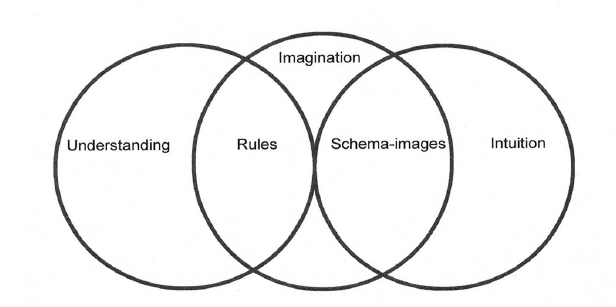
Fig. 1. Kantian mandala of the three major faculties

Kant provides the examples of a dog and a triangle to indicate the steps of how concepts can be made more sensible and intuitions more intelligible.

Heidegger’s Phenomenological Expansion

Kant dropped these insights in the B Edition and Heidegger later thought that was a mistake, because Kant’s work on the imagination in its role of producing knowledge had a profound congruence with the basic structure of phenomenological intentionality. What Heidegger brought into position was the tri-partite dynamics of the intentional structure of meaningful experiences, one of the breakthrough insights developed by Husserl (Heidegger, 1962b & 1997).

In a static, structural sense, phenomenological intentionality is always already of the form that consciousness is consciousness-of-X, and the dynamic aspect is that most experiences, if not all, start with a) emptily intending ‘X’, which pre-experiential, meaningful structure might then b) get fulfilled in an experience, after which c) the identity between the projection and its fulfilment is intended. So, we can emptily mean ‘dog’, then see a dog and then experience that the meaning and the seeing are congruent and the concept dog is applicable.

What Heidegger did, was to overlay the dynamic structure of intentionality onto the dynamics engaged in by Kant’s imagination, such that the imagination is the faculty which can emptily project structures (rules and images), which then can connect with intuitions, which, after their identity is established, is stable enough to affirm or connect with a concept. In this way there is a congruence between:

Kant     :        Imagination                  Intuition          Understanding

Husserl :      Empty intending         Fulfilment       Identity / conceptualization

This insight by Heidegger of lining up Kant’s faculties with Husserl’s intentionality was a tremendous help in deepening my understanding of all three big philosophers involved, including also Ricoeur, whose work on narrative identity and the complex synthesis of emplotment explicitly referred back to Kant’s faculty of the productive imagination as the enabling factor of our more or less fictitious sense of life-span identity.(Ricoeur, 1983: 68 & 1985: 3)

Surprisingly also Heidegger seemed to have dropped these ideas as he moved from phenomenology to a more poetic thinking, though one insightful Heidegger scholar made the case that Kant’s concept of the imagination and Husserl’s concept of empty intentionality did survive in Heidegger’s existential concept of Dasein’s projective possibilities as an integral part of our manner of being-in-the-world.(Richardson, 2004: 153f)

Imagination, Madness, and Creativity

This processing of Heidegger’s phenomenologized Kant also led to an epiphany, which also gave me great help in understanding the role of the projective imagination in the act of philosophizing itself and its intensification and possible derailment in madness.

My rearrangement of Heidegger’s Kant is premised on the idea that the imagination can not only provide a measure of freedom from reality-perception in purely mental endeavors like fiction, fantasies, hypothesis-formation, and running provisional scenarios in one’s ‘inner mind space’, but also provide a creative freedom in engaging in the perception-action cycle relatively free from ideations, like in dance, children’s play, mindless routines, sports and sexuality.

In the following figure the term ‘schema’ replaced ‘imagination’ and a third field of possible experiences and actions is indicated with Truth / Action, in which all three faculties work together

The re-arranged figure looks like this:
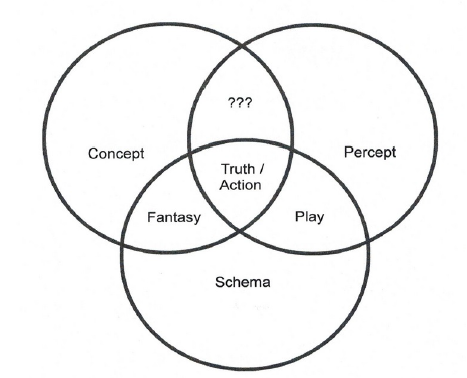
Fig. 2. Simple Three-ring Mandala

In the Truth and Action category one can place all experiences to which all three faculties contribute. Staying with Kant and the early Heidegger, the idea is that truth is a product of the harmonious cooperation of all three faculties. Truth is traditionally conceived as located in a proposition as its truth value, but in phenomenology the concept of truth increasingly shifted towards perception and, in the hands of Heidegger, became identified with the ‘opening’ enabled by the projective faculty of imagination. Following the German-American political philosopher Hannah Arendt, the arguably highest level of action (communal and political) would necessarily bring in the understanding because such action is mostly executed by speech and legislative acts in which conceptual entities like ideals, plans and promises are brought to verbal expression.(Arendt, 1958)

In all three fields of a) inner-mind fantasy, b) enacted play or c) complex truth / action scenarios, we can proceed conventionally and obey the explicit and tacit rules of one’s society; or proceed creatively in a post-conventional manner without getting in trouble; or engage in the mad variations of all three in either a) one’s mind with seemingly delusional ideations; or b) in public with seemingly incomprehensible play-acting; or c) with interventions in other people’s lives or the political arena based on seemingly inappropriate truth claims and proposals.

A Reframed Model of the Imagination

The main point here in connecting this phenomenological framework with madness is that maybe this framework might contribute to a better, or at least different, philosophical understanding of madness in its rootedness in the faculty of the imagination, but then with a deeper understanding of the imagination in its role as the transcendental, a priori enabler of any meaningful endeavor whatsoever, be it fantasy, play, intellectual action, or any of its runaway derangements.

A last thought on the conceptualization of mysticism. All three fields have their own mysticism and some might line up with Kusters’ fourfold differentiation of mystical delusions. In the fantasy field it is the emptying of the mind in Zazen, i.e. a sitting meditation disconnected from perceptual reality in which one tries to empty one’s inner mind space without necessarily deconstructing this space itself. It is a going inside, without necessarily challenging the constituted nature of this inside (aiming at nothingness). In the play field one could put the meditation of mindfulness while slowly moving one’s body and being aware of one’s surroundings (aiming at being). In the action / truth field one could find Heidegger’s mysticism of simple daily life experienced within a poetic opening of being-there. And maybe also Krishnamurti’s call for a post-egoic and non-conceptual way of life might fit in this category (aiming at oneness).

Conclusion

Kusters’ Philosophy of Madness challenges us to rethink madness as more than a pathology to be contained and treated. Instead, it presents madness as a complex and meaningful mode of existence with profound philosophical implications. By drawing parallels with philosophy and mysticism Kusters not only illuminates the fragility of normalcy but also the potential richness of what lies hidden in the psychotic thoughts of the madman.

The exploration of the transcendental faculty of imagination and its capacity to construct meaning, can add to the discussion, presenting a framework where the modes of experience in fantasy, play, and truth/action—and the manner in which all three have quotidian, mystical and mad variations—provide another categorization of human experiences in their complexity.

Ultimately, Philosophy of Madness is a call to embrace the unsettling questions posed by madness as illuminating contributions to understanding ourselves and the world. Kusters invites us to see madness not as a deviation but as a thought-provoking byway of the philosophical journey—a journey that, while risky and not to be recommended, holds the promise of profound insight and possible healing.

Wouter Kusters (PhD) studied linguistics and philosophy, and is an independent scholar and teacher in the Netherlands. He wrote two prize winning books on philosophy and madness in Dutch, and the last one – A Philosophy of Madness: The Experience of Psychotic Thinking – has been translated into English (2021) and Arabic (2023), while a Chinese translation is due to appear this year. His most recent book’s title is in English: Shock Effects: Philosophizing in the Age of Climate Change (2023). For more information, readers can visit his website at: https://kusterstekst.nl/.

Source

This review-essay of Philosophy of Madness was published in the Indian journal, Cetana: A Journal of Philosophy, 5/1 (Jan 2025): 38-58.

Cetana is published by the Centre for Phenomenological Studies.

Sources

Arendt, Hannah. 1958. The Human Condition. Chicago: University of Chicago Press.

Binswanger, Ludwig 1963. Being-in-the-World: Selected Papers of Ludwig Binswanger. Translated by Jacob Needleman. New York: Harper & Row.

—–, —–. 1993. Dream and Existence. Co-authored with Medard Boss, edited by Michel Foucault, and translated by Keith Hoeller. London: Humanities Press.

Boss, Medard 1963. Psychoanalysis and Daseinsanalysis. Translated by Ludwig Binswanger. New York: Harper & Row.

—–, —–. 1965. A Psychiatrist Discovers India. New York: Grune & Stratton.

—–, —–. 1979. Existential Foundations of Medicine and Psychology. Translated by Stephen Conway and Herbert Wehner. Lanham, MD: Jason Aronson.

Foucault, Michel 1965. Madness and Civilization: A History of Insanity in the Age of Reason. Translated by Richard Howard. New York: Vintage Books.

—–, —–. 1973. The Birth of the Clinic: An Archaeology of Medical Perception. Translated by A.M. Sheridan. New York: Vintage Books.

—–, —–. 2006. Psychiatric Power: Lectures at the Collège de France, 1973–1974. Translated by Graham Burchell. New York: Palgrave Macmillan.

Frankl, Viktor E. 1946. Man’s Search for Meaning. Translated by Ilse Lasch. New York: Beacon Press.

—–, —–. 1955. The Doctor and the Soul: From Psychotherapy to Logotherapy. Translated by Richard and Clara Winston. New York: Vintage Books.

—–, —–. 2000. Man’s Search for Ultimate Meaning. New York: Basic Books.

Frege, Gottlob. 1960. “On Sense and Reference”. In: Translations from the Philosophical Writings of Gottlob Frege, P. Geach and M. Black (eds and trans), Oxford: Blackwell, 56-78.

Geniusas, Saulius. 2015. “Between Phenomenology and Hermeneutics: Paul Ricoeur’s Philosophy of Imagination”. Human Studies, 38/2: 223-241.

—–, —–. 2018. “Productive Imagination and the Cassirer-Heidegger Disputation”. In: Geniusas, Saulius & Nikulin, Dmitri (Eds), 2018. Productive Imagination: Its History, Meaning and Significance, London: Rowman & Littlefield International, pp 135-156.

—–, —–. (Ed). 2018. Stretching the Limits of Productive Imagination: Studies in Kantianism, Phenomenology and Hermeneutics. London: Rowman & Littlefield International.

—–, —–. & Nikulin, Dmitri (Eds). 2018. Productive Imagination: Its History, Meaning and Significance. London: Rowman & Littlefield International.

Heidegger, Martin. 1962a. Being and Time. Macquerrie, John & Robinson, Edward (Transl). New York: Harper Collins.

—— . 1962b. Kant and the Problem of Metaphysics. Churchill, James (Transl). Bloomington, IN: Indiana U.P.

—— . 1985. History of the Concept of Time: Prolegomena. Kisiel, Theodore (Transl). Bloomington, IN: Indiana U.P.

—— . 1997 (1977). Phenomenological Interpretation of Kant’s Critique of Pure Reason. Emad, Parvis & Maly, Kenneth (Transl.). Bloomington, IN: Indiana U.P.

Husserl, Edmund. 1964. The Phenomenology of Internal Time-Consciousness. Churchill, James S (Transl). Bloomington: Indiana U.P.

Huxley, Aldous. 1954. “Foreword”. In Krishnamurti, Jiddu, The First and Last Freedom, New York: Harper & Brothers.

Jaynes, Julian. 1976. The Origin of Consciousness in the Breakdown of the Bicameral Mind. New York: Houghton Mifflin Harcourt.

Johnson, Mark. 1987. The Body in the Mind: The Bodily Basis of Meaning, Imagination, and Reason. Chicago: University of Chicago Press.

Kant, Immanuel. 1978. Critique of Pure Reason. Kemp Smith, Norman (Transl). London: Macmillan.

—— . 1987. Critique of Judgment. Pluhar, Werner S (Transl). Indianapolis, IN: Hackett Publishing.

Kisiel, Theodore. 2014. “The Paradigm Shifts of Hermeneutic Phenomenology: From Breakthrough to the Meaning-Giving Source”. Gatherings: The Heidegger Circle Annual, 4: 1-13.

Krishnamurti, Jiddu. 1954. The First and Last Freedom. New York: Harper & Brothers.

Kusters, Wouter. 2022. Philosophy of Madness: The Experience of Psychotic Thinking. Cambridge, MA: The MIT Press.

Laing, R.D. 1960. The Divided Self: An Existential Study in Sanity and Madness. London: Penguin Books.

—–, —–. 1964. Sanity, Madness and the Family. Co-authored with Aaron Esterson. London: Penguin Books.

McVeigh, Brian. 2024. The Self-Healing Mind: Harnessing the Active Ingredients of Psychotherapy. New York: Oxford UP.

Merleau-Ponty, Maurice 1942. The Structure of Behavior. Translated by Alden L. Fisher. New York: Beacon Press.

—–, —–. 1945. Phenomenology of Perception. Translated by Donald A. Landes. London: Routledge & Kegan Paul.

Richardson, William. 2004 (1963). Heidegger: Through Phenomenology to Thought. Fourth Edition. New York: Fordham U.P.

Ricoeur, Paul. 1978. “The Metaphorical Process as Cognition, Imagination, and Feeling”. Critical Inquiry, 5/1: 143-159.

—–, —–. 1979. “The Function of Fiction in Shaping Reality”. Man and World, 12/2: 123– 141.

—–, —–. 1983-88. Time and Narrative. Vols. 1-3. Chicago & London: University of Chicago Press.

—–, —–. 1992. Oneself as Another. Chicago & London: University of Chicago Press.

Schuller, Govert. 2019. The Possibility Conditions of Narrative Identity. Dissertation; Masters in Research in European Philosophy; Dr. Adrian Davis, Research Supervisor; University of Wales, Trinity Saint David, Lampeter, Wales, UK.

Szasz, Thomas 1961. The Myth of Mental Illness: Foundations of a Theory of Personal Conduct. New York: Harper Perennial.

—–, —–. 1970. The Manufacture of Madness: A Comparative Study of the Inquisition and the Mental Health Movement. Syracuse, NY: Syracuse University Press.

—–, —–. 1988. Schizophrenia: The Sacred Symbol of Psychiatry. Syracuse, NY: Syracuse University Press.

Philosophy, Religion, Mysticism and Madness


Introduction

I am still in the middle of reading Wouter Kusters’ phenomenal Philosophy of Madness: The Experience of Psychotic Thinking. This book is a must read for all interested in philosophy, mysticism and madness, and those who are open to the disturbing closeness, even overlap, of all three, like Kusters’ ideas that: Philosophy is controlled madness; Madness develops its own philosophy, which is not necessarily mad; Monist philosophies push you to mysticism, which can take a turn into madness when you see too many connections; Madness could be cured with a better, less verbal and imaginary mode of mysticism. The book is a true cornucopia of well-developed crossings and relevant to all interested in the emerging practice of philosophical counseling.

I read a big chunk of the book in mid-January at a six hour transfer at Mumbai airport, tired and high on caffeine in a sea of strangers, with some staring at me with seemingly benign wonder. Usually I’d feel uncomfortable in such a setting, but the book has a very calming effect, because, I think, the writer has something very important to share; something he knows literally inside-out as he has lived through two psychotic episodes, and takes great care to formulate. He even shares chunks of his psychotic, stream of consciousness thinking, which are funny, absurdist, fascinating, meaningful narratives.

The Instability of Inner Time-consciousness

A special spot in the book is reserved for Husserl’s phenomenology of inner time-consciousness, one of the deepest reflections on the possibility conditions of conscious experience, and in Kusters’ writing a handy tool to understand both normal and psychotic experiences.

How do we keep consensus reality running in a semi-chaotic flow of events? And what happens when that breaks down and a psychotic manner of meaning-construction takes over? How can we best understand the interplay between memory, the just-passed (retention), the present, the just-to-come (protention) and expectations in the construction and change of reality? Kusters makes good use of the idea that much can be learned from things going wrong, like Heidegger’s broken hammer and the unfortunate cases Merleau-Ponty looked into to understand behavior at its most basic moments of constitution.

Descriptive phenomenologies of madness and curative existential psychotherapies have earlier been developed by Merlau-Ponty, Michel Foucault, Thomas Szaz, Ronald Laing, Ludwig Binswanger, Meddard Boss, Viktor Frankl and quite some others, and Kusters can probably be placed in this category. Arguably he moved the investigation a couple of notches further.

For another step into understanding the genesis of madness I would connect the issue with Kant’s faculty of the productive imagination, which does not result necessarily in sane, justified knowledge, and actually could explain the highly productive, but not necessarily intelligible imagination operative in madness.

This highly intriguing and explanatory faculty got muffled away in the B version of the Critique of Pure Reason, only to be saved by Heidegger but for a few years just after he wrote Being and Time and developed a phenomenological reading of Kant.

Recently the faculty of productive imagination made a come-back with the work of Saulius Geniusas. Paul Ricoeur connected it with narrativity, the very effective epistemic device involved in identity-formation, a theme mentioned by Kusters and to which I devoted my master thesis.

Jaynes’ Take on Madness

The subject matter also connects with an impromptu paper I delivered a week earlier at this yearly philosophy conference which was started in 1925 by Nobel laureate Tagore and philosopher and first president of India, Radhakrishnan. One of its themes was the restoration of the ecosystem. This year it was hosted by the Mahatma Gandhi University, Wardha, Maharashtra, where Gandhi had his ashram from 1936 till his assassination and where he proclaimed the ‘Quit India’ movement. We visited the enchanted place, which was silently inspiring.

I titled my presentation, for which I got ten minutes, “The Future of Consciousness: Is Krishnamurti its Prophet?” It incorporates the ideas of Julian Jaynes, who also has some profound insights about the connection between madness and religion.

For Jaynes a lot of religious practices and manners of madness are triggered by a regression in (or by) the brain to an earlier ‘architecture’ he named bicameral, which was prevalent in the Bronze Age. This architecture had us humans obey Auditory Command Hallucinations (ACH) either originating in ourselves or in our superiors like kings and priests. It was the gods talking to us like in Homer’s Iliad with little to no space for disobedience and deliberation.

According to Jaynes the ACHs originate in the right hemisphere of the brain and travel over the corpus callosum to the other side where its messages are received as if coming from outside. Ergo him naming it ‘bicameral’.

This ‘mentality’, ‘mind-set’, or ‘architecture’ increasingly disappeared with the onset of our modern sense of consciousness around 1,500 to 1,000 BCE, with its socially constructed, introspectable, inner mind space, in which metaphorical room we move around a fictive me in different scenarios in order to think through and feel out possible courses of action.

The speculation is that at the end of the Bronze Age many cultures clashed and the authorities led by ACHs didn’t come up with very viable strategies. People had to literally figure things out for themselves, which ‘selves’ had to be constructed from scratch in the process, something we experience also in our own development at around age 5 or 6. This egoic awareness comes with a lot of personal choices and uncertainty, and can be made more certain by applying science and rationality.

It also has a backward-looking inclination aimed at reviving the bicameral mind and its authority through religious practices like divination, ecstasies, oracles, enthusiasms, mediumship, channeling, etc. to trigger variants of command hallucinations, coming from gods, God, angels, masters or other imagined meta-empirical beings. It also derails in forward-looking hyper-individualism, scientism, technologization, ego-centered small-mindedness, neoliberalism, and the current state of global civilization on its way to economic and environmental doom.

Sustainable Future?

And what has this to do with Krishnamurti and the restoration of the ecosystem? Well, I am starting to make the claim that egoic consciousness, as it started just three thousand years ago, has gobbled up all civilizations and tribes (whether bicameral or pre-bicameral) into its egoic mentality and civilizational structure named ‘central civilization’, now in its global phase (Wilkinson, 1987).

This mentality and its social organization has an inbuilt vector towards disaster, which can only be challenged by a wholly different conscious architecture, of which Gautama might have been one of the earliest proponents and Krishnamurti one of the clearest later ones, with who knows how many in between. It might be this architecture which will have the required post-egoic structure and intelligent sensitivity to create a truly sustainable and just society. But that might need another 200+ years to break through to effective scale. Before that, I am sorry to say, brace yourselves.

Sources

Binswanger, Ludwig 1963. Being-in-the-World: Selected Papers of Ludwig Binswanger. Translated by Jacob Needleman. New York: Harper & Row.

—–, —–. 1993. Dream and Existence. Co-authored with Medard Boss, edited by Michel Foucault, and translated by Keith Hoeller. London: Humanities Press.

Boss, Medard 1963. Psychoanalysis and Daseinsanalysis. Translated by Ludwig Binswanger. New York: Harper & Row.

—–, —–. 1965. A Psychiatrist Discovers India. New York: Grune & Stratton.

—–, —–. 1979. Existential Foundations of Medicine and Psychology. Translated by Stephen Conway and Herbert Wehner. Lanham, MD: Jason Aronson.

Foucault, Michel 1965. Madness and Civilization: A History of Insanity in the Age of Reason. Translated by Richard Howard. New York: Vintage Books.

—–, —–. 1973. The Birth of the Clinic: An Archaeology of Medical Perception. Translated by A.M. Sheridan. New York: Vintage Books.

—–, —–. 2006. Psychiatric Power: Lectures at the Collège de France, 1973–1974. Translated by Graham Burchell. New York: Palgrave Macmillan.

Frankl, Viktor E. 1946. Man’s Search for Meaning. Translated by Ilse Lasch. New York: Beacon Press.

—–, —–. 1955. The Doctor and the Soul: From Psychotherapy to Logotherapy. Translated by Richard and Clara Winston. New York: Vintage Books.

—–, —–. 2000. Man’s Search for Ultimate Meaning. New York: Basic Books.

Geniusas, Saulius. 2015. “Between Phenomenology and Hermeneutics: Paul Ricoeur’s Philosophy of Imagination.” Human Studies, 38/2: 223-241.

—–, —–. 2018. “ Productive Imagination and the Cassirer-Heidegger Disputation“. In Geniusas, Saulius & Nikulin, Dmitri (Eds.). 2018. Productive Imagination: Its History, Meaning and Significance. London: Rowman & Littlefield International. 135-156.

—–, —–. (Ed). 2018. Stretching the Limits of Productive Imagination: Studies in Kantianism, Phenomenology and Hermeneutics. London: Rowman & Littlefield International.

—–, —–. & Nikulin, Dmitri (Eds). 2018. Productive Imagination: Its History, Meaning and Significance. London: Rowman & Littlefield International.

Heidegger, Martin. 1962. Being and Time. Macquerrie, John & Robinson, Edward (Transl). New York: Harper Collins.

—–, —–. 1997 (1977). Phenomenological Interpretation of Kant’s Critique of Pure Reason. Emad, Parvis & Maly, Kenneth (Transl). Bloomington, IN: Indiana UP.

—–, —–. 1962. Kant and the Problem of Metaphysics. Churchill, James (Transl). Bloomington, IN: Indiana UP.

Husserl, Edmund. 1964. The Phenomenology of Internal Time-Consciousness. Churchill, James S. (Transl). Bloomington: Indiana UP.

Jaynes, Julian. 1976. The Origin of Consciousness in the Breakdown of the Bicameral Mind. New York: Houghton Mifflin Harcourt.

Kant, Immanuel. 1978. Critique of Pure Reason. Kemp Smith, Norman (Transl). London: Macmillan.

Kusters, Wouter. 2020. Philosophy of Madness: The Experience of Psychotic Thinking. Cambridge, MA: MIT Press.

Laing, R.D. 1960. The Divided Self: An Existential Study in Sanity and Madness. London: Penguin Books.

—–, —–. 1964. Sanity, Madness and the Family. Co-authored with Aaron Esterson. London: Penguin Books.

—–, —–. 1970. Knots. New York: Random House.

Merleau-Ponty, Maurice 1942. The Structure of Behavior. Translated by Alden L. Fisher. New York: Beacon Press.

—–, —–. 1945. Phenomenology of Perception. Translated by Donald A. Landes. London: Routledge & Kegan Paul.

Ricoeur, Paul. 1978. “The Metaphorical Process as Cognition, Imagination, and Feeling.” Critical Inquiry, 5/1: 143-159.

—–, —–. 1979. “The Function of Fiction in Shaping Reality”. Man and World, 12/2: 123– 141.

—–, —–. 1983-88. Time and Narrative. Volumes 1-3. Chicago & London: University of Chicago Press.

Schuller, Govert. 2019. The Possibility Conditions of Narrative Identity. Dissertation; Masters in Research in European Philosophy; Dr. Adrian Davis, Research Supervisor; University of Wales, UK.

—–, —–. 2022.  “The Future of Consciousness: Is Krishnamurti Its Prophet?”. Presentation at the Indian Philosophical Congress (IPC), Mahatma Gandhi Antarrashtriya Hindi Vishwavidyalaya, Wardha, Maharashtra, 30 Dec 2022.

—–, —–. 2024. “The Future of Central Civilization: Historical Cycles and the Path Forward”. Presentation at the 2024 American Monetary Institute Conference, 29 Sept 2024.

Szasz, Thomas 1961. The Myth of Mental Illness: Foundations of a Theory of Personal Conduct. New York: Harper Perennial.

—–, —–. 1970. The Manufacture of Madness: A Comparative Study of the Inquisition and the Mental Health Movement. Syracuse, NY: Syracuse University Press.

—–, —–. 1988. Schizophrenia: The Sacred Symbol of Psychiatry. Syracuse, NY: Syracuse University Press.

Wilkinson, David. 1987. “Central Civilization”. Comparative Civilizations Review, 17/17: Article 4. Also in: Sanderson, Stephen K., 1995, Civilizations and World Systems: Studying World-historical Change, Lanham, MD: Rowman Altamira, pp. 46-74.

President Trump should be submitted for a Psychiatric Evaluation


The assassination of the Iranian general Soleimani is almost certainly not because of some geopolitical strategic calculus by Trump. Two reasons will back up this observation. One, Trump is according to many mental health professionals not capable of such reasoning anymore and, two, according to many geopolitical analysts the risks far outweigh the advantages for the assassination to be a rational act.

The more plausible explanation is that the assassination satisfies a narrow set of Trump’s political and psychological needs which have to do with his impeachment for abuse of power and obstruction of congress. Both charges are increasingly backed up by daily revelations and pressure is building on the Senate to conduct a fair trial, which will mean even more revelations.

And for good measure, put on top of that the recent reporting that Deutsche Bank bailed out Trump because its massive loans were guaranteed by a Russian bank with links to the Kremlin. This happened when no other bank would extend Trump any credit anymore because of his serial bankruptcies. 

So, Trump is cornered and understandably feels frustrated and angry because the gig is maybe soon up. Killing an important and easy target to blow of steam and regain some feeling of power then makes sense and at the same time it will divert conveniently everybody’s attention away from the impeachment trial to the more dramatic confrontation with Iran. If that is the pathetic level of his strategic thinking we are in deep trouble as there is no other more sane strategy in place to direct the coming escalatory process towards a reasonable strategic result. 

The above line of reasoning is suggested again by the mental health professionals who have had the skill and courage to publicly share their insights to warn the world of the present and acute danger of Trump’s warped mental capacity. At this moment their most outspoken member, Dr. Brandy Lee, is actually pleading for  people in Trump’s political vicinity, like speaker Pelosi, to demand a “mental health hold” on Trump to have him psychologically evaluated.

Dr. Lee stated in an interview that “As a co-worker, she [Pelosi] has the right to have him submit to an involuntary evaluation, but she has not. I am beginning to believe that a mental health hold, which we have tried to avoid, will become inevitable.”

This of course is unprecedented and extraordinary to ask for a sitting president to be submitted to, but, if you have paid attention to the question regarding Trump’s mental health, this is what a sane community would do to take care of one of its less sane members, especially when that person poses a clear threat and has extraordinary powers to do harm through, what experts call, Trump’s “narcissistic rage”.  


https://www.salon.com/2020/01/04/yale-psychiatrist-urges-pelosi-request-72-hour-mental-health-hold-on-trump-after-iran-attack/

https://www.vox.com/science-and-health/2018/1/5/16770060/trump-mental-health-psychiatrist-25th-amendment

https://www.newsweek.com/trump-general-soleimani-obama-benghazi-iran-1480389

https://www.cnn.com/middleeast/live-news/us-iran-soleimani-tensions-live-intl-01-05-20/

https://www.npr.org/2020/01/05/793746580/iraqi-parliament-votes-to-expel-u-s-troops-from-country-in-wake-of-soleimani-str

Human Causes of the Economic Crisis and Spiritual Solutions

A Seeker Speaks / Thursday, November 27, 2008 / Steve Larsen

In recent months, we have seen unprecedented upheavals the US as well as the global economy. Big banks have fallen, as have insurance companies and brokerage companies followed by huge losses in the stock market. It is estimated US citizens have lost over a trillion dollars in their pensions and 401K plans. As matter of fact, I know a number of families, including our own, whose 401K funds were diminished by 20% or more in a matter of a few short days.

The government’s response, which was supported by both presidential candidates, is notable in that it chose not to address the underlying causes of the crisis, but rather to prop up a failing system with its 700 plus billion dollar bailout. Yet it could have chosen another route and that is to take a serious look at what really is wrong with our economic system and what can be done to fix it.

The fact that the government did not do this, however, really is not surprising as the public at large is generally unwilling to face these problems themselves. Of course, those who have the most to lose in all this – the big banks, brokerage companies, insurance companies and various conglomerate institutions who comprise what might be called the financial or power elite in America certainly don’t want to address the causes as they have a vested interest in keeping the system running just the way it has been – with the deck stacked decidedly in their favor.

The symbiotic relationship between the haves and the have-nots
This unwillingness to look at systemic problems of this nature is essentially a spiritual problem. Jesus talked about the necessity of taking the beam out of our eye as an essential part of our spiritual growth. This means being willing to fearlessly examine any and all conditions that prevent us from seeing the truth about ourselves, society and all its institutions, customs and mores. And then do what’s necessary to replace our incomplete and/or distorted ideas with a higher understanding.

And regarding the current crisis, while there certainly has been outrage at the government’s actions and actions of the financial elite, it wasn’t enough to carry the day to prevent the bailout from happening. And so far, it hasn’t been enough for most people to seriously question the modus operandi of the economic system itself. For many, the current system cannot be challenged as it is seen as unpatriotic and un-American. They equate the current economic system – which as we will see has been designed by and for the elite – as equivalent with free enterprise. Thus for many the system is a sacred cow that cannot be examined for fear that it might be undermined or compromised and with it the American way of life.

Einstein defined insanity as doing the same thing over and over while expecting different results. If our economic system has failed so miserably this time and in years past (think the Great Depression as well as the never ending cycles of inflation and recession) why then do people insist on doing the insane thing of not questioning what is clearly not working? I submit it’s because they have a vested interest in maintaining the status quo and therefore dare not question the beam in their own eye which prevents them from seeing the futility of their actions. And in regards to the economy, what is the nature of the beam that blinds us?

Before addressing this, we need to establish the fact that economically and spiritually speaking, there are two general groups of people. There is the 2 percent of the population that controls 98 percent of the wealth in this country – whom I call the power elite – and then there is the rest of us. Please note that when I discuss the concept of the power elite, my purpose is not to emphasize individuals who comprise the elite, but rather my focus is on the mindset or consciousness behind it.

By and large the power elite are untroubled by the fact that they hoard the wealth. It doesn’t bother them that two thirds of the world’s population lives in poverty while they have great wealth. Why? It’s because they need this disparity to maintain the illusion that they are better or superior to the normal people. This desire stems from the free will choices that many have made to cut themselves off from God – as they think they know better than God – and with it the abundant life that is given freely to all. And to maintain the illusion that they know better than God, they do all they can to keep God from acting in the earth.

Nevertheless, without this connection to God, they feel incomplete. Thus, they obtain a temporary reprieve from the gnawing sense of unwholeness by gaining a relative advantage over the people by acquiring more power, money, privilege, prestige, wealth, etc. compared to the masses. They also maintain the sense that they know better than God because they can demonstrate how powerful they are without God’s help. But their gain over us is always relative. And when it comes to money, they feel superior when they can reduce the amount of abundance we have compared to them. When we are lowered in economic stature they are raised in stature – relative to us. They do this even at the expense of lowering the total amount of wealth on this planet. For by keeping the people down, the built-in natural flow towards greater abundance is thwarted.

Yet the power elite can not maintain this sense of superiority in a vacuum. They need the regular people to play along with their illusion of superiority in order to sustain it. The regular people, however, generally do not have a desire to feel superior to others but rather they have the polar opposite need to feel inferior to the power elite. They have a subconscious belief that the power elite will take care of them. The regular people are happy that they don’t have to worry about running the economy because after all it’s too complicated and so they are grateful that the people whom they perceive to be higher than them will mange the economy so they don’t have to think about it.

Unfortunately, the people have entered into a mindset of an idolatry of the elite and so they believe that we must not let the elite fail. And so the government bailout of huge financial institutions and more recently the push for the bailout of the auto industry are acceptable to many due to the blindness of idolatry.

The central dynamic here causing this sense of idolatry is that the regular people on earth have also – to greater or lesser degrees – cut themselves off from God’s natural abundance. Not because they don’t believe in God or that they feel superior to others but rather because they don’t want to be responsible for making core decisions in life. They refuse to take dominion over their part of the earth and therefore the power elite are all too willing to do that for them.

So in the end, the people do not want to open the Pandora’s box of the money system as they are afraid that ultimately this will mean they have to make crucial decisions about it and thus be responsible for it. And this is something they have avoided for much of their sojourn here on earth. Instead, many people have been running more or less in an unquestioning automatic pilot mode. So you can see here that ignorance really is bliss – our ignorance (ig-nor-ance) is the power elite’s bliss.

To sum up, the power elite need the regular people to be in lower economic state so they can feel superior to them. The regular people have a need to feel inferior to the elite so they don’t have to take responsibility for themselves and the economy. Both groups have an interest in maintaining the status quo to prop up their unholy alliance. The power elite are the blind leaders. The regular people are the blind followers. The result is asymbiotic relationship between the blind leaders and blind followers that has lead to the fact that both groups have now fallen into the ditch of the current economic crisis.

So how do we break this gridlock between the two groups? I believe that like many things, knowledge is the key. As it says in Proverbs, “with all thy getting, get understanding.” I believe people will be far less fearful of challenging the elite if they are armed with correct information. Because when they truly understand what is going on, they will see that the elite only have as much power over people as we are willing to give them. Truly the elite are like the emperor without any clothes where the illusion of clothes was only maintained by those who wanted to see it that way.

Why am I suggesting that it is the people that must change and not the elite? Two reasons: First, the people have far more to gain (at least in the short term) from constructive change in the economy than the elite do. Second, the elite are typically too selfish, rebellious and proud to be open to positive changes that benefit everyone and not just themselves. This doesn’t mean the elite cannot change, but being a realist I think the probability of them changing in the near future is in fact very small.

Multiplying our talents to produce economic growth
One thing we need to understand about God’s design of the matter universe is that there are built in natural forces that move things forward even without our intervention. For example, there are built in evolutionary forces that drive species towards diversity and greater complexity. There are also built in economic forces that lead to greater and greater abundance in the earth. The main factor is that mankind simply needs to understand the principles behind this increase in abundance in order to flow with its tide rather against it by blocking its flow.

I could see how this could very well be a bit of a surprising statement to many. This is because most of us been programmed to believe that lack is the natural order of things and that there simply isn’t enough for everyone. As we’ll see later, this is a belief that has been perpetrated by the elite to block the flow of our abundance so they can maintain their relative superiority over us.

Of course right now it’s not so easy to see this natural economic force at work. However, if you look at two thousand years ago as compared to today, there is no doubt we experience a far greater amount of material abundance and a higher standard of living today then for example when Jesus walked the earth. So we must be doing something at least partially right, so what is that something?

Jesus’ parable of the talents eloquently expresses the main dynamic here. In this parable three servants are given varying amount of talents by a king and are told to go out and use those talents to the king’s benefit. Two of the three servants increased the talents which were then multiplied by the king saying to them “well done thou good and profitable servant, thou has been faithful over a few things, I will make thee ruler over many.” However, the third servant was fearful of the king and instead hid his talent in napkin whereupon the king promptly dismissed him as “unprofitable.”

The lesson here is that God has designed the universe in such a way as to increase our abundance. The principle is that when we put forth the effort to increase our own talents God multiplies all our talentsaccordingly. This is how individuals, society and economies grow and prosper.

Regarding economics, there are essentially three types of efforts that produce this multiplication effect:

1. Putting forth labor to produce goods or services.
2. Introducing new ideas, inventions and systems
3. Investing time, energy or money in endeavors that stimulate the first two. In other words taking some risk to promote economic projects even though you can’t be a certain of a return.

Any one of these three separately or in combination can have the effect of more abundance being created on earth. The fact that there is a greater material wealth on earth today than centuries ago proves the point that there is not a fixed amount of abundance on this planet and that God has multiplied it in accordance to the efforts we’ve put forth.

Yet even though the standard of living is higher today than ages past, many people are still living paycheck to paycheck, struggling to get by, and many others are still living in abject poverty. If there is a built in force in nature to increase abundance, why are so many people not experiencing this increase?

The answer lies in understanding how money works and how the money system can be turned on its head to benefit the few and not the many.

Money as an instrument
It has been said that money is the root of all evil. But if you also look at the good that has been accomplished through the use of many we can see that this is not a balanced statement. A more nuanced approach sees that money can be used for both good and evil and therefore is a tool for either and not the cause of it. I would say, however, that the love of money for its own sake is evil as we see shortly.

Money can be seen as a tool for economic transactions. As such, it has two primary functions:

1. As medium of exchange for goods and services
2. As a short term storage of value

In the ideal economy, the purpose of money is seen as a tool and not and end in itself. For money to flow properly, the amount of money in circulation should be roughly equal to the amount of goods and services currently produced in the nation or economic system. Also, money is meant to keep flowing and should not be hoarded. It serves as a temporary storage of value because it is meant to circulate through the people somewhat like blood in our veins.

In the ideal, spiritual economy, there is essentially a one-on-one relationship between the amount of money and the amount of something that has real actual value, be it goods or services. Or even, in the case of gold money, that the gold itself has a certain value. So the point here is there should always be a direct relationship between money and something that has real value. 

And when people actually multiply their talents, they can, as a result of that multiplication, accumulate a certain amount of money which they can then choose to store for times when they may not be able to make the money. Even this is legitimate, as long as the money was created as a result of providing a real service to life, be it an invention, taking the initiative, or performing physical labor. There is nothing wrong with storing that money. Even so, it is only when it is put to use in investing will it will help the economy grow. And thus, savings should really only be a temporary thing and should not mean that the money is permanently taken out of circulation.

For money is indeed meant to flow and thereby help the entire economy grow.But you see when there is a direct correspondence between money and something of real value, it is not possible to create money out of nothing, money that has no real value associated with it. And that means that even though the money supply can grow, the value of money is not degraded, for you still only have the money needed to buy goods and services.

And therefore, in a spiritual economy, you can actually have a society that has a steadily growing economy and a steady increase in the money supply without actually having an increase in the prices of goods and services. For why would we need an increase, when you do not have excess money that has no correspondence to real value? You still only have the amount of money needed to exchange goods and services, which means that the value of the money – what you can buy for that money – will remain constant.

For an example of a correct use of the money system, we need to look no further than the colonial economy prior to the revolutionary war. During this time, Ben Franklin gave a speech before British Parliament where he outlined the remarkable prosperity of the American colonies. He attributed this economic success primarily to the fact that there was only enough money printed to make the transfer of goods and services possible.

Franklin remarked: “In the Colonies we issue our own money…in proper proportion to make the products pass easily from the producers to the consumers. In this manner, creating ourselves our own paper money, we control its purchasing power, and we have no interest to pay to no one.”

During his speech, he maintained that there was very little unemployment, the public was well educated and the people were happy. The British were stunned and even outraged upon hearing this news and in response, quickly imposed their dysfunctional economic system (run by a Central bank) upon the colonies. The predictable result was that in a very short time the colonies experienced an inevitable economic decline. Franklin himself cited the imposition of the British money system as among the primary causes of the revolutionary war.

Although the success was short lived, it did demonstrate that an economy could prosper based on principles mentioned above. Certainly the Americans were industrious and ingenious and thus their efforts were multiplied accordingly. Secondly, they only printed enough money – called Colonial script – to grease the wheels of the economy – and no more. Thus there were no cycles of inflation and recession because there was not the intervention of the elite to create the conditions for such aberrations of the natural economic order to occur. Here we had the makings of an economy that was of the people, by the people, and for the people as opposed to of the elite, by the elite and for the elite. So how did the elite manage to create the economic conditions that benefit them to the total disregard of others?

Undermining the money system
Although the power elite have had their influence and grip on society throughout all recorded history, it is helpful to begin this discussion of the modern economic system during the middle ages and the feudal society.

In those days, the power elite were able to suppress and control the people through physical coercion. Anyone who rebelled against the system found themselves against the strong arm of unjust laws. Here, instead of multiplying their own talents, the people were basically slaves who worked so the nobility could maintain their privileged status. The power elite designed the system in such a way to reap the rewards of other people’s labor – basically reaping without sowing and thus stealing from the people. They were also in the mindset of getting something for nothing. Both of these conditions – reaping the reward of other people’s labor and wanting something for nothing – are two primary perversions of the natural economy and the money system that continues to this day. Essentially the power elite in that day as in the present see the people as worker bees whose main purpose is to provide them with lifestyle, shall we say, of the rich and famous.

Creating money out of nothing
Although this unjust system was in place for centuries, from the power elite’s perspective, there was a fundamental flaw in its design. Namely, when people are physically forced into a type of slavery they can’t help noticing that they are in fact enslaved. This will inevitably lead to rebellion and eventually did lead to the undoing of the system. The elite eventually recognized that it was far better for them to enslave people in such a way that they don’t notice that they are enslaved. And so this is what they did.

Centuries ago when the European kings began to go to war against each other, they realized they didn’t have the financial means to do it. So where did they get the money? Well around the same time, a concurrent but related development evolved which served the kings purposes. This development came from the fact that gold smiths (merchants who stored gold for a fee) in that day began lending out the gold in their reserves. They soon discovered that it was highly unlikely that all the gold in their reserves would ever be lent out at the same time – so they began to secretly lend out more gold than they actually had in their reserves and charging interest on it as well. This eventually led to writing promissory paper notes against these reserves which became the forerunners of the modern economic system known as fractional reserve banking.

Knowing that the kings needed money to finance their wars, these financiers convinced the kings to solve their financial problem and finance their wars by taking out loans from them. The loans themselves consisted of money that these financiers created out of nothing. What’s more, on the advice of these money changers, the king declared that this new money created out of nothing – or fiat money or money by decree – needed to be accepted by the king’s subjects as legal tender.

The result was that there was now more money in circulation than was needed to facilitate the transfer of goods and services. There was no longer a one to one correspondence between money and something of real value. The effect of this is that prices invariably go up – for three primary reasons:

1. There is now more money chasing after the same amount of things of value.
2. The first to receive the newly printed money – the power elite – bid up the prices of commodities as they compete for them while prices are still relatively lower.
3. The money changers charge interest on money created out nothing which can be viewed as an added tax on all commodities purchased through the loans.

The devaluation of the people’s labor
The problem with this back then which has continued to this day is that the effect that too much money in circulation disassociated from something of real value is that the value of the people’s labor is degraded. This is because when the price of goods and services goes up, people still only work x number of hours for x amount of dollars. So at the end of the day, their money simply doesn’t buy what it did before there was the influx of money into the system. This is why people have to work harder and harder just to make ends meet. They don’t understand why this is happening, they only know that their money doesn’t stretch like it used to and so they have to roll up their sleeves and work harder just to stay afloat.

So this is how the rich get richer and the poor get poorer. The rich are the first to get the newly printed money before prices increase and before these increases filter through the economy and effects the prices of all goods and services. This gives the power elite the advantage of purchasing commodities at lower prices than the rest of us enabling them to acquire more and more while the people struggle for a smaller and smaller portion of the pie. So essentially what what has been going on for centuries is a hidden but nonethelessmassive redistribution of wealth from the poor and middle class to the weathiest of the wealthy. Americans tend to get up in arms, and rightly so I might add, when socialists attempt to forcibly redistribute the wealth from rich to the poor. However, few protest when it is the other way around, as it has been for hundreds if not thousands of years on this planet.


War and hidden taxes
So this increase in prices and the degradation of the value of the people’s labor was and remains to this day ahidden tax on the people to accomplish the objectives of the power elite. This is how most of the wars for the last several hundred years have been financed. If the leaders went to the people and told them they would have to be taxed to finance their wars, the people would likely revolt and the taxes would not be levied and wars would not be fought. Yet because the tax is disguised as inflation, the people don’t notice they are being taxed because it doesn’t appear on their tax bill or paycheck. They only notice they have to work harder and harder for less and less – then the power elite have a far better chance of getting them to not only finance their wars, but to fight in them as well.

For example, do you think in 2003 if George Bush would have went to the people and told them that everyone in the United States would be taxed, say, $2,000 to finance the war in Iraq – a war that many people were unsure about – that the people would have approved this? Not likely. So instead of taxing the people, the power elite (in the form of the US government) simply fired up the money machine and created money out of nothing to finance the Iraq war as they have done for hundreds of years.

In fact, if you want to look for the driving engine behind wars, follow the money trail. If you do, you’ll see that in most cases wars are funded by banks are other financiers who often times fund both sides of any given conflict. For example, although there was supposed to be a great ideological divide between capitalism and communism, it is a not so well known fact that the Bolshevik revolution and the subsequent build up of the Soviet army (as well as the US military build up in response) was funded in part by Wall Street and other powerful interests in the West.

And when it comes to war, the power elite are able to convince the people to fight them because of some supposed differences over ideology, race, religion, land, politics, resources etc, but it is always the people who fight the wars and not the elite. Most wars are in fact, the result of infighting among the power elite where a dominant elite is being challenged by one or more aspiring elite groups or when any of them want to expand their power over the people. The power elite use the age old strategy of divide and conquer to get the people to fight their wars for them. Once again, the people suffer at the expense of the elite’s gain. And the people doubly suffer because ultimately war cannot produce something of value it only destroys something of value, e.g., the destruction of people lives, their livelihoods, their land, property, means of production, culture and entire way of life.

Another advantage for the elite is that when they fund wars, they know that governments are willing to spend far more to achieve their ends then when not at war. Once again, when war is on the horizon, follow the money trail and you’ll often find the true cause behind most military conflicts.

And of course there are many occasions where the elite create money of nothing to fund government programs that are not war related. In that case the dynamic is the same; the people pay a hidden tax when the government does not want to tax us directly thereby stealing from the people the value of their labor. For example, where do you think the money came from for the recent stimulus package, or for that matter the financial bailout of Wall Street? It of course came in the usual manner of rolling the printing presses and then charging interest on the money created out of nothing which has the inevitable inflationary effect of devaluing the people’s labor and purchasing power.

Underwriting the dysfunctional economy
One would think that if the power elite consistently created money out of nothing that the resulting inflation would eventually make all money virtually worthless. This has in fact happened in the last century in pre-Nazi German and later in Argentina where it took a wheelbarrow full of money to buy goods. The money wasn’t worth the paper on which it was printed proved by the fact that some even burned it for fuel. Incidentally, during the 1800’s and for 100 years thereafter Argentina relied on a gold standard to back their money supply and never had these problems. It was only when they switched to a fiat based money system that they did experience the severe inflation and the devaluation of people’s labor.

Yet for the most part, the western economies have managed to avoid this calamity (though with far less abundance then there could be) essentially because it is the hard working people who have, so to speak, underwritten the money system of the power elite. What has happened is that regular people, those who do not believe in getting something for nothing, have actually multiplied their talents and have thereby have managed to keep the power elite’s economy limping along to a greater or lesser degree.

So through the multiplication of our talents, we have all been underwriting or you might say enabling the power elite’s economy and thus it hasn’t totally collapsed. And if it weren’t for this fact, this economy would have done so centuries ago. This is because the greed of the elite who control the money supply and policy will not stop until they have killed the goose that laid the golden egg – which is the industry, creativity and ingenuity of the people.

The Federal Reserve – of the elite, by the elite and for the elite
In one sense, the history of the United States is the story of who controls the money supply – the people or the elite. Although America had the historical example of unrivaled success of the colonial economy, with the influence of Alexander Hamilton and financier Robert Morris, they chose to implement a system that incorporated a strong central bank as the backbone of the economy. This despite the fact that the Constitution stipulates that only Congress should have the power to print money. To me this was an effort by the framers of our constitution to ensure accountability to the people inasmuch as they are represented by Congress. Yet the United States nevertheless sided with the banking interests in forming their monetary policy. This virtually ensured that at least to the degree that banks and special interests were unaccountable; they would most assuredly manipulate the supply of money for their own selfish purposes.

Prior to 1913 however, there wasn’t a Central bank quite like the Federal Reserve. In fact, the control of the money supply went back and forth eight times between the bankers and the government before to this date. There was in fact the first National Bank of America founded in 1790, the same year that the European monopolist banker Mayer Amschel Roschild boldly declared: “Give me control of a nation’s money and I care not who makes the laws.” This system had the predictable effect of causing cycles of inflation and recession.

The Central bank was in power up until the time of Andrew Jackson who after great political battles in the 1830’s was able to root out of the Central bank and return the power of creating money to the government. During this fight for the money supply, the gold standard was put in place to a certain degree and did have some positive effect on balancing the economy. Even so, the fiat system was still the primary method used to create money as the Central banks still had significant reigns on the economy even if they weren’t officially sanctioned by the US government. This of course resulted in a number of economic downturns and debacles, including but not limited to the following:

Panic of 1797-1800
Depression of 1807-1804
Panic of 1837-1843
Panic of 1857-1860
Panic of 1873-1879
Panic of 1893 -1896
Panic of 1907-1908

Supposedly, the Federal Reserve was created to prevent these economic meltdowns. Yet since it’s inception in 1913, we have seen the following:

Recession of 1920 -1921
Great Depression of 1929 -1939
Recession of 1953
Recession of 1973 -1975 during the oil crisis
And of course the crash of 2008

It’s obvious that the Fed has failed to live up to its goal of preventing such calamities. So what is the Federal Reserve and what are its real purposes?

First off, we need to understand that the Federal Reserve is not Federal and it really has no reserves. From its inception the Fed has been and still is a consortium of unelected private bankers – whose identities are largely unknown – who are therefore unanswerable to the people. I’m sure you’ve noticed, for example that no one cast a vote to make Alan Greenspan or Barnard Bernanke chairmen of the Federal Reserve as this is an appointed position.

There are no reserves in that there is no backing for the money that the Fed creates out of nothing. The only backing is the implicit promissory note of American people to keep multiplying their efforts to keep the money machine afloat. The only backing is the perpetual burden of taxation placed on the American people to fill its coffers with money. For without their effort and these taxes, the Fed and the entire economic system would surely collapse under its own corruption.

It was brought into being by a secret meeting of private bankers and politicians on Jekyll Island in Georgia and later stealthily slipped through legislature on December 23rd 1913 when most representatives had gone home for the holidays. In fact there wasn’t even a quorum present when it passed the Senate.

So the entire enterprise was based on a deception of the American people. And as I said, it really is not a branch of the government. In reality, the Federal Reserve is an instrument of the power elite that serves three main purposes:

1. To enforce the fiat money system where money is created out of nothing, lent to the Federal Government, the interest of which is then placed on the backs of the American taxpayers.
2. To control the money supply and thereby control the people.
3. To prop up the major banks and protect them from risky investments.

All of these purposes have the effect of keeping the power elite in a superior status and keeping the people toiling for their bread. It is important to note that all money currently in circulation is created by the Federal Reserve. And the Fed – which is again a consortium of private bankers – makes enormous profits off of the interest they charge for printing our money. The money the US taxpayers owe to the Fed is the national debt that we keep hearing about. The Fed does not care if we ever pay off the debt they just want the magic money machine to keep rolling so they can keep making off the interest they charge us for creating money out of nothing.

The Fed controls the money supply by tightening and loosening lines of credit to business and the public. In times when money is more freely available, people multiply their talents, the economy expands and businesses thrive for a time. When the reigns of credit are tightened however, businesses fold and people lose their jobs. The Fed and the elite profit in either scenario. In good times they make money off the interest paid to the money machine. Yet in hard times, the elite are right there to buy up the lost businesses at bottom bargain prices and thereby expand their control over the people and the economy.

Relatively few people today are aware of the Fed’s negative influence as the power elite now controls much of the major media where people get there information. Yet this has not always been the case. The following are quotes from prominent citizens regarding the role of Central banks in the economy.

If the American People allow private banks to control the issuance of their currency, first by inflation and then by deflation, the banks and corporations that will grow up around them will deprive the People of all their Property until their Children will wake up homeless on the continent their Fathers conquered.
– Thomas Jefferson

“I sincerely believe, with you, that banking establishments are more dangerous than standing armies; and that the principle of spending money to be paid by posterity, under the name of funding, is but swindling futurity on a large scale.”
– Thomas Jefferson.

You are a den of vipers and thieves. I intend to rout you out, and by the Eternal God, I will rout you out… If people only understood the rank injustice of the money and banking system, there would be a revolution by morning.
– Andrew Jackson

“The money power preys upon the nation in times of peace & conspires against it in times of war. It is more despotic than monarchy, more insolent than autocracy, more selfish than bureaucracy. It denounces, as public enemies, all who even question its methods or throw light upon its crimes. I have two great enemies, the Southern Army in front of me & the financial institutions at the rear; the latter is my greatest foe.
– President Abraham Lincoln

“It is well that the people of the nation do not understand our banking and monetary system, for if they did, I believe there would be a revolution before tomorrow morning.”
– Henry Ford

“We have, in this country, one of the most corrupt institutions the world has ever known. I refer to the Federal Reserve Board. This evil institution has impoverished the people of the United States and has practically bankrupted our government. It has done this through the corrupt practices of the moneyed vultures that control it.” – Congressman Louis T. McFadden in 1932 (Rep. Pa)

“By this means government may secretly and unobserved, confiscate the wealth of the people and not one man in a million will detect the theft.”
– British Lord John Maynard Keynes

“The financial system has been turned over to the Federal Reserve Board. That Board administers the finance system by authority of a purely profiteering group. The system is Private, conducted for the sole purpose of obtaining the greatest possible profits from the use of other people’s money”
-Charles A. Lindbergh Sr., 1923

“All the perplexities, confusion and distresses in America arise not from defects in the constitution or confederation, nor from want of honor or virtue, as much from downright ignorance of the nature of coin, credit, and circulation – John Adams

“Whoever controls the volume of money in any country is absolute master of all industry and commerce.”-James A. Garfield

I cannot emphasize enough how important it is for the American people to understand how our economy works and how the Federal Reserve and the power elite are stealing the wealth of the people. Even as I’m writing this, the headlines read that the Fed has recently spent over 4 trillion dollars in bailing out the financial elite in this country. This will have the predictable inflationary effect of putting too much money into circulation that has no correspondence to something of value. Unless something is done quickly, the Fed, out of their greed and their need to keep the elite in a position of superiority, will bankrupt America.

We need to take back the money supply from the elite and give it to the people where it belongs. We need to overcome our idolatry of the elite and recognize the power of God in each of us. God can and will turn around the economy but it won’t be by a blinding flash of a miracle from the sky but through multiplying our illumined efforts in creating a balanced and sustainable economy by utilizing right principles.

For these interested in a far more detailed and thorough analysis of the Federal Reserve then provided here, I would highly encourage you to watch the following video: http://video.google.com/videoplay?docid=7757684583209015812&hl=en

The causes of current economic crisis
While the fiat money system is the major instrument for the manipulation of money supply and can therefore be considered a meta-cause of our economic ills, I would say that the current crisis was precipitated by more local factors consisting of a combination of greed, arrogance and fear.

The problem basically is that many of the elite (and also many of the people in general) want to get something for nothing. They are all hoping that a minimal investment will produce a large return. This is essentially the gambling consciousness where everyone wants to win the big prize by investing relatively small sums of money compared to the sum of the prize. The trouble is, of course that in gambling only a few can win the big prize because if everyone won it the gambling industries would all go under.

So investors were essentially gambling on their investments – and these investments were largely held in debt based products derived from the mortgage industry. A few years ago, a number of new financial products hit the market that went almost entirely unregulated by the government (due to intense lobbying in Congress by many large financial institutions). The products, termed “derivatives” because they were derived from the reselling of debt (primarily mortgage based) leveraged across a variety of complex financial instruments.

The trouble is, as recently corroborated by the G-20 economic summit, the risks on these debts were hidden and while large profits were taken on them, these debts eventually came home to roost because the risk could not be adequately assessed, even by the elite. So what essentially drove the investors was greed and the idea that they could get something for virtually nothing. And that nothing really consisted of the mortgage debts which essentially came from money created out of nothing. Arrogance played a role as these financial institutions thought they had the sophistication to adequately assess the risk when they obviously did not.

So what inevitably happens when greed goes too far and things begin to collapse is that the polar opposite of fear rears its’ head. Fear then drives the investors and stakeholders to begin pulling out their investments when the financial industries start to go south. What we need to realize, however, is that all these psychological conditions of greed, arrogance and fear and the concept of lack itself are all illusions which only exist as a result of mankind believing in the ultimate illusion that we are in fact separate from God.

It is only when we realize as Jesus said long ago that the kingdom of God is within us that we can remove the beam of separation and all the psychological baggage that comes with it from our individual and collective psyches and begin to heal ourselves of all illusions including the illusion that only the elite can run the economy. For surely God can and will inspire the economy but it is only when each of us makes ourselves the open doors through which divine light and ideas can flow that this will occur. Again, we must not passively wait for a miracle to occur as each of us needs to become the miracle and then the economic ship of this nation as well as the world will be righted.

Monopolies and the proper role of government in the economy
The power elite not only control our economy through monopolizing the money supply but through acquiring vast monopolies in the business sector as well. We need to realize that we cannot have a truly free economy when other businesses are not free to compete against large corporations. If one or a handful of corporations control 90% or more of the market share in any sector of the economy, how can any smaller company effectively compete against that? And if there is not competition, what incentive is there for corporations to reduce prices? And so we see that not only is the value of our labor and spending power being degraded through the fiat money system of the elite, but our pocketbooks are further emptied through the high prices that many monopolist industries charge for their products and services.

Now before I continue, it should be noted that in last 15 years or so, there has been enormous influx of relatively cheap goods coming into America from China and as well as various third world countries. This has given Americans and other Western nations the illusion of prosperity where no real prosperity exists. This has the effect of lulling the West to sleep believing that all is well in the economy, which as the dramatic events of the past few months have shown, nothing could be further from the truth.

There is also the added problem that these cheap goods are being bought for a price. And the price is the welfare of the workers who produce these goods. For as everyone knows, most of the workers are paid sub standard, near poverty level if not slave wages and therefore when the West purchases these goods we end up subsidizing the injustices done to these workers by the power elite in those countries. This is clearly not a sustainable system. We must know that the universe acts like a mirror and so it will inevitably return the effects of the unjust conditions of our brother and sisters to our doorstep – some of the effects of which we may be witnessing today.

Returning to monopolies, the history of United States is unfortunately replete with them. From the railroads, to the steel mills, to the auto industry, to the energy companies and now technology companies (ever wonder, for example, why one software company has their operating system installed on 99% of the world’s computers?), gigantic corporations have been allowed through certain government regulations, to gain an unjust hold on market shares and after that no regulation is needed as these companies can effectively undercut all other potential competitors through the control of the market share and all the subsidiary industries and suppliers that feed it.

Again, free competition is the enemy of monopolies so the latter will do all they can to stomp it out. Therefore, the government can play a legitimate role in regulating industry and trade in such a way that no single company is allowed to obtain more than a certain amount of the share of a particular market. Now, there are some anti-trust laws on the books but these are typically either ignored or circumvented altogether by the large corporations. We need to tighten these rules and enforce them in such a way as to create a level playing field where all can compete. And when we do, not only will consumers get better products, but they will get them at better prices due to the competition among businesses who are given a fair chance to compete.

Look what happened in the 1970’s when the Bell telephone monopoly was broken up by the Supreme Court. Many new companies emerged and phone rates were by and large dramatically reduced. However, this safeguard against this particular industry was not sustained as today we are also faced with virtual monopolies by the likes of AT&T and a few others.

This means we need to be vigilant for as we know, perpetual vigilance is the price of freedom. This also means that the media needs to reform and start playing a far greater role in all of this again, as today they are basically the lapdog of the elite and not the watch dog that will sound the cry of alarm when such shenanigans and crimes in high places occur. If you don’t believe me, when have you ever heard any of what I have discussed in this article in the popular dominant media? My guess is almost never. When have you ever heard a criticism of the Federal Reserve by any major newspaper or major media outlet? Of course you haven’t because these outlets are controlled by the elite. Government can play an important role here by regulating what percent of any medial outlet can be owned by a single or corporate conglomerate.

The government needs to also play a role in regulating financial products. New products that enter the market need to be vetted for viability and risk and if the risk is too high or they threaten the stability of the entire economy then they should not be allowed on the market. The present crisis that stemmed from the derivatives based on housing market debt could have been averted if these products would have first been assessed using the above criteria.

So in a modern economy it is clear that government must play a major role to prevent the system from collapsing as well as helping the entire economy grow by it’s insistence on sound economic practices. This means that we need men and women of wisdom, honor and intelligence to step up into roles in the government. I believe there are indeed people with these qualities that God has prepared and are so to speak, waiting in the wings. And so part of our job as citizens is to help find these individuals and raise them up and then put pressure on the government to involve such people in the day to day governmental operations and decision making regarding affairs of the economy.

But ultimately, a government can rise no higher than the people who elect it. And, inasmuch as the government is a reflection of the people – and we get the government we deserve – we need to rise higher to deserve better. Therefore it behooves us all to raise our consciousness regarding spiritual matters and from this knowledge about economic matters as well.

And while on the subject of control, it must be recognized that very few people in this country are learning about the history of money and it’s manipulation in our nation’s schools. If we are to be and remain a free people, we must be an enlightened people. This will only come about when parents demand that children stop being programmed in the mediocrity of the mass consciousness which encourages students to blindly accept every lie spoon fed them by the powers that be. Parents must insist that children be properly educated about the economy and government in the schools or remove them from these schools altogether as many Americans have already done.

Conclusions
For surely it is the Father’s good pleasure to give us the abundant life – but we need to reach for it and multiply our understanding and love that the Father may multiply our own efforts to produce the abundant life here on earth. Clearly, God is infinite and so is God’s abundance. There is more than enough for all, we just need to bring it into manifestation by making ourselves aware of spiritual principles and how the abrogation of these principles have produced an economic slavery in modern society that far surpasses that of the Israelites who toiled in the land of Egypt.

Let us all demand that our government follow sound economic principles, many of which are outlined here. Let us rise above the consciousness that we need an elite group to run our economy when we know that the power of God can run the economy through us. You can’t solve a problem in the same state of consciousness that created the problem. Therefore, we must entirely rethink how our economy is run and tear down the towers of Babel erected by the elite and replace it with the rock of Christ principles. When we do so, we will once again have an economy and a government that fulfills Lincoln’s vision so eloquently expressed over a century ago – that is truly of the people, by the people and for the people.

Steve Larsen is a writer, producer, guitarist and singer / songwriter in Illinois. Find him here and here.

On Trump: The Tasaroff Doctrine Trumps the Goldwater Rule


For those who are concerned about the appropriateness of using psychiatric diagnostic tools to assess the mental fitness and dangerousness of President Trump the following:

It apparently is totally legitimate, even legally required, for mental health professionals to warn targeted people and society at large for the dangers a troubled person or group of persons might exhibit in their words, actions and plans. Such a warning is not a psychiatric diagnosis and therefore does not break the APA’s Goldwater Rule [1] against professionals making a distant diagnosis of a public figure. A very important footnote to the introduction of the recently published anthology “The Dangerous Case of Donald Trump” [2] reads as follows:

“Assessing dangerousness requires a different standard from diagnosing so as to formulate a course of treatment. Dangerousness is about the situation, not the individual; it is more about the effects and the degree of impairment than on the specific cause of illness and it does not require a full examination but takes into account whatever information is available. Also, it requires that the qualified professional err on the side of safety, and it may entail breaking other, ordinarily binding rules to favor urgent action.”[3]

The legal duty to warn others was initially encoded in an influential court case and is known as the Tarasoff Doctrine.[4] The plaintiffs in the case were the parents of a murdered female student who found out that the murderer, who was a fellow student and her ex-boyfriend, had confessed to his therapist that he intended to kill her. The parents sued the university for having failed to warn her of the possible danger she might have been in. “The court ruled that when a therapist determines, or should have determined, that a patient presents a serious danger of violence to another, the therapist has a “duty to protect” that other person.”[5]

Though some mental health professionals have deliberately decided to break the Goldwater Rule and make very precise statements about Trump’s mental health, many others abide by the rule but still feel compelled by the Tasaroff Doctrine to sound the alarm loud and clearly and warn the world that Trump is truly a danger to minorities, domestic peace and and is too close to the nuclear button, which he might push when cornered by his critics, political opponents or the legal system.

For the sake of the civilizational process and project and for the sake of the good fight against authoritarian conservatism bordering on an American variation of fascism, mental health professionals and other academics will have to share their insights with the public, and not merely to inform them but more importantly to increase the pressure on the political system to take care of this problem by either impeachment, invoking Article 25 or outright institutionalization. Their insights might also lead to diminishing the amount of people strangely mesmerized by the self-aggrandizing serial liar now occupying the White House.

Originally posted on Facebook, October 27, 2017.

[1]. A. The Goldwater Rule. B. “On Trump: Diagnosing 301.81 and the Goldwater Rule“. Alpheus. 21 Feb 2017.

[2]. Lee, Bandy, M.D. (Ed.). 2017. “The Dangerous Case of Donald Trump: 27 Psychiatrists and Mental Health Experts Assess a President“. New York: St. Martin’s Press.

[3]. Lee, Bandy. 2017. “Introduction” to “The Dangerous Case of Donald Trump”, p. 14.

[4]. Tarasoff v. Regents of the University of California.

[5]. Simone, Simone & Fulero, Solomon M., PhD, JD. 2005. “Tarasoff and the Duty to Protect”. Journal of Aggression, Maltreatment & Trauma, Vol. 11 / Issues 1-2.

On Trump: Towards An Understanding Of Why Republicans Have Switched Off Their Critical Faculties


At the average rate of 4.88 lies a day [1] the current US president during his first 100 days in office has disgraced his office and further besmirched the international reputation of the US. Lie by lie he has walled himself in and lost credibility in the eyes of most sane and rational people. The disturbing and for many people mysterious phenomenon is that Trump’s job approval rating amongst Republicans is still at 87%.[2] This little article might provide some crucial pieces of this puzzle.

One study of the rise of malevolent political groups observed that when “a group [in this case the GOP] has succumbed to pathological influence [Trump and his clique] its members soon lose the ability to distinguish normal human behavior from pathological.”[3]

I think a strong case can be made that most Republicans have been hoodwinked and spellbound by Trumpism and that their increasing lack of critical thinking is being compensated with becoming more emotional and confused and that they increasingly, like their leader, perceive non-existent conspiracies and dangers.[4]

A very similar analysis was recently provided by the CEO of The New York Times, Mark Thompson, who gave an analysis of Trump’s use and abuse of the English language.

The super-short sentences emphasize certainty and determination, build up layer upon layer, like bricks in a wall themselves, toward a conclusion and an emotional climax. It’s a style that students of rhetoric call parataxis. This is the way generals and dictators have always spoken to distinguish themselves from the caviling civilians they mean to sweep aside. . . Trump’s appeal as a presidential candidate depends significantly on the belief that he is a truth-teller who will have nothing to do with the conventional language of politics. . . . We shouldn’t confuse anti-rhetorical ‘truth telling’ with actually telling the truth. One of the advantages of this positioning is that once listeners are convinced that you’re not trying to deceive them in the manner of a regular politician, they may switch off the critical faculties they usually apply to political speech and forgive you any amount of exaggeration, contradiction, or offensiveness. And if establishment rivals or the media criticize you, your supporters may dismiss that as spin.”[5]

If you tie the above ideas with the analysis by political scientist Karen Stenner on the increased intolerance of authoritarian conservatives based on their perception of real and imagined threats [6], you can get a more fine-grained understanding of what is really going on with the conservative part of the US electorate in relation to the truth.

Originally posted on Facebook, May 2, 2017.

[1]. “President Trump’s first 100 days: The fact check tally“. The Washington Post. 1 May 2017. 

[2]. “Presidential Approval Ratings — Donald Trump“. Gallup. 

[3]. “The Genesis of Evil“. Political Ponerology Web Site. 

[4]. “Trump: The Aspiring Pathocrat“. Alpheus. 24 Feb 2017. 

[5]. Blow, Charles. “Trump’s Degradation of the Language“. 1 May 2017. The New York Times. 

[6]. “On Trump: Intolerance and Authoritarianism“. Alpheus. 20 Feb 2017. 

On Trump: Why We Should not Normalize Trump


In December 2016 I found online a list of 76 proven lies by Trump and read them all. The list is named “Donald Trump’s Bullshitopedia: An Ever Expanding Catalog Of Lies”.[1] The list is a good reminder that Trump is a pathological liar. I am not just saying that to bash Trump, but to make the case that we have to move into larger theoretical frameworks to start understanding both Trump and his followers and what they are doing to this country and the world. So far I have scouted a few contenders, two of which complement each other:

1) Understanding Trump’s behavior within the theory of psychopathology.[2] Trump arguably suffers from what psychologists call ‘the dark triad’ of of narcissism (self-aggrandizing, self-serving), machiavellianism (calculated manipulation) and psychopathy (lack of impulse control and and lack of empathy).[3] Such persons are very hard to handle. Either you evade them as much as possible or suck up to them and play along. Not many people have the skill to stand up to them, stay fair and firm, gain respect and guide them into constructive attitudes and ideas.[4]

2) Understanding Trump within the theoretical framework of ponerology, i.e. the use of evil for political ends.[5] Trump is a psychologically deviant person who has aggressively taken over and pathologized a political machine–the Republican Party–and bamboozled and spellbound a significant part of the American electorate with blatant lies, undeliverable promises and fear mongering. Then he manipulated both the GOP and Americans to get himself into the White House thereby extending the reach and power of a pathocracy which might have started with the Bush II administration.[6] This process of ‘ponerization’ is enabled by more or less normal persons accepting and adjusting to a psychopath instead of standing up to him.[7]

What these two frameworks have in common is the idea that normal people might cave in by either stepping aside or getting spellbound. With these theoretical frameworks in mind the following set of sharp observations from the Bullshitopedia article will give such frameworks flesh and and relevance:

The fact that Trump still manages to attract supporters who are willing to look past his shameless mendacity, and worse, to revere him as a quasi-savior, is a frightening testament to the decline of American democracy. These are people who not only submit blissfully to being lied to, they embrace a philosophy of bigotry, division, fear, and the authoritarian strains of fascism. They have abandoned whatever tendencies they may have had toward freedom, in favor of a despot who reeks of false and unattainable promises of security and prosperity. It is the behavior of cultists who have surrendered to mindless discipleship and have lost the ability to discern fantasy from reality. It’s a learned response that has been ingrained from watching way too much Fox News.[1]

What caught my eye in this quote–and this has been noted before–was the observation that

It is the behavior of cultists who have surrendered to mindless discipleship and have lost the ability to discern fantasy from reality.

This very well accords with the observation in ponerology that when 

… a group has succumbed to pathological influence its members soon lose the ability to distinguish normal human behavior from pathological. This atrophy of critical faculties in relation to such individuals becomes an opening to their activities. It can also be used to identify potentially dangerous groups.[7]

That some will try to normalize Trump is understandable as the rise of a pathocrat to the office of president of the USA is for some too horrific to contemplate. It is only normal to want to cover over the fact that a psychologically deviant personality sits in the Oval Room.  The only hope in December 2106 was that the US Electoral College would have had the intellectual fortitude and authentic conscience to assess Trump as unfit for the job because of his psychopathology and massive conflicts of interest, and reject him. Unfortunately did this not happen, though impeachment is still possible.

Originally posted on Facebook, December 5, 2016.

[1]. “Donald Trump’s Bullshitopedia: An Ever Expanding Catalog Of Lies“. News Corpse. 29 Nov 2015. According to the compiler this list is based on the file on Donald Trump maintained by PolitiFact. The Huffington Post compiled a list with “The First 100 Lies: The Trump Team’s Flurry Of Falsehoods” enumerating the lies coming from Trump and his spokespersons since his inauguration. 

Originally posted on Facebook, February  2017.

[2]. Schuller, G. “On Trump: Diagnosing 301.81 and the Goldwater Rule“. Alpheus. 21 Feb 2017.

[3]. Whitbourne, Susan Krauss, Ph.D. “Shedding Light on Psychology’s Dark Triad: A dirty dozen test to detect narcissism, Machiavellianism, and psychopathy“. Psychology Today. 26 Jan 2013.

[4]. Barker, Eric. “How to Deal With a Narcissist: 5 Secrets Backed by Research“.  Observer. 28 Jan 2016. 
 
[5]. Ponerology is a psychological research program of psychopathological processes on a social scale in organizations and politics. See: Lobaczewski, Andrew. Political Ponerology: A Science on the Nature of Evil Adjusted for Political Purposes. Red Pill Press, 2006 [1998]. You can read online a very fine introduction.

[6]. Schuller, G. “On Trump: The Aspiring Pathocrat” Alpheus. 24 Feb 2017.

[7]. “The Genesis of Evil“. Political Ponerology Web Site.

On Trump: Intolerance and Authoritarianism


To make some sense of the chaos in the Republican Party during the primaries and to partially answer the question why conservatives are flocking to Trump to the extent that he won the 2016 US general election, the following:

Political scientist and expert on political authoritarianism Karen Stenner sees three different kinds of conservatism which will be at loggerheads about certain issues and under certain circumstances. The three, with their main representatives now in the US, are: authoritarian conservatism (Trump); status quo conservatism (Romney); and libertarian conservatism (Ron Paul).

Her research focuses on the dynamics which propel people into the authoritarian camp. Her hypothesis can be formalized as follows:

I = A x T.

Intolerance = Authoritarianism x Threat

One’s level of Intolerance is equal to the product of one’s Authoritarian predisposition and one’s experience or perception of real or imagined Threats.

In her own words:

The impact of authoritarianism on intolerance of difference is conditional upon levels of collective (particularly “normative”) threat, such that this relatively stable and enduring predisposition yields more or less intolerant attitudes and behavior depending upon (the experience or perception of) threatening or reassuring conditions.

Her tripartite differentiation of conservatisms together with the idea that intolerance increases with threat perception, might explain the current chaos in the Republican Party. And it’s quite simple.

Because of increased threat perceptions by conservatives, many of the status quo and libertarian conservatives with a higher than average authoritarian disposition are drifting into the authoritarian camp because that faction reflects better their new level of intolerance. Meanwhile those conservatives with a lower authoritarian disposition, especially the libertarians, are fighting back and denounce the leader of the authoritarian camp.

The threats Stenner identifies which trigger intolerance are big divisions in public opinions regarding political matters and political leaders perceived as untrustworthy. Again, in her own words:

Nothing aggravates authoritarians more than feeling that leaders are unworthy of trust and respect, and/or that beliefs are not shared across the community (“normative threat”). And nothing lets down their defenses more than confidence in political leaders and widespread public consensus (“normative reassurance”).

The big question is whether the perceived threats are real and if such threats justify an authoritarian answer, but that’s for another post.

Stenner, Karen. 2009. “Three Kinds of ‘Conservatism'”. Psychological Inquiry, 20: 142–159.

Originally posted on Facebook, March 7, 2016.