A Facebook friend of mine posted a quote from Volume 2 of these books [1] just hours ago, to which I gave quite a lengthy comment, and I now see the comment has been deleted (without any PM to myself). I think my comment is worth preserving.
I am very aware that, when it comes to people like Baird Spalding and his books, people find it very hard to face the truth that what he wrote was not genuine. So, evidently, my comment has been ‘censored’. Similarly, just for example, one comes across the same incapability to face the truth with believers in the books of Carlos Castaneda [2], who also definitely was long ago, in 1976, proven to have written his books as works of fiction [3]. I believed in the Castaneda books too for three or four years.
I’m a person who simply believes that real truths must be preserved, no matter how they may spoil one’s view of reality. We must adjust ourselves to Truth, not try to make Truth adjust to our conception of it. As the motto of Theosophy has it, “There is no Religion higher than Truth”[4].
My deleted or censored comment on Spalding and his “Life and Teachings” books, therefore, since I did take the trouble to write it, is as follows:
I myself am a lifelong believer in such genuine Masters. But in order for the truly genuine accounts and Their teachings to retain repute, I’ve always felt that we must ‘fess up when anything else is not quite what they seem: for the very sake of the reputation of wholly genuine books.
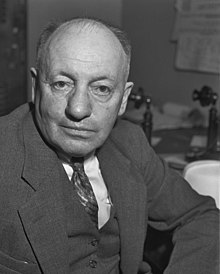
There is a deep mystery behind Spalding which may never be solved. The brief Wikipedia article the photo is taken from is evidently written by a ‘true believer’, and to be historically factual would need a lot of rewriting [5].
He had definitely never been to India before 1935, and he was not old enough to have been on any journey to India in “1894”. As his friend David Bruton states in his biography, Spalding advanced his age by two years upon every birthday to try to make it appear that he was old enough to have made such a journey [6]. He’d long planned to write Volume 1, though he had never himself been to the East. He wrote the first volume, and upon its unexpected success, the publisher asked him to write a second and then a third volume by virtue of the fact that, in the publisher’s eyes, they made more money for him than the rest of De Vorss’ books put together. If asked almost any question at all, Bruton tells how Spalding seemingly impulsively never replied truthfully, even about innocuous daily things.
As another means of making money, publisher DeVorss arranged for Spalding to be the guide for a party of spiritual tourists, who paid for the journey, to take them to India in 1935, yes, but soon after arrival it started becoming clear that Spalding had no knowledge or experience of India at all. (Anyone who does know India can tell that from the books, imho.) The travelling companions had frankly expected to meet at least one Master, but Spalding kept making poor excuses.
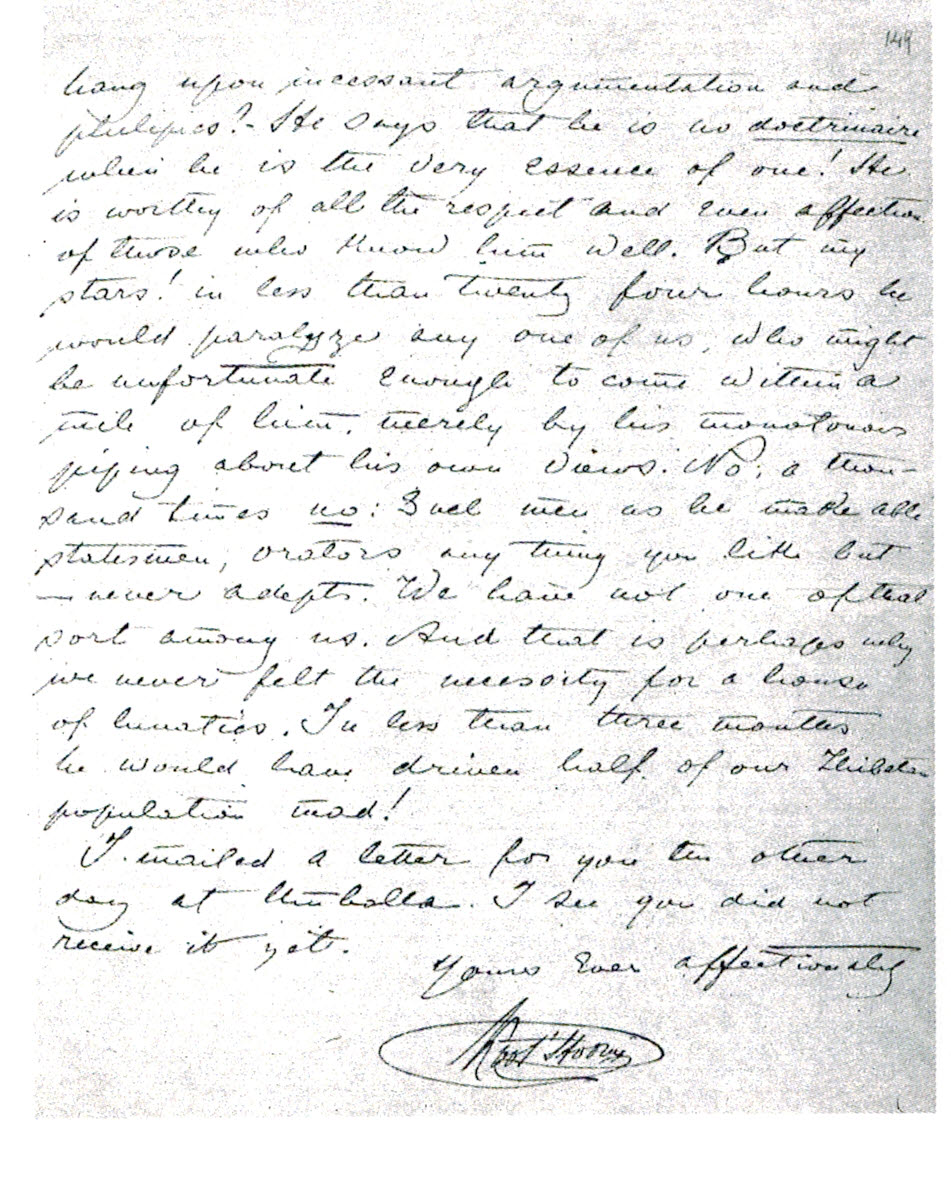
Genuine British mystic, Dr Paul Brunton, writes of how he came across Spalding and his disgruntled party. Mystic Paul Brunton (not to be confused with friend and biographer David Bruton) was India-experienced, and saw through him. so Spalding finally admitted to him that his India travelogues “dealt with visits made in his astral body, not in his physical body, as readers were led to believe”. There was a showdown with his traveling companions, upon which Spalding basically ran away, turning up weeks later at the docks, penniless, to get back to the USA. One of the fellow-travelers paid for his passage back.
A great deal more along these lines can be read about Spalding, and I would advise the researcher to read his one biography, Baird T. Spalding As I Knew Him by his genuine friend, David Bruton. It’s full of mysteries and puzzles, and a good read by itself. I do find that ‘true believers’ find all this hard to accept, yet they need to read further such as in Bruton’s book. Bruton is no critic, and not trying to debunk, simply to tell the real truth. By the time Volume 1 of “Life and Teachings” came out in 1924, there were plenty of esoteric/occult sources from which the gist of such a tale could have been concocted, particularly Theosophy, but many other sources too.
However, one major part of the mystery is that since Spalding was never in India before 1935, and was too young to have been there in 1894, nevertheless his books are certainly packed with spiritual truths, even if the actual events are fictitious. His books have inspired generations of readers nonetheless, doing great good, and therein lies their undoubted value. (By the way, publisher DeVorss must surely have swindled him, since he died with only $15 to his name, apparently.)
I like a portion of David Bruton’s introduction to his biography, in which he says, in as many words (my copy isn’t to hand), “No matter the reality or not, or the real nature of his stories, it cannot be taken from Baird that he did indeed inspire many thousands of people, for which he should be remembered.”
I am writing this post on a very coincidental day, because just today I received the latest edition of the books (!), which simply contains Volumes 1 to 3, later volumes being poor efforts of the publisher to just keep making more money and of little value. The first three volumes are now newly published as one book, with the new title, The Journey (2021), still by the same publishing house, but the initial publisher himself, DeVorss passed on in 1953. They have been honest enough now, today, to give this brand-new book a 14-page Introduction by Mitch Horowitz, academic of American occultism, who comes clean on the real life-story of Spalding [7].
I would just say, take Spalding’s works as ever one wishes, but the 1894 journey never took place. The supposed backing establishment confirms that. If one wishes, one can think of his accounts as being overshadowed by some spiritual force, or, in any case, at the very least by his own spiritual knowledge, and perhaps by even more. It is certainly not my wish to pop any balloons, but Truth Above All must be our guide.
So if anyone really wants to follow-up on this, you can start with David Bruton’s 1954 biography, and the recent 2021 14-page introduction to the latest edition.
Sources
[1]. Spalding, Baird T. 1924-1997. Life And Teachings of the Masters of the Far East. Vols. 1-6. Los Angeles: DeVorss & Company.
[3]. De Mille, Richard. 1976. Castaneda’s Journey: The Power and the Allegory. Santa Barbara, CA: Capra Press.
[4]. Blavatsky, H. P. 1889 (1920). The Key to Theosophy: An Exposition on the Ethics, Science, and Philosophy of Theosophy. Los Angeles, CA: The United Lodge of Theosophists.
[6]. Bruton, David. 1954. Baird T. Spalding As I Knew Him. Los Angeles: DeVorss & Company.
[7]. Spalding, Baird T. 2020. The Journey: Life And Teachings of the Masters of the Far East. Reprint in one volume of Life And Teachings of the Masters of the Far East, vols. 1-3. With introduction by Mitch Horowitz. Los Angeles: DeVorss & Company. (Amazon, where you can read the Horowitz intro)
If Theosophy is taken as a synthesis of science, philosophy and theology, together with its stated objectives of open dialogue, comparative investigation and experimentation, there will be a lot of room to overcome its own articles of faith, which in spite of its professed anti-dogmatic, free-thinking, non-partisan persona, are quite prevalent.
For example there are the Mahatmas as Theosophy’s collective God, the ever so interesting Helena Blavatsky as Their messenger and The Secret Doctrine as its Bible. Because of the strong intellectual, Buddhist and scientific elements within Theosophy the just enumerated sacred objects can be easily de-constructed. The Mahatmas are not unlike Zen masters, who can only point the way; Blavatsky was an advanced, but fallible, student; and The Secret Doctrine is no more than an interrelated set of hypotheses to be experimentally tested.
But after more than 125 years Theosophy needs to be updated with an integration of the latest breakthroughs in science, philosophy and theology. It will not suffice to deepen the understanding, as Theosophy can bring, of trans-personal psychology, or quantum mechanics, or existentialism, or history, or, as is often done, to merely recognize similarities between Theosophy and these investigations and be self-congratulatory satisfied with the congruencies. The real work lies in a more active attempt at integration of the most developed positions within science, philosophy and theology.
Personally I see a great potential in the integration of the very encompassing hypothesis of morphogenetic fields and morphic resonance as developed by Rupert Sheldrake (science), the epistemological and existential ideas coming out of the phenomenological movement (philosophy) and the spiritual philosophy of Krishnamurti (theology, if I may say so).
If this program is feasible is for now not clear as nobody has yet tried it. And such a trial might find the following obstacles: 1) Sheldrake’s hypothesis, now almost 40 years since its publication, has not fared well; and 2) the relationship between Krishnamurti and Theosophy might be more contradictory than assumed.
The other day I visited David Reigle’s excellent web site of the Eastern Tradition Research Institute and found again his paper on “The Centennial Cycle.” In this paper he discusses the origin of the policy by the Brotherhood of Mahatmas of enlightening the “western barbarians” on a centennial basis. Here I read that the very last of the Druid mystery schools in Europe was according to H.P.B. at Bibracte in Burgundy, France.
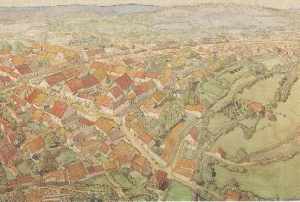
Drawing of Bibracte as it might have looked like 100 B.C.E.
Bibracte was the capital of the Celtic tribe the Aedui and around 50 B.C.E. Caesar conquered this important Celtic settlement during his Gallic campaigns. During the reign of Augustus its inhabitants left the place for the newly founded Augustodonum (Augustus-city, now Autun) 14 miles east and nobody else replaced them, leaving the site pristine for archeologists to uncover 1900 years later.
Digging out Bibracte
Apparently after this loss the Brotherhood instituted its policy of sending every last quarter of a century somebody to instruct the West in the Wisdom-Religion, with H.P.B. being the one for the 19th century cycle.
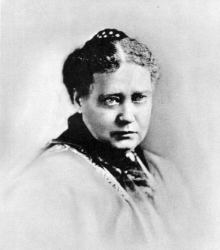
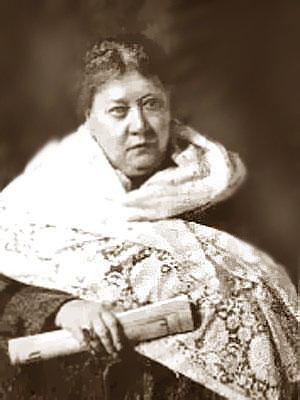
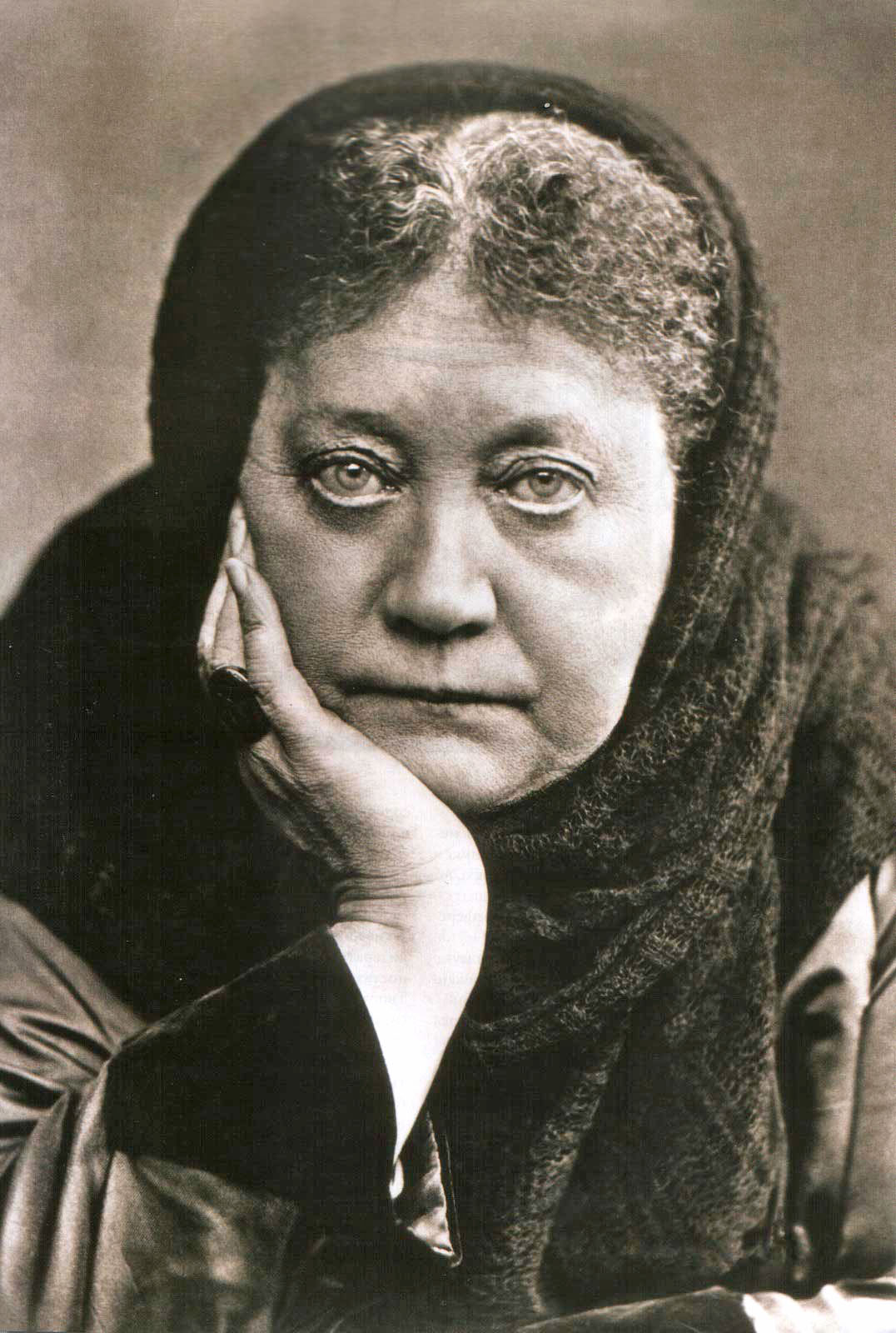
Helena Petrovna Blavatsky
H.P.B., in her posthumously published article “The Last of the Mysteries in Europe” quotes with apparent approval J.M. Ragon, a 19th century author on Masonic lore, from his Orthodoxie Maçonnique:…
Bibractis, the mother of sciences, the soul of the early nations [in Europe], a town equally famous for its sacred college of Druids, its civilisation, its schools, in which 40,000 students were taught philosophy, literature, grammar, jurisprudence, medicine, astrology, occult sciences, architecture, etc. Rival of Thebes, of Memphis, of Athens and of Rome, it possessed an amphitheater for gladiators, surrounded with colossal statues and accommodating 100,000 spectators, a capitol, temples of Janus, Pluto, Proserpine, Jupiter, Apollo, Minerva, Cybele, Venus and Anubis, and in the midst of these sumptuous edifices the Naumachy, with its vast basin, an incredible construction, a gigantic work wherein floated boats and galleys devoted to naval games; then a Champ de Mars, an aqueduct, fountains, public baths; finally fortifications and walls, the construction of which dated from the heroic ages.
She then stated:
Such was the last city in Gaul wherein died for Europe the secrets of the Initiations of the Great Mysteries, the Mysteries of Nature, and of her forgotten Occult truths.
I did this search because in a class at Olcott, the headquarters of The Theosophical Society in America (Adyar), we were looking into possible candidates of the 1975-2000 cycle and we discussed criteria for evaluating the candidates. Reigle in his paper develops a position in favor of the Dalai Lama and the Tibetan Buddhist diaspora as the 20th century effort of the Mahatmas.
Peculiar coincidence is that I visited Bibracte many times in my life as my aunt bought in the 1970s an old farmhouse in the hamlet Les Jours at the foot of Mont Beuvray on which top Bibracte used to be and the farm is the closest inhabited structure to the site!
My aunt’s farmhouse at Les Jours
I knew that the leader of the Gauls, Vercingetorix, had camped there and that Caesar had stayed there as well for a winter after defeating the Gauls and, while there, wrote his book on the Gallic campaigns, Commentarii de Bello Gallico.
View from Mont Beuvray
But I had no idea that this place on top of the hill, now known as Mont Beuvray, next to my aunt’s farmhouse, also was a Celtic center of occult learning–the last one of its kind in Europe—and that its loss lead many centuries later to the founding of the Theosophical Society. At least according to H.P.B. It is now a prime archaeological site with a very nice museum displaying their finds and reconstructions of Celtic life.
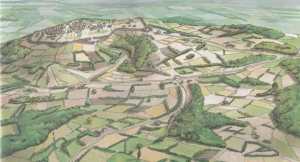
Reconstruction of the area of Mount Beuvray (1st century B.C.E.)
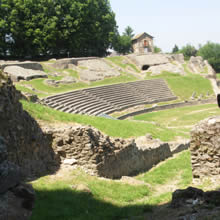
One memorable summer in the 1980s I spend in Les Jours with my aunt and grandfather, who was a Mason, while reading and discussing Yates’ academic study The Rosicrucian Enlightenment and Michael Baigent’s pseudo-historical Holy Blood, Holy Grail and through these books getting a feel for the “hidden tradition” of western esotericism. I would have gone to Les Jours again and join my family in August 2009 to celebrate my own half-centennial, but this plan fell through. I intended to do some research there and see what claims by H.P.B. and Ragon can be verified against the archaeological record. From what I read Ragon’s claims made about Bibracte are quite erroneous or, in H.P.B.’s words, “utterly incorrect”, as she qualified another of his claims. Bibracte was a fortified hill-town and none of the grand structures, which Ragon writes about, were ever erected there. It looks like, and he is not the only one, that he confused Bibracte with the nearby town of Autun, which does have a big Roman amphitheater, though it ‘only’ seats 17.000, and has a temple dedicated to Janus. Many historians and archaeologists in Ragon’s days thought that the correct location of Bibracte was to be found in Autun. But this was only a hypothesis. The other candidates were Beaune and Mont Beuvray. Only the excavations by the French archaeologist Jacques Gabriel Bulliot in the late 19th century confirmed the location to have been on Mont Beuvray.
Roman Amphitheater at Autun
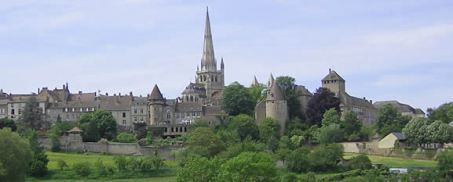
The problem here is that Autun did not exist before Caesar’s time as it was founded in Augustus’ reign replacing Bibracte as the capital of the Aedui about 20 kilometers (12 miles) east. The other problem is that Ragon ascribes to the Celts feats of architecture and pastimes which are distinctly Roman and were quite out of reach for the more simple Celts.
View of Autun
It looks like H.P.B. was a little careless in taking over wholesale these claims by Ragon about Bibracte, even while she was aware of Ragon’s shortcomings as a historian as she warned her readers that “[h]owever learned and erudite, some of the chronological mistakes of that author are very great.” What has to be done is to sort out in more detail all the claims and think through the possible implications of the findings, especially addressing the question whether H.P.B. was unto something, but was incorrect in certain details, or if she was constructing her own mythic historiography by selectively appropriating Ragon’s Masonic (mis-)construals of history. One way or another the gap of cognitive dissonance between the Blavatskyan, emic, esoteric perception of history and the etic, scientific perception of history has to be bridged.
Nitya: A Tale of Two Brothers
Mahesh Kishore, SHF Publications, 2019 (order here)
Just finished reading this remarkable study of the relationship of Krishnamurti and his younger brother Nityananda. The author provides a very intimate and sympathetic narrative of their deep friendship in the context of the World Teacher Project inaugurated by the then leaders of the Theosophical Society, Annie Besant and C.W. Leadbeater. This Project was the physical and mental preparation of the human ‘vehicle’ Krishnamurti for the consciousness of Maitreya, Buddha’s main disciple, to manifest through.
The narrative is firmly premised on 1) the idea that the Project was genuine, i.e. transcendental forces and personalities (Masters) were responsible for its start and guidance, and 2) that after Nitya’s death in November of 1925 his personality merged with Krishnamurti’s thereby transferring psychological attitudes Nitya had developed and Krishnamurti somewhat lacked, resulting in a quite different Krishnamurti at the end of December of 1925 when many people believed the first manifestations of Maitreya occurred.
In this manner Nitya indeed had become essential to Krishnamurti’s destiny, something many followers of the Project, including both brothers, believed, even to the extent that some of Nitya’s admirers could easily re-direct their more personable affection for Nitya to Krishnamurti.
The plot-line of the first volume of Mary Lutyen’s 1975 biography of Krishnamurti reads like a chronicle of Krishnamurti’s more or less solitary coming of age and enlightenment (“The Years of Awakening”), and seems to be, as far as its metaphysical premises are concerned, close to K’s deep skepticism of his Theosophical status and destiny as that attitude developed starting around 1927.
Kishore’s plot-line of his study reads more like a love story of two very close friends deeply dedicated (though with some ups and downs) to the Project and all its ramifications (except for the ‘Huizen manifestations’, which is a story by itself). And the author, as indicated above, is very much in sympathy with the Theosophical worldview guiding the brothers till 1925. Because he is in sympathy with that view he can easily recount the brothers’ experiences from their own situated perspective. This enables a very close emphatic interpretation of their lives and contributes to our understanding of the peculiar life-world of these two young men during their formative years. As the back cover justifiably states, the importance of this book is not only the presentation of some new facts, but the author’s “compellingly stringing his research together to create a new picture of of these two astonishing people”.
Very helpful to the narrative are indeed the author’s use of quotes from Nitya’s diary (ca. 10) and the many letters from Nitya to Krishnamurti (ca. 13), to Leadbeater (ca. 15), to Besant (ca. 10), and to the Manziarly family (ca. 8).
The quantity of letters, which have apparently survived, makes me think that it might be time, now about a hundred years after their composition, to have them all published in an academic format.
I like to end this review with a critical note about the author’s main claim regarding the merging of the consciousness of the two brother’s after Nitya’s death. This has to be done, because the author not only makes a strong case for this idea by quoting Krishnamurti himself, but he also recounts stories which makes this claim questionable, though there might be subtle ways out of certain contradictions based on the intricacies of Theosophical psychology, though such ad hoc reinterpretations will have their own interesting implications.
So, even though Krishnamurti made clear statements in his letters and poetry, and in verbal statements to others, that his consciousness had merged with Nitya’s, Kishore also recounts instances in which this idea becomes problematic. For example, and this might be one of the strongest counterfactuals, Kishore refers to Rosalind Rajagopal’s story that, when K saw her daughter Radha for the first time, he supposedly asked “Do you think it’s Nitya?” If the brothers’ consciousnesses had melded that question would never have been asked.
The leading questions of this presentation are: How do Theosophy and Krishnamurti perceive each other? How are their teachings related? Based on primary sources and notes from discussions, I will present a wide spectrum of possible answers as a contribution to an ongoing discussion.
CONTENT
Introduction
Theosophical Perceptions on Krishnamurti
Perceptions of World Teacher Project with K
Perceptions of K’s teachings
Krishnamurti on Theosophy and the Theosophical Society
Comparison between Theosophy and Krishnamurti
Dealing with the Differences
Further lines of investigation
Conclusion
Bibliography
Endnotes
=========
Introduction
What I intend to do in this presentation is to develop certain matrices or certain structural insights into a spectrum of possibilities of how a very complex subject can be made more transparent. I do have my personal views on the subject matter, but I will try to keep them out, though that is not always possible. For clarity’s sake, I will follow five major lines of investigation.
The first one is about the possible Theosophical perceptions of the metaphysical status of Krishnamurti. What kind of person was he that he went around the world giving very profound insights? Where did he come from, what is his background?
The next part will be about the possible Theosophical perceptions of Krishnamurti’s teachings. How can we evaluate them, how are they connected with Theosophy, how can we get a grip on that complex subject?
The third part is not about the Theosophical perceptions of Krishnamurti, but Krishnamurti’s perceptions of Theosophy and the Theosophical Society, which are of course historically connected.
The fourth part will be a comparison between Theosophy and Krishnamurti on certain very specific subjects.
The fifth and last part will be an overview of the many ways that I have encountered, and have also experimented with, in how to deal with these differences. Sometimes the differences are big or very enigmatic or puzzling to the point of even disturbing.
The article will finish with an overview of possible further investigations of K as a person and his teachings.
To dispel the fears from people who are very sympathetic to Krishnamurti and who might think that this is a completely wasted exercise, Krishnamurti himself said in 1932 “to find out whether I agree with theosophy or not, you will have to study what theosophy teaches and what I say and examine them impersonally”.i With that guidance we will do that. But again, this is more giving pointers for your own research than that I would like you to attain certain conclusions. Therefore this exercise falls under the second object of the Theosophical Society, which is “to encourage the comparative study of religion, philosophy and science”.
Let us start with a bare-bones background information about Theosophy and Krishnamurti.
The Theosophical Society
Helena Blavatsky and Henry Steel Olcott founded the Theosophical Society in 1875. Its stated aims were and still are:
1. To form a nucleus of the Universal Brotherhood of Humanity, without distinction of race, creed, sex, caste or color.
2. To encourage the study of comparative religion, philosophy and science.
3. To investigate unexplained laws of Nature and the powers latent in man.ii
In addition it can be argued that the aims or the agenda of the Theosophical Society were the following few:
One is to disseminate the doctrines of Theosophy. This is a basic overview of what I think that it is. Our lives are a part of a spiritually evolutionary scheme. We incarnate many times to learn the lessons of life and to evolve into selfless loving, understanding beings. Karma is the great law of cause and effect ordering this evolutionary process and giving us feedback on where we stand. As there are different levels of attainment in this process there are some enlightened souls ahead of us. Here I am referring to the existence of so-called enlightened beings named variously as Mahatmas, Masters, and Elder Brothers. These Masters are the guardians of a primordial Wisdom Religion or Wisdom Tradition. And this is one of the core aspects of Theosophy. This Wisdom Religion is very old, had been developed by these Masters, by Adepts and others with occult skills. This Wisdom Religion is by itself the essence and origin of all other religions and philosophies and sciences. Collectively, these Masters are sometimes called the Hierarchy or the White Lodge and at regular intervals they will send emissaries, they will sponsor deserving individuals and, for our story very important, they will prepare the way for a great spiritual teacher with the aim to re-instruct mankind about its high calling.
Another point on their agenda was to promote the cultural and intellectual revival of India and also its political independence from the British Empire.
The last point on the agenda of the Theosophical Society was to prepare for the coming of a “torchbearer of truth” or Avatar or World Teacher. Blavatsky at the close of her life, in her classic The Key to Theosophy, announced the coming of this “torchbearer of truth” for the later part of the 20th century. The mission of the Theosophical Society, according to Blavatsky, was to prepare the way for this new leader.
He will find the minds of men prepared for his message, a language ready for him in which to clothe the new truths he brings, an organization awaiting his arrival, which would remove the merely material mechanical obstacles and difficulties from his path.iii
Then she painted the possibility of a glorious, long-term goal of this plan and wrote that “if the theosophical society survives and lives true to its mission . . . earth will be a heaven in the twenty-first century”. We are now about a decade into that century. And this is the good thing of having a certain temporal distance to the subject to evaluate.
Krishnamurti
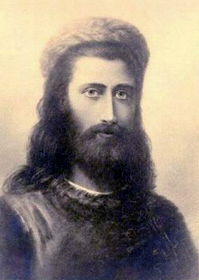
Krishnamurti was the son of a Theosophist who lived close by the international headquarter of the Theosophical Society in Adyar, India. The clairvoyant Charles Webster Leadbeater found him in 1909. Leadbeater noticed the teenager and saw a very selfless, spiritual aura and thought he was a very special young teenager. Leadbeater and Annie Besant were in those days the leaders of the Theosophical Society and Leadbeater, allegedly, was in contact with the Masters. And he was then allegedly informed by the Masters that he had to prepare this teenager as the possible vehicle for a very advanced other Master, the Lord Maitreya.
The plan was that Maitreya–as he had done 2000 years before with Jesus according to Leadbeater–that he would overshadow Krishnamurti, and that both having their consciousness blended in a very intimate spiritual cooperation would bring out a new teaching to humanity. The plan was to do this again, but then with this teenager Krishnamurti as the vehicle. I named this plan the World Teacher Project, because that term was used a lot, though the plan was also very often referred to as the Second Coming because of its connection with Jesus Christ. In 1911 the Order of the Star in the East was founded around Krishnamurti and the Project. Interestingly, and this goes back to the prophecy by Blavatsky, when Annie Besant was challenged about her involvement with this organization by other Theosophists who might have thought the Project was not genuine or it was not proper for her to get involved with it, she defended herself by referring explicitly to the view which Blavatsky had about the future mission of the Theosophical Society. Annie Besant said: “My crime is that I share it, and do what my poor powers permit in preparing the minds of men for that coming”.iv The only difference between her and Blavatsky is that Blavatsky put that event in the later part of the 20th century and Besant advanced that agenda by half a century. Because of the distance in time we can see who might be right. Besant actually said: “Which of us is right only time can show.”
Anyway, everything goes relatively well with the Project and Krishnamurti comes under the tutelage of a Master named Kuthumi. And he gets initiated into the White Lodge, which means that there is an inner occult connection being made between Krishnamurti and the Master so they can be on speaking terms. The high point of the Project was in the period between 1925 and 1927, when Krishnamurti was many times overshadowed by Maitreya. This claim was according to himself and according to some other clairvoyants like Leadbeater and Geoffrey Hodson, who wrote some beautiful descriptions of those occurrences.v But somehow in 1927, Krishnamurti starts having doubts about the Project. These doubts built up to such an extent that in 1929 he decides to go his own way, dissolves the Order of the Star of the East, and distances himself quite radically from Theosophy and the Theosophical Society. He then went solo and kept on meeting, teaching and talking to people for the rest of his. In his now famous 1929 speech when he dissolved the Order of the Star, he formulated his basic spiritual philosophy.
I maintain that truth is a pathless land and that you cannot approach it by any path whatsoever, by any religion, by any sect. Truth being limitless, unconditioned, unapproachable by any path whatsoever cannot be organized, nor should any organizations be formed to lead to or coerce people along any particular path.vi
This is the base line of his philosophy, which he expounded upon in many variations for the rest of his life.
The big question for many Theosophists was: How far away did Krishnamurti go from Theosophy? Here we wade into the issue of the many ways K was perceived by Theosophists.
Theosophical perceptions of Krishnamurti
I did some serious research on this and my basic thesis was that–given all the different Theosophical thoughts on Krishnamurti–that all these views can be differentiated according to how people answer two basic questions about Krishnamurti: vii
1. Was the project genuine or not?
2. Was the outcome of the project successful or not?
The possible answers to these two questions generated the four following positions:
1) The project was perceived as genuine and successful;
2) The project was perceived as genuine, but failed;
3) The project was perceived as not genuine and failed (of course); and
4) The project was perceived as not genuine, but succeeded!
And for all the four possible positions there were Theosophists or allied thinkers taking the different positions. The most important among them I discussed in my paper, but here they are placed in their proper quadrant:
Fig. 1. Theosophical Perceptions of the World Teacher Project
1. The project was perceived as genuine and successful
In the first quadrant we find Annie Besant, Krishnamurti, Radha Burnier, Jane Overton-Fuller and Ariel Sannat. Some quotes from these people will provide an idea of what their thinking was.
Annie Besant was reported to say in 1928 that “The Lord has spoken. I am now satisfied. This is the beginning of all that I have foreseen and worked for”.
Radha Burnier, who is the current president of the Theosophical Society, wrote in 1986 that the Theosophists “were not ready to listen to a profound message” coming from Krishnamurti. And she explicitly compares the situation between Krishnamurti and the Theosophical Society as similar to the Jews and Christ and the Hindus and Buddha. The Jews did not accept Christ. They did not understand him and couldn’t follow him. The same with the Hindus, when Buddha came around. They just didn’t get it. So, in the same way, the Theosophists just didn’t get it. It was a genuine project. Here you have a new World Teacher, but they just didn’t get it.
Jane Overton-Fuller is a Theosophical scholar and wrote some really interesting books. Her position was that Leadbeater and Besant were basically right with finding Krishnamurti, but everything else they did, they were wrong. It was not necessary to build up an organization around Krishnamurti; that, because it was the Second Coming, he would have apostles; and that there would be a church. There were a lot of things around the Project which were peripheral, and according to Jean Overton-Fuller most of it was wrong and unnecessary. And because how everything happened, it became understandable that eventually Krishnamurti had to distance himself from all that buildup and that he had to disassociate himself from the Theosophical Society.
Many years later K himself reinforced this view. In 1980 he said “the boy was found, conditioning took no hold–neither the Theosophy, nor the adulation, nor the World Teacher, the property, the enormous sums of money–none of it affected him.” Apparently he is saying that he came into Theosophy, breezed out of it and nothing kept him there. Problem with this is that it can be refuted by his own words from the earlier days. In those days, and I’m talking about 1909 when he was found and 1925 when the Project came to its fulfillment, it is very clear that he was a convinced Theosophist. He would lecture eloquently about the basic ideas of Theosophy. And that was not just for show, or because he was coerced to do that, or because it was expected from him. If you read these reports, the impression is that it came from really deep down and was very authentic. So there is something not jiving with his later view and his earlier view.
What did he otherwise think about himself as a World Teacher? In 1931, he wrote to someone very close to him “You know, mum, I have never denied it, I have only said it does not matter who or what I am but that they should examine what I say which does not mean that I have denied being the W.T.” So there is some admittance and he seems to say: “I’m the guy, but that’s not important. Forget about it; forget about my status. What I say, that’s important.” Something similar can be found in his book Truth and Actuality when he discussed with some people in England the subject of the upcoming biography of his life by Mary Lutyens. Much of his history would come out into the open in a well-researched book and much information would be new to people who were into Krishnamurti or even new for Theosophists. In these talks he is reported as saying
There is a very ancient tradition about the Bodhisattva that there is a state of consciousness, let me put it that way, which is the essence of compassion. And when the world is in chaos that essence of compassion manifests itself. That is the whole idea behind the Avatar and the Bodhisattva. And there are various gradations, initiations, various Masters and so on… viii
Of course this is a part of a larger quote, and if you read the whole quote it is quite clear that he is referring to himself. But in a way he used to do very much later, he would talk about – he would speak but he would not refer to himself in the first person, but in the third person and say “the speaker.” But he then clearly is referring to himself in an objectifying way. The point is that if you get used to that, you can interpret the quotes as referring to himself.
2. The project was genuine but failed.
First Leadbeater. What he thought was initially not easy to find out, because Leadbeater had an understanding with Annie Besant that he would not contradict whatever she would say in public. And as Annie Besant took the position ‘here is the World Teacher Krishnamurti; the Project is fulfilled’, Leadbeater would not say anything contrary to that. But, privately, we now know–and this came out in the 1960s–he had a different point of view. In 1930 he stated in an article
This is He who should come, and there is no need to look elsewhere; as I have said, I know that the World-Teacher often speaks through Krishnaji.
Here he backed up Annie Besant. But in private we now know he said, “The Coming had gone wrong”.
The second person in this box is Geoffrey Hodson, the other clairvoyant Theosophist next to Leadbeater. As I just referred to, by clairvoyant seeing, Hodson gave a beautiful description of the overshadowing of Krishnamurti by Lord Maitreya. Later Hodson believed the Project had failed and for three reasons. First of all Krishnamurti had a hard time dealing with the spiritual energies that were going through him. There was something going on in him that is called the “rising kundalini energies”. It was a part of his preparation, but it was very painful. In the period between 1921 and 1927 he had many weeklong periods experiencing excruciating pains, even to the point that he would faint. According to Hodson his body might have been too frail for these enormous energies to deal with.
Another reason that Hodson thought Krishnamurti did not fulfill his plan was the death of Krishnamurti’s brother Nityananda in 1925. These two brothers were very close. Nityananda developed a very grave health condition. Krishnamurti is said to have asked the Masters a request to spare his brother’s life. He thought that the request would be fulfilled. When his brother actually died, he was absolutely devastated. This is a frequently proposed reason why Krishnamurti had a change of heart. Hodson also said that Krishnamurti was very hurt by what other Theosophists did and say. There were some little scandals and strange episodes in the 1920s. They were so bizarre that Krishnamurti did not want to have anything to do with them. One issue was the announcement in the summer of 1925 by Annie Besant that there would be twelve apostles connected to his mission as a World Teacher. Krishnamurti had no appetite for that. He didn’t see that that would be genuine or necessary and he felt very uncomfortable being put in that position of people expecting a whole “Jesus show” including apostles. Anyway, all this contributed to Krishnamurti’s “decision to withdraw from the role that might have been his”. And this quote is from Hodson.
At this point I like to address the views of the British composer and Theosophist Cyril Scott. Because there are many quotes ascribed to certain Masters in this story I like to present such quotes in a neutral format so you can decide for yourself about the source and its veracity. The formula I will use is: “Master X per y in source z”. For example “Master Kuthumi said per Krishnamurti in At the Feet of the Masters” or “Master El Morya stated per Mrs. Prophet in The Chelah and the Path”. I am adopting this format because I want to suspend the question of the reality of the Masters as I am reporting them here and also bracket the truth of their pronouncements. I like to keep that neutral. It is up to ourselves to establish if these sources are legitimate or not.
Anyway, Scott wrote anonymously in the early 1930s the book The Initiate in the Dark Cycle, which contains two elaborate chapters dedicated to Krishnamurti. The book reads like a novel because it is written in a conversational style. Its main characters are the protagonist and his spiritual teacher Justin Moreward Haig. Interestingly there are people looking for who this person really was, because all the characters in the book are presented as real life characters. We do know who certain persons were and there is something of a sub-culture of Theosophists and non-Theosophists looking for Justin Moreward Haig.1 Then there is also a character named “Sir Thomas” presented as a full-fledged English Master. During an after dinner conversation ‘Sir Thomas’ stated that the project with Krishnamurti was a “success while still overshadowed by the World-Teacher, . . . a failure afterwards”.
The most sustained effort to identify the characters was done in Fuller, 1998. One of the real-life characters speculated to be one of Scott’s Initiates in his The Initiate in the New World book was Dr. Pierre Bernard, who ran an ashram in Nyack, New York. Scott visited the ashram on his US tour. Bernard and the happenings at his place were colorful and influential enough to deserve his own biography. See Love, 2010.
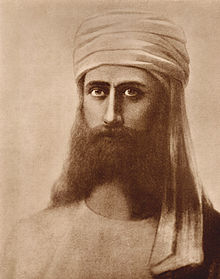
Teaming up with Scott in the 1030s was his friend, the British astrologer and Theosophist Brian Ross, who wrote under the pseudonym David Anrias. He also was allegedly connected with the Masters and in 1932 published the book Through the Eyes of the Masters with nine messages from different Masters accompanied by pencil drawings of them. Maitreya was one of these Masters and he stated through Anrias that because Krishnamurti had taken initiations along the line of the Deva-evolutions “it became all but impossible for him to be used any longer as my medium”.ix So Maitreya was saying that Krishnamurti took a specific initiation, therefore could not be used as his vehicle anymore, and therefore the the Project had to be called off.
Alice Bailey was also a Theosophist and prolific author. She was allegedly in communication with a Master called Djwal Kul. Djwal Kul per Alice Bailey in Discipleship in the New Age said that the Project was experimental and for various reasons “… the experiment was brought to an end.”
The last one in this list is Elizabeth Clair Prophet, leader of the American New Age organization The Summit Lighthouse. Here we meet Kuthumi again, who was allegedly Krishnamurti’s own former guru. He stated in 1975 per Mrs. Prophet in “An Exposé of False Teachings” that Krishnamurti was “selected to take the training for the calling of representing the World Teachers and the coming Buddha, Lord Maitreya,” but he “failed the test of the intellect and of the subtleties of spiritual pride”.x In short, it was a genuine Project but it failed because of K’s psychological shortcomings.
3) The project was perceived as not genuine and failed (of course)
There were a lot of Theosophists who said that the Project from the beginning was not genuine. From an historical point of view, one of the most important ones was the German clairvoyant and author Rudolph Steiner. His position is an interesting one because it involves spiritual geopolitics. According to Steiner impostor Masters had hijacked the Theosophical Society and used Besant, Leadbeater and Krishnamurti as unwitting instruments in a occult power game directed against humanity in general and the West in particular. The founding of the Anthroposophical Society by Steiner was a direct consequence of the view he had about Krishnamurti. When the Order of the Star was founded in 1911, the Council of the German Section of the Theosophical Society, of which Steiner was then general secretary, declared that no one could be simultaneously a member of the Order of the Star and the German TS. You had to choose, you couldn’t be member of both organizations. This went against the official policy of the Theosophical Society. If you want to be a member of anything else, the Theosophical Society cannot tell you what to do there. The logical reaction from the TS headquarters in India was to revoke the charter of the German section. Though that happened in 1913, Steiner had already in 1912 founded his own Anthroposophical Society and brought most of the German Theosophists with him in that big split off.
Another person that did not think it was all genuine was Mr. Albert E.S. Smythe, a well-regarded Canadian Theosophist. He denounced the Project and called it an “extraordinary delusion” and “absolutely contrary” to the literature of the Theosophical Society of Blavatsky’s days. And this ties into a discussion that a lot of what Leadbeater and Besant were bringing out as Theosophy was seen by other Theosophists as not in accordance with what Blavatsky was saying. They called it neo-Theosophy or even pseudo-Theosophy.
Edward Gardner, an influential English Theosophist, came out in 1963 with quite a controversial view. Gregory Tillett, Leadbeater’s biographer, said the following about his idea:
Leadbeater unconsciously created an entire artificial system, based upon his own strongly held views, and, again unconsciously, used his own occult power to vitalize this system into a state where it had the appearance of reality, and appeared as an objective reality to him when he viewed it clairvoyantly. xi
That is a fascinating thought. So, Leadbeater’s conversations with the Masters, his clairvoyant witnessing of initiations and whatever else was experienced by him as genuine, was nothing but a stage unconsciously created by himself. This is something for psychologists to look into and see if there are other examples of this kind of self-deception.
4) The project was perceived as not genuine, but succeeded!
Now we arrive at the interesting part where there are some people saying that the Project was successful but it had no genuine starting point at all.
This comes from Rom Landau, a writer on spiritual subjects who traveled in the 1930s interviewing people like Steiner and Krishnamurti. He heard the allegation that the Project was a bold invention. Make a person believe he will be a messiah, create a mass movement around the idea, and maybe it will come to fruition. How about that, not? Just a little mass manipulation. Rom Landau wrote that “it appears that Leadbeater and Annie Besant believed to the very end that Krishnamurti was thus developing naturally into the personality of the `World Teacher'”.xii So, if great lies can justify great ends, that is wonderful.
Theosophical perceptions of the status of Krishnamurti’s teachings
The next big part after addressing the Theosophical perceptions of Krishnamurti as a World Teacher is to look at the perceptions of the status of Krishnamurti’s teachings. First suggested by someone we will talk about, I came up with this structure of the perceptions of the relationship of Krishnamurti and Theosophy. in four variations.
Fig. 2. Perceptions of the Relationship of the Teachings of Krishnamurti and Theosophy
K & T stand for Krishnamurti and Theosophy and the circles represent their teachings. If K and T are in the same circle this means their essence is very close and if in different circles their essence is not close. How much the circles overlap indicates the extent to which they agree. The matrix is determined by two basic questions. Do K and T share the same essential teachings? And how much overlap is there on secondary issues? This generated the following possibilities:
1. Essentially the same, and hardly diverging on secondary issues.
2. Essentially the same, but diverging on secondary issues.
3. Essentially different, but overlapping on secondary issues.
4. Essentially different, and without any overlap.
Essentially the Same or the ‘K teaches Theosophy Hypothesis’
I found nobody taking position 1, but it is a possibility. Somebody might come up with it and might say “You don’t get it, they are the same essentially.” This would amount to saying that what Krishnamurti is teaching is part and parcel of Theosophy and would name this the K teaches Theosophy Hypothesis.
Only Diverging on Secondary Issues or the Revisionist Hypothesis
At position 2 we have TS presidents Annie Besant and Radha Burnier taking the position that, though their teachings are essentially the same, they do diverge on many secondary issues.
Before addressing that, I want to get back to Hans and Radhika Herzberger. Both are Krishnamurti scholars and edited a very useful paper titled “Krishnamurti on Theosophy: A collection of reference materials”. te paper was online for a while on the Krishnamurti Foundation web site, but has now been withdrawn. They name position 2 the Revisionist Hypothesis and think it was held by certain Theosophists who would make the claim that, despite the quite radical anti-Theosophical statements by Krishnamurti, there is still this very intimate connection between the two.
Revisionists hold that, while he may have disagreed with Theosophy on certain issues, he continued to teach its ‘central’ doctrines.xiii
So, we have Radha Burnier and Annie Besant in that position. To be more precise, Annie Besant’s position on Krishnamurti’s teachings and work is as follows:
Say, if you like, that we are two sides of one work. Dr. Besant is at the head of one side and Krishnaji of the other. One is the work of the Manu, the other the work of the Bodhisattva.xiv
The Manu is another important Master in the Theosophical pantheon with a certain role in occult and spiritual affairs. Interestingly, in 1949, Krishnamurti had a response to this idea.
You may deceive yourself by saying, “What you say and what I believe are the same. They’re the two sides of the coin”. You may say what you like, but that is mere self-deception.xv
So, K is blocking the possibility that there would be something essential in common. He is actually more radical than that and I will share later on some quotes to that effect. Radha Burnier said that
To every ancient truth found in cryptic form in the teachings of the religions of the world, he gave a new dimension.xvi
Here we have to interpret “ancient truth” as meaning Theosophy, being a repository of ancient truths. And in that way the sentence would read: “To every Theosophical truth Krishnamurti gave a new expression.” In short, teaching-wise they are essentially the same, but K gave it a new expression.
Only Overlapping on Secondary Issues or the DeviationHypothesis
Following Herzberger’s lead, I propose to call position 3, the Deviation Hypothesis. Deviationists would hold that while Krishnamurti deviated from the essential teachings of Theosophy, there is still overlap. Geoffrey Hodson can be seen as taking that position. According to Hodson the teachings of Krishnamurti were
. . . an extraordinary blend of rare flashes of transcendental wisdom, penetrating intelligence, incomprehensibility, prejudice, intolerance and vituperation.xvii
And he gave many an examples and expressed how he felt. He was a very convinced Theosophist who said at a certain moment “we are getting beaten up here by Krishnamurti by what he is saying about Theosophy and it’s time to say something back.” Most Theosophists seemed to be a bit numb in the 1930s about what Krishnamurti was saying. Hodson was one of the rare ones coming out saying “hey, the guy is going a little bit too far, we have to give a little bit of push back here.” About 25 years later he expressed a milder view. He said that the
. . . the splendid teachings, verbal and written, demonstrate that he is indeed, in his own right, an advanced Soul with an aspiring message to deliver to mankind.xviii
Hodson was a very nice person and was not someone who wanted to kick up too much dust and be controversial. In another statement from 1939, he said “everything which is comprehensible and rings true in Krishnamurti’s utterances is recognizable as part of the Ancient Wisdom.” Here again you have to read Ancient Wisdom as Theosophy. He is saying that there are a lot of things Krishnamurti is saying, which are true and are in accord with Theosophy and the Ancient Wisdom. At the same time Hodson said that there is plenty that is not.
Another elaborate expression of this position, where there is overlap but no essential coming together, comes through Cyril Scott. This time it is his teacher, Justin M. Haig, who stated
. . . instead of giving forth the new Teaching so badly needed, he [Krishnamurti] escaped from the responsibilities of his office as prophet and teacher by reverting to a past incarnation, and an ancient philosophy.xix
Haig then stated that Krishnamurti is teaching a variant of the Advaita, monist version of Vedanta philosophy. If you know Vedanta, and Shankaracharia is the great philosopher in Vedanta, you will find a lot of congruencies between what Krishnamurti is saying and what Vedanta is saying. To this, added ‘Sir Thomas’, that Adviata Vedanta is a “philosophy for chelas, and one of the most easily misunderstood paths to Liberation”.xx And that might be because it is a very complex, subtle and deep philosophy, which can be easily misinterpreted in a simplistic way.
There is some interesting research to be done about these statements. For example, the reincarnation referred to is maybe the one according to Leadbeater in which Krishnamurti was a disciple of Aryasanga, a Buddhist teacher and the founder of the Yogacarya school and identified by Leadbeater as a former incarnation of Master Djwal-kul.xxi Leadbeater, with his clairvoyant capacities, investigated 48 lives of Krishnamurti, which were published in 1925 as The lives of Alcyone, and this live as a Buddhist scholar was number forty-seven.xxii But the ancient philosophy referred to, you would expect that to be a form of Buddhism that Krishnamurti fell back into, because he was in that incarnation a Buddhist scholar. But the ancient philosophy, according to Scott’s characters, is Adviata Vedanta, a major school in Hindu philosophy. Though this might not add up entirely, according to Blavatsky
The Vedanta system is but transcendental or so to say spiritualized Buddhism, while the latter is rational or even radical Vedantism.xxiii
This same point she makes at different places, i.e. that at a deeper esoteric level the deepest teachings within Hinduism and Buddhism are the same. In that way it might add up, Krishnamurti had an incarnation as a Buddhist scholar, but then fell back in his last life into a Hindu philosophy.
Back to Scott’s friend Anrias again. The following is quite a quote, which goes to the essence where Krishnamurti and Theosophy differ. It is Maitreya per Anrias in Through the Eyes of the Masters:
Thus although Krishnamurti was right to emphasize the necessity for independent thought, he was wrong in assuming that everyone else, regardless of past Karma and present limitations, could instantly reach that point which he himself had only reached through lives of effort, and by the aid of those Cosmic Forces apportioned to him solely for his office as Herald of the New Age.xxiv
The big question with Krishnamurti is that he presents a spiritual view in which he asks people to go through an instantaneous, non-methodical transformation. In K’s kind of Enlightenment, there is no method to it and there is no guru to help you in that process. Nothing, it is instantaneous. On the other side you have Theosophy saying that this is a regular process, which takes quite a while and you have to work at it. There are rules involved, initiations etc. What Maitreya is pointing out is that Krishnamurti is making a mistake. Krishnamurti achieved a certain level of spiritual attainment and then says everybody can get up there, just like that. And he has an issue with that.
Essentially Different without Overlap or the ‘Total Split Hypothesis’
And now we get to, and this was a surprise, to box number 4, which is the position that both are essentially different and without any overlap. Again I want to follow Herzberger because he suggested this kind of structural organization. I will call this the Total Split Hypothesis. This hypothesis holds that Krishnamurti and Theosophy hold nothing in common and therefore there is no overlap. And if there is any overlap, it is insignificant. I found two persons holding this position: Krishnamurti himself and allegedly his former guru, Master Kuthumi.
For example Krishnamurti stated in1935 that “I am not a Theosophist nor a Theosophical missionary”xxv and in 1949 “What I say is diametrically opposite to your beliefs”. xxvi And at a Theosophical convention at the headquarters of the Theosophical Society in Adyar to which he was invited to speak he said:
Sirs, these two things are wholly different: what you are thinking and doing, and what I am talking and doing. The two cannot combine. Your whole system is based on exploitation, on following authority, on belief and faith.xxvii
This is quite clear and strong language. And there are many more similar quotes that you might find in this paper by Herzberger or scattered throughout K’s Collected Works.
The other person we find in this position is Elizabeth Clare Prophet or allegedly Master Kuthumi who stated per Mrs. Prophet in one of the series of Pearls of Wisdom in 1975 the following:
Today Krishnamurti, denounced by the Brotherhood, denounces the true teachers and the path of initiation, proclaiming that the individual needs only himself and that this is the only God there is. Leading thousands of youth in the direction of sophisticated disobedience to the God within, to Christ the inner mentor, and to the masters of the Brotherhood, this fallen one has been the instrument of a philosophy that is not and does not in any way represent the true teachings of the Great White Brotherhood.xxviii
This quote posits quite clearly the incompatibility of K’s teachings with Theosophy and is covered therefore, like K’s own position, by the Total Split Hypothesis. And the split duplicates the earlier mentioned agreement of Maitreya per Anrias and K himself about their incompatibility as far as K’s metaphysical status is concerned.
In finishing this overview I would like to repeat my position regarding the veracity of these quotes. I am merely reporting what can be found in print. And I am neutral regarding the ontological status of these Masters and the status of the veracity of their words. Figuring out those questions is all up your own research and thinking.
Krishnamurti on Theosophy and the Theosophical Society
Let us continue with the third big block, Krishnamurti on Theosophy and the Theosophical Society. Here I let him do most of the speaking, because it is quite clear what he is saying. There is a best case and a worst case quote from him, so we have a nice contrast. These are medium long quotes. Best case, he is talking here to Theosophists:
If you are really a social body, not a religious body, not an ethical body, then there is some hope for it in the world. If you are really a body of people who are discovering, not who have found, if you are a body of people who are giving information, not giving spiritual distinctions, if you are a body of people that have a really open platform, not for me or for someone special, if you are a body of people among whom there are neither leaders nor followers, then there is some hope. . . .
Don’t you see, if you really thought about these things and were honest, you could be an extraordinarily useful body in the world. You could then really work for the intrinsic merit of its ideas – not for some fantasy and emotionalism of your leaders. Then you would examine any idea, and find out its true significance and work it out, and not depend on the honors conferred for your services, on the enticement to work.
But, here comes the but:
But I am afraid you are followers, and therefore you all have leaders. And such a society, whether it is this or another, is useless. You are merely followers or merely leaders. In true spirituality there is no distinction of the teacher and the pupil, of the man who has knowledge and the man who has not.xxix
Now, we go to the worst case. These all come in a question and answer format from between 1929 and 1936.
Q: How can you say spiritual societies are a hindrance to man’s understanding? Or does this not apply to the Theosophical Society?
JK: [Every society which] stands on any authority, whether of the Buddha, Christ, or the Masters, has no significance. It merely becomes the means of exploiting people through their fears.xxx
Another good question, well not a good question actually, because people knew the answer actually, I think:
Q: Are you or are you not a member of the Theosophical Society?
JK: I do not belong to any religion, for organized belief is a great impediment, dividing man against man and destroying his intelligence. These societies and religions are fundamentally based on vested interests and exploitation.xxxi
That I thought was the worst-case statement by K on the Theosophical Society and any other spiritual society. To round this off there are two short quotes on the teachings of Theosophy itself.
Q: I have studied Theosophy very deeply and . . . I say that your wisdom is essentially the truth of Theosophy.
JK: You may study profoundly all the Theosophical books, but your conception of wisdom is utterly false. You gather dust from books and call it wisdom. I speak of a natural wisdom, beyond all books. To me your theories are utterly valueless.xxxii
Or in 1934, he said, as quoted before:
Sirs, these two things are wholly different: what you are thinking and doing, and what I am talking and doing. The two cannot combine. Your whole system is based on exploitation, on following authority, on belief and faith.
So far on Krishnamurti and Theosophy.
Comparison between Theosophy and Krishnamurti
I would like to direct your attention to the triple column comparison. The first column is the subject matter, the second contains what Theosophy would say about it, and the third is what Krishnamurti would say. Many of these categories were suggested by the aforementioned paper “Krishnamurti on Theosophy” by the Herzbergers, who looked into the conversions or diversions between the two, though they did not present it in this manner. In this way we can find out if there is overlap or not. The footnoted version you can find here. And I put them on-line so you can do research for yourself and see if these quotes are taken out of context or otherwise inappropriately used. Of course, there is also the question about what in their respective teachings is essential and what is not. Problem with that is that there might be different definitions of what is essential in Krishnamurti and what is essential in Theosophy. Nevertheless, we can go through some of these.
Fig. 2. Comparison between Theosophy and Krishnamurti (A clearer on-line version here)
The fourth one is right away interesting because it is about comparison itself and therefore addresses the methodology followed itself. What Blavatsky is saying about comparing, and I have a quote here from Blavatsky. And this is a quote, which I have found many times as the heading on a certain article.
Contrast alone can enable us to appreciate things at their right value, and unless a judge compares notes and hears both sides he can hardly come to a correct conclusion.xxxiii
Opposite this pro-comparison statement from Blavatsky is Krishnamurti saying that comparison is not understanding. If you compare two items, you destroy both. You have to see one item for what it is and you have to see the other item for what it is, but if you start comparing, everything is lost. In that sense, he says again, it is competition. Because that is based on comparison. There is a way where you can differentiate where he would allow comparison because say in science you have to make comparisons. He would not object against that. So there are ways that thought can use comparison in legitimate ways. Although Krishnamurti is very often making very generalized statements about something. So, you might think that well, any comparison is out of the question, dangerous, don’t do it, stay away from it. But you can make differentiations, where, for example, where he is taking many examples he is taking is that people compare themselves where they are. Either socially or financially or psychologically, or whatever. If you start comparing that is something destructive. Because that breeds competition, that breeds fear, fear breeds conflict and there you go down the path into trouble.
Anyway, there are some subjects about which it is very clear what Krishnamurti and Theosophy are thinking.
Higher and lower selves. Theosophy is positing that there is a three fold nature of the self. Actually at the bottom comparison you will see, in all the teachings from Blavatsky it is called the Atman, Buddhi, Manas. Leadbeater called it the monad, ego and the self. Krishnamurti said such ideas are merely that, just idea, not facts, so forget about it.
Reincarnation. This idea is a pivotal doctrine of Theosophy, but for Krishnamurti it is immaterial.
Spiritual paths. It is not completely clear what Theosophy might say about it. There might be many or there is only one. For Krishnamurti “Truth is a pathless land” and there is no Way you can get there. There are no paths to, from or in that ‘space’.
Spiritual evolution. This is a core concept in Theosophy, being the perpetual progress for each incarnating ego. We keep going and going until we get off the ladder of reincarnation and then there is even more evolving to do. Krishnamurti states that spiritual evolution doesn’t exist, that life cannot have a plan. The thing about ladders is that it implies a gradual process. “No single rung of the ladder can be skipped” says Blavatsky, while Krishnamurti counters with the idea that the ladder of hierarchical achievement is utterly false.
Masters. For Theosophists they have an undeniable existence and a lot of them will testify to that, even Krishnamurti himself. You can go back to his own writings in the period between 1911 and 1929 where he reports on his interactions with the Masters. But the later Krishnamurti says that they are products of your own projections.
Mediators. According to Theosophy spiritual emissaries are sent out periodically and Krishnamurti was meant to be one of them. K said they are all exploiters.
Nationalism / patriotism. This is a sensitive matter for many. For many Theosophists the sentiment is positive and to be awakened, like ones love for family and community. This idea has to be seen also in the context of Theosophists contributing to India’s struggle for cultural and political independence. Early Theosophists promoted the idea of Indians becoming more loving of their own religions, culture and country and not become weighted down by a negative self-image put upon them by the British Imperialists. For Krishnamurti nationalism is an absurd and cruel obstacle to world unity and used by exploiters for their own ends.
Ceremonies. They “have their place, they have their use” and should be respected “for the sake of those good souls to whom they are still important”. This quote came from Krishnamurti’s At the Feet of the Master, which was allegedly dictated by his former teacher Kuthumi (or was written by Leadbeater), so I put it in on the side of Theosophy. For the later Krishnamurti ceremonies are illusions and “to no avail”.
Religions. In Theosophy they are complimentary. All religions carry an aspect of truth; they all blend altogether; and they originate from the same transcendental source. Krishnamurti states quite clear and repeatedly that they divide and destroy.
Brahman and Atman. Brahman is the impersonal, supreme and un-cognizable principle of the universe. For Krishnamurti the concept is an invention of thought, which also applies to the concept of Atman.
Now we arrive at some agreements, and those are interesting. And if you think that these points of agreement are the essential teachings of both Krishnamurti and Theosophy, then you are in that position where Theosophy and Krishnamurti are basically the same.
Personal God. He is a “gigantic shadow of man”, a bundle of contradictions and a logical impossibility. Krishnamurti more or less agrees: Thought has created God.
The oneness of consciousness. This is an important issue. Theosophy is saying that consciousness is one, i.e. that our experience in daily life of being separate individuals is in the last analysis an illusion. We are all one, or we are all aspects of something which is larger than ourselves and we all are an integral part of that. The experience of separateness is illusory. Krishnamurti has the same idea. “Consciousness is the consciousness of the rest of mankind”, he states. Your consciousness is mankind’s consciousness. We are all going through the same thing. We do not know where we are and we are all groping for a way out. We are all in the same boat, but not as individuals, but as one undivided movement. There’s no inside, there’s no outside, there’s no me, there’s no you, and there is even no my ego and there is no your ego.
The personal self, the ego, the me. And still, somehow there is a way out. And the way out might be very similar in Theosophy and K, even an essential part in both teachings. In Theosophy the ego is to be renunciated and we are encouraged to engage in a self-less life in service to mankind. For Krishnamurti, the ego has to be dissolved through a transformative insight of the mind into itself.
Differentiation within consciousness. The last topic is still tentatively in the process of development. The case could be made that there is a congruence between the Theosophical trinity of Atman – Buddhi –Manas and Krishnamurti’s concepts of intelligence – individuality – mind. This calls for a creative, interpretive reading of Krishnamurti’s basic terms, but it is feasible. Atman is the divine self which, because it can be equated with Brahman, is a transpersonal force which can manifest in one’s life. In a parallel manner K thinks that intelligence is something far beyond the personal mind, but can act upon it. Buddhi would be your higher self in which resides a sense of individuality. Krishnamurti defines individuality as a person who is whole, who is non-divided. He says we are in a state of being divided, we are in inner conflict, and this state can be overcome. And there is Manas, which is the thinking part in Theosophical psychology. It is very clear in Krishnamurti’s teaching that intelligence can work on the mind if the process is not interfered with by the ego, or the ‘me’. Inspired thinking is possible. One could also add the parallel between Theosophy’s notion of Kama-Manas (literally the desire-mind or ‘everyday self’) and K’s notion of ego. In short, one could argue for a parallel between a set of basic terms.
Dealing with the Differences
Now we are coming to the last part of this article, that is, how are we dealing with the differences?
Again, and wonderfully so, the Herzbergers come up with the Convergence Theory, which claims that all the criticisms lobbed at Theosophy by Krishnamurti have been taken serious and incorporated. I would counter that that position is stretching it. But it is a hypothesis and can be tested against the evidence. The evidence he finds is in two examples: The disappearance of both nationalism and ceremonies from Theosophy. There is something to that observation but it is a long way to say that Krishnamurti’s criticisms of Theosophy have now been disarmed by relevant changes in Theosophical doctrines and practices.
On the other side, why not have an alternate Convergence Theory? And I can think of two. Alternate convergence theory # 1: The previous theory is a one-way transformation of changing Theosophy and the Theosophical Society in such a way that it would be acceptable to Krishnamurti and to what he is teaching. But how about the other way around? How about we interpret Krishnamurti’s teachings within an esoteric framework as developed by Theosophy and making certain corrections here and there. For example what I tried to do in the Consciousness category above comes down to a creative playing around with Krishnamurti’s teachings such that you will find some congruence. Such a strategy is quite legitimate and actually the study by Hodson titled Krishnamurti and the Search for Light can be seen as an attempt towards that end. If you read it you will find it is a fair reinterpretation of what Krishnamurti is saying about Theosophy.
Now there is an alternate convergence theory # 2. This is basically coming from Aryel Sanat, who in 1999 published the book The Inner Life of Krishnamurti. He is reinterpreting all the mystical, esoteric aspects of Krishnamurti’s life in such a way that the distance between Krishnamurti and Theosophy is drastically diminished. He focuses on Krishnamurti’s clairvoyant experiences, his mystical experiences, the so-called Process of the kundalini, and K’s use of language. A lot of facts are now in the public domain about Krishnamurti’s hidden, esoteric life, which form and content any Theosophist will understand.
So, you can restructure Krishnamurti’s life as being completely understandable in Theosophical terms. Sanat, I think, goes a little bit far in this reconstruction. For example, one of his assertions is that Krishnamurti had a “lifelong relationship with the Masters and the Lord Maitreya”xxxiv and the way he uses evidence for that is problematic to say the least. His book needs a very critical reading, because it contains many interesting but also problematic parts.
Another way to deal with this difference between Krishnamurti and Theosophy is to see it as a part of a so-called Hegelian dialectic. Hegel, a great philosopher of the early 19th century, developed the idea of dialectics. It is the process of thesis, antithesis and synthesis. Theosophy would be the thesis: Masters, initiations, gradual development, occult powers and manifestations, etc. This system was bound to attract an antithesis. And that came with Krishnamurti: no Masters, no initiations, revolutionary one time transformation etc.
Now the logic of dialectic will call for a synthesis of both positions, where both positions would be ‘aufgehoben‘, which is a German term meaning three things: 1) both positions are overcome, 2) both positions, in that overcoming, are transformed, and 3) both positions are preserved in the new synthesis. And of course this synthesis by itself and in time will attract its own antithesis again. And so it goes on and on. And we are just at a particular stage of this development. It must be noted here that the new position, if it is ever being worked out, might be so radically different from both Theosophy and Krishnamurti that both will probably have a hard time recognizing it. And even if they recognize it, then to accept it. But, you never know how thought develops. Anyway, Krishnamurti again has something interesting to say about this possibility. In 1933 he stated:
Please do not think that in the combination of your ideas and mine, you are going to realize a unified whole.xxxv
So, he says, forget about it. “You cannot take what I say and add it to your own. You cannot mix oil and water.”
The fifth and last manner to deal with these differences is to see them as complementary, archetypal modes of spirituality. They are both legitimate ways between which one can alternate during different phases of one’s life. During one phase it might be legitimate to seek out the Masters, try to qualify for initiations and accept a gradual process. And at another time it might be legitimate to toss that all out, just go solo and aim at a complete transformation. You can switch between the two according to what feels right. A question here might be that, if you make these switches, you might lose everything you have gained in one mode. You might keep merely switching around and go nowhere.
Further lines of investigation
There are further lines of investigation to be engaged in. First of all it would be interesting to investigate how Theosophical perceptions of Krishnamurti’s metaphysical status line up with specific evaluations of his teachings. Do all those who see K as the World Teacher also agree with his teachings? And do all those who do not see K as the World Teacher also disagree with his teachings? Overall that is the case, but there are intriguing exceptions.
Secondly, one could look at Krishnamurti and everything he put into motion as the emergence of a new civilization. The structure of that civilization would be as follows: in the middle you have Krishnamurti as remembered, i.e. the enigmatic and charismatic person himself. Around that, his teachings as they are preserved in books and videos. Around that, an organizational circle of the Krishnamurti foundations and the Krishnamurti schools where you will find a first circle of social structurization. And then, in a larger circle, all the institutions and habits of society at large which can become increasingly restructured by the inspirations coming from the first three parts. I propose to name the organized spiritual aspect of this civilization Krishnamurtianity and the wider culture the Krishnamurtian Civilization. Such terminology is purely descriptive and does not entail any valuation. It is my hope that academic disciplines like religious studies, psychology, sociology and history will take notice of that because it might be a unique phenomenon to investigate, i.e. the emergence of a whole new civilization.xxxvi Of course, on the other side, other academics might say it is merely a sect and not interesting.
Another aspect which has to be further investigated–and here I am very much with the philosopher Aryel Sanat–is looking at Krishnamurti’s teachings with the analytical tools developed by the philosophical movement of phenomenology.xxxvii Certain studies have already been undertaken like comparing Krishnamurti and Edmund Husserl, the founder of that movement.xxxviii There are also some studies comparing Krishnamurti with the early works of the French existentialist Jean-Paul Sartre, who was a phenomenologist.xxxix I made a list of reasons why phenomenology, Krishnamurti and Theosophy are relevant to each other.xl
Another investigation would be, and I call this the “micro investigation of the changes of vocabulary” of Krishnamurti around the crucial period of 1925 – 1929, i.e. the period before 1925 when he was still a convinced Theosophist, then the days when everything was changing because of his own deep mystical experiences, and then after 1929 when he went solo and distanced himself from anything esoteric. What were the gradual changes in his vocabulary?
Another project would be to put the Krishnamurti narrative within a grand Theosophical narrative. Blavatsky in The Key to Theosophy, the same book that I quoted from and in the very same chapter where she talks about a coming torch-bearer of truth, made a suggestion to look for outbursts of spirituality in the west during the last quarter of every century.xli She stated that there are certain teachers showing up and certain spiritual things happening in those twenty-five years which will shape the century to come. I took her idea serious and was indeed able to develop an alternate, esoteric history of the west, including identifying some of its main cycles.xlii
Then there are some critical readings to be done of some of the major studies of Krishnamurti. Aryel Sanat’s The Inner Life of Krishnamurti is one as well as the article “Realization or Revelation” by Dutch Theosophist J.J. van der Leeuw, who puts Krishnamurti and Theosophy against each other. And a paper titled “Was K Simplistic In His Approach To The Psyche?” by Carol Brandt, which was published in the magazine The Link, which I found very interesting. She compared some of the latest research on consciousness with what Krishnamurti was saying.
Then there is K’s possible early exposure to Advaita Vedanta through one of his teachers, the Theosophist Ernest Wood. He wrote The Pinnacle of Indian Thought, which is a translation with commentaries of The Crest Jewel of Discrimination allegedly by Advaita’s founding father Shankaracharya. The lead question would be, if K picked up already early in his life some basic Advaita concepts which then worked their way into his mature philosophy.
A last item to look into is K’s friendship with Vimala Thakar, the possibly one and only person having gone through K’s proposed radical transformation of consciousness. She lived a fascinating life and was considered by the What Is Enlightenment? magazine as the “most enlightened person in the world”.xliii She wrote a small, charming autobiography about her encounter with K and some see her as a female version of K.xliv
In short, there is still lots to investigate and the above is only a small contribution to an ongoing research agenda.
Bibliography
The Theosophist 107/6 (March 1986) & The Theosophist 116/8 (May 1995). Special Krishnamurti issues.
Alcyone (Krishnamurti). 1911 (2000). At the Feet of the Masters. Wheaton, IL: Theosophical Publishing House.
Algeo, John. 1995. “Review of Krishnamurti–Love and Freedom by Peter Michel”. Quest, 8/3: 86-87.
*Anonymous Master. 1926. “A Message to the Members of the Theosophical Society from an Elder Brother”. The Theosophist 47/4 (January 1926), Supplement: 1-7.
*Anrias, David. 1932. Through the Eyes of the Masters: Meditations and Portraits. London: Routledge.
Agrawal, M. M. 1991a. Consciousness and the Integrated Being: Sartre and Krishnamurti. Shimla, India: Indian Institute of Advanced Studies.
——-. 1991b. “Nothingness and Freedom: Sartre and Krishnamurti”. Journal of Indian Council of Philosophical Research, 9/1: 45-58.
Bailey, Alice. 1955. Discipleship in the New Age, vol.2. New York: Lucis Trust.
Besant, Annie. 1912. “Freedom of Opinion in the T.S.” Letter to The Vâhan 21\8 (March 1912): 153.
——-. 1930. “To Members of the Theosophical Society”. The Theosophist, 51\6 (March 1930).
——-. 1995 (1889). The Key to Theosophy. Pasadena, CA: Theosophical University Press.
Brandt, Carol. 2003. “Was K Simplistic In His Approach To The Psyche?” The Link, 22.
Burnier, Radha. “J. Krishnamurti”. The Theosophist, 107/6 (March 1986). See also The Theosophist, 116/8 (May 1995).
Fouéré, René. n.d. “Krishnamurti et l’Existentialisme”. In: Linsen, Robert (Ed.), Krishnamurti et la Pensée Occidentale. Brussles: Editions Être Libre.
——-. 1998. Cyril Scott and a Hidden School: Towards the Peeling of an Onion. Theosophical History Journal, Occasional Paper VII.
Gunturu, Vanamali. 1998. Jiddu Krishnamurti’s Gedanken auser der Phaenomenologischen Perspective Edmund Husserl’s. Ph.D. Thesis. Frankfurt: Peter Lang.
Herzberger, Hans and Radhika (Eds.). 1995. “Krishnamurti on Theosophy: A Collection of Reference Materials”. Working Paper #4. Rishi Valley Study Centre, May 1995, Revised October 1996.
*Hodson, Geoffrey. ca. 1939. Krishnamurti and the Search for Light. Sydney: St. Alban Press.
Hodson, Geoffrey. 1929. Thus Have I Heard: A Book of Spiritual and Occult Gleanings from the Teachings of the Great. Adyar, India: Theosophical Publishing House.
*Hodson, Geoffrey. 1929. “Camp-fire Gleams” in Thus Have I Heard, 101-115.
Krishnamurti, Jiddu. 1929. “The Dissolution of the Order of the Star”. International Star Bulletin, (September 1929): 28-34. Also titled “Truth is a Pathless Land”.
—–. 1977. Truth and Actuality. London: Victor Gollancz.
—–. 2014. The Collected Works of J.Krishnamurti. Vols. I – XVIII. Delhi: Motalil Banarsidass.
Landau, Rom. 1935. God is my Adventure. London: Nicholson & Watson.
Leadbeater, Charles Webster. 1925. The Lives of Alcyone. Two volumes. Adyar, India: Theosophical Publishing House.
—–. 1930. “Art Thou He That Should Come?” The Theosophist, 51/9 (June 1930): 470-479.
*Leeuw, J.J. van der. 1930. “Revelation or Realization: The Conflict in Theosophy”. Amsterdam: TS?
Love, Robert. 2010. The Great Oom: The Improbable Birth of Yoga in America. New York; Viking.
Michel, Peter. 1995. Krishnamurti: Love and Freedom. Woodside, CA: Bluestar Communications.
Prophet, Elizabeth Claire. 1975. The Chela and the Path. Malibu, CA: Summit University Press.
*——-. 1976. “An Exposé of False Teachings”. Messsage from Kuthumi. Pearls of Wisdom, 19/5: 25-30.
Quigley, Carroll. 1979 (1961). The Evolution of Civilizations: An Introduction to Historical Analysis. Indianapolis, IN: Liberty Fund,.
Ransom, Josephine. 1938. A Short History of The Theosophical Society, 1875-1937. Adyar, Madras, India: Theosophical Publishing House.
Robertson, John K. 1971. “Aquarian Occultist: The Life and Teachings of Geoffrey Hodson”. Unpublished MS.
Sanat, Aryel. 1988. “The Secret Doctrine, Krishnamurti & Transformation”. The American Theosophist, 76/5 (May 1988): 133-143.
——-. 1999. The Inner Life of Krishnamurti: Private Passion and Perennial Wisdom. Wheaton, IL: Theosophical Publishing House.
Sanderson, Stephen K. 1999. Social Transformations: A General Theory of Historical Development. Lanham, MD: Rowman & Littlefield.
This article is based on the text of a lecture by the same title given at the Theosophical Society in America in 2004. The text is slightly expanded and references to sources have been added. Apologies for the dysfunctional endnote apparatus. I have not yet figured out how to make OpenOffice and WordPress compatible.
The Sympathetic and Critical Views Interpreting Each Other
First strategy
Second Strategy
Specific Questions and Answers
What was K’s experience of Benediction?
Was K enlightened or not?
What is true and what is false in K’s teachings?
Was K living his own teachings?
Postscript
Bibliography
Endnotes
INTRODUCTION
This article focuses on a few aspects of the Theosophy-Krishnamurti nexus and probably will only be of interest for those who like to think through the relationship between the very successful New Age movement of Theosophy and one of the most intriguing persons coming out of that movement, the Indian spiritual philosopher Jiddu Krishnamurti (from here on named K).
The article is based on an exchange of e-mails between a then anonymous writer and myself in November 2005, which I later posted as “Krishnamurti Discussion“. Because we both expressed an ambiguous relationship to K and his teachings, the exchange became a vessel to explore these in depth. What I added are some more autobiographical and narative elements inspired by my recent engagement with narrative identity theory and I expanded some arguments for the sake of clarity. I am also leaving intact some very stark statements I made about K with which I do not agree anymore, but were justified within the framework they were made.
Before diving into the intricacies of the exchange, a little introduction to the larger framework which this discussion took into account might be helpful.
Little did I know that, when I made a clarifying matrix of possible Theosophical perceptions of Krishnamurti’s metaphysical status, that the contradictory position I included in that matrix, i.e. the Project was Not Genuine & Successful, would develop into the one I now find most likely.i
The logic of this matrix was based on the possible combinations to the answer to two questions: Was the World Teacher Project with Krishnamurti perceived as genuine? And was it perceived as successful? The Project, as I will call it from here on, was the expectation of, and preparation for, the return of a great teacher in the form of the Christ overshadowing again a chosen vehicle like he had done with Jesus of Nazareth, but now through the young boy Jiddu Krishnamurti. With ‘genuine’ was meant that the initiative of the Project lay in some transcendental source of supreme intelligence and with ‘successful’ was meant whether the original intention of the transcendental source of intelligence had come to fruition.
The possible answers to these two questions generated the four following positions:
1) The project was perceived as genuine and successful;
2) The project was perceived as genuine, but failed;
3) The project was perceived as not genuine and failed (of course); and
4) The project was perceived as not genuine, but succeeded!
And for all the four possible positions there were Theosophists or allied thinkers taking the different positions. The most important among them I discussed in a previous paper, but here they are placed in their proper quadrant:
Fig. 1. Theosophical Perceptions of the World Teacher Project
The contradictory position is the Not Genuine & Successful one, which was thought to be plausible by the polish-British author Rom Landau and the Russian esotericist Pyotr Ouspensky, whose views Landau reported on. Their reasoning was that the Theosophical leaders Annie Besant and Charles Leadbeater just experimented with a sensitive boy to make him believe he could become the next great Christ-like teacher and that–low and behold!–the experiment produced a spiritual teacher of very great charisma and high caliber. Therefore the project was not genuine, but still successful.
When I did this research I was convinced of a quite different position. I thought that the Masters, i.e. a group of allegedly superhuman beings working in the deep background, had really directed the Theosophical luminaries Blavatsky, Besant and Leadbeater to prepare the way for a new Avatar, but that K was not up to the task and exited the Project. This was not as most Theosophists had expected. Though Leadbeater was initially sympathetic to K’s claims of transformation, in the end he didn’t buy it, while Besant went along with the idea that K was being overshadowed and then tried to harmonize the different factions developing in the Theosophical Society. My perspective was that K had indeed abrogated the Project, though very quickly turned around and claimed its success after all, but then on his own terms. In this interpretation the Masters moved on and expressed through some of their other trained channels their view of what had gone wrong. I gathered and combined these critical views in two pamphlets, which were released alongside the paper.ii
At the end of both pamphlets I made the case, with the help of the British philosopher of history Arnold Toynbee, that, as flawed K’s teachings might be, the combined impact of his charisma, life history and teachings would result in the foreseeable future in a new, though still flawed, civilization replacing the current globalized western one, provided the western one would not arrive at a level of sustainable maturity with the help of esoteric sources.
A few years later I was approached in an e-mail by someone who posed some really profound questions about K’s life and the many possible interpretations circling about him. This inspired me then to develop as well as possible, but still in a reasonably short response, the two dominant positions regarding K: The Genuine & Successful one and the Genuine & Unsuccessful one. What follows is an expanded version of this e-mail.iii
Context of Discovery
I shared with my correspondent that I also had a very ambivalent relation to K and his teachings and that, because K had such a profound influence on my life and thinking, I had been pursuing many of the questions my correspondent did.
When I first started dabbling in K it became quite clear that he had something very transformational to say, meaning that, while or after reading him, I would find myself with changed and awakened states of alertness about my surroundings and the workings of my own mind, though not actually knowing how or why. After a while I got the ‘hang’ of his teachings and started experimenting increasingly on my own during long walks and discussions with others.
Just after reading his remarkable biography in the spring of 1980 by Mary Lutyens, Krishnamurti: The Years of Awakening, I realized he was still alive. I hitchhiked to Saanen, Switzerland that summer and participated in the gatherings for two weeks. Just before hitting the road I had started reading Krishnamurti’s Notebook and, after a while at my Swiss destination, I was having similar experiences of benediction and bliss as described by K. These experiences only lasted, on and off, for the time I was in Switzerland.iv
I also found a little autobiography there, in French, by K’s former friend Vimala Thakar titled On an Eternal Voyage. From reading the account of her experiences with K and her own enlightenment, I derived the conviction that what K inspires us to do would indeed be feasible.
After many years of being a ‘purist’ Krishnamurtian, I developed again an interest in Theosophy, to which I had been previously exposed during high school. With all the ‘occult’ phenomena surrounding K it seemed to be a feasible project to harmonize the two outlooks. This did not have a high priority though. I was more interested then in philosophy, east and west, and especially found phenomenology, philosophy of science and Advaita Vedanta to my taste.
A sudden change in my philosophical endeavors happened when I found an early work by Sartre on ego-genesis titled The Transcendence of the Ego, which, because it came very close to what K was saying, provided a bridge and framework to re-interpret K in existential-phenomenological terms, an endeavor undertaken by many others I later discovered. The basic idea is that consciousness is originally ego-less, it has no self, but, because consciousness operates in a specious or thick now, it has the ‘space’ to reflect back on itself and catch its own ‘just past’. Sartre makes the case that in this self-reflexive move the ego arises as the product of the restructuring which happens in acts of self-awareness. The ego arising from this reflection is then seen as the carrier of all kinds of attitudes and dispositions. For example, when I meet the same person a couple of times and experience the meeting as pleasant, I might upon reflection conclude that I like this person thereby transferring the ephemeral quality of the encounter to my ‘self’ as its carrier and be able to say “I like this person”. At the same time the quality can also be transferred to the other person and conclude that that person is likeable as if it were a continuous attribute. This transformation is in itself quite innocent and maybe even helpful in finding one’s bearing in social life (‘life might be nicer if you are more likable and find more likeable people’), but Sartre’s point is that the ego and its imputed qualities is a derivative phenomenon, it is a construct. In a more simple form both Nietzsche and K said something similar: a thinker does not precede thought; it is thought which creates the thinker.
Anyway, this encounter with Sartre pretty much strengthened my conviction that phenomenology was not only fruitful for my understanding of both K and myself, but also of religion and mysticism in general to the point that I wrote an article making the case that Theosophy and phenomenology should as far as possible appropriate each other.v Later I found phenomenology very helpful in understanding conceptual art, especially the French pioneer in this genre Marcel Duchampvi, and it was my load-stone in the investigation of ‘narrative identity theory’ as the best tool to understand this most plausible of identity theories.vii
Another breakthrough in the mid-1980s, again quite unexpected and of a very different kind, was when I found Cyrill Scott’s The Initiate in the Dark Cycle.viii That book hit hard and deep. I was open to the profound Theosophical critique of K laid out in that book because I had started to doubt the feasibility of K’s transformation and had become disappointed trying. This revelation was also prepared by seriously entertaining the question of what the Masters might have thought about K. Probably I looked to them to extract myself from my self-imposed conundrum in regards to K. This set of experiences, maybe better named a genuine crisis of faith, paved the way to get involved in what I then believed to be a post-Theosophical group connected with the same Masters to which Blavatsky, Leadbeater and K were allegedly connected. And from this corner came an even more devastating critique of K.ix
But, while repudiating the metaphysical claims of K’s status and the claims regarding the purity of his teachings, I knew he had said many a true thing, and I was not ready to completely throw him overboard. After some intensive research in the mid-90s I wrote the Krishnamurti and the World Teacher Project: Some Theosophical Perceptions paper, trying to be objective and comparative. I also released on my newly constructed web site Alpheus two pamphlets to lay out my own personal, metaphysical views. On this site I tried to present as many resources as possible for people to investigate these matters for themselves.
Then philosophy struck again and I started another round of intensive studies of phenomenology, now with the Heidegger expert Theodore Kisiel, who I found at Northern Illinois University just 30 miles west from where I lived. This resulted in the above mentioned paper “The Relevance of Phenomenology for Theosophy”, which was also the basis for a class I taught on phenomenology at the Theosophical Society in America.x In the paper there is a sub-section on K, which spells out my intended philosophical research program to deal with K.xi
As regards the subtleties themselves involved in this endeavor I submit the following two analyses of K’s experiences in which I pull from both phenomenology and Theosophy. The two analyses are at loggerheads and a deeper investigation is necessary (see way below) to find the angle from which both accounts can be seen as true. This then might result in a deeper understanding of our ambivalence towards K.
Analysis I: The Sympathetic Theosophical View
The origin of this account was in several discussions conducted with Theosophists on awareness and its connection to implicit and explicit self-awareness and how such ideas might apply to K. At the same time we used a lot of Theosophical concepts to further elucidate K’s experiences and states of mind. The following is a table of the Sanskrit and English terminology used by many Theosophists, to which I added descriptions in an experiential terminology.
Fig. 2. Table of Sanskrit and English Terms for Aspects of Human Beings
In terms of states-of-consciousness one could differentiate within Krishnamurti’s own experiences and history–as he related them publicly and privately in his own words–the following ‘states,’ to which I will attach some of the above discussed Theosophical and/or Sanskrit terms:
a) In the years leading up to 1922 K was often critical, rebellious, doubtful of his expected role, even sometimes depressed. One could say that he was subjected to regular, mundane experiences of Kama-Manas with sometimes some Buddhi poking through.xii
b) This attitude was radically altered by his re-conversion or re-dedication to his mission inspired by a Mahatmic message received in Sydney in June 1922. With a touch of skepticism Lutyens wrote that the message was ” ‘brought through’ by Leadbeater”. The opening sentences read:
Of you, too, we have the highest hopes. Steady & widen yourself, and strive more & more to bring the mind & brain into subservience to the true Self within.xiii
Inspired by the message K wrote five weeks later that “I am going to get back my old touch with the Masters & after all that’s the only thing that matters in life & nothing else does”.xiv One could say that in a moment of vision the Buddhi principle was prevailing over his Kama-Manas.
c) From then on K engaged in a regular regime of meditation. This could be conceived as the stabilizing of the Buddhic in silence by subsuming the lower bodies. Of his intention K wrote that ” . . . I had to harmonize all my other bodies with the Buddhic plane . . . To harmonize the various bodies I had to keep them vibrating at the same rate as the Buddhic . . .” xv
d) In August 1922 in Ojai saw the start of the painful and dramatic Process. This could be conceived as if the Masters were purging K’s body through occult means while K himself was mostly absent in a state of out-of-body experience. K also had experiences of his Kundalini rising, i.e. the awakening of his spiritual energies in the Root Chakra at the base of the spine and rising towards the CrownChakra at the top of the head.xvi Occasionally, when K’s soul was OBE (went off”), a child-like sub-personality would express itself about the pain the body was going through. In Theosophy this is called the “physical elemental” and is a part of one’s Kama Rupa (lower desire body) connected to the physical body.xvii
e) After a year and a half, and back in Ojai again, the Process culminates in the opening of both the Crown and Third EyeChakras making it possible for K to have conscious communion with the Masters and a clear certainty about his mission.xviii At this moment one could say that the Buddhic principle had fully overcome and subdued the Kama-Manas.
f) Then K experienced initially a traumatic, but finally a very transformative experience. On his way to India in November 1925 he received news of the death of his brother and life companion Nitya. In and through the mourning process K seemed to have purged the last vestiges of doubt and attachments. It was a deepened vision born out of suffering. K also expressed that he was unified in spirit with Nitya.xix This could be explained by the idea that the brothers were Twin Flames, a neo-Theosophical concept originating in the I AM Movement.xx
g) On December 28, 1925 occurred the first manifestation of Maitreya in Adyar, India at the grounds of the international headquarters of the Theosophical Society during a meeting of the Star in the East. Many claimed, and even watched clairvoyantly, that Maitreya spoke through K, something K himself confirmed afterwards.xxi The openness and trust involved were enabled by K’s stable Buddhic state of awareness, making it possible for a realized Mahatma to temporally ‘take over’ K’s vocal cords at that level.
h) Around 1927 K starts to reframe his mystical-developmental arc with the intentionally vague term “my Beloved“. For K the Beloved was the ultimate goal to be united with, like attaining a mountain top or entering a flame.xxii As long as this goal had not yet been attained one could conceive this as the Buddhic sighting of Atman, i.e. the individualized spiritual soul has the vision of the all-pervasive divine self.
i) K becomes the Beloved in moments of intense mysticism. He sees the Beloved as everywhere and within everything. For K the Beloved was “the open skies, the flower, every human being” including all the masters, even Maitreya and Buddha, “and yet it is beyond all these forms”.xxiii Here it could be argued that some fusion of the Buddhic with the Atman was established. These pronouncements became the stepping stones for K to go beyond Theosophy into his own unique interpretation of his states of mind, but K’s statements also became stumbling blocks for the more doctrinaire Theosophists in their evaluation of K, especially surrounding the question whether he was fulfilling the Project or not.
j) By 1961, and maybe even earlier, K has deep experiences of ‘benediction,’ ‘otherness,’ and ‘immensity.’ He referred to these experiences early on in his Notebook as “that fullness of Il L.”, i.e. Il Leccio, the name of a Tuscan villa belonging to K’s friend Vanda Scaravelli.xxiv This might have been the place where these experiences started when he visited it on a regular basis just after WWII, though he had stayed there once before in 1937. This experience seems to have been unexpectedly coming and going, though in differing intensities. Again, in more Sanskrit terminology one could say he was experiencing Sat-chit-ananda, the combination of Being (Sat), Consciousness (Cit) and Bliss (Ananada), and, maybe best caught in the phrase ‘blissful consciousness of being’.
k) K’s state of high intensity meditation culminates one night in the middle of November 1979 in reaching “the source of all energy”, which he perceived as “the ultimate, the beginning and the ending and the absolute” as he stated in a specially dictated account of that momentous event. In Hindu philosophy Atma (the soul) is equated with Brahm (God). As K was arguably at that level of consciousness already, it could very well be that the ‘source’ was beyond Brahm, i.e. Parabrahm, the highest, supreme principle. On the other side it has to be mentioned that in the same statement K cautioned his readers that his experience “must in no way be confused with, or even thought of, as god or the highest principle, the Brahman, which are the projections of the human mind out of fear and longing, the unyielding desire for total security.”xxv
So far the identifiable steps K took on his spiritual-developmental arc and the possible Sanskrit terms to describe them. Excluded in this enumeration are the states of consciousness relevant to K as a teacher, which had its own developmental stages.
What has been gained with this differentiation? First of all it has to be noted that, though words fall short in giving complete descriptions, these states of consciousness are different enough that they can be expressed in different concepts. Secondly, that K was aware of these differences and was the first one to suggest the appropriate non-technical concepts. Thirdly, as skilled Theosophists can do, parallels can be found with Theosophical and Sanskrit terminology.
The fact that K was aware of these experiences and could describe them afterwards indicates that something like a ‘self,’ or something ‘self-same,’ was enduring during these experiences, at least from the experience itself up to the moment of having them written down. For me this also indicates that something implicitly self-aware in the experience became explicitly so in the wording and that memory had some function in this transition. In the context of this article such pondering is not that relevant, though it has to be mentioned that K’s mystical experiences are grist to the mill of an existential-phenomenological interpretation to be pursued in other venues.xxvi
Analysis II: The Critical Theosophical View
The critical Theosophical view would accept the above development of K until around 1927. At that point a sharp divergence can be noticed and it all seems to hinge on the interpretation of what K called his Beloved.
Around 1927, when Annie Besant proclaimed to the world the return of the Christ in the body of K, a process had commenced within Krishnamurti which made it more and more difficult for Maitreya to overshadow him. Besant’s understanding that K’s consciousness was blended with Maitreya’s and that a part of Maitreya was blended with K is incorrect. K became his ‘own’ and the only fusion taking place was K and his Beloved, not K and Maitreya.
In K’s own view he was leaving the Masters behind, and in Maitreya’s view, as per David Anrias, K took certain initiations under some very advanced and coldly intellectual nature spirits or Devas. Maitreya (per Anrias) specifically stated:
You who have studied the horoscope of Krishnamurti know that he is incapable of compromising with the past; also that he was reinforced in his seemingly destructive work by those great Devas of the Air, who, under direction of the Lords of Karma, are helping Man to polarize himself towards spiritual rather than material conquests.
In order to co-operate more completely with the Devas, Krishnamurti took initiations along their line of evolution. The essential nature of these Devas, used as agents of the Great Law, being perforce impersonal and detached, it came by degrees to influence his whole point of view, making him appear unsympathetic and even inhuman. Furthermore, since he had attained these initiations in the causal body by a positive effort of consciousness, it became all but impossible for him to be used any longer as my medium.xxvii
K’s account, based on experience and seen from the inside out, seems to accord with Maitreya’s account, seen from the outside in. Only their valuations differ. The crucial point, which made these developments possible, was that the Project was a unique experimental one, never done before with any previous preparations for an Avataric happening. Because it was experimental it had the chance for not working out as was hoped. And I thought anno 2005 that it had failed.
The failing factor, and here I use the word ‘failing’ in a completely factual and non-judgmental sense, was that K’s body could not endure the strain, even though it could endure a quite inconceivable amount of pain and stress. This shortcoming of K’s body was nobody’s fault.xxviii Where K was at fault was in re-interpreting the Project according to his own emerging understanding, which became increasingly at odds with Theosophy.
This understanding was–and this is the core of the problem–a reflection of K’s non-acceptance of the failure of the Project and his decision to carry it out anyway, even if that meant arrogating, through creative conceptual massaging, the World Teacher title while tossing out the whole spiritual-conceptual framework of Theosophy, including Masters and initiations.
Seen from this perspective, and mixing in some psychoanalysis, K’s teachings are one long continuous justification of that one fateful decision he made. Because of his charisma and appeal to flawed deep motives within ourselves similar to his own, he was successful in converting quite some people to his view and providing them thereby with the justifications to leave behind the deeper mystical understandings of life provided by Theosophy.
The only exceptions would be those Krishnamurtian Theosophists and Theosophical Krishnamurtians who have taken on a mighty spiritual-intellectual struggle to straighten out the many inconsistencies between the two views, for which I only have the greatest respect, even while contributing my own contrarian view.xxix
The Sympathetic and Critical Views Interpreting Each Other
Though both accounts are obviously quite different, I can see some of the possible strategies to explain the sympathetic analysis from the perspective of the critical one, and other way around.
First Strategy
To start with the first strategy–the refutation of the critical view by the sympathetic view–I think that K himself already gave some indications about possible interpretations. These mostly come down, as I pointed out in “K and the World Teacher Project”, to ad hominem attacks: the listener just doesn’t get it, because he/she doesn’t want to or has an alternate agenda. Many variations can be found on that theme. Or Theosophists might fall back on more esoteric ideas like the existence of imposter Masters who deceived critical Theosophists like Scott, Anrias, Hodsen and others. Or, some will argue, they were just hallucinating. The possibilities are vast and have not yet been presented in an exhaustive manner. What is safe to state here is that the Scott-Anrias line of criticism has been overall neglected except for the British Theosophist and writer Jean Overton Fuller, with whom I have had some exchanges on the subject, and German writer Peter Michel. Both took some pains to engage the Scott-Anrias material. Fuller was quite critical and thought that the Scott and Anrias writings was fictional and that some of its allegedly enlightened characters spouted “nonsense”.xxx Michel took them quite serious, but then tried to combine contradictory positions, which complexity I will leave for the aficionados to think through.xxxi What is quite fascinating is that K in 1936 responded to a question in which its criticism of K was lifted from a book by Scott. His answer was, that,
People who write books of this kind are consciously or unconsciously exploiting others. They have axes to grind, and having committed themselves to a certain system, they bring in the authority of a Master, of tradition, of superstition, of churches, which generally controls the activities of an individual.xxxii
So far for the manner in which all these Theosophical criticisms were and could be parried.
Second Strategy
The second strategy–and the real challenge for me–is to incorporate and re-interpret K’s development and experiences as presented in the sympathetic view, into the critical view. Is it possible for a person, in this case K, to have all that charisma, deep mystical experiences and profound teachings even while having failed a crucial test and having repudiated the Masters and Theosophy? This was, anno 2005, the leading question for me. Two points I will make in this context, one about skill acquisition as a time-consuming phenomenon and the second about K’s critical statements regarding Theosophy and the Masters.
One of the lines of investigation is to get a grip on the idea of skill acquisition as that pertains to displaying charisma, attaining deep levels of meditation and being able to talk to an audience without notes. The idea is that these are skills developed over a long period of time, possibly including many lives, and are not the side effects of a passive state of consciousness through which something otherworldly comes through, though apparently it was perceived as such by K himself and others.
Phenomenology can help here again, because it has made some attempts to differentiate the different levels of skill acquisition. Especially the American Heidegger expert Hubert Dreyfus is quite active in this field. For example the beginning of his paper “Could Anything Be More Intelligible than Everyday Intelligibility?” has some very pertinent things to say about action at the highest levels of human endeavor, i.e. public action based on visionary experiences, which is what K, and also HPB and others, were all about.
The crux of the matter is a correct understanding of the highest level of skill, i.e. expertise or the Aristotelian virtue of Phronesis, in which an actor has a uniquely appropriate response to a unique situation. Important here is to realize that this is a very high skill only obtained through time and experience, not through some methodless, instantaneous transformation as K wants it. Further, this analysis of skill acquisition might also shed light on the whole initiatic process, which might be nothing less than a gradual and integrated development of mental, volitional and affective skills, a process through which K went himself between 1911 and 1925, only to repudiate it, when he was arguably at a quite proficient level of spiritual skillfulness, if I can put it like that.
Meanwhile the more or less passive part of the Project–i.e. K’s overshadowing by Maitreya–can also be re-interpreted along phronetic lines, because it involved K’s skill to maintain a certain level of attunement and Maitreya’s skill to then ‘overshadow’ K and bring forth the needed teachings for the new epoch. As you can see the idea has some fruitful applications in clarifying many of the subtleties involved in the K-problematic.
Though the above line of reasoning with the help of a phenomenology of skill acquisition could be used in both the sympathetic and critical account of K, I think its crucial importance is to make clear that K’s all-or-nothing, methodless methodology to get enlightened and his repudiation of the gradual initiatic process was erroneous. It therefore strengthens the critical view.
The second point is about the really big challenge for the sympathetic view of K to come to terms with K’s very critical remarks about Theosophy, the role of the Masters and the initiatic process. I created a double column juxtaposition of the views of Theosophy and K on numerous subjects titled “Comparison between Theosophy and Krishnamurti” and would present that as exhibit A in making the case that it would be extremely improbable that someone working with the Masters, even to the point of having ‘melded’ his consciousness with one, would make such denunciatory remarks.xxxiii Only the Theosophically critical view of K would be able, and in a very easy manner, to explain those remarks–after all–this view is based on the idea that K repudiated the whole Theosophical set-up for which he gave ample evidence. Let’s listen to what he said.
JK: You may deceive yourself by saying, “What you say and what I [Theosophist] believe are the same. They’re the two sides of the coin.” You may say what you like; but that is mere self-deception.xxxiv
JK: Sirs, these two things are wholly different: what you [Theosophists] are thinking and doing, and what I am talking and doing. The two cannot combine. Your whole system is based on exploitation, on following authority, on belief and faith. . . . What you are doing and what I am doing are two totally different things that have nothing in common.xxxv
My exhibit B would be the working paper “Krishnamurti on Theosophy” composed by Hans and Radhika Herzberger for the Rishi Valley Study Centre, a study retreat run by the Krishnamurti Foundation of India. This is an exhaustive list of relevant quotes by K and also has a very good introduction discussing different theories applicable to the relationship of K and Theosophy, which I will address in another article.xxxvi One of the more clear quotes presented is:
Q: I have studied Theosophy very deeply and …I say that your wisdom is essentially the truth of Theosophy.
JK: You may study profoundly all the Theosophical books; but your conception of wisdom is utterly false. . . . You gather dust from books and call it wisdom. I speak of a natural wisdom, beyond all books. . . . To me your theories are utterly valueless.xxxvii
Numerous similar quotes can be found, especially in the years 1927 to 1934, and which summation might be best expressed by Dominique Johnson in his article processing the divergence between K and Theosophy:
Jiddu Krishnamurti utterly rejected the convergence of his thought and Theosophy, and his wishes should be respected. Contemporary Theosophists have to let go of Jiddu Krishnamurti, and trying to reconcile or find a convergence of Krishnamurti’s thought and Theosophy (italics in original).xxxviii
Notwithstanding K’s strong statements and the many irreconcilable differences, Theosophists and, for that matter, any researcher, can find some points of convergence, if not agreement. In the double column I placed such under the headings of God, Consciousness and Ego. The Argentinian-American Theosophical scholar Pablo Sender wrote a very perceptive article on these agreements and also presented his own ‘two-aspects’ or ‘two sides of the same coin’ argument to reconcile the differences, though is not engaging–let’s call it– the Herzberger material.xxxix
In sumary I think that, provided one likes to see the problematic from a Theosophical point of view, the most plausible theory is that K drifted away from Theosophy not only because Theosophists started having increasingly fictive notions of the Project, but that K had no more use nor sympathy for any kind of esoteric thinking whatsoever. The only baffling thing was that he still claimed, in ever more subtle and evasive wording, the mantle of World Teacher.
Additional Questions and Answers
The foregoing is an introduction to answer some specific question:
1). What was K’s experience of Benediction actually?
2). Was K really enlightened or not?
3). What is true and what is false in K’s teachings?
4). Was K living his own teachings?
1). First the Benediction. Going back to the sympathetic view of K presented earlier I can indeed see it as an experience of Satchitananda (blissful consciousness of being) operative at the Buddhi-Atman level. As many have reported similar experiences, and I have partaken of this myself, it does not seem to be so extraordinary by itself. What is unique in K’s case is the apparent depth of his experience, its ongoing nature, and the simple and poetic language in which he was able to convey its intensity. The experience doesn’t indicate a necessary reference to Maitreya, the Masters or God.
Aryel Sanat in his esoteric study of K seems to think that the experience is somehow indicative of an intimate communion with Maitreya. He tries to make the case that all of K’s initiatic experiences like the Process and the Kundalini rising were conducted by the Masters; that K’s experience of the Beloved was an experience of the Lord Maitreya because the Beloved had to be equated with that Master as K seemed to imply; and that the experience of the Beloved was the same as the Benediction, therefore Maitreya was with K throughout his life and therefore at least co-responsible for the teachings.xl This series of equations is quite a stretch and I think he errs. Of course Kundalini was involved, especially in the preparatory stages of the Process. A differentiation has to be made between the Process, which seems to be a painful purging of the lower bodies in which other intelligences might be involved like Masters or Devas, and the Benediction, which is an experience of cosmic bliss beyond the Process and beyond other intelligences. Initially K included the Masters in his concept of the Beloved, but after abjuring the Masters and Theosophy in the early 1930s this inclusion can hardly be maintained.
Anno 2005, I saw K’s capacity for having these experiences as rooted in a very subtle skill developed over many lifetimes and greatly helped by his intimate relationship with the Masters in the early stages of his last life.
2). Second, it is hard to establish the idea whether K was enlightened or not. It all depends on one’s definition of enlightenment of course and as long as we are not enlightened ourselves, it could be argued we really do not know. My position is that he attained some superior levels of spiritual skill, but got stuck, though he himself thought he had reached the highest level of ego-less being. For some he might be a genuine and really helpful beacon of light for a while, but beyond a certain point his role becomes that of a very subtle pied-piper leading souls to an impasse similar to his own. The really enlightened teachers for humanity are the Ascended Masters. I believed that Buddha, Kuthumi, El Morya, Jesus, Saint Germain, Nicholas and Helena Roerich and Guy Ballard were all at that level. I did not know about Ramana Maharshi and Nisargadatta Maharaj. So, for me, K could not be considered enlightened.
3). Sorting out the true from the false in K’s teachings will be an arduous task. His disregard for other religions and philosophies is quite unacceptable. Most of them are a mixed bag, as are his own teachings. I think he can be very perceptive in his analysis of certain existential themes like fear, desire, death, escapism, etc. But he can be quite wrong and simplistic in his analysis of the function of thought and understanding. Also his analysis of ego-genesis as solely depending on thought, while leaving out the necessary component of consciousness reflecting upon itself, is quite inadequate. And he really starts fumbling when he equates the essence of thought with that of matter. He is also quite deficient in finding a realistic balance between gradual developments and possible ‘quantum leaps’ in spiritual development. He also reduces issues, far more often than acceptable, into black-white dichotomies, which suggests to me that he is a little bit infatuated, without knowing so, by the power of logo-centric thinking. This is all the more ironic because of his purported deep insights into the nature of thought. There are pearls to be found in his thoughts, but it is a dangerous picking.
4). One other important issue to discuss is whether or not K was living his own teachings. A lot is involved, beginning with the problem of what it means in the first place to “live a teaching”. The phrase seems to imply that the teaching is the more important part of the equation, and that it would be possible to live according to the teaching. The problem with K seems to be that he doesn’t give much of a teaching to live by in the first place. If there are specific instructions, they are very commonsense and obvious, like “don’t smoke,” or they are so general that nothing specific is implied, like “be aware”. I don’t think he ever said “always tell the truth” or “don’t bed your friend’s wife,” etc, which would be obvious grounds to accuse him of hypocrisy. He might have trespassed conventional norms of behavior, but those norms are ours, not his. As a highly creative and observant person, K was bound to do things many would not understand, or find immoral, but again, that might be more due to our own shortcomings than his.
Now, if one sees his live as more important than his teachings, and instead of measuring his live by the content of his teachings, one could try to assess if his teachings are an expression of his life. Here I can see three possible perspectives from which to answer that question, which will be elaborated below: Either a) we see K’s life as he wanted us to see it, or b) see his life from a sympathetic Theosophical view, or c) from a critical Theosophical point of view, as I laid these out above.
a). In the first case it could be argued that his life is lived on such a high, subtle, virtuous and trans-rational level, that whatever he teaches, his verbal expressions will never really express what he really wants to express, though he can get very close. And, as he keeps trying and trying, he is bound to make an excusable mistake or two here and there. And as his teachings are on a lesser level than his life, you can not throw those teachings back into his face, as he would say himself. And, as far as some of his questionable behavior is concerned, one could make a similar defense by making the case that, as his actions come from his seeing, and we do not see how he sees, we can hardly criticize him. And even if he would make a mistake, we should give him some leeway for such, for he keeps experimenting for the sake of truth and humanity and is therefore bound to make some mistakes. In short, there is enough material in K’s life, and enough arguments shaped by his teachings, to construe K such that he is indeed the almost infallible enlightened world teacher as many believe him to be.
b). In the second case we enter into the thought realm of thinkers like Radha Burnier, Aryel Sanat, Jean Overton Fuller and Peter Michel, all of whom are sympathetic to K and try to see him also from an esoteric perspective. The only one having some doubts about K is Michel for he is aware of the Scott and Anrias perspective, which I analyzed in my review of his book on K.xli
Anyway, the crux of the matter is that they see K’s life as intimately bound with his teachers, the Theosophical Masters of Wisdom, and his teachings as, at least, sanctioned and possibly suggested and even formulated, by them. Seen in this way his life is that of an Avatar bringing a new and superior message. And the new teaching is superior to Theosophy, which might therefore be legitimately abandoned here and there. There are of course some other interesting strategies deployed to reconcile their esoteric perspective with K’s criticisms of the same. In short, his life has a transcendental dimension few of us are aware of, and his teachings are better understood if that dimension is taken into account.
c). The last perspective, the one I thought was correct anno 2005, is seeing K’s life in the perspective of his, first attempted, then failed and then pretended, messiah-ship, fueled by a subtle spiritual and intellectual pride he never overcame. In this critical perspective I stated somewhat dramatically that “K’s teachings are one long continuous justification of that one fateful decision he made” of “non-acceptance of the failure of the Project and his decision to carry it out anyway.” I think it is this perspective that will be able to reconcile the many contradictions and mysteries in his life and teachings and see both as being in ‘harmony,’ for both are terribly flawed. In short, one could say that K did live his teachings and his teachings do reflect his life, but not in the way most of his Theosophical and non-Theosophical followers would like to see.
Postscript Anno 2019
A few years later, in 2008, I started having doubts about the Theosophical worldview itself. This doubt was set in motion by a deeper investigation of the life and teachings of the founder of Theosophy Helena Blavatsky, which investigation itself was caused by my intensified engagement with Theosophy and my need to figure out some of its basic assumptions. In the years 2008 and 2010 I volunteered at the Theosophical retreat camp Far Horizons in the Sequoia National park after which I lived for more than a year at the Theosophical Society in America headquarters where I conducted some classes on esoteric history and had the time to write a large article engaging Jean Overton Fuller on the issue of the Scott & Anrias writings, the research for which focused on one of the Masters by the name of Narayan.xlii The article was written again as objective and neutral as possible, though I did make the case that both Mrs. Fuller and myself should still divulge, as a matter of fairness to our readers, our respective metaphysical positions as such would inevitably give some coloring to our writings.
In that spirit I wrote a little article telling my story of how the Scott and Anrias material came into my life and what radical changes that caused.xliii I do not want to burden this article with my mind’s gyrations, but my readings resulted in a very skeptical position towards Blavatsky and her Theosophy. What I learned was that from the very start of Blavatsky’s appearance as a major writer in the genre of Western esotericism many journalists, academics and fellow esotericists were skeptical of her and wrote many an article, report or book challenging her veracity. Arguably this string of challenges to Theosophy culminated in Marion Meade’s 1980 Madame Blavatsky: The Woman behind the Myth, which is a bit flawed biography bringing together a wealth of sources, which have to be studied and evaluated by themselves.xliv
My engagement with the primary sources triggered a second crisis of faith resulting in the crumbling of my belief in the whole esoteric-occult edifice build up in the last four or five hundred years in and by the spiritual stream of Western Esotericism, as academics call it, including the ideas by Scott and Anrias which were so important in my critical view of K.
What gradually filled the vacuum, and also actively pushed Theosophy out, could be blamed, if I may simplify the process a bit, on the following three books, each of which are anchored in a more naturalist, evolutionary view of life: Richard Dawkins’ The Selfish Gene, Julian Jaynes’ The Origin of Consciousness and Into the Flow by Dorion Sagal and Eric Schneider. It is not the intention in this article to work out their thoughts (including many others’) in their mutual coherence, but I made a start in an article about Jaynes in which I also found room for a new appreciation for K as a very secular ‘enlightened’ being with a profound, challenging, this-worldly message shorn of any esoteric or transcendental elements.xlv
Of course I had to reassess my previous views and writings on K and had to decide whether to throw them away and delete the portions on my web site inspired by them. In the end I decided to leave it all intact, idiosyncrasies and all, and start with a new platform dedicated to “Critical History” with a link to the ‘old Alpheus’, where you can find all that former, esoteric material dedicated to “Esoteric History” and my critical Theosophical view of K.xlvi
In conclusion, I believe now that there was never a transcendental cause working in K’s background, and that, even if the grand Project was based on either false believes or an intentional experiment, K came out of this as a truly transformed human being opening vast possibilities for others to also experiment with, though with caution. As far as my own positions regarding K developed, I went from being a K purist with some sympathy for Theosophy, to a Theosophical view very critical of K, to now a secular, sympathetic view of him, though not without some philosophical criticism of his teachings
Bibliography
Agrawal, M. M. 1991a. Consciousness and the Integrated Being: Sartre and Krishnamurti. Shimla, India: Indian Institute of Advanced Studies.
——-. 1991b. “Nothingness and Freedom: Sartre and Krishnamurti”. Journal of Indian Council of Philosophical Research, 9/1: 45-58.
Anrias, David. 1932. Through the Eyes of the Masters: Meditations and Portraits. London: Routledge. [For more information and excerpts see Dossier]
–——. 1933. Adepts of the Five Elements. London: Routledge.
Dawkins, Richard. 1976. The Selfish Gene. Oxford: Oxford UP.
Dreyfus, Hubert. 2000. “Could Anything Be More Intelligible than Everyday Intelligibility? Reinterpreting Division I of Being and Time in the Light of Division II.” In Faulconer, James E. & Wrathall, Mark A. (Eds.), Appropriating Heidegger. Cambridge: Cambridge UP. 155-174.
Fouéré, René. n.d. “Krishnamurti et l’Existentialisme”. In Linsen, Robert (Ed.), Krishnamurti et la Pensée Occidentale. Brussles: Editions Être Libre.
Gunturu, Vanamali. 1998. Jiddu Krishnamurti’s Gedanken auser der Phaenomenologischen Perspective Edmund Husserl’s. Ph.D. Thesis. Frankfurt: Peter Lang.
Hammer, Olav. 2004. Claiming Knowledge: Strategies of Epistemology from Theosophy to the New Age. Leiden: Brill.
Hanegraaff, Wouter J. 1998. New Age Religion And Western Culture: Esotericism In The Mirror Of Secular Thought. New York: SUNY.
Herzberger, Hans and Radhika. 1995. “Krishnamurti on Theosophy“. Reference Materials on Krishnamurti’s Teachings. Working Paper #4. Rishi Valley Study Centre.
Jaynes, Julian. 1976. The Origin of Consciousness in the Breakdown of the Bicameral Mind. Boston: Houghton Mifflin.
Kisiel, Theodore. 2005. “The Future of Being: Is Heidegger Its Prophet?” Lecture on CD. Wheaton, IL: The Theosophical Society in America.
Krishnamurti, Jiddu. 1929. “The Dissolution of the Order of the Star”. International Star Bulletin, (September 1929): 28-34. Also titled “Truth is a Pathless Land”.
——-. 1972. Early Talks IV. Bombay: Chetena.
——-. 1976. Krishnamurti’s Notebook. New York: Harper & Row.
——-. 1991. The Collected Works of J. Krishnamurti. Volumes 1-18. Ojai, CA: Krishnamurti Foundation of America. Also Delhi: Banarsidass, 2014.
Lutyens, Emily. 1957. Candles in the Sun. London: Rupert Hart-Davis.
Lutyens, Mary. 1976. Krishnamurti: The Years of Awakening. New York: Avon Books.
——-. 1983. Krishnamurti: The Years of Fulfillment. New York: Avon Books.
——-. 1988. Krishnamurti: The Open Door. London: John Murray.
——-. 1996. Krishnamurti and the Rajagopals. Ojai, CA: Krishnamurti Foundation America.
——-. 1990. The Life and Death of Krishnamurti. London: John Murray.
——-. 1995. The Boy Krishna: The First Fourteen Years in the Life of. J. Krishnamurti. Brockwood Park, UK: Krishnamurti Foundation Trust, England.
Meade, Marion. 1980. Madame Blavatsky: The Woman behind the Myth. New York: Putnam’s Sons.
Michel, Peter. 1995. Krishnamurti: Love and Freedom (Approaching a Mystery). Woodside, CA: Bluestar Communications.
Oliveira, Pedro. 2008. “Blavatsky and Krishnamurti: A Timeless Dialogue”. The Theosophist 129/12 (September 2008): 456-464
Robertson, John K. “Aquarian Occultist: The Life and Teachings of Geoffrey Hodson” (unpublished MS, 1971), 190-198.
Sanat, Aryel. 1988. “The Secret Doctrine, Krishnamurti & Transformation”. The American Theosophist, 76/5 (May 1988): 133-143.
——-. 1999. The Inner Life of Krishnamurti: Private Passion and Perennial Wisdom. Wheaton, IL: Quest Books.
Sartre, Jean-Paul. 1957. The Transcendence of the Ego. New York: The Noonday Press.
Schneider, Eric D.& Sagan, Dorion. 2005. Into the Cool: Energy Flow, Thermodynamics, and Life. University of Chicago Press,.
——-. 2004a. “Theosophy and Krishnamurti: Harmonies and Tensions”. Lecture at The Theosophical Society in America. Wheaton, IL: TSA. [Audiofile forthcoming] [Handout]
Scott, Cyril. 1932. The Initiate in the Dark Cycle. London: Routledge. Published anonymously under the authorship of “His Pupil”. [For more information and excerpts see Dossier]
xxvi For this phenomenological interpretation of Krishnamurti’s experiences and teachings see Fouéré, n.d.; Agrawal, 1991a & 1991b; Gunturu,1998; Vedaparayana, 2003; and Schuller, 2005a;
xxviii This line of thought was developed by Geoffrey Hodson. See Robertson MS, summarized in Schuller, 1997a: 11-13.
xxix To the many Theosophists mentioned in my 1997 paper I would now add C. Jinarajadasa (1930), J.J. van der Leeuw (1930), Bill Keidan (2000), Pablo Sender (2004) and Pedro Oliveira (2008).
xxx My discussion with Fuller spanned over more than a decade. In chronological order the relevant documents are: Schuller, 1997a; Fuller, 1997; Schuller, 1998; Fuller, 1998 & 2003; Schuller, 2009.
xxxii Found in J. Krishnamurti, 1972, Early Talks IV, Bombay: Chetena, p. 100. Second talk at Eddington, Pennsylvania, 14 June 1936. Michel (1997: n139, 193) and I (2010) used the quote.
xxxiii Many of the quotes used in this document were found in Herzberger, 1995.
xxxiv London, 16 Oct 1949, Q7 in The Collected Works of J. Krishnamurti, Vol. 5: p. 354.
xxxv Adyar, 1 Jan 1934, Q2 in The Collected Works of J. Krishnamurti, Vol. 1: p. 172.
xxxvi See Schuller, 2019b, “Theosophy and Krishnamurti: Harmonies and Tensions”.
xxxvii Pulled from different sources by Herzberger, 1995.
xliv Meade’s study was written in 1980 therefore did not include the work by K. Paul Johnson (1990, 1994, 1995) and his hypothesis that HPB’s Masters were fictionalized characters based on real-life persons who HPB had met or knew about. How Theosophy might have been cobbled together see Hanegraaff (1998) and Hammer (2004). A good project would be to collect all the studies critical of HPB and the ones responding to those in one bibliography.
xlv. See “The Jaynesian Paradigm and Beyond“. The Schneider & Sagan book is about thermodynamics and entropy and how the evolutionary process could be explained by that basic law of energy behavior. I named their hypothesis the ‘mother of all reductions’ and have an explanatory article titled “Gradiance: The Mother of all Reductions“.
The West Turns Eastward:
Madame Blavatsky and the Transformation of the Occult Tradition
By Mark Bevir
Journal of the American Academy of Religion
Vol. 62, No. 3 (Autumn, 1994), pp. 747-767
ABSTRACT
THROUGHOUT THE TWENTIETH CENTURY increasing numbers of western men and women have turned to India for spiritual fulfillment. The image of meditation centres and Indian gurus thriving in California and elsewhere now has become an integral part of our understanding of western culture. The sources of this western interest in the mystical East stretch back at least as far as the romantics and liberal Christians of the early nineteenth century (Christy; Lavan). In this essay, I will concentrate on one neglected source of this popular orientalism, namely, occultism. More particularly, I will examine, first, the way in which Madame Blavatsky transformed the occult tradition in response to the Victorian crisis of faith, and second, how she thereby encouraged the West to turn to India for spiritual enlightenment.
Please allow me to add a few thoughts to Mr. Moody’s fine article on the inner life of Krishnamurti (Quest, Fall 2015), especially to Krishnamurti’s experiences of immense vastness, energy and sacredness which he described in the diary he kept in 1961.[1] My additional comments fall in four different categories by which one could try to make sense of these experiences. In keeping with the special subject matter of the last Quest, i.e. God, I will first make [A] a more or less theological comment, to be followed by [B] a view within a Theosophical perspective, then [C] a more personal note, and I will finish with [D] a secular, scientific hypothesis regarding these extraordinary experiences.
[A] It could be argued that Krishnamurti, in and through these experiences, had reached the ultimate as far as consciousness is concerned. There is nothing else beyond and he connects it with creation.
On waking there was in the very depths, in the measureless depths of the total mind, an intense flame alive and burning furiously, of attention, of awareness, of creation. … The fire of creation that is destruction is life. In it there is no beginning, no ending, neither tomorrow or yesterday.[2]
Could this “fire of creation” be Krishnamurti’s ‘God’? If so, and in more theological terms, this God is indeed beyond the human mind with its self-centered activities, but can still be experienced. And it is also quite impersonal. In none of Krishnamurti’s descriptions there is any sense of anything personal to this sacredness. It just is, comes and goes without warning, and does not leave a message. The Sanskrit concept of Satchitananda comes in my opinion closest, capturing maybe the three essential elements of this experience: Consciousness-Being-Bliss, or in a more phenomenologically structured way, blissful consciousness of being. But Krishnamurti’s meditations did not stop at this level.
Apparently he went one step deeper and claimed to have reached “the source of all energy” during one of his meditations in the middle of November 1979. This experience was so momentous that he dictated an account of it in the third person to a friend, in which he also shared a little, though ‘negative’ theological reflection.
“This must in no way be confused with, or even thought of, as god or the highest principle, the Brahman, which are the projections of the human mind out of fear and longing, the unyielding desire for total security”.[3]
[B] Ten years ago I discussed these experiences with an acquaintance and tried to capture the whole arc of Krishnamurti’s psychic experiences within an explicit Theosophical framework.[4] I made a differentiation between eleven states of mind, starting at the mundane Kama-Manas level, then going through different mystical states Krishnamurti experienced between the crucial formative years 1922 and 1927, temporarily culminating at the level of fusion between the Bhuddic and Atman principles. From this level he dissolved The Order of the Star, distanced himself from The Theosophical Society, and developed his teachings over the years. Then in the middle of 1960, while in Italy, he started to have the intense experiences of bliss and benediction described in his diary, which I interpreted as Satchitananda to be only experienced at the Buddhi-Atman level. I then reasoned about his 1979 experience of the source of all energy that as Atma is equated with Brahm and Krishnamurti was arguably at that level of consciousness, it could very well be that the ‘source’ was beyond Brahm, i.e. Para-Brahm. One could discuss, as I did with some Theosophical friends, whether this interpretation is Theosophically sound, because it was argued that a person from the fifth root race could hardly go beyond the Buddhic level at the current state of humanity’s spiritual evolution.
[C] To dispel any notion that Krishnamurti’s extraordinary experiences were just his and his only, there are numerous references in his diary that others were feeling the same bliss and energy when he was with them in the same space. And I can witness to the fact that when I was for the first time in Saanen, Switzerland, at the 1980 Krishnamurti summer gathering, I had, together with another person I had befriended, these very same experiences numerous times. It would befall us like a cloud of quiet but intense ecstasy while walking before sunset through the Saanen valley. The remarkable effects were that the mind would considerably quiet down, though not necessarily go into total silence; the senses would get very acute; the speed of walking would spontaneously slow down; and we would create a bit of a space between our bodies. These experiences might have lasted, I guess, between five and twenty minutes. I have always wondered what the possibility conditions were for this to have happened. One important ingredient was that I had just started reading Krishnamurti’s Notebook before hitchhiking to Saanen and was still reading it while there, which might have, psychologically speaking, primed me to be open to its possibility. Other ingredients might have been the fact that I was already exercising a kind of nature mysticism while having long walks in nature, and was engaging Krishnamurti’s teachings at a very serious intense level, which had only become more intense at the gathering while listening live to Krishnamurti and having great conversations with other attendees. But the most important factor was, I think, the fact that Krishnamurti, through his presence in the valley and having these experiences on an almost daily basis, somehow had anchored this vibration of ecstasy throughout the valley, which then could be accessed by anybody in the right sensitive state of mind. It was only at that gathering where I had these experiences in a clean and clear fashion. The next year at the gathering I only had some echoes of it and much later in 2008, while participating at a workshop of the very Krishnamurtian Steven Harrison, there was a short but very recognizable come-back of the experience.[5]
[D] Besides a Theosophically framed interpretation of Krishnamurti’s mystical experiences there is also the possibility to interpret those in a more secular, naturalistic manner. One possible venue is to extrapolate from the very intriguing scientific-philosophical ideas on the second law of thermodynamics by Eric Schneider and Dorion Sagan, who make a good case about how the inherent tendency of all energy towards disorder and decay actually is also the driving, creative force of its exact opposite, that is, towards all order and complexity.[6] Nature abhors energy differences between warm and cold, high pressure and low pressure, etc., and the cosmos is continually and all-pervasively trying to overcome these differences, but does so through creating order and complexity to hasten or smoothen the process, including, as the authors argue, through organic live, evolution, human behavior and the functioning of the mind. Though the authors discuss religion and the purpose of life, they do not address mystical states of mind. The extrapolation I suggest is that when the mind is very, very silent, it senses at an objective level this palpable, vast cosmic energy flux of which the body is an integral part—thereby contributing to the spatial and energetic component of the experience–, but also, on a more subjective level, the brain itself and its hormonal activities might be impacted by it (an issue Krishnamurti himself brought up a few times)– thereby contributing to the blissful aspect of it. Of course the experience, because of the absence or near absence of thought, is a unitary experience, but only qua experience, because thought, through science and careful thinking, can analyze its contributing components. How far Krishnamurti would go along with such an idea is, I think, quite open. He was not necessarily looking to Theosophical ideas to understand what happened to him and was definitely interested in a more physical, scientific way of explanation.
In short, Krishnamurti’s experience of bliss and vastness are indeed extraordinary, but not to the extent that they were private, nor that such experiences could not be tentatively explored within different frameworks of understanding.
(Trumbull, CT, USA: Weatherhill, 2004)
First published as Traumwelt Tibet: Westliche Trugbilder
(Berne: Verlag Paul Haupt, 2000)
Part 2
In Search of ‘Shambha-la’ and the Aryan Lamas:
The Tibet images of the theosophists, occultists, Nazis and neo-Nazis
(excerpt; pp. 24-37; pagination in square brackets;
footnotes and relevant bibliography at end of document)
===
A. The Theosophists and some of their followers
An Aryan brotherhood
For centuries we have had in Thibet a moral, pure hearted, simple people, unblest with civilization, hence—untainted by its vices. For ages has been Thibet the last corner of the globe not so entirely corrupted as to preclude the mingling together of the two atmospheres—the physical and the spiritual.1
These lines were ascribed to Koot Hoomi, who was said to have belonged to a secret brotherhood in Tibet. Like other supposed ‘brothers’ in Tibet, he was most closely linked with Helena Petrovna Blavatsky (1831-1891), the founder of Theosophy. The first meeting of HPB (we shall frequently use this abbreviation for Helena Petrovna Blavatsky below) with her ‘Master’ goes back to the year 1851, but as so often in Blavatsky’s biography, there exist various accounts, sometimes contradictory, of this first meeting.
17. Master Koot Hoomi Lal Singh, who was said to have been Pythagoras in a previous incarnation and to have lived in Shigatse during Helena Blavatsky ‘s lifetime. Many of the mysterious letters that Helena Blavatsky and other Theosophists received by miraculous means are supposed to originate from him.
Her Master, called Morya, was a member of an Indian or Nepalese delegation that stayed for some time in London. When she met him, ‘a tall Hindu’, in London—or according to another version, in Ramsgate—she immediately recognized in him the person who had often appeared to her ‘in the Astral’, that is to say, in her astral, non-corporeal form. The very next day she met him again in Hyde Park. In the course of this he is supposed to have disclosed to her that he had come to London on an important mission with some Indian princes and wanted to meet her personally, because he needed her co-operation for a task he wished to tackle. He told her at this meeting how the Theosophical Society was to be formed and that he wished HPB to found the Society. Morya also asked her to travel to Tibet and live there for three years, to prepare herself for her important task.2
In 1856 HPB traveled to India, because she longed for the Master she assumed was in Tibet. She risked everything to cross the Tibetan border—apparently first from Darjeeling, then also from North-west India via Leh (Ladakh). The attempts were unsuccessful—even if, as some Theosophists were to claim, Blavatsky reached Leh and at best even Mongolia.
In 1868, after Master Morya had again appeared to her in Florence, HPB tried once more to reach Tibet, and in the view other supporters her efforts were definitely crowned with success, for from the autumn of 1868 until the end of 1870 she lived in the neighbourhood of Tashi Lhünpo Monastery in Southern Tibet. There Blavatsky was received by her Master Morya and one of his friends, Koot Hoomi. According to Blavatsky these two were not Tibetans, but Indians, who knew Europe and spoke English, and Koot Hoomi even French. Morya was a Rajput by birth,
one of the old warrior race of the Indian desert, the finest and handsomest nation in the world … a giant, six feet height, and splendidly built; a superb type of manly beauty.3
Koot Hoomi, a Kashmiri Brahmin, who had studied in Leipzig, welcomed to his house Tibetan scholars ‘who wore the yellow cap of the Gelugpas’. The most advanced scholar was Djwal [25] Khool, who later achieved fame as ‘the Tibetan’ at the time of Alice Bailey.
HPB was regarded as the chosen one who was to carry to Europe and the USA the secret knowledge of the sages living the other side of the Himalaya, in Tibet, ‘to gradually prepare the way for others’. In a letter ascribed to Koot Hoomi appears:
This state of hers [Blavatsky’s] is intimately connected with her occult training in Tibet, and due to her being sent out alone into the world to gradually prepare the way for others. After nearly a century of fruitless search, our chiefs had to avail themselves of the only opportunity to send out a European body upon European soil to serve as a connecting link between that country and our own [Tibet].4
In other words, the Masters living in Tibet, ‘the custodians of the Ancient Wisdom’, had recognized HPB’s special abilities and wished to appoint her as an intermediary between Tibet and Europe, just as they had already done before with certain chosen Western men, such as Robert Fludd (Rosicrucian, spiritual father of Freemasonry, 1574-1637), Thomas Vaughan (physician and alchemist, 1622-1666), Paracelsus (1493-1541), Pico della Mirandola (Italian humanist and philosopher, 1463-1494) and Count Saint Germain (occultist and alchemist, 1685—1784). They, like the other chosen, were so-called ‘chelas’ [Skt/Hindi: servants, disciples], who had declared themselves ready ‘to learn practically the “hidden mysteries of Nature and the psychical powers latent in man.'” For this a chela needed a guru,
an Adept in the Occult Science. A man of profound knowledge, exoteric and esoteric, especially the latter;5
to whom he had to be totally devoted. In the view of the Theosophists, these ‘Masters’ or ‘Mahatmas’ are not gods but simply links with the divine plane. At the top of this strictly hierarchical system reigns ‘The Lord of the World’, who lives in Shamballa in the Gobi Desert. Under him are his helpers, such as Buddha, Manu and Maitreya, each of whom has a Master as assistant. These Masters are simple, saintly mortals,
nonetheless morally, intellectually and spiritually higher than all others in this world. However saintly and developed they are,… they are still men, members of a brotherhood that goes back to pre-Buddhist times …,
that is, ascetics who had ‘the good Doctrine even before the days of [the Buddha] Sakya-muni’ and have lived for time immemorial on the other side of the Himalaya [Tibet]. In prehistoric times they preferred to remain in their inaccessible and unidentified hiding places, instead of migrating to the South (i.e., India) like others of them. The adepts living in Tibet are linked with those in Egypt, Syria and Europe,6 and are
beings who have at their disposal powers far surpassing human measure, and for whom time and space play only a limited role.7
The Masters are also supposed to have the ability to materialize themselves, i.e., to ‘condense’ themselves in a temporary body in far-distant places for a short or a longer time, and then ‘evaporate’ again. It seems the Masters are exclusively men, although Colonel Olcott, who was very close to HPB, once conceded that there were also women in Tibet with remarkable powers—he had even communicated with them—but he could not say whether they were Mahatmas.8 [26]
18. Master Morya—allegedly a Rajput prince, and in an earlier incarnation Akbar, thereat Mogul of India in the 16th century— is supposed to have lived in Shigatse. According to her own statements, Helena Blavatsky met her Master for the first time in 1851. He was a member of an Indian or Nepalese delegation that stayed for some time in London. When she saw him, ‘a tall Hindu’, she immediately recognized him as the person who had often appeared to her ‘in the Astral’, that is to say, in her astral, non-corporeal form. Morya revealed to her that she was to found the Theosophical Society, and asked her to travel to Tibet to prepare herself for the important task.
The (fictitious) Tibet journeys of Helena Blavatsky
Although the Theosophists have tried time and again to provide evidence for a long stay by HPB in Tibet—altogether she is supposed to have spent seven years there—it remains beyond doubt, not only that she never lived in the neighbourhood of Tashi Lhünpo, but even that she probably never trod on actual Tibetan soil. There are certain indications that HPB stayed in the region of Darjeeling and reached as far as Sikkim, where she met Tibetans and Bhutanese. From here no doubt came also her evident aversion to the Duk-pa9 and the ‘Shammars’—by which she surely meant the Sha-mar-pa, a subgroup of the Ka-gyud-pa. Blavatsky calls them ‘the Red Capped Brothers of the Shadow’,10 adherents of the Bon religion, ‘a religion entirely based on necromancy, sorcery and sooth-saying’.11 They would also ‘lead Europe’s best minds into the most insane and fatal of superstitions—Spiritualism’.12 She accused the ‘Dugpa’ of being sorcerers and damage-causers and of fighting the Gelukpa (the reformed school within Tibetan Buddhism). One of their infamous methods involved leaving at dangerous points of paths ‘bits of old rag … impregnated with their evil magnetism’ by the Dugpa. When a wayfarer stepped on one, it could communicate to him an enormous psychic shock, so that he might lose his footing and fall down the precipice.13
19. Helena Petrovna Blavatsky (1831-1891), co-founder of Theosophy, described herself as a ‘Thibetan Buddhist’, who had already as a child been quite familiar with the ‘Lamaism of the Tibetan Buddhists’. She was regarded as a chosen one, who was supposed to carry the secret knowledge of the sages living the other side of the Himalaya in Tibet to Europe and the USA. She was called by her admirers ‘the white yogini of the West’, ‘a messenger of the light’ or ‘the most remarkable woman of our century’.
There are many reasons to suppose that HPB did not ‘arrive in the forbidden land of Tibet hidden in a hay-cart’, to learn Sanskrit from the Masters there and be initiated into occult knowledge. For one thing, there is the fact that none of the quite numerous people who to travelled Tibet had heard of the Indian Masters in the region of Tashi Lhünpo, or indeed seen them. In addition, Blavatsky’s descriptions of Tibet are exceedingly rare and superficial, and—the most important argument—the explanations presented as Tibetan by the Masters and HPB are at best reminiscent of Tibetan wise sayings, but are mostly a matter of gross distortions or ‘teachings’ that have next to nothing in common with Tibetan Buddhism. HPB, who herself claimed that she was a ‘Thibetan Buddhist’,14 evaded authentic ancient knowledge without a qualm, when it did not suit her. In Blavatsky’s numerology the number seven has quite a special meaning. In Tibetan Buddhism, however, groups of five frequently occur. No problem for HPB: in the case of the five ‘Dhyani-buddhas’ (actually Tathagatas), she claimed that in esoteric Buddhism there were seven of them. But as she could not deny the existence of five Tathagatas, she explained that this grouping belonged to ‘exoteric’ (i.e., outer or ordinary) Buddhism.15 She got round the Buddhist theory of five human ‘components’ (heaps, Skt skandha) similarly: for her the human being was made up of seven constituents or principles,16 a transitory tetrad and an intransitory triad—a theory she probably borrowed from the medieval secret teachings of Agrippa of Nettesheim and Paracelsus.17 As evidence that the Tibetan Buddhists also supported this theory, she promptly provided Tibetan and Sanskrit names for the seven [27] constituents, but thereby drew criticism from Indologists, who pointed out discrepancies and errors.18
20. Although the Theosophists have repeatedly tried to produce evidence that Helena Blavatsky stayed for a long time in Tibet, it remains beyond doubt that she never trod on actual Tibetan soil. This is also indicated by this picture, which is supposed to depict the valley in which HPB visited the Masters. The arched gateways on the left of the picture are extremely untypical of Tibet, and the vegetation too—especially the palm-like tree in the bottom right-hand corner—in no way fits Tibet. The prayer-flags typical of Tibetan dwellings are missing, and nowhere can one see a stupa or any other distinctive Buddbist feature, such as a Wheel of the Doctrine flanked by two deer or a mani-wall, as one would expect in a Tibetan Buddhist area.
The interpretation of the Master’s name also gave considerable difficulty: it suggested neither a Tibetan nor any other Buddhist origin. Morya could if need be be related to (Chandragupta) Maurya, as HPB seems to have suggested, a ruler who was in fact not Buddhist but Jaina. But why should Morya, who Blavatsky said was a Rajput and Sikh, have had a Jain name?
The valley too, in which the Masters or Brothers supposedly lived, is to be found in China rather than in Tibet. There exists a picture of it, which Djwal Khool is supposed to have painted. The style of painting and the architecture recall China, the arched gateways on the left of the picture are extremely untypical of Tibet, and the vegetation too, especially the palm-like tree in the bottom right-hand comer, in no way fits Tibet. The prayer-flags typical of Tibetan dwellings are missing (a single flag can indeed be made out on the roof of the left-hand house, but it has nothing in common with a Tibetan prayer-flag), and nowhere can one see a stupa (a typical Buddhist religious structure) or any other distinctive Buddhist feature, such as a Wheel of the Doctrine flanked by two deer or a mani-wall, as one would expect in a Tibetan Buddhist area.
One must have a certain sympathy with HPB’s position, that the Masters had non-Tibetan names because they were Indians living in Tibet. But what about the teachings transmitted by the sages? If one analyses the letters ascribed to the Masters, as well as some writings by HPB in which she refers to Tibet, the yield is extremely meager. There is hardly one Tibetan term correctly interpreted, and only a little of the essential content of Tibetan Buddhism is explained. Amongst the allegedly Tibetan terms mentioned now and then are in [28]
21 (above), 22 (p. 29). Helena Blavatsky often lived in her own world, mysterious to those outside, and had trouble distinguishing between reality and her own subjective perceptions. What she experienced in her imagination she interpreted as reality—and this laid the foundation for many Tibet stereotypes of the present day.
particular ‘Chohan Lama’, the superior of Koot Hoomi, and the books Kiu-te and Dzyan. Neither Chohan nor Dzyan is demonstrably a Tibetan word. By Kiu-te HPB surely means rGyud-sde, the Tantric texts within the bKa’-‘gyur text collection. She had probably read the term in a text by the Capuchin Orazio della Penna, in which some books called Khiute are mentioned. Delia Penna said they gave instructions for magical practices and other harmful things and set out the shortest, but rugged and unsafe, way to holiness. The book Dzyan, supposed to have been written in the unknown language ‘Senzar’, was spelled by HPB in the most varied ways (Dan, Jan-na, Dzan, Djan, Dzyn or Dzen), and the translation of the book title comes out similarly vague also: ‘Mystical meditation’ or ‘Occult (divine) Knowledge’. According to Blavatsky the first volume concerns the ‘incredibly ancient commentaries of the seven secret books of the Kiu-te‘, which contained archaic doctrines concerning the origin and construction of worlds and races. The book, which HPB had allegedly seen in an underground monastery in the Himalaya,19 forms the basis of her great work, The Secret Doctrine, but it has not yet been possible to find and identify it either inside or outside Tibet.20 As far as the secret language ‘Senzar’ is concerned, this is supposed to be used by all adepts the world over as a language of mysteries—however, since Helena Blavatsky it has never come to light either in Tibet or anywhere else.
HPB calls the Chohan Lama
the chief of the Archive-registrars of the libraries containing manuscripts on esoteric doctrines belonging to the Dalai and Tashi-lhunpo Lamas … than whom no one in Tibet is more deeply versed in the science of esoteric and exoteric Buddhism,21
truly the Tibetan authority! But where we would expect some clarification about the Chohan Lama, we find instead mystification and obfuscation.
For Blavatsky, ‘the Lamaism of Tartary, Mongolia, and Tibet’ was the purest Buddhism;22 in fact, her readers learn about it little that is concrete, and a great deal that is false. Thus in her Collected Writings one finds completely untenable interpretations of the word ‘Lama’ —
‘Lama’ means path or road in the vulgar Tibetan language
—and the name ‘Tibet’ —
the land of the Wisdom Deity, or of the incarnations of Wisdom.23
In her Tibetan Teachings one finds more Buddhist terms, such as Ho-pahme (Öpame = Amitâbha), Bodhisattwa, Alaya Vijnâna and Kwan-yin, but one cannot avoid the impression that they have been noted down by free association and without a plan. And Tibetan Teachings is especially concerned with a petty settling of scores with two authors: Arthur Lillie (Buddha and Early Buddhism) and Orazio della Penna.24 If one remembers that in the Tibetan Teachings HPB professes to be proclaiming not her own opinion, but that of the venerable Tibetan Chohan Lama, then one inevitably asks oneself whether this most erudite lama had nothing better to do than keep struggling with publications appearing in Europe, and how it came about that he had a good command of a European language.
Evidently HPB settled scores in this way with authors she did not like. That is, she let other [29] authorities, Tibetan or Indian, speak, so as to feign substance and credibility. Basically it is a matter of HPB’s thoughts and words. Was HPB conscious of this? Was she, as has repeatedly been claimed, a confidence trickster? Or was she convinced that others—in this case the Chohan Lama, one of the Mahatmas—were proclaiming their views and using her as a medium to do so? This is a hard question to answer, but there are some indications that HPB suffered from a split personality, of which she was probably not aware. HPB often lived in her own world, mysterious to those outside; had trouble distinguishing between reality and her own subjective perceptions; heard voices; felt she was the object of plots and conspiracies: in short, she had symptoms that are typical of schizophrenia. These schizoid characteristics of HPB’s may explain the following passage from a letter from her sister Vera:
Madame Blavatsky was taken very ill… It was one of those mysterious nervous diseases … Soon after the commencement of that illness, she began—as she repeatedly told her friends—to ‘lead a double life’. … This is how she herself describes that state:’Whenever I was called by name, I opened my eyes upon hearing it, and was myself, my own personality in every particular. As soon as I was left alone, however, I relapsed into my usual, half-dreamy condition, and became somebody else … When somebody else, i.e., the personage I had become, I know I had no idea of who was H.P. Blavatsky! I was in another far-off country, a totally different individuality from myself, and had no connection at all with my actual life.’ 25
In other places HPB describes rather unclearly an ‘operation’ by which apparently the soul of a living being was released from its body. This operation was carried out by the ‘Brothers’— likewise a reference to her split personality:
They have operated on me, and I once slept for eleven weeks, believing myself to be awake the whole time and walking around like a ghost … without being able to understand why no one appeared to see me and to answer me. I was entirely unaware that I was liberated from my old carcase which, at that time, however, was a little younger. That was at the beginning of my studies.26
This could have been an account of the grave illness that HPB suffered in the period of her life about which we possess the most contradictory or very inaccurate information, and in which she was allegedly living in Tibet. Even an author favourably disposed towards her thinks:
There is a hiatus [in knowledge] between the years following her marriage (July 7,1849) up to the date of her coming to America to commence her work in the world (July 7, 1873).27
This is a period of over twenty years and, note well, the period in which among other things Blavatsky is alleged to have been in Tibet! The first letter from the Masters, a letter addressed to HPB’s aunt, Mme de Fadeyev, spoke other grave illness and at the same time announced that HPB, believed missing, would soon turn up again. In other words: thanks to the Masters, in Tibet HPB became a new person, learnt the ancient knowledge preserved there and was now bringing it to the West. Blavatsky’s recovery, Blavatsky’s cure, came (allegedly) from Tibet. [30]
The mysterious letters
It is a particularly interesting question how, in the view of the Theosophists, the letters from the Masters reached their recipients, as the mode of transmission provides information on the powers and abilities the Theosophists attribute to the Masters from Tibet. As so often, the Theosophists’ answer is nebulous and complex. One theory started from the assumption that the Masters made the letters they had written disintegrate into tiny particles, which joined together into the original document again at the destination. Letters from the sages of Tibet are supposed often to have arrived on HPB’s desk overnight by this means, and in many cases the letters allegedly dropped onto the table beside the recipient, ‘as it were “out of nothing'”.28 There is also mention of ‘photographic reproduction from one’s head’,29 or that the document was moved by the ‘transmitter’ line by line via the stars, holding his breath until a ringing made it known that the letter had been read and noted down at its destination. According to another view, to be rematerialized in another place the letter had to be burned in a ‘virgin flame’, lit not by a match, sulphur or any preparation, but by rubbing with a small, resinous, translucent stone, which no bare hand must
23. Helena Blavatsky claimed she was in continual contact with her Masters, living in Tibet. She or other Theosophists, she said, received letters from the Masters, whom she also called Brothers. These letters did not arrive at their destination by normal post, but by supernatural means. One theory assumes that the Masters got their letters to disintegrate into tiny particles, whereupon they reunited into the original document at the destination. Other letters were moved by the ‘transmitter’ line by line via the stars, until a ringing made it known that the letter had been read and noted down at the destination. On another view, the letter was burned in a ‘virgin flame’, and rematerialized at the destination. As if these interpretations were not enough, Helena Blavatsky described the transmission of the letters as ‘a sort of psychological telegraphy’: the Master clothes his thoughts in words and transmits them mentally along astral currents to the receiving pupil. From the latter’s brain the thoughts are carried by his nerves to his fingertips, which are resting on some magnetically prepared paper, on which the thoughts are then noted down.
touch. As if these interpretations were not enough, in The Theosophist in 1893 HPB described the transmission of the letters as:
a sort of psychological telegraphy … An electromagnetic connection, so to say, exists on the psychological plane between a Mahatma (Master) and his chelas (disciples), one of whom acts as his amanuensis. When the Master wants a letter to be written in this way, he draws the attention of the chela, whom he selects for the task, by causing an astral bell to be rung near him … The thoughts arising in the mind of the Mahatma are then clothed in words, pronounced mentally and forced along the astral currents he sends towards the pupil to impinge upon the brain of the latter. Thence they are borne by the nerve-currents to the palms of his hands and the tips of his fingers, which rest on a piece of magnetically prepared paper. As the thought-waves are thus impressed on the tissue, materials are drawn to it from the ocean of akasha (permeating every atom of the sensuous universe) by an occult process … and permanent marks are left.30
This description of ‘psychic telegraphy’ leads us back to HPB’s early youth. Every night for six years, from about the ninth to the fifteenth year of her life, the spirit of a Mrs T.L. came to write through HPB in the presence of her father, her aunts and many other people,
in clear, old-fashioned, curious handwriting and grammar, in German (a language which I had never learned and could not even speak well) and in Russian.
As HPB emphasized, T.L. was not a dead person, as was initially suspected, but was living in Norway. HPB understood herself as a medium not for the spirits of the dead but for the living. The [31] origins of the mediumistic letter-writing of the ‘Brothers’ working in Tibet are therefore to be found in HPB’s younger days. And it is to be assumed that most of the letters of the ‘Brothers’ were written by HPB herself. In the view of the Theosophists, however, it was a matter of ‘psychic telegraphy’, an occult action that the (Indian) sages in Tibet have mastered.
The following passage from a letter to her sister Vera demonstrates what probably ‘happened’ with HPB when she wrote her letters, or the Mahatmas’ letters:
Someone comes and envelops me as a misty cloud and all at once pushes me out of myself, and then I am not ‘I’ any more—Helena Petrovna Blavatsky— but someone else. Someone strong and powerful, born in a totally different region of the world; and as to myself it is almost as if I were asleep, or lying by not quite conscious,—not in my own body but close by, held only by a thread which ties me to it.31 However, at times I see and hear everything quite clearly: I am perfectly conscious of what my body is saying and doing—or at least its new possessor. I even understand and remember it all so well that afterwards I can repeat it and even write down his words …32
We can assume that the Mahatma letters render what HPB saw and heard in moments in which she was—as described above—’outside herself’, was someone else, and apparently that ‘someone’ was one of the Masters. HPB in fact wrote to her aunt:
It seems strange to you that a Hindu Sahib comes like an intruder … into my house [body] … When his double, or the real Sahib leaves temporarily his vehicle, the body is left in a similar state to that we can observe in a calm idiot. He orders it either to sleep or it is guarded by his men. At first it seemed to me that he pushed me out of my body, but soon I seemed to become accustomed to it, and now during the moments of his presence in me, it only seems (to me) that I am living a double life. I am learning only now to leave my body; to do it alone I am afraid, but with him I am afraid of nothing.33
24. Emmanuel Swedenborg (Swedish scientist and mystic, 1688—1772). His writings, in which he claimed that the ancient teaching existed in Great Tartary (Tibet?), also influenced Helena Blavatsky.
Fascination with Tibet
Why did Blavatsky feel so drawn by Tibet and India? What fascinated her so much? HPB wrote that as a child she was already well acquainted with the ‘Lamaism of the Tibetan Buddhists’.
I spent months and years of my childhood among the Lamaist Kalmucks of Astrakhan and with their high priests … With an uncle of mine … I had visited Semipalatinsk and the Urals, on the border of the Mongolian lands where the ‘Terakhan Lama’ resided, and made numerous excursions beyond the border and known all about lamas and Tibetans, before I was fifteen.34
Apart from this direct contact with ‘Lamaists’, HPB was undoubtedly strongly influenced by the body of thought of the so-called Rosicrucians, a mysterious secret brotherhood whose supposed founder, Christian Rosenkreutz, is a fictitious character, invented like HPB’s Tibetan Brothers.
But where should a brotherhood be established, whose existence began to be doubted when no one ever managed to see them? Sensibly, in a completely isolated, inaccessible place. Tibet seemed suitable, for Heinrich Neuhaus, one of the [32]
25. Although some Theosophical circles disapproved of pictures of the Masters, since they were only interpretations by the relevant artist and in no way lifelike portraits, there do exist some depictions of them. This portrait shows the Tibetan Chohan Lama, Koot Hoomi’s superior and another Master who here looks more like an Indian priest than a Tibetan one.
original Rosicrucian pamphleteers, suggested that the Brothers had settled in India and Tibet.35 Emanuel Swedenborg also (Swedish scientist and mystic, 1688-1772), told his disciples that the ancient teaching was in Great Tartary, where perhaps it could still be found. It is debatable, however, whether Great Tartary actually meant Tibet, or more likely Outer Mongolia.36
Blavatsky must have taken up and extended these theories. She was certainly also strongly influenced by English occult novels, especially by Edward Bulwer-Lytton (English novelist, 1803-1873), whose work she knew well, and by Eliphas Levi (Alphonse-Louis Constant, well-known French occultist and esoteric writer, 1810-1875). W.E. Coleman was able to prove that HPB copied from around a hundred books, which mainly had as their subject ancient and exotic religions, teachings on demons, Freemasonry and spiritualism.37
‘Ever on the lookout for occult phenomena, hungering after sights,’38 Blavatsky was extremely fascinated by the marvels that were attributed to the Tibetans among others. Thus, for example, she was familiar with the account of Huc and Gabet (whom she seems otherwise not to have liked very much) that in the monastery of Kumbum in North-eastern Tibet there stands a legendary tree that goes back to the year the reformer Tsong-kha-pa first had his head shaved, at the age of three, and displays a Tibetan letter on every one of its leaves. She sharply dismissed the critics of this legend—without having seen the tree or its leaves herself.39
Blavatsky also wrote with pleasure of the child prodigy, a claimed incarnation whom she is supposed to have met ‘about four days journey from Islamabad,’ apparently in Ladakh. This infant of three or four months, who was placed on a bit of carpet in the middle of the floor, suddenly jerked upright and then stood on his feet ‘erect and firm as a man’, and spoke the words: ‘I am Buddha; I am the old Lama; I am his spirit in a new body.’40 Even a perpetually carping and doubting sceptic, a positivist, learned better through this experience…
HPB believed the ability to undertake aerial journeys in one’s own ‘astral body’ was particularly developed in Tibet; she was convinced of the phenomenon of levitation, the neutralization of gravity and as a result of this the floating of the body, and wrote of the proverbial longevity of many lamas, which was put down to their using a chemical compound that ‘renews the old blood’, as the lamas themselves put it.41 We shall see that all these occult abilities that Blavatsky attributed to the Tibetans belong even today to the stock caricature of Tibet. They have survived up to the present and been ‘reincarnated’ in, for example, comics, feature films, novels and advertising.
Blavatsky’s familiarity with ‘Lamaism’,42 going back to her childhood, the theory already current of a brotherhood living in Tibet and India, and the Tibetan legends, which contain much that is occult and mystical, may explain why HPB was so interested in Tibet and described it as the place of origin of the ancient wisdom. In the face of this enormous interest in Tibet it is astonishing that only three or four Tibetans actually appear in Blavatsky’s writings: the Chohan Lama, Ten-dup Ughien, Djwal Khool (whose nationality is [33] in fact disputed) and, in the inaccessible distance, the Panchen Lama. This led Poul Pedersen to the conclusion:
that there were no Tibetans on the global religious and spiritual scene where the Theosophists were acting … Tibet and the Tibetans were, in the Theosophical teaching, purely imaginary objects, all made up from various sources .. .43
Alice Bailey and ‘the Tibetan’
Not only did H.P. Blavatsky refer to Tibet and Masters living in Tibet, but one of her female followers, Alice A. Bailey (1880-1949), also had contact with the Masters and after 1919 even had an allegedly genuine ‘Tibetan’ as a permanent companion in life.44
Bailey had her first meeting with a Master— at that time it was just the Indian Koot Hoomi—when she was fifteen.
The door opened and in walked a tall man dressed in European clothes … but with a turban on his head …
As the years went by I found that at seven years intervals (until I was thirty-five) I had indications of the supervision and interest of this individual. … I found that this visitor was the Master K.H., the Master Koot Hoomi, a Master Who is very close to the Christ, Who is on the teaching line and Who is an outstanding exponent of the love-wisdom of which the Christ is the full expression.45
In November 1919 she came in contact for the first time with her personal Master. Bailey was sitting on a hill,
and then suddenly I sat startled and attentive. I heard what I thought was a clear note of music which sounded from the sky, through the hill and in me. Then I heard a voice which said, There are some books which it is desired should be written for the public. You can write them. Will you do so?46
Bailey declined. After three weeks she was spoken to again and let herself be persuaded to try for a few weeks. The few weeks turned into over twenty-five years.
Who her personal Master was remained for a long time a closely kept secret, until Bailey herself first published his name: it was Djwal Khool, ‘the Tibetan’, the former disciple of Koot Hoomi, who was supposed to have lived as his teacher near the monastery of Tashi Lhünpo in southern Tibet.
Bailey did not think of herself as the author of her books, but would simply ‘register and write down the thoughts … as He dropped them into my mind.’ The protagonist was ‘the Tibetan’, and Bailey saw herself as his helper and secretary. As Bailey feared she could be injured through this activity, she turned to her Master K.H., who however reassured her: it had been he himself who had suggested Bailey to the Tibetan. Since her discussion with K.H., Bailey wrote many books for the Tibetan and over the years developed their own technique of—telepathic—communication. The final responsibility for the texts, however, as Bailey could not emphasize enough, lay with the Tibetan.
After all, the books are His, not mine, and basically the responsibility is His … I have published exactly what the Tibetan has said.47
Although Bailey called him Tibetan, what he allegedly dictated had little Tibetan about it. No work of Bailey contains Tibetan teachings or allows a Tibetan to be recognized as its author.
Who was Alice Bailey?
A quite unimportant woman who was forced (usually against her will) by circumstances, by an actively intruding conscience, and by a knowledge of what her Master wanted done, to undertake certain tasks,48
Bailey once said of herself. Bailey was a victim of the strict Victorian age,
a life of discipline, rhythm and obedience, varied occasionally by spurts of rebellion and consequent punishment.49
She suffered from the dogma that the world was divided into two parts,
into those who were Christians and worked hard to save souls, and those who were heathen and bowed down to images of stone and worshipped them. The Buddha was a stone image; and it never dawned on me then that the images of the Buddha were on a par with the statues and images of the Christ in the Christian churches … I was in a complete fog. And then—at the height of my unhappiness and in the very middle of my dilemma and questioning—one of the Masters of the Wisdom came to me.50
Bailey had found deliverance from ‘the narrowest kind of Christianity’ in the form of a Master from distant Tibet, who was later to be joined by a real Tibetan. Her deliverance came from Tibet. [34]
The Theosophists’ image of Tibet
Theosophy and Tibet are fatefully linked together: essential Theosophical teachings were supposed to have come from Tibet; Blavatsky claimed to have studied the occult knowledge of an age-old wisdom teaching in Tibet; she described herself as a Tibetan Buddhist; the Mahatma letters, so important for the development of Theosophy, came from Tibet (in fact, most were written by non-Tibetans); the book Dzyan, which formed the basis of The Secret Doctrine, was according to HPB a Tibetan book; and HPB’s followers referred to Tibet again and again. Without Tibet Theosophy would scarcely be conceivable. But what sort of image of Tibet did the Theosophists have? It was a Tibet without beggars ‘nor people dying from hunger’, where ‘drunkenness and crime are unknown, as well as immorality’, a Tibet with ‘a moral, pure hearted, simple people,’ untainted by the ‘vices of civilization’; a land where ‘the two atmospheres, the physical and the spiritual,’ still existed side by side and together; a land in which the people were so honest that the shopkeepers would return to their unlocked shops to find all their wares untouched—or money on the counter for articles taken.51 Tibet, ‘the very land of mystery, mysticism and seclusion’,52 occult, shrouded in mystery; where ‘the custodians of the Ancient Wisdom’ evoke ‘powers and potencies which are at present not only unknown to the Western world, but are dormant as well’;53 a region where ‘the atmosphere and human magnetism [are] absolutely pure and—no animal blood is spilt’;54 in short, an imaginary, transfigured, Utopian and unreal Tibet, which HPB wished fate might protect from the charity of civilization and especially from missionaries. This Tibet, as we know today, had little in common with the actual Tibet.55
The special achievement of Theosophy did not, in today’s view, lie in the transmission of detailed knowledge about Tibet or other countries and religious traditions, for ‘such a mixture of unbelievable rubbish and inane esotericism’ (Bharati) was not suited for that. Its value lay in demonstrating that there were entirely different and remarkable ways of living and thinking besides the puritanical Victorian lifestyle and Christianity—not only in Ancient Greece or Egypt, but also in Asia, in far-off Tibet among other places. Theosophy made it possible to break out of the tight corset of the Victorian age. It demonstrated alternatives, for example in the field of ethics, that were taken up again around a hundred years later by the New Age movement and pursued further. Then all of a sudden, in place of far distant Masters telepathically imparting (allegedly) Tibetan knowledge to the West, there were real Tibetans standing in front of you. Now meeting a Master was no longer the exclusive privilege of a Helena Petrovna Blavatsky, but every Tom, Dick and Harry had the chance of hearing from an authentic mouth what HPB had transmitted in garbled fashion. The Masters now revealed themselves to every seeker.
26. The achievement of Theosophy did not lie in the transmission of detailed knowledge about Tibet. Rather, Theosophy demonstrated that there existed quite different ways of thinking that were worthy of consideration, besides Christianity—especially in Asia. Thus the social reformer Colonel Olcott helped Buddhism in Sri Lanka (Ceylon) get new blood and thereby strengthened the process of shaping a national identity.
Theosophy did not only demonstrate alternatives to Christianity, but was also a ‘revolt against positivism’.56 Not only what was scientifically secure should be valid, but also such ‘self-evident truths’ as rebirth and the theory of karma, a ‘belief’ also adopted by the New Age movement of the 20th century, which has many [35] similarities with Theosophy.
Another achievement of the Theosophists—particularly of the social reformer Colonel Olcott—that should not be underestimated was that in Sri Lanka (Ceylon) they helped Buddhism gain new blood and thereby strengthened the process of shaping a national identity. Olcott and Blavatsky’s visit to Ceylon in 1880 thus became a significant event for the Buddhists of Ceylon. For the first time, members of the then ruling race came to the country, who were not spreading the Christian faith but wanted to promote the Buddhist religion. The ensuing foundation of the ‘Buddhist Theosophical Society’—which actually had very little ‘Theosophical’ about it and stood instead for a new type of Buddhism—contributed considerably towards stemming the influx of Christian schools into Ceylon.57
In general, Theosophy knew how to break down prejudices with regard to Hindus and Buddhists in India and Ceylon and to demonstrate that there were also other religious options besides Christianity. Or, in the words of the Indologist Glasenapp:
Despite all criticism of the frequently chaotic fantasy and the strange outward history of the Theosophical Society, it must on the other hand be granted that even with the imperfections attaching to them, they brought home to wider circles in the West, for the first time and with great success, Indian trains of thought and Indian books such as the Bhagavadgita—circles that would never have been reached by more scientifically sound and less sensationally presented works and endeavours.58
And according to Pedersen, the Theosophists did not only strengthen the interest of the West in Asiatic religions and philosophies:
Perhaps more important was their introduction of Western interpretations of Eastern traditions to the educated Asian elites.59
Roots of racism
Blavatsky, like other Theosophists also, encouraged a racist body of thought—connections that have scarcely been examined up to now.60 The basis of this racist doctrine was a theory of evolution, getting its bearings from Hinduism and Buddhism, according to which living beings develop from a lower state to a higher (with temporary steps backwards being part of the norm), over extremely long periods of time, until the most highly developed state is reached, after which a cycle starts again from the beginning.
In this Theosophical evolutionary plan, the majority of human beings alive today—Chinese, Malayans, Mongolians, Tibetans, Hungarians, Finns and Eskimos—belong to the ‘Fourth Root-Race’.61 In this period of the fourth root race, in which the miraculous power ‘vril’ was developed, the islands of Atlantis and Lemuria were submerged, along with a great many living beings. A few chosen people, however, escaped this great catastrophe and reached a beautiful island in the Central Asian sea of that time, which lay where the Gobi Desert is today, and corresponded to ‘the “fabled” Shambhallah’. The island could not be reached by sea, but there were underground passages, known only to the highest, that led in all directions. At the same time,
some of their accursed races, separating from the main stock, now lived in the jungles and underground (‘cave-men’), when the golden yellow race (the Fourth) became in its turn ‘black with sin.’… The demi-gods of the Third had made room for the semi-demons of the Fourth Race. … the White Island had veiled her face. Her children now lived on the Black land .. 62
During this ‘degeneration of mankind’ the nucleus of the fifth root race was formed in Shambhala (for around a million years). The first subrace of this fifth race was formed by the Indian Aryas, and the fifth and therefore higher subrace was the whites.
In the course of the degeneration of the fifth root race, which will begin in the middle of their cycle, will arise the sixth root race. They will live once more on Lemuria and Atlantis, which will have risen again, purified.63
Each root-race reaches its evolutionary maximum at its midpoint, when a racial cataclysm occurs and the race begins to decline. At the same time the seeds of the succeeding root-race appear, and the new root-race in its infancy begins to run parallel with the race that is declining, so that there is continual overlapping.64
According to this theory, at the moment the Aryan whites and the Indian Aryas clearly stand at the highest point in the hierarchy of evolution. They are above the descendants of the fourth root race, who are apparently also subdivided into higher (Chinese, Tibetans, etc.) and lower spheres (who are ‘black with sin’). This racism supported [36] by Theosophy still more clearly pervades the following passage from a letter, supposedly written by Koot Hoomi (but probably by Blavatsky):
I told you before now, that the highest people now on earth (spiritually) … are the Aryan Asiatics; the highest race (physical intellectuality) is … yourselves the white conquerors. The majority of mankind belongs to … the fourth Root race,—the above mentioned Chinamen and their off-shoots and branchlets (Malayans, Mongolians, Tibetans, Javanese, etc., etc., etc.) …—and the seventh sub-race of the third race. All these, fallen, degraded semblances of humanity are the direct lineal descendants of highly civilized nations neither the names nor memory of which have survived ,..65
Among these ‘inferior races’, HPB also counted the Australian aborigines and some African and Oceanic tribes,66 who were regarded as ‘wild’ in contrast to the highly cultivated and civilized. Her racial theory was somewhat qualified, in that even the Africans could ‘form the bulk of the civilized nations’, if Europe were to disappear and they gave up their isolation and were scattered on the face of the Earth.67
The doctrine of racial development sketched here, supported by HPB, was a strong impulse for Ariosophy, a kind of ‘Germanized Theosophy, whose core is a dualistic doctrine of race’.68 Thus for example, Guido von List (1848-1919), influenced by HPB’s The Secret Doctrine, combined volkisch ideology with occultism and Theosophy.69 Jorg Lanz von Liebenfels (1874-1954) too was intensely preoccupied with the Theosophist racial doctrine, which, he said, plausibly demonstrated that the heroic Aryas mistakenly got mixed up with animals, through which the original races, the Chandalas, arose,
who are therefore so dangerous, because they have blond-blue blood in their veins, and that is why the Asiatic race became so dangerous an enemy.70
Pennick leads us to the topic of Tibet once more, when he mentions the reasons why, in his opinion, the Theosophical writings contain many seeds of the Nazis’ racist ideology:
Both the Theosophists and the Nazis had connections with Tibetan esoteric schools, so it is not surprising that we find similar themes in both systems.71
Tibet therefore once again becomes the place of origin of an abstruse ideology, in this instance, indeed, an ideology contemptuous of mankind. The perfidy lies in the fact that this myth is disseminated in a book whose author claims in the introduction to belong to the guild of professional historians.72
But to return to the Nazis: we shall see below that some Nazis, prompted by the Theosophists, tracked down the origin of the Aryan race in Asia—whether actually or only in the fantasy of the neo-Nazis remains for the moment an open question—which will lead us into the undergrowth of the legends about Thule, Atlantis and Shambhala.
We shall also pursue the question of whether an (ultimately) racist theory of evolution does not lie at the bottom of the positive image of Tibet so widespread today, assigning Tibetan culture to the so-called high cultures and thereby to a supposedly higher stage of human development.
And if the Theosophical influence on the precursors of National Socialism is a fact, should Blavatsky’s writings not be condemned here in their entirety? It should simply be shown how HPB’s Theosophy influenced National Socialist esotericism, volkisch occultism and likewise National Socialism’s racial theory. We can also not hide the fact that in later documents of Theosophy it says their goal is to form a universal brotherhood of mankind, without distinction of race, faith, sex, social stratum or skin colour, but this formulation dates from the year 1896,73 that is to say, it was written down five years after Blavatsky’s death. It is not included in the original code of rules from the time of the foundation of the Theosophical Society in 1875.74
As already mentioned, Jorg Lanz von Liebenfels also allowed himself to be demonstrably influenced by Blavatsky in his ‘sexo-racist gnosis’.75 In one important point, however, Blavatsky differs from Lanz von Liebenfels: Blavatsky also dreamed of a new race, but she saw its source not in Germany, nor in an ‘Aryo-Christian area’, but in America. ‘When shall this be?’ she asks in The Secret Doctrine:
Who knows save the great Masters of Wisdom, perchance, and they are as silent upon the subject as the snow-capped peaks that tower above them.76
The Tibetan sages also apparently know more than anyone else about this secret.
Helena Petrovna Blavatsky, who was called by her admirers ‘the white yogini of the West’, ‘a messenger of the light’, or ‘the most remarkable woman of our century’,77 influenced not only [37] National Socialist occultists but also a number of personalities seriously interested in religion, and left her mark on their Tibet images: Alexandra David-Neel, W.Y. Evans-Wentz, Lama Anagarika Govinda and, in particular, Nicholas Roerich. Donald Lopez said of them that:
First, they mystified Tibet, embellishing the realities of Tibet with their own mystical fancies, and, second, they mystified their readers, playing on the credulity of the reading public.78
When Lopez speaks of playing with the public, he is suggesting that the authors in question deliberately sought to deceive their readers, an assessment that will not be shared here. However, I am in agreement with Lopez that these authors did introduce their own mystical fantasies (also) into their works and drew, at least in places, a greatly transfigured image of Tibet. This can be shown clearly from Nicholas Roerich.
===
Footnotes to Part 2 (pp.250-252) and relevant bibliography
1. Barker (1926) (all references to this source are to the online edition): Letter No. 98. The recipient of this letter was Alfred Percy Sinnett, a journalist. After initial scepticism, H.P. Blavatsky had found a ‘Brother’ in Tibet, who wrote Sinnett letters regularly from then on.
2. Constance Wachtmeister, Reminiscences of H.P. Blavatsky and ‘The Secret Doctrine’; quoted in Barborka 1969:17-18.
34. Neff 1937, pp.1-2, Chapter 1 (retranslated from the German version).
35. Washington 1993: 39.
36. Swedenborg n.d., Vol. 2, number 266.
37.William Emmette Coleman, 1895, The Source of Madame Blavatsky’s Writings, in Vsevolod Soloviev, A Modern Priestess of Isis, London.
38. Blavatsky, Isis Unveiled, Vol. 2: 609.
39. Blavatsky, Collected Writings, Vol. IV: 347ff. [Huc’s very detailed account (Huc 1982: 107-9) certainly reads like that of a sceptical eye-witness: ‘We made every effort, until our brows were wet with sweat, to discover some evidence of fraud, but in vain.’]
40. Blavatsky, Isis Unveiled, Vol. 2: 599-602.
41. Blavatsky, Isis Unveiled, Vol. 2: 620.
42. If ‘Lamaism’ is mentioned here and there in the present book, that is in full knowledge of the questionability of this term. As the authors cited frequently speak of ‘Lamaism’, the term cannot be completely avoided. On ‘Lamaism’, see Lopez 1998: 15ff.
43. Pedersen 2001: 157.
44. In Theosophical eyes, to describe Bailey as one of Blavatsky’s female followers is not correct, as Bailey [251] and her husband left the Theosophical Society in 1920 on account of disagreements, and founded the Lucis Trust, as well as the Theosophical Association (from 1923, the Arkan [sic] School).
45. Bailey 1994: 35-37.
46. Bailey 1994: 162-3.
47 Bailey 1994: 168.
48. Bailey 1994: 6.
49. Bailey 1994: 26.
50. Bailey 1994: 34-3 5.
51. Blavatsky, Collected Writings, Vol. VIII: 84.
52. Blavatsky, Collected Writings, Vol. IV: 11.
53. According to Barborka 1969: 116.
54. Blavatsky, Collected Writings, Vol. III: 268.
55. Blavatsky, Collected Writings, Vol. VIII: 84.
56. H.S. Hughes, Consciousness and Society (1958), quoted in Pedersen 2001: 152.
57. Bechert 1966, Vol. 1:45.
58. Glasenapp 1960: 201-2.
59. Pedersen 2001: 158.
60. Goodrick-Clarke 1985 constitutes an exception: in several places he refers to the points of contact between Theosophical and nationalistic racial doctrine, for example that of Jorg Lanz von Liebenfels. See also Rose 1994.
61. Blavatsky, The Secret Doctrine, Vol. 2: 178.
62. Blavatsky, The Secret Doctrine, Vol. 2: 319.
63. Fuller 1988: 96ff.
64. G. de Purucker’s Encyclopedic Theosophical Glossary: A Resource on Theosophy (Theosophical University Press online edition, 1999, <http://www.theosociety. org/pasadena/etgloss/etg-hp.htm>), under the headword ‘Races’.
65. Barker (1926): Letter No. 23b.
66. Blavatsky, The Secret Doctrine, Vol. 2: 162.
67. Blavatsky, The Secret Doctrine, Vol. 2: 426.
68. Rose 1994: 87; Mosse 1978: 92 is of the opinion that Theosophy itself was not racist, based on the fact that Theosophy was the first European movement that showed the Indians that their religions were superior to Christianity. Eventually, however, says Mosse, racism did become allied to Theosophy.
69. Goodrick-Clarke 1985: 33ff. According to Mosse 1978: 94, List believed in the cycle of birth and rebirth. He maintained that future Aryan leaders would be rebirths of ancient dead heroes.
70. Daim 1958: 178; see also Goodrick-Clarke 1985: 101 ff. According to Blavatsky, Verse 32 of the book Dzyan in fact states likewise (Secret Doctrine, Vol. 2: 184): ‘And those [men] which had no spark [of intellectual capacity] took huge she-animals unto them. They begat upon them dumb races.’ [252]
71. Pennick 1981: 124ff (quotation retranslated from German).
72. How carelessly Pennick worked is shown for example by the facts that instead of Dr (Ernst) Schäfer he wrote Dr Scheffer; that he claimed Ferdinand Ossendowski had described the ‘Vril’ energy in his book Tiere, Menschen und Götter, and so on. In addition, Pennick disseminates the errors and half-truths put into the world by Pauwels & Bergier, without naming that source.
73. Washington 1993:69.
74. Tingley 1992 (1921): 88 [German edition]. The closeness of certain Theosophists to the Nazis could be further substantiated with additional examples. It is sufficient here to cite the president of the German Theosophical Society, who pronounced in 1933, after Hitler’s seizure of power: ‘The strongest and most influential powers that at present determine the life and development of the nations and that will always exist in future are the National Socialists and Theosophy.’ (Schweidlenka 1989: 21).
75. On this, see for example Daim 1958.
76. Blavatsky, The Secret Doctrine, Vol. 2: 445.
77. These examples come from Tingley 1992.
78. Lopez 2001:184.
Literature used
Bailey, Alice A., 1994: The Unfinished Autobiography. New York/London: Lucis
Barborka, Geoffrey A., 1969: H. P. Blavatsky, Tibet & Tulku. Adyar/Wheaton: The Theosophical Publishing House
Barker, A.T., 1926: The Mahatma Letters to A. P. Sinnett, from the Mahatmas M. and K.H. London: Rider & Co., 1948. Third Ed., Revised.
Bechert, Heinz, 1966: Buddhismus, Staat und Gesellschaft in den Landern des Theravada Buddhismus, Vol. 1. Frankfurt
Bharati, Agehananda, 1974: Fictitious Tibet: The Origin and Persistence of Rampaism, in The Tibet Society Bulletin, vol. VII, p. 1-11. Bloomington, Indiana. [<http://www.serendipity.li/baba/rampa.html>%5D
Daim, Wilfried, 1958: Der Mann, Der Hitler die Ideen gab, Von den religiosen Verirrungen eines Sektierers zum Rassenwahn des Diktators. Munich: Isar.
Frick, Karl. H., 1978; Licht und Finsterniss–gnostisch-theosophische und freimaurerisch-okkulte Geheimgesellschaften bis an die Wende des 20. Jahrhunderts. Graz: Akademische Druck- und Verlangsanstalt.
Fuller, Jean Overton, 1988: Blavatsky and her Teachers. An investigative Biography. London/The Hague: East-West Publications
Glasenapp, Helmut von, 1960: Das Indienbild deutscher Denker. Stuttgart: Koehler.
Goodrick-Clarke, Nicholas, 1985: The Occult Roots of Nazism. The Ariosophists of Austria and Germany. Wellingborough: The Aquarian Press.
Markham, Clements R., 1897: Narratives of the Mission of George Bogle to Tibet and of the Journey of Thomas Manning to Lhasa. London: Trübner & co.
Mosse, George L., 1978: Rassismus. Ein Krankheitsymptom in der Europäischer Geschichte des 19. und 20. Jahrhunderts. Konigstein/Ts.: Athenäum
Neff, Mary K., 1937: Personal Memoirs of H. P. Blavatsky. London: Rider & Co.
Pauwels, Louis & Bergier. Jacques, 1974: Le Matin des Magiciens. Introduction au réalisme fantastique. Paris: Gallimard. Eng. Tr. The Dawn of Magic. US: The Morning of the Magicians.
Pedersen, Poul, 2001: Tibet, Theosophy and the Psychologization of Buddhism, in Imagining Tibet: 151-166.
Rose, Detlev, 1994: Die Thule-Gesellschaft–Legende–Mythos–Wirklichkeit. Tübingen: Grabert.
Soloviev, Vsevolod, A Modern Priestessof Isis, London
Schweidlenka, Roman, 1989: Altes blüht aus der Ruinen, New Age und neues Bewusstsein. Vienna: Verlag für Gesellschaftskritik.
Tingley, Katherine, 1992: Helena Petrovna Blavatsky: foundress of the original Theosophical Society in New York, 1875. Point Loma, Ca.: Women’s International Theosophical League, 1921
Washington, Peter, 1993: Madame Blavatsky’s Baboon. Theosophy and the Emergence of the Western Guru. London:Secker & Warburg.
===
About the author (from backflap)
Martin Brauen (b. 15.3. 1948), PhD, is Lecturer and Head of the Department of Tibet, Himalayas and Far East at the Ethnographic Museum of the University of Zurich, Switzerland. He studied Cultural and Social Anthropology, History of Religions, and Buddhism at Zurich and Delhi Universities.
Dr Brauen is the author of several books and exhibitions about Tibet, Bhutan, Nepal, Ladakh, and Japan. Among the books, The Mandala: the Sacred Circle in Buddhism is the most widely known (appearing so far in six languages). Other books in English are Peter Aufschnaiter’s Eight Years in Tibet (Orchid Press, Bangkok, 2003) and Bamboo in Old Japan (Arnoldscher Verlag, Stuttgart, 2003).
Dr. Brauen, has also produced several movies and documentaries about Tibet and the Himalayas, and worked in the field of development aid and policy in a private NGO.
He remains engaged in the field of humanitarian aid and human rights issues for Tibetans.
Martin Brauen is married to the Tibetan Sonam Dolma and has two children.
[Excerpt posted with the permission of the author. For a pdf document of the except go here . ]
The Princeton psychologist Julian Jaynes in his 1976 book The Origin of Consciousness in the Breakdown of the Bicameral Mind proposed a novel and ingenious theory of consciousness, which is making a come-back in the scientific community. His initial reception was marred by a widespread misunderstanding of his concept of consciousness and the absence of neuro-imaging techniques to test some of his more precise hypotheses. These days, because of 1) brain imaging technologies; 2) the conceptual clarification of his overall theory; and 3) the formation of the Julian Jaynes Society, his theory is having a second birth in a truly inter-disciplinary fashion with many researchers thinking through and testing its multitude of implications (Kuijsten).Continue reading “The Jaynesian Paradigm and Beyond”