The Next Financial Crisis is around the Corner?


Introduction

We know that the current monetary system is crisis-prone. We know that during the last big crisis in 2008 we skirted a total freeze-up and a possible break-down of the international banking system. We know that Wall Street was bailed-out and Main Street left to fend for itself. We know the system received some band-aids and was not re-set on a sound footing. And now we see another series of big booms and possible big busts, starting with the implosion of crypto-giant FTX in November 2022 and recently the bankruptcy of SVB.

Maybe a good quote to set the table for some warnings is the following from economists Dirk Bezemer and Michael Hudson (2016: 761):

An economy based increasingly on rent extraction by the few and debt buildup by the many is, in essence, the feudal model applied in a sophisticated financial system. It is an economy where resources flow to the FIRE sector [Finance, Insurance & Real Estate] rather than to moderate-return fixed capital formation [the productive economy]. Such economies polarize increasingly between property owners and industry/labor, creating financial tensions as imbalances build up. It ends in tears as debts overwhelm productive structures and household budgets. Asset prices fall, and land and houses are forfeited.

Different sources make it clear that we might be close again. Below is a little collection of economists and financial commentators ringing the bell with a postscript on the Silicon Valley Bank bankruptcy in March 2023.

Nouriel Roubini, aka Dr. Doom

Dr. Doom in 2007 was on the forefront of warning the world that the time was ripe for a big correction, if not crisis. He’s back again.

The chairman and chief executive officer of Roubini Macro Associates, nicknamed Dr. Doom following his 2008 prediction, warned that anyone expecting a shallow US recession should examine the extensive debt ratios of corporations and governments.

Roubini added that as rates increase and debt servicing costs grow, “many zombie institutions, zombie households, corporates, banks, shadow banks and zombie countries are going to die” (Boughedda).

Later Roubini himself opened his analysis in an article with:

The world economy is lurching toward an unprecedented confluence of economic, financial, and debt crises, following the explosion of deficits, borrowing, and leverage in recent decades (Roubini).

“Recession is a certainty in 2023, but how much will it hurt India?”

This article in India Today carries lots of colorful graphs to see that the world will get into a recession in 2023 and that “various financial crises” will accompany it. When the World Bank and the IMF think there will be a recession this might be interpreted that it will actually pack out worse.

A new World Bank study shows that central banks across the globe raising interest rates to curb inflation may not be a good idea. This can likely lead to various financial crises along with the recession. “Global growth is slowing sharply, with further slowing likely as more countries fall into recession. My deep concern is that these trends will persist, with long-lasting consequences that are devastating for people in emerging markets and developing economies,” said World Bank Group President David Malpass (Sharma).

“Why The Banks Are Collapsing”

A reasonably good video comes from a somewhat alarmist web site analyzing five reasons why we can expect some or many big banks to collapse. The video is sponsored by a dubious company selling titles like ‘Lord’ and ‘Lady’ in Scotland.

1) Collateral Debt Obligations, 2) Corruption, 3) Collateral Loan Obligations, 4) Overconfidence, 5) Recession.

We can argue with this list as #5 Recession is more of an effect than a cause of bank behavior. And, though they mention it, Moral Hazard, the idea that banks expect that they will be bailed out anyway, should have its own entry. And what is totally missing is an analysis of the leading cause of financial crises and that is the allocation of easily created loans by commercial banks to the unproductive FIRE sector creating thereby asset bubbles which usually pop.

Trouble in Cryptoland

In November 2022 the crypto currency exchange platform FTX went bankrupt after a classic bank run with depositors withdrawing $6 billion. Crypto-giant and rival Binance might have triggered the run by withdrawing from FTX after revelations about a murky relationship between FTX and a sister company Alameda. Binance then thought of buying and bailing out the platform, but changed its mind in a day.

How far this bankruptcy will reverberate through cryptoland and the banking world is anyone’s guess but it is already dragging in its wake a few other outfits and the wipe-out of about $2 trillion in market value. And after FTX filed for bankruptcy hackers got away with $515 million. Some think this is a Lehman moment, which started the GFC in 2008, others compare it with the 2001 collapse of Enron. Regulators are expected to step in, which might scare more people into selling, creating more havoc, and justifying more regulation (Yaffe-Bellany; Wiki entry of FTX).

The inequality-crisis nexus: Its origin and application to India

I stumbled upon prominent Indian economist Raghuram Rajan as one of the few who warned his peers at the 2005 Jackson Hole, Wyoming gathering of top bankers and their regulators, that the financial system had become potentially more crises-prone because of deregulation, innovation, dangerous incentives to bank managers and some other flaws (Rajan, 2006).

He said the rollout of complicated instruments such as credit-default swaps and mortgage-backed securities made the global financial system a riskier place. Indeed, he argued that such developments “may also create a greater – albeit still small – probability of a catastrophic meltdown” (Cooper).

Rajan was then chief economist at the IMF. Later he became governor of the Reserve Bank of India (RBI), Vice-Chairman at the Bank for International Settlements (BIS) and is now back in academia at the University of Chicago.

After the crisis he came out with an award-winning book, Fault Lines (2010), making the case that inequality had increased the debt burden of households. The logic was that households, in order to keep up with spending while income shrank, took on debt to make up for the difference. Rajan also thought that the US government was incentivizing mortgages too much, also leading to a growth in debt. For this he was criticized as it looked he was blaming the victims of the GFC. Summarizing Rajan’s position:

Much of the impetus for the current debate stems from Raghuram Rajan’s widely discussed book ‘Fault Lines’ (2010). Rajan argues that low and middle income consumers have reduced their saving and increased debt since income inequality started to soar in the United States in the early 1980s. This has temporarily kept private consumption and employment high, but it also contributed to the creation of a credit bubble. With the downturn in the housing market and the sub-prime mortgage crisis starting in 2007, the overindebtedness of U.S. households became apparent and the debt-financed private demand expansion came to an end in the ‘Great Recession’ of 2008/9 (Van Treeck, 2013: 421).

How this nexus might apply to India is next and starts with a picture of inequality in India.

For example, data from the recently published “World Inequality Report 2022” suggests that inequality – of both income and wealth – in India kept increasing in the last few decades and that this trend has continued even in recent years. In particular, after 1990, the share of the national income of the top 10% and top 1% has consistently increased while the share of the national income of the bottom 50% has consistently declined.

The article comes with a table which makes the trend over six decades painfully clear (Gathak, 2022).
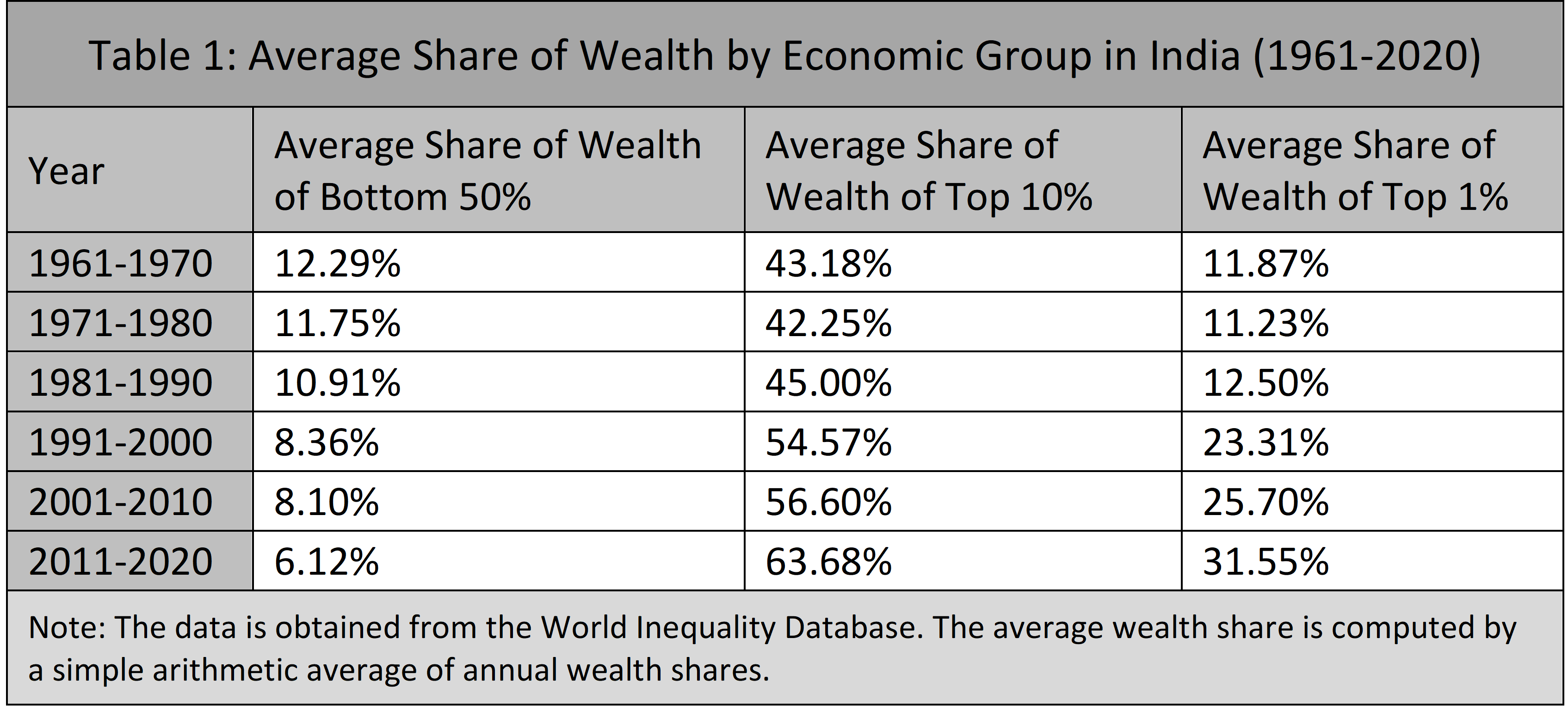
Next step is to look at the trend in bank lending in the form of retail loans and mortgages.

According to data released by RBI, the bulk of the increase in bank lending has been on account of retail loans, with credit card outstanding, consumer durables and loans against fixed deposits being the new drivers of growth in FY22.

. . . . Individuals continue to borrow for consumption even as corporations have deleveraged and paid their loans (Shetty, 2022). 

But what are the causes of this increase of indebtedness? Increased consumer optimism? Easier access to loans? Or the relative income hypothesis? This hypothesis is based on the idea that consumption patterns are related to the perception and valuation of one’s relative socio-economic position in one’s environment. It combines the desire of ‘keeping up with the Joneses’ during boom times and trying to keep up with your own previous peak consumption during downturns. The relative income hypothesis is a component of the Rajan hypothesis of causally connecting inequality with financial fragility.

Though I have anecdotal and observed evidence from the US for Rajan’s hypothesis, I am not sure how it would work out in India. The first thing to find is some correlation between increased inequality in India and increased indebtedness, and then see if causal connections can be made. But this project is too big to pursue here.

Postscript

Meanwhile in March 2023 a potentially humungous crisis was temporarily averted after two US banks went bankrupt and were taken over by different authorities. Silicon Valley Bank (SVB) in California ($209b) and Signature Bank in New York ($118b) are now the second and third biggest bank failures in US history after the record-setting failure of Washington Mutual ($307b) in 2008. Though 97% of deposits at SVB and 90% at Signature were not insured, the US government regards the crisis as a systemic risk and will guarantee all deposits in newly formed ‘bridge banks’. Throughout the crisis stock markets stayed relatively calm, but some banks took big hits with shares of Republican Bank going down 60%. The price of safe-haven gold increased about 5%.

Some Tremors in India

SVB’s troubles created also concern in India because many Indian start-ups and high-net-worth individuals have big accounts at SVB.

Indian startups that have millions of dollars stuck with the troubled Silicon Valley Bank are waiting for business hours in the US to resume Monday and could withdraw all their money from the bank en masse. The only thing that could stop that is if the US government manages to find a buyer for the beleaguered bank, founders said (Barik).

Little did anybody know that US regulators would step in with guarantees.

Ellen Brown

Again, what is next is anybody’s guess, though some of our allies in the monetary reform movement think it can be dire.

For example Ellen Brown of the Public Banking Institute warns that again we are facing the collapse of the derivatives house of cards. This time the derivatives used as a hedge against interest rate changes will come into play. She writes about “The Interest Rate Shock” which will ripple through the system.

Interest rate derivatives are particularly vulnerable in today’s high interest rate environment. From March 2022 to February 2023, the prime rate (the rate banks charge their best customers) shot up from 3.5% to 7.75%, a radical jump. Market analyst Stephanie Pomboy calls it an “interest rate shock.” It won’t really hit the market until variable-rate contracts reset, but $1 trillion in U.S. corporate contracts are due to reset this year, another trillion next year, and another trillion the year after that.

A few bank bankruptcies are manageable, but an interest rate shock to the massive derivatives market could take down the whole economy (Brown).

Steve Keen

Another warning comes form Australian economist and author Steve Keen. He blames the actions of the Fed in raising interest rates while ignoring its effects on the financial sector. He thinks that the Fed uses models in which debt, banks and money are ignored. The causal chain is that increased interest rates will diminish the value of bonds, of which many banks have massive amounts on their books.

Meanwhile, in the real world, rising interest rates on government bonds can cause banks to go insolvent. SVB was the canary in the coal mine here, but the factor that brought it undone is shared by all financial institutions, because government bonds are a major component of their assets. When interest rates rise, bond values fall, and this can drive financial institutions into insolvency—where their Liabilities exceed their Assets (Keen).

In his own Minsky Model he shows that the financial sector as a whole might get into negative equity territory if interest rates hit 5%. That is, the whole sector can go belly-up. Though he states his scenario is more hypothetical and educational than a real-world plausibility, the lesson he wants to convey is that,

It’s The Fed that deserves to be roasted instead, for attempting to manage the financial system using models that ignore banks, debt, and money.

Michael Hudson

Famed author and economist Michael Hudson addresses both of the above mentioned dangers, i.e. a) the effect of increased interest rates on the value of bonds and in turn its effect on the equity position of banks, and b) the looming danger of derivatives. On the interest rate he states that,.

Prices are plunging for bonds, and also for the capitalized value of packaged mortgages and other securities in which banks hold their assets on their balance sheet to back their deposits.

The result threatens to push down bank assets below their deposit liabilities, wiping out their net worth – their stockholder equity.

Like others, he wondered “why the Fed doesn’t simply bail out banks in SVB’s position”, but that question has just been answered by the regulators with their decisive intervention fully guaranteeing all deposits.

The issue with derivatives he thinks is the “larger elephant in the room”.

Volatility increased last Thursday and Friday. The turmoil has reached vast magnitudes beyond what characterized the 2008 crash of AIG and other speculators. Today, JP Morgan Chase and other New York banks have tens of trillions of dollar valuations of derivatives – casino bets on which way interest rates, bond prices, stock prices and other measures will change.

According to Hudson we are getting into really dangerous territory:

So far, the stock market has resisted following the plunge in bond prices. My guess is that we will now see the Great Unwinding of the great Fictitious Capital boom of 2008-2015. So the chickens are coming home to roost – with the “chicken” being, perhaps, the elephantine overhang of derivatives fueled by the post-2008 loosening of financial regulation and risk analysis.

By the way, the two above economists have written some of the most hard-hitting and provocative criticisms of how the economics discipline is mis-theorized by their peers through ignoring the role of money, banks and the money creation process. From Hudson we have J Is For Junk Economics, and Keen wrote Debunking Economics.

Alternatives

In the six years after the 2008/9 Global Financial Crisis (GFC) the monetary reform movement has attained far-reaching results in promoting breakthrough monetary theories, especially the credit creation theory of money and banking, and in proposing reform policies based on empirical findings and computer models.

Many central and commercial banks admitted the truth about money creation and through citizen’s initiatives many popular assemblies had to discuss the findings and proposals. In Switzerland it even came to a referendum.

Our ideas are still spreading and are picked up in many countries to the extent that monetary reform organizations have been started. Even so, main stream economists, politicians and policy think tanks are resisting our findings or stay blissfully ignorant of them. Hopefully this half-panic around SVB’s downfall will create questions about the current crisis-prone, unsustainable monetary system and awaken the vision that a more stable, more equitable and less indebted system is possible.

Sources

Anonymous. 2022. “Why The Banks Are Collapsing: The Coming Economic Crisis”. Moon YouTube Channel, Nov 2022.

Barik, Soumyarendra. 2023. “Indian startups with millions of dollars stuck in Silicon Valley Bank weighing en masse withdrawal”. Indian Express, 13 March 2023.

Bezemer, Dirk & Hudson, Michael. 2016. “Finance is not the economy: Reviving the conceptual distinction ”. Journal of Economic Issues, 50/3: 745-768.

Boughedda, Sam. 2022. “Nouriel Roubini, “Dr. Doom,” Expects a Severe, Long and Ugly Recession – Bloomberg”. Investing.com, 20 Sept 2022.

Brown, Ellen. 2023. “The Looming Quadrillion Dollar Derivatives Tsunami”. The Web of Debt Blog, 13 Mar 2023.

Cameron, Cooper. 2015. “6 economists who predicted the global financial crisis”. In the Black, 7 July 2015.

Gathak, Maitreesh et al. 2022. “Trends in Economic Inequality in India”.The India Forum, 19 Sept 2022.

Hudson, Micheal. 2017. J Is For Junk Economics: A Guide To Reality In An Age Of Deception. Dresden, Germany: ISLET Press. (Amazon)

Hudson, Micheal. 2023. “Why the Banking System is Breaking Up“.12 Mar 2023.

Keen, Steve. 2011. Debunking Economics: The Naked Emperor Dethroned? London: Zed Books. (Amazon)

Keen, Steve. 2023. “Silicon Valley Bank: The Fed’s Role in its Downfall”. Patreon, 11 Mar 2023.

Rajan, Raghuram G. 2006. “Has finance made the world riskier?.” European Financial Management, 12/4: 499-533. 

Rajan, Raghuram G. 2010. Fault Lines: How Hidden Fractures Still Threaten the World Economy. Princeton, New Jersey: Princeton University Press.

Roubini, Nouriel. 2022. “The Unavoidable Crash“. Project Syndicate, 2 Dec 2022.

Sharma, Samrat. 2022. “Recession is a certainty in 2023, but how much will it hurt India?” India Today, 12 Oct 2022.

Shetty, Mayur. 2022. “Individuals borrow more, corporates deleverage”. Times of India, 5 Sept 2022. 

Trading Economics. 2022. Graph of Households Debt in India in Percentage of GDP, 2009-2022. Derived from the Bank of International Settlements.

Van Treeck, Till. 2014. “Did inequality cause the US financial crisis?” Journal of Economic Surveys, 28/3: 421-448. 

Wiki entry: FTX (Company)

Yaffe-Bellany, David. 2022. “Embattled Crypto Exchange FTX Files for Bankruptcy”. New York Times, 11 Nov 2022.

Extra: https://www.visualcapitalist.com/ftx-leaked-balance-sheet-visualized/

Additions to Bibliography February 2023


B. Academic Studies on Sovereign Monetary Theory and Reform

Armelius, Hanna & Carl Andreas Claussen, David Vestin. 2020. “Money and monetary policy in times of crisis”. Monetary Policy Department and the Payments Department of the Riksbank. Riksbank of Sweden. Economic Commentaries, 4 (11 June 2020): 1-15.

Assenmacher, Katrin & Claus Brand. 2018. “The Swiss Sovereign Money Initiative”. Credit and Capital Markets, 51/4: 621-644.

Baeriswyl, Romain. 2017. “The Case for the Separation of Money and Credit”. In Heinemann, F., Klüh, U., and Watzka, S. (eds.), 2017, Monetary Policy, Financial Crises, and the Macroeconomy, Cham: Springer, pp. 105–21.

Barber, G. Russell. 1973. “The One Hundred Percent Reserve System”. The American Economist, 17/1: 115–127.

Bertocco, Giancarlo & Andrea Kalajzic. 2018. “How much does finance benefit society?”. PSL Quarterly Review, 71/287: 419-437.

—–, —–. 2001. “Is Kaldor’s theory of money supply endogeneity still relevant?” Metroeconomica, 52/1: 95–120.

—–, —–. 2010. “The endogenous money theory and the characteristics of a monetary economy”. Rivista Italiana degli Economisti, 15/3: 365–401.

—–, —–. 2013a. “Money as an institution of capitalism: Some notes on a monetary theory of uncertainty”. Economic Notes, 42/1: 75–101.

—–, —–. 2013b. “On Keynes’s criticism of the loanable funds theory”. Review of Political Economy, 25/2: 309–26.

Bjerg, Ole. 2018. “We Need to Put Things Back to Normal”. Interview with Ole Bjerg (2018) Journal of Economic Sociology = Ekonomicheskaya sotsiologiya, 19/4: 172–181.

Brown, Harry Gunnison. 1940. “Objections to the 100 Per Cent Reserve Plan.” The American Economic Review, 26/3: 309–314.

Buchanan, James M. 2010. “The Constitutionalization of Money.” Cato Journal, 30/2: 251–258.

Burns, Scott. 2016. “Old (Chicago) School, New Century: The Link between Knight and Simons’ Chicago Plan to Buchanan’s Constitutional Money.” Constitutional Political Economy, 27/3: 299–318.

Carroll, Charles Holt. 1964. Organization of Debt into Currency and Other Papers. Edited with an Introduction by E. C. Simmons. Princeton, NJ: Van Nostrand.

Chai, Hee-Yul, and Sang B. Hahn. 2018. “Does Monetary Policy Regime Determine the Nature of the Money Supply?: Evidence from Seven Countries in the Asia-Pacific Region“. East Asian Economic Review, 22/2: 217-239.

Currie, Lauchlin B. [1934] 1968. The Supply and Control of Money in the United States. New York, NY: Russell & Russell.

Demeulemeester, Samuel. 2019. “The 100% money proposal of the 1930s: Conceptual clarification and theoretical analysis.” PhD thesis, ENS de Lyon.

—–, —–. 2020. “Would a State Monopoly over Money Creation Allow for a Reduction of the National Debt? A Study of the ‘Seignorage Argument’ in Light of the ‘100% Money’”. Debates, Research in the History of Economic Thought and Methodology, vol. 38A, A Symposium on Public Finance in the History of Economic Thought, 123–44.

—–, —–. 2021. “The 100% money proposal of the 1930s: An avatar of the Currency School’s reform ideas?” The European Journal of the History of Economic Thought, 28,/4: 577–98.

Doorman, Frans. 2015. Our Money – Towards a New Monetary System. Lulu internet publishers.

Douglas, Paul H. 1935. Controlling Depressions. New York, NY: Norton.

Dow, S.C. 1997. “Endogenous Money”. In G.C. Harcourt and P.A. Riach (eds), A ‘Second Edition’ of The General Theory, vol. II, London and New York: Routledge, 61–78.

Fisher, Irving. 1936. “100% Money Again.” Social Research, 3/2: 236–241.

—–, —–. 1936. “The Bankers’ Interest in 100% Money.” The Bankers’ Magazine, October, 1936.

—–, —–. 1937. “100 Percent Reserves—An Old System Adapted to Modern Needs.” Commercial & Financial Digest, Los Angeles, California, June 1937. Reprinted in I. Fisher, Testimony before a Subcommittee of the Committee on Agriculture and Forestry, U.S. Senate, 75:1, August 12, 1937, 292–296.

—–, —–. 1937. “Note Suggested by Review of ‘100 Per Cent Money.’” Journal of the Royal Statistical Society, 100/2: 296–298.

—–, —–. 1946 (1997). “Answers to Objections to the 100% Plan.” Fisher Papers, Yale University Library. Reprinted in Barber et al, 1997, The Works of Irving Fisher – Vol. 11. 100% Money, 308–311.

Graham, Frank D. 1936. “Partial Reserve Money and the 100 Per Cent Proposal.” The American Economic Review, 26/3: 428–440.

—–, —–. 1941. “100 Per Cent Reserves: Comment.” The American Economic Review, 31/2: 338–340.

Higgins, Benjamin. 1941. “Comments on 100 Per Cent Money.” The American Economic Review, 31/1: 91–96.

Hook, Andrew. 2022. “Examining modern money creation: An institution-centered explanation and visualization of the “credit theory” of money and some reflections on its significance.” The Journal of Economic Education, 53/3: 210-231.

Krainer Robert E. 2013, “Towards a Program for Financial Stability”. Journal of Economic Behavior & Organization, 85 (January): 207-218.

—–, —–. 2017, “Economic Stability under Alternative Banking Systems: Theory and Policy”. Journal of Financial Stability, 31: 107-118.

Kumhof, Michael, et al. 2020. “Central Bank Money: Liability, Asset, or Equity of the Nation?” Cornell Law School Research Paper No. 20-46.

Lainà, Patrizio. 2017. “Seignorage from Full-Reserve Banking”. Published in Lainà, Patrizio, “Full-Reserve Banking: Separating Money Creation from Bank Lending”, PhD Thesis, University of Helsinki (November 13, 2017).

Lehmann, Fritz. 1936. “100% Money.” Social Research, 3/1: 37–56.

Lester, Richard A. 1935. “Check-Book Inflation.” The American Scholar, 4/1: 30–40.

Mellor, Mary. 2019. Money: Myths, Truths, and Alternatives. Bristol, UK: Policy Press.

Nayan, S., Kadir, N., Abdullah, M. S., & Ahmad, M. 2013. “Post Keynesian Endogeneity of Money Supply: Panel Evidence”. Procedia: Post Keynesian Endogeneity of Money Supply: Panel Evidence Economics and Finance, 7: 48-54.

Neuman, Andrew M. 1937. “100 Per Cent. Money.” The Manchester School, 8/1: 56–62.

Ponsot, Jean-François. 2017. “Rethinking Money“. In: Rochon, Louis-Philippe, and Sergio Rossi (eds), A Modern Guide to Rethinking Economics, Edward Elgar Publishing, 2017, 114-28.

Robbins, Richard H. 2014. “Debt and the Monetary Foundations of Inequality”. Anthropology News, 55, 14–15.

—–, —–. 2020. “Financialization, Plutocracy, and the Debtor’s Economy: Consequences and Limits”. In: Hann, Chris and Don Kalb (Eds.), Financialization: Relational Approaches. Max Planck Studies in Anthropology and Economy, Volume 6, New York and Oxford: Berghahn, 65–94.

—–, —– & Tim DiMuzio. 2020. “Capitalized money, austerity and the math of capitalism”. Current Sociology, 68: 149–168.

Robinson, George Buchan. 1937. “100% Bank Reserves.” Harvard Business Review, 15: 438–447.

Rochon, Louis-Philippe. 1999. Credit, money, and production: An alternative post-Keynesian approach. Cheltenham, UK and Northampton, MA: Edward Elgar.

—–, —–. 2001. “Cambridge’s Contribution to Endogenous Money: Robinson and Kahn on Credit and Money”. Review of Political Economy, 13/3: 287-307.

—–, —– & —–, —–. (eds). 2003. Modern Theories of Money: The Nature and Role of Money in Capitalist Economies. Cheltenham, UK and Northampton, MA: Edward Elgar.

Schuller, Govert. 2023. “Rochon’s Five Propositions on Bank Credit Creation”. Valatie, NY: American Monetary Institute.

Simarmata, Djamester. 2023. “Development Finance by Money Creation, instead of Foreign Debt or Saving: A New Paradigm For Development Economics”. MS [Forthcoming]

Simons, Henry C. 1934. “A Positive Program for Laissez-Faire”. Public Policy Pamphlet No 15. Chicago: University of Chicago Press.

Skaggs N.T. 1997. “Henry Dunning Macleod and the Credit Theory of Money”. In: Cohen A.J., Hagemann H., Smithin J. (eds), Money, Financial Institutions and Macroeconomics, Recent Economic Thought Series, vol 53, Dordrecht: Springer.

Smithin, J. 2013. “Keynes’s theories on money and banking in the Treatise and the General Theory”. Review of Keynesian Economics, 2/2: 242–56.

Stellinga, Bart, et al. 2021. Money and Debt: The Public Role of Banks. Research for Policy Series. Studies by the Netherlands Council for Government Policy. Cham, Switzerland: Springer.

Thomas, Rollin G. 1940. “100 Per Cent Money: The Present Status of the 100 Per Cent Plan.” The American Economic Review, 30/2: 315–323.

Tolley, George S. 1962. “100 Per Cent Reserve Banking”. In: Yeager, L. B. (ed.), In Search of a Monetary Constitution, Cambridge, MA: Harvard University Press, 275–304.

Watkins, Leonard L. 1938. Commercial Banking Reform in the United States: With Especial Reference to the 100 Per Cent Plan and the Regulation of Interest Rates on Bank Deposits. Vol. 5. Michigan Business Studies, 8. Ann Arbor, MI: University of Michigan.

Werner, Richard A. 2003. Princes of the Yen: Japan’s Central Bankers and the Transformation of the Economy. New York: M.E. Sharpe.

—–, —–. 2018. “Shifting from Central Planning to a Decentralised Economy”. Paper presented at the 14th Rhodes Forum: Dialogue of Civilisations Research Institute, Panel 2: “Economic Alternatives when Conventional Models Fail”, Rhodos, Greece, on 1 October 2016 and at the 4th European Conference on Banking and the Economy (ECOBATE 2016), in Winchester Guildhall, Winchester UK, on 12 October 2016.

Whittlesey, Charles R. 1935. “Banking and the New Deal”. Public Policy Pamphlet No. 16. Chicago: University of Chicago Press.


C. Studies Critical of Sovereign Monetary Theory and Reform (including MMT section)

Pro MMT

Berkeley, A., Ryan-Collins, J., Tye, R., Voldsgaard, A. and Wilson, N. 2022. “The self-financing state: An institutional analysis of government expenditure, revenue collection and debt issuance operations in the United Kingdom.“ UCL Institute for Innovation and Public Purpose, Working Paper Series (IIPP WP 2022-08)

Ryan-Collins, Josh. 2022. “Why the British state is a magic money tree“. The New Statesman, 26 May 2022

Keen, Steven. 2022. “A Little Knowledge is a Dangerous Thing: Observations on the debate between MMT advocates and Progressive Money Canada founder Jeff Eder”. Planksip, 30 Sept 2022.

Critical of MMT

Eder, Jeff. 2022. “Steve Keen has lost his way in a Minsky Maze”. Progressive Money Canada. [Response to Keen, 2022]

Epstein, Gerald A. 2019. What’s Wrong with Modern Money Theory? A Policy Critique. Cham, Switzerland: Palgrave.

Mueller, Antony P. 2019. “The magic money tree: The case against modern monetary theory (MMT).” Research Paper Series Adam Smith Institute (ASI), UK.

Schuller, Govert. 2020a. “Requesting Evidence for a Crucial MMT Claim”. Blog. Alliance For Just Money, 16 Aug 2020.

—–, —–. 2020b. “Triple-column Comparison between Modern Monetary Theory (MMT), the Actual Monetary System, and Sovereign Money Reform (SMR)”. Blog. Alliance For Just Money, 21 Sept 2020.

—–, —–. 2020c. “ ‘What’s Wrong with Modern Money Theory?’: A Summary”. Blog. Alliance For Just Money, 5 Oct 2020.

—–, —–. 2022. “Did Dr. Joshua Ryan-Collins go MMT?”. Paper presented at the American Monetary Institute conference, October 8, 2022. Video here.

D. Non-academic Advocacy Pamphlets, Reports, Briefings and Books

AMI. 2021. “AMI Conference Statement to COP26: Regarding the Monetary Dimension of Climate Change”. American Monetary Institute, Evanston, IL, USA, 11 Nov 2021.

Anon. 2019. “Open Letter: Rethinking the Role of Banks in Economics Education”. Rethink Economics.

Hermanutze, Derryl. 2020. A Brief History of Financial Plunder. Independently published.

Jordan, Thomas J. 2018. “How money is created by the central bank and the banking system.” Speech at the Zürcher Volkswirtschaftliche Gesellschaft, Zürich, 16 Jan 2018. Speech given in German. Zürich: Swiss National Bank.

McConnachie, A. 2006. Clarifying Our Money Reform Proposals: A Report for the Tenth Annual Bromsgrove Conference. Bromsgrove Conference, Bromsgrove, England.

Positive Money. N.d. “What people think banks do: The money multiplier and other myths“. London: Positive Money.

Stuart, James Gibb. 1991. Scotland and Its Money. Edinburgh: John Dunlop.

—–, —–. 1992. Economics of a Green Renaissance. Glasgow: Ossian Publishers.

—–, —–. 1993. Hidden Menace to World Peace. Glasgow: Ossian Publishers.

Turner, W.E. 1966. Stable Money: A Conservative Answer to Business Cycles. With introduction by Representative Wright Patman. N.p.

E. Supporting Studies Addressing Monetary Issues

Costa, Jorge Meira & Marc Gauvin, McNeill. 2015. “A proposal for harmonising current disparate (scientific and legal) definitions of money towards greater decidability in the provision of Justice according to universal principles of contract law“. Presentation at MERC first annual conference on The Monetary Policies in The Balkans, The Future of The Euro and The Eurozone in The Balkan Region. Monetary and EconomicResearch Center, Sofia -Bulgaria, 2015.

DiMuzio, Tim. 2023. “Capitalism, Money and Inequality in the World”. In: Bieri, Sabin & Bader, Christoph (Eds.), Transitioning to Reduced Inequalities, Basel, Switzerland: MDPI Books.

Gauvin, Marc & Sergio Dominguez. 2020. “A Systems Engineering Approach to Formal Monetary and Financial Stability Without the Vagaries of “Austerity” “. Submitted December 2020 to Monetary Research Centre (MRC), University of National and World Economy (UNWE), Sofia Bulgaria.


F. Journalistic Articles Addressing Monetary Reform

Baker, Scott, 2012. “The Instant Solution to the New Depression: Debt-free Money”. HuffPost, 4 june 2012.

Howell, John. 2017a. “Who creates money and where does it go?” The Athens Messenger, 25 Jan 2017.

—–, —–. 2017b. “Why money creation is central to most of the problems faced by society”. Athens, OH: Democracy over Corporations.

Joób, Mark. 2014. “The Sovereign Money Initiative in Switzerland“. World Economics Association Newsletter, 4/3 (June 2014): 6-7. (Comments here)

Hulsmann, Jorg Guido & Patrizio Laina & Joseph Huber & Ib Ravn & Bryan Gould. 2020. “Letter: It’s time to reconsider full reserve banking”. Financial Times (UK), 30 Aug 2020.


G. Educational and Promotional Videos (and other media)

Collins, Josh Ryan & Gabor, Daniela & Dyson, Ben & Werner, Richard. 2014. “Money and Banking”. Rethinking Economics, London Conference, June 2014. RE YouTube Channel, 25 Aug 2014.

Reiss, Michael. 2012. “Money… How It Works”. Unconventional Economics YouTube Channel, 22 dec 2012.

Schasfoort, Joeri. 2020. “How Commercial Banks Really Create Money (the Money Multiplier is a MYTH).” Money & Macro YouTube Channel, 28 Mar 2020.

—–, —–. 2020. “The Monetary Financial System Visually Explained“. Money & Macro YouTube Channel, 9 Dec 2020.

—–, —–. 2021. “Why Private Bank Money Creation is Dangerous.” Money & Macro YouTube Channel, 27 Jan 2021.

Turner, Adair. 2014. “The Need for Radical Change”. Keynote Speech, Rethinking Economics, London Conference, June 2014. RE YouTube Channel, 25 Aug 2014.

Kamp, Diane & Dave Zollinger. 2008. “Stephen Zarlenga Talks About the Lost Science of Money”. Demcracy’s Edge talk radio. 48m31s. Internet Archive, 20 Oct 2008.

Werner, Richard. 2015. “A Prosperous Future Together”. Dialogues of Civilizations. Rhodes Forum 2015. Dialogues of Civilizations YouTube Channel, 23 Dec 2015.


H. Other Relevant Background Studies

Barrdear, John & Kumhof, Michael. 2021. “The macroeconomics of central bank digital currencies.” Journal of Economic Dynamics and Control (2012): 1041-48.

Bichler, Shimshon, Jonathan Nitzan, and Timothy DiMuzio. 2012. “The 1%, Exploitation and Wealth: Tim Di Muzio interviews Shimshon Bichler and Jonathan Nitzan“. Faculty of Law, Humanities and the Arts, University of Wollongong – Papers 810.

Chick, Victoria. 1986. “The evolution of the banking system and the theory of saving, investment and interest”. Economies et Sociétés, 20/8–9: 111–26.

Grim, Ryan. 2009. “Priceless: How the federal reserve bought the economics profession.” Huffington Post,23 Oct 2009

Hockett, Robert C. 2020. “The capital commons: A plan for building back better and beyond.” 20 Aug 2020. Available at SSRN 3697337.

—–, —– & Omarova, Saule T., 2018. “Private Wealth and Public Goods: A Case for a National Investment Authority“. Journal of Corporation Law, 437:

—–, —– & —–, —–. 2020. “Financing Continuous Development: The ‘American Plan’ of State Capitalism”. Cornell Legal Studies Research Paper No. 20-31 (April 2, 2020). Available at SSRN. Also in: Wright, Mike et al (eds.), 2020, The Oxford Handbook of State Capitalism, Oxford: Oxford UP.

Kaldor, N. 1970. “The New Monetarism”. Lloyds Bank Review, 97/1: 1–18.

Kuypers, Stef. 2019. Money, behavior and society: The invisible link. TEDxAntwerp, Nov 2019.

Lietaer, Bernard & Christian Arnsperger, Sally Goerner, Stefan Brunnhuber. 2012. Money and Sustainability The Missing Link. A Report from the Club of Rome – EU Chapter – to Finance Watch and the World Business Academy. Axminster, UK: Triarchy Press.

—–, —– & Dunne, Jacqui. 2013. Rethinking Money: How New Currencies Turn Scarcity into Prosperity. San Francisco: Berrett-Koehler.

Lonergan, Eric. 2014. Money (The Art of Living). Second edition. Oxon, UK & New York: Routledge.

Minsky, Hyman P. 1994. “Financial Instability and the Decline (?) of Banking: Future Policy Implications“. Working Paper No. 127, October 1994. The Jerome Levy Research Institute of Bard College.

—–, —–. 1995. “Would Universal Banking Benefit the U.S. Economy?” Hyman P. Minsky Archive, Paper 51, reworked version dated April 5, 1995.

Nain, Aditya, & P. G. Jung. 2021. Understanding Money: Philosophical Frameworks of Monetary Value. London & New York: Taylor & Francis.

Omarova, Saule T. “The People’s Ledger: How to Democratize Money and Finance the Economy”. Vanderbilt Law Review, 74/5:

Palley, Thomas. 2022. Theorizing dollar hegemony, Part 1: The political economic foundations of exorbitant privilege. No. PKWP2220. Post-Keynesian Economics Society, August 2022.

Ricardo, David. [1824] 1951. Plan for the Establishment of a National Bank. London: John Murray, Albemarle-Street, 1824. Reprinted in: Sraffa P. (ed.), 1951, The Works and Correspondence of David Ricardo, Vol. 4, Cambridge, UK: Cambridge UP, 271-300

Robbins, Richard H. 2022. “ ‘An Opportunity of a Lifetime’: Covid-19 in the Age of Finance”. In: Tim Di Muzio and Matt Dow (Eds.), Covid-19 and the Global Economy, London & New York: Routledge.

—–, —–. 2022. “Financialization”. In: James G. Carrier (ed.), The Handbook of Economic Anthropology, 3rd Edition, Oxford: Berg Publishing.

—–, —–. 2020. ‘The Economy After Covid-19”. Focaal Blog.

Sanderson, Stephen K. 1995. Civilizations and World Systems: Studying World-historical Change. Lanham, MD: Rowman Altamira.

Schuller, Govert. 2020. “Talk About Borders”. Blog, Alliance For Just Money, 23 May 2020.

Seligman, Edwin Robert Anderson, et al. 1908. The Currency Problem and the Present Financial Situation: A Series of Addresses Delivered at Columbia University, 1907-1908. New York, NY: Columbia University Press.

Suaste Cherizola, Jesús. 2021. “From Commodities to Assets: Capital as Power and the Ontology of Finance”. Review of Capital as Power, 2/1: 1-29.

Toynbee, Arnold J. 1962–1964 [1934–1961]. A Study of History. 12 vols. Oxford: Oxford University Press.

Toynbee, Arnold J. 1947a. A Study of History. Vol. I. Abridgment of vols. I–VI by D. C. Somervell. London: Oxford University Press.

Toynbee, Arnold J. 1947b. A Study of History. Vol. II. Abridgment of vols. VII–XI by D. C. Somervell. London: Oxford University Press.

Viñuela, Carlos, Juan Sapena, and Gonzalo Wandosell. 2020. “The Future of Money and the Central Bank Digital Currency Dilemma” Sustainability, 12/12: 9697.

Wallerstein, Immanuel. 1974-1989. The Modern World-System. 3 volumes. New York & San Diego & London: Academic Press.

—–, —–. 2000. The Essential Wallerstein. New York: The New Press.

—–, —–. 2004. World-Systems Analysis: An Introduction. Durham, NC: Duke University Press.

Wilkinson, David. 1987. “Central Civilization”. Comparative Civilizations Review, 17/17: Article 4. Also in: Sanderson, Stephen K., 1995, Civilizations and World Systems: Studying World-historical Change, Lanham, MD: Rowman Altamira, pp. 46-74.


New Links to Older Studies

Klein, Manuel et al. 2018. “The Future of Money – 10 years after Lehman and Nakamoto” (Conference). Conference videos and papers. 24 Nov 2018. Berlin, Germany: Monetative.

Robertson, James. 2012. Future Money: Breakdown or Breakthrough? Totnes, UK: Green Books.

Werner, Richard A. 1997. “Towards a New Monetary Paradigm: A Quantity Theorem of Disaggregated Credit, With Evidence from Japan“. Kredit und Kapital, 30/2 (July 1997): 276–309 .

—–, —–. 2005. New Paradigm in Macroeconomics: Solving the Riddle of Japanese Macroeconomic Performance. Basingstoke, UK & New York: Palgrave Macmillan.

Nominating the 2022 Nobel Economics Committee for the 2023 Ig Noble Economics Prize


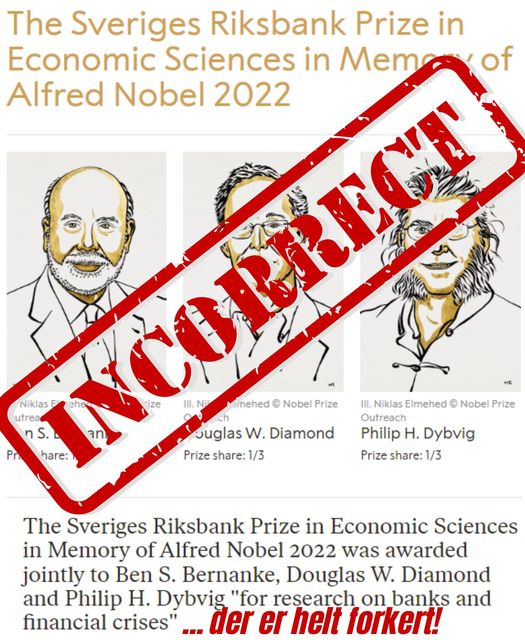
It is an honor to be awarded the prestigious Nobel Prize in Economic Sciences. This year it went to three American economists “for their research on banks and financial crises”. The lucky recipients were Ben S. Bernanke, Douglas W. Diamond, and Philip H. Dybvig and the Swedish committee titled their justification “Financial Intermediation and the Economy”.

For reasons to be shared here, this award is also an unexpected gift to the international monetary reform movement. Not because the Nobel committee or its award recipients are siding with this movement and its analysis of money and banking, but because the award is given for research which is based on the outdated, refuted, incorrect, mistaken ‘intermediation theory of money and banking’ based on the idea that banks are the intermediaries between savers and borrowers.

Meanwhile the truth, ladies and gentlemen, is that loans create deposits, because, when a loan is originated the borrower receives money which had not been in existence before. The commercial bank just credited his or her account and received in exchange the signed loan contract of the same value. This theory is named the credit creation theory, because a credit is created out of nothing, which then can be spend into the economy where it is received as good as money, no questions asked.

This is counter-intuitive, for sure, but we will see that even the research staff in the Swedish Riksbank, which is involved in awarding the prize, knows that the credit creation theory is the correct one and not the intermediation theory. I am sure you see the reason of the Ig Noble prize looming.

The news of this award came to me from someone sharing an article by Scott Horsely of the US-based National Public Radio (NPR), and Horsely, as so many reporters merely passing on official statements, dutifully reproduced the idea that,

Banks help to foster a more productive economy by channeling excess cash from depositors to borrowers in need of money to build homes and factories and businesses.[1]

So, he is, innocently or not, parroting the Swedish academy, which stated along the same lines that,

Financial intermediaries such as traditional banks and other bank-like institutions facilitate loans between lenders and borrowers, and thereby play a key role for the allocation of capital.[2]

A little further in the justification they state that,

. . . it would likely be prohibitively costly for a home buyer to write a separate financial contract with every individual lender that ultimately finances her mortgage. Furthermore, if every lender required the contract to stipulate that she had the right to get her money back on demand, costs would escalate quickly, as the borrower may repeatedly have to seek refinancing.

To solve this problem, financial intermediaries such as banks and mutual funds exist. These institutions channel funds from savers to investors, receiving funds from some customers and using the funds to finance others.

Of course people in the monetary reform (MR) movement immediately perceive the problem here, i.e. the committee still believes in the refuted intermediation theory, which has been replaced by the correct credit creation theory.

The irony is that researchers working at the ‘Monetary Policy Department and the Payments Department of the Riksbank’ of Sweden know where money comes from. I am not going to paraphrase but let them tell us themselves:

Commercial bank money is created when banks give loans

To understand what commercial bank money is and how it is created, we can look at an example that starts with a customer wanting a loan. The loan involves the customer signing a promissory note, that is, a promise to pay back the loan in the future as a certain amount of money to the bank. In return, the bank deposits a sum of money into the customer’s account with the bank.[3]

The source they refer to in ftn. #3 is the now quite famous 2014 paper by McLeay et all.[4]

3. For an accessible primer for how banks create credit, see McLeay et al. (2014).[3]

And this is not the only paper to be found at the Riksbank web site incorporating the credit creation theory of money. Another paper addressing CBDC even explicitly takes it as its starting point.

The paper builds on a model of bank loan supply that is based on the actual practice of banking. In the model, banks can create potentially unlimited amounts of loans and deposits in their own books. When banks give out loans and create deposits, they must also make sure that they can satisfy customers’ outflows to other banks, cash or CBDC. To satisfy these outflows, banks need central bank reserves.[5]

Given the above analysis it is my conviction that this is a gift for the monetary reform movement, because it can hammer home its message, citing chapter and verse, that 1) modern, mainstream macroeconomics (except for the Post-Keynesian theory of endogenous money [6]) is mistaken in its monetary theories; 2) that monetary reformers have the right theory; and 3) that radical monetary reforms are required and possible based on that theory.

These reforms could be boiled down to:

1. All official money – be it cash, money-on-account or new forms of digital currency – is created by a monetary state authority, according to the needs of the economy in a transparent and accountable process.

2. Money is created free of debt, and is directly spent into the economy via the state by way of government expenditure or directly distributed to the citizens as an equal dividend.

3. Private banks cannot create official money as credit. They only act as payment service providers and/or financial intermediaries by lending and investing existing official money, which they obtain from savers and investors.[7]

Furthermore, this committee of the Swedish academy and Swedish central bank should be nominated for next years Ig Noble Prize for improbable research (I used their logo above), because they gave it to research based on an imaginary, outmoded understanding of banking.

Following the motto of the Ig Noble Prize of “Research that makes people LAUGH . . . then THINK”, we can honestly say the 2022 economics award makes us laugh for its flat-earth-like outdatedness, and makes us think about why on our round earth the committee would give the prize to these economists.

And there is a precedent for giving allegedly successful entities that prize, like in the 2002 Ig Nobel prize for economics given to many accounting and financial entities “for adapting the mathematical concept of imaginary numbers for use in the business world” leading to financial crises and accounting scandals.[8]

So, what to do with this? Can we protest the prize? Instead of joking about the Ig Noble prize, look at its nomination procedures?[9] For truth’s sake maybe we should.

P.S.: Next door to Sweden in Denmark the monetary reform organization Gode Penge is not too happy with this prize either. On Facebook they gave the same explanation accompanied with a clear image.


Sources

[1]. Horsely, Scott. 2022. “Ben Bernanke among 3 American winners of Nobel Prize in economics”. NPR, 10 Oct 2022.

[2]. The Committee for the Prize in Economic Sciences in Memory of Alfred Nobel. 2022. “Financial Intermediation and the Economy”. Scientific Background on the Sveriges Riksbank Prize in Economic Sciences in Memory of Alfred Nobel 2022. The Royal Swedish Academy of Sciences, 10 Oct 2022.

[3]. Armelius, Hanna & Carl Andreas Claussen, David Vestin. 2020. “Money and monetary policy in times of crisis”. Monetary Policy Department and the Payments Department of the Riksbank. Riksbank of Sweden. Economic Commentaries, 4 (11 June 2020): 1-15.

[4]. McLeay, Michael & Radia, Amar & Thomas, Ryland. 2014a. “Money Creation in the Modern Economy”.Monetary Analysis Directorate. Bank of England Quarterly Bulletin (Q1, 2014): 14-27.

McLeay, Michael & Radia, Amar & Thomas, Ryland. 2014b. “Money in the modern economy: An introduction”. Monetary Analysis Directorate. Bank of England Quarterly Bulletin (Q1 2014): 4-13.

[5]. Juks, Reimo. 2020. “Central bank digital currencies, supply of bank loans and liquidity provision by central banks.” Sveriges Riksbank Economic Review, 2 (2020): 62-79.

[6]. See for example: Rochon, L.- P. and S. Rossi. 2013. “Endogenous money: the evolutionary versus revolutionary views”. Review of Keynesian Economics, 1 /4: 210–29.

[7]. International Movement for Monetary Reform. 2018. “About the IMMR & Our Manifesto”. IMMR web site.

[8]. Ig Nobel Prize Winners 2002.

[9]. The Ig Noble Nominations. “How to Nominate Someone”. Improbable Research web site.

Triple-column Comparison

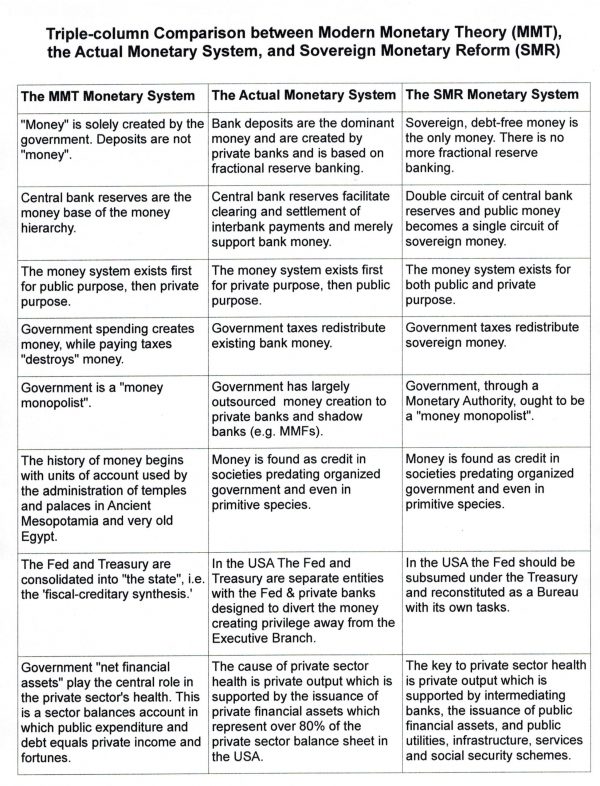
Triple-column Comparison between Modern Monetary Theory (MMT), the Actual Monetary System, and Sovereign Monetary Reform (SMR)


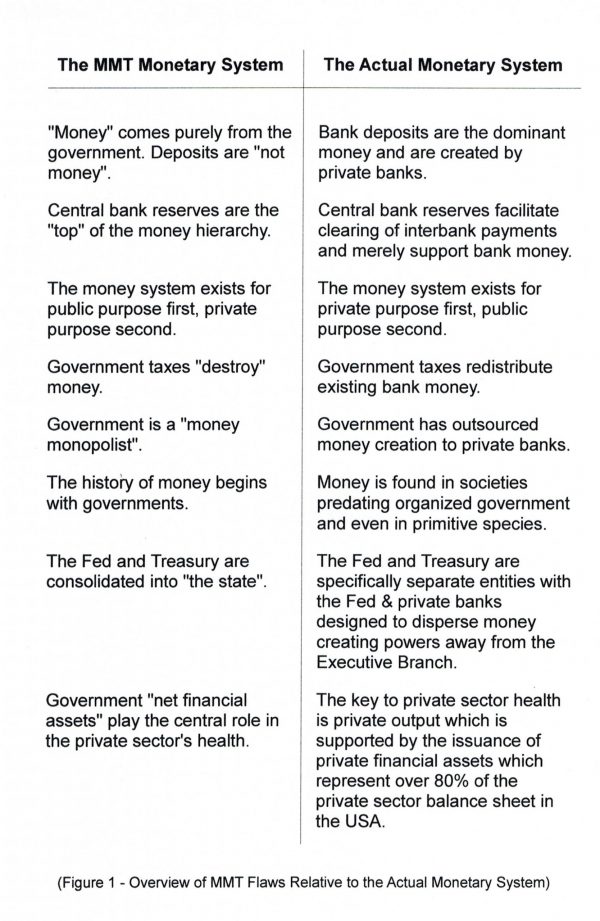
A while ago I found a very useful double-column comparison of the concept of the monetary system in Modern Monetary Theory (MMT) and how the monetary system actually functions. The figure is titled:

“Overview of MMT Flaws Relative to the Actual Monetary System”

It is a small image easily used on-line in posts and discussions and was composed by Cullen Roche in a 2013 article titled “A Critique of Modern Monetary Theory (MMT)“. Roche is the author of Pragmatic Capitalism: What Every Investor Needs to Know About Money and Finance and editor of the eponymous web site Pragmatic Capitalism.


Recently I had the idea to expand the double column into a triple one by adding the ideas and proposals by the movement proposing Sovereign Money Reform (SMR) based on what Dr. Joseph Huber calls New Currency Theory (NCT). With some help the entries were refined, corrected or paraphrased. The result is the following triple column.

I am presenting it here for anybody to use as an educational tool in the discussion about the deep flaws of MMT in order to 1) promote what we think is the correct theory of money and banking and 2) promote the necessary legislative changes which are needed to redress the deep systemic flaws of the current money regime.

To be clear, what we propose is the following triple-pronged policy proposal, which can be found on the web site of the International Movement for Monetary Reform:

We propose a transition towards a sovereign money system in which:

All official money – be it cash, money-on-account or new forms of digital currency – is created by a monetary state authority, according to the needs of the economy in a transparent and accountable process.

Money is created free of debt, and is directly spent into the economy via the state by way of government expenditure or directly distributed to the citizens as an equal dividend.

Private banks cannot create official money as credit. They only act as payment service providers and/or financial intermediaries by lending and investing existing official money, which they obtain from savers and investors.

This proposal of course is quite different of what proponents of MMT propose and that is government spending on worthy causes like the Green New Deal by allegedly creating new money and do so till the ‘slack’ is out of the economy and inflation might set in. We think that, based on our understanding how the system currently works, 1) this will lead to deficit spending because spending still has to be compensated through taxes and bonds, and 2) it unconscionably neglects to deal with the issue of money creation in the hands of private commercial banks and its disastrous consequences.

Meanwhile the American people already have a bill on the shelf to implement sovereign monetary reform and it is the 2012 H.R. 2990, the National Emergency Employment Defense Act or NEED Act. With some tweaking this bill can be adopted to solve a large chunk of the severe financial challenges the US Congress is facing to prevent the economy from collapse and citizens from bankruptcy and eviction, all in the context of the COVID-19 pandemic. Once you understand the current monetary system, one cannot but see its solution in sovereign monetary reform.


More critical posts on MMT:

Requesting Evidence for a Crucial MMT Claim

Richard Wolff’s Trajectory beyond MMT into SMR

Introduction to the Problem with Modern Monetary Theory (MMT)

Money and Banking: Assessing overlaps and differences between SMR and MMT

Modern Money Theory revisited – still the same false promise

Global Problems and the Culture of Capitalism


Introduction

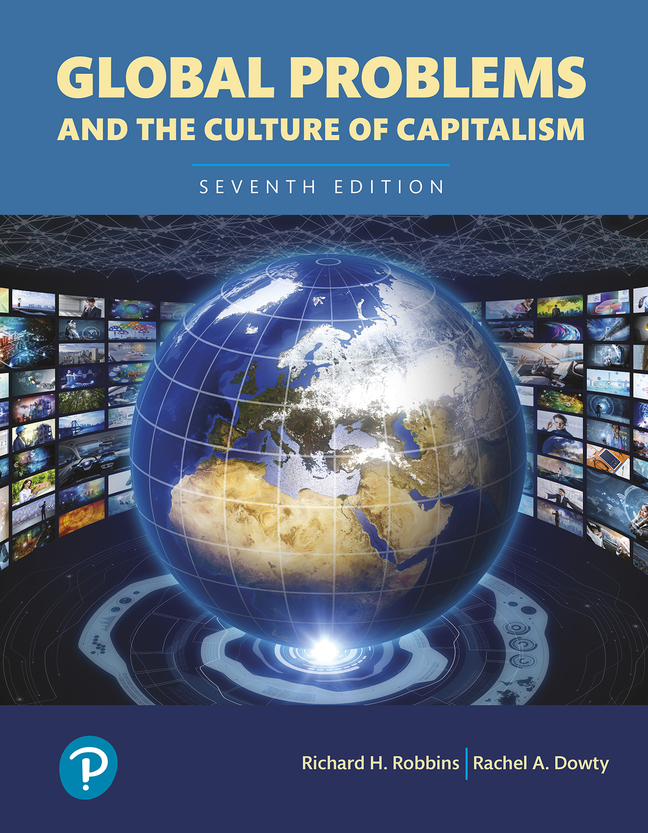
In 2011 I took a sociology class on global social problems. Three texts were required and one of them, Global Problems and the Culture of Capitalism by Richard Robbins, stood out in several ways. The book was very rich in information with many on-the-ground narratives. It had a simple but effective overarching theory; it addressed the issue of money creation, something I was already familiar with through Stephen Zarlenga and the American Monetary Institute. And it offered many interesting references I wanted, and did, pursue.

Of all the textbooks on economics, political science, history and sociology, this one counts for me as one of the best and most impactful ones during my crawl through college. And I am certainly not alone in assessing the book’s value. Though originally written in 1999 it went through seven editions, the latest in 2018, and has been translated into Polish, Korean, Chinese and Arab.

Tim Di Muzio

Now, many years later I dug into the work by the Canadian academic Tim Di Muzio and especially liked his book Debt as Power in which the destructive impact of the our debt-money capitalist regime is systemically addressed. There was a co-author involved. Last week we hosted Di Muzio on our Monetary Coffee House meeting and he shared that his foray into debt-money had more or less started with reading a book on global problems and that he had contacted its author.

A few hours later, while composing an e-mail about the sources mentioned in our meeting, did it dawn on my thick skull that the book Di Muzio referred to was Global Problems, the very same I had studied, and that its author Richard Robbins was also his co-author of Debt as Power! This put the book in a new light and I pulled out my old, underlined and annotated copy of Global Problems to give some passages another read.

Money

One of the foundational sections in the book is titled “A Primer on Money: The Philosopher’s Stone”. On Amazon you can read it as part of the “Look inside” feature on pages 4 to 11. Around page 100 (depending on the edition) one can read the basic idea reiterated:

We generally assume that governments create money by printing it. And, in fact, when money was linked to gold, there was a limit on how much could be printed. However, with the lifting of these restrictions, most money is now created by banks and other lending institutions through debt. We generally assume, also, that the money that banks lend is money that others have deposited.

However, that is not the case; only a fraction of the money that banks lend needs to be in deposits. In effect, whenever a bank lends money, or whenever a product or service is purchased on credit, money has been created. In effect, then, there is virtually no limit on the amount of money that lending institutions can create; furthermore, the interest on the loan payments creates yet more money. Economists call this debt money (Rowbotham 1998:5), or credit money (Guttmann 1994).

Though some parts of this quote could be calibrated for accuracy, the basic theory is there. Most of what we use as money is debt-money created by banks when they extend loans. 

Forced Money Growth

The main thrust of the textbook is to provide empirical flesh to the following, skeletal mechanism. When banks create loans and charge interest, they do not create the money to pay off the interest. This pushes the system into finding ways to grow the money supply by making ever more loans extended to consumers and businesses. And they need to find ever more ingenious ways to create or find things and services to be sold.

In other words, the money supply must grow if the economy is to remain healthy, and for the money supply to grow there must be a steady increase in the things or services that money can buy (4th edition, p. 11).

To keep the system going, Robbins argues,

. . . there must be a constant conversion of things that have no money value into things that do–that is, there must be constant commodification.

And the maintenance and global spread of this impetus is not without problems. On the contrary, Robbins argues that many if not most global problems can be traced back to the blind and iron logic of perpetual growth and commodification. But that is not something necessarily acknowledged by its beneficiaries living in the privileged zones at the core of the world-system.

Robbins challenges this blind spot and actually in the third part of the book addresses the resistance and rebellion against the culture of capitalism by workers, feminists, ecologists, minorities, indigenous people and other citizen-activists engaging in “antisystemic protest”.  

Solutions

As far as solutions to this impetus is concerned Robbins discusses a wide spectrum of possibilities. And the ones relevant to monetary reform are the reassessment of  perpetual economic growth as an index of a nation’s well-being and look for alternative indices and goals. And, more explicitly, Robbins sees “Zero Economic Growth” as a valid prospect and agrees with David Korten’s proposal to:

Make the creation of national currencies a public function, rather than allowing banks and other financial institutions to increase the money supply through debt (405).

This is also what the Alliance for Just Money proposes in its promotion of the NEED Act, which boils down to the following three basic and interconnected fundamental changes:

1. Require Congress to exercise its Constitutional power to be the sole creator of all U.S. money, issued debt-free, and to establish a transparent and independent public monetary authority to determine the amount of new money the Treasury will disperse under authority of Congress.

2. End the privilege of commercial banks to create and issue what we use as money.

3. Transfer ownership of the 12 Federal Reserve Banks, and all remaining operations of the Federal Reserve System, to the U.S. Treasury. 

In closing I like to reiterate that Robbins’ Global Problems and the Culture of Capitalism is a great starting point to study the connection between debt-money and global problems.  Also that the books co-authored with Di Muzio will only deepen the understanding of this connective tissue and add to the motivation towards, and see the possibilities of, structural reform.

Stay tuned for more from Richard Robbins and Tim Di Muzio.

Sources

Robbins, Richard & Rachel Dowty. 2018 (1999). Global Problems and the Culture of Capitalism (Seventh Edition). New York: Pearson/Allyn & Bacon.

Di Muzio, Tim & Robbins, Richard. 2016a. Debt as Power: Theory for a Global Age. Manchester, UK: Manchester U.P.

Di Muzio, Tim & Robbins, Richard. 2017. An Anthropology of Money: A Critical Introduction. London: Routledge.

Guttmann, Robert. 1994. How Credit-Money Shapes the Economy: The United States in a Global System. London: M. E. Sharpe.

Rowbotham, Michael. 1998. The Grip of Death: A Study of Modern Money, Debt Slavery and Destructive Economics. Charlbury, Oxfordshire: Jon Carpenter.

Modeling the Financial-Economic System and how to make it Sustainable

Two economic researchers, van Egmond and de Vries, at the Sustainable Finance Lab (University of Utrecht, the Netherlands) developed a dynamics model in which the financial system is explicitly included. Their working paper is titled “Dynamics of a Sustainable Financial-Economic System”[1] and it also addresses a sovereign monetary system.

After Yamaguchi in 2010 [2] and then Kumhoff & Benes in 2012 [3], this might be the third successful modeling of sovereign monetary reform (SMR) to date.

They also explicitly heeded the call by Richard Werner, who supports SMR, for a new research programme in macroeconomics citing what increasingly looks like his seminal 2012 paper on the Quantity Theory of Credit.[4]

Find below the Abstract of the van Egmond & de Vries paper and the section on the “Legitimacy of money creation by the government”.

Abstract (page 1)

Along the lines of neoclassical theory, a system dynamics model has been developed to describe the most important mechanisms governing the physical output of goods and services in the economy in interaction with the financial system. The model gives a meaningful reconstruction of the overall long-term dynamical behaviour of the financial-economic system, including the endogenously modeled crisis.

The occurrence of the boom- and bust-cycles can be understood and to a reasonable extent predicted from the asset price driven credit cycle. The model confirms Minsky’s instability hypothesis, in which the euphoria over apparently ever increasing (asset) prices, GDP, wages, consumption and loans turn the system into the downward spiral of the bust, when financing cost becomes unbearable for individual households and the economy is no longer stimulated by a continuously decreasing interest rate as soon as the interest rate approaches the zero level. Once the residential quote passes a certain threshold, defaults significantly increase, banks tend to go bust and have to be recapitalized by the government, with substantial macro-economic consequences.

The current financial system appears to be fundamentally unstable. Lacking central coordination, euphoric herd behavior of the many private banks causes the unjustified creation of too much money and subsequent boom-and-bust behavior of the economic system.

The model experiments show that money creation by the government, according to a ‘money creation rule’, for example directed to price stability and / or employment, can stabilize the boom-bust cycles. At a constant price level, both the physical and the monetary production as well as consumption then follow a pathway of stable, continuous growth which reflects the increased productivity resulting from technical progress. Throughout history, money creation by the government is strongly legitimated and advocated by prestigious social, philosophical and economic thinking.

Price stability and the associated positive effects on employment and GDP can be realized by creation of debt free money at a rate corresponding to the growth of the real, physical economy (without inflation); in the model experiment this was about 10 to 15 bn € /year. In case an inflation rate (e.g. 2 %) would be preferred politically, an additional amount over 10 bn € has to be created yearly, increasing over time. Including the saving on interest payments on the declining government debt, the total sum of money which could be spent by the government amounts over 25 bn € / year. This money can be used to lower tax rates and to invest in physical and social infrastructure, for example in the transition to sustainable energy and transport systems.

Legitimacy of money creation by the government (pages 43-44)

Although beyond the scope of this paper, the proposed reform can also be motivated from a more fundamental point of view and in addition to the considerations with respect to system instability as discussed here. As already pointed out by Aristotle in his Ethica Nicomachea (350 BC), ‘money exist by law, not by nature’. Money is not a commodity, but a social construct (Van Dixhoorn 2013). This implies that money has to be created by (groups in) society, in practice usually the State and that the money supply is a government prerogative. . Since Aristotle, numerous philosophers, economists and politicians including Locke, Franklin, Paine, Berkeley, de Montesquieu , Ricardo, Lincoln, Jefferson and Jackson have supported this view.

The current money-as-debt (MaD)system, with money creation by private banks, cannot be considered beforehand as ‘normal’. On the contrary, the system is from a relatively recent date, the end of the 17th century, when in the ‘Glorious Revolution’ the concept of the Bank of Amsterdam was transferred to London and ownership changed from public (the city of Amsterdam) to private. William Paterson, the founder of the Bank of England stated that ‘the bank hath benefit of interest on all moneys which it creates out of nothing’ (Zarlenga, 2002). Since then the struggle for power over the creation of money has caused many conflicts and even wars.

The usual argument in favor of privatized money creation is the alleged assertion that poorly run money systems of the past were under governmental control. In most cases these assertions refer to developing countries and the German hyperinflation of 1923. However, closer examination of the hyperinflation in interwar Germany points to the contrary: it was rather the pressure from the World War I allies (UK, USA) to privatize the German Bank rather than public governmental control that brought he inflation about. After taking control back by the government by Reichskanzler Schacht, the hyperinflation was halted within one year (Zarlenga 2002). It also should be realized, as shown in this paper, that over the last decades private banks and not governments have created the enormous amounts of money that have led to the 2007 / 2008 financial crisis.

From a political point of view, the Central Bank is under full governmental and democratic control, though legally independent in order to prevent interference by short-term oriented political forces. Comparable to the judicial power as the ‘third power’, the Central Bank would be part of a ‘fourth power’, which can act with great independency according to a priori defined rules but, at the end of the day, under full democratic control. (pp. 43-44)

Sources

[1]. Van Egmond, N. D., and B. J. M. de Vries. 2016. “Dynamics of a Sustainable Financial-economic System“. Working Paper of the Sustainable Finance Lab. Version 2. Utrecht University, The Netherlands.

[2]. Yamaguchi, Kaoru. 2010. “On the Liquidation of Government Debt under A Debtfree Money System: Modeling the American Monetary Act”. In Proceedings of the 28th International Conference of the System Dynamics Society, Seoul, Korea, 2010. The System Dynamics Society. 

[3]. Kumhof, Michael & Benes, Jaromir. 2012. “The Chicago Plan Revisited“. IMF Working Papers 12/202. Washington: International Monetary Fund. 

[4]. Werner, Richard A. 2012 “Towards a New Research Programme on ‘Banking and the Economy’ — Implications of the Quantity Theory of Credit for the Prevention and Resolution of Banking and Debt Crises”. International Review of Financial Analysis, 25/5 (December 2012): 94-105.