Ponerology and the Pathology of Leadership:

Assessing Trump and his Movement

The rise of Donald Trump and the behavior of his followers should prompt an interest in political ponerology, a framework for understanding how pathological leaders can gain influence, distort moral standards, and polarize societies. From the lens of political ponerology, that is, the study of “evil” in political systems, Donald Trump’s movement can be examined as part of a larger pattern in which ideological, social, and emotional mechanisms enable the growth of pathological, political systems. Political ponerology, as developed by the Polish psychiatrist Andrzej Łobaczewski, provides a framework for understanding how political structures evolve towards a state of socio-pathology and how individuals and groups can become agents of social harm and violence as part of a systemic process—often without conscious malice, though some with clear malicious intent.

Pathocracy and the Emergence of Pathological Leadership

Pathocracy is a core concept in political ponerology, describing a political system where individuals with psychopathic traits gain power and spread their pathological worldview across the broader society, usually first in and through a political party and possibly subsequently by attaining state power. In this view, Trump’s appeal to populism, nationalism, racism, and protectionism could be seen as fostering an atmosphere where emotions like fear, frustration and anger are weaponized for political purposes.

By using emotionally charged language and divisive rhetoric, Trump has effectively tapped into existing grievances (both real and imagined), which in turn normalizes hostility and discredits empathy, self-control, cooperation, and compromise—traits essential for a healthy democratic system and civilizational development.

The Role of the “Spellbinders”

In ponerology, spellbinders are charismatic figures who manipulate public sentiment and cultivate a kind of psychological spell over followers, often by framing their leadership as the solution to complex societal problems. Trump’s rhetorical style and personal brand as an outsider fighting an alleged corrupt system fit this mold.

Łobaczewski observed that spellbinders rely on psychological and emotional manipulation, often distorting reality through conspiracy theories, scapegoating, and exaggeration of threats (like immigration or globalism in Trump’s case) to create a narrative of “us vs. them.” This psychological manipulation undercuts critical thinking and empowers followers to disregard facts that do not align with the leader’s narrative. Trump’s conscious use of a few “Big Lies”, like the allegations that Obama was not an American citizen or the 2020 election was rigged, fits this pattern.

Normalization of Paranoia and Tribalism

A key outcome of ponerogenic movements is the erosion of social cohesion. Trump’s rhetoric frequently focuses on themes that divide Americans by race, nationality, class and political ideology, contributing to what could be described as a form of “tribalism.” This tendency aligns with what Łobaczewski called hysteroidal cycles, where societies under the sway of pathological leaders exhibit extreme polarization and develop paranoid, even murderous, attitudes toward out-groups. This cycle might endure for several decades.

Trump’s movement often emphasizes distrust of traditional institutions (media, judiciary, scientific authorities), framing them as tools of the elite. Though there exists a self-serving US power elite as the executive arm of the upper class, Trump and his followers have a very confused understanding of it. This skewed perception of society undermines the democratic process and engenders a paranoid mindset among followers who see themselves in an existential struggle against an enemy they hardly understand.

Paralogical Reasoning: Constructing an Alternative Reality

One core concept in ponerology is paralogical reasoning, where followers are encouraged to abandon reasonable arguments based on established truths in favor of a reality defined by the leader or his lieutenants like Stephen Bannon, Stephen Miller and to a lesser degree, but not less toxic, Alex Jones. Trump’s movement frequently relies on this tactic, promoting narratives that validate his authority and dismiss established facts as part of a conspiratorial “deep state” plot.

For example, the persistent denial of the 2020 election results, despite clear evidence to the contrary, illustrates the strength of paralogical thinking within Trump’s movement. Through relentless promotion of “fake news” rhetoric, Trump builds an alternative reality where only his version of events is trustworthy. In Trump’s narrative most immigrants are raping, thieving, freeloading individuals who even eat their neighbors’ pets.

This paralogical approach isolates followers from traditional sources of information and fosters a mindset that disregards logic in favor of partisan emotions and “alternate facts”. When Trump positions his narrative as the only “truth,” followers become highly resistant to outside perspectives, creating a closed belief system that intensifies loyalty and distrusts anything that contradicts the leader’s perspective. And when caught with a claim too preposterous, he will state he was only joking.

Paramoral Confusion: Redefining Morality to Justify Behavior

Paramorality, another ponerological concept, refers to the redefinition of ethical standards to serve the leader’s interests. Leaders like Trump, and he is certainly not the only one, redefine moral frameworks so that actions that might normally be condemned are viewed as noble or justified when they serve the movement’s goals. For example, Trump’s portrayal of aggressive actions as patriotic acts—such as rejecting legitimate electoral outcomes or encouraging hostility toward political opponents—reframes behavior that undermines democracy as morally righteous.

All this was clearly and dramatically on display on January 6, 2021, when Trump instigated his followers to storm the US Capitol on the day of the final vote count of the Electoral College, even to the point of endangering the life of his own Vice-President Pence, who chaired the ceremonial procedure and was pressured by Trump to send back the results to the states, something he correctly thought he could not do.

Within Trump’s movement, paramoral thinking justifies undemocratic actions by portraying them as necessary to “save” America. Loyalty to Trump is reframed as a higher moral duty than loyalty to democratic principles, enabling followers to rationalize behavior they might otherwise find unacceptable, or become intolerant to people they previously perceived as fellow Americans. This creates a moral code tailored to Trump’s needs, allowing actions that destabilize society.

Groupthink and Loss of Individual Agency

According to ponerology, movements like Trump’s often discourage critical thinking and encourage conformity to the group’s values and beliefs, even when they are harmful. Followers may begin to think collectively rather than individually, reinforcing group identity over personal judgment. This dynamic can lead to what Łobaczewski called ponerization, where otherwise moral individuals adopt behaviors that contribute to systemic harm due to social pressure and indoctrination.

These persons are not pathological themselves, but adapt their thinking, morals and behavior to the demands of the pathological political system they are allied with. It is a temporary madness, but not a chronic disorder.

Groupthink can lead to the internalization of propaganda, making it difficult for followers to recognize contradictions within the movement or its leader’s behavior, even when it diverges from the follower’s own original values. Their passionate, emotional state muffles or overrides their cognitive dissonance and moral contradictions. In this mind set they can belittle or ignore the many dubious and even outright criminal behaviors of Trump.

Malignant Narcissism and Pathological Leadership

From a political ponerology perspective, incorporating the concept of malignant narcissism into the analysis of Donald Trump and his movement provides an additional layer of insight. Malignant narcissism—a term coined by the social psychologist Erich Fromm—combines narcissistic personality disorder (NPD) with antisocial behavior, paranoia, and sadism. This particular combination of traits can be especially dangerous in leaders, as it often drives them to seek validation and power at any cost.

In Trump’s case, behaviors such as the refusal to accept criticism, his fixation on loyalty and personal loyalty tests for those around him, and his frequent disparagement of perceived “enemies” suggest a deep need for admiration combined with a tendency to view those who do not provide it as threats.

This aligns with traits of malignant narcissism, where a leader’s fragile self-image results in extreme defensiveness and hostility towards perceived adversaries. Some argue that Trump’s political ambition to become president only became serious after then President Obama made jokes about him in public at a roast of Obama himself.

Malignant narcissism is a form of extreme narcissism that includes elements of antisocial behavior and paranoid tendencies, making individuals exceptionally manipulative, controlling, and defensive. According to ponerology, leaders with these traits are highly effective in establishing pathocracies, or pathological social systems, by a process of mental contagion.

As far as scale is concerned, it could be argued that Trump established initially his own little pathocratic kingdom with his business empire, then, according to Republican moderates, took over the Republican party, and is now poised again to preside over the USA, but this time not with adult, moderate Republicans as guardrails, but with spellbound loyalists ready to implement his radical plans like deporting millions of immigrants, sacking disloyal bureaucrats, and prosecuting his political opponents.

Grandiosity and the Role of the “Spellbinder”

Trump’s public image emphasizes grandiosity, a defining characteristic of narcissistic personality disorder, but his tendency toward self-aggrandizement and exaggeration goes beyond typical narcissism. In political ponerology, spellbinders are charismatic figures who charm and manipulate others to adopt a distorted, inflated vision of reality. Trump’s self-presentation as a singularly capable leader—the “only one who can fix” societal issues and claims to be “the best” at numerous skills—reflects a pathological level of grandiosity typical of malignant narcissism.

This grandiosity not only draws followers but also acts as a psychological force that deflects criticism. Followers may see him as a near-mythic figure, whose weaknesses and faults are dismissed or reinterpreted as evidence of his strength or unique insight, reinforcing a cycle of dependency and idealization. A part of this strategy is to project all negative traits upon one’s opponents. With Trump, if you didn’t know better, it is the Democrats who are the liars, subversives, riggers, corrupters, anti-Semites, fascists, etc., who are America’s biggest danger.

Paranoia and the Weaponization of Fear

Paranoia is a key component of malignant narcissism, and it manifests in Trump’s rhetoric through recurrent themes of conspiracies and victimization by hostile forces, both real (the decline of well-paying manufacturing jobs) and imagined (cultural Marxists running US colleges and the media). His movement is characterized by a pronounced fear of outsiders and a perception that institutions like the media, judicial system, or political establishment are “rigged” or corrupt.

Sadistic Pleasure and the Culture of Dominance

Malignant narcissism also includes elements of sadism, often expressed through a need to dominate or humiliate others. Trump’s rhetoric often includes disparaging nicknames, insults, and public humiliation of perceived opponents, not just as political strategy but as a form of personal gratification.

Political ponerology views such sadism as a mark of pathocratic leadership, where the leader derives pleasure from displays of dominance and superiority over others. This pattern often filters into the culture of the leader’s followers, who may adopt similar language and attitudes, contributing to a wider culture of antagonism and aggression toward not only outsiders or dissenters, but also inferiors, employees and contractors.

Manipulation and the Exploitation of Followers

Individuals with malignant narcissism are often highly manipulative, using charm and coercion to gain loyalty. Trump’s use of emotional appeals, coupled with a rejection of factual criticisms or accountability, aligns with how ponerology describes the creation of a “paramoral” environment. In this environment, actions that would typically be unethical (e.g., disparaging democratic norms, encouraging violent rhetoric and violence itself) are justified as necessary to support the urgent cause of making America great again.

Followers, drawn to the sense of empowerment provided by their identification with a “strong” leader, are often manipulated into supporting actions and ideas that serve the leader’s personal interests, not the broader community’s well-being. Given the many serious court cases he is embroiled in, one of Trump’s personal, top priorities is staying out of jail, which might only be feasible if the wins the 2024 presidential election.

Charismatic and Pathological Leadership

Comparing Donald Trump’s movement to Mussolini’s fascism, Hitler’s Nazism and Stalin’s communism reveals striking parallels, especially when viewed through the lens of political ponerology. Though the historical, social, and ideological contexts differ, all four movements exhibit a similar pattern of pathological leadership, reliance on paralogical and paramoral manipulation, and the establishment of a culture of fear, division, and loyalty.

Trump, Mussolini, Hitler and Stalin each portrayed themselves as charismatic leaders uniquely capable of restoring national greatness. All leveraged their personal appeal to cultivate large, loyal followings who saw them as the only solution to complex social, economic, or cultural problems. In each case, their leadership style exhibited elements of malignant narcissism—including grandiosity, paranoia, and manipulative sadism.

Hitler and Mussolini went a step further by embedding their personal ideologies, after gaining state power, into the core of state identity, thereby creating a pathocracy where social, cultural, and moral standards were defined by the leaders’ pathological perspectives, and policies were developed based on their idiosyncratic references.

Trump, though operating in a flawed democracy, similarly positioned himself as a figure above traditional political norms, encouraging his followers to reject and even vilify the institutional pillars of American democracy, and even told the militias he embraced to “stand by” for a possible coup d’etat.

Each of these leaders fostered a paralogical framework where objective facts were secondary to the leader’s narrative. Hitler used extensive propaganda to reshape reality, portraying Germany as besieged by Jews, Communists, and “degenerate” forces, creating a rationale for extreme policies, including the creation of concentration camps and genocide. Mussolini similarly shaped Italy’s perception of the state as eternally embattled, painting resistance to his rule as treasonous opposition to Italian greatness, though he didn’t share Hitler’s anti-Semitic, genocidal inclinations.

Trump’s use of paralogical reasoning manifest in his rejection of verifiable facts (such as the 2020 election results) and in the propagation of conspiratorial beliefs. At a certain moment the number of verifiable lies he had made was 30,000 and counting. By rejecting mainstream media, science, and institutions, Trump’s movement builds an alternative reality that validates followers’ grievances and mistrusts democratic processes, deepening the movement’s emotional and ideological isolation from broader society.

See for example the bizarre phenomenon of the QAnon movement in which paralogical processes of interpretation are stretched to their limit, triggering paramoral actions like looking for basements under pizzerias to find satanic pedophiles, or triggering the smaller relational dramas of alienation from family and friends.

The US electorate has been warned by multiple and diverse people about this flirtation with its own version of fascism. And in some professions, like psychologists and psychiatrists, there exists even a duty to warn potential victims of possible danger if a person with clearly bad intentions might get the means to execute them on a big scale. Trump poses exactly such a clear and present danger to the well-being of the US and beyond.

The Inevitable Pathological Collapse?

A ponerological perspective would argue that pathological systems eventually collapse due to their inherent unsustainability, as they ultimately fail to provide functional solutions to real societal issues. People become disillusioned, snap out of their spell, or have time in jail to contemplate. However, the process can be slow and destructive, potentially causing lasting damage to the social fabric and political institutions, especially if the process leads to the capture of state power, pushed into military adventures and ends in inglorious defeat.

In Trump’s case, even if his political movement wanes, the deepened divisions and distrust sown will have long-lasting effects. The willingness of Trump’s followers to challenge election legitimacy, view political opposition as enemies, and support actions that undermine democratic norms reflects a pathologically altered political culture that may take years to reverse.

Conclusion

Viewed through the lens of political ponerology, Trump’s movement reveals a pattern of pathological leadership that manipulates reality, redefines moral standards, spellbinds followers, and fosters deep divisions. Concepts like paralogical reasoning and paramoral confusion provide insights into how Trump has created a movement that is both self-sustaining and frustratingly resistant to critique, fostering loyalty through an alternative reality and moral framework that supports his dubious authority and amoral actions.

While comparisons to historical leaders like Mussolini and Hitler are necessary, Trump’s movement operates within the unique democratic context of the US Constitution, with all its checks and balances, and with a population usually proud of its individualism and independence.

Yet the core dynamics remain similar: a leader who fosters an intense, morally rationalized loyalty; a belief system rooted in manipulated truths and repeated lies; a movement of collectivized individuals homogenized by their shared paramoral and paralogical beliefs; a political will to establish an authoritarian state, and a deeply polarized society left in its wake.

To address this legacy, American society will need to renew its commitment to truth, ethical standards, and democratic principles. The challenge will be, after the fever has broken and the myriad delusions popped, that of reintegrating Trump’s future-former followers into a collective framework where loyalty to the nation is grounded in shared values, not individual allegiance, and where logical reasoning, common-sense morality and deliberative democracy become again the ingredients of its moral compass, maybe improving upon its earlier, flawed state.

But first, he has to be decisively beaten at the polls on November 5, 2024, a day that might become infamous if Trump wins, or part of a cautionary tale about collective madness if he loses. In either case, people have to educate themselves about the structure and dynamics of ponerology and find ways to non-coercively filter out candidates with serious and dangerous personality disorders.

Sources

Domhoff, G. William. 1969. The Higher Circles: The Governing Class in America: An Investigation of the Men and Women who govern our Country. New York: Vintage Books.

Domhoff, G. William. 1978. The Powers That Be: Processes of Ruling Class Domination in America. New York: Vintage Books.

Elias, Norbert. 1939. The Civilizing Process: Sociogenetic and Psychogenetic Investigations. Oxford: Blackwell.

Fromm, Erich. 1941. Escape from Freedom. New York: Farrar & Rinehart.

Hedges, Chris. 2018. America: The Farewell Tour. New York: Simon & Schuster.

Holoyda, Brian. 2024. “QAnon”. Entry in: Encyclopedia Britannica, 28 Oct. 2024.

Jaynes, Julian. 1976. The Origin of Consciousness in the Breakdown of the Bicameral Mind. Boston: Houghton Mifflin.

Lee, Bandy (Ed). 2017. The Dangerous Case of Donald Trump: 27 Psychiatrists and Mental Health Experts Assess a President. New York: Thomas Dunne Books.

Lee, Bandy. 2024. The Psychology of Trump Contagion: An Existential Danger to American Democracy and All Humankind. Washinton, DC: World Mental Health Coalition.

Lobaczewski, Andrew. 2006 [1998]. Political Ponerology: A Science on the Nature of Evil Adjusted for Political Purposes. Grand Prairie, Canada: Red Pill Press.

Mika, Elizabeth. 2017. “National Character Counts Week: Welcome to Pathocracy“. Medium, 19 Oct 2017.

Mika, Elizabeth. 2017. ”‘Now More Than Ever’: On Straitjacketing Trump“. Medium, 23 Aug 2017.

Rosenbaum, Ron. 1998. Explaining Hitler: The Search for the Origins of His Evil. New York: Random House.

Rosenbaum, Ron. 2017. “Against Normalization: The Lesson of the ‘Munich Post’ “.  Los Angeles Review of Books, Feb 2017.

Schuller, Govert. 2017. “On Trump: The Aspiring Pathocrat“. Alpheus, 24 Feb 2017.

Schuller, Govert. 2017. “On Trump: The Tasaroff Doctrine Trumps the Goldwater Rule.” Alpheus, 2 Nov 2017.

Schuller, Govert. 2018. “On Trump: The Ruling Pathocrat.” Alpheus, 14 April 2018.

Simone, Simone & Fulero, Solomon M., PhD, JD. 2005. “Tarasoff and the Duty to Protect”.  Journal of Aggression, Maltreatment & Trauma, Vol. 11 / Issues 1-2.

Stenner, Karen. 2009. “Three Kinds of ‘Conservatism’”. Psychological Inquiry, 20: 142–159.
Additions to Bibliography September 2024


Additions to the main Bibliography Monetary Theory and Reform

A. Proposed Legislations and Organizational Endorsements

Carmack, Patrick S.J., J.D. 1996. “Monetary Reform Act“. The Money Masters.

B. Academic Studies on Sovereign Monetary Theory and Reform

Bang-Andersen, Jens & Lars Risbjerg & Morten Spange. 2014. “Money, Credit and Banking“. Monetary Review, 3: 65-81.

Bichler, Shimshon & Nitzan, Jonathan. 2022. “Book review: Steve Keen, (2021) The New Economics: A Manifesto“. realworld economics review, 102 (18 December 2022): 156-163.

Bofinger, Peter & Haas, Thomas. 2018. “A simple microeconomic model for the analysis of Vollgeld“. W.E.P. – Würzburg Economic Papers, No. 99, University of Würzburg, Department of Economics, Würzburg.

Carmack, Patrick S.J., J.D. 2020. “Reforming the Primary Instrumental Cause of Increasing Income Inequality“. Adler–Aquinas Institute, Colorado Springs, CO, USA.

—–, —–. 2019. “The Main Cause of Income Inequality”. Studia Gilsoniana, A Journal in Classical Philosophy, 8/4.

Constâncio, V. 2016. “Challenges for the European Banking Industry”. Lecture given at the Conference on “European Banking Industry: What’s Next?”, organised by the University of Navarra, Madrid, 7 July 2016.

Crocker, Geoff. 2020. Basic Income and Sovereign Money. The Alternative to Economic Crisis and Austerity Policy. Cham, Switzerland: Palgrave Mcmillan.

Daneke, Gregory A. 2019. Serfs Up: Finance, Feudalism, and Fascism, Ruminations on the political economy of our time while there is still time. Seattle: Amazon Paperback.

—–, —–. 2022. “The Paradigm in the Iron Mask: Toward an Institutional Ecology of Ecological Economics.” real-world economics review, 102: 16-29.

De Grauwe, Paul. 2008. “Returning to Narrow Banking“. In: B. Eichengreen and R. Baldwin, What the G20 should do on November 15th to fix the financial system, a VoxEU.org Publication.

Demeulemeester, Samuel. 2022. “Divorcing money creation from bank loans: Revisiting the “100% money” proposal of the 1930s“. Revue d’economie politique, 132/5: 835-859.

Desan, Christine A. 2022. “How To Spend a Trillion Dollars: Our Monetary Hardwiring, Why It Matters, and What To Do About It.” Shared at AMI Conference 2022.

Dietsch, Peter. 2021. “Money creation, debt, and justice”. Politics, Philosophy & Economics, 20/2: 151-179.

Dietz, Rob, Herman Daly, and Dan O’Neill. 2013. Enough is enough: Building a sustainable economy in a world of finite resources. London: Routledge.

Diren Valayden & Jakob Feinig. 2022. “Humanization as Money: Modern Monetary Theory and the Critique of Race“. Humanity: An International Journal of Human Rights, Humanitarianism, and Development, 13/2 (Summer 2022): 146-157.

Etzrodt, Christian. 2023. “Positive Money: Progressive Solution or Trojan Horse?“. Cambridge Journal of Economics, 47/6: 1207-1224.

Feinig, Jakob. 2015. Money and its publics: Public involvement in American monetary policy from 1690 to 1936. Dissertation, State University of New York at Binghamton.

Flaschel, Peter, et al. 2010. “Broad banking, financial markets and the return of the narrow banking idea“. The Journal of Economic Asymmetries, 7/2: 105-137.

Goodhart, Charles & Jensen, Meinhard. 2015. “Currency School versus Banking School: An ongoing Confrontation“. Economic Thought, 4 /2: 20-31.

Hockett, Robert C. 2019a. “Money’s Past is Fintech’s Future: Wildcat Crypto, the Digital Dollar, and Citizen Central Banking“. Cornell Legal Studies Research Paper No. 19-05, Stanford Journal of Blockchain Law & Policy. 

—–, —–. 2019b. “Finance without Financiers“. Politics & Society, 47/4: 491-527.

—–, —–. 2021. “Digital Greenbacks: A Sequenced’ Treasury Direct’ and ‘Fed Wallet ‘Plan for the Democratic Digital Dollar.” Journal of Technology Law & Policy,  25/1.

—–, —–. 2024. Spread the Fed: Distributed Central Banking for Productive Monetary Policy. London: Palgrave Macmillan. Forthcoming.

Hook, Andrew. 2023. “Towards an institutional “landscape” view of modern money creation mechanisms and some reflections on their ecological significance“. Sustainability Science, 18: 1977–1993.

Hotson, John H. 1983. “What’s Wrong with Mainstream Macroeconomics?“. Eastern Economic Journal, 9/3: 246-257.

—–, —–. 1985a. “The Growlery: Ending the Debt-Money System“. Challenge, 28/1 (March / April 1985): 48-50.

—–, —–. 1985b. “Response: Professor Friedman’s Goals Applauded, His Means Questioned“. Challenge, 28/4: 59-61.

—–, —–. 1986. The Keynesian Revolution and the Aborted Fisher-Simons Revolution, Or, The Road Not Taken. Department of Economics, University of Waterloo, 1986.

—–, —–. 1996. “The Chicago Plan and New Deal Banking Reform“. Eastern Economic Journal, 22/1 (Winter, 1996): 108-110.

Huber, Joseph. 2012. “Many roads lead to Rome–not all by the shortest path. Comments and reflections on The Chicago Plan Revisited.”

Kash, Ian A., Eric J. Friedman, and Joseph Y. Halpern. 2007. “Optimizing scrip systems: Efficiency, crashes, hoarders, and altruists“. Proceedings of the 8th ACM conference on Electronic commerce, 2007.

Keen, Steve. 2021. The New Economics: A Manifesto. Cambridge, UK: Polity Press.

—–, —–. 1995. “Finance and Economics Breakdown: Modeling Minsky’s ‘Financial Instability Hypothesis’“. Journal of Post Keynesian Economics, 17/4: 607-35.

Kim, Hongkil & Griffin, Hunter. 2022. “Why not Sovereign Money AND Job Guarantee?” real-world economics review, 99: 106-124.

Li, Boyao. 2022. “How does bank equity affect credit creation? Multiplier effects under Basel III regulations“. Economic Analysis and Policy, 76: 299-324.

Li, Boyao & Yougui Wang. 2020. “Money creation within the macroeconomy: An integrated model of banking”. International Review of Financial Analysis, 71: 101547.

Loef, Hans E., and Hans G. Monissen. 1999. “Monetary policy and monetary reform: Irving Fisher’s contributions to monetary macroeconomics“. WEP-Würzburg Economic Papers, No. 11, University of Würzburg, Department of Economics, Würzburg.

McMillan, Jonathan. 2024. Capitalism and the Market Economy: Bringing back together what Banking Pulls apart. Zurich, Switzerland: Zero/One Economics.

Pilkington, Philip. 2014. “Bank of England endorses post-Keynesian endogenous money theory“. No. 32. Working paper (PDF). Fixing the Economists, 12 March 2014.

Sheard, Paul. 2023. The Power of Money: How Governments and Banks Create Money and Help Us All Prosper. Dallas, TX: Matt Holt.

Simić, Aleksander. 2019. Just Money. Sovereign Money System and the Ethics of Banking. Master’s of Applied Ethics. MS thesis. Utrecht University.

Tavlas George. 2020. “On the Controversy over the Origins of the Chicago Plan for 100 Percent Reserves: Sorry Frederick Soddy: It Was Knight and (Most Probably) Simons!” Hoover Institution, Economics Working Paper 20102. Forthcoming, Journal of Money, Credit and Banking.

Tymoigne, Éric, and L. Randall Wray. 2006. “Money: An Alternative Story“. In: Arestis, Philip, and Malcolm C. Sawyer, (eds), A Handbook of Alternative Monetary Economics, Cheltenham, UK & Northampton, MA: Edward Elgar Publishing: pp. 1-16. Also; Working Paper No. 45, Center for Full Employment and Price Stability (July 2005).

van Egmond, N., and B. de Vries. 2020. “Modeling the Dynamics of the Financial-Economic System: Understanding The Current ‘Money as Debt’ Crisis“. Journal of Banking, Finance and Sustainable Development, 1/1: 145-168

van Egmond, N., and B. de Vries. 2020. “Modelling the dynamics of the financial-economic system: Exploring the ‘debt free money’ alternative“. Journal of Banking, Finance and Sustainable Development, 1/1: 169-180.

van Eijck, Jan, and Philip Elsas. 2017. “What is money?” In: Başkent, Can, Lawrence S. Moss, and Ramaswamy Ramanujam (eds), Rohit Parikh on logic, language and society, Vol. 11, Springer, pages 67-75.

Vivian, R., and Nicholas Spearman. 2016. “Banks and Money Creation ‘Out of Nothing’“. No. 3. Working Paper, EU and Comparative Law Issues and Challenges Series, Dec 2016.

White, William. 2023. “Why The Monetary Policy Framework in Advanced Countries Needs Fundamental Reform.” Institute for New Economic Thinking Working Paper Series 210.

C. Studies Critical of Sovereign Monetary Theory and Reform (including MMT section)

Green Party USA. 2022. “Special MMT Edition“. Banking and Monetary Reform Committee. Green Party USA. Newsletter, January 2022.

Lavoie, Marc. 2022. “MMT, sovereign currencies and the Eurozone“. Review of Political Economy, 34/4: 633-646.

Miles, Derrick. 2021. “MMT and the Green Party: A GPWA Member Perspective“. Real Progressives, 30 Jan 2021.

Musgrave, Ralph. 2014. “Charlotte Van Dixhoorn criticises Positive Money“. Ralphonomics, 12 May 2014. [Responding to van Dixhoorn, 2013]

Nersisyan, Y. and Wray, L. R. 2017. “Cranks and heretics: The importance of an analytical framework“. Cambridge Journal of Economics, 41/6: 1749–60.

D. Non-academic Advocacy Pamphlets, Reports, Briefings and Books

Bossone, Biagio & Costa Massimo. 2018. “The ‘accounting view’ of Money: Money as Equity (Part II)“. All About Finance, World Bank Blog, 21 May 2018.

Dawnay, Emma. 2017. “Souvereign Money Initiative: The Background to the National Referendum on Sovereign Money In Switzerland“. Wettingen, Switzerland: Verein Monetäre Modernisierung (MoMo).

Egnatz, Nick. 2019. “The Constitution and a Just System of Money“. Alliance For Just Money, 19 July 2019.

—–, —–. 2019. “Challenging the Economics Profession“. Alliance For Just Money, 2 Nov 2019.

Egnatz, Nick. 2023. Money Creation 101: Change Our Money – Change Our World.

—–, —–. 2024. History of Money 101: Change Our Money – Change Our World.

Hummel, Sam. 2022a. “Global Study on Monetary Literacy Finds Massive Illiteracy & Disapproval“. Sam Thinks out Loud on Substack, 21 Jan 2022.

—–, —–. 2022b. “The Bank of England Says Economics Textbooks Teach Falsehoods About Money and Banking“. Sam Thinks out Loud on Substack, 23 March 2022.

—–, —–. 2022c. “80% of People Have a Mistaken Understanding of the Relationship Between Money and the Economy“. Sam Thinks out Loud on Substack, 19 May 2022.

—–, —–. 2022d. “Here’s the Proof that Banking Crises Simply Don’t Need to Happen. Period“. Sam Thinks out Loud on Substack, 4 June 2022.

—–, —–. 2022e. “One Paragraph Summaries of Top Papers for Understanding Bank Money Creation and Its Economic Effects“. Sam Thinks out Loud on Substack, 29 Sept 2022.

—–, —–. 2022f. “Who Owns and Controls Your Country’s Central Bank? It May Not Be Who You Think“. Sam Thinks out Loud on Substack, 6 Oct 2022.

—–, —–. 2022g. “100+ Experts Confirm: ‘Banks Create New Money Whenever They Lend’ “. Sam Thinks out Loud on Substack, 11 Nov 2022.

—–, —–. 2022h. “Ben Bernanke’s 2022 Nobel Prize in Economics is an Embarrassment“. Sam Thinks out Loud on Substack, 21 Nov 2022.

Jackson, Andrew. 2014. “The Positive Money Proposal: The Transition Process in Balance Sheets“. London: Positive Money.

Jackson, Andrew, Ben Dyson, and Graham Hodgson. 2013. “The Positive Money Proposal“. London: Positive Money.

Jackson, Tim. 2009. Prosperity without Growth: Economics for a Finite Planet. London: Earthscan / Routledge.

Schuller, Govert. 2019. “Ons Geld and the Road to the WRR Report“. Alliance For Just Money, 8 Mar 2019.

E. Supporting Studies Addressing Monetary Issues

Goldstein, Jonathan. 2020. “A Three Class Predator-Prey Model with Financial Super Predators: The Financial Profit Squeeze“. Working paper 503 (February 2020), Political Economic Research Institute, University of Massachusetts, Amherst.

Hudson, Michael & Charles Goodhart. 2018. “Could/should Jubilee debt cancellations be reintroduced today? If not, what alternative measures of debt relief and redistribution might be possible?“. Economics: The Open-Access, Open-Assessment E- Journal, 12 (2018-45): 1–25.

Hudson, Michael. 2024. Temples of Enterprise: Creating Economic Order in the Bronze Age Near East. Dresden, Germany: ISLET Press.

van Doornen, Heske. 2017. “Going Beyond Exchange“. Economic Questions, Blog of the Young Scholars Initiative, 15 May 2017.

F. Journalistic Articles Addressing Monetary Reform

Daneke, Gregory A. 2023. “When Wank Became Swank: Money, Banking, and The Evolution of the All-Debt Economy“. Medium, 31 Aug 2023.

Hockett, Robert. 2020. “Digital Greenbacks“. Forbes, 17 May 2020.

Kummer, Larry. 2012. “The lost history of money: An antidote to the myths“. Fabius Maximus Web Site, 12 Dec 2012.

Murphy, Richard. 2024. “Central bankers on their ability of banks to create money out of thin air“. Funding the Future, 6 Jan 2024.

Ongweso Jr, Edward. 2023. “Saule Omarova’s Plan to Remake the Financial System“. Dissent, Fall 2023.

Switzer, Howard. 2018. “Weaving a Unifying Narrative: The Money Thread“. Green Horizon, 15/36: 4-6.

G. Educational and Promotional Videos

Dietz, Rob, Herman Daly, and Dan O’Neill. 2019. Enough is enough: Building a sustainable economy in a world of finite resources. Video.

Funny Money. 2023. “Decolonizing International Economy: Featuring Fadhel Kabou“. Funny Money YouTube Channel. 25 Aug 2023.

Schularick, Moritz. 2021. “Central Bank Balance Sheets and the Macroeconomy: 1587-2020“. Paris School of Economics on YouTube, 31 May 2021.

Tily, Geoff. 2016. “Academics and civil society clash on money“. Policy Research in Macroeconomics, 18 July 2016.

H. Other Relevant Background Studies

Blyth, Mark. 2013. Austerity: The History of a Dangerous Idea. Oxford: Oxford University Press.

Chang, Ha-Joon. 2002. Kicking Away the Ladder: Development Strategy in Historical Perspective. London: Anthem Press.

Chwieroth, Jeffrey. 2010. Capital Ideas: The IMF and the Rise of Financial Liberalization. Princeton, NJ: Princeton University Press.

Domhoff, G william. 1967-2023. Who Rules America? 8 Editions. Upper Saddle River, NJ: Prentice-Hall

—–, —–. 2005. “The Four Networks Theory of Power: A Theoretical Home for Power Structure Research“. Who Rules America Website.

Edwards, Sebastian. 2019. American Default: The Untold Story of FDR, the Supreme Court, and the Battle over Gold. Princeton, NJ: Princeton University Press.

Eichengreen, Barry. 2019. Globalizing Capital: A History of the International Monetary System. Princeton, NJ: Princeton University Press.

Ferguson, Niall, et al. 2023. “The Safety Net: Central Bank Balance Sheets and Financial Crises, 1587-2020“. Hoover Institution, Centre for Economic Policy Research, 3 Feb 2023.

Ferguson, Niall & Andreas Schaab & Moritz Schularick. 2015. “Central bank balance sheets: expansion and reduction since 1900“. CESifo Working Paper, No. 5379, Center for Economic Studies and ifo Institute (CESifo), Munich.

Good, Aaron. 2022. American Exception: Empire and the Deep State. Ashland, OR: Blackstone Publishing.

Hochschild , Adam. 2023. American Midnight: The Great War, a Violent Peace, and Democracy’s Forgotten Crisis. Boston, MA: Mariner Books.

Hülsmann, Jörg Guido. 2014. “Fiat money and the distribution of incomes and wealth.” In: The Fed at One Hundred: A Critical View on the Federal Reserve System. Cham, Switzerland: Springer: 127-138.

Kentikelenis, Alexandros & Thomas Stubbs. 2023. A Thousand Cuts: Social Protection in the Age of Austerity. Oxford: Oxford UP.

Lowenstein, Roger. 2023. Ways and Means: Lincoln and His Cabinet and the Financing of the Civil War. London & New York: Penguin Books

Maher, Stephen and Scott Aquanno. 2024. The Fall and Rise of American Finance: From JP Morgan to Blackrock. London & New York; Verso.

Marx, Karl. “Comments on James Mill, Éléments D’économie Politique“. Collected Works.

Mattei, Clara. 2022. The Capital Order: How Economists Invented Austerity and Paved the Way to Fascism. Chicago: University of Chicago Press.

McCoy, Alfred. 2017. In the Shadows of the American Century: The Rise and Decline of US Global Power. Chicago: Haymarket Books.

Phillips, Peter. 2018. Giants: The Global Elite. New York: Seven Stories Press

Phillips, Peter. 2024. Titans of Capital: How Concentrated Wealth Threatens Humanity. New York: Seven Stories Press.

Shermer, Ellie. 2021. Indentured Student: How Government-Guaranteed Loans Left Generations Drowning in College Debt.  Chapel Hill, NC: University Press of North Carolina.

Schularick, Moritz and Alan M. Taylor. 2012. “Credit Booms Gone Bust: Monetary Policy, Leverage Cycles, and Financial Crises, 1870-2008”. American Economic Review, 102/2: 1029-61.

Scott, Brett. 2022. Cloudmoney: Cash, Cards, Crypto, and the War for Our Wallets. New York: Harper Business.

Sokona et al. 2023. Just Transition: A Climate, Energy and Development Vision for Africa. Independent Expert Group on Just Transition and Development.

Taylor, Yamagata. 2021. Race for Profit: How Banks and the Real Estate Industry Undermined Black Homeownership. Chapel Hill, NC: University Press of North Carolina.

Tooze, Adam. 2008. The Wages of Destruction: The Making and Breaking of the Nazi Economy. London & New York: Penguin Books

—–, —–. 2015. The Deluge: The Great War, America and the Remaking of the Global Order, 1916-1931. London & New York: Penguin Books

—–, —–. 2018. Crashed: How a Decade of Financial Crises Changed the World. London & New York: Penguin Books

—–, —–. 2021. Shutdown: How Covid Shook the World’s Economy. London & New York: Penguin Books

White, Richard. 2017. The Republic for Which It Stands: The United States during Reconstruction and the Gilded Age, 1865-1896. Oxford: Oxford UP.

Reflections on the World’s Biggest Election

Introduction

India is constitutionally a secular country, but polarizing aspects of its religious culture and ethnic diversity have undermined electoral politics at an alarming speed and in an alarming manner.

Dr. Ambedkar, the author of India’s constitution, and Mahatma Gandhi (and even Jiddu Krishnamurti) tried to prevent that development in their own diverse ways.

Ambedkar tried by promoting the secular values of freedom, equality and fraternity with pragmatic arguments; Gandhi tried it with his inclusivity, especially by promoting good relations between Hindus and Muslims; and Krishnamurti contributed by radically questioning the violence-prone mechanisms of identity formation around the ‘me’.

What specific advise they would give contemporary Indians could be a worthy exercise in educated guessing, but they would certainly observe the current drift towards religion-based authoritarianism with consternation.

Education

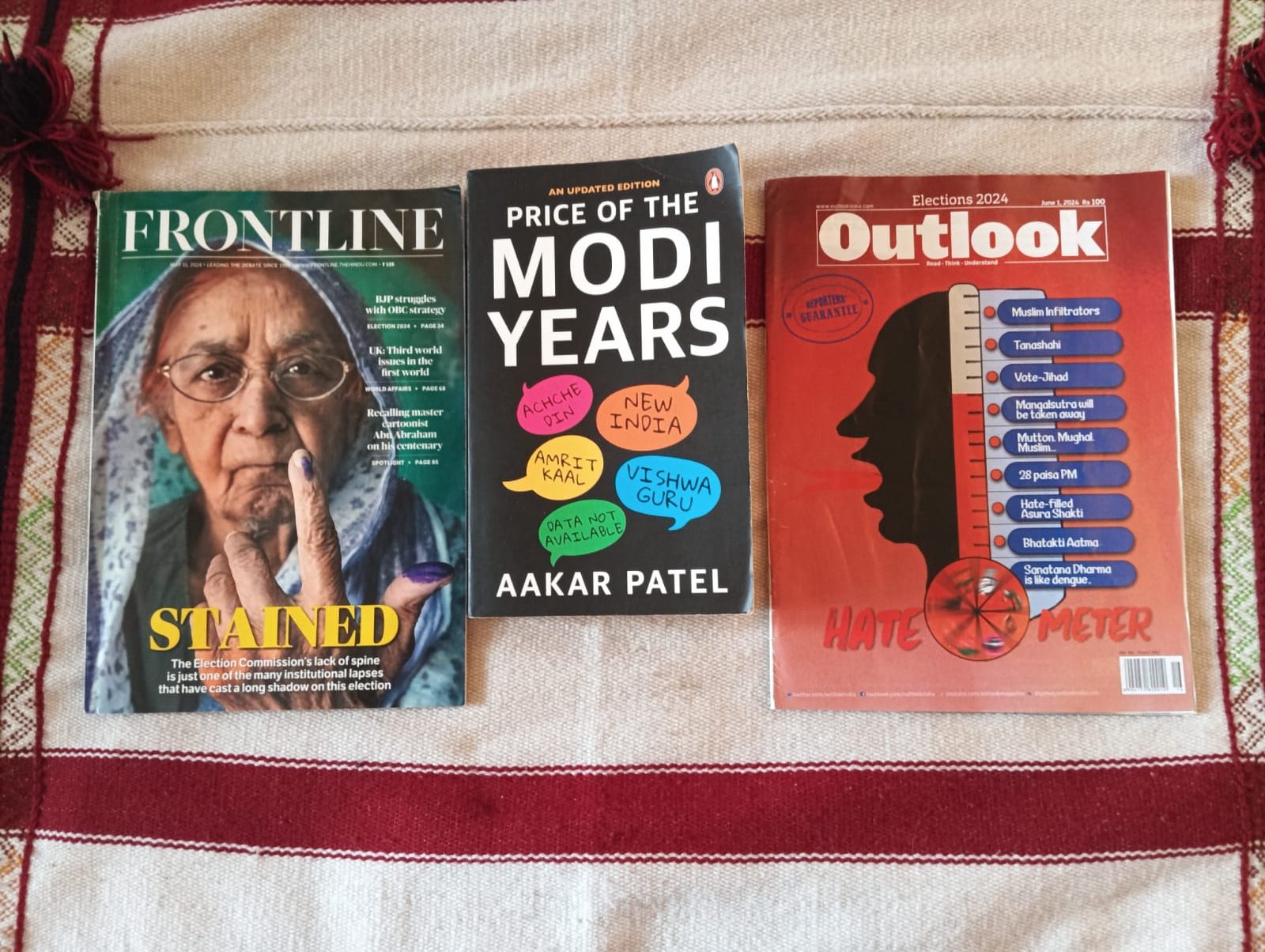
My own political education about India’s current affairs I’m receiving from, among others, the below pictured publications, which do not paint a pretty picture.

While reading the venerable Frontline and Outlook magazines during the election, and specifically Amnesty International India Aakar Patel‘s Price of the Modi Years, I became really worried about Indian politics.

Patel’s book opens with a devastating list of 50 international indices and ratings indicating that since 2014 India was slipping on almost all metrics, except some economic ones like competitiveness and innovation.

India fell in ranking in the spheres of democracy, human development, civil liberties, rule of law, press freedom, religious freedom, air quality, sustainability, the gender gap, intellectual property, food security and then some. Instead of reflection and realistic analysis, the response of the government in 2020 was a media campaign to correct perceptions, and some proposing India create its own indices. Patel concluded that,

The record leaves little room for debate or dispute. The scale and rapidity of decline in governance after 2014 is manifest. India was struggling to keep up with the world and sinking on several fronts. It may appear strange that anyone should have thought that reversing this performance required ‘a massive publicity campaign’ which would ‘shape India’s perception’ through advertising and more websites, but that is what Modi thought and how he oriented his government to act [p. 33].

Then page after page, going on for 450 in total, Patel’s “report card on India” relentlessly exposed many of the failed policies, illegal tricks and unconstitutional schemes by Modi and the BJP, apparently condoned by a partisan supreme court, largely under-reported by a suppliant press, uncritically accepted by their followers, and impotently decried by the opposition. 

The Election

But now I’m somewhat relieved with the outcome of the election (fortunately accepted by all as fair), which was reported as “India Cuts Modi Down“, illustrated by the following facts. BJP lost its seat in the district where the highly controversial Ayodhya temple was recently inaugurated–a feat high on its wish list–accompanied by lots of pomp with Modi as the guest of honor, or better, the officiating, non-official high priest.

Then BJP got halved in the conservative states of Uttar Pradesh, Maharashtra and Haryana, all part of BJP’s heartland, but also important agrarian states. Two states went from 100% BJP or BJP-allied representation to 100% Indian National Congress (INC), i.e. one seat from Nagaland and both seats from conflict-ridden Manipur (which means that the INC should move quickly to negotiate reconciliation and normalization).

All in all BJP lost 63 seats, while they had hyped the projection that their coalition could get a whopping 400+ out of 543 total seats in the Lokh Sabha, India’s chamber of representatives. Maybe they hoped for the magic realization of a self-fulfilling prophecy with the help of some of their favorite deities.

What motivated the Voters?

But this also scared voters, especially minorities (of which 200m Muslims), about what protections and privileges Modi and the BJP could take away from them with a super-majority, for example with a rewritten constitution (there are some versions floating around taking away all voting rights from religious minorities).

Another section of the population it might have lost are the farmers, whose plight has not improved since Modi promised to double their income in 2014, and who felt existentially threatened by a couple of agrarian reform bills against which they vehemently protested with success.

Then Modi’s mismanagement of the COVID pandemic, especially during the second wave in the spring of 2021, might also have cost him votes, certainly from the underpaid frontline health workers, and families and friends of the poor who didn’t get oxygen nor vaccines in time. And then those working in the deliberately shackled NPO sector (with 19m people involved) would have lost reason to vote for Modi, as would be the case for producers and consumers in the demoted journalism business.

Anyway, Modi, who now speculates that his birth was maybe not biological, has to step down from his self-promoted, Priest-King status to become an ordinary politician doing ordinary coalition politics with his secular allies to form a government and take his third term as India’s prime minister. 

He claims he was humbled by the election outcome, but his spokesperson stated that “the way the government was run for the last 10 years, it will be the same”, which after reading Patel, doesn’t sound reassuring.

Not Just India

And I do not want to merely single out India on its right-ward, theocratic slide. There is a global tendency towards authoritarianism in which religious fundamentalism plays a huge role.

I have seen this happening up close in the USA and even a highly developed, progressive and tolerant country like The Netherlands can, and just did, fall into xenophobia by voting a far right-wing party, led by an Islamophobic politician, into power as its largest party. Fortunately such set-backs are only temporary and India might still set a great example in that regard.

I’m comfortable with debating conservatives justifying classical liberalism and the value of communal life, but we should by all means abide by a Habermas-inspired, dialogue-based, negotiated, mutual accommodation leading to peaceful co-existence. Maybe we should appeal to the religious idea of the sacredness of the stranger as guest, and / or the philosophical idea of deep reference for the Other.

The demonizing of Muslims, Dalits, Palestinians, Israelis, colored immigrants, and whoever else you don’t like based on fanatic ideologies, fundamentalist theologies or unacknowledged racism should be challenged, which is not always easy as it feels often like poking a bear.

Take Action for Monetary Justice

.
Sign AFJM’s Letter to the Federal Reserve! 

Urgent and fundamental problems require urgent and fundamental solutions. When those in charge are incapable or unwilling to make fundamental changes, then We, the People, must take charge!

The Alliance For Just Money exclaims “Mayday! Mayday! Mayday!” a distress call for our destructive money system, which is structurally incapable of serving our people and planet. Earth is warming and its species, oceans, and ecosystems are dying. Our government and people are drowning in debt; wealth inequality is growing exponentially; wars are multiplying; and the money supply is bigger than ever. Yet we are told there is not enough money to care for our people and planet!

Individuals and organizations are invited to add their signatures to a letter [also below] initiated by the Alliance For Just Money and supporters of a public money system to the leaders of the Federal Reserve Bank of Chicago calling on them to work with us and elected officials to enact the American Monetary Reform Act of 2024.

The letter is part of an action taking place at the Federal Reserve Bank of Chicago on Friday, May 17, starting at 12PM CT. It includes an outside press conference, leafleting, petitioning, and delivering the letter to and meeting with Federal Reserve Bank of Chicago leaders.

Take charge! Take action!

  1. Sign the letter as an individual or organization to the Board President of the Federal Reserve Bank of Chicago. The deadline is Wednesday, May 15th at 5PM CT.
  2. Join us at the Federal Reserve Bank, 230 S La Salle St, Chicago on Friday, May 17th at 12PM CT.
  3. Take part in any of the Mayday for Money events in Chicago, May 17th-19th.

====

Dr. Austan D. Goolsbee, 

President, Federal Reserve Bank of Chicago

230 South LaSalle Street
Chicago, IL 60604

Dear Dr. Goolsbee and the Federal Reserve Bank of Chicago Board of Directors:

Mayday! Mayday! Mayday for Money! The Alliance For Just Money (AFJM), allied organizations, and citizens are gathering together in Chicago this weekend to issue the international distress call about the US Federal Reserve System and related monetary systems worldwide.

Tomorrow marks the 110th anniversary of the formal signing of the Federal Reserve Bank of Chicago’s organization certificate.[1] In passing the Federal Reserve Act in December 1913, Congress surrendered its Constitutional authority—under Article I Section 8—to create all U.S. money and regulate the value thereof. Congress instead ceded that power to the commercial banks nationwide. Over a century later, We, the People declare “Mayday for Money,” calling for a sovereign public money system. 

We and a growing number of citizens recognize that, no matter how officially established and protected it has been, the private, debt-based modern money system is inherently unjust, unsustainable, and undemocratic.[2] Our current money system is structurally incapable of serving our people and planet. Earth is warming and its species, oceans, and ecosystems are dying. Our government and people are drowning in debt; wealth inequity is growing exponentially; wars are multiplying; and the money supply is bigger than ever. Yet we are told there is simply not enough money to care for our people and planet! We must change this narrative and demand a sovereign public money system.

We are at a historical juncture regarding monetary policy and financial systems worldwide. With the rise of digital currencies, we invite you to dialogue with us to enact Just Money rather than allow our financial institutions to continue our private, debt-based money system. We call upon you to work with us and our elected officials to pass the American Monetary Reform Act of 2024, that will establish and transition us to a sovereign public money system.[3]

Respectfully submitted by the undersigned, representing over _#_ organizations and _#_ individuals whose signatures are collected in our online petition at http://www.________.  

~~Alliance For Just Money Board of Directors and staff; American Monetary Institute Stewards; Move to Amend Co-Director Team; Banking & Monetary Reform Committee of the Green Party-US; An Economy of Our Own Advisory Board; and the Women, Money, & Democracy committee of the 108-year-old Women’s International League for Peace and Freedom-US; Ecological Economics for All.

Cc:  President Biden, Vice President Harris, and US Senators and Representatives

Alliance For Just Money, Inc., is a national, nonpartisan, nonprofit 501(c)(3)


[2] Omarova, S. T. (2020, March 20). “Technology v technocracy: Fintech as a regulatory challenge“. Journal of Financial Regulation, 6(1), 75–124 . See also International Movement for Monetary Reform; legal scholars of money at JustMoney.org; and regenerative and distributive economics efforts of DoughnutEconomics.org.

[3] The American Monetary Reform Act (AMRA) of 2024 is based on the H.R. 2990 National Emergency Employment Defense (NEED) Act of 2011 which was updated and improved upon by AFJM. It and a two-page factsheet on it are on AFJM’s Archive page (www.monetaryalliance.org/archive-afjm/) and directly at www.monetaryalliance.org/wp-content/uploads/American-Monetary-Reform-Act.pdf, and  www.monetaryalliance.org/wp-content/uploads/AMRA-Fact-Sheet.pdf.

The American Monetary Institute: View from a Steward


Focus

The focus of the American Monetary Institute was and is on the almost unbridled credit creation facility of commercial banks (and its frequent turning off the tap) as a major cause of the destructive booms & busts in the financial sector and its spilling over into the real economy with disastrous consequences for regular people.

Furthermore, as a viable, structural, long-term solution we promote so-called sovereign monetary reform based on 1930s proposals collectively known as the Chicago Plan developed by prominent economists (Phillips, Demeulemeester, Kumhof).

Our first focus is on monetary theory and AMI embraces the so-named ‘credit creation theory of money and banking’ (Werner, McLeay, Ryan-Collins), aka ‘endogenous money’ in post-Keynesian parlance (Rochon & Rossi), and very nicely explained as the ‘finance franchise’ in Hockett & Omarova (2017).

Secondly, based on numerous analyses and models (Kumhof, Yamaguchi, van Egmond, Huber, Jackson), we promote the proposal that,

a) a nation’s money supply (and central bank if not yet done so) should be nationalized and transformed into debt-free, stable money,

b) stop the credit creation privilege of commercial banks and make them thereby into true intermediaries, 

c) institute a monetary authority to manage the money supply, and

d) let congress allocate the seigniorage (or taxation) coming out of the monetary authority’s decision process.

Implementation

This monetary theory and, based on it, radical reform proposal were a) incorporated into the 2012 NEED Act (HR 2990), with the help of AMI (Zarlenga), and sponsored (only) by Kucinich and Conyers; b) considered by the parliament of Iceland (Sigurjonsson); c) became the subject of a 2017 referendum in Switzerland, sorely lost by 75-25 (Lyons); and d) was debated by the parliament of the Netherlands in 2016, triggered by a citizens initiative, which only led to a thorough report after three years (Schuller; WRR).

After these half successes the movement seems to have burned out a little. Besides there was also a friendly schism, if I can say so, within the AMI leading to the formation of the Alliance For Just Money in 2018. And we had the shock that our very successful sister organization in the UK, Positive Money, thought it was advisable to distance itself from sovereign monetary reform because, in their still non-published deliberations, they thought it would crash the economy. On top of that COVID-19 hit with interesting financial responses by governments, from which we still try to extract the economic lessons.

For now AMI is giving some space to a) economists and monetary activists from LDCs; b) discussing the promises and perils of CBDC; c) of public and non-profit banking; d) of local currencies; and e) of parity economics, i.e. the idea to set a minimum price for raw materials in agriculture, fishing and mining.

But in the end, we are aiming at a ‘big switch’, when the money supply gets secured and prudently managed, and banking as we know it will end.

Sources

Demeulemeester, Samuel. 2018. “The 100% Money Proposal and its Implications for Banking: The Currie–Fisher Approach versus the Chicago Plan Approach“. The European Journal of the History of Economic Thought, 25/2: 357-387.

H.R.2990 – National Emergency Employment Defense Act of 2011 (NEED Act). 112th US Congress (2011-2012).

Hockett, Robert C. & Omarova, Saule. 2017. “The Finance Franchise“. Cornell Law Review, 102: 1143-1218.

Huber, Joseph. 2017. Sovereign Money. Beyond Reserve Banking. London: Palgrave Macmillan.

Jackson, Andrew & Dyson, Ben. 2012. Modernising Money: Why Our Monetary System Is Broken And How It Can Be Fixed. London: Positive Money.

Kumhof, Michael & Benes, Jaromir. 2012. “The Chicago Plan Revisited.” IMF Working Papers 12/202. Washington: International Monetary Fund.

Lyons, Matthew. 2018. “Will Switzerland Be The First Country In The World To Introduce A Sovereign Money System?” London: Positive Money. 28 Feb 2018.

McLeay, Michael & Radia, Amar & Thomas, Ryland. 2014a. “Money Creation in the Modern Economy”. Monetary Analysis Directorate. Bank of England Quarterly Bulletin (Q1, 2014): 14-27.

Phillips, Ronnie. 1995. The Chicago Plan & New Deal Banking Reform. Oxon, UK & New York, NY: Routledge.

Rochon, Louis-Philippe & Rossi, Sergio (eds.). 2015. The Encyclopedia of Central Banking. Cheltenham, UK & Northampton, MA: Edward Elgar Publishing.

Ryan-Collins, Josh & Greenham, Tony & Werner, Richard & Jackson, Andrew. 2012. Where Does Money Come From? A Guide to the UK Monetary and Banking System. London: New Economics Foundation. “Introduction”.

Schuller,Govert. 2019. “Ons Geld and the Road to the WRR Report“. AFJM, 8 Mar 2019.

Sigurjonsson, Frosti. 2015. “Monetary Reform: A Better Monetary System for Iceland“. A Report Commissioned by the Prime Minister of Iceland. March 2015. Foreword by Aidar Turner. Rekjavik, Iceland.

Van Egmond, Nicolas D & de Vries, Bert JM. 2016. “Dynamics of a sustainable financial-economic system”. Sustainable Finance Lab Working Paper. Utrecht University, The Netherlands.

Werner, Richard. 2014c. “How do banks create money, and why can other firms not do the same? An explanation for the coexistence of lending and deposit-taking”. International Review of Financial Analysis, 36 (2014): 71–77.

—–, —–. 2016. “A lost century in economics: Three theories of banking and the conclusive evidence”. International Review of Financial Analysis, 46 (July 2016): 361-379.

WRR. 2019. “Money Creation”. The Hague: The Netherlands Scientific Council for Government Policy (WRR).

WRR. 2019. Money and Debt: The Public Role of Banks – Summary of WRR Report. The Hague: Netherlands Scientific Council for Government Policy.

Yamaguchi, Kaoru. 2011. “Workings of a Public Money System of Open Macroeconomies: Modeling the American Monetary Act Completed”. In: Proceedings of the 29th International Conference of the System Dynamics Society, Washington D.C., USA, 2011. The System Dynamics Society. 

—–, —–. 2012. “On the Monetary and Financial Stability under A Public Money System (Revised): Modeling the American Monetary Act Simplified”. Paper presented at the 8th Annual AMI Monetary Reform Conference in Chicago, USA, Sept. 20 – 23, 2012. It was originally presented at the 30th International Conference of the System Dynamics Society, St. Gallen, Switzerland, July 22 – 26, 2012.

Zarlenga, Stephen. 2014 (2006). “Presenting the American Monetary Act / The 32-Page Brochure”. Valatie, NY: American Monetary Institute. Extensive introduction to, and final version of, the NEED Act.

Govert Schuller
Shillong, September 20, 2023

Additions to Bibliography February 2023


B. Academic Studies on Sovereign Monetary Theory and Reform

Armelius, Hanna & Carl Andreas Claussen, David Vestin. 2020. “Money and monetary policy in times of crisis”. Monetary Policy Department and the Payments Department of the Riksbank. Riksbank of Sweden. Economic Commentaries, 4 (11 June 2020): 1-15.

Assenmacher, Katrin & Claus Brand. 2018. “The Swiss Sovereign Money Initiative”. Credit and Capital Markets, 51/4: 621-644.

Baeriswyl, Romain. 2017. “The Case for the Separation of Money and Credit”. In Heinemann, F., Klüh, U., and Watzka, S. (eds.), 2017, Monetary Policy, Financial Crises, and the Macroeconomy, Cham: Springer, pp. 105–21.

Barber, G. Russell. 1973. “The One Hundred Percent Reserve System”. The American Economist, 17/1: 115–127.

Bertocco, Giancarlo & Andrea Kalajzic. 2018. “How much does finance benefit society?”. PSL Quarterly Review, 71/287: 419-437.

—–, —–. 2001. “Is Kaldor’s theory of money supply endogeneity still relevant?” Metroeconomica, 52/1: 95–120.

—–, —–. 2010. “The endogenous money theory and the characteristics of a monetary economy”. Rivista Italiana degli Economisti, 15/3: 365–401.

—–, —–. 2013a. “Money as an institution of capitalism: Some notes on a monetary theory of uncertainty”. Economic Notes, 42/1: 75–101.

—–, —–. 2013b. “On Keynes’s criticism of the loanable funds theory”. Review of Political Economy, 25/2: 309–26.

Bjerg, Ole. 2018. “We Need to Put Things Back to Normal”. Interview with Ole Bjerg (2018) Journal of Economic Sociology = Ekonomicheskaya sotsiologiya, 19/4: 172–181.

Brown, Harry Gunnison. 1940. “Objections to the 100 Per Cent Reserve Plan.” The American Economic Review, 26/3: 309–314.

Buchanan, James M. 2010. “The Constitutionalization of Money.” Cato Journal, 30/2: 251–258.

Burns, Scott. 2016. “Old (Chicago) School, New Century: The Link between Knight and Simons’ Chicago Plan to Buchanan’s Constitutional Money.” Constitutional Political Economy, 27/3: 299–318.

Carroll, Charles Holt. 1964. Organization of Debt into Currency and Other Papers. Edited with an Introduction by E. C. Simmons. Princeton, NJ: Van Nostrand.

Chai, Hee-Yul, and Sang B. Hahn. 2018. “Does Monetary Policy Regime Determine the Nature of the Money Supply?: Evidence from Seven Countries in the Asia-Pacific Region“. East Asian Economic Review, 22/2: 217-239.

Currie, Lauchlin B. [1934] 1968. The Supply and Control of Money in the United States. New York, NY: Russell & Russell.

Demeulemeester, Samuel. 2019. “The 100% money proposal of the 1930s: Conceptual clarification and theoretical analysis.” PhD thesis, ENS de Lyon.

—–, —–. 2020. “Would a State Monopoly over Money Creation Allow for a Reduction of the National Debt? A Study of the ‘Seignorage Argument’ in Light of the ‘100% Money’”. Debates, Research in the History of Economic Thought and Methodology, vol. 38A, A Symposium on Public Finance in the History of Economic Thought, 123–44.

—–, —–. 2021. “The 100% money proposal of the 1930s: An avatar of the Currency School’s reform ideas?” The European Journal of the History of Economic Thought, 28,/4: 577–98.

Doorman, Frans. 2015. Our Money – Towards a New Monetary System. Lulu internet publishers.

Douglas, Paul H. 1935. Controlling Depressions. New York, NY: Norton.

Dow, S.C. 1997. “Endogenous Money”. In G.C. Harcourt and P.A. Riach (eds), A ‘Second Edition’ of The General Theory, vol. II, London and New York: Routledge, 61–78.

Fisher, Irving. 1936. “100% Money Again.” Social Research, 3/2: 236–241.

—–, —–. 1936. “The Bankers’ Interest in 100% Money.” The Bankers’ Magazine, October, 1936.

—–, —–. 1937. “100 Percent Reserves—An Old System Adapted to Modern Needs.” Commercial & Financial Digest, Los Angeles, California, June 1937. Reprinted in I. Fisher, Testimony before a Subcommittee of the Committee on Agriculture and Forestry, U.S. Senate, 75:1, August 12, 1937, 292–296.

—–, —–. 1937. “Note Suggested by Review of ‘100 Per Cent Money.’” Journal of the Royal Statistical Society, 100/2: 296–298.

—–, —–. 1946 (1997). “Answers to Objections to the 100% Plan.” Fisher Papers, Yale University Library. Reprinted in Barber et al, 1997, The Works of Irving Fisher – Vol. 11. 100% Money, 308–311.

Graham, Frank D. 1936. “Partial Reserve Money and the 100 Per Cent Proposal.” The American Economic Review, 26/3: 428–440.

—–, —–. 1941. “100 Per Cent Reserves: Comment.” The American Economic Review, 31/2: 338–340.

Higgins, Benjamin. 1941. “Comments on 100 Per Cent Money.” The American Economic Review, 31/1: 91–96.

Hook, Andrew. 2022. “Examining modern money creation: An institution-centered explanation and visualization of the “credit theory” of money and some reflections on its significance.” The Journal of Economic Education, 53/3: 210-231.

Krainer Robert E. 2013, “Towards a Program for Financial Stability”. Journal of Economic Behavior & Organization, 85 (January): 207-218.

—–, —–. 2017, “Economic Stability under Alternative Banking Systems: Theory and Policy”. Journal of Financial Stability, 31: 107-118.

Kumhof, Michael, et al. 2020. “Central Bank Money: Liability, Asset, or Equity of the Nation?” Cornell Law School Research Paper No. 20-46.

Lainà, Patrizio. 2017. “Seignorage from Full-Reserve Banking”. Published in Lainà, Patrizio, “Full-Reserve Banking: Separating Money Creation from Bank Lending”, PhD Thesis, University of Helsinki (November 13, 2017).

Lehmann, Fritz. 1936. “100% Money.” Social Research, 3/1: 37–56.

Lester, Richard A. 1935. “Check-Book Inflation.” The American Scholar, 4/1: 30–40.

Mellor, Mary. 2019. Money: Myths, Truths, and Alternatives. Bristol, UK: Policy Press.

Nayan, S., Kadir, N., Abdullah, M. S., & Ahmad, M. 2013. “Post Keynesian Endogeneity of Money Supply: Panel Evidence”. Procedia: Post Keynesian Endogeneity of Money Supply: Panel Evidence Economics and Finance, 7: 48-54.

Neuman, Andrew M. 1937. “100 Per Cent. Money.” The Manchester School, 8/1: 56–62.

Ponsot, Jean-François. 2017. “Rethinking Money“. In: Rochon, Louis-Philippe, and Sergio Rossi (eds), A Modern Guide to Rethinking Economics, Edward Elgar Publishing, 2017, 114-28.

Robbins, Richard H. 2014. “Debt and the Monetary Foundations of Inequality”. Anthropology News, 55, 14–15.

—–, —–. 2020. “Financialization, Plutocracy, and the Debtor’s Economy: Consequences and Limits”. In: Hann, Chris and Don Kalb (Eds.), Financialization: Relational Approaches. Max Planck Studies in Anthropology and Economy, Volume 6, New York and Oxford: Berghahn, 65–94.

—–, —– & Tim DiMuzio. 2020. “Capitalized money, austerity and the math of capitalism”. Current Sociology, 68: 149–168.

Robinson, George Buchan. 1937. “100% Bank Reserves.” Harvard Business Review, 15: 438–447.

Rochon, Louis-Philippe. 1999. Credit, money, and production: An alternative post-Keynesian approach. Cheltenham, UK and Northampton, MA: Edward Elgar.

—–, —–. 2001. “Cambridge’s Contribution to Endogenous Money: Robinson and Kahn on Credit and Money”. Review of Political Economy, 13/3: 287-307.

—–, —– & —–, —–. (eds). 2003. Modern Theories of Money: The Nature and Role of Money in Capitalist Economies. Cheltenham, UK and Northampton, MA: Edward Elgar.

Schuller, Govert. 2023. “Rochon’s Five Propositions on Bank Credit Creation”. Valatie, NY: American Monetary Institute.

Simarmata, Djamester. 2023. “Development Finance by Money Creation, instead of Foreign Debt or Saving: A New Paradigm For Development Economics”. MS [Forthcoming]

Simons, Henry C. 1934. “A Positive Program for Laissez-Faire”. Public Policy Pamphlet No 15. Chicago: University of Chicago Press.

Skaggs N.T. 1997. “Henry Dunning Macleod and the Credit Theory of Money”. In: Cohen A.J., Hagemann H., Smithin J. (eds), Money, Financial Institutions and Macroeconomics, Recent Economic Thought Series, vol 53, Dordrecht: Springer.

Smithin, J. 2013. “Keynes’s theories on money and banking in the Treatise and the General Theory”. Review of Keynesian Economics, 2/2: 242–56.

Stellinga, Bart, et al. 2021. Money and Debt: The Public Role of Banks. Research for Policy Series. Studies by the Netherlands Council for Government Policy. Cham, Switzerland: Springer.

Thomas, Rollin G. 1940. “100 Per Cent Money: The Present Status of the 100 Per Cent Plan.” The American Economic Review, 30/2: 315–323.

Tolley, George S. 1962. “100 Per Cent Reserve Banking”. In: Yeager, L. B. (ed.), In Search of a Monetary Constitution, Cambridge, MA: Harvard University Press, 275–304.

Watkins, Leonard L. 1938. Commercial Banking Reform in the United States: With Especial Reference to the 100 Per Cent Plan and the Regulation of Interest Rates on Bank Deposits. Vol. 5. Michigan Business Studies, 8. Ann Arbor, MI: University of Michigan.

Werner, Richard A. 2003. Princes of the Yen: Japan’s Central Bankers and the Transformation of the Economy. New York: M.E. Sharpe.

—–, —–. 2018. “Shifting from Central Planning to a Decentralised Economy”. Paper presented at the 14th Rhodes Forum: Dialogue of Civilisations Research Institute, Panel 2: “Economic Alternatives when Conventional Models Fail”, Rhodos, Greece, on 1 October 2016 and at the 4th European Conference on Banking and the Economy (ECOBATE 2016), in Winchester Guildhall, Winchester UK, on 12 October 2016.

Whittlesey, Charles R. 1935. “Banking and the New Deal”. Public Policy Pamphlet No. 16. Chicago: University of Chicago Press.


C. Studies Critical of Sovereign Monetary Theory and Reform (including MMT section)

Pro MMT

Berkeley, A., Ryan-Collins, J., Tye, R., Voldsgaard, A. and Wilson, N. 2022. “The self-financing state: An institutional analysis of government expenditure, revenue collection and debt issuance operations in the United Kingdom.“ UCL Institute for Innovation and Public Purpose, Working Paper Series (IIPP WP 2022-08)

Ryan-Collins, Josh. 2022. “Why the British state is a magic money tree“. The New Statesman, 26 May 2022

Keen, Steven. 2022. “A Little Knowledge is a Dangerous Thing: Observations on the debate between MMT advocates and Progressive Money Canada founder Jeff Eder”. Planksip, 30 Sept 2022.

Critical of MMT

Eder, Jeff. 2022. “Steve Keen has lost his way in a Minsky Maze”. Progressive Money Canada. [Response to Keen, 2022]

Epstein, Gerald A. 2019. What’s Wrong with Modern Money Theory? A Policy Critique. Cham, Switzerland: Palgrave.

Mueller, Antony P. 2019. “The magic money tree: The case against modern monetary theory (MMT).” Research Paper Series Adam Smith Institute (ASI), UK.

Schuller, Govert. 2020a. “Requesting Evidence for a Crucial MMT Claim”. Blog. Alliance For Just Money, 16 Aug 2020.

—–, —–. 2020b. “Triple-column Comparison between Modern Monetary Theory (MMT), the Actual Monetary System, and Sovereign Money Reform (SMR)”. Blog. Alliance For Just Money, 21 Sept 2020.

—–, —–. 2020c. “ ‘What’s Wrong with Modern Money Theory?’: A Summary”. Blog. Alliance For Just Money, 5 Oct 2020.

—–, —–. 2022. “Did Dr. Joshua Ryan-Collins go MMT?”. Paper presented at the American Monetary Institute conference, October 8, 2022. Video here.

D. Non-academic Advocacy Pamphlets, Reports, Briefings and Books

AMI. 2021. “AMI Conference Statement to COP26: Regarding the Monetary Dimension of Climate Change”. American Monetary Institute, Evanston, IL, USA, 11 Nov 2021.

Anon. 2019. “Open Letter: Rethinking the Role of Banks in Economics Education”. Rethink Economics.

Hermanutze, Derryl. 2020. A Brief History of Financial Plunder. Independently published.

Jordan, Thomas J. 2018. “How money is created by the central bank and the banking system.” Speech at the Zürcher Volkswirtschaftliche Gesellschaft, Zürich, 16 Jan 2018. Speech given in German. Zürich: Swiss National Bank.

McConnachie, A. 2006. Clarifying Our Money Reform Proposals: A Report for the Tenth Annual Bromsgrove Conference. Bromsgrove Conference, Bromsgrove, England.

Positive Money. N.d. “What people think banks do: The money multiplier and other myths“. London: Positive Money.

Stuart, James Gibb. 1991. Scotland and Its Money. Edinburgh: John Dunlop.

—–, —–. 1992. Economics of a Green Renaissance. Glasgow: Ossian Publishers.

—–, —–. 1993. Hidden Menace to World Peace. Glasgow: Ossian Publishers.

Turner, W.E. 1966. Stable Money: A Conservative Answer to Business Cycles. With introduction by Representative Wright Patman. N.p.

E. Supporting Studies Addressing Monetary Issues

Costa, Jorge Meira & Marc Gauvin, McNeill. 2015. “A proposal for harmonising current disparate (scientific and legal) definitions of money towards greater decidability in the provision of Justice according to universal principles of contract law“. Presentation at MERC first annual conference on The Monetary Policies in The Balkans, The Future of The Euro and The Eurozone in The Balkan Region. Monetary and EconomicResearch Center, Sofia -Bulgaria, 2015.

DiMuzio, Tim. 2023. “Capitalism, Money and Inequality in the World”. In: Bieri, Sabin & Bader, Christoph (Eds.), Transitioning to Reduced Inequalities, Basel, Switzerland: MDPI Books.

Gauvin, Marc & Sergio Dominguez. 2020. “A Systems Engineering Approach to Formal Monetary and Financial Stability Without the Vagaries of “Austerity” “. Submitted December 2020 to Monetary Research Centre (MRC), University of National and World Economy (UNWE), Sofia Bulgaria.


F. Journalistic Articles Addressing Monetary Reform

Baker, Scott, 2012. “The Instant Solution to the New Depression: Debt-free Money”. HuffPost, 4 june 2012.

Howell, John. 2017a. “Who creates money and where does it go?” The Athens Messenger, 25 Jan 2017.

—–, —–. 2017b. “Why money creation is central to most of the problems faced by society”. Athens, OH: Democracy over Corporations.

Joób, Mark. 2014. “The Sovereign Money Initiative in Switzerland“. World Economics Association Newsletter, 4/3 (June 2014): 6-7. (Comments here)

Hulsmann, Jorg Guido & Patrizio Laina & Joseph Huber & Ib Ravn & Bryan Gould. 2020. “Letter: It’s time to reconsider full reserve banking”. Financial Times (UK), 30 Aug 2020.


G. Educational and Promotional Videos (and other media)

Collins, Josh Ryan & Gabor, Daniela & Dyson, Ben & Werner, Richard. 2014. “Money and Banking”. Rethinking Economics, London Conference, June 2014. RE YouTube Channel, 25 Aug 2014.

Reiss, Michael. 2012. “Money… How It Works”. Unconventional Economics YouTube Channel, 22 dec 2012.

Schasfoort, Joeri. 2020. “How Commercial Banks Really Create Money (the Money Multiplier is a MYTH).” Money & Macro YouTube Channel, 28 Mar 2020.

—–, —–. 2020. “The Monetary Financial System Visually Explained“. Money & Macro YouTube Channel, 9 Dec 2020.

—–, —–. 2021. “Why Private Bank Money Creation is Dangerous.” Money & Macro YouTube Channel, 27 Jan 2021.

Turner, Adair. 2014. “The Need for Radical Change”. Keynote Speech, Rethinking Economics, London Conference, June 2014. RE YouTube Channel, 25 Aug 2014.

Kamp, Diane & Dave Zollinger. 2008. “Stephen Zarlenga Talks About the Lost Science of Money”. Demcracy’s Edge talk radio. 48m31s. Internet Archive, 20 Oct 2008.

Werner, Richard. 2015. “A Prosperous Future Together”. Dialogues of Civilizations. Rhodes Forum 2015. Dialogues of Civilizations YouTube Channel, 23 Dec 2015.


H. Other Relevant Background Studies

Barrdear, John & Kumhof, Michael. 2021. “The macroeconomics of central bank digital currencies.” Journal of Economic Dynamics and Control (2012): 1041-48.

Bichler, Shimshon, Jonathan Nitzan, and Timothy DiMuzio. 2012. “The 1%, Exploitation and Wealth: Tim Di Muzio interviews Shimshon Bichler and Jonathan Nitzan“. Faculty of Law, Humanities and the Arts, University of Wollongong – Papers 810.

Chick, Victoria. 1986. “The evolution of the banking system and the theory of saving, investment and interest”. Economies et Sociétés, 20/8–9: 111–26.

Grim, Ryan. 2009. “Priceless: How the federal reserve bought the economics profession.” Huffington Post,23 Oct 2009

Hockett, Robert C. 2020. “The capital commons: A plan for building back better and beyond.” 20 Aug 2020. Available at SSRN 3697337.

—–, —– & Omarova, Saule T., 2018. “Private Wealth and Public Goods: A Case for a National Investment Authority“. Journal of Corporation Law, 437:

—–, —– & —–, —–. 2020. “Financing Continuous Development: The ‘American Plan’ of State Capitalism”. Cornell Legal Studies Research Paper No. 20-31 (April 2, 2020). Available at SSRN. Also in: Wright, Mike et al (eds.), 2020, The Oxford Handbook of State Capitalism, Oxford: Oxford UP.

Kaldor, N. 1970. “The New Monetarism”. Lloyds Bank Review, 97/1: 1–18.

Kuypers, Stef. 2019. Money, behavior and society: The invisible link. TEDxAntwerp, Nov 2019.

Lietaer, Bernard & Christian Arnsperger, Sally Goerner, Stefan Brunnhuber. 2012. Money and Sustainability The Missing Link. A Report from the Club of Rome – EU Chapter – to Finance Watch and the World Business Academy. Axminster, UK: Triarchy Press.

—–, —– & Dunne, Jacqui. 2013. Rethinking Money: How New Currencies Turn Scarcity into Prosperity. San Francisco: Berrett-Koehler.

Lonergan, Eric. 2014. Money (The Art of Living). Second edition. Oxon, UK & New York: Routledge.

Minsky, Hyman P. 1994. “Financial Instability and the Decline (?) of Banking: Future Policy Implications“. Working Paper No. 127, October 1994. The Jerome Levy Research Institute of Bard College.

—–, —–. 1995. “Would Universal Banking Benefit the U.S. Economy?” Hyman P. Minsky Archive, Paper 51, reworked version dated April 5, 1995.

Nain, Aditya, & P. G. Jung. 2021. Understanding Money: Philosophical Frameworks of Monetary Value. London & New York: Taylor & Francis.

Omarova, Saule T. “The People’s Ledger: How to Democratize Money and Finance the Economy”. Vanderbilt Law Review, 74/5:

Palley, Thomas. 2022. Theorizing dollar hegemony, Part 1: The political economic foundations of exorbitant privilege. No. PKWP2220. Post-Keynesian Economics Society, August 2022.

Ricardo, David. [1824] 1951. Plan for the Establishment of a National Bank. London: John Murray, Albemarle-Street, 1824. Reprinted in: Sraffa P. (ed.), 1951, The Works and Correspondence of David Ricardo, Vol. 4, Cambridge, UK: Cambridge UP, 271-300

Robbins, Richard H. 2022. “ ‘An Opportunity of a Lifetime’: Covid-19 in the Age of Finance”. In: Tim Di Muzio and Matt Dow (Eds.), Covid-19 and the Global Economy, London & New York: Routledge.

—–, —–. 2022. “Financialization”. In: James G. Carrier (ed.), The Handbook of Economic Anthropology, 3rd Edition, Oxford: Berg Publishing.

—–, —–. 2020. ‘The Economy After Covid-19”. Focaal Blog.

Sanderson, Stephen K. 1995. Civilizations and World Systems: Studying World-historical Change. Lanham, MD: Rowman Altamira.

Schuller, Govert. 2020. “Talk About Borders”. Blog, Alliance For Just Money, 23 May 2020.

Seligman, Edwin Robert Anderson, et al. 1908. The Currency Problem and the Present Financial Situation: A Series of Addresses Delivered at Columbia University, 1907-1908. New York, NY: Columbia University Press.

Suaste Cherizola, Jesús. 2021. “From Commodities to Assets: Capital as Power and the Ontology of Finance”. Review of Capital as Power, 2/1: 1-29.

Toynbee, Arnold J. 1962–1964 [1934–1961]. A Study of History. 12 vols. Oxford: Oxford University Press.

Toynbee, Arnold J. 1947a. A Study of History. Vol. I. Abridgment of vols. I–VI by D. C. Somervell. London: Oxford University Press.

Toynbee, Arnold J. 1947b. A Study of History. Vol. II. Abridgment of vols. VII–XI by D. C. Somervell. London: Oxford University Press.

Viñuela, Carlos, Juan Sapena, and Gonzalo Wandosell. 2020. “The Future of Money and the Central Bank Digital Currency Dilemma” Sustainability, 12/12: 9697.

Wallerstein, Immanuel. 1974-1989. The Modern World-System. 3 volumes. New York & San Diego & London: Academic Press.

—–, —–. 2000. The Essential Wallerstein. New York: The New Press.

—–, —–. 2004. World-Systems Analysis: An Introduction. Durham, NC: Duke University Press.

Wilkinson, David. 1987. “Central Civilization”. Comparative Civilizations Review, 17/17: Article 4. Also in: Sanderson, Stephen K., 1995, Civilizations and World Systems: Studying World-historical Change, Lanham, MD: Rowman Altamira, pp. 46-74.


New Links to Older Studies

Klein, Manuel et al. 2018. “The Future of Money – 10 years after Lehman and Nakamoto” (Conference). Conference videos and papers. 24 Nov 2018. Berlin, Germany: Monetative.

Robertson, James. 2012. Future Money: Breakdown or Breakthrough? Totnes, UK: Green Books.

Werner, Richard A. 1997. “Towards a New Monetary Paradigm: A Quantity Theorem of Disaggregated Credit, With Evidence from Japan“. Kredit und Kapital, 30/2 (July 1997): 276–309 .

—–, —–. 2005. New Paradigm in Macroeconomics: Solving the Riddle of Japanese Macroeconomic Performance. Basingstoke, UK & New York: Palgrave Macmillan.

Troubles in Scotland of the East


It might not have made it to the international news platforms, but we have had a disturbing series of events happening in Meghalaya. Let me recount.

The effects of an inter-state incident last Tuesday early morning at the Assam-Meghalaya border between Assam police and Meghalaya citizens resulting in six dead (one Assam forest official and five Meghalaya locals), are still rippling through the state. It happened in or just outside the village of Mukroh in the district of West Jaintia Hills, about a 4 hours and 125 km drive east from Shillong. Out of respect for the dead and to prevent social unrest the state government cancelled all festivals, which is too bad because November–with its pleasant, dry and sunny weather and cherry trees blossoming–is festival month. The state also partially shut down the internet for 48 hours, which was later criticized for good reasons by an editorial in the Shillong Times. Unexpectedly I was able to stay on-line and receive updates and reports through WhatsApp and news platforms.

One unfortunate side-effect was that on that very Tuesday NEHU, the non-profit SEHER and the central government in Delhi had an international music festival organized with bands from Singapore, Indonesia, Myanmar and one local band. A similar but larger event had succesfully taken place a few days before in Delhi with the same bands to celebrate 30 years of diplomatic relations with the Association of South-East Asian Nations (ASEAN). Lots of work, money and planning had gone into this. I was part of it, one day driving with a group of volunteers all over Shillong to eleven colleges to distribute invitations. Unfortunately exams were going on and the principals we met were reluctant to let students go to the fest. Still, one of the principals, a very nice man I had met before, together with a friend who teaches there, gave us the best welcome with tea and cookies.

Maybe because the event was on our relatively safe and gated campus the organizers from the Office of International Affairs at NEHU tried to keep it going. Even though it was at 1:30 pm that I received the first message via WhatsApp that all festivals were cancelled (and for a moment believed the rumor that it actually was a fake news message regurgitated from 2018), I heard that the organizers proceeded as if everything was still on while conferring with authorities. I was fine with that not realizing that the early morning incident would have such a wide impact. My big question throughout the day and later was if the state and the NEHU officials had overreacted.

Around 2 pm I was seated with some other volunteers inside the venue in one of the front rows next to the entrance when a group of activist student union members came in their black clothes, black masks and scarfs and black flags, which they planted in the pots next to the entrances. That looked pretty intimidating though I didn’t know then if there was a connection with the border incident. A group of six of them were allowed inside and they walked in front of the podium as if checking out the situation. Meanwhile one of the bands was doing its sound check. This might have been the MRTV Modern Music Band from Myanmar, which sounded, like the other bands, very promising. Later I heard that the students had demanded the cancellation to be effectuated. Apparently there was a scuffle outside between them and some organizers and I did hear a professor on the phone yelling “get our people here”, as if he had access to a group of students or security personnel to counter the student union.

We were still seated when one of the organizers from Delhi–the chair of the non-profit SEHER, which organizes festivals on behalf of the central government–passed by and thanked us for our volunteer work. I politely stood up, shook his hand and talked with him. He seemed not to know what was going on, even that the festival was probably cancelled. This was around 3 pm, an hour before the event should have started with an official opening. So, I told him and he was understandably a bit miffed, as I was a bit perplexed. Later I got flack for having told him, which I’m still in the dark about.

I then walked off with a little group of volunteers to an adjacent part of the campus. To somewhat bemused consternation I dropped one of my rare F-bombs. We visited the complex of unused bio-domes, used to house a butterfly park, which now looked both post-apocalyptic and photogenic. It was constructed in 2019 but probably abandoned because of Covid. We were all uncertain about what had happened and very sad about the cancellation. Some had planned to go back home for a few days, but would not travel for safety reasons. The concern was especially for students from Assam. One of them thought she might be beaten up.

For me and my African friend’s protection we were put on the bus around 4 pm with the last performers, the singer-songwriter Linying and her band from Singapore, having done their sound check, and drove back to the guest house where they were staying.

The organizer from Delhi was there too and I conveyed my condolences for what had happened, gave my obviously fake apologies for having informed him, and talked with him about the effects of the cancellation. He was very distraught and saddened and thought it was a set-back for his long-term project to have India look more to its south-east neighbors and what they can offer, starting with music. It was also a sad set-back for NEHU and Meghalaya. Which international bands would like to come? I suggested everybody interested watch some world cup football or have a small acoustic concert or jam with the musicians at the guest house. This never happened, but still heard later that despite the unfortunate developments our guests had a good time.

I did talk to some of the Indonesian musicians of the fusion band Rhiau Rhythm from Sumatra. Asked them if they knew the little town Lahat on Sumatra, which they did. Told them my father had been born there and apologized for my grandfather’s colonialist impact when the Dutch were in control, which they received with a good laugh.

I went back to my place, which is next to the guest house. Unexpectedly I still had access to the internet and received raw video footage of the shooting, and first news reports and government communications about what had happened at the border. That story is still not totally clear as more detailed versions became available correcting previous ones. I did watch some World Cup matches and got news that a car with Assam plates had been set on fire in Shillong and that further unrest was expected. Now the ripples started looking a bit scary.

Days later I heard that a tourist car had been pelted with stones by teenagers and that there was an attempt to set a bus on fire. Some political groups have held peaceful rallies in Shillong to commemorate the dead and protest the non-resolution of the ongoing problems at the border. They are demanding more protection for the locals from intrusions by Assam police and border personnel. Afterwards some incidences of violence were reported.

Then the union of petrol truck drivers refused to drive petrol from Assam to Meghalaya without further safety measures, which caused a panic with long lines at petrol pumps. With added escorts this seem to have been resolved. Taxi drivers’ associations of Guwahati and Shillong, whose members drive between the two towns, but are not driving that stretch now, also demand resolution to border issues otherwise they’ll strike next week. Then a trainee customs official from outside the state was seriously injured in a mob attack in Shillong.

The latest news is that the state has extended by 48 hours mobile access to the internet (I still have access both on phone and laptop) and Assam authorities have advised Assamese not to travel to Meghalaya as the situation is not good there. Meanwhile Delhi sent four groups of paramilitary forces to the affected border area to help law enforcement keep law and order. No other incidents were reported and Monday Shillong ‘limped back to normalcy‘.

What other ripples to expect is unclear, but the weather is still very pleasant, and positive plans for the future concerning international student relations are set in motion. We also should be able, after everything has calmed down, to watch one day the Shillong rock band Colours in concert. They were the last band on the program and deducing from video footage, would have closed the festival in a dancing frenzy. I missed that workout as I was on the dance card of some dance and music lovers.

John Titus is not up to Snuff? Or the Need for Epistemic Maturation


For several reasons I feel compelled to write this blog about some of the output of video-blogger John Titus. Titus is a prolific vlogger usually commenting on all kinds of shenanigans in the financial world. In 2012 he produced the feature-length documentary Bailout after which he became a regular commentator. He has been interviewed many times, speaks at conferences and has published some articles.

But he makes some alarming claims which are not backed by evidence. For example, he came out as a Covid-19 conspiracist, stating that “the arrival of the 2020 pandemic was about as accidental as an assassination. The pandemic narrative is nothing but a cover story to conceal from the public what in reality is the biggest asset transfer ever”[1a]. In another video he makes bizarre claims about a mainstream TV interview with a FED official [1b]. It is hard to analyze, so you have to watch it for yourself.

Recently I dove also into his presentation at the 2021 conference of the American Monetary Institute, with which I am affiliated. Its title was “Did BlackRock Originate the Federal Reserve’s Unprecedented Pandemic Response Six Months beforehand?”[2]

My analysis of that presentation is that Titus was construing a false connection between 1) a BlackRock semi-public economics paper discussing the possibility of the FED ‘going direct’, defined there as “the central bank finding ways to get central bank money directly in the hands of public and private sector spenders”[3] and b) a later instantiation of that policy by the FED during the Covid-19 emergency.

Titus tries to make us believe that BlackRock had originated this policy and even ordered the FED to implement it. Titus states at 21m (till which point the video is very instructive and even enjoyable) that the BlackRock paper “tells the FED what to do when there is another downturn” and at 31m “that it is no accident, but according to a plan”.

The two points of meaningful coincidence he mentions to back up his allegation are 1) the paper was delivered at Jackson Hole, Wyoming, at the yearly gathering of the central and commercial bank big shots in August 2019, and 2) the FED implemented the policy about six months later at the beginning of the Covid-19 pandemic. Based on this coincidence–which is not even a correlation, leave alone causation–Titus bases his conclusion that BlackRock both originated the plan and ordered its implementation.

What he overlooked, and what pulls pretty much the rug out from his origination and coerced implementation thesis, is that ‘going direct’ and its close cousin ‘helicopter money’ have been discussed far and wide and comes up almost automatically when there is some financial crisis happening.

The media seems awash with talk about rotary flight – the ‘helicopter money’ or ‘helicopter drop‘ of Milton Friedman and Ben Bernanke fame.

This was stated by Oxford Professor of International Economics Roger Baldwin in 2016 in a paper with an overview of economists’ views of ‘going direct’ [4].

And some monetary reformers look at it like a possible step towards a sovereign money system [5,6]. Thomas Mayer, of the Swiss institute Flossbach von Storch Research Institute with sympathies for monetary reform, stated,

Helicopter money would facilitate the change-over from our present credit money system to an alternative money system, in which money is no longer created as private debt but as an asset backed by the reputation of the issuer. Crypto money technology would be well suited for the creation of and payments with reputation money.

And all these papers, including BlackRock’s, not only overlap in their policy proposals, but also in their analyses of the very minimal monetary policy space left for monetary authorities since the 2007 Global financial Crisis, which would justify the unusual policy.

Titus’ construal however–interpreting the policy as a novelty imposed on the FED–is based on unacceptable cherry-picking of just two events (the BlackRock paper and The FED policy), severely de-contextualizing the situation, then insinuating suspicious shenanigans, all laced with an entertaining “gotcha” element.

Titus does have a case in pointing out the entanglement between BlackRock and the FED, creating a big conflict of interest, either real or perceived. But he unnecessarily undermines this alarming fact by framing it in a highly speculative, conspiratorial set-up.

Given the frequency of Titus’ defective analyses I would conclude with the two following points, one of which is about research strategy and the second about the relationship between the monetary reform movement and researchers like Titus.

First, similar to my advise on how to use Wikipedia and conspiracist sources, if Titus (or Wikipedia or a conspiracist) makes a plausible claim, go to the source provided and engage the source itself. And if the material pans out and you get into a debate, refer to the source, not Titus, not Wikipedia nor any conspiracist.

Second, if the movement for just money aspires to applying the highest epistemic standards in making its case to the public, academia and the policy formation community, we have to keep our distance from researchers who mix too many unsubstantiated conspiracist claims into their discourse, as good and informative their non-speculative material might be.

But not all is lost. Many researchers started out in conspiracist or religionist circles and extracted themselves from such and learned to apply higher, epistemic standards to their output. And you would be surprised to find out the many to whom that might apply. Personally speaking, ‘been there, done that’, and left on my old web site the evidence for all to see and remind myself of my own jagged arc of epistemic maturation.

Govert Schuller
Shillong, Sept 2022

Sources

[1a]. Titus, John. 2020. “Summary – Going Direct Reset”. The Solari Report.

[1b]. Titus, John. 2020. “Presenting The Federal Reserve Script for Totalitarianism”. Best Evidence channel on YouTube, 20 April 2020.

[2]. Titus, John. 2021. “Did BlackRock Originate the Federal Reserve’s Unprecedented Pandemic Response Six Months beforehand?” AMI channel on YouTube, 24 Nov 2021.

[3]. Bartsch, E., Boivin, J., Fischer, S., Hildebrand, P., & Wang, S. 2019. “Dealing with the next downturn: From unconventional monetary policy to unprecedented policy coordination“. Macro and Market Perspectives, 105: 1-16.

[4]. Baldwin, Richard. 2016. “Helicopter money: Views of leading economists.” Voxeu.org, 13.

[5]. Mayer, Thomas. 2016. “From Zirp, Nirp, QE, and helicopter money to a better monetary system.” Flossbach von Storch Research Institute, Economic Policy Note 16.3 (2016): 2016.

[6]. Jourdan, Stan & Lonergan, Eric. 2016. “Citizens’ Monetary Dividend: Upgrading the ECB’s toolkit”. Quantitative Easing For People, Policy Brief, September 2016. 

Monetary Reform: Simple Spiel


What monetary reform is all about is to promote a bill that has already been drafted in various formulations here in the USA. One in the 1930s and one in 2012. And it concerns a radical change in the current monetary system.

In western countries, the proportion of bank money is about 93-97%. If everyone were to pay off their debt, only a very small amount of money would remain (3-7%).

What most people, including bankers and economists, do not understand is that the money supply comes from banks issuing credit. Most people think that if you borrow for example $200,000, a bank already has that money in the form of deposits from other customers (or equity), and then passes that amount on to the borrower. Not so. The bank creates credit as debt which ‘circulates’ in the economy as if it were money. And when you pay off your loan, the principal is written off, and the money supply decreases (sort of destroying that money). The interest goes into the pocket of the bank.

This sounds counter-intuitive, but this phenomenon has long been known to some economists, sociologists, historians, politicians and critics. Only a few see the consequence that an economic article of faith, i.e. investments follow from savings, is incorrect. The savings are the result of bank lending.

The credit-based monetary system is inherently unstable. If the bank debts are not paid properly, the bank money loses its backing. The government must then help. In this system, the greatest concern is that everyone continues to pay their debts properly. However, debt levels have become unsustainable. In a non-commercial monetary system, this could be easily solved, by putting extra cash into circulation with which to pay off debts. However, the current credit-based monetary system focuses on commercial exploitation. In that system, no debts can be canceled and no money can be given away “for nothing.” Within this commercial system, unsustainable debts will have to be addressed through inflation. This prevents the loss generated by the rickety monetary system from ending up with the banks. The public and society are left with the tab. That is unnecessary and perverse. Hence, I am recruiting you to promote a monetary system that serves society, rather than the oligarchy that exploits it for its convenience.

The very dangerous side of this system lies in the short-term thinking of the banks. Most people expect banks to be prudent, but they are not. Too many loans when things are going well in a boom, and too few during a bust. As a result, the money supply and the economy fluctuate like a yo-yo with repeated financial crises and dramatic consequences for the citizen.

Some even think that this ‘invention’ of bank money is the semi-secret engine of imperialist capitalism and is pushing the world to its doom. All this bank money is manically looking for returns and just waltzes over citizens, governments and nature in search of the greatest possible profit.

What we are now proposing is a system of sovereign, stable money that is issued by the state and managed by a monetary authority. Banks are no longer allowed to create money themselves and will finance their loans with either their own capital, raised capital or savings.

And the monetary authority then has the responsibility to ensure that enough money flows through the economy such that neither inflation nor deflation takes place. And a growing and stable economy thus needs a proportional increase in the money supply, which is calculated by the monetary authority and then gives Congress the green light to spend it democratically as debt-free money.

According to economic analyses and computer models, this system has the advantage that bank runs will no longer take place, the economy is more stable, economic inequality decreases, and that public debt and debt in general will decrease. And because the state now (again) has the right to be the first to spend new money, and it can do this democratically, there is much more leeway to tackle the major social problems. The austerity mindset can be lifted and society can be freed from the political power and malignant priorities of the banking system. Banks naturally have a social function, such as evaluating the creditworthiness of citizens and companies, but they are no longer allowed to run the monetary system.

The monetary system should be seen as a utility company and history provides many examples that the state can do this better than private institutions.

In the Netherlands, our sister organization is called Ons Geld (Our Money) and has put this subject on the political agenda through a citizens’ initiative and with the help of the theater group De Verleiders (The Seducers) and their play Door de Bank Genomen (Taken by the Bank). The political process is a bit slow, but they continue to work towards a socially responsible monetary system.

____________

This blog was written originally in Dutch to explain friends and family there why I took the job of managing director of the Alliance For Just Money in december of 2020. I checked the piece with Edgar Wortmann for grammar and content and then translated it into English. That’s why it might not flow as it could if I’d had it written in English in the first draft and why there is this reference at the end to Dutch monetary reform efforts only.

Launch Announcement of Democratizar el Dinero


The Alliance For Just Money is excited to have stepped into the publishing business by releasing a Spanish anthology of a dozen translations of high quality articles on the latest findings in monetary theory and on ongoing improved reasons for real monetary reform.

The title is Democratizar el Dinero. Una introducción a la Reforma del Dinero Soberano (Democratizing Money: An introduction to Sovereign Monetary Reform) and is available in print, as a downloadable pdf, and as an audiobook (forthcoming).

One of the Alliance’s goals is to ensure that all nations and ethnic groups, regardless of language, understand the importance of monetary reform, especially those countries and populations that have the most to benefit from a reform of our monetary system for their nations and citizens.

A special thanks goes to Jesús Suaste Cherizola for helping us to achieve this very important goal. The essays translated for this publication were selected to give the reader of broad overview of the history, problems, solutions and obstacles associated with our current system and reforming it for the benefit of all people.

Please enjoy the articles in Spanish by purchasing the book or downloading the pdf version, or read the original articles in English. The book’s landing page has all the relevant links.

Please visit our website here and our social media platforms on Facebook and Twitter @AllianceJust. Although the website resources are in English the website can be viewed in Spanish be utilizing the translate function on your mobile device or PC. You can also contact the International Movement For Monetary Reform (IMMR) at this address if you are interested in more information on monetary reform or interested in taking action in your community.

And remember that anything physically possible, ecologically wise, and socially desirable is also financially feasible.