Educational and Promotional Videos


VIDEOS ON MONETARY THEORY AND REFORM


A. TOP 12 Videos
B. Videos Produced in the Monetary Reform Movement
C. Other Monetary Theory and Reform Videos of Interest
D. Background Videos


A. TOP 12 VIDEOS

Bjerg, Ole. 2016. “Where does money come from?“ TEDxCopenhagen. 24 May 2016.

Bongiovanni, Joe. 2013. “Why Monetary Reform Must Become Your Number One Issue“. Argusfest on YouTube. 29 Sept 2013.

Dyson, Ben. 2014. “Why Our Monetary System Is Broken and How It Can Be Fixed“. Presentation at the Economy, People and Planet conference at the Copenhagen Business School (CBS). Positive Money on YouTube. 1 Oct 2014.

Grant, Victoria. “12 year old child reveals one of the best kept secrets in the world”. Public Banking Institute. 5 May 2013.

Hammon, Virginia. 2019. “How We Can Pay for a Better World: Change the Money System“. How We Pay for a Better World. YouTube. 30 Aug 2019.

Hammon, Virginia. 2020. “A Solution to the Crisis – Just Money Now!“. How We Pay for a Better World. YouTube. 21 July 2020.

Kucinich, Dennis. 2012. “The Key to Economic Recovery; Kucinich Explains Monetary Reform”. DJ Kucinich on YouTube. 8 May 2012.

Positive Money. 2011. “A Simple Solution to the Debt Crisis“. Positive Money on YouTube. 13 Aug 2011.

Positive Money. 2013. “What Is Money?“. Positive Money on YouTube. 13 May 2013.

Positive Money. 2013. “10 year old explains the truth about where money comes from…” Positive Money on YouTube. 4 Sep 2013.

Wolf, Martin. 2014. “Case for Radical Monetary Refrom“. Keynote speech at “Bridging Theory and Practice” conference organized by the Sustainable Finance Lab, Amsterdam, 14 Dec 2016. Sustainable Finance Lab on YouTube. 16 Oct 2018. (Accompanying slides)

Zarlenga, Stephen. 2009. “Nationalize the Fed: End Banks Power to Create Money”. Recorded 2 May 2009. YouTube. 22 June 2009.


B. VIDEOS PRODUCED IN THE MONETARY REFORM MOVEMENT

American Monetary Institute. Collection of Videos. American Monetary Institute on YouTube.

Boait, Fran. 2013. “How the current money system is damaging Businesses, Society and Environment“. Presentation at the Positive Money Conference, January 2013. Positive Money on YouTube. 22 Mar 2013.

Boait, Fran. 2014. “How does the money system affect Inequality, Housing & Environment?“. Positive Money on YouTube. 21 Dec 2014.

Bongiovanni, Joe. 2013. “Why Monetary Reform Must Become Your Number One Issue“. Argusfest on YouTube. 29 Sept 2013.

Bongiovanni, Joe. 2014. “Why Should GUV Borrow? Who Controls the Money?“. Economic Stability on YouTube. 25 Jan 2014.

Bongiovanni, Joe. 2017. “On Public Money: Thoughts on our Monetary Sytem, and our History of Public Money“. Presentation at the 2017 “Democracy Convention”, Minneapolis, MS. AMI on YouTube. 9 Aug 2017.

Chalmers, Patrick. 2013. “Why doesn’t the Media understand Money?“. Presentation at the Positive Money Conference, January 2013. Positive Money on YouTube. 22 Feb 2013.

Chick, Victoria. 2013. “Why don’t Economists understand money?” Presentation at the Positive Money Conference, January 2013. Positive Money on YouTube. 6 Mar 2013.

Coates, Delman. 2016. “The New Abolitionism: Monetary Reform and the Struggle for Human Rights “. Presentation at the 12th AMI Conference, Chicago, September 2016. AMI on YouTube. 12 Oct 2016.

Coates, Delman. 2017. “The New Abolitionism: Monetary Reform and the Future of Social Justice”. Presentation at the 2017 Democracy Convention, Minneapolis, MS. AMI on YouTube. 9 Aug 2017.

Dyson, Ben. 2012. “Power of Banks vs Democracy“. Positive Money on YouTube. 24 Oct 2012.

Dyson, Ben. 2013. “How to Fix Banking“. Presentation at the Positive Money Conference, January 2013. Positive Money on YouTube. 19 Feb 2013.

Dyson, Ben. 2014. “Why Our Monetary System Is Broken and How It Can Be Fixed“. Presentation at the Economy, People and Planet conference at the Copenhagen Business School (CBS). Positive Money on YouTube. 1 Oct 2014.

Eckrich, Lucille & Walsh, Steven. 2017. “Money, Schooling and Educators: Creating a Critically-Informed Movement for Monetary Reform and Ecojustice“. Presentation at the 2017 Democracy Convention, Minneapolis, MS. AMI on YouTube. 9 Aug 2017.

Eder, Jeff. 2020. “Banking for a Better World“. Progreessive Money Canada. 6 Sep 2020.

Egnatz, Nick. 2016. “On Social Justice through Monetary Reform”. Presentation at the 11th AMI Conference, Chicago, September 2015. AMI on YouTube. 27 Jan 2016.

Hammon, Virginia. 2019. “How We Can Pay for a Better World: Change the Money System“. How We Pay for a Better World. YouTube. 30 Aug 2019.

Hammon, Virginia. 2020. “A Solution to the Crisis – Just Money Now!“. How We Pay for a Better World. YouTube. 21 July 2020.

Huber, Joseph. 2016. “How The Money System Works“. Presentation at the American Monetary Institute Conference, 2016. American Monetary Institute on YouTube. 16 Dec 2016.

Kucinich, Dennis. 2012. “The Key to Economic Recovery; Kucinich Explains Monetary Reform”. DJ Kucinich on YouTube. 8 May 2012.

Kucinich, Dennis. 2009. “Dennis Kucinich addresses AMI Monetary Reform Conference Participants 2009“. Presentation at the 5th AMI Conference, Chicago, September 27, 2009. AMI on YouTube. 13 Oct 2009.

Kucinich, Dennis. 2010. “Dennis Kucinich 5 Minutes on Money on House Floor”. AMI on YouTube. 16 Aug 2010.

Kucinich, Dennis. 2010. “Dennis Kucinich speaks on the American Monetary Act in House of Representatives – Part 1”. AMI on YouTube. 8 June 2010.

Kumhof, Michael. 2019. “Banks are not Intermediaries of Loanable Funds“. Positiva Pengar on YouTube. 13 July 2019.

Positive Money. Collection of Videos. Positive Money on YouTube.

Positive Money. 2011. “A Simple Solution to the Debt Crisis“. Positive Money on YouTube. 13 Aug 2011.

Positive Money. 2012. “House Prices: Why are they so high?“. Positive Money on YouTube. 18 Sept 2012.

Positive Money. 2012. “Why is there so much Debt?“. Positive Money on YouTube. 24 Oct 2012.

Positive Money. 2013. “What Is Money?“. Positive Money on YouTube. 13 May 2013.

Positive Money. 2013. “Inequality: Why are the rich getting richer?“. Positive Money on YouTube. 2 Aug 2013.

Positive Money. 2013. “10 year old explains the truth about where money comes from…” Positive Money on YouTube. 4 Sep 2013.

Positive Money. 2014. “Could These 3 Simple Changes to Banking Fix the Economy?” Positive Money on YouTube. 16 Jan 2014.

Positive Money. 2014. “How to waste £445 billion? (The Failure of Quantitative Easing)“. Positive Money on YouTube. 27 June 2014

Positive Money. 2014. “Banking 101“. 6 Videos. Positive Money on YouTube. 30 June 2014.

Positive Money. 2019. “It’s the banks, stupid“. Positive Money on YouTube. 8 Aug 2019.

Melor, Mary. 2010. “Money is Us: The Social and Public Nature of Money“. Presentation at the Positive Money Student Conference on Monetary Reform and Fractional Reserve Banking. In three parts. Positive Money on YouTube. 14 Dec 2010.

Morris, Miriam. 2013. “How to change the money system“. Presentation at the Positive Money Conference, January 2013. Positive Money on YouTube. 12 Mar 2013.

Poteat, Robert. 2010. “The Case for Monetary Reform“. Presentation at the 6th Annual AMI Conference, Chicago, September 2010. AMI on YouTube. 14 Oct 2010. [Not complete]

Switzer, Howard. 2017. “Climate Change and Money: Hacking at the Root“. Presentation at the 2017 Democracy Convention, Minneapolis, MS. AMI on YouTube. 14 Aug 2017.

Turner, Aidar. 2015. “A new era for monetary policy“. Positive Money on YouTube. 17 Feb 2015.

Walton, Jamie et al. 2017. “On Public Money: The Need Act“. Presentation at the 2017 Democracy Convention, Minneapolis, MS. AMI on YouTube. 26 Aug 2017.

Zarlenga, Stephen. 2009. “Nationalize the Fed: End Banks Power to Create Money”. Recorded 2 May 2009. YouTube. 22 June 2009.

Zarlenga, Stephen. 2010. “AMI’s Purpose, Objectives and Methodology“. Presentation at the 6th Annual AMI Conference, Chicago, September 2010. AMI on YouTube. 13 Oct 2010.

Zarlenga, Stephen. 2010. “Introduction to The American Monetary Institute “. AMI on YouTube. 4 Jan 2010.


C. OTHER MONETARY REFORM AND THEORY VIDEOS OF INTEREST

Altraide, Dagogo. 2017. “Who Controls All of Our Money?“. ColdFusion on YouTube. 11 June 2017.

Altraide, Dagogo. 2020. “How is Money Created? – Everything You Need to Know.”. ColdFusion on YouTube. 8 June 2020.

Anon. “Solutions Unincorporated – My Name Is William”. Interview with William Abram. D See Video Productions. 4 Feb 2013.

Anon. 2012. “Where does money come from? Waar komt geld vandaan? Var kommer pengarna ifrån?” Vastgoedzeepbel, 21 Nov 2012. .

Anon. 2013. “Hitler finds out how money is created“. Ville livarinen. 18 Sep 2013.

Bjerg, Ole. 2016. “Where does money come from? “ TEDxCopenhagen. 24 May 2016.

Brown, Ellen. 2016. “Taking Back the Money Power: The Public Option in Banking“. (Q&A). Argusfest on YouTube. 13 Nov 2016.

Bruce, Jim. 2013. “Money for Nothing: Inside the Federal Reserve“. Liberty Street Films. 7 June 2013.

Conference videos: The Future of Money – 10 years after Lehman and Nakamoto. November 2018, Frankfurt, Germany. Frankfurt School of Finance and Management.

Conference videos: The Future of Money – Central Bank Digital Currency and Beyond. 15 June 2019, Stockholm, Sweden. Positiva Pengar

Corbett, James. 2014. “Century of Enslavement“. The Corbett Report. 11 July 2014.

Dalio, Ray. 2013. “How The Economic Machine Works“. YouTube, 22 Sept 2013.

Desan, Christine. 2011. “Booms and Busts: The Legal Dynamics of Modern Money “. OpenCulture.com, 12.

Desan, Christine A. 2013. “Modern Money & Public Purpose 5: Constitutional History ”. Presentation at seminar, “Money, Democracy and the Constitution: Revolutionary Experience in the United States”. Modern Money Network. 16 Mar 2013.

Desan, Christine. 2017. “The Dollar as a Democratic Medium: Making Money a Currency of Social Justice ”. HLS Thinks Big, 23 May 2017.

Graeber, David. 2017. “Where Did Money Really Come From? ”. YouTube. 17 Oct 2017.

Grant, Victoria. “12 year old child reveals one of the best kept secrets in the world”. Public Banking Institute. 5 May 2013.

Horwath, Mike & Oswald, Michael. 2012. “97% Owned – Economic Truth documentary – How is Money Created “. Documentary. Independent POV. YouTube. May 1 2012.

Huber, Joseph. 2018. “Vollgeld – Yes, Implementing a Sovereign Money System“. Presentation at “Our Money, Our Banks, Our Country – Money Creation in the Modern Economy” conference by The Monetary Institute, Zürich, February 2018. The Monetary Institute on YouTube. 23 April 2018.

Klein, Manuel et al. 2018. Conference videos and papers. Berlin, Germany: Monetative. 24 Nov 2018.

Kotlikoff, Larry. 2018. “Why I Support Sovereign Money“. Presentation at “Our Money, Our Banks, Our Country – Money Creation in the Modern Economy” conference by The Monetary Institute, Zürich, February 2018. The Monetary Institute on YouTube. 23 April 2018.

Kumhof, Micheal. 2013. “The Chicago Plan Revisited “. London School of Economics and Political Science (LSE). 22 Nov 2013.

Monetary Institute. Collection of Presentations. From “Our Money, Our Banks, Our Country – Money Creation in the Modern Economy” conference by the Monetary Institute, Zürich, February 2018. The Monetary Institute on YouTube.

Niepelt, Dirk & Rimkus, Ron. 2016. “Contemplating the End of Fractional Reserve Banking in Switzerland”. CFA Institute.

Orrrefur, Samuel K. et al (Eds.). 2019. “The Future of Money: Central Bank Digital Currency and Beyond “. Conference videos. Stockholm: Positiva Pengar. 15 June 2019.

Oswald, Michael. 2014. “Princes of the Yen: Central Banks and the Transformation of the Economy”. Documentary. Independent POV. YouTube. 4 Nov 2014.

Oxley, James. 2014. “Money creation in the modern economy – Quarterly Bulletin Article”. Bank of England on YouTube. 12 Mar 2014.

Oxley, James. 2014. “Money in the modern economy: An introduction – Quarterly Bulletin Article”. Bank of England on YouTube. 12 Mar 2014.

Permanent Commission on Finance. 2015. “Round table conversation on the money system“. Hearing at the Permanent Commission on Finance of the Second Chamber of the States General of the Netherlands. Troelstra Hall. 14 Oct 2015.

Public Banking Institute. Collection of Videos. Argusfest on YouTube.

Rosenblith, Alan. 2009. “The Money Fix – A Documentary for Monetary Reform ”.

Still, Bill. 2013. “Jekyll Island: The Truth Behind The Federal Reserve“. YouTube, 7 April 2018.

Titus, John. 2019. “Mommy, Where Does Money Come From?“. BestEvidence on YouTube. 15 April 2019.

Vollgeld Initiative & Studierende für die Freiheit & Hayek Club. 2017.“Monetary reform and the future of money”. Panel discussion at the University of Zürich.

Vrabel, Damon. “Renaissance 2.0 – the Rise of Financial Empire”. csper.org. 9 Jan 2012.

Vrabel, Damon.”Debunking Money – The Way the World Really Works”. csper.org. 10 Jan 2012.

Werner, Richard. 2018. “Today’s Source of Money Creation“. Presentation at “Our Money, Our Banks, Our Country – Money Creation in the Modern Economy” conference by The Monetary Institute, Zürich, February 2018. The Monetary Institute on YouTube. 23 April 2018.

Wortmann, Edgar. 2015. “Verkenning van de monetaire werkelijkheid [Exploring Monetary Reality]”. In English. Presentation at the University of Leiden. In two parts. (part 1); (part 2).

Wolf, Martin. 2014. “Stop banks from creating money“. Presentation at “Does Money Grow on Trees?” event, 9 Sept 2014. Positive Money on YouTube. 14 Oct 2014.

Wolf, Martin. 2014. “On Radical Reform for the Global Financial System“. Presentation at the New York Council on Foreign Relations, 17 Oct 2014. Council on Foreign Relations on YouTube. 17 Oct 2014.

Wolf, Martin. 2014. “Case for Radical Monetary Refrom“. Keynote speech at “Bridging Theory and Practice” conference organized by the Sustainable Finance Lab, Amsterdam, 14 Dec 2016. Sustainable Finance Lab on YouTube. 16 Oct 2018. (Accompanying slides)
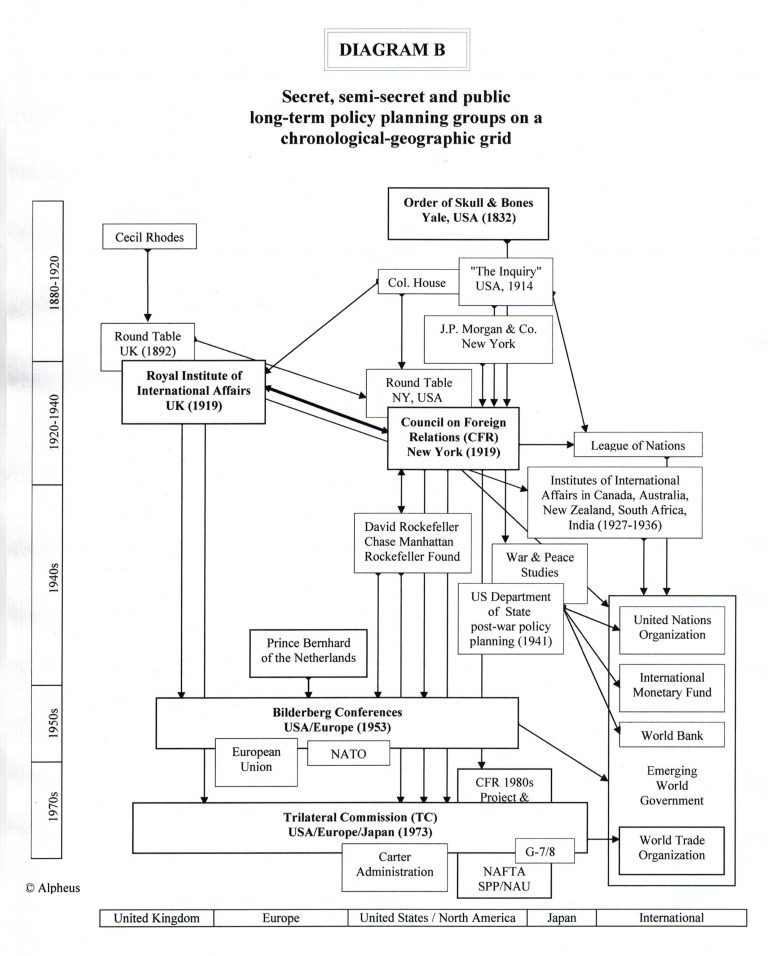
Bilderberg, Beyond the Taboo

© Peter Edel, 2020

The Dutch King, the Prime Minister, and a Minister
associated themselves withan anti-democrat
who financed right-wing extremists.

At the beginning of June of this year, a tradition was missing: the Bilderberg conference. The annual gathering of the elite from politics, business, the media and science has been postponed for the time being. ‘The meeting 2020 is postponed’ read the short statement on the opening page of the official Bilderberg website. Probably has everything to do with the corona crisis; there are regular visitors who, given their age, certainly belong to the risk group. For example, the invariably present Henry Kissinger, who, at the age of 97, still carries around him his crimes during the Vietnam War.

If postponement leads to cancellation, it is the second time that a conference has been called off since Bilderberg started in 1954. The first time was in 1976, in the middle of the Lockheed bribe scandal in which then-chairman HRH Prince Bernhard of the Netherlands was deeply involved.

It looks like we will not hear about Bilderberg in the media this summer. Not a very big loss, because the reports about the infamous annual meeting generally amount to little, with one of the few exceptions in this century being an episode of Andere Tijden from 2003. Furthermore, the media limits itself to the observation that there are links between Bilderberg and the Dutch royal family, that the conference is veiled in secrecy, and that conspiracy theorists love it. The Dutch language area does not get to hear much more about it than that.

This is a taboo that also applies to politics. Parliamentary questions from 2008 by former Socialist Party Member of Parliament Harry Van Bommel about Bilderberg were recently labeled as a conspiracy theory, while what Van Bommel brought up referred to nothing conspiratorial. But whoever mentions Bilderberg is simply lumped together very quickly with conspiracy buffs. Then, what exactly is said, no longer matters.

This article ignores the taboo that rests on Bilderberg, without connecting in any way to the usual conspiracy theories in this area.

Cyber Industry

What is Bilderberg actually? The initiators wanted to give American and European representatives from politics, business, the media and academia the opportunity to exchange ideas as private citizens without having to fear that their opinions would be aired in public.

The premise implies secrecy, although something will be made public. Since 2000, Bilderberg has placed a list of invitees on its website and a list of the key topics to be discussed. Afterwards, however, nobody explains anything and you have to guess what was discussed.

What is striking on the list of participants is that nowadays the cyber industry has gained a firm foothold within Bilderberg. Last year in Montreux, this was also reflected in the discussion topics, such as The Weaponization of Social Media and Cyber Threats.

In 2019, former Google CEO Eric Schmidt and Jared Cohen, CEO of Jigsaw, Google’s technology incubator, received an invitation. In addition, Satya Nadella, the CEO of Microsoft and Mustafa Suleyman, the co-founder of the artificial intelligence company Deepmind, were also invited. The same goes for LinkedIn and PayPal founder Reid Hoffman.

Another PayPal founder was also present last year: German-born American Peter Thiel. This article is mainly about this Bilderberger, billionaire, venture capitalist, libertarian and contrarian, because he is a prominent exponent of the cyber sector within Bilderberg, but also mainly because he stands head and shoulders above his cyber colleagues in terms of controversial antecedents.

Thiel is not just any Bilderberger either. He has been there for twelve years, an ‘honor’ that few have. You have to carry the name Oranje, Kissinger or Rockefeller for that (although that family has not been represented since the death of David Rockefeller in 2017). More tellingly, Thiel joined Bilderberg’s steering committee, which is an important position within the structure of the organization. In other words, Thiel belongs to the inner circle. As the name indicates, the steering committee determines the course of Bilderberg. It “assists” with tasks such as raising funds to make the conference possible, but especially also with the important selection of invitees.

Peter Thiel

After PayPal was acquired by eBay in 2002, Peter Thiel invested in Facebook, where he also joined the board of directors. Around the same time he started Palantir. One of the branches of this company, Palantir Gotham, supplies software to security services with which large amounts of data and systems to which, for example, number plate and face recognition are linked. Palantir claims not only to be able to solve crimes, but even to predict them.

The downside is that, according to critics, Palantir’s collecting of personal data is on a shaky footing with the (human) right to privacy. In other words: when you drive under a traffic light in a city where Palantir provides services to the police, Thiel knows that.

In the US, Palantir also supplies software to the Immigration and Customs Enforcement (ICE). Thiel’s company thus commits itself to the raids by ICE on undocumented immigrants and to the human rights violations that accompany it, such cages as with locked-up children. This led to protests among some Palantir employees.

Like Bilderberg, Palantir is also surrounded by secrecy. This is evident from the collaboration that the company started in 2012 with the New Orleans Police. The mayor of this American city knew about it, but the city government was kept out, which led to criticism. Under pressure New Orleans ended its partnership with Palantir six years later.

Palantir is not only represented within Bilderberg by Peter Thiel. The CEO of Palantir, Thiel’s college friend Alex Karp, will also be there. And not only that, because like Thiel, Karp also joined the steering committee of Bilderberg.

Startups

Peter Thiel, who may have taken refuge in New Zealand during the corona crisis, provided grants to numerous startups through his Founders Fund. They are usually in the cyber sector, but not always. Thiel, for example, donated seven million dollars to a project that was to lead to the development of a drug against herpes. He also came under fire because the project ignored the Food and Drugs Administration (FDA) guidelines for experiments with newly developed drugs. Thiel responded in a typical way: he opened an attack on the FDA.

Actually, more money went from Thiel to startups with a questionable character. Such as to Tlon, the producer of the computer program Urbit. Tlon was founded by Curtis Yarvin, who is not only a software developer, but also became known as the founder of the philosophy behind the far-right movements neo-reactionism and dark enlightenment. Through his website Unqualified Reservations Yarvin thus gained influence in general on the more developed circles within the far right in the US and in particular on the Alt Techies within the underbelly of Silicon Valley.

Neoreactionism

Yarvin’s neo-reactionism is equivalent to reactionism covered with a bit of cyber sauce. He rejects the ideas of equality, human rights and democracy arising from enlightenment thinking. He preferred to see the world return to the pre-enlightenment situation. Including feudalism and monarchism, on the understanding that Yarvin would prefer to draw the new monarchs from the ranks of CEOs of tech giants. He would also prefer to place the administration of the US in the hands of a CEO, a principle that he attaches rather incoherently to the ancient form of government cameralism.

Yarvin’s neo-reactionism shows affinity with traditionalism, such as that of the Russian ultra-nationalist Alexander Dugin. The latter harks back to the Italian traditionalist and ‘super fascist’ Julius Evola, whose thoughts can be found back in Yarvin. In addition, neoreactionism is a form of palingenesis (rebirth), the harking back to the glory of a bygone era, which is considered an aspect of fascism by political theorist Roger Griffin.

Yarvin’s views are shocking. The Norwegian mass murderer Anders Breivik failed, according to Yarvin, because his attack was “insufficient to liberate Norway from European communism.” Apparently, the 77 murders on Breivik’s conscience did not go far enough for Yarvin.

The Education of a Libertarian

In Thiel’s defense, it could be argued that he only decided to subsidize Yarvin because Tlon / Urbit is innovative in internet technology. However, relations between Thiel and Yarvin go further than a business relationship. Plus, Yarvin isn’t the only cyber-fascist to receive funding from Thiels Founder Fund. The Machine Intelligence Research Institute received money from the same direction when the transhumanist and eugenicist Michael Anissimov was the media director there. The same goes for Patri Friedman (the grandson of economist Milton Friedman) of the Seasteading Institute. Anissimov and Friedman, like Curtis Yarvin, are known as neo-reactionaries.

It may go too far to call Thiel himself a neo-reactionary, but there is certainly an ideological affinity. For example, in The Education of a Libertarian, like Yarvin, he spoke out against democracy. “Most importantly, I no longer believe that freedom and democracy are compatible”, he wrote in 2009, the year after his first appearance at Bilderberg. He never rescinded it.

Like Yarvin, Thiel sees CEOs, especially CEOs of tech companies, as the new monarchs. He said said: “We just do not call them monarchies in public, anything that’s not democracy makes people feel uncomfortable.”

The Diversity Myth

Another unpleasant fact about Thiel is his co-authorship of the book The Diversity Myth: Multiculturalism and Political Intolerance on Campus, published in 2016, in which multicultural policy of universities was criticized and date rape en passant was dismissed as “belated regret”. It took twenty years, but unlike his aversion to democracy in The Education of a Libertarian, he did come back to this idea in 2016.

Thiel did so in a statement sent to Forbes. “Rape in all forms is a crime” he wrote. He also expressed regret about insensitive, crudely argued statements in the book. But as Forbes‘ Ryan Mac put it, Thiel was vague about exactly what he meant by that. Mac did not explicitly blame Thiel for rejecting the 1996 criticism of multicultural policies.

Trump

Peter Thiel is good friends with US President Donald Trump. He donated $1.25 million to his election fund and was later also part of Trump’s Transition Team. According to the British newspaper The Guardian, Trump is “the fulfillment of Thiel’s desire to build a successful political movement for less democracy.”

Especially given Trump’s weakness with regard to the corona crisis, his re-election is no longer as self-evident as previously assumed. However, Thiel has deployed a new weapon to support his friend in the White House: HHS Protect Now, software developed by Palantir that could efficiently map the spread of the coronavirus.

It is unclear exactly how it works, so the mystery surrounding Palantir also remains here. Partly because of this, it is necessary to wait and see whether conditions regarding privacy will be respected. There is certainly concern about this in the American media.

Confrontations

Last year at the Bilderberg conference there were also guests of a completely different order from Peter Thiel. Such as the American historian Timothy D. Snyder, who specializes not only in the Nazi Holocaust, but also in Eastern Europe. The fact that he was invited must have had everything to do with the discussion theme Russia, although he is also known for his heavy criticism of Donald Trump.

By inviting Snyder, the steering committee planted the seeds for a fierce confrontation with Jared Kushner, Trump’s son-in-law who was there last year in Montreux, but especially with Thiel. We will probably never know whether that confrontation really happened due to the proverbial secrecy surrounding Bilderberg, but the author of this article would have liked to have been there …

Also because another confrontation was lurking in 2019. Thiel is nowadays not welcome at Google, which fielded last year, as previously described, a number of representatives to Bilderberg. A month after the conference, Thiel accused Google of being infiltrated by Chinese military.

“How many foreign intelligence agencies have infiltrated Manhattan Project for AI?” he said. By Manhattan Project for AI, he referred to the artificial intelligence-focused company Deepmind, which was founded by the aforementioned Mustafa Süleyman and was acquired by Google in 2014 – although Thiel himself also invested in it.

China was also one of the key topics at Bilderberg last year. Also keep in mind the trade war that Thiel’s friend Trump unleashed against China.

Facebook / Cambridge Analytica

Back to Timothy Snyder. In one of his videos on YouTube, he calls the image of Donald Trump as a successful businessman a myth. The fact that this image could nevertheless arise, according to Snyder, is mainly due to a lot of Russian money and efforts on social media, such as via Facebook.

Facebook was at the center of the 2018 scandal surrounding Cambridge Analytica (CA), the British / American data mining company that used data on many millions of Facebook users to influence both the British Brexit referendum in 2016 and the US Presidential election of the same year.

The outrage over CA’s manipulations was enormous. And that did not decrease after Netflix released the documentary The Great Hack about it. Andrew Adonis a member of the British House of Lords on behalf of Labor, who was also present at Bilderberg last year, made no bones about it: “Cambridge Analytica was hired to wage a giant, illegal ‘psy-ops’ campaign for the 2016 (Brexit) referendum & it’s amazing there haven’t yet been more prosecutions.”

Wylie

Peter Thiel knows CA’s primary financier, Trump and Brexit supporter Robert Mercer. In any case, reports appeared that he wanted to start a conservative news channel with Mercer. However, it is mainly Palantir that linked Thiel to CA.

This is how it emerges in the book Mindf*ck by former CA employee and later whistleblower Christopher Wylie. According to Wylie, the contacts between CA and Palantir came about at the initiative of an intern who worked at Strategic Communications Laboratories (SCL), the company from which CA originated. This Sophie Schmidt is the daughter of the former CEO of Google and last year Bilderberger, Eric Schmidt.

Wylie learned from his boss at CA, Alexander Nix, that Palantir had access to data on millions of US citizens. Equally interesting is that Palantir employee Alfredas Chmieliauskas joined CA to work on the development of the This Is Your Digital Life app, a personality test aimed solely at harvesting data about Facebook users. Thiels Palantir initially denied any connection, but later admitted that Chmieliauskas worked for CA.

Russia

There are also the Russian connections that can be made from CA. Steve Bannon is the former strategist of Donald Trump, editor of the far-right website Breitbart, alleged contact of Thiel-subsidized Curtis Yarvin, and co-founder of CA. Bannon showed his respect for the aforementioned Alexander Dugin, the Russian ultra-nationalist who has a lot of influence within the Kremlin and on the Russian armed forces.

Bannon and Dugin disagree when it comes to capitalism, for example, but the differences between them virtually disappear in light of the shared tendency to traditionalism; the traditionalism that Curtis Yarvin is also familiar with. According to The Nation, Bannon and Dugin had a secret meeting in 2018.

The information collected by CA about Facebook users also went to Russia, according to Christopher Wylie. CA employee Alexander Kogan, who, like Palantir employee Alfredas Chmieliauskas, was involved in the app that harvested data from Facebook users, was also working on a Russian-funded study into ‘Stress, health and psychological wellbeing in social networks.’ At the time, Kogan was affiliated with the University of Cambridge, but also with the University of Saint Petersburg.

CA also hired US political consultant Sam Patten. At the time, Patten was working with the Russian Konstantin Kilimnik, a former agent of the Russian intelligence service GRU. According to Wylie, Patten insisted that he had not transferred information from CA to Kilimnik. But Kilimnik got information about election polls in the US anyway, even if it came from Donald Trump’s former campaign chief Paul Manafort. Sam Patten and Konstantin Kilimnik worked in Ukraine for Manafort, which, as is known in the US, was sentenced to imprisonment, among other things for illegal services to the pro-Russian Ukrainian government of Viktor Yanukovych.

Facebook / Milner

Also, in the CA manipulations so essential to Facebook, one can note a Russian connection. In 2009, Russian / Israeli billionaire Yuri Milner invested many millions in Facebook, where Peter Thiel was already on the supervisory board at that time.

After the Paradise Papers were unveiled, it turned out that this investment had traveled a complicated route, but initially came from Gazprom, the Russian energy company in which the Russian state has a majority stake. In 2009 relations between the US and Russia were still different than they are today, but it was inevitable that Gazprom’s investment in Facebook through Milner received attention after the Russian manipulations in the US of 2016 came to light.

Yuri Milner also invested in Cadre, a company co-founded by Jared Kushner, Donald Trump’s son-in-law who, as we saw earlier, was also present at Bilderberg last year. Other investors in Cadre besides Milner include Goldman Sachs, George Soros (odd given his aversion to Trump) and Peter Thiel.

The connection with Russian interests that Peter Thiel acquired through the contacts between Palantir, CA and Facebook is a bit contrary to Bilderberg’s traditional Transatlantic orientation.

Personal capacity

In short, during last year’s Bilderberg conference, HRH Willem Alexander, Prime Minister Rutte and Minister Kaag, associated themselves with someone whose company was guilty of human rights violations, financed right-wing extremists, considered freedom incompatible with democracy, criticized multicultural policies and who also had a whiff of vodka.

The King, Prime Minister and Minister were at Bilderberg in their personal capacity but how much difference does that really make? Is there no problem when they become personally associated with an anti-democratic element?

If such a thing had happened at another meeting, the Netherlands would probably have been too small, but when it takes place at Bilderberg, no journalist makes a point of it – although the question is how many Dutch journalists fully understand the connections outlined above . . .

Nor did the political world get excited about it. Perhaps for the same reason, although according to an anonymous source well known in political The Hague, it is possible that a presence at Bilderberg here is regarded as the icing on the cake of a political career. In other words, according to this source, there are MPs who are reluctant to criticize Bilderberg because they secretly hope to be invited themselves. The fact that Member of Parliament on behalf of Groen Links Kathalijne Buitenweg was one of the participants of Bilderberg last year is one of the indications that this does not only apply to right-wing politicians.

So probably there will not be a Bilderberg in 2020. And its absence creates space to think carefully about this tradition of conferences.

This article has been brought to the attention of the Bilderberg media team before publication, with an offer to include a possible response. However, they waived that.

Source

This article was originally published in Dutch by Peter Edel on the Belgian on-line site De Wereld Morgen (The World Tomorrow) titled “Bilderberg: voorbij het taboe!” on 15 June 2020. Google was so kind to translate it into English with final edits by Govert Schuller. All done with the permission of the author.

Peter Edel is a Dutch analyst and investigative journalist from Amsterdam. He is the author of De Schaduw van de Ster (The Shadow of the Star, 2002); Banvloek (Anathema, 2003); and De diepte van de Bosporus, een politieke biografie van Turkije (The Depth of the Bosporus: A political biography of Turkey, 2011).

On Trump: More on Alex Jones


Into the Grove

In quite some ways the following is an instructive story. In July 2000 Alex Jones, Mike Hanson and British journalist Jon Ronson infiltrated the yearly Bohemian Grove gathering of very wealthy and well-connected people just north of San Francisco. They dressed up as preppy, casual CEOs and slipped into the estate with hidden cameras without anybody being suspicious. On the first evening they witnessed and recorded a ritual named the Cremation of Care which symbolized the start of the two week gathering. Men were dressed in robes with hoods and sacrificially burned something they called Dull Care in front of a big stone owl accompanied by music.

In Ronson’s telling of the story, when they returned to their motel room that evening and watched the tape, Jones made the case that it was an occultic sacrifice of a human effigy, some sort of “bizarre Luciferian garbage”, and made other remarks to interpret the ritual in the most dark manner possible.

Ronson was less alarmed and thought they were merely burning “a symbol of their troubles so they can enjoy their bloody summer holiday”. When Jones insisted, Ronson called him out, actually yelled at him, for projecting onto this gathering acute dangers in the same way the government projects danger on other people with sometimes lethal consequences.

“YOU’RE DOING TO THEM EXACTLY WHAT THEY DID TO RANDY WEAVER AND DAVID KORESH.  . . . YOU’RE PUTTING TWO AND TWO TOGETHER AND MAKING FIVE!”

The moral of the story is that Jones just wants to see dangers and makes intentionally skewered, conspiricist interpretations of things which by themselves might be quite innocent. Then his threat perception is so overblown, it triggers very emotional conspiranoid and aggressive reaction patterns, even leading him now in the arms of Trump.

Though he does direct attention to some under-reported issues and employs the Watson brothers, whose reporting seem to be factual, the way Jones goes about it is not very helpful to make real reform and changes possible. Trump and Jones deserve each other, but the US deserves something far better.

Meanwhile reptilian-detector David Icke thinks that real human sacrifices happen at the Bohemian Grove and that the stone owl stands for Moloch.

On the opposite side of the spectrum lies the statement the Bohemian Grove provided to Jonson about what they think they do: “The cremation of care is a musical and verse pageant heralding a two week midsummer escape from business cares and celebrating nature and good fellowship. As grand scale stage drama it may be a bit overdrawn, but it’s about as innocent as anything could be”.

Sociology of the Grove

In between one can find a more sociological assessment of this gathering by G. William Domhoff, a student of C. Wright Mills and long-time researcher of the US upper class and its executive branch, the power elite. Domhoff used his study of the Bohemian Grove to further make his case that a distinct upper class of about 1% of the population really exists and that its summer gatherings serve the social cohesiveness of their class.

At a political level the Bohemian Grove is one of the many organizations in the US where consensus-seeking and policy-planning occurs by the leaders of corporations and banks on class-related issues. But this “high-status summer resort” is not the primary organization for policy planning. That is done at the more specialized organizations like the Council on Foreign Relations and the Committee for Economic Development.

In short, the Bohemian Grove is not a satanic cult of the puppet masters of the world sacrificing babies, and it is neither an innocent midsummer escape for the rich. Its function is for members of the upper class to bond with each other and smooth over policy differences.

Because many of these policies exploit and hurt untold other people these gatherings have to be researched, exposed and countered. Alex Jones both contributed and hindered that process. Through him many people now know about the Bilderberg Group and the Bohemian Grove, but his hot-headed, conspiricist interpretations of what goes on there darken the minds of his audience, many of whom might have even drifted off further and fell for the utterly bizarre fantasies of QAnon.

Only a good dose of careful social science might counter that trend and the work by Domhoff is crucial to arrive at a nuanced insight of the power elite.

At the same time, and very unfortunately so, a large part of the US electorate might already be in a dangerous phase of ramped-up emotions and in serious denial of facts, reasoning and science. This hysteria, coupled with a tendency towards authoritarianism, became amplified by a psychopathic politician, or pathocrat, now sitting in the White House.

To what level of intensity and destructiveness this might lead is unknown, but the signs are not good. Mix in the pandemic and the fight for racial justice and you might end up with something explosive. For the sake of the health of the US body politique this pathocrat has to be impeached or voted out and made harmless. Some experts expect that, once he is out, many people will come back to their senses and America can assess and repair the extensive damages.

Sources

Domhoff, G. William. 1974. The Bohemian Grove and Other Retreats: A Study in Ruling Class Cohesiveness. New York: Harper & Row. Abbreviated text.

Ronson, Jon. 2001. “The Satanic Shadowy Elite?” Part 4 of “Secret Rulers of the World”. Documentary. World of Wonder Productions, 20 May 2001.

Ronson, Jon. 2001. “The Bilderberg Group“. Part 5 of “Secret Rulers of the World”. Documentary. World of Wonder Productions, 27 May 2001.

Ronson, Jon. 2002. Them: Adventures with Extremists. Book. New York: Simon & Schuster, 2002.

Frontline. 2020. “Alex Jones and Donald Trump: How the Candidate Echoed the Conspiracy Theorist on the Campaign Trail“. Frontline, 28 July 2020.

Willimon, Beau, et al. 2013. House of Cards. The Complete Fifth Season.
The Bohemian Grove is the inspiration for the “Elysian Fields” in season 5.

Nietzsche’s Reluctant Acceptance of Liberal Democracy (and later Rejection)

Introduction.

The questions to be addressed in this essay are 1) whether we can extract from Nietzsche’s book Human, All Too Human, which was written in his more moderate science-oriented middle period, something of a political view; 2) whether this view can be construed, with some hedging here and there, as supporting modern liberal democracy; and 3) whether Nietzsche’s qualified endorsement, or maybe better formulated, reluctant acceptance of liberal democracy can be found in his other works.

This should be an interesting challenge because the book has many passages in which he deals with the relationship between, on one side man and on the other culture, society and the state. The initial focus will be on chapter eight, titled “A Look at the State”, in which we can find most of his thinking about the state, class, caste, socialism, nationalism, anarchism, democracy, war, religion, “Great politics” and many other themes connected to political thought. I will make here and there some excursions into the future, not into Nazi Germany, but into the post-WWII West in which liberal democracy has firmly established itself, and try to figure out how Nietzsche might have come down in different political issues.

Liberal Democracy: Cynically and Conditionally Accepted

The very first section (438) in this chapter is already rich with ideas which could support a liberal, democratic form of government, but not without some cynical denigrations about the mental capacity of the demos and warnings for the misfortunes it could heap upon itself. First, Nietzsche observes and accepts that something of an earthquake-like change has occurred in politics, highly probably referring to the rise of democracy and constitutional government, and that this change just has to be accepted. It would be futile not to accept it. If the goal of politics is now to make life bearable for the most amount of people through democratic politics with all its demagoguery, lies and manipulations, then, so be it. Nietzsche seems to look at this state of affairs like a force of nature to adapt to, not an arrangement he would necessarily recommend. Actually, he is quite cynical about it and sets some conditions to make it minimally acceptable for him and his fellow (or future) free spirits.

His quite humorous cynicism about democracy is based on a very denigrating view of the intellectual capacity of the population and is visible for example in his quote from Voltaire, who wrote that “Once the populace begins to reason, all is lost”. Nietzsche thinks that the narrow-minded masses can only contain “five or six concepts” in their heads–and they are even proud of that–and believes that they are quite deluded in thinking that they have the capacity to come up with the right policies to increase their own well-being. But, as long as they are deluded, Nietzsche avers, they will “gladly bear the fatal consequences of their narrowness” (438).

So, Nietzsche sees some dangers lurking in the democratic set-up and, because democracy can be a dangerous homogenizer of people, he makes a plea for the freedom 1) for some people to stand aside from politics; 2) for some people to be not too serious about the well-being of the many and even be ironic about it; and 3) for some people to emerge from the masses and try out some unconventional thinking and expressing themselves.

The above enumerated conditions for some spirits to have a little unconventional freedom to make themselves heard is not necessarily just for the sake of such free spirits or would-be free spirits. Earlier in the book, in his crucial passages about such free spirits and their role in society (224-237), Nietzsche made it quite clear in biologistic terms that such freedom is essential for a culture to further develop. Unbound spirits maim their society by experimenting with new and different expressions and society reacts by getting inoculated through assimilating the new into their bloodstream. “Wherever progress is to ensue, deviating natures are of the greatest importance” (224).

The Necessity of a Permeable Class Society

Another condition for society to develop and create a “higher culture” is the existence of a stratified population with an “idle caste” on top and a “working caste” at the bottom. Because the upper crust is capable of a more refined sensitivity and deeper suffering and has the wealth and leisure to do so, it can set the conditions for a higher culture to emerge and sustain. With its wealth it can afford the most beautiful women (apparently regardless of caste); the best teachers; avoid mind-numbing labor; and be clean and healthy (479).

And if there is some permeability between the two castes, when upper class individuals and whole families become so obtuse to become demoted to the lower class and, other way around, deserving individuals from the working class, for example beautiful women and good teachers, but especially free spirits, rise up and get accepted in the leisure class, then such an arrangement would be very good according to Nietzsche. It is not entirely clear though what he meant with his valuing expression, that, if this state is achieved, then beyond it “only the open sea of indefinite desires is still visible” (439).

What does he mean with, in his original German, “das offene Meer unbestimmter Wünsche”, and what does it indicate as far as importance is concerned? Is he saying that, if there is social mobility between the classes and newly, self-minted free spirits arise from the lower classes, then such spirits can, or even should forthwith enter the upper class, take advantage of its leisure, and start experimenting with unconventional ways of being, because only if such a flow of individuals is established then any and all of the higher and still undetermined desires can come to fruition in higher cultural expressions? And was this mobility more prevalent in the past, as Nietzsche finishes the section with “Thus the fading voice of the old era speaks to us; but where are the ears left to hear it?” (339). I dwell on this expression because it has such a positive visionary ring to it, which is not often found in Nietzsche’s non-fictional prose writings.

The Danger of Secularism and Egalitarianism

Another danger of democracy, and this one Nietzsche thought to be more of a long-term threat still in the future, is that it radically transforms the relationship between the government and the people, from a hierarchical structure, like one has with the teacher-pupil, master-slave or father-family relationship, to an egalitarian relation in which the government is seen as “an organ of the people”, or better said in Lincoln’s Gettysburg address, “government of the people, by the people, for the people“. Apparently Nietzsche will have none of that, but thinks there is still time, a century or so, for that unfortunate idea to become reality and therefore cautions to go slow in this regard (450).

If one looks at the 1970s (a little less than a hundred years after Nietzsche wrote the above warning) as the epitome of the West’s realization of the democratic spirit and economic equality, then one could see Nietzsche as somewhat prophetic. He might have abhorred it, but nevertheless foresaw it coming. He would have been gratified though that soon after, most of the policies leading to that moment in the West were turned around in the 1980s by the implementation of neoliberal policies developed by the Chicago School and the “1980s Project” within the Council of Foreign Relations (Shoup & Minter; Sklar).

And he might have been enamored by the rise of the hard, elitist, economic shock doctrine of so-called “disaster capitalism” (Klein). But he might not be enamored by the further extension of these privatization policies, because they are now gradually putting corporations in charge of many of the functions previously executed by the state, with some politicians and thinkers explicitly trying to diminish the state into a minimal entity which ultimately might lead to the “death of the state” (472; italics in original). Nietzsche again shows himself prophetic here. How far his warning for the corporate take-over of the state could be interpreted as anti-corporatism and therefore as proto-anti-fascist is an open question.

Democracy, Religion and Anarchism

Another disadvantage of the democratic state is that it forces religion from the public into the private sphere and therefore cannot be used anymore by the state as a force of societal cohesion and appeasement in times of trouble. And it will weaken the state itself because its “mysterium” is diminished and people will have less respect for it. This might then open the road, as observed before, for private contractors to come in and gradually take over the business of the state to the point of the “death of the state” (472; italics in original). As he summarizes it himself:

To recapitulate briefly, the interests of tutelary government and the interests of religion go together hand in hand, so that if the latter begins to die out, the foundation of the state will also be shaken. The belief in a divine order of political affairs, in a mysterium in the existence of the state, has a religious origin; if religion disappears, the state will inevitably lose its old veil of Isis and no longer awaken awe. The sovereignty of the people, seen closely, serves to scare off even the last trace of magic and superstition contained in these feelings; modern democracy is the historical form of the decline of the state (472; italics in original).

Even though Nietzsche seems to lament the possible decline of the state, he is not entirely dismissive of it. If and when it happens humanity’s clever and selfish resilience will be such that chaos will not come about and that “an invention more expedient than the state will triumph over the state”. But humanity is still far away from such anarchism. People are too afraid to contemplate it and the organizational forms to replace the state have not yet been developed, though some arrogant minds with a deficient notion of history, obviously referring to his anarchist contemporaries, might think they have the required ideas and try to implement them.

Meanwhile, the same selfishness and cleverness which might devise new forms of societal organization to replace the state in the distant future, will fortunately strengthen the state for the time being and ward off anarchist attempts at its destruction. Though Jennifer Ratner-Rosenhagen in her study on Nietzsche’s reception in America, American Nietzsche: A History of an Icon and His Ideas, makes it clear that American anarchists were very appreciative of Nietzsche, the feelings were not reciprocal.

Socialism: The Great Danger to Adept to

Whereas democracy is in Nietzsche’s assessment an inevitable development carrying some grave but maybe manageable risks, socialism is a far greater danger which can and should be managed at all cost. The manner in which Nietzsche perceives socialism is important because it carries explicit and implicit policy proposals both limiting and expanding the powers of his begrudgingly accepted constitutional, liberal democracy.

Though he concedes the truth of the socialist analysis that the current distribution of wealth and privileges is based on “countless injustices and atrocities”, he denies them the right to rectify it through redistribution (452). At a concrete political level this would imply that Nietzsche would have opposed many, if not most, taxation schemes, especially the progressive income tax, and would have opposed any social programs like a public pension system or universal health care. He would, by the same logic, also have opposed any wealth redistribution upwards. He would arguably have rejected the current policy of “private profits, public losses” and let bankruptcies naturally occur because some firms were obviously not fit, and let their failing, unfit CEOs and CFOs get demoted to the lower class.

The non-rectification of past injustices will also imply, for example here in the USA, that there will be no affirmative action to rectify the long-term effects of the countless atrocities of slavery, nor restitution to the Native American Indians for the holocaust perpetrated upon them. Actually, Nietzsche thinks that slaves “live more securely and happy” than the proletariat and that the sentiment driving the abolition of slavery is not the concern about human dignity, but some kind of vanity about equality (457). This perspective shows Nietzsche’s very elitist, paternalistic, though still somewhat compassionate, attitude.

Instead of redistribution, Nietzsche advocates a “gradual transformation of attitude”, such that the sense of justice will increase and violence decrease (452). What the practical consequences would be is not entirely clear, but Nietzsche might accept institutions like toothless reconciliation commissions and the like if he thinks it would contribute to his proposed change of attitude without the guilty parties having to pay indemnities. Otherwise the slogan rules that might made right. If there would be anything close to a socialist sense of justice and equality it would apply only among the members of the ruling elite themselves. Nietzsche does not take this idea serious though, because he thinks that it is promoted by noble, but not very insightful representatives of that class (451).

But, in case socialism becomes really a major force and comes out of hiding to engage the powers that be by social warfare (which in his perception had not yet happened), then, depending on a realistic assessment of its force, a compromise in the form of a treaty might be necessary. Only then socialism will gain rights–presumably anchored in legislation—and can workers demand justice in terms of the treaty (446). What concrete policies could be found in such a treaty? Maybe, given the plight of late nineteenth century workers and their demands, this might mean the 40-hour work week, fair pay, the right to unionize, free choice of employment, elimination of child labor, and, later, paid vacations, social security, socialized medicine, etc. So, even if Nietzsche might not like such policies, especially not those which need funding and the redistribution of wealth, he would by necessity accept compromise.

Communism: To be Avoided

Maybe he accepted some compromise with the demands of the oppressed, because one alternative, communist revolution, would be far worse. He is afraid that the “passionate idiocies and half-truths” of Rousseau, for example the superstitious belief in “a wondrous, innate, … but repressed goodness of human nature”, might inspire people to “the overthrow of all orders” with the expectation of establishing a new, just order ex nihilo. Nietzsche thinks that that cannot happen and that instead revolution will lead to disaster in which the wildest energies of humanity are resurrected and no real reconstruction is possible (463). Socialism could only establish and maintain itself by creating an absolute state with its citizens in complete subjugation and subjected to severe state terrorism (473). Nietzsche really is upset with Rousseau and thinks that because of him “the spirit of enlightenment and of progressive development has been scared off for a long time to come …” (463; italics in original).

Reactionary Repression: Not Good Either

It is admittedly quite speculative, but it is possible that Nietzsche is thinking above, not of the direct effects of the French Revolution—that event had come and gone–but of the long-term, anti-progressive, repressive policies associated with Austrian minister of foreign affairs and post-Napoleonic Concert of Europe architect, Klemens von Metternich, which were formulated in fearful reaction to the Rousseau inspired revolution, and were perceived by many as an obstacle to enlightened progress. One could argue that Nietzsche in his anti-revolutionary, pro-aristocratic zeal might have sided with a conservative like Metternich, but it might be more probable that he found Metternich too repressive and reactionary and realized that his own writings might have been censored and he himself spied upon. If that ever would have happened, the acidic venom of his pen would have been excruciatingly painful for the authorities (and maybe helpful for an earlier breakthrough if jailed). The criteria used to negatively evaluate a repressive conservatism a la Metternich might be the same which Nietzsche used to reluctantly accept democracy, and that is that there should be space for free spirits to engage in unconventional thinking, writing and publishing in order to keep society fit and help its development. His aversion of repression based on his belief in “the spirit of enlightenment and of progressive development ” indicates that he would accept maybe an enlightened despotism in which an aristocracy rules together with an established religion and in which there is also some freedom of expression.

In this context I am wondering where Nietzsche might have come down in the case of the 1973 coup d’état in Chile against the democratically elected socialist President Salvador Allende which led to the brutal military junta under General Augusto Pinochet. Would he have reluctantly accepted Allende’s policies as the understandable outcome of democracy (or maybe even as the rightful assertion of the Chilean state in the face of foreign interests)? Or would he have accepted the Pinochet regime with its reactionary, repressive policies as a rightful assertion of its upper class? It probably all hinges on his ‘highest value’, that is, the freedom of free spirits to do their thing, in which case I think he would have sided with Allende and hope for the best.

Gathering of the Positions

Can we combine the above political thoughts into a qualified endorsement of liberal democracy? Quite so, I think. It is the conclusion, and most people are familiar with this, that liberal democracy, with all its faults and drawbacks, is also in Nietzsche’s thinking the least bad form of government. Nietzsche does not state it as such, but in his via negativa politicus, if I may coin a Latinism, the only thing standing is liberal democracy, including some reluctant adaptations to workers’ rights; possible endorsement of neoliberal policies; and at least some form of cultural and social libertarianism; and all together perceived as an acceptable, temporary balance of different political-ideological wills to power. He rejects, going from left to right, anarchism (too young but promising); communism (too naive and destructive); socialism (too totalitarian and terrorist); enlightened despotism with an established religion (anachronistic, but still possible as runner-up); repressive conservatism (too repressive and stifling); Corporism (weakens the state); and Fascism (too nationalist and socialist, but not excluded).

After Human, all too Human

Does the above qualified, temporary acceptance of liberal democracy survive in his later works, for example in Beyond Good and Evil? In a previous entry I contemplated a possible change of mind by Nietzsche regarding the best possible set-up of a state for free spirits to flourish. I thought initially that Nietzsche in Human, all too Human was promoting the idea that free spirits were basically individualistic free agents in a stratified, but still liberal democratic society and that later, in Beyond Good and Evil (BGE), Nietzsche changed his mind towards a more collectivist, aristocratic form of political organization as the preferred possibility condition for free spirits to execute their cultural transformations. A crucial and disturbing passage expressing a harsher view of the lower classes and the prerogative of the upper class is in section 258 of BGE:

The essential characteristic of good and healthy aristocracy, however, is that it experiences itself not as a function (whether of the monarchy or the commonwealth) but as their meaning and highest justification–that it therefore accepts with a good conscience the sacrifice of untold human beings who, for its sake, must be reduced and lowered to incomplete human beings, to slaves, to instruments. Their fundamental faith simply has to be that society must not exist for society’s sake but only as the foundation and scaffolding on which a choice type of being is able to raise itself to its higher task and to a higher state of being …” (BGE, 258; italics in original).

Compared with the deeper investigations of Nietzsche’s political thinking in Human, All too Human, the essential difference seems to be that Nietzsche dished any acceptance of democracy, however reluctant that might have been, and takes back any possible compromise with the working class and their sense of human and workers’ rights. Democracy is merely the heir of Christianity (BGE, 202), inherently fractured (BGE, 208) and leads inevitably to tyranny (BGE, 242). He advises, and seems to prefer, for Europe “to acquire one will” and leave behind petty politics (BGE, 208). Therefore, if such ideas like democracy and human rights are tossed, then he can ‘overcome’ his previous reluctant acceptance of liberal democracy and go all out with a cruel, self-assertive, self-legislating, “value-creating” (BGE, 260; italics in original) upper class and reduce the rest of mankind to the status of Untermensch to be exploited, which is fine because exploitation “belongs to the essence of what lives, as a basic organic function; it is a consequence of the will to power, which is after all the will of life” (BGE, 259; italics in original). Here we can unfortunately see the foreshadows of a fascist ideology.

Sources

Klein, Naomi. 2007. The Shock Doctrine: The Rise of Disaster Capitalism. New York: Metropolitan Books/Henry Holt.

Nietzsche, Friedrich. 1989 (1966). Beyond Good & Evil; Prelude to a Philosophy of the Future. Trsl. Walter Kaufman. New York; Vintage Books.

Nietzsche, Friedrich W. 1984. Human, All Too Human: A Book for Free Spirits. Trans. Marion Faber, with Stephen Lehmann. Lincoln: University of Nebraska Press.

Ratner-Rosenhagen, Jennifer. 20112. American Nietzsche: A History of an Icon and His Ideas. Chicago: University of Chicago Press.

Schuller, Govert. “From Individualistic Free Spirits to a Collectivist Aristocracy?” Entry #11; November 14, 2013. Political Science 495, NIU, DeKalb, IL, Fall 2013.

Shoup, Laurence H. and Minter, William. 1977. Imperial Brain Trust: The Council on Foreign Relations and United States Foreign Policy. New York: Monthly Review Press.

Sklar, Holly (Editor). 1980. Trilateralism: The Trilateral Commission and Elite Planning for World Management. Boston: South End Press.

Origin

This term paper was written for the seminar “Nietzsche and Politics” (Political Science 495) conducted by Prof. Larry Arnhart at Northern Illinois University in the fall of 2013.

Dr. Arnhart responded to the posting of my paper on his blog and I responded there to him again. 

Darwinian Conservatism and the Liberal Welfare State

§1. Introduction.

In his book Darwinian Conservatism the political scientist Larry Arnhart makes the case that traditional conservatism is the right political philosophy for humanity to follow because “it rests on a view of human nature that is supported by Darwinian biology” (Arnhart, 10). Arnhart developed his case by way of defending five propositions, each dealing with how Darwinism would support a specific conservative proposition.

This essay will concentrate on the following question: Has Arnhart made a persuasive argument for Darwinian conservatism? My answer to the question is negative, because I think Arnhart makes certain jumps, or takes shortcuts, which are undermining the strength of the connection between his Darwinian premises and conservative conclusions. I will support my view with three arguments in which I will try to show that Darwinism does not necessarily lead to conservatism and can, for equally valid reasons, be interpreted to support liberalism.

The three arguments I like to develop are: 1) Arnhart does not consider reasonable liberal alternatives. Instead he sets up Liberalism as a straw man and then easily knocks it down; 2) Arnhart does not put his hypothesis to the test by looking at comparative research about how different countries with different socio-economic systems satisfy the twenty basic desires he identifies; 3) Arnhart thinks there is no manner to rank and prioritize our desires and therefore concludes society should have a libertarian, hands-off attitude in this regard. Based on psychological research and common sense one can reason in favor of some kind of ranking, which supports a more liberal direction of the policy making process.

I will also develop two lines of argument to challenge my own reasoning. 1) I will play with the idea that people in social democracies, though they might report at the subjective level a high sense of well-being and are by objective measures well off, they are deep down miserable, but do not know that, because they suppress such realization by their hedonistic life-style. 2) Secondly, arguing against the idea that the European social democracies evolved naturally, I will for the sake of argument side with conspiricist conservatives and make the case that the welfare state came into being as the result of devious conniving behind the scenes by an international network of individuals, families, and semi-secret groups.

§2.1. Liberal Alternatives

Arnhart seems to be too eager to make his case for Darwinian Conservatism and drive towards its conclusion without carefully considering possible alternatives. First of all, though he does address criticisms of his five main propositions, they are all challenges posed by other conservatives, especially transcendentalist conservatives (Arnhart, 10-13). Secondly, criticisms coming from more moderate liberal positions were not included among the commentaries solicited by the editor Kenneth Blanchard of the expanded edition of Darwinian Conservatism. The challenges came from transcendentalist conservatives and secular libertarians, not liberals or Marxists.

The liberals depicted and refuted by Arnhart are mostly Utopian liberals, whose abstract concept of liberty, rationalist ethics and Utopian programs based on the presumed perfectibility of man, are all shown to be dangerous ideas, because they do not take into account the more biological, realistic view of man with his natural desires and long established habits. Some of my liberal friends could not recognize themselves in the Utopian liberal depiction as presented by Arnhart and thought the argument reeked of a straw-man fallacy. This might be true from the perspective of more moderate, pragmatic liberals, but I think it certainly is applicable to the more classical Utopian and Marxist variations of liberalism.

It is easy to show with the historical record that Utopian left wing and authoritarian right wing regimes do a poor job in enabling their population to flourish, but as little as anti-fascism leads to liberalism does anti-communism lead to conservatism. And it is the latter move which Arnhart seems to make in his justification of Darwinian conservatism. If you do not want to end up with the unsatisfactory and unnatural results of liberal Utopianism, you will have to embrace a form of naturalistic conservatism as its only alternative. This is the fallacy of a false dichotomy. There is a continuum between the extremes of anarchy and totalitarianism, and pragmatic liberalism, as it evolved in Europe, is one of many socio-political systems on that continuum.

Arnhart does engage in his book the work of Peter Singer, because of the latter’s plea for a Darwinian liberalism based on biological science and not primarily on abstract moral principles or Marxist ideology, though those seem still operative in Singer’s thinking. Arnhart’s deconstruction of Singer follows two lines of counter-attack. First, he thinks that Singer’s principle of ethical impartiality, which is confessedly a rational principle, has no basis in human nature and therefore can not really be considered Darwinian, and secondly, that much of Singer’s “‘deflated’ leftism” is acceptable to conservatives, as long as it is based on the idea that “conformity to human nature is a fundamental standard for good social policy” (Arnhart, 128).

But the tables can be turned here and an argument can be made that liberal ends still might be attained in conformity with human nature. For example, one could argue that it was in conformity with the given natural desires, changing emotions and habits and evolving, prudential reasoning of its citizens that the European welfare state evolved. And it evolved naturally and gradually by incrementally changing its collective habits, deliberations and laws. If conservatives would recognize the gradual evolving quality of this process and see that it harmonized with man’s evolved nature, they would not have any reason to oppose the quite liberal outcome. Only by deducing arguments from purely ideological or religious sources could they make a case against a naturally evolved welfare state, but not on Darwinian conservative principles only.

§2.2. Comparative Research

Another line of critique involves empirical data. Arnhart does not provide enough supportive research in which countries with a different socio-political system are compared in which way they accomplish the satisfaction of the basic, genetically driven desires of humans. Arnhart stated that specifically the USA and the UK fulfill those desires, but, instead of making the case, he merely refers to Paul Rubin’s Darwinian Politics (Arnhart, 84). I find several problems with that. First of all, it looks contradictory to lump the USA with the UK. To me the UK is, even after Thatcher’s reforms, a fully developed welfare state comparable to other western European states. Maybe Canada might have been a better choice to put in the same category as the USA. Secondly, as I somewhat developed elsewhere, Rubin recognizes other natural desires which lead to a welfare state.1 This implies that, if these desires are considered natural and the welfare state provides a legitimate satisfaction of those desires, then the existence of the welfare state is justified on Darwinian principles.

My own exploratory research, comparing the liberal Netherlands with the more conservative USA, indicated that Holland is better off as far as the satisfaction of natural desires are concerned. In a preliminary conclusion in one of my entries I stated that the Dutch have “better health care, longer life span, a supportive parental leave system, less poverty, less hunger, less corruption, better protected fundamental and property rights, a better civil and criminal justice system, and greater press freedom”.2

One of the statistics I did not use in my entry was the index for human development and overall well-being. Here the numbers become interesting because in the Human Development Index (HDI), which is based on life expectancy, education and income, the US and Holland both score very high and very close. Actually, in 2011 the US and Holland tied at the third place after Norway and Australia and in 2012 the US went slightly ahead. But when the numbers are adjusted by taking into account income inequality–a procedure now widely accepted–the ranking changes quite dramatically. When one looks at the Inequality-adjusted HDI (IHDI) the US dropped a whopping 19 places in 2011 and 13 places in 2012, while the European countries on the list kept their high ranking because of their much lower inequality.3 The adjustment is justified by the idea that, when there is a large income inequality in a country and, because of that, most of the benefits are concentrated at the top, the average citizen will have a lower HDI then if the benefits would have been more equally spread over the population. The Inequality-adjusted HDI is thereby seen as the actual index and the unadjusted HDI as an index for a country’s potential. From this idea can be deduced that, though the US has a very high potential for human development, the country does not actualize this potential fully because of its income inequality. And of all the developed countries it is the USA which has the largest difference between its potential and actual development.

§2.3. Maslow and the Ranking of our Desires

It might not be true that there is no way to rank our desires and that, in light of such lack, one cannot assign policy priorities to help people attain some of the basic ones. A more careful, and even scientifically based model to create some overall ranking of our natural desires might lead to a more liberal and less conservative socio-political order.

Arnhart states that to “combine and rank the goods of life, each individual must exercise prudential judgment in deciding how to arrange and integrate these goods in a way that is fitting for the contingent and particular circumstances of the individual and for that individual’s propensities, abilities and history” (Arnhart, 239). This more open-ended, flexible and tolerant conception of human goods, which he named the “inclusive end conception,” seemed to have been developed in opposition to the more rigid “dominant end conception,” which comes with most transcendentalist conservative and, for that matter, Utopian liberal world views.

The question whether evolutionary theory can provide something of a ranking of our natural desires in such a way that we do not have to appeal to a transcendental source outside life itself to indicate which of our natural desires are good or bad. Question is if there is something of a natural ranking already taking place without humans necessarily noticing it. We might already act according to a certain naturally evolved and reasonably coherent value system, but are not yet aware of such. Or maybe some psychologists, though not explicitly working within the evolutionary paradigm, have found a hierarchy in our desires. If so, we’ll have to see if it harmonizes with evolutionary psychology.

The system I have in mind is the hierarchy of needs as developed by the American psychologist Abraham Maslow and presented in his paper “A Theory of Human Motivation.” In this now more or less accepted theory humans have a hierarchy of needs ranging from very basic physiological needs to the highest, which is self-actualization. And we move from first satisfying the basic set of needs to the next, higher set. Without getting into details, it is obvious that there is quite an overlap between the basic needs Maslow’ identified and the natural desires Arnhart enumerated. The first question is if Maslow’s hierarchy can be used to organize and evaluate our needs and thereby overcome the alleged problem of the probable absence of a transcendental source to provide a similar service. The second question is if this hierarchy can help settle questions in political philosophy.

Reflecting on the logic of its organization in the form of a pyramid, I can agree that the basic physiological needs come first to be satisfied. No life without air, water, food or sleep. And our sense of evolved sympathy would find it very hard to see or contemplate anybody in our proximity deprived of them. Slightly less vital for our survival, but still quite important, are our security needs for shelter, health and a safe environment. Then, one step further up in the hierarchy, are our social needs for friendship, romance, familial bonding and communal belonging. Next is our need for a sense of self-worth, which finds satisfaction in personal accomplishment and social recognition. Maslow’s highest rung is the need for the conscious actualization of one’s potential, a level where one can find peak experiences of flow, mastery and self-transcendence.

Given this hierarchy I would venture that a community should be organized such that a) the basic biological needs (food, health and shelter) are one way or another guaranteed to all members and that b) long-term policies are such that they give the best infrastructure for the optimal fulfillment of the other needs. A right to work and a minimum living wage would take care of the basic needs including housing, and a non-corrupt government can provide safety, health insurance and affordable education. At the same time there should be a maximum of freedom for people to pursue their social, romantic, vocational, economic, creative and spiritual needs. Apparently the social democracies of north-western Europe have accomplished a lot in this direction. They only still have to get their Muslim population to buy into the program, because the Muslim appeal to their own transcendental source of morality is posing somewhat of a danger to this more enlightened, secular, semi-self-regulating set-up.

In summary, what seems to be overlooked in the dichotomy between the libertarian “inclusive end conception” and the religionist or secular Utopian “dominant end conception” is a ‘two-tiered end conception’, which differentiates between basic and elective goods based on Maslow’s hierarchy of natural needs. The basic needs are food, health and shelter, which all should be more or less guaranteed by a polity if these could not be met within the context of a free market economy. The elective needs are social, vocational, cultural and spiritual, for which fulfillment a polity only has to provide the infrastructure, but not its actual fulfillment. To me it looks like that the social democracies of Europe have organized their societies around such a two-tiered conception of human needs and have done so quite successfully.

§3.1. Are the Dutch Really Better off?

Recently I discussed with a very wealthy, conservative father of one of my friends how mellow and happy the Dutch seem to be. He thought that the Dutch might not know they are actually unhappy. Maybe they “smoke” too much. They think they are happy, but their hedonistic lifestyle suppresses the fact that they are miserable escapists living in a life-sapping, oppressive welfare state. Given the idea that people tend to be self-deluded and self-justifying and that people might not be honest when asked to report about personal feelings, the idea of the Dutch not being really happy has some plausibility. The problem is then, of course, how to tease out the truth. Methodologically speaking this is tricky, because it is quite complex to differentiate between what people report about their well-being and how they deep down really think and feel. Probably the Harvard-based Project Implicit could help in this regard as they investigate “thoughts and feelings outside of conscious awareness and control.”5

Maybe by looking at statistics about suicide in the US and the Netherlands it might become clear if it is reasonable to think that there is a discrepancy between a nation’s self-image and reality. According to statistics from the European Commission the average suicide rate in the Netherlands in 2009 was 8.5 per 100.000 inhabitants (males 12.0 and females 5.0).6 According to the US Department of Health and Human Services the average suicide rate in the US in the same year was 12 per 100.000 inhabitants (males 19.5 and females 5.5).7 Wikipedia took these numbers and ranked 107 countries by average suicide rate, from high to low. The US came in 33rd place, just ahead of the traditionally suicide-prone populations of Sweden (11.9) and Norway (11.9) and just below Communist Cuba (12.3). The Netherlands came in at 51st place, leaving only Spain (7.6), Italy (6.3) and Greece (3.5) with lower rates of suicide in Europe.8 It looks like that females in both countries are equally inclined towards suicide and that US males are 50% more likely to commit suicide than their Dutch counterparts. If human nature is in general similar in both countries it seems reasonable to conclude that American men are one and a half times more unhappy then Dutch men. But, what if the psychological profile of both populations is quite different as my friend’s father suggests? Is it plausible to assume that the oppressiveness of the welfare state makes people more unhappy, but at the same time its tolerance of escapist habits would assuage this side effect and keeps people from committing suicide? Rationally speaking I can see the logic, but intuitively I find it quite absurd. It is an interesting question though and I have to admit that I am at a loss of arguments to be convinced one way or the other. I can only reiterate that Project Implicit might bring some clarity here.

§3.2. The Deviously Engineered Nature of the Welfare State

The argument that the welfare state is somehow the natural outcome of a social evolution in conformity with man’s natural desires might not be true and merely a rationalization. The truth is more ominous and relatively hidden. In broad lines it is as follows. For a few centuries a network of groups and individuals have conspired to introduce socialist policies into the fabric of society. Their ends justified their means and through Communist revolution, Fabian gradualism or the surreptitious infiltration of governments and civic institutions they steered the west into the adoption of unnatural, collectivist policies and the creation of institutions like the European Union and the United Nations. Libertarians and conservatives in the USA are the last bulwark against this encroachment and will have to engage in a battle of epic proportions to keep the USA free by rolling back the welfare state domestically and promote free markets and limited government in the international arena. A Darwinian conservative could use this conspiricist argument against the welfare state with great effect, because the deceitful origin of the welfare state shows how counter-natural it actual is.

§4. Conclusion

Though I heartily agree with the premise that a sound political philosophy has to take into account the evolved nature of man, I cannot agree with the idea that such a philosophy is necessarily conservative. Ironically, by the standards of Darwinian conservatism itself, European countries enabled the natural evolution of their welfare state (§2.1) and do a better job in fulfilling man’s natural desires than the more conservative USA (§2.2.). The difference between Arnhart’s more libertarian-leaning Darwinism and the Darwinism which leads naturally to the European style welfare state is that the latter incorporates 1) some natural needs which justify a welfare state identified by Rubin, but overlooked by Arnhart (§2.2.), and 2) it incorporates a two-tiered conception of natural needs instead of Arnhart’s proposed inclusive end conception (§2.3.). Two arguments can be made to totally undermine the above idea of Darwinian liberalism. The first is to argue that people in a welfare state are worse off because they are actually unhappy, but smother that feeling by unnatural and immoral activities (§3.1) and secondly by arguing that the welfare state is nothing more than the unnatural and immoral product of a long-term deception perpetrated by a devilish, Machiavellian cabal (§3.2.).

This paper was written for the class “Biopolitics and Human Nature” (Political Science
320) conducted by Prof. Larry Arnhart in the spring of 2013 at Northern Illinois University

[Response to paper: Arnhart, Larry. 2020. “Darwinian Conservatism, Darwinian Liberalism, and the Welfare State: A Reply to Govert Schuller“. Darwinian Conservatism by Larry Arnhart. Blog. 30 July 2020.]

Sources Cited

Arnhart, Larry, et al. 2009. Darwinian Conservatism: A Disputed Question. K.C. Blanchard, (Ed.). Charlottesville, VA: Imprint Academic.

1.  “More on Politics and Natural Desires”. Response to Michael Penicnak Entry #6. March 5, 2013. Political Science 320, NIU, Dekalb, IL, Spring 2013.

2.  “The Fulfillment of Basic Desires in the USA and the Netherlands”. Entry #6. February 26, 2013. Political Science 320, NIU, Dekalb, IL, Spring 2013.

3.  “Statistical Annex“. Human Development Report 2011 & 2013. United Nations Development Programme. Web. 29 April 2013. “Human Development Index“. Wikipedia. 

4. “The Political Implications of Maslow’s Hierarchy of Natural Needs” Entry#7. March 5, 2013. Political Science 320, NIU, DeKalb, IL, Spring 2013.

5.  Project Implicit. Home Page. Web. 29 April 2013. .

6 . “Death Due To Suicide“. Eurostat. European Commission. 2009. Web. 29 April 2013. 

7.  National Vital Statistics Reports. Vol. 60, No. 3 (December 29, 2011). Web. 29 April 2013. 

8.  “List of countries by suicide rate”. Wikipedia. Web. 29 April 2013. 


Talking about Borders


Often maps can convey ideas better than words. One example is this terrific map I recently found illustrating the geographical dimension of the ‘Trilateral West’ or ‘North-Western Triad’, which is composed of the three economic power houses, Japan, the US and the EU, including some of its loyal satellites like South Korea, Australia, New Zealand, Canada, Switzerland and Israel (Deutinger, 2009). It clearly indicates the porous maritime and hard continental borders keeping this walled world from getting inundated by political and economic refugees. In this article I will address three discernible planning phases since the start of WW II by which this walled arrangement came into being.

Fig 1. The Walled World (Deutinger, 2009)

Phase I: The War and Peace Studies Project

Historically speaking the foundation for this arrangement was the post-WW II Breton Woods system, which international order was devised by the power elites of the US and Europe in their elite, long-term policy planning think tanks, the New York based Council on Foreign Relations (CFR) and the London based Royal Institute for International Affairs (RIIA). Already in 1939 the CFR saw the need for a revamped international system and started even before the US was involved in the war with an organized study effort named ‘The War and Peace Studies Project’. This project was initiated in order to devise a best possible international order for its corporate members, predominantly Wall Street banks and international conglomerates (Shoup & Minter, 1977; Wala, 1994).

Starting in 1941 the study groups in the CFR were intimately cooperating with the US State Department’s own research groups, which incorporated many of the CFR’s ideas and personnel. The main institutional framework proposed by the State Department was the United Nations (UN), the International Monetary Fund (IMF) and the International Bank for Reconstruction and Development (the ‘World Bank’). At a series of conferences by the allies–Breton Woods being the most important one–the proposals were adopted and these institutions then all played important roles in the transition from a formal colonialist-imperialist international order to an informal imperialist order of nominally independent countries. The dollar, pegged to gold at $35 per ounce, became the basic currency for international trade. Only much later the originally planned World Trade Organization (WTO) was founded.

Within this international political-economic legal framework the important trans-national agents of influence were American and European big investment houses, trans-national corporations (TNCs), intelligence agencies and military alliances, with NATO being the most important one integrating the US and Europe.

Initially the US was the hegemon, but when Europe got back on its feet with the help of the Marshall Plan in the early 1950s and frictions developed between them, the very elite yearly Bilderberg conferences were started in 1953 to informally address US-European strategic differences and come to more coordinated policies. Many if not most of the US attendees who show up regularly are members of the CFR. And behind both there was the continual presence of David Rockefeller. These costly, high-security conferences are still held on a yearly basis, the last one in 2019 in Montreux, Switzerland (Thompson 1980, van der Pijl 1984, Richardson 2011, 2012, Schuller 2014).

Phase II: The 1980s Project

In the early 1970s, with the stellar rise of Japan and some serious problems in the international system like the oil crisis, the looming US defeat in Vietnam, Third World revolutions and the decoupling of the dollar from gold, it was time for the CFR, under the chairmanship of David Rockefeller, to re-address the whole international set-up with another multi-year round of studies and consultations now named ‘The 1980s Project’. Out of this came the further integration of Japan into the system by giving its corporate elite a big seat at the 1973 founded Trilateral Commission (TC) with Japan, the US and Europe each given a third of member- and leadership positions; the institution of international summits like the G-7 and G-20; and the start of neoliberalism initially implemented by the TC dominated Carter administration lead by TC founding member Jimmy Carter and TC main architect and executive director Zbigniew Brzezinski. This can be conceptualized as corporate democrats taking over the Democratic Party from the New Deal / Great Society social democrats. The establishment of the WTO and NAFTA can also be credited on its account (Shoup & Minter 1977; Shoup, 1980; Domhoff 1982; Sklar, 1980; Gill 1991, Domhoff 2013; Shoup 2015).

Because this system of ‘world management’ is composed of these three major and coordinating imperialist centers, it can be named the trilateral system, or the ‘North-Western Triad’, or as I do, the ‘Trilateral West’ with Japan seen as being in the ‘far west’ of the system as ‘The Walled World’ map is geo-spatially organized, and not as usual in the ‘far east’.

Phase III: Renewing America Initiative

A third round of in-depth CFR studies were commenced in 2011 under the leadership of CFR president Richard Haass. It was named the ‘Renewing America Initiative’, because the problems the US was increasingly facing were now domestic in nature: a crumbling infrastructure; a failing educational system; and loss of manufacturing jobs, and thereby a diminished power base to project influence internationally. The CFR also admitted, through Haass, that the US had gone from sole super power status as the indispensable, benign hegemon after the end of the Cold War to being a ‘first among equals’. To address the problems at the domestic front pensions, health care and other entitlements had to be cut; unions had to be curbed; congressional gridlock had to be broken (by a coalition of conservative democrats, moderate republicans and independents); and in foreign policy there would have to be an economic and military ‘pivot’ to Pacific Asia away from the Middle East. Major geo-economic initiatives were the Trans Pacific Partnership (TTP) and the Transatlantic Trade and Investment Partnership (TTIP). With the current Trump administration this agenda is in jeopardy, mainly because the moderate, status quo, internationalist, corporate Republicans started to lose power to emerging radical, nationalist, authoritarian Republicans. It is possible that, because of a back-lash against the semi-fascist and corrupt Trump administration, the corporate democrats and republicans will get the upper hand again and can revive their internationalist agenda after 2020 (Shoup, 2015).

The Deep History

The deep history of America’s premier foreign policy think tank, the CFR, is a story quite by itself. It was founded together with its UK sister organization, the RIIA, during the aftermath of the first world war when internationalist-oriented parties in the US became concerned about the US not joining the League of Nations (Quigley, 1966,1981). Feeding ideas and personnel into the CFR were some intriguing groups and individual movers and shakers. First of all, with the CFR as its extension, there was an informal study group concerned about post-WW I economic and political issues. This group had the name ‘The Inquiry’ with presidential advisor Col. House as its main force. House was also involved in the American branch of the semi-secret organization the ‘Round Table’, which was the US satellite of its UK mother lodge started by Cecil Rhodes, the premier UK imperialist planner. The British organization had many informal names besides its official one of ‘Round Table’, like ‘Milner’s Kindergarten’ and the ‘Cliveden Set’. The CFR can be conceptualized as the US Round Table front organization. Also representatives of J.P. Morgan & Co. and patriarchs of the Yale based fraternity Skull & Bones were at the founding table of the CFR (Sutton, 1986).

Many years ago I created a geographical-chronological grid of the main semi-secret groups, think tanks, international organizations and some individuals involved in this narrative of globalization. I cut it down to the essentials and the grid admittedly lacks a twenty-first century update.

Fig. 2. Chronological-geographic Grid


World System Analysis

There are different ways to conceptualize these international dynamics. In the framework of sociologist Wallerstein’s ‘world system analysis’ the Trilateral West is the ‘core’ of the world system imposing its political and economic will on the rest of the world, which is divided in a sphere of semi-peripheral countries, which have some development, and peripheral countries, which are under-developed (though there is a debate on what actually ‘development’ means)(Wallerstein, 2004).

Fig. 3. The World-Economy (Elwell, 2013)

In the above map the geographically integrated nature of the Trilateral West with its maritime and hard borders is somewhat lost. The Deutinger map has North America in the middle instead of Europe, which also reflects its importance . . . for now (a third map with China in the middle might become the more explanatory map in the coming decades).

Fig 4. Flow of Goods, Resources and Labor

Which brings me to the dynamic aspect of this international structure. Basically the core produces high-tech, high-profit goods for its domestic and foreign markets while taking in low-price raw materials and low wage workers. The periphery is in the unenviable position where it generates hardly any high-tech, high-profit goods and has to give up its resources and labor for a pittance. In between are the somewhat developed, semi-periphery countries with an intermediary, buffering role between the core and the periphery being both exploiter and exploitee. Countries in the core will try to stay in that position while the others will try to go at least one status up.

The core mostly has a hegemon, usually the country with the largest navy, merchant fleet, manufacturing base and financial institutions. In Wallerstein’s chronology the Dutch in the 17th century came first, and in the 18th and 19th century it was the UK. Then after a period of transition between 1914 and 1945, which knocked out Germany as a candidate, the USA became the hegemon. Anno 2020 the power and status of the USA is diminishing year by year, not the least because of the scandalous incompetence of the Trump administration, and that of China is rising. With China joining the WTO, G-20, the informal Davos, and the adoption of the adapted Trans-Pacific Partnership (TPP), China will become increasingly incorporated into the core of the globalized system from which position it is already reforming and protecting it, and will probably take over the role of hegemon in a few decades.

This transformation of a major Communist power from antagonist, to resister, to participant, to reformer, to protector and finally to leader of the international capitalist system is quite extraordinary (Zhihai, 2011). Some would see this as a diabolical and long established plot between Wall Street and Communists, while others would see this as the logical outcome once China went from failing Communism to authoritarian state capitalism–being communist only in name–and thereby going back to its traditional position of dominance in the world economy which it had lost to the west for about four centuries (Frank, 1998; Arrighi 2007).

It is also possible that this process will be halted by a cold or hot face-off between China and Russia on one hand (they have been long-time strategic allies) and the Trilateral West on the other. And the factors leading into this already smoldering conflict are legion. Botched intelligence operations, electoral interference, sanctions, tariffs, counter-tariffs, right-wing anti-globalization populism, the correlated rise of nationalism–and all of this now aggravated by the pandemic and global recession pushing countries into increased self-sufficiency–can result in the de-coupling of the two main spheres of geopolitical power and put them at severe loggerheads. Cooler and more competent heads are necessary to navigate the tectonic economic and political shifts caused by China’s rise.

At the same time alternatives have to be developed to deconstruct the juggernaut of imperialistic globalization. Most importantly the hidden engine of the globalization process, the current monetary system, will have to be reformed. Humongous streams of capital can be re-directed, even created, to help a controlled process of de-globalization take place focused on a social-economic development of the periphery and semi-periphery, which is non-exploitative and ecologically sustainable, while the Trilateral West itself will have to tackle its own inequalities through raising taxes on corporations and the rich, and nationalize their currencies to redirect capital from financial speculation to investments in infrastructure, either physical, health or educational in the context of a Green New Deal. Sounds big, but the research underpinning such radical reforms is now quite large and monetary reform proposals are already on the shelf and could be activated in a matter of weeks.*

Originally, in an on-line presentation, the above narrative was embedded in an even larger one, i.e. of the dynamics of civilizations since the dawn of history till the relative dominance of the West. This will have to wait for another article. For now, I hope to have sketched a historical, institutional and geographical framework wide enough to get some grip on international developments.

* For more on monetary theory and reform see: Zarlenga 2002, 2009; Kumhof & Benes 2012; Ingham 2004; Werner 2012, 2014; Egnatz 2015; Huber 2017; Di Muzio & Robbins 2016, 2017, 2020; and Hammon & Pash 2019. Browse also this small bibliography with introductory items for initial orientation and this weighted list of of best studies based on the opinion of a group of experts.

Sources

Arrighi, Giovanni. 2007. Adam Smith in Beijing: Lineages of the Twenty-first Century. London & New York: Verso.

Aubourg, Valerie. 2003. “Organizing Atlanticism: The Bilderberg Group and the Atlantic Institute, 1952–1963”. Intelligence and National Security, 18/2 (2003): 92-105. Comparing two private, transatlantic organizations which started in the 1950s and flourished in the 1960s.

Deutinger, Theo. 2009. “Walled World“. Amsterdam & Salzburg: TD Architects. Retrieved 17 May 2020.

Di Muzio, Tim & Robbins, Richard. 2016. Debt as Power: Theory for a Global Age. Manchester, UK: Manchester U.P.

Di Muzio, Tim & Robbins, Richard. 2017. An Anthropology of Money: A Critical Introduction. London: Routledge.

Di Muzio, Tim & Robbins, Richard. 2020. “Capitalized Money, Austerity and the Math of Capitalism“. Current Sociology, 68/2: 149–168.

Domhoff, G. William.1969. The Higher Circles: The Governing Class in America: An Investigation of the Men and Women who govern our Country. New York: Vintage Books. Penetrating sociological study of the power elite. Special chapter on the CFR and one on conspiricist views of the upper-class.

Domhoff, G. William. 1978. The Powers That Be: Processes of Ruling Class Domination In America. New York: Vintage Books. Study of the ways and means of power-elite hegemony. Most revealing chapter on the role of the CFR in creating the UN, IMF and World-bank.

Domhoff, G. William. 2013. The Myth of Liberal Ascendancy: Corporate Dominance from the Great Depression to the Great Recession. Boulder & London: Paradigm Publishers.

Egnatz, Nick. 2014. “Linking Social Justice to Monetary Reform”. Alpheus. 25 Dec 2014.

Elwell, Frank W. 2013. “Wallerstein’s World-Systems Theory“. Retrieved May 17, 2020.

Eringer, Robert. 1980. The Global Manipulators: The Bilderberg Group… the Trilateral Commission… covert power groups of the West. Bristol, UK: Pentacle Books. An early journalistic foray into Bilderberg-land and how the media failed the public. First chapter here.

Estulin, Daniel. 2007. The True Story of the Bilderberg Group. Walterville, OR: TrineDay
“For some 15 years, Estulin has been a thorn in the sides of the Bilderbergers, relentlessly hunting down their secret meeting places, gaining inside sources who divulge what goes on behind closed doors, even photographing attendees and publicly disclosing it all.”

Frank, Andre Gunder. 1998. ReOrient: Global Economy in the Asian Age. Berkeley: University of California Press.

Gill, Stephen. 1991. American Hegemony and the Trilateral Commission. Cambridge, UK & New York: Cambridge UP.

Hammon, Virginia & Pash, Mark. 2019. How We Pay for a Better World. Portland: Great Democracy Media.

Huber, Joseph. 2017. Sovereign Money. Beyond Reserve Banking. London: Palgrave Macmillan.

Ingham, Geoffrey. 2004. “The Emergence of Capitalist Credit Money.” In: L. Randall Wray (Ed.), Credit and State Theories of Money: The Contributions of A. Mitchell Innes. Edward Elgar. 173-223.

Kumhof, Michael & Benes, Jaromir. 2012. “The Chicago Plan Revisited“. IMF Working Papers 12/202. Washington: International Monetary Fund.

Miller. Todd. 2019. “Israel’s Occupation Inspired the Brutal Security Regime at the US-Mexico Border“. Truthout, 17 Oct 2019. Excerpt from Empire of Borders: The Expansion of the U.S. Border Around the World. London: Verso Books.

Quigley, Carroll. 1966. Tragedy and Hope: A History of the World in our Time. New York: Macmillan. Tucked away in a vast narrative of 1870-1945 world history, eminent historian reveals evidence of the existence of a secret cabal within the Anglo-American establishment and its impact on history.

Quigley, Carroll. 1981. The Anglo-American Establishment: From Rhodes to Cliveden. New York: Books in Focus. Eminent historian reveals historical roots of a secret cabal within the Anglo-American establishment. Study written in 1946 and finally published posthumously in 1981.

Richardson, Ian. “Bilderberg, Elite Consensus and the Media“. The Huffington Post, UK Edition. July 13, 2011. Web.

Richardson, Ian; Andrew Kakabadse; Nada Kakabadse. 2012. “Shaping Global Political Realities: The Workings of Transnational Elite Networks“. World Financial Review, March-April 2012.

Ronson, Jon. 2002. Them: Adventures with Extremists. New York: Simon & Schuster. Two chapters dedicated to his adventures to find out more about Bilderberg.

Ross Sr., Robert Gaylon. 1995. Who’s Who of the Elite: Members of the Bilderbergs, Council on Foreign Relations, Trilateral Commission, and Skull & Bones Society. N.p.; RIE.
“The book is an excellent “reference” as to specifically who is affiliated with each specific elite organization, as well as cross-referencing what branch of government, industry, etc. their “day-job” corresponds with”. Different editions available.

Schuller, Govert. 2014. “Bilderberg 2014: A Secretive Elite Wonders if Privacy Exists“. Alpheus, October 2014.

Scott, Peter Dale. 1993. Deep Politics and the Death of JFK. Berkeley and Los Angeles: University of California Press,.

Shoup, Laurence H. and Minter, William. 1977. Imperial Brain Trust: The Council on Foreign Relations and United States Foreign Policy. New York: Monthly Review Press. Academic study of the history, network and influence of the CFR, especially its architecture of the post-WW II order with institutes like the UN, IMF and World Bank, and later its 1980s Project laying the groundwork for trilateralism, the G-7 Summits and the Trilateral Commission.

Shoup, Laurence H. 1980. The Carter Presidency and Beyond: Power and Politics in the 1980’s. Palo Alto, CA: Ramparts Press.

Shoup, Laurence H. 2015. Wall Street’s Think Tank: The Council on Foreign Relations and the Empire of Neoliberal Geopolitics, 1976-2014. New York: Monthly Review Press. Continuation of Imperial Brain Trust.

Sklar, Holly (Editor). 1980. Trilateralism: The Trilateral Commission and Elite Planning for World Management. Boston: South End Press. Collection of case studies of the imperialist power of the TC. Includes an annotated TC membership list.

Sutton, Antony and Patrick Wood. 1978, 1981. Trilaterals Over Washington. 2 vols. Scottsdale, Arizona: August Corp. Groundbreaking study on the Trilateral Commission by academic investigators.

Sutton, Antony. 1986. America’s Secret Establishment: An Introduction to the Order of Skull & Bones. Billings, Montana: Liberty House. After obtaining the membership list of this Yale senior semi-secret society, Sutton could connect the dots from his Wall Street trilogy and lay out the central role S&B played in fomenting wars and revolutions and controlling education.

Thompson, Peter. 1980. “Bilderberg and the West”. In: Trilateralism, Holly Sklar (Editor).

van der Pijl, Kees. 1984. The Making of an Atlantic Ruling Class. London: Verso. Study of the development and integration of the American and West European post-WWII corporate elite.

Wala, Michael. 1994. The Council on Foreign Relations and American Foreign Policy in the Early Cold War. Oxford & New York: Berghahn Books. “Based on extensive analysis of primary sources, this book clearly delineates the Councils activities- its study and discussion groups and its publications – and the developing international political, military, and economic situations.”

Wallerstein, Immanuel. 1974-1989. The Modern World-System. 3 volumes. New York & San Diego & London: Academic Press.

Wallerstein, Immanuel. 2000. The Essential Wallerstein. New York: The New Press.

Wallerstein, Immanuel. 2004. World-Systems Analysis: An Introduction. Durham, NC: Duke University Press. Short overview and introduction to his comprehensive approach to world history.

Werner, Richard A. 2012. “How to Turn Banks into Financial Intermediaries and Restore Money Creation and Allocation Powers to the State”. University of Southampton, Center for Banking, Finance and Sustainable Development, Policy Discussion Paper, No. 3-12 (8 Nov 2012): 2-9.

Werner, Richard A. 2016. “A lost century in economics: Three theories of banking and the conclusive evidence”. International Review of Financial Analysis, 46 (July 2016): 361-379.

Zarlenga, Stephen. 2009 (2006). “Presenting the American Monetary Act”. Valatie, NY: American Monetary Institute.

Zarlenga, Stephen. 2002. The Lost Science of Money: The Mythology of Money – the Story of Power. Valatie, NY: American Monetary Institute.

Zhihai, X. I. E. 2011. “The Rise of China and its Growing Role in International Organizations“. Journal of Modern Chinese Studies, 4/1: 85-96.

President Trump should be submitted for a Psychiatric Evaluation


The assassination of the Iranian general Soleimani is almost certainly not because of some geopolitical strategic calculus by Trump. Two reasons will back up this observation. One, Trump is according to many mental health professionals not capable of such reasoning anymore and, two, according to many geopolitical analysts the risks far outweigh the advantages for the assassination to be a rational act.

The more plausible explanation is that the assassination satisfies a narrow set of Trump’s political and psychological needs which have to do with his impeachment for abuse of power and obstruction of congress. Both charges are increasingly backed up by daily revelations and pressure is building on the Senate to conduct a fair trial, which will mean even more revelations.

And for good measure, put on top of that the recent reporting that Deutsche Bank bailed out Trump because its massive loans were guaranteed by a Russian bank with links to the Kremlin. This happened when no other bank would extend Trump any credit anymore because of his serial bankruptcies. 

So, Trump is cornered and understandably feels frustrated and angry because the gig is maybe soon up. Killing an important and easy target to blow of steam and regain some feeling of power then makes sense and at the same time it will divert conveniently everybody’s attention away from the impeachment trial to the more dramatic confrontation with Iran. If that is the pathetic level of his strategic thinking we are in deep trouble as there is no other more sane strategy in place to direct the coming escalatory process towards a reasonable strategic result. 

The above line of reasoning is suggested again by the mental health professionals who have had the skill and courage to publicly share their insights to warn the world of the present and acute danger of Trump’s warped mental capacity. At this moment their most outspoken member, Dr. Brandy Lee, is actually pleading for  people in Trump’s political vicinity, like speaker Pelosi, to demand a “mental health hold” on Trump to have him psychologically evaluated.

Dr. Lee stated in an interview that “As a co-worker, she [Pelosi] has the right to have him submit to an involuntary evaluation, but she has not. I am beginning to believe that a mental health hold, which we have tried to avoid, will become inevitable.”

This of course is unprecedented and extraordinary to ask for a sitting president to be submitted to, but, if you have paid attention to the question regarding Trump’s mental health, this is what a sane community would do to take care of one of its less sane members, especially when that person poses a clear threat and has extraordinary powers to do harm through, what experts call, Trump’s “narcissistic rage”.  


https://www.salon.com/2020/01/04/yale-psychiatrist-urges-pelosi-request-72-hour-mental-health-hold-on-trump-after-iran-attack/

https://www.vox.com/science-and-health/2018/1/5/16770060/trump-mental-health-psychiatrist-25th-amendment

https://www.newsweek.com/trump-general-soleimani-obama-benghazi-iran-1480389

https://www.cnn.com/middleeast/live-news/us-iran-soleimani-tensions-live-intl-01-05-20/

https://www.npr.org/2020/01/05/793746580/iraqi-parliament-votes-to-expel-u-s-troops-from-country-in-wake-of-soleimani-str

On Money: The Libra versus Sovereignty

A US-based progressive monthly, The Nation, just published an article about the Libra by MMT enthusiast Rohan Grey, titled:

“Facebook Wants Its Own Currency. That Should Scare Us All. Instead of embracing Facebook’s Libra, we should be rallying for a public option for digital currency.”

This is an interesting article and deserves close scrutiny for several reasons. First of all it sounds the alarm about this proposal by a group of transnational corporations led by Facebook to capture the privilege of issuing currency at the expense of sovereign, public institutions. For Democrats, he observes,

. . . the core issue is the ever-greater concentration of economic power in the hands of private actors who lack any meaningful commitment to democratic values.

Secondly, and as a direct effect of this concern, citizens will have to think seriously about what money is; where it comes from; the advantages and disadvantages of the current system; and what reforms are possible and needed to prevent a wholesale kidnapping of our money system.

For better or worse, Libra has brought monetary reform to the forefront of our collective consciousness, and made it impossible to ignore.

The third point is the author’s own extensive list of possible changes, which is blind to the most obvious solution. He commendably mentions bank accounts at postal banks to service the un- and under-banked, and the introduction of digital cash. But, while he refers to the Bank of England’s seminal 2014 paper on how commercial banks create most of our money supply, he merely proposes to regulate that practice and not bring it back under democratic control. He ignores the solution presented by sovereign money advocates who are actively fighting for returning money to democratic control.

The fourth point is that the author of this article, Rohan Grey, is highly sympathetic to modern monetary theory (MMT), which is an amalgamation of economic theories and incorrect assertions. For sovereign monetary reformers, a very curious aspect of MMT is that it correctly embraces the credit theory of money creation, i.e. banks create 90-95% of what we use as money through extending loans, but it is strangely oblivious to the disastrous effects and possible remedies of that privatized money creation system. This MMT sympathy would explain why the author is in favor of digital cash but not necessarily of nationalizing the money supply, which would remove the current privilege of private commercial banks to create our money supply.

We are in agreement with MMT’s opposition to a corporate owned and controlled money system such as Libra and will work with them to oppose this development and promote public digital cash. However, we strongly disagree with MMT’s desire to keep the existing privately-created debt-money supply intact, because it is dysfunctional. Leaving the current money system in place and supplementing it with some changes in banking does not solve the deeper systemic problems of inequality, injustice, and an unsustainable economy. Upgrading from privately created debt-money to publicly created asset money is the best long-term solution. Why does MMT ignore this solution?

The author closes the article with arguably the best observation made on the Libra.

Libra, then, represents the preemptive privatization of a global public monetary layer that does not yet exist: a neoliberal corporatist’s wet dream.

Richard Wolff’s Trajectory beyond MMT into SMR

Introduction

Recently I watched two episodes of the progressive Thom Hartmann Program in which the host discussed banking and Modern Monetary Theory (MMT) with the Marxist economist Richard Wolff [1, 2]. Following are the pertinent points I came away with, which developed into a little article, in which I will try to make the case that, when Wolff found in MMT the correct theory of banking and money, he actually went beyond MMT. He did so by discerning some of the theory’s obvious policy implications, which people promoting Sovereign Monetary Reform (SMR)–which is a competing monetary theory focused on a radical reform of the monetary system–would heartily agree with.

Many persons in the comments section stated that both Hartmann and Wolff did not really understand MMT. For example the most stinging (pun intended) came from John B, commenting that

Prof Wolff knows very little about MMT or the functional operation of the banking system. As an academic, he should be conscious that one should not talk ‘authoritatively’ on a specialty discipline that one has not adequately researched[2].

This lack of understanding might be a surprise because both Wolff and Hartmann have had encounters with one of MMT’s spokespersons, Stephanie Kelton, and I assume that they have read some relevant literature.

Where Wolff is Right

Maybe it is most fair to say that Wolff’s understanding of MMT is half wrong and half right. He is right to state that, in order to originate loans, “banks do not depend on other people’s money”[2]. Banks can just credit the deposit account of their client when they sign up for a loan. This is basically the credit creation theory of money and banking.  Its truth is now admitted by central banks like the Bank of England [3] and empirically tested by the economist and central banking expert Richard Werner [4].

He is also right in the idea that the government can fine-tune the economy by increasing and decreasing the supply of money in circulation. This idea goes back to the theory of “functional finance” pioneered by Abba Lerner [5] and incorporated by MMT [6].

He also thinks that when government can create its own money it can drastically decrease its debt burden. He also correctly observed that leaving the money supply “in the hands of people who look at it as a source of private profit is a recipe for the disasters”[2] of the 2007/8 Global Financial Crisis which necessitated massive government bail-outs.

On all these points there is quite some agreement between the experts, MMT and the sovereign money reformers like Dr. Joseph Huber, Dr. Patricio Laina and the good folks at organizations like the American Monetary Institute (AMI), The Alliance for Just Money (AFJM) and the International Movement for Monetary Reform (IMMR).

Where Wolff is Wrong

Wollf is mistaken though when he ascribes to MMT the position that it is wrong to leave the power of money creation with banks and have that power transferred back to the government to put it under democratic control. The position of MMT is to leave the privilege of bank credit creation with the banks, while it assumes that the government already has the power to create money, unrestricted by any funding through taxation or selling bonds.

People promoting SMR will agree with Wolff that the money creation power should be transferred from the banks to the government. In the USA there exists a bill, the NEED Act, exactly proposing that [7]. And SMR disagrees with MMT’s position that taxes and bonds do not finance government spending and that government can just spend money under the existing rules and laws [8].

The Conflation and Confusion of Theories

The three main theories on money and banking all came into play in these conversations between Hartmann and Wolff, but were not sufficiently differentiated and separately evaluated. Hartmann, with his example of a $1m deposit becoming the basis to create $10m extra in loans seems to conflate the credit creation theory and the deposit multiplier theory. The credit creation theory basically says that bank credit money can be created out of nothing and that, at the end of the day, reserve requirements will be easily provided by the central bank. What drives the loan creation process is the demand for loans coupled to the banks’ evaluation of their profitability. Apparently the supply of money is not an issue.

The deposit multiplier theory posits a tight correlation between reserve requirements and the money supply. The often used example is from a 1961 FRB of Chicago publication in which an initial deposit of $10,000 and a reserve requirement of 10% can theoretically balloon into $90,000 in loans and investments. This happens when, in multiple stages, the bank loans out 90% of its deposit ($9,000), which will find its way first into the bank account of the borrower and from there into the account of the entity providing the merchandise or service for which purpose the loan was originated. The bank holding the second account in question can then originate a loan of $8,100, being the 90% allowed of the $9,000 deposit. This process can then be duplicated multiple times [11].

What Hartmann thinks is that a bank can just create $10m out of nothing based on a $1m deposit and an implied 10% reserve acquirement. This unrealistic scenario is not covered by any of these theories and looks more like a conflation of the credit creation theory and the deposit multiplier theory.

Wolff then corrects Hartmann with explaining the old and discredited financial intermediation theory of banking according to which banks make their profit by lending out money for a higher interest rate than they themselves pay to attract depositors. In this theory banks do not create nor multiply the money supply and merely mediate between those who have money to lend and those who desire money to borrow.

From MMT to SMR

Interestingly Wolff made these comments in the April 11, 2019 Hartmann program on the banking system and took them back again in the May 2, 2019 program on MMT. In the second program he first again explained the financial intermediation theory with the narration that first the money supply is created by the Federal Reserve and then banks can lend most of this money out again. Then, by explaining MMT’s research on how banks really operate, he switched to the credit creation theory as the correct one.

When a bank issues a loan nowadays, all that it does is create an account for the recipient of the loan and then the bank deposits into that account the amount of money that they had lend to the borrower. In other words, the bank is not dependent on other people putting deposits in . . . [2].

It looks like that Wolff had done some homework on MMT and was converted from the refuted financial intermediation theory to the credit creation theory. At the same time he did some suplemental thinking or reading over and beyond MMT, because he incorrectly projects behind MMT “the critical impulse” that “we should never have and we should not now put the control of the money supply so utterly into the hands of the banks” and mistakenly thinks that therefore MMT proposes that “we should have the creation of money brought back under the complete control of the government”. I am not sure where he might have found these ideas, but they are positions SMR is promoting and to which MMT is actually explicitly hostile to [9].

Conclusion

In short, the SMR crowd should be elated that Wolff, after learning some MMT and thereby switching from the old financial intermediation to the correct credit creation theory, apparently went beyond MMT by thinking through the policy implications of the credit creation theory and thereby arrived at a position with which SMR is quite in agreement, i.e. “we should have the creation of money brought back under the complete control of the government”.

This position might have been foreshadowed in Wolff’s book Capitalism’s Crisis Deepens in which he made the statement that to “ignore alternatives to private megabanks condemns us all to longer lasting, more socially costly, and recurring crises”[10].

Govert Schuller
Naperville, May 19, 2019

Sources

[1]. “Richard Wolff Explains How the Hell our Banking System was Put Together“. YouTube. Uploaded by Thom Hartmann Program, 11 April 2019.

[2]. “The Truth About Modern Monetary Theory (w/ Richard Wolff)“. YouTube. Uploaded by Thom Hartmann Program, 2 May 2019.

[3]. McLeay, Michael & Radia, Amar & Thomas, Ryland. 2014a. “Money Creation in the Modern Economy”. Monetary Analysis Directorate. Bank of England Quarterly Bulletin (Q1, 2014): 14-27.

[4]. Werner, Richard A. 2016. “A lost century in economics: Three theories of banking and the conclusive evidence”. International Review of Financial Analysis, 46 (July 2016): 361-379.

[5]. Lerner, Abba P. 1943. “Functional Finance and the Federal Debt“. Social Research, 10/1 (Feb): 38-5.

[6]. Bell [Kelton], Stephanie. 2000 “Do Taxes and Bonds Finance Government Spending?” Journal of Economic Issues, 34/3: 603-620.

[7]. H.R.2990 – National Emergency Employment Defense Act of 2011 (NEED Act). 112th US Congress (2011-2012).

[8]. Huber, Joseph. 2019a. “Modern Money Theory revisited – still the same false promise“. Sovereign Money, March 2019. Also here.

[9]. Mitchell, William. 2019. “The conga line of MMT critics – marching into oblivion“. Bill Mitchell – Modern Monetary Theory. 7 March 2019.

[10]. Wolff, Richard. 2016. Capitalism’s Crisis Deepens: Essays on the Global Economic Meltdown 2010-2014. Chicago: Haymarket Books. Page 117.

[11]. Nichols, Dorothy M. & Gonczy, Anne Marie L. 1961-1994. “Modern Money Mechanics: A Workbook on Bank Reserves and Deposit Expansion”. Chicago: Federal Reserve Bank of Chicago.

Dutch Report on Money and Debt and its Reception by Ons Geld

On January 17, 2019, a research institute of the Dutch government, The Netherlands Scientific Council for Government Policy (WRR), offered its report on banking and money-creation to the Dutch government [1]. The report was commissioned by the government after a motion in the Dutch parliament in March 2016 during a debate, which itself was triggered by a citizen’s initiative organized by the Dutch monetary reform organization Ons Geld (Our Money)[2].

The Report

The 301-page report is titled “Money and Debt: The Public Role of Banks” and was accompanied with a 15-page synopsis [3]. An English translation is forthcoming. In its own words the scope of the report was thus:

In this report we discuss how money-creation works; how the context of money-creation has changed; and which problems the current system has. We investigate to what extent a public money system – as proposed among others by Ons Geld – can provide a solution. Finally we make recommendations to reform our system (Synopsis, 5; translated from Dutch original).

This article will give a summary of all these points as presented in the synopsis and also a summery of the official response by Ons Geld. How this report came about you can read here [5].

Money-creation

In the section “How money-creation Works” the authors explain the manner by which money is created and enters the economy. One of their findings is that 93% of the Dutch money stock is created as debt when banks originate loans and 7% of the money stock consists of cash in the form of coins and paper money. The Dutch named the non-cash part of the money supply “giraal geld”, which would loosely translate as “check money” and is usually named in English bankmoney or debt money. Because of this money-creating role by banks “money, debt and banks are in the current system very closely entangled”. But, though banks do create the bulk of the money supply, they cannot just do so without some restraints, of which the authors identify three: 1) The demand for money by businesses and individuals; 2) risk assessments by banks; and 3) monetary policies set by central banks.

Context

As far as the “Changed Context of money-creation” is concerned the authors identified three developments: 1) the shift from using cash to check money (after World War II just above half was check money); 2) the disappearance of public payment and savings options (the public Postbank was privatized and became part of ING); and 3) there was a shift from a “diverse banking landscape” to one in which there are only three big, uniform banks. The effect of these shifts was that 1) bank money became less prone to be changed into cash; 2) the necessary amount of prudent bank reserves diminished; and 3) banks acquired an implicit, public guarantee against insolvency. The overall effect was that “the brakes on money-creation” lessened and the risk of asset bubbles, inflation and economic crises heightened.

Core Problems

The report indicates “Two Core Problems” with the current Dutch money system: 1) The large amount and volatility of debt creates instability and economic crises; and 2) the balance between private and public interests became skewered. The banking sector became more important and powerful in the economy and the government became more important in the banking sector by guaranteeing and bailing out banks in crisis, with both tendencies leading to a “sort of semi-public” banking sector. This section ended with a call for “a good balance between public and private interests” (Synopsis, 8).

Public Money Proposal

In the section “The Public Money System as Solution” the report addressed the proposal offered by the Dutch monetary reform organization Ons Geld (Our Money), which proposal was inspired by the 1930 Chicago Plan and has now many variants developed in other countries like Iceland, the United Kingdom and Switzerland. Their synopsis is as follows:

These proposals differ in effect, but they essentially always come down to breaking the close link between money and debt. The current banking landscape would be split into a payment sector and a financing sector. In the payment sector money is held in accounts directly at the central bank or with payment banks where all deposits are 100% covered with central bank reserves. New money can only be created by the central bank. New money comes into the economy through government spending, loans or possibly direct transfers to citizens. In addition, it is possible that new money is used to reduce taxes or to pay off the public debt. In the financing sector, banks first have to raise money before they can provide loans. They can therefore not create new money. People lending money to these financing banks can also suffer losses and they can not reclaim their money at any time. How this financing sector should function exactly differs from one proposal to another (Synopsis, 9).

Though they find the wish to separate payments from financing to be “understandable”, the authors think that it also creates many new uncertainties. Their barrage of questions range from whether the central bank would be able to withstand public pressure; to whether they could prevent money-creation to get out of hand; to whether there would be enough credit to finance real estate; to whether a shadow finance system can be devised by the banks, effectively canceling the reform; to whether the government will really let banks fail. “What looks good on the drawing board can become something quite different in practice”. Together with the fact that such a system has never been tried out, the authors think it is hard to establish whether the new system might function better than the current one. And finally it is uncertain how such a system will fare during the transition period after introduction, and in the context of substantial international economic interdependence.

In its conclusion on a public money system the reports states that,

The WRR considers the transition to a public money system an unsuitable experiment with the monetary-financial system, the backbone of the economy (Synopsis, 10).

Recommendations

Apart from the negative conclusion about an alternative money system the report does provide four recommendations to change the balance between private and public interests: 1) Promote diversity in the financial sector; 2) limit the prolific growth of debt; 3) be better prepared for the next crisis; and 4) solidify the public dimension of banks.

Diversity is important for increased choice and better prices for consumers; increased stability of the sector; and better guidance of credit allocation. A possibility is to have a public or private bank solely dedicated to payments and savings or even the introduction of “digital central bank money”, all of which would have a disciplining effect on the banking sector and diminish their dominance. And their dominance, the authors observe, should be actively weakened by the government through different regulatory measures.

In order to diminish the growth of debt–which the authors deem important for stability, fast recuperation after crises, and balanced economic growth–macro-prudential policies have to be introduced to handle systemic risks. Some tax changes would be necessary and also the behavior of other parts in the economy (pension funds and the real estate market) will have to be regulated to manage debt levels.

Because instability is inherent in the current system, preparations for future crises are important to diminish its effects and enable fast recuperation. Financial risks will have to be spread in a more balanced manner from debtors to creditors; banks might be obligated to recapitalize; and besides the lowering of interests and the buying of bonds maybe more controversial monetary measures by the central bank will have to be applied like the monetization of government debt.

As there exists an unavoidable tension within banks between their private activities and public functions, the latter should be better “anchored’, i.e. the public interest should get “a more robust place” in the system through, for example, an advisory council; increased choice; an alternative payment system; and more publicly responsive regulators.

Conclusion

The report’s final word is a call for several balances: 1) a balance between regulation and freedom in private money-creation; and 2) a balance between private and public interests. “The prudent guidance of money and debt is a permanent task” (Synopsis, 13).

Reception by Ons Geld

Ons Geld published an official response to the report [4]. They especially appreciated three issues which the report addressed: 1) The call to study possible economic scenario’s and alternative money systems; 2) the possibility of a “secure harbor” for one’s money in the form of a “digital safe” to store one’s digital cash; and 3) the report’s starting point with the problematic entanglement of private and public interests in the current financial system.

On the other hand their critique and disappointment with the report is that it points in the wrong direction. The report proposes to solidify and manage the entanglement through further regulations, while Ons Geldproposes a clear separation between money-creation as a public utility and money lending as a commercial business. One venue which could incrementally lead to this separation is the establishment of a digital variation of cash. Once people get accustomed to digital cash, Ons Geld reasons, it will be easier to end the bank privilege of money-creation.

Meanwhile the societal discussion on the role of banks has been broadened and the issue of a fundamental change of the money system is on the political agenda. It is up to the government now to publish its own response to the report. Stay tuned.

Footnotes

[1]. IMMR. 2019. “Dutch WRR Report on Money and Debt is out“. International Movement for Monetary Reform. 1 Feb 2019.

[2]. Wortmann, Edgar. 2015. “Burgerinitiatief Ons Geld“. Ons Geld, 21 April 2015.

[3]. WRR. 2019. “Geld en Schuld: De Publieke Rol van Banken“. WRR Raport No. 100. Den Haag: Wetenschappelijke Raad voor het Regeringsbeleid. Synopsis. Translations from Dutch by editor.

[4]. Ons Geld. 2019. “Reactie van Stichting Ons Geld op het WRR-rapport ‘Geld en Schuld’ “. 19 Jan 2019.

[5]. Schuller, Govert. 2019. “Ons Geld and the Road to the WRR Report“. News – Alliance for Just Money, 6 Mar 2019.