The Future of Consciousness: Is Krishnamurti its Prophet?


Subtitle: And What Has That to Do With the Restoration of the Ecosystem?

Introduction

In order to have a good grasp of what is possible in the future we need a good grasp on what has happened so far in the past. And if the aim is the assessment of the possibility that earth’s ecosystem can be restored, we need an assessment of the causes which lead to the dire ecological situation humanity finds itself in.

The following short paper is an admittedly speculative contribution to this assessment and is rooted in a particular philosophical history of consciousness. The guiding idea of this presentation is that consciousness has contingent structures and dynamics. Because it is contingent and left a historical record, it has a history which can be explicated and narrated.

The psychological hypotheses of Julian Jaynes and the teachings of global philosopher Jiddu Krishnamurti are central in the construction of this narrative. A short introduction of both will clarify why.

Julian Jaynes

Julian Jaynes (1920-1997) was an American psychologist who consternated quite some academics and lay people with his controversial 1976 book The Origin of Consciousness in the Breakdown of the Bicameral Mind.

In this intriguing study Jaynes developed four hypotheses which more or less hang together but can also be addressed separately. I will give a very short formulation of the first two.

1) J-Consciousness. This technical term refers to our modern sense of individuality and interiority and can be named “Introspectable inner mind space”, in which an analogue “I” can move around a metaphoric “me” in different scenarios to figure out and evaluate possible actions in order to cope with unfamiliar situations. Jaynes takes great pains to make clear that ‘consciousness’ is not to be equated with perception or sentience. It is made up of language in the format of narrativity and is an analogue to the real world. (65ff, 204ff & 447-52)

2) The Bicameral Mind. In ancient times individuals and groups, when in stressful, non-routine situations, were directed by Auditory Command Hallucinations (ACH) to successfully navigate the dangerous unknown. These commands originate in the right brain hemisphere and are received in the left hemisphere. Except for recent instances, recipients experience such commands as coming from outside themselves as if coming from a different, more authoritative being. Jaynes thinks this ‘mental architecture’ might have started around 12,000 BCE and was dominant till 1,000 BCE, after which J-consciousness set in (84ff & 452-3).

In short, one could say that J-consciousness is a manner of coping with the world through the metaphorical constitution of an introspectable inner mind space which is a selective and storied analog of the real world in which an analog ‘I’ can move around a metaphor ‘Me’ in a spatialized temporality in which the analog ‘I’ can switch swiftly between memories and expectations all in order to figure out possible actions congruent with its narrative arc.

Krishnamurti

Krishnamurti and his teachings are hard to classify, but naming him a global philosopher spreading a transformative philosophy might come close, especially if philosophy is not taken in the western, modern professional-technical meaning, but as the public pursuit of wisdom done through a variety of discourses. And, though born in India, I do not consider him an Indian philosopher.

His central concern is conveyed in the phrase ‘choiceless awareness’. The idea of ‘choiceless awareness’ is to convey the possibility to observe also without any reactivity, without any sense of judgement. It is what it is, as people say, and only when a person, idea, problem is approached in non-reactive awareness will there be a chance to see ‘what is’. And if ‘what is’ is some egoic or ego-centric process, merely observing it without judging, might lead to its transformation and overcoming.

As far as the role of thought is concerned Krishnamurti was very respectful of science and rationality, but also sharply critical of some of its inventions like god(s), soul, religions, ideologies, and the most dangerous invention of all, the ‘me’, the ego, the sense of separate selfness. Most, if not all, human problems start there and can only be solved there.

In short, one could say that Krishnamurti sees human liberation only in and through a close, non-judgmental awareness and intuitive understanding of the mind’s processes. When, in this process of self-knowledge, or awareness of the self, the observer realizes he is the observed, total transformation can take place.

Note that Jaynes’ notion of the introspectable inner mind space is almost congruent with Krishnamurti’s concept of the ‘me’ or ‘self’. Their specific differences and similarities I have worked out in a forthcoming paper.

History of Consciousness

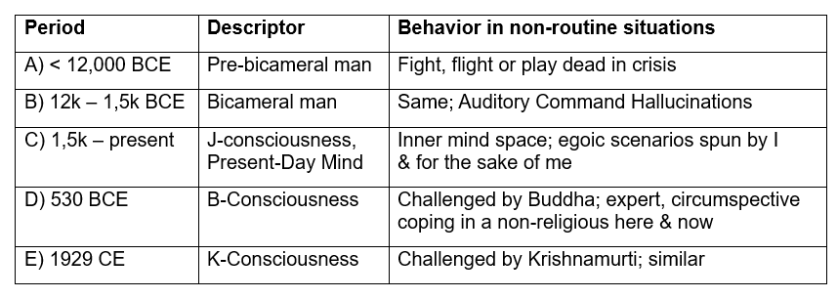
With the above minimal groundwork a history of consciousness and its contingent structures can be worked out. The first column has the approximate dates; the second its best one-word description; the third has some crucial aspects as far as its architecture / mentality is concerned and how it deals with uncommon, non-routine situations and crises.

B-consciousness is my name given to the first serious challenge to, or improvement of, J-consciousness. And K-consciousness is the second serious one. This doesn’t exclude that there were many in between. 

The shift from the bicameral mind to J-consciousness is still in full swing and has the following dynamics:

A) Attempts to re-activate the bicameral mind by religious practices like ecstasies, divination, inspirations, mediumship and more recent channeling. Where bicameral man had the certainty of being pushed around by commands and had no second thoughts about its wisdom and correctness, J-consciousness has to live with an awareness of the contingency of its actions based on the plurality of possibilities. One way out of this uncertainty is to reactivate the bicameral mind through certain spiritual techniques and be guided again by voices or by divined signs. There exist innumerable practices of this kind, which all have in common that a basic question of ‘what should I do’ will be answered as if coming from on high while it is the subconscious which is producing the voices and / or interpretations.

B) The move to overcome religious impulses in more rational and naturalized frameworks amplified by the Greek philosophical revolution of 700 – 300 BCE and similar developments in Asia. The other route to attain certainty about action is by improving the capacity to rationally analyze alternate courses of action. Logic, rationality, experimentation and imagination are all practices which will improve the predictability of action and take away a certain amount of anxiety.

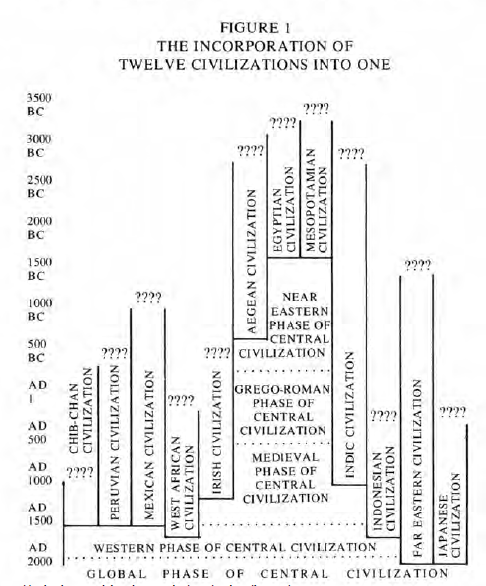
C) The Rise of Central Civilization incorporating all other civilizations in one global entity driven by an egocentric impulse based in J-consciousness (See Appendix A). If you look at the figure in Appendix A you will see an alternative conceptualization of the march of civilizations. This one is based on the merging of, on one side, historical investigations of comparing civilizations (Toynbee, 1947a, b, 1962-64; Quigley, 1979), and on the other side, sociological investigations in the field of world-system theory (Wallerstein, 1974-1989; Frank, 1998). What both seem to agree on is that the origin of now globalized western civilization is merely a phase of what they call ‘central civilization’, i.e. the merger of Egyptian and Mesopotamian civilizations around 1,500 BCE, which then went through a Near-Eastern phase, then a Greco-Roman phase, then a Medieval one, then Western and now a Global phase. In its growth it gobbled up almost any and all other civilizations (Wilkinson, 1997).

Central Civilization emerged around 1,500 BCE out of an intense civilizational conflict in which Jaynes argues the bicameral mind found its demise and J-consciousness its start as a better coping mechanism (Jaynes, 1976: 223f). Bicamerally ruled empires around the Mediterranean might have found their end during a “perfect storm of calamities” early in the 12th century BCE of earthquakes, rebellion, invasions, collapse of trade, disease, drought and famine (Cline, 2021: 134f). Since then this ‘mental architecture’ went through many modes of interiorization and is now also global.

The questions, or hypotheses, are 1) whether it was specifically J-consciousness, in its more powerful mode of planning and rationality, which gave central civilization its staying power and dubious success over others; 2) if Buddhist civilization(s) can be construed as a possible first attempts to overcome J-consciousness with a new mentality, which I will name B-consciousness, but failed; and 3) if K-consciousness–also based on a different architecture, but not dissimilar to Buddhism–as allegedly lived and promoted by Krishnamurti, might become another challenge to the reigning J-consciousness.

Transition to a Sustainable Civilization

The connection of the history of consciousness and its future along the lines of what Krishnamurti proposes should be connected to the idea of ecosystem restoration. It is possible that only under the aegis of a civilization inspired by the ecological sensitivities and ideas of Krishnamurti that humanity will be able to construct a sustainable civilization. This might take 200-500 years. Only then the very much needed restoration of the ecosystem can be executed with any success of making the relationship between humanity and nature truly sustainable. How bad the ecological and social situation might have turned is anybody’s guess, but a short dark age of anarchy and chaos is not out of the question. But, so far, humanity has gone through many of them before and survived to tell the story.

Origin

“The Future of Consciousness: Is Krishnamurti Its Prophet? And What Has That to Do With the Restoration of the Ecosystem?” Presentation at the Indian Philosophical Congress (IPC), 95th session, Gandhi University, Wardha, Maharashtra, December 29, 2022.

Sources

Agrawal, M. M. 1991a. Consciousness and the Integrated Being: Sartre and Krishnamurti. Shimla, India: Indian Institute of Advanced Studies.

Agrawal, M. M. 1991b. “Nothingness and Freedom: Sartre and Krishnamurti”. Journal of Indian Council of Philosophical Research, 9/1: 45-58.

Cline, Eric H. 2021. 1177 BC: The Year Civilization Collapsed. Revised and updated. Princeton: Princeton University Press.

Dreyfus, Hubert. 1972. What Computers Can’t Do: The Limits of Artificial Intelligence. New York: Free Press.

—— . 2002. “A phenomenology of skill acquisition as the basis for a Merleau-Pontian nonrepresentational cognitive science.” (2002)

—— & Stuart Dreyfus. 1980. “A Five-Stage Model of the Mental Activities Involved in Directed Skill Acquisition“. Washington, DC: Storming Media.

—— & —— . 1986. Mind Over Machine: The Power of Human Intuition and Expertise in the Era of the Computer. New York: Free Press.

—— & ——- . 1991. “Towards a Phenomenology of Ethical Expertise.” Human Studies, 14/4: 229-250.

Frank, Andre Gunder. 1998. ReOrient: Global Economy in the Asian Age. Berkeley: University of California Press.

Jaynes, Julian. 1982 (1976). The Origin of Consciousness in the Breakdown of the Bicameral Mind. 2nd edition with added Afterword. New York: Houghton Mifflin Harcourt.

Julian Jaynes Society. www.julianjaynes.org

Krishnamurti, J. 1929. “The Dissolution of the Order of the Star: A Statement”. International Star Bulletin (September 1929): 28-34. Also titled “Truth is a Pathless Land“.

—– . 1954. The First and Last Freedom. Foreword by Aldous Huxley. New York: Harper & Brothers.

—– . 1976. Krishnamurti’s Notebook. New York: Harper & Row.

Lutyens, Mary. 1975. Krishnamurti: The Years of Awakening, Avon Books, New York.

Martin, Raymond & Barresi, John. 2006. The Rise and Fall of Soul and Self: An Intellectual History of Personal Identity. New York: Columbia U.P.

Quigley, Carroll. 1979. The Evolution of Civilizations: An Introduction to Historical Analysis. Liberty Fund.

Rodrigues, Hillary. 1990. Insight and Religious Mind: An Analysis of Krishnamurti’s Thought. American University Studies, Series VII, Theology and Religion, Vol. 64. Master of Arts Thesis, McMaster University, 1988. New York: Peter Lang.

Rorty, Amelie O. 1976. “A Literary Postscript: Characters, Persons, Selves, Individuals”. In: Rorty, Amelie O. (Ed.), The Identities of Persons. Berkeley, CA: University of California Press. 301-323. Also in: Rorty, Amelie O. (Ed.). 1988. Mind in Action. Boston: Beacon Press, 1988.

Sartre, Jean-Paul. 1957 (1936). The Transcendence of the Ego. Trans. Williams, F. & Kirkpatrick, R (Transl.). New York: The Noonday Press.

Schuller, Govert. 1997. Krishnamurti and the World Teacher Project: Some Theosophical Perceptions. Theosophical History Journal, Occasional Paper V.

—— . 2014. “The Jaynesian Paradigm and Beyond“. Alpheus, January 2014.

Taylor, Charles. 1989. Sources of the Self: The Making of the Modern Identity. Cambridge, UK: Cambridge UP.

Toynbee, Arnold J. 1962–1964 [1934–1961]. A Study of History. 12 vols. Oxford: Oxford University Press.

Wallerstein, Immanuel. 1974-1989. The Modern World-System. 3 volumes. New York & San Diego & London: Academic Press.

Wilkinson, David. 1987. “Central Civilization”. Comparative Civilizations Review, 17/17: Article 4. Also in: Sanderson, Stephen K., 1995, Civilizations and World Systems: Studying World-historical Change, Lanham, MD: Rowman Altamira, pp. 46-74.

“AMI Conference Statement to COP26: Regarding the Monetary Dimension of Climate Change”. American Monetary Institute, Evanston, IL, USA, 11 Nov 2021.

Appendix A.

Central Civilization (Figure 2.1 from Wilkinson, 1997: 32).


Joined at the Mind: Philosophy, Mysticism and Madness


Review-essay of Wouter Kusters, Philosophy of Madness: The Experience of Psychotic Thinking, Cambridge, MA: MIT Press, 2022

Govert Schuller

In this article I will aim at giving an overview of Dutch philosopher Wouter Kusters’ phenomenal study, Philosophy of Madness, with some asides about what is phenomenologically important in it.

Kusters’ Philosophy of Madness: The Experience of Psychotic Thinking is a must read for all interested in philosophy, mysticism and madness, and the disturbing closeness, even overlap, of all three, indicated by the following thought-provoking short statements: Philosophy, madness and mysticism all have in common that their point of departure is in the suspension of the ‘natural attitude’ (Husserl), inauthentic average everydayness (Heidegger), or our collective, narrative identity (Ricoeur). They all step out of consensual, common-sense reality. Philosophy and mysticism are modes of controlled madness. Madness is uncontrolled philosophy and mysticism. Madness develops its own philosophy, which is not necessarily mad. Some insights might only be accessible in the mode of madness. Monist philosophies push you to mysticism, which can take a turn into madness when you make too many imaginary connections too fast. Madness could be cured with a better, less verbal and imaginary mode of mysticism. In (very) short, the book is a true cornucopia of well-developed crossings.

Philosophy of Madness

A more structured introduction to this study might be developed by contemplating the subtle nuances implied by its title. This would be a somewhat Heideggerian manner of unpacking a subject matter, especially by looking at the preposition ‘of’ as a so-called ‘double genitive’ indicating that the study is not only a philosophy about madness (of which there are many variants), but also, and maybe more importantly, delves into the practice of philosophy inherent in madness. The leading idea is that people who are considered mad are not lost in confusion and incomprehensible thoughts, but are in their own way grappling deeply with the meaning of life, their situation and their own sense of identity. This is not to say that Kusters is romanticizing or justifying madness, which some have done in the anti-psychiatry movement. His aim is more towards developing an empathetic understanding of the very complex, meaningful, lived experience of madness, which might provide a better basis for the treatment of people suffering from psychotic episodes, while it is also a philosophical reflection on his own life as Kusters had his own experiences of involuntarily venturing twice into that realm.

The structure of a ‘double genitive’, just to bring into play some more hermeneutic phenomenology, was also applied by Heidegger in the title of his 1923 semester, the “hermeneutics of facticity”, having the double meaning of 1) the non-theoretical interpretation of life as lived and 2) the idea that life as lived has the feature of already having-been-interpreted. In other words, the hermeneutics of facticity involves the interpretive exploration of the historical and contextual dimensions of human existence, which requires more than just abstract analysis or theoretical speculation; it necessitates a hermeneutic engagement with the realities of lived experience. At the same time the hermeneutics of facticity involves uncovering the meaning and significance of our factual existence, including our bodily sensations, emotions, relationships, projects, and encounters with the world, which all of them have already been interpreted by our ancestors, parents, teachers, etc., with the caveat that we have the freedom to re-interpret life’s facticities. This notion of an existential-phenomenological hermeneutics of life is neatly captured by the short expression of the “pan-hermeneutic” nature of human life by Heidegger expert Theodore Kisiel (2014).

About Madness

As far as a philosophy about madness is concerned, Kusters is not interested in the proceedings and findings of modern psychiatry with its diagnostic manuals and what Kusters sees as its dominant discourse of looking at madness as something that happens to the brain in terms of neuronal misfirings, hormonal imbalances or chemical interferences, all of which are incapable of addressing how the madman experiences his reality. Fortunately, there exists a long tradition of “phenomenological psychiatry” inspired by the founding fathers of phenomenology like Husserl, Heidegger and Merleau-Ponty, which tries to look from the inside-out at the experienced reality and world of the mad itself.

“This method attempts to understand the seemingly strange world of the mad, including their thoughts and experiences, without judging them in terms of disorders, abnormalities, and deficiencies. Using this approach, it has been observed that it is not only the language of madmen, their way of perceiving the world, and their emotional responses to it that change; a change also occurs in the very depths of their experiential world—in how they experience time, in how their thoughts and perceptions mutually influence each other, and in how closeness and distance relate to each other.”(7)

Descriptive phenomenologies of madness and curative existential psychotherapies have been developed by Merlau-Ponty, Michel Foucault, Thomas Szaz, Ronald Laing, Ludwig Binswanger, Meddard Boss, Viktor Frankl and quite some others, and Kusters can probably be placed in this category. Arguably he moved the investigation a couple of notches further by delving deeper into the experiences of madness themselves.

But, as much as Kusters appreciates phenomenology and uses many of its findings, this attitude is in his view not going far enough, because it stays on the edge and remains in an observational stance, gathering materials to make subtle differentiations and fitting them in the flexible framework of this school. Kusters proposes to go further and dive into madness “to taste its fluid substance, to feel its movements, whether swimming, diving, or drowning” and will do so with the help of what he calls “spiritual psychiatry” which is premised on the idea that madness and genius are closely related and that some or many mad people are actually highly sensitive and gifted crypto- or proto-philosophers who can help us broaden our experiential and philosophical horizons. But even this school (as well as psychoanalysis, which he puts into play) is “reluctant to break through the thin ice of madness”(8). Kusters wants to go deeper into a risky but also “wonderful” deconstruction in which the relationship between philosophy and madness is turned upside-down: “the madman comes to occupy the chair of the philosopher—and the philosopher ends up in the isolation cell”. In this movement in four phases, which are also the main parts of his book, Kusters is courageously on his own.

“In part I, the madman speaks mainly as a madman, as an object of observation, producing data analyzed by the philosopher. In part II he begins to stir; he dons the garments of the mystic, and his delusional writings are upgraded to the level of mysticism, if not philosophical aphorism. In part III, madness, mysticism, and philosophy join in a circle dance, precipitating a whirlwind in each of the four directions. In part IV, madness crystallizes; the madman rises to the surface from the mystical depths of part III; he solidifies into the more familiar forms of paranoia, paradox, and poetry and is now no longer discernible from the philosopher.”(9)

Therefore, besides the double genitive–setting up a dichotomy between a ‘sane’ philosophy about madness and a ‘deviant’ philosophy in madness–one can read the title also as covering the movement of philosophy into madness and its enriching return out of madness with the idea that we can “forge philosophy from madness”, which theme Kusters presents as underlying his book.

“What does the possibility and the existence of madness imply for commonly accepted ideas about humanity and the world? In what sense is philosophy changed or ‘stretched’ when we admit the ‘data’ of the madman’s experience? What is a philosophy of madness?”(11)

Here I like to interpolate–maybe retreating into my own safer philosophical attitude–that, from the stance of phenomenology, the movement and logic of the above questions and their answers as developed in the book, can be construed as an original instantiation of Husserl’s fundamental methodology, i.e. imaginative variation, by which one plays around with the particular structures and dynamics of a given experience by varying them to find its essential and contingent features and make ever more fine-grained differentiations.

What was maybe overlooked by Husserl, but put to good use by Heidegger and Marleau-Ponty, are the insights to be derived from variations of breakdown and dysfunction, like Heidegger’s broken hammer and the unfortunate cases Merleau-Ponty looked into to understand behavior at its most basic moments of constitution.

When a piece of equipment breaks or is missing, this can become the entry point to a reflection on the inter-connected and co-dependent nature of instruments in a specific setting, like a carpenter’s workshop or surgery room. What comes to light especially is the difference between the primordial, tacit, skilful relationship with equipment as ‘ready-to-hand’ when used, and its derivative, theoretical thingness as ‘present-to-hand’ when observed and inspected. Furthermore, the larger context of using equipment can also become more explicit, like the structures of the ‘in-order-to’ and ‘for-the-sake-of-which’ of the work, all together constituting a ‘referential totality’ of a ‘work-world’ of a skilled worker, and beyond it, referring to the world of its intended users and equipment producers, including nature as the source of raw materials (Heidegger, 1961:102-7).

In Kusters’ case this method is pushed into the domain of madness, or the breakdown of consensual normality, not merely taking the madman’s data as a meaningful variant of normal reality construction, but also by experiencing madness itself as best as possible (empathetically, vicariously or even first-hand in hypo- or full mode) in order to deepen our understanding of both normality and its mad deviations, resulting in fascinating and unsettling insights about the contingent and fragile constitution of the world and ourselves.

Beyond Psychiatry: A Phenomenological Approach

In part I, “Cogitating Your Head Off”, Kusters provides a great tableau of such mad experiences and their variations in the realm of the cognition and perception of reality; the experiences of what is ‘outer’ and what is ‘inner’; and the experiences of time and space. He analyzes what can happen to these reality-anchoring categories when they enter the “ocean of madness” and become transformed and fragmented and thereby disrupt regular philosophical discourse and even lays claim to philosophy itself.

A special spot in Part I is reserved for Husserl’s phenomenology of inner time-consciousness, one of the deepest reflections on the possibility conditions of conscious experience, and in Kusters’ writing a tool to understand both normal and psychotic experiences. How do we keep the coherence of consensus reality running in a semi-chaotic flow of events? And what happens when that breaks down and a psychotic manner of meaning-construction takes over? How can we best understand the Husserlian analysis of the interplay between memory, the just-passed (retention), the present, the just-to-come (protention) and expectations in the construction and change of reality? Furthermore, Kusters also reflects on the subject matter of time and its complexities, which itself can become so perplexing that thinking loses its footing and can go into a mad overdrive. This is where the philosopher can slip from controlled, experimental thinking, into hyperreflexive perplexity, possibly resulting in uncontrolled psychotic thinking.

As an illustration of what might happen when a mad experience of time takes over, Kusters provides a few sections narrating his own experiences as he lived them himself (Fragments III & IV). In Part I he shares eight of such fragments of personal experiences, which reminded me of the absurdist science fiction writings of the American author Kurt Vonnegut in the sense that the experience of flow still has the structure of a meaningful, coherent narrative, but then solipsistically personal and for an outsider seen as detached from normal reality. It is in these fragments and the quoted passages from other madmen of mad experiences that the reader can “taste its fluid substance” and “feel its movements” most closely. Again, much can be learned from things going wrong.

Into Mysticism & Madness

In Part II, “Via Mystica Psychotica”, Kusters goes deeper and leaves behind explanatory frameworks and intends to

“analyze what happens to the madman when he no longer has the security of the prosaic, and when fixed identities, images, words, and thoughts all melt, dissolve, and disappear. In this part, the emphasis is more on the mad process than on the mad condition. The kind of madness to be discussed here is what outsiders are more likely to call manic . . “(163)

And a new important mode of experience is inserted into the analysis and that is mysticism in order to help to further the analysis of philosophy and madness by finding parallels and communalities between madness and mysticism. The focus is on four subsets of phenomena where things can go wrong and each deserved a chapter: the perception and experience of truth (Detachment); the use of images and the imagination (Demagination); the problems of expression and language (Delanguization); and the transformation of the process of thinking (Dethinking). Some of the leading questions are about the difference between mad hallucinations and mystic visions and why some uncommon experiences lead to serenity and others to madness. The core of his musing seems to be the following train of thought, though he thinks it not entirely adequate.

“Perhaps the mad experience is a logical continuation of the mystical experience. The madman carries on with the journey, while the mystic drops out prematurely. For the very reason that he is connected to a tradition that has prepared him for his experience, the mystic will hold fast to certain assurances, identities, or traditional distinctions–such as the difference between good and evil–and that makes him incapable of penetrating the most extreme domains. The madman goes further and deeper, but he also pays a higher price: many do not return from this transmarginal zone–or so this line of reasoning goes.”(171)

Even though considered inadequate and maybe too romantic, this question seems to be one of the book’s core dilemmas in evaluating the respective value of a) controlled mysticism embedded in a tradition and b) manic mysticism which has broken through all conventionality and continues to explore “the realm of paradoxes, paranoia and prophetic madness”(171).

Mystical Delusions in Four Variations

After this analysis of the commonalities and differences between madness and mysticism, philosophy is again put to use in the analyses in Part III, “Light Mists”. Here Kusters differentiates more ethereal and abstract categories in “mystical madness”, which are “the One, being, infinity and nothingness”(280). Each again deserved its own chapter, which titles indicate we are dealing here with a set of fascinating and overlapping delusions which delineate the essence of mystic and manic experiences.

The chapter on the “uni-delusion” is framed by Plotinus and his mystical concept of the One, which is the apex of a hierarchical structure comprising everything, i.e. “all dimensions of life and the cosmos”, which will appeal to all people with a monist inclination. The problem, as Kusters sees it, is that aiming at experiencing the One leads to a mode of spiritual interiorization which leaves the body behind.

“The One is everywhere and nowhere; it’s a lovely idea for the mind, but for the body of the uni-deluded individual, it means nothing but fragmentation and alienation. If my mind is swallowed up in the One, my body is swallowed up in general scattered physicality.”(297)

Being: Immersion in sensory ecstasy, detached from others

The “esse-delusion” addressed in chapter 10, seems to aim at the opposite of the “uni-delusion” in that it is more exterior. Here Kusters, among a few, uses the drug-induced experiences of the British author Aldous Huxley to make his points that the “esse-delusion” is more experiential, aesthetic and focused on visual-sensory perceptions, which induce a sense of intense being, even “too much being”(320). In this analysis Kusters also addresses the mystical aspects of music, both in its capacity to induce mystic experiences, but also to soothe the minds of the mad. The problem here is that a new mode of “subjectification” emerges, one which leaves behind our fellow subjects by becoming too wrapped up in one’s solipsistic ecstasy and avoiding others.

As an aside, I would point out that Huxley’s work on mystical ecstasies set within a this-worldly, sensory here-and-now might have been deeply influenced by his friendship with the global sage Jiddu Krishnamurti, who arguably was promoting a form of quiet, non-cognitive, post-egoic nature mysticism and also had a deep appreciation of music. In this regard see Huxley’s foreword to Krishnamurti’s first book published by a major publisher (Huxley, 1953).

The third delusion, the infinity-delusion, I will treat separately in the next section as it is the start of a phenomenological contemplation on the role of the imagination in both sane sense-making and its mad variant.

Nothingness: Hyper-reflexivity leading to existential emptiness

The fourth delusion, the nothing-delusion in chapter 12, is the logical outcome of the process of the “de-xx-ing” on the via mystica psychotica, which destroys all mental content in the course of becoming “thoroughly detached, demagined, delanguized, and dethought”(389). Everything is questioned in a heightened state of reflexivity to the point where the normal relationship between being and nothingness is flipped. Where being used to be the norm and nothingness an aberration, in the experience of the psychotic the tables are turned and a hyperreflexive doubt undermines any and all tacit, common sense understanding of being and the resulting abysmal emptiness becomes the norm.

“Ordinary human reflexivity is stripped from the ground of existence and becomes a raging, nihilistic, inhuman hyperreflexivity in the vacuousness of Ø.”(396; with Ø standing for nothingness)

And a little further:

“… the mystical madman “slips away” from being by doubting everything, by calling everything into question, and by subjecting the most ordinary things to the scrutiny of a questioning and burning hyperreflexivity. This leads to perplexity that can be understood as the question mark with a capital letter, as the state of questioning in which there is no longer a questioned or a questioner, and as total nothingness: Ø. When being is swallowed up in questioning, the mystical madman disappears into nothingness. Hyperreflexivity is like the whirlpool that leads to an infinitesimal point of concentration in the endlessly vast, bottomless ocean of being.”(399)

For phenomenologists, Kusters’ analysis of the thoughts on nothingness by Sartre and Heidegger will be of interest. In the case of Sartre, the idea of the linkage of madness and the Husserlian concept of time is brought back. For Sartre human time is only possible if and when a break is inserted between the past and the future, a break by ‘nothingness’ in order to free man from its past and be open to its future, and this will be accompanied by anguish if we are conscious of it. And the presence of other people has a role in this constitution of freedom in anguish. Therefore, the structure of consciousness includes nothingness, being and others in an interdependent manner. In madness this structure also falls apart. In the Ø-delusion, nothingness swallows up being, others are left aside, and with them morality too, and the mood can waver between demonic and cheerful.

“Ø functions as the drain through which all possible life is carried away, sooner or later, in the sewer of nothingness.”(411)

Kusters calls Heidegger one of the “optimistic nothingness experts”(424), who recommends anxious encounters with nothingness, especially for philosophers, in pursuing the question of why there are beings rather than nothing. And it is fine if the grounds of one’s being disappear and you become speechless. This pursuit is harmless as long as you are not drawn into the realm of the imaginary with its illusions and hallucinations. It is all controlled and benign. But in mystical madness a more terrifying question is posed: “Is there anything at all? Isn’t there actually absolutely nothing?”(426) Here again might be the fine line between controlled philosophy and being in the runaway grip of madness.

The chapter ends with a discussion of the soteriological concepts of nothingness in the “nihil-centric”, spiritual philosophies in the east and their overlap with some aspects of the Ø-delusion. Kusters consulted the work of religion scholar Mircea Eliade on the “via mystica orientalis” of the yogi. Both yogi and madman turn their back to reality, including other humans and even their own body, and find it all illusory, and both become entangled in another, opposite world of detachment and emptiness, the yogi in samadhi or sacred nothingness, and the madman in the Ø-delusion. And again, their difference might lie in their measure of control, though the factor of cultural acceptability has to be taken into account. By western standards a yogi might get locked up and by eastern standards a madman might be venerated.

Rock Bottom

Part IV, “Crystral Fever”, dives into the end point of philosophy, mysticism and madness, that is complete disintegration in perplexity, solipsism, chronic psychosis, mania and paranoia. But here I will leave the summary and plunge into a contemplation on the role of the imagination in madness.

The Hidden Productivity of the Transcendental Imagination

Both mysticism and madness transgress all limits and touch thereby an ineffable infinite. Mathematical philosophy joins the two when it tries to think through what it means “to keep on counting” and asks where it ever might stop. In the chapter on the infinity-delusion Kusters starts with a discussion of the many infinities the German mathematical genius Georg Cantor could generate, including the ultimate infinity of infinities, the one he identified with God. Besides the obvious idea that infinities are mental concepts, Cantor thought infinities were somehow also to be found in reality. Many of his peers thought he had gone maybe too far into some form of pantheism. Kusters thinks that Cantor, who struggled with mental health issues, might have been the first to get trapped in an infinity-delusion.

Infinity in Reality

Kusters’ grappled with a similar ontological claim by Rudy Rucker, that “mathematical infinity can be found in reality”(335). How that could be interpreted, is the starting point for me to bring in a cluster of ideas with which I struggled when I wrote my MA dissertation on narrative identity and the role of the faculty of productive imagination.

I will first summarize Kuster’s processing of Rucker’s claims, then present my phenomenological ideas derived from Heidegger’s phenomenological interpretation of Kant regarding knowledge and action, after which I will present my own re-arrangement of these ideas and apply them to madness.

Rucker’s example of a ‘real’ infinity is the infinite length of the English coast encompassing a finite amount of land. The more you zoom into a stretch of coast, the more its irregularities add to the length of the coastline “until the measuring instrument breaks down and you slip into the realm of the molecular and the atomic”(339). The other, similar example is the phenomenon of fractals in which irregular lines or surfaces multiply seemingly without end into ever more detailed and longer lines when you zoom in.

But, Kusters questions this alleged experience of infinity and asks himself if this infinity is only taking place in your mind and whether you see only pixels “onto which you are projecting infinity?” Kuster then states that “Infinity is located somewhere between mind and matter, between thought and perception”, or maybe even beyond these faculties. Mathematicians therefore only “imagine” or “conceptualize” infinity “on the inside of his eyelids.”(340)

The Fregean and Kantian Distinctions

When contemplating these conundrums, I was thrown back to the dizzying complex of ideas in Heidegger’s phenomenological interpretation of Kant’s epistemology, but also the intuitively simpler Fregean differentiation between the sense (Sinn) and the reference (Bedeutung) of a word or expression. Both provide some possible clarification to Kusters’ questions, and by extension, to the issues he addresses in the overlap between madness and philosophy.(Frege, 1960)

In the framework of Frege the word ‘infinity’ can have a sense or meaning, but not necessarily a reference or experience. You can think the concept infinity and combine it with a lot of meaningful predicates, but its reference is always beyond one’s thought and perception. And maybe in Kantian terms, and like his concept of noumenon, one can think the concept infinity, but never experience it. Whatever you might experience is only phenomenal. And if you think you have the real thing, it is only an image seen with the mind’s eye.

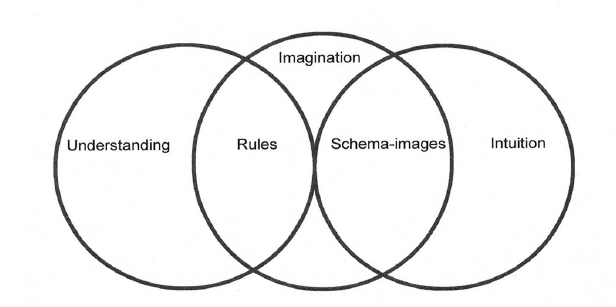
The segue into Heidegger’s Kant is this little concept ‘image’ and the pivotal role it played in the A edition of Kant’s Critique of Pure Reason, which addresses the question how the understanding (concepts) and intuition (experiences) are linked in order to produce empirical knowledge. Kant’s question was how concepts, which by themselves are empty, could be applied to experiences, which by themselves are under-organized (except for spatial and temporal aspects), and, other way around, how experiences could be subsumed under concepts.

In the A edition Kant elaborated on the “transcendental faculty of the productive imagination” as the necessary mediator between concepts and perceptions. What this faculty does–going from concepts to perceptions—is to generate from the concept a series of rules inherent in the concept, from which a series of images can be generated, which might then connect with a series of perceptions. Or, again other way around, this faculty can derive from our semi-chaotic experience a set of images, which can be formalized into patterns, which can be connected to the rules inhering in a specific concept.

Fig. 1. Kantian mandala of the three major faculties

Kant provides the examples of a dog and a triangle to indicate the steps of how concepts can be made more sensible and intuitions more intelligible.

Heidegger’s Phenomenological Expansion

Kant dropped these insights in the B Edition and Heidegger later thought that was a mistake, because Kant’s work on the imagination in its role of producing knowledge had a profound congruence with the basic structure of phenomenological intentionality. What Heidegger brought into position was the tri-partite dynamics of the intentional structure of meaningful experiences, one of the breakthrough insights developed by Husserl (Heidegger, 1962b & 1997).

In a static, structural sense, phenomenological intentionality is always already of the form that consciousness is consciousness-of-X, and the dynamic aspect is that most experiences, if not all, start with a) emptily intending ‘X’, which pre-experiential, meaningful structure might then b) get fulfilled in an experience, after which c) the identity between the projection and its fulfilment is intended. So, we can emptily mean ‘dog’, then see a dog and then experience that the meaning and the seeing are congruent and the concept dog is applicable.

What Heidegger did, was to overlay the dynamic structure of intentionality onto the dynamics engaged in by Kant’s imagination, such that the imagination is the faculty which can emptily project structures (rules and images), which then can connect with intuitions, which, after their identity is established, is stable enough to affirm or connect with a concept. In this way there is a congruence between:

Kant     :        Imagination                  Intuition          Understanding

Husserl :      Empty intending         Fulfilment       Identity / conceptualization

This insight by Heidegger of lining up Kant’s faculties with Husserl’s intentionality was a tremendous help in deepening my understanding of all three big philosophers involved, including also Ricoeur, whose work on narrative identity and the complex synthesis of emplotment explicitly referred back to Kant’s faculty of the productive imagination as the enabling factor of our more or less fictitious sense of life-span identity.(Ricoeur, 1983: 68 & 1985: 3)

Surprisingly also Heidegger seemed to have dropped these ideas as he moved from phenomenology to a more poetic thinking, though one insightful Heidegger scholar made the case that Kant’s concept of the imagination and Husserl’s concept of empty intentionality did survive in Heidegger’s existential concept of Dasein’s projective possibilities as an integral part of our manner of being-in-the-world.(Richardson, 2004: 153f)

Imagination, Madness, and Creativity

This processing of Heidegger’s phenomenologized Kant also led to an epiphany, which also gave me great help in understanding the role of the projective imagination in the act of philosophizing itself and its intensification and possible derailment in madness.

My rearrangement of Heidegger’s Kant is premised on the idea that the imagination can not only provide a measure of freedom from reality-perception in purely mental endeavors like fiction, fantasies, hypothesis-formation, and running provisional scenarios in one’s ‘inner mind space’, but also provide a creative freedom in engaging in the perception-action cycle relatively free from ideations, like in dance, children’s play, mindless routines, sports and sexuality.

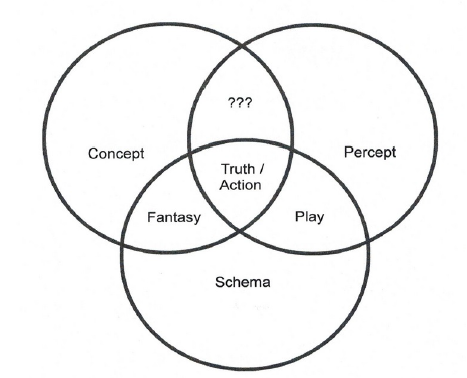
In the following figure the term ‘schema’ replaced ‘imagination’ and a third field of possible experiences and actions is indicated with Truth / Action, in which all three faculties work together

The re-arranged figure looks like this:

Fig. 2. Simple Three-ring Mandala

In the Truth and Action category one can place all experiences to which all three faculties contribute. Staying with Kant and the early Heidegger, the idea is that truth is a product of the harmonious cooperation of all three faculties. Truth is traditionally conceived as located in a proposition as its truth value, but in phenomenology the concept of truth increasingly shifted towards perception and, in the hands of Heidegger, became identified with the ‘opening’ enabled by the projective faculty of imagination. Following the German-American political philosopher Hannah Arendt, the arguably highest level of action (communal and political) would necessarily bring in the understanding because such action is mostly executed by speech and legislative acts in which conceptual entities like ideals, plans and promises are brought to verbal expression.(Arendt, 1958)

In all three fields of a) inner-mind fantasy, b) enacted play or c) complex truth / action scenarios, we can proceed conventionally and obey the explicit and tacit rules of one’s society; or proceed creatively in a post-conventional manner without getting in trouble; or engage in the mad variations of all three in either a) one’s mind with seemingly delusional ideations; or b) in public with seemingly incomprehensible play-acting; or c) with interventions in other people’s lives or the political arena based on seemingly inappropriate truth claims and proposals.

A Reframed Model of the Imagination

The main point here in connecting this phenomenological framework with madness is that maybe this framework might contribute to a better, or at least different, philosophical understanding of madness in its rootedness in the faculty of the imagination, but then with a deeper understanding of the imagination in its role as the transcendental, a priori enabler of any meaningful endeavor whatsoever, be it fantasy, play, intellectual action, or any of its runaway derangements.

A last thought on the conceptualization of mysticism. All three fields have their own mysticism and some might line up with Kusters’ fourfold differentiation of mystical delusions. In the fantasy field it is the emptying of the mind in Zazen, i.e. a sitting meditation disconnected from perceptual reality in which one tries to empty one’s inner mind space without necessarily deconstructing this space itself. It is a going inside, without necessarily challenging the constituted nature of this inside (aiming at nothingness). In the play field one could put the meditation of mindfulness while slowly moving one’s body and being aware of one’s surroundings (aiming at being). In the action / truth field one could find Heidegger’s mysticism of simple daily life experienced within a poetic opening of being-there. And maybe also Krishnamurti’s call for a post-egoic and non-conceptual way of life might fit in this category (aiming at oneness).

Conclusion

Kusters’ Philosophy of Madness challenges us to rethink madness as more than a pathology to be contained and treated. Instead, it presents madness as a complex and meaningful mode of existence with profound philosophical implications. By drawing parallels with philosophy and mysticism Kusters not only illuminates the fragility of normalcy but also the potential richness of what lies hidden in the psychotic thoughts of the madman.

The exploration of the transcendental faculty of imagination and its capacity to construct meaning, can add to the discussion, presenting a framework where the modes of experience in fantasy, play, and truth/action—and the manner in which all three have quotidian, mystical and mad variations—provide another categorization of human experiences in their complexity.

Ultimately, Philosophy of Madness is a call to embrace the unsettling questions posed by madness as illuminating contributions to understanding ourselves and the world. Kusters invites us to see madness not as a deviation but as a thought-provoking byway of the philosophical journey—a journey that, while risky and not to be recommended, holds the promise of profound insight and possible healing.

Wouter Kusters (PhD) studied linguistics and philosophy, and is an independent scholar and teacher in the Netherlands. He wrote two prize winning books on philosophy and madness in Dutch, and the last one – A Philosophy of Madness: The Experience of Psychotic Thinking – has been translated into English (2021) and Arabic (2023), while a Chinese translation is due to appear this year. His most recent book’s title is in English: Shock Effects: Philosophizing in the Age of Climate Change (2023). For more information, readers can visit his website at: https://kusterstekst.nl/.

Source

This review-essay of Philosophy of Madness was published in the Indian journal, Cetana: A Journal of Philosophy, 5/1 (Jan 2025): 38-58.

Cetana is published by the Centre for Phenomenological Studies.

Sources

Arendt, Hannah. 1958. The Human Condition. Chicago: University of Chicago Press.

Binswanger, Ludwig 1963. Being-in-the-World: Selected Papers of Ludwig Binswanger. Translated by Jacob Needleman. New York: Harper & Row.

—–, —–. 1993. Dream and Existence. Co-authored with Medard Boss, edited by Michel Foucault, and translated by Keith Hoeller. London: Humanities Press.

Boss, Medard 1963. Psychoanalysis and Daseinsanalysis. Translated by Ludwig Binswanger. New York: Harper & Row.

—–, —–. 1965. A Psychiatrist Discovers India. New York: Grune & Stratton.

—–, —–. 1979. Existential Foundations of Medicine and Psychology. Translated by Stephen Conway and Herbert Wehner. Lanham, MD: Jason Aronson.

Foucault, Michel 1965. Madness and Civilization: A History of Insanity in the Age of Reason. Translated by Richard Howard. New York: Vintage Books.

—–, —–. 1973. The Birth of the Clinic: An Archaeology of Medical Perception. Translated by A.M. Sheridan. New York: Vintage Books.

—–, —–. 2006. Psychiatric Power: Lectures at the Collège de France, 1973–1974. Translated by Graham Burchell. New York: Palgrave Macmillan.

Frankl, Viktor E. 1946. Man’s Search for Meaning. Translated by Ilse Lasch. New York: Beacon Press.

—–, —–. 1955. The Doctor and the Soul: From Psychotherapy to Logotherapy. Translated by Richard and Clara Winston. New York: Vintage Books.

—–, —–. 2000. Man’s Search for Ultimate Meaning. New York: Basic Books.

Frege, Gottlob. 1960. “On Sense and Reference”. In: Translations from the Philosophical Writings of Gottlob Frege, P. Geach and M. Black (eds and trans), Oxford: Blackwell, 56-78.

Geniusas, Saulius. 2015. “Between Phenomenology and Hermeneutics: Paul Ricoeur’s Philosophy of Imagination”. Human Studies, 38/2: 223-241.

—–, —–. 2018. “Productive Imagination and the Cassirer-Heidegger Disputation”. In: Geniusas, Saulius & Nikulin, Dmitri (Eds), 2018. Productive Imagination: Its History, Meaning and Significance, London: Rowman & Littlefield International, pp 135-156.

—–, —–. (Ed). 2018. Stretching the Limits of Productive Imagination: Studies in Kantianism, Phenomenology and Hermeneutics. London: Rowman & Littlefield International.

—–, —–. & Nikulin, Dmitri (Eds). 2018. Productive Imagination: Its History, Meaning and Significance. London: Rowman & Littlefield International.

Heidegger, Martin. 1962a. Being and Time. Macquerrie, John & Robinson, Edward (Transl). New York: Harper Collins.

—— . 1962b. Kant and the Problem of Metaphysics. Churchill, James (Transl). Bloomington, IN: Indiana U.P.

—— . 1985. History of the Concept of Time: Prolegomena. Kisiel, Theodore (Transl). Bloomington, IN: Indiana U.P.

—— . 1997 (1977). Phenomenological Interpretation of Kant’s Critique of Pure Reason. Emad, Parvis & Maly, Kenneth (Transl.). Bloomington, IN: Indiana U.P.

Husserl, Edmund. 1964. The Phenomenology of Internal Time-Consciousness. Churchill, James S (Transl). Bloomington: Indiana U.P.

Huxley, Aldous. 1954. “Foreword”. In Krishnamurti, Jiddu, The First and Last Freedom, New York: Harper & Brothers.

Jaynes, Julian. 1976. The Origin of Consciousness in the Breakdown of the Bicameral Mind. New York: Houghton Mifflin Harcourt.

Johnson, Mark. 1987. The Body in the Mind: The Bodily Basis of Meaning, Imagination, and Reason. Chicago: University of Chicago Press.

Kant, Immanuel. 1978. Critique of Pure Reason. Kemp Smith, Norman (Transl). London: Macmillan.

—— . 1987. Critique of Judgment. Pluhar, Werner S (Transl). Indianapolis, IN: Hackett Publishing.

Kisiel, Theodore. 2014. “The Paradigm Shifts of Hermeneutic Phenomenology: From Breakthrough to the Meaning-Giving Source”. Gatherings: The Heidegger Circle Annual, 4: 1-13.

Krishnamurti, Jiddu. 1954. The First and Last Freedom. New York: Harper & Brothers.

Kusters, Wouter. 2022. Philosophy of Madness: The Experience of Psychotic Thinking. Cambridge, MA: The MIT Press.

Laing, R.D. 1960. The Divided Self: An Existential Study in Sanity and Madness. London: Penguin Books.

—–, —–. 1964. Sanity, Madness and the Family. Co-authored with Aaron Esterson. London: Penguin Books.

McVeigh, Brian. 2024. The Self-Healing Mind: Harnessing the Active Ingredients of Psychotherapy. New York: Oxford UP.

Merleau-Ponty, Maurice 1942. The Structure of Behavior. Translated by Alden L. Fisher. New York: Beacon Press.

—–, —–. 1945. Phenomenology of Perception. Translated by Donald A. Landes. London: Routledge & Kegan Paul.

Richardson, William. 2004 (1963). Heidegger: Through Phenomenology to Thought. Fourth Edition. New York: Fordham U.P.

Ricoeur, Paul. 1978. “The Metaphorical Process as Cognition, Imagination, and Feeling”. Critical Inquiry, 5/1: 143-159.

—–, —–. 1979. “The Function of Fiction in Shaping Reality”. Man and World, 12/2: 123– 141.

—–, —–. 1983-88. Time and Narrative. Vols. 1-3. Chicago & London: University of Chicago Press.

—–, —–. 1992. Oneself as Another. Chicago & London: University of Chicago Press.

Schuller, Govert. 2019. The Possibility Conditions of Narrative Identity. Dissertation; Masters in Research in European Philosophy; Dr. Adrian Davis, Research Supervisor; University of Wales, Trinity Saint David, Lampeter, Wales, UK.

Szasz, Thomas 1961. The Myth of Mental Illness: Foundations of a Theory of Personal Conduct. New York: Harper Perennial.

—–, —–. 1970. The Manufacture of Madness: A Comparative Study of the Inquisition and the Mental Health Movement. Syracuse, NY: Syracuse University Press.

—–, —–. 1988. Schizophrenia: The Sacred Symbol of Psychiatry. Syracuse, NY: Syracuse University Press.

Additions to Krishnamurti Bibliography 2025

.

By Krishnamurti

—–. 1980. From Darkness to Light: Poems and Parables. The Collected Works of Krishnamurti, Vol 1. New York: Harper & Row.

—–. 2020. Happy Is the One Who Is Nothing: Letters to a Young Friend. London: Watkins.

—–. 1997. “A Letter from Krishnamurti to a Friend: The Place of Social Reform”. The Link, 12 (Spring, 1997): 14-15.

—–. 1977. Truth and Actuality. Brockwood, UK: Krishnamurti Foundation Trust.

—– & Bohm, David & Shainberg, D. 2004. The Transformation of Man. Chennai: Krishnamurti Foundation India.

—–. 2003. Can Humanity Change? J. Krishnamurti in Dialogue with Buddhist. Boulder, CO: Shambala Publications.

—–. 1984. Creation Come out of Meditation. Ojai, CA: Krishnamurti Foundation of America.

—– & Jayakar, Pupul. 1995. Fire in the Mind: Dialogues with J. Krishnamurti. Gurgaon, Harayana: Penguin Books India.

—–. 2015. The Whole Movement of Life is Learning: Letters to his Schools. Brockwood, UK: Krishnamurti Foundation Trust.

Academic

Allen, A. n.d. “Krishnamurti and Perls”. Unpublished MS.

Anderson, Allan W. 2012. On Krishnamurti’s Teachings: The Collected Writings, Talks and Classroom Discussions of Allan W. Anderson on the Teachings of J. Krishnamurti. Ojai, CA: Karina Library Press.

Bora, Shakuntala. 2010. Essays on: Philosophy of Jiddu Krishnamurti. Guwahati: Aalibaat Publication.

——. 2013. “Bounds of Thought and Beyond: Jiddu Krishnamurti”. In: Nataraju, Adarasupally (Ed), The Limits of Thought and Beyond, London: Bloomsbury, 88-94.

——. 2015. Rethinking: Philosophy of Jiddu Krishnamurti. Guwahati: Aalibaat Publication.

——. 2020. Suffering and Beyond: Jiddu Krishnamurti. Guwahati: Aalibaat Publication.

Bradford, Michael & Hayne, Patrick. 1995. “Jiddu Krishnamurti: 20th Century Philosopher and Mystic”. Markdale, Canada: Institute for Consciousness Research.

Cavanaugh, Thomas C. 1979. “The General and Educational Philosophy of Jiddu Krishnamurti and Its Relevance to Contemporary Education”. Ed. D. dissertation, University of Southern California, Los Angeles, USA.

Chaurasia, Rajesh. 2005.”Review Article of Luis SR Vas, J. Krishnamurti: Great Liberator or Failed Messiah“. Journal of Indian Council of Philosophical Research (ICPR),22/1 (Jan-Mar, 2005): 198-205.

——. 2013. “J. Krishnamurti: Freedom and Action“. Anusilana, 46: 1-10.

——. 2016. “J. Krishnamurti: Holistic Way of Living“. Anviksiki, 12: 138-144.

Chatterjee, Arup K. 2023. “Jiddu Krishnamurti and the Problem of Conscience”. Implicit Religion, 24 (3-4): 443-470.

Chatterjee, Visvanath. 2006. “Review of Luis S R Vas, J. Krishnamurti: Great Liberator or Failed Messiah?” Prabuddha Bharata, (Feb, 2006): 176 (58).

Dalal, Roshen. 2020. J Krishnamurti: A life of Compassion beyond Boundaries. Delhi: Macmillan.

Delkhah, M. 1997. The pure man, discipline of none. Positioning Grotowski’s metaphysics in contemporary Euro-Asian mysticism as represented by Krishnamurti. Unpublished doctoral dissertation, University of Kansas, Lawrence, USA.

Deshpande, Sudhakar. 2007. The Buddha Rediscovered in the Light of J. Krishnamurti. Rajghat: KFI. Also: Eastern Book Linkers, 2009.

Dhillon, Sunny. 2021. “Infinitesimal Freedom: Theodor W. Adorno meets Jiddu Krishnamurti“. Medium, 17 Feb 2021.

Fauché, Fabienne. 2001. J.-P. Sartre et J. Krishnamurti: Deux “athéismes” pour une morale. Dissertation. Villeneuve-d’Ascq, France: Presses Universitaires du Septentrion.

Foster Patrick M. 2012. The Last Guru: The Significance of J Krishnamurti for the Modern World. Scotts Valley, CA: CreateSpace Independent Publishing Platform.

Giddu, Narayan. 1998. As the River Joins the Ocean: Reflections about J. Krishnamurti. Delhi: Book Faith India.

Gogate, Kanchan. 2021. “Religion and Religious Mind: Hermeneutical Explorations with Special Reference to Swami Vivekananda and J Krishnamurti”. Buddhist and Pali University of Sri Lanka, Webinar Series, Religiosity and Secularism in Futuristic Context, June 2021, Proceedings: 9-12.

Golwelkar, Sameer. 2013. “A Critical Comparative Study of Self and Life as such in the philosophy of J Krishnamurti and Nisargadatta Mahara.” Devi Ahilya Vishwavidyalaya, 161-2 (?).

Grego, Richard. 1997. Jiddu Krishnamurti and Thich Nhat Hanh on the silence of God and the human condition. PhD dissertation, State University of New York, Albany, USA.

—–. 2018. ” ‘God Is Not in Temples, So It Doesn’t Matter Who Enters Them’: Jiddu Krishnamurti’s Critique of Gandhi’s Ahimsa Principle and Advaita Vedanta-Based Ethics”. In: Mahapatra, Debidatta Aurobinda (Ed), Gandhi and the World, Lanham, MD: Lexington Books, pp. 93-110.

Han, C. 1991. Comparing the “educated person” conceptions of Dewey and Krishnamurti: Implications for the Republic of China. PhD dissertation, Columbia University, New York, USA.

Horne, Robert Allan. 1973. “A Worldview Synthesis of Gestalt Therapy and J Krishnamurti.” PhD dissertation, California School of Professional Psychology, Alhambra, CA.

Hunter, A. “J Krishnamurti as Religious Teacher and Educator.” PhD dissertation, University of Leeds, UK.

Kalidas, Joshi. 2005. J. Krishnamurti: Demystified. New Delhi: Pustak Mahal.

Kalsi, Ashutosh. n.d. “The Ending of Nihilism: From Nietzsche to Krishnamurti.” PhD dissertation, State University of New York, Buffalo.

Karve, Sushama. 2015. J. Krishnamurti’s concepts of freedom, meditation, love and truth: A philosophical study. Thesis. Tilak Maharashtra Vidyapeeth, Pune, India.

Kobbekaduwa, L A. 1990. Education and the educated person: A comparison of J. Krishnamurti and R.S. Peters. Unpublished doctoral dissertation, University of Alberta, Edmonton, Canada.

Krishna, T M. 2021. “Silences of Jiddu Krishnamurti“. The India Forum, 12 May 2021.

Kumar, Ashwani. 2013. Curriculum as Meditative Inquiry. New York: Palgrave Macmillan.

Kumar, Lombadhar. 2024. “Jiddu Krishnamurti’s Philosophy of Education and National Education Policy 2020: A Review“. Shiksha Sanshodhan: Journal of Arts, Humanities and Social Sciences, 7/1: 58-62.

Kumar, P Kesava. 2015. Jiddu Krishnamurti’s Conception of Tradition and Revolution: A Critical Study. Delhi: Kalpaz Publications.

Martin, Raymond. 1998. “Why isn’t Krishnamurti accepted at the University?” KFA Newsletter, Fall, 1998.

Martins, Paulo Nuno. 2018. “A Concise Biography of Jiddu Krishnamurti: An Indian Philosopher of Contemporary Society”. International Journal of Humanities Social Sciences and Education (IJHSSE), 5/11: 38-42.

Methorst, Henri. 2003. Krishnamurti: A Spiritual Revolutionary. Ojai, CA: Edwin House.

Moffatt, Ron. n.d. “Psychotherapy and Krishnamurti: Beyond West and East”. Master’s thesis. University of Delaware.

Moolayil, Sebastian Varghese. 2014.  “Mind as a Way you Love Truth: A Philosophical Appraisal of Mind by Jiddu Krishnamurti.” Tattva Journal of Philosophy, 6/1: 73-85.

Mukherjee, M. & Agrawal, S. 2021. “Decolonising Lifelong Education: Learning from J. Krishnamurti“. In: Tiffany Prete & Elizabeth Lange (Eds), Special issue of Indigenous Voices and Decolonising Lifelong Education, International Journal of Lifelong Education, 40/4: 328-33.

Patnaik, Nandini. 2014. Beyond The Pathless. Cuttack, Odisha: SET Publications

Petrowski, Chari. 1995. “J Krishnamurti: Philosopher to the Common Man”. Ojai, CA: Krishnamurti Foundation of America.

Rathnam, Anbananthan. 2013. “Whole Teachers: A Holistic Education Perspective on Krishnamurti’s Educational Philosophy.” PhD dissertation, The University of Toronto.

Rechtshaffer, Ira. 1977. “The Awakened Mind: A Comparative Study of J. Krishnamurti, Chogyam Trungpa Rimpoche and Bubba Free John.” PhD dissertation, California Institute of Integral Studies, San Francisco, USA.

Rodrigues, Hillary. 1988. “Insight” and “The Religious Mind” in the Teachings of Jiddu Krishnamurti. Master of Arts Thesis, Religious Studies, McMaster University, Hamilton, Ontario.

——- . 1990. Insight and Religious Mind: An Analysis of Krishnamurti’s Thought. American University Studies, Series VII, Theology and Religion, Vol. 64, Master of Arts Thesis, McMaster University, 1988. New York: Peter Lang.

——- . 1995. “On Krishnamurti”. In: Blau, Evelyne (Ed), Krishnamurti: 100 Years, New York: Stewart, Tabori & Chang, 226-228.

——- . 1995. “Examining Jiddu Krishnamurti’s Legacy to Humanity”. New Perspectives: A Journal of Conscious Living, 9/2: 50-55.

——- . 1996. “J Krishnamurti’s ‘Religious Mind’ “. Religious Studies and Theology, 15/1: 40-56.

——- . 1997. “Movement in Emptiness: Assessing Krishnamurti’s Life and His Teachings on Religion”. Religious Studies and Theology, 15/ 2-3: 45-60.

——- . 2001. Krishnamurti’s Insight: An Examination of his Teachings on the Nature of Mind and Religion. Varanasi: Pilgrims Publishing.

——- . 2002. “The Nature and Implications of Transformation”. Krishnamurti Monograph Series, # 1. Ojai, CA: Krishnamurti Foundation of America.

——- . 2001. “Why Change?” Video talk by Professor Hillary Rodrigues. Annual KFA Gathering, May, 2001. Copyright 2001. Krishnamurti Foundation of America.

——- . 2007. “An Instance of Dependent Origination: Are Krishnamurti’s Teachings Buddhadharma?” Pacific World, 5/9: 85-102.

——- . 2009. “Krishnamurti on Religion”. The Link, 28: 30-35.

——- . 2010. “Valorizing Insight: Krishnamurti’s Educational Priority”. Published proceedings of the international symposium: “Being Alive to Responsible Citizenship: J. Krishnamurti and the Challenge for Education”, University of Delhi, New Delhi, India.

——- . 2012. “Young Lord Maitreya: The Curious Case of Jiddu Krishnamurti”. In: Sasson, Vanessa R. (ed), 2012, Little Buddhas: Children and Childhoods in Buddhist Texts and Traditions. Oxford: Oxford UP.

——- . 2018. “The Self in Hindu Philosophies of Liberation”. In: Fernando, Suman & Roy Moodley (Eds), Global Psychologies: Mental Health and the Global South, London: Palgrave Macmillan, 99-118.

——- . 2018. “Insight through Awareness: A Crucial Value in Krishnamurti’s Approach to Education”. In: Thapan, Meenakshi (Ed), J. Krishnamurti and Educational Practice: Social and Moral Vision for Inclusive Education, Delhi, India: Oxford UP, 42-67.

——- . 2024. “Learning from ‘What-is’: Resonances with Krishnamurti’s Pedagogy”. Journal of Unschooling & Alternative Learning, 18/36.

Rodríguez, Javier Gómez. 2022. “The Way of Insight: Krishnamurti’s Holistic Approach to Awareness in Education”. In: Bogner, Dirk Paul & Martin Harant (Eds), Bildung und Achtsamkeit: Theorie und Praxis des Kontemplativen im Bildungsprozess, Wiesbaden: Springer Fachmedien, 183-199.

Rogan, Daniel Patrick. 1980. “The Nature and Experience of ‘Will’ in Theosophy, Depth Psychology, Krishnamurti, and EST”. PhD dissertation, California Institute of Integral Studies.

Rommelaere, J. 1976. A comparative study of the educational theories of Mohandas Gandhi and Jiddu Krishnamurti. PhD dissertation, University of Connecticut, Storrs, USA.

Sabzevary, A. 2008. Choiceless awareness through psychological freedom in the philosophy of Krishnamurti. PhD dissertation, California Institute of Integral Studies, San Francisco, USA.

—–. 2009. Choiceless Awareness: Psychological Freedom in the Philosophy of Krishnamurti. Saarbrüken, Germany: Lambert Publishing.

Schmidt, Dominque. 2003. The Revolution of Consciousness: Essays on the teachings of J Krishnamurti. Pondicherry: By author.

——- . 2019. A New Humanity: According to Sri Aurobindo and J Krishnamurti. Pondicherry: By author.

——- . 2024. “Spiritual Awakening and Enlightenment according to Sri Aurobindo and J. Krishnamurti”. In: Reddy, V.A. (Ed), Sri Aurobindo: A Visionary Among World Thinkers (Comparative Studies in Select Concepts from Sri Aurobindo and World Thinkers), Pondicherry: Sri Aurobindo Centre for Advanced Research Trust (SACAR).

Singha, S. Debhari. 2011. Existence, Consciousness and Meditation: Aspects of the Philosophy of Krishnamurti.

Soni, Rakesh. 2021. “Truth in J. Krishnamurti’s Philosophy“. Mekal Insight, 5/1-2: 1-11.

Srinivasan, TS. 2000. “J. Krishnamurti and the Practice of Management”. Vision: The Journal of Business Perspective, 4/1: 52-56.

Thuruthiyil, S. 1999. The joy of creative living: Radical revolution of the mind. An approach proposed by Jiddu Krishnamurti. LAS.

Walter, Peter Fritz. 2014. Krishnamurti and the Psychological Revolution: A Critical Essay on Krishnamurti’s Teaching and Philosophy. Scotts Valley, CA: Createspace Independent Pub.

Weeraperuma, Susunaga. 1996. That Pathless Land: Essays on the Beauty and Uniqueness of J. Krishnamurti’s Teachings. New Delhi: Motilal Banarsidass.

—–. 1998. Bliss of Reality: Essays on J. Krishnamurti’s Extraordinary Insights into Life. New Delhi: Motilal Banarsidass.

—–. 2007. Say-ings of J. Krishnamurti. New Delhi: Motilal Banarsidass.

—–. 2016. Remembering Krishnamurti. New Delhi: Satyam Books

—–. 2024. Living and Dying from Moment to Moment. New Delhi: Motilal Banarsidass.

Wesley, Donald Martin. 1975. “An Analysis of Selected Works of J. Krishnamurti: Implications for Higher Learning.” Ed. D. dissertation, University of Cincinnati.

Wit, Adriaan de. 1992. “Krishnamurti and Ionesco: Pioneers of the New Age Perception / Consciousness”. Journal of Evolutionary Psychology, 739/1-2: 44-59.

Videos

Collins, Bob & Jay, Sue (producers). 1986. The Role of a Flower. Documentary. Great Britain: Television South.

Theosophical Perceptions

Carrithers, Walter, 1987. “Jiddu Krishnamurti and the Return of Madame Blavatsky”. Address read at The Second International Conference on Theosophical History, 1987. Including letter to “Brother Pilgrim” (Krishnamurti). Theosophical History (London), 2 (Oct. 1987): 126-33 and 2 (Jan. 1988): 165-83.

Bertram, E F D. n.d. “Krishnamurti and the Search for Light: A Reply to Mr. Hodson’s Attack”. n.p.

Baker, Gladys. Ca 1929. “Krishnamurti: Who is he?” Adyar, Madras, India: Indian Star Headquarters.

Krämer, Hans Martin & Julian Strube (Eds). 2020. Theosophy across Boundaries: Transcultural and Interdisciplinary Perspectives on a Modern Esoteric Movement. New York: SUNY.

Philosophy

Martin, Raymond & John Barresi. 2006. The Rise and Fall of Soul and Self: An Intellectual History of Personal Identity. New York: Columbia UP.

Waddell, Vivian L. 2007. “A Phenomenological Description of the Inner Voice Experience of Ordinary People”. Journal of Consciousness Studies, 14/8: 35–57.

Biographical

Krishna, Padmanabhan. 2015. A Jewel on a Silver Platter: Remembering Jiddu Krishnamurti. Leeds, UK: Peepal Leaves Publishing.

Tan, Fidellithy. 2023. A scandal in the British Empire: Child guardianship, theosophy, sexuality and fatherhood in Besant v. Narayaniah. Master’s thesis, Nanyang Technological University, Singapore. https://hdl.handle.net/10356/172900

Miscellaneous

Junior, Olival Freire. 2019. David Bohm: A Life Dedicated to Understanding the Quantum World. Cham, Switzerland: Springer Nature.

Krishnamurti, Jiddu. 2022. “Interview by Wilfred Thomas.” Urgency of Change: The Krishnamurti Podcast, episode 32, audio and transcript, 22 Apr. 2022. Interview conducted 1 June 1970 at Brockwood Park, UK.

Howard, Paul (Director). 2018. Infinite Potential. Documentary film. Origin Media.

Sternberg, Adam & Lisa Clark (Producer & Writers). 2007. Jiddu Krishnamurti: The Reluctant Messiah. Made for The Adventures of Young Indiana Jones. Lucas Films YouTube Channel, Nov 6 2024.

Krishnamurti Foundation of America. 1989. Krishnamurti: With a Silent Mind: Interviews about Krishnamurti. Krishnamurti YouTube Channel, 18 June 2017.

Evans, Jules. 2020. “Krishnamurti, the Lonely Hollywood Star”. Medium, 20 Aug 2020.

Osho (Chandra Mohan Jain). n.d. “J. Krishnamurti”. Osho on Topics. Osho web site.

Ponerology and the Pathology of Leadership:

Assessing Trump and his Movement

The rise of Donald Trump and the behavior of his followers should prompt an interest in political ponerology, a framework for understanding how pathological leaders can gain influence, distort moral standards, and polarize societies. From the lens of political ponerology, that is, the study of “evil” in political systems, Donald Trump’s movement can be examined as part of a larger pattern in which ideological, social, and emotional mechanisms enable the growth of pathological, political systems. Political ponerology, as developed by the Polish psychiatrist Andrzej Łobaczewski, provides a framework for understanding how political structures evolve towards a state of socio-pathology and how individuals and groups can become agents of social harm and violence as part of a systemic process—often without conscious malice, though some with clear malicious intent.

Pathocracy and the Emergence of Pathological Leadership

Pathocracy is a core concept in political ponerology, describing a political system where individuals with psychopathic traits gain power and spread their pathological worldview across the broader society, usually first in and through a political party and possibly subsequently by attaining state power. In this view, Trump’s appeal to populism, nationalism, racism, and protectionism could be seen as fostering an atmosphere where emotions like fear, frustration and anger are weaponized for political purposes.

By using emotionally charged language and divisive rhetoric, Trump has effectively tapped into existing grievances (both real and imagined), which in turn normalizes hostility and discredits empathy, self-control, cooperation, and compromise—traits essential for a healthy democratic system and civilizational development.

The Role of the “Spellbinders”

In ponerology, spellbinders are charismatic figures who manipulate public sentiment and cultivate a kind of psychological spell over followers, often by framing their leadership as the solution to complex societal problems. Trump’s rhetorical style and personal brand as an outsider fighting an alleged corrupt system fit this mold.

Łobaczewski observed that spellbinders rely on psychological and emotional manipulation, often distorting reality through conspiracy theories, scapegoating, and exaggeration of threats (like immigration or globalism in Trump’s case) to create a narrative of “us vs. them.” This psychological manipulation undercuts critical thinking and empowers followers to disregard facts that do not align with the leader’s narrative. Trump’s conscious use of a few “Big Lies”, like the allegations that Obama was not an American citizen or the 2020 election was rigged, fits this pattern.

Normalization of Paranoia and Tribalism

A key outcome of ponerogenic movements is the erosion of social cohesion. Trump’s rhetoric frequently focuses on themes that divide Americans by race, nationality, class and political ideology, contributing to what could be described as a form of “tribalism.” This tendency aligns with what Łobaczewski called hysteroidal cycles, where societies under the sway of pathological leaders exhibit extreme polarization and develop paranoid, even murderous, attitudes toward out-groups. This cycle might endure for several decades.

Trump’s movement often emphasizes distrust of traditional institutions (media, judiciary, scientific authorities), framing them as tools of the elite. Though there exists a self-serving US power elite as the executive arm of the upper class, Trump and his followers have a very confused understanding of it. This skewed perception of society undermines the democratic process and engenders a paranoid mindset among followers who see themselves in an existential struggle against an enemy they hardly understand.

Paralogical Reasoning: Constructing an Alternative Reality

One core concept in ponerology is paralogical reasoning, where followers are encouraged to abandon reasonable arguments based on established truths in favor of a reality defined by the leader or his lieutenants like Stephen Bannon, Stephen Miller and to a lesser degree, but not less toxic, Alex Jones. Trump’s movement frequently relies on this tactic, promoting narratives that validate his authority and dismiss established facts as part of a conspiratorial “deep state” plot.

For example, the persistent denial of the 2020 election results, despite clear evidence to the contrary, illustrates the strength of paralogical thinking within Trump’s movement. Through relentless promotion of “fake news” rhetoric, Trump builds an alternative reality where only his version of events is trustworthy. In Trump’s narrative most immigrants are raping, thieving, freeloading individuals who even eat their neighbors’ pets.

This paralogical approach isolates followers from traditional sources of information and fosters a mindset that disregards logic in favor of partisan emotions and “alternate facts”. When Trump positions his narrative as the only “truth,” followers become highly resistant to outside perspectives, creating a closed belief system that intensifies loyalty and distrusts anything that contradicts the leader’s perspective. And when caught with a claim too preposterous, he will state he was only joking.

Paramoral Confusion: Redefining Morality to Justify Behavior

Paramorality, another ponerological concept, refers to the redefinition of ethical standards to serve the leader’s interests. Leaders like Trump, and he is certainly not the only one, redefine moral frameworks so that actions that might normally be condemned are viewed as noble or justified when they serve the movement’s goals. For example, Trump’s portrayal of aggressive actions as patriotic acts—such as rejecting legitimate electoral outcomes or encouraging hostility toward political opponents—reframes behavior that undermines democracy as morally righteous.

All this was clearly and dramatically on display on January 6, 2021, when Trump instigated his followers to storm the US Capitol on the day of the final vote count of the Electoral College, even to the point of endangering the life of his own Vice-President Pence, who chaired the ceremonial procedure and was pressured by Trump to send back the results to the states, something he correctly thought he could not do.

Within Trump’s movement, paramoral thinking justifies undemocratic actions by portraying them as necessary to “save” America. Loyalty to Trump is reframed as a higher moral duty than loyalty to democratic principles, enabling followers to rationalize behavior they might otherwise find unacceptable, or become intolerant to people they previously perceived as fellow Americans. This creates a moral code tailored to Trump’s needs, allowing actions that destabilize society.

Groupthink and Loss of Individual Agency

According to ponerology, movements like Trump’s often discourage critical thinking and encourage conformity to the group’s values and beliefs, even when they are harmful. Followers may begin to think collectively rather than individually, reinforcing group identity over personal judgment. This dynamic can lead to what Łobaczewski called ponerization, where otherwise moral individuals adopt behaviors that contribute to systemic harm due to social pressure and indoctrination.

These persons are not pathological themselves, but adapt their thinking, morals and behavior to the demands of the pathological political system they are allied with. It is a temporary madness, but not a chronic disorder.

Groupthink can lead to the internalization of propaganda, making it difficult for followers to recognize contradictions within the movement or its leader’s behavior, even when it diverges from the follower’s own original values. Their passionate, emotional state muffles or overrides their cognitive dissonance and moral contradictions. In this mind set they can belittle or ignore the many dubious and even outright criminal behaviors of Trump.

Malignant Narcissism and Pathological Leadership

From a political ponerology perspective, incorporating the concept of malignant narcissism into the analysis of Donald Trump and his movement provides an additional layer of insight. Malignant narcissism—a term coined by the social psychologist Erich Fromm—combines narcissistic personality disorder (NPD) with antisocial behavior, paranoia, and sadism. This particular combination of traits can be especially dangerous in leaders, as it often drives them to seek validation and power at any cost.

In Trump’s case, behaviors such as the refusal to accept criticism, his fixation on loyalty and personal loyalty tests for those around him, and his frequent disparagement of perceived “enemies” suggest a deep need for admiration combined with a tendency to view those who do not provide it as threats.

This aligns with traits of malignant narcissism, where a leader’s fragile self-image results in extreme defensiveness and hostility towards perceived adversaries. Some argue that Trump’s political ambition to become president only became serious after then President Obama made jokes about him in public at a roast of Obama himself.

Malignant narcissism is a form of extreme narcissism that includes elements of antisocial behavior and paranoid tendencies, making individuals exceptionally manipulative, controlling, and defensive. According to ponerology, leaders with these traits are highly effective in establishing pathocracies, or pathological social systems, by a process of mental contagion.

As far as scale is concerned, it could be argued that Trump established initially his own little pathocratic kingdom with his business empire, then, according to Republican moderates, took over the Republican party, and is now poised again to preside over the USA, but this time not with adult, moderate Republicans as guardrails, but with spellbound loyalists ready to implement his radical plans like deporting millions of immigrants, sacking disloyal bureaucrats, and prosecuting his political opponents.

Grandiosity and the Role of the “Spellbinder”

Trump’s public image emphasizes grandiosity, a defining characteristic of narcissistic personality disorder, but his tendency toward self-aggrandizement and exaggeration goes beyond typical narcissism. In political ponerology, spellbinders are charismatic figures who charm and manipulate others to adopt a distorted, inflated vision of reality. Trump’s self-presentation as a singularly capable leader—the “only one who can fix” societal issues and claims to be “the best” at numerous skills—reflects a pathological level of grandiosity typical of malignant narcissism.

This grandiosity not only draws followers but also acts as a psychological force that deflects criticism. Followers may see him as a near-mythic figure, whose weaknesses and faults are dismissed or reinterpreted as evidence of his strength or unique insight, reinforcing a cycle of dependency and idealization. A part of this strategy is to project all negative traits upon one’s opponents. With Trump, if you didn’t know better, it is the Democrats who are the liars, subversives, riggers, corrupters, anti-Semites, fascists, etc., who are America’s biggest danger.

Paranoia and the Weaponization of Fear

Paranoia is a key component of malignant narcissism, and it manifests in Trump’s rhetoric through recurrent themes of conspiracies and victimization by hostile forces, both real (the decline of well-paying manufacturing jobs) and imagined (cultural Marxists running US colleges and the media). His movement is characterized by a pronounced fear of outsiders and a perception that institutions like the media, judicial system, or political establishment are “rigged” or corrupt.

Sadistic Pleasure and the Culture of Dominance

Malignant narcissism also includes elements of sadism, often expressed through a need to dominate or humiliate others. Trump’s rhetoric often includes disparaging nicknames, insults, and public humiliation of perceived opponents, not just as political strategy but as a form of personal gratification.

Political ponerology views such sadism as a mark of pathocratic leadership, where the leader derives pleasure from displays of dominance and superiority over others. This pattern often filters into the culture of the leader’s followers, who may adopt similar language and attitudes, contributing to a wider culture of antagonism and aggression toward not only outsiders or dissenters, but also inferiors, employees and contractors.

Manipulation and the Exploitation of Followers

Individuals with malignant narcissism are often highly manipulative, using charm and coercion to gain loyalty. Trump’s use of emotional appeals, coupled with a rejection of factual criticisms or accountability, aligns with how ponerology describes the creation of a “paramoral” environment. In this environment, actions that would typically be unethical (e.g., disparaging democratic norms, encouraging violent rhetoric and violence itself) are justified as necessary to support the urgent cause of making America great again.

Followers, drawn to the sense of empowerment provided by their identification with a “strong” leader, are often manipulated into supporting actions and ideas that serve the leader’s personal interests, not the broader community’s well-being. Given the many serious court cases he is embroiled in, one of Trump’s personal, top priorities is staying out of jail, which might only be feasible if the wins the 2024 presidential election.

Charismatic and Pathological Leadership

Comparing Donald Trump’s movement to Mussolini’s fascism, Hitler’s Nazism and Stalin’s communism reveals striking parallels, especially when viewed through the lens of political ponerology. Though the historical, social, and ideological contexts differ, all four movements exhibit a similar pattern of pathological leadership, reliance on paralogical and paramoral manipulation, and the establishment of a culture of fear, division, and loyalty.

Trump, Mussolini, Hitler and Stalin each portrayed themselves as charismatic leaders uniquely capable of restoring national greatness. All leveraged their personal appeal to cultivate large, loyal followings who saw them as the only solution to complex social, economic, or cultural problems. In each case, their leadership style exhibited elements of malignant narcissism—including grandiosity, paranoia, and manipulative sadism.

Hitler and Mussolini went a step further by embedding their personal ideologies, after gaining state power, into the core of state identity, thereby creating a pathocracy where social, cultural, and moral standards were defined by the leaders’ pathological perspectives, and policies were developed based on their idiosyncratic references.

Trump, though operating in a flawed democracy, similarly positioned himself as a figure above traditional political norms, encouraging his followers to reject and even vilify the institutional pillars of American democracy, and even told the militias he embraced to “stand by” for a possible coup d’etat.

Each of these leaders fostered a paralogical framework where objective facts were secondary to the leader’s narrative. Hitler used extensive propaganda to reshape reality, portraying Germany as besieged by Jews, Communists, and “degenerate” forces, creating a rationale for extreme policies, including the creation of concentration camps and genocide. Mussolini similarly shaped Italy’s perception of the state as eternally embattled, painting resistance to his rule as treasonous opposition to Italian greatness, though he didn’t share Hitler’s anti-Semitic, genocidal inclinations.

Trump’s use of paralogical reasoning manifest in his rejection of verifiable facts (such as the 2020 election results) and in the propagation of conspiratorial beliefs. At a certain moment the number of verifiable lies he had made was 30,000 and counting. By rejecting mainstream media, science, and institutions, Trump’s movement builds an alternative reality that validates followers’ grievances and mistrusts democratic processes, deepening the movement’s emotional and ideological isolation from broader society.

See for example the bizarre phenomenon of the QAnon movement in which paralogical processes of interpretation are stretched to their limit, triggering paramoral actions like looking for basements under pizzerias to find satanic pedophiles, or triggering the smaller relational dramas of alienation from family and friends.

The US electorate has been warned by multiple and diverse people about this flirtation with its own version of fascism. And in some professions, like psychologists and psychiatrists, there exists even a duty to warn potential victims of possible danger if a person with clearly bad intentions might get the means to execute them on a big scale. Trump poses exactly such a clear and present danger to the well-being of the US and beyond.

The Inevitable Pathological Collapse?

A ponerological perspective would argue that pathological systems eventually collapse due to their inherent unsustainability, as they ultimately fail to provide functional solutions to real societal issues. People become disillusioned, snap out of their spell, or have time in jail to contemplate. However, the process can be slow and destructive, potentially causing lasting damage to the social fabric and political institutions, especially if the process leads to the capture of state power, pushed into military adventures and ends in inglorious defeat.

In Trump’s case, even if his political movement wanes, the deepened divisions and distrust sown will have long-lasting effects. The willingness of Trump’s followers to challenge election legitimacy, view political opposition as enemies, and support actions that undermine democratic norms reflects a pathologically altered political culture that may take years to reverse.

Conclusion

Viewed through the lens of political ponerology, Trump’s movement reveals a pattern of pathological leadership that manipulates reality, redefines moral standards, spellbinds followers, and fosters deep divisions. Concepts like paralogical reasoning and paramoral confusion provide insights into how Trump has created a movement that is both self-sustaining and frustratingly resistant to critique, fostering loyalty through an alternative reality and moral framework that supports his dubious authority and amoral actions.

While comparisons to historical leaders like Mussolini and Hitler are necessary, Trump’s movement operates within the unique democratic context of the US Constitution, with all its checks and balances, and with a population usually proud of its individualism and independence.

Yet the core dynamics remain similar: a leader who fosters an intense, morally rationalized loyalty; a belief system rooted in manipulated truths and repeated lies; a movement of collectivized individuals homogenized by their shared paramoral and paralogical beliefs; a political will to establish an authoritarian state, and a deeply polarized society left in its wake.

To address this legacy, American society will need to renew its commitment to truth, ethical standards, and democratic principles. The challenge will be, after the fever has broken and the myriad delusions popped, that of reintegrating Trump’s future-former followers into a collective framework where loyalty to the nation is grounded in shared values, not individual allegiance, and where logical reasoning, common-sense morality and deliberative democracy become again the ingredients of its moral compass, maybe improving upon its earlier, flawed state.

But first, he has to be decisively beaten at the polls on November 5, 2024, a day that might become infamous if Trump wins, or part of a cautionary tale about collective madness if he loses. In either case, people have to educate themselves about the structure and dynamics of ponerology and find ways to non-coercively filter out candidates with serious and dangerous personality disorders.

Sources

Domhoff, G. William. 1969. The Higher Circles: The Governing Class in America: An Investigation of the Men and Women who govern our Country. New York: Vintage Books.

Domhoff, G. William. 1978. The Powers That Be: Processes of Ruling Class Domination in America. New York: Vintage Books.

Elias, Norbert. 1939. The Civilizing Process: Sociogenetic and Psychogenetic Investigations. Oxford: Blackwell.

Fromm, Erich. 1941. Escape from Freedom. New York: Farrar & Rinehart.

Hedges, Chris. 2018. America: The Farewell Tour. New York: Simon & Schuster.

Holoyda, Brian. 2024. “QAnon”. Entry in: Encyclopedia Britannica, 28 Oct. 2024.

Jaynes, Julian. 1976. The Origin of Consciousness in the Breakdown of the Bicameral Mind. Boston: Houghton Mifflin.

Lee, Bandy (Ed). 2017. The Dangerous Case of Donald Trump: 27 Psychiatrists and Mental Health Experts Assess a President. New York: Thomas Dunne Books.

Lee, Bandy. 2024. The Psychology of Trump Contagion: An Existential Danger to American Democracy and All Humankind. Washinton, DC: World Mental Health Coalition.

Lobaczewski, Andrew. 2006 [1998]. Political Ponerology: A Science on the Nature of Evil Adjusted for Political Purposes. Grand Prairie, Canada: Red Pill Press.

Mika, Elizabeth. 2017. “National Character Counts Week: Welcome to Pathocracy“. Medium, 19 Oct 2017.

Mika, Elizabeth. 2017. ”‘Now More Than Ever’: On Straitjacketing Trump“. Medium, 23 Aug 2017.

Rosenbaum, Ron. 1998. Explaining Hitler: The Search for the Origins of His Evil. New York: Random House.

Rosenbaum, Ron. 2017. “Against Normalization: The Lesson of the ‘Munich Post’ “.  Los Angeles Review of Books, Feb 2017.

Schuller, Govert. 2017. “On Trump: The Aspiring Pathocrat“. Alpheus, 24 Feb 2017.

Schuller, Govert. 2017. “On Trump: The Tasaroff Doctrine Trumps the Goldwater Rule.” Alpheus, 2 Nov 2017.

Schuller, Govert. 2018. “On Trump: The Ruling Pathocrat.” Alpheus, 14 April 2018.

Simone, Simone & Fulero, Solomon M., PhD, JD. 2005. “Tarasoff and the Duty to Protect”.  Journal of Aggression, Maltreatment & Trauma, Vol. 11 / Issues 1-2.

Stenner, Karen. 2009. “Three Kinds of ‘Conservatism’”. Psychological Inquiry, 20: 142–159.

Additions to Bibliography September 2024


Additions to the main Bibliography Monetary Theory and Reform

A. Proposed Legislations and Organizational Endorsements

Carmack, Patrick S.J., J.D. 1996. “Monetary Reform Act“. The Money Masters.

B. Academic Studies on Sovereign Monetary Theory and Reform

Bang-Andersen, Jens & Lars Risbjerg & Morten Spange. 2014. “Money, Credit and Banking“. Monetary Review, 3: 65-81.

Bichler, Shimshon & Nitzan, Jonathan. 2022. “Book review: Steve Keen, (2021) The New Economics: A Manifesto“. realworld economics review, 102 (18 December 2022): 156-163.

Bofinger, Peter & Haas, Thomas. 2018. “A simple microeconomic model for the analysis of Vollgeld“. W.E.P. – Würzburg Economic Papers, No. 99, University of Würzburg, Department of Economics, Würzburg.

Carmack, Patrick S.J., J.D. 2020. “Reforming the Primary Instrumental Cause of Increasing Income Inequality“. Adler–Aquinas Institute, Colorado Springs, CO, USA.

—–, —–. 2019. “The Main Cause of Income Inequality”. Studia Gilsoniana, A Journal in Classical Philosophy, 8/4.

Constâncio, V. 2016. “Challenges for the European Banking Industry”. Lecture given at the Conference on “European Banking Industry: What’s Next?”, organised by the University of Navarra, Madrid, 7 July 2016.

Crocker, Geoff. 2020. Basic Income and Sovereign Money. The Alternative to Economic Crisis and Austerity Policy. Cham, Switzerland: Palgrave Mcmillan.

Daneke, Gregory A. 2019. Serfs Up: Finance, Feudalism, and Fascism, Ruminations on the political economy of our time while there is still time. Seattle: Amazon Paperback.

—–, —–. 2022. “The Paradigm in the Iron Mask: Toward an Institutional Ecology of Ecological Economics.” real-world economics review, 102: 16-29.

De Grauwe, Paul. 2008. “Returning to Narrow Banking“. In: B. Eichengreen and R. Baldwin, What the G20 should do on November 15th to fix the financial system, a VoxEU.org Publication.

Demeulemeester, Samuel. 2022. “Divorcing money creation from bank loans: Revisiting the “100% money” proposal of the 1930s“. Revue d’economie politique, 132/5: 835-859.

Desan, Christine A. 2022. “How To Spend a Trillion Dollars: Our Monetary Hardwiring, Why It Matters, and What To Do About It.” Shared at AMI Conference 2022.

Dietsch, Peter. 2021. “Money creation, debt, and justice”. Politics, Philosophy & Economics, 20/2: 151-179.

Dietz, Rob, Herman Daly, and Dan O’Neill. 2013. Enough is enough: Building a sustainable economy in a world of finite resources. London: Routledge.

Diren Valayden & Jakob Feinig. 2022. “Humanization as Money: Modern Monetary Theory and the Critique of Race“. Humanity: An International Journal of Human Rights, Humanitarianism, and Development, 13/2 (Summer 2022): 146-157.

Etzrodt, Christian. 2023. “Positive Money: Progressive Solution or Trojan Horse?“. Cambridge Journal of Economics, 47/6: 1207-1224.

Feinig, Jakob. 2015. Money and its publics: Public involvement in American monetary policy from 1690 to 1936. Dissertation, State University of New York at Binghamton.

Flaschel, Peter, et al. 2010. “Broad banking, financial markets and the return of the narrow banking idea“. The Journal of Economic Asymmetries, 7/2: 105-137.

Goodhart, Charles & Jensen, Meinhard. 2015. “Currency School versus Banking School: An ongoing Confrontation“. Economic Thought, 4 /2: 20-31.

Hockett, Robert C. 2019a. “Money’s Past is Fintech’s Future: Wildcat Crypto, the Digital Dollar, and Citizen Central Banking“. Cornell Legal Studies Research Paper No. 19-05, Stanford Journal of Blockchain Law & Policy. 

—–, —–. 2019b. “Finance without Financiers“. Politics & Society, 47/4: 491-527.

—–, —–. 2021. “Digital Greenbacks: A Sequenced’ Treasury Direct’ and ‘Fed Wallet ‘Plan for the Democratic Digital Dollar.” Journal of Technology Law & Policy,  25/1.

—–, —–. 2024. Spread the Fed: Distributed Central Banking for Productive Monetary Policy. London: Palgrave Macmillan. Forthcoming.

Hook, Andrew. 2023. “Towards an institutional “landscape” view of modern money creation mechanisms and some reflections on their ecological significance“. Sustainability Science, 18: 1977–1993.

Hotson, John H. 1983. “What’s Wrong with Mainstream Macroeconomics?“. Eastern Economic Journal, 9/3: 246-257.

—–, —–. 1985a. “The Growlery: Ending the Debt-Money System“. Challenge, 28/1 (March / April 1985): 48-50.

—–, —–. 1985b. “Response: Professor Friedman’s Goals Applauded, His Means Questioned“. Challenge, 28/4: 59-61.

—–, —–. 1986. The Keynesian Revolution and the Aborted Fisher-Simons Revolution, Or, The Road Not Taken. Department of Economics, University of Waterloo, 1986.

—–, —–. 1996. “The Chicago Plan and New Deal Banking Reform“. Eastern Economic Journal, 22/1 (Winter, 1996): 108-110.

Huber, Joseph. 2012. “Many roads lead to Rome–not all by the shortest path. Comments and reflections on The Chicago Plan Revisited.”

Kash, Ian A., Eric J. Friedman, and Joseph Y. Halpern. 2007. “Optimizing scrip systems: Efficiency, crashes, hoarders, and altruists“. Proceedings of the 8th ACM conference on Electronic commerce, 2007.

Keen, Steve. 2021. The New Economics: A Manifesto. Cambridge, UK: Polity Press.

—–, —–. 1995. “Finance and Economics Breakdown: Modeling Minsky’s ‘Financial Instability Hypothesis’“. Journal of Post Keynesian Economics, 17/4: 607-35.

Kim, Hongkil & Griffin, Hunter. 2022. “Why not Sovereign Money AND Job Guarantee?” real-world economics review, 99: 106-124.

Li, Boyao. 2022. “How does bank equity affect credit creation? Multiplier effects under Basel III regulations“. Economic Analysis and Policy, 76: 299-324.

Li, Boyao & Yougui Wang. 2020. “Money creation within the macroeconomy: An integrated model of banking”. International Review of Financial Analysis, 71: 101547.

Loef, Hans E., and Hans G. Monissen. 1999. “Monetary policy and monetary reform: Irving Fisher’s contributions to monetary macroeconomics“. WEP-Würzburg Economic Papers, No. 11, University of Würzburg, Department of Economics, Würzburg.

McMillan, Jonathan. 2024. Capitalism and the Market Economy: Bringing back together what Banking Pulls apart. Zurich, Switzerland: Zero/One Economics.

Pilkington, Philip. 2014. “Bank of England endorses post-Keynesian endogenous money theory“. No. 32. Working paper (PDF). Fixing the Economists, 12 March 2014.

Sheard, Paul. 2023. The Power of Money: How Governments and Banks Create Money and Help Us All Prosper. Dallas, TX: Matt Holt.

Simić, Aleksander. 2019. Just Money. Sovereign Money System and the Ethics of Banking. Master’s of Applied Ethics. MS thesis. Utrecht University.

Tavlas George. 2020. “On the Controversy over the Origins of the Chicago Plan for 100 Percent Reserves: Sorry Frederick Soddy: It Was Knight and (Most Probably) Simons!” Hoover Institution, Economics Working Paper 20102. Forthcoming, Journal of Money, Credit and Banking.

Tymoigne, Éric, and L. Randall Wray. 2006. “Money: An Alternative Story“. In: Arestis, Philip, and Malcolm C. Sawyer, (eds), A Handbook of Alternative Monetary Economics, Cheltenham, UK & Northampton, MA: Edward Elgar Publishing: pp. 1-16. Also; Working Paper No. 45, Center for Full Employment and Price Stability (July 2005).

van Egmond, N., and B. de Vries. 2020. “Modeling the Dynamics of the Financial-Economic System: Understanding The Current ‘Money as Debt’ Crisis“. Journal of Banking, Finance and Sustainable Development, 1/1: 145-168

van Egmond, N., and B. de Vries. 2020. “Modelling the dynamics of the financial-economic system: Exploring the ‘debt free money’ alternative“. Journal of Banking, Finance and Sustainable Development, 1/1: 169-180.

van Eijck, Jan, and Philip Elsas. 2017. “What is money?” In: Başkent, Can, Lawrence S. Moss, and Ramaswamy Ramanujam (eds), Rohit Parikh on logic, language and society, Vol. 11, Springer, pages 67-75.

Vivian, R., and Nicholas Spearman. 2016. “Banks and Money Creation ‘Out of Nothing’“. No. 3. Working Paper, EU and Comparative Law Issues and Challenges Series, Dec 2016.

White, William. 2023. “Why The Monetary Policy Framework in Advanced Countries Needs Fundamental Reform.” Institute for New Economic Thinking Working Paper Series 210.

C. Studies Critical of Sovereign Monetary Theory and Reform (including MMT section)

Green Party USA. 2022. “Special MMT Edition“. Banking and Monetary Reform Committee. Green Party USA. Newsletter, January 2022.

Lavoie, Marc. 2022. “MMT, sovereign currencies and the Eurozone“. Review of Political Economy, 34/4: 633-646.

Miles, Derrick. 2021. “MMT and the Green Party: A GPWA Member Perspective“. Real Progressives, 30 Jan 2021.

Musgrave, Ralph. 2014. “Charlotte Van Dixhoorn criticises Positive Money“. Ralphonomics, 12 May 2014. [Responding to van Dixhoorn, 2013]

Nersisyan, Y. and Wray, L. R. 2017. “Cranks and heretics: The importance of an analytical framework“. Cambridge Journal of Economics, 41/6: 1749–60.

D. Non-academic Advocacy Pamphlets, Reports, Briefings and Books

Bossone, Biagio & Costa Massimo. 2018. “The ‘accounting view’ of Money: Money as Equity (Part II)“. All About Finance, World Bank Blog, 21 May 2018.

Dawnay, Emma. 2017. “Souvereign Money Initiative: The Background to the National Referendum on Sovereign Money In Switzerland“. Wettingen, Switzerland: Verein Monetäre Modernisierung (MoMo).

Egnatz, Nick. 2019. “The Constitution and a Just System of Money“. Alliance For Just Money, 19 July 2019.

—–, —–. 2019. “Challenging the Economics Profession“. Alliance For Just Money, 2 Nov 2019.

Egnatz, Nick. 2023. Money Creation 101: Change Our Money – Change Our World.

—–, —–. 2024. History of Money 101: Change Our Money – Change Our World.

Hummel, Sam. 2022a. “Global Study on Monetary Literacy Finds Massive Illiteracy & Disapproval“. Sam Thinks out Loud on Substack, 21 Jan 2022.

—–, —–. 2022b. “The Bank of England Says Economics Textbooks Teach Falsehoods About Money and Banking“. Sam Thinks out Loud on Substack, 23 March 2022.

—–, —–. 2022c. “80% of People Have a Mistaken Understanding of the Relationship Between Money and the Economy“. Sam Thinks out Loud on Substack, 19 May 2022.

—–, —–. 2022d. “Here’s the Proof that Banking Crises Simply Don’t Need to Happen. Period“. Sam Thinks out Loud on Substack, 4 June 2022.

—–, —–. 2022e. “One Paragraph Summaries of Top Papers for Understanding Bank Money Creation and Its Economic Effects“. Sam Thinks out Loud on Substack, 29 Sept 2022.

—–, —–. 2022f. “Who Owns and Controls Your Country’s Central Bank? It May Not Be Who You Think“. Sam Thinks out Loud on Substack, 6 Oct 2022.

—–, —–. 2022g. “100+ Experts Confirm: ‘Banks Create New Money Whenever They Lend’ “. Sam Thinks out Loud on Substack, 11 Nov 2022.

—–, —–. 2022h. “Ben Bernanke’s 2022 Nobel Prize in Economics is an Embarrassment“. Sam Thinks out Loud on Substack, 21 Nov 2022.

Jackson, Andrew. 2014. “The Positive Money Proposal: The Transition Process in Balance Sheets“. London: Positive Money.

Jackson, Andrew, Ben Dyson, and Graham Hodgson. 2013. “The Positive Money Proposal“. London: Positive Money.

Jackson, Tim. 2009. Prosperity without Growth: Economics for a Finite Planet. London: Earthscan / Routledge.

Schuller, Govert. 2019. “Ons Geld and the Road to the WRR Report“. Alliance For Just Money, 8 Mar 2019.

E. Supporting Studies Addressing Monetary Issues

Goldstein, Jonathan. 2020. “A Three Class Predator-Prey Model with Financial Super Predators: The Financial Profit Squeeze“. Working paper 503 (February 2020), Political Economic Research Institute, University of Massachusetts, Amherst.

Hudson, Michael & Charles Goodhart. 2018. “Could/should Jubilee debt cancellations be reintroduced today? If not, what alternative measures of debt relief and redistribution might be possible?“. Economics: The Open-Access, Open-Assessment E- Journal, 12 (2018-45): 1–25.

Hudson, Michael. 2024. Temples of Enterprise: Creating Economic Order in the Bronze Age Near East. Dresden, Germany: ISLET Press.

van Doornen, Heske. 2017. “Going Beyond Exchange“. Economic Questions, Blog of the Young Scholars Initiative, 15 May 2017.

F. Journalistic Articles Addressing Monetary Reform

Daneke, Gregory A. 2023. “When Wank Became Swank: Money, Banking, and The Evolution of the All-Debt Economy“. Medium, 31 Aug 2023.

Hockett, Robert. 2020. “Digital Greenbacks“. Forbes, 17 May 2020.

Kummer, Larry. 2012. “The lost history of money: An antidote to the myths“. Fabius Maximus Web Site, 12 Dec 2012.

Murphy, Richard. 2024. “Central bankers on their ability of banks to create money out of thin air“. Funding the Future, 6 Jan 2024.

Ongweso Jr, Edward. 2023. “Saule Omarova’s Plan to Remake the Financial System“. Dissent, Fall 2023.

Switzer, Howard. 2018. “Weaving a Unifying Narrative: The Money Thread“. Green Horizon, 15/36: 4-6.

G. Educational and Promotional Videos

Dietz, Rob, Herman Daly, and Dan O’Neill. 2019. Enough is enough: Building a sustainable economy in a world of finite resources. Video.

Funny Money. 2023. “Decolonizing International Economy: Featuring Fadhel Kabou“. Funny Money YouTube Channel. 25 Aug 2023.

Schularick, Moritz. 2021. “Central Bank Balance Sheets and the Macroeconomy: 1587-2020“. Paris School of Economics on YouTube, 31 May 2021.

Tily, Geoff. 2016. “Academics and civil society clash on money“. Policy Research in Macroeconomics, 18 July 2016.

H. Other Relevant Background Studies

Blyth, Mark. 2013. Austerity: The History of a Dangerous Idea. Oxford: Oxford University Press.

Chang, Ha-Joon. 2002. Kicking Away the Ladder: Development Strategy in Historical Perspective. London: Anthem Press.

Chwieroth, Jeffrey. 2010. Capital Ideas: The IMF and the Rise of Financial Liberalization. Princeton, NJ: Princeton University Press.

Domhoff, G william. 1967-2023. Who Rules America? 8 Editions. Upper Saddle River, NJ: Prentice-Hall

—–, —–. 2005. “The Four Networks Theory of Power: A Theoretical Home for Power Structure Research“. Who Rules America Website.

Edwards, Sebastian. 2019. American Default: The Untold Story of FDR, the Supreme Court, and the Battle over Gold. Princeton, NJ: Princeton University Press.

Eichengreen, Barry. 2019. Globalizing Capital: A History of the International Monetary System. Princeton, NJ: Princeton University Press.

Ferguson, Niall, et al. 2023. “The Safety Net: Central Bank Balance Sheets and Financial Crises, 1587-2020“. Hoover Institution, Centre for Economic Policy Research, 3 Feb 2023.

Ferguson, Niall & Andreas Schaab & Moritz Schularick. 2015. “Central bank balance sheets: expansion and reduction since 1900“. CESifo Working Paper, No. 5379, Center for Economic Studies and ifo Institute (CESifo), Munich.

Good, Aaron. 2022. American Exception: Empire and the Deep State. Ashland, OR: Blackstone Publishing.

Hochschild , Adam. 2023. American Midnight: The Great War, a Violent Peace, and Democracy’s Forgotten Crisis. Boston, MA: Mariner Books.

Hülsmann, Jörg Guido. 2014. “Fiat money and the distribution of incomes and wealth.” In: The Fed at One Hundred: A Critical View on the Federal Reserve System. Cham, Switzerland: Springer: 127-138.

Kentikelenis, Alexandros & Thomas Stubbs. 2023. A Thousand Cuts: Social Protection in the Age of Austerity. Oxford: Oxford UP.

Lowenstein, Roger. 2023. Ways and Means: Lincoln and His Cabinet and the Financing of the Civil War. London & New York: Penguin Books

Maher, Stephen and Scott Aquanno. 2024. The Fall and Rise of American Finance: From JP Morgan to Blackrock. London & New York; Verso.

Marx, Karl. “Comments on James Mill, Éléments D’économie Politique“. Collected Works.

Mattei, Clara. 2022. The Capital Order: How Economists Invented Austerity and Paved the Way to Fascism. Chicago: University of Chicago Press.

McCoy, Alfred. 2017. In the Shadows of the American Century: The Rise and Decline of US Global Power. Chicago: Haymarket Books.

Phillips, Peter. 2018. Giants: The Global Elite. New York: Seven Stories Press

Phillips, Peter. 2024. Titans of Capital: How Concentrated Wealth Threatens Humanity. New York: Seven Stories Press.

Shermer, Ellie. 2021. Indentured Student: How Government-Guaranteed Loans Left Generations Drowning in College Debt.  Chapel Hill, NC: University Press of North Carolina.

Schularick, Moritz and Alan M. Taylor. 2012. “Credit Booms Gone Bust: Monetary Policy, Leverage Cycles, and Financial Crises, 1870-2008”. American Economic Review, 102/2: 1029-61.

Scott, Brett. 2022. Cloudmoney: Cash, Cards, Crypto, and the War for Our Wallets. New York: Harper Business.

Sokona et al. 2023. Just Transition: A Climate, Energy and Development Vision for Africa. Independent Expert Group on Just Transition and Development.

Taylor, Yamagata. 2021. Race for Profit: How Banks and the Real Estate Industry Undermined Black Homeownership. Chapel Hill, NC: University Press of North Carolina.

Tooze, Adam. 2008. The Wages of Destruction: The Making and Breaking of the Nazi Economy. London & New York: Penguin Books

—–, —–. 2015. The Deluge: The Great War, America and the Remaking of the Global Order, 1916-1931. London & New York: Penguin Books

—–, —–. 2018. Crashed: How a Decade of Financial Crises Changed the World. London & New York: Penguin Books

—–, —–. 2021. Shutdown: How Covid Shook the World’s Economy. London & New York: Penguin Books

White, Richard. 2017. The Republic for Which It Stands: The United States during Reconstruction and the Gilded Age, 1865-1896. Oxford: Oxford UP.

Reflections on the World’s Biggest Election

Introduction

India is constitutionally a secular country, but polarizing aspects of its religious culture and ethnic diversity have undermined electoral politics at an alarming speed and in an alarming manner.

Dr. Ambedkar, the author of India’s constitution, and Mahatma Gandhi (and even Jiddu Krishnamurti) tried to prevent that development in their own diverse ways.

Ambedkar tried by promoting the secular values of freedom, equality and fraternity with pragmatic arguments; Gandhi tried it with his inclusivity, especially by promoting good relations between Hindus and Muslims; and Krishnamurti contributed by radically questioning the violence-prone mechanisms of identity formation around the ‘me’.

What specific advise they would give contemporary Indians could be a worthy exercise in educated guessing, but they would certainly observe the current drift towards religion-based authoritarianism with consternation.

Education

My own political education about India’s current affairs I’m receiving from, among others, the below pictured publications, which do not paint a pretty picture.

While reading the venerable Frontline and Outlook magazines during the election, and specifically Amnesty International India Aakar Patel‘s Price of the Modi Years, I became really worried about Indian politics.

Patel’s book opens with a devastating list of 50 international indices and ratings indicating that since 2014 India was slipping on almost all metrics, except some economic ones like competitiveness and innovation.

India fell in ranking in the spheres of democracy, human development, civil liberties, rule of law, press freedom, religious freedom, air quality, sustainability, the gender gap, intellectual property, food security and then some. Instead of reflection and realistic analysis, the response of the government in 2020 was a media campaign to correct perceptions, and some proposing India create its own indices. Patel concluded that,

The record leaves little room for debate or dispute. The scale and rapidity of decline in governance after 2014 is manifest. India was struggling to keep up with the world and sinking on several fronts. It may appear strange that anyone should have thought that reversing this performance required ‘a massive publicity campaign’ which would ‘shape India’s perception’ through advertising and more websites, but that is what Modi thought and how he oriented his government to act [p. 33].

Then page after page, going on for 450 in total, Patel’s “report card on India” relentlessly exposed many of the failed policies, illegal tricks and unconstitutional schemes by Modi and the BJP, apparently condoned by a partisan supreme court, largely under-reported by a suppliant press, uncritically accepted by their followers, and impotently decried by the opposition. 

The Election

But now I’m somewhat relieved with the outcome of the election (fortunately accepted by all as fair), which was reported as “India Cuts Modi Down“, illustrated by the following facts. BJP lost its seat in the district where the highly controversial Ayodhya temple was recently inaugurated–a feat high on its wish list–accompanied by lots of pomp with Modi as the guest of honor, or better, the officiating, non-official high priest.

Then BJP got halved in the conservative states of Uttar Pradesh, Maharashtra and Haryana, all part of BJP’s heartland, but also important agrarian states. Two states went from 100% BJP or BJP-allied representation to 100% Indian National Congress (INC), i.e. one seat from Nagaland and both seats from conflict-ridden Manipur (which means that the INC should move quickly to negotiate reconciliation and normalization).

All in all BJP lost 63 seats, while they had hyped the projection that their coalition could get a whopping 400+ out of 543 total seats in the Lokh Sabha, India’s chamber of representatives. Maybe they hoped for the magic realization of a self-fulfilling prophecy with the help of some of their favorite deities.

What motivated the Voters?

But this also scared voters, especially minorities (of which 200m Muslims), about what protections and privileges Modi and the BJP could take away from them with a super-majority, for example with a rewritten constitution (there are some versions floating around taking away all voting rights from religious minorities).

Another section of the population it might have lost are the farmers, whose plight has not improved since Modi promised to double their income in 2014, and who felt existentially threatened by a couple of agrarian reform bills against which they vehemently protested with success.

Then Modi’s mismanagement of the COVID pandemic, especially during the second wave in the spring of 2021, might also have cost him votes, certainly from the underpaid frontline health workers, and families and friends of the poor who didn’t get oxygen nor vaccines in time. And then those working in the deliberately shackled NPO sector (with 19m people involved) would have lost reason to vote for Modi, as would be the case for producers and consumers in the demoted journalism business.

Anyway, Modi, who now speculates that his birth was maybe not biological, has to step down from his self-promoted, Priest-King status to become an ordinary politician doing ordinary coalition politics with his secular allies to form a government and take his third term as India’s prime minister. 

He claims he was humbled by the election outcome, but his spokesperson stated that “the way the government was run for the last 10 years, it will be the same”, which after reading Patel, doesn’t sound reassuring.

Not Just India

And I do not want to merely single out India on its right-ward, theocratic slide. There is a global tendency towards authoritarianism in which religious fundamentalism plays a huge role.

I have seen this happening up close in the USA and even a highly developed, progressive and tolerant country like The Netherlands can, and just did, fall into xenophobia by voting a far right-wing party, led by an Islamophobic politician, into power as its largest party. Fortunately such set-backs are only temporary and India might still set a great example in that regard.

I’m comfortable with debating conservatives justifying classical liberalism and the value of communal life, but we should by all means abide by a Habermas-inspired, dialogue-based, negotiated, mutual accommodation leading to peaceful co-existence. Maybe we should appeal to the religious idea of the sacredness of the stranger as guest, and / or the philosophical idea of deep reference for the Other.

The demonizing of Muslims, Dalits, Palestinians, Israelis, colored immigrants, and whoever else you don’t like based on fanatic ideologies, fundamentalist theologies or unacknowledged racism should be challenged, which is not always easy as it feels often like poking a bear.

Is Israel Committing Genocide?


For those who aspire to think at the highest levels of human rights and International Humanitarian Law (IHL), the following article is a terrific historical overview of its concept and application, not only to Israel as a state possibly engaged in genocide, but also Hamas as a non-state perpetrator of crimes against humanity. The author was cofounder in 1978 of Human Rights Watch (HRW).

As of May 20 the legal issue has become of international importance with arrest warrants requested by chief prosecutor Karim Khan of the International Criminal Court (ICC) for Israel’s Prime Minister Netanyahu, his defense minister Yoav Gallant, and three Hamas officials, Yahya Sinwar (Hamas chief in the Gaza Strip), and Mohammed Deif (commander of its military wing), and Ismail Haniyeh (the leader Hamas’s political bureau).

Is Israel Committing Genocide?

By Aryeh Neier, President Emeritus of the Open Society Foundations

I have been engaged for six decades in the human rights movement, which has endeavored to restore peace by enforcing International Humanitarian Law. Can the law bring a measure of justice to the victims of Israel’s and Hamas’s violence?

Like most of my colleagues in the international human rights movement, I use the term “genocide” sparingly. During my fifteen-year tenure at Human Rights Watch (HRW), which I cofounded in 1978, I applied the term to only one of the many great crimes that we monitored: Saddam Hussein’s slaughter of the Iraqi Kurds in 1988.

The Kurds had suffered severe abuses under Saddam’s dictatorship, and during the Iran–Iraq War of 1980–1988 they rebelled. In response Saddam used chemical weapons against them, as he had against Iranian forces. A particularly large attack took place in March 1988 against the Kurdish city of Halabja, killing about five thousand people. Then, over the following six months, Saddam’s forces rounded up Kurdish men and boys from northern Iraq and bused them to a desert area where bulldozers had dug trenches in the sand. Thousands of victims were forced into the trenches, machine-gunned, and buried.

At HRW, it took us more than two years to discover the desert killings and burials. One person who provided crucial information was a twelve-year-old boy named Taymour Abdullah Ahmad who had climbed out of a trench with a bullet in his back. A Bedouin family found him as he crossed the desert, and they nursed him to health. Two years later Ahmad made his way back to the Kurdish region of Iraq, where we were able to get his story. We subsequently found a few other survivors.

Iraqi forces had destroyed a dozen towns and as many as four thousand villages, looted property and farm animals on a vast scale, and imprisoned tens of thousands of women, children, and elderly people under dire conditions. Iraqi intelligence had been trained by East Germany’s Stasi, and the regime kept detailed records of its actions throughout the war. In a few cities, Kurdish forces overran Iraqi security offices and captured many of these records. At HRW, we were able to have fourteen tons of them flown to the United States, and we translated them from Arabic to obtain a full picture of the crimes against the Kurds that we came to call a genocide.

In The Destruction of the European Jews (1961), the historian Raul Hilberg argued that the elimination of a people is “a step-by-step operation.” First comes defining the group, then expropriating its resources, then concentrating its members in one place, and finally annihilating them. Saddam’s campaign against the Kurds, we determined, fit Hilberg’s paradigm to perfection. It clearly met the definition of genocide under international law: “Intent to destroy, in whole or in part, a national, ethnical, racial or religious group, as such.” We were never able to arrange a trial of Saddam’s government in the International Court of Justice (ICJ), but the Iraqi interim government used some of our evidence when it tried Saddam and other leading officials, including his cousin Ali Hassan al-Majid (known as Chemical Ali), and executed them.

I stepped down as executive director of HRW in 1993, a year before the slaughter of the Tutsi in Rwanda. The organization called that, too, a genocide. In this century it has only used the term to characterize the persecution and slaughter of the Rohingya in Myanmar.

In late December, when South Africa brought to the ICJ its accusation that Israel was committing genocide in Gaza, I did not join some of my colleagues in the international human rights movement in their support of the charge. I was deeply distressed by Israel’s bombing campaign, particularly by its frequent use in densely populated areas of 500- and 2,000-pound bombs—supplied by the United States—that were killing large numbers of civilian noncombatants. (On May 8 Biden halted the shipment of such bombs to prevent their use in Rafah.) Such weapons are clearly inappropriate for use in those circumstances. Yet I was not convinced that this constituted genocide.

I thought then, and continue to believe, that Israel had a right to retaliate against Hamas for the murderous rampage it carried out on October 7. I also thought that Israel’s retaliation could include an attempt to incapacitate Hamas so that it could not launch such an attack again. To recognize this right to retaliate is not to mitigate Israel’s culpability for the indiscriminate use of tactics and weapons that have caused disproportionate harm to civilians, but I believe that Hamas shares responsibility for many of Israel’s war crimes. Hamas’s leaders knew, when they planned the attack, that Israel had the most right-wing government in its history, at immense cost to the civilian population of Gaza.

Hamas’s operatives do not wear uniforms, and they have no visible military bases. Hamas has embedded itself in the civilian population of Gaza, and its extensive network of tunnels provides its combatants the ability to move around quickly. Even if Israel’s bombers were intent on minimizing harm to civilians, they would have had difficulty doing so in their effort to destroy Hamas.

And yet, even believing this, I am now persuaded that Israel is engaged in genocide against Palestinians in Gaza. What has changed my mind is its sustained policy of obstructing the movement of humanitarian assistance into the territory.

As early as October 9 top Israeli officials declared that they intended to block the delivery of food, water, and electricity, which is essential for purifying water and cooking. Defense Minister Yoav Gallant’s words have become infamous: “I have ordered a complete siege on the Gaza Strip. There will be no electricity, no food, no fuel, everything is closed. We are fighting human animals and we act accordingly.” The statement conveyed the view that has seemed to guide Israel’s approach throughout the conflict: that Gazans are collectively complicit for Hamas’s crimes on October 7.

Since then Israel has restricted the number of vehicles allowed to enter Gaza, reduced the number of entry points, and conducted time-consuming and onerous inspections; destroyed farms and greenhouses; limited the delivery of fuel needed for the transport of food and water within the enclave; killed more than two hundred Palestinian aid workers, many of them employees of the United Nations Relief and Works Agency (UNRWA), the principal aid provider in the blockaded territory before October 7; and persuaded many donors, including the United States, to stop funding UNRWA by claiming that a dozen of the agency’s 13,000 employees in Gaza were involved in the October 7 attack or have other connections to Hamas. (An investigation by former French foreign minister Catherine Colonna, released on April 22, concluded that Israel had provided no evidence to support its allegations and that UNRWA is “irreplaceable and indispensable.”) The air strikes on April 1 that destroyed all three vehicles in a World Central Kitchen convoy, killing six international aid workers and a Palestinian driver and translator, seemed a continuation of these policies. Israel’s explanation that this was the result of a “misidentification” has aroused skepticism. As a result, other humanitarian groups may be deterred from providing aid.

The cumulative effect of these measures is that many Palestinians—especially young children—are starving. In April the Gaza Health Ministry reported that twenty-eight children have died of starvation. That number could multiply many times over if reports on food insecurity are valid. On April 10 USAID Administrator Samantha Power answered “yes” when asked, at a House Foreign Affairs Committee hearing, whether famine is already occurring in Gaza. On May 3 Cindy McCain, executive director of the World Food Program, stated on NBC News that there is a “full-blown famine in northern Gaza.” Deaths from famine are only a fraction of the total fatalities reported by the ministry. As of this writing, 34,904 Palestinians have been killed, including at least 14,685 children and 9,670 women, and another 78,514 have been injured. Though some Israelis dispute these figures, they are in truth probably an undercount because they do not include those buried under the rubble.

Many of those who survive malnutrition will suffer long-term consequences such as increased susceptibility to illnesses and psychological damage. In Gaza’s north, UNICEF found in February that malnutrition among children under five had nearly doubled in a month. The obstruction of humanitarian assistance is unlikely to affect Hamas combatants directly. Even in conditions of famine, men with guns find a way to get fed. It is those who bear no responsibility for Hamas’s crimes who are suffering most.

All access to the territory is controlled by the Israel Defense Forces, which have denied entry to Israeli and Palestinian human rights organizations and to international organizations like HRW and Amnesty International. Limiting the ability of these organizations to gather information and make detailed reports on the conflict hardly insulates Israel from criticism for its abuses. That is because international observers judge the conflict in Gaza on the basis of principles and assumptions that the human rights movement has helped to establish.

Today the human rights movement includes thousands of organizations around the world; among international citizen movements, only the environmental movement might be better developed. Amnesty International and HRW, neither of which seeks or accepts government funding, have offices and hundreds of research staff members in many countries. HRW’s staff numbers over five hundred; Amnesty’s staff is much larger. Over the past few decades these organizations have created a broad awareness that there is a body of law, known as International Humanitarian Law (IHL), that represents civilized values and regulates the conduct of combatants. It forbids such practices as indiscriminate bombing and requires military forces to try to protect civilians from harm. It condemns attacks that intentionally or indiscriminately destroy civilian dwellings and such structures as schools, hospitals, and places of religious worship. And it prohibits measures that are intended to starve the civilian population or to deny them other necessities of life.

Some principles of International Humanitarian Law have ancient roots. Herodotus tells us that Sparta, in violation of the customs of war, murdered heralds sent by the Persian king Xerxes to conduct negotiations. Sparta afterward sent to Persia two noblemen who were meant to pay for that crime with their lives. Xerxes refused to kill them; this, he said, would release the Spartans from their guilt for violating the customs of war. The Chinese military strategist Sun Tzu called on armies to treat captives well. Saint Augustine argued that the goal of war is not more war, but peace. Therefore conducting war in a manner that contributes to the restoration of peace is essential.

In the age of chivalry, from approximately the twelfth to the fifteenth century, specific rules were developed for those honored as knights. Courts such as the Parlement of Paris tried cases involving violations. In the seventeenth century the Dutch scholar Hugo Grotius codified the laws of war. A century later Jean-Jacques Rousseau wrote that once men have laid down their arms and submitted, “they cease to be enemies…and revert to the condition of men, pure and simple, over whose lives no one can any longer exercise a rightful claim.”

Contemporary IHL is substantially based on the work of two men who made major contributions in the 1860s: Henri Dunant, a young Swiss businessman who founded what would become the International Committee of the Red Cross (ICRC), and Francis Lieber, a German-born professor of law at Columbia who drafted a detailed code that Secretary of War Edwin Stanton promulgated to regulate the conduct of Union forces during the Civil War. Lieber’s code included a provision stating that when Union soldiers occupied enemy territory,

all wanton violence committed against persons in the invaded country, all destruction of property not commanded by the authorized officer, all robbery, all pillage or sacking, even after taking a place by main force, all rape, wounding, maiming, or killing of such inhabitants, are prohibited under the penalty of death, or such other severe punishment as may seem adequate for the gravity of the offense.

Lieber and Stanton’s efforts were aided by the invention of the telegraph, which made it possible for newspapers to employ war correspondents who reported on the conduct of military forces as battles were underway. When those forces engaged in cruel practices, that information was widely disseminated.

Another significant development took place at the end of the nineteenth century, when Tsar Nicholas II of Russia convened a peace conference at the Hague with the intent of placing limits on military expenditures and armaments. In that respect the conference failed. But it succeeded in adopting the first international treaty that placed limits on the conduct of war. This included the adoption of the Martens Clause, named for the Russian diplomat who proposed it:

Until a more complete code of the laws of war is issued, the high contracting Parties think it right to declare that in cases not included in the Regulations adopted by them, populations and belligerents remain under the protection and empire of the principles of international laws, as they result from the usage established between civilized nations, from the laws of humanity, and the requirements of the public conscience.

The Martens Clause gave rise to the concept of crimes against humanity, under which Nazi leaders were prosecuted at Nuremberg and Japanese military leaders were prosecuted at Tokyo after World War II.

The contemporary human rights movement began with a focus on political persecution. In 1898 the French lawyer and politician Ludovic Trarieux, motivated by the controversy over the trial in which Captain Alfred Dreyfus was convicted of spying for the Germans, launched the Ligue des Droits de l’Homme. The Ligue’s early work included efforts to protect indigenous peoples in French colonies against ethnic persecution and other abuses. In 1922 it helped found the Fédération Internationale des Ligues des Droits de l’Homme (FIDH), which united sections of that organization in several European countries. It was dangerous work. Giacomo Matteotti, a leading antifascist political figure and a leader of FIDH’s Italian section, was murdered by the Fascist secret police in 1924. Carl von Ossietzky, a leader of its German section who won the 1935 Nobel Peace Prize for exposing German rearmament in violation of the Versailles Treaty, was imprisoned by the Nazis and died in 1938 of tuberculosis, which he contracted in prison. Victor Basch, the president of FIDH in France, was murdered during World War II by a fascist paramilitary organization.

A few members of the FIDH escaped France after the German invasion and made their way to the United States. They contacted Roger Baldwin, the longtime director of the American Civil Liberties Union, and joined him in establishing the International League for Human Rights, which began operating during the war years and advocated for the United Nations to incorporate a commitment to protect human rights in its charter. Another organization, the Geneva-based International Commission of Jurists, which promotes the independence of judges and lawyers, was founded in 1952; it is still active today.

The work of the ICRC, a Swiss organization that is independent of national Red Cross societies, led to the adoption of the Geneva Conventions of 1929, which were important during World War II in protecting prisoners of war of countries that had ratified them. In 1949 the ICRC organized the adoption of a revised set of Geneva Conventions, which identified “grave breaches” that should be prosecuted and also provided significant protections against abuses in internal armed conflicts.

Additional important protections for civilians were incorporated in two important Protocols to the Geneva Conventions adopted in 1977, one dealing with international armed conflicts and the other with non-international armed conflicts. The Protocols outline many of the rules that the Israel Defense Forces have been accused of violating in Gaza, including a prohibition on indiscriminate bombing and the use of starvation as a weapon of war.

In 1961, after the British lawyer Peter Benenson published an article titled “The Forgotten Prisoners” in the British newspaper The Observer, an item that was subsequently reprinted all over the world and called for the release of all people held for peaceful expression of their beliefs, Amnesty International was established. From the start it set out to enlist members and establish sections in many countries. At first it strictly limited itself to freeing people it designated as “prisoners of conscience.” But it gradually expanded its mandate, adding the issue of torture and many other human rights concerns. The organization was also intent on remaining neutral in the cold war, insisting that its activists should “adopt” equal numbers of prisoners of conscience on opposing sides of the East–West divide, as well as in nonaligned countries.

In 1978, along with Robert Bernstein and Orville Schell, I founded the organization that became Human Rights Watch. It began as Helsinki Watch, which promoted human rights in the thirty-five countries of Europe and North America that had adopted the 1975 Helsinki Accords. These were the first international agreements to respect human rights that the Soviet Union and other communist countries joined in signing. Rights activists in Moscow and other Soviet bloc countries formed organizations to monitor compliance with them. When the Soviet Union started imprisoning those activists, we decided to form an organization to help secure their release and to extend the effort to obtain compliance with the human rights provisions of the Helsinki Accords.

As the chair and CEO of Random House, Bernstein was the publisher of some of the activists in those Soviet bloc countries, such as the physicist and Nobel Peace Prize laureate Andrei Sakharov, and so was affected by the Soviet Union’s crackdown. Schell was a prominent lawyer who had chaired the New York City Bar Association and had taken part in efforts to protect the rights of lawyers. As I had served as executive director of the ACLU, my participation signaled that we were also concerned with rights in the United States. After I became executive director in 1981, we added sections dealing with rights in the Americas, Asia, Africa, and the Middle East. Once we acquired the capacity to promote rights worldwide, we renamed the organization Human Rights Watch in 1988.

Before the 1980s the principal effort to promote compliance with International Humanitarian Law consisted of attempts by the ICRC to persuade military commanders and top government officials to conduct military operations in accordance with its principles. The ICRC did not publicize its efforts, in large part because it prized its ability to obtain access to prisoners of war and other security detainees so as to provide them with protection. The organization believed it would lose such access if it publicized its interactions with military officials, and detainees would suffer.

Human Rights Watch made the decision to try to complement the confidential work of the ICRC by engaging in publicized efforts to obtain compliance with the provisions of IHL in circumstances of armed conflict. Over time other human rights organizations, including Amnesty International, followed suit. These efforts, which reflected the growing strength and capacity of the human rights movement, created public awareness of IHL and helped to establish the context in which a conflict such as the war in Gaza is being judged by concerned members of the public worldwide.

The first significant use of IHL by the human rights movement came in 1981, when the Americas division of Human Rights Watch decided, in accordance with the provisions of the Geneva Conventions and Protocols, to assess the conduct of the armed forces engaged in the civil war in El Salvador that had begun two years before. During the war, which lasted until 1992, about 75,000 people died, the great majority in killings by death squads made up of military men, in aerial bombardments by the Salvadoran Air Force of rural areas where peasants were suspected of providing food and shelter to left-wing guerrillas, and in massacres carried out by the country’s military in villages suspected of harboring guerrillas. Up to that point, the human rights movement had been guided by international law largely based on UN-sponsored treaties that were intended to give legal force to the provisions of the Universal Declaration of Human Rights, which was adopted by the UN in 1948. Those treaties addressed such matters as race discrimination, the rights of women, and the rights of refugees, but they did not address the issues that arise during armed conflicts.

It was the war in Bosnia, which began in 1992, that made large parts of the human rights movement focus more closely on International Humanitarian Law. Bosnian Serb forces, which launched the war with the backing of the government of Serbian president Slobodan Milošević, announced explicitly that their purpose was “ethnic cleansing.” They conducted massacres in towns with large Muslim populations. They besieged Sarajevo, killing thousands of its residents by shelling and sniping from the surrounding hills and by depriving the city’s population of water, food, and other necessities. And the Serb military set up detention camps in which many inmates died after suffering from ill treatment, starvation, and sexual assault.

As the director of HRW, I proposed the establishment of an International Criminal Tribunal to deal with these crimes. There had been no such body since the Nuremberg and Tokyo tribunals in the immediate aftermath of World War II, as the onset of the cold war had made it impossible for the UN Security Council to agree on forming any. But by 1992 the Soviet Union had dissolved, and my call for a tribunal coincided with revelations in the press about the worst abuses of the Bosnian Serb detention camps. Many others took up the call, including Madeleine Albright, the US ambassador to the UN, and Robert Badinter, France’s former minister of justice. In May 1993 the Security Council unanimously established the International Criminal Tribunal for the Former Yugoslavia (ICTY). It was a triumph for International Humanitarian Law.

The tribunal got off to a slow start. The UN did not have a chief prosecutor for fourteen months, and for a long period the ICTY had only a low-level prison camp guard in custody. Eventually, however, it indicted leading figures from all parties to the wars of the 1990s in the former Yugoslavia, obtained custody of all of them except those who died before they were apprehended, and conducted fair trials. Milošević died while on trial, but the leaders of the Bosnian Serbs responsible for the largest number of atrocious crimes, Radovan Karadžić and General Ratko Mladić, are still serving prison sentences today.

The UN Security Council also created the International Criminal Tribunal for Rwanda (ICTR) in 1994 in the months following the genocide in that country. It too got off to a shaky start but righted itself over time. The ICTR conducted fair trials of the figures primarily responsible for many great crimes, including former Rwandan prime minister Jean Kambanda, the first person convicted of genocide by an international tribunal, who remains in prison at this writing. The ICTR has been faulted, however, for not bringing to trial leaders of the Rwandan Patriotic Front, which overthrew the government that conducted the genocide but in the process committed major crimes itself.

In the late 1990s the UN also started forming “hybrid” tribunals with national governments to try officials and revolutionaries who had committed atrocities. The most successful of these, in Sierra Leone, sentenced Charles Taylor, a former president of Liberia, to a fifty-year prison sentence for backing the Revolutionary United Front when it committed atrocities during the civil war in Sierra Leone. In 1998 the success of ad hoc tribunals helped make it possible to convene 148 governments in Rome for the conference that established the International Criminal Court (ICC). The treaty they adopted spelled out that the court’s jurisdiction includes war crimes, crimes against humanity (which can take place during times of peace as well as war, and which had not previously been spelled out in an international treaty), and genocide. Now not only could governments bring civil proceedings against other governments in the International Court of Justice; a prosecutor could also bring criminal charges of genocide against individuals at the ICC. One hundred twenty countries supported the treaty, twenty-one abstained, and seven voted to oppose it: Iraq, Libya, China, Qatar, Yemen, Israel, and the United States.

The ICC began operation in 2002. In its early years, all the prosecutions brought before it were in Africa, in part because many African countries had ratified the treaty that established the court, whereas other countries where significant crimes were committed—including China, India, and Russia—had not. The ICC may bring indictments against individuals from such states with the authorization of the UN Security Council, but the Council’s permanent members, including China, Russia, and the United States, can veto any such action. In March 2023 the ICC issued an arrest warrant against President Vladimir Putin of Russia for the war crime of transferring Ukrainian children to Russia. It was able to do so because the crime was committed on the territory of Ukraine, which had accepted the court’s jurisdiction. Any member state of the ICC that Putin visits is obliged to detain him.

In 2015 Palestine ratified the Rome Statute and was accepted as a party to the ICC. This appears to give the ICC jurisdiction to bring indictments both for the crimes Hamas committed on October 7 and for Israel’s crimes in Gaza. If the ICC does issue indictments involving Israel’s conduct in Gaza, I expect that Israel will argue that the court lacks jurisdiction on the grounds that Palestine is not a state and its ratification of the statute is not valid. But even if ICC prosecution does not become a significant factor in the conflict, the court’s existence has contributed to a public awareness that Israel’s and Hamas’s actions should be judged in accordance with contemporary standards of International Humanitarian Law.

If it were feasible, establishment of an ad hoc tribunal along the lines of the International Criminal Tribunal for the Former Yugoslavia or for Rwanda would be a good way to address the crimes committed by Hamas and the crimes committed by Israel since October 7. Such a tribunal could bring indictments against Hamas leaders who were in places like Qatar or Lebanon rather than Gaza on October 7 but who took part in planning and directing the assaults against Israeli civilians. It could also bring charges against Israeli officials who made decisions about the use of weapons and tactics that were designed to kill large numbers of civilians, and about the policies that continue to deny food, water, and other necessities to the civilian population of Gaza.

The chances of securing the creation of such a tribunal by the UN Security Council are, of course, slim. The United States could use its veto power to protect Israel, and Russia, which has prevented the establishment of a tribunal for Syria by the ability to exercise its veto power, is unlikely to be enthusiastic. In the absence of a special tribunal, prosecutions could be initiated by the International Criminal Court, which has been investigating possible war crimes by both Palestinian and Israeli actors since 2021. In recent days rumors have circulated that the ICC is preparing arrest warrants for Israeli prime minister Benjamin Netanyahu, Gallant, and IDF chief of staff Herzi Halevi—a rumor Israeli officials have responded to with indignation—as well as leaders of Hamas. Netanyahu’s assertion that ICC indictments would be antisemitic is indicative of his promiscuous use of antisemitism allegations. In the event that its head of government is charged, Israel is likely to object on the grounds that Palestine is not a state that could authorize such proceedings.

The International Court of Justice is considering the accusation that Israel is committing genocide in Gaza. The ICJ does not have criminal jurisdiction, and it is not able to adjudicate charges involving war crimes or crimes against humanity. Even so, if it ultimately finds that Israel has committed genocide, that will be a resounding defeat for a state that was born in the aftermath of a genocide that many of its founders had barely survived.

I have been engaged in efforts to protect human rights for more than six decades, often in circumstances with exceedingly high stakes. I cannot recall any dispute over rights that aroused greater passions and more debate than that involving the war in Gaza since October 7. There is much about it that is deeply depressing, including how difficult it is to find a way to give victims any hope that justice will eventually be done. I myself hope that the frequent citation of International Humanitarian Law as the standard for judging the conflict will have a positive effect. Whatever else emerges from this war, and whatever judgment comes from the ICJ, it is evident that Israel has done itself as well as its Palestinian victims long-term harm.

Aryeh Neier is President Emeritus of the Open Society Foundations. His most recent book is The International Human Rights Movement: A History. (June 2024)

From: New York Review of Books, June 6, 2024 issue.


Take Action for Monetary Justice

.
Sign AFJM’s Letter to the Federal Reserve! 

Urgent and fundamental problems require urgent and fundamental solutions. When those in charge are incapable or unwilling to make fundamental changes, then We, the People, must take charge!

The Alliance For Just Money exclaims “Mayday! Mayday! Mayday!” a distress call for our destructive money system, which is structurally incapable of serving our people and planet. Earth is warming and its species, oceans, and ecosystems are dying. Our government and people are drowning in debt; wealth inequality is growing exponentially; wars are multiplying; and the money supply is bigger than ever. Yet we are told there is not enough money to care for our people and planet!

Individuals and organizations are invited to add their signatures to a letter [also below] initiated by the Alliance For Just Money and supporters of a public money system to the leaders of the Federal Reserve Bank of Chicago calling on them to work with us and elected officials to enact the American Monetary Reform Act of 2024.

The letter is part of an action taking place at the Federal Reserve Bank of Chicago on Friday, May 17, starting at 12PM CT. It includes an outside press conference, leafleting, petitioning, and delivering the letter to and meeting with Federal Reserve Bank of Chicago leaders.

Take charge! Take action!

  1. Sign the letter as an individual or organization to the Board President of the Federal Reserve Bank of Chicago. The deadline is Wednesday, May 15th at 5PM CT.
  2. Join us at the Federal Reserve Bank, 230 S La Salle St, Chicago on Friday, May 17th at 12PM CT.
  3. Take part in any of the Mayday for Money events in Chicago, May 17th-19th.

====

Dr. Austan D. Goolsbee, 

President, Federal Reserve Bank of Chicago

230 South LaSalle Street
Chicago, IL 60604

Dear Dr. Goolsbee and the Federal Reserve Bank of Chicago Board of Directors:

Mayday! Mayday! Mayday for Money! The Alliance For Just Money (AFJM), allied organizations, and citizens are gathering together in Chicago this weekend to issue the international distress call about the US Federal Reserve System and related monetary systems worldwide.

Tomorrow marks the 110th anniversary of the formal signing of the Federal Reserve Bank of Chicago’s organization certificate.[1] In passing the Federal Reserve Act in December 1913, Congress surrendered its Constitutional authority—under Article I Section 8—to create all U.S. money and regulate the value thereof. Congress instead ceded that power to the commercial banks nationwide. Over a century later, We, the People declare “Mayday for Money,” calling for a sovereign public money system. 

We and a growing number of citizens recognize that, no matter how officially established and protected it has been, the private, debt-based modern money system is inherently unjust, unsustainable, and undemocratic.[2] Our current money system is structurally incapable of serving our people and planet. Earth is warming and its species, oceans, and ecosystems are dying. Our government and people are drowning in debt; wealth inequity is growing exponentially; wars are multiplying; and the money supply is bigger than ever. Yet we are told there is simply not enough money to care for our people and planet! We must change this narrative and demand a sovereign public money system.

We are at a historical juncture regarding monetary policy and financial systems worldwide. With the rise of digital currencies, we invite you to dialogue with us to enact Just Money rather than allow our financial institutions to continue our private, debt-based money system. We call upon you to work with us and our elected officials to pass the American Monetary Reform Act of 2024, that will establish and transition us to a sovereign public money system.[3]

Respectfully submitted by the undersigned, representing over _#_ organizations and _#_ individuals whose signatures are collected in our online petition at http://www.________.  

~~Alliance For Just Money Board of Directors and staff; American Monetary Institute Stewards; Move to Amend Co-Director Team; Banking & Monetary Reform Committee of the Green Party-US; An Economy of Our Own Advisory Board; and the Women, Money, & Democracy committee of the 108-year-old Women’s International League for Peace and Freedom-US; Ecological Economics for All.

Cc:  President Biden, Vice President Harris, and US Senators and Representatives

Alliance For Just Money, Inc., is a national, nonpartisan, nonprofit 501(c)(3)


[2] Omarova, S. T. (2020, March 20). “Technology v technocracy: Fintech as a regulatory challenge“. Journal of Financial Regulation, 6(1), 75–124 . See also International Movement for Monetary Reform; legal scholars of money at JustMoney.org; and regenerative and distributive economics efforts of DoughnutEconomics.org.

[3] The American Monetary Reform Act (AMRA) of 2024 is based on the H.R. 2990 National Emergency Employment Defense (NEED) Act of 2011 which was updated and improved upon by AFJM. It and a two-page factsheet on it are on AFJM’s Archive page (www.monetaryalliance.org/archive-afjm/) and directly at www.monetaryalliance.org/wp-content/uploads/American-Monetary-Reform-Act.pdf, and  www.monetaryalliance.org/wp-content/uploads/AMRA-Fact-Sheet.pdf.

AMI Statement to the UN Climate Conference COP28


Introduction

Monetary conference calls COP28’s attention to the connection between the current dysfunctional monetary system and environmental degradation, including climate change

Chicago, November, 2023 — Last month, from September 29 until October 1, the American Monetary Institute (AMI) held its 19th annual conference on monetary theory and reform.

The conference brought together some of the world’s leading experts on monetary history and theory with some of the world’s most serious advocates of real and achievable economic and monetary reforms.

Attendees of the conference and, since then, other interested parties and individuals were and still are invited to sign a statement addressing the strong correlation between the current, debt-based monetary system and environmental degradation.

We call for the debt-based system to be changed into a sovereign monetary system; to develop similar institutions at an international level; and for the UN to set up a commission of monetary inquiry.

The concise statement being released to the participants of the UN Climate Conference’s COP28 is as follows:

The Statement

We acknowledge there exists a strong correlation between the current, debt-based monetary system and environmental degradation, including climate change. It acts through multiple paths of transmission, which have to be taken into account to find just and sustainable solutions.

The current monetary system is a debt-based system, because most of the money used for economic transactions, both in the real economy and the Finance, Insurance and Real Estate (FIRE) sector, is generated through the creation of debt when banks extend loans. This system is also a major cause of destructive economic boom and bust cycles, and creates socioeconomic inequality and political polarisation between and within creditor and a debtor classes.

Furthermore, we strongly believe that sovereign monetary reform (SMR) will allow substantial public investments, which are required to steer global civilization from our brown, carbon-based age to a green, equitable, post- fossil fuel age with a balanced carbon cycle.

In the case of the USA, SMR would entail the three following inter-connected changes to its current design:

        • Requires Congress to be the sole creator of all U.S. money debt-free, as authorized in the U.S. Constitution;
        • Ends the privilege of commercial banks to create money; and
        • Makes all remaining operations of the Federal Reserve System accountable to the public.

At an international level parallel institutions and regulations should be developed including: 1) a supranational reserve currency; 2) an international clearing system; 3) a monetary authority of currency issuance; and 4) an advisory Intergovernmental Panel on Economic and Social Issues (IPESI) to assess progress and detect problems.

Given the promising nature of SMR, we, the undersigned, therefore call for a UN Monetary Commission to investigate the strengths and weaknesses of the current monetary system, and to evaluate alternate proposals, especially SMR, to improve it.

Please Sign

The statement with ample background references and names of signers can be found on-line here.

If you like to add your name please fill out this form.

Add, if you like, town, state & country, institutional affiliation and any titles.

For questions email Steven Walsh or Govert Schuller.

AMI is a publicly supported charity to present the results of research leading to monetary reforms that bring forth a greater level of economic justice. The institute was founded in 1996 by Stephen Zarlenga, author of The Lost Science of Money.

Contact: Steven Walsh, Executive Director, (773) 636-8255, stevenjjwalsh@gmail.com

The American Monetary Institute: View from a Steward


Focus

The focus of the American Monetary Institute was and is on the almost unbridled credit creation facility of commercial banks (and its frequent turning off the tap) as a major cause of the destructive booms & busts in the financial sector and its spilling over into the real economy with disastrous consequences for regular people.

Furthermore, as a viable, structural, long-term solution we promote so-called sovereign monetary reform based on 1930s proposals collectively known as the Chicago Plan developed by prominent economists (Phillips, Demeulemeester, Kumhof).

Our first focus is on monetary theory and AMI embraces the so-named ‘credit creation theory of money and banking’ (Werner, McLeay, Ryan-Collins), aka ‘endogenous money’ in post-Keynesian parlance (Rochon & Rossi), and very nicely explained as the ‘finance franchise’ in Hockett & Omarova (2017).

Secondly, based on numerous analyses and models (Kumhof, Yamaguchi, van Egmond, Huber, Jackson), we promote the proposal that,

a) a nation’s money supply (and central bank if not yet done so) should be nationalized and transformed into debt-free, stable money,

b) stop the credit creation privilege of commercial banks and make them thereby into true intermediaries, 

c) institute a monetary authority to manage the money supply, and

d) let congress allocate the seigniorage (or taxation) coming out of the monetary authority’s decision process.

Implementation

This monetary theory and, based on it, radical reform proposal were a) incorporated into the 2012 NEED Act (HR 2990), with the help of AMI (Zarlenga), and sponsored (only) by Kucinich and Conyers; b) considered by the parliament of Iceland (Sigurjonsson); c) became the subject of a 2017 referendum in Switzerland, sorely lost by 75-25 (Lyons); and d) was debated by the parliament of the Netherlands in 2016, triggered by a citizens initiative, which only led to a thorough report after three years (Schuller; WRR).

After these half successes the movement seems to have burned out a little. Besides there was also a friendly schism, if I can say so, within the AMI leading to the formation of the Alliance For Just Money in 2018. And we had the shock that our very successful sister organization in the UK, Positive Money, thought it was advisable to distance itself from sovereign monetary reform because, in their still non-published deliberations, they thought it would crash the economy. On top of that COVID-19 hit with interesting financial responses by governments, from which we still try to extract the economic lessons.

For now AMI is giving some space to a) economists and monetary activists from LDCs; b) discussing the promises and perils of CBDC; c) of public and non-profit banking; d) of local currencies; and e) of parity economics, i.e. the idea to set a minimum price for raw materials in agriculture, fishing and mining.

But in the end, we are aiming at a ‘big switch’, when the money supply gets secured and prudently managed, and banking as we know it will end.

Sources

Demeulemeester, Samuel. 2018. “The 100% Money Proposal and its Implications for Banking: The Currie–Fisher Approach versus the Chicago Plan Approach“. The European Journal of the History of Economic Thought, 25/2: 357-387.

H.R.2990 – National Emergency Employment Defense Act of 2011 (NEED Act). 112th US Congress (2011-2012).

Hockett, Robert C. & Omarova, Saule. 2017. “The Finance Franchise“. Cornell Law Review, 102: 1143-1218.

Huber, Joseph. 2017. Sovereign Money. Beyond Reserve Banking. London: Palgrave Macmillan.

Jackson, Andrew & Dyson, Ben. 2012. Modernising Money: Why Our Monetary System Is Broken And How It Can Be Fixed. London: Positive Money.

Kumhof, Michael & Benes, Jaromir. 2012. “The Chicago Plan Revisited.” IMF Working Papers 12/202. Washington: International Monetary Fund.

Lyons, Matthew. 2018. “Will Switzerland Be The First Country In The World To Introduce A Sovereign Money System?” London: Positive Money. 28 Feb 2018.

McLeay, Michael & Radia, Amar & Thomas, Ryland. 2014a. “Money Creation in the Modern Economy”. Monetary Analysis Directorate. Bank of England Quarterly Bulletin (Q1, 2014): 14-27.

Phillips, Ronnie. 1995. The Chicago Plan & New Deal Banking Reform. Oxon, UK & New York, NY: Routledge.

Rochon, Louis-Philippe & Rossi, Sergio (eds.). 2015. The Encyclopedia of Central Banking. Cheltenham, UK & Northampton, MA: Edward Elgar Publishing.

Ryan-Collins, Josh & Greenham, Tony & Werner, Richard & Jackson, Andrew. 2012. Where Does Money Come From? A Guide to the UK Monetary and Banking System. London: New Economics Foundation. “Introduction”.

Schuller,Govert. 2019. “Ons Geld and the Road to the WRR Report“. AFJM, 8 Mar 2019.

Sigurjonsson, Frosti. 2015. “Monetary Reform: A Better Monetary System for Iceland“. A Report Commissioned by the Prime Minister of Iceland. March 2015. Foreword by Aidar Turner. Rekjavik, Iceland.

Van Egmond, Nicolas D & de Vries, Bert JM. 2016. “Dynamics of a sustainable financial-economic system”. Sustainable Finance Lab Working Paper. Utrecht University, The Netherlands.

Werner, Richard. 2014c. “How do banks create money, and why can other firms not do the same? An explanation for the coexistence of lending and deposit-taking”. International Review of Financial Analysis, 36 (2014): 71–77.

—–, —–. 2016. “A lost century in economics: Three theories of banking and the conclusive evidence”. International Review of Financial Analysis, 46 (July 2016): 361-379.

WRR. 2019. “Money Creation”. The Hague: The Netherlands Scientific Council for Government Policy (WRR).

WRR. 2019. Money and Debt: The Public Role of Banks – Summary of WRR Report. The Hague: Netherlands Scientific Council for Government Policy.

Yamaguchi, Kaoru. 2011. “Workings of a Public Money System of Open Macroeconomies: Modeling the American Monetary Act Completed”. In: Proceedings of the 29th International Conference of the System Dynamics Society, Washington D.C., USA, 2011. The System Dynamics Society. 

—–, —–. 2012. “On the Monetary and Financial Stability under A Public Money System (Revised): Modeling the American Monetary Act Simplified”. Paper presented at the 8th Annual AMI Monetary Reform Conference in Chicago, USA, Sept. 20 – 23, 2012. It was originally presented at the 30th International Conference of the System Dynamics Society, St. Gallen, Switzerland, July 22 – 26, 2012.

Zarlenga, Stephen. 2014 (2006). “Presenting the American Monetary Act / The 32-Page Brochure”. Valatie, NY: American Monetary Institute. Extensive introduction to, and final version of, the NEED Act.

Govert Schuller
Shillong, September 20, 2023