Gradiance: The Mother of all Reductions


Introduction.

When I read the following passage in a review of a book on the philosophy of music, my understanding of Carnot’s second law of thermodynamics and its philosophical implications kicked in and inspired me to compose an article combining a wide variety of ideas and experiences. This is overdue as I had promised a late friend of mine an explanation of what I meant with the phrase ‘the mother of all reductions’.

According to this [Schopenhauer’s] metaphysics, the world has two aspects: representations and Will, which is the non-rational, aimless force at the heart of human instincts and, indeed, all of existence. Representations are a kind of manifestation of Will. Poetry, painting, sculpture and dance imitate the world of representations. According to Schopenhauer, music is, in contrast, “a copy of the will itself.” The world of representations or phenomena are pale reflections of Platonic forms; the Will is the essence of reality.[10]
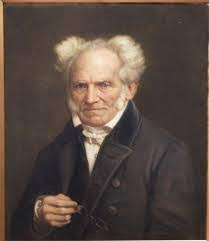
Arthur Schopenhauer

What if the aimless, non-rational Will, which Schopenhauer detected at the heart of existence, is nothing but what I would name ‘gradiance‘ (in French accent with a wink to Derrida’s ‘différance‘)? With this I mean the idea that everything exists and changes by the grace of gradient tensions between high and low pressures, high and low densities and high and low temperatures. These are arguably all variations of one phenomenon: uneven energy distribution, which create tensions to be overcome as energy always ‘aims’ at a perfectly evenly dispersed distribution.

Gradiance and Physics

This behavior can be experimentally observed in closed systems and explained with Carnot’s second law of thermodynamics. In physics the final energy state aimed at is called ‘thermodynamic equilibrium’, ‘maximum entropy’ or ‘heat death’. Pessimists might be dismayed by this end point, while optimists will point out that, before the universe will ever die of ‘heat death’, there will be an almost unlimited amount of creative, ordered ways in which this teleological process plays itself out. The Belgian physicist Ilya Prigogine named such emerging orderings dissipative structures [1].

The paradigmatic example of these dynamic structures can be found in the ‘Bénard Cell’ when a fluid in a container is exposed to an increased temperature difference between the bottom plane and the top plane and after a while spontaneously self-organizing, non-linear convection cells form to more efficiently mediate between the gradient temperatures [2].
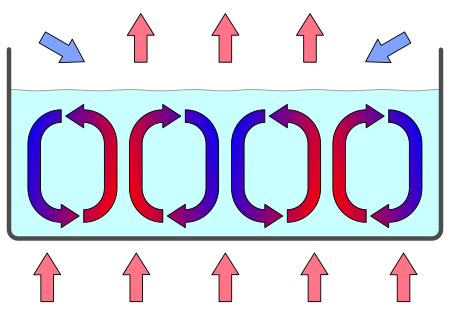
Convection cells dissipating energy gradients

Gradiance and Evolution

Writer and ecological philosopher Dorion Sagan (son of the famous scientist Carl Sagan) and his co-author Eric Schneider proposed to extrapolate this formative principle of gradiance to any and all phenomena including biological and mental life [3].

Into the Cool: Energy Flow,
Thermodynamics, and Life

He would see our biological life as the thin layer of a very complex energy-mediation system between the cool earth and the hot sun and would see evolution as one of the most inventive tricks in the universe to optimize energy flows. Biological entities are therefore nothing but self-organized energy transformers looking first for high energy sources, then using those sources and lastly leaving lowered energy forms behind.

They are dissipative structures mediating between high and low concentrations of energy. Natural, instinctual desires guide this process at the temporal span of the specious now in which perceptions (‘affordances’ in J.J. Gibson’s terminology) of food, security and procreation are immediately perceived and pursued [11].

Language and mental life–especially narrative constructs which can efficiently hold together multiple dialectical aspects of life–help this process get along as a medium of information storage and exchange of ‘best practices’. This happens at the mediate span of extended temporality of remembered pasts and projected futures accompanied by a temporarily extended sense of narrative self covering one’s life-span [4].

Gradiance and Consciousness

This whole process is also accompanied by different levels of sentience of which our sense of self-conscious self-hood is one of its most intense, especially when fretting over possible courses of action in one’s mind-space while desires and fears have become intensified [5].
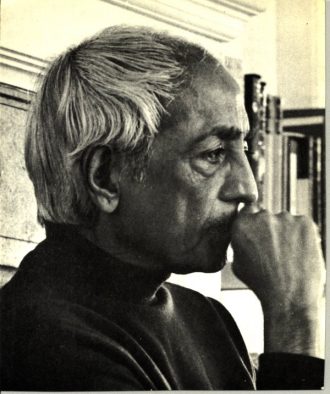
Jiddu Krishnamurti

Possibly the most intense experience humans could have is when it can silence its mind through meditation and then experience in this stillness the vastness and intense, whirling energy of the universe itself as was arguably the case with the maverick, global philosopher Jiddu Krishnamurti and his experiences of ‘benediction’. He left us with some poetic descriptions of these experiences, written in a diary he kept for a year in 1961.

[I]t was a movement in complete freedom, a movement that had no direction and dimension; in that movement there was boundless energy whose very essence was stillness. . . . In this emptiness there was fury; the fury of a storm, the fury of exploding universe, the fury of creation which could never have any expression. It was the fury of all life, death and love. But yet it was empty, a vast, boundless emptiness which nothing could ever fill, transform or cover up [6].

Saanen, Switzerland

When I attended the 1980 Krishnamurti gathering in Saanen, Switzerland, I had just started reading this Notebook, which opened my own mind to similar experiences.

Gradiance and Phenomenology

When talking about consciousness I would also like to make the connection between gradiance and Husserl’s phenomenology, especially the concept of the three-staged process of intentionality [12]. Intentionality here means the feature of directedness of consciousness towards something beyond itself, usually something complex like a landscape, a melody, a text, a social situation, etc.

Husserl makes the case that before we see a rolled-up rope as such, understand a string of words as a text, or hear a string of sounds as a melody, we approach the rope, text or melody initially with an empty intention which projects a possible fulfillment which might come to fruition, or not. The rope might turn out to be a snake, the text turns from a gentle love story into a dystopian nightmare, and the melodic structure sought in the sounds might stay elusive.

A successful fulfillment of an empty intention is achieved when a certain degree of identity can be established. The snake is really a snake because it looks like one, moves like one and reacts like one if you poke it. The end of the story makes the contrary beginning retro-actively meaningful. And the melody, once captured, is clearly repeated throughout the composition and can be reproduced by humming or by a skilled musician.

My proposal is that the dynamic, intentional structure of consciousness can be framed as an instance of gradiance, because there is an initial, teleological tension to be overcome between the empty phase and its fulfillment in possible identity. To be short, intentional experiences of desire and fear are connections between one’s natural evolved instincts projected emptily (like in hunger, thirst and attraction) unto one’s surrounding looking for fulfilment. Experiences of music connect intentionality to higher modes of experience, which will be the focus of the rest of this essay.

Gradiance and Music

How does art, especially music, fit into this discourse? According to the French philosopher Paul Ricoeur fictional narratives are laboratories for alternative ways to see and experience social life [7]. Characters and plots indicate possible templates for one’s own life to better overcome or mediate between all the diverse inner tensions and outer demands to which one is exposed.

Phrasing it in that way connects narrativity of course with managing one’s own energy field of natural desires, social habits and deliberative practices, and the possible ways to improve on them which might lead to different experiences of resolution and satisfaction. Within such a framework the phenomenon of art can be conceived as a very efficient medium to help both individual and collective energy transformations by provocatively breaking up old patterns and establishing new ones.

Bringing in the movie critic Roger Ebert and the sociologist Norbert Elias, one could muse that art functions as an ’empathy machine’ [8], which fuels the jagged civilizational process of increased empathy coupled with increased self-control with sometimes serious set-backs including disintegrations [9].
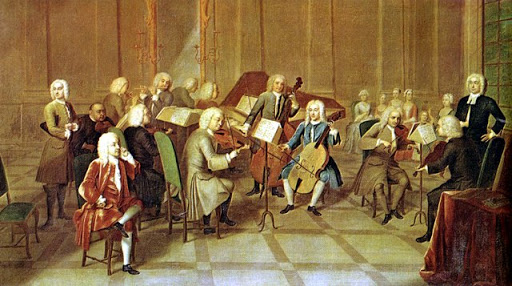
Baroque Orchestra

How does music fit in, especially its ineffable and utopian aspects highlighted by philosophers of music? Is music a non-verbal dissipative structure, which, qua experience, can be placed between literary art and meditation, if meditation can be re-conceived not merely as a spiritual practice but as a form of art by itself? Let’s work that out a little, first with connecting music with literature, then with meditation.

As an art-form music is arguably higher than literature because of its more expansive, emotive and energetic ‘meaning’, a meaning which does not refer to anything concrete outside itself but still evokes by its ineffable, spatial-temporally structured experience the depths, tensions, and resolutions of life itself.

To connect music with meditation I would first refer to personal experiences of nature mysticism in which one looks at, or into, nature through freely configurated dynamic gestalts of spontaneously arising perceived patterns in, for example, groupings of rocks and trees and other ‘compositions’. Such meditative way of seeing and being is highly creative and depends on a certain acquired skill of creatively perceiving gestalts and letting go of the usual chatter going on in one’s inner mind-space. In short, it is a form of art.

Secondly I would refer to my experiences of meditation after intensely listening to music, which can open up the appreciation of music’s containment in its silent and empty, spacious background. This background silence becomes foreground when one switches into a silent meditative mode and the lingering of the music becomes the background which then qualifies the particular silence of the foreground.

All such experiences are quite ineffable, but can still be, after reflection, find some words to get expressed by.

What about the ‘utopian’ aspect of music? In the review one can read that the German philosopher Ernst Bloch sees in music the “dialectical confrontation between two contradictory halves: formalism and materiality, rationalization and singular exemplarity, speculative autonomy and embodied immanence” and that “utopia is something that cannot be simply presented, represented, or even indicated; it must be obscurely interpreted through the abstract and translucent tone of the fugato. Music’s ineffability is a perplexing impetus to utopian insight” [10].
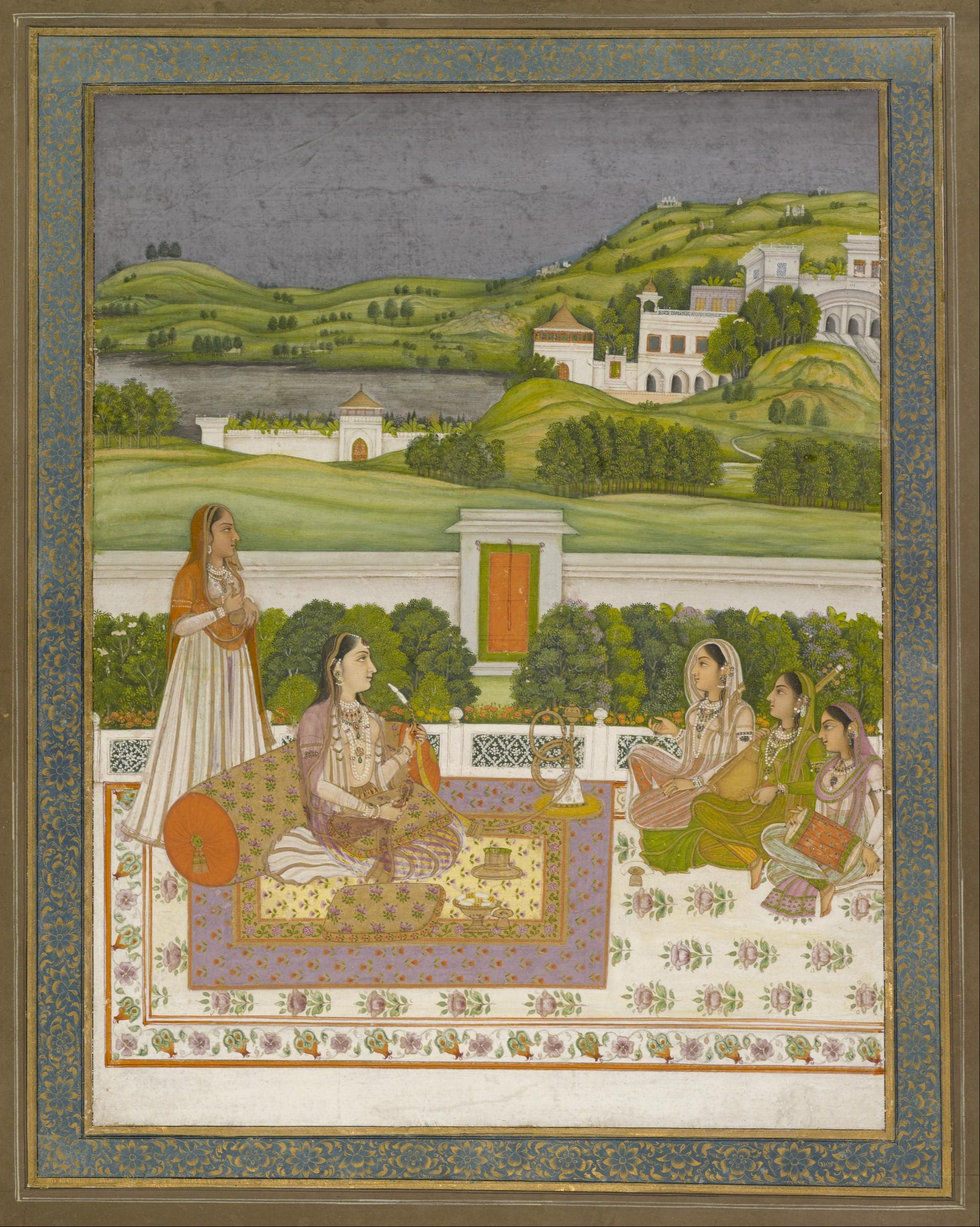
Princess Listening to Music

Leaving aside whether the above categorial dichotomies, like form vs matter, can be framed as conceptual expressions of an underlying gradiance, I would venture that music, interpreted as a temporally extended dissipative structure, has an intrinsic teleology towards a temporary or ultimate energetic resolution.

And one could, at the collective level, project into such experience of benign resolution, the emotive insight of a state of societal affairs which is commensurate to the music: Equally peaceful and dynamic, or whatever societal preferences one would like to project. In this manner the societal-formative power of music can be understood and shaved of its Romantic and/or esoteric interpretations [14].

Though the above view of interpreting art, music and meditation through thermodynamics looks like a stark, deflationary reductionism, this does certainly not imply a desolate devaluation of such experiences themselves. On the contrary, I see the second law of thermodynamics as the ‘mother of all reductions’ with which one can dismantle all kinds of fancy religious and metaphysical frameworks which will then open a more Taoist or Zen Buddhist sense of embodied, post-cognitive, energetic modes of being sans theological or metaphysical superstructures. And in this manner the Mother of all Reductions can pave the way for the Mother of All Experiences: The mystical experience of gradiance itself as was arguably experienced and expressed by J. Krishnamurti [6].

Endnotes

[1]. Prigogine, Ilya & Stengers, Isabelle. 1984. Order out of Chaos: Man’s New Dialogue with Nature. New York: Bantam Books.

[2]. “Rayleigh–Bénard Convection“. Entry Wikipedia.

[3]. Schneider, Eric D.& Sagan, Dorion. 2005. Into the Cool: Energy Flow, Thermodynamics, and Life. Chicago: University of Chicago Press.

[4]. Moore, Chris & Lemmon, Karen (Eds.). 2001. The Self in Time: Developmental Perspectives. Mahwah, NJ: Lawrence Erlbaum Associates, Inc.

[5]. Jaynes, Julian. 1976. The Origin of Consciousness in the Breakdown of the Bicameral Mind. New York: Houghton Mifflin Harcourt.

[6]. Krishnamurti, Jiddu. 1976. Krishnamurti’s Notebook. New York: Harper & Row.

[7]. Ricoeur, Paul. 1983-88. Time and Narrative. 3 Volumes. Chicago: University of Chicago Press.

[8]. Ebert, Roger. 2005. “Ebert’s Walk of Fame Remarks”. Roger Ebert’s Journal, 24 June 2005. Retreived 30 May 2020.

[9]. Elias, Norbert. 1978 (1939). The Civilizing Process. Vol 1: The History of Manners. Vol 2: Power and Civility. Jephcott, Edmund (Transl.). New York: Pantheon Books.

[10]. Gallope, Michael. 2017. Deep Refrains: Music, Philosophy, and the Ineffable. Chicago : University of Chicago Press.

[11]. Gibson, J.J. 1986. The Ecological Approach to Visual Perception. Hillsdale, NJ: Lawrence Erlbaum Associates.

[12]. Sokolowski, Robert. 1974. Husserlian Meditations: How Words Present Things. Evanston, IL: Northwestern U.P.

[13]. Young, James O. 2018. Review of Michael Gallope, 2017, Deep Refrains: Music, Philosophy, and the Ineffable, Chicago: University of Chicago Press. Notre Dame Philosophical Reviews, 22 April 2018.

[14]. For two great examples of esoteric interpretations of music see:

Scott, Cyril. 1933. The Influence of Music on History and Morals. London: Rider & Co.

Tame, David. 1984. The Secret Power of Music. Rochester, VT: Destiny Books
Life And Teachings of the Masters of the Far East


By David Tame, March 2023.

A Facebook friend of mine posted a quote from Volume 2 of these books [1] just hours ago, to which I gave quite a lengthy comment, and I now see the comment has been deleted (without any PM to myself). I think my comment is worth preserving.

I am very aware that, when it comes to people like Baird Spalding and his books, people find it very hard to face the truth that what he wrote was not genuine. So, evidently, my comment has been ‘censored’. Similarly, just for example, one comes across the same incapability to face the truth with believers in the books of Carlos Castaneda [2], who also definitely was long ago, in 1976, proven to have written his books as works of fiction [3]. I believed in the Castaneda books too for three or four years.

I’m a person who simply believes that real truths must be preserved, no matter how they may spoil one’s view of reality. We must adjust ourselves to Truth, not try to make Truth adjust to our conception of it. As the motto of Theosophy has it, “There is no Religion higher than Truth”[4].

My deleted or censored comment on Spalding and his “Life and Teachings” books, therefore, since I did take the trouble to write it, is as follows:

I myself am a lifelong believer in such genuine Masters. But in order for the truly genuine accounts and Their teachings to retain repute, I’ve always felt that we must ‘fess up when anything else is not quite what they seem: for the very sake of the reputation of wholly genuine books.

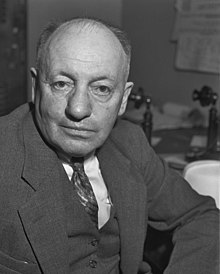
There is a deep mystery behind Spalding which may never be solved. The brief Wikipedia article the photo is taken from is evidently written by a ‘true believer’, and to be historically factual would need a lot of rewriting [5].

He had definitely never been to India before 1935, and he was not old enough to have been on any journey to India in “1894”. As his friend David Bruton states in his biography, Spalding advanced his age by two years upon every birthday to try to make it appear that he was old enough to have made such a journey [6]. He’d long planned to write Volume 1, though he had never himself been to the East. He wrote the first volume, and upon its unexpected success, the publisher asked him to write a second and then a third volume by virtue of the fact that, in the publisher’s eyes, they made more money for him than the rest of De Vorss’ books put together. If asked almost any question at all, Bruton tells how Spalding seemingly impulsively never replied truthfully, even about innocuous daily things.

As another means of making money, publisher DeVorss arranged for Spalding to be the guide for a party of spiritual tourists, who paid for the journey, to take them to India in 1935, yes, but soon after arrival it started becoming clear that Spalding had no knowledge or experience of India at all. (Anyone who does know India can tell that from the books, imho.) The travelling companions had frankly expected to meet at least one Master, but Spalding kept making poor excuses.

Genuine British mystic, Dr Paul Brunton, writes of how he came across Spalding and his disgruntled party. Mystic Paul Brunton (not to be confused with friend and biographer David Bruton) was India-experienced, and saw through him. so Spalding finally admitted to him that his India travelogues “dealt with visits made in his astral body, not in his physical body, as readers were led to believe”. There was a showdown with his traveling companions, upon which Spalding basically ran away, turning up weeks later at the docks, penniless, to get back to the USA. One of the fellow-travelers paid for his passage back.

A great deal more along these lines can be read about Spalding, and I would advise the researcher to read his one biography, Baird T. Spalding As I Knew Him by his genuine friend, David Bruton. It’s full of mysteries and puzzles, and a good read by itself. I do find that ‘true believers’ find all this hard to accept, yet they need to read further such as in Bruton’s book. Bruton is no critic, and not trying to debunk, simply to tell the real truth. By the time Volume 1 of “Life and Teachings” came out in 1924, there were plenty of esoteric/occult sources from which the gist of such a tale could have been concocted, particularly Theosophy, but many other sources too.

However, one major part of the mystery is that since Spalding was never in India before 1935, and was too young to have been there in 1894, nevertheless his books are certainly packed with spiritual truths, even if the actual events are fictitious. His books have inspired generations of readers nonetheless, doing great good, and therein lies their undoubted value. (By the way, publisher DeVorss must surely have swindled him, since he died with only $15 to his name, apparently.)

I like a portion of David Bruton’s introduction to his biography, in which he says, in as many words (my copy isn’t to hand), “No matter the reality or not, or the real nature of his stories, it cannot be taken from Baird that he did indeed inspire many thousands of people, for which he should be remembered.”

I am writing this post on a very coincidental day, because just today I received the latest edition of the books (!), which simply contains Volumes 1 to 3, later volumes being poor efforts of the publisher to just keep making more money and of little value. The first three volumes are now newly published as one book, with the new title, The Journey (2021), still by the same publishing house, but the initial publisher himself, DeVorss passed on in 1953. They have been honest enough now, today, to give this brand-new book a 14-page Introduction by Mitch Horowitz, academic of American occultism, who comes clean on the real life-story of Spalding [7].

I would just say, take Spalding’s works as ever one wishes, but the 1894 journey never took place. The supposed backing establishment confirms that. If one wishes, one can think of his accounts as being overshadowed by some spiritual force, or, in any case, at the very least by his own spiritual knowledge, and perhaps by even more. It is certainly not my wish to pop any balloons, but Truth Above All must be our guide.

So if anyone really wants to follow-up on this, you can start with David Bruton’s 1954 biography, and the recent 2021 14-page introduction to the latest edition.

Sources

[1]. Spalding, Baird T. 1924-1997. Life And Teachings of the Masters of the Far East. Vols. 1-6. Los Angeles: DeVorss & Company.

[2]. Wiki entry: Carlos Castaneda.

[3]. De Mille, Richard. 1976. Castaneda’s Journey: The Power and the Allegory. Santa Barbara, CA: Capra Press.

[4]. Blavatsky, H. P. 1889 (1920). The Key to Theosophy: An Exposition on the Ethics, Science, and Philosophy of Theosophy. Los Angeles, CA: The United Lodge of Theosophists.

[5]. Wiki entry: Baird T. Spalding.

[6]. Bruton, David. 1954. Baird T. Spalding As I Knew Him. Los Angeles: DeVorss & Company.

[7]. Spalding, Baird T. 2020. The Journey: Life And Teachings of the Masters of the Far East. Reprint in one volume of Life And Teachings of the Masters of the Far East, vols. 1-3. With introduction by Mitch Horowitz. Los Angeles: DeVorss & Company. (Amazon, where you can read the Horowitz intro)


The Next Financial Crisis is around the Corner?


Introduction

We know that the current monetary system is crisis-prone. We know that during the last big crisis in 2008 we skirted a total freeze-up and a possible break-down of the international banking system. We know that Wall Street was bailed-out and Main Street left to fend for itself. We know the system received some band-aids and was not re-set on a sound footing. And now we see another series of big booms and possible big busts, starting with the implosion of crypto-giant FTX in November 2022 and recently the bankruptcy of SVB.

Maybe a good quote to set the table for some warnings is the following from economists Dirk Bezemer and Michael Hudson (2016: 761):

An economy based increasingly on rent extraction by the few and debt buildup by the many is, in essence, the feudal model applied in a sophisticated financial system. It is an economy where resources flow to the FIRE sector [Finance, Insurance & Real Estate] rather than to moderate-return fixed capital formation [the productive economy]. Such economies polarize increasingly between property owners and industry/labor, creating financial tensions as imbalances build up. It ends in tears as debts overwhelm productive structures and household budgets. Asset prices fall, and land and houses are forfeited.

Different sources make it clear that we might be close again. Below is a little collection of economists and financial commentators ringing the bell with a postscript on the Silicon Valley Bank bankruptcy in March 2023.

Nouriel Roubini, aka Dr. Doom

Dr. Doom in 2007 was on the forefront of warning the world that the time was ripe for a big correction, if not crisis. He’s back again.

The chairman and chief executive officer of Roubini Macro Associates, nicknamed Dr. Doom following his 2008 prediction, warned that anyone expecting a shallow US recession should examine the extensive debt ratios of corporations and governments.

Roubini added that as rates increase and debt servicing costs grow, “many zombie institutions, zombie households, corporates, banks, shadow banks and zombie countries are going to die” (Boughedda).

Later Roubini himself opened his analysis in an article with:

The world economy is lurching toward an unprecedented confluence of economic, financial, and debt crises, following the explosion of deficits, borrowing, and leverage in recent decades (Roubini).

“Recession is a certainty in 2023, but how much will it hurt India?”

This article in India Today carries lots of colorful graphs to see that the world will get into a recession in 2023 and that “various financial crises” will accompany it. When the World Bank and the IMF think there will be a recession this might be interpreted that it will actually pack out worse.

A new World Bank study shows that central banks across the globe raising interest rates to curb inflation may not be a good idea. This can likely lead to various financial crises along with the recession. “Global growth is slowing sharply, with further slowing likely as more countries fall into recession. My deep concern is that these trends will persist, with long-lasting consequences that are devastating for people in emerging markets and developing economies,” said World Bank Group President David Malpass (Sharma).

“Why The Banks Are Collapsing”

A reasonably good video comes from a somewhat alarmist web site analyzing five reasons why we can expect some or many big banks to collapse. The video is sponsored by a dubious company selling titles like ‘Lord’ and ‘Lady’ in Scotland.

1) Collateral Debt Obligations, 2) Corruption, 3) Collateral Loan Obligations, 4) Overconfidence, 5) Recession.

We can argue with this list as #5 Recession is more of an effect than a cause of bank behavior. And, though they mention it, Moral Hazard, the idea that banks expect that they will be bailed out anyway, should have its own entry. And what is totally missing is an analysis of the leading cause of financial crises and that is the allocation of easily created loans by commercial banks to the unproductive FIRE sector creating thereby asset bubbles which usually pop.

Trouble in Cryptoland

In November 2022 the crypto currency exchange platform FTX went bankrupt after a classic bank run with depositors withdrawing $6 billion. Crypto-giant and rival Binance might have triggered the run by withdrawing from FTX after revelations about a murky relationship between FTX and a sister company Alameda. Binance then thought of buying and bailing out the platform, but changed its mind in a day.

How far this bankruptcy will reverberate through cryptoland and the banking world is anyone’s guess but it is already dragging in its wake a few other outfits and the wipe-out of about $2 trillion in market value. And after FTX filed for bankruptcy hackers got away with $515 million. Some think this is a Lehman moment, which started the GFC in 2008, others compare it with the 2001 collapse of Enron. Regulators are expected to step in, which might scare more people into selling, creating more havoc, and justifying more regulation (Yaffe-Bellany; Wiki entry of FTX).

The inequality-crisis nexus: Its origin and application to India

I stumbled upon prominent Indian economist Raghuram Rajan as one of the few who warned his peers at the 2005 Jackson Hole, Wyoming gathering of top bankers and their regulators, that the financial system had become potentially more crises-prone because of deregulation, innovation, dangerous incentives to bank managers and some other flaws (Rajan, 2006).

He said the rollout of complicated instruments such as credit-default swaps and mortgage-backed securities made the global financial system a riskier place. Indeed, he argued that such developments “may also create a greater – albeit still small – probability of a catastrophic meltdown” (Cooper).

Rajan was then chief economist at the IMF. Later he became governor of the Reserve Bank of India (RBI), Vice-Chairman at the Bank for International Settlements (BIS) and is now back in academia at the University of Chicago.

After the crisis he came out with an award-winning book, Fault Lines (2010), making the case that inequality had increased the debt burden of households. The logic was that households, in order to keep up with spending while income shrank, took on debt to make up for the difference. Rajan also thought that the US government was incentivizing mortgages too much, also leading to a growth in debt. For this he was criticized as it looked he was blaming the victims of the GFC. Summarizing Rajan’s position:

Much of the impetus for the current debate stems from Raghuram Rajan’s widely discussed book ‘Fault Lines’ (2010). Rajan argues that low and middle income consumers have reduced their saving and increased debt since income inequality started to soar in the United States in the early 1980s. This has temporarily kept private consumption and employment high, but it also contributed to the creation of a credit bubble. With the downturn in the housing market and the sub-prime mortgage crisis starting in 2007, the overindebtedness of U.S. households became apparent and the debt-financed private demand expansion came to an end in the ‘Great Recession’ of 2008/9 (Van Treeck, 2013: 421).

How this nexus might apply to India is next and starts with a picture of inequality in India.

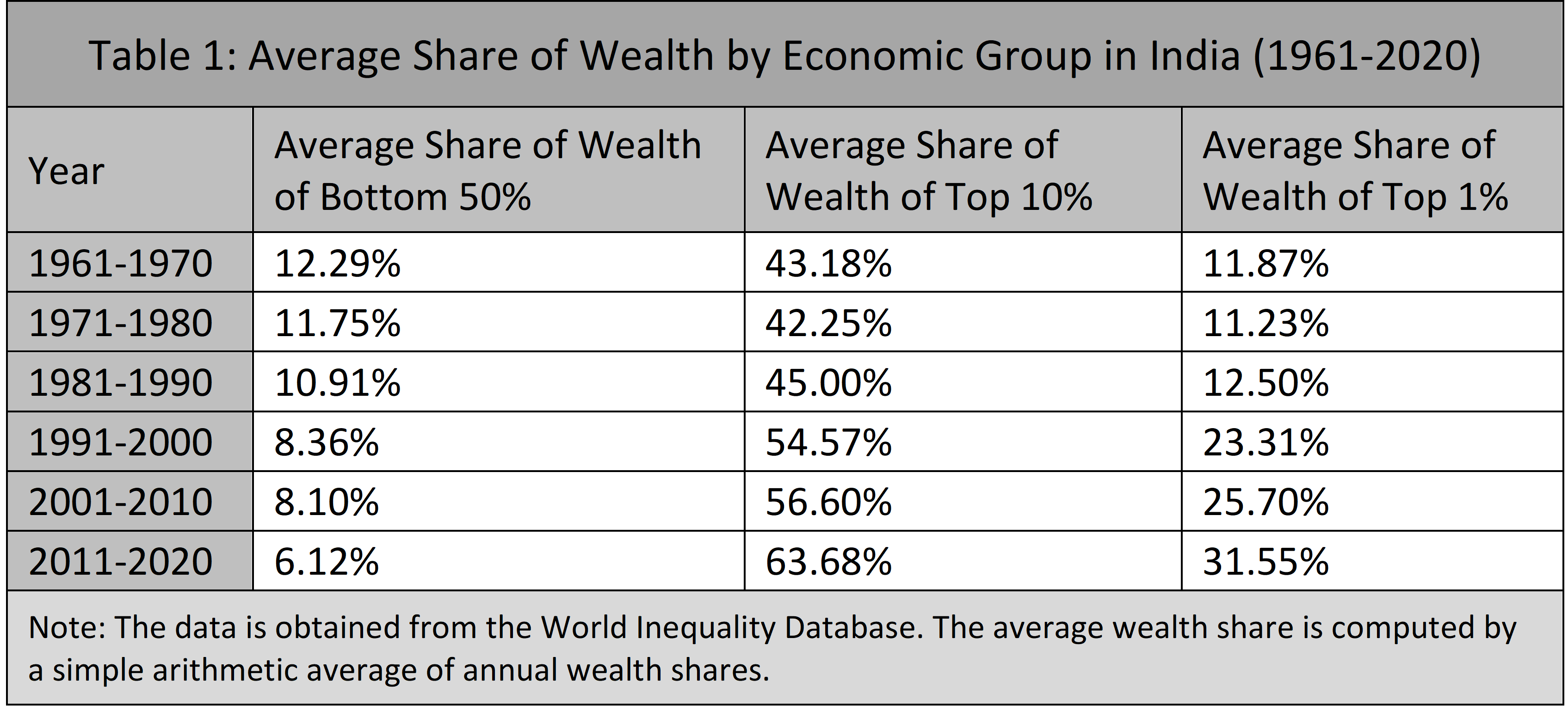
For example, data from the recently published “World Inequality Report 2022” suggests that inequality – of both income and wealth – in India kept increasing in the last few decades and that this trend has continued even in recent years. In particular, after 1990, the share of the national income of the top 10% and top 1% has consistently increased while the share of the national income of the bottom 50% has consistently declined.

The article comes with a table which makes the trend over six decades painfully clear (Gathak, 2022).

Next step is to look at the trend in bank lending in the form of retail loans and mortgages.

According to data released by RBI, the bulk of the increase in bank lending has been on account of retail loans, with credit card outstanding, consumer durables and loans against fixed deposits being the new drivers of growth in FY22.

. . . . Individuals continue to borrow for consumption even as corporations have deleveraged and paid their loans (Shetty, 2022). 

But what are the causes of this increase of indebtedness? Increased consumer optimism? Easier access to loans? Or the relative income hypothesis? This hypothesis is based on the idea that consumption patterns are related to the perception and valuation of one’s relative socio-economic position in one’s environment. It combines the desire of ‘keeping up with the Joneses’ during boom times and trying to keep up with your own previous peak consumption during downturns. The relative income hypothesis is a component of the Rajan hypothesis of causally connecting inequality with financial fragility.

Though I have anecdotal and observed evidence from the US for Rajan’s hypothesis, I am not sure how it would work out in India. The first thing to find is some correlation between increased inequality in India and increased indebtedness, and then see if causal connections can be made. But this project is too big to pursue here.

Postscript

Meanwhile in March 2023 a potentially humungous crisis was temporarily averted after two US banks went bankrupt and were taken over by different authorities. Silicon Valley Bank (SVB) in California ($209b) and Signature Bank in New York ($118b) are now the second and third biggest bank failures in US history after the record-setting failure of Washington Mutual ($307b) in 2008. Though 97% of deposits at SVB and 90% at Signature were not insured, the US government regards the crisis as a systemic risk and will guarantee all deposits in newly formed ‘bridge banks’. Throughout the crisis stock markets stayed relatively calm, but some banks took big hits with shares of Republican Bank going down 60%. The price of safe-haven gold increased about 5%.

Some Tremors in India

SVB’s troubles created also concern in India because many Indian start-ups and high-net-worth individuals have big accounts at SVB.

Indian startups that have millions of dollars stuck with the troubled Silicon Valley Bank are waiting for business hours in the US to resume Monday and could withdraw all their money from the bank en masse. The only thing that could stop that is if the US government manages to find a buyer for the beleaguered bank, founders said (Barik).

Little did anybody know that US regulators would step in with guarantees.

Ellen Brown

Again, what is next is anybody’s guess, though some of our allies in the monetary reform movement think it can be dire.

For example Ellen Brown of the Public Banking Institute warns that again we are facing the collapse of the derivatives house of cards. This time the derivatives used as a hedge against interest rate changes will come into play. She writes about “The Interest Rate Shock” which will ripple through the system.

Interest rate derivatives are particularly vulnerable in today’s high interest rate environment. From March 2022 to February 2023, the prime rate (the rate banks charge their best customers) shot up from 3.5% to 7.75%, a radical jump. Market analyst Stephanie Pomboy calls it an “interest rate shock.” It won’t really hit the market until variable-rate contracts reset, but $1 trillion in U.S. corporate contracts are due to reset this year, another trillion next year, and another trillion the year after that.

A few bank bankruptcies are manageable, but an interest rate shock to the massive derivatives market could take down the whole economy (Brown).

Steve Keen

Another warning comes form Australian economist and author Steve Keen. He blames the actions of the Fed in raising interest rates while ignoring its effects on the financial sector. He thinks that the Fed uses models in which debt, banks and money are ignored. The causal chain is that increased interest rates will diminish the value of bonds, of which many banks have massive amounts on their books.

Meanwhile, in the real world, rising interest rates on government bonds can cause banks to go insolvent. SVB was the canary in the coal mine here, but the factor that brought it undone is shared by all financial institutions, because government bonds are a major component of their assets. When interest rates rise, bond values fall, and this can drive financial institutions into insolvency—where their Liabilities exceed their Assets (Keen).

In his own Minsky Model he shows that the financial sector as a whole might get into negative equity territory if interest rates hit 5%. That is, the whole sector can go belly-up. Though he states his scenario is more hypothetical and educational than a real-world plausibility, the lesson he wants to convey is that,

It’s The Fed that deserves to be roasted instead, for attempting to manage the financial system using models that ignore banks, debt, and money.

Michael Hudson

Famed author and economist Michael Hudson addresses both of the above mentioned dangers, i.e. a) the effect of increased interest rates on the value of bonds and in turn its effect on the equity position of banks, and b) the looming danger of derivatives. On the interest rate he states that,.

Prices are plunging for bonds, and also for the capitalized value of packaged mortgages and other securities in which banks hold their assets on their balance sheet to back their deposits.

The result threatens to push down bank assets below their deposit liabilities, wiping out their net worth – their stockholder equity.

Like others, he wondered “why the Fed doesn’t simply bail out banks in SVB’s position”, but that question has just been answered by the regulators with their decisive intervention fully guaranteeing all deposits.

The issue with derivatives he thinks is the “larger elephant in the room”.

Volatility increased last Thursday and Friday. The turmoil has reached vast magnitudes beyond what characterized the 2008 crash of AIG and other speculators. Today, JP Morgan Chase and other New York banks have tens of trillions of dollar valuations of derivatives – casino bets on which way interest rates, bond prices, stock prices and other measures will change.

According to Hudson we are getting into really dangerous territory:

So far, the stock market has resisted following the plunge in bond prices. My guess is that we will now see the Great Unwinding of the great Fictitious Capital boom of 2008-2015. So the chickens are coming home to roost – with the “chicken” being, perhaps, the elephantine overhang of derivatives fueled by the post-2008 loosening of financial regulation and risk analysis.

By the way, the two above economists have written some of the most hard-hitting and provocative criticisms of how the economics discipline is mis-theorized by their peers through ignoring the role of money, banks and the money creation process. From Hudson we have J Is For Junk Economics, and Keen wrote Debunking Economics.

Alternatives

In the six years after the 2008/9 Global Financial Crisis (GFC) the monetary reform movement has attained far-reaching results in promoting breakthrough monetary theories, especially the credit creation theory of money and banking, and in proposing reform policies based on empirical findings and computer models.

Many central and commercial banks admitted the truth about money creation and through citizen’s initiatives many popular assemblies had to discuss the findings and proposals. In Switzerland it even came to a referendum.

Our ideas are still spreading and are picked up in many countries to the extent that monetary reform organizations have been started. Even so, main stream economists, politicians and policy think tanks are resisting our findings or stay blissfully ignorant of them. Hopefully this half-panic around SVB’s downfall will create questions about the current crisis-prone, unsustainable monetary system and awaken the vision that a more stable, more equitable and less indebted system is possible.

Sources

Anonymous. 2022. “Why The Banks Are Collapsing: The Coming Economic Crisis”. Moon YouTube Channel, Nov 2022.

Barik, Soumyarendra. 2023. “Indian startups with millions of dollars stuck in Silicon Valley Bank weighing en masse withdrawal”. Indian Express, 13 March 2023.

Bezemer, Dirk & Hudson, Michael. 2016. “Finance is not the economy: Reviving the conceptual distinction ”. Journal of Economic Issues, 50/3: 745-768.

Boughedda, Sam. 2022. “Nouriel Roubini, “Dr. Doom,” Expects a Severe, Long and Ugly Recession – Bloomberg”. Investing.com, 20 Sept 2022.

Brown, Ellen. 2023. “The Looming Quadrillion Dollar Derivatives Tsunami”. The Web of Debt Blog, 13 Mar 2023.

Cameron, Cooper. 2015. “6 economists who predicted the global financial crisis”. In the Black, 7 July 2015.

Gathak, Maitreesh et al. 2022. “Trends in Economic Inequality in India”.The India Forum, 19 Sept 2022.

Hudson, Micheal. 2017. J Is For Junk Economics: A Guide To Reality In An Age Of Deception. Dresden, Germany: ISLET Press. (Amazon)

Hudson, Micheal. 2023. “Why the Banking System is Breaking Up“.12 Mar 2023.

Keen, Steve. 2011. Debunking Economics: The Naked Emperor Dethroned? London: Zed Books. (Amazon)

Keen, Steve. 2023. “Silicon Valley Bank: The Fed’s Role in its Downfall”. Patreon, 11 Mar 2023.

Rajan, Raghuram G. 2006. “Has finance made the world riskier?.” European Financial Management, 12/4: 499-533. 

Rajan, Raghuram G. 2010. Fault Lines: How Hidden Fractures Still Threaten the World Economy. Princeton, New Jersey: Princeton University Press.

Roubini, Nouriel. 2022. “The Unavoidable Crash“. Project Syndicate, 2 Dec 2022.

Sharma, Samrat. 2022. “Recession is a certainty in 2023, but how much will it hurt India?” India Today, 12 Oct 2022.

Shetty, Mayur. 2022. “Individuals borrow more, corporates deleverage”. Times of India, 5 Sept 2022. 

Trading Economics. 2022. Graph of Households Debt in India in Percentage of GDP, 2009-2022. Derived from the Bank of International Settlements.

Van Treeck, Till. 2014. “Did inequality cause the US financial crisis?” Journal of Economic Surveys, 28/3: 421-448. 

Wiki entry: FTX (Company)

Yaffe-Bellany, David. 2022. “Embattled Crypto Exchange FTX Files for Bankruptcy”. New York Times, 11 Nov 2022.

Extra: https://www.visualcapitalist.com/ftx-leaked-balance-sheet-visualized/

Additions to Bibliography February 2023


B. Academic Studies on Sovereign Monetary Theory and Reform

Armelius, Hanna & Carl Andreas Claussen, David Vestin. 2020. “Money and monetary policy in times of crisis”. Monetary Policy Department and the Payments Department of the Riksbank. Riksbank of Sweden. Economic Commentaries, 4 (11 June 2020): 1-15.

Assenmacher, Katrin & Claus Brand. 2018. “The Swiss Sovereign Money Initiative”. Credit and Capital Markets, 51/4: 621-644.

Baeriswyl, Romain. 2017. “The Case for the Separation of Money and Credit”. In Heinemann, F., Klüh, U., and Watzka, S. (eds.), 2017, Monetary Policy, Financial Crises, and the Macroeconomy, Cham: Springer, pp. 105–21.

Barber, G. Russell. 1973. “The One Hundred Percent Reserve System”. The American Economist, 17/1: 115–127.

Bertocco, Giancarlo & Andrea Kalajzic. 2018. “How much does finance benefit society?”. PSL Quarterly Review, 71/287: 419-437.

—–, —–. 2001. “Is Kaldor’s theory of money supply endogeneity still relevant?” Metroeconomica, 52/1: 95–120.

—–, —–. 2010. “The endogenous money theory and the characteristics of a monetary economy”. Rivista Italiana degli Economisti, 15/3: 365–401.

—–, —–. 2013a. “Money as an institution of capitalism: Some notes on a monetary theory of uncertainty”. Economic Notes, 42/1: 75–101.

—–, —–. 2013b. “On Keynes’s criticism of the loanable funds theory”. Review of Political Economy, 25/2: 309–26.

Bjerg, Ole. 2018. “We Need to Put Things Back to Normal”. Interview with Ole Bjerg (2018) Journal of Economic Sociology = Ekonomicheskaya sotsiologiya, 19/4: 172–181.

Brown, Harry Gunnison. 1940. “Objections to the 100 Per Cent Reserve Plan.” The American Economic Review, 26/3: 309–314.

Buchanan, James M. 2010. “The Constitutionalization of Money.” Cato Journal, 30/2: 251–258.

Burns, Scott. 2016. “Old (Chicago) School, New Century: The Link between Knight and Simons’ Chicago Plan to Buchanan’s Constitutional Money.” Constitutional Political Economy, 27/3: 299–318.

Carroll, Charles Holt. 1964. Organization of Debt into Currency and Other Papers. Edited with an Introduction by E. C. Simmons. Princeton, NJ: Van Nostrand.

Chai, Hee-Yul, and Sang B. Hahn. 2018. “Does Monetary Policy Regime Determine the Nature of the Money Supply?: Evidence from Seven Countries in the Asia-Pacific Region“. East Asian Economic Review, 22/2: 217-239.

Currie, Lauchlin B. [1934] 1968. The Supply and Control of Money in the United States. New York, NY: Russell & Russell.

Demeulemeester, Samuel. 2019. “The 100% money proposal of the 1930s: Conceptual clarification and theoretical analysis.” PhD thesis, ENS de Lyon.

—–, —–. 2020. “Would a State Monopoly over Money Creation Allow for a Reduction of the National Debt? A Study of the ‘Seignorage Argument’ in Light of the ‘100% Money’”. Debates, Research in the History of Economic Thought and Methodology, vol. 38A, A Symposium on Public Finance in the History of Economic Thought, 123–44.

—–, —–. 2021. “The 100% money proposal of the 1930s: An avatar of the Currency School’s reform ideas?” The European Journal of the History of Economic Thought, 28,/4: 577–98.

Doorman, Frans. 2015. Our Money – Towards a New Monetary System. Lulu internet publishers.

Douglas, Paul H. 1935. Controlling Depressions. New York, NY: Norton.

Dow, S.C. 1997. “Endogenous Money”. In G.C. Harcourt and P.A. Riach (eds), A ‘Second Edition’ of The General Theory, vol. II, London and New York: Routledge, 61–78.

Fisher, Irving. 1936. “100% Money Again.” Social Research, 3/2: 236–241.

—–, —–. 1936. “The Bankers’ Interest in 100% Money.” The Bankers’ Magazine, October, 1936.

—–, —–. 1937. “100 Percent Reserves—An Old System Adapted to Modern Needs.” Commercial & Financial Digest, Los Angeles, California, June 1937. Reprinted in I. Fisher, Testimony before a Subcommittee of the Committee on Agriculture and Forestry, U.S. Senate, 75:1, August 12, 1937, 292–296.

—–, —–. 1937. “Note Suggested by Review of ‘100 Per Cent Money.’” Journal of the Royal Statistical Society, 100/2: 296–298.

—–, —–. 1946 (1997). “Answers to Objections to the 100% Plan.” Fisher Papers, Yale University Library. Reprinted in Barber et al, 1997, The Works of Irving Fisher – Vol. 11. 100% Money, 308–311.

Graham, Frank D. 1936. “Partial Reserve Money and the 100 Per Cent Proposal.” The American Economic Review, 26/3: 428–440.

—–, —–. 1941. “100 Per Cent Reserves: Comment.” The American Economic Review, 31/2: 338–340.

Higgins, Benjamin. 1941. “Comments on 100 Per Cent Money.” The American Economic Review, 31/1: 91–96.

Hook, Andrew. 2022. “Examining modern money creation: An institution-centered explanation and visualization of the “credit theory” of money and some reflections on its significance.” The Journal of Economic Education, 53/3: 210-231.

Krainer Robert E. 2013, “Towards a Program for Financial Stability”. Journal of Economic Behavior & Organization, 85 (January): 207-218.

—–, —–. 2017, “Economic Stability under Alternative Banking Systems: Theory and Policy”. Journal of Financial Stability, 31: 107-118.

Kumhof, Michael, et al. 2020. “Central Bank Money: Liability, Asset, or Equity of the Nation?” Cornell Law School Research Paper No. 20-46.

Lainà, Patrizio. 2017. “Seignorage from Full-Reserve Banking”. Published in Lainà, Patrizio, “Full-Reserve Banking: Separating Money Creation from Bank Lending”, PhD Thesis, University of Helsinki (November 13, 2017).

Lehmann, Fritz. 1936. “100% Money.” Social Research, 3/1: 37–56.

Lester, Richard A. 1935. “Check-Book Inflation.” The American Scholar, 4/1: 30–40.

Mellor, Mary. 2019. Money: Myths, Truths, and Alternatives. Bristol, UK: Policy Press.

Nayan, S., Kadir, N., Abdullah, M. S., & Ahmad, M. 2013. “Post Keynesian Endogeneity of Money Supply: Panel Evidence”. Procedia: Post Keynesian Endogeneity of Money Supply: Panel Evidence Economics and Finance, 7: 48-54.

Neuman, Andrew M. 1937. “100 Per Cent. Money.” The Manchester School, 8/1: 56–62.

Ponsot, Jean-François. 2017. “Rethinking Money“. In: Rochon, Louis-Philippe, and Sergio Rossi (eds), A Modern Guide to Rethinking Economics, Edward Elgar Publishing, 2017, 114-28.

Robbins, Richard H. 2014. “Debt and the Monetary Foundations of Inequality”. Anthropology News, 55, 14–15.

—–, —–. 2020. “Financialization, Plutocracy, and the Debtor’s Economy: Consequences and Limits”. In: Hann, Chris and Don Kalb (Eds.), Financialization: Relational Approaches. Max Planck Studies in Anthropology and Economy, Volume 6, New York and Oxford: Berghahn, 65–94.

—–, —– & Tim DiMuzio. 2020. “Capitalized money, austerity and the math of capitalism”. Current Sociology, 68: 149–168.

Robinson, George Buchan. 1937. “100% Bank Reserves.” Harvard Business Review, 15: 438–447.

Rochon, Louis-Philippe. 1999. Credit, money, and production: An alternative post-Keynesian approach. Cheltenham, UK and Northampton, MA: Edward Elgar.

—–, —–. 2001. “Cambridge’s Contribution to Endogenous Money: Robinson and Kahn on Credit and Money”. Review of Political Economy, 13/3: 287-307.

—–, —– & —–, —–. (eds). 2003. Modern Theories of Money: The Nature and Role of Money in Capitalist Economies. Cheltenham, UK and Northampton, MA: Edward Elgar.

Schuller, Govert. 2023. “Rochon’s Five Propositions on Bank Credit Creation”. Valatie, NY: American Monetary Institute.

Simarmata, Djamester. 2023. “Development Finance by Money Creation, instead of Foreign Debt or Saving: A New Paradigm For Development Economics”. MS [Forthcoming]

Simons, Henry C. 1934. “A Positive Program for Laissez-Faire”. Public Policy Pamphlet No 15. Chicago: University of Chicago Press.

Skaggs N.T. 1997. “Henry Dunning Macleod and the Credit Theory of Money”. In: Cohen A.J., Hagemann H., Smithin J. (eds), Money, Financial Institutions and Macroeconomics, Recent Economic Thought Series, vol 53, Dordrecht: Springer.

Smithin, J. 2013. “Keynes’s theories on money and banking in the Treatise and the General Theory”. Review of Keynesian Economics, 2/2: 242–56.

Stellinga, Bart, et al. 2021. Money and Debt: The Public Role of Banks. Research for Policy Series. Studies by the Netherlands Council for Government Policy. Cham, Switzerland: Springer.

Thomas, Rollin G. 1940. “100 Per Cent Money: The Present Status of the 100 Per Cent Plan.” The American Economic Review, 30/2: 315–323.

Tolley, George S. 1962. “100 Per Cent Reserve Banking”. In: Yeager, L. B. (ed.), In Search of a Monetary Constitution, Cambridge, MA: Harvard University Press, 275–304.

Watkins, Leonard L. 1938. Commercial Banking Reform in the United States: With Especial Reference to the 100 Per Cent Plan and the Regulation of Interest Rates on Bank Deposits. Vol. 5. Michigan Business Studies, 8. Ann Arbor, MI: University of Michigan.

Werner, Richard A. 2003. Princes of the Yen: Japan’s Central Bankers and the Transformation of the Economy. New York: M.E. Sharpe.

—–, —–. 2018. “Shifting from Central Planning to a Decentralised Economy”. Paper presented at the 14th Rhodes Forum: Dialogue of Civilisations Research Institute, Panel 2: “Economic Alternatives when Conventional Models Fail”, Rhodos, Greece, on 1 October 2016 and at the 4th European Conference on Banking and the Economy (ECOBATE 2016), in Winchester Guildhall, Winchester UK, on 12 October 2016.

Whittlesey, Charles R. 1935. “Banking and the New Deal”. Public Policy Pamphlet No. 16. Chicago: University of Chicago Press.


C. Studies Critical of Sovereign Monetary Theory and Reform (including MMT section)

Pro MMT

Berkeley, A., Ryan-Collins, J., Tye, R., Voldsgaard, A. and Wilson, N. 2022. “The self-financing state: An institutional analysis of government expenditure, revenue collection and debt issuance operations in the United Kingdom.“ UCL Institute for Innovation and Public Purpose, Working Paper Series (IIPP WP 2022-08)

Ryan-Collins, Josh. 2022. “Why the British state is a magic money tree“. The New Statesman, 26 May 2022

Keen, Steven. 2022. “A Little Knowledge is a Dangerous Thing: Observations on the debate between MMT advocates and Progressive Money Canada founder Jeff Eder”. Planksip, 30 Sept 2022.

Critical of MMT

Eder, Jeff. 2022. “Steve Keen has lost his way in a Minsky Maze”. Progressive Money Canada. [Response to Keen, 2022]

Epstein, Gerald A. 2019. What’s Wrong with Modern Money Theory? A Policy Critique. Cham, Switzerland: Palgrave.

Mueller, Antony P. 2019. “The magic money tree: The case against modern monetary theory (MMT).” Research Paper Series Adam Smith Institute (ASI), UK.

Schuller, Govert. 2020a. “Requesting Evidence for a Crucial MMT Claim”. Blog. Alliance For Just Money, 16 Aug 2020.

—–, —–. 2020b. “Triple-column Comparison between Modern Monetary Theory (MMT), the Actual Monetary System, and Sovereign Money Reform (SMR)”. Blog. Alliance For Just Money, 21 Sept 2020.

—–, —–. 2020c. “ ‘What’s Wrong with Modern Money Theory?’: A Summary”. Blog. Alliance For Just Money, 5 Oct 2020.

—–, —–. 2022. “Did Dr. Joshua Ryan-Collins go MMT?”. Paper presented at the American Monetary Institute conference, October 8, 2022. Video here.

D. Non-academic Advocacy Pamphlets, Reports, Briefings and Books

AMI. 2021. “AMI Conference Statement to COP26: Regarding the Monetary Dimension of Climate Change”. American Monetary Institute, Evanston, IL, USA, 11 Nov 2021.

Anon. 2019. “Open Letter: Rethinking the Role of Banks in Economics Education”. Rethink Economics.

Hermanutze, Derryl. 2020. A Brief History of Financial Plunder. Independently published.

Jordan, Thomas J. 2018. “How money is created by the central bank and the banking system.” Speech at the Zürcher Volkswirtschaftliche Gesellschaft, Zürich, 16 Jan 2018. Speech given in German. Zürich: Swiss National Bank.

McConnachie, A. 2006. Clarifying Our Money Reform Proposals: A Report for the Tenth Annual Bromsgrove Conference. Bromsgrove Conference, Bromsgrove, England.

Positive Money. N.d. “What people think banks do: The money multiplier and other myths“. London: Positive Money.

Stuart, James Gibb. 1991. Scotland and Its Money. Edinburgh: John Dunlop.

—–, —–. 1992. Economics of a Green Renaissance. Glasgow: Ossian Publishers.

—–, —–. 1993. Hidden Menace to World Peace. Glasgow: Ossian Publishers.

Turner, W.E. 1966. Stable Money: A Conservative Answer to Business Cycles. With introduction by Representative Wright Patman. N.p.

E. Supporting Studies Addressing Monetary Issues

Costa, Jorge Meira & Marc Gauvin, McNeill. 2015. “A proposal for harmonising current disparate (scientific and legal) definitions of money towards greater decidability in the provision of Justice according to universal principles of contract law“. Presentation at MERC first annual conference on The Monetary Policies in The Balkans, The Future of The Euro and The Eurozone in The Balkan Region. Monetary and EconomicResearch Center, Sofia -Bulgaria, 2015.

DiMuzio, Tim. 2023. “Capitalism, Money and Inequality in the World”. In: Bieri, Sabin & Bader, Christoph (Eds.), Transitioning to Reduced Inequalities, Basel, Switzerland: MDPI Books.

Gauvin, Marc & Sergio Dominguez. 2020. “A Systems Engineering Approach to Formal Monetary and Financial Stability Without the Vagaries of “Austerity” “. Submitted December 2020 to Monetary Research Centre (MRC), University of National and World Economy (UNWE), Sofia Bulgaria.


F. Journalistic Articles Addressing Monetary Reform

Baker, Scott, 2012. “The Instant Solution to the New Depression: Debt-free Money”. HuffPost, 4 june 2012.

Howell, John. 2017a. “Who creates money and where does it go?” The Athens Messenger, 25 Jan 2017.

—–, —–. 2017b. “Why money creation is central to most of the problems faced by society”. Athens, OH: Democracy over Corporations.

Joób, Mark. 2014. “The Sovereign Money Initiative in Switzerland“. World Economics Association Newsletter, 4/3 (June 2014): 6-7. (Comments here)

Hulsmann, Jorg Guido & Patrizio Laina & Joseph Huber & Ib Ravn & Bryan Gould. 2020. “Letter: It’s time to reconsider full reserve banking”. Financial Times (UK), 30 Aug 2020.


G. Educational and Promotional Videos (and other media)

Collins, Josh Ryan & Gabor, Daniela & Dyson, Ben & Werner, Richard. 2014. “Money and Banking”. Rethinking Economics, London Conference, June 2014. RE YouTube Channel, 25 Aug 2014.

Reiss, Michael. 2012. “Money… How It Works”. Unconventional Economics YouTube Channel, 22 dec 2012.

Schasfoort, Joeri. 2020. “How Commercial Banks Really Create Money (the Money Multiplier is a MYTH).” Money & Macro YouTube Channel, 28 Mar 2020.

—–, —–. 2020. “The Monetary Financial System Visually Explained“. Money & Macro YouTube Channel, 9 Dec 2020.

—–, —–. 2021. “Why Private Bank Money Creation is Dangerous.” Money & Macro YouTube Channel, 27 Jan 2021.

Turner, Adair. 2014. “The Need for Radical Change”. Keynote Speech, Rethinking Economics, London Conference, June 2014. RE YouTube Channel, 25 Aug 2014.

Kamp, Diane & Dave Zollinger. 2008. “Stephen Zarlenga Talks About the Lost Science of Money”. Demcracy’s Edge talk radio. 48m31s. Internet Archive, 20 Oct 2008.

Werner, Richard. 2015. “A Prosperous Future Together”. Dialogues of Civilizations. Rhodes Forum 2015. Dialogues of Civilizations YouTube Channel, 23 Dec 2015.


H. Other Relevant Background Studies

Barrdear, John & Kumhof, Michael. 2021. “The macroeconomics of central bank digital currencies.” Journal of Economic Dynamics and Control (2012): 1041-48.

Bichler, Shimshon, Jonathan Nitzan, and Timothy DiMuzio. 2012. “The 1%, Exploitation and Wealth: Tim Di Muzio interviews Shimshon Bichler and Jonathan Nitzan“. Faculty of Law, Humanities and the Arts, University of Wollongong – Papers 810.

Chick, Victoria. 1986. “The evolution of the banking system and the theory of saving, investment and interest”. Economies et Sociétés, 20/8–9: 111–26.

Grim, Ryan. 2009. “Priceless: How the federal reserve bought the economics profession.” Huffington Post,23 Oct 2009

Hockett, Robert C. 2020. “The capital commons: A plan for building back better and beyond.” 20 Aug 2020. Available at SSRN 3697337.

—–, —– & Omarova, Saule T., 2018. “Private Wealth and Public Goods: A Case for a National Investment Authority“. Journal of Corporation Law, 437:

—–, —– & —–, —–. 2020. “Financing Continuous Development: The ‘American Plan’ of State Capitalism”. Cornell Legal Studies Research Paper No. 20-31 (April 2, 2020). Available at SSRN. Also in: Wright, Mike et al (eds.), 2020, The Oxford Handbook of State Capitalism, Oxford: Oxford UP.

Kaldor, N. 1970. “The New Monetarism”. Lloyds Bank Review, 97/1: 1–18.

Kuypers, Stef. 2019. Money, behavior and society: The invisible link. TEDxAntwerp, Nov 2019.

Lietaer, Bernard & Christian Arnsperger, Sally Goerner, Stefan Brunnhuber. 2012. Money and Sustainability The Missing Link. A Report from the Club of Rome – EU Chapter – to Finance Watch and the World Business Academy. Axminster, UK: Triarchy Press.

—–, —– & Dunne, Jacqui. 2013. Rethinking Money: How New Currencies Turn Scarcity into Prosperity. San Francisco: Berrett-Koehler.

Lonergan, Eric. 2014. Money (The Art of Living). Second edition. Oxon, UK & New York: Routledge.

Minsky, Hyman P. 1994. “Financial Instability and the Decline (?) of Banking: Future Policy Implications“. Working Paper No. 127, October 1994. The Jerome Levy Research Institute of Bard College.

—–, —–. 1995. “Would Universal Banking Benefit the U.S. Economy?” Hyman P. Minsky Archive, Paper 51, reworked version dated April 5, 1995.

Nain, Aditya, & P. G. Jung. 2021. Understanding Money: Philosophical Frameworks of Monetary Value. London & New York: Taylor & Francis.

Omarova, Saule T. “The People’s Ledger: How to Democratize Money and Finance the Economy”. Vanderbilt Law Review, 74/5:

Palley, Thomas. 2022. Theorizing dollar hegemony, Part 1: The political economic foundations of exorbitant privilege. No. PKWP2220. Post-Keynesian Economics Society, August 2022.

Ricardo, David. [1824] 1951. Plan for the Establishment of a National Bank. London: John Murray, Albemarle-Street, 1824. Reprinted in: Sraffa P. (ed.), 1951, The Works and Correspondence of David Ricardo, Vol. 4, Cambridge, UK: Cambridge UP, 271-300

Robbins, Richard H. 2022. “ ‘An Opportunity of a Lifetime’: Covid-19 in the Age of Finance”. In: Tim Di Muzio and Matt Dow (Eds.), Covid-19 and the Global Economy, London & New York: Routledge.

—–, —–. 2022. “Financialization”. In: James G. Carrier (ed.), The Handbook of Economic Anthropology, 3rd Edition, Oxford: Berg Publishing.

—–, —–. 2020. ‘The Economy After Covid-19”. Focaal Blog.

Sanderson, Stephen K. 1995. Civilizations and World Systems: Studying World-historical Change. Lanham, MD: Rowman Altamira.

Schuller, Govert. 2020. “Talk About Borders”. Blog, Alliance For Just Money, 23 May 2020.

Seligman, Edwin Robert Anderson, et al. 1908. The Currency Problem and the Present Financial Situation: A Series of Addresses Delivered at Columbia University, 1907-1908. New York, NY: Columbia University Press.

Suaste Cherizola, Jesús. 2021. “From Commodities to Assets: Capital as Power and the Ontology of Finance”. Review of Capital as Power, 2/1: 1-29.

Toynbee, Arnold J. 1962–1964 [1934–1961]. A Study of History. 12 vols. Oxford: Oxford University Press.

Toynbee, Arnold J. 1947a. A Study of History. Vol. I. Abridgment of vols. I–VI by D. C. Somervell. London: Oxford University Press.

Toynbee, Arnold J. 1947b. A Study of History. Vol. II. Abridgment of vols. VII–XI by D. C. Somervell. London: Oxford University Press.

Viñuela, Carlos, Juan Sapena, and Gonzalo Wandosell. 2020. “The Future of Money and the Central Bank Digital Currency Dilemma” Sustainability, 12/12: 9697.

Wallerstein, Immanuel. 1974-1989. The Modern World-System. 3 volumes. New York & San Diego & London: Academic Press.

—–, —–. 2000. The Essential Wallerstein. New York: The New Press.

—–, —–. 2004. World-Systems Analysis: An Introduction. Durham, NC: Duke University Press.

Wilkinson, David. 1987. “Central Civilization”. Comparative Civilizations Review, 17/17: Article 4. Also in: Sanderson, Stephen K., 1995, Civilizations and World Systems: Studying World-historical Change, Lanham, MD: Rowman Altamira, pp. 46-74.


New Links to Older Studies

Klein, Manuel et al. 2018. “The Future of Money – 10 years after Lehman and Nakamoto” (Conference). Conference videos and papers. 24 Nov 2018. Berlin, Germany: Monetative.

Robertson, James. 2012. Future Money: Breakdown or Breakthrough? Totnes, UK: Green Books.

Werner, Richard A. 1997. “Towards a New Monetary Paradigm: A Quantity Theorem of Disaggregated Credit, With Evidence from Japan“. Kredit und Kapital, 30/2 (July 1997): 276–309 .

—–, —–. 2005. New Paradigm in Macroeconomics: Solving the Riddle of Japanese Macroeconomic Performance. Basingstoke, UK & New York: Palgrave Macmillan.

Philosophy, Religion, Mysticism and Madness


Introduction

I am still in the middle of reading Wouter Kusters’ phenomenal Philosophy of Madness: The Experience of Psychotic Thinking. This book is a must read for all interested in philosophy, mysticism and madness, and those who are open to the disturbing closeness, even overlap, of all three, like Kusters’ ideas that: Philosophy is controlled madness; Madness develops its own philosophy, which is not necessarily mad; Monist philosophies push you to mysticism, which can take a turn into madness when you see too many connections; Madness could be cured with a better, less verbal and imaginary mode of mysticism. The book is a true cornucopia of well-developed crossings and relevant to all interested in the emerging practice of philosophical counseling.

I read a big chunk of the book in mid-January at a six hour transfer at Mumbai airport, tired and high on caffeine in a sea of strangers, with some staring at me with seemingly benign wonder. Usually I’d feel uncomfortable in such a setting, but the book has a very calming effect, because, I think, the writer has something very important to share; something he knows literally inside-out as he has lived through two psychotic episodes, and takes great care to formulate. He even shares chunks of his psychotic, stream of consciousness thinking, which are funny, absurdist, fascinating, meaningful narratives.

The Instability of Inner Time-consciousness

A special spot in the book is reserved for Husserl’s phenomenology of inner time-consciousness, one of the deepest reflections on the possibility conditions of conscious experience, and in Kusters’ writing a handy tool to understand both normal and psychotic experiences.

How do we keep consensus reality running in a semi-chaotic flow of events? And what happens when that breaks down and a psychotic manner of meaning-construction takes over? How can we best understand the interplay between memory, the just-passed (retention), the present, the just-to-come (protention) and expectations in the construction and change of reality? Kusters makes good use of the idea that much can be learned from things going wrong, like Heidegger’s broken hammer and the unfortunate cases Merleau-Ponty looked into to understand behavior at its most basic moments of constitution.

Descriptive phenomenologies of madness and curative existential psychotherapies have earlier been developed by Merlau-Ponty, Michel Foucault, Thomas Szaz, Ronald Laing, Ludwig Binswanger, Meddard Boss, Viktor Frankl and quite some others, and Kusters can probably be placed in this category. Arguably he moved the investigation a couple of notches further.

For another step into understanding the genesis of madness I would connect the issue with Kant’s faculty of the productive imagination, which does not result necessarily in sane, justified knowledge, and actually could explain the highly productive, but not necessarily intelligible imagination operative in madness.

This highly intriguing and explanatory faculty got muffled away in the B version of the Critique of Pure Reason, only to be saved by Heidegger but for a few years just after he wrote Being and Time and developed a phenomenological reading of Kant.

Recently the faculty of productive imagination made a come-back with the work of Saulius Geniusas. Paul Ricoeur connected it with narrativity, the very effective epistemic device involved in identity-formation, a theme mentioned by Kusters and to which I devoted my master thesis.

Jaynes’ Take on Madness

The subject matter also connects with an impromptu paper I delivered a week earlier at this yearly philosophy conference which was started in 1925 by Nobel laureate Tagore and philosopher and first president of India, Radhakrishnan. One of its themes was the restoration of the ecosystem. This year it was hosted by the Mahatma Gandhi University, Wardha, Maharashtra, where Gandhi had his ashram from 1936 till his assassination and where he proclaimed the ‘Quit India’ movement. We visited the enchanted place, which was silently inspiring.

I titled my presentation, for which I got ten minutes, “The Future of Consciousness: Is Krishnamurti its Prophet?” It incorporates the ideas of Julian Jaynes, who also has some profound insights about the connection between madness and religion.

For Jaynes a lot of religious practices and manners of madness are triggered by a regression in (or by) the brain to an earlier ‘architecture’ he named bicameral, which was prevalent in the Bronze Age. This architecture had us humans obey Auditory Command Hallucinations (ACH) either originating in ourselves or in our superiors like kings and priests. It was the gods talking to us like in Homer’s Iliad with little to no space for disobedience and deliberation.

According to Jaynes the ACHs originate in the right hemisphere of the brain and travel over the corpus callosum to the other side where its messages are received as if coming from outside. Ergo him naming it ‘bicameral’.

This ‘mentality’, ‘mind-set’, or ‘architecture’ increasingly disappeared with the onset of our modern sense of consciousness around 1,500 to 1,000 BCE, with its socially constructed, introspectable, inner mind space, in which metaphorical room we move around a fictive me in different scenarios in order to think through and feel out possible courses of action.

The speculation is that at the end of the Bronze Age many cultures clashed and the authorities led by ACHs didn’t come up with very viable strategies. People had to literally figure things out for themselves, which ‘selves’ had to be constructed from scratch in the process, something we experience also in our own development at around age 5 or 6. This egoic awareness comes with a lot of personal choices and uncertainty, and can be made more certain by applying science and rationality.

It also has a backward-looking inclination aimed at reviving the bicameral mind and its authority through religious practices like divination, ecstasies, oracles, enthusiasms, mediumship, channeling, etc. to trigger variants of command hallucinations, coming from gods, God, angels, masters or other imagined meta-empirical beings. It also derails in forward-looking hyper-individualism, scientism, technologization, ego-centered small-mindedness, neoliberalism, and the current state of global civilization on its way to economic and environmental doom.

Sustainable Future?

And what has this to do with Krishnamurti and the restoration of the ecosystem? Well, I am starting to make the claim that egoic consciousness, as it started just three thousand years ago, has gobbled up all civilizations and tribes (whether bicameral or pre-bicameral) into its egoic mentality and civilizational structure named ‘central civilization’, now in its global phase (Wilkinson, 1987).

This mentality and its social organization has an inbuilt vector towards disaster, which can only be challenged by a wholly different conscious architecture, of which Gautama might have been one of the earliest proponents and Krishnamurti one of the clearest later ones, with who knows how many in between. It might be this architecture which will have the required post-egoic structure and intelligent sensitivity to create a truly sustainable and just society. But that might need another 200+ years to break through to effective scale. Before that, I am sorry to say, brace yourselves.

Sources

Binswanger, Ludwig 1963. Being-in-the-World: Selected Papers of Ludwig Binswanger. Translated by Jacob Needleman. New York: Harper & Row.

—–, —–. 1993. Dream and Existence. Co-authored with Medard Boss, edited by Michel Foucault, and translated by Keith Hoeller. London: Humanities Press.

Boss, Medard 1963. Psychoanalysis and Daseinsanalysis. Translated by Ludwig Binswanger. New York: Harper & Row.

—–, —–. 1965. A Psychiatrist Discovers India. New York: Grune & Stratton.

—–, —–. 1979. Existential Foundations of Medicine and Psychology. Translated by Stephen Conway and Herbert Wehner. Lanham, MD: Jason Aronson.

Foucault, Michel 1965. Madness and Civilization: A History of Insanity in the Age of Reason. Translated by Richard Howard. New York: Vintage Books.

—–, —–. 1973. The Birth of the Clinic: An Archaeology of Medical Perception. Translated by A.M. Sheridan. New York: Vintage Books.

—–, —–. 2006. Psychiatric Power: Lectures at the Collège de France, 1973–1974. Translated by Graham Burchell. New York: Palgrave Macmillan.

Frankl, Viktor E. 1946. Man’s Search for Meaning. Translated by Ilse Lasch. New York: Beacon Press.

—–, —–. 1955. The Doctor and the Soul: From Psychotherapy to Logotherapy. Translated by Richard and Clara Winston. New York: Vintage Books.

—–, —–. 2000. Man’s Search for Ultimate Meaning. New York: Basic Books.

Geniusas, Saulius. 2015. “Between Phenomenology and Hermeneutics: Paul Ricoeur’s Philosophy of Imagination.” Human Studies, 38/2: 223-241.

—–, —–. 2018. “ Productive Imagination and the Cassirer-Heidegger Disputation“. In Geniusas, Saulius & Nikulin, Dmitri (Eds.). 2018. Productive Imagination: Its History, Meaning and Significance. London: Rowman & Littlefield International. 135-156.

—–, —–. (Ed). 2018. Stretching the Limits of Productive Imagination: Studies in Kantianism, Phenomenology and Hermeneutics. London: Rowman & Littlefield International.

—–, —–. & Nikulin, Dmitri (Eds). 2018. Productive Imagination: Its History, Meaning and Significance. London: Rowman & Littlefield International.

Heidegger, Martin. 1962. Being and Time. Macquerrie, John & Robinson, Edward (Transl). New York: Harper Collins.

—–, —–. 1997 (1977). Phenomenological Interpretation of Kant’s Critique of Pure Reason. Emad, Parvis & Maly, Kenneth (Transl). Bloomington, IN: Indiana UP.

—–, —–. 1962. Kant and the Problem of Metaphysics. Churchill, James (Transl). Bloomington, IN: Indiana UP.

Husserl, Edmund. 1964. The Phenomenology of Internal Time-Consciousness. Churchill, James S. (Transl). Bloomington: Indiana UP.

Jaynes, Julian. 1976. The Origin of Consciousness in the Breakdown of the Bicameral Mind. New York: Houghton Mifflin Harcourt.

Kant, Immanuel. 1978. Critique of Pure Reason. Kemp Smith, Norman (Transl). London: Macmillan.

Kusters, Wouter. 2020. Philosophy of Madness: The Experience of Psychotic Thinking. Cambridge, MA: MIT Press.

Laing, R.D. 1960. The Divided Self: An Existential Study in Sanity and Madness. London: Penguin Books.

—–, —–. 1964. Sanity, Madness and the Family. Co-authored with Aaron Esterson. London: Penguin Books.

—–, —–. 1970. Knots. New York: Random House.

Merleau-Ponty, Maurice 1942. The Structure of Behavior. Translated by Alden L. Fisher. New York: Beacon Press.

—–, —–. 1945. Phenomenology of Perception. Translated by Donald A. Landes. London: Routledge & Kegan Paul.

Ricoeur, Paul. 1978. “The Metaphorical Process as Cognition, Imagination, and Feeling.” Critical Inquiry, 5/1: 143-159.

—–, —–. 1979. “The Function of Fiction in Shaping Reality”. Man and World, 12/2: 123– 141.

—–, —–. 1983-88. Time and Narrative. Volumes 1-3. Chicago & London: University of Chicago Press.

Schuller, Govert. 2019. The Possibility Conditions of Narrative Identity. Dissertation; Masters in Research in European Philosophy; Dr. Adrian Davis, Research Supervisor; University of Wales, UK.

—–, —–. 2022.  “The Future of Consciousness: Is Krishnamurti Its Prophet?”. Presentation at the Indian Philosophical Congress (IPC), Mahatma Gandhi Antarrashtriya Hindi Vishwavidyalaya, Wardha, Maharashtra, 30 Dec 2022.

—–, —–. 2024. “The Future of Central Civilization: Historical Cycles and the Path Forward”. Presentation at the 2024 American Monetary Institute Conference, 29 Sept 2024.

Szasz, Thomas 1961. The Myth of Mental Illness: Foundations of a Theory of Personal Conduct. New York: Harper Perennial.

—–, —–. 1970. The Manufacture of Madness: A Comparative Study of the Inquisition and the Mental Health Movement. Syracuse, NY: Syracuse University Press.

—–, —–. 1988. Schizophrenia: The Sacred Symbol of Psychiatry. Syracuse, NY: Syracuse University Press.

Wilkinson, David. 1987. “Central Civilization”. Comparative Civilizations Review, 17/17: Article 4. Also in: Sanderson, Stephen K., 1995, Civilizations and World Systems: Studying World-historical Change, Lanham, MD: Rowman Altamira, pp. 46-74.

Modernity Between the Rise and Fall of the Cartesian Cogito


Introduction.

In this blog I will compress into a short story my proposed periodization of Modernity, bookended by the Renaissance and Post-modernity. My idiosyncratic idea is to place the start of modernity in 1620 and its end in 1926.

The Start of Modernity in 1620

The choice of 1620 has two reasons. First, it was the winter of that year that Descartes had his most sustained meditations on his own intellectual traditions and authorities, all of which he deemed contradictory and not well-founded. He had the time and opportunity to do so because he was part of a Catholic army besieging Prague in 1620 in the context of the 30-year war (1618-1648) fought between Catholic and Protestant powers. So, reason one for 1620 is the moment Descartes hits upon, or constitutes, the experience of ‘Cogito ergo sum’ and its substantive mind-matter dichotomy.

The Esotericist Renaissance

Reason two has to do with what specific event triggered that war and what mythic-intellectual movement there and then found its demise. And here I will have to digress on what came before Modernity to which it was a partial reaction, and that is the astonishing Renaissance, but then in its mythic and philosophical aspects and not its usual humanist and artistic ones.

For starters, two sets of manuscripts, which came to the west around the 1470s, had a profound influence on the intellectual start of the Renaissance: 1) many of the Platonic dialogues coming from the Islamic east by way of Constantinople and 2) the so-called Corpus Hermeticum (CH), a collection of manuscripts in Greek many people thought were written at least before 1,000 BCE by an ancient and wise magus by the name of Hermes Trismegistus or Thrice Great Hermes. Both the terms hermeticism and hermeneutics are derived from the name of this mythic character.

These manuscripts contained a lot of magical, Gnostic and other pagan, pre-Christian ideas. The translation of the CH into Latin by the humanist and Platonist Marsilio Ficino got right of way before Plato. The first volume, titled Pimander, was published in 1471. Apparently intellectuals then were more interested in magical, esoteric, occult ideas and practices than the more sober, transcendental thoughts of Plato.

Ideas like ‘As above, so below’ (i.e. a sympathetic parallel between the microcosm of man and the macrocosm of the universe), the harmony of the cosmos, alchemy (the transmutation of lead into gold and the soul into divinity), astrology, and hidden sources of wisdom in Egypt and the east, were part and parcel of this ‘stream’, now named by academia Western Esotericism. Throughout the 15th and 16th century these ideas were very influential, but later historians did not give them much attention and so that aspect of the Renaissance became more or less forgotten. But in the early 17th century there were even some German principalities where these ideas were not only common but were half openly promoted by its rulers. One had as its capital Heidelberg in the Palatinate, the other was Prague in Bohemia.

Side Story

Now, one more step back before going forward, there existed something like the position of Holy Roman Emperor, which position was not Roman but Catholic, usually not that holy, and without an empire. It was a tradition since 9th century Emperor Charlemagne (Charles the Great) to have someone in that position, which became increasingly devoid of real power and territory, but was still something the Catholics and Protestants respected. And the person for that position was democratically chosen by his peers, i.e. a small quorum of other kings, princes and aristocrats.

Till 1612 it was Rudolf II of Bohemia, a Catholic, who held the title and he was an avid ‘western esotericist’ with his town Prague a free-haven for alchemists to set up their smokey laboratories and astrologers to cast their predictions. Catholics and Protestants alike did not necessarily look favorably on such practices. When the Bohemian nobles came together to choose the next king of their realm they chose Prince Frederick V of the Palatinate, who was Protestant and had strong esotericist sympathies. He accepted and moved to Prague in November 1620. With this crown came also the right to vote for the next Holy Roman Emperor, who might this time be a Protestant as the Protestants had gained with Frederick a majority in that electoral college.

Long story short, the whole of Catholic Christendom was verbally opposed to that prospect, but to no avail, and Frederick was crowned King of Bohemia. The Catholics then marched on Prague and beat Frederick at the Battle of the White Mountain, an early win in the 30 year war in which almost the whole of Europe was involved, including Descartes on the side of the Catholics. Frederick lost both Bohemia and the Palatinate and fled to The Netherlands. With him went the last instance of the Occult Renaissance in political power.

Preliminary Summary

So, it was at the siege of the stronghold of the last and losing ‘western esotericist’ Prince Frederick that Descartes had his profound ideas, which were more or less instrumental in challenging all this esotericism as unscientific and merely mythic. And a few decades later a Frenchman, Causabon, proved that the Corpus Hermeticum was composed in the 3rd century CE, so there went its authority as something wise and ancient.

And I just read Hegel to the same effect:

The discovery of the laws of nature enabled men to contend against the monstrous superstitions of the time, as also against all notions of mighty alien powers which magic alone could conquer. (Philosophy of History, Dover edition, p. 440)

Under the clear and precise eye of rationalism and science the esoteric tradition went underground. Therefore Frederick’s loss in 1620 was the second reason to have Modernity start in that year and a good reason to mark it off as the end of the Renaissance. I always thought this to be quite neat, but never wrote it down.

One last speculation is the question wether Descartes and Frederick might have met in the Netherlands in the 1620s and what conversation they might have had. A subject of possible agreement could have been the role of the pineal gland.

The End of Modernity in 1926

The reason to place modernity’s end at 1926 has to do with the thorough critique published that year of Descartes’ philosophy in Heidegger’s Being and Time. Basically his critique was that the Cartesian notion of both subject and object as separate substances was premised on the mistaken idea to interpret, or project onto, subject and object the ontological category of substantiality in the sense that both have the reified nature of being something ‘thing-ly’ present-at-hand (Vorhanden). 

Being and Time itself can also be construed as the beginning of post-modernity given its impact on the major thinkers of that movement. Of course before Heidegger there were Darwin, Nietzsche and Freud deeply challenging Modernity’s concept of a rational and progressing humanity, but Darwin and Freud were very rational and scientific in their aims and Nietzsche was still in the 1920s a bit marginal. It is only after the collective traumatic shock of WWII that Post-modernism gains traction.

And Modernity did not go unchallenged in its 300 year reign. Romanticism, German Idealism and intellectual developments in the latter half of the 19th century posed serious challenges to it. And the tradition of Western Esotericism had many small comebacks in the persons of Emanuel Swedenborg, Jacob Boehme and Anton Mesmer, and in the movements of American spiritualism with its off-shot the so-called occult revival in the US and Europe after 1875.

Madame Blavatsky and her Theosophy had a clear and important role in this movement, reviving many esotericist ideas from the Renaissance, combining it with eastern ideas, and her own prolific fantasies and stage magic.

Though it is interesting to also look for remnants of esotericism in Descartes’ or Hegel’s ideas, one of the more surprising and underreported developments in the history of philosophy was how Kant had reacted to the voluminous writings of Swedenborg, a mining engineer and a seer creating vivid descriptions of the many mansions of heaven. Kant might have believed these writings initially, but reacted later strongly against them, influencing his epistemology regarding phenomena and noumena and implicitly declaring Swedenborgian claims beyond the pale of experienceability and conceptualization.

And Romanticism might also have had adherents dabbling in western esotericism. Hegel comes to mind, but I do not have access to sources to deepen that. What is clear is that Romanticism’s predilection for traditions and history, and resistance to cold rationality, would not put a principled opposition to appropriate Western Esotericist memes like bygone golden ages, hidden ancient wisdoms, eastern sages, and other enchanted narratives.

Conclusion

Taking all the above in, I propose the following demarcations between the Middle Ages, the Renaissance, Modernity and Post-Modernity:

I) 1471. End of the Middle Ages and start of the Renaissance with the publication of the Pimander.

II) 1620. End of the Renaissance and beginning of Modernity with the defeat of Frederick of the Palatinate in Bohemia where Descartes had its breakthrough meditations.

III) 1926. End of Modernity and beginning of Post-Modernity with Heidegger’s critique of Descartes in the publication of Being and Time.

Of course this periodization can be easily contested as it reflects personal preferences, it still has an internal logic I find compelling and fun to play around with.

Troubles in Scotland of the East


It might not have made it to the international news platforms, but we have had a disturbing series of events happening in Meghalaya. Let me recount.

The effects of an inter-state incident last Tuesday early morning at the Assam-Meghalaya border between Assam police and Meghalaya citizens resulting in six dead (one Assam forest official and five Meghalaya locals), are still rippling through the state. It happened in or just outside the village of Mukroh in the district of West Jaintia Hills, about a 4 hours and 125 km drive east from Shillong. Out of respect for the dead and to prevent social unrest the state government cancelled all festivals, which is too bad because November–with its pleasant, dry and sunny weather and cherry trees blossoming–is festival month. The state also partially shut down the internet for 48 hours, which was later criticized for good reasons by an editorial in the Shillong Times. Unexpectedly I was able to stay on-line and receive updates and reports through WhatsApp and news platforms.

One unfortunate side-effect was that on that very Tuesday NEHU, the non-profit SEHER and the central government in Delhi had an international music festival organized with bands from Singapore, Indonesia, Myanmar and one local band. A similar but larger event had succesfully taken place a few days before in Delhi with the same bands to celebrate 30 years of diplomatic relations with the Association of South-East Asian Nations (ASEAN). Lots of work, money and planning had gone into this. I was part of it, one day driving with a group of volunteers all over Shillong to eleven colleges to distribute invitations. Unfortunately exams were going on and the principals we met were reluctant to let students go to the fest. Still, one of the principals, a very nice man I had met before, together with a friend who teaches there, gave us the best welcome with tea and cookies.

Maybe because the event was on our relatively safe and gated campus the organizers from the Office of International Affairs at NEHU tried to keep it going. Even though it was at 1:30 pm that I received the first message via WhatsApp that all festivals were cancelled (and for a moment believed the rumor that it actually was a fake news message regurgitated from 2018), I heard that the organizers proceeded as if everything was still on while conferring with authorities. I was fine with that not realizing that the early morning incident would have such a wide impact. My big question throughout the day and later was if the state and the NEHU officials had overreacted.

Around 2 pm I was seated with some other volunteers inside the venue in one of the front rows next to the entrance when a group of activist student union members came in their black clothes, black masks and scarfs and black flags, which they planted in the pots next to the entrances. That looked pretty intimidating though I didn’t know then if there was a connection with the border incident. A group of six of them were allowed inside and they walked in front of the podium as if checking out the situation. Meanwhile one of the bands was doing its sound check. This might have been the MRTV Modern Music Band from Myanmar, which sounded, like the other bands, very promising. Later I heard that the students had demanded the cancellation to be effectuated. Apparently there was a scuffle outside between them and some organizers and I did hear a professor on the phone yelling “get our people here”, as if he had access to a group of students or security personnel to counter the student union.

We were still seated when one of the organizers from Delhi–the chair of the non-profit SEHER, which organizes festivals on behalf of the central government–passed by and thanked us for our volunteer work. I politely stood up, shook his hand and talked with him. He seemed not to know what was going on, even that the festival was probably cancelled. This was around 3 pm, an hour before the event should have started with an official opening. So, I told him and he was understandably a bit miffed, as I was a bit perplexed. Later I got flack for having told him, which I’m still in the dark about.

I then walked off with a little group of volunteers to an adjacent part of the campus. To somewhat bemused consternation I dropped one of my rare F-bombs. We visited the complex of unused bio-domes, used to house a butterfly park, which now looked both post-apocalyptic and photogenic. It was constructed in 2019 but probably abandoned because of Covid. We were all uncertain about what had happened and very sad about the cancellation. Some had planned to go back home for a few days, but would not travel for safety reasons. The concern was especially for students from Assam. One of them thought she might be beaten up.

For me and my African friend’s protection we were put on the bus around 4 pm with the last performers, the singer-songwriter Linying and her band from Singapore, having done their sound check, and drove back to the guest house where they were staying.

The organizer from Delhi was there too and I conveyed my condolences for what had happened, gave my obviously fake apologies for having informed him, and talked with him about the effects of the cancellation. He was very distraught and saddened and thought it was a set-back for his long-term project to have India look more to its south-east neighbors and what they can offer, starting with music. It was also a sad set-back for NEHU and Meghalaya. Which international bands would like to come? I suggested everybody interested watch some world cup football or have a small acoustic concert or jam with the musicians at the guest house. This never happened, but still heard later that despite the unfortunate developments our guests had a good time.

I did talk to some of the Indonesian musicians of the fusion band Rhiau Rhythm from Sumatra. Asked them if they knew the little town Lahat on Sumatra, which they did. Told them my father had been born there and apologized for my grandfather’s colonialist impact when the Dutch were in control, which they received with a good laugh.

I went back to my place, which is next to the guest house. Unexpectedly I still had access to the internet and received raw video footage of the shooting, and first news reports and government communications about what had happened at the border. That story is still not totally clear as more detailed versions became available correcting previous ones. I did watch some World Cup matches and got news that a car with Assam plates had been set on fire in Shillong and that further unrest was expected. Now the ripples started looking a bit scary.

Days later I heard that a tourist car had been pelted with stones by teenagers and that there was an attempt to set a bus on fire. Some political groups have held peaceful rallies in Shillong to commemorate the dead and protest the non-resolution of the ongoing problems at the border. They are demanding more protection for the locals from intrusions by Assam police and border personnel. Afterwards some incidences of violence were reported.

Then the union of petrol truck drivers refused to drive petrol from Assam to Meghalaya without further safety measures, which caused a panic with long lines at petrol pumps. With added escorts this seem to have been resolved. Taxi drivers’ associations of Guwahati and Shillong, whose members drive between the two towns, but are not driving that stretch now, also demand resolution to border issues otherwise they’ll strike next week. Then a trainee customs official from outside the state was seriously injured in a mob attack in Shillong.

The latest news is that the state has extended by 48 hours mobile access to the internet (I still have access both on phone and laptop) and Assam authorities have advised Assamese not to travel to Meghalaya as the situation is not good there. Meanwhile Delhi sent four groups of paramilitary forces to the affected border area to help law enforcement keep law and order. No other incidents were reported and Monday Shillong ‘limped back to normalcy‘.

What other ripples to expect is unclear, but the weather is still very pleasant, and positive plans for the future concerning international student relations are set in motion. We also should be able, after everything has calmed down, to watch one day the Shillong rock band Colours in concert. They were the last band on the program and deducing from video footage, would have closed the festival in a dancing frenzy. I missed that workout as I was on the dance card of some dance and music lovers.

Nominating the 2022 Nobel Economics Committee for the 2023 Ig Noble Economics Prize


It is an honor to be awarded the prestigious Nobel Prize in Economic Sciences. This year it went to three American economists “for their research on banks and financial crises”. The lucky recipients were Ben S. Bernanke, Douglas W. Diamond, and Philip H. Dybvig and the Swedish committee titled their justification “Financial Intermediation and the Economy”.

For reasons to be shared here, this award is also an unexpected gift to the international monetary reform movement. Not because the Nobel committee or its award recipients are siding with this movement and its analysis of money and banking, but because the award is given for research which is based on the outdated, refuted, incorrect, mistaken ‘intermediation theory of money and banking’ based on the idea that banks are the intermediaries between savers and borrowers.

Meanwhile the truth, ladies and gentlemen, is that loans create deposits, because, when a loan is originated the borrower receives money which had not been in existence before. The commercial bank just credited his or her account and received in exchange the signed loan contract of the same value. This theory is named the credit creation theory, because a credit is created out of nothing, which then can be spend into the economy where it is received as good as money, no questions asked.

This is counter-intuitive, for sure, but we will see that even the research staff in the Swedish Riksbank, which is involved in awarding the prize, knows that the credit creation theory is the correct one and not the intermediation theory. I am sure you see the reason of the Ig Noble prize looming.

The news of this award came to me from someone sharing an article by Scott Horsely of the US-based National Public Radio (NPR), and Horsely, as so many reporters merely passing on official statements, dutifully reproduced the idea that,

Banks help to foster a more productive economy by channeling excess cash from depositors to borrowers in need of money to build homes and factories and businesses.[1]

So, he is, innocently or not, parroting the Swedish academy, which stated along the same lines that,

Financial intermediaries such as traditional banks and other bank-like institutions facilitate loans between lenders and borrowers, and thereby play a key role for the allocation of capital.[2]

A little further in the justification they state that,

. . . it would likely be prohibitively costly for a home buyer to write a separate financial contract with every individual lender that ultimately finances her mortgage. Furthermore, if every lender required the contract to stipulate that she had the right to get her money back on demand, costs would escalate quickly, as the borrower may repeatedly have to seek refinancing.

To solve this problem, financial intermediaries such as banks and mutual funds exist. These institutions channel funds from savers to investors, receiving funds from some customers and using the funds to finance others.

Of course people in the monetary reform (MR) movement immediately perceive the problem here, i.e. the committee still believes in the refuted intermediation theory, which has been replaced by the correct credit creation theory.

The irony is that researchers working at the ‘Monetary Policy Department and the Payments Department of the Riksbank’ of Sweden know where money comes from. I am not going to paraphrase but let them tell us themselves:

Commercial bank money is created when banks give loans

To understand what commercial bank money is and how it is created, we can look at an example that starts with a customer wanting a loan. The loan involves the customer signing a promissory note, that is, a promise to pay back the loan in the future as a certain amount of money to the bank. In return, the bank deposits a sum of money into the customer’s account with the bank.[3]

The source they refer to in ftn. #3 is the now quite famous 2014 paper by McLeay et all.[4]

3. For an accessible primer for how banks create credit, see McLeay et al. (2014).[3]

And this is not the only paper to be found at the Riksbank web site incorporating the credit creation theory of money. Another paper addressing CBDC even explicitly takes it as its starting point.

The paper builds on a model of bank loan supply that is based on the actual practice of banking. In the model, banks can create potentially unlimited amounts of loans and deposits in their own books. When banks give out loans and create deposits, they must also make sure that they can satisfy customers’ outflows to other banks, cash or CBDC. To satisfy these outflows, banks need central bank reserves.[5]

Given the above analysis it is my conviction that this is a gift for the monetary reform movement, because it can hammer home its message, citing chapter and verse, that 1) modern, mainstream macroeconomics (except for the Post-Keynesian theory of endogenous money [6]) is mistaken in its monetary theories; 2) that monetary reformers have the right theory; and 3) that radical monetary reforms are required and possible based on that theory.

These reforms could be boiled down to:

1. All official money – be it cash, money-on-account or new forms of digital currency – is created by a monetary state authority, according to the needs of the economy in a transparent and accountable process.

2. Money is created free of debt, and is directly spent into the economy via the state by way of government expenditure or directly distributed to the citizens as an equal dividend.

3. Private banks cannot create official money as credit. They only act as payment service providers and/or financial intermediaries by lending and investing existing official money, which they obtain from savers and investors.[7]

Furthermore, this committee of the Swedish academy and Swedish central bank should be nominated for next years Ig Noble Prize for improbable research (I used their logo above), because they gave it to research based on an imaginary, outmoded understanding of banking.

Following the motto of the Ig Noble Prize of “Research that makes people LAUGH . . . then THINK”, we can honestly say the 2022 economics award makes us laugh for its flat-earth-like outdatedness, and makes us think about why on our round earth the committee would give the prize to these economists.

And there is a precedent for giving allegedly successful entities that prize, like in the 2002 Ig Nobel prize for economics given to many accounting and financial entities “for adapting the mathematical concept of imaginary numbers for use in the business world” leading to financial crises and accounting scandals.[8]

So, what to do with this? Can we protest the prize? Instead of joking about the Ig Noble prize, look at its nomination procedures?[9] For truth’s sake maybe we should.

P.S.: Next door to Sweden in Denmark the monetary reform organization Gode Penge is not too happy with this prize either. On Facebook they gave the same explanation accompanied with a clear image.


Sources

[1]. Horsely, Scott. 2022. “Ben Bernanke among 3 American winners of Nobel Prize in economics”. NPR, 10 Oct 2022.

[2]. The Committee for the Prize in Economic Sciences in Memory of Alfred Nobel. 2022. “Financial Intermediation and the Economy”. Scientific Background on the Sveriges Riksbank Prize in Economic Sciences in Memory of Alfred Nobel 2022. The Royal Swedish Academy of Sciences, 10 Oct 2022.

[3]. Armelius, Hanna & Carl Andreas Claussen, David Vestin. 2020. “Money and monetary policy in times of crisis”. Monetary Policy Department and the Payments Department of the Riksbank. Riksbank of Sweden. Economic Commentaries, 4 (11 June 2020): 1-15.

[4]. McLeay, Michael & Radia, Amar & Thomas, Ryland. 2014a. “Money Creation in the Modern Economy”.Monetary Analysis Directorate. Bank of England Quarterly Bulletin (Q1, 2014): 14-27.

McLeay, Michael & Radia, Amar & Thomas, Ryland. 2014b. “Money in the modern economy: An introduction”. Monetary Analysis Directorate. Bank of England Quarterly Bulletin (Q1 2014): 4-13.

[5]. Juks, Reimo. 2020. “Central bank digital currencies, supply of bank loans and liquidity provision by central banks.” Sveriges Riksbank Economic Review, 2 (2020): 62-79.

[6]. See for example: Rochon, L.- P. and S. Rossi. 2013. “Endogenous money: the evolutionary versus revolutionary views”. Review of Keynesian Economics, 1 /4: 210–29.

[7]. International Movement for Monetary Reform. 2018. “About the IMMR & Our Manifesto”. IMMR web site.

[8]. Ig Nobel Prize Winners 2002.

[9]. The Ig Noble Nominations. “How to Nominate Someone”. Improbable Research web site.

18th Annual AMI Monetary Reform Conference, 2022


The Basics

The American Monetary Institute (AMI) will conduct its 18th international monetary conference on Friday till Sunday, October 7-9, 2022. It will be on-line on Zoom.

The provisional list of presenters and the schedule are here.

Times are in US Central Daytime. In India the Friday session starts 4:30 am IST; the Saturday starts at 6:30 pm IST; and Sunday starts 7:30 pm IST.

If you would like to participate in the October AMI conference, please register. If $35 is too much, for interested participants of developing countries, we will request a 1,500 INR donation. Even if that’s too much plead your case here.

About AMI

Since its founding in 1996 AMI was involved in monetary history, theory and reform. Its highlight was helping to draft legislation (the NEED Act) with Democrat Rep. Dennis Kucinich from Ohio for a radical change of the US monetary system in 2011. Unfortunately it stalled in committee.

The basic analysis of the problem is that the current monetary system is based on the fact that almost all that we use as money is created and allocated by commercial banks. Banks are not intermediaries between savers and borrowers as most people think, including economists and politicians. And we are talking about 90-97% of the money supply. It is banks which create money when originating loans and destroy it again when the principal is paid back.

As counter-intuitive this might sound, as of today, many commercial banks, central banks, economists, and other social scientists agree with this ‘credit creation theory of money and banking’ and have said so in peer-reviewed papers and official documents. The truth of this claim is not an issue anymore. The dialogue is about how dangerously dysfunctional this system is and what possibilities there are to reform, even, transform it.

This set-up creates many problems. First, it gives the banking community enormous economic and political power; 2) it creates inequality in the population; 3) it creates an unsustainable debt-burden; 4) even the state has to borrow from them as it believes it cannot create its own money; 5) it creates systemic problems like often recurring financial crises; 6) it creates a cruel profit-seeking, international system fueling corporate capitalism and globalization dependent for its return on investment on cheap labor and cheap resources while waltzing over human rights, political sovereignty and ecological integrity.

Proposed Legislation

Though this system needs multiple pieces of legislation to make it serve humanity and not the upper crust of the population, the pivotal legislation is monetary reform, the specific aims of which are:

1) Nationalize the central bank and institute a monetary authority to manage the money supply such that it is neither inflationary nor deflationary;

2) Allow the state to spend debt-free money into circulation on projects society really needs;

3) abrogate the prerogative of banks to create the money supply and let them be intermediaries in society’s flow of sovereign money.

Once this is accomplished the people will have the necessary tools to re-direct the flow of money towards 1) tackling now crippling budget deficits; 2) greening the economy; 3) repairing and building-up necessary physical, educational and health infrastructure; and 4) tampering destructive financial crises.

One point of detail maybe should be mentioned to make clear how this system would work as far as the creation and allocation of new, debt-free money would work. It will be the mandate of the Monetary Authority (MA) to research and analyze the national economy’s developments.  Based on that research it calibrates the amount of money to be issued such that no deflation nor inflation would occur (or maybe allow for a functional and benign 2% inflation). In a growing economy the money supply should grow proportionally and the MA would create the adequate amount, then pass it to congress, which then allocates this extra money through democratic deliberation.

International Scene

AMI also inspired the founding of sister organizations all over the world, some of which were instrumental in putting the issue of monetary justice on their national political agenda. Especially Iceland, the UK, The Netherlands, Switzerland and New Zealand have to be mentioned.

The Swiss monetary organization was even successful in making monetary reform the subject of a nation-wide referendum. Though the measure did not pass, it generated international attention. Struggling against deception by the authorities and bankers, and dealing with general ignorance of the public, it still garnered 25%.

If you are interested in systemic change on both national and global level, and perceive the central importance of how our monetary system is designed, we invite you to gain monetary literacy through the many sources mentioned below.

Sources

American Monetary Institute (AMI)

The Alliance For Just Money (AFJM)

Money Reform India (MRI)

Positive Money – UK (PM-UK)

International Movement For Monetary Reform (IMMR)

Introductory Bibliography (here)

Educational and Promotional videos (here)

Weighted Bibliography (here)

Extended bibliography (here)

Conference Page 2021 AMI Conference (here)

Video List 2021 AMI Conference (here)


John Titus is not up to Snuff? Or the Need for Epistemic Maturation


For several reasons I feel compelled to write this blog about some of the output of video-blogger John Titus. Titus is a prolific vlogger usually commenting on all kinds of shenanigans in the financial world. In 2012 he produced the feature-length documentary Bailout after which he became a regular commentator. He has been interviewed many times, speaks at conferences and has published some articles.

But he makes some alarming claims which are not backed by evidence. For example, he came out as a Covid-19 conspiracist, stating that “the arrival of the 2020 pandemic was about as accidental as an assassination. The pandemic narrative is nothing but a cover story to conceal from the public what in reality is the biggest asset transfer ever”[1a]. In another video he makes bizarre claims about a mainstream TV interview with a FED official [1b]. It is hard to analyze, so you have to watch it for yourself.

Recently I dove also into his presentation at the 2021 conference of the American Monetary Institute, with which I am affiliated. Its title was “Did BlackRock Originate the Federal Reserve’s Unprecedented Pandemic Response Six Months beforehand?”[2]

My analysis of that presentation is that Titus was construing a false connection between 1) a BlackRock semi-public economics paper discussing the possibility of the FED ‘going direct’, defined there as “the central bank finding ways to get central bank money directly in the hands of public and private sector spenders”[3] and b) a later instantiation of that policy by the FED during the Covid-19 emergency.

Titus tries to make us believe that BlackRock had originated this policy and even ordered the FED to implement it. Titus states at 21m (till which point the video is very instructive and even enjoyable) that the BlackRock paper “tells the FED what to do when there is another downturn” and at 31m “that it is no accident, but according to a plan”.

The two points of meaningful coincidence he mentions to back up his allegation are 1) the paper was delivered at Jackson Hole, Wyoming, at the yearly gathering of the central and commercial bank big shots in August 2019, and 2) the FED implemented the policy about six months later at the beginning of the Covid-19 pandemic. Based on this coincidence–which is not even a correlation, leave alone causation–Titus bases his conclusion that BlackRock both originated the plan and ordered its implementation.

What he overlooked, and what pulls pretty much the rug out from his origination and coerced implementation thesis, is that ‘going direct’ and its close cousin ‘helicopter money’ have been discussed far and wide and comes up almost automatically when there is some financial crisis happening.

The media seems awash with talk about rotary flight – the ‘helicopter money’ or ‘helicopter drop‘ of Milton Friedman and Ben Bernanke fame.

This was stated by Oxford Professor of International Economics Roger Baldwin in 2016 in a paper with an overview of economists’ views of ‘going direct’ [4].

And some monetary reformers look at it like a possible step towards a sovereign money system [5,6]. Thomas Mayer, of the Swiss institute Flossbach von Storch Research Institute with sympathies for monetary reform, stated,

Helicopter money would facilitate the change-over from our present credit money system to an alternative money system, in which money is no longer created as private debt but as an asset backed by the reputation of the issuer. Crypto money technology would be well suited for the creation of and payments with reputation money.

And all these papers, including BlackRock’s, not only overlap in their policy proposals, but also in their analyses of the very minimal monetary policy space left for monetary authorities since the 2007 Global financial Crisis, which would justify the unusual policy.

Titus’ construal however–interpreting the policy as a novelty imposed on the FED–is based on unacceptable cherry-picking of just two events (the BlackRock paper and The FED policy), severely de-contextualizing the situation, then insinuating suspicious shenanigans, all laced with an entertaining “gotcha” element.

Titus does have a case in pointing out the entanglement between BlackRock and the FED, creating a big conflict of interest, either real or perceived. But he unnecessarily undermines this alarming fact by framing it in a highly speculative, conspiratorial set-up.

Given the frequency of Titus’ defective analyses I would conclude with the two following points, one of which is about research strategy and the second about the relationship between the monetary reform movement and researchers like Titus.

First, similar to my advise on how to use Wikipedia and conspiracist sources, if Titus (or Wikipedia or a conspiracist) makes a plausible claim, go to the source provided and engage the source itself. And if the material pans out and you get into a debate, refer to the source, not Titus, not Wikipedia nor any conspiracist.

Second, if the movement for just money aspires to applying the highest epistemic standards in making its case to the public, academia and the policy formation community, we have to keep our distance from researchers who mix too many unsubstantiated conspiracist claims into their discourse, as good and informative their non-speculative material might be.

But not all is lost. Many researchers started out in conspiracist or religionist circles and extracted themselves from such and learned to apply higher, epistemic standards to their output. And you would be surprised to find out the many to whom that might apply. Personally speaking, ‘been there, done that’, and left on my old web site the evidence for all to see and remind myself of my own jagged arc of epistemic maturation.

Govert Schuller
Shillong, Sept 2022

Sources

[1a]. Titus, John. 2020. “Summary – Going Direct Reset”. The Solari Report.

[1b]. Titus, John. 2020. “Presenting The Federal Reserve Script for Totalitarianism”. Best Evidence channel on YouTube, 20 April 2020.

[2]. Titus, John. 2021. “Did BlackRock Originate the Federal Reserve’s Unprecedented Pandemic Response Six Months beforehand?” AMI channel on YouTube, 24 Nov 2021.

[3]. Bartsch, E., Boivin, J., Fischer, S., Hildebrand, P., & Wang, S. 2019. “Dealing with the next downturn: From unconventional monetary policy to unprecedented policy coordination“. Macro and Market Perspectives, 105: 1-16.

[4]. Baldwin, Richard. 2016. “Helicopter money: Views of leading economists.” Voxeu.org, 13.

[5]. Mayer, Thomas. 2016. “From Zirp, Nirp, QE, and helicopter money to a better monetary system.” Flossbach von Storch Research Institute, Economic Policy Note 16.3 (2016): 2016.

[6]. Jourdan, Stan & Lonergan, Eric. 2016. “Citizens’ Monetary Dividend: Upgrading the ECB’s toolkit”. Quantitative Easing For People, Policy Brief, September 2016.