Socio-Ecological Justice as Opportunities for All Humans to Flourish and Healthy Ecological Space for Nature to Flourish

Excerpts from a master’s thesis on combined human and ecological well-being. The full document is here.

Josef Mahesh Mathews, B.S.

A thesis submitted to the Graduate Council of Texas State University in partial fulfillment of the requirements for the degree of Master of Arts

ABSTRACT

In this master’s thesis, I characterize socio-ecological justice as opportunities for all humans to flourish and healthy ecological space for nature to flourish. I presume socio-ecological flourishing to be an intrinsic good and argue that we have a moral obligation to promote this good. I suggest that the injustices of domination and oppression of humans and nature are major impediments to flourishing. I survey causes of domination and oppression and identify various agents that dominate and oppress. As for causes, of particular interest to this thesis is a logic of domination that sanctions domination and oppression as well as the orientations of hypermaterialism, greed, and hyperconsumerism. I discuss some harms of domination and oppression to both the oppressors/dominators and the oppressed/dominated. Once I describe human and ecological flourishing and combine the two ideas to speak of a socio-ecological flourishing, I offer political, social, and educational pathways that can create the conditions for flourishing. The main argument herein is that socio-ecological flourishing is a collective good for the entire Earth community and that we have a moral obligation to foster it. Part of the work that this thesis does is bearing witness to much unnecessary suffering in this world that comes through domination and oppression while recognizing the possibilities for socio-ecological flourishing.

1. INTRODUCTION

The notion of socio-ecological justice in this master’s thesis echoes other discourses such as buen vivir, Earth Jurisprudence, and biocultural diversity conservation that assign moral worth to the entire Earth community and promote modes of being based on that view. It reflects the idea that the entire Earth community has intrinsic worth and deserves our respect and that fostering the conditions for socio-ecological justice is our moral duty. I characterize socio-ecological justice as opportunities for all humans to flourish and healthy ecological space for nature to flourish. I presume that socio-ecological flourishing is an intrinsic good and argue that we should foster it. I suggest that the injustices of domination and oppression of humans and nature are major impediments to socio-ecological flourishing and propose political, social, and educational pathways to achieve states of flourishing.

My conception of socio-ecological justice in Chapter 2 reflects existing notions of social and ecological justice. The social justice aspect echoes the capabilities approach framework, which advocates for creating optimal conditions for all people to realize their basic capabilities and realize their potential. The approach seeks the structuring of society’s economic and political institutions in ways that permit everyone access to the material and social resources to develop a set of basic capabilities with which they can develop their talents, capacities, and potentialities and make a decent life. The ecological justice component refers to treating all non-human elements of the natural world with respect and leaving nature a fair share of healthy ecological space to flourish and realize its potential.

Introduced in Chapter 2 are the injustices of domination and oppression of humans and nature that impede socio-ecological flourishing. Chapter 3 elaborates on these injustices and identifies the various agents that perpetrate and perpetuate them. Chapter 4 surveys the causes of domination and oppression. Of particular interest to this thesis is the logic of domination that sanctions domination and oppression and the causes of hypermaterialism, greed, and hyperconsumerism. Chapter 5 continues the discussion of the harms of domination and oppression to the oppressors/dominators and the oppressed/dominated. Chapter 6 takes up a substantial part of this thesis. In the chapter, I describe human and ecological flourishing and combine these ideas to speak of a socio-ecological flourishing and offer political, social, and educational pathways that can create the conditions for flourishing. The main argument in this thesis is that socio-ecological flourishing is a collective good for the entire Earth community and that we have a moral obligation to promote this good. I argue that flourishing requires attending to the call of justice so as to minimize the domination and oppression of humans and nature and further say that flourishing is achievable through more equitable sharing of natural resources and the cultivation of a moral consciousness that bends toward justice. Finally, part of the work that this thesis does is bearing witness to much unnecessary suffering in this world that comes through domination and oppression while recognizing the possibilities for socio-ecological flourishing.

2. SOCIO-ECOLOGICAL JUSTICE

The concept of justice has a rich and vast history. The idea has multiple geographical origins and has persisted over millennia. It has been expressed in various cultures, governments, legal systems, and religious and secular societies around the world (Lauren, 2013). The call of justice is as relevant today as when it was first conceived. Justice was a chief concern of the earliest known legal code, the Sumerian Code of Ur-Nammu, which emerged around 2100 B.C.E in the Middle East (Darling, 2013; Pryke, 2017). Among other meanings, justice held protecting the powerless from oppression by the powerful (Darling, 2013). The Far East was also a source of contributions to ideas about justice. The Chinese philosopher Kong Qiu, known as Confucius, whose life spanned the sixth and fifth centuries B.C.E., underscored the duty of doing no harm to others and respecting the intrinsic worth of all people. He advocated for laws that served justice and spoke out against oppressive governments (Lauren, 2013). In the West, around 380 B.C.E., the philosopher Plato explored the nature of justice and its relation to human well-being in the book Republic (Plato, 2004). In the same century, the philosopher Aristotle inquired into justice and injustice in his books Nicomachean Ethics and Politics (Aristotle, 1999a; Aristotle, 1999b). Others have followed. Many landmark thinkers of the Western civilization—Thomas Hobbes, John Locke, David Hume, Jean-Jacques Rousseau, Immanuel Kant, Georg Wilhelm Friedrich Hegel, Karl Marx, John Stuart Mill, and John Rawls—have contemplated the concept of justice (Jost, 2020). And rightfully so, as the concerns of justice continued to be important in human affairs.

2.1 Social Justice

Varieties of justice include distributive, procedural, interactional, retributive, restorative, social, and ecological (Jost, 2020). I focus on social and ecological justice. As for the former, the nineteenth century witnessed a pronounced interest in performing a comprehensive assessment of the full range of social institutions with the aim of fairly distributing the advantages and disadvantages, or benefits and burdens, within a society (Johnston, 2011). In the 1874 book Methods of Ethics, philosopher Henry Sidgwick posed the important question, “Are there any clear principles from which we may work out an ideally just distribution of rights and privileges, burdens and pains, among human beings as such?” (1874, p. 247).

The first two major developments in social justice theory, which came into prominence in the nineteenth century, were the “principle of desert” and the “principle of need.” According to the principle of desert, a version of justice articulated by Aristotle and at the base of important concepts of justice prior to ancient Greek philosophy, people’s contributions to society determine what they deserve. In other words, the benefits enjoyed should be equivalent in value to the contributions. This idea still has a powerful hold on the imagination of many people. The principle of need, on the other hand, says that each person contributes according to their ability and receives according to their needs and breaks the proportionality requirement between contributions and benefits maintained by the principle of desert (Johnston, 2011). The principle of need was expressed by Marx in the context of envisioning a higher phase of communist society. As he put it, “From each according to his ability, to each according to his needs” (Marx, 2008, p. 27).

The third major development in social justice theory took place in the twentieth century with the conception of justice as fairness. This new paradigm was advanced in philosopher John Rawls’ 1971 book A Theory of Justice (Johnston, 2011). Rawls was concerned about how the major institutions of society contributed differentially to people’s opportunities to flourish. He wrote, “The basic structure is the primary subject of justice because its effects are so profound and present from the start” (Rawls, 1999, p. 7). In his view, the political, economic, and social circumstances of a person at birth greatly determine that person’s starting social position, and differentials in starting positions between members of society could cause deep inequalities in initial life chances (Rawls, 1999). Referring to important social structures of society, Rawls wrote, “Taken together as one scheme, the major institutions … influence … [people’s] life prospects, what they can expect to be and how well they can hope to do” (Rawls, 1999, pp. 6-7). In this work, I reflect Rawls’ concern of all members of society having opportunities to flourish.

The twentieth century saw a fourth important development in social justice theory with the capabilities approach to justice. The contemporary version of the approach was initially articulated by economist Amartya Sen in 1979 at a Tanner lecture entitled “Equality of What?” (Robeyns, 2018; Sen, 2011). That question has framed much social justice discourse since then, generating a wide variety of answers, ranging from “welfare” (utilitarianism), “primary goods” (John Rawls), “resources” (Ronald Dworkin), “equality of opportunity for welfare” (Richard Arneson), and “equality of access to advantage” (Gerald Cohen). Sen’s capability approach favored the conception of “capability to achieve valuable human functionings.” Two other leading capability theorists are the philosophers Martha Nussbaum and Elizabeth Anderson. While the versions of the capabilities approach differ among the three, common moral and political principles support their theoretical foundation. At the heart of the approach is the notion of creating the optimal conditions for all people to realize their basic capabilities. The focus of the approach as a theory of justice is to structure society’s economic and political institutions in ways that permit everyone access to the material and social resources necessary to possess and exercise a set of basic capabilities with which they can develop their talents, capacities, and potentialities and make a decent life (Alexander, 2016). I echo the sentiments of the capabilities approach to social justice herein when referring to the fair distribution of opportunities to all members of global society to flourish.

2.2 Ecological Justice

The second concern of this work, ecological justice, became a more prominent feature of the terrain of justice in the twentieth century. This later arrival aligns with accounts of the expansion of the moral community, such as that of William Edward Hartpole Lecky, author of the 1917 publication History of European Morals: From Augustus to Charlemagne, who wrote, “At one time the benevolent affections embrace merely the family, soon the circle expanding includes first a class, then a nation, then a coalition of nations, then all humanity, and finally, its influence is felt in the dealings of man with the animal world” (pp. 100-101). Moral concern for the nonhuman world, however, was not a novel idea of the twentieth century. Plutarch, a philosopher of the first and second centuries, strongly advocated for admitting animals into the moral sphere (Lecky, 1917). The growing ethical sphere of the West now also considers the interests of non-sentient things, such as rivers, oceans, forests, and the land (Baxter, 2004). Other accounts suggest that human respect for nature “has been with humanity since we evolved” (Washington, Taylor, Kopnina, Cryer, & Piccolo, 2017, p. 35). Ecocentrism, a broad term for worldviews that recognize intrinsic value in both the biotic and abiotic components of the ecosphere, “has been an important theme [worldwide] for many individuals and some societies for millennia” (Washington et al., 2017, p. 39).

The field of environmental ethics emerged as a distinct area of philosophy in the 1970s at least partly in response to influential works such as Rachel Carson’s book Silent Spring (1962), Lynn White, Jr.’s article “The Historical Roots of Our Ecological Crisis,” and Garrett Hardin’s article “The Tragedy of the Commons” (Kawall, 2017). The term “ecological justice” appears to have entered the lexicon of ethics in 1995 in the edited bookGreen Planet Blues: Environmental Politics from Stockholm to Rio, with four essays on ecological justice (Conca, Alberty, & Dabelko, 1995; Okereke & Charlesworth, 2014). Other foundational works on ecological justice include Ecologism: An Introduction (Baxter, 1999), Justice, Society and Nature: An Exploration of Political Ecology (Low & Gleeson, 1998), and A Theory of Ecological Justice (Baxter, 2004). Between his two books, Baxter forwarded the notion that the nonhuman world is worthy of moral consideration and that it should be accounted for in social, economic, and political systems. He also proposed that nonhuman beings have a claim to a share of the Earth’s resources (Baxter, 2004). As in his thought, “ecological justice” herein means nature having a fair share of healthy ecological space to flourish.

2.3 Socio-ecological Justice

The notion of socio-ecological justice refers to the web of just relations woven among humans and between humans and nature. Although I use the term “nature” to refer to the nonhuman elements of the natural world, I consider humans to be a part of nature. I distinguish humans from the rest of nature to facilitate a conversation about humans and their interactions with the rest of the natural world. “Nature” means plants, animals, rocks, and other such things that constitute the natural world. Returning to the idea of socio-ecological justice, the two currencies of justice in this work are opportunities for all humans to flourish and healthy ecological space for nature to flourish. The currencies combine to permit socio-ecological flourishing.

The boundaries of the community of justice then are the boundaries of the Earth, and its members include both living and natural non-living things. It would not be meaningless to include non-living things, such as dirt and rocks, in the community of justice. Prominent environmental ethicists have invited us to extend moral consideration to non-living things. Aldo Leopold, considered by many as the father of wildlife ecology, challenged us to include the land, which contains non-living things, within the contours of our ethical community (The Aldo Leopold Foundation, n.d.; Leopold, 1949). Leopold envisaged the land as an interactive and interrelated community of all the living and non-living things on it and enlarged the moral circle from the human community to the land community. This new ethic sprouted out of the desire to care for all the interdependent parts on the land for the benefit of the whole. For Leopold, “The land ethic simply enlarges the boundaries of the community to include soils, waters, plants, and animals; or collectively: the land” (Leopold, 1949, p. 204). The boundaries of Leopold’s ethical concern coincide with the ones I am forwarding in this work. They include concerns about how we relate to the nonhuman world in addition to the human sphere.

Another figure that extended moral consideration to the non-living world is Holmes Rolston, III, widely recognized as the father of environmental ethics. Rolston argued for the intrinsic value of other species, ecosystems, and the biosphere that exists outside the human valuer (McDonald, 2004; Posas, 2010). In his book Environmental Ethics: Values in and Duties to the Natural World, Rolston pushes back against the idea that nature does not have intrinsic value. For him, a value theory that is more biocentric than anthropocentric is more appealing as it recognizes the inherent value of nature. As he puts it, “A … more biocentric theory holds that some values are objectively there—discovered, not generated, by the valuer” (Rolston, III, 1988, p. 116). Unsurprisingly, Rolston opposes several prevailing Western notions. He rejects such views as humans can have no duties to rocks, rivers, or ecosystems, and almost none to birds or bears; humans have serious duties only to each other, with nature often instrumental in such duties. The environment is the wrong kind of primary target for an ethic. It is a means, not an end in itself. Nothing there counts morally. Nature has no intrinsic value. (Rolston, III, 1988, p. 1)

Rolston’s writing indicates his high regard for nature. It suggests that nature has intrinsic value and that it counts morally. Rolston derives duties to nature from various other types of values that pertain to it, such as economic, recreational, scientific, aesthetic, and religious (Rolston, III, 1988). From my perspective, if the various elements of nature are subjects to whom we have duties, they are a part of our community of justice. This means that even the abiotic components of nature, for example, sand or stone, belong in our ethical field of view.

Another thinker who thought similarly as Rolston is legal scholar Christopher Stone. In a seminal work, Stone wrote in earnest, “I am quite seriously proposing that we give legal rights to forests, oceans, rivers and other so-called “natural objects” in the environment—indeed, to the natural environment as a whole” (Stone, 1972, p. 456). If we grant that legal rights assume the moral worth of subjects with legal rights, then the abiotic parts of the Earth are part of the community of justice. And we can say that we owe them something. I submit that the expansion of the moral community to the abiotic parts of the world is not an uncontested idea. Nonetheless, their inclusion is worthy of consideration. Jurisprudence professor Brian Leiter suggests as much in a discussion on where to draw the boundaries of our moral and legal communities when he writes:

But how far will the expansion of the moral community go? Will it come to include trees and plant life? Insects? The earth itself? You may think those cases far-fetched, and perhaps they are, but what has seemed “far-fetched” in moral matters at one time is often a poor guide to what comes to seem important at a later date. (Leiter, 2013, p. 525)

We have come far in the project of expanding membership in our moral community. If admitting abiotic parts of the natural world into the moral circle seems bizarre now, thoughtful consideration of ecocentric worldviews and an adoption of an attitude of reverence toward nature could alter that perspective. The framework of socio-ecological justice embraces the admittance of the entire planet into the moral sphere.

In a socially just world, each person in the City of New York, the country of India, and the continent of Africa, in fact, the entire globe, would have at least a few opportunities to realize their potential, whether moral, intellectual, social, athletic, musical, or otherwise. At minimum, a few pathways for self-development would exist for everyone even if there are inequalities in opportunities within and between cities, states, and countries. The overall result would be more fulfilling individual lives and more people contributing more to society, benefitting both individuals and societies.

In an ecologically just world, humans would also consider the welfare of the nonhuman sphere. A substantial amount of healthy ecological space would be left for nature to thrive. Biologist Edward O. Wilson suggested in his book Half-Earth: Our Planet’s Fight for Life that humans set aside about half the surface of the Earth for nature (Wilson, 2016). The idea is to permit members of the nonhuman world, such as squirrels and sharks and bats and bears, to engage in behaviors natural to them and maintain their populations in thriving ecosystems. It would also allow for a healthy diversity in species and ecosystems and genetic diversity within species, elements considered necessary for ecological flourishing if we take ecosystem stability as a measure of flourishing (Center for Biological Diversity, n.d.). Moral consideration of the nonhuman sphere could also mean humans limiting the use of non-living things, such as sand and limestone, for purposes such as making glass and computer chips, so that other living things that rely on them may also flourish (Ludacer, 2018). I will discuss in a more robust fashion what flourishing can look like for both humans and nature in Chapter 6.

7. CONCLUSION

I embarked on this thesis journey partly because I got the sense that socio-ecological ethics was not a prominent topic in ethical discourse based on my studies in ethics. Many conversations seemed to be restricted to either social or environmental ethics. The combined concerns of humans and nature did not appear to receive much attention. In my view, we ought to have more conversations that cover all the entities on the planet because we share ecological space with them and our actions can affect them. I undertook this project for other reasons as well. I sought to learn more about what we owe ourselves, each other, and nature and wanted to heighten my understanding of socio-ecological justice and flourishing, learn about the impediments to both, the causes and harms of those impediments, and outline pathways to foster justice and flourishing. Further, I thought this thesis would be a substantive culmination to my master’s education and believed doing it can enhance my own moral consciousness.

At the outset of this thesis, I characterized socio-ecological justice as opportunities for all humans to flourish and healthy ecological space for nature to flourish. If flourishing is a moral good, as I have suggested, then we have a moral duty to create the conditions for all people to develop at least a few important capabilities to experience fulfilling lives. Our duty extends further to allow the rest of the natural world—of which we are a part and on which we depend for our own flourishing—to thrive by minimizing the harm we do to it as we meet our basic needs. The flourishing of nature requires setting aside a certain amount of ecological space for it to express itself and not engaging in activities that are destructive to the natural environment.

Two major impediments to socio-ecological justice and flourishing are the injustices of domination and oppression of humans and nature. These two interpenetrating and overlapping injustices restrict life opportunities for people through social and political institutions. Both result in excessive alteration of the natural world, interfering with its self-realization. Domination and oppression can occur through individual agents as well as social and political structures through the unjust exercise of power over humans and nature. The manners in which individuals exercise power can maintain, create, or disrupt conditions of domination and oppression, either facilitating or constraining flourishing.

Domination and oppression of humans and nature have multiple causes. A few major reasons are the orientations of hypermaterialism, greed, and hyperconsumerism. It is true that members of society need to produce, distribute, and consume goods and services to flourish, but these activities need to occur in the context of understanding that we share a planet with finite resources with other species. A finite planet does not allow for the infinite use of natural resources. The consumer culture throughout the globe, particularly in industrialized countries, promoted by both corporations that seek profits and governments that aim to grow their economies, contributes to social and environmental decay. The acquisition of things that are not necessary for a flourishing life should not displace more worthwhile activities, such as spending time in nature, places of worship, and with friends and family. About consumption, professors Stephen Dovers and Colin Butler write:

The environmental impact of all this consumption is huge. The mass production of goods, many of them unnecessary for a comfortable life, is using large amounts of energy, creating excess pollution, and generating huge amounts of waste. … Individuals living in developed countries have, in general, a much bigger ecological footprint than those living in the developing world. (Dovers & Butler, 2015, Population Consumption section)

While the mass consumption of unnecessary goods is a problem, other items such as super yachts and super homes used by a limited number of people also have large ecological footprints.

The harmful effects of domination and oppression seem to be self-evident. Both hamper humans and nature from realizing their potential and living worthwhile existences. Blameworthiness for the domination and oppression of humans and nature varies from individual to individual. The consumption patterns of some are more damaging to socio-ecological justice and flourishing, but many of us participate in systems that dominate and oppress. The point to keep in mind is that sometimes we have some capacity to help shape the lives of others and the health of the planet for the better.

The first pathway to socio-ecological flourishing that I discussed is good governance. As a community, we can exert pressure on governments to initiate structural changes that would tackle the problem of forced complicity in social and political systems destructive to humans and nature. Governance based on the values of justice and flourishing is a cornerstone for those two ends. Instead of the Gross Domestic Product and the Gross National Product, perhaps we ought to pursue other metrics, such as Gross National Happiness or Happy Planet Index, that measure the well-being of people and the planet. For better governance, citizens should vote for politicians who will stand up for fairness in human affairs and ecological matters. This includes such things as recognizing that wealth accumulation in the millions of dollars is unnecessary for a good life. Perhaps it is wise to place caps on incomes and wealth to minimize the domination and oppression associated with high incomes and excessive wealth. The government can promote conscientious consumption campaigns on cruelty-free, fair-trade, and eco-friendly goods and services and aid in making them the default option for consumers by making these options more affordable, convenient, and accessible for widespread adoption.

The second pathway mentioned to socio-ecological flourishing is a robust social network where people lift each other up and care for nature. While good governance is an integral part of a flourishing Earth community, the private sector can reinforce and compensate for any shortcomings on the part of governments. Individuals and organizations can foster socio-ecological flourishing in conjunction with the state. Examples are non-profits providing children opportunities to develop their athletic potential and those working to conserve land and sea across the globe.

The third pathway discussed to promote socio-ecological flourishing is moral education. At the root of making changes is awareness of the problem. A 2017 poll indicated that 75 percent of US adults believed that they usually buy humane products when only one percent of food animals live on non-factory farms (Zampa, 2019). This reveals a problem with a lack of awareness. An appropriate solution to this problem is moral education as it can enhance students’ moral reasoning and moral empathy. Further, it can help them think about concepts such as socio-ecological justice and flourishing and how their actions impact others and nature.

Flourishing requires a consciousness that challenges unsustainable consumption patterns based on manufactured needs. A flourishing society would orient production to the satisfaction of authentic needs, such as water, food, clothing, and shelter and basic services such as health, education, and transportation. This approach increases the likelihood of the entire world population being able to meet its basic needs than systems that permit a minority of the global population to accumulate wealth at the expense of other humans and nature. This shift in thinking can be facilitated by a moral education that inspires people to profoundly care about other humans and nature. Warren’s logic of domination is an apt example of how our conceptions of other humans and nature factor into our attitudes and behaviors. The logic shows how faulty beliefs shore up unjustified relationships of domination and oppression (Warren, 2000). The development of a moral consciousness seems necessary for the mutual flourishing of humans and nature because it can inspire a desire to create a socially and ecologically just world. Education can help foster caring attitudes that can play an important role in creating the conditions for non-domination, non-oppression, justice, and flourishing.

For social justice, we ought to find ways to lessen the inequalities of wealth between rich and poor countries as well as within countries so that people everywhere can prosper and contribute to the global community. All people should have access to the material resources essential for flourishing so that they can develop capabilities fundamental to flourishing. As Alexander puts it, “A society that fosters those capabilities that are necessary for human flourishing is morally better than one that is either indifferent or (even worse) hostile to their manifestation” (Alexander, 2018, p. 9). All societies should aim to create opportunities for flourishing, and those that are succeeding should help those that are not. Flourishing requires ethical reflection and an understanding of the nature of a good life. We have to form moral foundations that emphasize the importance of fairness and the avoidance of harm. The fulfillment of human potential is a mark of a well-lived life and bad luck should not foreclose opportunities to develop the capacities needed for flourishing. A life cannot be expected to go well unless a person develops a few capabilities that can help them flourish. This means that all persons ought to have access to important needs, such as water, food, clothing, shelter, health care, and education and be free from domination and oppression.

Not feeling connected to others and nature can lead to the domination and oppression of both. Philosopher Val Plumwood recognized that the value system of anthropocentrism assumes a deep division between humans and nature even though humans are embodied beings who are part of nature. The presumption is that humans are somehow different in kind from the rest of material nature. The difference is believed to be the human mind. The Western tradition further refines the mind-matter division into a reason-nature division. Plumwood shows how this dualism informs many categories of Western thought. For example, it renders inferior all the groups that became associated with nature rather than reason: women, the working-class, the colonized, the Indigenous, and the other-than-human world, legitimizing their domination. Perhaps it would help us feel connected to nature if we adopted an ethic that regards humans as part of nature, as Plumwood does (Mathews, 2008). In addition to recognizing the instrumental value of nature, seeing intrinsic value in it can help foster respect for it.

Humans are part of an interdependent global ecosystem, existing in relationship with other humans and nature. Basic science tells us that a web of connections links all living and nonliving things on earth. For instance, plants need carbon dioxide, which is exhaled by humans and other animals, and the latter need oxygen, which is released by the former. Living and nonliving things, to various extents, depend on other things for their flourishing. We are interconnected to other humans and the rest of nature. A sense of interconnectedness can guide us toward conditions of non-domination and non-oppression. Philosopher Nancy Jecker and physician Zohar Lederman discuss interconnectedness and the need for an ethic of global solidarity from the perspective of the COVID-19 pandemic. They say that an ethic of global solidarity requires reckoning with the implications of our interconnected world. Just as pollutants in the sky and degradation of the earth endanger people everywhere, the SARS-CoV-2 virus anywhere threatens people everywhere. In today’s world, the ethic that ought to be front and center is solidarity with human beings everywhere. (Jecker & Lederman, 2021, p. 4)

Developing a sense of interconnectedness with other people and the rest of the natural world can help us grow an ethic of care.

Part of living a good life is living an ethical life. The latter requires entering into proper relations with humans and nature. I have discussed important ways we can be more ethical in our relationships with humans and the biosphere. The more we can live our lives in states of non-domination and non-oppression the better the chances for socio-ecological flourishing. Such ethical living requires the discipline to regulate the appetite for unnecessary material riches. To facilitate relationships of non-domination and non-oppression, we can utilize our understanding of why humans seek to dominate and oppress. We can also use our knowledge of how domination and oppression harms both humans and nature. This can help us develop an aversion to domination and oppression and minimize the problems of environmental destruction and social injustice fueled by hypermaterialism, greed, hyperconsumerism, and a logic of domination.

We have considered political, social, and educational pathways that can move us into conditions of non-domination and non-oppression that hold the promise for socio-ecological justice and flourishing. For more harmony between humans and nature, we need to change the policies that permit the domination and oppression of humans and nature and shift to frameworks that show respect toward both. Domination and oppression of people and nature are moral wrongs, and, as a global society, we ought to create the conditions necessary for all members of the earth community to flourish. A just world removes unfair advantages and disadvantages so that all people can live meaningful lives and the various components of the natural world can flourish. The social and ecological problems we face today may seem intractable, but they are not insurmountable. Society’s social and political institutions and the development of a moral consciousness can aid us to reach states of socio-ecological flourishing.

We can positively impact our circle of influence and create the conditions to live in ways with other people and nature that promote socio-ecological flourishing. Exactly how a person or a community fosters flourishing depends on the context and the aptitudes of the relevant people. As individuals and as collectives, we can address such problems as global inequality, institutional racism, patriarchy, climate change, and environmental degradation. Social and ecological violence need not be abiding features of human existence. There are ways of living without harming other people and destroying the natural environment. Just relations among humans and between humans and nature through societal institutions and right attitudes can create a better world. This may demand an inner revolution that develops a moral consciousness that gravitates toward the mutual flourishing of humans and nature.

Whether the changes we need to make to minimize domination and oppression and foster socio-ecological flourishing should be incremental or radical is a question we should consider. Given the damage that harmful attitudes are wreaking, a radical attitudinal change may be necessary. If socio-ecological flourishing calls for a radical shift in how we operate in this world, then that is what we ought to do. Delaying changes because they are inconvenient for people who are benefiting, but perhaps not fully flourishing because others are languishing, is not a good reason to do so. Regarding the magnitude and swiftness of change, Kretz writes:

I have never been persuaded by arguments suggesting that resistance movements are asking for too much too soon, that change takes time, and that if we are not patient the world as we know it will fall apart. If the world needs radical change because it is shaped by the contours of oppression, its collapse is not my concern; rather, its continuation is. (2018, p. 212)

In his 1963 letter from Birmingham jail, King writes something similar in the context of the struggles of the Black community to obtain civil rights. He invoked a sense of urgency to bring about justice when he said, “We must come to see with the distinguished jurist of yesterday that ‘justice too long delayed is justice denied’” (King, Jr., 2018, para. 13). Many would agree that we are overdue for socio-ecological justice. While it may be delayed, it is still worth achieving.
Monetary Reform: Simple Spiel


What monetary reform is all about is to promote a bill that has already been drafted in various formulations here in the USA. One in the 1930s and one in 2012. And it concerns a radical change in the current monetary system.

In western countries, the proportion of bank money is about 93-97%. If everyone were to pay off their debt, only a very small amount of money would remain (3-7%).

What most people, including bankers and economists, do not understand is that the money supply comes from banks issuing credit. Most people think that if you borrow for example $200,000, a bank already has that money in the form of deposits from other customers (or equity), and then passes that amount on to the borrower. Not so. The bank creates credit as debt which ‘circulates’ in the economy as if it were money. And when you pay off your loan, the principal is written off, and the money supply decreases (sort of destroying that money). The interest goes into the pocket of the bank.

This sounds counter-intuitive, but this phenomenon has long been known to some economists, sociologists, historians, politicians and critics. Only a few see the consequence that an economic article of faith, i.e. investments follow from savings, is incorrect. The savings are the result of bank lending.

The credit-based monetary system is inherently unstable. If the bank debts are not paid properly, the bank money loses its backing. The government must then help. In this system, the greatest concern is that everyone continues to pay their debts properly. However, debt levels have become unsustainable. In a non-commercial monetary system, this could be easily solved, by putting extra cash into circulation with which to pay off debts. However, the current credit-based monetary system focuses on commercial exploitation. In that system, no debts can be canceled and no money can be given away “for nothing.” Within this commercial system, unsustainable debts will have to be addressed through inflation. This prevents the loss generated by the rickety monetary system from ending up with the banks. The public and society are left with the tab. That is unnecessary and perverse. Hence, I am recruiting you to promote a monetary system that serves society, rather than the oligarchy that exploits it for its convenience.

The very dangerous side of this system lies in the short-term thinking of the banks. Most people expect banks to be prudent, but they are not. Too many loans when things are going well in a boom, and too few during a bust. As a result, the money supply and the economy fluctuate like a yo-yo with repeated financial crises and dramatic consequences for the citizen.

Some even think that this ‘invention’ of bank money is the semi-secret engine of imperialist capitalism and is pushing the world to its doom. All this bank money is manically looking for returns and just waltzes over citizens, governments and nature in search of the greatest possible profit.

What we are now proposing is a system of sovereign, stable money that is issued by the state and managed by a monetary authority. Banks are no longer allowed to create money themselves and will finance their loans with either their own capital, raised capital or savings.

And the monetary authority then has the responsibility to ensure that enough money flows through the economy such that neither inflation nor deflation takes place. And a growing and stable economy thus needs a proportional increase in the money supply, which is calculated by the monetary authority and then gives Congress the green light to spend it democratically as debt-free money.

According to economic analyses and computer models, this system has the advantage that bank runs will no longer take place, the economy is more stable, economic inequality decreases, and that public debt and debt in general will decrease. And because the state now (again) has the right to be the first to spend new money, and it can do this democratically, there is much more leeway to tackle the major social problems. The austerity mindset can be lifted and society can be freed from the political power and malignant priorities of the banking system. Banks naturally have a social function, such as evaluating the creditworthiness of citizens and companies, but they are no longer allowed to run the monetary system.

The monetary system should be seen as a utility company and history provides many examples that the state can do this better than private institutions.

In the Netherlands, our sister organization is called Ons Geld (Our Money) and has put this subject on the political agenda through a citizens’ initiative and with the help of the theater group De Verleiders (The Seducers) and their play Door de Bank Genomen (Taken by the Bank). The political process is a bit slow, but they continue to work towards a socially responsible monetary system.

____________

This blog was written originally in Dutch to explain friends and family there why I took the job of managing director of the Alliance For Just Money in december of 2020. I checked the piece with Edgar Wortmann for grammar and content and then translated it into English. That’s why it might not flow as it could if I’d had it written in English in the first draft and why there is this reference at the end to Dutch monetary reform efforts only.

Additions to Bibliography May 2021


Dear folks,

Find here the link to the fourth AFJM Monetary Reform bibliography update.

The list, as is the bibliography itself here on Alpheus and on the AFJM web site, is alphabetized and categorized under Academic Sources, MMT Issue, Advocacy, Supporting Studies, Articles, Videos and Background Studies.

The list contains about ten dozen items collected over the last year. Some are brand new, most were published in the last 5 years.

One of the highlights would be the collection of articles relevant to monetary reform by Richard C. Cook, who worked with Stephen Zarlenga on the NEED Act and was our AFJM Coffee House guest on Aug 24, 2020.

Another highlight is the publication of Uli Kortsch’s anthology The Next Money Crash and its ‘stable’ of authors. Kortsch was also a guest at our coffee house (see also the video section with videos from the “Our Money” conference he organized).

Also articles by AFJM members Steven Walsh, Joe Bongiovanni, Richard Robbins, Ralph Musgrave and Ben Rininger found their way into the list, as well as monetary reform academics Joseph Huber, Mary Mellor, Ben Dyson, Kaoru Yamaguchi, Patrizio Lainà and Ronnie Phillips.

Then I found some writers already active in the 1990s on the monetary reform front like Thomas Greco and William Hixon.

For an international, geo-political perspective I can recommend the articles by Kai Koddenbrock (very much so) and Radhika Dessai.

About doublespeak by Swiss bankers read Pierre Ortlieb and on the MMT front consult Jeff Eder.

A fascinating tale of a legal challenge to the bank money system can be found in Thomas Olson’s reporting on the Credit River Case.

In the video section find another TedTalk on money by Stef Kuypers, and the series of presentations and discussions on monetary reform efforts in Switzerland.

Also many items addressing ‘narrow banking’ were added.

Lastly, some overlap between money and literature was addressed by George Reiff (on Goethe) and Bradly Hansen (on the Wizard of Oz).

For additions or corrections contact the editor.

Govert Schuller

Additions to Bibliography – May 2021

The Cultural History of Inner Mind Space

Introduction.

Following are two sections from the dissertation: “The Possibility Conditions of Narrative Identity“.  Though I intended to include much more Jaynesian theory, I think these two sections will be most accessible for Jaynesians. The rest is also pretty compatible with Jaynes. What my dissertation did was to highlight the narrative component of consciousness and identity.

§ 30. Rorty and Trans-generational Narrative Identity Development

Somewhere between a) the long-term evolutionary story of language and narrative cognition, and b) the short-term life-span course of individual identity formation, lies c) the medium-term development of literature itself, including its impact on identity formation.

Anthropologist and Jaynes scholar Brian McVeigh makes a similar point on inserting a medium-term, cultural time-span with its own developmental arc.

Mainstream, conventional research psychology typically utilizes two types of time: (1) developmental, i.e., the trajectory of the human life span; and (2) evolutionary or the unimaginably long passage of many millennia. But I submit that certain research projects demand a third type of temporality measured in several centuries (or in some circumstances several millennia). This mid-range type is better suited for understanding sociocultural adaptation ( McVeigh, 2019: 5).

Here I will lay out the main idea and the contributions from two scholars in the way they highlighted larger or smaller chapters of this story. They are the American philosophers Amélie Oksenberg Rorty and Charles Taylor. The leading thought is that our identities have gone through changes in tandem with the changes in oral myths and written literature.

If our identities are thoroughly socially constructed by the formative power inherent in narrative cognition, then it stands to reason that any changes in the plots, characters, evaluative practices and emotional evocations throughout the ages will have a profound impact on the manner we take the world and ourselves to be and what action possibilities would be open.

Amélie Oksenberg Rorty wrestled with this issue in her paper “A Literary Postscript: Characters, Persons, Selves, Individuals” (1976). She perceives an enormous amount of identity variations throughout written history and acknowledges that identity theory is at an impasse, because theorists are very far from a consensus about the criteria by which persons can be identified. She wanted a history of the notion of identity and in her paper offered “a skeleton outline of some of the emotional and social spaces in which each of these move and have their being” (302).

In very short order the development of identity formations throughout western history went from Greek heroic characters, for whom lineage and deeds were paramount marks of identity; to figures who are “defined by their place in an unfolding drama” (307); to persons as dramatis personae who know they are playing roles and have donned a mask and are also a “unified center of choice and action” (309); to inward directed souls and minds slightly detached from the world; to selves with legal rights and societal obligations; and to individuals as “indivisible autonomous units” feeling the dialectic of individuality and community.

She sees connecting links between the different conceptions–the themes of agency and interiority are pervasive–but doesn’t see an “underlying substance” (320). If there is an abiding theme it would be that “humans are just the sort of organisms that interpret and modify their agency through their conceptions of themselves” (323). Her proposed research program to still make some sense of all variations would be to “investigate the biologically adaptive functions of the various cultural grafts: the obsession with unification and choice, salvation and simplicity, isolated integrity and achievement” (323).

In short–and in congruence with the concepts of narrative identity and its evolutionary roots so far presented–Rorty sees persons and individuals (the neutral terms she uses to envelop the entire class of variations) as entities inventing themselves through self-interpretation within a cultural evolutionary context.

In very short, identities are the product of adaptive self-interpretation, which went through a series of changes in at least the last 3,000 years, and its record can be found in literature.

§ 31. Charles Taylor and the History of Inwardness

The second contribution to this mid-range story of the cultural evolution of identity comes from Charles Taylor. In his landmark study Sources of the Self: The Making of the Modern Identity (1989) he addresses the historical development of how identity was experienced covering more or less the same time-span as Rorty, i.e. early classical Greece to modernity.

Taylor, like Rorty, highlights the themes of interiority and agency and starts his story actually when the “inwardness” had not yet become a part of a person’s experience of himself and life. He observed that in Homer the locus of strength, inspiration, thought, and passions are fragmented throughout the body and were not yet to be ‘found’ in a unified mind located in the head. Taylor brings in the research by German philologist Bruno Snell, who wrote The Discovery of the Mind: The Greek Origins of European Thought.

Snell remarked on the absence in Homer of words that could happily be translated by our ‘mind’, or even by ‘soul’ in its standard post-Platonic meaning, that is, a term designating the unique locus where all our different thoughts and feelings occur (118).

Snell found in Greek literature that there was a gradual change form the Homeric sense of bodily dispersed passions and thoughts to the Platonic sense of a unitary inner mind.

Plato’s view, just because it privileges a condition of self-collected awareness and designates this as the state of maximum unity with oneself, requires some conception of the mind as a unitary space (119).

Against expectation the language of interiority was rarely used to make moral points (536, n7). That came later. With the Stoics interiority became the locus of the will, which could give or withhold assent by choice (137), and in the Neo-Platonism of Plotinus the language of inwardness became more pronounced (537, n4).

With Augustine inwardness becomes even more central and very complex as it became the place of the soul, the will, truth, God and moral development. Taylor observed that Augustine was “concerned not just with a turn away from what is outside, but with a search within” (537, n4) and quoted his famous line: “Noli foras ire, in teipsum redi; in interiore homine habitat veritas“, which translates as “Do not go outward; return within yourself. In the inward man dwells truth” (129). For Augustine the inner/outer category becomes central and subsumes the other opposites of “spirit/matter, higher/lower, eternal/temporal, immutable/changing” (128-9). And the unity and wholeness of the self is only to be found in God and not (yet) in itself, which idea culminates in Descartes, for whom interiority is the locus of all thought as thinking substance, res cogitans, as opposed to res extensa, the spatial world of matter and one’s body.

Taylor considers the addition of “moral sources”, which were previously located outside in the well-ordered cosmos as an “epoch-making” and a “radical twist” to Augustinian inwardness (143). Reason rules the passions and dominates a disenchanted world. Reason becomes ‘disengaged’. The good life comes from one’s dignity as a rational being (152). Descartes established a “new conception of inwardness, an inwardness of self-sufficiency, of autonomous powers of ordering by reason” (158) resulting in a move towards mechanism and treating experience as a vorhanden object.

Another big step happened with the empiricist John Locke, who arguably demolished and rebuild the mind as a “punctual self” emptied from innate ideas and teleological impulses, i.e. the Tabula rasa. Locke “reifies the mind” and uses “metaphors to do with constructing and assembling stuff” (166). Ideas are impressions from outside to be treated as inert objects or propositional entities (164-5). Its context was the rise of a disciplinary stance and practices with its “ideal of rational self-responsibility” (167). Enormously important for Locke’s concept of personal identity is the role of reflexivity by which the self appears to itself. “Its only constitutive property is self-awareness” (49).

The story continues with Hume, Kant, Schelling and Schopenhauer, who all contributed additions or made rejections to this ongoing concept of interiority. The arc more or less ends in the literary experiments of T.S. Elliot, Ezra Pound and Marcel Proust. Inwardness is now complemented by decentering (465). The unitary self is no more and the focus is on the “flow of experience” and on language and its structures (465). The context is the ongoing Romantic reaction against mechanism, capitalism and industrialism (460-65). Meanwhile philosophers like Dilthey and Heidegger combat the role of mechanistic-utilitarian categories and turn from an idealized nature to the pragmatic life-world and try to retrieve experience from conventional, instrumental modes (469).

The upshot of this extraction from Taylor is the idea that 1) not only the concept of identity went through many phases, but that all these thinkers both expressed and influenced how identity was experienced at a non-thematic, quotidian level, and 2) that these identity concepts highlighting interiority can be integrated into a narrative identity theory, which Taylor himself subscribed to but not fully fleshed out theoretically (48-9).

Sources

Jaynes, Julian. 1976. The Origin of Consciousness in the Breakdown of the Bicameral Mind. New York: Houghton Mifflin Harcourt.

McVeigh, Brian J. 2019. “Jaynesian Psychology: Misunderstandings and Methodology”. Document at academia.edu.

Rorty, Amelie O. 1976. “A Literary Postscript: Characters, Persons, Selves, Individuals”. In: Rorty, Amelie O. (Ed.), The Identities of Persons. Berkeley, CA: University of California Press. 301-323. Also in: Rorty, Amelie O. (Ed.). 1988. Mind in Action. Boston: Beacon Press, 1988.

Taylor, Charles. 1989. Sources of the Self: The Making of the Modern Identity. Cambridge, MA: Harvard U.P.

Launch Announcement of Democratizar el Dinero


The Alliance For Just Money is excited to have stepped into the publishing business by releasing a Spanish anthology of a dozen translations of high quality articles on the latest findings in monetary theory and on ongoing improved reasons for real monetary reform.

The title is Democratizar el Dinero. Una introducción a la Reforma del Dinero Soberano (Democratizing Money: An introduction to Sovereign Monetary Reform) and is available in print, as a downloadable pdf, and as an audiobook (forthcoming).

One of the Alliance’s goals is to ensure that all nations and ethnic groups, regardless of language, understand the importance of monetary reform, especially those countries and populations that have the most to benefit from a reform of our monetary system for their nations and citizens.

A special thanks goes to Jesús Suaste Cherizola for helping us to achieve this very important goal. The essays translated for this publication were selected to give the reader of broad overview of the history, problems, solutions and obstacles associated with our current system and reforming it for the benefit of all people.

Please enjoy the articles in Spanish by purchasing the book or downloading the pdf version, or read the original articles in English. The book’s landing page has all the relevant links.

Please visit our website here and our social media platforms on Facebook and Twitter @AllianceJust. Although the website resources are in English the website can be viewed in Spanish be utilizing the translate function on your mobile device or PC. You can also contact the International Movement For Monetary Reform (IMMR) at this address if you are interested in more information on monetary reform or interested in taking action in your community.

And remember that anything physically possible, ecologically wise, and socially desirable is also financially feasible.

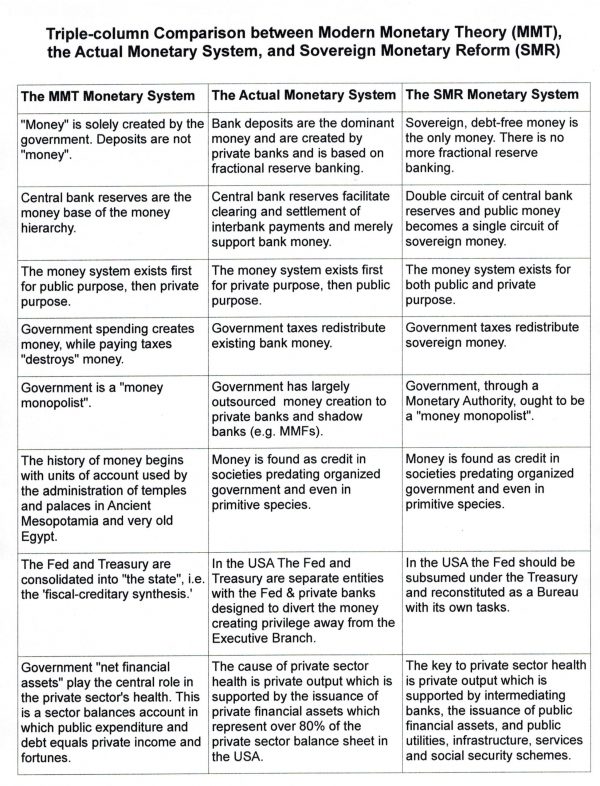
Triple-column Comparison

Triple-column Comparison between Modern Monetary Theory (MMT), the Actual Monetary System, and Sovereign Monetary Reform (SMR)


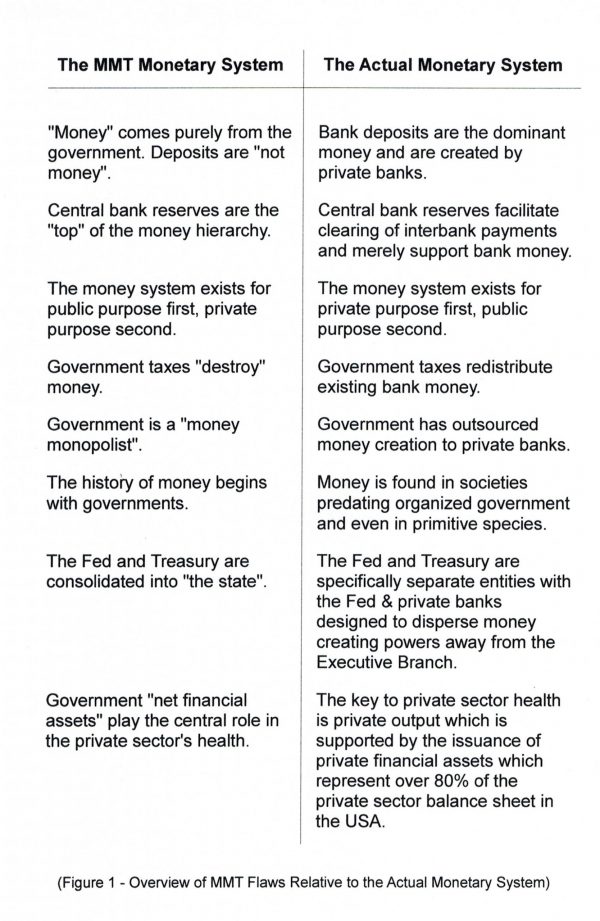
A while ago I found a very useful double-column comparison of the concept of the monetary system in Modern Monetary Theory (MMT) and how the monetary system actually functions. The figure is titled:

“Overview of MMT Flaws Relative to the Actual Monetary System”

It is a small image easily used on-line in posts and discussions and was composed by Cullen Roche in a 2013 article titled “A Critique of Modern Monetary Theory (MMT)“. Roche is the author of Pragmatic Capitalism: What Every Investor Needs to Know About Money and Finance and editor of the eponymous web site Pragmatic Capitalism.


Recently I had the idea to expand the double column into a triple one by adding the ideas and proposals by the movement proposing Sovereign Money Reform (SMR) based on what Dr. Joseph Huber calls New Currency Theory (NCT). With some help the entries were refined, corrected or paraphrased. The result is the following triple column.

I am presenting it here for anybody to use as an educational tool in the discussion about the deep flaws of MMT in order to 1) promote what we think is the correct theory of money and banking and 2) promote the necessary legislative changes which are needed to redress the deep systemic flaws of the current money regime.

To be clear, what we propose is the following triple-pronged policy proposal, which can be found on the web site of the International Movement for Monetary Reform:

We propose a transition towards a sovereign money system in which:

All official money – be it cash, money-on-account or new forms of digital currency – is created by a monetary state authority, according to the needs of the economy in a transparent and accountable process.

Money is created free of debt, and is directly spent into the economy via the state by way of government expenditure or directly distributed to the citizens as an equal dividend.

Private banks cannot create official money as credit. They only act as payment service providers and/or financial intermediaries by lending and investing existing official money, which they obtain from savers and investors.

This proposal of course is quite different of what proponents of MMT propose and that is government spending on worthy causes like the Green New Deal by allegedly creating new money and do so till the ‘slack’ is out of the economy and inflation might set in. We think that, based on our understanding how the system currently works, 1) this will lead to deficit spending because spending still has to be compensated through taxes and bonds, and 2) it unconscionably neglects to deal with the issue of money creation in the hands of private commercial banks and its disastrous consequences.

Meanwhile the American people already have a bill on the shelf to implement sovereign monetary reform and it is the 2012 H.R. 2990, the National Emergency Employment Defense Act or NEED Act. With some tweaking this bill can be adopted to solve a large chunk of the severe financial challenges the US Congress is facing to prevent the economy from collapse and citizens from bankruptcy and eviction, all in the context of the COVID-19 pandemic. Once you understand the current monetary system, one cannot but see its solution in sovereign monetary reform.


More critical posts on MMT:

Requesting Evidence for a Crucial MMT Claim

Richard Wolff’s Trajectory beyond MMT into SMR

Introduction to the Problem with Modern Monetary Theory (MMT)

Money and Banking: Assessing overlaps and differences between SMR and MMT

Modern Money Theory revisited – still the same false promise

Educational and Promotional Videos


VIDEOS ON MONETARY THEORY AND REFORM


A. TOP 12 Videos
B. Videos Produced in the Monetary Reform Movement
C. Other Monetary Theory and Reform Videos of Interest
D. Background Videos


A. TOP 12 VIDEOS

Bjerg, Ole. 2016. “Where does money come from?“ TEDxCopenhagen. 24 May 2016.

Bongiovanni, Joe. 2013. “Why Monetary Reform Must Become Your Number One Issue“. Argusfest on YouTube. 29 Sept 2013.

Dyson, Ben. 2014. “Why Our Monetary System Is Broken and How It Can Be Fixed“. Presentation at the Economy, People and Planet conference at the Copenhagen Business School (CBS). Positive Money on YouTube. 1 Oct 2014.

Grant, Victoria. “12 year old child reveals one of the best kept secrets in the world”. Public Banking Institute. 5 May 2013.

Hammon, Virginia. 2019. “How We Can Pay for a Better World: Change the Money System“. How We Pay for a Better World. YouTube. 30 Aug 2019.

Hammon, Virginia. 2020. “A Solution to the Crisis – Just Money Now!“. How We Pay for a Better World. YouTube. 21 July 2020.

Kucinich, Dennis. 2012. “The Key to Economic Recovery; Kucinich Explains Monetary Reform”. DJ Kucinich on YouTube. 8 May 2012.

Positive Money. 2011. “A Simple Solution to the Debt Crisis“. Positive Money on YouTube. 13 Aug 2011.

Positive Money. 2013. “What Is Money?“. Positive Money on YouTube. 13 May 2013.

Positive Money. 2013. “10 year old explains the truth about where money comes from…” Positive Money on YouTube. 4 Sep 2013.

Wolf, Martin. 2014. “Case for Radical Monetary Refrom“. Keynote speech at “Bridging Theory and Practice” conference organized by the Sustainable Finance Lab, Amsterdam, 14 Dec 2016. Sustainable Finance Lab on YouTube. 16 Oct 2018. (Accompanying slides)

Zarlenga, Stephen. 2009. “Nationalize the Fed: End Banks Power to Create Money”. Recorded 2 May 2009. YouTube. 22 June 2009.


B. VIDEOS PRODUCED IN THE MONETARY REFORM MOVEMENT

American Monetary Institute. Collection of Videos. American Monetary Institute on YouTube.

Boait, Fran. 2013. “How the current money system is damaging Businesses, Society and Environment“. Presentation at the Positive Money Conference, January 2013. Positive Money on YouTube. 22 Mar 2013.

Boait, Fran. 2014. “How does the money system affect Inequality, Housing & Environment?“. Positive Money on YouTube. 21 Dec 2014.

Bongiovanni, Joe. 2013. “Why Monetary Reform Must Become Your Number One Issue“. Argusfest on YouTube. 29 Sept 2013.

Bongiovanni, Joe. 2014. “Why Should GUV Borrow? Who Controls the Money?“. Economic Stability on YouTube. 25 Jan 2014.

Bongiovanni, Joe. 2017. “On Public Money: Thoughts on our Monetary Sytem, and our History of Public Money“. Presentation at the 2017 “Democracy Convention”, Minneapolis, MS. AMI on YouTube. 9 Aug 2017.

Chalmers, Patrick. 2013. “Why doesn’t the Media understand Money?“. Presentation at the Positive Money Conference, January 2013. Positive Money on YouTube. 22 Feb 2013.

Chick, Victoria. 2013. “Why don’t Economists understand money?” Presentation at the Positive Money Conference, January 2013. Positive Money on YouTube. 6 Mar 2013.

Coates, Delman. 2016. “The New Abolitionism: Monetary Reform and the Struggle for Human Rights “. Presentation at the 12th AMI Conference, Chicago, September 2016. AMI on YouTube. 12 Oct 2016.

Coates, Delman. 2017. “The New Abolitionism: Monetary Reform and the Future of Social Justice”. Presentation at the 2017 Democracy Convention, Minneapolis, MS. AMI on YouTube. 9 Aug 2017.

Dyson, Ben. 2012. “Power of Banks vs Democracy“. Positive Money on YouTube. 24 Oct 2012.

Dyson, Ben. 2013. “How to Fix Banking“. Presentation at the Positive Money Conference, January 2013. Positive Money on YouTube. 19 Feb 2013.

Dyson, Ben. 2014. “Why Our Monetary System Is Broken and How It Can Be Fixed“. Presentation at the Economy, People and Planet conference at the Copenhagen Business School (CBS). Positive Money on YouTube. 1 Oct 2014.

Eckrich, Lucille & Walsh, Steven. 2017. “Money, Schooling and Educators: Creating a Critically-Informed Movement for Monetary Reform and Ecojustice“. Presentation at the 2017 Democracy Convention, Minneapolis, MS. AMI on YouTube. 9 Aug 2017.

Eder, Jeff. 2020. “Banking for a Better World“. Progreessive Money Canada. 6 Sep 2020.

Egnatz, Nick. 2016. “On Social Justice through Monetary Reform”. Presentation at the 11th AMI Conference, Chicago, September 2015. AMI on YouTube. 27 Jan 2016.

Hammon, Virginia. 2019. “How We Can Pay for a Better World: Change the Money System“. How We Pay for a Better World. YouTube. 30 Aug 2019.

Hammon, Virginia. 2020. “A Solution to the Crisis – Just Money Now!“. How We Pay for a Better World. YouTube. 21 July 2020.

Huber, Joseph. 2016. “How The Money System Works“. Presentation at the American Monetary Institute Conference, 2016. American Monetary Institute on YouTube. 16 Dec 2016.

Kucinich, Dennis. 2012. “The Key to Economic Recovery; Kucinich Explains Monetary Reform”. DJ Kucinich on YouTube. 8 May 2012.

Kucinich, Dennis. 2009. “Dennis Kucinich addresses AMI Monetary Reform Conference Participants 2009“. Presentation at the 5th AMI Conference, Chicago, September 27, 2009. AMI on YouTube. 13 Oct 2009.

Kucinich, Dennis. 2010. “Dennis Kucinich 5 Minutes on Money on House Floor”. AMI on YouTube. 16 Aug 2010.

Kucinich, Dennis. 2010. “Dennis Kucinich speaks on the American Monetary Act in House of Representatives – Part 1”. AMI on YouTube. 8 June 2010.

Kumhof, Michael. 2019. “Banks are not Intermediaries of Loanable Funds“. Positiva Pengar on YouTube. 13 July 2019.

Positive Money. Collection of Videos. Positive Money on YouTube.

Positive Money. 2011. “A Simple Solution to the Debt Crisis“. Positive Money on YouTube. 13 Aug 2011.

Positive Money. 2012. “House Prices: Why are they so high?“. Positive Money on YouTube. 18 Sept 2012.

Positive Money. 2012. “Why is there so much Debt?“. Positive Money on YouTube. 24 Oct 2012.

Positive Money. 2013. “What Is Money?“. Positive Money on YouTube. 13 May 2013.

Positive Money. 2013. “Inequality: Why are the rich getting richer?“. Positive Money on YouTube. 2 Aug 2013.

Positive Money. 2013. “10 year old explains the truth about where money comes from…” Positive Money on YouTube. 4 Sep 2013.

Positive Money. 2014. “Could These 3 Simple Changes to Banking Fix the Economy?” Positive Money on YouTube. 16 Jan 2014.

Positive Money. 2014. “How to waste £445 billion? (The Failure of Quantitative Easing)“. Positive Money on YouTube. 27 June 2014

Positive Money. 2014. “Banking 101“. 6 Videos. Positive Money on YouTube. 30 June 2014.

Positive Money. 2019. “It’s the banks, stupid“. Positive Money on YouTube. 8 Aug 2019.

Melor, Mary. 2010. “Money is Us: The Social and Public Nature of Money“. Presentation at the Positive Money Student Conference on Monetary Reform and Fractional Reserve Banking. In three parts. Positive Money on YouTube. 14 Dec 2010.

Morris, Miriam. 2013. “How to change the money system“. Presentation at the Positive Money Conference, January 2013. Positive Money on YouTube. 12 Mar 2013.

Poteat, Robert. 2010. “The Case for Monetary Reform“. Presentation at the 6th Annual AMI Conference, Chicago, September 2010. AMI on YouTube. 14 Oct 2010. [Not complete]

Switzer, Howard. 2017. “Climate Change and Money: Hacking at the Root“. Presentation at the 2017 Democracy Convention, Minneapolis, MS. AMI on YouTube. 14 Aug 2017.

Turner, Aidar. 2015. “A new era for monetary policy“. Positive Money on YouTube. 17 Feb 2015.

Walton, Jamie et al. 2017. “On Public Money: The Need Act“. Presentation at the 2017 Democracy Convention, Minneapolis, MS. AMI on YouTube. 26 Aug 2017.

Zarlenga, Stephen. 2009. “Nationalize the Fed: End Banks Power to Create Money”. Recorded 2 May 2009. YouTube. 22 June 2009.

Zarlenga, Stephen. 2010. “AMI’s Purpose, Objectives and Methodology“. Presentation at the 6th Annual AMI Conference, Chicago, September 2010. AMI on YouTube. 13 Oct 2010.

Zarlenga, Stephen. 2010. “Introduction to The American Monetary Institute “. AMI on YouTube. 4 Jan 2010.


C. OTHER MONETARY REFORM AND THEORY VIDEOS OF INTEREST

Altraide, Dagogo. 2017. “Who Controls All of Our Money?“. ColdFusion on YouTube. 11 June 2017.

Altraide, Dagogo. 2020. “How is Money Created? – Everything You Need to Know.”. ColdFusion on YouTube. 8 June 2020.

Anon. “Solutions Unincorporated – My Name Is William”. Interview with William Abram. D See Video Productions. 4 Feb 2013.

Anon. 2012. “Where does money come from? Waar komt geld vandaan? Var kommer pengarna ifrån?” Vastgoedzeepbel, 21 Nov 2012. .

Anon. 2013. “Hitler finds out how money is created“. Ville livarinen. 18 Sep 2013.

Bjerg, Ole. 2016. “Where does money come from? “ TEDxCopenhagen. 24 May 2016.

Brown, Ellen. 2016. “Taking Back the Money Power: The Public Option in Banking“. (Q&A). Argusfest on YouTube. 13 Nov 2016.

Bruce, Jim. 2013. “Money for Nothing: Inside the Federal Reserve“. Liberty Street Films. 7 June 2013.

Conference videos: The Future of Money – 10 years after Lehman and Nakamoto. November 2018, Frankfurt, Germany. Frankfurt School of Finance and Management.

Conference videos: The Future of Money – Central Bank Digital Currency and Beyond. 15 June 2019, Stockholm, Sweden. Positiva Pengar

Corbett, James. 2014. “Century of Enslavement“. The Corbett Report. 11 July 2014.

Dalio, Ray. 2013. “How The Economic Machine Works“. YouTube, 22 Sept 2013.

Desan, Christine. 2011. “Booms and Busts: The Legal Dynamics of Modern Money “. OpenCulture.com, 12.

Desan, Christine A. 2013. “Modern Money & Public Purpose 5: Constitutional History ”. Presentation at seminar, “Money, Democracy and the Constitution: Revolutionary Experience in the United States”. Modern Money Network. 16 Mar 2013.

Desan, Christine. 2017. “The Dollar as a Democratic Medium: Making Money a Currency of Social Justice ”. HLS Thinks Big, 23 May 2017.

Graeber, David. 2017. “Where Did Money Really Come From? ”. YouTube. 17 Oct 2017.

Grant, Victoria. “12 year old child reveals one of the best kept secrets in the world”. Public Banking Institute. 5 May 2013.

Horwath, Mike & Oswald, Michael. 2012. “97% Owned – Economic Truth documentary – How is Money Created “. Documentary. Independent POV. YouTube. May 1 2012.

Huber, Joseph. 2018. “Vollgeld – Yes, Implementing a Sovereign Money System“. Presentation at “Our Money, Our Banks, Our Country – Money Creation in the Modern Economy” conference by The Monetary Institute, Zürich, February 2018. The Monetary Institute on YouTube. 23 April 2018.

Klein, Manuel et al. 2018. Conference videos and papers. Berlin, Germany: Monetative. 24 Nov 2018.

Kotlikoff, Larry. 2018. “Why I Support Sovereign Money“. Presentation at “Our Money, Our Banks, Our Country – Money Creation in the Modern Economy” conference by The Monetary Institute, Zürich, February 2018. The Monetary Institute on YouTube. 23 April 2018.

Kumhof, Micheal. 2013. “The Chicago Plan Revisited “. London School of Economics and Political Science (LSE). 22 Nov 2013.

Monetary Institute. Collection of Presentations. From “Our Money, Our Banks, Our Country – Money Creation in the Modern Economy” conference by the Monetary Institute, Zürich, February 2018. The Monetary Institute on YouTube.

Niepelt, Dirk & Rimkus, Ron. 2016. “Contemplating the End of Fractional Reserve Banking in Switzerland”. CFA Institute.

Orrrefur, Samuel K. et al (Eds.). 2019. “The Future of Money: Central Bank Digital Currency and Beyond “. Conference videos. Stockholm: Positiva Pengar. 15 June 2019.

Oswald, Michael. 2014. “Princes of the Yen: Central Banks and the Transformation of the Economy”. Documentary. Independent POV. YouTube. 4 Nov 2014.

Oxley, James. 2014. “Money creation in the modern economy – Quarterly Bulletin Article”. Bank of England on YouTube. 12 Mar 2014.

Oxley, James. 2014. “Money in the modern economy: An introduction – Quarterly Bulletin Article”. Bank of England on YouTube. 12 Mar 2014.

Permanent Commission on Finance. 2015. “Round table conversation on the money system“. Hearing at the Permanent Commission on Finance of the Second Chamber of the States General of the Netherlands. Troelstra Hall. 14 Oct 2015.

Public Banking Institute. Collection of Videos. Argusfest on YouTube.

Rosenblith, Alan. 2009. “The Money Fix – A Documentary for Monetary Reform ”.

Still, Bill. 2013. “Jekyll Island: The Truth Behind The Federal Reserve“. YouTube, 7 April 2018.

Titus, John. 2019. “Mommy, Where Does Money Come From?“. BestEvidence on YouTube. 15 April 2019.

Vollgeld Initiative & Studierende für die Freiheit & Hayek Club. 2017.“Monetary reform and the future of money”. Panel discussion at the University of Zürich.

Vrabel, Damon. “Renaissance 2.0 – the Rise of Financial Empire”. csper.org. 9 Jan 2012.

Vrabel, Damon.”Debunking Money – The Way the World Really Works”. csper.org. 10 Jan 2012.

Werner, Richard. 2018. “Today’s Source of Money Creation“. Presentation at “Our Money, Our Banks, Our Country – Money Creation in the Modern Economy” conference by The Monetary Institute, Zürich, February 2018. The Monetary Institute on YouTube. 23 April 2018.

Wortmann, Edgar. 2015. “Verkenning van de monetaire werkelijkheid [Exploring Monetary Reality]”. In English. Presentation at the University of Leiden. In two parts. (part 1); (part 2).

Wolf, Martin. 2014. “Stop banks from creating money“. Presentation at “Does Money Grow on Trees?” event, 9 Sept 2014. Positive Money on YouTube. 14 Oct 2014.

Wolf, Martin. 2014. “On Radical Reform for the Global Financial System“. Presentation at the New York Council on Foreign Relations, 17 Oct 2014. Council on Foreign Relations on YouTube. 17 Oct 2014.

Wolf, Martin. 2014. “Case for Radical Monetary Refrom“. Keynote speech at “Bridging Theory and Practice” conference organized by the Sustainable Finance Lab, Amsterdam, 14 Dec 2016. Sustainable Finance Lab on YouTube. 16 Oct 2018. (Accompanying slides)

Bilderberg, Beyond the Taboo

© Peter Edel, 2020

The Dutch King, the Prime Minister, and a Minister
associated themselves withan anti-democrat
who financed right-wing extremists.

At the beginning of June of this year, a tradition was missing: the Bilderberg conference. The annual gathering of the elite from politics, business, the media and science has been postponed for the time being. ‘The meeting 2020 is postponed’ read the short statement on the opening page of the official Bilderberg website. Probably has everything to do with the corona crisis; there are regular visitors who, given their age, certainly belong to the risk group. For example, the invariably present Henry Kissinger, who, at the age of 97, still carries around him his crimes during the Vietnam War.

If postponement leads to cancellation, it is the second time that a conference has been called off since Bilderberg started in 1954. The first time was in 1976, in the middle of the Lockheed bribe scandal in which then-chairman HRH Prince Bernhard of the Netherlands was deeply involved.

It looks like we will not hear about Bilderberg in the media this summer. Not a very big loss, because the reports about the infamous annual meeting generally amount to little, with one of the few exceptions in this century being an episode of Andere Tijden from 2003. Furthermore, the media limits itself to the observation that there are links between Bilderberg and the Dutch royal family, that the conference is veiled in secrecy, and that conspiracy theorists love it. The Dutch language area does not get to hear much more about it than that.

This is a taboo that also applies to politics. Parliamentary questions from 2008 by former Socialist Party Member of Parliament Harry Van Bommel about Bilderberg were recently labeled as a conspiracy theory, while what Van Bommel brought up referred to nothing conspiratorial. But whoever mentions Bilderberg is simply lumped together very quickly with conspiracy buffs. Then, what exactly is said, no longer matters.

This article ignores the taboo that rests on Bilderberg, without connecting in any way to the usual conspiracy theories in this area.

Cyber Industry

What is Bilderberg actually? The initiators wanted to give American and European representatives from politics, business, the media and academia the opportunity to exchange ideas as private citizens without having to fear that their opinions would be aired in public.

The premise implies secrecy, although something will be made public. Since 2000, Bilderberg has placed a list of invitees on its website and a list of the key topics to be discussed. Afterwards, however, nobody explains anything and you have to guess what was discussed.

What is striking on the list of participants is that nowadays the cyber industry has gained a firm foothold within Bilderberg. Last year in Montreux, this was also reflected in the discussion topics, such as The Weaponization of Social Media and Cyber Threats.

In 2019, former Google CEO Eric Schmidt and Jared Cohen, CEO of Jigsaw, Google’s technology incubator, received an invitation. In addition, Satya Nadella, the CEO of Microsoft and Mustafa Suleyman, the co-founder of the artificial intelligence company Deepmind, were also invited. The same goes for LinkedIn and PayPal founder Reid Hoffman.

Another PayPal founder was also present last year: German-born American Peter Thiel. This article is mainly about this Bilderberger, billionaire, venture capitalist, libertarian and contrarian, because he is a prominent exponent of the cyber sector within Bilderberg, but also mainly because he stands head and shoulders above his cyber colleagues in terms of controversial antecedents.

Thiel is not just any Bilderberger either. He has been there for twelve years, an ‘honor’ that few have. You have to carry the name Oranje, Kissinger or Rockefeller for that (although that family has not been represented since the death of David Rockefeller in 2017). More tellingly, Thiel joined Bilderberg’s steering committee, which is an important position within the structure of the organization. In other words, Thiel belongs to the inner circle. As the name indicates, the steering committee determines the course of Bilderberg. It “assists” with tasks such as raising funds to make the conference possible, but especially also with the important selection of invitees.

Peter Thiel

After PayPal was acquired by eBay in 2002, Peter Thiel invested in Facebook, where he also joined the board of directors. Around the same time he started Palantir. One of the branches of this company, Palantir Gotham, supplies software to security services with which large amounts of data and systems to which, for example, number plate and face recognition are linked. Palantir claims not only to be able to solve crimes, but even to predict them.

The downside is that, according to critics, Palantir’s collecting of personal data is on a shaky footing with the (human) right to privacy. In other words: when you drive under a traffic light in a city where Palantir provides services to the police, Thiel knows that.

In the US, Palantir also supplies software to the Immigration and Customs Enforcement (ICE). Thiel’s company thus commits itself to the raids by ICE on undocumented immigrants and to the human rights violations that accompany it, such cages as with locked-up children. This led to protests among some Palantir employees.

Like Bilderberg, Palantir is also surrounded by secrecy. This is evident from the collaboration that the company started in 2012 with the New Orleans Police. The mayor of this American city knew about it, but the city government was kept out, which led to criticism. Under pressure New Orleans ended its partnership with Palantir six years later.

Palantir is not only represented within Bilderberg by Peter Thiel. The CEO of Palantir, Thiel’s college friend Alex Karp, will also be there. And not only that, because like Thiel, Karp also joined the steering committee of Bilderberg.

Startups

Peter Thiel, who may have taken refuge in New Zealand during the corona crisis, provided grants to numerous startups through his Founders Fund. They are usually in the cyber sector, but not always. Thiel, for example, donated seven million dollars to a project that was to lead to the development of a drug against herpes. He also came under fire because the project ignored the Food and Drugs Administration (FDA) guidelines for experiments with newly developed drugs. Thiel responded in a typical way: he opened an attack on the FDA.

Actually, more money went from Thiel to startups with a questionable character. Such as to Tlon, the producer of the computer program Urbit. Tlon was founded by Curtis Yarvin, who is not only a software developer, but also became known as the founder of the philosophy behind the far-right movements neo-reactionism and dark enlightenment. Through his website Unqualified Reservations Yarvin thus gained influence in general on the more developed circles within the far right in the US and in particular on the Alt Techies within the underbelly of Silicon Valley.

Neoreactionism

Yarvin’s neo-reactionism is equivalent to reactionism covered with a bit of cyber sauce. He rejects the ideas of equality, human rights and democracy arising from enlightenment thinking. He preferred to see the world return to the pre-enlightenment situation. Including feudalism and monarchism, on the understanding that Yarvin would prefer to draw the new monarchs from the ranks of CEOs of tech giants. He would also prefer to place the administration of the US in the hands of a CEO, a principle that he attaches rather incoherently to the ancient form of government cameralism.

Yarvin’s neo-reactionism shows affinity with traditionalism, such as that of the Russian ultra-nationalist Alexander Dugin. The latter harks back to the Italian traditionalist and ‘super fascist’ Julius Evola, whose thoughts can be found back in Yarvin. In addition, neoreactionism is a form of palingenesis (rebirth), the harking back to the glory of a bygone era, which is considered an aspect of fascism by political theorist Roger Griffin.

Yarvin’s views are shocking. The Norwegian mass murderer Anders Breivik failed, according to Yarvin, because his attack was “insufficient to liberate Norway from European communism.” Apparently, the 77 murders on Breivik’s conscience did not go far enough for Yarvin.

The Education of a Libertarian

In Thiel’s defense, it could be argued that he only decided to subsidize Yarvin because Tlon / Urbit is innovative in internet technology. However, relations between Thiel and Yarvin go further than a business relationship. Plus, Yarvin isn’t the only cyber-fascist to receive funding from Thiels Founder Fund. The Machine Intelligence Research Institute received money from the same direction when the transhumanist and eugenicist Michael Anissimov was the media director there. The same goes for Patri Friedman (the grandson of economist Milton Friedman) of the Seasteading Institute. Anissimov and Friedman, like Curtis Yarvin, are known as neo-reactionaries.

It may go too far to call Thiel himself a neo-reactionary, but there is certainly an ideological affinity. For example, in The Education of a Libertarian, like Yarvin, he spoke out against democracy. “Most importantly, I no longer believe that freedom and democracy are compatible”, he wrote in 2009, the year after his first appearance at Bilderberg. He never rescinded it.

Like Yarvin, Thiel sees CEOs, especially CEOs of tech companies, as the new monarchs. He said said: “We just do not call them monarchies in public, anything that’s not democracy makes people feel uncomfortable.”

The Diversity Myth

Another unpleasant fact about Thiel is his co-authorship of the book The Diversity Myth: Multiculturalism and Political Intolerance on Campus, published in 2016, in which multicultural policy of universities was criticized and date rape en passant was dismissed as “belated regret”. It took twenty years, but unlike his aversion to democracy in The Education of a Libertarian, he did come back to this idea in 2016.

Thiel did so in a statement sent to Forbes. “Rape in all forms is a crime” he wrote. He also expressed regret about insensitive, crudely argued statements in the book. But as Forbes‘ Ryan Mac put it, Thiel was vague about exactly what he meant by that. Mac did not explicitly blame Thiel for rejecting the 1996 criticism of multicultural policies.

Trump

Peter Thiel is good friends with US President Donald Trump. He donated $1.25 million to his election fund and was later also part of Trump’s Transition Team. According to the British newspaper The Guardian, Trump is “the fulfillment of Thiel’s desire to build a successful political movement for less democracy.”

Especially given Trump’s weakness with regard to the corona crisis, his re-election is no longer as self-evident as previously assumed. However, Thiel has deployed a new weapon to support his friend in the White House: HHS Protect Now, software developed by Palantir that could efficiently map the spread of the coronavirus.

It is unclear exactly how it works, so the mystery surrounding Palantir also remains here. Partly because of this, it is necessary to wait and see whether conditions regarding privacy will be respected. There is certainly concern about this in the American media.

Confrontations

Last year at the Bilderberg conference there were also guests of a completely different order from Peter Thiel. Such as the American historian Timothy D. Snyder, who specializes not only in the Nazi Holocaust, but also in Eastern Europe. The fact that he was invited must have had everything to do with the discussion theme Russia, although he is also known for his heavy criticism of Donald Trump.

By inviting Snyder, the steering committee planted the seeds for a fierce confrontation with Jared Kushner, Trump’s son-in-law who was there last year in Montreux, but especially with Thiel. We will probably never know whether that confrontation really happened due to the proverbial secrecy surrounding Bilderberg, but the author of this article would have liked to have been there …

Also because another confrontation was lurking in 2019. Thiel is nowadays not welcome at Google, which fielded last year, as previously described, a number of representatives to Bilderberg. A month after the conference, Thiel accused Google of being infiltrated by Chinese military.

“How many foreign intelligence agencies have infiltrated Manhattan Project for AI?” he said. By Manhattan Project for AI, he referred to the artificial intelligence-focused company Deepmind, which was founded by the aforementioned Mustafa Süleyman and was acquired by Google in 2014 – although Thiel himself also invested in it.

China was also one of the key topics at Bilderberg last year. Also keep in mind the trade war that Thiel’s friend Trump unleashed against China.

Facebook / Cambridge Analytica

Back to Timothy Snyder. In one of his videos on YouTube, he calls the image of Donald Trump as a successful businessman a myth. The fact that this image could nevertheless arise, according to Snyder, is mainly due to a lot of Russian money and efforts on social media, such as via Facebook.

Facebook was at the center of the 2018 scandal surrounding Cambridge Analytica (CA), the British / American data mining company that used data on many millions of Facebook users to influence both the British Brexit referendum in 2016 and the US Presidential election of the same year.

The outrage over CA’s manipulations was enormous. And that did not decrease after Netflix released the documentary The Great Hack about it. Andrew Adonis a member of the British House of Lords on behalf of Labor, who was also present at Bilderberg last year, made no bones about it: “Cambridge Analytica was hired to wage a giant, illegal ‘psy-ops’ campaign for the 2016 (Brexit) referendum & it’s amazing there haven’t yet been more prosecutions.”

Wylie

Peter Thiel knows CA’s primary financier, Trump and Brexit supporter Robert Mercer. In any case, reports appeared that he wanted to start a conservative news channel with Mercer. However, it is mainly Palantir that linked Thiel to CA.

This is how it emerges in the book Mindf*ck by former CA employee and later whistleblower Christopher Wylie. According to Wylie, the contacts between CA and Palantir came about at the initiative of an intern who worked at Strategic Communications Laboratories (SCL), the company from which CA originated. This Sophie Schmidt is the daughter of the former CEO of Google and last year Bilderberger, Eric Schmidt.

Wylie learned from his boss at CA, Alexander Nix, that Palantir had access to data on millions of US citizens. Equally interesting is that Palantir employee Alfredas Chmieliauskas joined CA to work on the development of the This Is Your Digital Life app, a personality test aimed solely at harvesting data about Facebook users. Thiels Palantir initially denied any connection, but later admitted that Chmieliauskas worked for CA.

Russia

There are also the Russian connections that can be made from CA. Steve Bannon is the former strategist of Donald Trump, editor of the far-right website Breitbart, alleged contact of Thiel-subsidized Curtis Yarvin, and co-founder of CA. Bannon showed his respect for the aforementioned Alexander Dugin, the Russian ultra-nationalist who has a lot of influence within the Kremlin and on the Russian armed forces.

Bannon and Dugin disagree when it comes to capitalism, for example, but the differences between them virtually disappear in light of the shared tendency to traditionalism; the traditionalism that Curtis Yarvin is also familiar with. According to The Nation, Bannon and Dugin had a secret meeting in 2018.

The information collected by CA about Facebook users also went to Russia, according to Christopher Wylie. CA employee Alexander Kogan, who, like Palantir employee Alfredas Chmieliauskas, was involved in the app that harvested data from Facebook users, was also working on a Russian-funded study into ‘Stress, health and psychological wellbeing in social networks.’ At the time, Kogan was affiliated with the University of Cambridge, but also with the University of Saint Petersburg.

CA also hired US political consultant Sam Patten. At the time, Patten was working with the Russian Konstantin Kilimnik, a former agent of the Russian intelligence service GRU. According to Wylie, Patten insisted that he had not transferred information from CA to Kilimnik. But Kilimnik got information about election polls in the US anyway, even if it came from Donald Trump’s former campaign chief Paul Manafort. Sam Patten and Konstantin Kilimnik worked in Ukraine for Manafort, which, as is known in the US, was sentenced to imprisonment, among other things for illegal services to the pro-Russian Ukrainian government of Viktor Yanukovych.

Facebook / Milner

Also, in the CA manipulations so essential to Facebook, one can note a Russian connection. In 2009, Russian / Israeli billionaire Yuri Milner invested many millions in Facebook, where Peter Thiel was already on the supervisory board at that time.

After the Paradise Papers were unveiled, it turned out that this investment had traveled a complicated route, but initially came from Gazprom, the Russian energy company in which the Russian state has a majority stake. In 2009 relations between the US and Russia were still different than they are today, but it was inevitable that Gazprom’s investment in Facebook through Milner received attention after the Russian manipulations in the US of 2016 came to light.

Yuri Milner also invested in Cadre, a company co-founded by Jared Kushner, Donald Trump’s son-in-law who, as we saw earlier, was also present at Bilderberg last year. Other investors in Cadre besides Milner include Goldman Sachs, George Soros (odd given his aversion to Trump) and Peter Thiel.

The connection with Russian interests that Peter Thiel acquired through the contacts between Palantir, CA and Facebook is a bit contrary to Bilderberg’s traditional Transatlantic orientation.

Personal capacity

In short, during last year’s Bilderberg conference, HRH Willem Alexander, Prime Minister Rutte and Minister Kaag, associated themselves with someone whose company was guilty of human rights violations, financed right-wing extremists, considered freedom incompatible with democracy, criticized multicultural policies and who also had a whiff of vodka.

The King, Prime Minister and Minister were at Bilderberg in their personal capacity but how much difference does that really make? Is there no problem when they become personally associated with an anti-democratic element?

If such a thing had happened at another meeting, the Netherlands would probably have been too small, but when it takes place at Bilderberg, no journalist makes a point of it – although the question is how many Dutch journalists fully understand the connections outlined above . . .

Nor did the political world get excited about it. Perhaps for the same reason, although according to an anonymous source well known in political The Hague, it is possible that a presence at Bilderberg here is regarded as the icing on the cake of a political career. In other words, according to this source, there are MPs who are reluctant to criticize Bilderberg because they secretly hope to be invited themselves. The fact that Member of Parliament on behalf of Groen Links Kathalijne Buitenweg was one of the participants of Bilderberg last year is one of the indications that this does not only apply to right-wing politicians.

So probably there will not be a Bilderberg in 2020. And its absence creates space to think carefully about this tradition of conferences.

This article has been brought to the attention of the Bilderberg media team before publication, with an offer to include a possible response. However, they waived that.

Source

This article was originally published in Dutch by Peter Edel on the Belgian on-line site De Wereld Morgen (The World Tomorrow) titled “Bilderberg: voorbij het taboe!” on 15 June 2020. Google was so kind to translate it into English with final edits by Govert Schuller. All done with the permission of the author.

Peter Edel is a Dutch analyst and investigative journalist from Amsterdam. He is the author of De Schaduw van de Ster (The Shadow of the Star, 2002); Banvloek (Anathema, 2003); and De diepte van de Bosporus, een politieke biografie van Turkije (The Depth of the Bosporus: A political biography of Turkey, 2011).

On Trump: More on Alex Jones


Into the Grove

In quite some ways the following is an instructive story. In July 2000 Alex Jones, Mike Hanson and British journalist Jon Ronson infiltrated the yearly Bohemian Grove gathering of very wealthy and well-connected people just north of San Francisco. They dressed up as preppy, casual CEOs and slipped into the estate with hidden cameras without anybody being suspicious. On the first evening they witnessed and recorded a ritual named the Cremation of Care which symbolized the start of the two week gathering. Men were dressed in robes with hoods and sacrificially burned something they called Dull Care in front of a big stone owl accompanied by music.

In Ronson’s telling of the story, when they returned to their motel room that evening and watched the tape, Jones made the case that it was an occultic sacrifice of a human effigy, some sort of “bizarre Luciferian garbage”, and made other remarks to interpret the ritual in the most dark manner possible.

Ronson was less alarmed and thought they were merely burning “a symbol of their troubles so they can enjoy their bloody summer holiday”. When Jones insisted, Ronson called him out, actually yelled at him, for projecting onto this gathering acute dangers in the same way the government projects danger on other people with sometimes lethal consequences.

“YOU’RE DOING TO THEM EXACTLY WHAT THEY DID TO RANDY WEAVER AND DAVID KORESH.  . . . YOU’RE PUTTING TWO AND TWO TOGETHER AND MAKING FIVE!”

The moral of the story is that Jones just wants to see dangers and makes intentionally skewered, conspiricist interpretations of things which by themselves might be quite innocent. Then his threat perception is so overblown, it triggers very emotional conspiranoid and aggressive reaction patterns, even leading him now in the arms of Trump.

Though he does direct attention to some under-reported issues and employs the Watson brothers, whose reporting seem to be factual, the way Jones goes about it is not very helpful to make real reform and changes possible. Trump and Jones deserve each other, but the US deserves something far better.

Meanwhile reptilian-detector David Icke thinks that real human sacrifices happen at the Bohemian Grove and that the stone owl stands for Moloch.

On the opposite side of the spectrum lies the statement the Bohemian Grove provided to Jonson about what they think they do: “The cremation of care is a musical and verse pageant heralding a two week midsummer escape from business cares and celebrating nature and good fellowship. As grand scale stage drama it may be a bit overdrawn, but it’s about as innocent as anything could be”.

Sociology of the Grove

In between one can find a more sociological assessment of this gathering by G. William Domhoff, a student of C. Wright Mills and long-time researcher of the US upper class and its executive branch, the power elite. Domhoff used his study of the Bohemian Grove to further make his case that a distinct upper class of about 1% of the population really exists and that its summer gatherings serve the social cohesiveness of their class.

At a political level the Bohemian Grove is one of the many organizations in the US where consensus-seeking and policy-planning occurs by the leaders of corporations and banks on class-related issues. But this “high-status summer resort” is not the primary organization for policy planning. That is done at the more specialized organizations like the Council on Foreign Relations and the Committee for Economic Development.

In short, the Bohemian Grove is not a satanic cult of the puppet masters of the world sacrificing babies, and it is neither an innocent midsummer escape for the rich. Its function is for members of the upper class to bond with each other and smooth over policy differences.

Because many of these policies exploit and hurt untold other people these gatherings have to be researched, exposed and countered. Alex Jones both contributed and hindered that process. Through him many people now know about the Bilderberg Group and the Bohemian Grove, but his hot-headed, conspiricist interpretations of what goes on there darken the minds of his audience, many of whom might have even drifted off further and fell for the utterly bizarre fantasies of QAnon.

Only a good dose of careful social science might counter that trend and the work by Domhoff is crucial to arrive at a nuanced insight of the power elite.

At the same time, and very unfortunately so, a large part of the US electorate might already be in a dangerous phase of ramped-up emotions and in serious denial of facts, reasoning and science. This hysteria, coupled with a tendency towards authoritarianism, became amplified by a psychopathic politician, or pathocrat, now sitting in the White House.

To what level of intensity and destructiveness this might lead is unknown, but the signs are not good. Mix in the pandemic and the fight for racial justice and you might end up with something explosive. For the sake of the health of the US body politique this pathocrat has to be impeached or voted out and made harmless. Some experts expect that, once he is out, many people will come back to their senses and America can assess and repair the extensive damages.

Sources

Domhoff, G. William. 1974. The Bohemian Grove and Other Retreats: A Study in Ruling Class Cohesiveness. New York: Harper & Row. Abbreviated text.

Ronson, Jon. 2001. “The Satanic Shadowy Elite?” Part 4 of “Secret Rulers of the World”. Documentary. World of Wonder Productions, 20 May 2001.

Ronson, Jon. 2001. “The Bilderberg Group“. Part 5 of “Secret Rulers of the World”. Documentary. World of Wonder Productions, 27 May 2001.

Ronson, Jon. 2002. Them: Adventures with Extremists. Book. New York: Simon & Schuster, 2002.

Frontline. 2020. “Alex Jones and Donald Trump: How the Candidate Echoed the Conspiracy Theorist on the Campaign Trail“. Frontline, 28 July 2020.

Willimon, Beau, et al. 2013. House of Cards. The Complete Fifth Season.
The Bohemian Grove is the inspiration for the “Elysian Fields” in season 5.

The Operative Assumptions in Theosophy

If Theosophy is taken as a synthesis of science, philosophy and theology, together with its stated objectives of open dialogue, comparative investigation and experimentation, there will be a lot of room to overcome its own articles of faith, which in spite of its professed anti-dogmatic, free-thinking, non-partisan persona, are quite prevalent.

For example there are the Mahatmas as Theosophy’s collective God, the ever so interesting Helena Blavatsky as Their messenger and The Secret Doctrine as its Bible. Because of the strong intellectual, Buddhist and scientific elements within Theosophy the just enumerated sacred objects can be easily de-constructed. The Mahatmas are not unlike Zen masters, who can only point the way; Blavatsky was an advanced, but fallible, student; and The Secret Doctrine is no more than an interrelated set of hypotheses to be experimentally tested.

But after more than 125 years Theosophy needs to be updated with an integration of the latest breakthroughs in science, philosophy and theology. It will not suffice to deepen the understanding, as Theosophy can bring, of trans-personal psychology, or quantum mechanics, or existentialism, or history, or, as is often done, to merely recognize similarities between Theosophy and these investigations and be self-congratulatory satisfied with the congruencies. The real work lies in a more active attempt at integration of the most developed positions within science, philosophy and theology.

Personally I see a great potential in the integration of the very encompassing hypothesis of morphogenetic fields and morphic resonance as developed by Rupert Sheldrake (science), the epistemological and existential ideas coming out of the phenomenological movement (philosophy) and the spiritual philosophy of Krishnamurti (theology, if I may say so).

If this program is feasible is for now not clear as nobody has yet tried it. And such a trial might find the following obstacles: 1) Sheldrake’s hypothesis, now almost 40 years since its publication, has not fared well; and 2) the relationship between Krishnamurti and Theosophy might be more contradictory than assumed. 

Personal note lifted and extended from a paper titled “The Tacit Dimension operative in Phenomenology“.