The NEED Act Erases Big Steel’s Claimed Need for Worker Concessions

What do infrastructure repair and a looming steel strike have in common?

The American Society of Civil Engineers 2013 Infrastructure Report Card says $3.6 trillion needs to be spent by 2020 to bring our infrastructure up to modern standards. Congress has been quite clear that it will neither increase taxes or borrowing to accomplish this.

Fixing our infrastructure would put 10 million Americans to work at good-paying jobs and increase our global economic competitiveness.  It requires steel, thus negating management’s argument that demand is down and concessions are necessary.

SteelIndustry2

Management and labor, in both steel and construction industries, should support the only proposal that would fund the repairs.  The NEED Act is comprehensive monetary reform legislation that creates 10 million new, good-paying jobs by fully funding the Infrastructure Report Card, all without increasing taxes or borrowing.  Congress Members of both political parties should be lining up to support the bill, instead they can’t even fix the potholes.

Incredibly, management, labor and Congress have almost all, universally ignored the NEED Act.  Ignored the only proposed legislation that not only puts 10 million Americans to work and rebuilds our nation’s infrastructure, but also provides a bail-out for the poor, working class, small businesses and beleaguered state and local governments.

The NEED Act (National Emergency Employment Defense Act) was put before Congress in 2011 by Congressman Dennis Kucinich and co-sponsor John Conyers.

The 3 Necessary Monetary Reforms of the NEED Act:

1. Makes the Federal Reserve System part of our government, exactly what most people mistakenly believe it is now.

2. Decisively ends all bank creation of money as debt.  Banks will only loan money that already exists, exactly what most citizens mistakenly believe they do now.

3. Our federal government creates and spends new US Money for the needs of the nation and its people, as determined by Congress, in non inflation/deflationary amounts.

Acclaimed Economics Professor Karou Yamaguchi put the reforms that became the NEED Act into his advanced system dynamics computer model and concluded that the ASCE infrastructure modernization could be done, while simultaneously paying off the federal debt, without any inflation.  “Workings of a Public Money System of Open Macroeconomics — Modeling the American Monetary Act Completed”

Former head of the Modeling Division of the International Monetary Fund Dr. Michael Kumhoff and Dr. Jamomir Benes reached the same basic conclusion in their IMF Working Paper “The Chicago Plan Revisited”.

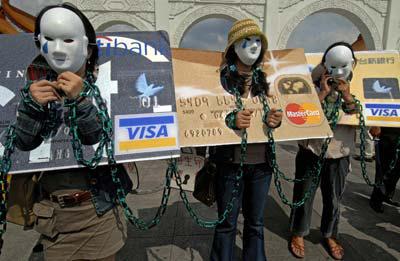
The recovery within the present system from the Financial Crash of 2008 has given us a real unemployment rate of 23% (ShadowStats.com),  the replacement of 2 million high and mid paying jobs with 2 million low paying jobs (National Employment Law Project) and 91-95% of all income gains going to the richest 1% (Emanuel Saez, “Evolution of Top Incomes in U.S.“).  The debt money monetary system responds to the crisis by helping the wealthiest.  Only the NEED Act helps the American people.

SteelIndustry1

Elected government representatives, union leaders and corporate decision makers should all educate themselves on monetary reform and the NEED Act before workers are locked out or a strike is called.  The American Monetary Institute’s 11th Annual Conference on Monetary Reform in Chicago, Sept 10-13, 2015 (monetary.org) is the perfect place for management, labor and government to come together.  All are invited to attend and learn how monetary reform can pay for jobs, infrastructure,  education and healthcare.

Nick Egnatz

occupynick@yahoo.com

References

“USW says it won’t strike yet as contract expiration nears“. Karren Caffarini, Chicago Tribune. Aug 28, 2015.

The NEED Act (National Emergency Employment Defense Act)

American Monetary Institute

American Society of Civil Engineers 2013 Infrastructure Report Card

The original NEED Act referenced the 2009 Infrastructure Report Card and would have created 7.2 million new jobs.  The 2013 ASCE Report Card calls for additional repairs and money and thus would create 10 million jobs. FACT SHEET: Congressman Kucinich’s Jobs Bill to Secure America’s Financial Sovereignty: The Debt Stops Here

Karou Yamaguchi “Workings of a Public Money System of Open Macroeconomics — Modeling the American Monetary Act Completed”

Jaromir Benes & Michael Kumhof, IMF Working Paper “The Chicago Plan Revisited”

John Williams, Shadow Government Statistics

The National Employment Law Project, “The Low Wage Recovery”

Emanuel Saez, “The Evolution of Top Incomes in the United States [2012]” and for 2013.

An Open Letter to Greens & Progressives

By Nick Egnatz
There is certainly much to like in Jill Stein’s Power to the People Plan, yet it will fail to create the “deep system change” it calls for unless it endorses Monetary Reform (Greening the Dollar) in the Green Party Platform, voted on and adopted by the Green Party National Committee. 
 
“Deep system change” requires a decisive end to the bank creation of money.  Putting the power to create our money with our Congress, as the Constitution states, is the only way forward to democracy. 
 
“Deep system change” starts with comprehensive monetary reform.  The problem with our monetary system is that banks create almost all of what we use for money as debt when they make loans.  As the loans are paid, this money is extinguished.  Of necessity it requires individuals and our different levels of government to remain in debt, at levels that can never be repaid, or there simply won’t be enough money in the system.  Aristotle examined money systems and concluded that “Money exists by law” and not by banker’s fiat.  It is the responsibility of the federal government to create and spend into existence, debt-free, an adequate money supply for the needs of the nation and its people.  How can the People Have Power, if we continue to allow the bank’s to create our money?
 
The Current Green Party Platform refers to the comprehensive monetary reform that had been developed by the American Monetary Institute called the American Monetary Act.  In 2011 Congressman Dennis Kucinich and co-sponsor John Conyers put it into legislative form before the Congress as the National Employment Defense Act (NEED Act). 
 
The 3 Necessary Monetary Reforms of the NEED Act: 

1.     Makes the Federal Reserve System part of our government, exactly what most people mistakenly believe it is now. 

2.     Decisively ends all bank creation of money as debt.  Banks will only loan money that already exists, exactly what most citizens mistakenly believe they do now. 

3.     Our federal government creates new US Money for the needs of the nation and its people, as determined by Congress, in non inflation/deflationary amounts. 
 
The NEED Act: 

·        Implements the American Society of Civil Engineers 2013 Infrastructure Report Card, creating an estimated 10 million new, good-paying jobs. 

·        
Bails out the American people with a Citizen’s Dividend, that should be $10,000 for each citizen, ending the Depression.

·        
Bails out small businesses by giving them customers with money in their pockets for their goods and services, not more loans.

·        
Commits to funding healthcare and education. 

·        Gives 25% of all newly created money directly to State governments.

·        
Provides interest free financing to local governments for streets, sewers, schools, libraries, etc., allowing them to save the exorbitant interest they now must pay for improving the physical structure of their communities.
 
The NEED Act is not an anti banking measure.  It nationalizes money creation, not banks.  Let the banks serve the nation’s people, exactly the way that almost all of us mistakenly think they do now — by loaning money that already exists.  Money for bank loans will come from our revitalized citizens and from the creation within the Treasury Department of a Revolving Fund to be lent to banks.  The NEED Act provides a seamless transition to a democratic money system.

All three reforms must be done or the Money Power will remain with banks. 

  • The Bank of England was nationalized in 1946 (Reform #1).  But because bank creation of money was not stopped (Reform #2), private banks still create 97% of the UK ‘s money. 
  • Jackson and Van Buren revoked the Second Bank of the U.S. ‘s charter, effectively ending most bank created money at the time (Reform #2).  Misunderstanding the true nature of money, they failed to create and spend, debt-free money into existence (Reform #3), bringing on the Panic of 1837. 
  • Debt-free Greenbacks (Reform #3 of) were created under Lincoln to fight the Civil War and save the nation.  Because bank creation of money (Reform #2) was not decisively stopped, the bankers eventually got the upper hand and quashed the Greenbacks.

Thus all 3 of the NEED Act’s reforms are necessary to change our monetary system from a banker’s debt money system to a democratic system.  Creating public banks is a false reform that does nothing to change the system.
 
The Green Party was founded on the principle that our society must be able to live in harmony with our Mother Earth.  A monetary system that by its nature allows banks to determine what projects our money is created for and requires people and nations to become debt slaves is anathema to this principle.  I urge Greens to support their own Party Platform by vigorously endorsing the NEED Act as the cornerstone in building a harmonious, sustainable, equitable and peaceful country.  
 
Nick Egnatz
Munster, Indiana 

Nick Egnatz is a Vietnam veteran. He has been actively protesting our government’s crimes of empire in both person and print for some years now and was named “Citizen of the Year” for Northwest Indiana in 2006 for his peace activism by the National Association of Social Workers. 

Linking Social Justice to Monetary Reform gives an easily understandable treatment of a subject that many  bankers and economists would prefer you not understand. 

Contact Nick at OccupyNick@yahoo.com

Celebrating 10 Years of Resistance to Banker’s Wars

By Nick Egnatz

Celebrating 10 Years of Resistance to Banker’s Wars
Saturday, August 1, 2015
Hwy of the Flags Vets Memorial
SE Corner Indianapolis Blvd & Ridge Rd,
Highland, Indiana 46322
Noon-1PM Vigil

Party to follow at 8340 Baring Ave, Munster, Indiana 46321
Food and beverages will be served. Not sure on the menu yet.
Feel free to bring something if you can. But it is not necessary.
Your attendance is the best thing that you can bring.
Bring lawn chairs if you have them.

Contributions to the American Monetary Institute will be accepted. Cash or check.
This is entirely voluntary. It is done because the funds are needed.
Those that can afford, please donate.
Those that can’t please come and learn.
About creating a society where fundraisers for just causes are unnecessary.

Introduction

10 years ago, July 23, 2005 twelve people stood against the Iraq War at the Hwy of the Flags Vets Memorial in Highland, Indiana. At the time many of us were under the delusion that one of our political parties supported war and the other one would in some way give us peace. Flushed with this delusion, many thought that a Democratic victory in the 2006 Congressional election and a Democratic victory in the 2008 Presidential, Congressional and Senate elections would bring about a more peaceful nation that would be able to address the growing inequality that indicts the country as an abject failure to the hopes and aspirations of those that believed the words, “all men are created equal.”

Many of those who stood against war when it was portrayed as Republicans — bad, Democrats — good, became confused when the wars continued under the Democrats. Some of us chose however to hold the Democrats to the same standards that we had demanded of the Republicans: championing a peaceful and more equal society that lived up to the Declaration of Independence’s promise.

All Wars Are Banker’s Wars

When we say that all wars are banker’s wars we refer to the first profit center of war — the banks loaning money created out of thin air to the national government so that it can go to war, build up vast arsenals of weaponry and operate 700-1,000 foreign military bases. The Bank of England began in just such a way in 1694, when Richard III abdicated his sacred duty to provide sovereign money for his people by gifting the Money Power to the private Bank of England. In return the Bank of England promised to create and loan the British government whatever monies were needed for its wars in return for the payment of interest on the forever debt that was created. The implication was that the loans were backed by gold or silver, the reality was they were created out of thin air and the practice continues today to the extreme anguish of the nations and people it has indebted.

They could be comfortable that there would never be a run on their bank because “The Bank’s notes had the one supreme advantage of being accepted by the Government for all payments due, and of being paid out by the Government for all state expenses. Thus they came to be identified with the government.” (Stephen Zarlenga, Lost Science of Money). What a scam!

A final irony, after the two World Wars of the last century the Archbishop of Canterbury William Temple led the fight that nationalized the Bank of England in 1946. Because they neglected to stop other private banks from creating money, the money creation in England just morphed over to the other private banks and the reform had very limited benefit. In the U.S. the private Federal Reserve System was modeled after the Bank of England and it remains private. It provides whatever funding is needed for war and militarization. While it does return its income, after profit is deducted, to the Federal government, the private banks that own all 12 Federal Reserve Regional Banks are allowed to keep all the profit they make in the money creation scheme.

For 10 years a handful of us have stood every Saturday at the Hwy of the Flags Vets Memorial. We have been out in the cold of winter and the heat of summer. A few times only one of us has been able to continue the vigil, but has done so. There have only been at most 3 or 4 Saturdays out of more than 500 that no one has been able to observe the protest at the ‘corner’ and those extremely rare occasions occurred because those in our core group had been involved in actions at other locales.

On Saturday, August 1, we will mark the 10th anniversary of repudiating the myths that American militarism and power is used for peace and that an equitable and sustainable lifestyle for our people can ever be achieved by allowing banks to create and control what we use for money.

What Then Must We Do?

Luke asked it in the Bible, Leo Tolstoy in his book of the same name. Today, overwhelmed with the plethora of issues pelting us daily like The Hard Rains Gonna Fall that Dylan wrote and sang about, every thinking individual asks the same question. End the Wars, A More Equal Society, Living Wage Jobs for All, Clean Sustainable Energy are just a few of the solutions that many of us would like to achieve.

Yet neither of the political parties are interested in the monetary reform that would be the cornerstone in building a new peaceful, more equal, prosperous and sustainable society. How can I make such an audacious claim? In 2011 Dennis Kucinich put the NEED Act (National Emergency Employment Defense Act) before Congress. John Conyers was the sole co-sponsor. One could certainly say that Kucinich was the sole real progressive voice in Congress and he was promptly redistricted. Since then in the midst of a depression for the poor and working class, not another single Democrat or Republican politician has had the intestinal fortitude to sponsor the NEED Act.

What does the NEED Act do?

1. It federalizes the Federal Reserve System. Most Americans mistakenly think that the Federal Reserve is part of the Federal government, yet all 12 Federal Reserve Banks are entirely owned by the private banks in their respective regions that they are then tasked to regulate.

2. It decisively stops the creation of almost all of our money by private banks when they make loans. The Bank of England confirmed this fact in their Quarterly Bulletin for Q1, 2014, “Money Creation in the Modern Economy”, which ” … explains how the majority of money in the modern economy is created by commercial banks making loans…”. Under the NEED Act, money loaned by banks will be actual money already in existence, exactly what the majority of Americans presently think is the case.

3. US Money will be created (originated), debt-free, by the federal government, in non inflation/deflationary amounts and spent, not loaned, into existence for the needs of the nation and its people, immediately putting 10 million Americans to work at good paying jobs rebuilding our country’s broken infrastructure.

10 million new good paying jobs and zero support in Washington for the NEED Act? Yes, but the power structure’s refusal to debate the monetary reforms needed in the NEED Act is actually much worse. The NEED Act also:

Pays off the national debt, as it comes due, an impossibility under the debt money created by banks monetary system.

Provides for a tax-free Citizen’s Bailout called a Citizen’s Dividend, that could easily be $10,000 per person or $40,000 for a family of four.

Channels 25% of all newly created money to the beleaguered state governments, debt-free, to use as they see fit. Could our neighbors in Illinois find a use for this money? In Indiana individual communities are forced to pass referendums to increase local taxes just to keep the schools going.

Provides interest-free loans to local governments for capital improvements such as schools, libraries and roads. Municipal bond indebtedness in Chicago is a scandal, as it is in many other U.S. cities.

Calls for US Money to be used for education and healthcare. Yes we can: fund a real national healthcare system and free public education, including university, for all.

Not only do all of our politicians avoid supporting or even debating the NEED Act’s benefits, but other organizations that should be leaders in the fight for social justice and a monetary/economic system that works for the entire nation have been woefully absent from the discussion.

The NEED Act has been presented to countless union officials and only one union and one local have bothered to study and endorse it: the Chicago Teachers Union and Chicago Local 126 of the International Association of Machinists and Aerospace Workers. Why are the country’s major unions not interested in supporting legislation that would allow their members to get out of debt and provide jobs for 10 million workers?

The American Society of Civil Engineers 2013 Infrastructure Report Card gives our infrastructure a D+ rating and calls for $3.6 trillion to be spent by 2020 rebuilding our country’s crumbling infrastructure. Under the present bank debt money monetary system, Congress can’t come up with enough money to fix the potholes, let alone do the major repairs called for by the ASCE. Yet the ASCE refuses to study or endorse the NEED Act that would provide needed jobs for their members and those that work for them.

A rational person would assume that the nation’s contractors that employ the union workers might be interested in participating in $3.6 trillion worth of future contracts rebuilding our country. The American Road & Transportation Builders Association and the Transportation Construction Coalition representing 31 different national associations and labor unions have all been presented with the NEED Act. They are not the slightest bit interested.

Churches have so far been largely content to sit on the sidelines in the struggle for peace and monetary reform. While many smaller groups within churches have taken up the cause for peace and social justice, the larger organizations have been content to sit this one out. And sadly even the smaller groups that fight for peace and social justice have not made the connection that both are impossible without first taking the power to create our money away from banks and putting it where it belongs with the people through our elected government. The one notable exception — Pope Francis “As long as the problems of the poor are not radically resolved by rejecting the absolute autonomy of markets and financial speculation and by attacking the structural causes of inequality, no solution will be found for the world’s problems or, for that matter, to any problems.” But even though the Pope is on the right track, he has not yet discovered the solution to the problems he enumerates — monetary reform.

This is what we must then do — educate everyone we know about the monetary reforms of the NEED Act. That is how we create a bottom up movement that will allow us to get the things our society needs: peace, sustainability and a level of equality and prosperity for all. You might think I’m nuts. How can this ever come about when no politicians or institutions support it? I leave you with the conclusion from my free pamphlet Linking Social Justice to Monetary Reform.

Author’s Conclusion

“It is this author’s conclusion that improved levels of social and economic justice within the capitalist system are possible only through the monetary reform of the NEED Act. Why did the Bank of England, after 320 years in operation, choose now to address the bank creation of money? Why did establishment insiders Adair Turner and Martin Wolf do the same? Why did the UK Parliament on November 20, 2014 have a discussion on money creation for the first time in 170 years? Brought about in large part by the efforts of Positive Money, a UK based monetary reform movement similar to the American Monetary Institute in the U.S.

In either case there is a fundamental realization that a monetary system that produces progressively greater and greater inequality–as the bank money creation as debt system does–is unsustainable and eventually will have to be replaced. Or the elites have realized that people have become more knowledgeable about money creation and want to bring up a discussion. But then ultimately dismiss the real reform of the NEED Act and allow a non reform such as adding state banks to the mix which does nothing to fundamentally change the bank money created as debt monetary system.

I believe that the capitalist class is very interested in self preservation. If necessary to preserve their dominant position in society, the 1% may very well ultimately sacrifice the bank money creation as debt system to remain at the top of the societal heap. This would allow the elites, at least for now, to save the most basic capitalist principle of private ownership of the earth and its resources, without which capitalism could never exist.

It is beyond the scope of this article to challenge this basic assumption of the capitalist system. While this author believes that monetary reforms of the NEED Act are the only way to save the capitalist system, he also believes that the democratization of our money, accomplished by the NEED Act, strengthens the possibility of an eventual socialist system. Neither system though, socialism nor capitalism, will ever be successful for the vast majority of the people as long as bankers control our money creation.”

Our job is to educate our friends and neighbors about monetary reform. The monetary reforms of the NEED Act are really very simple, it only gets complicated when the bankers and economics profession tries to explain their nefarious system. When the next crisis comes, and come it will, those we have taught to be knowledgeable about monetary reform can assist us in creating a movement to put pressure on the power structures of government and institutions to demand the NEED Act. Those at the top of the heap, the 1%, will then weigh the benefits of giving us monetary reform to save the overall capitalist system of private ownership.

Nick Egnatz

Nick Egnatz is a Vietnam veteran. He has been actively protesting our government’s crimes of empire in both person and print for some years now and was named “Citizen of the Year” for Northwest Indiana in 2006 for his peace activism by the National Association of Social Workers. For the last few years he has worked closely with the American Monetary Institute to bring about monetary reform.

Contact Nick OccupyNick@yahoo.com

By Way of Husserl: A Phenomenology of Duchampian Art

Introduction.

This paper is about the French painter and conceptual artist Marcel Duchamp, who created a series of very influential conceptual event-objects. In the beginning of the twentieth century he shocked and revolutionized the artworld. He did so with art objects trying to capture the phenomenon of motion and with already fabricated, found objects, called readymades, with which he poked and broke through the boundaries of what even the avant-garde in his days accepted as art. His influence was wide and enduring. New York Dada, Surrealism, installation art, Pop Art and conceptual art were all movements in which the contours of his shadow could be recognized even to the extent that one can study now a wide-ranging Duchamp Effect and study how, when and why that came about.

This paper will not focus on the Duchamp effect but on the Duchamp cause as a necessary ingredient of understanding Duchamp’s influence throughout the twentieth century and beyond. Therefore, if the question at hand is: “Is there a Duchamp Effect?”, then a really rigorous answer to that question will first have to establish what we mean with the idea “Duchamp Effect” by looking at the “Duchamp Cause”. In other words, and this will be my specific research question, what was it precisely that Duchamp did with, through, for and against art, such that we can then recognize and assess how other artists, both with and after him, could appropriate and expand on his innovations and how other writers could develop reasonable or unreasonable re-interpretations and critiques of his gestures.

Because of some training in phenomenological methodology obtained during a previous stint of classes which I took ten years ago at Northern Illinois University under the Heidegger expert Dr. Theodore Kisiel, I could quite easily see, not only that Duchamp’s radical experiments with art could be better understood from within the phenomenological framework, but also that Duchamp himself was applying, in an implicit, spontaneous manner, the very same tools which underlie phenomenology. After refreshing myself with some of the basic readings in phenomenology, especially regarding aesthetics, I could easily see the fruitfulness of letting Duchamp and phenomenology interact. On that basis I can formulate an initial answer to my research question, which is as follows:

In his artistic accomplishments Duchamp applied in a naïve, non-formal manner several techniques explicitly developed by the German philosopher and founder of the phenomenological school of philosophy Edmund Husserl. Duchamp did this especially through a) the ‘bracketing’ or ‘suspension’ of hitherto unquestioned assumptions regarding art (epoché) and b) by the application of ‘imaginative free variation’ (eidetic reduction) on many explicit and implicit aspects of art. These non-formal techniques enabled Duchamp to a) radically question the assumptions underlying the phenomenon art; and b) thereby opening up new possibilities how art can be re-conceptualized and executed. Besides that, a further deepening of the answer might be accomplished by a phenomenological interpretation of the inter-subjective phenomenon ‘artworld’.

During my second literature search for relevant sources regarding philosophical interpretations of Duchamp and phenomenological sources helpful in evaluating Duchamp from within that framework, I found a Master of Arts thesis by Alice Thorson titled “Marcel Duchamp: a phenomenological approach to art”, which was, of all places, submitted and approved at The School of Art at Northern Illinois University in 1981, the very same department I was taking a class on Duchamp for which I wrote this paper.[1]

After a careful reading I have to admit that the study is quite illuminating, thorough and basically trumps my own investigation. The structure of my paper will therefore be slightly different in that it will present Thorson’s findings, which I will try to test by some investigations of my own which she did not execute. Fortunately the volume of Duchamp’s artistic accomplishments, gestures, writings and interviews is extensive enough to execute the above intention. But before that we need a little outline of Husserl’s phenomenology, specially those features which will be relevant to the phenomenon art.

I. Phenomenology: epoché, eidetics, life-world

In this section I will present a somewhat skeletal overview of at least three basic phenomenological ideas, the first two of which–the epoché and eidetics–are better understood as philosophical techniques or procedures rather than ontological conclusions regarding fundamental features of reality. The third idea–the life-world–is about our experience of reality and, again, not about reality itself. As much as possible I will try to bring in the experience of art objects and of beauty into the discussion to clarify the ideas and create some initial understanding relevant to discussions later in the paper. Because Husserl’s ideas are all intimately and structurally interconnected, even define each other, it will be hard to keep his ideas in neat little boxes and not bring into play other fundamental Husserlian ideas like intentionality and intersubjectivity.

Epoché

The epoché is a subtle gestalt-switch in our perception of reality, going from our natural, naïve, quotidian attitude about life and art, to a “suspension” or “bracketing” of this attitude. And not only our quotidian attitude is put out of play, but also any and all–or at least initially, most of–scientific, religious and metaphysical explanations. The idea is to come to a direct consideration of our experiences from within such experiences and bring new observations to language with the help of a vocabulary most appropriate to experience, without the help of constructs which come from outside. The idea is that we cease to look at the givens of life as if they are readymade and come from the outside, but that their existence is correlated with the manner in which we ourselves, in a mostly hidden subjective accomplishment, constitute them.

The experience of an art object and the experience of beauty are not merely coming from outside ourselves but also have an active, intentional component which lies in our own subjective nature such that there is a congruency between the intentional perceiving act and the intended object as perceived. We are not passive blank slates upon which art objects, through the senses, can imprint their existence and beauty. We are active participants in the molding of such experiences by intending art objects as such and experience beauty (or the lack of it) as such. Or, as John Brough, from whom we will hear more later, expresses it. “In the epoché, then, the phenomenologist is no longer focused on the work of art as an object ‘in itself,’ but on how the work of art presents itself as a work of art in experience”. This attitude, or transcendental view, will “make possible the understanding of the subjectivity that functions anonymously in the natural attitude . . . ” (Brough, 1970, 29-30; italics in original; bold added).

If this point is grasped, one can see Husserl’s basic idea of the intentional structure of consciousness: consciousness is being conscious of–through a certain act–an intended object and is a process which goes through a few phases. Note that we might intend certain art objects as initially beautiful, but find ourselves frustrated in its fulfillment and might find the object actually ugly. This is because the dynamic aspect of intentional experience has the structural sequence of going from a) empty intending, to b) fulfilled intuiting, to c) relative stable identity over a certain time-span. For example, I might emptily intend something in the dark as a snake, but then cannot bring the intention to a fulfilled intuition of what I initially constitute as a snake, because it actually is a rope. This means I switched from the frustrated fulfillment of snake to emptily intending rope, and having that intention fulfilled such that a relative stable identity of rope is constituted. Such switches happen all the time in our experience of reality, but we are mostly not aware of the underlying mechanics.[2]

This point is of importance because a deeper understanding of Duchamp’s gestures might hinge on a correct understanding of the structure and dynamics of consciousness as investigated by Husserl and how Duchamp calibrates, inverts and even subverts these mechanics.

In short, the epoché is a subtle switch in attitude by which quotidian, scientific, religious and metaphysical explanations of experience and the manner in which they shape experience are set aside in order to make room for a more direct, careful exploration of experience from inside-out through which subsequently the intentional structure of consciousness can be discovered. In this manner many taken-for-granted claims about life and art become questionable, but also open to investigation as contingent accomplishments of human consciousness itself.

Eidetics

Eidetics, or the eidetic reduction, is a Husserlian technique to tease out the essence or eidos of a phenomenon by varying any and all aspects in one’s imagination and find out which aspects are, and which aspects are not, the sine qua non of both the experienced object and the experience of it. The procedure is also known as ‘imaginative free variation’ by which one can distinguish between ‘essential moments’ and ‘contingent parts’ of the phenomenon investigated. For example, one could wonder if the opening and the stem of a glass are essential or contingent elements of a glass. Through one’s imagination one can quickly figure out that a glass without stem can still function as a glass, but a glass without an opening not. Therefore, in phenomenologese, the stem is a contingent part and the opening an essential moment.

Applied to art, the procedure of imaginative free variation would try to vary any and all of its aspects and see which are necessary components and which ones one could ‘drop’ as contingent. Here one could dwell on the ‘obvious’ example that an art object does not have to be beautiful and that beauty does not necessarily reside only in art objects. Because one can vary art objects as having beauty or not, beauty is a contingent part of art. And because one can vary beauty as residing in an art object or in nature, an art object is therefore a contingent aspect of beauty. Note that, though the example seems self-evident and not necessarily in need of clarification, one is able to explain its truth by way of applying imaginative free variation to sort out essence from contingency. Here again I like to stress the idea that Duchamp’s variations on art can be made more understandable if one grasps the technique of ‘imaginative free variation’, because it provisionally looks like that Duchamp, through his very imaginative variations, brought to consciousness many a hidden aspect of art of which the artworld was barely conscious and then showed either their necessity or non-essential nature, or at least made them questionable.

The life-world

The third Husserlian idea to put in place is the idea of life-world. The best way to introduce this idea is by way of an illuminating article by continental philosopher John Barnett Brough, titled “Art and Artworld: Some Ideas for a Husserlian Aesthetic”, in which he re-interprets, with the help of Husserl’s phenomenological idea of life-world, the institutional theory of art as developed by analytic philosopher of art George Dickie.[3]

Brough agrees with Dickie that works of art are not natural objects with intrinsic properties but are artifacts which have to attain the status of art object within the complex context of the values and practices of the artworld, a world comprised of artists, art critics, dealers, collectors, curators and the interested public. It is these people in their local or internationalized scenes which share and transmit the for-the-time-being acceptable answers to the questions of what art is, how it is presented and what might be said about it. Brough diverts from Dickie in calibrating the idea of ‘institutional’ by downplaying its organizational aspect and up-playing the idea of a shared, but not institutionalized “cultural practice”. Brough, formulating in Husserlian terms the necessary and sufficient possibility conditions for art to be, states that

. . . a cultural object can arise and can present itself as a cultural object . . . only within a particular world in which those creating the object and those to whom the object is presented form a community of praxis bound by a common goal. . . . The artworld as the cultural horizon “within which, for the individual, possible ways of understanding this culture are present” serves as the necessary and sufficient condition for the presentation of artifacts as works of art (Brough 1988, 36; Italics in original; bold added; quoting from Husserl, 1970).

Other aspects which Brough highlights in his article are the ideas that a) all people comprising the artworld fulfill different roles or vocations which both contribute to the constitution of this artworld and take the artworld as his or her given context; b) the artworld is really a communal, intersubjective creation in which each actor plays a partial role within the role of the whole community, however romantic individualistic or indifferently detached an actor might be. As Brough states, the artworld is a “nexus of individual subjects unified in a single cultural praxis” and is “a total, many-leveled intentional accomplishment of intersubjectivity” (Brough 1988, 37). And c) that the artworld is a thoroughly historical world in the sense that it is a mosaic unity of traditions which includes its entire cultural past and which unity provides the horizon within which innovations are possible, including the limit-seeking and -breaking innovative gestures by Duchamp.

II. Earlier phenomenological study of Duchamp

In the abstract of Alice Thorson’s MA thesis one can read that “[a]lthough interpretations of Duchamp and his works are many and varied, his ideas have yet to be considered in relation to those of phenomenology, the philosophical movement with which his development coincides, both chronologically and foundationally” (Thorson, 1981; hereafter AT). In this section I will present what seem to be Thorson’s main findings, which, with the help of the groundwork done in the previous section, should not be too arduous. Her findings come under four headings. First, she sees a direct connection between Duchamp and Symbolism as both were battling naturalistic presuppositions in aesthetics, which struggle went parallel with Husserl’s own struggle with naturalism in philosophy. Second, she makes the case that Duchamp and Husserl went through a similar sequence of four phases in their development. Third, she found in Duchamp’s life and work “a number of strikingly phenomenological elements” (AT, Abstract), three of which (eidetics, intentionality, non-dualism) she found important. And fourth, regarding Duchamp’s legacy, she states quite boldly that later artists “would instinctively recognize the importance of Duchamp’s phenomenological investigations, and in retrospect, Duchamp’s contributions become unified under the heading of a phenomenological approach to art” (AT, Abstract). In this section I will focus on the second and third headings, i.e. the parallel development between Duchamp and Husserl and Duchamp’s own non-formal phenomenological investigations.

Developmental parallels

Though I quickly perceived the non-formal phenomenological aspects of Duchamp’s work and was very glad to find Thorson’s study, I was initially quite skeptical about her claims about the developmental parallels between Husserl and Duchamp. After all, one is an artist and the other a philosopher working in entirely different media and I have not found the slightest indication of any direct or indirect influence on Duchamp by the work of the older Husserl.[4]

But after rereading her arguments and contemplating that both reacted to similar naturalist positions and ended up doing similar investigations, it could even be argued that the parallel between the two was necessarily based in the bare logic of the phenomena themselves with which they were dealing, regardless of the difference in media through which they worked. But this point might only become established after a thorough familiarization with the developmental arc of both innovators.

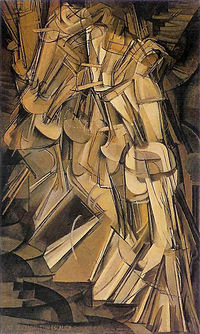
Returning to Thorson, she named the four parallel phases 1) Experiment, 2) Reintegration, 3) Transcendence, and 4) Return. The first phase was one of experiment and struggle, but maybe could have been better named refutation and rejection. Husserl’s first important development took place in his refutation of psychologism, which was an attempt at explaining logic by way of a naturalist psychology. Duchamp, after having created Nude Descending a Staircase, No. 2 (Fig. 1), arguably a cubist masterwork, rejects cubism, a style still harboring vestiges of naturalism. In this struggle against naturalism Thorson also detects a struggle against dualism.

Duchamp_-_Nude_Descending_a_Staircase
Fig. 1. Duchamp, Marcel. Nude Descending a Staircase (No. 2). 1912. Philadelphia Museum of Art

In the second phase Thorson sees a parallel between Husserl’s finding of the phenomenological reduction, the epoché, and Duchamp’s intention to “reduce, reduce, reduce …” (Duchamp quoted in AT, 98) his work from any concrete elements which resulted in what Thorson coins his short “mechanomorphic style” (AT, 91) and the presentation of the readymade. About the readymades she stated that its “effect of dispelling accepted preconceptions in art paralleled the effects of Husserl’s epoché in philosophy” (AT, 95). This is because both are quite radical switches from taking the world and art as merely given to the realization that there is a formative subjective component which might be more important in shaping our experience than previously acknowledged. This is the intentional structure of consciousness, which, because of the interaction and correlation between subject and object, is a step in overcoming dualism.

In the third phase the parallel is between on one side Husserl’s development of the eidetic reduction, i.e. the method to find essential structures and meanings through imaginative free variation, and on the other side Duchamp’s attempts to subjugate art to idea, which he very much realized in Large Glass (Fig. 2). As ideal meanings transcend their particular instantiations, so do the ideal elements in Large Glass resist identification with “empirical particulars” (AT, 98).

1952-98-1v1-pma
Fig. 2. Duchamp, Marcel. The Bride Stripped Bare by Her Bachelors, Even (The Large Glass). 1913-1925. Philadelphia Museum of Art

The last parallel, and this one clinched it for me, is about the return from the transcendental world of ideal meanings to the world as lived, the mundane world of everyday experiences, which after all, is the basis for any and all abstractions and idealizations we can construct. Maybe stirred by Martin Heidegger’s existential-phenomenological characterization of man’s Dasein as being-in-the-world (Heidegger, 1962)–that is, a part of man’s essence is the concrete situational ‘here/there’ of his world from which he cannot extract himself except in an imaginary way through mental abstraction–Husserl wrote a major analysis of the idea that in the end all our activities, even when oriented towards ideal meanings, scientific laws or philosophical necessities, they are all rooted within his or her communally constituted, intersubjective, thoroughly historical life-world (Husserl, 1970). Though Thorson under-presents Husserl’s idea of the life-world, she does develop how this return worked out for Duchamp. For her the pivotal year is 1934 when Duchamp executes this return with the conception of Box in Valise (Fig. 3), which gesture implied “a bow in the direction of art-permanence” (AT, 100), with which he confoundedly contradicted his status as an iconoclast.

Fig. 3. Duchamp, Marcel. Box in Valise or From or by Marcel Duchamp or Rrose Selavy . 1935-41.

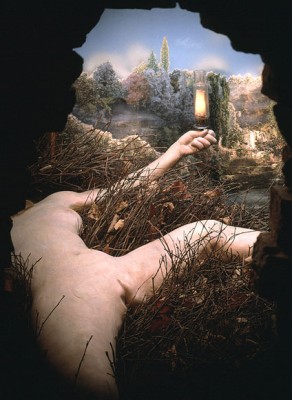
But the apotheosis of the return is Duchamp’s posthumously presented and still quite baffling Etant Donnés (trsl. Given; Fig. 4) comprised of a life-size old door with two peep holes through which one sees a three-dimensional tableau of a nude in a landscape. Thorson states that Etant Donnés is not a surrender to realism, nor a repudiation of his previous ideas, nor the effect of old age, nor a transformation because of looming death, all of which were proposed by other critics. The piece is an altogether logical outcome of the reconciliation of on one side ideas and the other side life. “The Etant Donnés signifies that like Husserl, Duchamp’s concern for ideas finds its ultimate resolution in a return to the lived-world as the basis of experience” (AT, 102).

Duchamp-EtantDonnee-Door

Fig. 4. Duchamp, Marcel. Etant donnés; 1. La chute d’eau, 2. Le gaz d’éclairage (Given: 1. The Waterfall, 2. The Illuminating Gas). 1946-1966. Philadelphia Museum of Art

In short, and as formulated in her abstract.

Careful examination reveals both artist and philosopher working through a similar sequence of ideas to arrive at comparable solutions. Both began with a struggle against dualism which they found couched in naturalist preconceptions. A realization of the intentionality of consciousness offered a solution to the initial subject/object division, while an awareness that meaning transcends its empirical presentation spurred them both on a search for ideal meanings. Ultimately each came to recognize that meaning inheres in the individual’s subjective experiencing of the everyday world (AT, Abstract).

III. The naive, non-formal phenomenology of Duchamp

Under the chapter title “Duchamp’s Phenomenological Approach to Art” Thorson unpacks further the very striking phenomenological aspects of Duchamp’s work. She especially focuses in on 1) Duchamp’s attitude towards art which very much resembles Husserl’s epoché; 2) his search for “eidetic essences”, 3) how intentionality confers meaning and binds subject and object and 4) the overcoming of duality in a qualified union. Once these aspects are fleshed out a new understanding is possible, one which could even provide a “unity and a new intelligibility” to Duchamp’s gestures with his conceptual event-objects.

Duchamp’s Epoché

Duchamp’s epoché can be found in his non-committal, aloof attitude towards politics, education, patriotism, religion, logic and many other aspects of society. He doesn’t believe in taking positions and tries to be beyond any of the pro or contra partisan positions. As far as art is concerned it looks like he is ‘bracketing’ a number of conventional ideas about art like the idea of progress in art; the artist’s sanctified role; art history and art’s alleged timeless power; taste and its cultivation in art education; and the institutionalized presentation of art in museums. Like Husserl’s concern to get “back to the things themselves” (Husserl quoted in AT, 119) Duchamp wants to be free from the limitations which come with ‘positions’ and conventional prejudices. He wants to go back to pure experience by breaking through the limitations which come with language and the manner in which language shapes experience.

Duchamp’s Eidetics

But, like Husserl, he is open for the existence of ideality, that is, the concept that in experience as well as in art, an idea or essence is always already operative or expressed and that this idea could be found through some sort of reduction, of which Husserl had a more explicit methodological awareness and Duchamp a more tacit, intuitive grasp. Thorson gives the example of how Duchamp went about to arrive at the essence of motion and how to depict that in artistic form. In this context Duchamp’s operative terms were reduction, stripping and denudation to conceive the essence of motion which culminated in his Nude Descending a Staircase, where naturalistic forms were stripped away and replaced by cubist abstractions with added lines and dots. As stated to Pierre Cabanne, Duchamp confirmed that with this piece he “was breaking the chains of naturalism forever . . .” (Cabanne quoting Duchamp as quoted in AT, 126). Thorson also discusses Duchamp’s use of “imaginative free variation”, being the methodology of the eidetic reduction and quotes him saying, “Any idea that came to me, the thing would be to turn it around and try to see it with another set of senses . . .” (Duchamp quoted in AT, 127). Initially his phenomenological investigations through free variations were directed at the essence of depicting motion in an artistic manner, but with the readymades the investigation shifted to the essence of art itself. Now his reductions and variations were targeting the then accepted attributes of art like “style, quality, originality, beauty, etc.” (AT, 132). These allegedly indispensable attributes were stripped away in the readymade, which were meant to have none of such even though others still did see beauty and originality.

Duchamp’s intentionality

Through this investigation of art with the readymade, what comes to the fore is, as discussed above, the intentional structure of experience. The art object is not established by external, objective standards about intrinsic qualities, nor by internal subjective, psychological reactions, but is established, or constituted, in the give and take between subject and object, in their polar relation. “Thus the readymade served to highlight the indissoluble unity between the object-as-intended and the subject’s intending-toward, and to reveal this relationship as the ultimate foundation for the determination of art-meaning” (AT, 132). It is Thorson’s contention that Duchamp is non-formally aware of this intentional structure in which the onlooker has a bigger role in establishing what art means than hitherto assumed.

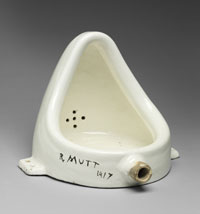
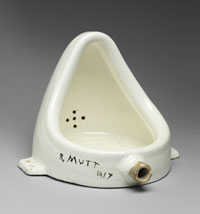
The above point can be made a bit more explicit with the following example. We might initially emptily intend Fountain (Fig. 5) as an art object because it is presented to us with the claim that it is art. But, because so many aspects of art seem to have been stripped away in this object, we have to re-calibrate our set of tacit expectations regarding art by doing some quick imaginative free variations to test if the missing aspects are essential or not, and then either interpret Fountain as a silly or shocking hoax if we hold on to beauty, taste and style as essential to art, or we interpret the object as a significant, artistic conceptual event-object if we go along with Duchamp and toss them. A third alternative might be possible and that is to acknowledge Fountain as both showing and changing the boundaries of the definition and function of art, but still keep open a personal choice of what art might mean for oneself with the whole issue having become more explicitly open and elective. In this middle position Duchamp showed something about art, but did not necessarily destroy it as some have argued.

Fig. 5. Duchamp, Marcel. Fountain. 1917. Photo of a duplicate.
Fig. 5. Duchamp, Marcel. Fountain. 1917.
Photo of a duplicate.

Duchamp’s non-dualism

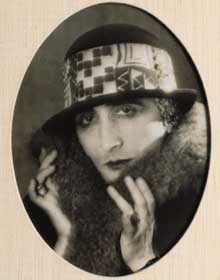
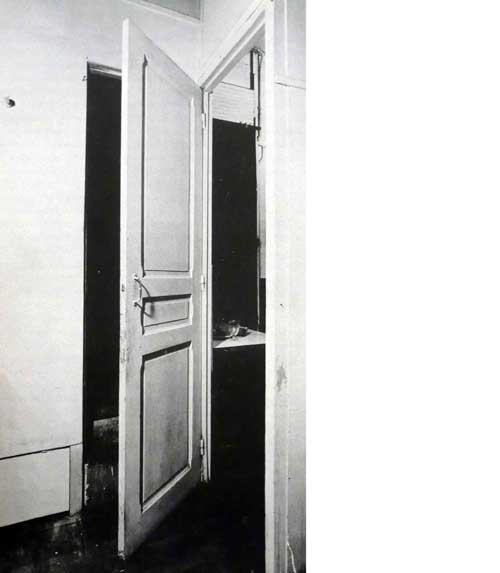
The last phenomenological aspect Thorson highlights is Duchamp’s overcoming of dualism–based on the inseparability of subject and object–not only in establishing the meaning and limits of art, but of meaning in general. His appreciation of complementarity of allegedly opposed positions; his acting out of the androgynous nature of the sexes through his alter ego Rrose Sélavy (trsl. Eros: Such-is-life; Fig. 6); his interest in the reconciliation of opposites in alchemy; his refutation of bivalent logic in Door, 11 Rue Larrey (Fig. 7), which door can be both open and closed at the same time; his eroto-maniacal preoccupation with sex; all these indicate a preference for non-dualism.

Fig. 6. Ray, Man. Rrose Sélavy (Marcel Duchamp). 1921. Philadelphia Museum of Art
Fig. 6. Ray, Man. Rrose Sélavy (Marcel Duchamp). 1921.
Philadelphia Museum of Art


Fig. 7. Duchamp, Marcel. Door, 11 Rue Larrey. 1927.

Duchamp as phenomenologist?

In closing her chapter, Thorson thinks it wrong to qualify Duchamp as a phenomenologist. Too much what he did has no parallel in phenomenology and, I would add, many phenomenological investigations are too technical to find an equivalent in Duchamp.[5]

But phenomenology does provide “a tentative framework through which the variety and complexity of his activities gain coherence and greater intelligibility . . .” (AT, 140). I would classify Duchamp therefore as a non-formal, intuitive phenomenologist, because he was very accomplished in suspending and playing around in a phenomenological manner with art, but was not explicitly aware of the formal phenomenological manner he was doing so.

Because Duchamp’s conceptual event-objects were often more about art than art itself, the discussion about whether he created art or not could be settled by naming his gestures meta-artistic, which nicely captures the idea that his gestures were neither art nor non-art and had a built-in self-referential structure.

From cause to effect

Duchamp, as a non-formal phenomenological meta-artist, was able to liberate a similar critical distancing and imaginative capacity in his fellow artists and audience, which could be traced as the “Duchamp Effect”. As Thorson states, and I do agree, the phenomenological framework will help us in understanding his legacy, because “Duchamp’s legacy is a phenomenological approach to art” (AT, 141; italics in original; bold added) especially picked up and amplified in his friend John Cage.

Here I like to stress the idea, and add my own thoughts, that phenomenology can provide a unity of intelligibility to Duchamp’s art, as Thorson makes clear in different parts of her study. The unity consists in the idea that the Husserlian epoché and eidetics are closely intertwined and feed off each other. Critical distancing through suspension of assumptions will create a field of new possibilities and, other way around, being confronted with surprising instances of conceptual event-objects could lead, in different degrees, to critical distancing, even full-fledged entry into a transcendental attitude from which the interaction between oneself as an intending subject and its intended, constituted objects becomes a possibility (Meraud, 2010). Once one gets habituated within that attitude–which is not a given as one can slip out of it–a multitude of variations are possible and it looks like that Duchamp operated within the art world by inhabiting this attitude in a non-formal manner.

Also, based on the presented insights, one might evaluate possible critiques and re-interpretations of Duchamp’s work, for example the critiques coming from Clement Greenberg, Thomas Hess and Wayne Andersen.

Greenberg’s beef with Duchamp was that he thought he was too destructive for one’s fragile faculty of esthetic, contextualized expectation-cum-surprised satisfaction in relation to art, which for him was an essential ingredient of art appreciation to be finely cultivated (Greenberg, 1971). Greenberg has a point because phenomenology will show that we always already engage life and art with an interacting mix of tacit and explicit expectations, all set within, and to be explicated by, the dynamic sequence of a) intentional experience of emptily intending, to b) different degrees of fulfillment, culminating in c) stability, frustration or ambiguity. I think Greenberg had a fine, though conservative, appreciation for that dynamic. But again, Duchamp and his fellow avant-gardistas were not necessarily out there to destroy art come what may. They merely made such expectations and frameworks more explicit, questionable, investigatable and changeable. If they did so in an aesthetically tasteless manner or by shock and scandal is besides the point. Granted, I think some of what claims to be modern art is bad and tasteless, but at the same time the challenging of conventional standards of taste could only be effected by provocations through its opposite. And contrary to Duchamp’s statements that he had given up on art, he actually never did, and the presentation of Etant Donnés, which incorporated a vast amount of modern styles and vintage Duchampian gestures, made that point quite clear. Greenberg might have been shocked again, but I would be surprised if he would deny having learned anything from Duchamp.
My position here would be somewhere in between, in that we do not necessarily have to give up our own tacit and explicitly cultivated standards of aesthetics just because Duchamp happened to show their contingent, subjective nature, and we do not have to stick defensively to these standards like Greenberg, because modern art, even avant-garde art, is full of pleasant, aesthetic and thought-provoking surprises.

The above considerations should remind us also that a tendency towards an idealized interpretation of Duchamp should be resisted. Though Duchamp’s status since the 1960s has risen to that of patron saint of modern art, I find these older criticisms of Duchamp by Clement Greenberg and Thomas Hess still valid. And the recent quite severe and provocative deconstruction of Duchamp as an “overrated erotomaniac” by art historian Wayne Andersen in his study Marcel Duchamp: The Failed Messiah, is a welcome antidote. Andersen thinks, to quote him at his most provocative, that “Marcel Duchamp’s gift to artists was similar to the Marquis de Sade’s gift to sadists—relief from moral restraints, accountability, guilt, and shame” (Andersen, 2010, p. 3). In Andersen’s study it is not so much Duchamp himself who is to be blamed, but a section of the art world which had sanitized, elevated and aggrandized him as a messianic figure, whose “nihilism was eagerly adopted as artistic freedom” (Andersen, 2010, p. 5) and whose persona became more important than his art. Again, it is phenomenology which can elucidate the constitution of idealized narrative interpretations. Amongst many aspects, the idealization process includes the discarding of truly contingent, unimportant elements as well as suppressing essential, important ones. In Andersen’s view what got suppressed was Duchamp’s vulgarity, the second-rate nature of most of his art and his anti-feminism. Whether Andersen cut Duchamp to size a notch too far is for me an open question, but I think he does show that certain overlooked aspects of Duchamp’s persona and art are essential and have to be taken into consideration if one wants to arrive at the complex eidos Marcel Duchamp. The in-between position might be to acknowledge Duchamp as important and influential, but not to be infatuated with.

IV. Conclusion

It is Thorson’s contention, and mine too, that through understanding the epoché; the procedure of “imaginative free variation”; and the concept of life-world, we can better understand a) what Duchamp seemed to have accomplished as a conceptual artist creating thought-provoking event-objects; b) that he himself executed imaginative variations on art which unity becomes intelligible through understanding Husserl’s ‘imaginative free variation’; and c) that these variations set examples to other conceptually nimble artists to find their own unique variations.

Because a phenomenological assessment of Duchamp is, from a transcendental viewpoint, purely philosophical, it cannot in principle trump Marxist, psycho-analytic or critical art historical interpretations, because those pertain to the more empirical realms of sociology, psychology and history. A Marxist analysis of Duchamp’s personal position within the elitist upper class of American society might still result in relevant insights about Duchamp’s life and his art. And a psycho-analytic assessment of some of his formative experiences is not ruled out either. Here one can look at the possible long-term influence of his traumatic experience of having some of his most important works rejected by his fellow artists, as well as the often repeated hypothesis that he struggled with an incestuous tendency towards his sister. The first experience might have made him cynical about art and the second made him conflicted about sexuality. And, lastly, phenomenology cannot invalidate criticisms coming from Greenberg and Andersen. At best it can illuminate its procedures, but not set aesthetic standards.

In closing, it looks like to me that Duchamp’s “artistic conceptual event-objects” are meta-artistic phenomena which precariously balance on the cusp between art and philosophy such that his art, which is neither art nor non-art, can illuminate philosophy and other way around.

Endnotes

[1]. That a phenomenological approach to Duchamp was executed at NIU might not be a coincidence as NIU’s philosophy department in the 1970s and ’80s harbored accomplished continental philosophers like Lester Embree, who moved on to become one of the major organizers of the international movement of phenomenologists; Theodore Kisiel, a world-renowned expert on the early Heidegger; and Michael Gelven, who delved into literature, art and spirituality.

[2]. With ‘mechanics’ I do not mean to imply a mechanistic view, but rather something like the dynamic and structural logos of experience in which all parts are integrated and have some causal effect on each other and together compose a whole.

[3]. Brough drew on the following studies by George Dickie: Art and the Aesthetic: An Institutional Analysis (Cornell University Press, 1974) and The Art Circle (Haven Publications, 1984).

[4]. If there might have been philosophical influences on Duchamp, besides the well-known influence of anarchist thinker Max Stirner, I would have looked at how Friedrich Nietzsche might have shaped Duchamp indirectly through artists like Hugo Ball of Cabaret Voltaire and closer to him, Francis Picabia, who both were familiar with and had embraced Nietzsche’s thought.

[5]. A logical next step would be to see if and how Heidegger’s existential-hermeneutic phenomenology might clarify further what Duchamp did.

Sources used and consulted

Andersen, Wayne. Marcel Duchamp: The Failed Messiah. Geneva, Switzerland: Éditions Fabriart, 2011. Print.

Brough, John B. “Art and Artworld: Some Ideas for a Husserlian Aesthetic”. Edmund Husserl and the Phenomenological Tradition: Essays in Phenomenology. Ed. Robert Sokolowski. Washington, D.C.: The Catholic University of America, 1988. 25-45. Print.

Danto, Arthur. “The Artworld”. The Journal of Philosophy, 61/19 (Oct. 15, 1964): 571-84.

Demos, T. J. “Duchamp’s Labyrinth: ‘First Papers of Surrealism,’ 1942”. October, vol. 97 (Summer, 2001): 91-119.

Duchamp, Marcel. The Writings of Marcel Duchamp. Michel Sanouillet and Elmer Peterson (Eds.). N.p.: Da Capo Press, n.d. Print. Originally published by Oxford University Press, 1973. Print.

Evans, J.C. et al. “Aesthetics”. Encyclopedia of Phenomenology. Ed. Lester Embree, et al. Dordrecht, The Netherlands: Kluwer Academic Publishers, 1997. Print.

Greenberg,Clement. “Counter Avant-Garde” [1971]. In Marcel Duchamp in Perspective. Masheck, Joseph, ed., Da Capo Press, 2002. Pp. 122-33. Print.

Heidegger, Martin. Being and Time. San Francisco: Harper Collins, 1962, trans. by Macquarrie and Robinson. Print.

Hess, Thomas B. “J’Accuse Marcel Duchamp”. In Marcel Duchamp in Perspective. Masheck, Joseph, ed., Da Capo Press, 2002. Pp. 115-20. Print.

Hofmann, Werner. “Marcel Duchamp and Emblematic Realism”. In Masbeck, Joseph (Ed.). Marcel Duchamp in Perspective. Englewood Cliffs, NY: Pretice-Hall, 1975. Print.

Hubregtse, Menno. “Robert J. Coady’s The Soil and Marcel Duchamp’s Fountain: Taste, Nationalism, Capitalism, and New York Dada”. Revue d’art canadienne / Canadian Art Review 34 / 2 (2009). Web. 09 Feb. 2014.

Husserl, Edmund. The Crisis of European Sciences and Transcendental Phenomenology: An Introduction to Phenomenological Philosophy. Evanston, IL: Northwestern University Press, 1970. Print.

Kisiel, Theodore. “Do It Yourself Phenomenology”. Hand-out. Philosophy 428, NIU, DeKalb, IL, Spring 2003.

Kosuth, Joseph. “Art after Philosophy”. Studio International (October, 1969).

Meraud,Tavi. “More Than Meets the Eye: Connections between Phenomenology and Art”. Postgraduate Journal of Aesthetics, Vol. 7, No. 3, December 2010. Web. 5 Feb 2014.

Moffitt, John F. Alchemist of the Avant-Garde: The Case of Marcel Duchamp. New York: State University of New York Press, 2003. Web. Googlebooks.

Ricoeur, Paul. Time and Narrative. 3 vols. transl. by Kathleen McLaughlin and David Pellauer. Chicago: University of Chicago Press, 1984-88. Print.

Sokolowski, Robert. “The Logic of Parts and Wholes in Husserl’s Investigations”. Philosophy and Phenomenological Research, 28/4 (Jun., 1968): 537-553

Thorson, Alice R. “Marcel Duchamp: A phenomenological approach to art”. MA Thesis Northern Illinois University, 1981. Thesis director Norman Magden. Print.

Linking Social Justice to Monetary Reform

By Nick Egnatz.

PDF version; Spanish translation in anthology; Portuguese translation at AMI.

Social Justice is the struggle to make society work for the vast majority of people. The comprehensive monetary reform of the NEED Act is the necessary first step on the path to realization of this struggle. The following ten points are the major social issues in which I will try to link social justice with monetary reform.

1) How do we end war, militarism and empire?

The primary cause of war, militarism and empire is the profit that these enterprises bring to a relative handful of people. It begins by allowing banks to create our money supply out of thin air when they make loans and then charge us interest for the privilege. Bankers are absolutely delighted to create and loan our government money for militarism, war and empire. It enriches bankers and creates a mutual bond between the banks and government to do whatever is necessary to keep each other in power. True monetary reform contained in the NEED Act decisively ends bank creation of money.

2) How do we transition to clean renewable energy?

Allowing banks to create our money means that they determine what it is created for. The banker’s preference has been and always will be to create money for war, speculation and bubbles, since this has historically given them huge profits. The NEED Act puts the power to create money, debt-free, with our elected government. We the citizens then have the power to insist that our legislative representatives use these funds to make the transition to clean, sustainable energy. Of course, making our representatives more responsive to the people will not be an easy task. But without monetary reform, it is an impossible task.

3) How do we create millions of good paying jobs?

The NEED Act specifically calls upon our government to completely rebuild our country’s crumbling infrastructure, referencing the American Society of Civil Engineers Infrastructure Report Card.[1] The 2013 ASCE Report Card calls for $3.6 trillion to be spent doing so by the year 2020. In addition to bringing our infrastructure into the 21st Century, this creates 10 million new, good-paying jobs. [2]

4) How do we insure that all Americans are paid a wage that allows them life’s basic necessities without putting employers out of business?

No one wants to see businesses close and further reading makes clear the NEED Act’s commitment to supporting small businesses. Yet there is something functionally wrong in a society that facilitates the massive accumulation of wealth at the top while those at the bottom and middle are increasingly unable to simply get by. A simple fix possible under the NEED Act would be to increase the minimum wage to a livable minimum wage ($15). For those employers whose financial and tax statements document that they are unable to pay the new livable wage, the federal government would use newly created US Money to make up the difference until such time as they were able to pay the wage without federal help. An exception could be made for teen age workers whose earnings are not contributing to a family’s livelihood, by paying them a percentage of the living wage and increasing it each year.

5) How do we immediately provide “bail out” assistance to the American people who have been overwhelmed by the recession/depression now in its sixth year?

In 2008, when Wall Street financial markets crashed as a result of the creation of exotic, fraudulent, financial instruments by banks and other institutions, these same banks and financial institutions were rewarded with a $750 billion public bailout and another secret $16 trillion of Federal Reserve loans at zero or close to zero percent interest. All this done while they were functionally bankrupt.[3] The NEED Act will provide a bailout or Citizen’s Dividend to each and every American citizen that could easily be $10,000 for each and every one of us, thus allowing the American people, devastated by bank creation of money as debt, to begin to repair their financial health.

6) How can we best help embattled small businesses grow and thrive?

Bailing out the people with the Citizen’s Dividend immediately gives our small businesses what they desperately need. What they certainly do not need are more loans which they can’t afford . They need you and I to have money in our pockets for the goods and services they provide. The NEED Act gives them this with the Citizen’s Dividend and massive job creation in infrastructure.

Whosoever controls the volume of money in any country
is absolute master of all industry and commerce,
and when you realize that the entire system is very easily controlled,
one way or another, by a few powerful men at the top,
you will not have to be told how
periods of inflation and depression originate

James Garfield, U.S. President 1881, Congressman from Ohio

7) How do we solve the crisis of young Americans entering an abysmal job market, while owing $1.2 trillion in student loan debt? Is it society’s responsibility to educate its youth?

The NEED Act provides society with the vehicle to pay for implementing this principle. One of the reforms of the NEED Act is the incorporation of the Federal Reserve System into our government. It presently is wholly owned by the nation’s private banks, while retaining some ambiguous claimed autonomy from them with a Board of Governors appointed by the President. When the Federal Reserve System is federalized under the NEED Act, its funds will belong to the people and should be distributed to them. A $10,000 Citizen’s Dividend paid to each and every citizen, plus the entirety of the student loan debt could be paid from these funds.[4]

8) How do we pay for an all inclusive national healthcare system?

The NEED Act again provides the vehicle to fund a universal healthcare program that is all inclusive and leaves no one behind. The U.S. is the only major industrial country that does not have such a system. Total U.S. healthcare spending is roughly twice that of those nations that do have a true universal system. The Commonwealth Fund uses national, World Health Organization (WHO) and Organization for Economic Cooperation and Development (OECD) statistics and surveys to rank the healthcare systems of eleven industrial nations. The U.S. ranks dead last overall and dead last in the following categories: cost related access, efficiency, equity and healthy lives. Even in overall quality of care the U.S. ranks only fifth.[5]

9) How can we make our society more democratic?

The NEED Act democratizes our money and makes it the tool of the people and not the banks. As our people become free from debt, they will naturally gravitate toward more democratic political involvement in order to protect this new level of freedom for themselves, their children and grandchildren.

10) How do we pay off our debt, federal and personal?

Under the present monetary system there is no way forward to pay off the federal debt. Under the NEED Act it will be paid off with new US Money as it comes due. The Citizen’s Dividend, 10 million new good-paying jobs, resolution of the student loan crisis and ending bank created money as debt will allow our people to get out of personal debt and become financially healthy.

Debt

The NEED Act specifically calls for the implementation of the ASCE Report Card on Infrastructure; the payment of Citizen’s Dividend in an undetermined amount; directing 25% of all newly created US Money debt-free, to the beleaguered state governments; and providing interest free financing to local governments for schools, sewers, roads, libraries etc. It more generally references spending money for healthcare, education, stabilizing the Social Security retirement system and promoting the general welfare. It will be up to us the U.S. citizens to make the demands upon our elected representatives to use our money for these and other important social programs that will transform our country to the American Dream, rather than the American Nightmare it has become for so many.

Our present monetary system of bank created debt money is unable to provide any relief in the above listed areas. Those at the top of the bank created debt money food-chain will scream that rebuilding our country, putting people to work, providing healthcare, etc will create inflation. Please read the entire article before allowing yourself to be influenced by their self-serving propaganda.
While Pope Francis has probably not closely studied monetary history, his grasp of the structural causes of inequality make him a natural ally of the comprehensive reforms of the NEED Act.

“As long as the problems of the poor are not radically resolved by rejecting the absolute autonomy of markets and financial speculation and by attacking the structural causes of inequality, no solution will be found for the world’s problems or, for that matter, to any problems.” [6] His Holiness Pope Francis of the Catholic Church

Do banks really create money out of thin air when they make loans?

Yes and no. Please, allow me to explain. At the American Monetary Institute’s 10th Annual Conference on Monetary Reform in Chicago this October a discussion began on whether or not banks actually created money when making loans. Monetary reformers will say yes they do and bankers and economists will say no they don’t. Both statements will be somewhat truthful. The monetary reformer’s statement that banks create money is technically incorrect, but actually offers a more correct picture of reality than the banker’s claim that they don’t create money which is technically true, but meant to obfuscate reality.

At the AMI conference Stephen Zarlenga, Director of the AMI, then played Alexander the Great who solved the mystery of the Gordian Knot with a statement striking at the core of the issue.

“Banks do not create money, they create what we use as money when they make loans.” [7]

What we use for money is not real money, although we call it money. Almost the entirety of what is used for money in the U.S. is debt money created by banks when loans are made and then extinguished into the ether of the atmosphere when the loan is paid, except for the interest which goes into the pocket of the banks. The bank simply makes two accounting entries, a credit and a debit balancing each other, the loan check is issued and the money is created from thin air. As the loan is paid off the accounts are reduced and with the final payment the money is extinguished.

Don’t blindly accept my word on this though. Instead, let’s listen to what the Bank of England recently said on money creation. Yes, the Bank of England (BoE), founded in 1694, the UK’s central bank and the model upon which most central banks have been built, including the U.S. Federal Reserve System.

In its first 2014 Quarterly Bulletin the BoE published the revealing and important article “Money Creation in the Modern Economy”, which ” … explains how the majority of money in the modern economy is created by commercial banks making loans…”.

The article explicitly stated the following:

” …Whenever a bank makes a loan, it simultaneously creates a matching deposit in the borrower’s bank account, thereby creating new money.

The reality of how money is created today differs from the description found in some economics textbooks:

Rather than banks receiving deposits when households save and then lending them out, bank lending creates deposits.” [8] (Emphasis Bank of England).

Though usually obfuscated, this understanding of bank credit is not new, as the following quote by Robert B. Andersen, Secretary of Treasury under President Dwight D. Eisenhower, makes clear:

“When a bank makes a loan it simply adds to the borrowers’ deposit account in the bank by the amount of the loan. The money is not taken from anyone else’s deposit; it was not previously paid in to the bank by anyone. It’s new money, created by the bank for the use of the borrower.” [9]

Only the principal amount of the loan is created though, while there is no money creation for the interest that we must pay. As this interest multiplies over the years there is simply not enough money in the system to pay both the principal amounts of the loans that were made and the interest that was not created with the loans. Indeed, no one individual can get out of debt within this system, without someone else, somewhere, going into debt. What? Yes the original debtor can only repay his loan using the debt money in the system that he obtains as wages or in some other manner. For this money to exist it must be created by someone else, somewhere, taking out a loan and going into debt. Is there any question why we are such an indebted society at all levels — individual, federal, state and local?

Thus our national circulating medium
is now at the mercy of loan transactions of banks,

which lend, not money, but promises
to supply money  they do not possess

Irving Fisher
Yale University Economist
Supporter of the Chicago Plan

Bankers and economists will argue that allowing banks to create credit/debt money allows our economy to function and expand in good times and that stopping the practice would bring our economy to a grinding halt.

To answer this argument, we could just observe the sorry results of bank money creation as debt. But first let’s listen to what a leading member of the financial aristocracy has to say on the subject. These remarks were not given in casual conversation over a pint at the local pub, but in a formal address to the prestigious Stockholm School of Economics.

Jonathan Adair Turner is a British businessman, academic, a member of the UK’s Financial Policy Committee, and was Chairman of the Financial Services Authority until its abolition in March 2013. He is the former Chairman of the Pensions Commission and the Committee on Climate Change. He has described himself in a BBC Hardtalk interview with Stephen Sackur as a ‘technocrat’.

Turner’s lecture which was presented to The Stockholm School of Economics via video in September, 2013 is titled “Credit, Money and Leverage: What Wicksell, Hayek and Fisher Knew and Modern Macroeconomics Forgot”. He made some remarkable observations:

7:00 “The flip side of creating purchasing power with credit and money creation is that you create a set of ongoing debt contracts thereafter.”

8:35 “Investment funding has become a small part of what the bank or shadow bank system does.”

14:00 “I think it is reasonable to say that both in undergraduate textbooks today and in advanced economics and in central bank orthodoxy we have tended to work on a way of thinking about the credit creation process which is simply not true.”

14:30 “Modern textbook assumptions. I think it’s fair to say that they make 3 assumptions which are dramatic and wrong over the best simplifications. They tend to assume that what banks do is take deposits from household depositors and lend it to borrowers. That misses the insight that banks create credit and money and purchasing power. They tend still and I have read back through several economic textbooks over the last several months to check this. They tend to say that what banks do with that money is that they lend it to businesses in order to fund those projects that have a higher return than the interest rate. That ignores almost entirely the fact that most credit extension is no longer funding business capital projects.” [10] [11]

If bank credit is no longer funding capital projects in the real economy, what is it funding? One doesn’t have to be a genius or a member of the economic establishment to know that bank credit or money creation is funding wars, bubbles and speculation for the wealthy and debt for the 99%. And let’s not forget Baron Turner’s stark admission that our economic textbooks have been lying to us about the money creation process.

It is correct that simply stopping bank created debt money and not replacing it would bring economic gridlock because as existing loans were paid and no new loans were made the supply of what we use as money would shrivel to almost nothing. But stopping bank creation of debt money and replacing it with US Money, created free and clear of debt and spent into existence for the needs of the nation and its people, would allow our economy and people to flourish. That brings us to legislation that was before the last Congress introduced by Congressman Dennis Kucinich and co-sponsored by John Conyers.

The NEED Act (National Emergency Economic Defense Act) [12]

The NEED Act is a comprehensive monetary reform which was written by the Congressional Legislative Counsel as a non-partisan bill. Its three simple, but necessary, reforms are:

1) The Federal Reserve System is federalized. It becomes part of our government, exactly what most citizens mistakenly think it is now.

2) The banks’ ability to create what we use for money is decisively ended. The banks are not nationalized, but money creation is. In the future when banks make loans, they will be loaning money that already exists, not creating it. Exactly what most citizens mistakenly think they do now.

3) New US Money is created by our federal government and spent, not loaned, into existence, debt-free, for the needs of the nation and its people as determined by our elected, representative Congress. By charter the Monetary Commission, charged with determining how much money to create, will do so in a non inflation/deflationary manner.

Let’s listen to one more expert from the financial establishment in this case Martin Wolf, a British journalist, considered to be one of the world’s most influential writers on economics. He is associate editor and chief economics commentator at the Financial Times. In his April 24, 2014 Column for the Financial Times, titled “Strip Private Banks of Their Power to Create Money”, he wrote:

“Printing counterfeit banknotes is illegal, but creating private money is not. The interdependence between the state and the businesses that can do this is the source of much of the instability of our economies. It could – and should – be terminated.”

Later he recommends The Chicago Plan that The NEED Act was based on.

“A maximum response would be to give the state a monopoly on money creation. One of the most important such proposals was in the Chicago Plan, advanced in the 1930s by, among others, a great economist, Irving Fisher. Its core was the requirement for 100 per cent reserves against deposits. Fisher argued that this would greatly reduce business cycles, end bank runs and drastically reduce public debt. A 2012 study by the International Monetary Fund staff suggests this plan could work well.”  [13] (100% reserves simply means that banks will only loan money that already exists, exactly what the NEED Act calls for.)

While Martin Wolf does not specifically mention The NEED Act, his solution is to strip banks of their money creation power and have the government spend money into circulation. These are reforms two and three of The NEED Act. Reform one, nationalizing the Federal Reserve System or in the case of the UK, the Bank of England, was already done in the UK after WWII.

The IMF study referred to by Martin Wolf was written by Jaromir Benes and Michael Kumhof, “The Chicago Plan Revisited”. I was privileged to hear Dr. Kumhof lecture on the subject at the American Monetary Institute’s Annual Convention 2013 in Chicago. [14]

Debt Money Is the Natural Result of a Money as a Commodity Monetary System

Our present system of debt money created by banks is the result of misinformation disseminated by the wealthy for millennia. It exists because those with power, gold and silver were able to use their influence in determining that money was gold or silver — money as a commodity monetary system. The next step in the middle ages were goldsmiths as early bankers issuing paper receipts for gold stored in their vaults. When the receipts or notes became widely acceptable by other merchants, those whose gold was stored with the goldsmiths were happy with the convenience of the paper notes and generally reluctant to redeem them. The goldsmith/bankers realized this and began to issue paper notes or receipts for about ten times the gold that they actually held in their vaults. Thus was born what became known as fractional reserve lending — the banks/goldsmiths issuing notes for something (gold or silver) that they didn’t actually have.

This is the logic underpinning the present bankers’ creation and control of what should be our money. Except now within the Federal Reserve System there is no longer any fractional reserve, the banks create deposits and money together when we take out loans and use the entire Federal Reserve System to do so.

What invariably happened in these money as a commodity systems was that they became progressively more and more unequal with all the gold and silver either owned by a few rich people or residing in the temples. Ancient Sumerian kings were forced to issue periodic debt jubilees (forgiveness of debt) because society simply became unworkable when almost everyone had become indebted as slaves. The ancient Hebrew society experienced the same results as Sumer and called for such a jubilee every 49 years when all those indebted as slaves would be freed. (Bible, Leviticus 25:8-13)

Money By Law

In stark contrast to money as a commodity monetary systems is money by law. Rome had a money by law monetary system of bronze bars and coins from the reign of King Numa in 716 BC until wars further and further from home resulted in the minting of silver coins to pay their armies in foreign lands beginning around 310 BC. The bronze money by law monetary system was still used exclusively at home until the Punic Wars with Carthage resulted in Rome converting into a silver coin money as a commodity system by about 212 BC. Rome became a world power with its money by law monetary system. Its decline coincided with its changeover to a money as a commodity system.

Before Lycurgus became king of Sparta around 800 BC, he traveled much of the known world to get ideas about how to have the fairest and most equitable system for his future subjects. On the island of Crete he met the poet Thales “the lawgiver” who returned to Sparta to advise him. Lycurgus then eschewed the money as a commodity system of gold and silver and instead installed a money by law monetary system of elongated iron discs. They were called Pelanors because they resembled small cakes of the same name. They intentionally had no value outside the law. They were dipped in vinegar when hot during the smelting process. This made them brittle and useless for anything but money by law. Lycurgus also instituted land reforms, dividing the land more equally among the Spartan citizens.

Sparta grew into a Hellenic power during the almost 400 years of a money by law monetary system. Around 415 BC Sparta became more and more involved in wars far from home and regressed to a gold and silver money as a commodity monetary system. This was done largely as a result of successful foreign conquests and the capture of gold and silver from the vanquished that then made its way back to Sparta. The combination of war and a money as a commodity monetary system was then the cause of Sparta’s demise as a world power. But for 400 years each, both Rome and Sparta grew and prospered as examples to the world of money by law monetary systems.

The philosopher Aristotle decisively came down on the side of money by law when he made his famous statement, “Money exists not by nature (as gold or silver), but by law.” Unlike modern economists that use undecipherable theories to support the present system of bank created money as debt, Aristotle instead relied entirely upon empirical evidence of what worked and what didn’t work. [15]

Our own history shows that money by law worked extremely well.

U.S. Money by Law

Throughout U.S. history one can clearly detect a struggle and search for a fair and equitable system of money. For example, Jefferson and Madison were battling with the private 1st Bank of the United States; Jackson and Van Buren were clashing with the private 2nd Bank of the United States, the Greenback and Progressive Movements, more recently parts of the Occupy Movement. Unfortunately, until now the banking class has had the money, clout and the ability to befuddle the issue enough to retain its money creation privilege. Bank accountants then mystify the explanations of their occult practices, while the 99% are swallowed up in the quicksand of debt and taxation from present and past monetary and fiscal policies.

It is well that the people of the nation
do not understand our banking and monetary system,

for if they did, I believe there would be
a revolution before tomorrow morning

Henry Ford
Founder Ford Motor Company

The justification for giving the Money Power to the private First and Second Banks of the U.S. and the private Federal Reserve System was that they were issuing money as a commodity backed by gold and silver in their vaults. But the reality was that the banks that Jefferson, Madison, Jackson and Van Buren fought, the private banks and their private Federal Reserve System that citizens battle today, have always created our money supply out of thin air by issuing debt money created by banks. This has been done historically by a process called “fractional reserve lending” in which banks loaned out about 10 times the actual money they had in reserve. Recently this process has been advanced to the point that the banks make the loans first and then use the entire Federal Reserve System to borrow whatever funds are necessary to back up the loan.

This is why citizens in the U.S., countries across the globe such as Greece, Cyprus and Spain, our own cities like Detroit and states like Illinois, are all becoming debt slaves to a private banking class. [16]

Let’s look at the successful examples of money by law in our own history.

Colonial Scrip: North American colonists suffered from a lack of money throughout their history. Remember that the colonies were created to benefit the mother country and not to provide a good life for the colonists. English law forbade sending coinage to the colonies and the Dutch also kept coinage from New Amsterdam (New York). Economic activity became so difficult that Massachusetts even made a small amount of Indian wampum legal tender in an effort to create a circulating medium.

Massachusetts rediscovered the science of money in 1690 when she issued “bills of credit”, the first paper money in the West. She spent them into circulation paying for the colonial expenses. Pennsylvania followed in 1723 with paper money that was loaned instead of spent into existence. A much less perfect system, but still effective in alleviating the shortage of money in the colony.

The colonial money by law fiat currencies dramatically improved life in the colonies, facilitated the building of real infrastructure and reversed the flow of emigrants who for decades had been moving back to England. The colonial scrip was successful at alleviating hardship and fostering a new spirit of independence in the colonies, Parliament responded with the Currency Act of 1764, banning the use of colonial paper currency in all private transactions and making the ban retroactive for ten years. “It was the enforcement of this policy that brought on the Revolution” observed the American political economist Alexander Del Mar in his History of Money in America. [17]

Continental Currency: The Continentals helped us to win our independence. The Continental Congress authorized $200 million and issued that amount to finance the new nation’s struggle for independence. Long after they made the Revolution a reality, they have been smeared by pundits as inflation money. What actually happened was that the British counterfeited billions of them and eventually destroyed the Continentals. Yet they still carried us over a 5 1/2 year period of Revolutionary War and to within 6 months of final victory. They gave us our nation!

Greenbacks: $450 million of paper Greenbacks were issued to fight the Civil War, in lieu of paying usurious interest rates to private banks. Eventually they were exchanged dollar for dollar with gold coins, but few were returned as Americans liked their paper money by law Greenbacks. The Greenbacks allowed us to keep the nation that the Continentals had given us and the Colonial Paper Scrip had helped to build. [18]

The National Bank Acts of 1863, also known as the National Currency Act established chartered national banks that could issue bank notes, backed by the U.S. Treasury. The bankers supported the Bank Acts as a means to eventually replace the public Greenbacks and gain full private control of the U.S. monetary system.

Salmon P. Chase, the U.S. Treasury Secretary and U.S. Senator from Ohio who was involved in the passage of the bill, later regretted his involvement. He stated that,

“My agency, in procuring the passage, of the National Bank Act, was the greatest financial mistake of my life. It has built up a monopoly that affects every interest in the country. It should be repealed. But before this can be accomplished, the people will be arrayed on one side and the banks on the other in a contest such as we have never seen in this country.” [19]

Result of a Debt Money Created by Banks Monetary System

The current monetary system doesn’t work for the people. The present system of debt money created by private banks works just fine for the private banks and those that own them. And the numbers are staggering. According to the Global Debt Clock the world is $54 trillion in public debt. [20] And the picture of the aggregate U.S. Debt does not look good either:

Federal debt $ 17.9 trillion $56,000 / each citizen

State gov debt $ 1.2 trillion $ 4,000 / each citizen

Local gov debt $ 1.9 trillion $ 6,000 / each citizen

Consumer debt $11.68 trillion $37,000 / each citizen

Total $103,000 / each citizen*

* Does not include business debt. [21]

U.S. household consumer debt profile:

Average credit card debt: $15,593

Average mortgage debt: $153,184

Average student loan debt: $32,511

* These figures are averages for those who have debt, households with credit card debt, mortgages and students and graduates with student loans. [22]

Almost half of all Americans have zero net worth, as their debts exceed their assets. [23] [24]

These sorry statistics, which increase with each passing day, are the direct result of allowing banks to create and control our money as debt. The conclusion is inescapable, that a debt money monetary system must be decisively ended if we are ever to improve society for the vast majority of people. Because the U.S. is the world’s hegemonic leader, both militarily and economically, monetary reform must come first in the U.S., thus allowing the countries of the world to follow our lead and break the shackles of debt.

The Russian writer and social reformer Leo Tolstoy made the following statement more than a century ago about the debt money system:

“Money is a new form of slavery, and distinguishable from the old simply by the fact that it is impersonal, there is no human relation between master and slave. “ [25]

Federal Reserve System

The 100 year old Federal Reserve System is not a part of our federal government. It belongs to neither the legislative, executive nor the judicial branches of our federal government. It consists of a Board of Governors in Washington, D.C. and twelve regional Federal Reserve Banks (New York, Boston, Philadelphia, Richmond, Cleveland, Chicago, Atlanta, St. Louis, Dallas, Minneapolis, Kansas City, San Francisco). These twelve regional Federal Reserve Banks are wholly owned by the private banks in their respective districts. The Board of Governors calls itself a “federal government agency”. [26]

Over time, whoever controls
the money system, controls the nation

Stephen Zarlenga
Director American Monetary Institute

Yet the sole claim of Federal Reserve accountability to our federal government and the citizens is that the seven member Board of Governors is nominated by the President and confirmed by the Senate to fourteen year terms. The Federal Open Market Committee (FOMC) decides policy and is composed of the seven members of the Board of Governors and five of the twelve regional Federal Reserve Bank presidents who serve one year terms on a rotating basis. The president of the New York Federal Reserve Bank does not rotate and is always a voting member of the FOMC. All twelve Federal Reserve Bank presidents take part in policy discussions and formal meetings that take place eight times per year.

The private banks in the U.S. own the Federal Reserve Banks and the Federal Reserve “Division of Banking Supervision and Regulation is responsible for the oversight of U.S. banking holding companies, foreign banking organizations operating in the U.S., and state-chartered member banks of the Federal Reserve System.” [27]

Thus, the banks in essence regulate themselves.

To complete the circle of villainy we will listen to testimony from Senator Dick Durbin of Illinois in April, 2009 when he told a Chicago radio station,

“And the banks — hard to believe in a time when we’re facing a banking crisis that many of the banks created — are still the most powerful lobby on Capitol Hill. And they frankly own the place.” [28]

Recapping: The private banks create our money out of thin air when they make loans, regulate themselves via the Federal Reserve System that they own, and last, but not least, the private banks own Congress.

The citizen’s only protection in this predatory system is in the membership of the appointed and confirmed Board of Governors. But the Board of Governors and the Fed regional bank presidents that make policy are exclusively members of the financial establishment; either CEOs of huge banking corporations or academic economists who have been thoroughly vetted in supporting the entire criminal enterprise.

The Federal Reserve System does return all profits made, after expenses and stock profits are paid to its private bank owners. But the profits made in the money creation process by the private banks that own the Fed are kept and not returned to the federal government. The best in-depth article on the Fed was written in 2008 by American Monetary Institute Director Stephen Zarlenga, titled “Is the Federal Reserve System a Governmental or a Privately controlled organization?” [29]

The FED normally operates in secret and makes every attempt to befuddle us and keep us in the dark about money. Every now and then they slip up and let just a little truth escape. For example in a 1992 updated publication by the Federal Reserve Bank of Chicago titled “Modern Money Mechanics” it was stated that,

“The actual process of money creation takes place in commercial banks. Banks can build up deposits by increasing loans and investments… This unique attribute of the banking business was discovered several centuries ago… At one time, bankers were merely middlemen. They made a profit by accepting gold and coins for safekeeping and lending them to borrowers. But they soon found that the receipts (bank notes or IOUs) they issued were being used as if they were a means of payment. These receipts were acceptable as if they were money since whoever held them could go to the banker and exchange them for metallic money… Then bankers discovered … that they could make loans merely by giving borrowers their promises to pay (bank notes). In this way banks began to create money… More notes (IOUs) could be issued than the gold and coin on hand, because only a portion of the notes outstanding would be presented for payment at any one time… Demand deposits (checks) are the modern counterpart of bank notes. It was a small step from printing notes to making book entries to the credit of borrowers, which the borrowers in turn, could ‘spend’ by writing checks.” [30]

Barry Goldwater, conservative Senator from Arizona and 1964 Presidential candidate, stated the issue quite simply:

“The financial system has been turned over to the Federal Reserve Board. That Board administers the finance system by authority of a purely profiteering group. The system is Private, conducted for the sole purpose of obtaining the greatest possible profits from the use of other people’s money.” [31]

It took the Federal Reserve System only sixteen years to bring on the Great Depression and completely crash the American economy.

Louis McFadden, Chairman of the House Banking and Currency Committee in 1933, brought Articles of Impeachment against the Federal Reserve Board of Governors, the Officers and Directors of the Federal Reserve Regional Banks and Others for their collusion in causing the Great Depression. He stated the following:

“The Great Depression was not accidental; it was a carefully contrived occurrence… bankers sought to bring about a condition of despair here, so that they might emerge as rulers of us all.”

“We have in this country one of the most corrupt institutions the world has ever known. I refer to the Federal Reserve Board and the Federal Reserve Banks. Some people think the Federal Reserve Banks are U.S. government institutions. They are private credit monopolies; domestic swindlers, rich and predatory money lenders, which prey upon the people of the United States for the benefit of themselves and their foreign customers….The truth is, the Federal Reserve Board has usurped the Government of the United States by the arrogant credit monopoly, which operates the Federal Reserve Board.” [32]

The American Monetary Institute Leads the Way toward Monetary Reform

• In 1991 Stephen Zarlenga, drawing on 35 years of experience in finance, securities, insurance, mutual funds, real estate and futures trading begins focused research on the money problem.

• In 1996 he helps found the American Monetary Institute to further his research.

• He draws on 800 monetary source books and materials to form his thesis encapsulated in his book The Lost Science of Money.

• In 1999 Conzett Verlag of Zurich, Switzerland translates and publishes The Lost Science of Money in German.

• In 2002 Zarlenga refutes Mitchell Innes’ Credit Theory of Money. [33]

• In 2002 The Lost Science of Money is published in English by the American Monetary Institute.

• Zarlenga and the AMI build upon the monetary reform of the “Chicago Plan”, written in the Great Depression by Henry Simons and Paul Douglas of the University of Chicago and vigorously endorsed by Irving Fisher, Yale University; Frank Graham, Charles Whittlesley, Princeton University; Earl Hamilton, Duke University. The Chicago Plan was sent to hundreds of university economists and supported by the vast majority. [34]

The mistake lies
in fearing money
and trusting debt

Henry Simons
University of Chicago

• In 2006 AMI releases the American Monetary Act and presents it in Philadelphia at the Eastern Economic Association Conference for general comment.

• In 2010 Professor Kaoru Yamaguchi, Doshisha University, Kyoto, Japan puts the American Monetary Act through his advanced computer system model and concludes that it will allow the implementation of the American Society of Civil Engineers 2009 Infrastructure Report Card (then $2.2 trillion, in 2013 $3.6 trillion) and simultaneously pay off the federal debt as it comes due and will do so without causing inflation. [35]

• In 2011 Congressman Dennis Kucinich and co-sponsor Congressman John Conyers release the National Emergency Defense Act (NEED Act), based upon the AMI American Monetary Act, into the 112th Congress. For the first time offering the nation comprehensive monetary reform and a workable alternative to bank creation of what we use for money as debt. [36]

• The Yamaguchi study and The Lost Science of Money come to the attention of Michael Kumhof, Deputy Division Chief of the Modeling Division, International Monetary Fund Research Department. He reads The Lost Science of Money and proclaims it “a masterful work”. [37]

• In 2012 Dr. Kumhof and Dr. Jaromir Benes of the IMF release an IMF Working Paper “The Chicago Plan Revisited” which echoes the findings of the Yamaguchi study and the NEED Act. [38]

• Dr. Kumhof is then invited to speak on three occasions to officials at the Bank of England.

• In 2013 Adair Turner lectures the Stockholm School of Economics that “modern textbook assumptions are dramatic and wrong…they tend to assume that what banks do is take deposits from household depositors and lend it to borrowers. That misses the insight that banks create credit and money and purchasing power…That ignores almost entirely that ignores almost entirely the fact that most credit extension is no longer funding business capital projects“. [39]

• In 2014 the Bank of England’s 1st Quarter Bulletin Money Creation in the Modern Economy “explains how the majority of money in the modern economy is created by commercial banks making loans…“. [40]

• In 2014 Martin Wolf’s Financial Times column is entitled “Strip Private Banks of Their Power to Create Money”. [41]

• In 2014 environmental and economic sociologist Joseph Huber of the Martin Luther University, Germany refutes the mistaken monetary reforms of Modern Monetary Theory (MMT) with a paper “Modern Monetary Theory and New Currency Theory”. [42]

• In 2014 the UK Parliament conducted a debate on money creation in which the progressive MPs Michael Meacher and Austin Mitchell promoted the money by law concept and referenced to the Positive Money organization, the sister organization in the UK of the American Monetary Institute. [43]

Building a Nation

The knee jerk reaction from the economics profession will be that the money by law system of the NEED Act, also called sovereign money, will result in inflation. This is the same economics profession that has rubber stamped its approval of the debt money created by banks system over the last century and the massive inequality that it has spawned. A 1913 dollar has lost 96% of its worth in 2014. [44] It is worth just 4% of what it formerly was in 1913 and this inflation has all occurred within the present system of bank created debt money. All accomplished with nary a peep from the economics profession.

The classic historic example of hyper inflation occurred in Germany from 1923-24. On insistence by the Allies the German central bank, the Reichsbank, became in 1922 privately owned, while before and during the war it had been controlled and operated by the German government through appointment of its president and directors by the Emperor. The 1922 edict took away governmental control and made the Reichsbank entirely a private operation. The hyper inflation followed immediately and only stopped when the government brought the central bank back under its control and issued the new Rentenmark. [45] The first reform of the NEED Act brings our Reichsbank, the Federal Reserve System, out of the control of private banks and into the Treasury Department of our federal government.

The money by law Greenbacks of the Civil War era did not cause inflation. Nor did the Continental Currency of the Revolution. The Continentals gave us our nation and were eventually brought down, not by inflation, but by massive British counterfeiting.

Of course there will be concerns about how much money can be created. But the charter of the NEED Act stipulates that the amounts created will be neither inflationary, nor deflationary. Money created for things of actual value to a society has never been inflationary and there is no reason to believe that it will be now. If and when inflation starts to rear its head, the amount of money created will have to be cut back or what the money is being spent for will need to be changed.

The real unemployment rate in the U.S. is in the 23% range, counting those that are no longer jumping through government hoops in looking for work and those who are working part time, but need a full time job. [46] The difference between a full employment economy and the Gross Domestic Product (GDP) of our present economy is called a GDP gap. There is no reason to believe that creating new sovereign, money by law US Money to close this GDP gap would be inflationary as long as the money was used to provide actual value to society.

The NEED Act allows us to create money to insure that our people are paid a living wage; to address the tremendous challenge of global warming and climate change; to insure that all Americans have healthcare without unduly burdening our employers; to educate our youth; to provide a bailout to our citizens that have borne the brunt of the depression; to provide customers with funds for our small businesses; to rebuild our country’s crumbling infrastructure making our country competitive in the global arena; putting 10 million Americans to work a good-paying jobs doing so; and pay off existing student loans and thus allow an entire generation of Americans to escape from crushing debt, marry, have families and partake in the American Dream. These are not the building blocks of inflation, they are the building blocks of a nation.

Author’s Conclusion

It is this author’s conclusion that improved levels of social and economic justice within the capitalist system are possible only through the monetary reform of the NEED Act. Why did the Bank of England, after 320 years in operation, choose now to address the bank creation of money? Why did establishment insiders Adair Turner and Martin Wolf do the same? Why did the UK Parliament on November 20, 2014 have a discussion on money creation for the first time in 170 years? [47] Brought about in large part by the efforts of Positive Money, a UK based monetary reform movement similar to the American Monetary Institute in the U.S. [48]

In either case there is a fundamental realization that a monetary system that produces progressively greater and greater inequality–as the bank money creation as debt system does–is unsustainable and eventually will have to be replaced. Or the elites have realized that people have become more knowledgeable about money creation and want to bring up a discussion. But then ultimately dismiss the real reform of the NEED Act and allow a non reform such as adding state banks to the mix which does nothing to fundamentally change the bank money created as debt monetary system.

I believe that the capitalist class is very interested in self preservation. If necessary to preserve their dominant position in society, the 1% may very well ultimately sacrifice the bank money creation as debt system to remain at the top of the societal heap. This would allow the elites, at least for now, to save the most basic capitalist principle of private ownership of the earth and its resources, without which capitalism could never exist.

It is beyond the scope of this article to challenge this basic assumption of the capitalist system. While this author believes that monetary reforms of the NEED Act are the only way to save the capitalist system, he also believes that the democratization of our money, accomplished by the NEED Act, strengthens the possibility of an eventual socialist system. Neither system though, socialism nor capitalism, will ever be successful for the vast majority of the people as long as bankers control our money creation.

The NEED Act is the keystone that will allow our government to address war, militarism, empire, clean renewable energy, 10 million new jobs, a living minimum wage, small business health, citizens’ financial health, student loan debt, education, real national healthcare, a more democratic society and actually paying off our federal debt. Within the present monetary system of bank created money as debt there are and will be no proposals that can adequately deal with any one of these issues, let alone the entirety of them.

Those who care about these issues have a duty to educate themselves further about monetary reform. Go to the website for the American Monetary Institute. Do your own research. Contact me for assistance. Then work within your organizations, unions and Congressional Offices for formal endorsements of the NEED Act.

Nick Egnatz is a Vietnam veteran. He has been actively protesting our government’s crimes of empire in both person and print for some years now and was named “Citizen of the Year” for Northwest Indiana in 2006 for his peace activism by the National Association of Social Workers.

In 2012 Nick began working closely with the American Monetary Institute in support of the comprehensive monetary reform contained in the NEED Act, as the necessary first step to ending U.S. militarism, wars, empire and the growing inequality between those at the top and the rest of the heap in our society.

Contact Nick at OccupyNick@yahoo.com

Endnotes

1. American Society of Civil Engineers, 2013 Infrastructure Report Card.

2. The original NEED Act referenced the now outdated 2009 ASCE Report Card that would have created 7 million jobs American Monetary Institute. Fact Sheet on Infrastructure Job Numbers.

3. “The Fed’s $16 Trillion Bailouts Under-Reported‘, Forbes, September 20, 2011.

4. Jamie Walton, “The Fed, Student Debt and How to Fund a Student Jubilee“, American Monetary Institute.

6. Information Clearing House, Reuters, “Pope Francis Calls Unfettered Capitalism ‘Tyranny‘”.

7. American Monetary Institute 2013 Conference on Monetary Reform.

8. “Money Creation in the Modern Economy“, Quarterly Bulletin, 2014 Q1, Bank of England.

9. Create Real Democracy, “Monetary History Calendar”.

10. Adair Turner, “Money, Credit and Prices…“, Part 3. You Tube. Emphasis mine (the numerals indicate the time of the quotes in the video).

12. American Monetary Institute, NEED Act, National Emergency Employment Defense Act.

13. Martin Wolf, “Strip Private Banks of Their Power to Create Money“, Financial Times, April 24, 2014.

14. Jaromir Benis & Michael Kumhof, “The Chicago Plan Revisited“, International Monetary Fund Working Paper, .

15. Stephen Zarlenga, The Lost Science of Money, American Monetary Institute, 2002.

16. Nick Egnatz, “Occupying the NEED Act“, American Monetary Institute.

17. Alexander Del Mar, History of Money in America, 1900.

18. Zarlenga, The Lost Science of Money.

19. Create Real Democracy, “Monetary History Calendar”.

20. The Economist, Global Debt Clock.

22. Nerdwallet, “American Household Credit Card Debt Statistics: 2014”. [Updated to: “2019 American Household Credit Card Debt Study“.]

24. Silvia Allegretto, “The State of Working America’s Wealth, 2011“, Economic Policy Institute.

25. Create Real Democracy, “Monetary History Calendar”.

26. Federal Reserve System Online,

27. Board of Governors Federal Reserve System, “Banking Supervision and Regulation“.

28. Glenn Greenwald, “Top Senate Democrat: bankers ‘own’ the U.S. Congress“, Salon.com.

29. Stephen Zarlenga, “Is the Federal Reserve System a Governmental or a Privately controlled organization?“, American Monetary Institute.

30. Federal Reserve Bank of Chicago, 1992, “Modern Money Mechanics”, American Monetary Institute.

31. Create Real Democracy, “Monetary History Calendar”.

32. Create Real Democracy, “Monetary History Calendar”.

33. Stephen Zarlenga, “Critique of Innes’ ‘Credit Theory of Money’“, American Monetary Institute.

34. Paul Douglas, Irving Fisher, Frank D. Graham, Earl J. Hamilton, Willford I. King, Charles R. Whittlesey. “A Program for Monetary Reform”, July, 1939, original document reprinted with handwritten notes by American Monetary Institute.

36. American Monetary Institute, National Emergency Employment Defense Act, NEED Act,

37. Jaromir Benis & Michael Kumhof, “The Chicago Plan Revisited“, IMF Working Papers 12/202, International Monetary Fund, p. 13. 

38. Benis & Kumhof, “The Chicago Plan Revisited”.

39. Adair Turner, “Credit, Money and Leverage: What Whicksell, Hayek and Fisher Knew…”.

40. Bank of England, Quarterly Bulletin, 2014 Q1, “Money Creation in the Modern Economy”.

41. Martin Wolf, “Strip Private Banks of Their Power to Create Money”, Financial Times, April 24, 2014.

45. Benis & Kumhof, “The Chicago Plan Revisited”, p. 16.

46. Alternate Unemployment Charts. ShadowStats.com.

48. Positive Money.

Coda

Major organizations promoting monetary reform:
American Monetary Institute (USA)
Positive Money (UK)
Monetative (Germany)
Ons Geld (Netherlands)

The full list of national organizations can be found at: International Movement for Monetary Reform

Special thanks to Greg Coleridge and the Monetary History Calendar at Create Real Democracy for providing society with a wonderful compilation of monetary quotes. at

The on-line version with all active links and a 16-page pdf printable format can be found at the Alpheus web site of Govert Schuller, the editor of this pamphlet.

© 2014 by Nick Egnatz. Permission to copy and distribute this document is hereby granted provided that this notice is retained on all copies and that copies are not altered.

The Tibet Images of the Theosophists

Dreamworld Tibet: Western Illusions
Martin Brauen

pdf-icon(Trumbull, CT, USA: Weatherhill, 2004)
First published as Traumwelt Tibet: Westliche Trugbilder
(Berne: Verlag Paul Haupt, 2000)

  Part 2
In Search of ‘Shambha-la’ and the Aryan Lamas:
The Tibet images of the theosophists, occultists, Nazis and neo-Nazis
(excerpt;
pp. 24-37; pagination in square brackets;
footnotes and relevant bibliography at end of document)

 ===

A. The Theosophists and some of their followers
An Aryan brotherhood

For centuries we have had in Thibet a moral, pure hearted, simple people, unblest with civilization, hence—untainted by its vices. For ages has been Thibet the last corner of the globe not so entirely corrupted as to preclude the mingling together of the two atmospheres—the physical and the spiritual.1

These lines were ascribed to Koot Hoomi, who was said to have belonged to a secret brotherhood in Tibet. Like other supposed ‘brothers’ in Tibet, he was most closely linked with Helena Petrovna Blavatsky (1831-1891), the founder of Theosophy. The first meeting of HPB (we shall frequently use this abbreviation for Helena Petrovna Blavatsky below) with her ‘Master’ goes back to the year 1851, but as so often in Blavatsky’s biography, there exist various accounts, sometimes contradictory, of this first meeting.

koothoomi2200bcuse17. Master Koot Hoomi Lal Singh, who was said to have been Pythagoras in a previous incarnation and to have lived in Shigatse during Helena Blavatsky ‘s lifetime. Many of the mysterious letters that Helena Blavatsky and other Theosophists received by miraculous means are supposed to originate from him.

Her Master, called Morya, was a member of an Indian or Nepalese delegation that stayed for some time in London. When she met him, ‘a tall Hindu’, in London—or according to another version, in Ramsgate—she immediately recognized in him the person who had often appeared to her ‘in the Astral’, that is to say, in her astral, non-corporeal form. The very next day she met him again in Hyde Park. In the course of this he is supposed to have disclosed to her that he had come to London on an important mission with some Indian princes and wanted to meet her personally, because he needed her co-operation for a task he wished to tackle. He told her at this meeting how the Theosophical Society was to be formed and that he wished HPB to found the Society. Morya also asked her to travel to Tibet and live there for three years, to prepare herself for her important task.2

In 1856 HPB traveled to India, because she longed for the Master she assumed was in Tibet. She risked everything to cross the Tibetan border—apparently first from Darjeeling, then also from North-west India via Leh (Ladakh). The attempts were unsuccessful—even if, as some Theosophists were to claim, Blavatsky reached Leh and at best even Mongolia.

In 1868, after Master Morya had again appeared to her in Florence, HPB tried once more to reach Tibet, and in the view other supporters her efforts were definitely crowned with success, for from the autumn of 1868 until the end of 1870 she lived in the neighbourhood of Tashi Lhünpo Monastery in Southern Tibet. There Blavatsky was received by her Master Morya and one of his friends, Koot Hoomi. According to Blavatsky these two were not Tibetans, but Indians, who knew Europe and spoke English, and Koot Hoomi even French. Morya was a Rajput by birth,

one of the old warrior race of the Indian desert, the finest and handsomest nation in the world … a giant, six feet height, and splendidly built; a superb type of manly beauty.3

Koot Hoomi, a Kashmiri Brahmin, who had studied in Leipzig, welcomed to his house Tibetan scholars ‘who wore the yellow cap of the Gelugpas’. The most advanced scholar was Djwal [25] Khool, who later achieved fame as ‘the Tibetan’ at the time of Alice Bailey.

HPB was regarded as the chosen one who was to carry to Europe and the USA the secret knowledge of the sages living the other side of the Himalaya, in Tibet, ‘to gradually prepare the way for others’. In a letter ascribed to Koot Hoomi appears:

This state of hers [Blavatsky’s] is intimately connected with her occult training in Tibet, and due to her being sent out alone into the world to gradually prepare the way for others. After nearly a century of fruitless search, our chiefs had to avail themselves of the only opportunity to send out a European body upon European soil to serve as a connecting link between that country and our own [Tibet].4

In other words, the Masters living in Tibet, ‘the custodians of the Ancient Wisdom’, had recognized HPB’s special abilities and wished to appoint her as an intermediary between Tibet and Europe, just as they had already done before with certain chosen Western men, such as Robert Fludd (Rosicrucian, spiritual father of Freemasonry, 1574-1637), Thomas Vaughan (physician and alchemist, 1622-1666), Paracelsus (1493-1541), Pico della Mirandola (Italian humanist and philosopher, 1463-1494) and Count Saint Germain (occultist and alchemist, 1685—1784). They, like the other chosen, were so-called ‘chelas’ [Skt/Hindi: servants, disciples], who had declared themselves ready ‘to learn practically the “hidden mysteries of Nature and the psychical powers latent in man.'” For this a chela needed a guru,

an Adept in the Occult Science. A man of profound knowledge, exoteric and esoteric, especially the latter;5

to whom he had to be totally devoted. In the view of the Theosophists, these ‘Masters’ or ‘Mahatmas’ are not gods but simply links with the divine plane. At the top of this strictly hierarchical system reigns ‘The Lord of the World’, who lives in Shamballa in the Gobi Desert. Under him are his helpers, such as Buddha, Manu and Maitreya, each of whom has a Master as assistant. These Masters are simple, saintly mortals,

nonetheless morally, intellectually and spiritually higher than all others in this world. However saintly and developed they are,… they are still men, members of a brotherhood that goes back to pre-Buddhist times …,

that is, ascetics who had ‘the good Doctrine even before the days of [the Buddha] Sakya-muni’ and have lived for time immemorial on the other side of the Himalaya [Tibet]. In prehistoric times they preferred to remain in their inaccessible and unidentified hiding places, instead of migrating to the South (i.e., India) like others of them. The adepts living in Tibet are linked with those in Egypt, Syria and Europe,6 and are

beings who have at their disposal powers far surpassing human measure, and for whom time and space play only a limited role.7

The Masters are also supposed to have the ability to materialize themselves, i.e., to ‘condense’ themselves in a temporary body in far-distant places for a short or a longer time, and then ‘evaporate’ again. It seems the Masters are exclusively men, although Colonel Olcott, who was very close to HPB, once conceded that there were also women in Tibet with remarkable powers—he had even communicated with them—but he could not say whether they were Mahatmas.8 [26]

Morya
18. Master Morya—allegedly a Rajput prince, and in an earlier incarnation Akbar, thereat Mogul of India in the 16th century— is supposed to have lived in Shigatse. According to her own statements, Helena Blavatsky met her Master for the first time in 1851. He was a member of an Indian or Nepalese delegation that stayed for some time in London. When she saw him, ‘a tall Hindu’, she immediately recognized him as the person who had often appeared to her ‘in the Astral’, that is to say, in her astral, non-corporeal form. Morya revealed to her that she was to found the Theosophical Society, and asked her to travel to Tibet to prepare herself for the important task.

The (fictitious) Tibet journeys of Helena Blavatsky

Although the Theosophists have tried time and again to provide evidence for a long stay by HPB in Tibet—altogether she is supposed to have spent seven years there—it remains beyond doubt, not only that she never lived in the neighbourhood of Tashi Lhünpo, but even that she probably never trod on actual Tibetan soil. There are certain indications that HPB stayed in the region of Darjeeling and reached as far as Sikkim, where she met Tibetans and Bhutanese. From here no doubt came also her evident aversion to the Duk-pa9 and the ‘Shammars’—by which she surely meant the Sha-mar-pa, a subgroup of the Ka-gyud-pa. Blavatsky calls them ‘the Red Capped Brothers of the Shadow’,10 adherents of the Bon religion, ‘a religion entirely based on necromancy, sorcery and sooth-saying’.11 They would also ‘lead Europe’s best minds into the most insane and fatal of superstitions—Spiritualism’.12 She accused the ‘Dugpa’ of being sorcerers and damage-causers and of fighting the Gelukpa (the reformed school within Tibetan Buddhism). One of their infamous methods involved leaving at dangerous points of paths ‘bits of old rag … impregnated with their evil magnetism’ by the Dugpa. When a wayfarer stepped on one, it could communicate to him an enormous psychic shock, so that he might lose his footing and fall down the precipice.13

blavatsky

19. Helena Petrovna Blavatsky (1831-1891), co-founder of Theosophy, described herself as a ‘Thibetan Buddhist’, who had already as a child been quite familiar with the ‘Lamaism of the Tibetan Buddhists’. She was regarded as a chosen one, who was supposed to carry the secret knowledge of the sages living the other side of the Himalaya in Tibet to Europe and the USA. She was called by her admirers ‘the white yogini of the West’, ‘a messenger of the light’ or ‘the most remarkable woman of our century’.

There are many reasons to suppose that HPB did not ‘arrive in the forbidden land of Tibet hidden in a hay-cart’, to learn Sanskrit from the Masters there and be initiated into occult knowledge. For one thing, there is the fact that none of the quite numerous people who to travelled Tibet had heard of the Indian Masters in the region of Tashi Lhünpo, or indeed seen them. In addition, Blavatsky’s descriptions of Tibet are exceedingly rare and superficial, and—the most important argument—the explanations presented as Tibetan by the Masters and HPB are at best reminiscent of Tibetan wise sayings, but are mostly a matter of gross distortions or ‘teachings’ that have next to nothing in common with Tibetan Buddhism. HPB, who herself claimed that she was a ‘Thibetan Buddhist’,14 evaded authentic ancient knowledge without a qualm, when it did not suit her. In Blavatsky’s numerology the number seven has quite a special meaning. In Tibetan Buddhism, however, groups of five frequently occur. No problem for HPB: in the case of the five ‘Dhyani-buddhas’ (actually Tathagatas), she claimed that in esoteric Buddhism there were seven of them. But as she could not deny the existence of five Tathagatas, she explained that this grouping belonged to ‘exoteric’ (i.e., outer or ordinary) Buddhism.15 She got round the Buddhist theory of five human ‘components’ (heaps, Skt skandha) similarly: for her the human being was made up of seven constituents or principles,16 a transitory tetrad and an intransitory triad—a theory she probably borrowed from the medieval secret teachings of Agrippa of Nettesheim and Paracelsus.17 As evidence that the Tibetan Buddhists also supported this theory, she promptly provided Tibetan and Sanskrit names for the seven [27] constituents, but thereby drew criticism from Indologists, who pointed out discrepancies and errors.18

ravine


20. Although the Theosophists have repeatedly tried to produce evidence that Helena Blavatsky stayed for a long time in Tibet, it remains beyond doubt that she never trod on actual Tibetan soil. This is also indicated by this picture, which is supposed to depict the valley in which HPB visited the Masters. The arched gateways on the left of the picture are extremely untypical of Tibet, and the vegetation too—especially the palm-like tree in the bottom right-hand corner—in no way fits Tibet. The prayer-flags typical of Tibetan dwellings are missing, and nowhere can one see a stupa or any other distinctive Buddbist feature, such as a Wheel of the Doctrine flanked by two deer or a mani-wall, as one would expect in a Tibetan Buddhist area.

The interpretation of the Master’s name also gave considerable difficulty: it suggested neither a Tibetan nor any other Buddhist origin. Morya could if need be be related to (Chandragupta) Maurya, as HPB seems to have suggested, a ruler who was in fact not Buddhist but Jaina. But why should Morya, who Blavatsky said was a Rajput and Sikh, have had a Jain name?

The valley too, in which the Masters or Brothers supposedly lived, is to be found in China rather than in Tibet. There exists a picture of it, which Djwal Khool is supposed to have painted. The style of painting and the architecture recall China, the arched gateways on the left of the picture are extremely untypical of Tibet, and the vegetation too, especially the palm-like tree in the bottom right-hand comer, in no way fits Tibet. The prayer-flags typical of Tibetan dwellings are missing (a single flag can indeed be made out on the roof of the left-hand house, but it has nothing in common with a Tibetan prayer-flag), and nowhere can one see a stupa (a typical Buddhist religious structure) or any other distinctive Buddhist feature, such as a Wheel of the Doctrine flanked by two deer or a mani-wall, as one would expect in a Tibetan Buddhist area.

One must have a certain sympathy with HPB’s position, that the Masters had non-Tibetan names because they were Indians living in Tibet. But what about the teachings transmitted by the sages? If one analyses the letters ascribed to the Masters, as well as some writings by HPB in which she refers to Tibet, the yield is extremely meager. There is hardly one Tibetan term correctly interpreted, and only a little of the essential content of Tibetan Buddhism is explained. Amongst the allegedly Tibetan terms mentioned now and then are in [28]

Blavatsky2

21 (above), 22 (p. 29). Helena Blavatsky often lived in her own world, mysterious to those outside, and had trouble distinguishing between reality and her own subjective perceptions. What she experienced in her imagination she interpreted as reality—and this laid the foundation for many Tibet stereotypes of the present day.

particular ‘Chohan Lama’, the superior of Koot Hoomi, and the books Kiu-te and Dzyan. Neither Chohan nor Dzyan is demonstrably a Tibetan word. By Kiu-te HPB surely means rGyud-sde, the Tantric texts within the bKa’-‘gyur text collection. She had probably read the term in a text by the Capuchin Orazio della Penna, in which some books called Khiute are mentioned. Delia Penna said they gave instructions for magical practices and other harmful things and set out the shortest, but rugged and unsafe, way to holiness. The book Dzyan, supposed to have been written in the unknown language ‘Senzar’, was spelled by HPB in the most varied ways (Dan, Jan-na, Dzan, Djan, Dzyn or Dzen), and the translation of the book title comes out similarly vague also: ‘Mystical meditation’ or ‘Occult (divine) Knowledge’. According to Blavatsky the first volume concerns the ‘incredibly ancient commentaries of the seven secret books of the Kiu-te‘, which contained archaic doctrines concerning the origin and construction of worlds and races. The book, which HPB had allegedly seen in an underground monastery in the Himalaya,19 forms the basis of her great work, The Secret Doctrine, but it has not yet been possible to find and identify it either inside or outside Tibet.20 As far as the secret language ‘Senzar’ is concerned, this is supposed to be used by all adepts the world over as a language of mysteries—however, since Helena Blavatsky it has never come to light either in Tibet or anywhere else.

HPB calls the Chohan Lama

the chief of the Archive-registrars of the libraries containing manuscripts on esoteric doctrines belonging to the Dalai and Tashi-lhunpo Lamas … than whom no one in Tibet is more deeply versed in the science of esoteric and exoteric Buddhism,21

truly the Tibetan authority! But where we would expect some clarification about the Chohan Lama, we find instead mystification and obfuscation.

For Blavatsky, ‘the Lamaism of Tartary, Mongolia, and Tibet’ was the purest Buddhism;22 in fact, her readers learn about it little that is concrete, and a great deal that is false. Thus in her Collected Writings one finds completely untenable interpretations of the word ‘Lama’ —

‘Lama’ means path or road in the vulgar Tibetan language

—and the name ‘Tibet’ —

the land of the Wisdom Deity, or of the incarnations of Wisdom.23

In her Tibetan Teachings one finds more Buddhist terms, such as Ho-pahme (Öpame = Amitâbha), Bodhisattwa, Alaya Vijnâna and Kwan-yin, but one cannot avoid the impression that they have been noted down by free association and without a plan. And Tibetan Teachings is especially concerned with a petty settling of scores with two authors: Arthur Lillie (Buddha and Early Buddhism) and Orazio della Penna.24 If one remembers that in the Tibetan Teachings HPB professes to be proclaiming not her own opinion, but that of the venerable Tibetan Chohan Lama, then one inevitably asks oneself whether this most erudite lama had nothing better to do than keep struggling with publications appearing in Europe, and how it came about that he had a good command of a European language.

Evidently HPB settled scores in this way with authors she did not like. That is, she let other [29] authorities, Tibetan or Indian, speak, so as to feign substance and credibility. Basically it is a matter of HPB’s thoughts and words. Was HPB conscious of this? Was she, as has repeatedly been claimed, a confidence trickster? Or was she convinced that others—in this case the Chohan Lama, one of the Mahatmas—were proclaiming their views and using her as a medium to do so? This is a hard question to answer, but there are some indications that HPB suffered from a split personality, of which she was probably not aware. HPB often lived in her own world, mysterious to those outside; had trouble distinguishing between reality and her own subjective perceptions; heard voices; felt she was the object of plots and conspiracies: in short, she had symptoms that are typical of schizophrenia. These schizoid characteristics of HPB’s may explain the following passage from a letter from her sister Vera:

Madame Blavatsky was taken very ill… It was one of those mysterious nervous diseases … Soon after the commencement of that illness, she began—as she repeatedly told her friends—to ‘lead a double life’. … This is how she herself describes that state:’Whenever I was called by name, I opened my eyes upon hearing it, and was myself, my own personality in every particular. As soon as I was left alone, however, I relapsed into my usual, half-dreamy condition, and became somebody else … When somebody else, i.e., the personage I had become, I know I had no idea of who was H.P. Blavatsky! I was in another far-off country, a totally different individuality from myself, and had no connection at all with my actual life.’ 25

In other places HPB describes rather unclearly an ‘operation’ by which apparently the soul of a living being was released from its body. This operation was carried out by the ‘Brothers’— likewise a reference to her split personality:

They have operated on me, and I once slept for eleven weeks, believing myself to be awake the whole time and walking around like a ghost … without being able to understand why no one appeared to see me and to answer me. I was entirely unaware that I was liberated from my old carcase which, at that time, however, was a little younger. That was at the beginning of my studies.26

This could have been an account of the grave illness that HPB suffered in the period of her life about which we possess the most contradictory or very inaccurate information, and in which she was allegedly living in Tibet. Even an author favourably disposed towards her thinks:

There is a hiatus [in knowledge] between the years following her marriage (July 7,1849) up to the date of her coming to America to commence her work in the world (July 7, 1873).27

This is a period of over twenty years and, note well, the period in which among other things Blavatsky is alleged to have been in Tibet! The first letter from the Masters, a letter addressed to HPB’s aunt, Mme de Fadeyev, spoke other grave illness and at the same time announced that HPB, believed missing, would soon turn up again. In other words: thanks to the Masters, in Tibet HPB became a new person, learnt the ancient knowledge preserved there and was now bringing it to the West. Blavatsky’s recovery, Blavatsky’s cure, came (allegedly) from Tibet. [30]

Garden

The mysterious letters

 It is a particularly interesting question how, in the view of the Theosophists, the letters from the Masters reached their recipients, as the mode of transmission provides information on the powers and abilities the Theosophists attribute to the Masters from Tibet. As so often, the Theosophists’ answer is nebulous and complex. One theory started from the assumption that the Masters made the letters they had written disintegrate into tiny particles, which joined together into the original document again at the destination. Letters from the sages of Tibet are supposed often to have arrived on HPB’s desk overnight by this means, and in many cases the letters allegedly dropped onto the table beside the recipient, ‘as it were “out of nothing'”.28 There is also mention of ‘photographic reproduction from one’s head’,29 or that the document was moved by the ‘transmitter’ line by line via the stars, holding his breath until a ringing made it known that the letter had been read and noted down at its destination. According to another view, to be rematerialized in another place the letter had to be burned in a ‘virgin flame’, lit not by a match, sulphur or any preparation, but by rubbing with a small, resinous, translucent stone, which no bare hand must

CCI06102014

23. Helena Blavatsky claimed she was in continual contact with her Masters, living in Tibet. She or other Theosophists, she said, received letters from the Masters, whom she also called Brothers. These letters did not arrive at their destination by normal post, but by supernatural means. One theory assumes that the Masters got their letters to disintegrate into tiny particles, whereupon they reunited into the original document at the destination. Other letters were moved by the ‘transmitter’ line by line via the stars, until a ringing made it known that the letter had been read and noted down at the destination. On another view, the letter was burned in a ‘virgin flame’, and rematerialized at the destination. As if these interpretations were not enough, Helena Blavatsky described the transmission of the letters as ‘a sort of psychological telegraphy’: the Master clothes his thoughts in words and transmits them mentally along astral currents to the receiving pupil. From the latter’s brain the thoughts are carried by his nerves to his fingertips, which are resting on some magnetically prepared paper, on which the thoughts are then noted down.

touch. As if these interpretations were not enough, in The Theosophist in 1893 HPB described the transmission of the letters as:

a sort of psychological telegraphy … An electromagnetic connection, so to say, exists on the psychological plane between a Mahatma (Master) and his chelas (disciples), one of whom acts as his amanuensis. When the Master wants a letter to be written in this way, he draws the attention of the chela, whom he selects for the task, by causing an astral bell to be rung near him … The thoughts arising in the mind of the Mahatma are then clothed in words, pronounced mentally and forced along the astral currents he sends towards the pupil to impinge upon the brain of the latter. Thence they are borne by the nerve-currents to the palms of his hands and the tips of his fingers, which rest on a piece of magnetically prepared paper. As the thought-waves are thus impressed on the tissue, materials are drawn to it from the ocean of akasha (permeating every atom of the sensuous universe) by an occult process … and permanent marks are left.30

This description of ‘psychic telegraphy’ leads us back to HPB’s early youth. Every night for six years, from about the ninth to the fifteenth year of her life, the spirit of a Mrs T.L. came to write through HPB in the presence of her father, her aunts and many other people,

in clear, old-fashioned, curious handwriting and grammar, in German (a language which I had never learned and could not even speak well) and in Russian.

As HPB emphasized, T.L. was not a dead person, as was initially suspected, but was living in Norway. HPB understood herself as a medium not for the spirits of the dead but for the living. The [31] origins of the mediumistic letter-writing of the ‘Brothers’ working in Tibet are therefore to be found in HPB’s younger days. And it is to be assumed that most of the letters of the ‘Brothers’ were written by HPB herself. In the view of the Theosophists, however, it was a matter of ‘psychic telegraphy’, an occult action that the (Indian) sages in Tibet have mastered.

The following passage from a letter to her sister Vera demonstrates what probably ‘happened’ with HPB when she wrote her letters, or the Mahatmas’ letters:

Someone comes and envelops me as a misty cloud and all at once pushes me out of myself, and then I am not ‘I’ any more—Helena Petrovna Blavatsky— but someone else. Someone strong and powerful, born in a totally different region of the world; and as to myself it is almost as if I were asleep, or lying by not quite conscious,—not in my own body but close by, held only by a thread which ties me to it.31 However, at times I see and hear everything quite clearly: I am perfectly conscious of what my body is saying and doing—or at least its new possessor. I even understand and remember it all so well that afterwards I can repeat it and even write down his words …32

We can assume that the Mahatma letters render what HPB saw and heard in moments in which she was—as described above—’outside herself’, was someone else, and apparently that ‘someone’ was one of the Masters. HPB in fact wrote to her aunt:

It seems strange to you that a Hindu Sahib comes like an intruder … into my house [body] … When his double, or the real Sahib leaves temporarily his vehicle, the body is left in a similar state to that we can observe in a calm idiot. He orders it either to sleep or it is guarded by his men. At first it seemed to me that he pushed me out of my body, but soon I seemed to become accustomed to it, and now during the moments of his presence in me, it only seems (to me) that I am living a double life. I am learning only now to leave my body; to do it alone I am afraid, but with him I am afraid of nothing.33

swedenborg

24. Emmanuel Swedenborg (Swedish scientist and mystic, 1688—1772). His writings, in which he claimed that the ancient teaching existed in Great Tartary (Tibet?), also influenced Helena Blavatsky.

Fascination with Tibet

Why did Blavatsky feel so drawn by Tibet and India? What fascinated her so much? HPB wrote that as a child she was already well acquainted with the ‘Lamaism of the Tibetan Buddhists’.

I spent months and years of my childhood among the Lamaist Kalmucks of Astrakhan and with their high priests … With an uncle of mine … I had visited Semipalatinsk and the Urals, on the border of the Mongolian lands where the ‘Terakhan Lama’ resided, and made numerous excursions beyond the border and known all about lamas and Tibetans, before I was fifteen.34

Apart from this direct contact with ‘Lamaists’, HPB was undoubtedly strongly influenced by the body of thought of the so-called Rosicrucians, a mysterious secret brotherhood whose supposed founder, Christian Rosenkreutz, is a fictitious character, invented like HPB’s Tibetan Brothers.

But where should a brotherhood be established, whose existence began to be doubted when no one ever managed to see them? Sensibly, in a completely isolated, inaccessible place. Tibet seemed suitable, for Heinrich Neuhaus, one of the [32]


ChohanLama

25. Although some Theosophical circles disapproved of pictures of the Masters, since they were only interpretations by the relevant artist and in no way lifelike portraits, there do exist some depictions of them. This portrait shows the Tibetan Chohan Lama, Koot Hoomi’s superior and another Master who here looks more like an Indian priest than a Tibetan one.

original Rosicrucian pamphleteers, suggested that the Brothers had settled in India and Tibet.35 Emanuel Swedenborg also (Swedish scientist and mystic, 1688-1772), told his disciples that the ancient teaching was in Great Tartary, where perhaps it could still be found. It is debatable, however, whether Great Tartary actually meant Tibet, or more likely Outer Mongolia.36

Blavatsky must have taken up and extended these theories. She was certainly also strongly influenced by English occult novels, especially by Edward Bulwer-Lytton (English novelist, 1803-1873), whose work she knew well, and by Eliphas Levi (Alphonse-Louis Constant, well-known French occultist and esoteric writer, 1810-1875). W.E. Coleman was able to prove that HPB copied from around a hundred books, which mainly had as their subject ancient and exotic religions, teachings on demons, Freemasonry and spiritualism.37

‘Ever on the lookout for occult phenomena, hungering after sights,’38 Blavatsky was extremely fascinated by the marvels that were attributed to the Tibetans among others. Thus, for example, she was familiar with the account of Huc and Gabet (whom she seems otherwise not to have liked very much) that in the monastery of Kumbum in North-eastern Tibet there stands a legendary tree that goes back to the year the reformer Tsong-kha-pa first had his head shaved, at the age of three, and displays a Tibetan letter on every one of its leaves. She sharply dismissed the critics of this legend—without having seen the tree or its leaves herself.39

Blavatsky also wrote with pleasure of the child prodigy, a claimed incarnation whom she is supposed to have met ‘about four days journey from Islamabad,’ apparently in Ladakh. This infant of three or four months, who was placed on a bit of carpet in the middle of the floor, suddenly jerked upright and then stood on his feet ‘erect and firm as a man’, and spoke the words: ‘I am Buddha; I am the old Lama; I am his spirit in a new body.’40 Even a perpetually carping and doubting sceptic, a positivist, learned better through this experience…

HPB believed the ability to undertake aerial journeys in one’s own ‘astral body’ was particularly developed in Tibet; she was convinced of the phenomenon of levitation, the neutralization of gravity and as a result of this the floating of the body, and wrote of the proverbial longevity of many lamas, which was put down to their using a chemical compound that ‘renews the old blood’, as the lamas themselves put it.41 We shall see that all these occult abilities that Blavatsky attributed to the Tibetans belong even today to the stock caricature of Tibet. They have survived up to the present and been ‘reincarnated’ in, for example, comics, feature films, novels and advertising.

Blavatsky’s familiarity with ‘Lamaism’,42 going back to her childhood, the theory already current of a brotherhood living in Tibet and India, and the Tibetan legends, which contain much that is occult and mystical, may explain why HPB was so interested in Tibet and described it as the place of origin of the ancient wisdom. In the face of this enormous interest in Tibet it is astonishing that only three or four Tibetans actually appear in Blavatsky’s writings: the Chohan Lama, Ten-dup Ughien, Djwal Khool (whose nationality is [33] in fact disputed) and, in the inaccessible distance, the Panchen Lama. This led Poul Pedersen to the conclusion:

that there were no Tibetans on the global religious and spiritual scene where the Theosophists were acting … Tibet and the Tibetans were, in the Theosophical teaching, purely imaginary objects, all made up from various sources .. .43

Alice Bailey and ‘the Tibetan’

Not only did H.P. Blavatsky refer to Tibet and Masters living in Tibet, but one of her female followers, Alice A. Bailey (1880-1949), also had contact with the Masters and after 1919 even had an allegedly genuine ‘Tibetan’ as a permanent companion in life.44

Bailey had her first meeting with a Master— at that time it was just the Indian Koot Hoomi—when she was fifteen.

The door opened and in walked a tall man dressed in European clothes … but with a turban on his head …
As the years went by I found that at seven years intervals (until I was thirty-five) I had indications of the supervision and interest of this individual. … I found that this visitor was the Master K.H., the Master Koot Hoomi, a Master Who is very close to the Christ, Who is on the teaching line and Who is an outstanding exponent of the love-wisdom of which the Christ is the full expression.45

In November 1919 she came in contact for the first time with her personal Master. Bailey was sitting on a hill,

and then suddenly I sat startled and attentive. I heard what I thought was a clear note of music which sounded from the sky, through the hill and in me. Then I heard a voice which said, There are some books which it is desired should be written for the public. You can write them. Will you do so?46

Bailey declined. After three weeks she was spoken to again and let herself be persuaded to try for a few weeks. The few weeks turned into over twenty-five years.

Who her personal Master was remained for a long time a closely kept secret, until Bailey herself first published his name: it was Djwal Khool, ‘the Tibetan’, the former disciple of Koot Hoomi, who was supposed to have lived as his teacher near the monastery of Tashi Lhünpo in southern Tibet.

Bailey did not think of herself as the author of her books, but would simply ‘register and write down the thoughts … as He dropped them into my mind.’ The protagonist was ‘the Tibetan’, and Bailey saw herself as his helper and secretary. As Bailey feared she could be injured through this activity, she turned to her Master K.H., who however reassured her: it had been he himself who had suggested Bailey to the Tibetan. Since her discussion with K.H., Bailey wrote many books for the Tibetan and over the years developed their own technique of—telepathic—communication. The final responsibility for the texts, however, as Bailey could not emphasize enough, lay with the Tibetan.

After all, the books are His, not mine, and basically the responsibility is His … I have published exactly what the Tibetan has said.47

Although Bailey called him Tibetan, what he allegedly dictated had little Tibetan about it. No work of Bailey contains Tibetan teachings or allows a Tibetan to be recognized as its author.

Who was Alice Bailey?

A quite unimportant woman who was forced (usually against her will) by circumstances, by an actively intruding conscience, and by a knowledge of what her Master wanted done, to undertake certain tasks,48

Bailey once said of herself. Bailey was a victim of the strict Victorian age,

a life of discipline, rhythm and obedience, varied occasionally by spurts of rebellion and consequent punishment.49

She suffered from the dogma that the world was divided into two parts,

into those who were Christians and worked hard to save souls, and those who were heathen and bowed down to images of stone and worshipped them. The Buddha was a stone image; and it never dawned on me then that the images of the Buddha were on a par with the statues and images of the Christ in the Christian churches … I was in a complete fog. And then—at the height of my unhappiness and in the very middle of my dilemma and questioning—one of the Masters of the Wisdom came to me.50

Bailey had found deliverance from ‘the narrowest kind of Christianity’ in the form of a Master from distant Tibet, who was later to be joined by a real Tibetan. Her deliverance came from Tibet. [34]

The Theosophists’ image of Tibet

 Theosophy and Tibet are fatefully linked together: essential Theosophical teachings were supposed to have come from Tibet; Blavatsky claimed to have studied the occult knowledge of an age-old wisdom teaching in Tibet; she described herself as a Tibetan Buddhist; the Mahatma letters, so important for the development of Theosophy, came from Tibet (in fact, most were written by non-Tibetans); the book Dzyan, which formed the basis of The Secret Doctrine, was according to HPB a Tibetan book; and HPB’s followers referred to Tibet again and again. Without Tibet Theosophy would scarcely be conceivable. But what sort of image of Tibet did the Theosophists have? It was a Tibet without beggars ‘nor people dying from hunger’, where ‘drunkenness and crime are unknown, as well as immorality’, a Tibet with ‘a moral, pure hearted, simple people,’ untainted by the ‘vices of civilization’; a land where ‘the two atmospheres, the physical and the spiritual,’ still existed side by side and together; a land in which the people were so honest that the shopkeepers would return to their unlocked shops to find all their wares untouched—or money on the counter for articles taken.51 Tibet, ‘the very land of mystery, mysticism and seclusion’,52 occult, shrouded in mystery; where ‘the custodians of the Ancient Wisdom’ evoke ‘powers and potencies which are at present not only unknown to the Western world, but are dormant as well’;53 a region where ‘the atmosphere and human magnetism [are] absolutely pure and—no animal blood is spilt’;54 in short, an imaginary, transfigured, Utopian and unreal Tibet, which HPB wished fate might protect from the charity of civilization and especially from missionaries. This Tibet, as we know today, had little in common with the actual Tibet.55

The special achievement of Theosophy did not, in today’s view, lie in the transmission of detailed knowledge about Tibet or other countries and religious traditions, for ‘such a mixture of unbelievable rubbish and inane esotericism’ (Bharati) was not suited for that. Its value lay in demonstrating that there were entirely different and remarkable ways of living and thinking besides the puritanical Victorian lifestyle and Christianity—not only in Ancient Greece or Egypt, but also in Asia, in far-off Tibet among other places. Theosophy made it possible to break out of the tight corset of the Victorian age. It demonstrated alternatives, for example in the field of ethics, that were taken up again around a hundred years later by the New Age movement and pursued further. Then all of a sudden, in place of far distant Masters telepathically imparting (allegedly) Tibetan knowledge to the West, there were real Tibetans standing in front of you. Now meeting a Master was no longer the exclusive privilege of a Helena Petrovna Blavatsky, but every Tom, Dick and Harry had the chance of hearing from an authentic mouth what HPB had transmitted in garbled fashion. The Masters now revealed themselves to every seeker.


HS_Olcott

26. The achievement of Theosophy did not lie in the transmission of detailed knowledge about Tibet. Rather, Theosophy demonstrated that there existed quite different ways of thinking that were worthy of consideration, besides Christianity—especially in Asia. Thus the social reformer Colonel Olcott helped Buddhism in Sri Lanka (Ceylon) get new blood and thereby strengthened the process of shaping a national identity.

Theosophy did not only demonstrate alternatives to Christianity, but was also a ‘revolt against positivism’.56 Not only what was scientifically secure should be valid, but also such ‘self-evident truths’ as rebirth and the theory of karma, a ‘belief’ also adopted by the New Age movement of the 20th century, which has many [35] similarities with Theosophy.

Another achievement of the Theosophists—particularly of the social reformer Colonel Olcott—that should not be underestimated was that in Sri Lanka (Ceylon) they helped Buddhism gain new blood and thereby strengthened the process of shaping a national identity. Olcott and Blavatsky’s visit to Ceylon in 1880 thus became a significant event for the Buddhists of Ceylon. For the first time, members of the then ruling race came to the country, who were not spreading the Christian faith but wanted to promote the Buddhist religion. The ensuing foundation of the ‘Buddhist Theosophical Society’—which actually had very little ‘Theosophical’ about it and stood instead for a new type of Buddhism—contributed considerably towards stemming the influx of Christian schools into Ceylon.57

In general, Theosophy knew how to break down prejudices with regard to Hindus and Buddhists in India and Ceylon and to demonstrate that there were also other religious options besides Christianity. Or, in the words of the Indologist Glasenapp:

Despite all criticism of the frequently chaotic fantasy and the strange outward history of the Theosophical Society, it must on the other hand be granted that even with the imperfections attaching to them, they brought home to wider circles in the West, for the first time and with great success, Indian trains of thought and Indian books such as the Bhagavadgita—circles that would never have been reached by more scientifically sound and less sensationally presented works and endeavours.58

And according to Pedersen, the Theosophists did not only strengthen the interest of the West in Asiatic religions and philosophies:

Perhaps more important was their introduction of Western interpretations of Eastern traditions to the educated Asian elites.59

Roots of racism

Blavatsky, like other Theosophists also, encouraged a racist body of thought—connections that have scarcely been examined up to now.60 The basis of this racist doctrine was a theory of evolution, getting its bearings from Hinduism and Buddhism, according to which living beings develop from a lower state to a higher (with temporary steps backwards being part of the norm), over extremely long periods of time, until the most highly developed state is reached, after which a cycle starts again from the beginning.

In this Theosophical evolutionary plan, the majority of human beings alive today—Chinese, Malayans, Mongolians, Tibetans, Hungarians, Finns and Eskimos—belong to the ‘Fourth Root-Race’.61 In this period of the fourth root race, in which the miraculous power ‘vril’ was developed, the islands of Atlantis and Lemuria were submerged, along with a great many living beings. A few chosen people, however, escaped this great catastrophe and reached a beautiful island in the Central Asian sea of that time, which lay where the Gobi Desert is today, and corresponded to ‘the “fabled” Shambhallah’. The island could not be reached by sea, but there were underground passages, known only to the highest, that led in all directions. At the same time,

some of their accursed races, separating from the main stock, now lived in the jungles and underground (‘cave-men’), when the golden yellow race (the Fourth) became in its turn ‘black with sin.’… The demi-gods of the Third had made room for the semi-demons of the Fourth Race. … the White Island had veiled her face. Her children now lived on the Black land .. 62

During this ‘degeneration of mankind’ the nucleus of the fifth root race was formed in Shambhala (for around a million years). The first subrace of this fifth race was formed by the Indian Aryas, and the fifth and therefore higher subrace was the whites.

In the course of the degeneration of the fifth root race, which will begin in the middle of their cycle, will arise the sixth root race. They will live once more on Lemuria and Atlantis, which will have risen again, purified.63

Each root-race reaches its evolutionary maximum at its midpoint, when a racial cataclysm occurs and the race begins to decline. At the same time the seeds of the succeeding root-race appear, and the new root-race in its infancy begins to run parallel with the race that is declining, so that there is continual overlapping.64

According to this theory, at the moment the Aryan whites and the Indian Aryas clearly stand at the highest point in the hierarchy of evolution. They are above the descendants of the fourth root race, who are apparently also subdivided into higher (Chinese, Tibetans, etc.) and lower spheres (who are ‘black with sin’). This racism supported [36] by Theosophy still more clearly pervades the following passage from a letter, supposedly written by Koot Hoomi (but probably by Blavatsky):

I told you before now, that the highest people now on earth (spiritually) … are the Aryan Asiatics; the highest race (physical intellectuality) is … yourselves the white conquerors. The majority of mankind belongs to … the fourth Root race,—the above mentioned Chinamen and their off-shoots and branchlets (Malayans, Mongolians, Tibetans, Javanese, etc., etc., etc.) …—and the seventh sub-race of the third race. All these, fallen, degraded semblances of humanity are the direct lineal descendants of highly civilized nations neither the names nor memory of which have survived ,..65

Among these ‘inferior races’, HPB also counted the Australian aborigines and some African and Oceanic tribes,66 who were regarded as ‘wild’ in contrast to the highly cultivated and civilized. Her racial theory was somewhat qualified, in that even the Africans could ‘form the bulk of the civilized nations’, if Europe were to disappear and they gave up their isolation and were scattered on the face of the Earth.67

The doctrine of racial development sketched here, supported by HPB, was a strong impulse for Ariosophy, a kind of ‘Germanized Theosophy, whose core is a dualistic doctrine of race’.68 Thus for example, Guido von List (1848-1919), influenced by HPB’s The Secret Doctrine, combined volkisch ideology with occultism and Theosophy.69 Jorg Lanz von Liebenfels (1874-1954) too was intensely preoccupied with the Theosophist racial doctrine, which, he said, plausibly demonstrated that the heroic Aryas mistakenly got mixed up with animals, through which the original races, the Chandalas, arose,

who are therefore so dangerous, because they have blond-blue blood in their veins, and that is why the Asiatic race became so dangerous an enemy.70

Pennick leads us to the topic of Tibet once more, when he mentions the reasons why, in his opinion, the Theosophical writings contain many seeds of the Nazis’ racist ideology:

Both the Theosophists and the Nazis had connections with Tibetan esoteric schools, so it is not surprising that we find similar themes in both systems.71

Tibet therefore once again becomes the place of origin of an abstruse ideology, in this instance, indeed, an ideology contemptuous of mankind. The perfidy lies in the fact that this myth is disseminated in a book whose author claims in the introduction to belong to the guild of professional historians.72

But to return to the Nazis: we shall see below that some Nazis, prompted by the Theosophists, tracked down the origin of the Aryan race in Asia—whether actually or only in the fantasy of the neo-Nazis remains for the moment an open question—which will lead us into the undergrowth of the legends about Thule, Atlantis and Shambhala.

We shall also pursue the question of whether an (ultimately) racist theory of evolution does not lie at the bottom of the positive image of Tibet so widespread today, assigning Tibetan culture to the so-called high cultures and thereby to a supposedly higher stage of human development.

And if the Theosophical influence on the precursors of National Socialism is a fact, should Blavatsky’s writings not be condemned here in their entirety? It should simply be shown how HPB’s Theosophy influenced National Socialist esotericism, volkisch occultism and likewise National Socialism’s racial theory. We can also not hide the fact that in later documents of Theosophy it says their goal is to form a universal brotherhood of mankind, without distinction of race, faith, sex, social stratum or skin colour, but this formulation dates from the year 1896,73 that is to say, it was written down five years after Blavatsky’s death. It is not included in the original code of rules from the time of the foundation of the Theosophical Society in 1875.74

As already mentioned, Jorg Lanz von Liebenfels also allowed himself to be demonstrably influenced by Blavatsky in his ‘sexo-racist gnosis’.75 In one important point, however, Blavatsky differs from Lanz von Liebenfels: Blavatsky also dreamed of a new race, but she saw its source not in Germany, nor in an ‘Aryo-Christian area’, but in America. ‘When shall this be?’ she asks in The Secret Doctrine:

Who knows save the great Masters of Wisdom, perchance, and they are as silent upon the subject as the snow-capped peaks that tower above them.76

The Tibetan sages also apparently know more than anyone else about this secret.

Helena Petrovna Blavatsky, who was called by her admirers ‘the white yogini of the West’, ‘a messenger of the light’, or ‘the most remarkable woman of our century’,77 influenced not only [37] National Socialist occultists but also a number of personalities seriously interested in religion, and left her mark on their Tibet images: Alexandra David-Neel, W.Y. Evans-Wentz, Lama Anagarika Govinda and, in particular, Nicholas Roerich. Donald Lopez said of them that:

 First, they mystified Tibet, embellishing the realities of Tibet with their own mystical fancies, and, second, they mystified their readers, playing on the credulity of the reading public.78

When Lopez speaks of playing with the public, he is suggesting that the authors in question deliberately sought to deceive their readers, an assessment that will not be shared here. However, I am in agreement with Lopez that these authors did introduce their own mystical fantasies (also) into their works and drew, at least in places, a greatly transfigured image of Tibet. This can be shown clearly from Nicholas Roerich.

 ===

 Footnotes to Part 2 (pp.250-252) and relevant bibliography

1. Barker (1926) (all references to this source are to the online edition): Letter No. 98. The recipient of this letter was Alfred Percy Sinnett, a journalist. After initial scepticism, H.P. Blavatsky had found a ‘Brother’ in Tibet, who wrote Sinnett letters regularly from then on.

2. Constance Wachtmeister, Reminiscences of H.P. Blavatsky and ‘The Secret Doctrine’; quoted in Barborka 1969:17-18.

3. Blavatsky, Collected Writings, Vol. VII: 398; quoted in Barborka 1969:242.

4. Barker (1926): Letter No. 26.

5. Blavatsky: ‘Chelas and Lay Chelas’, in Collected Writings, Vol. IV: 606; see <http://www.katinka hesselink.net/lay.htm>.

6. Echoes from the Past, in The Theosophist, October 1907: 77, according to Cranston 1995: 119 (German edition, quotations retranslated).

7. Lauppert 1954: 11 (quotation retranslated from German).

8. An interview with Colonel Olcott, in The Daily Chronicle, London, 14 September 1891.

9. Whether H.P. Blavatsky had in mind the Bhutanese or the members of the Ka-gyüd-pa sub-school called the Druk-pa, or both, is unclear.

10. Barker (1926): Letter No. 49.

11. Blavatsky, Collected Writings, Vol. IV: 15 note.

12. Barker (1926): Letter No. 49.

13. Barker (1926): Letter No. 66.

14. Pedersen 2001: 153.

15. Blavatsky, Secret Doctrine, Vol. I: 571 ft.

16. See Fuller 1988, Chap. 40.

17. Glasenapp 1960: 199.

18. See for example Glasenapp 1960.

19. Goodrick-Clarke 1985: 19; according to Frick 1978: 280, in a rock library that was chiselled into the wall of a ravine.

20. Frick 1978: 281 cites an author Hoffmann, who claims that Dzyan was of Taoist origin.

21. Blavatsky, Collected Writings, Vol. VI: 94-95.

22. Barborka 1969: 124.

23. Blavatsky, Collected Writings, Vol. Ill: 178, 180.

24. Probably Blavatsky only knew about the short report, which was printed in Markham 1879.

25. A.P. Sinnett, Incidents in the Life of Mme. Blavatsky, quoted in Barborka 1969: 351-2.

26. The Complete Works of H.P. Blavatsky, Vol. II: 46, quoted in Barborka 1969: 120.

27. Barborka 1969: Preface.

28. Lauppert 1977-82: Vol. 1: 166 (quotation retranslated from German).

29. Fuller 1988: 179.

30. H.P. Blavatsky in The Theosophist, Vol. V, December 1883/Januaryl884.

31. This ‘thread’ is probably the ‘silver cord’ that will be described more precisely in Section 3.2.2, Rampa’s Tibet image, pp. 94-96.

32. The Path, Vol. IX, No. 9 (December 1894): 266, quoted in Barborka 1969: 357.

33. H.P.B. Speaks, Vol. I: 224-5, quoted in Barborka 1969: 365-7.

34. Neff 1937, pp.1-2, Chapter 1 (retranslated from the German version).

35. Washington 1993: 39.

36. Swedenborg n.d., Vol. 2, number 266.

37.William Emmette Coleman, 1895, The Source of Madame Blavatsky’s Writings, in Vsevolod Soloviev, A Modern Priestess of Isis, London.

38. Blavatsky, Isis Unveiled, Vol. 2: 609.

39. Blavatsky, Collected Writings, Vol. IV: 347ff. [Huc’s very detailed account (Huc 1982: 107-9) certainly reads like that of a sceptical eye-witness: ‘We made every effort, until our brows were wet with sweat, to discover some evidence of fraud, but in vain.’]

40. Blavatsky, Isis Unveiled, Vol. 2: 599-602.

41. Blavatsky, Isis Unveiled, Vol. 2: 620.

42. If ‘Lamaism’ is mentioned here and there in the present book, that is in full knowledge of the questionability of this term. As the authors cited frequently speak of ‘Lamaism’, the term cannot be completely avoided. On ‘Lamaism’, see Lopez 1998: 15ff.

43. Pedersen 2001: 157.

44. In Theosophical eyes, to describe Bailey as one of Blavatsky’s female followers is not correct, as Bailey [251] and her husband left the Theosophical Society in 1920 on account of disagreements, and founded the Lucis Trust, as well as the Theosophical Association (from 1923, the Arkan [sic] School).

45. Bailey 1994: 35-37.

46. Bailey 1994: 162-3.

47 Bailey 1994: 168.

48. Bailey 1994: 6.

49. Bailey 1994: 26.

50. Bailey 1994: 34-3 5.

51. Blavatsky, Collected Writings, Vol. VIII: 84.

52. Blavatsky, Collected Writings, Vol. IV: 11.

53. According to Barborka 1969: 116.

54. Blavatsky, Collected Writings, Vol. III: 268.

55. Blavatsky, Collected Writings, Vol. VIII: 84.

56. H.S. Hughes, Consciousness and Society (1958), quoted in Pedersen 2001: 152.

57. Bechert 1966, Vol. 1:45.

58. Glasenapp 1960: 201-2.

59. Pedersen 2001: 158.

60. Goodrick-Clarke 1985 constitutes an exception: in several places he refers to the points of contact between Theosophical and nationalistic racial doctrine, for example that of Jorg Lanz von Liebenfels. See also Rose 1994.

61. Blavatsky, The Secret Doctrine, Vol. 2: 178.

62. Blavatsky, The Secret Doctrine, Vol. 2: 319.

63. Fuller 1988: 96ff.

64. G. de Purucker’s Encyclopedic Theosophical Glossary: A Resource on Theosophy (Theosophical University Press online edition, 1999, <http://www.theosociety. org/pasadena/etgloss/etg-hp.htm>), under the headword ‘Races’.

65. Barker (1926): Letter No. 23b.

66. Blavatsky, The Secret Doctrine, Vol. 2: 162.

67. Blavatsky, The Secret Doctrine, Vol. 2: 426.

68. Rose 1994: 87; Mosse 1978: 92 is of the opinion that Theosophy itself was not racist, based on the fact that Theosophy was the first European movement that showed the Indians that their religions were superior to Christianity. Eventually, however, says Mosse, racism did become allied to Theosophy.

69. Goodrick-Clarke 1985: 33ff. According to Mosse 1978: 94, List believed in the cycle of birth and rebirth. He maintained that future Aryan leaders would be rebirths of ancient dead heroes.

70. Daim 1958: 178; see also Goodrick-Clarke 1985: 101 ff. According to Blavatsky, Verse 32 of the book Dzyan in fact states likewise (Secret Doctrine, Vol. 2: 184): ‘And those [men] which had no spark [of intellectual capacity] took huge she-animals unto them. They begat upon them dumb races.’ [252]

71. Pennick 1981: 124ff (quotation retranslated from German).

72. How carelessly Pennick worked is shown for example by the facts that instead of Dr (Ernst) Schäfer he wrote Dr Scheffer; that he claimed Ferdinand Ossendowski had described the ‘Vril’ energy in his book Tiere, Menschen und Götter, and so on. In addition, Pennick disseminates the errors and half-truths put into the world by Pauwels & Bergier, without naming that source.

73. Washington 1993:69.

74. Tingley 1992 (1921): 88 [German edition]. The closeness of certain Theosophists to the Nazis could be further substantiated with additional examples. It is sufficient here to cite the president of the German Theosophical Society, who pronounced in 1933, after Hitler’s seizure of power: ‘The strongest and most influential powers that at present determine the life and development of the nations and that will always exist in future are the National Socialists and Theosophy.’ (Schweidlenka 1989: 21).

75. On this, see for example Daim 1958.

76. Blavatsky, The Secret Doctrine, Vol. 2: 445.

77. These examples come from Tingley 1992.

78. Lopez 2001:184.

Literature used

Bailey, Alice A., 1994: The Unfinished Autobiography. New York/London: Lucis

Barborka, Geoffrey A., 1969: H. P. Blavatsky, Tibet & Tulku. Adyar/Wheaton: The Theosophical Publishing House

Barker, A.T., 1926: The Mahatma Letters to A. P. Sinnett, from the Mahatmas M. and K.H. London: Rider & Co., 1948. Third Ed., Revised.

Bechert, Heinz, 1966: Buddhismus, Staat und Gesellschaft in den Landern des Theravada Buddhismus, Vol. 1. Frankfurt

Bharati, Agehananda, 1974: Fictitious Tibet: The Origin and Persistence of Rampaism, in The Tibet Society Bulletin, vol. VII, p. 1-11. Bloomington, Indiana. [<http://www.serendipity.li/baba/rampa.html>%5D

Daim, Wilfried, 1958: Der Mann, Der Hitler die Ideen gab, Von den religiosen Verirrungen eines Sektierers zum Rassenwahn des Diktators. Munich: Isar.

Frick, Karl. H., 1978; Licht und Finsterniss–gnostisch-theosophische und freimaurerisch-okkulte Geheimgesellschaften bis an die Wende des 20. Jahrhunderts. Graz: Akademische Druck- und Verlangsanstalt.

 Fuller, Jean Overton, 1988: Blavatsky and her Teachers. An investigative Biography. London/The Hague: East-West Publications

 Glasenapp, Helmut von, 1960: Das Indienbild deutscher Denker. Stuttgart: Koehler.

Goodrick-Clarke, Nicholas, 1985: The Occult Roots of Nazism. The Ariosophists of Austria and Germany. Wellingborough: The Aquarian Press.

 Lauppert, Norbert, 1954: Briefe tibetanischer Weiser. Graz: Adyar

 Markham, Clements R., 1897: Narratives of the Mission of George Bogle to Tibet and of the Journey of Thomas Manning to Lhasa. London: Trübner & co.

 Mosse, George L., 1978: Rassismus. Ein Krankheitsymptom in der Europäischer Geschichte des 19. und 20. Jahrhunderts. Konigstein/Ts.: Athenäum

 Neff, Mary K., 1937: Personal Memoirs of H. P. Blavatsky. London: Rider & Co.

 Pauwels, Louis & Bergier. Jacques, 1974: Le Matin des Magiciens. Introduction au réalisme fantastique. Paris: Gallimard. Eng. Tr. The Dawn of Magic. US: The Morning of the Magicians.

 Pedersen, Poul, 2001: Tibet, Theosophy and the Psychologization of Buddhism, in Imagining Tibet: 151-166.

 Pennick, Nigel, 1981: Hitler’s Secret Sciences. Sutbury/Suffolk: Neville Spearman.

 Rose, Detlev, 1994: Die Thule-Gesellschaft–Legende–Mythos–Wirklichkeit. Tübingen: Grabert.

 Soloviev, Vsevolod, A Modern Priestessof Isis, London

 Schweidlenka, Roman, 1989: Altes blüht aus der Ruinen, New Age und neues Bewusstsein. Vienna: Verlag für Gesellschaftskritik.

 Tingley, Katherine, 1992: Helena Petrovna Blavatsky: foundress of the original Theosophical Society in New York, 1875. Point Loma, Ca.: Women’s International Theosophical League, 1921

 Washington, Peter, 1993: Madame Blavatsky’s Baboon. Theosophy and the Emergence of the Western Guru. London:Secker & Warburg.

 ===

 About the author (from backflap)

 Martin Brauen (b. 15.3. 1948), PhD, is Lecturer and Head of the Department of Tibet, Himalayas and Far East at the Ethnographic Museum of the University of Zurich, Switzerland. He studied Cultural and Social Anthropology, History of Religions, and Buddhism at Zurich and Delhi Universities.

Dr Brauen is the author of several books and exhibitions about Tibet, Bhutan, Nepal, Ladakh, and Japan. Among the books, The Mandala: the Sacred Circle in Buddhism is the most widely known (appearing so far in six languages). Other books in English are Peter Aufschnaiter’s Eight Years in Tibet (Orchid Press, Bangkok, 2003) and Bamboo in Old Japan (Arnoldscher Verlag, Stuttgart, 2003).

Dr. Brauen, has also produced several movies and documentaries about Tibet and the Himalayas, and worked in the field of development aid and policy in a private NGO.
He remains engaged in the field of humanitarian aid and human rights issues for Tibetans.

Martin Brauen is married to the Tibetan Sonam Dolma and has two children.

[Excerpt posted with the permission of the author. For a pdf document of the except go here . ]

Bilderberg 2014: A Secretive Elite Wonders if Privacy Exists


Introduction

If you are interested in studying parapolitics–i.e. the practice of attaining political ends through secrecy and covert operations by intelligence agencies, think tanks and private networks (Scott)–there might be no better group to look into as the “Bilderberg”, the annual three-day conference in which the cream of the crop of the Atlantic power elite can freely exchange differing viewpoints and enhance mutual understanding, as they like the public to believe.

This year (2014) the conference was in Copenhagen, in a Marriott hotel guarded by “a double ring of three-metre (10ft) high security fencing” and a little army of security guards. As usual, the hotel was closed off to regular guests and certainly to journalists, two of whom were arrested for asking questions of the organizers at the hotel bar (Skelton).

The conference is conducted under the so-called Chatham House Rule by which “participants are free to use the information received, but neither the identity nor the affiliation of the speaker(s), nor that of any other participant, may be revealed” (Chatham House). Participants can make notes, but are not allowed to take those home. What they can take home is a list of the participants and their contact information. There was no press conference nor a communiqué and participants agreed not to give interviews to the press. As the organizers state about the conference in a press release: “There is no desired outcome, no resolutions are proposed, no votes are taken, and no policy statements are issued”.

The organization does publish a list of participants and mentions the topics of discussion, but is otherwise stingy in providing more information. Its headquarters has the same address as the main address of the University of Leiden in the Netherlands at a picturesque canal just around the corner where I used to live. It might have a staff of just one person. All the footwork and research though seems to be done at the Council on Foreign Relations (CFR) in New York, which many consider the most influential of long-term policy planning organizations in the West. They were the architects of the United Nations, the International Monetary Fund, the World Bank and the then still-born World Trade Organization (Shoup & Minter). Many of the Bilderberg Steering Committee members are prominent members of the CFR.

The Non-Reporting by Reporters

The media were well represented, but do not hold your breath to receive a report or, God forbid, a scoop by John Micklethwait, Editor-in-Chief of The Economist; Natalie Nougayrède, Director and Executive Editor of Le Monde; Martin Wolf, Chief Economics Commentator of The Financial Times; or by any of the other five highly placed journalists present from Austria, Italy, Spain, Sweden and Turkey. The condition of their participation is to put away their notebooks and keep silent afterward.

If Bilderberg is ever mentioned in such media it is to ridicule conspiracy theorists and their inflated, paranoid ideas about who runs the world. Any attempt at critical analysis, of which I deem them perfectly capable, seems verboten, though reporting during the last decade has improved. And small chance to see academic studies mentioned which view such gatherings from a non-conspiratorial social science angle like the work of Ian Richardson, Carol Quigley, Anthony Sutton, Laurence Shoup, Holly Sklar, G. William Domhoff, or Kees van der Pijl. This is unfortunate, because such knowledge is now pushed under and into the dark where it gets mixed with antisemitism, alien agendas and–to which undersigned has contributed–occultism. Fortunately, besides the mainstream The Guardian in the United Kingdom, there are some journalists representing smaller and fringe media reporting on the Bilderberg like Jon Ronson, Jim Tucker, Alex Jones and others with widely differing qualities of reporting.

One of the questions discussed this year in Denmark was “Does privacy exist?” Given the extensive security measures surrounding the conference and the strict rules of engagement inside, this question drips with sinister irony. As Charlie Skelton, reporting on the spot for The Guardian, UK’s foremost paper to tackle under-reported stories, contemplates:

There’s something distinctly chilling about the existence of privacy being debated, in extreme privacy, by people such as the executive chairman of Google, Eric Schmidt, and the board member of Facebook Peter Thiel: exactly the people who know how radically transparent the general public has become.

Now, add to this list of social media representatives Reid Hoffman, the co-founder and executive chairman of LinkedIn, and Clara Shih, CEO and founder of Hearsay Social (about whom more later), and you have a nice group of experts for the elite to consult about social media and privacy.

Maybe the best way to frame the topic is to realize that the elite there gathered in Denmark takes privacy and secrecy for granted as a right for themselves and considers the public’s privacy as merely a privilege to be tinkered with in secrecy. Facebook’s business model requires transparency to shape its members into predictable, profitable consumers and the NSA’s Snowden-blown secret mandate is to monitor the world’s communication patterns and treat ordinary Americans as incipient terrorists. Both NSA and Facebook tinker with their interpretations of privacy and political rights as much as they can get away with.

Little Case Study

To help maximize the reach of “highly regulated companies” like banks and insurers into our social networks to make money, is a California start-up company Hearsay Social. Without a hint of alarm about the company’s 1984-ish agenda The New York Times reported that,

To help bank employees navigate regulations, Hearsay offers software that includes libraries of approved content to post on social media, and it allows employees to customize their messages as long as they are vetted before publication. In addition, the program lets its users “listen” to activity on their social networks (Alden).

I mention this factoid because the CEO of this company, Clara Shih, was also in Copenhagen and might be the youngest Bilderberg attendee I know of. She is 32. Her monitoring software might be in high demand by other very important participants from the banking sector like HSBC’s chairman Douglas Flint and its senior adviser Sherard Cowper-Coles; Paul Achleitner and Josef Ackerman of Deutsche Bank; Franco Bernabe, VP of Rothschild Europe; and representatives of international financial institutions like Christine Lagarde, head of the IMF and Benoît Coeuré, executive board member of the European Central Bank. Add to this list some higher-ups from Lazard and Goldman Sachs and the picture is again of an enormous concentration of power and influence present at this Bilderberg conference.

NATO War Council?

Besides the social media and banking companies, both the intelligence and military community are also well represented at this Bilderberg meeting. Where else would one find–besides a possible NATO war council–professionals with the highest security clearance and military authority like Keith B. Alexander, the former commander of the U.S. Cyber Command and former director of the NSA; Philip M. Breedlove, the Supreme Allied Commander of Europe; the Secretary General of NATO, Anders Fogh Rasmussen; and John Sawers, head of the UK Secret Intelligence Service? Again, a quite impressive grouping.

Because the crisis in the Ukraine is officially on the Bilderberg agenda and NATO can be construed as an instrument of western, corporate finance capitalism (extremely well represented in Copenhagen) which together push into Eastern Europe and beyond to find more living space for corporations to extract wealth, this meeting might indeed be an informal war council to formulate a medium to long term policy which might satisfy all major–and sometimes divergent–corporate, military, intelligence and financial interests involved. After all, the name of the game in these clubs is consensus building around long-term corporate policy preferences (Richardson).

The Facebook-Intelligence Interface

As a last point, one might find in the above mentioned Peter Thiel an interesting interface between social media and the intelligence community as he sits on the board of Facebook and was behind Palantir Technologies, “a secretive data-mining company that made its name working for the CIA” (Waters), whose current CEO Alex Karp’s whereabouts in June was … you guess … also in Copenhagen. Once you look into the biographies of the attendants, very interesting patterns come to the fore and cry out for further investigation.

One might ask Thiel for the sake of transparency what actionable information he privately divulged and received on the question of privacy during the conference. And if the information might impact the running of Facebook. As long as he does not mention with which participants he had an exchange and is not talking to the press, he is not breaking the rules, at least not the ones set by the organizers. Such questions are relevant as Thiel is on the record stating he wants even more and better technology to monitor the world to prevent terrorism (Waters).

Academic Scrutiny

Fortunately a group of social scientists did manage to publish one of the rare academic monographs on Bilderberg, titled Bilderberg People: Elite power and consensus in world affairs. They did interview some of the attandees. Their research program is based on the following legitimate curiosity:

“In order to comprehend the significance of elite transnational networks, we need to gain some degree of transparency on what is taking place within them. We need to understand the interdependencies and motivations of participants, as well as the relationship between power and consensus within such communities. And, crucially, we need to understand how consensus is formed and disseminated within, and beyond, networks of this kind” (Richardson, 36).

Framing the Bilderberg like this might not be exciting, but the imperative to correctly understand these people, rather than demonizing them, is of great importance if attainable, realistic reforms of this world are on your agenda.

One of the pertinent questions in this study is about how to best frame our understanding of this club. One quoted reference about the origin of Bilderberg asked in its title ” CIA plot, socialist conspiracy, or new world order?” (Wilford), to which the authors answered, though tucked away in a footnote, that “Wilford’s research provides extremely qualified support for the new world order hypothesis” (Richardson et al). This hypothesis is basically stating that Bilderberg tries to understand and shape the process of globalization through secretive consensus building within the transatlantic elite. In their conclusion Richardson et al come to the following succinct formulation of their findings:

This book has sought to demonstrate that they are an integral part of a system of world politics that exists beyond any formal conception of constituency or process. They facilitate communication primarily between transnational business interests and internationalist political elites, and their focus, not always conscious, is related to the structural challenges of globalization (217).

Much more could be written about this group, but for now, I hope you have obtained a taste for parapolitics as a relevant discipline to understand a bit better how the world works. It is not an invitation to grand conspiracy theorizing, but a call to vigilance because the cumulative effect of a series of petites conspiracies in the many shapes corruption takes, combined with the secretive long-term policy formation process within the transnational elites, might be equal to the dystopian disasters the grand conspiracy theorists project.

Sources

Alden, William. “Hearsay Social Raises $30 Million to Give Bankers an Online Presence“. The New York Times. Sept 5, 2013. Web.

Bilderberg Meetings. “Participants“. Web (cached).

Bilderberg Meetings. “Press Release“. Web (cached).

Chatham House. “Chatham House Rule“. Web.

Richardson, Ian; Andrew Kakabadse; Nada Kakabadse. Bilderberg People: Elite Power and Consensus in World Affairs. (London & New York; Routledge, 2011). Print.

Skelton, Charlie. “Bilderberg at 60: inside the world’s most secretive conference“. The Guardian. May 29, 2014. Web.

Waters, Richard. “Lunch with the FT: Peter Thiel“. Financial Times . Dec 20, 2013. Web.

Wilford, Hugh. “CIA plot, socialist conspiracy, or new world order? The origins of the Bilderberg group, 1952–55”. Diplomacy & Statecraft 01/2003; 14(3):70-82. Print.

Background

Aubourg, Valerie. “Organizing Atlanticism: the Bilderberg group and the Atlantic Institute, 1952–1963”. Intelligence and National Security, 18:2 (2003), 92-105. Comparing two private, transatlantic organizations which started in the 1950s and flourished in the 1960s.

Domhoff, G. William. The Higher Circles: The Governing Class in America: An Investigation of the Men and Women who govern our Country (New York: Vintage Books, 1969). Penetrating sociological study of the power elite. Special chapter on the CFR and one on conspiricist views of the upper-class.

Domhoff, G. William. The Powers That Be: Processes Of Ruling Class Domination In America (New York: Vintage Books, 1978) Study of the ways and means of power-elite hegemony. Most revealing chapter on the role of the CFR in creating the UN, IMF and Worldbank.

Eringer, Robert. The Global Manipulators: The Bilderberg Group… the Trilateral Commission… covert power groups of the West. Bristol, UK: Pentacle Books, 1980. Print. An early journalistic foray into Bilderberg-land and how the media failed the public. First chapter here.

Estulin, Daniel. The True Story of the Bilderberg Group. Walterville, OR: TrineDay, 2007. Print. “For some 15 years, Estulin has been a thorn in the sides of the Bilderbergers, relentlessly hunting down their secret meeting places, gaining inside sources who divulge what goes on behind closed doors, even photographing attendees and publicly disclosing it all.”

Pijl, Kees van der. The Making of an Atlantic Ruling Class (London: Verso, 1984). Print. Study of the development and integration of the American and West European post-WWII corporate elite.

Quigley, Carroll. The Anglo-American Establishment: From Rhodes to Cliveden (New York: Books in Focus, 1981). Print. Eminent historian reveals historical roots of a secret cabal within the Anglo-American establishment. Study written in 1946 and finally published posthumously in 1981.

Quigely, Carroll. Tragedy and Hope: A History of the World in our Time (New York: Macmillan, 1966). Print. Tucked away in a vast narrative of 1870-1945 world history, eminent historian reveals evidence of the existence of a secret cabal within the Anglo-American establishment and its impact on history.

Richardson, Ian. “Bilderberg, Elite Consensus and the Media“. The Huffington Post, UK Edition. July 13, 2011. Web.

Richardson, Ian; Andrew Kakabadse; Nada Kakabadse. “Shaping Global Political Realities: The Workings of Transnational Elite Networks“. World Financial Review. March-April 2012. Web.

Ronson, Jon. Them: Adventures with Extremists (New York: Simon & Schuster, 2002). Two chapters dedicated to his adventures to find out more about Bilderberg.

Ross Sr., Robert Gaylon. Who’s Who of the Elite: Members of the Bilderbergs, Council on Foreign Relations, Trilateral Commission, and Skull & Bones Society. (N.p.; RIE, 1995). “The book is an excellent “reference” as to specifically who is affiliated with each specific elite organization, as well as cross-referencing what branch of government, industry, etc. their “day-job” corresponds with”. Different editions available.

Scott, Peter Dale. Deep Politics and the Death of JFK. Berkeley and Los Angeles: University of California Press, 1993.

Shoup, Laurence H. and Minter, William. Imperial Brain Trust: The Council on Foreign Relations and United States Foreign Policy (New York: Monthly review Press, 1977). Print. Academic study of the history, network and influence of the CFR, especially its architecture of the post-WW II order with institutes like the UN, IMF and World Bank, and later its 1980s Project laying the groundwork for trilateralism, the G-7 Summits and the Trilateral Commission.

Thompson, Peter. “Bilderberg and the West”. In Trilateralism, Holly Sklar (Editor).

Sklar, Holly (Editor). Trilateralism: The Trilateral Commission and Elite Planning for World Management (Boston: South End Press, 1980). Collection of case studies of the imperialist power of the TC. Includes an annotated TC membership list.

Sutton, Antony and Patrick Wood. Trilaterals Over Washington. 2 vols. (Scottsdale, Arizona: August Corp., 1978, 1981). Groundbreaking study on the Trilateral Commission by academic investigators.

Sutton, Antony. America’s Secret Establishment: An Introduction to the Order of Skull & Bones (Billings, Montana: Liberty House, 1986). After obtaining the membership list of this Yale senior secret society, Sutton could connect the dots from his Wall Street trilogy and lay out the central role S&B played in fomenting wars and revolutions and controlling education.

Wala, Michael. The Council on Foreign Relations and American Foreign Policy in the Early Cold War (Oxford & New York: Berghahn Books, 1994). “Based on extensive analysis of primary sources, this book clearly delineates the Councils activities- its study and discussion groups and its publications – and the developing international political, military, and economic situations.”

Added in 2020:

Ronson, Jon. 2001. “The Bilderberg Group“. Part 5 of “Secret Rulers of the World”. Documentary. World of Wonder Productions, 27 May 2001.

Wisnewski, Gerhard. 2014. The Bilderbergers, Puppet-Masters of Power?: An Investigation into Claims of Conspiracy at the Heart of Politics, Business and the Media. West Hoathly, UK: Clairview Books.

Kantor, Lukas. 2017. “Bilderberg Group and Transnational Capitalist Class: Recent Trends in Global Elite Club as Vindication of neo-Marxism.” Critique, 45/1-2: 183-204.

Gijswijt, Thomas W. 2007. Uniting the West: The Bilderberg Group, the Cold War and European Integration, 1952-1966. PhD. Thesis / Dissertation. Heidelberg University, 2007.

Gijswijt, Thomas W. 2019. Informal Alliance: The Bilderberg Group and Transatlantic Relations During the Cold War, 1952-1968. Oxon, UK & New York: Routledge.

Willimon, Beau, et al. 2013. House of Cards. The Complete Fifth Season.
Bohemian Grove is the inspiration for “Elysian Fields” in season 5.

Fountain and Large Glass by Marcel Duchamp: What was that all about?

Introduction

This essay will try to formulate a coherent statement about the connection between two influential ‘conceptual event-objects’ created by the French avant-garde painter and conceptual artist Marcel Duchamp (1887-1968). The two items under discussion are Fountain (1917; Fig. 1) and Large Glass (1913-1925; Fig. 2).

Maybe to call them provisionally ‘conceptual event-objects’ might be helpful in order to ween us away from our conventional manner of conceptualizing. Admittedly, these objects are now treated as art objects, with their reproductions now statically displayed in various museums, but, after reading about them, they also have serious temporal aspects to justify the term of ‘event’ and are also highly conceptual in their referral to philosophical questions regarding the ontological status of art and its relation to reality, even the nature of reality itself. In other words, all conventional meanings associated with art and art production are more or less suspended to facilitate, at least for me in my historical situatedness, a fresh entry into the subject.

Note on Method

The terms and ideas which seem to be often associated with both objects, both in the writings of Duchamp himself and in the writings by commentators are: esthetics; taste; readymade; indifference; object; event; mind; humor; irony; meta-irony; sarcasm; delay; timing; subversion; inversion; functionality; and science.

One manner of bringing these terms together in their coherence is by using them in one paragraph, or ideally in one sentence, and by this limitation of space force the inner structure of their connections to come out by a creative use of grammar and connecting words. And if in the process the form of the linguistic accomplishment reflects its content, then maybe a truly coherent ‘statement’ might be had. Therefore, without further ado:

Duchamp’s readymades are humorous, ironic, sometimes even sarcastic subversions of both traditional and avant-garde standards of taste and esthetics of the late Belle Époque, by choosing esthetically neutral objects to which he felt indifferent, giving them thought-provoking titles which invert the locus of action from the object to the mind; from its functionality to its dubious esthetics; from its superficial, narrow, specific quotidian meaning to an open-ended philosophical impact.

Hofmann’s Formalizable Take on Readymades

The above can be construed as another step in opening up this new space in understanding Duchamp, which initially started for me with naive amusement and intrigue and then moved in a formalized framework of understanding readymades with the help of German historian of art Werner Hofmann. In his article “Marcel Duchamp and Emblematic Realism” the author makes the case that Duchamp’s readymades carry a plurality of meaning, or “levels of reality” of which he gives five–and as we shall see, five very logically interconnected–variations.

The first alternate meaning he observes besides its quotidian one, is that readymades indicate that quotidian objects can be more than just their utility and that Duchamp gave ordinary objects an extra aura or authority of meaning. The second interpretation is that a readymade can trigger a “psychopathlogical encounter” with nihilism in the sense that the object has lost all intrinsic esthetic or functional meaning and became completely “enigmatic and unfathomable”. The third variation is that the object can be freed from its functional meaning and seen purely formally and esthetically. The last interpretation is to let “the formal value of the object coincide with the its utilitarian value” (Hofmann in Masbeck; 1975, pp. 62-3).

The formal-logical interconnection of these five meanings can be shown to be as follows. Let B stand for beauty or esthetic value; and let F stand for function or utilitarian value; then the four positions can be formalized as follows:

1) just F ( F & – B )
2) Not only F ( F & X )
3) Not F, nor B ( – F & – B )
4) Not F, but B. ( – F & B )
5) Both F and B ( F & B )

This formalization pretty much exhausts most, if not all, possible combinations of the object’s properties of functionality and esthetics. Though this formalization can give a handle on the enigmatic logic of the multi-interpretable readymade, it is also very abstract, actually, too abstract. What is of course not mentioned are the very specific, complex, historical circumstances in which the readymade emerged, especially in the case of Fountain if we follow the narrative reconstructed by Canadian doctoral candidate in history of art Menno Hubregtse.

Fountain

Hubregtse’s hypothesis is that Duchamp chose the readymade Fountain to both playfully mock and seriously protest a concept of art promoted by an American dealer of avant-garde art, Robert Coady, as an opportunity to challenge the concept of art and the status of the artist in general. Coady, in his magazine The Soil, criticized the influence of European art on American sensibilities and thought that America already had its indigenous, though unintentional, art in the form of its industrial machines and mass products. Hubregtse wrote that “Coady believed that industrial products embodied the spirit of America and had far greater significance as a national art form than the art being produced and promoted by artists and critics trained at the various academies throughout America” (Hubregtse; 2009, p. 29). From several references and other indirect connections between Coady and Duchamp, Hubregtse’s hypothesis of an antagonistic Coady-Duchamp relationship as a background narrative to Fountain looks very plausible.

But it is not the whole story. Hubregtse makes the case that Duchamp was not just opposed to Coady’s concept of American art, but also was looking for an opportunity to challenge any and all standards of esthetics and taste. This was motivated by his anarchist-individualist worldview shaped by his reading of German anarchist philosopher Max Stirner. Hubregtse states that Duchamp’s “submission of the urinal as an art object tried to kick out the pedestal from under the ‘artist’ and destabilize the elevated status the artist enjoyed in the social hierarchy” (Hubregtse; 2009, p. 36).

Large Glass

Moving from Fountain to Large Glass is initially a bit of a challenge. Not everything applicable to readymades could be applied to Large Glass, which on face value looks like a ‘traditional’, ‘conventional’ (from the perspective of the 21st century) piece of modern art with its ‘seemingly abstract, enigmatic content, use of various materials and its reputation as an important milestone in the history of modern art made by the very influential Marcel Duchamp’. But, once the object came out of hiding; and Duchamp’s notes about it were piece by piece published; and the artist himself made some public comments; and friends an experts formulated their interpretations; the item (or conceptual event-object) took on increasingly clear and profound interpretations.

Duchamp’s friend Michel Sanouillet in his introduction to The Writings of Marcel Duchamp basically sees Large Glass as something of a work of science fiction in which the problem of the relationship between man and machine is highlighted in a particular hypothetical scenario, in this case the romantic and sexual relationship between the sexes, but then as machines. Maybe machines are more alive then we think, which opens the possibility that, posed in a question, “What if the machine, stripped of all its anthropomorphic attributes were to evolve in a world made in its image with no reference to the criteria governing man, its creator? (Sanouillet; 1973, p. 8). What would the mental state be, and the laws governing, its possible desires for, and interactions with, other machines? Would there be love, marriage and ‘blossomings’? And if so, how would that look like? Maybe Large Glass is a fantastic depiction of such a science fictional state of affairs in which a mechanical bride excites a bunch of mechanical bachelors and gets excited by them with “essence d’amour” (“love gasoline”), all by the laws (some real, some invented) of mechanical causation and random chance which rule the behavior of cylinders, magnets, weights, pumps, grinders, shootings, etc.

Both Compared

If one would now compare Duchamp’s readymades with Large Glass, it looks like that Large Glass is seemingly a more traditional piece of art, because it has multiple, philosophical messages, though the temporal aspect of it being unfinished and the role of the piecemeal published notes and remarks, makes the object into what I keep calling a conceptual event-object. The object triggers a meaningful event which has to be conceptually finished in the mind. The readymade Fountain is in a similar manner an event which message has to be finished in the mind. Fountain is actually even more of an event, because of the very ephemeral status of its original object. It does not exist anymore, it was never properly exhibited, and might even have been nonchalantly tossed away after it had triggered the event of its higher, ironic, conceptual meaning as a fundamental challenge to the ontological status of art, artists and ordinary objects.

Illustrations

1998-74-1v1-pma

Fig. 1. Duchamp, Marcel. Fountain. 1917.


1952-98-1v1-pma

Fig. 2. Duchamp, Marcel. The Bride Stripped Bare by
Her Bachelors, Even (The Large Glass). 1913-1925.
Philadelphia Museum of Art

Sources

Duchamp, Marcel. The Writings of Marcel Duchamp. Michel Sanouillet and Elmer Peterson (Eds.). N.p.: Da Capo Press, n.d. Print. Originally published by Oxford University Press, 1973.

Hofmann, Werner. “Marcel Duchamp and Emblematic Realism”. In Masbeck, Joseph (Ed.). Marcel Duchamp in Perspective. Englewood Cliffs, NY: Pretice-Hall, 1975. Print.

Hubregtse, Menno. “Robert J. Coady’s The Soil and Marcel Duchamp’s Fountain: Taste, Nationalism, Capitalism, and New York Dada“. Revue d’art canadienne / Canadian Art Review 34 / 2 (2009). Web. 09 Feb. 2014.

Entertaining, Type-II Error-prone, Axiomatic Skepticism: An Incomplete Form of Systemic Doubt

Review of “The Perks of Paranoia” (Video; 2013; 3.30 mins) by Christopher Griffin.

Though the creator of the entertaining video, Christopher Griffin, used the fruitful idea of “hyper-active threat detection” derived from evolutionary psychology to explain the tendency of some hyper-active brains to see conspiracies where there are none, he is only giving a part of the evolutionary picture. He overlooks the idea that–as people have evolved faculties to detect the good or bad intentions of other people, and as we try to detect the intentions for beneficial cooperation or nefarious conspiracies in other groups–we do so because deception and deception-detection are structural ingredients of evolution. It is not merely the simple case of evading predators. There is more going on, and more than we might be comfortable with. Continue reading “Entertaining, Type-II Error-prone, Axiomatic Skepticism: An Incomplete Form of Systemic Doubt”

The Jaynesian Paradigm and Beyond

.

Introduction

The Princeton psychologist Julian Jaynes in his 1976 book The Origin of Consciousness in the Breakdown of the Bicameral Mind proposed a novel and ingenious theory of consciousness, which is making a come-back in the scientific community. His initial reception was marred by a widespread misunderstanding of his concept of consciousness and the absence of neuro-imaging techniques to test some of his more precise hypotheses. These days, because of 1) brain imaging technologies; 2) the conceptual clarification of his overall theory; and 3) the formation of the Julian Jaynes Society, his theory is having a second birth in a truly inter-disciplinary fashion with many researchers thinking through and testing its multitude of implications (Kuijsten). Continue reading “The Jaynesian Paradigm and Beyond”