The West Turns Eastward

The West Turns Eastward:
Madame Blavatsky and the Transformation of the Occult Tradition

By Mark Bevir
Journal of the American Academy of Religion
Vol. 62, No. 3 (Autumn, 1994), pp. 747-767
ABSTRACT

THROUGHOUT THE TWENTIETH CENTURY increasing numbers of western men and women have turned to India for spiritual fulfillment. The image of meditation centres and Indian gurus thriving in California and elsewhere now has become an integral part of our understanding of western culture. The sources of this western interest in the mystical East stretch back at least as far as the romantics and liberal Christians of the early nineteenth century (Christy; Lavan). In this essay, I will concentrate on one neglected source of this popular orientalism, namely, occultism. More particularly, I will examine, first, the way in which Madame Blavatsky transformed the occult tradition in response to the Victorian crisis of faith, and second, how she thereby encouraged the West to turn to India for spiritual enlightenment.

Continue

An Analysis of ‘What Second Amendment People Maybe Can Do’

Introduction

There is talk by Republicans to invoke Rule Nine of the GOP to get Donald Trump out of the presidential race based on the fact that he went way too far with his, as many people perceive, proposal to assassinate his political opponent Hillary Clinton by “Second Amendment people”. The rule allows the Republican leadership to fill presidential candidate vacancies “which may occur by death, declination, or otherwise”. They argue that the “otherwise” is applicable to Trump.[4] If the “otherwise” would cover gross incompetence, inexcusable ignorance and borderline insanity, they would have a strong case. On the other hand, they might not have to do anything as the Trump campaign is in an ongoing mode of self-destruction, intentionally or not, and the chance of winning the White house is dramatically shrinking.

But did Trump really utter such a violent and totally illegal proposal? Is it not possible that such an interpretation is manipulatively offered by the allegedly totally corrupt establishment press which is whipping up an anti-Trump sentiment because they and their class are afraid of what might happen to their privileges, power and wealth if he becomes president? To get some grip on such questions I propose first to apply some meaning-analysis of what Trump said and go from there.

Digging up some Philosophical Tools of the Trade

In the tradition of Analytic Philosophy a great deal of attention is focused on the analysis of language and meaning. One very useful idea, coming from the eminent philosopher John Perry, is to make a differentiation between a) an utterance and b) its propositional content.[1] His example is his son telling him over the phone “It is raining” (the utterance), which full meaning only can be established if the context is taken into account, which was that his son was in Palo Alto and therefore the meaning of the utterance was “It is raining in Palo Alto” (the propositional content). The idea is that in our communications we very often use ‘short-hand’ to express ourselves with the tacit assumption that one’s counter-part will understand your meaning because of an implicit understanding of each others’ believes and intentions and the context in which the utterance is made.

In a more technical vocabulary one can say that certain parts of the propositional content (background facts of time and place and the speaker’s intentions and beliefs; Perry calls these parts ‘constituents’) are not expressed in the corresponding utterance and have to be derived from the context. Perry calls the elements of the utterance ‘components’ which might be or might not be present. If absent, Perry calls these the ‘unarticulated constituents’. In his example “Palo Alto” is the unarticulated constituent of the proposition because there is no corresponding component in the utterance “It is raining”. You just have to derive it from the context. As I shall do later, one can re-construct the propositional content by adding the unarticulated constituents to the utterance even while placing them in square brackets to indicate the difference. In Perry’s simple case it would look like this: “It is raining [in Palo Alto]”.

The importance of this kind of analysis is twofold. First it helps to determine the intended meaning of an utterance, and secondly, when the meaning is determined, one can check with reality if the utterance is true or false.

This hopefully simple and straightforward framework can be quite useful when dealing with double entendres, innuendo, metaphors, unfinished sentences and other expressions which have an underlying propositional content which is not immediately clear and therefore need careful interpretation by contextualizing and analysis so that the intended implicit meaning can be brought into an explicit formulation. It is the skill of “reading between the lines”, but more systematic.

 What Second Amendment People Maybe Can Do

I propose to apply this framework to a recent controversial–for some even shocking–statement by the Republican presidential candidate Donald Trump, who at a campaign rally on Tuesday August 9 in Wilmington, North Carolina, said the following off the cuff remark:

Hillary wants to abolish, … essentially abolish the Second Amendment. By the way, if she gets to pick, … if she gets to pick her judges, nothing you can do, folks. Although the Second Amendment people, maybe there is. I don’t know. But I tell you what, that will be a horrible day, if … if …. if Hillary gets to put her judges in. Right now we’re tied.[2]

There are now three positions with different claims and evaluations about what Trump really meant, i.e. what the intended propositional content actually was.

1) Many commentators from all political persuasions think he expressed a half-veiled incitement to violence in the form of proposing the assassination of his opponent, the Democratic presidential candidate Hillary Clinton (or maybe even her picked Supreme Court justices) by some, or just one, gun-loving, pro-Second Amendment gun owner(s).

2) Some defenders of Trump think he was indeed referring to an act of assassination, but was making a very bad joke.

3) Then there is Trump himself, his campaign spokesperson, the NRA and other Trump supporters who state that he was not referring to killing Clinton but to the great electoral power of those who love and own guns who can prevent Clinton from becoming president by voting for Trump.

 What can ‘They’ do?

To figure out who might be right in this discussion I propose to plug in the unarticulated constituents into Trump’s utterance (and filling out and correcting some factual and grammatical elements) first guided by the ‘assassination interpretation’ and then by the ‘political power interpretation’. In the first case the underlying proposition would approximately read as follows:

“[I believe that] Hillary wants to [hollow out] the Second Amendment [through packing the Supreme Court with liberals, who would rule in favor of gun control legislation]. If she gets to pick her [preferred Supreme Court] judges [by nominating them and leave it to the Senate to confirm them], [then there is] nothing you can do [about that process which will lead to the hollowing out of the Second Amendment]. Although [for] the Second Amendment people [of gun-loving gun owners], maybe there is [something they uniquely can do after Hillary wins the election and that is to use their guns to assassinate Clinton {and/or even the judges}], [though] I don’t know [how passionate those people might feel about committing such an illegal, violent deed]. But I tell you what [I do know and that is], that [it] will be a horrible day if [the criminal, violent assassination of Clinton would take place] … if [eh … correction] … if Hillary gets to put her judges in, [because] right now we’re tied [and therefore we need all the electoral help we can get from the pro-gun movement to legally and non-violently defeat her].”

The crucial sentence is of course “Although the Second Amendment people, maybe there is. I don’t know” and how to interpret that utterance, i.e., what are the exact unarticulated constituents of the underlying proposition. Guided by the ‘political power’ interpretation the proposition expressed is approximately as follows:

“Although [for] the Second Amendment people [of gun-loving gun owners], maybe there is [something they uniquely can do before Hillary wins the election and that is to use their political power to defeat Clinton at the ballot box, [though] I don’t know [how passionate those people might feel to come out in sufficient numbers to make the electoral defeat of Clinton happen].

What seems to be the central, pivotal, decisive word in the crucial sentence is the temporal preposition governing the sequence of events. Is Trump referring to what some gun lovers can do “AFTER Hillary wins the election”, which would shift the whole meaning of the paragraph towards the ‘assassination’ interpretation, or is Trump referring what they can do “BEFORE Hillary wins the election”, which would shift the meaning to the ‘political power interpretation’.

Again, the crucial utterance to be interpreted is this:

” … if she gets to pick her judges, nothing you can do, folks. Although the Second Amendment people, maybe there is, I don’t know”.

Reasons to believe the Assassination Interpretation

Though the ‘political power interpretation’ is not impossible, I think it is far more probable that the ‘assassination interpretation’ is the correct one for the following reasons.

1) Trump has displayed a reckless tendency to incite violence and breaking the law. The casual reference to the possibility of someone assassinating Clinton for political purposes fits the pattern.

2) The temporal sequence of events as depicted in the sentence is such that it is governed by the conditional “… if she gets to pick”, which choice she can only exercise if and only if she wins the election. Trump seems to muse that, even if legally nothing can be done to prevent her from nominating judges after she is elected, “maybe there is” a way out with the help of those who have guns.

3) His expression of uncertainty about his proposed action–“… maybe there is. I don’t know”–obviously expresses some doubt. But doubt about what? Probably not about the political power of the pro-gun movement. Everybody agrees on that. Has he doubts whether that political power is enough to deliver him the election? That’s certainly possible, but, if that is the case, a presidential candidate would be amiss by merely and lightly acknowledging that possibility with a shrug of the shoulders kind of “I don’t know” and should instead inspire his target audience with a fierce “Yes, we can [defeat Clinton at the ballot box with the help of the Second Amendment people!]”. The third possibility is that he doubts if any pro-gun person would follow up on his projected possibility of political assassination and if that would be such a great idea after all. His “I don’t know” seems to have the sub-text of saying “I do not want to make the impression of condoning such a deed”. To me it looks that he has the assassination option on his mind while expressing his doubts.

4) The previous idea–that Trump is thinking about the assassination option while composing his half-formed utterances–can also account for him saying directly after that: “But I tell you what, that will be a horrible day …” and thereby more or less abjuring the assassination proposal because it would be horrible, maybe even unacceptably so. Of course he qualifies in the same sentence what would constitute that “horrible day” and that is “… if Hillary gets to put her judges in”, but the two parts are not fluently connected. There is a pause in which he seems to ponder while he is repeating “if” three times, maybe realizing he was going too far with his assassination proposal and decided to deflect his train of thought into discussing the prospect of Clinton choosing judges. If one is imprecise with words then it is easy to change one’s guiding thought (the propositional content), even in the midst of a sentence.

5) If you carefully analyze the reaction of his audience when he utters “Although the Second Amendment people, maybe there is”, one can see quite a few people reacting as if something quite unusual was expressed by Trump. I think they are getting the assassination drift of his remark and either react a bit shocked or amused or just looking around to others to find a clue how to interpret it. Especially the reaction of the bearded gray man in the red shirt at shoulder height on Trump’s left is quite telling. When he was tracked and interviewed he said he was “absolutely taken aghast” and that, because “we don’t make jokes like that in public”, the proper reaction would have been that “We would have taken Mr. Trump to the shed”.[5]

In short, it looks very plausible that Trump is very concerned about the fate of the Second Amendment if Clinton becomes president and suggests that those who would be most affected could take matters in their own hand with the tools they are so afraid of losing.

Of course Trump is denying that he expressed the assassination proposal, but in his interview with Fox News Sean Hannity he surrounded the denial with so many dubious and outright incorrect statements that it looks like that his denial is a lie needing support from more lies, like a) “… nobody in that room thought anything other …”; b) “Hillary wants to take your guns away. She wants to leave you unprotected in your home“; and c) “And there can be no other interpretation“, after which he begs “ … give me a break”.[2.b]

 Some Related Issues

There are other aspects of this proposal which makes it actually an unnecessary or ineffective course of action. First of all the premise that Clinton wants to abolish the Second Amendment is false. She wants to reduce gun violence, plug some legal loopholes and maybe institute a voluntary buy-back program.[3] Second, if Clinton would die in office she would be replaced by her vice president Tim Kaine, which probably would not change anything as they both were rated “F” by the NRA.

One has to ponder then if Trump’s assassination proposal is really motivated by concerns about the Second Amendment and not by something more personal or more sinister. Though they were more or less close and friendly as members of the same upper class circles in New York, which is illustrated by the fact that their daughters are good friends, it is possible that Trump came to hate Clinton because he was infected by that sentiment by his increasingly prejudiced followers. The sinister angle is that, according to some intelligence experts, Trump is played by Russian President Putin, who himself is a trained intelligence operative, which makes it possible that Trump now identifies with Putin’s relative fear of pro-NATO and somewhat belligerent Clinton.

Personally I definitely felt a chill when I contemplated the implications of his statement and thought it very possible that just one lone nut might feel sufficiently inspired to go after Clinton with a gun. I also think Trump expressed in this proposal not only a reckless disregard for the rules of the political game, but also a shocking disregard for another person’s life. It was already clear to me that he suffered from either a curable narcissistic personality trait or even from irreversible narcissistic personality disorder, but now there seems to be reasons to think he is possibly a sociopath. And that brings this back to the possibility of invoking Rule Nine of the GOP in which the word “otherwise” might cover sociopathy.

Sources

[1]. Perry, John & Blackburn, Simon (1986). “Thought without Representation”. Proceedings of the Aristotelian Society Supplementary. Vol. 60. Pp. 137-151. Stable URL: http://www.jstor.org/stable/4106900

[2]. The quote with its particular punctuation is a combination of a) how CNN wrote out the quote; b) how it was reproduced by Trump’s campaign; and c) my own careful listening to a clip of the performance.

a) Jeremy Diamond and Stephen Collinson. “Donald Trump: ‘Second Amendment’ gun advocates could deal with Hillary Clinton“. CNN. 9 Aug 2016.

b) “Donald Trump Discusses Second Amendment Rights On Hannity.”

c) Haines, Tim. “Trump: Maybe “The Second Amendment People” Will Have To Stop Hillary’s Supreme Court From Banning Guns“. RealClear Politics. 9 Aug 2016.

[3]. Qiu, Linda. “Donald Trump falsely claims Hillary Clinton ‘wants to abolish the 2nd Amendment‘”. PolitiFact. 11 May 2016.

[4]. Cheney, Kyle. “Former GOP senator pleads with RNC to replace Trump“. Politico. 9 Aug 2016.

[5]. Kirell, Andrew. “Trump Fan: ‘I Would’ve Taken Him to the Shed’ for Joking About Hillary’s Murder“. CNN. 10 Aug 2016.


Unfolding the Art of Georgia O’Keeffe

pdf-icon

by Deborah Jenner.

O’Keeffe’s special vision bends, buckles and lobs flowers, landscapes and space itself
into similar smoothly-painted folds of swirling hues in order to unearth a deeper truth.

Abstract

Through the metaphor of folding, O’Keeffe’s art reveals an original interpretation of form and colour. Parallels with origami shed light on her approach to composition that never loses sight of the intrinsic wholeness of the surface. Her palette is seen as a prismatic refraction releasing brilliant hues from the underlying white light. By redefining her art’s erotic, biomorphic folds within a spiritual context, this paper reveals a uniquely all-embracing vision of her work. Her frequent shifts between abstraction and realism function not unlike the graceful reversal of a Mobius strip. Seen through the significance of folds, critiques of O’Keeffe’s art from Camera Work to present times take on a new twist.

Key words: 20th century American art, Gallery 291, abstract art, origami, spirituality, Transcendentalism

Text

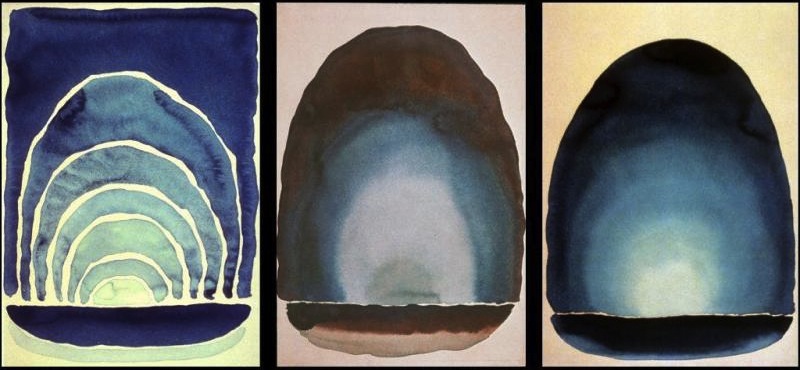
O’Keeffe’s Texan landscape series of 1917, Light Coming on the Plains (Fig. 1), traces the breaking of dawn or unfolding of light in its simplest form: Pure white sunrays start arching above the sky-blue horizon only to dissipate and reappear as glowing aura. The morning light is coming (as the title aptly points out) and going over an extended present. When all three paintings are hung together, their interactive radiant glow releases pulsating halos. The sensation is dazzling.

light-coming-on-the-plains-i-ii-and-iii
Fig. 1. Georgia O’Keeffe. Light Coming on the Plains, I, II and III, 1917, watercolor on paper (each 30.2 x 22.54), Amon Carter Museum, Fort Worth, Texas.

Her smoothly painted fields of swirling hues suggest a cosmic soup with the eternal potential of metamorphose. Her luminous patterns hold in suspension the fertile phase before light waves collapse into textured particles. Her brushwork has no need for Impressionist flicks that freeze fleeting instants. Instead of depicting momentarily reflecting surfaces, her sleek, luminous vistas unveil how energy shapes light itself. Even the shadows are not cast from an exterior light source. The art of O’Keeffe expresses the idea that creation is seen as a refraction of whiteness or visual emptiness. In this optic, forms are not drawn upon a blank background. The whole pictorial surface is sub-divided by bending light into colours to reveal its potential differentiation.

Although O’Keeffe feared that the strange, abstract patterns of her early works, or ‘Specials’, would seem incomprehensible and even foolish,[1] she asked her friend, Anita, to take a cardboard tube of them to Gallery ‘291’ in 1916. The moment Alfred Stieglitz unrolled her drawings he experienced the same sensation of awe as one does with Chinese landscape scrolls. The act of spreading them out is all part of their allure. The viewer is led to participate and explore new vistas by following the imaginary journey through their continually shifting perspective of voids and forms. Such parallels with O’Keeffe’s work are hardly farfetched since she had studied Sung Dynasty ink painting under Arthur Dow at Columbia University and her own work was clearly unlike that of any other Western artist.

Stieglitz recognized the worth of O’Keeffe’s art at once and insisted on exhibiting it. He foresaw that her drawings “would bring a greater awareness to all who saw them”.[2] He hung Blue Lines (1916) right over his desk at Gallery 291. This quiet little painting, minimal in every respect, simply juxtaposes a straight line and a bent one, both seemingly growing out of a pool of inky blue. Yet, it presents a binary option, I-Ching-like, that enables all further variations of expression to unfold. And, in O’Keeffe’s case, they soon do. Her works of the late 1910s Music: Blue and Green, Music: Pink and Blue (Fig. 2), and Evening Star correspondingly fan out, twist, and coil light in order to channel prismatic colour into liquidly, abstract linear forms.

Fig. 2. Georgia O'Keeffe. Music – Pink and Blue, N°1, 1918, oil on canvas (88,9 x 73.7) Collection of Barney A Ebsworth, St. Louis, Missouri, partial and promised gift to Seattle Art Museum
Fig. 2. Georgia O’Keeffe. Music – Pink and Blue, N°1, 1918, oil on canvas (88,9 x 73.7), Collection of Barney A Ebsworth, St. Louis, Missouri, partial and promised gift to Seattle Art Museum

However, any reference to factorization in O’Keeffe’s art must not be considered as some variation of cubism, which fragments by multiplying the external viewpoints. Quite the opposite, O’Keeffe’s whole pictorial plane is factored, not fractured. Hers demonstrates the method of “dividing space in a beautiful way” developed by her art instructor at Columbia Teacher’s College, Arthur Dow. Furthermore, in contrast to the illusionist devices, which cubism still relied on, her depiction of depth through painted folds is always subordinated to the conscious presence of the unbroken surface. O’Keeffe’s picture plane can, thus, display the implied volumes without disguising the fictive nature of their individual materiality. In evoking forms through folds, her works emphasize a sort of creative play, toying with shapes as they unfold. All the while, it underlines the impermanence of all that appears to have been made and the fallacy of believing that any truly independent structure could be made. Her paintings suggest that she has bent space itself to enclose the volumes portrayed and upon closer scrutiny, they would simply sink back into the canvas’ undifferentiated surface.

This recalls the approach of paper-folding – Origami – whose immaculate sheets of white paper offer an ideal symbol of the primordial space and at the same time, when artfully creased, allow temporary forms to appear. Another aspect of Japanese art, that O’Keeffe adopted is Notan. It replaces chiaroscuro to balance areas of light and dark without designating a particular light source or rupturing the flat pictorial surface. In painting, Notan, thus, complements the illusion of folds. Dow had illustrated Notan in his manual, Composition, with the bold, graphic, floral patterns and elaborate draping of kimonos that respect the fabric’s intrinsic flatness. Is it a coincidence that in later life O’Keeffe wore only kimonos? She quite naturally introduced elegant pleats, creases and tucks in various objects of everyday life. She was an avid seamstress and even made her own undergarments. As a child, she had designed a portable dollhouse that that exploited the concept of unfolding volumes. In fact, Duchamp’s Valise (1935-1941)– that contains a display of his works folded up in a briefcase – was inspired by her dollhouse and that of her friend, Carrie Stettheimer, for whom he painted miniature copies of his works.[3]

O’Keeffe did not always wish to create an object of art or even a handicraft but simply render aesthetic whatever she came into contact with. This explains her Zen-like refinement and presence in every action even that of folding a dinner napkin. Her graceful gestures echo those of a Tea Ceremony Master. It is not surprising that Okakura Kakozo’s Book of Tea was a most treasured source of inspiration for her.[4] Stieglitz noticed the way she fondled things and often photographed her elegant long fingers. Graceful hands may also become a mudrâ, a Sanskrit term for a symbolic gestures in Buddhist images. O’Keeffe prominently displayed one such sculpture in her bedroom at Abiquiu – a Thai carving of a hand in the mudrã ‘Fear not’ – which she had received as a gift from art curator Henry Clifford. [5]

Indeed, there is nothing to fear as long as the ultimate emptiness of form itself and the impermanence of all creation are understood. O’Keeffe’s images are designed precisely to demonstrate this quintessential truth.[6] Through the contemplation of their beauty, they become a meditative act that epitomizes the ultimate vacuity of any subject matter portrayed. Her still lifes such as Calla Lily on Grey (1928; Fig. 3) tease the viewer by relaxing here and there their portrayed ‘solid’ objects into a fluid state of pure colour where tucks, pleats and curls express the underlying cataclysmic nature of all natural phenomenon.

Fig. 3. Georgia O’Keefe. Calla Lily on Grey, 1928, oil on canvas (80.96 x 43.18), Museum of Fine Arts, Boston, Gift of the William H. Lane Foundation

What may be called substance never loses its malleable quality. In the same way, her New Mexican landscapes such as Black Mesa Landscape, New Mexico, Out back of Marie’s II (1930) depict mountainous folds buckling and smoothing out again and again over geological time.

Even her individual ‘portraits’ of plants and animals – clamshells, calla lilies, and snakes – are foremost defined by their organic hinges, folds and coiling as simply an on-going process rather than a separate entity.

In fact, a so-called individual form ‘unfolds’ when an expanse of space temporarily folds itself up. Just as the Mobius strip appears to turn inside out, yet has but one surface, the ultimate non-differentiated reality is able to model itself into an apparent existence. That is why authentic origami intentionally keeps the original sheet of paper intact. Both cutting and pasting are taboo.[7] O’Keeffe’s compositions have this same fundamental unity. This is what gives them such a different feeling from collage or trompe l’œil. They evoke the innate, primordial creative force that perpetually defines mountain valleys, ocean waves, river networks, leaves, flower buds and even shellfish by simply folding and unfolding itself.

When the viewer opens his eyes onto such wonder, he naturally repeats the same folding gesture with his own eyelids. It is as if the world has come into existence anew with his conscious regard. This recalls the celebrated phrase of O’Keeffe, “I think all the world has turned into what I’m seeing”.[8] It also alludes to her mystical motivation for painting: In graphically putting to paper her own vision, she alters ours. She makes our material world appear to dematerialize into her own harmonious compositions of coloured light.

Given that colour is simply white light bent through a prism, tinted folds naturally appear as the underlying subject of O’Keeffe’s more abstract art. Grey Line with Lavender and Yellow (1925), for example, depicts a few large, flat shapes, each of a different hue, overlapping or curling back to form a delicate, luminous composition. Blind I, Dark (1921), on the other hand, gives a haunting view of curves as obstructions. Hues and bends can compete with each other thereby emphasizing their interdependence. Abstraction (1926) fades the colours to emphasize the folds. Through this seemingly banal subject, O’Keeffe resolves the painterly question of adapting surfaces to reveal volumes with her origami-like facets instead of foreshortening.

While with Inside Red Canna (1919), she had taken the opposite approach by collapsing her voluminous figurative subject so that it could fit onto the two-dimensional canvas plane. In fact, Canna’s multi-layered, organic petals are reduced to completely flat, knife-edged pleats. The motif becomes a spectacular fan-shaped blossom that recalls the Sri Yantra. Other more realistic flower paintings by O’Keeffe portray naturally folded forms – from sprouting stems to curling petals – with refined sweeps of parabolic curves. In Skunk Cabbage (1928), she brings the viewer right up into the folds of her enveloping subject by placing the vanishing point outside the canvas. Flowers Abstraction (1924) makes an elaborate study of intertwining petals edged in orange whereas Abstraction, White (1927) focuses on a close-up of two, colourless folds. Abstraction, White Rose of the same year expresses the flower’s heart as a bursting array of whorls.

Fig. 4. Georgia O'Keefe. Black Place - I, 1944, oil on canvas (66 x 76,5) San Francisco Museum of Modern Art, Gift of Charlotte Mack
Fig. 4. Georgia O’Keefe. Black Place – I, 1944, oil on canvas (66 x 76,5)
San Francisco Museum of Modern Art, Gift of Charlotte Mack

Not only close-up flowers but also far-away landscapes appear to be folding and unfolding. O’Keeffe’s seascape, Night Wave (1928) gives the movement of an entire ocean with one solitary wave lapping against the shore. She seems to alternate between intricate and streamlined compositions in order to recall the reversibility of folds and of form itself. In Black Place – I (1944; Fig. 4), O’Keeffe suggests the textures of valleys as ‘crumpled’ and of mountains as ‘buckled’ by varying the angle and frequency at which folds appear.

One of the most curious subjects is from a later series, Untitled (Sacsayhuaman) (1956). It looks like a flattened sheet of paper showing traces of previous creases. Folds everywhere even unfolded and smoothed out become a memory of past forms just as facial wrinkles and palm reading trace an individual’s unique history. In old age, O’Keeffe bore proudly her own wrinkled visage that had been weathered by New Mexico’s desert sun.

After the death of Stieglitz, Georgia traveled all around the world. Her 1950s landscapes were sketched from an airplane window as if she was reflecting back upon her memories of life on earth, isolating the essential. Their flattened, birds-eye views, tracing only a few bends and turns, clearly suggest rivers or roads. Brian Dijkstra in Georgia O’Keeffe and the Eros of Place, found that: “O’Keeffe’s paintings illuminate and celebrate the eerie beauty of the silences that fold themselves into nature’s ability to overcome the closely guarded distances between our selfhood and what is Other”.[9]

In viewing O’Keeffe’s far-away and close-up perspectives, which she often wittingly juxtaposed in the same painting, we start to feel grand – not in the sense of dominating our environment but in the sense of surpassing our own limited self. Just as with the Mobius strip, the outer and inner appear to be interchangeable. Her vision makes us open up. For Eldredge, her paintings provoke “a universal sensation of joyful release into another world”.[10]

The metaphor of folds can be taken even further when interpreted, as ‘mind-bending’. This applies to the particular way that O’Keeffe paints which obliges the viewer to consciously participate in the process of regarding a painting. We become aware of that fact that what we think we see is, in reality, something else. This, in turn, encourages us to regard our own mind in a new way. Fisher recognized such an effect at O’Keeffe’s very first solo show as his critique in Camera Work of 1917 explains:

And it is in so communing that the consciousness comes that one’s self is other than oneself, is something larger, something almost tangibly universal, since it is en rapport with a wholeness in which one’s separateness is, for the time, lost. Some such consciousness, it seems to me, is active in the mystic and musical drawings of Georgia O’Keeffe … strongly appealing to that apparently unanalyzable sensitivity in us through which we feel the grandeur and sublimity of life.[11]

In regarding O’Keeffe’s art as spiritual, it becomes clear that she accentuates her motifs of folds to express the most profound realities. There is a sort of vibrating energy between the light and dark zones provoked not by shadows but by the event of a natural landscape continuously unfolding. This energy can also be seen through O’Keeffe’s flower paintings. Black and Purple Petunias (1925) seem to be ‘peeling’ apart their individual petals in order to blossom right before our eyes. One viewer at O’Keeffe’s exhibition of 1925 understood their profound meaning as:

The essential truth … the drama of life working itself out there among the petals … it is the universe we are looking at, it isn’t it? Whatever the object may be that catches our eye if we look into things rather than at them … You take a seed … and unroll the Cosmos out of it.[12]

The folds in O’Keeffe’s abstract flowers loop back upon themselves. In this way, they reconnect the interior of a simple bud with the entire universe. They trace the ultimate fold, which turns infinite space itself perpetually inside out. Her more concretized forms, on the contrary, must sustain the repercussions of folding and unfolding space. The art of O’Keeffe, whether abstract or realist, is unique in that it has found the delicate balance between manifestation and nothingness. She, thus, demonstrates how the mystical becomes visible on earth. In order to achieve this, she based her view of nature, and of all reality, on the syncopated swings between forms and intervals of space as if she sought to demonstrate the Buddhist mantra from the Heart Sutra: “Form is emptiness, emptiness is form”.

In this optic, O’Keeffe’s work admirably fits Ansel Adams’ definition of art as “… the turning out to the light the inner folds of the awareness of the spirit”.[13] Her paintings of radiant flowers, hills and abstract forms in folds engender a vision of the Beyond made visible. Adams declared, in reference to her own particular art, that “Nobody can look at a painting without being deeply affected. So the mystique begins and endures”.[14] He is far from being the only one who understood the spiritual nature of her art. Sara Whitaker Peters in The Early Years: Becoming O’Keeffe went even further: “I now that O’Keeffe was a visionary Symbolist artist whose central concern was to cure people’s minds and bodies with her paintings. And this is why she would not (or could not) divulge what she did”.[15]  Furthermore, Barbara Rose has claimed for many years that O’Keeffe is a maverick mystic and a Later-day Emersonian.[16]

O’Keeffe’s connection with Transcendentalism can be better understood in recalling that when Emerson insisted on ‘the bended horizon’ (Journal V, 46)[17], he had recognized the deep spiritual connotations with regards to the angle of one’s viewpoint. He, thus, proposed that everyone envision himself as ‘a transparent eyeball'[18] in order to “discover that Within and Above are synonymous” (Journal III, 399).[19] He took his inspiration for the ‘Oversoul’ from the absolute, all-enfolding Consciousness described in the Upanishads as the ‘Divine Ground’ from which all things emanate and to which all living things may hope to return. Another Transcendentalist, Walt Whitman, in Autumn Rivulets, personifies this ‘Divine Ground’ in the form of a woman whose folds are the matrix of all creation: “Unfolded out of the folds of the woman man comes unfolded, and is always to come unfolded”.[20] The sensuous forms, in O’Keeffe’s paintings, enveloping hidden cavities – too easily explained as representing a woman’s desire to have a child – actually recall this poem from Leaves of Grass.

The idea of folds in association with O’Keeffe’s art has cropped up again and again in both her colleagues’ and art historians’ commentary. In 1922, Rosenfeld re-evaluated such a metaphor for the folds in her images: “Shapes as tender and sensitive as trembling lips, seem slowly, ecstatically to unfold before the eye. It is as though one had been given to see the mysterious parting movement of petals under the rays of sudden fierce heat or the scarcely perceptible twist of a leaf in a breath of air”.[21]

Through folds, O’Keeffe managed to symbolize all creation in a single rose. This brings out the underlying wave-like patterns that characterize each motif which, in turn, echo the undulations that transmit all light, sound and rays of energy along the electromagnetic spec[tr]a. This is why O’Keeffe’s paintings often seem musical or charged with electricity like with Ballet Skirt or Electric Light (1927). Moreover, for Rosenfeld, O’Keeffe’s knife-edged creases and fluid undulations in Blue and Green Music (1919) go much deeper, reaching that:

Dim region where human and animal and plant are One, indistinguishable, and where the state of existence is blind pressure and dumb unfolding. There are spots in this work wherein the artist seems to bring before one the outline of a whole universe, an entire course of life, mysterious cycles of birth and reproduction and death, expressed through the terms of a woman’s body.[22]

Unfortunately, the folds in the works of O’Keeffe were quickly dismissed by other art historians as simply symbols of feminine genitals. Her flowers became identified as the folds or undulations of a vulva. Even Judy Chicago’s porcelain plates from The Dinner Party (1970s) portray O’Keeffe as such.[23] There is no point in denying that many of her paintings of oysters or clams do emphasize puckering clefts of symmetric shells with mysterious interiors of dark, opaque emptiness. Yet, they evoke more than an equivalent of female sexuality. Such shapes call forth not only early forms of life on this earth, but also early forms of the earth itself. Her uterine landscapes and abstracts insist on the materiality of Mother Earth. Folds being naturally organic render all subjects biomorphic and fertile, bursting out into ever-new forms – a style quite distinct from the cerebral, geometric abstraction favoured by most European artists. They represent something quite abstract and powerful in their inert energy, which is at the same time full of potential evolution. Their imminent unfolding is inevitable.

However, at the same time, O’Keeffe’s pictures seem to demonstrate that that all forms and colours are just a mirage. They recall the importance Carl Jung gave to never losing sight of the form’s underlying clear light, which is the ultimate reality. In her treasured book on alchemy, The Secret of the Golden Flower, Jung tells the follower to not forget that although “every separate thought takes shape and becomes visible colour and form, the total spiritual power unfolds its trace and transforms itself into emptiness”.[24] This corresponds to an Eastern mystical component. O’Keeffe achieved such glowing, back-lit luminosity by delimiting coloured shapes and simply leaving areas of bare, white paper or sized canvas around them to better outline their natural boundaries. She composes, thus, like for music with intervals of silence or space. That being said, her borders are rarely softened; all is in sharp focus. Yet the forms never stick out. The white spaces serve to show that forms are not solid but just diaphanous images like those of a film projected on a screen. Colours are after all simply bent light that, thanks to a prismatic effect, becomes spectral.

Just as Origami translates this phenomenon of folds into sculpture, O’Keeffe’s painting does so with pigment. As Jack Cowart so aptly put it, “O’Keeffe wrapped colour around the ethereal”.[25] When critiques sense her ‘photographic influence’ they may actually be trying to explain the primordial presence of white light in all her works just as this article’s insistence on folds underlines that O’Keeffe’s colours are always presented as refracted light rays. As her colleague, Charles Dumuth, said of her palette: “Each colour almost regains the fun it must have felt within itself on forming the first rainbow”.[26]

This has deep spiritual significance. Manifestation is simply play or Lila. Emptiness in a picture – whether blank spaces or translucent tints – lets the light circulate and breathe. If not, the space is smothered and the fundamental unity is forgotten. All shapes, after all, are simply temporary displays made by turning space inside out. It is in this light that O’Keeffe paints folds.

O’Keeffe was always careful to deny the three-dimensional solidity for her forms. Her apparently illogical maze of flower petals and tilted pelvis cavities elicit a more abstract space – at once interior and exterior. O’Keeffe thus finds the delicate balance along ‘the razor’s edge’ determining the particular while maintaining awareness of the whole. Her motifs have no contours. Their edges, albeit often very sharp, do not cut shapes out of the background. They are themselves the ridges and troughs of each other. They can even loop back on themselves so that when the viewer follows their borders, he never arrives at a whole circle but finds twists and turns that render interior and exterior space one.[27] The edge, in this way, negates the very form it outlines. With O’Keeffe, the whole, or entire canvas, is truly divided in a beautiful way without ever breaking its innate unity.

Her approach brings to mind an article in Camera Work which redefined the role of the artist as that of literally unravelling or reversing the process of creation: “translating with brush or chisel all things back to their private original glamour with the witchcraft of this holy pagan innocence unwinding the cords of complexity … wound round and round the Holy Ghost of Beauty”.[28] The Stieglitz circle developed Straight Photography and abstract painting to reveal this primitive force. As O’Keeffe’s colleague, Arthur Dove, insisted, one must depict not form but formation. It is not the object but the act of creation or unfolding that counts.

What is more, O’Keeffe’s folds do not just suggest the known forms of the universe; she creates her own private universe of forms to show us how illusions manifest in our minds. For example, her creases delicately trace a ‘hard edge’. Such wrinkles symbolize all potential deformations of space. At the same time they point to the smooth, underlying continuity. This recalls O’Keeffe’s comment about her paintings of sun-bleached bones against the sky: “The blue that will always be there as it is now after all man’s destruction is finished”. As with Pelvis II (1944), all of her paintings transcend their immediate themes to become universal reminders of Wholeness.

This delicate balance between such a two-fold reality is explained from a Theoretical Physics point of view by David Bohm whose central theory is fittingly called ‘Enfolded order’. Bohm believes that forms ‘explicate’ themselves similarly from the Universe as a whole, and then ‘fold back in again’ only to re-emerge again, in ceaseless succession.[29] O’Keeffe’s folds illustrate the illusion of form itself, thus, shattering the normal vision in traditional Western art known as Alberti’s window. Her series of Sky Above the Clouds in the 1960s even reverse normal linear perspective so as to make the vanishing point fall upon the viewer standing a meter or so away from the canvas. In this way, it seems as if the pictorial space tips horizontally to form a flat shelf-like area spreading out before one’s eyes.

When almost blind, O’Keeffe painted a final canvas, The Beyond (1972), which explores a whole new dimension. It unrolls the horizon evenly along the entire width of the canvas. No longer following any vanishing point, the vista revealed seems to suggest a field of vision of 360 degrees simultaneously. In eliminating all refraction, blackness invades the foreground yet a line of luminous whiteness traces a suspended horizon against the boundless blue sky. O’Keeffe shows the viewer that all folds, all phenomena and lives themselves are fleeting ripples on the surface of infinite openness.

Acknowledgements: This paper has never been presented or published before;

Posted on Alpheus web site on July 24, 2016;

Deborah Jenner, Ph.D. is a lecturer in Art History at the Sorbonne in Paris, France. 

jennerdeborah@yahoo.fr

Notes

[1] Robert M Cortes, ‘Profiles – Abstraction – Flowers’, The New Yorker, July 6, 1929, pp. 21–24 21

[2] Sara Whitaker Peters, The Early Years – Becoming O’Keeffe, Abbeville Press, New York, 1991. p. 27

[3] O’Keeffe and Duchamp were regulars at the Stettheimer sisters’ salons. Carrie’s dollhouse is on permanent display at the Museum of the City of New York.

See : http://brbl-archive.library.yale.edu/exhibitions/cvvpw/gallery/stetthe2.html

[4] Okakura Kakuzo, student and then colleague of Ernest Fenollosa in Japan, became curator in the Asian Arts department of the Boston Museum of Fine Arts in 1904. Dow’s 1913 edition of Composition, praised his work, The Book of Tea (1906).

[5] Eldredge, The Georgia O’Keeffe Museum catalogue. New Mexico, 1995. p. 101

[6] Buisson, Manuel pratique d’origami (Practical Manual of Origami), Celiv, Paris, 1990. pp. 103–4

[7] Ibid. p.138

[8] Sharyn Udall, O’Keeffe and Texas, The Marion Koogler McNay Art Museum, San Antonio, Texas, 1998. p. 26

[9] Brian Dijkstra, Georgia O’Keeffe and the Eros of Place, Princeton University Press, New Jersey, 1998. p. 6

[10] Charles Eldredge, catalogue. p. 16

[11] William Murrell Fisher, ‘The Georgia O’Keeffe Drawings and Paintings at ‘291’’, Camera Work 49–50, June 1917. p. 5

[12] Charles Eldredge, Georgia O’Keeffe: American and Modern, Yale University Press, National Gallery of Art, Washington DC, 1993. 1 p. 75 (Letter from Albert Blohm to O’Keeffe, Yankers, New York, April 4, 1925) (Yale)

[13] Roger Lipsey, An Art of Our Own: The Spiritual in Modern Art, Shambhala, Boston, 1988. p. 393

[14] Jan Garden Castro, The Art & Life of Georgia O’Keeffe, Crown Publishers, New York, 1985. p. 135

[15 ] Peters, Op. Cit. p.12

[16] Katherine Hoffmann, An Enduring Spirit: The Art of Georgia O’Keeffe, Scarecrow Press, London, 1984. p.84 (O’Keeffe Trail, New York Review of Books, March 31, 1977)

[17] Sherman Paul, Emerson’s Angle of Vision: Man & Nature in American Experiences, Harvard University Press, Cambridge, Massachusetts, 1952. p.76–78. Citing Emerson’s Journal, Paul gives a detailed analysis of how Emerson’s ‘transparent eyeball’ whose motifs become “chromatic entities, without resistance, mass or convexity”. This study on O’Keeffe shows that such a vision can be suggested in a painting through certain plastic means such as avoiding that which solidifies forms (i.e. a vanishing point and shadows) with smoothly-blending multiple, atmospheric perspectives and that which renders opacity (i.e. chiaroscuro, heavy brushwork and effects of reflection) by keeping colours translucent and tones pure.

[18] Ralph Waldo Emerson, ‘Nature,’ Selected Essays, Penguin Classics, New York, 1982. p. 39

[19] Ibid. pp. 34–35

[20] Emory Hollaway (Editor), Walt Whitman – Complete Poetry and Selected Prose and Letters, Bodley Head, Random House, 1978. pp. 356–57

[21] Paul Rosenfeld, ‘The Paintings of Georgia O’Keeffe – The Work of the Young Artist,’ Vanity Fair, Oct. 1922. pp. 56, 114

[22] Ibid., 56

[23] Judy Chicago, Through the Flower: My Struggle as a Woman Artist, Anchor Books, Doubleday, New York, 1977 pp. 141–43

[24] Richard Wilhelm (translator), The Secret of the Golden Flower – A Chinese Book of Life (with commentary by Carl Jung) A Harvest Book, Harcourt Brace & Company, San Diego 1931 (1962). p.108

[25] Jack Cowart, & Juan Hamilton, Georgia O’Keeffe Art and Letters, National Gallery of Art, Washington DC, 1987. p.4

[26] Eldredge, Georgia O’Keeffe: American and Modern, Yale University Press, National Gallery of Art, Washington DC, 1993 p.165 (citation of ‘Paints’ 1926 Intimate Gallery 1927 n.p. Statement)

[27] Allan Watts, The Book: On the Taboo Against Knowing Who You Are, Collier Books, New York 1966. p13. Alan W. Watts, a student of Suzuki, explains: “God has no skin and no shape because there isn’t any outside to him. (With a sufficiently intelligent child, I illustrate this with a Mobius strip – a ring of paper tape twisted once in such a way that it has only one side and one edge.) The inside and the outside of God are the same.”

[28] Benjamin Decasseres, ‘Rodin and the Eternality of the Pegan Soul’, Camera Work, no. 34 April 1911. pp.13–4

[29] ‘The New Scientist Interviews David Bohm,’ New Scientist, 96, no. 1331, November 11, 1982. pp.361–65. http://www.robert-temple.com/articles/NewScientist_DBohm.pdf

Environmental Virtue Ethics–Review

Environmental Virtue Ethics
Philip Cafaro and Ronald D. Sandler (editors)
Lanham, MD: Rowman & Littlefield, 2004. Print.

A Review-essay by Josef Mathews

“No Man is an Island,” writes poet John Donne. The idea contained in those words is a profound and timeless truth. It refers to the sea of connections that bind human beings. Environmental Virtue Ethics, edited by Ronald Sandler and Philip Cafaro, echoes this sentiment and extends the concept into the nonhuman world. There is a spider web of links between humans and betwixt humans and nature. The book is a collection of 13 essays penned by academics. They share their views on the topic of human relations with the natural world as well as with each other. While this paper captures the essence of the entire book, special attention is given to ideas in a chapter by Peter Wenz. Nonetheless, the collective message is that if humans live in harmony with each other and with nature, both the natural world and the human species will flourish; otherwise, social problems and environmental degradation multiply.

A tenable claim advanced in the book is that people are interconnected to and interdependent on each other as well as the natural world. Most people will not need complex scientific experiments to be convinced of this idea. Simple observations of causes and effects as they occur in the laboratory of daily life will do. While personal experience is valuable, keen insights on the global biotic community from dedicated and perceptive observers and thinkers of reality expands the band of individual observations. Geoffrey Frasz, in his essay Benevolence as an Environmental Virtue, captures the sentiment of the inextricable link between humans and nature:

We do not exist in the world as isolated, atomic individuals who simply act on objects outside of ourselves. Rather we are relational beings, moral agents who act in specific social, historical, and ecological contexts. …To be human is to dwell in relations with the nonhuman world (133).

While this observation is plain, its acknowledgment has profound implications. Some reflection on this idea will likely persuade the thinker to believe that what he does to the environment he is doing to himself and others. Therefore, out of enlightened self-interest and a genuine concern for everything other than the self, the individual is more inclined to make better behavior choices.

Indeed, actions have consequences. When humans act on the environment the impact can be classified essentially as positive or negative for human and environmental health. Peter Wenz uses a David Korten quote to summarize relations between humans and between humans and nature and the eventual fallout. Japan, a first world nation, in order to dodge pollution on their land, set up a copper smelting operation in the Philippines, a third world nation. The project began with the ejection of local residents from their land. Subsequently, plant contamination diminished local water supplies, fish, and rice. It increased upper-respiratory diseases among local residents who depended on the most dangerous and filthiest jobs at the plant. As a result, the locals suffered while the company owners prospered (201). This example highlights a willful disregard of marginalized people. Clearly, their worth as human beings, in the eyes of the company owners, is not much more than a means to an end. If the owners and other decision makers cared, there would have been significantly more consideration for the well-being of the people that already lived on the land as well as the workers. In fact, it is quite possible that a modicum of concern for people and the environment might have rendered the plan unconscionable.

Think about the hopes and dreams of these workers. A dirty plant which compromises their well-being is not fertile ground to realize their potential. Furthermore, the above example demonstrates that maltreatment of the environment reflects back on human well-being as well. In this case, the residents who dwell near the smelting operation endured the health repercussions associated with the degradation of the environment. To put it simply, at the benefit of a few people, many people suffered and the environment degraded. However, this need not be. If decision makers regard workers as intrinsically valuable and view them as human beings, they will not only ensure the health and safety of workers but also support their personal and professional development. Everyone has the basic rights to clean air, water, and it is a basic truth that all people have gifts and talents. Consultation of human development literature will bolster the idea that although people may have different capacities and abilities, all hold the potential to develop them. It is simply a matter of having the opportunity to flourish.

As often the case is, poor people bear the brunt of consumerism. Peter Wenz defines consumerism as the “ideology that society should maximize consumption, pursue consumption without limit” (198). It is true that humans need to consume. As a matter of fact, everyone depends on the natural world for sustenance; that includes the rich and the poor. However, some are deprived of basic necessities for survival while others overconsume. Wenz writes that “dependence on free sources of food and materials is common in the Third World” (200). However, the pursuit of increased output at times interferes with this access to even the basic supplies. Take, for example, the reduced access to basic nutrients like Vitamin A. The killing of a wild and free source of Vitamin A, bathau, with pesticides in India serves as an example. Ironically, the proliferation of bathau was fanned by the use of artificial fertilizers. One problem with such fertilizers is that poor people cannot afford them (200). The fertilizer was meant to grow high-yield crops. Two problems with this particular crop are their high water requirement and need for artificial fertilizers. Unable to dig deeper wells as well as secure artificial fertilizers, the poorest farmers were rendered incapable of keeping their farms and grow traditional varieties which required less water and no artificial fertilizers. While increased production and profits are not necessarily bad in themselves, it is the existent poor that often suffer. They get pushed deeper into destitution while a minority prospers on profits from fertilizers and pesticides. The lucky farmers who could afford the farming inputs profit from the crops themselves.

In the specific scenario described above, the locals were essentially denied Vitamin A. An unacceptable consequence is the occurrence of blindness among tens of thousands of Indian children every year due to a lack of vitamin A (200). As Wenz demonstrates, the benefits of particular practices are not always enjoyed by everyone. In fact, it negatively impacts vulnerable people. A concern for human welfare needs to be inclusive, and the negative consequences of boosting production need to be balanced against the benefits of freeing resources for optional consumer items. Respect for others should be a pivot point for projects intended to maximize production.

While problems dot the human landscape, so do solutions. The book proposes a strong idea which is a salve for social and environmental problems. It is land-ownership for the masses. Wenz uses another quote by Korten which explains this idea:

Rapid economic growth in low-income countries brings modern airports, television, express highways, and air-conditioned shopping malls … for the fortunate few. It rarely improves living conditions for the many. This kind of growth requires gearing the economy toward exports to earn the foreign exchange to buy the things that wealthy people desire. Thus, the lands of the poor are appropriated for export crops. The former tillers of these lands find themselves subsisting in urban slums on starvation wages paid by sweatshops producing for export. Families are broken up, the social fabric is strained to the breaking point, and violence becomes endemic (202).

An idea that emerges from the above quote is that the lack of land ownership is a contributor to social problems. In fact, other sources confirm this idea. A number of articles filed under World Food & Hunger on The Global Policy Forum website explore the nexus between land ownership and hunger. The page heading captures a basic truth that land is distributed unfairly and this inequity is a key factor to poverty and hunger. Across the globe, land is mostly in the hands of the rich elites, stripping the paupers arguably of the basic right to grow their own food. The principal message in the quote outlines the relationship between groups of humans, expressly the relationship between a small group of landowners and the landless many.

However, there is no need for people to starve, especially if they are willing to work the land to grow their own food. A book originally published in 1995, When Corporations Rule the World by David Korten, asserts that equitable sharing of the earth’s sustainable resources would meet the needs of the population at that time (199). The 2015 third edition of the same book contains the same wording which signifies even today, with the earth bustling with more than seven billion people, there is enough for everyone to survive. Another fertile argument for land ownership on a global scale is that small landowners who depend on their land will be good custodians of the earth because the land sustains them and they have a personal relationship with it. In that scenario both humans and the environment flourish, a universal wish of the essayists in the book.

Peter Wenz underscores other problems that are associated with the integration of traditional societies into the global consumer market. The resulting destitution creates social problems, like child prostitution, which disintegrates the social fabric of societies. Other negative effects are a growing disparity in income between nations and a decrease in global food security. In the year 2000, half the global population’s vitamin and nutritional needs were unmet (202). As mentioned earlier, it is not just humans that suffer; the environment aches as well. Environmental concerns aside, the earth simply does not contain the resources for all its inhabitants to embark on a lifestyle which is on par with the high-income countries (199, 203). An undeniable conclusion is that an insatiable appetite for endless goods and services precipitates social and environmental problems. Therefore, it is in the best interest of the human species and the rest of the earth community for humans to be more considerate consumers.

One approach to solving social and environmental problems is through educating the global population of the consequences of overconsumption along with character development, in particular the cultivation of empathy. People are less likely to jeopardize the well-being of other humans and other living things, no matter which part of the world they live in, if they develop a concern for the other like John Donne observed. Furthermore, one need not stop at living things; respect and reverence can be distributed more broadly to nonliving things like rocks, mountains, streams, and rivers. After all, all of these entities individually make up the whole of our natural world and life-sustaining systems. The education and character development applies both to the young people of today, who are still in their formative years, and the adults who make decisions which have consequences in the real world. The book clearly articulates the development of virtues that result in desirable outcomes for all.

Furthermore, the drivers of consumption need to consider that environmental degradation eventually spills over into their own neighborhoods. After all, water flows and air circulates, taking pollution along with them. To be sure, there may be less contamination when the water and air reach their homes, but that should not deter polluters from being better global citizens. Plus, the wealthy are not immune to social problems. The waves of those problems reach their shores as well.

Rich or poor, the factors that make human beings tick vary. This is so even when their actions are identical. Simply stated, people’s motives may differ. Wenz notices this peculiarity in the human species but places the importance on the end results rather than the motivations. What matters is the flowering of humans and the environment. He writes:

[N]onanthropocentric environmentalists have reasons to favor traditional virtues because their exercise tends to protect the nonhuman environment. Anthropocentrists have reason to support the same virtues because their exercise promotes human flourishing. Nonanthropocentric and anthropocentric considerations regarding human virtue and vice are thus mutually reinforcing. Each is stronger in combination with the other than alone, a relationship I define as synergistic (197).

As the above quote suggests, a balance of human and nonhuman interests motivating an individual is probably the ideal. Nonetheless, the following example demonstrates the concept of dual stimuli at work. Consider a group of people acting out of concern for other humans and another group acting out of concern for the natural world. On the one hand, humans concerned about other humans may oppose the use of sport utility vehicles because it contributes to climate change which adversely affects poor people across the globe. On the other hand, humans concerned about the natural world might be troubled by climate change because it endangers the survival of many species. The motivations are different, but they result in less consumption of natural resources and more preservation of the environment, and more flourishing of humans (209-210). In the absence of a broader environmental ethic, human-centered ethics still manages to promote the well-being of the natural world because, on many occasions, what is good for humans and what is good for the environment coincide. Still, the environment may not get the full protection that it would under a more rigorous environmental ethic (Gruen, 58, 60). Of course, some people may be equally compelled by the welfare of human beings and a reverence for the natural world. Perhaps this dual concern is a more well-rounded approach, but people possess different value systems which originate from many places. Some people may wish to protect the environment because it has instrumental value. Others are motivated to preserve the environment because they regard nature with a sense of reverence and sees intrinsic worth; its value is independent of whether or not it serves human ends (220).

The book, Environmental Virtue Ethics, in its entirety, including Wenz’s chapter, wishes for a peaceful existence not only between human beings but also between the human species and the natural world. The desire is that people respect each other and nature. However, despite people having strong convictions, changing their ways of being in a society that operates counter to their principles is akin to swimming upstream. Wenz takes into account the nuances and complexities of culture and status quo which make it difficult to adhere to virtues to their full extent. He does not ask individuals to ditch their car, in a car-centric society, if it halts their flourishing. Yet that is not a valid excuse to drive a thirsty vehicle. Wenz posits alternatives that deviate from mainstream practice, like driving vehicles that are fuel efficient, driving less, or/and increasing use of public transportation. The message is to adopt practices that improve on existing ones while not causing disharmony in social relationships which are critical for human flourishing. He asks the individual to be the vanguard of trendsetters that help both humans and the natural world to blossom (210-211). As the example illustrates, modifying current lifestyles for the welfare of the global biotic community is not an all-or-nothing effort. This piece of news should be encouraging for someone who does not think their small efforts will make a difference in the grand scheme of things. There is plenty of middle ground. A small change is better than no change and a significant change is an improvement over a small correction. Permission is granted to act even in the smallest ways for a better outcome for the greater good.

The consequences of over-consumption of goods and services by people in wealthy nations and by elite groups in poor nations disproportionately afflict the already marginalized poor. This is both unjust and morally reprehensible. While social and environmental problems are real and grave concerns in the world of today, the solutions are simple and actionable. Consuming less and living with a concern for the human and nonhuman world are obvious choices. The cultivation of virtues encourages individuals to be more concerned for others and the natural world. A more ethical global community allows for greater cohesion among its members and better relations with the natural world. Therefore, when possible, whether by doing a little or doing a lot, human beings “should cultivate … virtues to benefit themselves, other human beings, and the nonhuman environment (212). Environmental Virtue Ethics inspires the fostering of virtues that benefit both humankind and the natural world that the species is a part of.

Works Cited

Cafaro, Philip, and Ronald D. Sandler. Environmental Virtue Ethics. Lanham, MD: Rowman & Littlefield, 2004. Print.

“Global Policy Forum.” Land Ownership and Hunger. Global Policy Forum. Web. 14 Feb. 2016. .

Gruen, Lori, Dale Jamieson, and Christopher Schlottmann. Reflecting on Nature: Readings in Environmental Philosophy. New York: Oxford UP, 2013. Print.

The Inner Life of Krishnamurti

To the editor of the Quest:

Please allow me to add a few thoughts to Mr. Moody’s fine article on the inner life of Krishnamurti (Quest, Fall 2015), especially to Krishnamurti’s experiences of immense vastness, energy and sacredness which he described in the diary he kept in 1961.[1] My additional comments fall in four different categories by which one could try to make sense of these experiences. In keeping with the special subject matter of the last Quest, i.e. God, I will first make [A] a more or less theological comment, to be followed by [B] a view within a Theosophical perspective, then [C] a more personal note, and I will finish with [D] a secular, scientific hypothesis regarding these extraordinary experiences.

[A] It could be argued that Krishnamurti, in and through these experiences, had reached the ultimate as far as consciousness is concerned. There is nothing else beyond and he connects it with creation.

On waking there was in the very depths, in the measureless depths of the total mind, an intense flame alive and burning furiously, of attention, of awareness, of creation. … The fire of creation that is destruction is life. In it there is no beginning, no ending, neither tomorrow or yesterday.[2]

Could this “fire of creation” be Krishnamurti’s ‘God’? If so, and in more theological terms, this God is indeed beyond the human mind with its self-centered activities, but can still be experienced. And it is also quite impersonal. In none of Krishnamurti’s descriptions there is any sense of anything personal to this sacredness. It just is, comes and goes without warning, and does not leave a message. The Sanskrit concept of Satchitananda comes in my opinion closest, capturing maybe the three essential elements of this experience: Consciousness-Being-Bliss, or in a more phenomenologically structured way, blissful consciousness of being. But Krishnamurti’s meditations did not stop at this level.

Apparently he went one step deeper and claimed to have reached “the source of all energy” during one of his meditations in the middle of November 1979. This experience was so momentous that he dictated an account of it in the third person to a friend, in which he also shared a little, though ‘negative’ theological reflection.

“This must in no way be confused with, or even thought of, as god or the highest principle, the Brahman, which are the projections of the human mind out of fear and longing, the unyielding desire for total security”.[3]

[B] Ten years ago I discussed these experiences with an acquaintance and tried to capture the whole arc of Krishnamurti’s psychic experiences within an explicit Theosophical framework.[4] I made a differentiation between eleven states of mind, starting at the mundane Kama-Manas level, then going through different mystical states Krishnamurti experienced between the crucial formative years 1922 and 1927, temporarily culminating at the level of fusion between the Bhuddic and Atman principles. From this level he dissolved The Order of the Star, distanced himself from The Theosophical Society, and developed his teachings over the years. Then in the middle of 1960, while in Italy, he started to have the intense experiences of bliss and benediction described in his diary, which I interpreted as Satchitananda to be only experienced at the Buddhi-Atman level. I then reasoned about his 1979 experience of the source of all energy that as Atma is equated with Brahm and Krishnamurti was arguably at that level of consciousness, it could very well be that the ‘source’ was beyond Brahm, i.e. Para-Brahm. One could discuss, as I did with some Theosophical friends, whether this interpretation is Theosophically sound, because it was argued that a person from the fifth root race could hardly go beyond the Buddhic level at the current state of humanity’s spiritual evolution.

[C] To dispel any notion that Krishnamurti’s extraordinary experiences were just his and his only, there are numerous references in his diary that others were feeling the same bliss and energy when he was with them in the same space. And I can witness to the fact that when I was for the first time in Saanen, Switzerland, at the 1980 Krishnamurti summer gathering, I had, together with another person I had befriended, these very same experiences numerous times. It would befall us like a cloud of quiet but intense ecstasy while walking before sunset through the Saanen valley. The remarkable effects were that the mind would considerably quiet down, though not necessarily go into total silence; the senses would get very acute; the speed of walking would spontaneously slow down; and we would create a bit of a space between our bodies. These experiences might have lasted, I guess, between five and twenty minutes. I have always wondered what the possibility conditions were for this to have happened. One important ingredient was that I had just started reading Krishnamurti’s Notebook before hitchhiking to Saanen and was still reading it while there, which might have, psychologically speaking, primed me to be open to its possibility. Other ingredients might have been the fact that I was already exercising a kind of nature mysticism while having long walks in nature, and was engaging Krishnamurti’s teachings at a very serious intense level, which had only become more intense at the gathering while listening live to Krishnamurti and having great conversations with other attendees. But the most important factor was, I think, the fact that Krishnamurti, through his presence in the valley and having these experiences on an almost daily basis, somehow had anchored this vibration of ecstasy throughout the valley, which then could be accessed by anybody in the right sensitive state of mind. It was only at that gathering where I had these experiences in a clean and clear fashion. The next year at the gathering I only had some echoes of it and much later in 2008, while participating at a workshop of the very Krishnamurtian Steven Harrison, there was a short but very recognizable come-back of the experience.[5]

[D] Besides a Theosophically framed interpretation of Krishnamurti’s mystical experiences there is also the possibility to interpret those in a more secular, naturalistic manner. One possible venue is to extrapolate from the very intriguing scientific-philosophical ideas on the second law of thermodynamics by Eric Schneider and Dorion Sagan, who make a good case about how the inherent tendency of all energy towards disorder and decay actually is also the driving, creative force of its exact opposite, that is, towards all order and complexity.[6] Nature abhors energy differences between warm and cold, high pressure and low pressure, etc., and the cosmos is continually and all-pervasively trying to overcome these differences, but does so through creating order and complexity to hasten or smoothen the process, including, as the authors argue, through organic live, evolution, human behavior and the functioning of the mind. Though the authors discuss religion and the purpose of life, they do not address mystical states of mind. The extrapolation I suggest is that when the mind is very, very silent, it senses at an objective level this palpable, vast cosmic energy flux of which the body is an integral part—thereby contributing to the spatial and energetic component of the experience–, but also, on a more subjective level, the brain itself and its hormonal activities might be impacted by it (an issue Krishnamurti himself brought up a few times)– thereby contributing to the blissful aspect of it. Of course the experience, because of the absence or near absence of thought, is a unitary experience, but only qua experience, because thought, through science and careful thinking, can analyze its contributing components. How far Krishnamurti would go along with such an idea is, I think, quite open. He was not necessarily looking to Theosophical ideas to understand what happened to him and was definitely interested in a more physical, scientific way of explanation.

In short, Krishnamurti’s experience of bliss and vastness are indeed extraordinary, but not to the extent that they were private, nor that such experiences could not be tentatively explored within different frameworks of understanding.

Govert Schuller, Naperville

Sources

[1] Moody, Edmund. “Krishnamurti’s Inner Life“. Quest 103/4 (Fall 2015): 143-147.

[2] Krishnamurti, J. Krishnamurti’s Notebook (San Francisco: Harper & Row, 1976), p. 25.

[3] Lutyens, Mary. Krishnamurti: His Life and Death (New York: St. Martin’s Press, 1991), p. 168.

[4] “Krishnamurti Discussion”. Alpheus, 2005. 

[5] “About Steven Harrison”. Web site: Doing Nothing: Post-Spirituality and the Creative Life.

[6] Schneider, Eric D. & Sagan, Dorion. Into the Cool: Energy Flow, Thermodynamics and Life. (Chicago: University of Chicago Press, 2005).

TPP: What Could Possibly Go Wrong?

By Nick Egnatz.

The TPP (Trans Pacific Partnership) is a treaty between the U.S. and 11 other Pacific Rim nations. Together with the TTIP (Trans-Atlantic Trade and Investment Partnership) between the U.S. and the European Union countries and TiSA (Trade in Services Agreement) between the U.S. and 49 other nations, the three treaties represent what consumer advocate Ralph Nader calls a “corporate coup d’etat”.

This trio of treaties has been negotiated in secrecy for the last 7 years by 600 corporate lawyers and our State Department.  President Obama exerted his political muscle to obtain Fast Tract Authority that limits debate and forces Congress to vote up or down on the treaties without amendments.

Benignly called a trade deal, yet only 6 of the TPP’s 30 chapters deal with trade.

“The other two dozen chapters amount to a devilish ‘partnership’ for corporate protectionism. They create sweeping new ‘rights’ and escape hatches to protect multinational corporations from accountability to our governments… and to us.” Syndicated columnist Jim Hightower.[1]

As treaties, the U.S. Constitution’s Supremacy Clause will anoint the trio, “the supreme law of the land”, superior to all state law and to all prior federal law.

“By the Constitution of the United States, a treaty and a statute are placed on the same footing, and if the two are inconsistent, the one last in date will control, provided the stipulation of the treaty on the subject is self-executing”.[2]

Finally released on Nov. 5, 2015, the TPP now confronts us — 5,544 pages of undecipherable legalese. President Obama, the Republican Congress and just enough Democratic Members have joined hands with the huge transnational corporations singing kumbaya in praise of the TPP. What could possibly go wrong with it?

In 1994 President Clinton had similar rosy predictions that NAFTA (North American Free Trade Agreement) would result in one million new jobs, twenty years later the Economic Policy Institute estimated that 700,000 jobs were lost to Mexico as a result of the treaty.[3]

Again in 2012, President Obama predicted 70,000 new jobs would result from the Korea-U.S. Free Trade Agreement (KORUS). The Economic Policy Institute instead says it has cost us 40,000 jobs.[4]

Obama has dispatched his Cabinet officers to the media, singing the treaty’s praises. But their refrain has fallen on ears that have heard it all before. Trade unions have been the backbone of support for the Democratic Party, yet every major trade union vehemently opposes the TPP. Environmental organizations oppose the TPP. Groups defending internet freedom, oppose the TPP.

AFL-CIO President Richard Trumka called NAFTA, TPP and TTIP

“thinly disguised tools to increase corporate profits by poisoning workers, polluting the environment and hiding information from consumers”.[5]

On the other side President Obama thinks that,

“We have an opportunity to set the most progressive trade agreement in our nation’s history”. (BarackObama.com)

Ralph Nader’s response:

“One must seriously question what President Obama and his corporate allies believe to be the definition of “progressive” when it comes to this grandiose statement. History shows the very opposite of progress when it comes to these democratic sovereignty-shredding and job-exporting corporate-driven trade treaties — unless progress is referring to fulfilling the deepest wishes of runaway global corporations”.[6]

Pulitzer Prize winning journalist Chris Hedges on the TPP:

“Corporations will be empowered to hold a wide variety of patents, including over plants and animals, turning basic necessities and the natural world into marketable products. And, just to make sure corporations extract every pound of flesh, any public law interpreted by corporations as impeding projected profit, even a law designed to protect the environment or consumers, will be subject to challenge in an entity called the investor-state dispute settlement (ISDS) section. The ISDS, bolstered and expanded under the TPP, will see corporations paid massive sums in compensation from offending governments for impeding their ‘right’ to further swell their bank accounts. Corporate profit effectively will replace the common good”.[7]

Sierra Club Executive Director Michael Brune also opposes the treaty:

“Congress must stand up for American jobs, clean air and water, and a healthy climate and environment by rejecting the Trans-Pacific Partnership”.[8]

President Obama’s Affordable Care Act, 11,000 pages of legalese, was unintelligible enough that the Constitutional law professor himself did not understand that many people would not be able to keep their health insurance policies when he promised them that they would. The TPP likewise makes general statements that environmental and labor standards will be upheld and then proceeds to offer pages and pages of unintelligible mumbo jumbo that pave the way for legal action challenging these generalities. Citizens, labor groups, environmental groups, etc. will have no standing to bring legal action within the TPP, TTIP and TiSA. Only the corporations are given the right to adjudicate claims and this will be done before secret tribunals of corporate lawyers.

What could possibly go wrong, indeed?

Nick Egnatz is a Vietnam vet who was named NW Indiana Citizen of the Year 2006 by the National Association of Social Workers for his anti war activism. 

Contact Nick at OccupyNick@yahoo.com

[1]. Hightower, Jim. “The Trans-Pacific Partnership is not about free trade. It’s a corporate coup d’etat–against us!“. Hightower – Lowdown. 30/8, Aug 2015.

[2]. Whitney v. Robertson, U.S. Supreme Court, 124 U.S. 190 (1888).

[3]. Scott, Robert E. “NAFTA’s Legacy: Growing U.S. Trade Deficits Cost 682,900 Jobs“. Economic Policy Institute. 17 Dec 2013.

[4]. “KORUS Has Cost the United States 40,000 Jobs: U.S.-Korea Free Trade Agreement has hurt the American economy, Trans-Pacific Partnership could be even worse”. Press release. Economic Policy Institute. 18 July 2013.

[5]. Vail, Bruce. “Rejecting TPP, AFL-CIO’s Trumka Calls for ‘Global New Deal’“. In These Times. 25 Mar 2014.

[6]. Nader, Ralph. “10 Reasons The TPP Is Not A ‘Progressive’ Trade Agreement“. Huffington Post. The Blog. 8 June 2015.

[7]. Hedges, Chris. “The Most Brazen Corporate Power Grab in American History“. Truthdig. 6 Nov 2015.

[8].Byrnes, Dan. “Sierra Club: Congress Should Reject Polluter-Friendly Trans-Pacific Partnership“. Sierra Club (Oklahoma Chapter). 5 Oct 2015.

News from Switzerland on Money Reform


Our sister organization in Switzerland, MoMo (Monetary Modernization) and its action arm Vollgeld Initiative (Sovereign Money Initiative), have just passed the 100,000 mark in collecting signatures to trigger a referendum on the Swiss money system. They started their drive in the spring of 2014 and had 18 months time to get the required amount of signatures. The notarized signatures will be handed over to the Swiss government on December 1.

As guest author Daniel Hersheson stated on Positive Money, that

. . . should the MoMo team succeed in putting such a fundamental reform proposal to a national vote, this would be a momentous achievement for the monetary reform movement in Europe and across the globe.  All eyes would be fixed on Switzerland, because success for this small but significant player in the financial arena would inevitably have a ripple effect in other countries[1].

So far at least two dozen Swiss news outlets shared the news and was picked up by Reuters.[4] The Swiss paper Die Blick seems even moderately positive about the initiative and interviewed respectfully one of its initiators, the economist Reinhold Harringer.[2]

The text of the initiative proposes to amend the Swiss constitution such that (these are my chosen highlights and translations)

1) ” The federal government guarantees the maintenance of the economy with money and financial services”.

2) “The federal government alone creates coins, banknotes and electronic money as legal tender”.

3) “The Swiss National Bank enacts as an independent Central Bank a monetary policy which serves the overall welfare of the country; it controls the money supply and ensures the functioning of payments as well as to maintain the economy with credit to the financial service providers”.

4) “Under its legal mandate it spends newly created money debt free into circulation, either through the federal state, the cantons, or directly assign it to citizens”[3].

In the Reuters article Momo spokesman Raffael Wuethrich was quoted, stating that it might still take five years for the referendum to take place.[4]

[1] Hersheson, Daniel. “Campaign for Monetary Reform – News from Switzerland“. 18 Dec 2013. Positive Money.

[2] Studer, Rudy. “105’000 beglaubigte Unterschriften: Vollgeld-Initiative kommt zustande“. Die Blick.  31 Oct 2015.

[3] Federal popular initiative. “For crisis-resilient money: Money creation solely by the National Bank! (Full Money Initiative) “

[4] Miller, John. “Swiss group says it has signatures for ‘sovereign money’ vote“. Reuters. 31 Oct 2015.

The Controlled Demolition of WTC 1, 2, 7 and of its Official Explanation

In less time than the duration between American Airline Flight 11 crashing into World Trade Center One on September 11, 2001, and its total collapse 102 minutes later, one can experience the controlled demolition of the official version presented by the National Institute of Standards and Technology (NIST) of how the collapse allegedly happened through a combination of structural damage and fire-induced failure. By placing scientific facts at the many weak points of the NIST structure a group of experts representing the more than 2,300 professional members of Architects & Engineers for 9/11 Truth effectively demolished the NIST report and send its authors back to engineering school.

In their recently published booklet, “Beyond Misinformation: What Science Says about the Destruction of World Trade Center Buildings 1, 2, and 7“, the authors make the case that the NIST hypothesis was grossly under-developed because a) it only speculates about how the collapse could have been initiated, but gives no analysis whatsoever of the building’s behavior during its destruction; b) it ignores recordings and eyewitness accounts of explosions while also misrepresenting the occurrence of molten steel and smoke puffs occurring before and below the cascading collapse, all indicating the possibility of controlled demolition; and c) NIST’s inadequate responses to “Requests for Correction” by critical experts pointing to serious flaws.

While the NIST study admits it cannot provide a full explanation of the collapse, the A&E report makes a strong case that “the hypothesis of controlled demolition readily, simply, and completely explains all of the evidence regarding the structural behavior of WTC 1 and WTC 2 during their destruction” (p. 23). The evidence discussed ranges from the statistical improbability of total collapse of high-rise steel buildings; the sudden onset of the collapse; the constant acceleration of their fall as if nothing existed below to slow the cascade; the enormous energy needed for the pulverization, dismemberment, and explosive ejection of materials; the occurrence of demolition squibs; and the eyewitness accounts of explosions.

On top of that the A&E report also presents the forensic evidence of “high-temperature thermitic reactions” before, during and after the destruction of the buildings (pp. 30-37). Molten metal was seen pouring out of WTC 2 and was found in the debris; the few samples of steel investigated had sulfidated; four samples of WTC dust contained spherules and other composite particles indicating temperatures much higher (2,800F) than officially acknowledged (1,000F); and the smoking gun was the discovery of unreacted nano-thermite in the dust samples. Note well that this last finding means that traces of explosives were found which had not yet detonated!

While overall the main stream media and many technical journals ignore these findings, it is obviously up to civic society, comprised of grass-root organizations and activist individuals, to present truth to power and fight the good political fight to get the real culprits of 9/11 apprehended. I invite you to click on the booklet and spend $2.50 [as of 12/20/15 the booklet is free] and 100 minutes to see why.

A&E-Cover

Hearing on Monetary Reform in Holland

The October 14, 2015 hearing at the finance commission of the Dutch parliament regarding monetary reform was a milestone for the Dutch and international movement. The 140 minute long hearing can be watched on-line and will soon be provided with English subtitles [1]. This momentous event was triggered by a citizens’ initiative by  the Dutch monetary reform organization Ons Geld (Our Money) and the satirical theater group De Verleiders (The Seducers), which gathered more than 100,000 signatures, comfortably over the 40,000 needed. The first panel at the hearing, comprised of members of the citizens’ initiative, gave a very clear exposition of its proposals and during the second panel, comprised of financial authorities, bankers and academics, an outstanding debate developed between Dr. Bezemer and Dr. van Egmond about the necessity of reform.

Van Egmond made some very clear and passionate points in favor of reform. He seems to be totally on board with the monetary reform agenda, which is a great boon as he is not only a respected sustainability scholar, but also a founding member of the Sustainable Finance Lab at the University of Utrecht and, most importantly, a member of the very influential Dutch advisory council De Sociaal-Economische Raad (The Social-Economic Council).

Actually van Egmond co-wrote a working paper with Dr. de Vries titled “Dynamics of a sustainable financial-economic system”[7], which presents a “dynamic simulation model” in which the recent research into the nature of bank credit money by Dr. Werner [9,10] is incorporated.

“The model provides the ‘laboratory’ setting in which the discontinuities and associated socio-economic un-sustainability of the current financial-economic system can be studied and the feasibility of more sustainable alternatives can be explored”[7].

As far as I know the paper by van Egmond and de Vries is the third one to model the sovereign money proposal after the papers by Drs. Benes and Kumhof at the IMF [6] and Dr. Yamaguchi from Japan [11]. They all come to very positive conclusions regarding the proposal.

To be complete, there does exist a very recent fourth paper by Drs. Van Suntum and Neugebauer of the Center for Applied Economics Muenster, Germany. They investigated and modeled the Swiss sovereign money proposal and concluded that it was promising way more than could be realistically expected, even stating that “[m]ost of its desired effects are either negative or wishful thinking”[8].

In a response Dr. Huber, a long-time advocate of sovereign money [2] and critic of its alternatives [3,4], challenges the assumptions on which the authors had based their model, especially their idea that sovereign money would just be added to the already existing pool of money, instead of realizing that “Sovereign money – in its original and proper meaning – is a replacement for bankmoney, not an addition to the existing quantities of bankmoney”[5].

Govert Schuller
Naperville, October 20, 2015

Sources

[1]. “Round table conversation on the money system”. 2015. Hearing at the Permanent Commission on Finance of the Second Chamber of the States General of the Netherlands. Troelstra Hall. 14 Oct 2015. https://www.youtube.com/watch?v=3TSb9gBdyVE

[2]. Huber, Joseph & Robertson, James. 2000. Creating New Money. London: New Economics Foundation.

[3]. Huber, Joseph. 2014a. “Modern Money Theory and New Currency Theory”. Real-world economics review 66, (13 January 2014): 38-57. http://www.paecon.net/PAEReview/issue66/Huber66.pdf

[4]. Huber, Joseph. 2014b. “Sovereign Money in Critical Context: Responding to criticism of monetary reform from a variety of economic viewpoints”. Source: sovereignmoney.eu/papers-and-manuscripts, Oct 2014. http://www.sovereignmoney.eu/sovereign-money-in-critical-context

[5]. Huber, Joseph. 2015. “Side notes to” van Suntum, Ulrich & Neugebauer, Tom. 2015. Link to note at http://www.sovereignmoney.eu/confronting-criticism/.

[6]. Kumhof, Michael & Benes, Jaromir. 2012. “The Chicago Plan Revisited”. IMF Working Papers 12/202, International Monetary Fund. http://www.imf.org/external/pubs/ft/wp/2012/wp12202.pdf

[7]. Van Egmond, N.D. &  de Vries, B.J.M . 2015. “Dynamics of a sustainable financial-economic system”. Sustainable Finance Lab Working Paper. http://sustainablefinancelab.nl/files/2015/04/SFM-working-paper.pdf

[8]. van Suntum, Ulrich & Neugebauer, Tom. 2015. “Vollgeld, Public Debt, and the Natural Rate of Interest”. Working Paper, Centrum für Angewandte Wirtschaftsforschung Münster (CAWM), June 2015. Link to paper at http://www.sovereignmoney.eu/confronting-criticism/.

[9]. Werner, Richard A. 2014a. “Can banks individually create money out of nothing? The theories and the empirical evidence”. International Review of Financial Analysis, 36 (2014): 1–19. http://www.sciencedirect.com/science/article/pii/S1057521914001070

[10]. Werner, Richard A. 2014b. “How do banks create money, and why can other firms not do the same? An explanation for the coexistence of lending and deposit-taking”. International Review of Financial Analysis, 36 (2014): 71–77. http://www.sciencedirect.com/science/article/pii/S1057521914001434

[11]. Yamaguchi, Kaoru. 2011. “Workings of a Public Money System of Open Macroeconomies: Modeling the American Monetary Act Completed”. In Proceedings of the 29th International Conference of the System Dynamics Society, Washington D.C., USA, 2011. The System Dynamics Society. http://monetary.org/wp-content/uploads/2011/11/DesignOpenMacro.pdf

Surgery Prescribed for the Debt Money Disease: Fighting for the NEED Act

By Nick Egnatz.

Introduction.

The author is a former small businessman who has spent the last decade as an activist for peace and social justice. About five years ago he discovered that our monetary system is not what the people had been led to believe it is. More specifically:

1. The Federal Reserve System is not a part of our government, all 12 Regional Federal Reserve Banks are entirely owned by the same private banks in their districts that they were chartered to regulate. [source]

2. Almost all of what we use for money is created out of thin air by banks when they make loans. The only money created by the federal government are the coins in our pockets and our children’s piggy banks. [source]

3. While the U.S. Department of Engraving prints the Federal Reserve Notes which we commonly refer to as dollar bills of various denominations, the Federal Reserve pays the treasury only for the cost of printing them, about 5 cents for a one dollar bill and 12 cents for a one hundred dollar bill. [source]

“When a bank makes a loan it simply adds to the borrowers’ deposit account in the bank by the amount of the loan. The money is not taken from anyone else’s deposit; it was not previously paid in to the bank by anyone. It’s new money, created by the bank for the use of the borrower.”
Robert B. Andersen, Secretary of Treasury under President Dwight D. Eisenhower [source]

What I concluded was that the basic unfairness of allowing private banks to have the Money Power is at odds with democracy. It certainly flies in the face of our Declaration of Independence’s statement that “all men are created equal”. Perhaps if the people in our country were experiencing prosperity, we could in some crazy way justify giving the Money Power to private banks. After all, Aristotle looked to see what worked and what didn’t work. He junked the latter and supported the former. No doubt, he wouldn’t support our current monetary system. Our country is supposedly recovering from the Global Financial Crisis, but the recovery certainly doesn’t seem to trickle down to the poor or working class. Those who use the term middle class freely admit that it continues to shrink. The basic unfairness and the horrendous results of our monetary system is why I became a monetary reformer and a passionate advocate of the only comprehensive monetary reform bill placed into our Congress — the NEED Act.

I have written several other articles supporting monetary reform and the NEED Act. It has always been my intention to write an article that anyone can understand because economists have their own language and I for one had difficulty following their reasoning. This is not meant to denigrate economists, but those academics seeking a more technical explanation are encouraged to read the NEED Act and other papers included in the references, with particular encouragement in reading German economic sociologist Joseph Huber’s “Sovereign Money in Critical Context“.

While encouraging academics to read Huber, I caution those uninitiated in economist-speak to at the very least read this article first. Huber’s sovereign money, also called new currency theory, is entirely supportive of the NEED Act, but reading and understanding his paper will be a tough slog for those outside the economics community. Indeed, the grasp of his argument will be a challenge for bankers and economists alike. Not because they are unfamiliar with the language, but because they are unfamiliar with even considering reforming the present monetary system.

Money

Money is the very lifeblood of a nation. If a nation’s money system is healthy, society and people will prosper. From a sick or diseased money system, just as the night must follow the day, all manner of ills will follow.

A healthy monetary system is one in which the money is created and issued by the national government, debt-free, and spent into existence for the needs of the nation and its people as determined by its elected, representative government, in amounts that are neither inflationary nor deflationary.

A sick or diseased monetary system is one in which the money is created by banks and loaned into existence, as debt, for those endeavors that are determined profitable for bankers, with little or no regard for the actual needs of the nation and its people.

The Lost Science of Money, Director of the American Monetary Institute Stephen Zarlenga’s tour de force book on money, examines over 3,000 years of monetary history and uses Aristotle’s sage guidance in diagnosing and prescribing the cure for the critically diseased monetary system. It is available at the AMI website monetary.org. A much shorter treatment of the subject, Linking Social Justice to Monetary Reform, is available free online at alpheus.org.

Our understanding begins with Aristotle’s statement “Money exists not by nature, but by law.” The “money by nature” Aristotle referred to was a money as a commodity monetary system in which money was gold, silver or some other commodity, the system of choice for the wealthy who held the gold and silver. Money as a commodity, rejected by Aristotle, embraced by the rich, is the foundation for the debt money monetary system of today. Early goldsmiths or bankers began to issue paper notes for gold or silver given to them for safekeeping. They soon realized that people preferred the paper notes, which were accepted as money within their community by merchants, for their convenience. Very few people turned their paper notes in for their gold on deposit. This led the banker/goldsmiths to issue more, roughly 10 times the amount, paper notes than gold on deposit. Called “fractional reserve lending” it is the philosophical justification for the present debt money monetary system. (Federal Reserve Bank of Chicago 1992 publication “Modern Money Mechanics” available at AMI website, monetary.org)

The author is fully aware that Aristotle died more than 2,500 years ago. He prized justice above all other virtues and there is little doubt that Aristotle, confronted with the basic injustice of the present day debt money system, would prescribe a system of money based on justice or law and the NEED Act (explained below) is that system.

Money: an abstract Power and Duty of the state, that acts as a medium of exchange, for the benefit of the people and society.

 The Debt Money Disease

Our present monetary system is one in which almost all (except the coins) of what is used as money is created by private banks when they make loans.  As the loans are repaid the money is extinguished on their books and no longer exists.  The problem is exacerbated because no money is created with the loan to pay the interest that we most certainly are required to pay.  (Putting aside for now the matter of justice: why should we be made to pay interest to a bank for the use of money that they were allowed to create from the ether of the atmosphere?)  Since repaying our loans with the banks erases the money, it is necessary for us to be in debt so that the system has money with which to function.  Expanding the supply of money can only come from an expansion of the level of debt with which we and our government are burdened.  This system requires us, individually and collectively through our governments, to be in debt at unsustainable levels.  This debt money monetary system (known as fractional reserve banking) is a cancer that must be removed.  


Of course there are apologists for the debt money system, using terms like stocks and flows, who will be quick to point out that there does not have to be enough money in the system to repay all the debts, because this has never been done. We would add, of course it has never been done because any significant repayment of the overall level of indebtedness would result in a crash of the system. The system is designed to keep us in debt, not to allow us to repay our debt. The system is designed for debt slavery, not freedom from debt.

A few symptoms of the debt money disease:

1. The nations of the world are $57 trillion in debt (Economist World Debt Clock)

2. Federal, state and local government debt: $66,000/person (USGovernmentDebt.us)

3. U.S. citizens’ personal debt: $53,000/person (USDebtClock.org)

4. Greece is but the first nation to be destroyed by the disease.

5. Estimated 9 million American families lost their homes to foreclosure (Cornell University)

6. Real U.S. unemployment rate: 23% (ShadowStats.com)

7. Increasing wars and militarism, financed by loans at interest from bankers.

8. Destruction of our environment, since the bankers can realize little profit in its care and nurturing.

9. Inability of U.S. society to fund education, $1.3 trillion student loan debt and broke local school districts.

10. Inability of U.S. society to provide comprehensive healthcare for all.

11. Yet the banking cartel responsible for the debt money epidemic has only one prescription for the people — austerity in increasing doses.

“The mistake lies in fearing money and trusting debt.”
Henry Simons, University of Chicago Economist and advocate of the Chicago Plan that inspired the NEED Act
Economic Policy for a Free Society, 1948, page 199.

The NEED Act Is the Cure

Building upon Aristotle’s empirical conclusion that money is a function of the law; and seconded by the U.S. Constitution (“Congress shall have Power To…coin Money, regulate the Value thereof…”, Article I, Section 8); the complete cure was developed by the American Monetary Institute as the American Monetary Act and put into legislative form before the U.S. Congress in 2011 by Congressman Dennis Kucinich, co-sponsored by Congressman John Conyers, as the NEED Act (National Emergency Employment Defense Act).

The 3 Necessary Reforms of the NEED Act are actually just common sense and represent what most citizens mistakenly think is actually how our monetary system works.

1. Federal Reserve System is nationalized and placed under the Department of Treasury.

2. Bank creation of money as debt, commonly called fractional reserve lending, is decisively ended. Banks will only lend money that already exists.

3. Money is created and spent, debt-free, in non inflation/deflationary amounts for the needs of the nation and its people, immediately putting 10 million people to work, at good paying jobs, by financing the rebuilding of our country’s broken infrastructure.

The NEED Act also calls for specifically funding education, healthcare and addressing the mortgage crisis.

Regarding infrastructure; the NEED Act was written using the American Society of Civil Engineers 2009 Infrastructure Report Card calling for $2.2 trillion in infrastructure repairs. The 2013 Report Card now calls for $3.6 trillion to be spent by 2020 to bring 16 categories of U.S. infrastructure up to a state of good repair. That increases the jobs that would be created from 7 to 10 million, the vast majority of which would be good-paying union jobs that would also each support 6 or 7 other jobs in local economies across the country.(source, source, source).

It is important to note that “Since 1996, the Society (ASCE) has formally recognized civil engineers’ obligation to practice sustainability by making it part of its Code of Ethics.”

“The banks got bailed out, we got sold out.” A chant that echoed throughout Occupy camps across the country. The NEED Act addresses this inequity with a people’s bail-out, called a Citizen’s Dividend, that could and should be $10,000 for every citizen. It is necessary to immediately inject money in the economy when the NEED Act begins, to avoid deflation and a deepening of the present depression. The Citizen’s Dividend instantly does so and begins to ameliorate the disastrous effects of the depression on the people. It will also provide our small businesses with what they need — you and I to have money in our pockets to purchase their goods and services.

The NEED Act stipulates that 25% of all newly created money will be given to the states on a per capita basis to use as they individually see fit for their very real funding needs. And interest free funding will be available to help local governments fund capital expenditures on schools, libraries, sewers, roads and other major projects.

While a transition to clean, renewable energy and other environmental concerns are not spelled out in the NEED Act, it provides the vehicle to fund these with the approval of Congress. All Congress will need is for a knowledgeable citizenry to make its desires clear.

The NEED Act pays off the national debt as it comes due and does so with no inflation. No one from either political party has a plan to do this. They go into crisis mode with regularity trying to agree on increasing the debt ceiling, closing government programs or the government itself. Aristotle understood that a debt money system is incapable of co-existing with a free independent people and a government free of debt.

Before the NEED Act was written, Dr. Kaoru Yamaguchi put the American Monetary Act into his advanced system dynamic computer model and concluded that the national debt can be paid off as it comes due and the ASCE infrastructure repairs (at the time $2.2 trillion, now $3.6 trillion, putting 7-10 million people to work), can be done without causing any inflation. (source)

In 2012, Jaromir Benes and Michael Kumhof, Deputy Director of the Modeling Division at the International Monetary Fund, published the IMF Working Paper “The Chicago Plan Revisited”, in which they concluded the 1939 Chicago Plan, which is the template of the NEED Act, would solve most of the problems of the current Depression.

“At the height of the Great Depression a number of leading U.S. economists advanced a proposal for monetary reform that became known as the Chicago Plan. It envisaged the separation of the monetary and credit functions of the banking system, by requiring 100% reserve backing for deposits. Irving Fisher (1936) claimed the following advantages for this plan: (1) Much better control of a major source of business cycle fluctuations, sudden increases and contractions of bank credit and of the supply of bank-created money. (2) Complete elimination of bank runs. (3) Dramatic reduction of the (net) public debt. (4) Dramatic reduction of private debt, as money creation no longer requires simultaneous debt creation. We study these claims by embedding a comprehensive and carefully calibrated model of the banking system in a DSGE model of the U.S. economy. We find support for all four of Fisher’s claims. Furthermore, output gains approach 10 percent, and steady state inflation can drop to zero without posing problems for the conduct of monetary policy.”

Endorse the NEED Act

The American Monetary Institute welcomes vigorous debate on monetary reform, but is somewhat perplexed by organizations and individuals that claim to work for monetary reform, while ignoring the NEED Act and the AMI.

The NEED Act is the only comprehensive monetary reform ever put forth into our Congress in ready-to-go legislative form. This was a tremendous step and as such it deserves the attention of everyone interested in monetary reform. Evading it while at the same time pushing another monetary reform agenda is similar to an environmental group that concentrates on a single issue such as fracking, Arctic drilling, or the Keystone pipeline, that would completely ignore taking a position on legislation that has been presented to Congress that provides a complete seamless transition to clean sustainable energy. You can’t claim to be a reputable environmental advocacy group and ignore proposed comprehensive environmental legislation like it doesn’t exist. The same can be said for monetary reform legislation.

Those groups that claim to want monetary reform should either publicly endorse the NEED Act or present a paper telling the nation their reasons for not supporting the only comprehensive reform ever put into the U.S. Congress that decisively ends the debt money system and provides a seamless overnight transition to a democratic money system.

It is easy to understand people being led astray by alleged monetary reform groups who think that peaceful coexistence is possible with the debt money system. Once the monstrous nature of the this system becomes known, unsuspecting individuals start looking for a cure for the debt disease. In their search they may be introduced to a group that purports to greatly empathize with their concern over the debt disease and then seemingly innocently prescribes a remedy that leaves the basic debt disease intact, while the patient is treated with the distraction of a traveling medicine show, complete with snake oil elixir that does nothing to strike at the heart of the disease.

The NEED Act diagnoses the debt money system as a cancer that can only be treated by removal. Allowing the disease to continue consigns the country and its people to a future of overwhelming debt, unable to pump the lifeblood of money into the projects most needed — good-paying jobs, clean sustainable energy, 21st century infrastructure, national healthcare for all, education for our youth, etc.

Before entrusting your health and the health of those dear to you to a monetary reform group, ask them if they heartily endorse the only comprehensive monetary reform ever placed before Congress — the NEED Act? If not, tell them you are interested in 21st Century medicine and not snake oil, while running, not walking, to the nearest door. Then join AMI at monetary.org and become part of the monetary reform solution.

Endorsements of the NEED Act should not be limited to monetary reformers. All organizations, unions, political parties, social justice groups, citizen and neighborhood groups, etc. who are interested in a sane, democratic monetary policy are invited to publicly endorse the NEED Act.

Is It Necessary to Enact all 3 Reforms of the NEED Act?

A resounding yes! Historically partial reforms have been tried before and the Money Power has always been able to overturn the partial reforms and get back to the business of amassing wealth at the top by putting us and our governments in greater and greater debt.

The 3 Necessary Reforms of the NEED Act

1. Nationalize the Federal Reserve.
2. Decisively end all bank creation of money.
3. Federal government will create and spend into existence, debt-free, US Money for the needs of the nation and its people.

All 3 Reforms must be done or the Money Power will remain with the banks.

The Bank of England was nationalized in 1946 (Reform #1). But because bank creation of money was not stopped (Reform #2), private banks now still create 97% of the UK’s money.

Presidents Jackson and Van Buren revoked the Second Bank of the U.S.’s charter, effectively ending most bank created money at the time (Reform #2). Misunderstanding the true nature of money, they failed to create and spend debt-free money into existence (Reform #3), bringing on the terrible Panic of 1837.

Debt-free Greenbacks (Reform #3) were created under Lincoln to fight the Civil War and save the nation. Because bank creation of money (Reform #2) was not decisively stopped, the bankers eventually got the upper hand and quashed the Greenbacks.

NEED Act Brings Sanity and Safety to Monetary System

Surgery for a cancer that is destroying its host is standard medical practice. The NEED Act does the surgery and brings our monetary system in line with the Constitution and what people think it should be. The NEED Act is not radical. The only thing radical is to keep the debt money system in place and to continue allowing the Money Power to reside with the bankers and not the people through our elected government.

The NEED Act provides the safe, seamless transition to a just money system that Aristotle would be proud of. Bankers have no need to fear the system. Their liquidity and income should both improve. The people have nothing to fear from the system. Under the present debt money system our money deposited in banks is not ours, but is owed to us by the banks. Under the new system, it will belong to us and be kept in a bank “safekeeping” account. This again, is what most of us mistakenly think is the presently being done.

“How the NEED Act gives an Immediate, Seamless and Non-Disruptive Overnight Transition from a Crisis-Prone Bank Debt System to a Stable Government Money System” by Jamie Walton gives an easy to understand explanation (source).

Moving the NEED Act Forward

Not a single member of the U.S. Congress or Senate has stepped forward to re-introduce the NEED Act. Kucinich is no longer in Congress and Conyers has not done so on his own.

A July, 2014 poll of 100 UK Members of Parliament by Dods Monitoring revealed that 70% mistakenly believed that money was created by the government and only 10% understood that it was created by banks making loans.

Without a reputable scientific poll of U.S. Congress Members on money creation, we must judge their knowledge by their actions. Since none of them now publicly support returning the Money Power to Congress, where the Constitution places it, we must conclude that they too are ignorant on the subject.  The personal experience of colleagues talking with bankers on the subject also brings out their confusion and ignorance.  Many bankers erroneously believing that they lend bank reserves instead of creating the money from thin air.   

It is not hard to understand why our legislators, bankers and the American public are misinformed and confused on the subject of money. Lord Adair Turner is one of the world’s most respected members of the monetary establishment, a member of UK’s Financial Policy Committee, former chairman of Financial Services Authority, Pensions Commission and Committee on Climate Change. He made the following admission in his 2013 featured lecture to the Stockholm School of Economics:

“Modern textbook assumptions. I think it’s fair to say that they make 3 assumptions which are dramatic and wrong over the best simplifications. They tend to assume that what banks do is take deposits from household depositors and lend it to borrowers. That misses the insight that banks create credit and money and purchasing power. They tend still and I have read back through several economic textbooks over the last several months to check this. They tend to say that what banks do with that money is that they lend it to businesses in order to fund those projects that have a higher return than the interest rate. That ignores almost entirely the fact that most credit extension is no longer funding business capital projects.” (source, source)

In other words, our economic textbooks have been lying to us. These concepts are not difficult to understand, we have just been lied to and misinformed by the monetary establishment for years. Those with the most formal monetary education have been duped the most. In that light, it is not difficult to understand why many of our leaders are clueless. Our job is to educate them.

If most legislators are ignorant and bankers confused, it is not difficult to understand the lack of support in Congress for the NEED Act. What our legislators will not be confused about is an aroused citizenry demanding the justice of the NEED Act. This is a matter of education. Every person we talk with, give a pamphlet or book to, every letter to the editor, every comment we make online, every article we post on Face Book, every email, phone call or meeting with our Congressman, every time we speak up at a union meeting or town board meeting, every time we invite a knowledgeable speaker from the AMI to speak: all adds up to a more informed public. As this people’s movement grows it will reach a critical mass and Congress will take notice.

Our own monetary donations to those fighting for the comprehensive reforms of the NEED Act are also vital to the cause.  Those of us that can afford to contribute monetarily to the cause should and those that are unable to can find other ways to support the movement.  

An August, 2015 Gallup Poll shows only a 14% approval rating for Congress and a whopping 82% disapproval rating. To be fair, it is because they have been given an impossible job: “promote the general welfare” of the people and the nation with a cancerous monetary system. An aroused citizenry will have the immediate attention of a Congress with these dismal ratings. People do want their Congress Members, Senators and President to work together to solve the issues and crises that confront us. The NEED Act is not a partisan bill. It was written as non-partisan legislation by the Congressional Legislative Counsel. It’s appeal is universal.

A couple hours of reading Aristotle last night left me completely comfortable that he prized justice above all other virtues.  Of course he couldn’t have prescribed the NEED Act, because he never could have imagined the degree of injustice that flows from the present debt money system. But would he prescribe the NEED Act if he were here today?  Most definitely!

Aristotle has given us insight on money, but it is our struggle now. It is a fight for our destiny. Join us. What shall it be? A free independent people? Or a nation of debt slaves?

Nick Egnatz

Nick Egnatz is a Vietnam veteran. He has been actively protesting our government’s crimes of empire in both person and print for some years now and was named “Citizen of the Year” for Northwest Indiana in 2006 for his peace activism by the National Association of Social Workers. For the last few years he has passionately fought for monetary reform.

Contact Nick OccupyNick@yahoo.com

Reference Materials

Fisher, Irving. 1935. 100 per cent Money. Works Vol. 11, ed. and introduced by William J. Barber, London: Pickering & Chatto, 1997.

Fisher, Irving. 1936.  “100% Money and the Public Debt”. Economic Forum, Spring Number (April-June 1936): 406-420.

Huber, Joseph. 2014a. “Modern Money Theory and New Currency Theory”. Real-world economics review 66, (13 Jan 2014): 38-57.

Huber, Joseph. 2014b. “Sovereign Money in Critical Context: Responding to criticism of monetary reform from a variety of economic viewpoints“. Sovereign Money Website, Oct 2014.

Huber, Joseph & Robertson, James. 2000. Creating New Money: A Monetary Reform for the Information Age. London: New Economics Foundation.

Kumhof, Michael & Benes, Jaromir. 2012. “The Chicago Plan Revisited.” IMF Working Papers 12/202, International Monetary Fund.

Lainà, Patrizio. 2015. “Proposals for Full-Reserve Banking: A Historical Survey from David Ricardo to Martin Wolf”. Economic Thought, Vol 4, No 2 (28 Sep 2015): 1-19.

McLeay, Michael & Radia, Amar & Thomas, Ryland. 2014. “Money in the modern economy: an introduction”. Bank of England Monetary Analysis Directorate. Bank of England Quarterly Bulletin 2014 Q1.

Werner, Richard A. 2012. “How to Turn Banks into Financial Intermediaries and Restore Money Creation and Allocation Powers to the State”. University of Southampton, Centre for Banking, Finance and Sustainable Development, Policy Discussion Paper, No. 3-12 (8 Nov 2012): 2-9.

Werner, Richard A. 2014a. “Can banks individually create money out of nothing? The theories and the empirical evidence”. International Review of Financial Analysis, 36 (2014): 1–19.

Werner, Richard A. 2014b. “How do banks create money, and why can other firms not do the same? An explanation for the coexistence of lending and deposit-taking”. International Review of Financial Analysis, 36 (2014): 71–77.

Yamaguchi, Kaoru. 2010. “On the Liquidation of Government Debt under A Debtfree Money System: Modeling the American Monetary Act”. In Proceedings of the 28th International Conference of the System Dynamics Society, Seoul, Korea, 2010. The System Dynamics Society.

Yamaguchi, Kaoru. 2011. “Workings of a Public Money System of Open Macroeconomies: Modeling the American Monetary Act Completed”. In Proceedings of the 29th International Conference of the System Dynamics Society, Washington D.C., USA, 2011. The System Dynamics Society.

Yamaguchi, Kaoru. 2012. “On the Monetary and Financial Stability under A Public Money System (Revised): Modeling the American Monetary Act Simplified”. Paper presented at the 8th Annual AMI Monetary Reform Conference in Chicago, USA, Sept. 20 – 23, 2012. It was originally presented at the 30th International Conference of the System Dynamics Society, St. Gallen, Switzerland, July 22 – 26, 2012.

Zarlenga, Stephen. 2005. “Moving Monetary Reform to the ‘Front Burner’”. American Review of Political Economy, Vol 3, No. 1 (March 2005): 39-84.

Zarlenga, Stephen. 2002. The Lost Science of Money: The Mythology of Money – The Story of Power. Valatie, NY: American Monetary Institute.