The Tacit Dimension Operative in Phenomenology

Abstract

This paper tries to assess the tacit dimension operative in the doing of phenomenology itself. The pre-phenomenological, pre-thematic naive skills of everyday abstraction and reflection comprise the tacit basis upon which phenomenology draws to do its work.

In the natural attitude we are always already using these skills in daily life, and in the phenomenological attitude we have refined these skills to different levels of proficiency, where abstraction is named eidetic variation, and reflection is then named phenomenological reduction.

In both the natural attitude and while doing phenomenology we can make reflection and abstraction into explicit subjects for reflection and abstraction, and while doing so we tacitly use the same sedimented skills as background.

If reflection and abstraction are the two basic skills of the rational mind, and if both skills can be executed with different levels of accomplishment and if these two skills can take each other as material, then a multitude of possible rational operations can be worked out. The paper explores the possible permutations of the combination of these elements.

CONTENTS

§ 1. The question about taciticy in phenomenological perspective

§ 2. The tacitly pre-supposed in science

§ 3. The tacitly pre-supposed in theology

§ 4. The tacitly pre-supposed in metaphysics

§ 5. The non-elective dimension of science and rationality

§ 6. The nonsensicallity of the question from an analytic viewpoint

§ 7. Phenomenology as a methodological innovation of reflection and abstraction

§ 8. An introductory phenomenological reflection on the tacit dimension illustrated with the pastime of watching movies

§ 9. What phenomenology is not.

§ 10. Phenomenology’s first and last subject: the tacit dimension.

§ 11. The tacit dimension operative in phenomenology.

§ 12. The phenomenology of skill acquisition and the acquisition of phenomenological skill

§ 13. Eidetic variation as refined abstraction.

§ 14. The phenomenological reduction as a refined reflexivity

§ 15. The temporo-logical architectonic of abstractive and reflexive refinement.

§ 16. The naïve assessment of phenomenology as the crucial entry level to phenomenology.

§ 17. Conclusion

§ 1. The question about taciticy in phenomenological perspective

What is and how works the latent dimension of human experience? With Heidegger’s admonishment in mind about the virtue of sticking to, and radicalizing a question in order to find an answer, I propose first to play around with the question a little in a self-referential way. Maybe I can tease out some insights by kicking around the question itself. If the question is about the latent dimension of human experience and its description, it might be appropriate to ask what this question itself assumes about us, students, in receiving and understanding that question. Who are we, or, who am I, that this question could make sense?

Before further radicalizing the question I have to reflectively investigate the setting of the question in my present situation. I am a student of phenomenology investigating the structure and logic of consciousness and the whole spectrum of human experience, without using the tools of science, metaphysics or theology. Instead I am supposed to use a non-scientific, non-revealed, non-speculative faculty of access. But access to what? Apparently not the phenomena to which science, theology and metaphysics think they have access to, i.e. those phenomena, which are already presupposed as unproblematic, like the universe for science, the whole or absolute for metaphysics, and the divine in theology. The questions these disciplines are engaged in are about proofs about the existents they deal with, not the way in which these existents are already presupposed to exist.

§ 2. The tacitly pre-supposed in science

For the scientist the existence of the universe, as the totality of all objects and processes (including those he has not yet discovered) is not problematic per se. Even if he inquires about its beginning and possible end—or even dares to speculate beyond these parameters and ask about the nature of time, space and causality before the supposed beginning and after the plausible end–he still will investigate these questions within the framework of the universe’s pre-given existence and will stick to the meanings of the categories as used within science itself, however these concepts by themselves might have evolved into mind-boggling constructs for most people.

§ 3. The tacitly pre-supposed in theology

In a similar way there is a field of pre-given ‘existents’ for the theologian, irrespective of his religion. For the Christian theologian it is not the existence of God, Christ or the Bible, which is problematic. It is obvious to him that God revealed Himself through history, the Bible and Christ. His questions are about the triune nature of God; the mixture of human and divine elements in Christ; the proper interpretation of the Bible; developing effective apologetics to convince prospective converts and strengthen the faith of the already converted. All these questions are dealt with within this faith’s framework of the existence of God, Christ and the Bible, which themselves are not im Frage. And if you do question their existence–a question, which has always been open to ask, because there have always been alternative non-Christian theologies–you risk going outside the faith and possibly de-convert yourself, a move you might not dare to make because the ultimate salvation of one’s soul is at stake. Maybe only a few, like some thinking mystics, might have penetrated to a deeper layer of questioning and thereby going beyond, but not necessarily outside, the exoteric doctrines of their faith.

In atheistic Buddhism it is Buddha’s enlightenment, and the possible attainment of enlightenment by oneself, which are the sine qua non of a Buddhist’s faith. But here the situation of the pre-givenness of a Buddhists’ basic faith is more fluid and, from a philosophical point of view, more interesting. Most Buddhists will live their religion as most people do. They have made a leap of faith, which can be re-enacted time and again, and thereby they have put certain questions beyond the pale, out of order. This pattern is of course strengthened by the fact that a whole community carries this sedimented act within its deeper collective consciousness and re-affirm it explicitly in ritual, and implicitly in the ethics guiding their daily life. But because there runs a deep anti-authoritarian and doubting stream within Buddhism the access to deeper questions is more open. It has even crystallized into certain schools, where the supreme virtue is the letting go of anything taken for granted, including, or even specifically, one’s own beliefs about the Buddha and enlightenment themselves, because those by themselves might be the most subtle of obstacles in the pursuit of enlightenment. (And beyond this are the philosophically interesting ideas of the letting go of letting go, the radical nothingness of emptiness, and the non-existence of enlightenment itself.)

§ 4. The tacitly pre-supposed in metaphysics

In metaphysics the situation is different again. It has the impetus of radical doubt and questioning in common with Buddhism, but it is not aiming at an altered state of consciousness. It aims at an integrated view of the world, integrating and bringing to resolution the problematics of knowledge, consciousness, freedom, origin, teleology, etc. in a cohesive whole. In history, as inherited by us, this endeavor resulted in different positions, like materialism, idealism, dualism, skepticism, etc., which we, as starting thinkers, find in our own Western intellectual world as possible world-views. But most of us will have already imbibed from our parents and teachers a pre-thematic sense of reality, which, if not challenged, stays operative throughout one’s life. This pre-thematic sense of reality might possibly stay tenaciously operative even during studying this discipline called philosophy. Philosophy here might be taken only as a receptacle of diverse arguments and systems. One can just pick and choose those ideas which seem to be most in harmony with one’s deeper pre-thematic sense of reality, instead of taking philosophy as the possibility and space to question and investigate one’s deepest assumptions about reality itself. ‘Man, know thyself’ was the Greek imperative, not ‘Man know philosophy.’

[Personal note: What about the operative assumptions in Theosophy? If Theosophy is taken as a synthesis of science, philosophy and theology, together with its stated objectives of open dialogue, comparative investigation and experimentation, there will be a lot of room to overcome its own articles of faith, which in spite of its professed anti-dogmatic, free-thinking, non-partisan persona, are quite prevalent. For example there are the Mahatmas as Theosophy’s collective God, the ever so interesting Helena Blavatsky as Their messenger and The Secret Doctrine as its Bible. Because of the strong intellectual, Buddhist and scientific elements within Theosophy the just enumerated sacred objects can be easily de-constructed. The Mahatmas are not unlike Zen masters, who can only point the way; Blavatsky was an advanced, but fallible, student; and The Secret Doctrine is no more than an interrelated set of hypotheses to be experimentally tested. But after more than 125 years Theosophy needs to be updated with an integration of the latest breakthroughs in science, philosophy and theology. It will not suffice to deepen the understanding, as Theosophy can bring, of trans-personal psychology, or quantum mechanics, or existentialism, or history, or, as is often done, to merely recognize similarities between Theosophy and these investigations and be self-congratulatory satisfied with the congruencies. The real work lies in a more active attempt at integration of the most developed positions within science, philosophy and theology. Personally I see a great potential in the integration of the very encompassing hypothesis of morphogenetic fields and morphic resonance as developed by Rupert Sheldrake (science), the epistemological and existential ideas coming out of the phenomenological movement (philosophy) and the spiritual philosophy of Krishnamurti (theology, if I may say so).]

§ 5. The non-elective dimension of science and rationality

In short, before doing phenomenology it is appropriate to see what the presuppositions are that we are asked to suspend, so they will not re-enter, in disguised form, at a later stage of the investigation. If one sees the elective nature of one’s metaphysics and religion, the basic assumptions underlying them might be the easiest to overcome. If one’s faith is deep-rooted, then the underlying assumptions might act as a deep invisible rudder, steering subsequent thoughts, not so much in a pre-determined fashion, but toward or within a certain field of possibilities and away and outside others. With science, given the scientific nature of our culture, it is a little more difficult. One can define oneself within the field of religion as an anti-theist, or anti-atheist, anti-pagan or anti-Muslim, etc.; and within the field of metaphysics as anti-materialist, or anti-idealist, or non-dualist, etc. and still stay respectable. All because of the elective, contingent nature of one’s own religion and metaphysics. But with science it seems to be different. It has such deep roots now that it seems to be too radical and dangerous to come out against science and its results. Who could even conceive of becoming anti-scientific, let alone anti-rational or even anti-logical? Who hasn’t benefited from science? Of course there are protests against certain technologies, or even technology in general, and protests against certain sciences, but probably not so much against science in general. In the majority of cases the protests will be expressed with rational arguments, even citing scientific investigations from the disciplines of medicine, psychology, sociology or ecology. Therefore moving outside of rationality might not be easy, even unconceivable, if the goal one sets is the investigation of a certain matter under question and not to move into mysticism or madness. The best we can do, according to phenomenology, is asking after the how, what, wherefrom and whereto of science, rationality and logic itself. This then should be done in such a way that the claims these disciplines exert upon our mind in daily life are not taken for granted in our investigative mode. Instead we are asked to closely observe and describe or interpret them in their operations from a point of view as neutral as possible.

§ 6. The nonsensicallity of the question from an analytic viewpoint

Now back to the question about the latent dimension of human experience. A first shot at the question would be to investigate if the question is a legitimate question in the first place. Maybe it is one of those pseudo-questions the analytic philosophers try to warn us about. They will understand the intention within the question of having something described. After all, they are so-called empiricists, i.e. relying on the faculty of observation and the method of experimentation (and also quackery and ‘without due regard for science and theory’ according to my Webster Dictionary!?) in order to get solid scientific results. They will also have their own ideas what human experience is: a barrage of atomistic sense data processed by the brain into actionable aggregates, which will produce a certain output. No problem there. But what about a latent dimension? We know about three spatial dimensions and maybe a fourth for time. Are there dimensions we haven’t seen yet, which are not manifested or visible? And what has that to do with human experience? If dimension stands for measurement and human experience can be measured as far as input and output is concerned, where is the hidden aspect of measurement? What is it about measurement we don’t know? The only thing hidden is what we don’t know yet, but eventually we will and we will find it either through science or logic. Therefore to ask for the description of something we don’t know is absurd. At face value the question breaks down into nonsense and the empiricist will sigh in exasperation and say ‘typically continental. Much ado about nothing!’ ‘Not so fast,’ would the ‘continental’ respond, there is a style of philosophy about no-thing which can fill a library. Webster might be right in assessing you as having no ‘due regard for science and theory’ in their most radical and philosophical sense.

§ 7. Phenomenology as a methodological innovation of reflection and abstraction

A methodological innovation has been made by the German mathematician-philosopher Edmund Husserl, which opened up a field of research unheard of in previous philosophical attempts to understand science, logic and especially consciousness in all the many ways it relates to the world and itself. The key of this method is a peculiar kind of refined reflection of consciousness upon its own operations by purging this reflection of some of the prejudices and suppositions, which were previously not acknowledged and which blocked the view of a realm that had been always there, but just not noticed. Because of the aha-Erlebnis character of the refinement procedure and the great resistance of daily consciousness to execute something it can hardly even imagine, this method by itself has stayed one of the more enigmatic parts of Husserl’s legacy, though for some it is strangely obvious, as obvious that a movie is a movie, even though from the first scene on you forget that fact and are focused on what the movie is about. With this example of the experience of movie watching many of the points phenomenologists brought to light can be illustrated, especially the latent dimension of human experience.

§ 8. An introductory phenomenological reflection on the tacit dimension illustrated with the pastime of watching movies

At this stage of the investigation I will not just report about phenomenology, but will try to convey what phenomenology itself is about and will develop it using the theme of movie watching. I will zoom in on this peculiar difference between on one side the experience of watching a movie and getting absorbed in the characters and the story, and on the other side watching the movie as a movie, and the many things implied in that, like for example the movie being the end product of an elaborate production process.

The way I live my life has parallels with how I watch a movie. The way one practices phenomenology has parallels with seeing the movie as a movie. I’m mostly absorbed in the execution of the routine tasks of life, going about my business either on my own or within the context of the tasks taken up with my fellow men and women, taking care of the necessities of life and pursuing my freely chosen interests. When watching a movie I live vicariously through the characters and am focused on their concerns and actions. Or I project myself as a neutral observer who just happens to be there and gets mysteriously swept along from one place and time to another, but still engaged in what the characters are engaged in. The better the movie is, the less I experience it as a movie, but as real, and can get as scared, perplexed, joyful or sad as the protagonists themselves.

But there is a limit of how good a movie can be before the awareness sets in again that it is a movie I am watching and this time a really, really good one. This would be one of the limit situations where one is triggered into a reflection and one becomes aware of the previously submerged dimension of the movie being a movie. Or maybe when the movie moves outside of my comfort zone, when it gets very boring or scary, I might wake up again to the fact that I am watching a movie and tell myself reassuringly so: It was not my life that got boring or scary, merely the movie had these qualities. In these limit situations I suspend or bracket the realistically lived content of the movie and create a distance between the movie and myself and see it from a different vantage-point. This perspective might only endure for a little moment, just enough to, let’s say, recollect myself, and before I know it I am back again living the movie in a naïve way, swept along into the exciting world of the characters and forget the ‘movie-ness’ of the movie.

On the other side it is also possible that, once triggered out of the naïve mode of movie watching, I stay within the new position sustained by a budding mode of curiosity and wonder and resist the natural tendency to get ‘back’ into the movie. Now I might start inquiring into the larger context or horizon of the movie as a movie. Now I can look at the actors as actors, the plot as plot, and all the other integral parts of the movie like the editing, the camerawork, the special effects, and so on. Now I can look at what all these aspects mean by themselves, or in relationship to each other, or in relationship to the whole of the movie itself as a temporal unity. Meanwhile I remain the possibility to slip back into the natural attitude. And with a little training can switch back and forth, like a gestalt switch, ever more easy. Because of this skill the natural attitude will be slightly transformed, because it will carry the growing background presence of the possibility to switch and it can more easily import the new sensitivities opened up in the theoretical realm. In the long run this might result also, but not necessarily so, in the actual loss of the capacity of going back into straightforwardly enjoying the movie, because the reflective attitude can become so strongly habituated that it just prevents the regaining of innocence from happening.

Here should be noted that what is now looked at from a different vantage point is still the same movie, there is nothing added to the phenomena appearing to consciousness. The only thing extra coming into play is my tacit knowledge of making a movie, though I might never have made one myself and might not even be able to run a camera. The only thing changed was the attitude in which the phenomena are looked at. This attitude can be called the theoretical or phenomenological attitude as contrasted with the pre-theoretical naïve natural attitude of watching absorbedly. This attitude has to be set off against another closely related possibility of investigation with which it might be easily confused. And that is a historical genetic reconstruction of the movie in the way it was actually made. The actual when, how, why and by whom of the movie are not in question in the phenomenological quest.

§ 9. What phenomenology is not

The phenomenological attitude also has to be contrasted with the attitude operative in scientific, metaphysical and theological investigations. None of their presuppositions and subject matters are in play here. The phenomena are investigated as far as they are phenomenal, as far as they appear as such to consciousness, not as effects of yet unknown scientific causes, or manifestations of noumenal metaphysical substances, or emanations of theological spiritual absolutes. None of these are even needed. In fact, these themselves can be seen from this newly acquired mode of access and be investigated anew. And to bring the argument to its logical conclusion, and going a little ahead in the laying out of the new mode and field of investigation, this mode itself can become a legitimate and possible, even necessary per demand of completion, subject of investigation, i.e. the phenomenological investigation of the investigative mode of phenomenology itself.

§ 10. Phenomenology’s first and last subject: the tacit dimension

Let’s backtrack here a little and see what structure, if any, can be gleaned from the previous paragraphs to make the case for the intelligibility and possibility of the phenomenological attitude more clear. Basically, and as compressed as possible, I made the following claim:

As we can watch a movie either in an absorbed way or in a reflective theoretical way, we can make a similar distinction between life lived in an absorbed naïve way, and see it from a specifically refined reflective theoretical way, i.e. the phenomenological vantage point.

Or, similarly stated, but more elaborate: As we can watch a movie either in an absorbed way or in a reflective theoretical way–free of all historical, scientific, metaphysical and theological presuppositions, though not without the tacit knowledge of what a movie is–we can make a similar distinction between life lived in an absorbed naïve way—be it our involvement with ourselves, our body, things in the world, our fellow men and women, the world, the universe; be it as a professional, a scientist, a philosopher; be it in watching movies, reading fine literature or creating art, etc.–and see and interpret the whole of life from a specifically refined reflective theoretical way, i.e. the phenomenological vantage point, and investigate its heretofore hidden outer and inner contexts and the way the phenomena are experienced. Again without any presuppositions, just zooming in on this tacit knowledge of what life is, or just letting this dimension come to the fore, and lay it out in explicit assertions.

Here it might be stated that it looks like that phenomenology opens up nothing less nor more than the implicit dimension itself. It is its first and last subject. Next to a phenomenology of logic or language or whatever else, there is not another separate phenomenology of the tacit dimension of human experience. All phenomenology is about the tacit dimension of experience, and it is always human, because that’s the only kind of experience we have reflexively access to. All phenomenological key terms like intentionality, intersubjectivity, evidence, horizon, temporality, passive synthesis etc. find their origin in the tacit dimension and are descriptors of structural aspects of this realm. Some of these terms, like lifeworld or Dasein even try to bring the whole of this realm to expression.

Maybe a useful distinction can be made between deep and surface structures of the tacit realm, where the taciticy of the surface realm is more obviously recognized as such, and the taciticy of the deeper structure is more hidden. In this distinction I would place on the side of surface taciticy the tacit dimension revealed in the concept of kinesthetics (the coordination of bodily action and perception in the context of our environment); the dimension of our pre-reflective tacit skill in dealing with people, including our spontaneous use of language and gestures in communication and our capacity to empathize; and the almost always pre-thematic obvious sense that we share a world with others. These philosophical themes can be laid out and made intelligible even for those who have had no introduction to phenomenology itself. Its tacitness lays on the surface and no great intellectual effort has to be made to bring its taciticy into the open. On the more hidden side I would place issues like Husserl’s concept of the lifeworld, which would for example lay out the embeddedness of science and philosophy within the lifeworld itself; the complex interconnected issue of intentionality, synthesis and evidence; and the complex structure of inner time-consciousness. Without these deeper tacit dimensions there would be no intelligible human experience whatsoever, including the so-called category mistakes, which can only happen if there are tacit categorial structures operative within consciousness in the first place. When trying to open up these deeper structures it might seem that one is engaged in speculative constructions.

§ 11. The tacit dimension operative in phenomenology

The deepest and most interesting aspect of the tacit dimension is the one operative within the doing of phenomenology itself. Here we enter the realm of the phenomenology of phenomenology, and if, as stated earlier, all phenomenology is by its very essence about the tacit dimension, then the phenomenology of phenomenology is about its own still hidden horizon of meaning and pre-thematic skill. In terms of skills, or accomplishments (Leistung) as Husserl characterizes all operations of consciousness, the following idea suggests itself. Some phenomenologists, like Dreyfus, have developed, or opened up, a phenomenology of skill acquisition and made careful distinctions in the stages of this process. The insights thus obtained about the tacit pre-reflective human capacity to acquire specific skills found its way in a very fruitful manner into the community of nursing educators and practitioners and educators in general. The obvious thought for a philosopher, who should always be on the lookout for self-referential possibilities, would be to apply these insights, as developed within phenomenology, to the procedures and skills operative in doing phenomenology itself. I am not sure if this has ever been tried, but the possibility presents itself as quite obvious. Its possible outcome might replace the existing introductory books to phenomenology with one that not only specifically describes the different stages a novice would traverse before he would become an expert, but would also include exercises for every of the identified stages.

§ 12. The phenomenology of skill acquisition and the acquisition of phenomenological skill

The question now to be addressed is how to put some more meat to this abstract possibility of exploring the pre-reflectively operative skill in doing phenomenology. Skill acquisition is based on a process of sedimentation of subtle insights, both explicitly experienced in Aha-Erlebnisse and in hardly noticed moments of just-getting-something-right, all in the context of trials and errors, of hands-on grappling with real life or artificial challenges. But a skill doesn’t develop ex nihilo, it is based on previously acquired skills, but now set to new tasks of ever more complex possibilities. The acquisition of mathematical skills comes to mind, where one first has to be able to count before making additions and subtractions, which by themselves become the basis for multiplication and division, on which can be build the rest of mathematics, provided that one combines it with the skill of abstraction and formalization. The very skill required in higher mathematics to abstract and formalize is a skill which is already operative, but then in a very basic form, within the mathematical entry skill of counting itself. In counting one has to abstract already from the diversity of things to be counted and experience the essential nature of counting as it is executed. Even on a deeper level the notion of object permanence is operative, which is a spontaneous skill of perceiving an entity enduring as itself throughout its diverse temporal manifestations. This subsequently forms the possibility condition of counting and, keeping as counted, the entities, which just have been constituted as time-transcending endurances. Keeping the counted as counted is also by itself an enduring time-transcending entity without which the next level would not be possible. Besides the time-transcending nature of the products constituted by skill, the skill itself is also enduring. This might, as many phenomenological observations, sound very obvious, but in a phenomenological frame of mind, which would discount any and all mechanistic explanatory devices, one can come to great wonder about the enduring nature of skill, especially within the context of the living now. How a specific skill transcends the ongoing sequence of moments in which it is operative, and how it can become operational again in a later moment after it has run its course, is not as obvious as one might think, though in our daily life we experience it on an ongoing basis and take it for granted.

§ 13. Eidetic variation as refined abstraction

Within phenomenology the skills of abstraction and formalization are operative in a peculiarly refined and skillful manner, called eidetic reduction, through which certain structures of human experience can come to the fore. Starting with a phenomenon as found reflexively within immanent consciousness, one can ‘abstract,’ or draw out, by imaginatively varying the phenomenon, a meaning, or structure, or essence, which seems to endure throughout the variation and can be construed as its time- and variation-transcending essence. As stated above, this skill is based on, and is a peculiar refinement of, the skill of abstraction as found in mathematics or formal reasoning. An interesting question here to pursue might be to inquire phenomenologically if any abstractive procedure whatsoever is already eidetic in itself. If this is found to be so, as I think Husserl tried to point out, then the more formally presented phenomenological technique of eidetic variation is nothing more than the essence of the abstractive procedure itself, only now brought out from its tacit dimension into the open, reflexive, thematic-explicative realm. Here it has to be noted that the procedure itself applied to bring out this insight was what the insight was about. I am not claiming here that I executed that procedure. It is more the case that I, as a novice, see its possibility, but lack the skill to bring it to completion, though seeing the possibility itself is already half the work. In short the eidetic reduction of the eidetic reduction would be one ‘moment’ of the phenomenology of phenomenology.

§ 14. The phenomenological reduction as a refined reflexivity

Besides the skill of abstraction and formalization another skill is operative in phenomenology and that is reflexivity. This is another skill that lies ready-at-hand within the horizon of human experience and is pre-thematically operative in many situations. Reflectivity is here the capacity of consciousness, within the spacious structure of the living now, to reflect upon itself and find the just-passed as its own possession and find therein structures and meanings, which can be brought out thematically, and were previously pre-thematic. For example, if I am asked what I am doing and why, I can reflect and answer with a descriptive statement, going from a certain concerned absorbed attitude about something to its wider context and meaning. As Sartre pointed out, even in memory I can reconstruct every remembered lived moment as having been my own and place it in a larger framework. In combination with abstraction and memory I can reflectively discover enduring characteristics about myself, like certain desires and fears, values, skills etc. Reflexivity can bring out this enduring sense of individuality that we take ourselves to be. Here one is reminded of a parallel with the experience of the object permanence of things. The permanence here is the sense of the time-transcending endurance of the individual self, though I leave it here open what the results might be from ultimate phenomenological investigations into the relation between consciousness and self, especially the issue of the egological or non-egological structure of consciousness.

As there is a pre-thematic sense of, and skill in, reflexivity in daily life, there is the phenomenological equivalent called the epoché or reduction, which can be construed as the revolutionized variant of reflexivity in the natural attitude. Natural reflexivity sets the condition for the widening of a horizon, like in the example of movie watching where reflexivity moves the naïve watcher into an explicit awareness of the movie as movie and on that basis can access a diversity of aspects of the movie, which were hidden within the natural attitude. One could say that the movie watcher bracketed the movie, froze it, so to speak, in the just-passed, and created a little distance by zooming itself out to bring into focus the horizon itself and therefore have certain aspects appear. In a similar manner the phenomenological reduction reflexively turns upon consciousness, but now with the conscious motivation to bracket the being of the world and the manner I experience it, thereby opening up the lived world as the horizon of all horizons, the meaning of all meaning, or the structure of all structures, the context of all contexts, and the ultimate possibility condition of any reflexive abstraction or abstractive reflection whatsoever. With this last characterization I am going ahead of myself again. Suffice it to say that reflexivity is besides abstraction another essential skill of phenomenology.

§ 15. the temporo-logical architectonic of abstractive and reflexive refinement

An architectonic of a phenomenology of phenomenology is now arising, and this will be stated to direct this investigation to a possible finale, not as a final conclusion or ultimate insight, but as a personal progress report. What is emerging is the idea that if reflexivity and abstraction in their phenomenological variant, i.e. phenomenological reduction and eidetic variation, are the two essential moments of phenomenology then phenomenology self-reflexively and abstractivley applied to itself would have to include these moments themselves.

As reduction/reflection is procedure-wise the sine qua non of any rational/phenomenological investigation and therefore precedes abstraction, the structure, to put it in a temporo-logical order, should start with a reflection upon abstraction, proceed with and abstract investigation of abstraction, then move into a reflection on reflection, and end with an abstract investigation of reflection. The whole procedure will be duplicated on two other levels: a phenomenology of abstraction and reflection in the natural attitude, and a phenomenology of abstraction and reflexivity in their refined phenomenological level of skill. Therefore the whole temporo-logical order will start with a reflection on abstraction in the natural attitude and will end with an eidetic investigation of the phenomenological reduction, which might be the most basic Wesenanschauung to be gotten from a Husserlian point of view, and actually is its start and finish, its origin and highest accomplishment.

So we start with:

A) the naïve assessment of abstraction and reflexivity of themselves in the natural attitude:

  1. a reflection on abstraction, i.e. the naïve reflexively executed hold on abstraction itself.

  2. an abstract investigation of abstraction, i.e. what is abstraction thought to be in the natural attitude,

  3. a reflection on reflection, i.e. the naïve reflexively executed hold on reflexivity itself.

  4. an abstract investigation of reflection, i.e. what is reflection thought to be in the natural attitude.

These four steps have to be duplicated in:

B) a straightforward phenomenology of abstraction and reflexivity:

  1. a phenomenological reduction of abstraction, i.e. the refined reflexively executed hold on abstraction itself.

  1. an eidetic investigation of abstraction, i.e. what is abstraction essentially in all its variations,

  1. a phenomenological reduction of reflexivity, i.e. the refined reflexively executed hold on reflexivity itself, and

  2. an eidetic investigation of reflexivity, i.e. what is reflexivity essentially in all its variations.

As a finale these four steps have to be duplicated in:

C) a phenomenology as turned upon itself:

  1. a phenomenological reduction of eidetic variation, i.e. the refined reflexively executed hold on eidetic variation itself.

  2. an eidetic investigation of eidetic variation, i.e. what is eidetic variation essentially in all its variations,

  3. a phenomenological reduction of phenomenological reduction, i.e. the refined reflexively executed hold on phenomenological reduction itself, and

  4. an eidetic investigation of the phenomenological reduction, i.e. what is the phenomenological reduction essentially in all its variations.

This architectonic is of course slightly annoying, because it is the overly elaborate systematic bringing out of a structural insight and its possibilities, which could be grasped in a flash, and could be stated in short as follows:

If reflection and abstraction are the two basic skills of the rational mind, and if both skills can be executed with different levels of accomplishment (above only the levels of naïve/natural and refined/phenomenological were used), and if these two skills can take each other as material, then a multitude of possible rational operations can be worked out, as was done above.

Whatever level of refinement we accomplish in abstraction or reflection, both as skill in action and in our understanding of these skills as subjects to be investigated, this skill will be always already non-thematically operative as the inescapable background when we do reflect upon and abstract from any subject whatsoever, even if the subject is reflection and abstraction themselves. As these skills are operative they can never be made into full presence for the phenomenological onlooker. It is this onlooker who applies the skill, and has to forget about the skill thematically to be able to successfully apply it upon a subject, which needs his full attention. Even at the highest level of reflection within phenomenology, when it takes itself as explicit subject matter, there always will be and stay a subtle difference between phenomenological skill as tacit background, phenomenological skill as consciously applied skill and phenomenological skill as subject of investigation. A complete self-transparency, where subject and object and background collapse into each other might not be possible.

§ 16. The naïve assessment of phenomenology as the crucial entry level to phenomenology.

Mathematically speaking I might have to end up with 16 variations instead of the 12 above, because the equation would be as follows: 2 (operations: abstraction and reflection) x 2 (subjects for ‘operation’: abstraction and reflection) x 2 (levels of skill in operation: naïve and refined) x 2 (levels of skill as subject: naïve and refined) = 16 permutations. I have 12 so far, therefore I am missing 4! This would be the set of four operations where the natural attitude reflects and abstracts upon the phenomenological attitude. This might be quite impossible, because, as Fink showed, the natural attitude doesn’t know anything about phenomenology, it only has a tacit understanding of abstraction and reflection and has no notion of the refined way phenomenology proceeds. Per Fink the human mind first needs the know-how of the phenomenological reduction before it can do phenomenology, but as the architectonic shows, the founding insight for this skill comes from the eidetic investigation of the phenomenological reduction, which is only to be had at the very end of the long and arduous quest of phenomenology for its self-clarification and foundation.

D) the naïve assessment of phenomenology in the natural attitude:

  1. a reflection on eidetic variation, i.e. the naïve reflexively executed hold on eidetic variation itself.

  2. an abstract investigation of eidetic variation, i.e. what is eidetic variation thought to be in the natural attitude,

  3. a reflection on phenomenological reduction, i.e. the naïve reflexively executed hold on phenomenological reduction itself.

  4. an abstract investigation of the phenomenological reduction, i.e. what is the phenomenological reduction thought to be in the natural attitude.

As impossible as this set might be, it is at the same time the crucial entry level for doing phenomenology in the first place, because one will, and has to, start with a naïve notion of phenomenology in order to proceed and find out what the phenomenological paradigm is really about. Therefore one starts with the tools of reflection and abstraction on the level of the natural attitude to investigate the phenomenological tools of phenomenological reduction and eidetic variation. What will come out of that will be the phenomenologically cleared notion of the natural attitude. Temporo-logically the D-set will have to be placed between A and B, because it is based on, and one step beyond the naïve assessment of the natural attitude, and is the introductory level towards a phenomenological assessment of the natural attitude. In this way the 16 permutations found their temporo-logical order. As we can learn from Kuhn, the right set of introductory problems can ignite the learning process, and as Husserl was confident, a gradual ‘zig-zag-wise’ change of one’s notions of abstraction and reflection will then come about. In terms of taciticy what happens in the process is that our tacit skill in reflecting and making abstractions will guide our effort to become self-aware of these two skills in ever more refined ways depending on the amount of levels of skill one wants to differentiate between.

§ 17. Conclusion

This paper tries to assess, at a lower level of phenomenological skill, the tacit dimension operative in the doing of phenomenology itself. The pre-phenomenological, pre-thematic naive skills of everyday abstraction and reflection comprise the tacit basis upon which phenomenology draws to do its work. In the natural attitude we are always already using these skills in daily life, and in the phenomenological attitude we have refined these skills to different levels of proficiency, where abstraction is named eidetic variation, and reflection is then named phenomenological reduction. In both the natural attitude and while doing phenomenology we can make reflection and abstraction into explicit subjects for reflection and abstraction, and while doing so we tacitly use the same sedimented skills as background. The highest possible level of phenomenological reflection would comprise the following structure: Having the sedimented phenomenological skill as tacit background, we use the phenomenological skill as consciously applied skill, and apply it to phenomenological skill itself as subject of investigation. It’s crowning achievement would be an eidetic investigation of the phenomenological reduction, i.e. what is the phenomenological reduction essentially in all its variations. Once this is figured out the opening up of the tacit dimension in all its varieties will be a piece of cake, for the sedimented tacit skills of eidetic variation and phenomenological reduction will be at their most effective. If anyone has achieved this is dubitable. The one who went farthest along these lines, Eugen Fink, did not finish the quest, and only indicated in his Sixth Cartesian Meditation the preliminary concept of a full-blown phenomenology of phenomenology, or, as he called it, the ‘idea of a transcendental theory of [phenomenological] method.’ I wonder why he stopped.

Source

This is a paper written for the class “20th Century Phenomenological Philosophies” (PHIL 428), conducted by Prof. Th. J. Kisiel in the spring of 2003 at Northern Illinois University. Edited in 2018.

The Possibility Conditions of Narrative Identity

Each of us constructs and lives a ‘narrative’ . . .
this narrative is us, our identities — Oliver Sacks.

This dissertation is the fruit of my research on the concept of narrative identity, i.e. the claim that our sense of self is structured like a story. While investigating this concept it became clear that narrativity functioned metaphorically, not in the sense of a literary figure of speech, but as a tacit, formative operation, which transfers the intelligibility inherent in the familiar domain of stories to the more elusive domain of personal identity, especially in regards to the intimate and often problematic significance of its life-span.

This research was undertaken under the auspices of the University of Wales: Trinity Saint David and was submitted in partial fulfillment for the award of a Degree of Masters by Research in European Philosophy in the School of Humanities and Performing Arts of the University of Wales.

My research supervisor was Dr. Adrian Davis.

The dissertation was submitted in January 2019 and was accepted in September 2019.

Text

Full text in pdf here.

Abstract

The focus of this dissertation is narrative identity theory, i.e. the proposition that our sense of self is structured like a story. The imputed advantage of narrative identity is that it enables great coherence and guidance to our complex lives composed of multiple and often conflicting inner impulses and social demands.

The manner in which this is accomplished is that narrativity functions metaphorically as a tacit, formative operation, which transfers the intelligibility inherent in the familiar domain of stories to the more elusive domain of personal identity. Narrativity is an epistemically efficient kind of discourse which can synthesize a multitude of elements into a unity called plot. A plot gives unity to the whole of a story and confers significance to its parts.

Both narrativity and metaphoricity are the more recognizable products of an underlying mechanism both share, i.e. productive imagination. This faculty pervasively and continually configures the whole field of our experience, accentuating the relevant structures of our physical, social or inner, affective-mental environment (context) and projects the path through this environment towards a physical destiny, social accomplishment or resolution (direction).

With the tools of classic Husserlian phenomenology and its radicalization in Heideggerian existential hermeneutics the main concepts of narrativity, metaphoricity and productive imagination can be further clarified and connected. This will enable a discussion about the question whether the ontological status of narrative identity can be construed such that either 1) personal identity merely has narrative cognition available as a pervasive, tacit tool to cope with life, or 2) whether our personal identity is nothing but the product of the productive imagination operating through narrativity.

Bibracte: Last Center of Celtic Occultism?

The other day I visited David Reigle’s excellent web site of the Eastern Tradition Research Institute and found again his paper on “The Centennial Cycle.” In this paper he discusses the origin of the policy by the Brotherhood of Mahatmas of enlightening the “western barbarians” on a centennial basis. Here I read that the very last of the Druid mystery schools in Europe was according to H.P.B. at Bibracte in Burgundy, France.

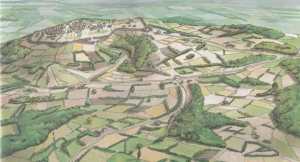
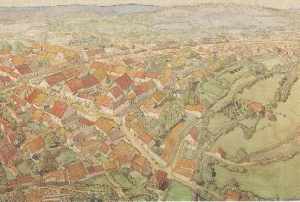
Drawing of Bibracte
Drawing of Bibracte as it might have looked like 100 B.C.E.

Bibracte was the capital of the Celtic tribe the Aedui and around 50 B.C.E. Caesar conquered this important Celtic settlement during his Gallic campaigns. During the reign of Augustus its inhabitants left the place for the newly founded Augustodonum (Augustus-city, now Autun) 14 miles east and nobody else replaced them, leaving the site pristine for archeologists to uncover 1900 years later.

Digging out Bibracte

Apparently after this loss the Brotherhood instituted its policy of sending every last quarter of a century somebody to instruct the West in the Wisdom-Religion, with H.P.B. being the one for the 19th century cycle.

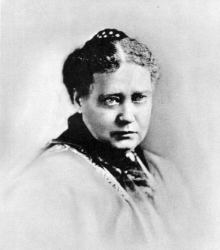
Helena Petrovna Blavatsky

H.P.B., in her posthumously published article “The Last of the Mysteries in Europe” quotes with apparent approval J.M. Ragon, a 19th century author on Masonic lore, from his Orthodoxie Maçonnique:…

Bibractis, the mother of sciences, the soul of the early nations [in Europe], a town equally famous for its sacred college of Druids, its civilisation, its schools, in which 40,000 students were taught philosophy, literature, grammar, jurisprudence, medicine, astrology, occult sciences, architecture, etc. Rival of Thebes, of Memphis, of Athens and of Rome, it possessed an amphitheater for gladiators, surrounded with colossal statues and accommodating 100,000 spectators, a capitol, temples of Janus, Pluto, Proserpine, Jupiter, Apollo, Minerva, Cybele, Venus and Anubis, and in the midst of these sumptuous edifices the Naumachy, with its vast basin, an incredible construction, a gigantic work wherein floated boats and galleys devoted to naval games; then a Champ de Mars, an aqueduct, fountains, public baths; finally fortifications and walls, the construction of which dated from the heroic ages.

She then stated:

Such was the last city in Gaul wherein died for Europe the secrets of the Initiations of the Great Mysteries, the Mysteries of Nature, and of her forgotten Occult truths.

I did this search because in a class at Olcott, the headquarters of The Theosophical Society in America (Adyar), we were looking into possible candidates of the 1975-2000 cycle and we discussed criteria for evaluating the candidates. Reigle in his paper develops a position in favor of the Dalai Lama and the Tibetan Buddhist diaspora as the 20th century effort of the Mahatmas.

Peculiar coincidence is that I visited Bibracte many times in my life as my aunt bought in the 1970s an old farmhouse in the hamlet Les Jours at the foot of Mont Beuvray on which top Bibracte used to be and the farm is the closest inhabited structure to the site!

My aunt’s farmhouse at Les Jours

I knew that the leader of the Gauls, Vercingetorix, had camped there and that Caesar had stayed there as well for a winter after defeating the Gauls and, while there, wrote his book on the Gallic campaigns, Commentarii de Bello Gallico.

View from Mont Beuvray

But I had no idea that this place on top of the hill, now known as Mont Beuvray, next to my aunt’s farmhouse, also was a Celtic center of occult learning–the last one of its kind in Europe—and that its loss lead many centuries later to the founding of the Theosophical Society. At least according to H.P.B. It is now a prime archaeological site with a very nice museum displaying their finds and reconstructions of Celtic life.

Reconstruction of the area of Mount Beuvray (1st century B.C.E.)

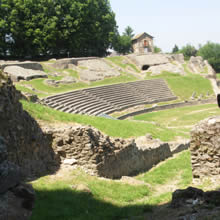
One memorable summer in the 1980s I spend in Les Jours with my aunt and grandfather, who was a Mason, while reading and discussing Yates’ academic study The Rosicrucian Enlightenment and Michael Baigent’s pseudo-historical Holy Blood, Holy Grail and through these books getting a feel for the “hidden tradition” of western esotericism. I would have gone to Les Jours again and join my family in August 2009 to celebrate my own half-centennial, but this plan fell through. I intended to do some research there and see what claims by H.P.B. and Ragon can be verified against the archaeological record. From what I read Ragon’s claims made about Bibracte are quite erroneous or, in H.P.B.’s words, “utterly incorrect”, as she qualified another of his claims. Bibracte was a fortified hill-town and none of the grand structures, which Ragon writes about, were ever erected there. It looks like, and he is not the only one, that he confused Bibracte with the nearby town of Autun, which does have a big Roman amphitheater, though it ‘only’ seats 17.000, and has a temple dedicated to Janus. Many historians and archaeologists in Ragon’s days thought that the correct location of Bibracte was to be found in Autun. But this was only a hypothesis. The other candidates were Beaune and Mont Beuvray. Only the excavations by the French archaeologist Jacques Gabriel Bulliot in the late 19th century confirmed the location to have been on Mont Beuvray.

Roman Amphitheater at Autun

The problem here is that Autun did not exist before Caesar’s time as it was founded in Augustus’ reign replacing Bibracte as the capital of the Aedui about 20 kilometers (12 miles) east. The other problem is that Ragon ascribes to the Celts feats of architecture and pastimes which are distinctly Roman and were quite out of reach for the more simple Celts.

View of Autun

It looks like H.P.B. was a little careless in taking over wholesale these claims by Ragon about Bibracte, even while she was aware of Ragon’s shortcomings as a historian as she warned her readers that “[h]owever learned and erudite, some of the chronological mistakes of that author are very great.” What has to be done is to sort out in more detail all the claims and think through the possible implications of the findings, especially addressing the question whether H.P.B. was unto something, but was incorrect in certain details, or if she was constructing her own mythic historiography by selectively appropriating Ragon’s Masonic (mis-)construals of history. One way or another the gap of cognitive dissonance between the Blavatskyan, emic, esoteric perception of history and the etic, scientific perception of history has to be bridged.

Govert Schuller
Wheaton, July, 2009

Nietzsche’s Reluctant Acceptance of Liberal Democracy (and later Rejection)

Introduction.

The questions to be addressed in this essay are 1) whether we can extract from Nietzsche’s book Human, All Too Human, which was written in his more moderate science-oriented middle period, something of a political view; 2) whether this view can be construed, with some hedging here and there, as supporting modern liberal democracy; and 3) whether Nietzsche’s qualified endorsement, or maybe better formulated, reluctant acceptance of liberal democracy can be found in his other works.

This should be an interesting challenge because the book has many passages in which he deals with the relationship between, on one side man and on the other culture, society and the state. The initial focus will be on chapter eight, titled “A Look at the State”, in which we can find most of his thinking about the state, class, caste, socialism, nationalism, anarchism, democracy, war, religion, “Great politics” and many other themes connected to political thought. I will make here and there some excursions into the future, not into Nazi Germany, but into the post-WWII West in which liberal democracy has firmly established itself, and try to figure out how Nietzsche might have come down in different political issues.

Liberal Democracy: Cynically and Conditionally Accepted

The very first section (438) in this chapter is already rich with ideas which could support a liberal, democratic form of government, but not without some cynical denigrations about the mental capacity of the demos and warnings for the misfortunes it could heap upon itself. First, Nietzsche observes and accepts that something of an earthquake-like change has occurred in politics, highly probably referring to the rise of democracy and constitutional government, and that this change just has to be accepted. It would be futile not to accept it. If the goal of politics is now to make life bearable for the most amount of people through democratic politics with all its demagoguery, lies and manipulations, then, so be it. Nietzsche seems to look at this state of affairs like a force of nature to adapt to, not an arrangement he would necessarily recommend. Actually, he is quite cynical about it and sets some conditions to make it minimally acceptable for him and his fellow (or future) free spirits.

His quite humorous cynicism about democracy is based on a very denigrating view of the intellectual capacity of the population and is visible for example in his quote from Voltaire, who wrote that “Once the populace begins to reason, all is lost”. Nietzsche thinks that the narrow-minded masses can only contain “five or six concepts” in their heads–and they are even proud of that–and believes that they are quite deluded in thinking that they have the capacity to come up with the right policies to increase their own well-being. But, as long as they are deluded, Nietzsche avers, they will “gladly bear the fatal consequences of their narrowness” (438).

So, Nietzsche sees some dangers lurking in the democratic set-up and, because democracy can be a dangerous homogenizer of people, he makes a plea for the freedom 1) for some people to stand aside from politics; 2) for some people to be not too serious about the well-being of the many and even be ironic about it; and 3) for some people to emerge from the masses and try out some unconventional thinking and expressing themselves.

The above enumerated conditions for some spirits to have a little unconventional freedom to make themselves heard is not necessarily just for the sake of such free spirits or would-be free spirits. Earlier in the book, in his crucial passages about such free spirits and their role in society (224-237), Nietzsche made it quite clear in biologistic terms that such freedom is essential for a culture to further develop. Unbound spirits maim their society by experimenting with new and different expressions and society reacts by getting inoculated through assimilating the new into their bloodstream. “Wherever progress is to ensue, deviating natures are of the greatest importance” (224).

The Necessity of a Permeable Class Society

Another condition for society to develop and create a “higher culture” is the existence of a stratified population with an “idle caste” on top and a “working caste” at the bottom. Because the upper crust is capable of a more refined sensitivity and deeper suffering and has the wealth and leisure to do so, it can set the conditions for a higher culture to emerge and sustain. With its wealth it can afford the most beautiful women (apparently regardless of caste); the best teachers; avoid mind-numbing labor; and be clean and healthy (479).

And if there is some permeability between the two castes, when upper class individuals and whole families become so obtuse to become demoted to the lower class and, other way around, deserving individuals from the working class, for example beautiful women and good teachers, but especially free spirits, rise up and get accepted in the leisure class, then such an arrangement would be very good according to Nietzsche. It is not entirely clear though what he meant with his valuing expression, that, if this state is achieved, then beyond it “only the open sea of indefinite desires is still visible” (439).

What does he mean with, in his original German, “das offene Meer unbestimmter Wünsche”, and what does it indicate as far as importance is concerned? Is he saying that, if there is social mobility between the classes and newly, self-minted free spirits arise from the lower classes, then such spirits can, or even should forthwith enter the upper class, take advantage of its leisure, and start experimenting with unconventional ways of being, because only if such a flow of individuals is established then any and all of the higher and still undetermined desires can come to fruition in higher cultural expressions? And was this mobility more prevalent in the past, as Nietzsche finishes the section with “Thus the fading voice of the old era speaks to us; but where are the ears left to hear it?” (339). I dwell on this expression because it has such a positive visionary ring to it, which is not often found in Nietzsche’s non-fictional prose writings.

The Danger of Secularism and Egalitarianism

Another danger of democracy, and this one Nietzsche thought to be more of a long-term threat still in the future, is that it radically transforms the relationship between the government and the people, from a hierarchical structure, like one has with the teacher-pupil, master-slave or father-family relationship, to an egalitarian relation in which the government is seen as “an organ of the people”, or better said in Lincoln’s Gettysburg address, “government of the people, by the people, for the people“. Apparently Nietzsche will have none of that, but thinks there is still time, a century or so, for that unfortunate idea to become reality and therefore cautions to go slow in this regard (450).

If one looks at the 1970s (a little less than a hundred years after Nietzsche wrote the above warning) as the epitome of the West’s realization of the democratic spirit and economic equality, then one could see Nietzsche as somewhat prophetic. He might have abhorred it, but nevertheless foresaw it coming. He would have been gratified though that soon after, most of the policies leading to that moment in the West were turned around in the 1980s by the implementation of neoliberal policies developed by the Chicago School and the “1980s Project” within the Council of Foreign Relations (Shoup & Minter; Sklar).

And he might have been enamored by the rise of the hard, elitist, economic shock doctrine of so-called “disaster capitalism” (Klein). But he might not be enamored by the further extension of these privatization policies, because they are now gradually putting corporations in charge of many of the functions previously executed by the state, with some politicians and thinkers explicitly trying to diminish the state into a minimal entity which ultimately might lead to the “death of the state” (472; italics in original). Nietzsche again shows himself prophetic here. How far his warning for the corporate take-over of the state could be interpreted as anti-corporatism and therefore as proto-anti-fascist is an open question.

Democracy, Religion and Anarchism

Another disadvantage of the democratic state is that it forces religion from the public into the private sphere and therefore cannot be used anymore by the state as a force of societal cohesion and appeasement in times of trouble. And it will weaken the state itself because its “mysterium” is diminished and people will have less respect for it. This might then open the road, as observed before, for private contractors to come in and gradually take over the business of the state to the point of the “death of the state” (472; italics in original). As he summarizes it himself:

To recapitulate briefly, the interests of tutelary government and the interests of religion go together hand in hand, so that if the latter begins to die out, the foundation of the state will also be shaken. The belief in a divine order of political affairs, in a mysterium in the existence of the state, has a religious origin; if religion disappears, the state will inevitably lose its old veil of Isis and no longer awaken awe. The sovereignty of the people, seen closely, serves to scare off even the last trace of magic and superstition contained in these feelings; modern democracy is the historical form of the decline of the state (472; italics in original).

Even though Nietzsche seems to lament the possible decline of the state, he is not entirely dismissive of it. If and when it happens humanity’s clever and selfish resilience will be such that chaos will not come about and that “an invention more expedient than the state will triumph over the state”. But humanity is still far away from such anarchism. People are too afraid to contemplate it and the organizational forms to replace the state have not yet been developed, though some arrogant minds with a deficient notion of history, obviously referring to his anarchist contemporaries, might think they have the required ideas and try to implement them.

Meanwhile, the same selfishness and cleverness which might devise new forms of societal organization to replace the state in the distant future, will fortunately strengthen the state for the time being and ward off anarchist attempts at its destruction. Though Jennifer Ratner-Rosenhagen in her study on Nietzsche’s reception in America, American Nietzsche: A History of an Icon and His Ideas, makes it clear that American anarchists were very appreciative of Nietzsche, the feelings were not reciprocal.

Socialism: The Great Danger to Adept to

Whereas democracy is in Nietzsche’s assessment an inevitable development carrying some grave but maybe manageable risks, socialism is a far greater danger which can and should be managed at all cost. The manner in which Nietzsche perceives socialism is important because it carries explicit and implicit policy proposals both limiting and expanding the powers of his begrudgingly accepted constitutional, liberal democracy.

Though he concedes the truth of the socialist analysis that the current distribution of wealth and privileges is based on “countless injustices and atrocities”, he denies them the right to rectify it through redistribution (452). At a concrete political level this would imply that Nietzsche would have opposed many, if not most, taxation schemes, especially the progressive income tax, and would have opposed any social programs like a public pension system or universal health care. He would, by the same logic, also have opposed any wealth redistribution upwards. He would arguably have rejected the current policy of “private profits, public losses” and let bankruptcies naturally occur because some firms were obviously not fit, and let their failing, unfit CEOs and CFOs get demoted to the lower class.

The non-rectification of past injustices will also imply, for example here in the USA, that there will be no affirmative action to rectify the long-term effects of the countless atrocities of slavery, nor restitution to the Native American Indians for the holocaust perpetrated upon them. Actually, Nietzsche thinks that slaves “live more securely and happy” than the proletariat and that the sentiment driving the abolition of slavery is not the concern about human dignity, but some kind of vanity about equality (457). This perspective shows Nietzsche’s very elitist, paternalistic, though still somewhat compassionate, attitude.

Instead of redistribution, Nietzsche advocates a “gradual transformation of attitude”, such that the sense of justice will increase and violence decrease (452). What the practical consequences would be is not entirely clear, but Nietzsche might accept institutions like toothless reconciliation commissions and the like if he thinks it would contribute to his proposed change of attitude without the guilty parties having to pay indemnities. Otherwise the slogan rules that might made right. If there would be anything close to a socialist sense of justice and equality it would apply only among the members of the ruling elite themselves. Nietzsche does not take this idea serious though, because he thinks that it is promoted by noble, but not very insightful representatives of that class (451).

But, in case socialism becomes really a major force and comes out of hiding to engage the powers that be by social warfare (which in his perception had not yet happened), then, depending on a realistic assessment of its force, a compromise in the form of a treaty might be necessary. Only then socialism will gain rights–presumably anchored in legislation—and can workers demand justice in terms of the treaty (446). What concrete policies could be found in such a treaty? Maybe, given the plight of late nineteenth century workers and their demands, this might mean the 40-hour work week, fair pay, the right to unionize, free choice of employment, elimination of child labor, and, later, paid vacations, social security, socialized medicine, etc. So, even if Nietzsche might not like such policies, especially not those which need funding and the redistribution of wealth, he would by necessity accept compromise.

Communism: To be Avoided

Maybe he accepted some compromise with the demands of the oppressed, because one alternative, communist revolution, would be far worse. He is afraid that the “passionate idiocies and half-truths” of Rousseau, for example the superstitious belief in “a wondrous, innate, … but repressed goodness of human nature”, might inspire people to “the overthrow of all orders” with the expectation of establishing a new, just order ex nihilo. Nietzsche thinks that that cannot happen and that instead revolution will lead to disaster in which the wildest energies of humanity are resurrected and no real reconstruction is possible (463). Socialism could only establish and maintain itself by creating an absolute state with its citizens in complete subjugation and subjected to severe state terrorism (473). Nietzsche really is upset with Rousseau and thinks that because of him “the spirit of enlightenment and of progressive development has been scared off for a long time to come …” (463; italics in original).

Reactionary Repression: Not Good Either

It is admittedly quite speculative, but it is possible that Nietzsche is thinking above, not of the direct effects of the French Revolution—that event had come and gone–but of the long-term, anti-progressive, repressive policies associated with Austrian minister of foreign affairs and post-Napoleonic Concert of Europe architect, Klemens von Metternich, which were formulated in fearful reaction to the Rousseau inspired revolution, and were perceived by many as an obstacle to enlightened progress. One could argue that Nietzsche in his anti-revolutionary, pro-aristocratic zeal might have sided with a conservative like Metternich, but it might be more probable that he found Metternich too repressive and reactionary and realized that his own writings might have been censored and he himself spied upon. If that ever would have happened, the acidic venom of his pen would have been excruciatingly painful for the authorities (and maybe helpful for an earlier breakthrough if jailed). The criteria used to negatively evaluate a repressive conservatism a la Metternich might be the same which Nietzsche used to reluctantly accept democracy, and that is that there should be space for free spirits to engage in unconventional thinking, writing and publishing in order to keep society fit and help its development. His aversion of repression based on his belief in “the spirit of enlightenment and of progressive development ” indicates that he would accept maybe an enlightened despotism in which an aristocracy rules together with an established religion and in which there is also some freedom of expression.

In this context I am wondering where Nietzsche might have come down in the case of the 1973 coup d’état in Chile against the democratically elected socialist President Salvador Allende which led to the brutal military junta under General Augusto Pinochet. Would he have reluctantly accepted Allende’s policies as the understandable outcome of democracy (or maybe even as the rightful assertion of the Chilean state in the face of foreign interests)? Or would he have accepted the Pinochet regime with its reactionary, repressive policies as a rightful assertion of its upper class? It probably all hinges on his ‘highest value’, that is, the freedom of free spirits to do their thing, in which case I think he would have sided with Allende and hope for the best.

Gathering of the Positions

Can we combine the above political thoughts into a qualified endorsement of liberal democracy? Quite so, I think. It is the conclusion, and most people are familiar with this, that liberal democracy, with all its faults and drawbacks, is also in Nietzsche’s thinking the least bad form of government. Nietzsche does not state it as such, but in his via negativa politicus, if I may coin a Latinism, the only thing standing is liberal democracy, including some reluctant adaptations to workers’ rights; possible endorsement of neoliberal policies; and at least some form of cultural and social libertarianism; and all together perceived as an acceptable, temporary balance of different political-ideological wills to power. He rejects, going from left to right, anarchism (too young but promising); communism (too naive and destructive); socialism (too totalitarian and terrorist); enlightened despotism with an established religion (anachronistic, but still possible as runner-up); repressive conservatism (too repressive and stifling); Corporism (weakens the state); and Fascism (too nationalist and socialist, but not excluded).

After Human, all too Human

Does the above qualified, temporary acceptance of liberal democracy survive in his later works, for example in Beyond Good and Evil? In a previous entry I contemplated a possible change of mind by Nietzsche regarding the best possible set-up of a state for free spirits to flourish. I thought initially that Nietzsche in Human, all too Human was promoting the idea that free spirits were basically individualistic free agents in a stratified, but still liberal democratic society and that later, in Beyond Good and Evil (BGE), Nietzsche changed his mind towards a more collectivist, aristocratic form of political organization as the preferred possibility condition for free spirits to execute their cultural transformations. A crucial and disturbing passage expressing a harsher view of the lower classes and the prerogative of the upper class is in section 258 of BGE:

The essential characteristic of good and healthy aristocracy, however, is that it experiences itself not as a function (whether of the monarchy or the commonwealth) but as their meaning and highest justification–that it therefore accepts with a good conscience the sacrifice of untold human beings who, for its sake, must be reduced and lowered to incomplete human beings, to slaves, to instruments. Their fundamental faith simply has to be that society must not exist for society’s sake but only as the foundation and scaffolding on which a choice type of being is able to raise itself to its higher task and to a higher state of being …” (BGE, 258; italics in original).

Compared with the deeper investigations of Nietzsche’s political thinking in Human, All too Human, the essential difference seems to be that Nietzsche dished any acceptance of democracy, however reluctant that might have been, and takes back any possible compromise with the working class and their sense of human and workers’ rights. Democracy is merely the heir of Christianity (BGE, 202), inherently fractured (BGE, 208) and leads inevitably to tyranny (BGE, 242). He advises, and seems to prefer, for Europe “to acquire one will” and leave behind petty politics (BGE, 208). Therefore, if such ideas like democracy and human rights are tossed, then he can ‘overcome’ his previous reluctant acceptance of liberal democracy and go all out with a cruel, self-assertive, self-legislating, “value-creating” (BGE, 260; italics in original) upper class and reduce the rest of mankind to the status of Untermensch to be exploited, which is fine because exploitation “belongs to the essence of what lives, as a basic organic function; it is a consequence of the will to power, which is after all the will of life” (BGE, 259; italics in original). Here we can unfortunately see the foreshadows of a fascist ideology.

Sources

Klein, Naomi. 2007. The Shock Doctrine: The Rise of Disaster Capitalism. New York: Metropolitan Books/Henry Holt.

Nietzsche, Friedrich. 1989 (1966). Beyond Good & Evil; Prelude to a Philosophy of the Future. Trsl. Walter Kaufman. New York; Vintage Books.

Nietzsche, Friedrich W. 1984. Human, All Too Human: A Book for Free Spirits. Trans. Marion Faber, with Stephen Lehmann. Lincoln: University of Nebraska Press.

Ratner-Rosenhagen, Jennifer. 20112. American Nietzsche: A History of an Icon and His Ideas. Chicago: University of Chicago Press.

Schuller, Govert. “From Individualistic Free Spirits to a Collectivist Aristocracy?” Entry #11; November 14, 2013. Political Science 495, NIU, DeKalb, IL, Fall 2013.

Shoup, Laurence H. and Minter, William. 1977. Imperial Brain Trust: The Council on Foreign Relations and United States Foreign Policy. New York: Monthly Review Press.

Sklar, Holly (Editor). 1980. Trilateralism: The Trilateral Commission and Elite Planning for World Management. Boston: South End Press.

Origin

This term paper was written for the seminar “Nietzsche and Politics” (Political Science 495) conducted by Prof. Larry Arnhart at Northern Illinois University in the fall of 2013.

Dr. Arnhart responded to the posting of my paper on his blog and I responded there to him again. 

Darwinian Conservatism and the Liberal Welfare State

§1. Introduction.

In his book Darwinian Conservatism the political scientist Larry Arnhart makes the case that traditional conservatism is the right political philosophy for humanity to follow because “it rests on a view of human nature that is supported by Darwinian biology” (Arnhart, 10). Arnhart developed his case by way of defending five propositions, each dealing with how Darwinism would support a specific conservative proposition.

This essay will concentrate on the following question: Has Arnhart made a persuasive argument for Darwinian conservatism? My answer to the question is negative, because I think Arnhart makes certain jumps, or takes shortcuts, which are undermining the strength of the connection between his Darwinian premises and conservative conclusions. I will support my view with three arguments in which I will try to show that Darwinism does not necessarily lead to conservatism and can, for equally valid reasons, be interpreted to support liberalism.

The three arguments I like to develop are: 1) Arnhart does not consider reasonable liberal alternatives. Instead he sets up Liberalism as a straw man and then easily knocks it down; 2) Arnhart does not put his hypothesis to the test by looking at comparative research about how different countries with different socio-economic systems satisfy the twenty basic desires he identifies; 3) Arnhart thinks there is no manner to rank and prioritize our desires and therefore concludes society should have a libertarian, hands-off attitude in this regard. Based on psychological research and common sense one can reason in favor of some kind of ranking, which supports a more liberal direction of the policy making process.

I will also develop two lines of argument to challenge my own reasoning. 1) I will play with the idea that people in social democracies, though they might report at the subjective level a high sense of well-being and are by objective measures well off, they are deep down miserable, but do not know that, because they suppress such realization by their hedonistic life-style. 2) Secondly, arguing against the idea that the European social democracies evolved naturally, I will for the sake of argument side with conspiricist conservatives and make the case that the welfare state came into being as the result of devious conniving behind the scenes by an international network of individuals, families, and semi-secret groups.

§2.1. Liberal Alternatives

Arnhart seems to be too eager to make his case for Darwinian Conservatism and drive towards its conclusion without carefully considering possible alternatives. First of all, though he does address criticisms of his five main propositions, they are all challenges posed by other conservatives, especially transcendentalist conservatives (Arnhart, 10-13). Secondly, criticisms coming from more moderate liberal positions were not included among the commentaries solicited by the editor Kenneth Blanchard of the expanded edition of Darwinian Conservatism. The challenges came from transcendentalist conservatives and secular libertarians, not liberals or Marxists.

The liberals depicted and refuted by Arnhart are mostly Utopian liberals, whose abstract concept of liberty, rationalist ethics and Utopian programs based on the presumed perfectibility of man, are all shown to be dangerous ideas, because they do not take into account the more biological, realistic view of man with his natural desires and long established habits. Some of my liberal friends could not recognize themselves in the Utopian liberal depiction as presented by Arnhart and thought the argument reeked of a straw-man fallacy. This might be true from the perspective of more moderate, pragmatic liberals, but I think it certainly is applicable to the more classical Utopian and Marxist variations of liberalism.

It is easy to show with the historical record that Utopian left wing and authoritarian right wing regimes do a poor job in enabling their population to flourish, but as little as anti-fascism leads to liberalism does anti-communism lead to conservatism. And it is the latter move which Arnhart seems to make in his justification of Darwinian conservatism. If you do not want to end up with the unsatisfactory and unnatural results of liberal Utopianism, you will have to embrace a form of naturalistic conservatism as its only alternative. This is the fallacy of a false dichotomy. There is a continuum between the extremes of anarchy and totalitarianism, and pragmatic liberalism, as it evolved in Europe, is one of many socio-political systems on that continuum.

Arnhart does engage in his book the work of Peter Singer, because of the latter’s plea for a Darwinian liberalism based on biological science and not primarily on abstract moral principles or Marxist ideology, though those seem still operative in Singer’s thinking. Arnhart’s deconstruction of Singer follows two lines of counter-attack. First, he thinks that Singer’s principle of ethical impartiality, which is confessedly a rational principle, has no basis in human nature and therefore can not really be considered Darwinian, and secondly, that much of Singer’s “‘deflated’ leftism” is acceptable to conservatives, as long as it is based on the idea that “conformity to human nature is a fundamental standard for good social policy” (Arnhart, 128).

But the tables can be turned here and an argument can be made that liberal ends still might be attained in conformity with human nature. For example, one could argue that it was in conformity with the given natural desires, changing emotions and habits and evolving, prudential reasoning of its citizens that the European welfare state evolved. And it evolved naturally and gradually by incrementally changing its collective habits, deliberations and laws. If conservatives would recognize the gradual evolving quality of this process and see that it harmonized with man’s evolved nature, they would not have any reason to oppose the quite liberal outcome. Only by deducing arguments from purely ideological or religious sources could they make a case against a naturally evolved welfare state, but not on Darwinian conservative principles only.

§2.2. Comparative Research

Another line of critique involves empirical data. Arnhart does not provide enough supportive research in which countries with a different socio-political system are compared in which way they accomplish the satisfaction of the basic, genetically driven desires of humans. Arnhart stated that specifically the USA and the UK fulfill those desires, but, instead of making the case, he merely refers to Paul Rubin’s Darwinian Politics (Arnhart, 84). I find several problems with that. First of all, it looks contradictory to lump the USA with the UK. To me the UK is, even after Thatcher’s reforms, a fully developed welfare state comparable to other western European states. Maybe Canada might have been a better choice to put in the same category as the USA. Secondly, as I somewhat developed elsewhere, Rubin recognizes other natural desires which lead to a welfare state.1 This implies that, if these desires are considered natural and the welfare state provides a legitimate satisfaction of those desires, then the existence of the welfare state is justified on Darwinian principles.

My own exploratory research, comparing the liberal Netherlands with the more conservative USA, indicated that Holland is better off as far as the satisfaction of natural desires are concerned. In a preliminary conclusion in one of my entries I stated that the Dutch have “better health care, longer life span, a supportive parental leave system, less poverty, less hunger, less corruption, better protected fundamental and property rights, a better civil and criminal justice system, and greater press freedom”.2

One of the statistics I did not use in my entry was the index for human development and overall well-being. Here the numbers become interesting because in the Human Development Index (HDI), which is based on life expectancy, education and income, the US and Holland both score very high and very close. Actually, in 2011 the US and Holland tied at the third place after Norway and Australia and in 2012 the US went slightly ahead. But when the numbers are adjusted by taking into account income inequality–a procedure now widely accepted–the ranking changes quite dramatically. When one looks at the Inequality-adjusted HDI (IHDI) the US dropped a whopping 19 places in 2011 and 13 places in 2012, while the European countries on the list kept their high ranking because of their much lower inequality.3 The adjustment is justified by the idea that, when there is a large income inequality in a country and, because of that, most of the benefits are concentrated at the top, the average citizen will have a lower HDI then if the benefits would have been more equally spread over the population. The Inequality-adjusted HDI is thereby seen as the actual index and the unadjusted HDI as an index for a country’s potential. From this idea can be deduced that, though the US has a very high potential for human development, the country does not actualize this potential fully because of its income inequality. And of all the developed countries it is the USA which has the largest difference between its potential and actual development.

§2.3. Maslow and the Ranking of our Desires

It might not be true that there is no way to rank our desires and that, in light of such lack, one cannot assign policy priorities to help people attain some of the basic ones. A more careful, and even scientifically based model to create some overall ranking of our natural desires might lead to a more liberal and less conservative socio-political order.

Arnhart states that to “combine and rank the goods of life, each individual must exercise prudential judgment in deciding how to arrange and integrate these goods in a way that is fitting for the contingent and particular circumstances of the individual and for that individual’s propensities, abilities and history” (Arnhart, 239). This more open-ended, flexible and tolerant conception of human goods, which he named the “inclusive end conception,” seemed to have been developed in opposition to the more rigid “dominant end conception,” which comes with most transcendentalist conservative and, for that matter, Utopian liberal world views.

The question whether evolutionary theory can provide something of a ranking of our natural desires in such a way that we do not have to appeal to a transcendental source outside life itself to indicate which of our natural desires are good or bad. Question is if there is something of a natural ranking already taking place without humans necessarily noticing it. We might already act according to a certain naturally evolved and reasonably coherent value system, but are not yet aware of such. Or maybe some psychologists, though not explicitly working within the evolutionary paradigm, have found a hierarchy in our desires. If so, we’ll have to see if it harmonizes with evolutionary psychology.

The system I have in mind is the hierarchy of needs as developed by the American psychologist Abraham Maslow and presented in his paper “A Theory of Human Motivation.” In this now more or less accepted theory humans have a hierarchy of needs ranging from very basic physiological needs to the highest, which is self-actualization. And we move from first satisfying the basic set of needs to the next, higher set. Without getting into details, it is obvious that there is quite an overlap between the basic needs Maslow’ identified and the natural desires Arnhart enumerated. The first question is if Maslow’s hierarchy can be used to organize and evaluate our needs and thereby overcome the alleged problem of the probable absence of a transcendental source to provide a similar service. The second question is if this hierarchy can help settle questions in political philosophy.

Reflecting on the logic of its organization in the form of a pyramid, I can agree that the basic physiological needs come first to be satisfied. No life without air, water, food or sleep. And our sense of evolved sympathy would find it very hard to see or contemplate anybody in our proximity deprived of them. Slightly less vital for our survival, but still quite important, are our security needs for shelter, health and a safe environment. Then, one step further up in the hierarchy, are our social needs for friendship, romance, familial bonding and communal belonging. Next is our need for a sense of self-worth, which finds satisfaction in personal accomplishment and social recognition. Maslow’s highest rung is the need for the conscious actualization of one’s potential, a level where one can find peak experiences of flow, mastery and self-transcendence.

Given this hierarchy I would venture that a community should be organized such that a) the basic biological needs (food, health and shelter) are one way or another guaranteed to all members and that b) long-term policies are such that they give the best infrastructure for the optimal fulfillment of the other needs. A right to work and a minimum living wage would take care of the basic needs including housing, and a non-corrupt government can provide safety, health insurance and affordable education. At the same time there should be a maximum of freedom for people to pursue their social, romantic, vocational, economic, creative and spiritual needs. Apparently the social democracies of north-western Europe have accomplished a lot in this direction. They only still have to get their Muslim population to buy into the program, because the Muslim appeal to their own transcendental source of morality is posing somewhat of a danger to this more enlightened, secular, semi-self-regulating set-up.

In summary, what seems to be overlooked in the dichotomy between the libertarian “inclusive end conception” and the religionist or secular Utopian “dominant end conception” is a ‘two-tiered end conception’, which differentiates between basic and elective goods based on Maslow’s hierarchy of natural needs. The basic needs are food, health and shelter, which all should be more or less guaranteed by a polity if these could not be met within the context of a free market economy. The elective needs are social, vocational, cultural and spiritual, for which fulfillment a polity only has to provide the infrastructure, but not its actual fulfillment. To me it looks like that the social democracies of Europe have organized their societies around such a two-tiered conception of human needs and have done so quite successfully.

§3.1. Are the Dutch Really Better off?

Recently I discussed with a very wealthy, conservative father of one of my friends how mellow and happy the Dutch seem to be. He thought that the Dutch might not know they are actually unhappy. Maybe they “smoke” too much. They think they are happy, but their hedonistic lifestyle suppresses the fact that they are miserable escapists living in a life-sapping, oppressive welfare state. Given the idea that people tend to be self-deluded and self-justifying and that people might not be honest when asked to report about personal feelings, the idea of the Dutch not being really happy has some plausibility. The problem is then, of course, how to tease out the truth. Methodologically speaking this is tricky, because it is quite complex to differentiate between what people report about their well-being and how they deep down really think and feel. Probably the Harvard-based Project Implicit could help in this regard as they investigate “thoughts and feelings outside of conscious awareness and control.”5

Maybe by looking at statistics about suicide in the US and the Netherlands it might become clear if it is reasonable to think that there is a discrepancy between a nation’s self-image and reality. According to statistics from the European Commission the average suicide rate in the Netherlands in 2009 was 8.5 per 100.000 inhabitants (males 12.0 and females 5.0).6 According to the US Department of Health and Human Services the average suicide rate in the US in the same year was 12 per 100.000 inhabitants (males 19.5 and females 5.5).7 Wikipedia took these numbers and ranked 107 countries by average suicide rate, from high to low. The US came in 33rd place, just ahead of the traditionally suicide-prone populations of Sweden (11.9) and Norway (11.9) and just below Communist Cuba (12.3). The Netherlands came in at 51st place, leaving only Spain (7.6), Italy (6.3) and Greece (3.5) with lower rates of suicide in Europe.8 It looks like that females in both countries are equally inclined towards suicide and that US males are 50% more likely to commit suicide than their Dutch counterparts. If human nature is in general similar in both countries it seems reasonable to conclude that American men are one and a half times more unhappy then Dutch men. But, what if the psychological profile of both populations is quite different as my friend’s father suggests? Is it plausible to assume that the oppressiveness of the welfare state makes people more unhappy, but at the same time its tolerance of escapist habits would assuage this side effect and keeps people from committing suicide? Rationally speaking I can see the logic, but intuitively I find it quite absurd. It is an interesting question though and I have to admit that I am at a loss of arguments to be convinced one way or the other. I can only reiterate that Project Implicit might bring some clarity here.

§3.2. The Deviously Engineered Nature of the Welfare State

The argument that the welfare state is somehow the natural outcome of a social evolution in conformity with man’s natural desires might not be true and merely a rationalization. The truth is more ominous and relatively hidden. In broad lines it is as follows. For a few centuries a network of groups and individuals have conspired to introduce socialist policies into the fabric of society. Their ends justified their means and through Communist revolution, Fabian gradualism or the surreptitious infiltration of governments and civic institutions they steered the west into the adoption of unnatural, collectivist policies and the creation of institutions like the European Union and the United Nations. Libertarians and conservatives in the USA are the last bulwark against this encroachment and will have to engage in a battle of epic proportions to keep the USA free by rolling back the welfare state domestically and promote free markets and limited government in the international arena. A Darwinian conservative could use this conspiricist argument against the welfare state with great effect, because the deceitful origin of the welfare state shows how counter-natural it actual is.

§4. Conclusion

Though I heartily agree with the premise that a sound political philosophy has to take into account the evolved nature of man, I cannot agree with the idea that such a philosophy is necessarily conservative. Ironically, by the standards of Darwinian conservatism itself, European countries enabled the natural evolution of their welfare state (§2.1) and do a better job in fulfilling man’s natural desires than the more conservative USA (§2.2.). The difference between Arnhart’s more libertarian-leaning Darwinism and the Darwinism which leads naturally to the European style welfare state is that the latter incorporates 1) some natural needs which justify a welfare state identified by Rubin, but overlooked by Arnhart (§2.2.), and 2) it incorporates a two-tiered conception of natural needs instead of Arnhart’s proposed inclusive end conception (§2.3.). Two arguments can be made to totally undermine the above idea of Darwinian liberalism. The first is to argue that people in a welfare state are worse off because they are actually unhappy, but smother that feeling by unnatural and immoral activities (§3.1) and secondly by arguing that the welfare state is nothing more than the unnatural and immoral product of a long-term deception perpetrated by a devilish, Machiavellian cabal (§3.2.).

This paper was written for the class “Biopolitics and Human Nature” (Political Science
320) conducted by Prof. Larry Arnhart in the spring of 2013 at Northern Illinois University

[Response to paper: Arnhart, Larry. 2020. “Darwinian Conservatism, Darwinian Liberalism, and the Welfare State: A Reply to Govert Schuller“. Darwinian Conservatism by Larry Arnhart. Blog. 30 July 2020.]

Sources Cited

Arnhart, Larry, et al. 2009. Darwinian Conservatism: A Disputed Question. K.C. Blanchard, (Ed.). Charlottesville, VA: Imprint Academic.

1.  “More on Politics and Natural Desires”. Response to Michael Penicnak Entry #6. March 5, 2013. Political Science 320, NIU, Dekalb, IL, Spring 2013.

2.  “The Fulfillment of Basic Desires in the USA and the Netherlands”. Entry #6. February 26, 2013. Political Science 320, NIU, Dekalb, IL, Spring 2013.

3.  “Statistical Annex“. Human Development Report 2011 & 2013. United Nations Development Programme. Web. 29 April 2013. “Human Development Index“. Wikipedia. 

4. “The Political Implications of Maslow’s Hierarchy of Natural Needs” Entry#7. March 5, 2013. Political Science 320, NIU, DeKalb, IL, Spring 2013.

5.  Project Implicit. Home Page. Web. 29 April 2013. .

6 . “Death Due To Suicide“. Eurostat. European Commission. 2009. Web. 29 April 2013. 

7.  National Vital Statistics Reports. Vol. 60, No. 3 (December 29, 2011). Web. 29 April 2013. 

8.  “List of countries by suicide rate”. Wikipedia. Web. 29 April 2013. 


Krishnamurti Bibliography

.

A. By Jiddu Krishnamurti (Selection)

B. Academic & Expository Studies (Exhaustive)

C. Biographical (Extensive)

D. Philosophical Background (Initial)

E. Theosophical Perceptions (Initial)

F. Videos on Krishnamurti

G. Books read by Krishnamurti (forthcoming)

H. Miscellaneous

===============

A. By Jiddu Krishnamurti (Selection)

Landmark Speeches and Publications

Krishnamurti, Jiddu. 1929. “The Dissolution of the Order of the Star”. International Star Bulletin (September 1929): 28-34. Also titled “Truth is a Pathless Land”.

—– . 1954. The First and Last Freedom. New York: Harper & Brothers.

Written by Krishnamurti

—–. 1956-1960. Commentaries on Living. From the Notebooks of J Krishnamurti. Series One to Three. Edited by Rajagopal Desikacharya. New York: Harper.

—– . 1976. Krishnamurti’s Notebook. New York: Harper & Row.

—– . 1981. “The Core of Krishnamurti’s Teaching“. Ojai, CA: Krishnamurti Foundation of America.

—–. 1982. Krishnamurti’s Journal. Foreword by Lutyens, Mary. New York: Haper & Row.

—–. 1987. Krishnamurti to Himself: His Last Journal. Foreword by Lutyens, Mary. New York: Haper & Row.

—–. 1997. “A Letter from Krishnamurti to a Friend: The Place of Social Reform”. The Link, 12 (Spring, 1997): 14-15.

—–. 2015. The Whole Movement of Life is Learning: Letters to his Schools. Brockwood Park, UK: Krishnamurti Foundation Trust.

—–. 2020. Happy Is the One Who Is Nothing: Letters to a Young Friend. London: Watkins.

—–. 2023. The Beauty of Life: Krishnamurti’s Journal. Revised and expanded third edition of Krishnamurti’s Journal, 1982. Introduction by McCoy, Ray; Foreword by Lutyens, Mary. London: Watkins.

Dialogues

—–. 1977. Truth and Actuality. Brockwood, UK: Krishnamurti Foundation Trust.

—–. 1979. Exploration into Insight. Foreword by Pupul Jayakar & Sunanda Patwardhan. London: Gollancz.

—– . 1984. Creation Come out of Meditation. Scientists Questions, Los Alamos, New Mexico, March 21, 1984. Video & transcript. Ojai, CA: Krishnamurti Foundation of America.

—–  & Bohm, David. 1985. The Ending of Time. San Francisco: Harper & Row.

—– . & Bohm, D. 1986. The Future of Humanity: A Conversation. New York: HarperCollins.

—– & Jayakar, Pupul. 1995. Fire in the Mind: Dialogues with J Krishnamurti. Gurgaon, Harayana: Penguin Books India.

—– . 1996. Questioning Krishnamurti: J Krishnamurti in Dialogue with Leading Twentieth Century Thinkers. Edited by David Skitt. Bramdean Hampshire: Krishnamurti Foundation Trust Ltd.

—– . & Bohm, David. 1999. The Limits of Thought. London & New York: Routledge.

—– . & Anderson, A.W. 2000. A Wholly Different Way of Living. Chennai: Krishnamurti Foundation of India.

—–. 2003. Can Humanity Change? J Krishnamurti in Dialogue with Buddhists. Boulder, CO: Shambala Publications.

—– & Bohm, David & Shainberg, David. 2004. The Transformation of Man. Chennai: Krishnamurti Foundation India.

Collections

—–. 1969–1972. Early Writings.  Vols. 1-7. Covering 1927-1933. Bombay: Chetana.

—–. 1980. From Darkness to Light: Poems and Parables. The Collected Works of Krishnamurti, Vol 1. New York: Harper & Row.

—– . 1991. “The Krishnamurti Text Collection & Index”. CD-Rom. Brockwood Park, UK: The Krishnamurti Foundation Trust.

—– . 1991. The Collected Works of J Krishnamurti. Volumes 1-18. Ojai, CA: Krishnamurti Foundation of America. Also Delhi: Motilal Banarsidass, 2014.

—–. The Complete Works of J Krishnamurti: 1910-1986. In ca. 50 volumes. Announced in: Krishnamurti Foundation India. Vasanta Vihar Newsletter. March 3, 2003, p. 1.

B. Academic & Expository Studies (Exhaustive)

Aberbach, David. 1993. “Mystical Union and Grief: The Ba ‘al Shem Tov and Krishnamurti”. Harvard Theological Review, 86/3: 309-321.

Agrawal, M. M. 1989. Reply To Mercier–A Pathless Reality: The Central Theme In J Krishnamurti’. International Philosophical Quarterly, 29: 351-356.

——- . 1991a. Consciousness and the Integrated Being: Sartre and Krishnamurti. Shimla, India: Indian Institute of Advanced Studies.

——- . 1991b. “Nothingness and Freedom: Sartre and Krishnamurti”. Journal of Indian Council of Philosophical Research, 9/1: 45-58.

Allen, A. n.d. “Krishnamurti and Perls”. Unpublished MS.

Anderson, Allen W. 2002. “On the Significance of Krishnamurti’s Teachings”. Krishnamurti Monograph Series, # 9. Ojai, CA: Krishnamurti Foundation of America.

—–. On Krishnamurti’s Teachings: The Collected Writings, Talks and Classroom Discussions of Allan W. Anderson on the Teachings of J Krishnamurti. Ojai, CA: Karina Library Press.

Anderson, Tyson. 2001. ” ‘We Share the Sunlight’: A Postmodern Spirituality”. Krishnamurti Monograph Series, # 5. Ojai, CA: Krishnamurti Foundation of America

Bauscher, Lance A. 1999. Imagination and the Self in the Philosophies of William Blake and Jiddu Krishnamurti. Dissertation, California State University, Dominguez Hills. Ann Arbor, MI: ProQuest Dissertations Publishing.

Bazemore, Duncan. 1995. “Krishnamurti: An Introduction to his Meditation”. Krishnamurti Monograph Series, # 7. Ojai, CA: Krishnamurti Foundation of America.

Boag, Al. 2010. From Being God To Being Human: Biblical Influences in the Teachings of J Krishnamurti. Master of Art (Research), The University of Sydney, NSW, Australia.

——- . 2011. “From Blavatsky to Krishnamurti: Hindu Chronology, Biblical Eschatology, Physiology”. Literature & Aesthetics, 21/1.

Bora, Shakuntala. 2010. Essays on: Philosophy of Jiddu Krishnamurti. Guwahati: Aalibaat Publication.

——. 2013. “Bounds of Thought and Beyond: Jiddu Krishnamurti”. In: Nataraju, Adarasupally (Ed), The Limits of Thought and Beyond, London: Bloomsbury, 88-94.

——. 2015. Rethinking: Philosophy of Jiddu Krishnamurti. Guwahati: Aalibaat Publication.

——. 2020. Suffering and Beyond: Jiddu Krishnamurti. Guwahati: Aalibaat Publication.

Bouchard, Roch. 1984. “Krishnamurti Zen”. Revue de l’Université d’Ottawa, 54: 91-100.
Boutte, Veronica. 2002. “The Phenomenology of Compassion in the Teachings of Jiddu Krishnamurti, 1895-1986”. Studies in Asian Thought and Religion, Vol. 23. Illustrated edition. Lewiston, NY: Edwin Mellen Press.
Bradford, Michael & Hayne, Patrick. 1995. “Jiddu Krishnamurti: 20th Century Philosopher and Mystic”. Markdale, Canada: Institute for Consciousness Research.
Brandt, Carol. 2003. “Was K Simplistic In His Approach To The Psyche?” The Link, 22: 29-31.

Butcher, Peter. 2002. “The Phenomenological Psychology of J Krishnamurti”. Krishnamurti Monograph Series, # 6. Ojai, CA: Krishnamurti Foundation of America.

Cavanaugh, Thomas C. 1979. “The General and Educational Philosophy of Jiddu Krishnamurti and Its Relevance to Contemporary Education”. Ed. D. dissertation, University of Southern California, Los Angeles, USA.

Chaurasia, Rajesh. 2005. “Review Article of Luis SR Vas, J Krishnamurti: Great Liberator or Failed Messiah“. Journal of Indian Council of Philosophical Research (ICPR),22/1 (Jan-Mar, 2005): 198-205.

——. 2013. “J Krishnamurti: Freedom and Action“. Anusilana, 46: 1-10.

——. 2016. “J Krishnamurti: Holistic Way of Living“. Anviksiki, 12: 138-144.

Chatterjee, Arup K. 2023. “Jiddu Krishnamurti and the Problem of Conscience”. Implicit Religion, 24 (3-4): 443-470.

Chatterjee, Visvanath. 2006. “Review of Luis S R Vas, J Krishnamurti: Great Liberator or Failed Messiah?” Prabuddha Bharata, (Feb, 2006): 176 (58).

Christianson, John. 2002. “Exploring Seeing with J Krishnamurti”. Krishnamurti Monograph Series, # 4. Ojai, CA: Krishnamurti Foundation of America.

Cloninger, K. M. 2008. Transcending Curriculum Ideologies: Educating Human Beings Well. PhD dissertation, University of Denver, Colorado, USA.

Dalal, Roshen. 2020. J Krishnamurti: A life of Compassion beyond Boundaries. Delhi: Macmillan.

De Sousa, Avinash. 2012. “Mind and Consciousness as per J Krishnamurti“. Mens Sana Monographs, 10/1: 198.

Delkhah, M. 1997. The Pure Man, Discipline of None: Positioning Grotowski’s Metaphysics in Contemporary Euro-Asian Mysticism as Represented by Krishnamurti. PhD dissertation, University of Kansas, Lawrence, USA.

Deshpande, Sudhakar. 2007. The Buddha Rediscovered in the Light of J Krishnamurti. Rajghat: KFI. Also: Eastern Book Linkers, 2009.

Dewhurst, David. 1994. “Awareness of Mind: A Discussion of the Krishnamurti Schools in India”. Educational Philosophy and Theory, 26/2: 16-32.
Dhillon, Sunny. 2021. “Infinitesimal Freedom: Theodor W. Adorno meets Jiddu Krishnamurti“. Medium, 17 Feb 2021.

—–. 2023. “Adorno, Jiddu Krishnamurti, and Critical Theory: Negative Dialectics and Non-Identity Thinking”. Comparative and Continental Philosophy, 15/3: 181–94.

Dhopheshwarkar, AD. 1961 (1973). Krishnamurti and the Texture of Reality. Bombay: Chetana.
——- . 1967. J Krishnamurti and Awareness in Action. Bombay: Chetana.

——- . 1970. J Krishnamurti And Mind In Revolution. Bombay: Chetana.

——- . 1973 (1956). Krishnamurti and the Experience of the Silent Mind. Bombay: Chetana.

——- . 1976. Yoga of J Krishnamurti: A Catechism. Bombay: Chetana.

Erricker, Clive. 2001. “Jiddu Krishnamurti and the open secret”. In Erricker, Clive, and Jane Erricker (Eds), Contemporary Spiritualities: Social and Religious Contexts. London: Continuum.
Fauché, Fabienne. 2001. J-P Sartre et J Krishnamurti: Deux “athéismes” pour une morale. PhD Dissertation. Villeneuve-d’Ascq, France: Presses Universitaires du Septentrion.

Fitzgerald, T. 1991. “Krishnamurti and the Myth of God Incarnate”. Asian Philosophy, 1/2: 109-126.

Forbes, Scott. 1997. “Education as Religious Activity”. Krishnamurti Monograph Series, # 10. Ojai, CA: Krishnamurti Foundation of America.

Foster Patrick M. 2012. The Last Guru: The Significance of J Krishnamurti for the Modern World. Scotts Valley, CA: CreateSpace Independent Publishing Platform.

Fouéré, René. nd. “Krishnamurti et l’Existentialisme”. In Linsen, Robert (Ed), Krishnamurti et la Pensée Occidentale. Brussles: Editions Être Libre.

Fuller, Jean Overton. 1998. Cyril Scott And A Hidden School:Towards The Peeling Of An Onion. Fullerton, Ca.: Theosophical History.

Gardner, Martin. 2003. “The Vagueness of Krishnamurti”. In: Are Universes Thicker than Blackberries? New York & London: W. W. Norton. 112-121. Originally published in The Skeptical Inquirer (July/August 2000).

Gertel, Elliot B. 2002. “Krishnamurti, language and biblical ‘remembrance'”. Religious Studies and Theology, 21/2: 49.

Giddu, Narayan. 1998. As the River Joins the Ocean: Reflections about J Krishnamurti. Delhi: Book Faith India.

Gogate, Kanchan. 2021. “Religion and Religious Mind: Hermeneutical Explorations with Special Reference to Swami Vivekananda and J Krishnamurti”. Buddhist and Pali University of Sri Lanka, Webinar Series, Religiosity and Secularism in Futuristic Context, June 2021, Proceedings: 9-12.

Goleman, Daniel. 1977. “Krishnamurti’s Choiceless Awareness”. In The Varieties of Meditative Experience. New York: Dutton.

Golwelkar, Sameer. 2013. “A Critical Comparative Study of Self and Life as such in the philosophy of J Krishnamurti and Nisargadatta Mahara”. Devi Ahilya Vishwavidyalaya, 161-2 (?).

Gorman, Michael E. 1978. “AJ Korzybski, J Krishnamurti, And Carlos Castaneda: A Modest Comparison”. ETC: A Review of General Semantics, 35/2: 162-174.

Grego, Richard. 1997. Jiddu Krishnamurti and Thich Nhat Hanh on the Silence of God and the Human Condition. PhD dissertation, State University of New York, Albany, USA.

—–. 2018. ” ‘God Is Not in Temples, So It Doesn’t Matter Who Enters Them’: Jiddu Krishnamurti’s Critique of Gandhi’s Ahimsa Principle and Advaita Vedanta-Based Ethics”. In: Mahapatra, Debidatta Aurobinda (Ed), Gandhi and the World, Lanham, MD: Lexington Books, pp. 93-110.

Gullette, Alan. 1980. “Mystical Awareness and the Problem of Intentionality”. Independent Study. Dr. Richard Aquila. Philosophy 4103, Spring 1980. University of Tennessee-Knoxville.

Gunturu, Vanamali. 1998. Jiddu Krishnamurti’s Gedanken auser der Phaenomenologischen Perspective Edmund Husserl’s. PhD dissertation. Frankfurt: Peter Lang.

——- . 1999. Krishnamurti: Leben und Werk. München: Diedrichs.

Han, C. 1991. Comparing the “Educated Person” Conceptions of Dewey and Krishnamurti: Implications for the Republic of China. PhD dissertation, Columbia University, New York, USA.

Haynes, Joanna. 2007. “Freedom and the urge to think in philosophy with children”. Gifted Education International, 22/2-3: 229-237.

Heber, L. 1935. Krishnamurti and the World Crisis. London: Allen & Unwin.

Herzberger, Hans and Radhika (Eds). 1996a. “Krishnamurti on Interpretation”. Reference Materials on Krishnamurti’s Teachings. Working Paper #1. Madanapalle: Rishi Valley Study Centre.

——- & ——– (Eds). 1996b. “Krishnamurti on Analysis”. Reference Materials on Krishnamurti’s Teachings. Working Paper #2. Madanapalle: Rishi Valley Study Centre.

——- & ——– (Eds). 1996c. “Krishnamurti on Theosophy“. Reference Materials on Krishnamurti’s Teachings. Working Paper #4. Madanapalle: Rishi Valley Study Centre.

——- & ——– (Eds). 1997. “Krishnamurti on the Flight from Disturbance”. Reference Materials on Krishnamurti’s Teachings. Working Paper #5. Madanapalle: Rishi Valley Study Centre

——- & ——– (Eds). 1998. “Krishnamurti on Responsibility”. Reference Materials on Krishnamurti’s Teachings. Working Paper #7. Madanapalle: Rishi Valley Study Centre.

Hixon, Lex. 1989. Coming Home: The Experience of Enlightenment in Sacred Traditions. Los Angeles: Jeremy P Tarcher.

Holden, Lawrence K. 1972. The Structure of Krishnamurti’s Phenomenological Observations and its Psychological Implications. PhD dissertation, United States International University, Nairobi, Kenya.

Holroyd, Stuart. 1980. The Quest of the Quiet Mind: The Philosophy of Krishnamurti. Wellingborough, UK: Aquarian Press.

——- . 1991. Krishnamurti the Man, the Mystery & the Message. London: Element Books Ltd.

Horne, Robert Allan. 1973. A Worldview Synthesis of Gestalt Therapy and J Krishnamurti. PhD dissertation, California School of Professional Psychology, Alhambra, CA.

Hufford, Don. 2006. “Interpreting Jiddu Krishnamurti: Educational Implications”. Journal of Philosophy and History of Education, 56: 73.

Hunter, A. No date. J Krishnamurti as Religious Teacher and Educator. PhD dissertation, University of Leeds, UK.

Huxley, Aldous. 1954. “Foreword”. In Krishnamurti, Jiddu, The First and Last Freedom. New York: Harper & Brothers.

John, Joseph. 1975. “J Krishnamurti: A Noneudaemonistic Approach to Guidance”. Counseling and Values, 19/.4: 254-258.

Kalidas, Joshi. 2005. J Krishnamurti: Demystified. New Delhi: Pustak Mahal.

Kalsi, Ashutosh. 2007. The Ending of Nihilism: From Nietzsche to Krishnamurti. PhD dissertation, State University of New York, Buffalo, USA.

Kapur, Raman. 1985. “Krishnamurti and Psychotherapy”. Self & Society, 13/5: 230-237.

Kapur, Tribhuwan. 1999. Quest for Realisation: Jiddu Krishnamurti, The Bhagavad Gita, and G. I. Gurdjieff. Delhi: New Dawn.
Karve, Sushama. 2015. J Krishnamurti’s concepts of freedom, meditation, love and truth: A philosophical study. Thesis. Tilak Maharashtra Vidyapeeth, Pune, India.

Khare, Brij B. 1988. J Krishnamurti: Things of the Mind. Delhi: Motilal Banarsidass.

Khattar, R. 2001. Creativity as the impulse of life: Scholarly philosophies and thoughts for education. Unpublished master’s thesis, York University, Toronto, Canada.

Kneupper, Theodore L. 2003. “Krishnamurti’s Approach to Education”. Krishnamurti Monograph Series, # 11. Ojai, CA: Krishnamurti Foundation of America.

Kobbekaduwa, L.A. 1990. Education and the educated person: A comparison of J Krishnamurti and R.S. Peters. PhD dissertation, University of Alberta, Edmonton, Canada.

Krishna, P. 2003. “J Krishnamurti and the Scientific Temper”. Krishnamurti Monograph Series, # 14(?). Ojai, CA: Krishnamurti Foundation of America.

Krishna, T M. 2021. “Silences of Jiddu Krishnamurti“. The India Forum, 12 May 2021.

Krishnamurti, V.G.1990. From J Krishnamurti to the Upanishads. Calcutta: Writers Workshop.

Kumar, Ashwani. 2011. Understanding Curriculum as Meditative Inquiry: A Study of the Ideas of Jiddu Krishnamurti and James Macdonald. PhD dissertation, University of British Columbia, Vancouver, Canada.

—–. 2013. Curriculum as Meditative Inquiry. New York: Palgrave Macmillan.

Kumar, Lombadhar. 2024. “Jiddu Krishnamurti’s Philosophy of Education and National Education Policy 2020: A Review“. Shiksha Sanshodhan: Journal of Arts, Humanities and Social Sciences, 7/1: 58-62.

Kumar, P Kesava. 2015. Jiddu Krishnamurti’s Conception of Tradition and Revolution: A Critical Study. Delhi: Kalpaz Publications.

Linsen, Robert (Ed). nd. Krishnamurti et la Pensée Occidentale. Brussles: Editions Être Libre.

Martin, D. W. 1975. An Analysis of Selected Works of Jiddu Krishnamurti: Implications for Higher Education. PhD dissertation, University of Connecticut, Storrs, USA.

Martin, Raymond.1997. “Introduction”. In: Martin, Raymond (Ed), Krishnamurti: Reflections on the Self, Chicago: Open Court, xi–xix.

—– . 1998. “Why isn’t Krishnamurti accepted at the University?” KFA Newsletter, Fall, 1998.

——- . 2003. On Krishnamurti. London: Wadsworth.

——-  & Barresi, John. 2006. The Rise and Fall of Soul and Self: An Intellectual History of Personal Identity. New York: Columbia U.P.

Martins, Paulo Nuno. 2018. “A Concise Biography of Jiddu Krishnamurti: An Indian Philosopher of Contemporary Society”. International Journal of Humanities Social Sciences and Education (IJHSSE), 5/11: 38-42.

Masoud, Delkhah. 1997. The pure man, disciple of none: Positioning Grotowski’s metaphysics and “method” in contemporary Euro-Asian mysticism as represented by Krishnamurti. PhD Dissertation, Department of Theatre and Film, University of Kansas. Ann Arbor, MI: ProQuest Dissertations Publishing. (Part)

Mathur, Dinesh. 1984. “J Krishnamurti on Choiceless Awareness, Creative Emptiness and Ultimate Freedom”. Diogenes, 126 (summer): 91-103.

Maxwell, Patrick. 1994. “The Enigma of Krishnamurti”. Journal for the Study of Religion, (1994):57-81.

McAuley, C. E. 2018. “Krishnamurti and Education: Application of Liberation”. Journal of Conscious Evolution, 5/5.

Mercier, Jean L. 1988. “A Key to Krishnamurti’s Thought”. International Philosophical Quarterly, 28/2: 171-183.

Mehta, Rohit, and Shridevi Mehta. 1990. J Krishnamurti and Sant Kabir: A Study in Depth. Delhi: Motilal Banarsidass.

Methorst, Henri. 2003. Krishnamurti: A Spiritual Revolutionary. Ojai, CA: Edwin House.

Michel, Peter. 1995. Krishnamurti: Love and Freedom (Approaching a Mystery). Woodside, CA: Bluestar Communications.

Miller, William. 1994. “A Krishnamurti perspective on integral consciousness”. Integrative Explorations, 2/1: 30.

Moffatt, Ron. 1976. “Krishnamurti and Psychotherapy: Beyond East and West”. Unpublished master’s thesis, University of Delaware, Newark.

Mohammaditabar, Mohammad, et al. 2016. “J Krishnamurti and Alan Watts’ Philosophical Speeches: A Critical Discourse Analysis”. Modern Journal of Language Teaching Methods, 6/1: 524.

Moolayil, Sebastian Varghese. 2014.  “Mind as a Way you Love Truth: A Philosophical Appraisal of Mind by Jiddu Krishnamurti”. Tattva Journal of Philosophy, 6/1: 73-85.

Mukherjee, M. & Agrawal, S. 2021. “Decolonising Lifelong Education: Learning from J Krishnamurti“. In: Tiffany Prete & Elizabeth Lange (Eds), Special issue of Indigenous Voices and Decolonising Lifelong Education, International Journal of Lifelong Education, 40/4: 328-33.

Nagaraja, J & Vedaparayana, G. 2016. “The Nature of the Conditioned Mind according to Krishnamurti: A Study“. International Journal of Academic Research and Development, 1/10: 34-35.

Narayan, G. Chandramouli Narsipur (Ed).1998. As the River Joins the Ocean: Reflections about J Krishnamurti. Ojai, CA: Edwin House Publishing Inc.

Narayana Moorty, J S R L. 1988. “Fragmentation, Meditation and Transformation: The Teachings of J Krishnamurti”. Journal of Indian Council of Philosophical Research, 133-145.

Needleman, Jacob. 1970. “A Note on Krishnamurti”. In The New Religions . New York: Doubleday. 145-162.

Niel, Andre. 1957. Krishnamurti: The Man in Revolt. Bombay: Chetana.

Patnaik, Nandini. 2014. Beyond The Pathless. Cuttack, Odisha: SET Publications

Perry, Whitall N. 1972. “Anti-Theology and the Riddles of Alcyone“. Review of Alan Watts, 1968, Beyond Theology: The Art of Godmanship, Cleveland & New York: Meridian Books. Studies in Comparative Religion, 6/3: 176-192.

Persico, Tomer. 2016. “A Pathless Land: Krishnamurti and the Tradition of No Tradition”. In: Chajes, Julie, and Boaz Huss (Eds), Theosophical Appropriations: Esotericism, Kabbalah and the Transformation of Traditions, Beer Sheva: Ben-Gurion University of the Negev Press.

Petrowski, Chari. 1995. “J Krishnamurti: Philosopher to the Common Man”. Ojai, CA: Krishnamurti Foundation of America.

Pillay, Kriben. 2003. “The Teachings of J Krishnamurti and their Links with Educational Theory”. Krishnamurti Monograph Series, # 12. Ojai, CA: Krishnamurti Foundation of America.

Poortman, JJ. 1964. “The World-Teacher and Contradictions”. In: Philosophy, Theosophy, Parapsychology, Leiden: Sythoff, 80-88
——- . 1961. “J Krishnamurti en de Wijsbegeerte”. In: De Grondparadox en andere Voordrachten en Essays, Assen: Van Gorcum, 93-110.

Powell, Robert. 1971. “Zen and Liberation according to Krishnamurti”. In: Vas, Luis S R (Ed), The Mind of J Krishnamurti, Bombay: Jaico Publishing House.

Rao, S.R. 2005. J Krishnamurti. New Delhi: Sahitya Akademi.

Rathnam, Anbananthan. 2013. Whole Teachers: A Holistic Education Perspective on Krishnamurti’s Educational Philosophy. PhD dissertation, The University of Toronto, Canada.

Raveh, Daniel. 2004. “Transformative Education: Sankara and Krishnamurti on the Encounter between Teacher and Student”. Journal of Indian Council of Philosophical Research, 21/3: 137-160.
Rechtshaffer, Ira. 1977. The Awakened Mind: A Comparative Study of J Krishnamurti, Chogyam Trungpa Rimpoche and Bubba Free John. PhD dissertation, California Institute of Integral Studies, San Francisco, USA.

Reinsmith, William. 1994. “Cultural Conditioning: The Dark Underside of Multiculturalism (Part Two: A Way Out)”. Inquiry, 14/2: 78-85.

Rodrigues, Hillary. 1988. “Insight” and “The Religious Mind” in the Teachings of Jiddu Krishnamurti. Master of Arts Thesis, Religious Studies, McMaster University, Hamilton, Ontario.

——- . 1990. Insight and Religious Mind: An Analysis of Krishnamurti’s Thought. American University Studies, Series VII, Theology and Religion, Vol. 64, Master of Arts Thesis, McMaster University, 1988. New York: Peter Lang.

——- . 1995. “On Krishnamurti”. In: Blau, Evelyne (Ed), Krishnamurti: 100 Years, New York: Stewart, Tabori & Chang, 226-228.

——- . 1995. “Examining Jiddu Krishnamurti’s Legacy to Humanity”. New Perspectives: A Journal of Conscious Living, 9/2: 50-55.

——- . 1996. “J Krishnamurti’s ‘Religious Mind’ “. Religious Studies and Theology, 15/1: 40-56.

——- . 1997. “Movement in Emptiness: Assessing Krishnamurti’s Life and His Teachings on Religion”. Religious Studies and Theology, 15/ 2-3: 45-60.

——- . 2001. Krishnamurti’s Insight: An Examination of his Teachings on the Nature of Mind and Religion. Varanasi: Pilgrims Publishing.

——- . 2002. “The Nature and Implications of Transformation”. Krishnamurti Monograph Series, # 1. Ojai, CA: Krishnamurti Foundation of America.

——- . 2001. “Why Change?” Video talk by Professor Hillary Rodrigues. Annual KFA Gathering, May, 2001. Copyright 2001. Krishnamurti Foundation of America.

——- . 2007. “An Instance of Dependent Origination: Are Krishnamurti’s Teachings Buddhadharma?”.it going? Pacific World, 5/9: 85-102.

——- . 2009. “Krishnamurti on Religion”. The Link, 28: 30-35.

——- . 2010. “Valorizing Insight: Krishnamurti’s Educational Priority”. Published proceedings of the international symposium: “Being Alive to Responsible Citizenship: J Krishnamurti and the Challenge for Education”, University of Delhi, New Delhi, India.

——- . 2012. “Young Lord Maitreya: The Curious Case of Jiddu Krishnamurti”. In: Sasson, Vanessa R. (ed), 2012, Little Buddhas: Children and Childhoods in Buddhist Texts and Traditions. Oxford: Oxford UP.

——- . 2018. “The Self in Hindu Philosophies of Liberation“. In: Fernando, Suman & Roy Moodley (Eds), Global Psychologies: Mental Health and the Global South, London: Palgrave Macmillan, 99-118.

——- . 2018. “Insight through Awareness: A Crucial Value in Krishnamurti’s Approach to Education”. In: Thapan, Meenakshi (Ed), J Krishnamurti and Educational Practice: Social and Moral Vision for Inclusive Education, Delhi, India: Oxford UP, 42-67.

——- . 2024. “Learning from ‘What-is’: Resonances with Krishnamurti’s Pedagogy”. Journal of Unschooling & Alternative Learning, 18/36.

Rodríguez, Javier Gómez. 2022. “The Way of Insight: Krishnamurti’s Holistic Approach to Awareness in Education”. In: Bogner, Dirk Paul & Martin Harant (Eds), Bildung und Achtsamkeit: Theorie und Praxis des Kontemplativen im Bildungsprozess, Wiesbaden: Springer Fachmedien, 183-199.

Rommelaere, J. 1976. A comparative study of the educational theories of Mohandas Gandhi and Jiddu Krishnamurti. PhD dissertation, University of Connecticut, Storrs, USA.

Rogan, Daniel Patrick. 1980. The Nature and Experience of ‘Will’ in Theosophy, Depth Psychology, Krishnamurti, and EST. PhD dissertation, California Institute of Integral Studies.

Sabzevary, A. 2008. Choiceless Awareness through Psychological Freedom in the Philosophy of Krishnamurti. PhD dissertation, California Institute of Integral Studies, San Francisco, USA.

—–. 2009. Choiceless Awareness: Psychological Freedom in the Philosophy of Krishnamurti. Saarbrüken, Germany: Lambert Publishing.

Sanat, Aryel. 1988. “The Secret Doctrine, Krishnamurti & Transformation”. The American Theosophist, 76/5 (May 1988): 133-143.

——- . The Inner Life of Krishnamurti: Private Passion and Perennial Wisdom. Wheaton, IL: Quest Books. (Review)

Santucci, James A. 1997. “Foreword” to Krishnamurti and the World Teacher Project: Some Theosophical Perceptions. Theosophical History Journal, Occasional Paper V.

Sardesai, Arundhati. 1996. “Epistemology of J Krishnamurti”. Indian-Philosophical-Quarterly, 23/3-4: 454-466.

Schmidt, Dominque. 2003. The Revolution of Consciousness: Essays on the teachings of J Krishnamurti. Pondicherry: By author.

——- . 2019. A New Humanity: According to Sri Aurobindo and J Krishnamurti. Pondicherry: By author.

——- . 2024. “Spiritual Awakening and Enlightenment according to Sri Aurobindo and J Krishnamurti”. In: Reddy, V.A. (Ed), Sri Aurobindo: A Visionary Among World Thinkers (Comparative Studies in Select Concepts from Sri Aurobindo and World Thinkers), Pondicherry: Sri Aurobindo Centre for Advanced Research Trust (SACAR).

Schuller, Govert. 1997. Krishnamurti and the World Teacher Project: Some Theosophical Perceptions. Theosophical History Journal, Fullerton, CA, Occasional Papers, Volume V.

Sen, Sanat-Kumar. 1989. “Choiceless Awareness”. Journal of Indian Council of Philosophical Research, 1989: 43-55.

——- . 1988. “Knowledge as Bondage: An Unconventional Approach”. Journal of Indian Council of Philosophical Research, 1988: 61-66.

Shah, Manzoor A. & M. Maroof Shah. 2008. “Krishnamurti’s Environmentalist Critique of Traditional Religion: A Critical Appraisal from Perennialist Perspective”. European Journal of Science and Theology, 4/2: 61-78.

Sherriff, Daryl. 2003. “On Factual and Psychological Memory in the Teachings of J Krishnamurti”. Krishnamurti Monograph Series, # 13. Ojai, CA: Krishnamurti Foundation of America.

——- . 2003. “On Thought and Memory: Jiddu Krishnamurti”.

Shringy, Ravindra Kumar. 1975. “Philosophy of J Krishnamurti”. Darshana-International, 15: 27-38.

——- . 1977. Philosophy of J Krishnamurti: A Systematic Study. New Delhi: Munshiram Manoharlal Publishers.

Singha, S Debhari. 2011. Existence, Consciousness and Meditation: Aspects of the Philosophy of Krishnamurti.

Skitt, David. 2000. “Editor’s Introduction: Philosophy without Boundaries”. In: Krishnamurti, Jiddu, 2000, To Be Human, Boston & London: Shambhala.

Smith, Stephen. 1995. “The Priesthood of Humankind”. Krishnamurti Monograph Series, # 2. Ojai, CA: Krishnamurti Foundation of America.

——- . 2002. “Krishnamurti’s Meditation: A Quantum View of Mind”. Krishnamurti Monograph Series, # 8. Ojai, CA: Krishnamurti Foundation of America.

Soni, Rakesh. 2021. “Truth in J Krishnamurti’s Philosophy“. Mekal Insight, 5/1-2: 1-11.

Srinivasan, TS. 2000. “J Krishnamurti and the Practice of Management”. Vision: The Journal of Business Perspective, 4/1: 52-56.

Suares, Carlo. 1971. Krishnamurti and the Unity of Man. Bombay: Chetana.

Subrata, Roy. 1995. “Our Future in J Krishnamurti”. Darshana-International, 35 (3/139): 58-62.

Thapan, Meenakshi. 2001. “J Krishnamurti (1895–1986)”. Prospects: The Quarterly Review of Comparative Education, 31/2: 273-286.

——- . 2006. Life at School: An Ethnographic Study. New Delhi: Oxford UP.
——- . 2007. “Education and the Purpose of Living: The Legacy of J Krishnamurti”. Contemporary Education Dialogue, 5/1: 64-77.

——- (Ed). 2018. J Krishnamurti and Educational Practice: Social and Moral Vision for Inclusive Education. New Delhi: Oxford UP.

The Link. Issues 12 – 29 (Spring 1997 till 2010-2011). Magazine published by Krishnamurti Link International (KLI).

Thuruthiyil, Scaria. 1999. The Joy of Creative Living: Radical Revolution of the Mind: An Approach Proposed by Jiddu Krishnamurti. Roma: Biblioteca di Scienze Religiose.

Tiwari, B G. 1962. “The Philosophy of J Krishnamurti”. University Journal of Philosophy, 1/1 (April): 13-19.

Trout, Polly. 2001. Eastern Seeds, Western Soil: Three Gurus in America. Mountain View, CA: Mayfield Publishing Company.

Tubali, Shai. 2023. The Transformative Philosophical Dialogue: From Classical Dialogues to Jiddu Krishnamurti’s Method. Sophia Studies in Cross-cultural Philosophy of Traditions and Cultures, Volume 41. Cham, Switzerland: Springer.

Vas, Luis S R (Ed). 1971. The Mind of J Krishnamurti. Bombay: Jaico Publishing House.

——- . 2004. J Krishnamurti: Great Liberator or Failed Messiah? Delhi: Motilal Banarsidass.

Vedaparayana, Gandikota. 1986. “The Known and the Unknown: J Krishnamurti’s Conception of Consciousness”. Darshana International, 26/4 (Oct1986).

——- . 1997. “Philosophy as the Perception of Truth: A Comment on ‘Epistemology of J Krishnamurti’ “. Indian Philosophical Quarterly, 24/3: 413-424.

——- . 2001. “The Perspective of Truth with Special Reference to J Krishnamurti“. Indian Philosophical Quarterly, 28/3: 399-408.

——- . 2002. “Krishnamurti’s Philosophy of Education“. Indian Philosophical Quarterly, 29/4: 505-516.

——- . 2003. “The Conditioned and the Unconditioned Mind: J Krishnamurti’s Perspective“. Indian Philosophical Quarterly, 30/4: 525-552.

——- . 2005. Jean-Paul Sartre and Jiddu Krishnamurti on Consciousness and Freedom. Tirupati: Sri Venkateswara University.

——- . 2009. Collected Essays on JP Sartre and J Krishnamurti. Tirupati: Sri Venkateswara University.

——- . 2016. Curriculum Vitae.

Walter, Peter Fritz. 2014. Krishnamurti and the Psychological Revolution: A Critical Essay on Krishnamurti’s Teaching and Philosophy. Scotts Valley, CA: Createspace Independent Pub.

Weeraperuma, Susunaga. 1974. A Bibliography of the Life and Teachings of Jiddu Krishnamurti. Leiden: EJ Brill.

——- . 1996. Jiddu Krishnamurti: A Bibliographical Guide. Delhi: Motilal Banarsidass.

—– . 1996. That Pathless Land: Essays on the Beauty and Uniqueness of J Krishnamurti’s Teachings. New Delhi: Motilal Banarsidass.

—–. 1998. Bliss of Reality: Essays on J Krishnamurti’s Extraordinary Insights into Life. New Delhi: Motilal Banarsidass.

—–. 2007. Say-ings of J Krishnamurti. New Delhi: Motilal Banarsidass.

—–. 2016. Remembering Krishnamurti. New Delhi: Satyam Books

—–. 2024. Living and Dying from Moment to Moment. New Delhi: Motilal Banarsidass.

Wesley, Donald Martin. 1975. “An Analysis of Selected Works of J Krishnamurti: Implications for Higher Learning”. Ed. D. dissertation, University of Cincinnati, USA.

Wessinger, Catherine Lowman. 1988. Annie Besant and Progressiv Messianism. Lewiston, NY: Edwin Mellen Press.

Williams, S Lloyd. 2001. “Preserving the Teachings: The Historical Importance of Krishnamurti”. Krishnamurti Monograph Series, # 3. Ojai, CA: Krishnamurti Foundation of America.

Wingerter, J Richard. 2002. Beyond Metaphysics Revisited: Krishnamurti and Western Philosophy. Lanham: University Press of America.
Wit, Adriaan de. 1992. “Krishnamurti and Ionesco: Pioneers of the New Age Perception / Consciousness”. Journal of Evolutionary Psychology, 739/1-2: 44-59.

C. Biographical (Extensive)

Balfour-Clarke, R. 1977. The Boyhood of J Krishnamurti. Bombay: Chetana.

Blackburn, Gabriele. 1996. The Light of Krishnamurti. Ojai, CA: Idylwild Books.

Blau, E. 1995. Krishnamurti: 100 years. New York: A Joost Elffers Book.

Chandmal, Asit. 1985. One Thousand Moons: Krishnamurti at Eighty-five. New York: Harry N Abrams.

Grohe, F. 2001. The Beauty of the Mountain: Memories of Krishnamurti. Brockwood Park, Hampshire: Krishnamurti Foundation Trust Ltd.

Field, Sidney & Hay, Peter. 1989. Krishnamurti: The Reluctant Messiah. New York: Paragon House.

Forbes, Scott H. 2021. Krishnamurti: Preparing to Leave. Portland, OR: SHF Publications.

Fuller, Jean Overton. 1985. “Krishnamurti and Blavatsky”. Theosophical History, 1/2 (April 1985): 20-24.

——- . 1986. “Krishnamurti”. Theosophical History, 1/6 (April 1986): 140-142.

——- . 1998. Cyril Scott and a Hidden School: Towards the Peeling of an Onion. Theosophical History Journal, Occasional Paper VII.

——- . 2003. Krishnamurti and the Wind: An Integral Biography. London: The Theosophical Publishing House.

Jayakar, Pupul. 1986. J Krishnamurti: A Biography. Delhi: Penguin Books India.

Kishore, Mahesh. 2019. Nitya: A Tale of Two Brothers. Portland, OR: SHF Publications.

Krishna, Padmanabhan. 2015. A Jewel on a Silver Platter: Remembering Jiddu Krishnamurti. Leeds, UK: Peepal Leaves Publishing.

Krishnamurti Foundation of America. 1996. “Statement by the Krishnamurti Foundation of America about the Radha Sloss’ book Lives in the Shadow with J Krishnamurti“. Ojai, CA: Krishnamurti Foundation of America.

Krohnen, Michael. 1996. The Kitchen Chronicles: 1001 Lunches with Krishnamurti. Ojai, California: Edwin House Publishing.

Landau, Rom. 1964 (1935). God is my Adventure. London: Unwin Books. Originally published by: Ivor Nicholson & Watson Limited, London, 1935.

Lee, Mark. 2015. Knocking at the Open Door: My Years with J Krishnamurti. New Delhi: Hay House.

Lilliefelt, Erna. 1995. History of the KFA: Report on the Formation of Krishnamurti Foundation of America and the Lawsuits Which Took Place between 1968 and 1986 to Recover Assets for Krishnamurti’s Work. Ojai, CA: Krishnamurti Foundation of America.

Lutyens, Lady Emily. 1957. Candles in the Sun. London: Rupert Hart-Davis.

Lutyens, Mary. 1975. Krishnamurti: The Years of Awakening. New York: Avon Books

Lutyens, Mary. 1981. Krishnamurti: The Years of Fulfillment. New York: Avon Books.

Lutyens, Mary. 1988. Krishnamurti: The Open Door. London: John Murray.

Lutyens, Mary. 1990. The Life and Death of Krishnamurti. London: John Murray.

Lutyens, Mary. 1995. The Boy Krishna: The first fourteen years in the life of. J Krishnamurti. Brockwood Park, UK: Krishnamurti Foundation Trust, England.

Lutyens, Mary. 1996. Krishnamurti and the Rajagopals. Ojai, CA: Krishnamurti Foundation America.

Moody, David Edmund. 2013. The Unconditioned Mind: J Krishnamurti and the Oak Grove School. Wheaton, IL: Quest Books.

Narayan, G. 1999. As the River Joins the Ocean: Reflections about J Krishnamurti. Ojai, CA: Edwin House Publishing.

Nearing, Helen. 1992. Loving and Leaving the Good Life. White River Jct, VT: Chelsea Green.

Nethercot, Arthur H. 1963. The Last Four Lives of Annie Besant. London: Rupert Hart-Davis.

Patnaik, Nadini. 2014. Anecdotes from the Life of J Krishanmurti. Cuttack, India: Set Publications.

Patwardhan, Sunanda. 1999. A Vision of the Sacred: My Personal Journey with Krishnamurti. Ojai,CA: Edwin House.

Peat, David F. 1997. Infinite Potential: The Life and Times of David Bohm. Reading, MA: Addison Wesley.

Ravindra, Ravi. 1995. Krishnamurti: Two Birds on One Tree. Wheaton, IL: Quest Books.

Ross, Joseph E. 1989. Krotona of Old Hollywood: 1866-1913. The Krotona Series, Volume I. Montecito, CA: El Montecito Oaks Press.

——- . 2000. Krishnamurti: The Taormina Seclusion 1912. Bloomington, IN: XLibris.

——- . 2004. Krotona of Old Hollywood: 1914-1920. The Krotona Series, Volume II. Ojai, CA: The author.

——- . 2009. The New Krotona: From Hollywood to Ojai: 1921-1922. The Krotona Series, Volume III. Ojai, CA: The author.

——- . 2009. Krotona in the Ojai Valley: 1923-1926. The Krotona Series, Volume IV. Ojai, CA: The author.

——- . 2011. Krotona, Theosophy and Krishnamurti, 1927-1931: Archival Documents of the Theosophical Society’s Esoteric Center, Krotona, in Ojai, California. The Krotona Series, Volume V. Ojai, CA: The author.

——- . 2012. Krishnamurti’s Departure from the Theosophical Society: 1932-1940. The Krotona Series, Volume VI. Ojai, CA: The author.

Sloss, Radha Rajagopal. 1991. Lives in the Shadow with J Krishnamurti. Reading, MA: Addison-Wesley.

Smith, Ingram. 1989. Truth is a Pathless Land: A Journey with Krishnamurti. Wheaton, IL: Quest Books. Republished as The Transparent Mind.

——- . 1999. The Transparent Mind: A Journey with Krishnamurti. Ojai, CA: Edwin House. New edition of Truth is a Pathless Land.

Tan, Fidellithy. 2023. A scandal in the British Empire: Child guardianship, theosophy, sexuality and fatherhood in Besant v. Narayaniah. Master’s thesis, Nanyang Technological University, Singapore. https://hdl.handle.net/10356/172900

Thakar, Vimala. 1966. On an Eternal Voyage. Hilversum, Netherlands: E.A.M. Frankena-Geraets.

Tillett, Gregory. 1982. The Elder Brother: A Biography of Charles Webster Leadbeater. London: Routledge & Kegan Paul.

Vernon, Roland. 2000. A Star in the East: Krishnamurti, the Invention of a Messiah. New York: St. Martin’s Press. (Review)

Webb, James. 1976. The Occult Establishment. La Salle, IL: Open Court.

Weeraperuma, Susunaga. 1996 (1988). J Krishnamurti as I knew him. Delhi: Motilal Banarsidass.
Williams, C V. 2004. Jiddu Krishnamurti: World Philosopher (1895-1986) — His Life and Thoughts. Delhi: Motilal Banarsidass.

Zimbalist, Mary. 2016. In The Presence of Krishnamurti: Mary’s Unfinished Book. Edited by Scott H Forbes. Portland, OR: SHF Publications.

D. Philosophical Background (initial)

Chattopadhyaya, DP & Embree, Lester & Mohanty, Jitendranath (Eds). 1992. Phenomenology and Indian Philosophy. Delhi, India: Motilal Banarsidass.
Cox, James. 2006. Guide to the Phenomenology of Religion: Key Figures, Formative Influences and Subsequent Debates. London & New York: Continuum.
Dallmayr, Fred. 1994. “Western Thought and Indian Thought: Comments on Ramanujan”. Philosophy East and West, 44/3: 527-542.
Eliade, Mircia. 1987. The Sacred and the Profane: The Nature of Religion. San Diego: Harcourt Brace Jovanovich.
Fasching, Wolfgang. 2008. “Consciousness, Self-consciousness, and Meditation“. Phenomenology and the Cognitive Sciences, 7/4: 463-83.
Halbfass, Wilhelm. 1988. India and Europe: An Essay in Understanding. New York: SUNY.
Heidegger, Martin. 1962. Being and Time. Transl. by Macquarrie and Robinson. San Francisco: HarperCollins
——– . 2004. The Phenomenology of Religious Life. Bloomington, IN: Indiana U.P.
Husserl, Edmund. 1925. “Ueber die Reden Gotama Buddhos”. Der Piperbote (spring 1925).
Jonas, Hans. 1963. “Gnosticism, Existentialism and Nihilism”. Epilogue in: The Gnostic Religion: The Message of the Alien God & the Beginnings of Christianity, Boston: Beacon Press, 320-340.
Maharana, Surya Kanta. 2009. “Phenomenology of Consciousness in Ādi Śamkara and Edmund Husserl”. Indo-Pacific Journal of Phenomenology, 9/1.

Martin, Glen T. 1986. “Transformative Philosophy: A study of Sankara, Fichte, and Heidegger”. Metaphilosophy, 17/4: 363-370.

Martin, Raymond & John Barresi. 2006. The Rise and Fall of Soul and Self: An Intellectual History of Personal Identity. New York: Columbia UP.

May, Reinhard. 1996. Heidegger’s Hidden Sources: East Asian Influences on His Work. New York: Routledge.
Mohanty, Jitendranath N. 1972. “Phenomenology and Existentialism: Encounter with Indian Philosophy”. International Philosophical Quarterly, 12/4: 485-511.
——– . 1988. “Phenomenology and Indian Philosophy: The Concept of Rationality”. Journal of the British Society for Phenomenology, 19/3: 269-281. Also in Chattopadhyaya, Phenomenology and Indian Philosophy, 8-19.
——– . 1993. Essays on Indian Philosophy: Traditional and Modern. Oxford: Oxford U.P.
Morley, James. 2008. “Embodied Consciousness in Tantric Yoga and the Phenomenology of Merleau-Ponty”. Religion and the Arts, 12/1: 144-163.
Otto, Rudolf. 1958. The Idea of the Holy. London: Oxford University Press.
Parkes, Graham (Ed). 1990 (1978). Heidegger and Asian Thought. Honolulu: University of Hawaii Press.
Schuhman, Karl. 1992. “Husserl and Indian Thought”. In Chattopadhyaya (Ed), Phenomenology and Indian Philosophy, 20-43.
Sedlmeier, Peter, and Kunchapudi Srinivas. 2016. “How Do Theories of Cognition and Consciousness in Ancient Indian Thought Systems Relate to Current Western Theorizing and Research?”. Frontiers in Psychology, 7: 343.

Sinha, D. 2002. “Phenomenology in India”. In: Tymieniecka AT. (eds) Phenomenology World-Wide, Analecta Husserliana (The Yearbook of Phenomenological Research), vol 80. Dordrecht: Springer.

Tillich, Paul. 1957. Dynamics of Faith. New York: Harper and Row.
Twiss, Sumner & Walter Conser, Jr (Eds). 1992. Experience of the Sacred: Readings in the Phenomenology of Religion. Hanover, NH & London: University Press of New England.
Waddell, Vivian L. 2007. “A Phenomenological Description of the Inner Voice Experience of Ordinary People”. Journal of Consciousness Studies, 14/8: 35–57.
Wilberg, Peter. 2008. Heidegger, Phenomenology and Indian Thought. No place: New Gnosis Publications.

E. Theosophical Perceptions (Sympathetic and Critical)

Anrias, David. 1932. Through the Eyes of the Masters: Meditations and Portraits. London: Routledge.

——– . 1933. Adepts of the Five Elements. London: Routledge. (Excerpts)

Baker, Gladys. Ca 1929. “Krishnamurti: Who is he?” Pamphlet. Adyar, India: Indian Star Headquarters.

Bertram, EFD. n.d. “Krishnamurti and the Search for Light: A Reply to Mr. Hodson’s Attack”. n.p.

Carrithers, Walter, 1987. “Jiddu Krishnamurti and the Return of Madame Blavatsky”. Address read at The Second International Conference on Theosophical History, 1987. Including letter to “Brother Pilgrim” (Krishnamurti). Theosophical History (London), 2 (Oct. 1987): 126-33 and 2 (Jan. 1988): 165-83.

Fuller, Jean Overton. 1985. “Krishnamurti and Blavatsky”. Theosophical History, 1/2 (April 1985): 20-24.

—– . 1986. “Krishnamurti“. Theosophical History, 1/6 (April 1986): 140-141.

Gower, Dudley C. 1960. “The Impact of Jung and Krishnamurti on some Theosophical Teachings“. The Theosophist, June: 174-185; July: 258-264; August: 322-331.

Hodson, Geoffrey. 1929. Thus Have I Heard: A Book of Spiritual and Occult Gleanings from the Teachings of the Great. Adyar, India: Theosophical Publishing House. (Excerpt)

——- . nd [ca. 1939]. Krishnamurti and the Search for Light. Sydney: St Alban Press.

Jinarajadasa, C. 1930. “Krishnamurti’s Message“. Adyar Pamphlets, No.134. Adyar: Theosophical Publishing House.

Keidan, Bill. 2002. “What Really Happened to J Krishnamurti?” Alpheus, 2 Jan 2002. 

Krämer, Hans Martin & Julian Strube (Eds). 2020. Theosophy across Boundaries: Transcultural and Interdisciplinary Perspectives on a Modern Esoteric Movement. New York: SUNY.

Krishna, P. 1995. “Was Krishnamurti a Theosophist?”. The Theosophist, 116: 305-307.

Krishnamurti, Jiddu. 2022. “Interview by Wilfred Thomas”. Urgency of Change: The Krishnamurti Podcast, episode 32, audio and transcript, 22 Apr. 2022. Interview conducted 1 June 1970 at Brockwood Park, UK.

Schuller, Govert. 1997. “Krishnamurti: An Esoteric View of his Teachings“. Alpheus, 1997.

——- . 1997. “The Masters and Their Emissaries: From H.P.B. to Guru Ma and Beyond“. Alpheus, 1997, 2nd edition 1999.

——- . 2004. “Theosophy and Krishnamurti: Harmonies and Tensions”. Lecture at The Theosophical Society in America.

——- . 2004. Hand-out for 2004 Lecture at The Theosophical Society in America. “Theosophy and Krishnamurti: Harmonies and Tensions”.

——- . 2005. “The Relevance of Phenomenology for Theosophy“. Alpheus, 16 April 2005.

——- . 2005. “Krishnamurti Discussion: Exchange of e-mails between Anonymous and Govert Schuller in November 2005″. Alpheus, November 2005.

——- . 2010. “Review of Peter Michel’s Krishnamurti: Love and Freedom“. Alpheus, 3 Feb 2010.

——- . 2019. “Two Theosophical Views on Krishnamurti: One Sympathetic, One Critical“. Alpheus, 3 Oct 2019.

——- . 2019. “Theosophy and Krishnamurti: Harmonies and Tensions“. Text based on 2004 lecture at the Theosophical Society in America. Alpheus, November 2019.

——- . 2019 (2004). “Comparison between Theosophy and Krishnamurti“. Double Column Comparison with Footnotes.

Scott, Cyril. 1932. The Initiate in the Dark Cycle. London: Routledge. Published anonymously under the authorship of “His Pupil”. (Excerpt 1; excerpt 2)

Sender, Pablo. 2004. “Krishnamurti’s Teachings and Theosophy“. The Theosophist, 126/2: 93-100.

——- . 2015. “Radhaji on the Esoteric Side of J Krishnamurti“. The Indian Theosophist, (May 2015): 131-134.

van der Leeuw, Jacobus Johannes. 1930. “Revelation or Realization: The Conflict in Theosophy”. Amsterdam: Theosofische Vereeniging Uitgevers Maatschappij.

F. Videos

Aravindan, Govindan (producer). 1985. K – The Seer Who Walks Alone. Documentary. YouTube, 24 June 2012. 

Collins, Bob & Jay, Sue (producers). 1986. The Role of a Flower. Documentary. Great Britain: Television South.

Herzberger, Radhika and Hans. 2012. Krishnamurti: Chronicles of a Less Ordinary Life. Documentary. YouTube, 26 Feb 2012.
Krishnamurti Foundation of America. 1989. Krishnamurti: With a Silent Mind: Interviews about Krishnamurti. Krishnamurti YouTube Channel, 18 June 2017.

Mendizza, Michael. 1984. The Challenge to Change: A Feature-length Documentary Film on the Life and Teachings of J Krishnamurti. A. Chamberlain, R. (Narrator). Blau, Evelyne (Producer).

——- . 2014. The Mind of J Krishnamurti. Documentary. YouTube, 11 Feb 2014.

Sadhguru. 2019. “Sadhguru on Jiddu Krishnamurti & His Life“. YouTube, 9 May 2019.
Sternberg, Adam & Lisa Clark (Producer & Writers). 2007. Jiddu Krishnamurti: The Reluctant Messiah. Made for The Adventures of Young Indiana Jones. Lucas Films YouTube Channel, Nov 6 2024.

G. Books read by Krishnamurti (Forthcoming) 


H. Miscellaneous

Evans, Jules. 2020. “Krishnamurti, the Lonely Hollywood Star”. Medium, 20 Aug 2020.

Howard, Paul (Director). 2018. Infinite Potential. Documentary film. Origin Media.

Junior, Olival Freire. 2019. David Bohm: A Life Dedicated to Understanding the Quantum World. Cham, Switzerland: Springer Nature.

Osho (Chandra Mohan Jain). nd. “J Krishnamurti”. Osho on Topics, Osho web site.

Foucault’s Concept Discipline: A Systematic Analysis

Introduction.

In this essay I will primarily focus on the pivotal Foucauldian concept of discipline as developed in his influential 1975 study Discipline and Punish: The Birth of the Prison (hereafter DP). The plan of the paper is to first connect the concept with its immediate neighboring terms, especially punishment and surveillance. Then I will address how Foucault sets the practice within a four-fold categorization of space, time, movement and tactics, to be followed by his thoughts on the practice of examination, which term will be framed as a manifestation of the Foucauldian concept of power/knowledge. After this I will set penal discipline in its historical context in which it was the punishment mode which won over the more rational mode of punishment which Enlightenment reformers proposed to replace the ever more politically dangerous monarchical mode of spectacular, cruel punishment. I will also shortly address the history and reason for the first penal institute in Europe and the origin of certain disciplinary practices. Lastly I will bring in a framework to understand discipline as a system of punishment in correlation with the then rising system of production of mercantilism and how this can also be understood at the micro-level of the body. As a finale, Foucault’s original leading question regarding the constitution of individuality and how that played out in disciplinary practices will be addressed.

Discipline and its Components

First, I like to position the concept of discipline within the field of other crucial terms in Foucault’s study, starting with a critical reflection on the inaccurate title of the English translation Discipline and Punish, which does not convey the same logic as the original French title Surveiller et Punir.1 As Stuart Elden points out, discipline and punishment are not two discrete terms. The first comprises the second, because discipline is made up of two mutually dependent elements, i.e. surveillance and punishment (Elden). A more accurate title might have been something along the lines of The Genesis and Praxis of the Modern Prison: Penal Discipline through Surveillance and Punishment.

Surveillance in the context of the penal system refers to a group of spatial arrangements and evaluational procedures by which the behavior of prisoners is observed, recorded, classified and ranked in order to constitute a body of knowledge about them. Prisoners are distributed and ‘fixed in space’ according to the nature of their crime and their behavior, and prison architecture enables maximum visibility by putting them in cells which are directly observable by guards. The maximum efficacy in such penal architecture is attained in Jeremy Bentham’s 1843 idea of the Panopticon, a circular prison with all cells facing an inside space with in the middle a tower from which guards can observe all prisoners without themselves being seen.

Punishment in this context does not refer to the sentence imposed upon the defendant by the judicial system, but it is rather a quite independent, extra-juridical “small penal mechanism” at the heart of the penal disciplinary system comprised of a proliferating amount of micro-penalties and rewards (DP: 177). Its aim is to normalize the inmates in conformity to certain rules and standards. Its method is, first by surveillance, to compare, differentiate, quantitatively measure and hierarchize the behavior of the inmates, with which knowledge the system then can coerce and incentivize them by corrections towards an established norm. One could say that the system differentiates individuals in order to create a homogenized population. Foucault captures this disciplinary mechanism of evaluation succinctly in the concept of Normalizing Judgment, in which the verb to normalize means coercive conditioning towards a norm and the noun judgment means a rebuking assessment of how far one is deviant from the norm.

Discipline and its Categories

Foucault has a few other differentiations and central concepts by which to understand not only penal discipline, but also the origin and spread of disciplinary practices circulating between other institutions like monasteries, military barracks, schools, hospitals, psychiatric wards, bureaucracies and workplaces. It looks to me that the large field Foucault tries to cover together with his methodology of staying close to primary sources forces him to apply different schemata and organizing concepts to bring order to the many historically changing practices and discourses he investigates. One way he gets a grip on what he perceives as “a whole set of techniques, a whole corpus of methods and knowledge, descriptions, plans and data” is a fourfold differentiation according to the categories of space, time, movement and their integration in the concept of composition of forces (DP:141). Each category has its own disciplinary techniques and also shapes an aspect of the identity of the person involved.

The spatial component of discipline was referred to already above and comprises elements like the enclosure of protected spaces, i.e. the cell; the partitioning of these spaces to seclude inmates from each other; and the creation of functional sites for different activities to enable efficiency of surveillance and production. Foucault names this aspect the cellular distribution of space which also constitutes a cellular individuality.

The temporal aspect of discipline is about the breaking down of time in serialized divisions to regulate the different enforced behaviors to which the inmates are subjected to. Washing, eating, work and exercise all have specific points of start and finish according to a time-table, which increases power over the inmates by “the possibility of a detailed control and a regular intervention” (DP:160).

Closely connected with disciplinary space and time are of course the movements and activities controlled within the rigid spatio-temporal grid of penal architectonics and temporal segmentation. Control over activities are enabled by the enforcement of a time-table to “establish rhythms, impose particular occupations, regulate the cycles of repetition” (DP:149); by the temporal elaboration of the act by which the development and stages of an activity are analyzed and controlled in terms of a succession of punctuated gestures; the correlation of the body and the gesture to ensure the correct use of the body and its time by “imposing the best relation between a gesture and the overall position of the body, which is its condition of efficiency and speed” (DP:152); by the analysis of the seemingly most elementary components of activity, i.e. the “breakdown of the total gesture into two parallel series: that of the parts of the body used … and that of the object manipulated” thereby constituting something like a “body-machine complex” (DP: 153); and lastly by the exhaustive use of the body to extract ever more productive moments by pushing its operations to optimum speed and efficiency.

All the above techniques of analysis and control can be combined in the concept of the composition of forces. When the behaviors of individual bodies are rationally combined and mutually integrated in a larger machine-like construct like a well-disciplined army or an efficient assembly line, the composite mechanism will be more productive than the sum of the composed parts ever could be. For this to happen the individual as a body-segment will be assigned its spatial niche and it will have to execute its “chronological series” of gestures in temporal and spatial co-ordination with other body-segments “in such a way that the maximum quantity of forces may be extracted from each and combined with the maximum result” (DP: 164-5). This co-ordination also “requires a precise system of command” with communicative signals to be directly obeyed by the ensembled body-segments which have been carefully conditioned to respond automatically. Furthermore, to ensure its best results, the command has to apply “the highest form of disciplinary practice”, tactics, which Foucault defines as “the art of constructing, with located bodies, coded activities and trained aptitudes, mechanisms in which the product of the various forces is increased by their calculated combination … “ (DP: 167). Granted that tactics has its origin and best example in military theory and practices, it also easily applies to the workplace, educational institutes, hospitals, politics and the prison.

Foucault’s tentative summation of the above is

… that discipline creates out of the bodies it controls four types of individuality, or rather an individuality that is endowed with four characteristics: it is cellular (by the play of spatial distribution), it is organic (by the coding of activities), it is genetic (by the accumulation of time), it is combinatory (by the composition of forces). And, in doing so, it operates four great techniques: it draws up tables; it prescribes movements; it imposes exercises; lastly, in order to obtain the combination of forces, it arranges ‘tactics’ (DP: 167).

Discipline and Examination as Manifestations of Co-original Power/Knowledge

At the level of epistemology the cardinal hypothesis Foucault develops is the mutual implication of knowledge and power, which in the case of the penal system manifests as the mutual constituting elements of a) the power of calibrated punishment based on knowledge and b) the detailed knowledge obtained through surveillance enabled by having power over the inmates. Discipline, as the overarching concept containing both surveillance and punishment, is therefore a more complex and dynamic concept in which its power and knowledge elements are not just sitting side by side with a contingent relationship of profitable give-and-take, but are inextricably entwined and depend on each other for their existence. Power and knowledge are co-original and have to be thought together in their constitutive circularity, and, as Foucault does, they can be combined in one concept: power/knowledge.2

According to Foucault one of the key techniques in which this co-original circularity can be recognized is the phenomenon of the examination. Though the familiar method of examination can be considered a “tiny operational schema”, Foucault questions whether this widespread and overlooked practice actually utilizes “within a single mechanism, power relations that make it possible to extract and constitute knowledge?” (DP: 185). To quote Foucault further:

The examination combines the techniques of an observing hierarchy and those of a normalizing judgement. It is a normalizing gaze, a surveillance that makes it possible to qualify, to classify and to punish. It establishes over individuals a visibility through which one differentiates them and judges them. . . . In it are combined the ceremony of power and the form of the experiment, the deployment of force and the establishment of truth. At the heart of the procedures of discipline, it manifests the subjection of those who are perceived as objects and the objectification of those who are subjected. The superimposition of the power relations and knowledge relations assumes in the examination all its visible brilliance (DP: 184-5; italics added).

I think the italicized phrases catch the phenomenon very closely and paraphrasing it one could say that, as a manner of establishing both a knowledge and power relationship, inmates are not only perceived as observable entities to be subjugated and subjugated entities to be observed, but, and more deeply so, subjugation is dependent on observation as is observation made possible by subjugation.

One could say that examinations are not neutral and examinators are not interest-free. They threaten and induce, if not actually punish and reward, based on the knowledge extracted through the exam to differentiate and rank the examinee. And the examinee feels this pressure coming from the observers and their normalizing judgment to conform to the established norm by coughing up the desired data or behavior as best as possible, mostly fearing disqualification and punishment and desiring recognition and rewards. In and through the examination, power and knowledge go hand in hand in order to create a docile and usable population.

There are three or four specific mechanisms at work in the exam by which the formation of knowledge and the exercise of power are linked. Traditionally, Foucault observes, power was ostentatiously visible on the side of those who exercised it—mostly monarchs–while those on whom it was exercised could stay in its shadows. This relationship became reversed during modernity. The exercising, now disciplinary power became fragmented, anonymous, bureaucratic and invisible while its subjects became necessarily visible through surveillance and examination in order to maintain the now disciplined, objectified individuals in subjection.

Second, examination created a whole system of documentation, a “whole apparatus of writing”, which enabled the two correlative possibilities of a) constituting “the individual as a describable, analyzable object” and also of b) creating a comparative, statistical system of measurement, description and distribution of collective characteristics. In this way one can develop categories, calculate averages and establish standards and norms and also create a unique, individualized subject with a possibly in-depth description of how the individual conforms or deviates from the norm in the welter of categories developed. Thirdly, and extending the second mechanism of documentation, examination creates out of each individual a case, i.e. an individual who is measured, described and judged in terms of knowledge, but also is subject to possible correction, training or exclusion in terms of disciplinary power. Fourth, examination is at the heart of the procedure by which the individual is paradoxically both a creation and object of knowledge and is also both the creation and object of power. If we label an individual as a delinquent we are not merely describing an already formed individual and his criminal act, but actually create by the power of classification a certain identity for that individual behind the criminal act, which then also becomes a hook into which power can insert itself to correct and dominate him.

It is the examination which, by combining hierarchical surveillance and normalizing judgement, assures the great disciplinary functions of distribution and classification, maximum extraction of forces and time, continuous genetic accumulation, optimum combination of aptitudes and, thereby, the fabrication of cellular, organic, genetic and combinatory individuality. With it are ritualized those disciplines that may be characterized in a word by saying that they are a modality of power for which individual difference is relevant (DP: 192).

For now let it stand as a formula that punishment and surveillance are co-originally related in the same manner as power and knowledge and that the practices of discipline and examination are to be understood with this co-originality in mind.3

The Genesis of Discipline

Within the centuries he focuses upon, Foucault differentiates between three modes of dealing with crimes which all have their own distinguishable practices and discourses and are respectively dealt with in the first three parts of his study under the headings Torture, Punishment and Discipline.

Torture refers to the monarchical, Ancien Régime mode of dealing with criminality through the cruel, ceremonial, public display of torture and executions on scaffolds by which the monarch displayed his vengeful, sovereign power over those who dared to break his laws. The criminal was treated as a vanquished enemy who had lost most if not all of his rights and had his body marked by torture or obliterated by execution. It was a kind of state terror to keep the masses in fear and subdued, though sometimes the tables were turned and the masses took the gathering as an opportunity to liberate the criminal for whom they might have felt sympathy or create a small-scale uprising against the authorities to express their frustrations. For several reasons this kind of public spectacle became outdated. Reformist thinkers thought the practices inhumane; the population lowered its tolerance of cruel spectacles; the nature of overall crimes shifted from acts of violence to skillful thievery; and the spectacle became too often a political liability for the authorities.

Punishment refers to the mode of dealing with criminality which was developed in opposition to the monarchical mode and was driven by 18th century macro–reformist Enlightenment ideologues and micro-reformist lawyers and magistrates in order to make punishments less cruel, more ‘humane’, more proportionate to the offense, more functional to prevent crime and more concerned with the reform of the offender, while also trying to make the juridical apparatus more rational and efficient. They criticized the cruelty and arbitrariness of the old system and its disorganized nature because of the proliferation of sold offices with each their own often overlapping and therefore conflicting authorities to arrest, sentence and punish. Reformists developed new theories of law and criminality, more rational justifications for new punishments and the abolition of old ones, and proposals to reform the judiciary. Numerous reform schemes were proposed and new penal codes formulated. Many of these made it through the legislative process throughout Europe with the net effect that by the mid-1900s the “gloomy festival of punishment” had mostly vanished (DP: 8). They took the philosophy of an-eye-for-an-eye serious and devised many ways to punish in proportion to the crime. If you murder you get executed; if you steal you get fined; if you take away someone’s freedom you will get imprisoned, etc. The criminal became a juridical subject with rights because imputed with a moral conscience, and would be sentenced by the social body comprised of his fellow citizens according to the law at a public trial in a court with the aim to restore him eventually to the “social pact” (DP: 129). It could be argued that the idealist spirit of the reformers is still with us and that it informs the folk conception of justice, even while and under the radar of public perception a different power relationship to the offender came into being, i.e. discipline.

Foucault dug up in the historical record that indeed something quite different developed, incrementally, unintentionally and outside of the official juridical system as a new manner of treatment of sentenced offenders. This was the mode of discipline as described above. Increasingly the prison had become the preferred manner of punishment for crimes and within the prison a whole new quite hidden administrative apparatus was set up, not so much to reform the juridical subject and make him fit again as a responsible partner of the social contract, but to condition and coerce the newly constituted individuality of the delinquent, i.e. the sick, deviant ‘criminal’ behind the crime whose whole life and psyche now becomes the object of possible knowledge and a “point of application for punitive mechanisms” (DP: 251). Correction is not pursued through an appeal to the offender’s conscience but through a relentless surveillance and punishment of the delinquent’s behavior to train and condition him into an obedient, manipulable entity. At trial there is still the notion of a juridical subject with a certain amount of privacy and who is only judged for the criminal act, but Foucault makes it clear that once an individual is delivered to the penal system that identity is exchanged for that of the subjugated and objectified delinquent, who has no privacy because he became an object of thorough investigation, permanent surveillance, ongoing evaluation, normalizing conditioning, coercive correction and punitive measures.4

One of the earliest models of a disciplinary prison Foucault finds is the Rasphuis in 16th century Amsterdam. This institute had the function of locking up young male idlers, beggars and other malefactors; use them as industrious workers, who even received wages; and turn them into good people by means of a “strict time-table, a system of prohibitions and obligations, continual supervision, exhortations, religious readings” and other hopefully transformative methods (DP: 121). This very first Dutch ‘punish-house’ came into being in 1596 because the Amsterdam city council was in a quandary what to do with a confessed thief of good parentage. Under the influence of two prominent citizens the idea came up, not to publicly flog the young man as was usual, but to try to rehabilitate him through forced labor and lodge him in a secure house with a strict code of conduct.

The historical origin of the many techniques comprising penal discipline are to be found in a few disparate places and institutions like the monastery, the workshop and the military. From the monastery with its ascetic disciplines came the architectonic practice of cellular enclosures within an inward-directed fortress; rigid time-tables for repetitive activities; continuous exercises aimed at transformation; and even something as simple as common meals in silence. Tucked away in a footnote Foucault observes that, in their turn, many of the monastic practices of Christian religious orders were adopted from the Roman army (DP: 315fn8). From the military came the structure of pyramidal supervision; the roll call to account for all inmates; the numbering of prisoners; regular inspections of cleanliness; and the division into groups and sub-groups with heads and second in command.

What should be noted here is that the three modes of punishment Foucault identified co-existed for a long while and were in tension, sometimes open conflict, with each other at different levels of intensity and at different points of contention. Especially in the 1750-1850 period there were many shifts, discontinuities and reversals of the many laws, regulations, habits, techniques and justifications comprising the juridic-penal system in western Europe. The standard Whiggish narrative is that Europe progressed from an arbitrary, cruel, might is right system to a rational, humane, enlightened law-based system, with the whole historical process driven by an impelling, rationalist teleology. Foucault makes it quite clear that, though the Enlightenment has many valuable ideas, many if not most elements of the Whig narrative are nevertheless fictitious. The discipline regime created many points of power where cruelty and arbitrariness resurfaced including modern forms of hidden torture and ‘accidental’ deaths. Such excesses are generally not perceived by the public and possibly willfully ignored by the judiciary. His analysis goes even so far that the logic and demands of the disciplinary penal system are actually overriding the ones of the juridical system. As a possible coup de grâce to our naivety regarding the rehabilitative function of the prison Foucault states on the last pages that,

… the prison is not the daughter of laws, codes or the judicial apparatus; that it is not subordinated to the court and the docile or clumsy instrument of the sentences that it hands out and of the results that it would like to achieve; that it is the court that is external and subordinate to the prison (DP: 307-8).

This bleak assessment makes only sense if an even larger historical context is taken into account than the three modes of punishment so far. The leading idea of this context is the correlation between systems of punishment and systems of production.

Correlations between Punishment and Production

At the end of the first chapter, “The Body of the Condemned”, Foucault gives praise to the 1939 criminological study Punishment and Social Structure by Marxist sociologists Georg Rusche and Otto Kirchheimer, who were connected to the Frankfurter Schule. Foucault refers to this study as a “great work”, which provided him with “a number of essential reference points” (DP: 24). What Foucault borrows from this study is the idea that the penal system is not merely there to reduce crime with a series of negative mechanisms to prevent, deter and exclude criminals and their behavior, nor that it is just the effect and appendage of the juridical system as its executive branch, but that it has primarily a positive, formative social function within the context of the political-economic structure. In short, modes of punishment are subordinated and made serviceable to the means of production. Concretely, in a slave economy punishment takes the form of enslavement to provide extra labor; in a mercantile economy there is forced labor and prison factories to get the idle to work and provide cheap labor; and an industrial economy needs corrected, docile, trainable, flexible bodies to be added to the pool of the free and ever changing market in labor.

Foucault develops this idea further by switching from this Marxist macro-level of analysis to the micro-level of the body and its “forces, their utility and their docility, their distribution and their submission” (DP: 25).5 So far the body has been seen through many scientific lenses, except a political-economic one; and political science and economics have been looking at a lot of power relations between institutions, classes, groups, etc., but never at its concrete impingement on the body. Foucault stepped into this lacunae and found a whole world of bodily power points and bodily techniques of domination diffused throughout the body politic. As Foucault stated it:

But the body is also directly involved in a political field; power relations have an immediate hold upon it; they invest it, mark it, train it, torture it, force it to carry out tasks, to perform ceremonies, to emit signs. This political investment of the body is bound up, in accordance with complex reciprocal relations, with its economic use; it is largely as a force of production that the body is invested with relations of power and domination; but, on the other hand, its constitution as labour power is possible only if it is caught up in a system of subjection … ; the body becomes a useful force only if it is both a productive body and a subjected body (DP: 25-6).

He named this micro-sociological analysis of the disciplined body “a micro-physics of power”, which is the field where the power of the macro-size social “apparatuses and institutions” meets the comparatively small body to shape and condition it to make it serviceable for the even larger, historically contingent political-economic forces which subordinate penal systems to their shifting demands (DP: 26). In short, the police-juridical-penal complex is an instrument of the prevailing economic system to create docile workers and extract maximum profits for a small upper level of owners and managers.

Towards the end of DP Foucault executes an analysis which shows a similar logic of class domination and class justice. Here he feels forced to assume again that penalties are not to punish and diminish illegalities in general and equitably, but are applied in such a manner that a differentiation is established between illegalities which lead to prosecution and incarceration and those which are tolerated and benefit its offenders without legal consequences. Concretely, and here in the USA, one can think of, on one side, police officers getting away with murder and big bankers getting away with massive fraud, while on the other side petty crimes by young black males can lead to cycles of incarceration, recidivism and the establishment of a semi-permanent under-class of delinquents, the depressing dynamics of which Foucault also analyses.

Discipline and its Context of Discovery

To round out and finish the many facets of Foucauldian discipline I should also address what seems to be Foucault’s initial and leading question, the one about the constitution of individuality. Throughout DP it is clear that with the exertion of power on the body, a correlative sense of identity is established. Within the modern disciplinary institutes persons become cases and are identified by the specifics of their case. And the more one is subjected to disciplinary measures, like the delinquent, mentally ill, the sick, the deviant, etc., the larger is one’s dossier and the more one is individualized. As discussed earlier, this dynamic flows forth from the intricate manner that knowledge about people is entwined with the possibility of having power over them. It is not just true that through better knowledge one attains more power, but also that knowledge can only be extracted through power. In order to dominate a body to make it docile and usable you have to give it an identity, a ‘soul’, by which you can control it, but this identity is dependent on having constructed a certain amount of knowledge about it. Constructed might be the right word, because the predicates applicable to the identity are not referring to essential, intrinsic aspects of that person, but are valuations in reference to certain norms, statistical comparisons and other contextual frameworks of measurement and valuation. Once one is measured within these statistical valuations one can start to coerce the body and its gestures towards the desired norm and measure its ‘progress’. This then founds Foucault’s striking inverted expression that “the soul is the prison of the body” (DP: 30). This expression is preceded by a philosophically most pregnant contemplation on the politico-ontological status of this soul.

This real, non-corporal soul is not a substance; it is the element in which are articulated the effects of a certain type of power and the reference of a certain type of knowledge, the machinery by which the power relations give rise to a possible corpus of knowledge, and knowledge extends and reinforces the effects of this power. On this reality-reference, various concepts have been constructed and domains of analysis carved out: psyche, subjectivity, personality, consciousness, etc.; on it have been built scientific techniques and discourses, and the moral claims of humanism. But let there be no misunderstanding: it is not that a real man, the object of knowledge, philosophical reflection or technical intervention, has been substituted for the soul, the illusion of the theologians. The man described for us, whom we are invited to free, is already in himself the effect of a subjection much more profound than himself. A ‘soul’ inhabits him and brings him to existence, which is itself a factor in the mastery that power exercises over the body. The soul is the effect and instrument of a political anatomy; the soul is the prison of the body (DP: 29-30).

Conclusion

Is it possible to gather all these aspects of discipline and combine them in a paragraph? Looking over the headings, they seem to fall into the two familiar categories of systematics and history, i.e. of structure and genesis.

Structure: Penal discipline consists of knowledge-producing surveillance and punitive coercions towards ‘normality’ of subjugated, objectified bodies. This tandem of surveillance and punishment can also be conceptualized as knowledge and power, even as the manifestation of the co-original phenomenon knowledge/power in which both terms constitute each other. Penal discipline can also be clarified by the categories of space (cellular distribution), time (punctuated segments), behavior (conditioning of the body-machine) and tactics (the combination of integrated bodies). Correlative with penal discipline comes the constitution of the delinquent individuality, not as a personality with intrinsic characteristics, but as a product of extrinsic valuations and measurements.

Genesis: The history of penal discipline (and discipline in other institutions) might be best understood by the logic of the demands of early capitalist, mercantile production processes which profited by the ongoing disciplining of idle bodies into docile, usable workers. The prison and its penal disciplines incrementally replaced the more spectacular, but wasteful and politically risky manner of punishment by tortures and executions. Reformers tried to humanize the whole juridical and penal system and succeeded to a certain extent, but also provided unintentionally the ideological cover for the now more hidden cruelties of penal discipline and the creation of an under-class of delinquents. Many of the techniques comprising discipline came from other institutions, especially the monastery and military, and circulated into and through other institutions like hospitals, psych wards, schools and especially the workforce, all optimizing their own efficiency by borrowing and adapting these techniques from each other.

Origin

This paper was written for the class Twentieth Century European Philosophy (CSPH7047) conducted by Dr. David Morgans in the Masters by Research in European Philosophy program at the University of Wales in the spring of 2015.

Sources quoted and consulted

Bouchard, Donald F. 1977. Introduction to Language, Counter-Memory, Practice. Michel Foucault. Donald F. Bouchard (Ed.). Ithaca, New York: Cornell University Press.

Brass, Paul R. 2000. “Foucault Steals Political Science”. Annual Review of Political Science, 3:305-330.

Elden, Stuart. “Beyond Discipline and Punish: Is it time for a new translation of Foucault’s Surveiller et punir?” Progressive Geographies: Thinking about place and power (blog). 22 Jan 2014. Accessed 18 May 2014.

Foucault, Michel. 1995 (1975). Discipline and Punish: The Birth of the Prison. Transl. Alan Sheridan. New York: Vintage.

Foucault, Michel. 1980. Power/Knowledge: Selected Interviews and Other Writings, 1972–1977. Colin Gordon (Ed.). New York: Pantheon Books.

Foucault, Michel. 1982. “The Subject and Power”. Afterword in Michel Foucault: Beyond Structuralism and Hermeneutics. Paul Rabinow & Hubert L. Dreyfus. Chicago: The University of Chicago Press. Pp. 208-226.

Foucault, Michel. 1984. The Foucault Reader. Paul Rabinow (Ed.). New York: Pantheon Books.

Mark, Philp. 1990. “Foucault”. In: The Return of Grand Theory in the Human Sciences. Quentin Skinner (Ed.). Cambridge: Cambridge University Press. Pp. 65-82.

Melossi, Dario. 2003. “A New Edition of Punishment and Social Structure Thirty-Five Years Later: A Timely Event”. Social Justice, Vol. 30, No. 1 (91): 248-263.

Nietzsche, Friedrich. 1989 (1886). Beyond Good & Evil: Prelude to a Philosophy of the Future. Trsl. Walter Kaufman. New York: Vintage Books.

Nietzsche, Friedrich. 1989 (1887). On the Genealogy of Morality: A Polemic. New York: Vintage Books.

Rabinow, Paul & Dreyfus, Hubert L. 1982. Michel Foucault: Beyond Structuralism and Hermeneutics. Chicago: The University of Chicago Press.

Rouse, Joseph. 2005. “Power/Knowledge”. In: The Cambridge Companion to Foucault. Second Edition. Gary Gutting (Ed.). Cambridge: Cambridge University Press. Pp. 95-122.

Sheridan, Alan. 1990 (1980). Michel Foucault: The Will to Truth. New York: Routledge.

Veyne, Paul. 1997. “Foucault Revolutionizes History”. In: Foucault and His Interlocutors. Arnold Davidson (Ed.). Chicago & London: University of Chicago Press. Pp. 146-182.

Endnotes

1. Because Alan Sheridan, the translator of the book, could not find a good equivalent term for the French verb Surveiller he went with Foucault’s suggestion of Discipline (Sheridan in Foucault, 1995: ix).

2. It is possible that Foucault derived the idea of mutual constitution from his readings of Heidegger, who in Being and Time developed some clarifying formulations of what he named equiprimordiality (gleichursprünglichkeit).

3. On many places Foucault proposes the idea that the establishment of disciplinary institutions might have been a factor in the rise of the social sciences. I did not get a good handle on how this might have played out in the penal context, but I am sure that his excavations in the history of other institutions produced more concrete examples.

4. There is an interesting parallel between Foucault and Nietzsche here. Foucault’s observation of the substitution of a) the delinquent and his psyche with its history and intentions for b) the juridical subject and his action, i.e. the crime, echos Nietzsche’s substitution of c) morally valuing the origin of an action in a purported self and its intentions for d) pre-morally valuing the consequences of an action. It looks as if this “reversal of perspective”, which Nietzsche placed in our pre-history, made its delayed and surreptitious entrance into the penal system (Nietzsche, 1989: §32).

5. According to Italian criminologist Dario Melossi in a review of Punishment and Social Structure there exists not merely a family resemblance between Foucault and Marx, but that even discipline, “the linchpin that ties the place of production with the place of punishment”, is a concept wholly derivative from Marx (Melossi: 253). Be that as it may, Foucault’ Nietzschean sense of history would prevent him from buying into the teleological arc of dialectical materialism.

The Mechanics of Epistemic Contextualism

§1.0. General introduction.

A few years ago I happened to participate in a class on DeRose’s recent monograph The Case for Contextualism: Knowledge, Skepticism, and Context (vol. 1). We picked the text apart and read also papers by Moore, Unger, Lewis, Kaplan, Perry, Schiffer and a few more. In his monograph DeRose was mainly concerned to prove that knowledge claims, especially knowledge attributions, are context sensitive. The reason why that is the case he left open to be explored in volume 2 of his study. When in this current class I started playing with the insights which I obtained in studying epistemic contextualism (EC) and applied them to the Gettier cases I thought I could give it a try myself to explore the deeper reasons why EC, as my professor formulated it–”offers the promise of explaining the force of the skeptical arguments, while at the same time preserving the utility of the notion of knowledge”.

Then it struck me as very fruitful to also bring into play some of the insights obtained from a philosophy of science class in which we read Carl Craver’s monograph Explaining the Brain: Mechanisms and the Mosaic Unity of Neuroscience. In this study the case is made that most of the successful advances in the biological sciences are due, explicitly or implicitly, to the use of explanations which include 1) a two-tier structure; 2) the notion of mechanism; 3) the idea that the elements of the mechanism in their interaction add up to an explanation; and 4) the concept of composition is central. The explanatory model is named ‘Inter-Level Mechanistic Explanation’ (ILME) and I think I can transpose this model to EC.

§1.1. Introduction

This paper is an attempt to contribute to the analysis of the standard definition of knowledge as ‘justified true belief’ (JTB) in its relationship to the standard ‘skeptical argument’ (SA) that humans do not know much for sure, if anything at all—including the existence of the world–because knowledge is hardly ever sufficiently justified as both our senses and reason are both fallible and deceivable to the point that we do not even know for certain if the world of our experience really exists independent of us.

The specific route taken in this paper is to combine two complex sets of ideas developed independently from each other. In their combination they constitute a model with which certain skeptical cases can be analyzed in the specific manner such cases are generated. The result is that such cases can be, if not solved, at least be contained to the extent that scientific and quotidian notions of knowledge are preserved.

The two ideas are 1) from epistemology the idea of ‘epistemic contextualism’ (EC), especially the work by Keith DeRose; and 2) from the philosophy of science ‘Inter-Level Mechanistic Explanation’ (ILME) as developed by Carl Craver and Carl Gillett, but then transposed to the ‘mechanics’ of meaning generation.

The linchpin of the operation will be to show that there is enough congruence between 1) the structure of meaning generation, especially as developed in EC, and 2) the structure of natural processes and their successful explanation which the ILME model claims to have developed, such that the insights of ILME can be transposed to EC and tested.

The model will then be tested on some of the more prominent examples of skeptical arguments like the ‘Brain in a Vat’ argument which posits the possibility that all of our experience is generated by a scientist who knows how to manipulate our brain to have worldly experiences while actually our brain is in a vat, and the first of the Gettier cases in which someone by accident has a justified true believe but paradoxically has to be denied to have real knowledge.

This operation, because of its experimental character, is of course fallible, but my hunch is that it could succeed if it is executed in a flexible manner with a sensitivity to the nature of meaning.

This paper will first explain EC , intending to bring out certain of its features which are relevant to show the above mentioned structural congruency with ILME. Once these features are highlighted I will explain the work of ILME and highlight the features which will be relevant to make it ‘fit’ EC and be of service to the operation.

§2.1. Epistemic Contextualism

A recent development in philosophy is the notion of ‘epistemic contextualism’, which claims to get some grip on skepticism by making the point that when someone engages in the Skeptical Argument she is actually setting the epistemic standard so high that no proposition whatsoever about the world can be said to be true for certain. The usual context in which these claims are made is academia, especially in philosophy classes. Other contexts like court rooms, journalistic reporting and quotidian situations have, as is EC’s contention, their own appropriate epistemic standards.

The important strategy applied by EC is to make context and its accompanying epistemic standard an essential part of evaluating the strength of one’s knowledge claims. DeRose, who is today the most prolific defender of EC, constructed an illustrative example in which one person could justifiably attribute to a third person that she knows the truth of a certain proposition, while another person could paradoxically, but still justifiably, attribute to the same third person and at the same time the opposite, i.e. that he or she does not know the truth of the proposition in question. DeRose’s solution to the paradox is to highlight the difference in context and its different accompanying epistemic standard.

§2.2. The Office Case

One of the paradigmatic examples with which DeRose makes his case for EC is the Office Case. Thelma, Louise, Lena and John all work at the same office. John is often absent from the office. The three women are friends and on their day off, just before going to dinner, they pick up their pay-check at the office where they have some indication that John is present. They see his hat hanging on the coat rack and someone else makes an audible reference to him as if he were present. After dinner the women go their own way with Thelma going to a local tavern, Lena going home and Louise stopped by the police. Thelma at the tavern settles a bet with another friend about John’s showing up at work that day. Thelma, having bet John would be at work, tells her friend to pay up because John was at work. Her friend also had the same bet with Lena and asks Thelma if Lena also knows that John was at work. Thelma answers that “Lena knows that John was at the office”. Meanwhile Louise is stopped by the police who are conducting an investigation of John’s whereabouts in connection with a crime. Asked whether she knows if John was in the office she had to answer in the negative—she only saw his hat and heard a remark about him– and when asked if Lena knows she felt obliged to answer that “Lena does not know that John was at the office”.

The paradox is obviously in the fact that Thelma and Louise make opposite knowledge attributions to Lena at approximately the same time, but somehow both seem justified to do so. DeRose’s contextualist solution is to highlight the difference in circumstances in which Thelma and Louise found themselves and the different epistemic standards comprising the truth-conditions for making statements in the different contexts. Conversations at the tavern are governed by a low epistemic standard by which Thelma’s claim can be considered true, while Louise’s situation calls for a quite high standard by which her opposite statement can also be considered true. In other words, though both Thelma and Louise have epistemic positions of equal strength in regards to their knowledge about John’s presence at the office, Thelma’s position is strong enough to pass the low standard at the tavern while Louise’s position is not strong enough to pass the high standard operative in the police station.

§2.3. The Sufficiently Articulated Contextual Formula

In my effort to understand DeRose’s conceptualization of EC I constructed the following formula to incorporate some of the more relevant contextual elements which he discussed, which I baptized as the Sufficiently Articulated Contextual Formula (SACF):

(1) In the role of X, individual S knows p relative to epistemic standard N, which is prevalent in social context C.

If one plugs into the formula Thelma and Louise’s different epistemic contexts one would get the following propositions, which might look contradictory, but, because of the idea of context-sensitive epistemic standards, really are not.

(1a) Thelma can state that Lena, were she to join Thelma at the tavern, would say, as a betting person, that she (Lena) knows–relative to standard LOW reigning at a low-stakes, friendly bet–that John was in the office that afternoon.

(1b) Louise can state that Lena, were she to join Louise in the station, would say, as a police interviewee, that she (Lena) doesn’t know–relative to standard HIGH reigning at a criminal investigation–that John was in the office that afternoon.

Because of its relevance later in this paper, the origin of some of the elements comprising the formula will receive a more elaborate discussion. The majority of the formula’s elements came from a diverse set of thinkers discussed by DeRose and Rysiew who grappled throughout the years with context-sensitive terms like demonstratives, indexicals, gradable adjectives and the issue of context-sensitive epistemic standards.

§2.4. Kaplan’s Machinery

The most important idea—of which the other ideas seem to be refinements—is Kaplan’s machinery by which mere utterances can become true or false propositions. Kaplan’s idea is to make a differentiation within the already established Fregean differentiation between the sense (Sinn) and the reference (Bedeutung) of a word or expression. The sense of an expression is its intelligible, mental structure which comes with the expression and the reference is the non-mental thing or state of affairs outside of itself it is referring to. Frege’s own exact formula is:

A proper name (word, sign, sign combination, expression) expresses its sense, stands for or designates its reference. By means of a sign we express its sense and designate its reference (Frege: 40; italics in original).

Kaplan makes the distinction within the Fregean concept of sense between the ordinary meaning of an utterance (its character) and its propositional aspect (the content). This distinction is helpful to deal with context-sensitive terms. For example, when one utters ‘he was there’, the expression only states the ordinary meaning, or character, that ‘some male was somewhere’. It has no clear sense, let alone reference yet. The utterance has to be paired with the context in which it was spoken to generate a testable proposition. To bring back Thelma and the Office Case, if she made that utterance in the tavern to her friend, her friend would have understood that Thelma actually expressed the proposition ‘John was at the office that afternoon’, which circumstance was relevant to the bet and could have been verified. Kaplan names this proposition generated by the pairing of the character of the expression with its context, the content of the utterance. The sequence of Kaplan’s machinery can be formalized as follows:

(2) Utterance + understanding → character; character + context → content;
content + circumstance
→ truth or falsity

Kaplan’s contribution is that he identifies a two-level structure in Frege’s concept of sense in which the character-meaning of an utterance has to be paired with the context of utterance to determine its underlying propositional content-meaning.

§2.5. Perry’s Unarticulated Constituents

Because utterances do not always express the full content of the underlying proposition it makes sense, as John Perry does, to further analyze the idea that the propositional content of an utterance often has “unarticulated constituents” (Perry: 138; italics in original). Perry’s example is his son telling him ‘It is raining’, which propositional content can be established per Kaplan by bringing in the context of the utterance, i.e. both are in Palo Alto, and therefore the proposition is ‘It is raining in Palo Alto’. In this example the place was the unarticulated constituent, which could only be derived from the context of utterance. Though this looks straightforward, Perry’s framework of analysis in the form of five initial assumptions makes the issue a bit more complex. Because of its importance for this paper, I will summarize this framework.

From the following set of assumptions Perry draws a principle, which later proves to be problematic: 1) statements express propositional content; 2) propositions have constituents; 3) statements have components; 4) a statement’s meaning is systematically tied to its components’ meanings; and 5) if the proposition expressed by the statement is true, then the statement is true. The principle derived from the above he called homomorphic representation and runs as follows:

Each constituent of the proposition expressed by a statement is designated by a component of the statement (Perry: 140).

This one-to-one relationship between constituents and components is absent when one compares the constituents in the proposition ‘It is raining in Palo Alto’ with the components in the utterance ‘It is raining’. Of this counterexample Perry states the obvious that “… the problem is that there is no component of the sentence that designates the unarticulated constituent …” (Perry: 141). The pressing question then becomes how we can determine these constituents for which there are no corresponding components. Perry’s proposed solution is that the unarticulated constituents are determined by the whole of the statement, which includes its context of use like background facts of time and place and the speaker’s intentions and beliefs.

In short, crucial components can be absent from statements though their presence is more or less clearly implied by the context of the statement. The absent components are the unarticulated constituents of the underlying proposition.

§2.7. Context-Sensitive Gradable Knowledge

The most important element of the formula is of course the idea that knowledge can be graded according to the context in which a knowledge claim is made. And it has to be noted that the formula is a compound proposition in which arguably a sufficient amount of determining contextual constituents are integrated, which mostly go silent. Just to repeat, the formula as it stands is:

(1) In the role of X, individual S knows p relative to epistemic standard N, which is prevalent in social context C.

But often this proposition is expressed by the statement:

(2) S knows p.

For the justification of the three constituents of the formula—situated role X, epistemic standard N and social context C—I present the following considerations. Though DeRose usually works with a binary epistemic standard of HIGH and LOW in his examples and more or less backs off in pursuing the idea that knowledge tracks the behavior of context-sensitive gradable adjectives very well, I think the comparison between the two is very fruitful. When two teachers discuss the height of their student John and conclude that ‘John is tall’, while the two basketball coaches at the same school conclude ‘John is not tall’, we have to solve this little paradox by bringing out the context-sensitive unarticulated constituent reigning gradable adjectives formalized as ‘for an X’. So, John is considered tall ‘for a student’, but is not tall ‘for a basketball player’.

Transposed to knowledge claims, and following David Annis’ example in this, one could say that in one context Jones, as a layperson, can be considered justified to know that ‘polio is caused by a virus’ (hereafter h), but that this statement is not justified to count as knowledge if Jones, as a medical student in an exam, would give this as an answer to the question ‘what causes polio?’. Jones knows h ‘for a layperson’, but does not know h ‘for a medical student’. As Annis states the point:

Thus relative to one issue-context a person may be justified in believing h but not justified relative to another context” (Annis in Rysiew: 5).

Therefore the social context and the different roles played in such contexts can be considered as the unarticulated constituents of knowledge claims in statements like ‘S knows h‘.

Though the three constituents of the formula seem to imply each other and all three could be considered as hanging and swaying together in their gradability, I thought it best to consider them as different constituents for clarity’s sake. The best defense for their differentiation is that in complex social situations the roles and standards of participants are very different. For example in a court case there is a whole roster of participants playing different roles, having different interests and applying different epistemic standards. One could say that most court cases are essentially a tug of war between the defense and the prosecutor regarding the epistemic standard by which the defendant might be considered innocent or guilty. The defense will try to set the standard high enough to plead not guilty while the prosecutor will try to lower the standard to get a guilty verdict.

Based on the above elaborated ideas that a) a difference has to be made between a statement and its underlying proposition; b) that not all constituents of propositions are expressed by components in the statement; c) that it is the context of the statement which will determine the content of the unarticulated constituents; d) that the context-sensitive constituents in knowledge claims are the situated role of the claimant—including its interests and beliefs–and the appropriate epistemic standard prevalent for that role and/or situation; one can construct a more elaborate epistemic contextual formula.

(3) ‘S knows p‘ is the simple statement which expresses the underlying compound proposition ‘In the role of X, individual S, with interests i1-in and beliefs b1-bn, knows p relative to epistemic standard N, which is prevalent in social context C at place p and at time t.

This formulation I will baptize the Fully Articulated Epistemic Contextual Formula.

§3.1. Inter-Level Mechanistic Explanation

The idea occurred to me to bring into play the idea of ‘compositional explanation’ hired from recent developments in the philosophy of the biological sciences in order to understand better the two-tier structure of simple utterances and their underlying complex proposition(s). The idea is that a natural entity is mostly composed of a certain set of components with their own properties, powers and processes which together in their specific, mechanistic interactions can satisfactorily explain the properties, powers and processes of the composed entity. Because the entity’s behavior is on one level and the behavior of its components on one level deeper one could say of this explanatory model that it is an Inter-Level Mechanistic Explanation (ILME). The formula best capturing this idea is as follows:

(4) A whole composed individual s* has the powers and properties G1-Gn , which can robustly be explained by the joint role-playing of its component entities s1-sn with their own qualitatively different powers and properties F1-Fn , enabled by the background conditions $1-$n (Derived from Gillett, 2013).

For example the explanation of why a diamond can scratch glass–which is a process on one level containing two entities and their interaction–can be brought about by bringing in the properties and powers of the underlying components at the lower level, which are the carbon atoms composing the diamond and the molecules composing the glass. The explanation is that the carbon atoms are stronger bonded than the glass molecules and that when the right pressure is exerted and the right movement executed, the stronger bonded carbon atoms break up and displace the weaker bonded glass molecules creating the scratch (Fig. 1). Note that on the higher level one can say that it is the harder diamond which causes the scratch in the softer glass. This might suffice as an intra-level explanation. When the process is explained by bringing in the lower-level entities and their properties, i.e. carbons and molecules and the way they are bonded, the explanation is inter-level.

Fig. 1. Inter-Level Mechanistic Explanation of a diamond
causing a scratch in glass. From Gillett (2007).

Note here some important structural features of this example. We are dealing with a) two levels: one, the diamond and the glass, the other, the carbon atoms comprising the diamond and the molecules comprising the glass; b) there is a mechanism involved by which we can explain the phenomenon scratch; c) all the elements in the account add up to an explanation; and d) the concept of composition is central to the explanation.

§3.2. Some Key Features of the Concept of Composition

Based on careful descriptive work, especially in the biological sciences, Gillett was able to tease out a set of about a dozen key features of successful inter-level mechanistic explanations (Gillett, 2013: 317-8). Though most of them could be put into play in EC, I will just highlight three of them.

  1. Qualitative distinct relata, which is the feature that the properties and powers of the entity are qualitatively different from the properties and powers of the components. One can easily observe that a diamond is hard and its carbons are strongly bonded, but not that the carbons are hard or the diamond is strongly bonded.

  2. Natural necessitation, which feature is that under certain conditions the bonded carbons necessitate the hardness of the diamond and its ability to scratch glass.

  3. Katanoesis, which is the feature of understanding why and how the carbons through its properties and powers ground the hardness of the diamond.

This topic of ILME is much richer and more complex than I can convey here and there might be overlooked aspects which might completely undermine the intention of this paper. Nevertheless I will proceed and present certain succinct formulations of ILME to serve my purpose, for example the following condensed formulation by Gillett of his concept of composition:

… composition involves teams of individuals bearing spatio-temporal, powerful and/or productive relations, where all the team members are spatially contained within the constituted individual, and such that the properties of the individuals in the team realize the properties of the constituted individual and the processes grounded by the individuals in the team implement the processes grounded by the constituted individual (Gillett, 2013: 318).

This brings the presentation of the two sets of ideas to an end. From here the work will be possibly easy because of the already suggested structural congruence between EC and ILME.

§4.1. Combining EC and ILME

It is my contention that both EC and ILME have certain features in common which make them, with some appropriate calibrations here and there, quite congruent, combinable and fruitful in their combination to tackle academic skepticism and some other vexing philosophical conundrums. Applied to the phenomenon of knowledge and meaning one could argue that the meaning and truth of an utterance can only be determined by the interaction between its relevant constituents, articulated or not, especially the context-sensitive ones like roles, social settings and epistemic standards.

The crux seems to lay in combining EC and ILME into a coherent formula or model. This could be done by calibrating the scientific composition formula (4) in terms of EC and replacing the idea of natural entities having causal ‘properties, powers and processes’ to linguistic entities having implied ‘sense, reference, character and content’.

(5) The simple statement ‘S knows p’ has the character-meaning M and property T v F, which can sufficiently be determined by the joint role-playing of its constituent propositional entities s1-sn with their own qualitatively different content-meanings F1-Fn and properties T v F, enabled by the background conditions $1-$n.

In other words, the full meaning and truth of a knowledge claim can only be assessed if and only if a sufficient amount of contextual and non-contextual, lower-level ‘unarticulated constituents’ are brought out of hiding and are seen, in their meaningful interaction, as composing the meaning and truth of the higher level linguistic entity.

§4.2. Testing the Combination

To test this idea on a deeper level I propose to assess how this formula fares with some of the identified key features of scientific composition enumerated above.

  1. Qualitative distinct relata, which is the feature that the meaning and truth of the entity are qualitatively different from the meanings and truths of the constituents. One can easily observe that the meaning of ‘Jones knows that polio is caused by a virus’ is different from the meanings of its constituents like ‘Jones is an educated layman’ or ‘Jones is with his friends at a bar’. Though it seems trivial, the point is that the relata are qualitatively different.

  2. Natural necessitation, which feature is that under certain conditions the meaning and truth of the constituents of a compound proposition necessitate the meaning and truth of a simple statement. If all constituent elements of the proposition a) ‘As an informed layman, Jones knows that polio is caused by a virus, and knows so relative to an above average epistemic standard, which is operative when he has drinks with his educated friends’ are understood and are true then this necessitates the meaning and truth of the simple statement that b) ‘Jones knows that polio is caused by a virus’.

  3. Katanoesis, which is the feature of understanding why and how the interaction of the meaning and truth of the constituent elements of the compound proposition ground the meaning and truth of the simple statement. The interaction of role, social context and prevalent epistemic standard is of course not causal, but is an inter-connection at the level of meaning at which they imply, hang and sway together along a wide spectrum of different social contexts from low epistemic taverns to mid epistemic editorial offices to high epistemic courts to ideally high epistemic philosophy classes. Instead of natural causality the operative term is social and linguistic appropriateness.

So far I think the formula is passing the test quite well. And even though the first feature looks trivial, the last two are from that.

§5.1. Generating and Solving Skeptical Arguments

Having formulated this multilevel mechanism of knowledge production I propose to further test it on a few prominent cases like the ‘Brain in a Vat’ argument (BIV) and the first of the Gettier problems.

Maybe the best manner to proceed with analyzing the BIV argument is by juxtaposing again two opposing statements, in this case the recurring skeptical issue whether I know or not if I have hands. The negation of the statement is the conclusion derived from what DeRose named the ‘Argument from Ignorance’ (AI) and the affirmation is supported by G.E. Moore by holding up his hands and asserting he has hands (DeRose 1999: 183 & Moore: 24). When plugging into the AI the hand issue together with the Brain in a Vat idea (BIV), the following argument can be constructed:

(6) I don’t know that I’m not a BIV.

If I don’t know that I’m not a BIV, then

I don’t know that I have hands.

Therefore, I don’t know that I have hands.

To fall back on formula (3) one can say that the seemingly absurd utterance ‘I don’t know that I have hands’, when made in a very specific context, accurately expresses the underlying compound proposition:

(7) As a student in a philosophy class, with the interest to discuss skepticism and the belief it will sharpen my philosophical skills, ‘I don’t know that I have hands’ because I do not know I’m not a Brain in a Vat relative to the very high epistemic standard reigning while discussing skepticism (which actually happened for a moment at DuSable 474 in the fall of 2012).

Though only for a moment and in the quite specific context of a philosophy class, the thought that ‘I don’t know I have hands’ was a true thought, because it expressed a specific underlying compound proposition, all of which constituents were (for a moment) true. And it was true only for a moment because applying the very high standard in an experientially lived manner–as opposed to merely entertain it in a verbal, hypothetical manner–is so counter-natural and counter-intuitive that a real effort has to be made to execute it and once it is executed one would quickly fall back into a more natural attitude reigned by more quotidian epistemic standards by which it is no problem whatsoever that one knows that one has hands. And this brings us to Moore.

In order to quickly demonstrate the existence of an external world Moore stated while holding up his hands: “Here is one hand … and here is another” (Moore: 24), which obviously expressed the idea that he knows he has hands. Moore’s statement is also true because it expresses the proposition,

(8) As a public lecturer and philosopher, Moore, with the interest to challenge skepticism, knows he has hands relative to a more common sense epistemic standard prevalent in the context of a public lecture.

Therefore, and again, we have two opposing statements, both of which are true because of the differing contexts in which different epistemic standards are set by the interests of its participants. In the BIV argument it is an experimental exercise in stretching one’s epistemic standard to almost impossible heights, while Moore firmly keeps the epistemic standard at a more quotidian level.

In short, the generation of skeptical cases is done by setting the epistemic standard to the point of undermining the justification of a targeted knowledge claim, while its solution depends on bringing this crucial context-sensitive epistemic constituent out of hiding and showing how it operates.

§5.2. The First Gettier Case

To deal with the vexing challenge Edmund Gettier created with his two scenarios undermining the standard idea that knowledge is justified true belief, I will initially follow a recently proposed solution by Lukasz Lozanski and then deepen it with my proposed model. Lozanski thinks that the first Gettier example is a case of ‘reference-muddling’. I will try to show how exactly the ‘reference-muddling’ is executed.

Gettier’s very unlikely hypothetical ‘Case I’ concerns two acquaintances, Jones and Smith, who both have applied for the same job. Smith has reasons to believe the following things about Jones: 1) Jones will get the job; 2) Jones has ten coins in his pocket; 3) based on 1) and 2) one can validly infer that ‘the man who gets the job has ten coins in his pocket’. But, by a quirk of fate, what actually happens is that 4) Smith gets the job and 5) Smith has also ten coins in his pocket, which facts do not change the truth of 3), i.e. that ‘the man who gets the job has ten coins in his pocket’! Smith, assuming to have a justified, true belief that 3) is the case based on 1) and 2), is indeed right, but for the wrong reasons for 3) is now correct because of 4) and 5). In other words, this seems to be a case in which we have true premises and a true conclusion, but the reasoning is somehow invalid. What happened here?

My proposal is to treat 3) as a statement which underlying proposition is being messed with by Gettier. The statement 3) is ‘the man who gets the job has ten coins in his pocket’, which initial underlying compound proposition is:

(9) Jones is the man who applied for a specific job and he is the man who gets the job and he has ten coins in his pocket.

What Gettier then does is a multi-step operation on the proposition. First he silences some of the crucial constituents of the proposition, which could be rendered visually by putting the silenced parts between brackets:

(10) (Jones is the man who applied for a specific job and he his) the man who gets the job has ten coins in his pocket.

The next step is that he just cuts out the silenced, but still implied, parts, which we can visually render by crossing the relevant parts out:

(11) (Jones is the man who applied for a specific job and he his) the man who gets the job has ten coins in his pocket.

Then, because by an improbable sequence of circumstances, Smith gets the job and he also happen to have ten coins in his pocket, which renders (11) true, though the underlying proposition now has become:

(12) Smith is the man who applied for a specific job and he his the man who gets the job and he has ten coins in his pocket.

The difference between (10) and (11) is that, even though both are the same utterance, the propositional meaning of (10) is still about Jones, though in an implicit manner, while (11) is about an unspecified ‘man’, which opens the way to apply it to Smith and generate (12), which miraculously happens to be the case even though Smith does not know it! In this way Gettier could construct the apparently knowledge-undermining scenario in which Smith has the seemingly justified true belief that ‘the man who gets the job has ten coins in his pocket’ but cannot be said to have real knowledge.

But, as Lozanski pointed out, and I will re-phrase in terms of Kaplan and Perry, it is not clear what exact proposition the statement (11) expresses. If it is (9) and the component ‘man’ stands for constituent Jones, then the statement is false, and if it is (12) and the component ‘man’ stands for constituent Smith, then Smith has no justification believing that, because he still believes (9). As Lozanski concludes:

The first possibility violates the truth requirement for justified true belief, while the second case violates the justification requirement. Gettier has tried to use semantic obscurity to trick the reader into believing that justified true belief is not enough for knowledge. However, it can be seen that in this case the ‘knowledge’ was either not justified or false, and thus never constituted knowledge in the first place (Lozanski; italics in original).

In other words, the ‘reference-muddling’ can be construed as a bait-and-switch strategy which was exposed by Lozanski and further clarified by an inter-level linguistic explanatory model as formulated in (5).

§6.1. Conclusion

The conclusion is that it is not only feasible to show that knowledge is context-sensitive and that academic skepticism is a special case depending on a specific context in which a very high epistemic standard rules the conversation, but also to show the underlying linguistic mechanism by which skeptical cases can be both generated and solved with the effect of safeguarding the notion of scientific and quotidian knowledge by respecting their appropriate levels of epistemic standards.

Origin

This paper was written for the class Philosophical Methods and Approaches (CSPH7048) conducted by Dr. Rebekah Humphreys in the Masters by Research in European Philosophy program at the University of Wales in the spring of 2015.

Sources used and cited

Braun, David. (2017). “Indexicals“. The Stanford Encyclopedia of Philosophy (Summer 2017 Edition), Edward N. Zalta (ed.).

Craver, Carl. (2007). Explaining the Brain: Mechanisms and the Mosaic Unity of Neuroscience. New York: Oxford University Press.

DeRose, Keith (1999). “Solving the Skeptical Problem”. In Skepticism: A Contemporary Reader. Keith DeRose and Ted A. Warfield (Eds.). Oxford: Oxford University Press. Pp. 183-218.

DeRose, Keith (2008). “Gradable adjectives: A defense of pluralism”. Australasian Journal of Philosophy 86 (1):141-160.

DeRose, Keith (2009). The Case for Contextualism: Knowledge, Skepticism, and Context. Vol. 1. Oxford: Clarendon Press.

Frege, Gottlob (1960). “On Sense and Reference”. In Translations from the Philosophical Writings of Gottlob Frege. P. Geach and M. Black (eds. and trans.). Oxford: Blackwell. Pp 56-78.

Gettier, Edmund. (1963). “Is Justified True Belief Knowledge?”. Analysis 23:121-23.

Gillett, Carl (2007). “The Metaphysics of Mechanisms and the Challenge of the New Reductionism”. In: The Matter of the Mind: Philosophical Essays on Psychology, Neuroscience, and Reduction. Maurice Schouten and Huib Looren de Jong (Eds.). Oxford: Blackwell Publishing. Pp. 76-100.

Gillett, Carl (2013). “Constitution, and Multiple Constitution, in the Sciences: Using the Neuron to Construct a Starting Framework”. Minds and Machines 23 (3):309-337.

Halliday, Daniel (2007). “Contextualism, Comparatives, and Gradability”. Philosophical Studies, 132 (2): 381-393.

Kaplan, David (1989). “Demonstratives.” In: Themes from Kaplan. J. Almog, J. Perry, and H. Wettstein (Eds.). Oxford: Oxford University Press. Pp. 481–563.

Lozanski, Lukasz (2015). “The Gettier Problem No Longer a Problem”. Philosophy Now (Apr/May 2015).

Ludlow, Peter (2005). “Contextualism and the New Linguistic Turn In Epistemology”. In: Contextualism in Philosophy. G. Preyer and G. Peter (Eds.). Oxford: Oxford University Press.

Moore, G.E. (1962). “Proof of an External World”. In: G.E. Moore, Philosophical Papers. New York: Collier Books. Pp. 144-8.

Perry, John, (1986). “Thought without Representation”. Proceedings of the Aristotelian Society Supplementary. Vol. 60. Pp. 137-151.

Rysiew, Patrick. (2011). “Epistemic Contextualism”. The Stanford Encyclopedia of Philosophy (Winter 2011 Edition), Edward N. Zalta (Ed.).

Schiffer, Stephen (1996). “Contextualist Solutions to Scepticism.” Proceedings of the Aristotelian Society, New Series 96. Pp. 317-333.

Schuller, Govert. “To know or not to know–or somewhere in between”. Final Paper. December 14, 2012. Philosophy 390, “Knowledge, Skepticism and Context Sensitivity”, Northern Illinois University, DeKalb, IL. Fall 2012.

Schuller, Govert. “Comparing Two Accounts of the Notion of Scientific Composition”. Final Paper. April 28, 2014. Philosophy 461, “Metaphysics of Science”, Northern Illinois University, DeKalb, IL. Spring 2014.

Sokolowski, Robert (1974). Husserlian Meditations: How Words Present Things. Evanston: Northwestern University Press.

Unger, Peter (1971). “In Defense of Skepticism”. The Philosophical Review, 80 (2):198-219.

Zagzebski, Linda. (1994). “The Inescapability of Gettier Problems”. The Philosophical Quarterly, 44 (174):65–73.

The Dialectical Gyrations in and between Hegel and Marx

Introduction.

This paper initially intended to address discussions regarding the importance and scope of an alleged break between the early, philosophical articles of the revolutionary theoretician Karl Marx (1818-1883) and his later, mature historical-materialist socioeconomic investigations. But, because Marx in his early years dealt predominantly with the grand and influential philosophy of the German idealist Georg Hegel (1770-1831) and with the ideas of the Left Hegelians, who developed the progressive and even revolutionary strands within Hegel, the conceptualization and investigation of this ‘break’ morphed into a search for the proper locus of an idealism-naturalism transition within the field of the larger and more complex subject matter, which in a memetic shell could be named the ‘Hegel-Marx transition’, though when unpacked and put to paper, as done by many later philosophers and social thinkers, might fill quite some library shelves.

Before outlining the thesis and structure of this paper I will present an introductory sketch of the two ideal poles between which one can position the assessments of the Hegel-Marx relationship by those who looked into it.

Among some scholars, especially Althusser and those who follow him, there reigns a long-standing and conventional idea that in order to properly understand Marx’s intellectual work it is not necessary to bring in Marx’s historical role as an early critic of Hegel’s philosophy, a philosophy which merely happened to be the dominant background of young Marx’s intellectual world when he was in the formative phase of his intellectual, revolutionary career in the 1840s. Hegel’s spiritual, transcendental, pan-logistic philosophy together with its political conservative and pro-Christian attributes is so fundamentally different from the atheist, revolutionary, social-economic investigations of Marx that studying Marx’s critiques of Hegel–let alone reading the very works by Hegel which were critiqued by Marx—would not contribute anything to a deeper understanding of Marx’s own work. As Marx engagement with Hegel was merely an accidental fact, a fluke of history to be left alone, it would not even make sense to look for a connection between the two thinkers.

On the other side there is the surprising and according to British Marxist philosopher Joseph McCarney (2000) “hyperbolic and notorious claim” by the Russian revolutionary Marxist Vladimir Lenin (1870-1924) made after he had studied Hegel’s Logic during his WWI exile in Switzerland, that,

It is impossible completely to understand Marx’s Capital, and especially its first chapter, without having thoroughly studied and understood the whole of Hegel’s Logic. Consequently, half a century later none of the Marxists understood Marx. (Quoted in McCarney, 62; italics in original)

Hyperbolic or not, Lenin indicated that Marx picked up important ideas from Hegel and developed them further such that Hegel becomes a necessary key—if read “materialistically” casting away “God, the Absolute, the Pure Idea, etc.” (quoted in McCarney: 62)–to unlock not only the first part of Capital, but the whole of Marx thought. In terms of ‘transition’ one could argue that an essential component of Hegel’s’ work transferred into Marx’s work, in which it became an equally essential part, though this went according to Lenin unrecognized and therefore barely appreciated.

Structure and Outline

After reading a) most of the relevant early works by Marx in conjunction with b) those parts of Hegel’s philosophy he criticized; c) some of Marx’s later work; and d) also many, but certainly not all, of the knowledgeable commentators, my provisional strategy to tackle the problematic of a ‘break’ in Marx’s work or between Hegel and Marx, is to ‘complexify’ the field by posing several initial, probing questions and proposing a metaphor which seems to provide some space in which to answer them.

The questions range from a) the starting question, Where can one locate a ‘break’ in Marx? b) If there is no ‘break’, where is the break to be located between Marx and Hegel? c) Is there a ‘break’ in Hegel with one part to be rejected and another part to be incorporated into Marxism? d) Do the later commentaries address the same break or not? e) Are there different breaks, possibly at different times? f) Did a break happen retro-activley after Marx’s death in the later work of Engels in which he arguably reconstructed the Hegel-Marx transition according to his own understanding, which was then received as the real Marxian position? g) And would it not be helpful to insert Feuerbach between Hegel and Marx as he arguably provided some of the keys to Marx to transform some of Hegel’s ideas to make them acceptable within an naturalist framework?

Maybe a helpful metaphor is to see the Hegel-(Feuerbach)-Marx-(Engels) sequence as a more or less continuous bundle of ideas, some of which strands, intentionally or not, get silently dropped or explicitly refuted, and others silently or explicitly appropriated or transformed. The preliminary hypothesis is that different commentators locate ‘breaches’ at different places in this uneven, bundled continuum of strands between Hegel and Marx in which there might be multiple breaks of different kinds and all evaluated differently in their importance.

The task of this paper then seems to come down, with the help of the commentators, to identify the most relevant of strands; differentiate and classify the different kinds of strands; locate possible breaks in these strands; and differentiate and classify the different kinds of breaks. It is my hope that by using this metaphor I can evaluate the ongoing debate about the question if there was a break in Marx’s work set within the wider context of Marx’s struggle with Hegel’s philosophy.

For a starting and entry point I will take the lead from the American continental philosopher James Luchte, who proposes to see a poetic break in Marx’s work (Luchte, 2015) in contradistinction to French Marxist philosopher Louis Althusser (1918-1990) who made the case for an epistemic break in Marx’s work (Althusser, 1968). Then I will go through different commentators in a chronological order starting with Marx’s and Engels’ own quite different perceptions of Hegel’s political thought with the help of Italian Marxist philosopher Lucio Colletti (1975), then moving on to Herbert Marcuse (1941) Erich Fromm (1961), Louis Althusser (1968), and ending with Tony Burns and Ian Fraser (2000).

The above mentioned thinkers, who had access to and grappled with the relevance of Marx’s Early Works, are the experts from whom I will try to extract the relevant ideas on the relation between an early and later Marx while taking the very important Hegelian background into consideration, a background which is so important that it almost naturally becomes foreground.

James Luchte

My point of entry into the problematic is the short paper “Into the Breach – the Meaning of ‘Marx’” by James Luchte [1]. Though the paper is a very critical examination of Althusser’s interpretation of Marx, Luchte makes the case that he adheres to a ‘continuity theory’ regarding the relationship between the early and later Marx.

Luchte develops his position by questioning Althusser’s use of the classical, formal division of labor in academia between the different disciplines of poetry, philosophy and science. Althusser posits a sharp epistemological break between an early, idealist, pre-scientific, philosophical Marx and a later historical-scientific Marx. For Althusser pre-scientific philosophy is nothing more than an ideological veil or deluded interpretation of the world covering the reality which the later Marx scientifically investigated. According to Althusser the break started in The German Ideology and the Theses on Feuerbach (both written in 1845), after which Marx’s work becomes thoroughly re-organized in harmony with scientific principles and should not be considered philosophical anymore. Althusser therefore is a “discontinuity theorist” (Luchte, 3). Even if a meaningful philosophy could be established, according to Althusser, it would be based on Marx’s matured science some-when still in the future.

Luchte criticizes Althusser’s adoption of this division of disciplines by reasoning that such a division itself is still beholden to a capitalist, alienated, ideological categorization (Luchte:9). He even depicts Althusser’s take on the later purported ‘scientific’ Marx as similar to Hegel’s Absolute Idea, because both Hegel and Althusser’s Marx claim a “monologicity of meaning” in their understanding of history, “free of interpretation”(Luchte, 12). He even muses whether Althusser’s thought becomes thereby “perhaps one of the vanguard of capitalist ideologies”(Luchte, 12), an accusation which seems to take a page out of the ongoing intra-Marxist debates in which contestants jockey for the most pure, revolutionary interpretation of Marx free of any capitalist ideological elements and often berate their opponents of having succumbed to such elements.

In contrast to Althusser, Luchte sees a “continuity and maturation of insights” running through the whole of Marx’s oeuvre which consisted not only of, as per Althusser, alleged early philosophical and later scientific studies, but also included “differing topographies of expression” (Luchte:12) like poetry, magazine articles, political pamphlets and political programs within which one can detect an ongoing ‘flow’ of “analyses, deconstructions and actions”, even to the extent that “all of Marx’s later insights were originally developed in his early works” (Luchte:2). He belongs therefore to the “continuity theorists” camp (Luchte:3).

Nevertheless, Luchte does see a relevant breach happening in Marx’s work, but it is not on the epistemic level, which he does not deny, but regards as quite overblown by Althusser. Luchte locates the ‘event’ of a breach in Marx’s poetry in which he found the “emergence of a profound questioning which took place amid his first readings of Hegel, Fichte and Schelling”. Luchte wrote,

That which erupts in Marx is a poetic space in which he began to explore the sense and contours of ‘love’ and commitment, of the sacred, a space, as with dasein in Heidegger or the ethical in Levinas, where an alterior sensibility is disclosed which is not articulated via the theoretical and practical ‘logics’ of rational organization (3).

This profound poetic questioning was obviously not conducted in a philosophical vacuum, but within the context of German Idealism, which importance is such that Luchte states the following:

… that which is most profound about Marx is precisely his relationship to and transformation of the philosophy of Hegel – and thus, of the relationship of Marx with the traditions of early German Romanticism and German Idealism. (Luchte, n.d.:13)

If I were to venture into characterizing Luchte’s position I would say that Marx attained something of a non-theoretical sensibility in his very early years while grappling with German Idealism, which gave him a quite unique attitudinal vantage point from which he could both appropriate and transform this tradition. Initially he expressed this perspective in his poetry, then in his early philosophical works, and was still guided by those early insights while developing later his more historical, economic, proto-sociological investigations, which, though quite technical, also retained many poetic and philosophical elements.

Marx’s and Engels’ take on Hegel per Colletti

From the fact that Marx never explicitly repudiated his early writings and that many of his later ideas had their origin in the early works, Luchte deduces the idea that Marx himself would not have perceived a ‘breach’ in his own work. If there is a break it would be with certain elements of Hegel’s philosophy, even while incorporating other strands of Hegel’s thought. In this section I will discuss Marx’s and Engels’ self-perception of the break between Hegel’s dialectical spiritualism and their own dialectical materialism.

In his exhaustive and helpful foreword to Marx’s Early Writings, which contains many of Marx’s articles critically examining Hegel’s philosophy, Colletti highlighted Marx’s own assessment of his difference with Hegel’s philosophy with the help of Marx’s pithy expression penned for the afterword of the second edition of Capital, that

The mystification which dialectic suffers in Hegel’s hands, by no means prevents him from being the first to present its general form of working in a comprehensive and conscious manner. With him it is standing on its head. It must be turned right side up again, if you would discover the rational kernel within the mystical shell. (Marx, 1873)

For Colletti it seems not so much that the oft-quoted spatial metaphor of turning Hegel ‘right side up’ was of crucial importance for understanding Marx’s difference from Hegel, but that instead he found it more useful to focus on Marx’s proposed correction of Hegel’s philosophy of discarding within Hegel’s dialectic method the ‘mystical shell’ in order to discover its ‘rational kernel’ (Colletti, 13). Note here that Colletti, and he is quite adamant about this point, refers to a problem Marx perceived within the dialectical method itself. According to Colletti Marx distinguished “two different and opposed aspects of the Hegelian dialectic itself—that is, two aspects of the ‘method’” (Colletti:13; italics in original). This makes Marx’s position quite different from Engels’ critique of Hegel, which was close to, if not identical with, the position of the Left Hegelians, i.e. Hegel’s dialectical method was basically correct and quite revolutionary in itself, but, because Hegel compromised with the Prussian State and produced incorrect conservative conclusions, Hegel’s inherently revolutionary principles would have to be worked out anew towards the more correct revolutionary conclusions (Colletti:11). In short, whereas Engels saw Hegel’s conservatism as extrinsic to Hegel’s dialectic method, Marx saw it as intrinsic.

The Core: Marx’s Sublation of Hegel

But what is Marx’s understanding of Hegel’s dialectic method in this respect? In this section I will first sketch Hegel’s system and then plunge into Marx’s 1844 unpublished article “Critique of the Hegelian Dialectic and Philosophy as a Whole”, which also addresses Feuerbach’s pivotal role in Marx’s grappling with the deficiencies of Hegel’s abstruse dialectics.

Hegel’s System

Hegel’s philosophy could be construed as a logicized narrative of alienation and redemption, which movement is fueled by an inner logic of Aufhebung (sublation, suspension) in which a particular idea or reality becomes first, and paradoxically all in one swoop, a) negated, b) lifted up and c) preserved, into its dialectical opposite, only to be sublated again—the negation of the negation—back into its starting point, though now thoroughly transformed by the whole process. It could be argued that on a grand, ontological level the process is a 1-2-3 motion (1. positing; 2. negation; 3. negation of the negation) and that in the human, historical realm this process of dialectical transformation is multiplied many times over in multi-periodic, multi-layered sequences. This dialectical movement is quite inevitable because every station on the way, every idea or reality, carries in itself the seeds of its own suspension, though for both Hegel and Marx there is a culmination happening, or to be expected, in the historical process of man’s development. For Hegel, the starting point is the Idea or Self-consciousness, which negates or externalizes itself into its opposite, i.e. material reality including humanity, which in turn is the entity in and through which the sublated Idea executes its double negation and becomes transformed into self-conscious Spirit, which realized itself on the world-historical stage in protestant Christianity in conjunction with the Prussian State of the 1820s, and especially in Hegel’s own and privileged philosophical awareness of that culmination.

Feuerbach’s Inversions of Hegel

Marx’s criticisms of Hegel’s system are initially based on the ideas of Ludwig Feuerbach (1804-1872), whom Marx credits with “genuine discoveries” in the field of Hegel’s dialectics and being the “true conqueror of the old philosophy” (Marx, 1988:144). Basically, according to Marx, Feuerbach’s criticism of Hegel is that Hegel incorrectly starts–and therefore equally incorrectly finishes in the double negation–with a position which itself is already a negation (or estrangement) of something more primary and concrete. The Idea, or infinite absolute with its religious overtones, with which Hegel starts the dialectical process is nothing more than a logical abstraction of what is concrete and primary, which is for Marx the “actual, sensuous, real, finite, particular”(144), which for Hegel in turn is the negation of the Idea and therefore secondary and to be overcome. Because Feuerbach sees Hegel’s abstract starting point as theological and religious, and the first negation in material reality as the realm where philosophy and science hold sway, Hegel’s philosophy qua philosophy is therefore self-contradictory, because in the negation of the negation it negates itself as philosophy and re-instates theology and religion.

Feuerbach thus conceives the negation of the negation … as a contradiction of philosophy with itself—the philosophy which affirms theology (the transcendent etc.) after having denied it, and which it therefore affirms in opposition to itself (Marx, 1988:144).

The implication of this false starting point for the correct understanding of man’s history is that it is locked in an abstract, empty logic. According to Marx, Hegel had “only found the abstract logical, speculative expression for the movement of history”(145), but not the real, concrete process of history anchored by man’s social relations and desires embedded in nature.

Besides criticizing Hegel for inverting the concrete and the abstract, Feuerbach also had a parallel criticism of Hegel’s inversion of the subject-predicate relation, which lead to the formulation of his influential “transformative method”.[2] For Hegel the concrete subject bearing the whole of history is the absolute, infinite Idea or God, which would make “real man and real nature”(162) into its mere abstract predicate. Feuerbach saw this tendency in Hegel to make out of the essential attributes of man, like thinking and self-consciousness, real living, concrete subjects, and therefore proposed to just reverse the relationship to get at the truth. In Marx’s appropriation of the “transformative method” the correction is formulated such that man is not the predicate of a hypothesized self-consciousness (with its theological implications), but that self-consciousness is a predicate or attribute of the real, sensuous man (with obvious naturalist implications). In Marx’s own statement, in which one has to juggle with the original Hegelian dialectical double negation together with Marx’s inversion of it (adding a third complexifying negation to the whole dialectical edifice), one could make sense of the following.

If I know religion as alienated human self-consciousness, then what I know in it as religion is not my self-consciousness, but my alienated self-consciousness confirmed in it. I therefore know my own self, the self-consciousness that belongs to its very nature, confirmed not in religion but rather in annihilated and superseded religion.

In Hegel, therefore, the negation of the negation is not the confirmation of the true essence, effected precisely through the negation of the pseudo-essence. With him the negation of the negation is the confirmation of the pseudo-essence, or of the self-estranged essence in its denial; or it is the denial of this pseudo-essence as an objective being dwelling outside man and independent of him, and its transformation into the subject (Marx, 1988:158-9; italics in original).

Marx’s Assimilation of Hegel

Important to the overall argument of this paper is the fact that Marx in his inversion of Hegel’s dialectic did not enact a wholesale refutation of Hegel, but made a qualified appropriation of it, which–if one keeps in mind the paradoxical nature of sublation as both negation and preservation—was arguably itself a dialectical move in which Marx both criticized its incorrect aspects and preserved its positive elements. In the later part of his “Critque ..” he spells out two positive elements in the context of the foundational concept of estrangement (alienation). According to Marx the positive elements in Hegel’s dialectic were a) that Hegel saw the possibility of the annulment of estrangement (even though he incorrectly exchanged its abstract and concrete moments) and b) saw the estranged nature of the world and man’s “self-estrangement” (even though incorrectly in an abstract manner and not in a concrete manner) (161). To make some sense of the quite abstruse closing paragraphs (161-8) of the article, the following:

For Hegel this world is a defective world where we do not really belong. It is the negation of our spiritual origin and the way out, back into positivity, is by overcoming the initial negation by a second one, i.e. the annulment of the estrangement. Marx turns this logic around. He accedes that the world as experienced by man seems an alien world, that the objective world is in an ”estranged mode of being”(161), but then makes the case that the key in overcoming this estrangement is by appropriating the objective world by “annulling” its estranged character, and not by going beyond it by, and into, abstraction. Marx thus accedes Hegel’s possibility of “[a]nnulling as an objective movement of retracting the alienation into self” but inverts the sequence of Idea-Nature-Idea to Nature-Idea-Nature. For Marx man is a this-worldly being fully embedded in nature as an integral, symbiotic part. Religion and Idealist philosophy did not realize that and made their own abstractions into living entities projected into a fictitious transcendent realm seen as both our place of origin and destiny. This redirected humanity’s attention away from each other and their social and practical world towards a fictitious beyond and therefore man felt home-less and estranged. Religion therefore was the real cause of alienation, which was later amplified by the capitalist system in which the institution of private ownership of the means of production and its correlate, commodified labor, alienated man from his own essence as a practical, creative, environment-shaping, sensuous being. To overcome this estrangement Marx proposes a one-two punch. First atheism would annul religion to establish “theoretic humanism”, then communism would annul private property and establish “practical humanism”(161).

In Marx’s explanation of Hegel’s second “positive achievement”(162) it could be argued that Marx was not just inverting Hegel’s logic, but was actually pushing it to its logical, dialectical conclusion, which would entangle the development of Marx’s thought even more intimately with Hegel’s. Though Marx mainly paraphrases and criticizes Hegel in these last pages of the article, it is not always entirely clear whether he also sometimes develops or inverts Hegel—something which apparently created belated discussions (See Stanley, 1997). Given that slight ambiguity and opening, I will venture into an interpretation which reads Marx as completing a dialectical sublation of Hegel. The key paragraph here is the following.

But what, then, is the Absolute Idea? It supersedes its own self again, if it does not want to traverse once more from the beginning the whole act of abstraction, and to acquiesce in being a totality of abstractions or in being the self-comprehending abstraction. But abstraction comprehending itself as abstraction knows itself to be nothing: it must abandon itself–abandon abstraction–and so it arrives at an entity which is its exact contrary—at nature. Thus, the entire Logic is the demonstration that abstract thought is nothing in itself; that the Absolute Idea is nothing in itself; that only Nature is something (Marx, 1988:163; italics in original).

Marx seems to make the case that Hegel’s dialectical endpoint in absolute spirit is a “totality of abstractions” or a “self-comprehending abstraction”, which, because it knows itself to be empty, will have to abandon and annul itself and “so it arrives at an entity which is its exact contrary—at nature”(163; italics in original).

Abstraction which, made wise by experience and enlightened concerning its truth, resolves … to abandon itself and to replace its selfabsorption, nothingness, generality and indeterminateness by its other-being, the particular, and the determinate; resolves to let nature, which it held hidden in itself only as an abstraction, as a thought-entity, go forth freely from itself: that is to say, abstraction resolves to forsake abstraction and to have a look at nature free of abstraction. (Marx, 1988:164; italics in original)

In other words, in my reading of these passages, it looks like that Marx was not merely paraphrasing Hegel’s defective dialectical move from Idea to Nature, but seems to suggest—as its sub-text–how to push and finish Hegel’s Idealist dialectics into a dialectical, naturalist humanism by a more radical overcoming of ‘abstraction’ [3]. The other way to read it, and admittedly the overall intention of the closing paragraphs goes in that direction, is that Marx is still, and only, criticizing Hegel’s dialectical move from Idea into Nature as infected with ‘abstraction’, that is, Hegel’s nature is still “abstract nature, only nature as a thought-entity”, and that Hegel’s supposed “abandonment of thought” is still “revolving solely within the orbit of thought, of thought devoid of eyes, of teeth, of ears, of everything”(165).

The upshot here is that it could be argued that Marx either executed a corrective inversion of Hegel, which would create some critical distance between the two systems, or executed a dialectical completion, which would imply a systemic enmeshment of their thoughts, with Marx dialectically continuing where Hegel stopped short, and with the implication that in both cases Marx’s early struggle with Hegel was not only an integral part of the development of his own thought, but also a qualified continuation of Hegel’s system.

Herbert Marcuse

Another possibility is to interpret the Hegel-Marx transition along the lines of the German-American thinker Herbert Marcuse (1898-1979). Marcuse makes the case that the important discontinuity did not happen between Hegel and Marx, but already in Hegel’s thought itself. Hegel, according to Marcuse, already made important moves towards, or even into, a dialectical materialist interpretation of history, especially in his concrete social studies (Marcuse:60, 184). Hegel’s social thinking was already driven by a “conception of the world as a product of human activity and knowledge”(39), in which the concept of alienated labor is pivotal (78). Marcuse’s Hegel also sees that a social order based on “blind economic mechanisms” causes the “irreconcilable contradictions of modern society” and that such system will not be able to establish “a rational community”. Marcuse credits Hegel to be the first one to acknowledge the contradictions inherent in an individualistic market system, though Hegel wants a strong state to overcome its problematic nature (60-61). Reading these passage it is quite clear that Marcuse’s Hegel, except for minor issues, already thinks within a dialectical materialist framework centered around man as a world-transformative agent through his labor, and sees the necessity to overcome the contradictions of the market-based social order. Hegel in Marcuse’s depiction is therefore not necessarily exclusively an idealist and certainly not a conservative.

Later commentators of Marcuse’s engagement with Hegel observed a contradiction within Marcuse’s assessment of Hegel between the above mentioned dialectical materialist insights and Marcuse’s “official judgment” that Hegel was still beholden to his idealist metaphysics. In the end, and in harmony with Marx’s “canonical” self-perception of his break with Hegel, Marcuse goes with the general view that it was Marx who surpassed Hegel’s idealism, not Hegel himself as Marcuse’s own more detailed investigations seemed to suggest (McCarney:61-2; see also Burns and Fraser:12-3).

Erich Fromm

This section will get us back again into the question of continuity within Marx’s own thought with the help of German social thinker Erich Fromm (1900-1980), who, like Marcuse, had a background in the Frankfurter Schule and embraced a Marxist “existentialist humanism”. He published in 1961 large parts of Marx’s Economic and Philosophical Manuscripts (EPM here after) within a study titled Marx’s Concept of Man, in which he makes the case that the “central issue” of Marx’s philosophy is the “real individual man” and what he or she concretely is and does and changes through history (Fromm:v); that this humanist concept of “productive” man was best expressed in this early work (v); that this concept, from EPM to The German Ideology to Capital, never changed (74-75); and that Marx’s criticism of capitalism and promotion of socialism could not be adequately understood without this foundational concept of man as worked out in his early works (79). Fromm stresses Marx’s ongoing concern for man’s self-realization and freedom through overcoming the alienation of man from his labor and fellow men caused by the capitalist division of labor (43-58). Fromm developed this position also by contrasting it polemically with other western Marxists and Russian Communists, who all downplayed Marx’s early works with its humanist concept of man, in favor of more abstract sociological concepts like class and economic forces, thereby rationalizing their own theoretical and real disregard–even more than in the capitalist system–for the concrete individual (70-75).

Besides making the case for the ongoing importance of Marx’s humanist concept of man throughout his whole oeuvre, Fromm also makes the case that Marx actually picked up these ideas from an already established rich tradition with its roots in “Prophetic Messianism”, carried over by Spinoza, Goethe and Hegel with the latter giving it its “most systemic and profound expression”(29). In Fromm’s own words the central idea is of

… the productive man, of the individual who is he, inasmuch as he is not passive-receptive, but actively related to the world; who is an individual only in this process of grasping the world productively, and thus making it his own. For Hegel the development of all individual powers, capacities and potentialities is possible only by continuous action, never by sheer contemplation or receptivity. For Spinoza, Goethe, Hegel, as well as for Marx, man is alive only inasmuch as he is productive, inasmuch as he grasps the world outside of himself in the act of expressing his own specific human powers, and of grasping the world with these powers. (Fromm:29; italics in original)

Like with Marcuse, who is approvingly quoted by Fromm on Hegel’s technicalities, there is the idea that Hegel did some foundational work on the topics of man’s “self-activity”, labor, alienation, and its overcoming, such that Marx could appropriate this big chunk of Hegel’s thought and incorporate it by cutting it out of its idealist origin and setting it in a atheist, humanist framework. Actually, Fromm seems to interpret this move by Marx as a proper dialectical move operated upon Hegel’s idealism. Fromm takes serious and elaborates on a passage in Marx’s EPM in which Marx states that his “… naturalism or humanism distinguishes itself both from idealism and materialism, constituting at the same time the unifying truth of both”(Marx, 1988:154). The materialism apparently sublated here is a positivist, mechanical, bourgeois, abstract materialism which excluded man’s self-activity set within the concrete historical process of “the real economic and social life of man and of the influence of man’s actual way of life on this thinking and feeling”(Fromm:9). The dialectical character of this move is that idealism and its negation in crude materialism is overcome by a synthesis in which both are negated, lifted up and preserved in a naturalist humanism. In this dialectical sequence Marx’s philosophy is not the refutation or negation of idealism, but the synthesis of idealism and its anti-thesis, crude materialism. In short, Marx’s early work on Hegel is both content-wise and methodologically a critical, dialectical continuation of Hegel.

Louis Althusser

Althusser’s concept of an epistemic break within Marx’s work was already discussed above in the context of Luchte’s ‘continuity theory’. The positive aspect of the break was the establishment of the wholly new science of history, a “scientific discovery without historical precedent, in its nature and effects”(Althusser, 1970:14), which slowly but steadily happened starting in 1845 and finding its fulfillment in about 1875. Its correlative negative aspect was Marx’s break with pre-scientific ideologies in general and Hegelianism in particular. In Althusser’s preface to the French translation of the first volume of Marx’s Capital he stated that, though the rupture with Hegel could be discerned in Marx’s 1845 Theses on Feuerbach and The German Ideology, Marx was not necessarily fully aware of that and that he “needed a very long period of revolutionary work before he managed to register the rupture”(Althusser, 1971:93). Traces of Hegelianism remained throughout his mature writings and only were decisively overcome in his later work. In the metaphor of continental drift, which Althusser employed, the first crack between the newly to be formed continent and the landmass from which it broke away happened in 1845 and was barely perceivable. Then around 1875 the new continent was totally detached and irreversibly drifting away.

The implication here is that, because Marx’s break with Idealism only started to happen in 1845, that his pre-1845 writings like EMP were still within the ban of Idealism, and, even though they were critical of Hegel, were still ideological and pre-scientific. The decisive break is in Marx’s own work and the early Marx consists of variations of German Idealism. Althusser’s more detailed assessment of the relationship of Marx early writings with Hegel can be found in Althusser’s For Marx, in which he made the case that “the Young Marx was never strictly speaking a Hegelian”, except in one singular, unique text , EPM, which was “the most extreme test of the ‘inversion’ of Hegel ever attempted”(Althusser, 1970:35; italics in original), though this text was not the locus of Marx’s break-through and transformation as many perceive it to be.

[Marx] had always kept his distance from Hegel, and to grasp the movement whereby he passed from his Hegelian university studies to a Kantian-Fichtean problematic and thence to a Feuerbachian problematic, we must realize that, far from being close to Hegel, Marx moved further and further away from him (Althusser, 1970:35; italics in original).

Fraser & Burns

The last commentators for whom there is room in this paper are the British Hegel and Marx scholars Ian Fraser and Tony Burns who compiled the very helpful The Hegel Marx Connection. They open their insightful introductory essay with an apt quote from erstwhile Marxist and later anti-communist Sidney Hook, which truth I am now quite aware of, that to “conjoin . . . the names Hegel and Marx . . . is not so much to express a relationship as to raise a problem – one of the most challenging problems in the history of thought” (Fraser & Burns:1). To make sense of the diverse positions trying to understand this problematic and complex relationship they propose to initially categorize them in two camps: those who appropriate Hegel into Marx and those who expunge Hegel from Marx. The first see the importance of Hegel’s principles of dialectics, but then recast in a humanist frame, while the second group would reject any use of Hegel’s dialectics because it is still problematically enmeshed with idealist metaphysics.

Though there are many variations within the two categories, Burns and Fraser see a recent emergence of a third alternative, which seems to me a variation of the appropriation agenda. This alternative would reject the assumption shared by the first two groups of the idea that “Marx is a materialist, [and] Hegel is an idealist” and would interpret Hegel’s economic, social and political writings as already materialist. Burns and Fraser think this position of Hegelian materialism was initially ‘hinted’ (20) at in the thoughts of Lenin, Lukács and Marcuse, and then developed by more contemporary thinkers, but my reading above suggests that at least Marcuse was explicitly taking that position already. He might not have fully develop it, at least he made some big strides in that direction.

As we saw in the case of Marcuse and Fromm, who would belong to the first (or third) group, it looks strongly that the Hegel-Marx ‘appropriationists’ would also adhere to a ‘continuity theory’ in Marx’s own work by the logic that the young Marx picked up useful elements in Hegel’s thought, which subsequently continued to be integral to Marx development. The mirror image is to be found in Althusser, who seems to be both the ‘expunger’ and ‘discontinuity theorist’ par excellence.

Conclusion

Given the obvious complexity of the subject matter, it will maybe be forgiven that a neat conclusion of this topic is well nigh impossible. Sticking to my initial metaphor to see the continuities and discontinuities within Marx work and within the inevitably closely connected Hegel-Marx transition as a bundle of ideas of which some go through fundamental changes (or not) at different moments, and are evaluated differently depending on who is looking, I will venture into the proposal that there are three major strands, each with a multiple amount of threads themselves. I will try to organize and name the threads while also naming those who could be associated with them.

The major strands are A) ontology, B) methodology, and C) content.

The two major components of the ontological strand are A.1) Idealism and its opposite A.2) Materialism. Most commentators seem to incorporate this simple dichotomy as a basic assumption, though Marx, and Fromm following him, would make a tripartite differentiation of A.1) idealism, A.2′) its antithesis, crude materialism and their synthesis in A.3) naturalist humanism, which overcomes the subject-object dualism in a concept in which man and his social and natural environment continually co-create and transform each other.

The two major components of the methodological strand are B.1) dialectics and B.2) science, with many variations in between (see below), and a minor third methodology of accessing the whole subject matter, and that is through B.3) a non-theoretical, poetic sensibility (Luchte).

Content-wise one could create a quite long list, but the major contenders would be C.1) productive, self-active man, C.2) a. alienated labor and b. freedom, C.3) man’s a. social, b. economic and c. political life, C.4) a. thought and b. consciousness, C.5) a. biological and b. physical nature.

Though I think that Fromm is right to perceive the central issue in both Hegel and Marx to be man’s self-realization and freedom, the deeper methodological issue by which much is decided is that of the dialectical method. It seems to be this specific topic on which all thinkers have widely different ideas and even adhere to different versions within their own thought.

The first simple differentiation is between B.1.a) Hegelian Idealist dialectics and B.1.b) Marxist, naturalist dialectics.

The second differentiation concerns the where of the idealism-naturalism transition with the possibilities of placing it in B.1.x) Hegel (Marcuse), B.1.y) in Feuerbach (Marx), or B.1.z) in Marx (Althusser).

The third differentiation concerns the how of the transition with the possibilities of B.1.k) partial assimilation/appropriation (Marx, Engels), B.1.l) dialectical continuation/radicalization (early Marx, Fromm), B.1.m) inversion (Marx, Feuerbach), and rejection (Althusser).

Then, within the dialectical radicalization thread one can see this happening either in B.1.l.a) a one stroke radicalized sublation of Hegel’s abstract system into naturalism as I suggest to read EPM, or B.1.l.b) a two stroke dialectical sequence from Hegelian Idealism to crude materialism to naturalist humanism (Marx, Fromm).

Also, within the appropriation thread there is the difference between B.1.k.a) assimilating the revolutionary, dialectical method wholesale but shedding the conservative conclusions (Engels), and B.1.k.b) assimilating only the rational core of the method but shedding its mystical shell (Marx).

And, as a hopefully last differentiation, one can see both the difference and similarity within the inversion thread between B.1.m.a) the abstract-concrete inversion (Marx, Feuerbach), and B.1.m.b) the subject-predicate inversion (Marx, Feuerbach).

Is there a simple summation possible of these concluding observations such that the whole topic can be nicely wrapped up in a meme? I don’ think so, though my preference goes towards Marcuse’s Hegelian materialism and its dialectical radicalization in Marx.

Endnotes

[1]. This short paper made its way in a slightly extended form as chapter one into a longer piece titled “Marx and the Revolution of the Sacred”. I copied, pasted, double-lined and paginated the chapter to keep this paper somewhat organized and referable.

[2]. It is an open question for me if the tensions and possible inversions in the pairings of Idea-Reality, Subject-Predicate, Essential-Contingent, and Concrete-Abstract, are variations of an underlying logic of the relation between Transcendence and Immanence.

[3]. There is another passage in which Marx seems to indicate that his naturalist humanism is based on a dialectical overcoming of the dualism between idealism and materialism. “… naturalism or humanism distinguishes itself both from idealism and materialism, constituting at the same time the unifying truth of both”(154). Fromm took this quote serious. See below.

Origin

This graduate essay was written for the class “Nineteenth Century European Philosophy” (CSPH7046) under Dr. Adrian Davis at the University of Wales in the fall of 2015.

Sources quoted and consulted

Althusser, Louis. 1970. For Marx. New York: Vintage Books.

Althusser, Louis. 1971 (1968). “Lenin and Philosophy”. In Lenin and Philosophy and other Essays. Translated by Ben Brewster. New York & London: Monthly Review Press.

Althusser, Louis. 1971 (1969). “Preface to Capital Volume One”. In Lenin and Philosophy and other Essays. Translated by Ben Brewster. New York & London: Monthly Review Press.

Arthur, Christopher. 2000. “From the Critique of Hegel to the Critique of Capital”. In The Hegel–Marx Connection. Burns, Tony & Fraser, Ian (eds.). New York: St. Martin’s Press.

Avineri, Shlomo. 1968. The Social and Political Thought of Karl Marx. Cambridge, UK: Cambridge University Press.

Burns, Tony & Fraser, Ian (eds.). 2000. The Hegel–Marx Connection. New York: St. Martin’s Press.

Colletti, Lucio. 1992 (1975). “Introduction”. In Karl Marx, Early Writings. New York, London: Penguin Books.

Fraser, Ian. 2000. “Hegel and Marx on Needs: the Making of a Monster”. In The Hegel–Marx Connection. Burns, Tony & Fraser, Ian (eds.). New York: St. Martin’s Press.

Fromm, Erich. 1996 (1961). Marx’s Concept of Man. With a translation from Marx Economic And Philosophical Manuscripts by T. B. Bottomore. New York: Continuum.

Jacoby, Russell. 1981. Dialectic of Defeat: Contours of Western Marxism. Cambridge, UK: Cambridge University Press.

James, Susan. 1985. “Louis Althusser”. In The Return of Grand Theory in the Human Sciences. Skinner, Quentin (ed.). Cambridge, UK: Cambridge University Press.

Kain, Philip. 1993. Marx and Modern Political Theory: From Hobbes to Contemporary Feminism. Lanham, MD: Rowman & Littlefield.

Lukács, György. 1971 (1923). History and Class Consciousness: Studies in Marxist Dialectics. Trsl. Rodney Livingstone. Cambridge, MA: The MIT Press.

Luchte, James. n.d. “Into the Breach – the Meaning of ‘Marx’”. Reading assignment for Philosophy CSPH7046, University of Wales, Lampeter, UK, Fall 2015. Extended version became chapter one in Luchte, “Marx and the Revolution of the Sacred”. I copied, pasted, double-lined and paginated the chapter to keep this paper somewhat organized and referable.

Luchte, James. 2015. “Marx and the Revolution of the Sacred”. James Luchte: Philosophy. Web. 15 Oct 2015.

Magee, Glenn Alexander. 2008. Hegel and the Hermetic Tradition. Ithica, NY: Cornell University Press.

Marcuse, Herbert. 1986 (1941). Reason and Revolution: Hegel and the Rise of Social Theory. London: Routledge and Kegan Paul.

Marx, Karl. 1873. “Afterword to the Second German Edition”. In Capital. Volume One.

Marx, Karl & Engels, Frederick. 1988 (1927). Economic and Philosophical Manuscripts of 1844. Translated by Martin Milligan. Amherst, NY: Prometheus Books.

Marx, Karl. 1992 (1975). Early Writings. Translated by Rodney Livingstone and Gregor Benton. New York, London: Penguin Books.

Marx, Karl. 1992 (1975). “Critique of Hegel’s Doctrine of the State (1843)”. In Early Writings. New York, London: Penguin Books.

Marx, Karl. 1992 (1975). “A Contribution to the Critique of Hegel’s Philosophy of Right. Introduction (1843-4)”. In Early Writings. New York, London: Penguin Books.

Marx, Karl. 1992 (1975). “Preface (to A Contribution to the Critique of Political Economy)”. In Early Writings. New York, London: Penguin Books.

McCarney, Joseph. 2000. “Hegel’s Legacy“. In The Hegel–Marx Connection. Burns, Tony & Fraser, Ian (eds.). New York: St. Martin’s Press.

Rotenstreich, Nathan. 1965. Basic Problems of Marx’s Philosophy. Indianapolis: Bobbs-Merrill.

Stanley, John L. 1997. “Marx’s Critique of Hegel’s Philosophy of Nature”. Science & Society, 61/4 (Winter 1997/1998).

Wood, Allen. 1992. “Hegel and Marxism”. In The Cambridge Companion to Hegel. Frederick C. Beiser (Ed.). Cambridge, UK: Cambridge University Press.

Talking about Borders


Often maps can convey ideas better than words. One example is this terrific map I recently found illustrating the geographical dimension of the ‘Trilateral West’ or ‘North-Western Triad’, which is composed of the three economic power houses, Japan, the US and the EU, including some of its loyal satellites like South Korea, Australia, New Zealand, Canada, Switzerland and Israel (Deutinger, 2009). It clearly indicates the porous maritime and hard continental borders keeping this walled world from getting inundated by political and economic refugees. In this article I will address three discernible planning phases since the start of WW II by which this walled arrangement came into being.

Fig 1. The Walled World (Deutinger, 2009)

Phase I: The War and Peace Studies Project

Historically speaking the foundation for this arrangement was the post-WW II Breton Woods system, which international order was devised by the power elites of the US and Europe in their elite, long-term policy planning think tanks, the New York based Council on Foreign Relations (CFR) and the London based Royal Institute for International Affairs (RIIA). Already in 1939 the CFR saw the need for a revamped international system and started even before the US was involved in the war with an organized study effort named ‘The War and Peace Studies Project’. This project was initiated in order to devise a best possible international order for its corporate members, predominantly Wall Street banks and international conglomerates (Shoup & Minter, 1977; Wala, 1994).

Starting in 1941 the study groups in the CFR were intimately cooperating with the US State Department’s own research groups, which incorporated many of the CFR’s ideas and personnel. The main institutional framework proposed by the State Department was the United Nations (UN), the International Monetary Fund (IMF) and the International Bank for Reconstruction and Development (the ‘World Bank’). At a series of conferences by the allies–Breton Woods being the most important one–the proposals were adopted and these institutions then all played important roles in the transition from a formal colonialist-imperialist international order to an informal imperialist order of nominally independent countries. The dollar, pegged to gold at $35 per ounce, became the basic currency for international trade. Only much later the originally planned World Trade Organization (WTO) was founded.

Within this international political-economic legal framework the important trans-national agents of influence were American and European big investment houses, trans-national corporations (TNCs), intelligence agencies and military alliances, with NATO being the most important one integrating the US and Europe.

Initially the US was the hegemon, but when Europe got back on its feet with the help of the Marshall Plan in the early 1950s and frictions developed between them, the very elite yearly Bilderberg conferences were started in 1953 to informally address US-European strategic differences and come to more coordinated policies. Many if not most of the US attendees who show up regularly are members of the CFR. And behind both there was the continual presence of David Rockefeller. These costly, high-security conferences are still held on a yearly basis, the last one in 2019 in Montreux, Switzerland (Thompson 1980, van der Pijl 1984, Richardson 2011, 2012, Schuller 2014).

Phase II: The 1980s Project

In the early 1970s, with the stellar rise of Japan and some serious problems in the international system like the oil crisis, the looming US defeat in Vietnam, Third World revolutions and the decoupling of the dollar from gold, it was time for the CFR, under the chairmanship of David Rockefeller, to re-address the whole international set-up with another multi-year round of studies and consultations now named ‘The 1980s Project’. Out of this came the further integration of Japan into the system by giving its corporate elite a big seat at the 1973 founded Trilateral Commission (TC) with Japan, the US and Europe each given a third of member- and leadership positions; the institution of international summits like the G-7 and G-20; and the start of neoliberalism initially implemented by the TC dominated Carter administration lead by TC founding member Jimmy Carter and TC main architect and executive director Zbigniew Brzezinski. This can be conceptualized as corporate democrats taking over the Democratic Party from the New Deal / Great Society social democrats. The establishment of the WTO and NAFTA can also be credited on its account (Shoup & Minter 1977; Shoup, 1980; Domhoff 1982; Sklar, 1980; Gill 1991, Domhoff 2013; Shoup 2015).

Because this system of ‘world management’ is composed of these three major and coordinating imperialist centers, it can be named the trilateral system, or the ‘North-Western Triad’, or as I do, the ‘Trilateral West’ with Japan seen as being in the ‘far west’ of the system as ‘The Walled World’ map is geo-spatially organized, and not as usual in the ‘far east’.

Phase III: Renewing America Initiative

A third round of in-depth CFR studies were commenced in 2011 under the leadership of CFR president Richard Haass. It was named the ‘Renewing America Initiative’, because the problems the US was increasingly facing were now domestic in nature: a crumbling infrastructure; a failing educational system; and loss of manufacturing jobs, and thereby a diminished power base to project influence internationally. The CFR also admitted, through Haass, that the US had gone from sole super power status as the indispensable, benign hegemon after the end of the Cold War to being a ‘first among equals’. To address the problems at the domestic front pensions, health care and other entitlements had to be cut; unions had to be curbed; congressional gridlock had to be broken (by a coalition of conservative democrats, moderate republicans and independents); and in foreign policy there would have to be an economic and military ‘pivot’ to Pacific Asia away from the Middle East. Major geo-economic initiatives were the Trans Pacific Partnership (TTP) and the Transatlantic Trade and Investment Partnership (TTIP). With the current Trump administration this agenda is in jeopardy, mainly because the moderate, status quo, internationalist, corporate Republicans started to lose power to emerging radical, nationalist, authoritarian Republicans. It is possible that, because of a back-lash against the semi-fascist and corrupt Trump administration, the corporate democrats and republicans will get the upper hand again and can revive their internationalist agenda after 2020 (Shoup, 2015).

The Deep History

The deep history of America’s premier foreign policy think tank, the CFR, is a story quite by itself. It was founded together with its UK sister organization, the RIIA, during the aftermath of the first world war when internationalist-oriented parties in the US became concerned about the US not joining the League of Nations (Quigley, 1966,1981). Feeding ideas and personnel into the CFR were some intriguing groups and individual movers and shakers. First of all, with the CFR as its extension, there was an informal study group concerned about post-WW I economic and political issues. This group had the name ‘The Inquiry’ with presidential advisor Col. House as its main force. House was also involved in the American branch of the semi-secret organization the ‘Round Table’, which was the US satellite of its UK mother lodge started by Cecil Rhodes, the premier UK imperialist planner. The British organization had many informal names besides its official one of ‘Round Table’, like ‘Milner’s Kindergarten’ and the ‘Cliveden Set’. The CFR can be conceptualized as the US Round Table front organization. Also representatives of J.P. Morgan & Co. and patriarchs of the Yale based fraternity Skull & Bones were at the founding table of the CFR (Sutton, 1986).

Many years ago I created a geographical-chronological grid of the main semi-secret groups, think tanks, international organizations and some individuals involved in this narrative of globalization. I cut it down to the essentials and the grid admittedly lacks a twenty-first century update.

Fig. 2. Chronological-geographic Grid


World System Analysis

There are different ways to conceptualize these international dynamics. In the framework of sociologist Wallerstein’s ‘world system analysis’ the Trilateral West is the ‘core’ of the world system imposing its political and economic will on the rest of the world, which is divided in a sphere of semi-peripheral countries, which have some development, and peripheral countries, which are under-developed (though there is a debate on what actually ‘development’ means)(Wallerstein, 2004).

Fig. 3. The World-Economy (Elwell, 2013)

In the above map the geographically integrated nature of the Trilateral West with its maritime and hard borders is somewhat lost. The Deutinger map has North America in the middle instead of Europe, which also reflects its importance . . . for now (a third map with China in the middle might become the more explanatory map in the coming decades).

Fig 4. Flow of Goods, Resources and Labor

Which brings me to the dynamic aspect of this international structure. Basically the core produces high-tech, high-profit goods for its domestic and foreign markets while taking in low-price raw materials and low wage workers. The periphery is in the unenviable position where it generates hardly any high-tech, high-profit goods and has to give up its resources and labor for a pittance. In between are the somewhat developed, semi-periphery countries with an intermediary, buffering role between the core and the periphery being both exploiter and exploitee. Countries in the core will try to stay in that position while the others will try to go at least one status up.

The core mostly has a hegemon, usually the country with the largest navy, merchant fleet, manufacturing base and financial institutions. In Wallerstein’s chronology the Dutch in the 17th century came first, and in the 18th and 19th century it was the UK. Then after a period of transition between 1914 and 1945, which knocked out Germany as a candidate, the USA became the hegemon. Anno 2020 the power and status of the USA is diminishing year by year, not the least because of the scandalous incompetence of the Trump administration, and that of China is rising. With China joining the WTO, G-20, the informal Davos, and the adoption of the adapted Trans-Pacific Partnership (TPP), China will become increasingly incorporated into the core of the globalized system from which position it is already reforming and protecting it, and will probably take over the role of hegemon in a few decades.

This transformation of a major Communist power from antagonist, to resister, to participant, to reformer, to protector and finally to leader of the international capitalist system is quite extraordinary (Zhihai, 2011). Some would see this as a diabolical and long established plot between Wall Street and Communists, while others would see this as the logical outcome once China went from failing Communism to authoritarian state capitalism–being communist only in name–and thereby going back to its traditional position of dominance in the world economy which it had lost to the west for about four centuries (Frank, 1998; Arrighi 2007).

It is also possible that this process will be halted by a cold or hot face-off between China and Russia on one hand (they have been long-time strategic allies) and the Trilateral West on the other. And the factors leading into this already smoldering conflict are legion. Botched intelligence operations, electoral interference, sanctions, tariffs, counter-tariffs, right-wing anti-globalization populism, the correlated rise of nationalism–and all of this now aggravated by the pandemic and global recession pushing countries into increased self-sufficiency–can result in the de-coupling of the two main spheres of geopolitical power and put them at severe loggerheads. Cooler and more competent heads are necessary to navigate the tectonic economic and political shifts caused by China’s rise.

At the same time alternatives have to be developed to deconstruct the juggernaut of imperialistic globalization. Most importantly the hidden engine of the globalization process, the current monetary system, will have to be reformed. Humongous streams of capital can be re-directed, even created, to help a controlled process of de-globalization take place focused on a social-economic development of the periphery and semi-periphery, which is non-exploitative and ecologically sustainable, while the Trilateral West itself will have to tackle its own inequalities through raising taxes on corporations and the rich, and nationalize their currencies to redirect capital from financial speculation to investments in infrastructure, either physical, health or educational in the context of a Green New Deal. Sounds big, but the research underpinning such radical reforms is now quite large and monetary reform proposals are already on the shelf and could be activated in a matter of weeks.*

Originally, in an on-line presentation, the above narrative was embedded in an even larger one, i.e. of the dynamics of civilizations since the dawn of history till the relative dominance of the West. This will have to wait for another article. For now, I hope to have sketched a historical, institutional and geographical framework wide enough to get some grip on international developments.

* For more on monetary theory and reform see: Zarlenga 2002, 2009; Kumhof & Benes 2012; Ingham 2004; Werner 2012, 2014; Egnatz 2015; Huber 2017; Di Muzio & Robbins 2016, 2017, 2020; and Hammon & Pash 2019. Browse also this small bibliography with introductory items for initial orientation and this weighted list of of best studies based on the opinion of a group of experts.

Sources

Arrighi, Giovanni. 2007. Adam Smith in Beijing: Lineages of the Twenty-first Century. London & New York: Verso.

Aubourg, Valerie. 2003. “Organizing Atlanticism: The Bilderberg Group and the Atlantic Institute, 1952–1963”. Intelligence and National Security, 18/2 (2003): 92-105. Comparing two private, transatlantic organizations which started in the 1950s and flourished in the 1960s.

Deutinger, Theo. 2009. “Walled World“. Amsterdam & Salzburg: TD Architects. Retrieved 17 May 2020.

Di Muzio, Tim & Robbins, Richard. 2016. Debt as Power: Theory for a Global Age. Manchester, UK: Manchester U.P.

Di Muzio, Tim & Robbins, Richard. 2017. An Anthropology of Money: A Critical Introduction. London: Routledge.

Di Muzio, Tim & Robbins, Richard. 2020. “Capitalized Money, Austerity and the Math of Capitalism“. Current Sociology, 68/2: 149–168.

Domhoff, G. William.1969. The Higher Circles: The Governing Class in America: An Investigation of the Men and Women who govern our Country. New York: Vintage Books. Penetrating sociological study of the power elite. Special chapter on the CFR and one on conspiricist views of the upper-class.

Domhoff, G. William. 1978. The Powers That Be: Processes of Ruling Class Domination In America. New York: Vintage Books. Study of the ways and means of power-elite hegemony. Most revealing chapter on the role of the CFR in creating the UN, IMF and World-bank.

Domhoff, G. William. 2013. The Myth of Liberal Ascendancy: Corporate Dominance from the Great Depression to the Great Recession. Boulder & London: Paradigm Publishers.

Egnatz, Nick. 2014. “Linking Social Justice to Monetary Reform”. Alpheus. 25 Dec 2014.

Elwell, Frank W. 2013. “Wallerstein’s World-Systems Theory“. Retrieved May 17, 2020.

Eringer, Robert. 1980. The Global Manipulators: The Bilderberg Group… the Trilateral Commission… covert power groups of the West. Bristol, UK: Pentacle Books. An early journalistic foray into Bilderberg-land and how the media failed the public. First chapter here.

Estulin, Daniel. 2007. The True Story of the Bilderberg Group. Walterville, OR: TrineDay
“For some 15 years, Estulin has been a thorn in the sides of the Bilderbergers, relentlessly hunting down their secret meeting places, gaining inside sources who divulge what goes on behind closed doors, even photographing attendees and publicly disclosing it all.”

Frank, Andre Gunder. 1998. ReOrient: Global Economy in the Asian Age. Berkeley: University of California Press.

Gill, Stephen. 1991. American Hegemony and the Trilateral Commission. Cambridge, UK & New York: Cambridge UP.

Hammon, Virginia & Pash, Mark. 2019. How We Pay for a Better World. Portland: Great Democracy Media.

Huber, Joseph. 2017. Sovereign Money. Beyond Reserve Banking. London: Palgrave Macmillan.

Ingham, Geoffrey. 2004. “The Emergence of Capitalist Credit Money.” In: L. Randall Wray (Ed.), Credit and State Theories of Money: The Contributions of A. Mitchell Innes. Edward Elgar. 173-223.

Kumhof, Michael & Benes, Jaromir. 2012. “The Chicago Plan Revisited“. IMF Working Papers 12/202. Washington: International Monetary Fund.

Miller. Todd. 2019. “Israel’s Occupation Inspired the Brutal Security Regime at the US-Mexico Border“. Truthout, 17 Oct 2019. Excerpt from Empire of Borders: The Expansion of the U.S. Border Around the World. London: Verso Books.

Quigley, Carroll. 1966. Tragedy and Hope: A History of the World in our Time. New York: Macmillan. Tucked away in a vast narrative of 1870-1945 world history, eminent historian reveals evidence of the existence of a secret cabal within the Anglo-American establishment and its impact on history.

Quigley, Carroll. 1981. The Anglo-American Establishment: From Rhodes to Cliveden. New York: Books in Focus. Eminent historian reveals historical roots of a secret cabal within the Anglo-American establishment. Study written in 1946 and finally published posthumously in 1981.

Richardson, Ian. “Bilderberg, Elite Consensus and the Media“. The Huffington Post, UK Edition. July 13, 2011. Web.

Richardson, Ian; Andrew Kakabadse; Nada Kakabadse. 2012. “Shaping Global Political Realities: The Workings of Transnational Elite Networks“. World Financial Review, March-April 2012.

Ronson, Jon. 2002. Them: Adventures with Extremists. New York: Simon & Schuster. Two chapters dedicated to his adventures to find out more about Bilderberg.

Ross Sr., Robert Gaylon. 1995. Who’s Who of the Elite: Members of the Bilderbergs, Council on Foreign Relations, Trilateral Commission, and Skull & Bones Society. N.p.; RIE.
“The book is an excellent “reference” as to specifically who is affiliated with each specific elite organization, as well as cross-referencing what branch of government, industry, etc. their “day-job” corresponds with”. Different editions available.

Schuller, Govert. 2014. “Bilderberg 2014: A Secretive Elite Wonders if Privacy Exists“. Alpheus, October 2014.

Scott, Peter Dale. 1993. Deep Politics and the Death of JFK. Berkeley and Los Angeles: University of California Press,.

Shoup, Laurence H. and Minter, William. 1977. Imperial Brain Trust: The Council on Foreign Relations and United States Foreign Policy. New York: Monthly Review Press. Academic study of the history, network and influence of the CFR, especially its architecture of the post-WW II order with institutes like the UN, IMF and World Bank, and later its 1980s Project laying the groundwork for trilateralism, the G-7 Summits and the Trilateral Commission.

Shoup, Laurence H. 1980. The Carter Presidency and Beyond: Power and Politics in the 1980’s. Palo Alto, CA: Ramparts Press.

Shoup, Laurence H. 2015. Wall Street’s Think Tank: The Council on Foreign Relations and the Empire of Neoliberal Geopolitics, 1976-2014. New York: Monthly Review Press. Continuation of Imperial Brain Trust.

Sklar, Holly (Editor). 1980. Trilateralism: The Trilateral Commission and Elite Planning for World Management. Boston: South End Press. Collection of case studies of the imperialist power of the TC. Includes an annotated TC membership list.

Sutton, Antony and Patrick Wood. 1978, 1981. Trilaterals Over Washington. 2 vols. Scottsdale, Arizona: August Corp. Groundbreaking study on the Trilateral Commission by academic investigators.

Sutton, Antony. 1986. America’s Secret Establishment: An Introduction to the Order of Skull & Bones. Billings, Montana: Liberty House. After obtaining the membership list of this Yale senior semi-secret society, Sutton could connect the dots from his Wall Street trilogy and lay out the central role S&B played in fomenting wars and revolutions and controlling education.

Thompson, Peter. 1980. “Bilderberg and the West”. In: Trilateralism, Holly Sklar (Editor).

van der Pijl, Kees. 1984. The Making of an Atlantic Ruling Class. London: Verso. Study of the development and integration of the American and West European post-WWII corporate elite.

Wala, Michael. 1994. The Council on Foreign Relations and American Foreign Policy in the Early Cold War. Oxford & New York: Berghahn Books. “Based on extensive analysis of primary sources, this book clearly delineates the Councils activities- its study and discussion groups and its publications – and the developing international political, military, and economic situations.”

Wallerstein, Immanuel. 1974-1989. The Modern World-System. 3 volumes. New York & San Diego & London: Academic Press.

Wallerstein, Immanuel. 2000. The Essential Wallerstein. New York: The New Press.

Wallerstein, Immanuel. 2004. World-Systems Analysis: An Introduction. Durham, NC: Duke University Press. Short overview and introduction to his comprehensive approach to world history.

Werner, Richard A. 2012. “How to Turn Banks into Financial Intermediaries and Restore Money Creation and Allocation Powers to the State”. University of Southampton, Center for Banking, Finance and Sustainable Development, Policy Discussion Paper, No. 3-12 (8 Nov 2012): 2-9.

Werner, Richard A. 2016. “A lost century in economics: Three theories of banking and the conclusive evidence”. International Review of Financial Analysis, 46 (July 2016): 361-379.

Zarlenga, Stephen. 2009 (2006). “Presenting the American Monetary Act”. Valatie, NY: American Monetary Institute.

Zarlenga, Stephen. 2002. The Lost Science of Money: The Mythology of Money – the Story of Power. Valatie, NY: American Monetary Institute.

Zhihai, X. I. E. 2011. “The Rise of China and its Growing Role in International Organizations“. Journal of Modern Chinese Studies, 4/1: 85-96.